

- Market Size (2026)
- USD 1.51 Bn
- Forecast (2036)
- USD 3.05 Bn
- CAGR (2026 to 2036)
- 7.3%
Anti-Scratch High-Traffic Interior Component Systems Market Size, Market Forecast and Outlook By FMI
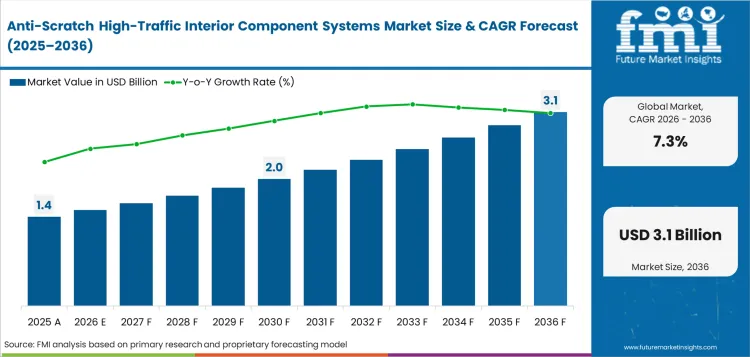
Anti-scratch high-traffic interior component systems market was valued at USD 1.41 billion in 2025 and is projected to reach USD 1.51 billion in 2026. It is forecast to reach USD 3.05 billion by 2036 at 7.3% CAGR. Passenger cars are projected to lead vehicle class demand with 61.0% share. Tier 1 module programs are expected to hold 48.0% share by sourcing route in 2026.
Summary of the Anti-Scratch High-Traffic Interior Component Systems Market
- Demand and Growth Drivers
- OEMs specify cabin durability earlier as shared vehicles and family SUVs expose door trim to repeated abrasion.
- OEMs are adding hardcoat and textured surfaces where visible wear can reduce resale value and brand perception.
- Electric vehicle cabins use wider consoles and display-adjacent trim, which raises the need for scratch control near touch zones.
- Service providers in ride-hailing and shuttle fleets prefer replaceable interior modules that keep cabins visually clean for longer.
- Product and Segment View
- Passenger cars are projected to account for 61.0% share in 2026 due to the broader interior trim volume held by personal vehicles.
- Tier 1 module programs are forecast to account for 48.0% share in 2026 as OEMs buy validated parts near platform launch.
- Door trim panels are expected to hold 32.0% share in 2026 because shoes and entry motion create repeated contact.
- Geography and Competitive Outlook
- China is expected to post 8.4% CAGR through 2036 as electric vehicle output and cabin feature cycles lift trim replacement value.
- India is projected at 8.2% CAGR through 2036 as passenger vehicle sales and local interior module sourcing expand together.
- Some of the key players such as Yanfeng and FORVIA shape integrated interior module supply. PPG and BASF Coatings influence coating system qualification.
- Covestro and KURZ raise material system relevance as decorative films and coated polycarbonate surfaces move into visible cabin zones.
- Analyst Opinion
- Nikhil Kaitwade, Principal Consultant at FMI says, “I see this market as a cabin lifetime problem, not a surface finish problem. OEMs are asking suppliers to protect the parts that people touch, kick and clean every day. The winners are likely to be suppliers that can prove abrasion performance on molded parts instead of coating samples only. That shifts buying power toward companies that combine material and film knowledge. Coating and module validation must happen before the vehicle platform is frozen.”
- Anti-Scratch High-Traffic Interior Component Systems Market Value Analysis
- OEMs are specifying scratch protection earlier in vehicle programs as high‑contact cabin areas face repeated abrasion, increasing the value of protected interior components.
- Growth in shared mobility and premium cabins is raising wear exposure, driving higher spending on durable surfaces and boosting per‑vehicle content.
- Expansion of electric vehicles with larger consoles and touch zones is increasing the need for scratch‑resistant materials near visible surfaces.
- Rising focus on resale value and long‑term cabin appearance is pushing automakers to adopt advanced coatings and protected material systems.
Key Takeaways, Market Size, and Forecast
- The anti-scratch high-traffic interior component systems market was valued at USD 1.41 billion in 2025.
- By 2036, the market is expected to be worth USD 3.05 billion.
- From 2026 to 2036, the market is projected to expand at 7.3% CAGR.
- The market is projected to create an incremental opportunity of USD 1.54 billion between 2026 and 2036.
- Passenger cars are projected to account for 61.0% share of vehicle class demand in 2026.
- Tier 1 module programs are expected to account for 48.0% share of sourcing route demand in 2026.
- China at 8.4% CAGR and India at 8.2% CAGR are likely to witness steady adoption during the forecast period.
Automakers are increasingly evaluating cabin surfaces based on long‑term appearance durability alongside traditional factors such as touch and weight. The International Organization of Motor Vehicle Manufacturers stated in April 2026 that global vehicle production rose from 92.7 million units in 2024 to 96.4 million units in 2025.
Higher vehicle output results in more frequent contact of door trim panels and center consoles with shoes and other abrasive elements, while cleaning agents introduce an additional source of surface degradation. In response, OEMs are pushing suppliers to integrate scratch resistant PCR surface coatings and automotive interior plastic components early in the manufacturing process to ensure durability of high‑contact surfaces before final assembly.
Anti-Scratch High-Traffic Interior Component Systems Market Definition
The anti-scratch high-traffic interior component systems market covers protected interior parts used in vehicle zones that face repeated contact. Scope includes door trim panels and center consoles sold as validated component systems. Seat back panels and scuff plates are included when scratch control is specified. Revenue includes part value linked to scratch control and surface protection. Coated plastics and decorated modules are counted when protection is specified. Adjacent materials such as 2K coatings and polyurethane coatings are included only when they are specified for high-contact interior components.
Anti-Scratch High-Traffic Interior Component Systems Market Inclusions
Market scope includes molded plastic parts and decorated films sold for high-traffic cabin surfaces. Hardcoat layers and coating systems are included when used in components. Covered vehicle classes include passenger cars and light commercial vehicles. Buses and shared mobility fleets are included when cabin wear drives part choice. Covered materials include polypropylene blends and ABS with PC blends. Thermoplastic olefins and recycled blends are covered when they support interior parts. Related formulation inputs such as polyurethane resin coatings and waterborne polyurethane dispersions are included when suppliers use them to build scratch resistance into interior modules.
Anti-Scratch High-Traffic Interior Component Systems Market Exclusions
Scope excludes exterior body coatings, paint protection films and temporary interior sprays sold only as consumer care products. Leather repair kits and fabric protectors are excluded unless supplied as part of an OEM-approved component system. Generic plastic parts without a defined scratch-resistance requirement are outside the market scope. Electronic displays are excluded unless the protected surface is sold as an interior trim or control-zone component.
Anti-Scratch High-Traffic Interior Component Systems Market Research Methodology
- Primary Research: FMI analysts reviewed interior module suppliers and coating formulators. Film makers, OEM platform needs and replacement channels were checked across major vehicle countries.
- Desk Research: The study used public data from vehicle associations and national statistics bodies. Company releases and technical material disclosures were reviewed.
- Market sizing and forecasting: Market size was estimated with a hybrid bottom-up and top-down approach using vehicle output, protected part penetration and average system value.
- Data validation: Forecast checks compared vehicle production and automotive coatings capacity. Interior module activity and supplier investment signals were reviewed across major regions.
Why is the Anti-Scratch High-Traffic Interior Component Systems Market Growing?
- Door panels and consoles are receiving more protection as visible wear appears quickly in shared and family vehicles.
- Automakers are adding surface durability checks as cabins carry larger displays and more touch surfaces near trim edges.
- Coating suppliers are investing in automotive capacity so OEMs can qualify interior and exterior coating systems together.
Interior surfaces are becoming part of the vehicle quality promise. The European Automobile Manufacturers Association reported in April 2026 that global car production grew 4.2% to 78.7 million units in 2025. The larger car base creates repeated demand for coated door panels and protected consoles. Durable seat backs add another surface need. The value pool now extends beyond the coating layer. Suppliers are expected to gain more control when waterborne coatings and UV curable coatings are matched with substrate and cleaning resistance during part development.
Wear control is gaining attention because high-touch cabin parts now carry more visible design value. Large center consoles and dark glossy trim can show scuffs faster than older textured plastics. Fleet operators and ride-hailing providers have less tolerance for scratched parts because cabin condition affects passenger ratings. The result pushes suppliers to offer validated systems with abrasion data, chemical wipe resistance and color retention. The market stays limited where OEMs treat scratch control as a low-cost finish choice instead of a full component requirement.
Market Segmentation Analysis
- Passenger cars are projected to account for 61.0% share of vehicle class demand in 2026 as they carry the broadest trim volume.
- With an estimated 48.0% share in 2026, Tier 1 module programs are expected to lead sourcing route demand through platform-level qualification.
- Door trim panels are anticipated to hold 32.0% of component type demand in 2026 as entry movement exposes surfaces to shoes and bags.
- Coated plastic systems are projected to represent 38.0% share of surface technology demand in 2026 as they fit existing molding flows.
- Polypropylene blends are expected to account for 36.0% share of material platform demand in 2026 as OEMs balance cost and weight.
- Front cabin touchpoints are forecast to account for 41.0% share of interior zone demand in 2026 due to constant user contact.
The market is divided by vehicle class and sourcing route. Component type, surface technology and material platform explain how suppliers build wear resistance. Vehicle class shows where volume enters the forecast. Sourcing route explains whether OEMs buy protected modules through Tier 1 programs or coating partnerships. Component type tracks the parts exposed to visible scuffing. Surface technology separates coated plastics, in-mold films and hardcoat laminates. Material platform links performance to resin choice and recyclability.
Insights into the Passenger Cars Vehicle Class Segment
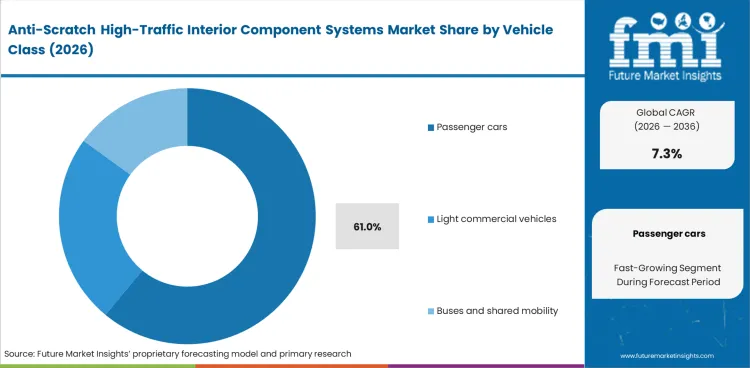
- Passenger cars are projected to account for 61.0% share of vehicle class demand in 2026 as they carry the widest mix of consoles, doors and seat backs.
- OEM trim teams often specify scratch control first on family SUVs and electric cars where larger cabins expose more plastic surface area.
Insights into the Tier 1 Module Programs Sourcing Route Segment
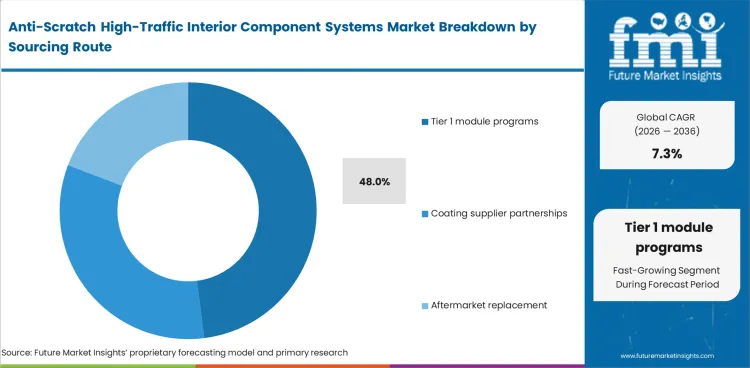
- Tier 1 module programs are expected to hold 48.0% share of sourcing route demand in 2026 since OEMs prefer validated parts before tooling release.
- Module suppliers gain leverage when they can combine molded parts with coating data and abrasion test records in one release package.
Insights into the Door Trim Panels Component Type Segment
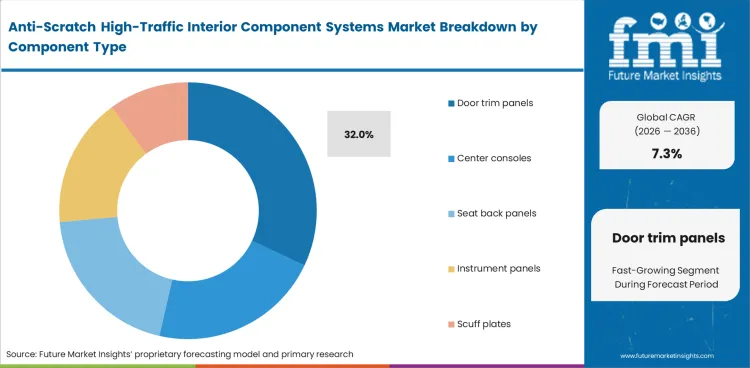
- Door trim panels are anticipated to account for 32.0% share of component type demand in 2026 as entry motion creates repeated shoe and bag contact.
- Scuff mapping around lower door pockets has become a practical design input for suppliers that sell textured and coated trim sets.
Insights into the Coated Plastic Systems Surface Technology Segment
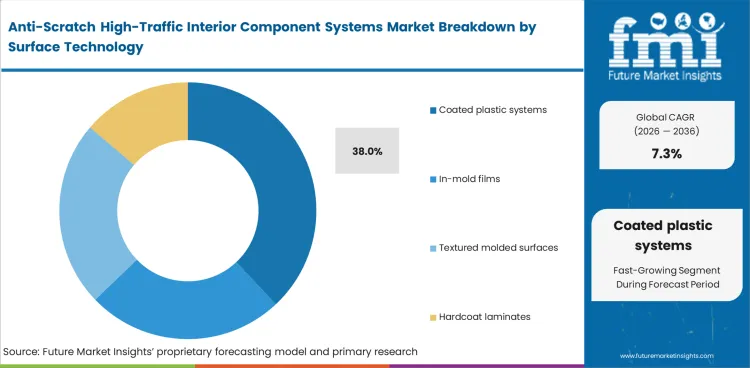
- Coated plastic systems are projected to capture 38.0% share of surface technology demand in 2026 as they work with current injection molding lines.
- These systems keep tool changes limited for OEMs, which matters when a platform needs durability upgrades without a full trim redesign.
Insights into the Polypropylene Blends Material Platform Segment
- Polypropylene blends are estimated to account for 36.0% share of material platform demand in 2026 as they balance weight, cost and moldability.
- Material suppliers focus on mar resistance and low gloss stability because recycled-content targets can change surface texture and scratch visibility.
Insights into the Front Cabin Touchpoints Interior Zone Segment
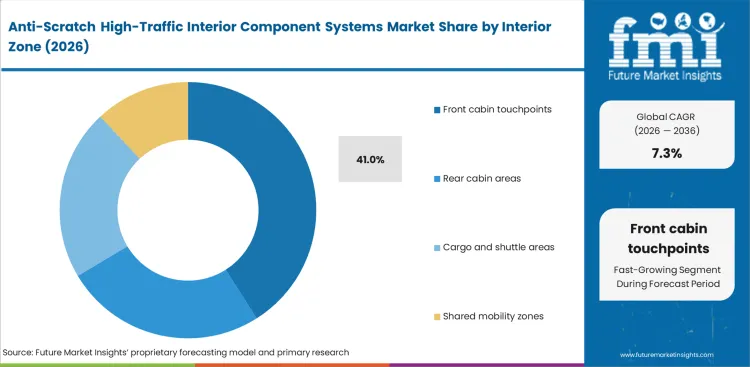
- Front cabin touchpoints are forecast to hold 41.0% share of interior zone demand in 2026 as drivers use those surfaces on every trip.
- Console sides and cupholder surrounds attract early protection work because small scratches appear near glossy trim and high-use storage areas.
Anti-Scratch High-Traffic Interior Component Systems Market Drivers, Restraints, and Opportunities
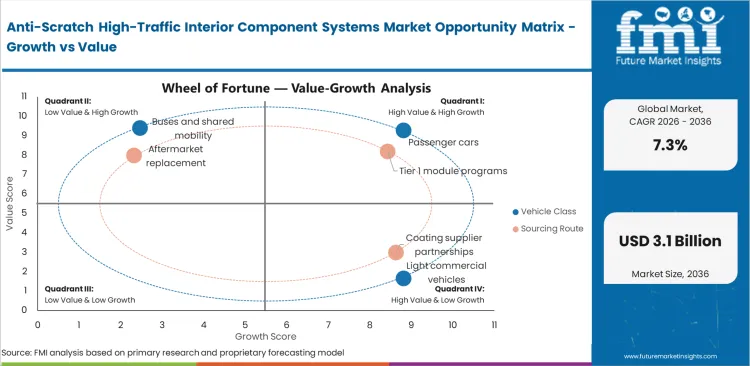
- High-contact trim zones are gaining earlier engineering attention as OEMs try to reduce visible cabin wear during ownership.
- Surface qualification cost limits smaller suppliers because scratch control must be proven on shaped parts and not flat samples only.
- Recycled resin use creates an opportunity for suppliers that can keep scratch resistance stable after material-content changes.
Shared cabin wear raises specifications
Shared vehicles and family SUVs create a tougher use environment for interior trim. The International Organization of Motor Vehicle Manufacturers reported global vehicle sales of 99.8 million units in 2025. The sales base expands the number of cabins exposed to shoes and cleaning routines. Scratch resistance becomes a way to protect residual value and visible quality. Suppliers that validate coatings on door panels and consoles can move the discussion from surface appearance to lifecycle cost. Validated part testing gives Tier 1 module suppliers a clearer role in OEM platform planning.
Flat-sample testing slows approvals
A considerable growth restraint is the gap between lab coupons and finished parts. A coating may pass a flat abrasion test but perform differently on surface grain and curved part edges. Finished-part testing forces OEMs to repeat checks on the actual component shape. Extra testing raises cost and slows supplier changes late in the program. Smaller formulators face the greatest pressure because they may lack molding partners and global test support. Wider acceptance is expected to depend on test packages that connect surface chemistry with real part geometry.
Recycled substrates create value
Recycled plastics presents an opportunity for durable interior systems. Interior parts such as dashboard trim and console carriers are moving into recycled-content programs. Recycled resins can change surface finish and color stability. Material tuning is becoming a crucial aspect before the part reaches the coating line. Suppliers that combine engineering plastics with validated surface protection can help OEMs increase recycled content without lowering cabin quality.
Analysis of Anti-Scratch High-Traffic Interior Component Systems Market by Key Countries
.webp "Top Country Growth Comparison Anti Scratch High Traffic Interior Component Systems Market Cagr (2026 2036)")
| Country | CAGR |
|---|---|
| China | 8.4% |
| India | 8.2% |
| South Korea | 7.8% |
| Germany | 7.4% |
| United States | 7.1% |
| Japan | 6.9% |
| United Kingdom | 6.6% |
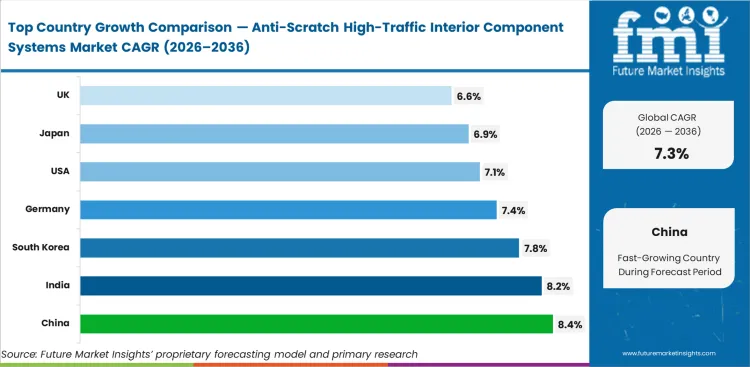
Source: Future Market Insights, 2026.
Anti-Scratch High-Traffic Interior Component Systems Market CAGR Analysis by Country
- China is projected to record an 8.4% CAGR through 2036 owing to rising electric vehicle output driving demand for durable cabin trim.
- India is expected to expand at 8.2% CAGR through 2036 due to passenger vehicle growth which is supporting local interior module programs.
- South Korea is forecast to grow at 7.8% CAGR through 2036 as premium electric cabins use more protected touch surfaces.
- Germany is expected to advance at 7.4% CAGR through 2036 reflecting strong demand for premium interiors and early platform-level validation.
- The United States is projected to rise at 7.1% CAGR through 2036 as pickup and fleet cabins need durable trim.
- Japan is forecast at 6.9% CAGR through 2036 underpinned by strict quality standards for scratch performance in visible interior areas.
- The United Kingdom is expected to post 6.6% CAGR through 2036 as luxury vehicles and low-volume interiors support specialist demand.
The global market is forecast to rise at 7.3% CAGR from 2026 to 2036. China and India are forecast above the global average as vehicle output expands faster. South Korea also sits above it as electric cabin feature cycles quicken. Germany and the United States track close to the average due to premium platforms and large SUV volumes. Japan and the United Kingdom grow below the average, but they keep value through strict appearance expectations.
Demand Outlook for Anti-Scratch High-Traffic Interior Component Systems Market in China
China is projected to record an 8.4% CAGR through 2036 as electric vehicle output and cabin feature updates raise surface durability needs. The European Automobile Manufacturers Association stated in April 2026 that China car output rose 10.4% in 2025. The production base gives local suppliers more programs for protected door trim and console parts. OEMs in Shanghai and Shenzhen are using wider screens and gloss trim that show scratches quickly.
- Shanghai electric vehicle programs need protected console surfaces near large display and storage zones.
- Guangdong trim suppliers can shorten validation cycles by pairing molded parts with coating partners.
- Chongqing vehicle output supports demand for lower door panels that resist shoe scuffing.
Sales Analysis of Anti-Scratch High-Traffic Interior Component Systems Market in India
India’s passenger vehicle market is adding more premium trims in compact SUVs and electric cars. India is expected to expand at 8.2% CAGR through 2036 as local module sourcing rises with domestic production. The Society of Indian Automobile Manufacturers reported total production of 2.69 million vehicles across key categories in August 2025. The production scale supports coated console parts, hard-wearing door panels and seat back protection.
- Tamil Nadu assembly clusters support local testing for protected consoles and lower door trim.
- Gujarat vehicle programs can use scratch-resistant scuff plates in family SUVs and fleet cars.
- Pune interior module suppliers gain from OEM interest in durable touchpoints for premium hatchbacks.
Demand Analysis of Anti-Scratch High-Traffic Interior Component Systems Market in South Korea
South Korean OEMs use cabin finish to separate electric vehicles from older combustion platforms. South Korea is forecast to grow at 7.8% CAGR through 2036 as premium electric cabins use more protected touch surfaces. Invest Korea stated in December 2025 that the government named autonomous vehicle commercialization as one of seven flagship projects. The program focus supports more sensor-rich interiors with comfort-focused trim.
- Ulsan vehicle plants create demand for lower door trim that tolerates daily commuter wear.
- Gyeonggi electronics suppliers support display-adjacent trim where glossy surfaces need scratch control.
- Seoul design centers can test protected materials for connected-cabin demonstrators and premium interiors.
Opportunity Analysis of Anti-Scratch High-Traffic Interior Component Systems Market in Germany
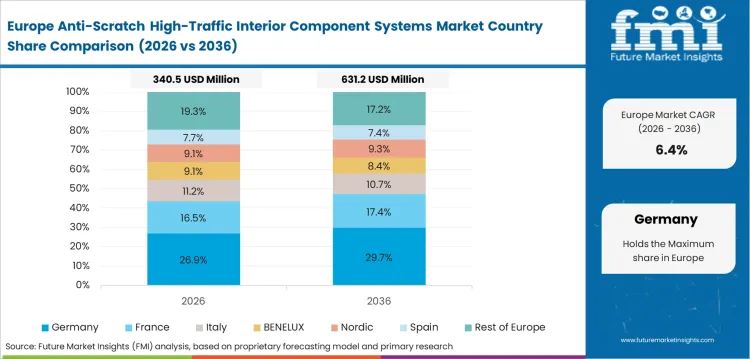
German interior programs place high weight on visible quality across long ownership cycles. The Federal Statistical Office of Germany reported in February 2026 that real manufacturing orders rose 7.8% month on month in December 2025. Germany is expected to advance at 7.4% CAGR through 2036 as premium suppliers validate protected trim earlier. The order gain supports tooling work for coated interior components. Suppliers with test data on grain and gloss stability are better placed in German platform reviews.
- Bavaria premium programs need coated center consoles that keep low-gloss finish after repeated cleaning.
- Saxony electric vehicle sites can test protected door trim near new assembly lines.
- Baden-Württemberg engineering teams often require part-level abrasion data before supplier approval.
Future Outlook for Anti-Scratch High-Traffic Interior Component Systems Market in the United States
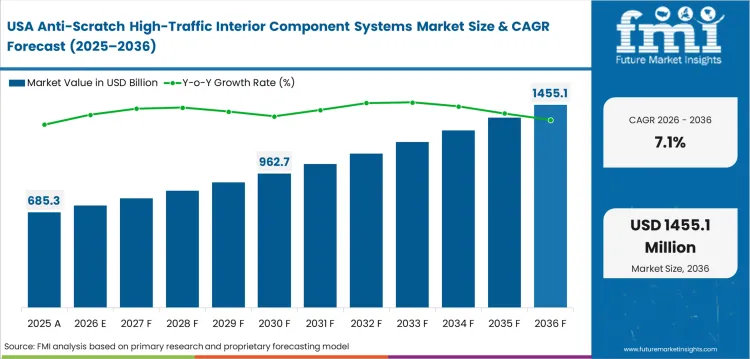
The United States has a large pickup and SUV mix that increases high-contact cabin surface area. The United States is projected to rise at 7.1% CAGR through 2036 as larger vehicles carry more trim and storage zones. The United States Bureau of Labor Statistics reported 44.6 average weekly hours for motor vehicles and parts manufacturing production and nonsupervisory workers in April 2026. The factory load supports steady component demand.
- Tennessee benefits from PPG’s new automotive coatings plant planned for Loudon County.
- Michigan OEM engineering teams can specify scratch-resistant consoles during early platform reviews.
- Ohio parts suppliers can support molded trim validation for pickup and SUV programs.
Sales Analysis of Anti-Scratch High-Traffic Interior Component Systems Market in Japan
Japanese OEMs treat cabin finish as part of long-term product quality. Japan is forecast at 6.9% CAGR through 2036 as quality standards keep scratch testing important for visible interiors. The Japan Automobile Manufacturers Association reported motor vehicle production of 8.23 million units in 2024 in its 2025 industry review. Stable production supports steady but selective demand for protected interior systems. Suppliers that can document aging, abrasion and cleaning performance will hold an advantage in Japanese qualification cycles.
- Aichi suppliers can test scratch-resistant parts for Toyota-linked console and door programs.
- Fukuoka vehicle output supports demand for durable scuff plates and lower trim surfaces.
- Tokyo design centers can evaluate films for glossy and display-adjacent interior zones.
Future Outlook for Anti-Scratch High-Traffic Interior Component Systems Market in the United Kingdom
The United Kingdom is smaller in volume but important in luxury and specialist vehicle interiors. The United Kingdom is expected to post 6.6% CAGR through 2036 as low-volume premium programs use protected cabin surfaces. The Office for National Statistics reported in February 2026 that computer, electronic and optical products rose 3.3% in the fourth quarter of 2025. The technical manufacturing base supports interior electronics and trim work.
- West Midlands vehicle programs need durable trim for premium SUVs and low-volume models.
- Oxford and Solihull plants create opportunities for protected console and door trim packages.
- Coventry design centers support cabin surface trials linked to displays and touch controls.
Competitive Landscape and Strategic Positioning
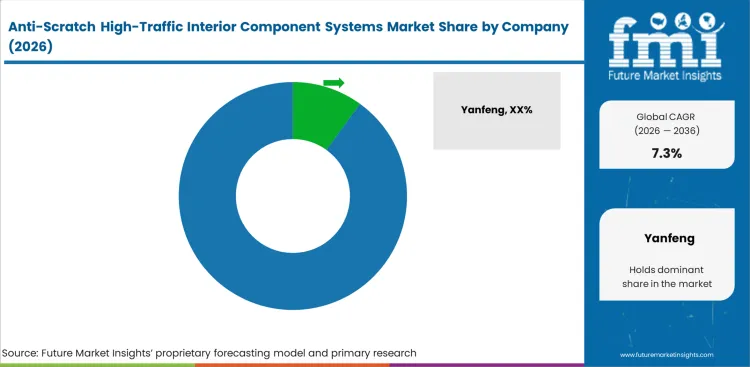
- The market is concentrated around interior module validation and surface chemistry rather than standalone coating supply.
- Yanfeng, FORVIA and Antolin lead through cabin module depth and direct access to OEM design teams.
- Coating specialists compete by proving abrasion, gloss stability and chemical wipe performance on shaped interior parts.
- Entry barriers include tool-side validation, OEM platform approval and repeat test data across resin grades.
Module suppliers shape competition because protected surfaces must fit the final part. Yanfeng lists press activity around connected-cabin concepts and circular interior materials during 2024 and 2025. Such supplier activity shows how cabin suppliers are tying surface design to sustainability and user experience. FORVIA brings instrument panels and door panels into the same buying discussion. Center consoles add another program route. Supplier breadth gives large suppliers more influence before tooling closes. Smaller coating firms can win only when their technology passes OEM part tests and integrates with injection molded plastic production.
Coating companies compete on qualification depth and production reach. PPG announced in May 2024 that it would invest USD 300 million in North American manufacturing for automotive paints and coatings. BASF Coatings commissioned a new automotive OEM coatings plant in Muenster in November 2025. The investments matter because OEMs want repeat supply close to vehicle plants. In this market, local capacity reduces risk when a protected trim part moves from trial to full platform use.
Material suppliers take a different route into the market. Covestro presented Direct Coating technology for automotive applications in December 2025 with polycarbonate substrates and polyurethane coating inputs. Material control also affects automotive fabrics and automotive interior leather when cabin designers want similar wear behavior across hard and soft surfaces. KURZ and other decoration specialists can compete where films and hardcoats replace painted surfaces. The common buyer question is simple. Will the part look the same after years of touch and cleaning.
Key Companies in the Anti-Scratch High-Traffic Interior Component Systems Market
Competition is best viewed by role because interior modules, surface films and coating chemistry solve different parts of the wear problem.
- Interior Module Leaders: Yanfeng and FORVIA compete through interior part design. Antolin and Toyoda Gosei add OEM program access and part-level validation. Their position is strongest where door panels and consoles need surface protection before launch.
- Coating and Material Specialists: PPG and BASF Coatings compete through coating chemistry. Covestro, AkzoNobel and Axalta add substrate knowledge and global supply.
- Decoration and Regional Specialists: KURZ and Röchling Automotive compete where films and foils matter. Other focused suppliers serve molded plastics with durable textures.
Competitive Benchmarking: Anti-Scratch High-Traffic Interior Component Systems Market
| Company | Part-Level Wear Validation | Surface System Depth | OEM Program Access | Geographic Footprint |
|---|---|---|---|---|
| Yanfeng | High | Strong | Strong | Global with China and Europe depth |
| FORVIA | High | Strong | Strong | Global with Europe and North America depth |
| Antolin | High | Medium | Strong | Europe centered with China exposure |
| Toyoda Gosei | Medium | Medium | Strong | Japan centered with global OEM links |
| Röchling Automotive | Medium | Medium | Moderate | Europe and Americas focused |
| PPG | Medium | High | Strong | Global coating supply |
| BASF Coatings | Medium | High | Strong | Global coating supply |
| Covestro | Medium | High | Medium | Global material supply |
| AkzoNobel | Low | High | Medium | Global coating supply |
| KURZ | Medium | Strong | Medium | Europe centered decorative surface reach |
Source: Future Market Insights competitive analysis, 2026. Ratings reflect relative positioning based on part-level wear validation, surface system depth and OEM program access.
Key Developments in Anti-Scratch High-Traffic Interior Component Systems Market
- In October 2025, BASF and Carlyle agreed on a coatings transaction with an enterprise value of EUR 7.7 billion. The carve-out raises focus on automotive coatings.
- In December 2025, Covestro presented Direct Coating technology for automotive coatings with tailored polycarbonate substrates. The technology is relevant for molded interior surfaces.
- In January 2026, Antolin moved the LUXIA project forward for adaptive emotional lighting in automotive interiors. It shows how cabin surfaces are becoming functional zones.
Key Players in the Anti-Scratch High-Traffic Interior Component Systems Market
Interior Module Leaders:
- Yanfeng
- FORVIA
- Antolin
- Toyoda Gosei
- Röchling Automotive
Coating and Material Specialists:
- PPG
- BASF Coatings
- Covestro
- AkzoNobel
- Axalta
Decoration and Regional Specialists:
- KURZ
- Mankiewicz
- KCC Corporation
Report Scope and Coverage
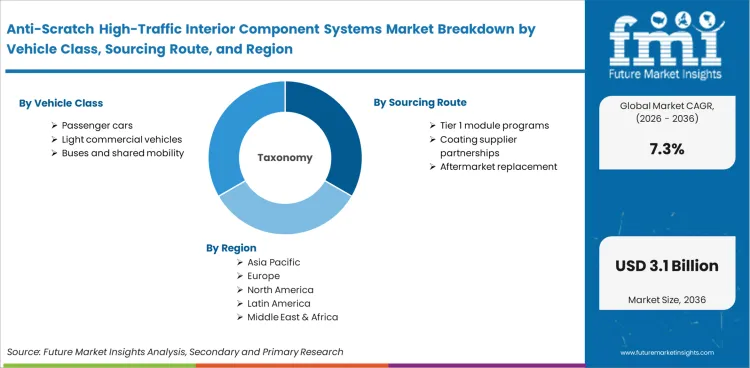
| Parameter | Details |
|---|---|
| Quantitative Units | USD 1.51 billion to USD 3.05 billion, at 7.3% CAGR |
| Market Definition | Protected interior components used in vehicle zones that face repeated touch, cleaning and abrasion. |
| Vehicle Class | Passenger cars, Light commercial vehicles, Buses and shared mobility |
| Sourcing Route | Tier 1 module programs, Coating supplier partnerships, Aftermarket replacement |
| Component Type | Door trim panels, Center consoles, Seat back panels, Instrument panels, Scuff plates |
| Surface Technology | Coated plastic systems, In-mold films, Textured molded surfaces, Hardcoat laminates |
| Material Platform | Polypropylene blends, ABS and PC blends, Thermoplastic olefins, Recycled blends |
| Interior Zone | Front cabin touchpoints, Rear cabin areas, Cargo and shuttle areas, Shared mobility zones |
| Regions Covered | North America, Latin America, Western Europe, Eastern Europe, East Asia, South Asia and Pacific, Middle East and Africa |
| Countries Covered | China, India, South Korea, Germany, United States, Japan, United Kingdom, and 30+ countries |
| Key Companies Profiled | Yanfeng, FORVIA, Antolin, Toyoda Gosei, Röchling Automotive, PPG, BASF Coatings, Covestro, AkzoNobel, Axalta, KURZ |
| Forecast Period | 2026 to 2036 |
| Approach | Hybrid bottom-up and top-down methodology using vehicle output, protected part penetration, supplier activity and interior module signals |
Source: Future Market Insights, 2026.
Anti-Scratch High-Traffic Interior Component Systems Market Breakdown by Vehicle Class, Sourcing Route, Component Type, Surface Technology, Material Platform, Interior Zone and Region
Anti-Scratch High-Traffic Interior Component Systems Market Segmented by Vehicle Class:
- Passenger cars
- Light commercial vehicles
- Buses and shared mobility
Anti-Scratch High-Traffic Interior Component Systems Market Segmented by Sourcing Route:
- Tier 1 module programs
- Coating supplier partnerships
- Aftermarket replacement
Anti-Scratch High-Traffic Interior Component Systems Market Segmented by Component Type:
- Door trim panels
- Center consoles
- Seat back panels
- Instrument panels
- Scuff plates
Anti-Scratch High-Traffic Interior Component Systems Market Segmented by Surface Technology:
- Coated plastic systems
- In-mold films
- Textured molded surfaces
- Hardcoat laminates
Anti-Scratch High-Traffic Interior Component Systems Market Segmented by Material Platform:
- Polypropylene blends
- ABS and PC blends
- Thermoplastic olefins
- Recycled blends
Anti-Scratch High-Traffic Interior Component Systems Market Segmented by Interior Zone:
- Front cabin touchpoints
- Rear cabin areas
- Cargo and shuttle areas
- Shared mobility zones
Anti-Scratch High-Traffic Interior Component Systems Market by Region:
- North America
- United States
- Canada
- Mexico
- Latin America
- Brazil
- Chile
- Rest of Latin America
- Western Europe
- Germany
- United Kingdom
- Italy
- Spain
- France
- Nordic
- BENELUX
- Rest of Western Europe
- Eastern Europe
- Russia
- Poland
- Hungary
- Balkan and Baltic
- Rest of Eastern Europe
- East Asia
- China
- Japan
- South Korea
- South Asia and Pacific
- India
- ASEAN
- Australia and New Zealand
- Rest of South Asia and Pacific
- Middle East and Africa
- Kingdom of Saudi Arabia
- Other GCC Countries
- Turkiye
- South Africa
- Other African Union
- Rest of Middle East and Africa
Research Sources and Bibliography
- International Organization of Motor Vehicle Manufacturers. (2026, April 23). Auto industry growth shifted east in 2025 amid global repositioning. OICA.
- European Automobile Manufacturers Association. (2026, April 2). Economic and market report: Global and EU auto industry full year 2025. ACEA.
- United States Census Bureau. (2026, May 4). Monthly full report on manufacturers’ shipments, inventories and orders: March 2026.
- United States Bureau of Labor Statistics. (2026, May). Automotive industry: Employment, earnings, and hours.
- Society of Indian Automobile Manufacturers. (2025, September 15). Auto industry performance of August 2025.
- Japan Automobile Manufacturers Association. (2025, September 26). The motor industry of Japan 2025.
- BASF SE. (2025, March 10). BASF Coatings and NIO agree on strategic partnership for automotive coatings.
- PPG Industries. (2024, May 21). PPG to build new paint and coatings manufacturing facility in Tennessee.
- Covestro AG. (2025, December 17). Covestro accelerates automotive coatings innovation with Direct Coating.
- Yanfeng. (2025, October 15). Yanfeng wins 2025 Red Dot Design Award.
- Antolin. (2026, January 26). Antolin advances LUXIA project to develop adaptive emotional lighting for automotive interiors.
- Toyoda Gosei Americas. (2026, January 8). Toyoda Gosei develops dynamic shadowy illumination.
- Röchling Group. (2025, June 11). Röchling Group stable despite many challenges.
The bibliography uses primary company sources, official trade body data and government statistics relevant to vehicle output, coatings capacity and interior component demand signals.
This Report Answers
- What is the current and future size of the anti-scratch high-traffic interior component systems market?
- How fast is the anti-scratch high-traffic interior component systems market expected to expand between 2026 and 2036?
- Which vehicle class is expected to lead anti-scratch high-traffic interior component systems demand by 2026?
- Which sourcing route is projected to account for the main share of anti-scratch interior component supply in 2026?
- Why are door trim panels and center consoles important for anti-scratch interior component demand?
- How do recycled plastics and surface coatings affect supplier selection in this market?
- Which countries are projected to record faster expansion during the forecast period?
- Who are the main companies active in anti-scratch high-traffic interior component systems?
- How does FMI define the anti-scratch high-traffic interior component systems market scope?
- How does FMI estimate and validate the anti-scratch high-traffic interior component systems forecast?
Frequently Asked Questions
What is the global market demand for Anti-Scratch High-Traffic Interior Component Systems in 2026?
In 2026, the global anti-scratch high-traffic interior component systems market is expected to be worth USD 1.51 billion as protected trim gains use.
How big will the Anti-Scratch High-Traffic Interior Component Systems Market be in 2036?
By 2036, the anti-scratch high-traffic interior component systems market is expected to be worth USD 3.05 billion as cabin durability spending widens.
How much is demand for Anti-Scratch High-Traffic Interior Component Systems expected to expand between 2026 and 2036?
Between 2026 and 2036, demand is projected to expand at 7.3% CAGR as OEMs protect high-contact trim earlier.
Which vehicle class is expected to lead the Anti-Scratch High-Traffic Interior Component Systems Market by 2026?
Passenger cars are projected to lead vehicle class demand with 61.0% share in 2026 because they carry the broadest trim volume.
Which component type is expected to lead Anti-Scratch High-Traffic Interior Component Systems demand in 2026?
Door trim panels are expected to lead component type demand with 32.0% share in 2026 due to entry scuffs and frequent touch.
Which country is forecast to grow fastest in the Anti-Scratch High-Traffic Interior Component Systems Market?
China is projected to record 8.4% CAGR through 2036 as electric vehicle production raises demand for durable interior trim.
What does the Anti-Scratch High-Traffic Interior Component Systems Market include?
The market includes protected interior parts used in vehicle zones that face repeated touch and cleaning. Abrasion resistance is the defining requirement.
How does FMI estimate the Anti-Scratch High-Traffic Interior Component Systems Market forecast?
FMI uses vehicle output and protected part penetration to validate the forecast. Supplier developments, average system value and country activity adjust the model.
Which anti-scratch interior component type is best for high-use vehicle doors?
Coated plastic door trim panels are best for high-use doors because they combine molded strength with a protected surface. The best choice depends on grain and gloss. Cleaning exposure should be checked separately.
Preview the report firsthand - request a free sample
Get SampleGet the brochure for pricing and purchase details.
Get PDFTable of Content
- Key Takeaways
- Market Size and CAGR
- Top Growth Driver
- Fastest Growing Segment
- Leading Region
- Key Companies
- Emerging Opportunities
- Executive Summary
- Global Market Outlook
- Demand-side Trends
- Supply-side Trends
- Technology Roadmap Analysis
- Analysis and Recommendations
- Analyst Perspective (What is happening? Why now? What should investors know?)
- Key Questions Answered
- How large is the market?
- What is the CAGR?
- What are key trends?
- Which region dominates?
- Who are the leaders?
- Market Overview
- Market Coverage / Taxonomy
- Market Definition / Scope / Limitations
- Research Methodology
- Chapter Orientation
- Analytical Lens and Working Hypotheses
- Market Structure, Signals, and Trend Drivers
- Benchmarking and Cross-market Comparability
- Market Sizing, Forecasting, and Opportunity Mapping
- Research Design and Evidence Framework
- Desk Research Programme (Secondary Evidence)
- Expert Input and Fieldwork (Primary Evidence)
- Tooling, Models, and Reference Databases
- Data Engineering and Model Build
- Quality Assurance and Audit Trail
- Market Background
- Market Dynamics (Drivers, Restraints, Opportunity, Trends)
- Scenario Forecast (Optimistic, Likely, Conservative)
- Impact Analysis
- AI Impact
- Sustainability Impact
- Regulatory Impact
- Technology Impact
- Consumer / Buyer Analysis
- Purchase Drivers
- Adoption Barriers
- Buyer Journey
- Opportunity Map Analysis
- Product Life Cycle Analysis
- Supply Chain Analysis
- Investment Feasibility Matrix
- Value Chain Analysis
- PESTLE and Porter's Analysis
- Regulatory Landscape
- Regional Parent Market Outlook
- Production and Consumption Statistics
- Import and Export Statistics
- Global Market Analysis and Forecast, 2021 to 2036
- Historical Market Size Value (USD Billion) & Volume (Unit) Analysis, 2021 to 2025
- Current and Future Market Size Value (USD Billion) & Volume (Unit) Projections, 2026 to 2036
- Y-o-Y Growth Trend Analysis
- Absolute $ Opportunity Analysis
- Global Market Pricing Analysis, 2021 to 2036
- Global Market Analysis and Forecast, By Vehicle Class, 2021 to 2036
- Introduction / Key Findings
- Historical Market Size Value (USD Billion) & Volume (Unit) Analysis By Vehicle Class, 2021 to 2025
- Current and Future Market Size Value (USD Billion) & Volume (Unit) Analysis and Forecast By Vehicle Class, 2026 to 2036
- Passenger cars
- Light commercial vehicles
- Buses and shared mobility
- Passenger cars
- Y-o-Y Growth Trend Analysis By Vehicle Class, 2021 to 2025
- Absolute $ Opportunity Analysis By Vehicle Class, 2026 to 2036
- Global Market Analysis and Forecast, By Sourcing Route, 2021 to 2036
- Introduction / Key Findings
- Historical Market Size Value (USD Billion) & Volume (Unit) Analysis By Sourcing Route, 2021 to 2025
- Current and Future Market Size Value (USD Billion) & Volume (Unit) Analysis and Forecast By Sourcing Route, 2026 to 2036
- Tier 1 module programs
- Coating supplier partnerships
- Aftermarket replacement
- Tier 1 module programs
- Y-o-Y Growth Trend Analysis By Sourcing Route, 2021 to 2025
- Absolute $ Opportunity Analysis By Sourcing Route, 2026 to 2036
- Global Market Analysis and Forecast, By Component Type, 2021 to 2036
- Introduction / Key Findings
- Historical Market Size Value (USD Billion) & Volume (Unit) Analysis By Component Type, 2021 to 2025
- Current and Future Market Size Value (USD Billion) & Volume (Unit) Analysis and Forecast By Component Type, 2026 to 2036
- Door trim panels
- Center consoles
- Seat back panels
- Instrument panels
- Scuff plates
- Door trim panels
- Y-o-Y Growth Trend Analysis By Component Type, 2021 to 2025
- Absolute $ Opportunity Analysis By Component Type, 2026 to 2036
- Global Market Analysis and Forecast, By Surface Technology, 2021 to 2036
- Introduction / Key Findings
- Historical Market Size Value (USD Billion) & Volume (Unit) Analysis By Surface Technology, 2021 to 2025
- Current and Future Market Size Value (USD Billion) & Volume (Unit) Analysis and Forecast By Surface Technology, 2026 to 2036
- Coated plastic systems
- In-mold films
- Textured molded surfaces
- Hardcoat laminates
- Coated plastic systems
- Y-o-Y Growth Trend Analysis By Surface Technology, 2021 to 2025
- Absolute $ Opportunity Analysis By Surface Technology, 2026 to 2036
- Global Market Analysis and Forecast, By Material Platform, 2021 to 2036
- Introduction / Key Findings
- Historical Market Size Value (USD Billion) & Volume (Unit) Analysis By Material Platform, 2021 to 2025
- Current and Future Market Size Value (USD Billion) & Volume (Unit) Analysis and Forecast By Material Platform, 2026 to 2036
- Polypropylene blends
- ABS and PC blends
- Thermoplastic olefins
- Recycled blends
- Polypropylene blends
- Y-o-Y Growth Trend Analysis By Material Platform, 2021 to 2025
- Absolute $ Opportunity Analysis By Material Platform, 2026 to 2036
- Global Market Analysis and Forecast, By Interior Zone
- Introduction / Key Findings
- Historical Market Size Value (USD Billion) & Volume (Unit) Analysis By Interior Zone, 2021 to 2025
- Current and Future Market Size Value (USD Billion) & Volume (Unit) Analysis and Forecast By Interior Zone, 2026 to 2036
- Front cabin touchpoints
- Rear cabin areas
- Cargo and shuttle areas
- Shared mobility zones
- Front cabin touchpoints
- Y-o-Y Growth Trend Analysis By Interior Zone, 2021 to 2025
- Absolute $ Opportunity Analysis By Interior Zone, 2026 to 2036
- Global Market Analysis and Forecast, By Region, 2021 to 2036
- Introduction
- Historical Market Size Value (USD Billion) & Volume (Unit) Analysis By Region, 2021 to 2025
- Current Market Size Value (USD Billion) & Volume (Unit) Analysis and Forecast By Region, 2026 to 2036
- North America
- Latin America
- Western Europe
- Eastern Europe
- East Asia
- South Asia and Pacific
- Middle East & Africa
- Market Attractiveness Analysis By Region
- North America Market Analysis and Forecast, By Country, 2021 to 2036
- Historical Market Size Value (USD Billion) & Volume (Unit) Trend Analysis By Market Taxonomy, 2021 to 2025
- Market Size Value (USD Billion) & Volume (Unit) Forecast By Market Taxonomy, 2026 to 2036
- By Country
- USA
- Canada
- Mexico
- By Vehicle Class
- By Sourcing Route
- By Component Type
- By Surface Technology
- By Material Platform
- By Interior Zone
- By Country
- Market Attractiveness Analysis
- By Country
- By Vehicle Class
- By Sourcing Route
- By Component Type
- By Surface Technology
- By Material Platform
- By Interior Zone
- Key Takeaways
- Latin America Market Analysis and Forecast, By Country
- Historical Market Size Value (USD Billion) & Volume (Unit) Trend Analysis By Market Taxonomy, 2021 to 2025
- Market Size Value (USD Billion) & Volume (Unit) Forecast By Market Taxonomy, 2026 to 2036
- By Country
- Brazil
- Chile
- Rest of Latin America
- By Vehicle Class
- By Sourcing Route
- By Component Type
- By Surface Technology
- By Material Platform
- By Interior Zone
- By Country
- Market Attractiveness Analysis
- By Country
- By Vehicle Class
- By Sourcing Route
- By Component Type
- By Surface Technology
- By Material Platform
- By Interior Zone
- Key Takeaways
- Western Europe Market Analysis and Forecast, By Country
- Historical Market Size Value (USD Billion) & Volume (Unit) Trend Analysis By Market Taxonomy, 2021 to 2025
- Market Size Value (USD Billion) & Volume (Unit) Forecast By Market Taxonomy, 2026 to 2036
- By Country
- Germany
- UK
- Italy
- Spain
- France
- Nordic
- BENELUX
- Rest of Western Europe
- By Vehicle Class
- By Sourcing Route
- By Component Type
- By Surface Technology
- By Material Platform
- By Interior Zone
- By Country
- Market Attractiveness Analysis
- By Country
- By Vehicle Class
- By Sourcing Route
- By Component Type
- By Surface Technology
- By Material Platform
- By Interior Zone
- Key Takeaways
- Eastern Europe Market Analysis and Forecast, By Country
- Historical Market Size Value (USD Billion) & Volume (Unit) Trend Analysis By Market Taxonomy, 2021 to 2025
- Market Size Value (USD Billion) & Volume (Unit) Forecast By Market Taxonomy, 2026 to 2036
- By Country
- Russia
- Poland
- Hungary
- Balkan & Baltic
- Rest of Eastern Europe
- By Vehicle Class
- By Sourcing Route
- By Component Type
- By Surface Technology
- By Material Platform
- By Interior Zone
- By Country
- Market Attractiveness Analysis
- By Country
- By Vehicle Class
- By Sourcing Route
- By Component Type
- By Surface Technology
- By Material Platform
- By Interior Zone
- Key Takeaways
- East Asia Market Analysis and Forecast, By Country
- Historical Market Size Value (USD Billion) & Volume (Unit) Trend Analysis By Market Taxonomy, 2021 to 2025
- Market Size Value (USD Billion) & Volume (Unit) Forecast By Market Taxonomy, 2026 to 2036
- By Country
- China
- Japan
- South Korea
- By Vehicle Class
- By Sourcing Route
- By Component Type
- By Surface Technology
- By Material Platform
- By Interior Zone
- By Country
- Market Attractiveness Analysis
- By Country
- By Vehicle Class
- By Sourcing Route
- By Component Type
- By Surface Technology
- By Material Platform
- By Interior Zone
- Key Takeaways
- South Asia and Pacific Market Analysis and Forecast, By Country
- Historical Market Size Value (USD Billion) & Volume (Unit) Trend Analysis By Market Taxonomy, 2021 to 2025
- Market Size Value (USD Billion) & Volume (Unit) Forecast By Market Taxonomy, 2026 to 2036
- By Country
- India
- ASEAN
- Australia & New Zealand
- Rest of South Asia and Pacific
- By Vehicle Class
- By Sourcing Route
- By Component Type
- By Surface Technology
- By Material Platform
- By Interior Zone
- By Country
- Market Attractiveness Analysis
- By Country
- By Vehicle Class
- By Sourcing Route
- By Component Type
- By Surface Technology
- By Material Platform
- By Interior Zone
- Key Takeaways
- Middle East & Africa Market Analysis and Forecast, By Country
- Historical Market Size Value (USD Billion) & Volume (Unit) Trend Analysis By Market Taxonomy, 2021 to 2025
- Market Size Value (USD Billion) & Volume (Unit) Forecast By Market Taxonomy, 2026 to 2036
- By Country
- Kingdom of Saudi Arabia
- Other GCC Countries
- Türkiye
- South Africa
- Other African Union
- Rest of Middle East & Africa
- By Vehicle Class
- By Sourcing Route
- By Component Type
- By Surface Technology
- By Material Platform
- By Interior Zone
- By Country
- Market Attractiveness Analysis
- By Country
- By Vehicle Class
- By Sourcing Route
- By Component Type
- By Surface Technology
- By Material Platform
- By Interior Zone
- Key Takeaways
- Key Countries Market Analysis
- USA
- Pricing Analysis
- Market Share Analysis, 2025
- By Vehicle Class
- By Sourcing Route
- By Component Type
- By Surface Technology
- By Material Platform
- By Interior Zone
- Canada
- Pricing Analysis
- Market Share Analysis, 2025
- By Vehicle Class
- By Sourcing Route
- By Component Type
- By Surface Technology
- By Material Platform
- By Interior Zone
- Mexico
- Pricing Analysis
- Market Share Analysis, 2025
- By Vehicle Class
- By Sourcing Route
- By Component Type
- By Surface Technology
- By Material Platform
- By Interior Zone
- Brazil
- Pricing Analysis
- Market Share Analysis, 2025
- By Vehicle Class
- By Sourcing Route
- By Component Type
- By Surface Technology
- By Material Platform
- By Interior Zone
- Chile
- Pricing Analysis
- Market Share Analysis, 2025
- By Vehicle Class
- By Sourcing Route
- By Component Type
- By Surface Technology
- By Material Platform
- By Interior Zone
- Germany
- Pricing Analysis
- Market Share Analysis, 2025
- By Vehicle Class
- By Sourcing Route
- By Component Type
- By Surface Technology
- By Material Platform
- By Interior Zone
- UK
- Pricing Analysis
- Market Share Analysis, 2025
- By Vehicle Class
- By Sourcing Route
- By Component Type
- By Surface Technology
- By Material Platform
- By Interior Zone
- Italy
- Pricing Analysis
- Market Share Analysis, 2025
- By Vehicle Class
- By Sourcing Route
- By Component Type
- By Surface Technology
- By Material Platform
- By Interior Zone
- Spain
- Pricing Analysis
- Market Share Analysis, 2025
- By Vehicle Class
- By Sourcing Route
- By Component Type
- By Surface Technology
- By Material Platform
- By Interior Zone
- France
- Pricing Analysis
- Market Share Analysis, 2025
- By Vehicle Class
- By Sourcing Route
- By Component Type
- By Surface Technology
- By Material Platform
- By Interior Zone
- India
- Pricing Analysis
- Market Share Analysis, 2025
- By Vehicle Class
- By Sourcing Route
- By Component Type
- By Surface Technology
- By Material Platform
- By Interior Zone
- ASEAN
- Pricing Analysis
- Market Share Analysis, 2025
- By Vehicle Class
- By Sourcing Route
- By Component Type
- By Surface Technology
- By Material Platform
- By Interior Zone
- Australia & New Zealand
- Pricing Analysis
- Market Share Analysis, 2025
- By Vehicle Class
- By Sourcing Route
- By Component Type
- By Surface Technology
- By Material Platform
- By Interior Zone
- China
- Pricing Analysis
- Market Share Analysis, 2025
- By Vehicle Class
- By Sourcing Route
- By Component Type
- By Surface Technology
- By Material Platform
- By Interior Zone
- Japan
- Pricing Analysis
- Market Share Analysis, 2025
- By Vehicle Class
- By Sourcing Route
- By Component Type
- By Surface Technology
- By Material Platform
- By Interior Zone
- South Korea
- Pricing Analysis
- Market Share Analysis, 2025
- By Vehicle Class
- By Sourcing Route
- By Component Type
- By Surface Technology
- By Material Platform
- By Interior Zone
- Russia
- Pricing Analysis
- Market Share Analysis, 2025
- By Vehicle Class
- By Sourcing Route
- By Component Type
- By Surface Technology
- By Material Platform
- By Interior Zone
- Poland
- Pricing Analysis
- Market Share Analysis, 2025
- By Vehicle Class
- By Sourcing Route
- By Component Type
- By Surface Technology
- By Material Platform
- By Interior Zone
- Hungary
- Pricing Analysis
- Market Share Analysis, 2025
- By Vehicle Class
- By Sourcing Route
- By Component Type
- By Surface Technology
- By Material Platform
- By Interior Zone
- Kingdom of Saudi Arabia
- Pricing Analysis
- Market Share Analysis, 2025
- By Vehicle Class
- By Sourcing Route
- By Component Type
- By Surface Technology
- By Material Platform
- By Interior Zone
- Türkiye
- Pricing Analysis
- Market Share Analysis, 2025
- By Vehicle Class
- By Sourcing Route
- By Component Type
- By Surface Technology
- By Material Platform
- By Interior Zone
- South Africa
- Pricing Analysis
- Market Share Analysis, 2025
- By Vehicle Class
- By Sourcing Route
- By Component Type
- By Surface Technology
- By Material Platform
- By Interior Zone
- USA
- Market Structure Analysis
- Competition Dashboard
- Competition Benchmarking
- Market Share Analysis of Top Players
- By Regional
- By Vehicle Class
- By Sourcing Route
- By Component Type
- By Surface Technology
- By Material Platform
- By Interior Zone
- Emerging Startups
- Innovation Benchmarking
- Competition Analysis
- Competition Deep Dive
- Yanfeng
- Overview
- Product Portfolio
- Profitability by Market Segments (Product/Region/Sales Channel)
- Sales Footprint
- Strategy Overview
- Marketing Strategy
- Product Strategy
- Channel Strategy
- FORVIA
- Antolin
- Toyoda Gosei
- Röchling Automotive
- PPG
- BASF Coatings
- Covestro
- AkzoNobel
- Axalta
- KURZ
- Mankiewicz
- KCC Corporation
- Yanfeng
- Case Studies
- Success Stories
- Recent Developments
- Competition Deep Dive
- Assumptions & Acronyms Used


