

- Market Size (2026)
- USD 920.6 Mn
- Forecast (2036)
- USD 1602.6 Mn
- CAGR (2026 to 2036)
- 5.7%
How big is Antiparasitic Chemicals Market in 2026?
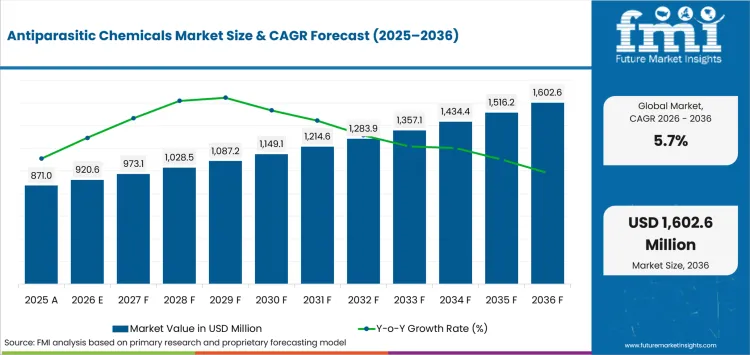
USD 920.6 million in 2026 and USD 1,602.6 million by 2036 at a 5.7% CAGR.
Demand for antiparasitic chemicals is projected to expand at a 5.7% CAGR between 2026 and 2036. Market value is projected to rise from USD 920.6 million in 2026 to USD 1,602.6 million by 2036. Livestock and aquaculture producers increasingly incorporate parasite management into routine health programs because infestations can affect productivity, growth rates and animal welfare before severe clinical symptoms become evident. FAO reported in June 2026 that aquaculture production reached 103 million tonnes of aquatic animals during 2024. The scale of farmed aquatic production expands the population exposed to parasitic threats such as gill parasites and protozoal infections.
Mexico has a sharper near-term treatment trigger than mature animal healthcare channels since New World screwworm control reaches cattle movement and inspection. Mexico's Agriculture Ministry reported in November 2025 that officials had inspected and treated 2.2 million cattle at verification points. The inspection response turns outbreak containment into registered treatment orders while mature markets depend more on scheduled prevention and lifecycle label expansion.
Key Takeaways of Antiparasitic Chemicals Market
- Routine livestock and aquaculture health programs sustain antiparasitic demand as parasite exposure repeats within normal production and veterinary care schedules.
- By chemical class, benzimidazoles are estimated to hold 22.0% in 2026 owing to longstanding use against gastrointestinal endoparasites.
- Feed additives are set to lead the route category with 31.0% share in 2026 due to efficient group administration during routine feeding.
- In 2026, livestock is expected to lead the species category with 34.0% share since commercial herds face repeated parasite exposure.
- Resistance and species-specific label conditions reduce treatment reliability by increasing the need for diagnostics and disciplined dosing.
- Some of the key players in this market include Elanco, Zoetis, MSD Animal Health, Boehringer Ingelheim, Virbac, Vetoquinol, Phibro Animal Health, and Norbrook.
Analyst Perspective
“Antiparasitic portfolios earn repeat use when the active ingredient matches the parasite species and the dosing route permitted by the label. Resistance changes that calculation quickly, so clinics and livestock programs need susceptibility evidence to justify repeating familiar chemistry in another treatment cycle.”
- Nikhil Kaitwade, Principal Consultant, Future Market Insights
How is the Antiparasitic Chemicals Market segmented?
The antiparasitic chemicals market is segmented by chemical class, route, species, application and sales channel.
Chemical class covers benzimidazoles, organophosphates, pyrethroids, avermectins, formalin or oxidizing agents and herbal or natural antiparasitics. Route includes feed additives, bath treatment, water treatment and topical or immersion formats. Species includes livestock, shrimp, aquaculture fish, companion animals and ornamental fish. Application covers endoparasites, ectoparasites, gill parasites, skin parasites and protozoal parasites. Sales channels include veterinary distributors, aquaculture input dealers, direct farm supply and retail or e-commerce.
Why do Endoparasites lead the Application category?
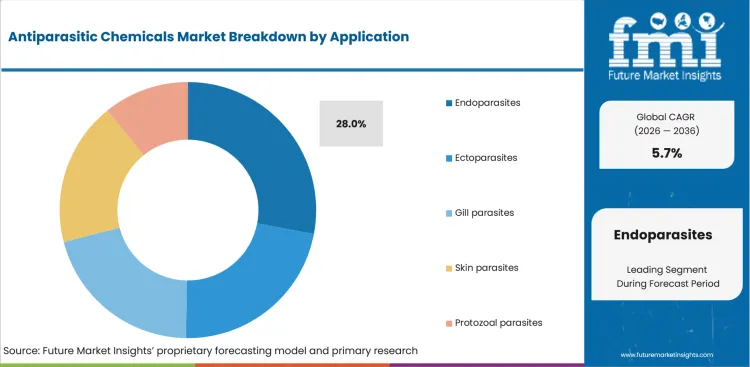
Gastrointestinal worms reduce animal performance even without severe clinical signs in grazing herds, which keeps endoparasites commercially important. Repeated treatment raises the value of farm-level susceptibility evidence and disciplined dosing during routine herd management.
- The endoparasites segment is likely to capture 28.0% share in 2026 attributable to repeated control needs in grazing systems.
- Selective treatment becomes more valuable once farms see declining response from familiar active ingredients. VMD pages amended in November 2025 documented ivermectin resistance in Cooperia species and Ostertagia ostertagi in cattle. Veterinary point-of-care diagnostics can then support local susceptibility checks ahead of another treatment cycle.
What makes Benzimidazoles central to the Chemical class category?
Benzimidazoles retain a broad role in internal-parasite programs as veterinarians already understand their dosing limits and resistance history. Sheep treatment shows why long familiarity does not remove stewardship requirements once local response changes. EMA's August 2026 referral summary retained oral albendazole use in sheep while harmonizing the gastrointestinal-nematode dose and adding resistance warnings.
- By chemical class, benzimidazoles are projected to account for 22.0% in 2026 owing to longstanding use against gastrointestinal endoparasites.
- Farm-level response varies once benzimidazole resistance develops. Veterinary molecular diagnostics then guide treatment selection by confirming parasite susceptibility and documenting prior dosing history.
Why do Feed additives lead the Route category?
Animal feed additives provide a practical administration route on farms that control mixing and intake closely enough to maintain the labelled dose. Group delivery reduces individual handling without removing veterinary oversight or concentration checks during routine farm operations.
- In 2026, feed additives are expected to lead the route category with 31.0% share as existing feeding routines carry group treatment efficiently.
- FDA approved a Phibro medicated-feed combination on April 8, 2025, for confined beef cattle using monensin to prevent and control coccidiosis. The approval ties antiparasitic chemistry to a feed route with defined concentration and indication requirements.
What supports Livestock within the Species category?
Veterinary vaccines and antiparasitic medicines share the same herd-health calendar while addressing different biological risks. Grazing and herd contact repeatedly expose cattle and small ruminants to internal or external parasites.
- Livestock is set to lead the species category with 34.0% share in 2026 due to repeated parasite exposure and treatment-failure costs.
- Emergency parasite threats make regulatory access commercially relevant for livestock operators already running routine control programs. FDA conditionally approved Dectomax-CA1 in September 2025 for New World screwworm prevention and treatment in cattle. The approval gave cattle programs a registered response without changing the familiar injection route.
What are the drivers, restraints and opportunities in the Antiparasitic Chemicals Market?
Repeated parasite exposure sustains treatment demand while resistance limits predictable efficacy and broader label coverage rewards differentiated formulations.
- Driver: Routine prevention becomes a repeat purchase when one formulation covers several parasite classes within a familiar veterinary schedule.
- Restraint: Anthelmintic resistance raises treatment-failure costs and increases reliance on diagnostics for repeat use of familiar active ingredients.
- Opportunity: Longer-duration and broader-label products reduce dosing events while preserving species-specific control under existing veterinary routines.
One monthly prescription can address several parasite risks, which gives broad companion-animal coverage a practical advantage in preventive care. Elanco disclosed in September 2025 that Credelio Quattro reached USD 100 million in net sales less than eight months after launch. The early uptake shows how monthly multi-parasite coverage can turn preventive care into repeat prescription demand.
Resistance changes the purchase decision once a familiar treatment no longer produces dependable farm-level control. APHA published its October-to-December 2025 surveillance report on March 18, 2026, and documented fatal mixed worm burdens in lambs nine days after ivermectin treatment. OTC veterinary drugs therefore compete on label clarity and susceptibility guidance alongside product availability.
Registered brands can grow without changing the monthly administration routine if a new indication fits the same prescription workflow. Zoetis received an FDA indication for Simparica Trio in April 2025 to prevent flea tapeworm infections by killing vector fleas. The approval widened preventive use while keeping the product inside a schedule clinics and dog owners already understood.
Which country CAGRs are profiled in the Antiparasitic Chemicals Market?
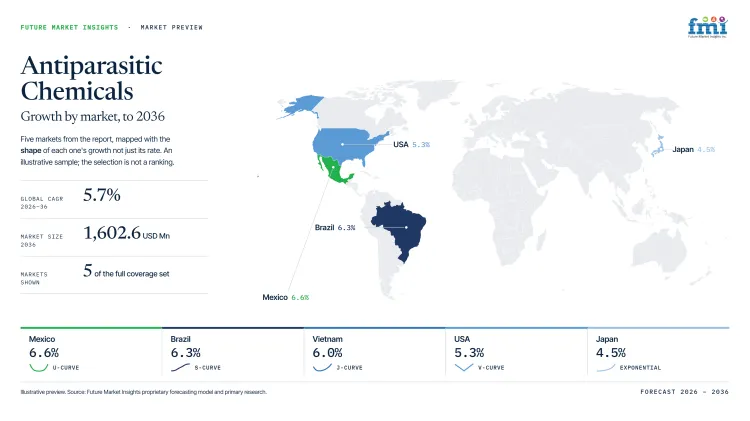
| Country | CAGR |
|---|---|
| Mexico | 6.6% |
| Brazil | 6.3% |
| Vietnam | 6.0% |
| USA | 5.3% |
| Japan | 4.5% |
How do country-level CAGRs compare in the Antiparasitic Chemicals Market?
Mexico and Brazil form the faster growth pair within the narrow 1.3-percentage-point spread separating the five profiled countries. Vietnam separates that pair from Australia and the USA because aquaculture demand follows a distinct treatment route. The spacing reflects registration fit and service models rather than simple differences in current market maturity.
- Mexico's cattle ranching mix favors pour-on options that field veterinarians administer quickly.
- Brazil's cattle scale rewards products with clear withdrawal guidance for repeat food-animal treatment programs.
- Vietnam's export shrimp sector rewards treatments that fit residue-control expectations in traded production.
- USA companion-animal clinics favor monthly products covering several preventive parasite risks routinely.
- Japan’s veterinary sector favors reliable products for routine parasite prevention.
Comparable CAGRs mask distinct entry conditions shaped by registration and service models. The full report provides country-level CAGR analysis across North America, Latin America, Europe, East Asia, South Asia, Oceania and the Middle East and Africa.
Country-wise Analysis
- In Mexico, New World screwworm turns cattle movement into an inspection and treatment decision as infested animals can interrupt transfers and trigger immediate field response at verification points near livestock corridors serving northern cattle states. Mexico is projected to grow at 6.6% CAGR through 2036 tied to border surveillance and veterinary treatment activity documented by SENASICA at 16,489 confirmed cases through February 28, 2026, during the active outbreak. Local distributors with stock near inspection corridors can convert outbreak pressure into orders, but they need rapid replenishment and clear dosing guidance so affected cattle do not move beyond active containment zones into new production areas.
- Large cattle operations rely on long field-service routes, and IBGE's March 2025 data recorded 39.27 million cattle slaughtered under health inspection in 2024 following a 15.2% annual increase. Veterinary distributors need broad regional coverage as parasite exposure shifts with climate and herd movement between production zones that use different stocking patterns and seasonal treatment schedules during wet-season shifts in parasite pressure. Antiparasitic chemicals demand in Brazil is forecast to rise at 6.3% CAGR over the forecast period driven by commercial herd scale, yet repeat ordering depends on protocols that fit dispersed operations and variable parasite pressure in major cattle states.
- Intensive brackish-water shrimp farms fit parasite treatment into pond-level water management and harvest schedules so chemical use cannot be separated from environmental control during each production cycle. Adoption of antiparasitic chemicals in Vietnam is estimated to expand at 6.0% CAGR through 2036 given aquaculture scale and December 2025 Ministry of Agriculture and Environment data documenting about 737,000 hectares of brackish-water shrimp area for 2024. Aquaculture input dealers extend local technician support and dosing guidance, yet products lose commercial fit if treatment disrupts pond protocols or increases uncontrolled chemical loading in high-density systems serving national export markets each year.
- Outbreak response requires veterinarians to distinguish emergency permissions from ordinary labels while stocking parasite treatments for livestock exposed to fast-moving New World screwworm risks near affected movement corridors. Antiparasitic chemicals demand in the USA is forecast to rise at 5.3% CAGR through 2036 attributable to mature distribution, while FDA expanded Dectomax emergency use on May 19 2026 to dairy cattle and several additional livestock species. Future uptake will depend on manufacturers keeping temporary authorizations separate from routine indications, since national distribution converts response demand only if species restrictions remain clear to veterinary clinics and livestock operations during outbreak response.
- Outbreak response requires Japanese veterinarians to distinguish emergency measures from standard product labels when managing parasite risks in livestock. Antiparasitic chemicals demand in Japan is forecast to rise at 4.5% CAGR through 2036, supported by established veterinary distribution and routine livestock treatment practices. Future uptake will depend on manufacturers maintaining clear species and use restrictions, allowing veterinary clinics and livestock operations to apply approved treatments correctly during parasite-control programs.
Who are the notable companies in the Antiparasitic Chemicals Market?
Elanco, Zoetis, MSD Animal Health, Boehringer Ingelheim, Virbac, Vetoquinol, Phibro Animal Health, and Norbrook are the notable companies serving this market.
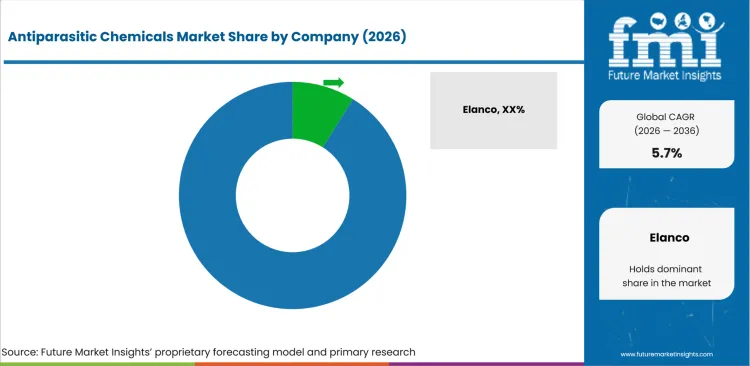
Competition separates by species coverage and administration format instead of company size alone. Global animal-health groups defend broad companion and livestock portfolios while specialists rely on feed delivery or focused deworming routes. Adjacent veterinary biologics portfolios can strengthen clinic access, but parasite labels and resistance guidance still decide whether a parasiticide earns repeat orders.
- Broad companion-animal and livestock platforms include Elanco, Zoetis, MSD Animal Health and Boehringer Ingelheim as multi-species portfolio companies.
- Virbac and Vetoquinol maintain veterinary-channel portfolios, while companion animal vaccines use many of the same clinic relationships without replacing parasiticide expertise.
- Phibro Animal Health and Norbrook serve food-animal programs as feed-delivered medicines and livestock dewormers require different field-service routes from veterinary dietary supplements.
Competitive Benchmarking: Antiparasitic Chemicals Market
| Company | Species Coverage Breadth | Administration Route Breadth | Technical Channel Breadth | Geographic Reach |
|---|---|---|---|---|
| Elanco | High | High | High | Global multi-region |
| Zoetis | High | High | High | Global multi-region |
| MSD Animal Health | High | High | High | Global multi-region |
| Boehringer Ingelheim | High | High | High | Global multi-region |
| Virbac | High | High | High | Global subsidiary network |
| Vetoquinol | High | Medium | High | Europe, Americas and Asia-Pacific |
| Phibro Animal Health | Medium | High | Medium | International food-animal markets |
| Norbrook | High | High | High | North America, Europe and other export markets |
Scoring basis: High species breadth requires documented companion-animal and food-animal coverage while Medium identifies a narrower multi-species position and Low identifies one species group. High route breadth requires three or more administration formats while Medium requires two and Low identifies one. High technical-channel breadth requires clinic and farm support plus distributor access while Medium requires two channel types and Low identifies one. Geographic reach records current official commercial presence in the reviewed market and does not use headquarters location as a proxy.
Key Developments in the Antiparasitic Chemicals Market
- In February 2026, Boehringer Ingelheim received FDA emergency authorization for NexGard to treat New World screwworm infestations in dogs and puppies.
- In October 2025, Elanco received FDA label expansions for Credelio Quattro and Credelio covering Lyme-disease prevention and longhorned-tick protection in dogs.
- In July 2025, MSD Animal Health received FDA approval for BRAVECTO QUANTUM as a once-yearly injectable flea and tick treatment for dogs.
Key Players in the Antiparasitic Chemicals Market
Broad Companion-Animal and Livestock Platforms
- Elanco
- Zoetis
- MSD Animal Health
- Boehringer Ingelheim
Veterinary-Channel Multi-Species Portfolios
- Virbac
- Vetoquinol
Food-Animal and Deworming Specialists
- Phibro Animal Health
- Norbrook
Antiparasitic Chemicals Market - Report Scope
| Coverage field | Report scope |
|---|---|
| Market breakdown | By chemical class, route, species, application, sales channel and region. |
| Quantitative Units | USD million. |
| Market Definition | Commercial antiparasitic chemical products and formulations sold for parasite prevention or treatment within the stated animal and route categories. |
| Regions Covered | North America, Latin America, Europe, East Asia, South Asia and Pacific, and Middle East and Africa. |
| Countries Covered | Mexico, Brazil, Vietnam, Australia, USA, and 20+ countries included in the full report. |
| Key Companies Profiled | Elanco, Zoetis, MSD Animal Health, Boehringer Ingelheim, Virbac, Vetoquinol, Phibro Animal Health, and Norbrook. |
| Forecast Period | 2026 to 2036. |
| Approach | Primary and secondary research with market triangulation. |
Antiparasitic Chemicals Market - Research Methodology
| Method | Approach |
|---|---|
| Primary Research | FMI analysts gathered input from manufacturers, service providers, technology developers, distributors, end users, procurement teams, and subject-matter experts. Interviews examined purchasing decisions, product or service evaluation, adoption barriers, approval requirements, pricing considerations, and expectations for technical or commercial support. Respondents were also asked what evidence is required before a trial, pilot, or initial order develops into regular purchasing. |
| Desk Research | Desk research covered government statistics, regulatory publications, trade data, industry associations, technical literature, standards, company filings, product information, and official corporate announcements. Sources were reviewed for relevance, publication date, geographic coverage, and consistency with the defined market scope. Claims relating to performance, applications, approvals, capacity, investment, and commercial activity were retained only when supported by credible public evidence. |
| Market Sizing and Forecasting | The market model combined the baseline value with historical performance, segment structure, pricing and volume indicators, adoption levels, company participation, and country-level demand conditions. Forecast assumptions considered economic activity, investment trends, regulatory developments, technology adoption, purchasing cycles, supply availability, and barriers to wider market use. Segment and regional estimates were reconciled before the final market total was calculated. |
| Data Validation | Estimates were checked against multiple independent indicators, including public data, company activity, trade patterns, industry developments, and findings from primary interviews. Validation also tested whether products, services, applications, and company revenues fell within the defined market boundaries. Adjacent categories, unsupported claims, overlapping revenues, and activities without direct market relevance were excluded to reduce double counting and maintain consistency across segments and countries. |
Antiparasitic Chemicals Market by Segments
Antiparasitic Chemicals Market segmented by Chemical Class:
- Benzimidazoles
- Organophosphates
- Pyrethroids
- Avermectins
- Formalin / oxidizing agents
- Herbal / natural antiparasitics
Antiparasitic Chemicals Market segmented by Route:
- Feed additives
- Bath treatment
- Water treatment
- Topical / immersion
Antiparasitic Chemicals Market segmented by Species:
- Livestock
- Shrimp
- Aquaculture fish
- Companion animals
- Ornamental fish
Antiparasitic Chemicals Market segmented by Application:
- Endoparasites
- Ectoparasites
- Gill parasites
- Skin parasites
- Protozoal parasites
Antiparasitic Chemicals Market segmented by Sales Channel:
- Veterinary distributors
- Aquaculture input dealers
- Direct farm supply
- Retail / e-commerce
Antiparasitic Chemicals Market by Region:
- North America
- United States
- Canada
- Latin America
- Brazil
- Mexico
- Chile
- Rest of Latin America
- Western Europe
- Germany
- United Kingdom
- Italy
- Spain
- France
- Nordics
- Benelux
- Rest of Western Europe
- Eastern Europe
- Russia
- Poland
- Hungary
- Balkan and Baltic States
- Rest of Eastern Europe
- East Asia
- China
- Japan
- South Korea
- South Asia and Pacific
- India
- ASEAN
- Australia and New Zealand
- Rest of South Asia and Pacific
- Middle East and Africa
- Kingdom of Saudi Arabia
- Other GCC Countries
- Türkiye
- South Africa
- Other African Union Countries
- Rest of Middle East and Africa
Research Sources and Bibliography
- Food and Agriculture Organization of the United Nations. (2026, June 16). SOFIA 2026: Global fisheries and aquaculture production reaches new highs.
- Secretaría de Agricultura y Desarrollo Rural. (2025, November 25). A un año del primer caso de gusano barrenador del ganado, los casos activos equivalen sólo al 0.003% del hato nacional.
- European Medicines Agency. (2026, August 3). Veterinary medicinal products containing albendazole as a single active substance presented as oral suspension in sheep - referral.
- USA Food and Drug Administration. (2025, April 8). Freedom of Information Summary: NADA 141-587.
- USA Food and Drug Administration. (2025, September 30). FDA Conditionally Approves First Drug for Prevention and Treatment of New World Screwworm Infestations in Cattle.
- Veterinary Medicines Directorate. (2025, November). Amended pages: November 2025, AN 01686/2025.
- Elanco Animal Health. (2025, September 8). Elanco Innovation Builds Momentum, Credelio Quattro™ (lotilaner, moxidectin, praziquantel, and pyrantel chewable tablets) Reaches Blockbuster Status.
- Animal and Plant Health Agency. (2026, March 18). Great Britain small ruminant quarterly report, disease surveillance and emerging threats: Volume 28, Quarter 4 - October to December 2025.
- Zoetis. (2025, April 14). FDA Approves New Indication for Zoetis’ Simparica Trio® (sarolaner, moxidectin, and pyrantel chewable tablets), Now the First and Only Canine Parasiticide to Prevent Flea Tapeworm Infections, by Killing Vector Fleas.
- Servicio Nacional de Sanidad, Inocuidad y Calidad Agroalimentaria. (2026, March 10). Situación actual del gusano barrenador del ganado en México.
- Brazilian Institute of Geography and Statistics. (2025, March 18). 2024 hits record in the slaughtering of cattle, chicken and hogs and pigs.
- Ministry of Agriculture and Environment of Vietnam. (2025, December 24). Ứng dụng tiến bộ kỹ thuật phát triển nuôi tôm nước lợ bền vững thích ứng với biến đổi khí hậu vùng ĐBSCL.
- Australian Pesticides and Veterinary Medicines Authority. (2026, April 9). Annual product sales data.
- USA Food and Drug Administration. (2026, May 19). FDA Issues Emergency Use Authorization for Over-the-Counter Injectable Drug for New World Screwworm in Dairy Cattle, Horses, Swine, Sheep, and Deer.
- USA Food and Drug Administration. (2026, February 18). Fact Sheet for V6685 NexGard EUA for NWS.
- Elanco Animal Health. (2025, October 27). Elanco Announces Expansion of Credelio Quattro™ (lotilaner, moxidectin, praziquantel, and pyrantel chewable tablets) and Credelio™ (lotilaner) Labels, Offering Protection Against Lyme Disease and an Emerging Tick Species.
- MSD Animal Health. (2025, July 10). FDA Approves BRAVECTO® QUANTUM (Fluralaner for Extended-Release Injectable Suspension) from MSD Animal Health.
- Vetoquinol. (2026, March 25). Universal Registration Document 2025.
- Virbac. (2026, March 17). 2025 annual results.
- Phibro Animal Health Corporation. (2025, February 5). Phibro Animal Health Corporation Reports Second Quarter Results, Updates Financial Guidance.
- Norbrook Laboratories. (2026). About Us. Retrieved August 23, 2026.
- Elanco Animal Health. (2026, June 4). Elanco Animal Health Commits to Supporting USA Livestock Producers and Pet Owners in Fight Against New World Screwworm.
- Zoetis. (2026, June 12). Zoetis Stands Ready as the First and Only Nonprescription Solution for New World Screwworm, Supporting Customers and National Emergency Preparedness.
- MSD Animal Health. (2025, December 4). FDA Conditionally Approves MSD Animal Health’s EXZOLT™ CATTLE-CA1 for the Prevention and Treatment of New World Screwworm (Cochliomyia hominivorax) Larvae (myiasis).
- USA Food and Drug Administration. (2026, February 5). Letter of Authorization for Emergency Use - Ivomec.
- Elanco Animal Health. (2026, February 20). Elanco Australia Receives APVMA Approval for Advocate™ Ultra Chew: The Broadest Spectrum Parasite Protection* for Dogs in Australia.
- Zoetis. (2026, August 13). Zoetis Receives Emergency Use Authorization for Simparica Trio® (sarolaner, moxidectin, and pyrantel chewable tablets) for Treatment of New World Screwworm Infestations in Dogs and Puppies.
- USA Food and Drug Administration. (2026, January 20). Freedom of Information Summary: NexGard PLUS, NADA 141-554.
- Virbac. (2025, October 14). Our new collar for long-lasting parasite protection in cats and dogs.
- Norbrook Laboratories. (2026, April 8). Norbrook® launches Defendazole™ (fenbendazole) in the USA
- Petmedica. (2025, October). Atrevia® 360°, Comprehensive Canine Parasite Protection Arrives in Guatemala.
- SAVAVET. (2025, April 4). SAVAVET launched “nulura” at the Annual Sales Conference of CA Division.
- USA Food and Drug Administration. (2026, March 16). FOI Summary sN 141599 BRAVECTO® QUANTUM.
This bibliography is provided for reader reference and is not exhaustive. The full report contains the complete reference list and detailed citations.
This Report Answers
- How large is the antiparasitic chemicals market in 2026 and what value is forecast by 2036?
- Which animal-production conditions sustain repeat demand for antiparasitic chemicals?
- Why do benzimidazoles hold the leading position within the chemical class category?
- How do feed additives change treatment delivery in large livestock operations?
- Why does livestock hold the largest share within the species category?
- How do resistance and label conditions alter product selection and repeat ordering?
- Why do Mexico and Brazil record faster forecast growth than the USA?
- Which companies compete with broad parasiticide portfolios or food-animal delivery routes?
- What should veterinary and farm operators compare during a change to an antiparasitic protocol?
Frequently Asked Questions
How big is the Antiparasitic Chemicals Market in 2026?
The antiparasitic chemicals market is valued at USD 920.6 million in 2026 and is projected to reach USD 1,602.6 million by 2036. Repeated parasite exposure keeps treatment inside routine livestock and aquaculture programs while companion-animal clinics maintain scheduled prevention.
What is the CAGR of the Antiparasitic Chemicals Market from 2026 to 2036?
The antiparasitic chemicals market is projected to grow at a CAGR of 5.7% between 2026 and 2036. Expansion is supported by routine prevention plus emergency parasite response and lifecycle label extensions within mature veterinary channels.
Which chemical class leads the Antiparasitic Chemicals Market?
The benzimidazoles segment is expected to hold 22.0% of the antiparasitic chemicals market in 2026, supported by its established role against gastrointestinal endoparasites. Resistance-aware dosing keeps farm susceptibility evidence relevant during repeat selection of the same active ingredient.
How much value will the Antiparasitic Chemicals Market add between 2026 and 2036?
The antiparasitic chemicals market is expected to add USD 682.0 million in value between 2026 and 2036. The increase follows repeated animal-health spending and broader treatment access through veterinary and farm channels.
Which companies are active in the Antiparasitic Chemicals Market?
Key companies operating in the antiparasitic chemicals market include Elanco, Zoetis, MSD Animal Health, Boehringer Ingelheim, Virbac, Vetoquinol, Phibro Animal Health, and Norbrook. These companies compete on species coverage and administration route while clinic and farm-channel depth separates their active treatment positions.
Preview the report firsthand - request a free sample
Get SampleGet the brochure for pricing and purchase details.
Get PDFTable of Content
- Key Takeaways
- Market Size and CAGR
- Top Growth Driver
- Fastest Growing Segment
- Leading Region
- Key Companies
- Emerging Opportunities
- Executive Summary
- Global Market Outlook
- Demand-side Trends
- Supply-side Trends
- Technology Roadmap Analysis
- Analysis and Recommendations
- Analyst Perspective (What is happening? Why now? What should investors know?)
- Key Questions Answered
- How large is the market?
- What is the CAGR?
- What are key trends?
- Which region dominates?
- Who are the leaders?
- Market Overview
- Market Coverage / Taxonomy
- Market Definition / Scope / Limitations
- Research Methodology
- Chapter Orientation
- Analytical Lens and Working Hypotheses
- Market Structure, Signals, and Trend Drivers
- Benchmarking and Cross-market Comparability
- Market Sizing, Forecasting, and Opportunity Mapping
- Research Design and Evidence Framework
- Desk Research Programme (Secondary Evidence)
- Expert Input and Fieldwork (Primary Evidence)
- Tooling, Models, and Reference Databases
- Data Engineering and Model Build
- Quality Assurance and Audit Trail
- Market Background
- Market Dynamics (Drivers, Restraints, Opportunity, Trends)
- Scenario Forecast (Optimistic, Likely, Conservative)
- Impact Analysis
- AI Impact
- Sustainability Impact
- Regulatory Impact
- Technology Impact
- Consumer / Buyer Analysis
- Purchase Drivers
- Adoption Barriers
- Buyer Journey
- Opportunity Map Analysis
- Product Life Cycle Analysis
- Supply Chain Analysis
- Investment Feasibility Matrix
- Value Chain Analysis
- PESTLE and Porter's Analysis
- Regulatory Landscape
- Regional Parent Market Outlook
- Production and Consumption Statistics
- Import and Export Statistics
- Global Market Analysis and Forecast, 2021 to 2036
- Historical Market Size Value (USD Million) Analysis, 2021 to 2025
- Current and Future Market Size Value (USD Million) Projections, 2026 to 2036
- Y-o-Y Growth Trend Analysis
- Absolute $ Opportunity Analysis
- Global Market Pricing Analysis, 2021 to 2036
- Global Market Analysis and Forecast, By Chemical Class, 2021 to 2036
- Introduction / Key Findings
- Historical Market Size Value (USD Million) Analysis By Chemical Class, 2021 to 2025
- Current and Future Market Size Value (USD Million) Analysis and Forecast By Chemical Class, 2026 to 2036
- Benzimidazoles
- Organophosphates
- Pyrethroids
- Avermectins
- Formalin / oxidizing agents
- Herbal / natural antiparasitics
- Benzimidazoles
- Y-o-Y Growth Trend Analysis By Chemical Class, 2021 to 2025
- Absolute $ Opportunity Analysis By Chemical Class, 2026 to 2036
- Global Market Analysis and Forecast, By Route, 2021 to 2036
- Introduction / Key Findings
- Historical Market Size Value (USD Million) Analysis By Route, 2021 to 2025
- Current and Future Market Size Value (USD Million) Analysis and Forecast By Route, 2026 to 2036
- Feed additives
- Bath treatment
- Water treatment
- Topical / immersion
- Feed additives
- Y-o-Y Growth Trend Analysis By Route, 2021 to 2025
- Absolute $ Opportunity Analysis By Route, 2026 to 2036
- Global Market Analysis and Forecast, By Species, 2021 to 2036
- Introduction / Key Findings
- Historical Market Size Value (USD Million) Analysis By Species, 2021 to 2025
- Current and Future Market Size Value (USD Million) Analysis and Forecast By Species, 2026 to 2036
- Livestock
- Shrimp
- Aquaculture fish
- Companion animals
- Ornamental fish
- Livestock
- Y-o-Y Growth Trend Analysis By Species, 2021 to 2025
- Absolute $ Opportunity Analysis By Species, 2026 to 2036
- Global Market Analysis and Forecast, By Application, 2021 to 2036
- Introduction / Key Findings
- Historical Market Size Value (USD Million) Analysis By Application, 2021 to 2025
- Current and Future Market Size Value (USD Million) Analysis and Forecast By Application, 2026 to 2036
- Endoparasites
- Ectoparasites
- Gill parasites
- Skin parasites
- Protozoal parasites
- Endoparasites
- Y-o-Y Growth Trend Analysis By Application, 2021 to 2025
- Absolute $ Opportunity Analysis By Application, 2026 to 2036
- Global Market Analysis and Forecast, By Sales Channel, 2021 to 2036
- Introduction / Key Findings
- Historical Market Size Value (USD Million) Analysis By Sales Channel, 2021 to 2025
- Current and Future Market Size Value (USD Million) Analysis and Forecast By Sales Channel, 2026 to 2036
- Veterinary distributors
- Aquaculture input dealers
- Direct farm supply
- Retail / e-commerce
- Veterinary distributors
- Y-o-Y Growth Trend Analysis By Sales Channel, 2021 to 2025
- Absolute $ Opportunity Analysis By Sales Channel, 2026 to 2036
- Global Market Analysis and Forecast, By Region, 2021 to 2036
- Introduction
- Historical Market Size Value (USD Million) Analysis By Region, 2021 to 2025
- Current Market Size Value (USD Million) Analysis and Forecast By Region, 2026 to 2036
- North America
- Latin America
- Western Europe
- Eastern Europe
- East Asia
- South Asia and Pacific
- Middle East & Africa
- Market Attractiveness Analysis By Region
- North America Market Analysis and Forecast, By Country, 2021 to 2036
- Historical Market Size Value (USD Million) Trend Analysis By Market Taxonomy, 2021 to 2025
- Market Size Value (USD Million) Forecast By Market Taxonomy, 2026 to 2036
- By Country
- USA
- Canada
- By Chemical Class
- By Route
- By Species
- By Application
- By Sales Channel
- By Country
- Market Attractiveness Analysis
- By Country
- By Chemical Class
- By Route
- By Species
- By Application
- By Sales Channel
- Key Takeaways
- Latin America Market Analysis and Forecast, By Country
- Historical Market Size Value (USD Million) Trend Analysis By Market Taxonomy, 2021 to 2025
- Market Size Value (USD Million) Forecast By Market Taxonomy, 2026 to 2036
- By Country
- Brazil
- Mexico
- Chile
- Rest of Latin America
- By Chemical Class
- By Route
- By Species
- By Application
- By Sales Channel
- By Country
- Market Attractiveness Analysis
- By Country
- By Chemical Class
- By Route
- By Species
- By Application
- By Sales Channel
- Key Takeaways
- Western Europe Market Analysis and Forecast, By Country
- Historical Market Size Value (USD Million) Trend Analysis By Market Taxonomy, 2021 to 2025
- Market Size Value (USD Million) Forecast By Market Taxonomy, 2026 to 2036
- By Country
- Germany
- UK
- Italy
- Spain
- France
- Nordic
- BENELUX
- Rest of Western Europe
- By Chemical Class
- By Route
- By Species
- By Application
- By Sales Channel
- By Country
- Market Attractiveness Analysis
- By Country
- By Chemical Class
- By Route
- By Species
- By Application
- By Sales Channel
- Key Takeaways
- Eastern Europe Market Analysis and Forecast, By Country
- Historical Market Size Value (USD Million) Trend Analysis By Market Taxonomy, 2021 to 2025
- Market Size Value (USD Million) Forecast By Market Taxonomy, 2026 to 2036
- By Country
- Russia
- Poland
- Hungary
- Balkan & Baltic
- Rest of Eastern Europe
- By Chemical Class
- By Route
- By Species
- By Application
- By Sales Channel
- By Country
- Market Attractiveness Analysis
- By Country
- By Chemical Class
- By Route
- By Species
- By Application
- By Sales Channel
- Key Takeaways
- East Asia Market Analysis and Forecast, By Country
- Historical Market Size Value (USD Million) Trend Analysis By Market Taxonomy, 2021 to 2025
- Market Size Value (USD Million) Forecast By Market Taxonomy, 2026 to 2036
- By Country
- China
- Japan
- South Korea
- By Chemical Class
- By Route
- By Species
- By Application
- By Sales Channel
- By Country
- Market Attractiveness Analysis
- By Country
- By Chemical Class
- By Route
- By Species
- By Application
- By Sales Channel
- Key Takeaways
- South Asia and Pacific Market Analysis and Forecast, By Country
- Historical Market Size Value (USD Million) Trend Analysis By Market Taxonomy, 2021 to 2025
- Market Size Value (USD Million) Forecast By Market Taxonomy, 2026 to 2036
- By Country
- India
- ASEAN
- Australia & New Zealand
- Rest of South Asia and Pacific
- By Chemical Class
- By Route
- By Species
- By Application
- By Sales Channel
- By Country
- Market Attractiveness Analysis
- By Country
- By Chemical Class
- By Route
- By Species
- By Application
- By Sales Channel
- Key Takeaways
- Middle East & Africa Market Analysis and Forecast, By Country
- Historical Market Size Value (USD Million) Trend Analysis By Market Taxonomy, 2021 to 2025
- Market Size Value (USD Million) Forecast By Market Taxonomy, 2026 to 2036
- By Country
- Kingdom of Saudi Arabia
- Other GCC Countries
- Türkiye
- South Africa
- Other African Union
- Rest of Middle East & Africa
- By Chemical Class
- By Route
- By Species
- By Application
- By Sales Channel
- By Country
- Market Attractiveness Analysis
- By Country
- By Chemical Class
- By Route
- By Species
- By Application
- By Sales Channel
- Key Takeaways
- Key Countries Market Analysis
- USA
- Pricing Analysis
- Market Share Analysis, 2025
- By Chemical Class
- By Route
- By Species
- By Application
- By Sales Channel
- Canada
- Pricing Analysis
- Market Share Analysis, 2025
- By Chemical Class
- By Route
- By Species
- By Application
- By Sales Channel
- Mexico
- Pricing Analysis
- Market Share Analysis, 2025
- By Chemical Class
- By Route
- By Species
- By Application
- By Sales Channel
- Brazil
- Pricing Analysis
- Market Share Analysis, 2025
- By Chemical Class
- By Route
- By Species
- By Application
- By Sales Channel
- Chile
- Pricing Analysis
- Market Share Analysis, 2025
- By Chemical Class
- By Route
- By Species
- By Application
- By Sales Channel
- Germany
- Pricing Analysis
- Market Share Analysis, 2025
- By Chemical Class
- By Route
- By Species
- By Application
- By Sales Channel
- UK
- Pricing Analysis
- Market Share Analysis, 2025
- By Chemical Class
- By Route
- By Species
- By Application
- By Sales Channel
- Italy
- Pricing Analysis
- Market Share Analysis, 2025
- By Chemical Class
- By Route
- By Species
- By Application
- By Sales Channel
- Spain
- Pricing Analysis
- Market Share Analysis, 2025
- By Chemical Class
- By Route
- By Species
- By Application
- By Sales Channel
- France
- Pricing Analysis
- Market Share Analysis, 2025
- By Chemical Class
- By Route
- By Species
- By Application
- By Sales Channel
- India
- Pricing Analysis
- Market Share Analysis, 2025
- By Chemical Class
- By Route
- By Species
- By Application
- By Sales Channel
- ASEAN
- Pricing Analysis
- Market Share Analysis, 2025
- By Chemical Class
- By Route
- By Species
- By Application
- By Sales Channel
- Australia & New Zealand
- Pricing Analysis
- Market Share Analysis, 2025
- By Chemical Class
- By Route
- By Species
- By Application
- By Sales Channel
- China
- Pricing Analysis
- Market Share Analysis, 2025
- By Chemical Class
- By Route
- By Species
- By Application
- By Sales Channel
- Japan
- Pricing Analysis
- Market Share Analysis, 2025
- By Chemical Class
- By Route
- By Species
- By Application
- By Sales Channel
- South Korea
- Pricing Analysis
- Market Share Analysis, 2025
- By Chemical Class
- By Route
- By Species
- By Application
- By Sales Channel
- Russia
- Pricing Analysis
- Market Share Analysis, 2025
- By Chemical Class
- By Route
- By Species
- By Application
- By Sales Channel
- Poland
- Pricing Analysis
- Market Share Analysis, 2025
- By Chemical Class
- By Route
- By Species
- By Application
- By Sales Channel
- Hungary
- Pricing Analysis
- Market Share Analysis, 2025
- By Chemical Class
- By Route
- By Species
- By Application
- By Sales Channel
- Kingdom of Saudi Arabia
- Pricing Analysis
- Market Share Analysis, 2025
- By Chemical Class
- By Route
- By Species
- By Application
- By Sales Channel
- Türkiye
- Pricing Analysis
- Market Share Analysis, 2025
- By Chemical Class
- By Route
- By Species
- By Application
- By Sales Channel
- South Africa
- Pricing Analysis
- Market Share Analysis, 2025
- By Chemical Class
- By Route
- By Species
- By Application
- By Sales Channel
- USA
- Market Structure Analysis
- Competition Dashboard
- Competition Benchmarking
- Market Share Analysis of Top Players
- By Regional
- By Chemical Class
- By Route
- By Species
- By Application
- By Sales Channel
- Emerging Startups
- Innovation Benchmarking
- Competition Analysis
- Competition Deep Dive
- Elanco
- Overview
- Product Portfolio
- Profitability by Market Segments
- Sales Footprint
- Strategy Overview
- Marketing Strategy
- Product Strategy
- Channel Strategy
- Zoetis
- MSD Animal Health
- Boehringer Ingelheim
- Ceva Santé Animale
- Virbac
- Phibro Animal Health
- Huvepharma
- Benchmark Animal Health
- Vetoquinol
- Elanco
- Case Studies
- Success Stories
- Recent Developments
- Competition Deep Dive
- Assumptions & Acronyms Used


