

- Market Size (2026)
- USD 339.8 Mn
- Forecast (2036)
- USD 797.1 Mn
- CAGR (2026 to 2036)
- 8.9%
How big is Arepas Market in 2026?
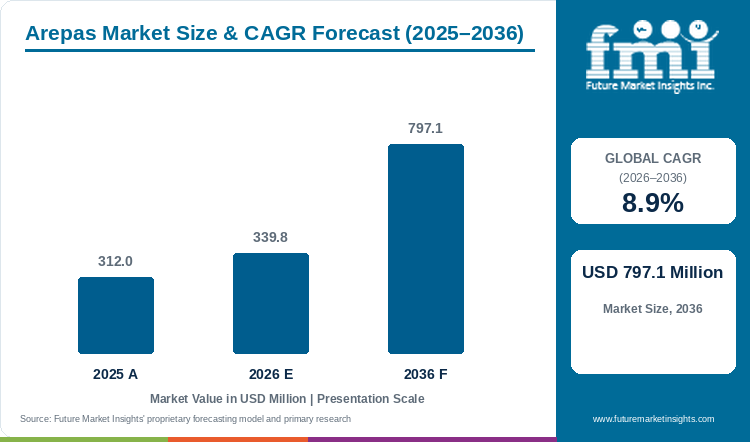
Starting from USD 312.0 million in 2025, the arepas market valuation advanced to USD 339.8 million in 2026, with projections pointing toward USD 797.1 million by 2036 at a CAGR of 8.9%. Classic / Original leads product type with a 35.0% share in 2026, Conventional commands 62.0% in claim / nature, and Fresh accounts for 31.0% of format.
In March 2026, Europastry confirmed full-year 2025 revenue of EUR 1.63 billion on an 8% increase, crediting international expansion of par-baked and frozen specialty flatbreads across 80 markets, and the line item pulling that growth carried arepas from diaspora carts into mainstream freezer doors [20]. The global arepas market was valued at USD 312.0 million in 2025 and is estimated to reach USD 339.8 million in 2026. The market is projected to reach USD 797.1 million by 2036, expanding at a compound annual growth rate (CAGR) of 8.9% between 2026 and 2036. Classic original patties are projected to capture 35.0% of 2026 demand as unstuffed white and yellow corn discs split cleanly for breakfast egg-and-cheese assembly. Demand is supported by toaster-ready convenience formats and celiac-safe wheat substitution, positioning precooked corn masa against both bread and gluten-free flour blends [3] [4]. That double positioning keeps arepas ahead of the tortilla market at 5.2% CAGR, since tortilla demand matures with burrito penetration while arepas gain on Latin grocery adjacency and breakfast occasion capture [1]. Grupo Bimbo detailed in April 2026 its Baked for You clean-label renovation and regenerative corn partnerships across 35 countries [19]. Rapid maize starch retrogradation remains the shelf-life tax on the format, and the processors that hold fresh-milled nixtamalized texture in frozen pucks keep the breakfast contracts through 2036.
Key Market Trends & Insights
- By product type: Classic / Original patties are projected to capture 35.0% in 2026 because unstuffed white and yellow corn discs split cleanly for breakfast eggs, shredded meats, and melted cheese.
- By claim / nature: Conventional recipes are estimated to command 62.0% in 2026 as high-volume bodegas and supermarket delis prioritize familiar roasted maize flavor and accessible unit pricing.
- By format: Fresh arepas are expected to concentrate 31.0% in 2026 because daily bakery route deliveries satisfy immediate restaurant and household consumption without freezer defrosting.
- By packaging format: Multipack pouches are forecast to generate 34.0% in 2026 owing to 4-count to 6-count thermoformed barrier packs that match weekly family meal cycles.
- By sales channel: Supermarkets & Hypermarkets are anticipated to account for 43.0% in 2026 through the migration of packaged corn flatbreads from ethnic dry aisles into perimeter deli cases.
Regional Highlights
- Top national expansion: The UAE is projected to lead evaluated national markets at a 10.3% CAGR through 2036 as more than 570 domestic food processors and hotel catering commissaries expand halal-certified specialty flatbread lines.
- Broader country progression: Saudi Arabia is expected to expand at a 9.9% CAGR ahead of South Korea at 9.6% and the USA at 9.3%, while Japan is forecast to advance at an 8.1% CAGR.
Market Size & Forecast
Table 1: Market Size and Forecast for the Arepas Market (USD million and CAGR percentage), 2025 to 2036
| Metric | Value |
|---|---|
| 2025 Market Size | USD 312.0 million |
| Estimated Market Size in 2026 | USD 339.8 million |
| Projected Market Size by 2036 | USD 797.1 million |
| CAGR, 2026 to 2036 | 8.9% |
| Added Revenue, 2026 to 2036 | USD 457.3 million |
Supermarket bakery buyers and fast-casual restaurant chains face mounting regulatory pressure to prevent undeclared wheat cross-contact in gluten-free and specialty flatbread fixtures. Manual kitchen preparation from dry cornmeal frequently introduces hydration variability and shared-griddle allergen risks across foodservice shifts. In January 2026, the U.S. Food and Drug Administration published a Federal Register notice (91 FR 2781) requesting scientific data on gluten cross-contact controls and mandatory ingredient disclosure to protect 3.3 million residents with celiac disease [2]. so retail category managers are replacing unbranded deli batches with sealed multipacks milled from dedicated nixtamalized corn flour lines so stores guarantee allergen compliance.
Consumer-Pool and Bakery-Volume Sizing
Table 2: Consumer-Pool and Production-Volume Sizing for the Arepas Market (USD million and operational ranges), 2025 to 2036
| Metric | 2025 | 2026 | 2036 |
|---|---|---|---|
| Market size (USD million) | 312.0 | 339.8 | 797.1 |
| Core diaspora & specialty flatbread buyers (million) | 48.0 to 54.0 | 51.5 to 58.0 | 88.0 to 98.0 |
| Commercial packaged arepa units sold per day (million) | 1.4 to 1.6 | 1.5 to 1.7 | 2.8 to 3.2 |
| Average retail realization per kilogram (USD) | 6.1 to 6.2 | 6.3 to 6.4 | 7.7 to 7.9 |
Operational note: Consumer-pool and daily unit ranges reconcile commercial pre-cooked dent maize flour conversion (2.15 kg hydrated dough per 1.0 kg dry flour) against retail multipack and foodservice case shipments.
Industrial flatbread plants require uniform starch pre-gelatinization across hydrothermal cooking and drum-drying stages to prevent patty edge cracking on high-speed forming belts. Commercial bakers partner with specialized corn flour millers to calibrate particle size distributions and moisture absorption prior to rotary stamping and blast freezing.
Per Capita & Retail Fixture Sizing
Table 3: Per Capita and Retail Fixture Spending Indicators for the Arepas Market (USD), 2025 to 2036
| Metric | 2025 | 2026 | 2036 |
|---|---|---|---|
| Global population base (million) | 8,200.0 | 8,300.0 | 9,000.0 |
| Spend per 1,000 people (USD) | 38.0 | 40.9 | 88.6 |
| Annual spend per regular buying household (USD) | 18.5 to 22.0 | 19.5 to 23.5 | 31.0 to 37.0 |
| Modern supermarket & hypermarket channel share (%) | 41.5% to 43.5% | 42.0% to 44.0% | 45.0% to 48.0% |
Table 4: Retail & Foodservice Procurement Indicators for the Arepas Market (USD and percentages), 2026
| Metric | Value | Institutional Reference Basis |
|---|---|---|
| Market size, 2026 | USD 339.8 million | 2026 global commercial baseline |
| Supermarkets & hypermarkets revenue, 2026 | USD 146.1 million | 43.0% primary sales channel allocation |
| Classic / Original product revenue, 2026 | USD 118.9 million | 35.0% leading product type allocation |
| Multipack packaging revenue, 2026 | USD 115.5 million | 34.0% leading packaging format allocation |
Expansion of refrigerated and frozen distribution requires balancing authentic stone-ground maize texture with 5-minute household toaster or air-fryer convenience. Retail category managers pair pre-griddled corn rounds with frozen tortillas in perimeter deli bays to capture higher basket rings from weekday breakfast and snacking occasions.
Analyst Perspective
"Supermarket deli buyers require pre-griddled corn patties that recover a crisp outer crust and tender interior crumb directly from a household slot toaster without pan frying. Manufacturers combining certified gluten-free four-ingredient labels with modified-atmosphere or blast-frozen shelf stability will capture national retail planogram expansions."
- Nandini Roy Choudhury, Principal Analyst at Future Market Insights
How is the arepas market segmented?
The arepas market is segmented by product type, claim / nature, format, packaging format, and sales channel. Classic / Original leads product type at 35.0% in 2026, while Conventional captures 62.0% of claim / nature and Fresh holds 31.0% of format.
By product type: Classic / Original, Whole Grain & Seeded, Flavored & Filled, Mini & Snacking Formats, and Premium / Artisan.
By claim / nature: Conventional, Clean Label, Organic, Gluten-Free, and High-Protein / Fortified.
By format: Fresh, Frozen, Ambient Packaged, Chilled, and Par-Baked.
By packaging format: Multipack, Single-Serve, Family / Loaf Pack, and Bulk Foodservice.
By sales channel: Supermarkets & Hypermarkets, Artisan & Specialty Bakeries, Convenience & Forecourt, Online & DTC, and Foodservice Distributors.
Why does Classic / Original anchor Product Type demand?
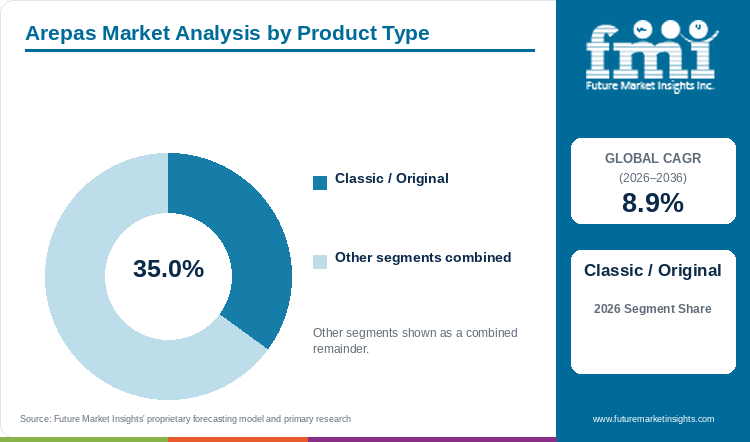
Classic / Original patties are projected to capture 35.0% of product type revenue in 2026 (USD 118.9 million) by serving as the neutral carrier across breakfast, sandwich, and foodservice occasions.
Table 5: Product Type Share for the Arepas Market (percentage share), 2026
| Product Type | Share (2026) |
|---|---|
| Classic / Original | 35.0% |
| Other Segments Combined | 65.0%* |
| Total | 100.0% |
*Note: Remaining product type categories sum to 100.0% of 2026 commercial arepas volume.
Table 6: Product Type Leadership and Market Growth for the Arepas Market (segment and CAGR percentage), 2026 to 2036
| Metric | Value |
|---|---|
| Global CAGR (2026 to 2036) | 8.9% |
| Leading Segment | Classic / Original |
Retail grocery buyers and restaurant commissaries favor unstuffed white and yellow corn rounds because a neutral 100-millimeter patty accommodates regional fillings ranging from melted queso blanco to shredded beef without SKU proliferation. Standardized classic discs on high-speed rotary forming lines eliminate complex stuffing-nozzle sanitation downtime while competing directly with packaged bread in morning toast routines.
- Classic / Original is projected to secure 35.0% of product type revenue in 2026 by uniting high-speed bakery line efficiency with multi-occasion household versatility.
- Research published in the Journal of the Science of Food and Agriculture in July 2026 demonstrated that substituting up to 30% modified corn flake processing residue into classic arepa bread flour preserves crumb softness and specific loaf volume while lowering raw maize cost [3].
What keeps Conventional ahead within Claim / Nature?
Conventional formulations are estimated to command 62.0% of the claim / nature segment in 2026 (USD 210.7 million) as core diaspora and foodservice buyers prioritize price accessibility.
High weekly repeat purchase velocity in Hispanic supermarkets and Latin fast-casual chains depends on keeping per-patty unit costs competitive against standard wheat buns and corn tortillas. Conventional masa formulated with standard food-grade dent corn and mold inhibitors allows high-volume bakeries to avoid organic grain premiums while gradually introducing certified gluten-free foods into natural grocery chains.
- Conventional options are estimated to command 62.0% of the claim / nature segment in 2026 because everyday staple buyers prioritize roasted corn flavor and shelf-life dependability over specialty audit seals.
- An April 2026 study in Current Developments in Nutrition using INFOGEST digestion and Caco-2 cell models confirmed that fortifying conventional corn masa with sodium iron EDTA (NaFeEDTA) achieves significantly higher iron bioavailability than ferrous fumarate or ferrous sulfate [4].
How does Fresh retain its lead among preparation Formats?
Fresh format is expected to concentrate 31.0% of format revenue in 2026 (USD 105.3 million) through daily direct-store-delivery routes and immediate foodservice griddling.
Same-day and short-cycle refrigerated distribution preserves the soft interior moisture and toasted maize aroma that core Latin American shoppers evaluate at the point of purchase. While regional commissaries rely on fresh direct-store-delivery routes for high-turnover urban stores, national exporters pair modified-atmosphere fresh pouches with blast-frozen frozen bakery lines to reach distant retail freezers.
- Fresh format is expected to hold 31.0% of format sales in 2026 because metropolitan bodegas and Latin restaurants favor ready-to-sear patties that require zero thawing time.
- Experimental milling analysis published in Food Chemistry X in August 2025 proved that wet-milled and jet-milled corn flours generate lower damaged-starch fractions and slower short-term amylopectin retrogradation during chilled fresh storage [5].
Why is Multipack the largest Packaging Format?
Multipack pouches are forecast to generate 34.0% of packaging format revenue in 2026 (USD 115.5 million) by aligning unit barrier economics with weekly household consumption.
Packaging four to six pre-griddled corn patties inside a single thermoformed nylon-polyethylene pouch amortizes barrier film and gas-flushing costs across multiple servings. Carbon dioxide and nitrogen head-space flushing prevents aerobic mold growth and edge dehydration during 35-day supermarket dairy-case merchandising without requiring high doses of chemical preservatives.
- Multipack is forecast to account for 34.0% of packaging format demand in 2026 as household buyers stock 5-count and 6-count packs for weekday breakfast and school-lunch assembly.
- Latina-owned brand Kiosco (formerly TOAST-IT) completed its corporate rebrand in March 2025 to scale 5-count multipacks of four-ingredient toaster arepas across Publix, Walmart, and Whole Foods Market freezer aisles [6].
What makes Supermarkets & Hypermarkets the leading Sales Channel?
Supermarkets & Hypermarkets are anticipated to capture 43.0% of sales channel revenue in 2026 (USD 146.1 million) as grocery chains relocate arepas into perimeter deli and freezer fixtures.
Mainstream supermarket chains convert occasional restaurant trial into routine household replenishment by placing branded corn patties inside high-traffic refrigerated deli bays and natural freezer doors. Centralized grocery warehousing and multi-buy promotional endcaps generate volume velocity that independent neighborhood tiendas cannot match.
- Supermarkets & Hypermarkets are anticipated to capture 43.0% of sales channel revenue in 2026 because national planogram integration exposes ready-to-toast corn rounds to non-Hispanic convenience shoppers.
- A two-year mycotoxin surveillance study published in Toxicology Reports in July 2025 found persistent aflatoxin and fumonisin contamination in uncertified nixtamalized corn dough, explaining why major supermarket chains enforce strict optical-sorting and batch-testing audits on commercial suppliers [7].
What are the drivers, restraints, and opportunities in the arepas market?
In the arepas market, toaster-ready convenience formats and celiac-safe wheat substitution propel supermarket adoption, while rapid maize starch retrogradation and mycotoxin screening costs restrain small-batch producers.
- Driver: Pre-griddled toaster and air-fryer formats compress household preparation from 25 minutes of manual dough kneading to 5 minutes of automated reheating.
- Restraint: Amylopectin recrystallization in gluten-free maize crumb causes rapid staling and edge fissuring unless stabilized by hydrocolloids or cold-chain packaging.
- Opportunity: Co-formulating pre-cooked corn masa with pigmented blue or purple maize, pulse flours, and resistant starch unlocks low-glycemic functional bakery premiums.
Growth Analysis and Future Potential: Qualitative Demand Catalysts
Mainstream grocery operators are expanding chilled and frozen Latin flatbread doors because household buyers want authentic global carriers that fit five-minute weekday morning routines. Traditional scratch preparation requires hydrating dry harina precocida with warm water and resting the dough before hand-forming rounds and pan-roasting on a cast-iron budare. Industrial bakeries remove this culinary friction by par-baking and flash-freezing hydrated patties next to savory snacks so consumers crisp them directly in a vertical slot toaster. In October 2025, texture and milling research in the Journal of Texture Studies confirmed that controlled extrusion and milling of nixtamalized blue corn flour preserves anthocyanin antioxidants while delivering cohesive flatbread elasticity [8]. Supermarket category managers consequently allocate dedicated eye-level freezer facings to clean-label toaster arepas that attract both Hispanic and health-conscious shoppers.
Risk Assessment of the Arepas Market: Operational and Formulation Friction
Rapid starch retrogradation during ambient and chilled storage and strict incoming grain mycotoxin tolerances represent the primary technical barriers restricting category expansion. Because corn masa lacks viscoelastic wheat gluten networks to trap bound water, cooked maize amylopectin chains re-associate quickly and cause reheated patties to split or turn leathery. In September 2025, rheological research published in Food Research International demonstrated that unmodified gluten-free doughs suffer severe baking moisture loss unless stabilized by in situ sourdough exopolysaccharides [9]. Commercial bakeries shipping across transcontinental routes must therefore invest in costly modified-atmosphere thermoforming or continuous blast-freezing tunnels comparable to frozen dough supply chains. When regional producers compare cold-chain freight surcharges and mandatory aflatoxin ELISA batch testing against ambient wheat bread economics, tight gross margins block undercapitalized entrants.
Commercial Opportunity Analysis: Formulation Differentiation and Value-Add Formats
Retail merchandising economics reward flatbread formulators that upgrade standard white-corn patties into high-fiber, protein-fortified, and low-glycemic functional carriers. Metabolic-health shoppers and parents seeking nutrient-dense school snacks willingly pay a 25% to 35% price premium for corn rounds enriched with legumes, seeds, and pigmented heirloom maize. Manufacturers capturing higher gross margins blend pre-cooked corn flour with red lentil, carob, or purple maize meal sourced through gluten-free bakery premixes. In May 2026, functional flatbread research published in Foods demonstrated that enriching traditional flatbread dough with high-amylose resistant starch raises resistant starch content above 12% and significantly lowers postprandial glycemic impact [10]. Pre-sliced pocket convenience combined with verified fiber and resistant-starch nutrition claims enables specialty brands to win national club-store and natural-channel rotations.
Arepas Market by Country (2026 to 2036)
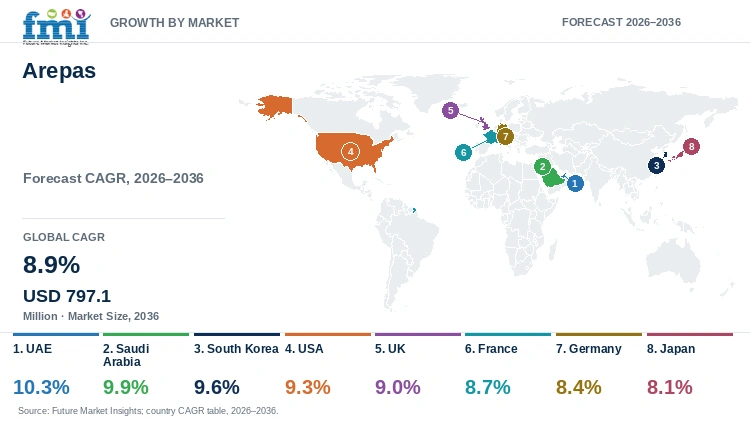
As per FMI, the UAE is projected to lead commercial arepas expansion across evaluated national markets at a 10.3% CAGR through 2036, whereas Japan is forecast to progress at an 8.1% CAGR. Commercial performance across Gulf hospitality hubs and East Asian convenience channels and North American or European supermarket chains depends on cold-chain import clearance and toaster-ready texture recovery.
Table 7: Country CAGR and Primary Growth Levers for the Arepas Market (CAGR percentage and operational drivers), 2026 to 2036
| Country | CAGR (2026 to 2036) | Primary Growth Lever |
|---|---|---|
| UAE | 10.3% | 570+ domestic food processors, hotel catering buffets, and Dubai Municipality cold-chain inspections |
| Saudi Arabia | 9.9% | USD 57 billion food retail expansion and Vision 2030 halal bakery localization |
| South Korea | 9.6% | KRW 111.9 trillion food processing sector and convenience-store cheese-stuffed snack formats |
| USA | 9.3% | 68.0 million Hispanic consumer base and nationwide supermarket deli & freezer migration |
| UK | 9.0% | FSA allergen cross-contact enforcement and non-HFSS street-food retail multipacks |
| France | 8.7% | Santé publique France Nutri-Score A/B fiber reformulation and frozen bake-off counters |
| Germany | 8.4% | Long-term domestic grain maize breeding yields and organic gluten-free supermarket private labels |
| Japan | 8.1% | MHLW imported maize mycotoxin monitoring and single-serve convenience delicatessen packs |
Source: Future Market Insights analysis
UAE Arepas Market Outlook (2026 to 2036)
The UAE arepas market is projected to expand at a leading 10.3% CAGR from 2026 to 2036, driven by luxury hotel breakfast commissaries and expatriate grocery delivery platforms in Dubai and Abu Dhabi. Unlike North American retail chains that rely on neighborhood bodega turnover, the UAE works as a temperature-controlled re-export and hospitality hub where more than 570 food processors convert imported grain inputs into halal-certified bakery items [11]. In August 2026, the USDA Foreign Agricultural Service reported that the UAE Food Cluster initiative and National Food Security Strategy 2051 are accelerating domestic co-packing investments. Strict municipal cold-chain inspections still penalize unvalidated ambient imports and favor blast-frozen multipacks.
Key takeaway: In the UAE, hotel catering commissaries and domestic halal bakery co-packing under the UAE Food Cluster initiative are projected to anchor 10.3% CAGR expansion.
Saudi Arabia Arepas Market Outlook (2026 to 2036)
Whereas Western European demand centers on unstuffed vegan corn rounds, Saudi Arabia channels commercial volume through modern hypermarkets and fast-casual coffee chains seeking halal cheese-stuffed and spiced chicken pocket formats. Commercial sales in Saudi Arabia are forecast to expand at a 9.9% CAGR between 2026 and 2036. An August 2026 USDA Foreign Agricultural Service report documented that food retail sales in Saudi Arabia reached USD 57 billion in 2025, supported by 1,300 registered domestic food factories and a 22% surge in imported specialty foods during early 2026 [12]. Mandatory Arabic nutritional labeling and SFDA trans-fat bans still require foreign suppliers to partner with licensed local cold-chain distributors.
Key takeaway: In Saudi Arabia, rapid modern hypermarket expansion and domestic halal bakery localization are forecast to sustain a 9.9% CAGR.
South Korea Arepas Market Outlook (2026 to 2036)
In contrast to Latin American markets where arepas replace dinner bread, South Korea positions mozzarella-filled and sweet-corn griddled patties as single-serve hot snacks inside convenience stores and air-fryer home meal replacement kits. In April 2026, the USDA Foreign Agricultural Service reported that imports of food processing ingredients to Peru totaled USD 1.1 billion in 2025, mirroring Latin American demand for prepared maize and grain-free inputs [24]. so the South Korea arepas market is projected to register a 9.6% CAGR from 2026 through 2036. Strict Ministry of Food and Drug Safety overseas facility registration rules and cold-chain import inspections still compel foreign exporters to pre-certify corn milling plants.
Key takeaway: In South Korea, convenience-store hot-snack merchandising and air-fryer mozzarella-filled formats are projected to drive a 9.6% CAGR.
USA Arepas Market Outlook (2026 to 2036)
What sets the USA apart from import-reliant European and Asian markets is the convergence of a 68.0 million Hispanic consumer base with coast-to-coast domestic corn masa milling and supermarket perimeter distribution. Rather than confining pre-cooked corn patties to international dry-grocery shelves, national chains such as Publix and Walmart plus Whole Foods Market merchandise toaster-ready frozen and chilled multipacks inside mainstream deli and gluten-free freezer doors. In July 2026, Gruma reported resilient second-quarter operating margins across its U.S. corn flour and specialty flatbread divisions as households rotated toward value-added corn formats [14]. Commercial retail and foodservice demand across the USA is forecast to advance at a 9.3% CAGR from 2026 through 2036.
Key takeaway: In the USA, national supermarket perimeter migration and domestic pre-cooked masa milling scale are forecast to support a 9.3% CAGR.
UK Arepas Market Outlook (2026 to 2036)
The UK arepas market will expand at a 9.0% CAGR between 2026 and 2036, propelled by urban street-food casual dining and supermarket free-from fixture expansion. What distinguishes the UK from continental European markets is the combination of strict Natasha's Law allergen enforcement and statutory restrictions on less-healthy food promotions. In July 2026, the UK Food Standards Agency updated its technical allergen guidance for food businesses to tighten precautionary cross-contact labeling across commercial bakeries [15]. Because plain pre-cooked corn rounds contain minimal saturated fat and sugar while avoiding wheat gluten, supermarket private-label buyers across the UK use chilled multipacks to expand world-food bays without triggering statutory promotional bans.
Key takeaway: In the UK, strict FSA allergen cross-contact governance and non-HFSS nutritional profiles are estimated to sustain a 9.0% CAGR.
France Arepas Market Outlook (2026 to 2036)
Whereas UK demand is led by chilled world-food meal kits, France evaluates specialty flatbreads through strict front-of-pack Nutri-Score grading and organic bio-supermarket standards. Commercial retail and foodservice revenue across France is forecast to grow at an 8.7% CAGR from 2026 to 2036. In March 2026, Santé publique France reinforced the updated Nutri-Score calculation framework that rewards whole-grain dietary fiber and penalizes excess sodium in packaged bakery products [16]. Because standard refined white-corn patties can score poorly on fiber density, European frozen bakery suppliers blend purple corn flour and red lentil meal into par-baked rounds sold across hypermarket bake-off counters and Latin bistros in Paris and Lyon or Marseille.
Key takeaway: In France, fiber-fortified corn masa recipes engineered for Nutri-Score A and B grades are forecast to underpin an 8.7% CAGR.
Germany Arepas Market Outlook (2026 to 2036)
Germany diverges from Southern European markets where Latin American diaspora grocers drive volume, relying instead on discount and full-line supermarket private labels that position corn rounds inside vegan and celiac-safe bakery fixtures. In November 2025, long-term agronomic trials published in Theoretical and Applied Genetics documented sustained multi-decade yield improvements in domestic grain maize across Germany, strengthening local European dent corn availability for dry milling [17]. Commercial revenue in the Germany arepas market is projected to expand at an 8.4% CAGR over the 2026 to 2036 forecast period. Price-sensitive discount grocery tenders across Germany still compress supplier brand margins and compel flatbread manufacturers to automate high-speed modified-atmosphere thermoforming lines.
Key takeaway: In Germany, private-label gluten-free supermarket assortments and domestic European maize milling supply are projected to drive an 8.4% CAGR.
Japan Arepas Market Outlook (2026 to 2036)
Unlike Western grocery markets that favor 6-count family packs, Japan centers commercial demand on single-serve frozen stuffed patties and convenience-store hot-case snacks tailored for compact urban households. Under the Ministry of Health, Labour and Welfare FY 2025 Imported Foods Monitoring Plan, port quarantine laboratories strictly screen imported maize products for aflatoxins and unauthorized genetically modified traits [18]. Because regulatory non-compliance triggers mandatory cargo destruction at port entry, specialty importers in Tokyo and Osaka exclusively contract with identity-preserved non-GMO corn masa processors that certify batch purity prior to shipment. Commercial sales in Japan's arepas market are forecast to progress at an 8.1% CAGR from 2026 to 2036.
Key takeaway: In Japan, MHLW non-GMO and mycotoxin import clearance paired with single-serve convenience snack formats are forecast to support an 8.1% CAGR.
Full report country CAGRs cover: North America; Latin America; Western Europe; Eastern Europe; East Asia; South Asia and Pacific; Middle East and Africa.
Who are the notable companies in the arepas market?
Gruma, Mission Foods, Ole Mexican Foods, Toufayan Bakeries, Kontos Foods, FGF Brands, Signature Flatbreads, Angel Bakeries, Grupo Bimbo, and Europastry are the notable companies in the market.
FMI analysis indicates that the competitive arena divides between vertically integrated corn masa millers, regional refrigerated flatbread specialists, and multinational frozen bakery groups. Upstream masa producers control hydrothermal corn cooking and dry flour milling, whereas downstream flatbread bakeries compete on toaster-ready par-baking and modified-atmosphere shelf life across supermarket perimeter bays.
- Corn-Based Latin Flatbread Platforms: Gruma and Mission Foods along with Ole Mexican Foods operate integrated nixtamalized and pre-cooked corn milling assets that supply authentic Latin flatbreads across retail and foodservice channels.
- Retail and Foodservice Flatbread Specialists: Toufayan Bakeries and Kontos Foods along with Signature Flatbreads and Angel Bakeries use high-speed sheeting lines and direct-store-delivery routes to stock supermarket deli bays.
- Broad Bakery and Frozen Supply Systems: FGF Brands, Grupo Bimbo, and Europastry deploy multinational blast-freezing and bake-off distribution networks to supply par-baked and toaster-ready specialty breads.
Competitive Benchmarking: Arepas Market
Table 8: Competitive Benchmarking for the Arepas Market (qualitative capability ratings), 2026
| Company | Corn-Based Processing | Packaged Retail Bread | Foodservice / Frozen Supply | Geographic Reach |
|---|---|---|---|---|
| Gruma | High | High | Medium | High |
| Mission Foods | High | High | Medium | High |
| Ole Mexican Foods | High | High | Medium | Medium |
| Toufayan Bakeries | Medium | High | High | Medium |
| Kontos Foods | Medium | High | High | Medium |
| FGF Brands | Medium | High | High | Medium |
| Signature Flatbreads | Medium | High | High | High |
| Angel Bakeries | Medium | Medium | Medium | Medium |
| Grupo Bimbo | Medium | High | High | High |
| Europastry | Medium | High | High | High |
Scoring basis: Capability tiers evaluate documented vertical integration in pre-cooked corn masa processing and packaged retail flatbread SKU breadth. Foodservice / frozen supply and geographic ratings reflect verified modified-atmosphere and blast-frozen distribution across the Americas, Europe, and Asia-Pacific.
Key Developments in the Arepas Market
- Grupo Bimbo published its 2025 Annual Report in April 2026 detailing its Baked for You clean-label recipe renovation and regenerative corn and wheat agriculture partnerships across 35 countries [19].
- Europastry announced in March 2026 that full-year 2025 revenue reached EUR 1.63 billion (an 8% increase over 2024), supported by international expansion of par-baked and frozen specialty flatbreads across 80 markets [20].
- Bianchi, Agnolin, and Simonato demonstrated in April 2026 that combining tapioca starch with red lentil flour in gluten-free bread formulations boosts protein density and crumb elasticity for clean-label bakery launches [21].
Key Players in the Arepas Market
Corn-Based Latin Flatbread Platforms
- Gruma
- Mission Foods
- Ole Mexican Foods
Retail and Foodservice Flatbread Specialists
- Toufayan Bakeries
- Kontos Foods
- Signature Flatbreads
- Angel Bakeries
Broad Bakery and Frozen Supply Systems
- FGF Brands
- Grupo Bimbo
- Europastry
Arepas Market - Report Scope
Table 9: Report Scope for the Arepas Market (coverage fields and definitions), 2026 to 2036
| Coverage field | Report scope |
|---|---|
| Market breakdown | Product Type; Claim / Nature; Format; Packaging Format; Sales Channel |
| Quantitative Units | USD Million |
| Market Definition | Includes commercial supplier revenue from pre-formed, packaged arepa corn patties (fresh, frozen, ambient packaged, chilled, and par-baked) sold through retail and foodservice channels. Category Scope Note: Excludes loose dry 1 kg pre-cooked corn flour bags (harina precocida) sold for home kneading and unformed raw corn dough. |
| Regions Covered | North America; Latin America; Western Europe; Eastern Europe; East Asia; South Asia and Pacific; Middle East and Africa |
| Countries Covered | UAE, Saudi Arabia, South Korea, USA, UK, France, Germany, Japan, and additional countries in the full report |
| Key Companies Covered | Gruma, Mission Foods, Ole Mexican Foods, Toufayan Bakeries, Kontos Foods, FGF Brands, Signature Flatbreads, Angel Bakeries, Grupo Bimbo, Europastry |
| Forecast Period | 2026 to 2036 |
| Approach | Primary and secondary research with top-down and bottom-up market triangulation. |
Arepas Market - Research Methodology
Table 10: Research Methodology for the Arepas Market (research methods and approach), 2026 edition
| Method | Approach |
|---|---|
| Primary Research | Structured interviews with corn dry-millers, industrial flatbread production directors, supermarket deli category buyers, and foodservice distributors across North America, Latin America, Europe, and the Middle East. |
| Secondary Research | Analysis of corporate annual filings, PubMed cereal-chemistry studies, U.S. Census Bureau and USDA GAIN country reports, FDA Federal Register dockets, and national food safety registries. |
| Market Sizing and Forecasting | Top-down tortilla and Latin flatbread category models reconciled against bottom-up facility mass-balance conversions (2.15 kg finished arepa dough per 1.0 kg dry pre-cooked dent maize flour). |
| Country Forecasting Model | Econometric country projections weight Latin American diaspora growth, supermarket perimeter cold-chain doors, halal/allergen regulatory compliance, and convenience foodservice adoption. |
| Operational Benchmark Traceability | Consumer-pool and retail fixture spending indicators in Tables 2, 3, and 4 trace directly to U.S. Census Bureau, USDA FAS, and supermarket scanner velocity benchmarks. |
| Data Triangulation and Validation | Demand estimates are cross-checked against commercial masa milling throughput, retail multipack pricing, and audited company segment disclosures. |
Arepas Market by Segments
Arepas Market segmented by Product Type:
- Classic / Original
- Whole Grain & Seeded
- Flavored & Filled
- Mini & Snacking Formats
- Premium / Artisan
Arepas Market segmented by Claim / Nature:
- Conventional
- Clean Label
- Organic
- Gluten-Free
- High-Protein / Fortified
Arepas Market segmented by Format:
- Fresh
- Frozen
- Ambient Packaged
- Chilled
- Par-Baked
Arepas Market segmented by Packaging Format:
- Multipack
- Single-Serve
- Family / Loaf Pack
- Bulk Foodservice
Arepas Market segmented by Sales Channel:
- Supermarkets & Hypermarkets
- Artisan & Specialty Bakeries
- Convenience & Forecourt
- Online & DTC
- Foodservice Distributors
Arepas Market by Region
- North America
- United States
- Canada
- Latin America
- Brazil
- Mexico
- Argentina
- Chile
- Western Europe
- Germany
- France
- United Kingdom
- Italy
- Spain
- Benelux
- Nordics
- Eastern Europe
- Poland
- Czech Republic
- Romania
- Hungary
- East Asia
- China
- Japan
- South Korea
- South Asia and Pacific
- India
- ASEAN
- Australia and New Zealand
- Middle East and Africa
- GCC Countries
- South Africa
- Türkiye
- Israel
Research Sources and Bibliography
- [1] United States Census Bureau. (2026, August 11). National Hispanic Heritage Month: 2026. U.S. Department of Commerce (Press Release CB26-FF.07).
- [2] U.S. Food and Drug Administration. (2026, January 22). Labeling and Preventing Cross-Contact of Gluten for Packaged Foods; Request for Information. Federal Register, 91(14), 2781 (Document No. 2026-01121).
- [3] Silva, S. T. P., Magalhães, G. L., Caliari, M., & Soares Júnior, M. S. (2026, July 18). Recovered residue from corn flake processing and its application in modified flours and arepa bread. Journal of the Science of Food and Agriculture (PubMed PMID 42470219).
- [4] Zhang, J., & Lindshield, B. L. (2026, April 3). Bioavailability of Sodium Iron Ethylenediaminetetraacetate, Ferrous Fumarate, and Ferrous Sulfate in Corn Flour Using Different INFOGEST Digestion and Caco-2 Cell Model Methods. Current Developments in Nutrition, 10(5), 107686 (PubMed PMID 42093955).
- [5] Li, X., Yan, J., Gao, J., Xing, F., Gu, Q., Zhao, C., & Liu, J. (2025, August 8). Structure, physicochemical properties and in vitro digestibility of starch in corn flour with different milling processes. Food Chemistry: X, 30, 102901 (PubMed PMID 40831971).
- [6] Kiosco. (2025, March 11). Kiosco: Latina-Owned Food Brand Rebrands to Celebrate Latin Roots and Expand Mission. NOSH Industry Releases.
- [7] Hernandez-Rauda, R., Peña-Rodas, O., Arbaiza-Rodríguez, G., Cuadra-Escobar, M., & Guzman-Rodríguez, M. (2025, July 14). Aflatoxins and fumonisins in nixtamalized corn dough from El Salvador: A two-year survey. Toxicology Reports, 15, 102087 (PubMed PMID 40703636).
- [8] Gerardo-Rodríguez, J. E., Menchaca-Armenta, M., Chan-Higuera, J. E., Montaño-Leyva, B., Ledesma-Osuna, A. I., Silvas García, M. I., et al. (2025, October 1). Exploring the Impact of Milling on the Texture and Anthocyanin Preservation in Tortillas Made From Extruded Nixtamalized Blue Corn (Zea mays L.) Flour. Journal of Texture Studies, 56(5), e70044 (PubMed PMID 41013954).
- [9] Woo, S.-H., Sung, J. M., Park, J., Park, J.-D., & Park, E. Y. (2025, September 16). Sucrose-induced structural modification of in situ exopolysaccharides: Effects on rheological and baking properties of gluten-free sourdough. Food Research International, 221(Pt 4), 117523 (PubMed PMID 41185281).
- [10] Ozer, C., Yildirim, H., Surek, E., Ozkan, K., Sagdic, O., Palombieri, S., Sestili, F., & Koksel, H. (2026, May 15). Transforming Traditional Flatbread (Bazlama) into a Functional Food with Very High Resistant Starch and Low Glycemic Impact. Foods, 15(10), 1752 (PubMed PMID 42195959).
- [11] U.S. Department of Agriculture, Foreign Agricultural Service. (2026, August 4). United Arab Emirates: Food Processing Ingredients Annual. USDA GAIN Report TC2026-0009.
- [12] U.S. Department of Agriculture, Foreign Agricultural Service. (2026, August 31). Saudi Arabia: Retail Foods Annual. USDA GAIN Report SA2026-0013.
- [13] U.S. Department of Agriculture, Foreign Agricultural Service. (2026, May 27). South Korea: Food Processing Ingredients Annual. USDA GAIN Report KS2026-0013.
- [14] Gruma, S.A.B. de C.V. (2026, July 22). GRUMA reporta resultados del segundo trimestre de 2026. Gruma Eventos Relevantes.
- [15] UK Food Standards Agency. (2026, July 17). Allergen guidance for food businesses. GOV.UK Official Guidance.
- [16] Santé publique France. (2026, March 19). Nutri-Score. French National Public Health Agency.
- [17] Laidig, F., Feike, T., Brandes, H., & Piepho, H.-P. (2025, November 13). Breeding progress of grain and forage maize in long-term variety trials compared to on-farm yield development. Theoretical and Applied Genetics, 138(12), 303 (PubMed PMID 41224944).
- [18] Ministry of Health, Labour and Welfare. (2025, March 28). Imported Foods Monitoring Plan for FY 2025. Government of Japan (Notice No. 0328-2).
- [19] Grupo Bimbo, S.A.B. de C.V. (2026, April 30). Annual Report 2025 | Grupo Bimbo. Grupo Bimbo Investor Relations.
- [20] Europastry, S.A. (2026, March 25). Europastry continues to grow and reaches €1.63 billion in revenue in 2025, an 8% increase compared to 2024. Europastry Corporate Communications.
- [21] Bianchi, F., Agnolin, L., & Simonato, B. (2026, April 3). Functional Optimization of a Novel Gluten-Free Bread Made with Tapioca Starch and Red Lentil Flour. Foods, 15(7), 1230 (PubMed PMID 41976524).
- [22] Cardona-Herrera, R., Pérez-Carrillo, E., de la Rosa-Millán, J., Mirón-Mérida, V. A., Mares-Mares, E., & Ozuna, C. (2026, February 28). Physical, nutritional, and sensory characterization of tortillas formulated with nixtamalized milpa ingredients (Zea mays var. Elotes occidentales, Phaseolus vulgaris L. var. Negro, and Cucurbita pepo L.). Food Chemistry, 503, 147817 (PubMed PMID 41494323).
- [23] Voučko, B., Drakula, S., Čukelj Mustač, N., Pleš, V., Nanjara, L., Grgić, T., & Novotni, D. (2026, April 25). Gluten-Free Flatbread with Carob Flour and Sourdough: Nutritional Composition, Technological Properties and Storage Stability. Foods, 15(9), 1504 (PubMed PMID 42121447).
- [24] U.S. Department of Agriculture, Foreign Agricultural Service. (2026, April). Peru: Food Processing Ingredients Annual. Global Agriculture Information Networkhttps://www.fas.usda.gov/data/gain-report/2026/04/Food%20Processing%20Ingredients%20Annual_Lima_Peru_PE2026-0005.pdf
This bibliography is provided for reader reference and is not exhaustive. The full report contains the complete reference list and detailed citations.
This Report Answers
- How large is the arepas market in 2026 and what is forecast for 2036?
- Which retail convenience and allergen-compliance pressures support demand for packaged arepas?
- Why does Classic / Original lead the product type category?
- Why does Conventional lead the claim / nature category globally?
- How do growth rates differ across the UAE, Saudi Arabia, and the USA?
- Which leading companies supply relevant corn masa and flatbread categories today?
- What limits adoption or supplier switching in the arepas market?
- What should buyers evaluate before purchasing a commercial arepa SKU?
Frequently Asked Questions
How big is the arepas market in 2026, and what is forecast for 2036?
According to FMI, global arepas market value is estimated to reach USD 339.8 million in 2026 from USD 312.0 million in 2025. Valuation is forecast to hit USD 797.1 million by 2036 as supermarkets expand perimeter deli and freezer doors.
What is the CAGR for the arepas market from 2026 to 2036?
Future Market Insights projects an 8.9% compound annual growth rate between 2026 and 2036, representing an anticipated USD 457.3 million increase in annual market value across retail and foodservice channels.
Which product type segment leads the arepas market?
Classic / Original is projected to capture 35.0% of product type demand in 2026 because unstuffed white and yellow corn rounds split cleanly for diverse breakfast, sandwich, and foodservice fillings.
Which claim / nature segment leads the arepas market?
Conventional formulations are estimated to secure 62.0% of the claim / nature category in 2026 as high-volume diaspora grocers and restaurant chains prioritize familiar roasted maize flavor and everyday price parity.
Which country has a notable growth outlook during the assessment period?
The UAE is projected to lead national growth at a 10.3% CAGR through 2036, supported by more than 570 domestic food processors and hotel catering commissaries.
Who are the key players in the market?
Gruma, Mission Foods, Ole Mexican Foods, Toufayan Bakeries, Kontos Foods, FGF Brands, Signature Flatbreads, Angel Bakeries, Grupo Bimbo, and Europastry lead commercial supply across retail and foodservice networks.
Preview the report firsthand - request a free sample
Get SampleGet the brochure for pricing and purchase details.
Get PDFTable of Content
- Key Takeaways
- Market Size and CAGR
- Top Growth Driver
- Fastest Growing Segment
- Leading Region
- Key Companies
- Emerging Opportunities
- Executive Summary
- Global Market Outlook
- Demand-side Trends
- Supply-side Trends
- Technology Roadmap Analysis
- Analysis and Recommendations
- Analyst Perspective (What is happening? Why now? What should investors know?)
- Key Questions Answered
- How large is the market?
- What is the CAGR?
- What are key trends?
- Which region dominates?
- Who are the leaders?
- Market Overview
- Market Coverage / Taxonomy
- Market Definition / Scope / Limitations
- Research Methodology
- Chapter Orientation
- Analytical Lens and Working Hypotheses
- Market Structure, Signals, and Trend Drivers
- Benchmarking and Cross-market Comparability
- Market Sizing, Forecasting, and Opportunity Mapping
- Research Design and Evidence Framework
- Desk Research Programme (Secondary Evidence)
- Expert Input and Fieldwork (Primary Evidence)
- Tooling, Models, and Reference Databases
- Data Engineering and Model Build
- Quality Assurance and Audit Trail
- Market Background
- Market Dynamics (Drivers, Restraints, Opportunity, Trends)
- Scenario Forecast (Optimistic, Likely, Conservative)
- Impact Analysis
- AI Impact
- Sustainability Impact
- Regulatory Impact
- Technology Impact
- Consumer / Buyer Analysis
- Purchase Drivers
- Adoption Barriers
- Buyer Journey
- Opportunity Map Analysis
- Product Life Cycle Analysis
- Supply Chain Analysis
- Investment Feasibility Matrix
- Value Chain Analysis
- PESTLE and Porter's Analysis
- Regulatory Landscape
- Regional Parent Market Outlook
- Production and Consumption Statistics
- Import and Export Statistics
- Global Market Analysis and Forecast, 2021 to 2036
- Historical Market Size Value (USD Million) Analysis, 2021 to 2025
- Current and Future Market Size Value (USD Million) Projections, 2026 to 2036
- Y-o-Y Growth Trend Analysis
- Absolute $ Opportunity Analysis
- Global Market Pricing Analysis, 2021 to 2036
- Global Market Analysis and Forecast, By Product Type, 2021 to 2036
- Introduction / Key Findings
- Historical Market Size Value (USD Million) Analysis By Product Type, 2021 to 2025
- Current and Future Market Size Value (USD Million) Analysis and Forecast By Product Type, 2026 to 2036
- Classic / Original
- Whole Grain & Seeded
- Flavored & Filled
- Mini & Snacking Formats
- Premium / Artisan
- Y-o-Y Growth Trend Analysis By Product Type, 2021 to 2025
- Absolute $ Opportunity Analysis By Product Type, 2026 to 2036
- Global Market Analysis and Forecast, By Claim / Nature, 2021 to 2036
- Introduction / Key Findings
- Historical Market Size Value (USD Million) Analysis By Claim / Nature, 2021 to 2025
- Current and Future Market Size Value (USD Million) Analysis and Forecast By Claim / Nature, 2026 to 2036
- Conventional
- Clean Label
- Organic
- Gluten-Free
- High-Protein / Fortified
- Y-o-Y Growth Trend Analysis By Claim / Nature, 2021 to 2025
- Absolute $ Opportunity Analysis By Claim / Nature, 2026 to 2036
- Global Market Analysis and Forecast, By Format, 2021 to 2036
- Introduction / Key Findings
- Historical Market Size Value (USD Million) Analysis By Format, 2021 to 2025
- Current and Future Market Size Value (USD Million) Analysis and Forecast By Format, 2026 to 2036
- Fresh
- Frozen
- Ambient Packaged
- Chilled
- Par-Baked
- Y-o-Y Growth Trend Analysis By Format, 2021 to 2025
- Absolute $ Opportunity Analysis By Format, 2026 to 2036
- Global Market Analysis and Forecast, By Packaging Format, 2021 to 2036
- Introduction / Key Findings
- Historical Market Size Value (USD Million) Analysis By Packaging Format, 2021 to 2025
- Current and Future Market Size Value (USD Million) Analysis and Forecast By Packaging Format, 2026 to 2036
- Multipack
- Single-Serve
- Family / Loaf Pack
- Bulk Foodservice
- Y-o-Y Growth Trend Analysis By Packaging Format, 2021 to 2025
- Absolute $ Opportunity Analysis By Packaging Format, 2026 to 2036
- Global Market Analysis and Forecast, By Sales Channel, 2021 to 2036
- Introduction / Key Findings
- Historical Market Size Value (USD Million) Analysis By Sales Channel, 2021 to 2025
- Current and Future Market Size Value (USD Million) Analysis and Forecast By Sales Channel, 2026 to 2036
- Supermarkets & Hypermarkets
- Artisan & Specialty Bakeries
- Convenience & Forecourt
- Online & DTC
- Foodservice Distributors
- Y-o-Y Growth Trend Analysis By Sales Channel, 2021 to 2025
- Absolute $ Opportunity Analysis By Sales Channel, 2026 to 2036
- Global Market Analysis and Forecast, By Region, 2021 to 2036
- Introduction
- Historical Market Size Value (USD Million) Analysis By Region, 2021 to 2025
- Current Market Size Value (USD Million) Analysis and Forecast By Region, 2026 to 2036
- North America
- Latin America
- Western Europe
- Eastern Europe
- East Asia
- South Asia and Pacific
- Middle East and Africa
- Market Attractiveness Analysis By Region
- North America Market Analysis and Forecast, By Country, 2021 to 2036
- Historical Market Size Value (USD Million) Trend Analysis By Market Taxonomy, 2021 to 2025
- Market Size Value (USD Million) Forecast By Market Taxonomy, 2026 to 2036
- By Country
- United States
- Canada
- By Product Type
- By Claim / Nature
- By Format
- By Packaging Format
- By Sales Channel
- By Country
- Market Attractiveness Analysis
- By Country
- By Product Type
- By Claim / Nature
- By Format
- By Packaging Format
- By Sales Channel
- Key Takeaways
- Latin America Market Analysis and Forecast, By Country
- Historical Market Size Value (USD Million) Trend Analysis By Market Taxonomy, 2021 to 2025
- Market Size Value (USD Million) Forecast By Market Taxonomy, 2026 to 2036
- By Country
- Brazil
- Mexico
- Argentina
- Chile
- By Product Type
- By Claim / Nature
- By Format
- By Packaging Format
- By Sales Channel
- By Country
- Market Attractiveness Analysis
- By Country
- By Product Type
- By Claim / Nature
- By Format
- By Packaging Format
- By Sales Channel
- Key Takeaways
- Western Europe Market Analysis and Forecast, By Country
- Historical Market Size Value (USD Million) Trend Analysis By Market Taxonomy, 2021 to 2025
- Market Size Value (USD Million) Forecast By Market Taxonomy, 2026 to 2036
- By Country
- Germany
- France
- United Kingdom
- Italy
- Spain
- Benelux
- Nordics
- By Product Type
- By Claim / Nature
- By Format
- By Packaging Format
- By Sales Channel
- By Country
- Market Attractiveness Analysis
- By Country
- By Product Type
- By Claim / Nature
- By Format
- By Packaging Format
- By Sales Channel
- Key Takeaways
- Eastern Europe Market Analysis and Forecast, By Country
- Historical Market Size Value (USD Million) Trend Analysis By Market Taxonomy, 2021 to 2025
- Market Size Value (USD Million) Forecast By Market Taxonomy, 2026 to 2036
- By Country
- Poland
- Czech Republic
- Romania
- Hungary
- By Product Type
- By Claim / Nature
- By Format
- By Packaging Format
- By Sales Channel
- By Country
- Market Attractiveness Analysis
- By Country
- By Product Type
- By Claim / Nature
- By Format
- By Packaging Format
- By Sales Channel
- Key Takeaways
- East Asia Market Analysis and Forecast, By Country
- Historical Market Size Value (USD Million) Trend Analysis By Market Taxonomy, 2021 to 2025
- Market Size Value (USD Million) Forecast By Market Taxonomy, 2026 to 2036
- By Country
- China
- Japan
- South Korea
- By Product Type
- By Claim / Nature
- By Format
- By Packaging Format
- By Sales Channel
- By Country
- Market Attractiveness Analysis
- By Country
- By Product Type
- By Claim / Nature
- By Format
- By Packaging Format
- By Sales Channel
- Key Takeaways
- South Asia and Pacific Market Analysis and Forecast, By Country
- Historical Market Size Value (USD Million) Trend Analysis By Market Taxonomy, 2021 to 2025
- Market Size Value (USD Million) Forecast By Market Taxonomy, 2026 to 2036
- By Country
- India
- ASEAN
- Australia and New Zealand
- By Product Type
- By Claim / Nature
- By Format
- By Packaging Format
- By Sales Channel
- By Country
- Market Attractiveness Analysis
- By Country
- By Product Type
- By Claim / Nature
- By Format
- By Packaging Format
- By Sales Channel
- Key Takeaways
- Middle East and Africa Market Analysis and Forecast, By Country
- Historical Market Size Value (USD Million) Trend Analysis By Market Taxonomy, 2021 to 2025
- Market Size Value (USD Million) Forecast By Market Taxonomy, 2026 to 2036
- By Country
- GCC Countries
- South Africa
- Türkiye
- Israel
- By Product Type
- By Claim / Nature
- By Format
- By Packaging Format
- By Sales Channel
- By Country
- Market Attractiveness Analysis
- By Country
- By Product Type
- By Claim / Nature
- By Format
- By Packaging Format
- By Sales Channel
- Key Takeaways
- Key Countries Market Analysis
- United States
- Pricing Analysis
- Market Share Analysis, 2025
- By Product Type
- By Claim / Nature
- By Format
- By Packaging Format
- By Sales Channel
- Canada
- Pricing Analysis
- Market Share Analysis, 2025
- By Product Type
- By Claim / Nature
- By Format
- By Packaging Format
- By Sales Channel
- Mexico
- Pricing Analysis
- Market Share Analysis, 2025
- By Product Type
- By Claim / Nature
- By Format
- By Packaging Format
- By Sales Channel
- Brazil
- Pricing Analysis
- Market Share Analysis, 2025
- By Product Type
- By Claim / Nature
- By Format
- By Packaging Format
- By Sales Channel
- Chile
- Pricing Analysis
- Market Share Analysis, 2025
- By Product Type
- By Claim / Nature
- By Format
- By Packaging Format
- By Sales Channel
- Germany
- Pricing Analysis
- Market Share Analysis, 2025
- By Product Type
- By Claim / Nature
- By Format
- By Packaging Format
- By Sales Channel
- United Kingdom
- Pricing Analysis
- Market Share Analysis, 2025
- By Product Type
- By Claim / Nature
- By Format
- By Packaging Format
- By Sales Channel
- Italy
- Pricing Analysis
- Market Share Analysis, 2025
- By Product Type
- By Claim / Nature
- By Format
- By Packaging Format
- By Sales Channel
- Spain
- Pricing Analysis
- Market Share Analysis, 2025
- By Product Type
- By Claim / Nature
- By Format
- By Packaging Format
- By Sales Channel
- France
- Pricing Analysis
- Market Share Analysis, 2025
- By Product Type
- By Claim / Nature
- By Format
- By Packaging Format
- By Sales Channel
- India
- Pricing Analysis
- Market Share Analysis, 2025
- By Product Type
- By Claim / Nature
- By Format
- By Packaging Format
- By Sales Channel
- ASEAN
- Pricing Analysis
- Market Share Analysis, 2025
- By Product Type
- By Claim / Nature
- By Format
- By Packaging Format
- By Sales Channel
- Australia and New Zealand
- Pricing Analysis
- Market Share Analysis, 2025
- By Product Type
- By Claim / Nature
- By Format
- By Packaging Format
- By Sales Channel
- China
- Pricing Analysis
- Market Share Analysis, 2025
- By Product Type
- By Claim / Nature
- By Format
- By Packaging Format
- By Sales Channel
- Japan
- Pricing Analysis
- Market Share Analysis, 2025
- By Product Type
- By Claim / Nature
- By Format
- By Packaging Format
- By Sales Channel
- South Korea
- Pricing Analysis
- Market Share Analysis, 2025
- By Product Type
- By Claim / Nature
- By Format
- By Packaging Format
- By Sales Channel
- Poland
- Pricing Analysis
- Market Share Analysis, 2025
- By Product Type
- By Claim / Nature
- By Format
- By Packaging Format
- By Sales Channel
- Hungary
- Pricing Analysis
- Market Share Analysis, 2025
- By Product Type
- By Claim / Nature
- By Format
- By Packaging Format
- By Sales Channel
- Türkiye
- Pricing Analysis
- Market Share Analysis, 2025
- By Product Type
- By Claim / Nature
- By Format
- By Packaging Format
- By Sales Channel
- South Africa
- Pricing Analysis
- Market Share Analysis, 2025
- By Product Type
- By Claim / Nature
- By Format
- By Packaging Format
- By Sales Channel
- UAE
- Pricing Analysis
- Market Share Analysis, 2025
- By Product Type
- By Claim / Nature
- By Format
- By Packaging Format
- By Sales Channel
- Saudi Arabia
- Pricing Analysis
- Market Share Analysis, 2025
- By Product Type
- By Claim / Nature
- By Format
- By Packaging Format
- By Sales Channel
- United States
- Market Structure Analysis
- Competition Dashboard
- Competition Benchmarking
- Market Share Analysis of Top Players
- By Regional
- By Product Type
- By Claim / Nature
- By Format
- By Packaging Format
- By Sales Channel
- Emerging Startups
- Innovation Benchmarking
- Competition Analysis
- Competition Deep Dive
- Gruma
- Overview
- Product Portfolio
- Profitability by Market Segments
- Sales Footprint
- Strategy Overview
- Marketing Strategy
- Product Strategy
- Channel Strategy
- Mission Foods
- Ole Mexican Foods
- Toufayan Bakeries
- Kontos Foods
- FGF Brands
- Signature Flatbreads
- Angel Bakeries
- Grupo Bimbo
- Europastry
- Gruma
- Case Studies
- Success Stories
- Recent Developments
- Competition Deep Dive
- Assumptions & Acronyms Used


