

- Market Size (2026)
- USD 3.0 Bn
- Forecast (2036)
- USD 4.6 Bn
- CAGR (2026 to 2036)
- 4.1%
Arrowroot Starch Market Size, Market Forecast and Outlook By FMI
Summary of the Arrowroot Starch Market
- Demand and Growth Drivers
- Demand is being reshaped by clean-label reformulation, as food manufacturers increasingly replace modified starches and synthetic thickeners with arrowroot to meet consumer transparency expectations.
- Grain-free and Paleo-aligned specialty baking demand is supporting premium market positioning, driving significant interest in DTC and specialty retail channels.
- Tropical agricultural supply concentration in regions such as St. Vincent, India, Brazil, and Southeast Asia is creating procurement volatility risks that pressure margins but highlight the need for supply chain diversification.
- Product and Segment View
- With a 60.0% market share, conventional arrowroot starch is the most popular product. This is because it is cheaper to buy in bulk for use in processed foods.
- Food and drink applications make up the most at 65.0%. Bakery, sauces, and baby food are some of the sub-applications that drive volume as companies look for gluten-free options.
- Geography and Competitive Outlook
- North America and Western Europe are the biggest markets for food manufacturers and specialty retailers, while Asia-Pacific has the fastest-growing market because more people are buying healthy food in cities.
- There are a lot of different types of specialty retail brands, like Bob's Red Mill and NOW Foods, as well as large-scale industrial ingredient suppliers that get most of their volume through private-label procurement.
- Analyst Opinion
- FMI's Nandini Roy Choudhury, "The market is moving toward clean-label reformulation, where arrowroot's functional profile as a synthetic thickener replacement provides a stable, long-term growth trajectory that mitigates risks associated with agricultural supply volatility."
- Market evolution means moving away from volume based on commodities and toward high-specification ingredients needed for clean-label and grain-free standards.
- Key adoption is driven by the need for food manufacturers to meet consumer transparency requirements. This keeps annual growth going even though tapioca and cornstarch are putting pressure on the market.
- New products are moving toward specialized certifications, like Paleo-certified and non-GMO verified. These certifications let brands charge 30% to 50% more than regular grades.
- To deal with the 15% to 30% annual price changes that happen in tropical raw material supply chains, strategic growth is more and more dependent on multi-origin procurement strategies.
Arrowroot Starch Market Definition
The arrowroot starch market encompasses commercial-grade arrowroot powder and starch extracted from Maranta arundinacea and related tropical tubers, used as thickening agent, binding agent, and gluten-free flour substitute. Product scope covers conventional, organic, and specialty-grade arrowroot sold through business-to-business food manufacturer channels, foodservice distribution, and consumer retail.
Arrowroot Starch Market Inclusions
Market scope includes all commercially traded arrowroot starch covering the product, application, end-use, and distribution-channel segments detailed in Section 4, spanning the 2026 to 2036 forecast period across North America, Latin America, Europe, East Asia, South Asia and Pacific, and Middle East and Africa regions.
Arrowroot Starch Market Exclusions
The scope excludes other specialty starches including tapioca, cornstarch, potato starch, and rice flour, even when used in similar thickening or binding applications. Native arrowroot root sales for direct consumption and arrowroot-based finished food products are also excluded from market sizing.
Arrowroot Starch Market Research Methodology
- Primary Research: FMI analysts talked to procurement leaders, technical experts, and commercial managers along the arrowroot starch value chain in North America, Europe, and Asia-Pacific.
- Desk Research: We gathered industry association statistics, regulatory filings, company annual reports, and trade publication data to set baseline parameters that could be verified.
- Market Sizing and Forecasting: We get baseline values by adding up transaction volumes from the bottom up and using growth rates and substitution curves for each region to predict demand through 2036.
- Data validation and update cycle: Every three months, projections are checked against sales data from the industry, regulatory disclosures, and shipment statistics from manufacturers.
Why is the Arrowroot Starch Market Growing?
- Food companies in North America and Western Europe have changed their recipes to use clean-label ingredients instead of modified starches and synthetic thickeners. This has led to an 8% to 12% annual increase in demand for arrowroot.
- The demand for specialty baking that is grain-free and follows the Paleo diet means that organic arrowroot costs 30% to 50% more than regular grades.
- When harvests are good, prices can change by 15% to 30% a year in St. Vincent, India, Brazil, and Vietnam, where most tropical agricultural supplies come from.
In North America and Western Europe, clean-label reformulation is changing the way people want food. Arrowroot is used instead of modified starches, xanthan gum, and synthetic thickeners in a wide range of foods, from baby food and soups to baked goods and sauces. This supports claims of ingredient transparency on labels.
Grain-free and Paleo-aligned specialty baking is a fast-growing premium sub-segment. Bob's Red Mill, Authentic Foods, and Arrowhead Mills have set standards for arrowroot as a gluten-free flour substitute in the consumer retail category. Organic certification adds 30% to 50% to the price of conventional grades. King Arthur and Thrive Market are two DTC specialty baking brands that help people try out new types of baking.
Tropical agricultural supply concentration makes the structure more risky. Over 80% of the world's arrowroot comes from St. Vincent and the Grenadines, India, Brazil, and Vietnam. This makes manufacturers vulnerable to changes in harvest yield and currency rates. Prices can change by 15% to 30% a year, which puts pressure on food manufacturers' margins if they don't have forward procurement contracts.
Segmental Analysis
- In 2026, regular arrowroot will have 60% of the market share, while organic arrowroot will grow by double digits because of the demand for clean-label and specialty baking.
- Food and drink applications are at the top with 65%, and bakery, sauces, and baby food are the biggest sub-applications.
- Business-to-business distribution has 70% of the channel share, which shows that food manufacturers are the most common buyers in bulk.
The arrowroot starch market is divided into groups based on product, use, end use, distribution channel, function, and price range. Product segmentation separates conventional grades from organic grades. Applications include food and drink, pharmaceuticals, and personal care products.
Insights into the Conventional Arrowroot Starch Segment
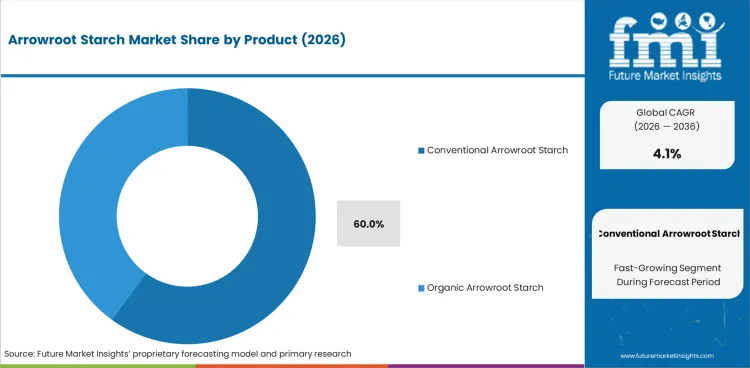
It is expected that conventional arrowroot starch will have the biggest share of the market in 2026, with 60% of the total. This leadership shows that food manufacturers should buy in bulk for bakery, sauce, and processed food applications where organic certification premiums aren't worth it.
In the realm of conventional grades, food-manufacturer-spec arrowroot with specific viscosity, moisture, and granulation profiles stands out as the primary procurement category. Nestle, Gerber, and Hain Celestial are some of the big food companies that use regular arrowroot in baby food, sauces, and clean-label baked goods.
It is expected that conventional arrowroot will keep most of its market share until 2036. Organic-grade arrowroot is the fastest-growing sub-segment, with annual growth rates of 12% to 15%. However, the absolute volumes are still smaller than those of conventional arrowroot. Specialty grades like Paleo-certified and non-GMO verified give you a little more pricing power but not a lot of market share.
Insights into the Food and Beverage Applications Segment
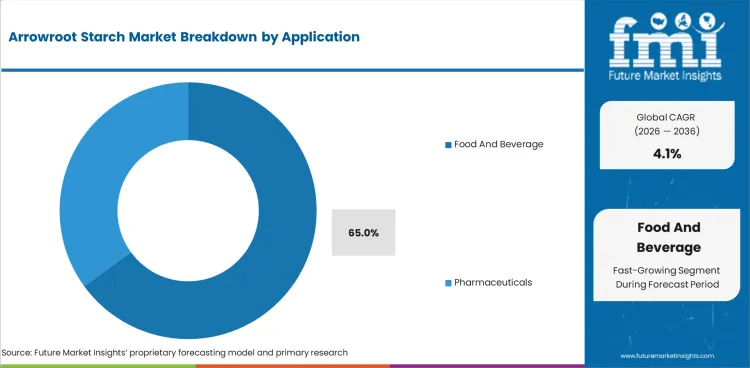
In 2026, food and drink applications are expected to make up 65% of the application segment. The three biggest sub-applications by volume are bakery, sauces and dressings, and baby food.
Baby food applications cost a lot because of strict supplier quality standards. For example, Nestle, Gerber, and HiPP Organic get arrowroot for certain infant cereal and texture formulations. The gluten-free bakery is the fastest-growing sub-segment, thanks to people becoming more aware of celiac disease and choosing to live a grain-free lifestyle.
Arrowroot Starch Market Drivers, Restraints, and Opportunities
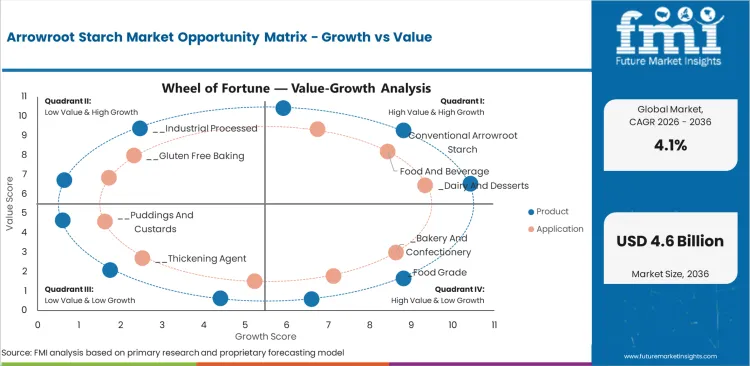
- Clean-label reformulation drives food manufacturer demand at 8% to 12% annual growth in developed markets.
- Grain-free and Paleo specialty baking supports organic arrowroot 30% to 50% price premiums.
- Tropical agricultural supply concentration creates 15% to 30% annual price volatility on conventional grades.
The arrowroot starch segment is shaped by clean-label reformulation, grain-free specialty baking demand, and tropical agricultural supply volatility. Constraints include production concentration in a small number of tropical geographies, ongoing substitution competition from tapioca and cornstarch, and price volatility that pressures margin stability.
Clean-Label Reformulation and Food Manufacturer Demand
Demand is shaped by food manufacturer reformulation replacing modified starches, xanthan gum, and synthetic thickeners with arrowroot in baby food, sauces, bakery, and processed food categories. North American and Western European food manufacturers including Nestle, Gerber, Hain Celestial, and Pinnacle Foods source arrowroot to meet consumer clean-label expectations. Annual demand growth of 8% to 12% in these regions reflects sustained reformulation momentum.
Grain-Free Specialty Baking and Organic Premium
Growth reflects grain-free, Paleo-aligned, and celiac-driven specialty baking demand supporting organic arrowroot at 30% to 50% price premiums versus conventional. Bob's Red Mill, Authentic Foods, Arrowhead Mills, and DTC specialty brands at Thrive Market drive category trial. Organic arrowroot subcategory growth at 12% to 15% annually outpaces conventional grade growth.
Global Supply Chain Diversification
Adoption is going up because the supply of tropical crops is growing beyond St. Vincent. India, Vietnam, Brazil, and Indonesia are all growing more export-grade arrowroot. Diversifying the supply lowers the risk of concentration and helps multinational food companies keep prices more stable. Tropical Traditions, NOW Foods, and Authentic Foods all get their ingredients from more than one place to deal with changes in harvest yields.
Price Volatility and Substitution Competition
Tropical harvest yield changes cause prices to change by 15% to 30% every year, which affects growth. Food makers have to choose between arrowroot, tapioca, cornstarch, and potato starch based on how much they cost and how well they work. Arrowroot is still the most popular choice for clean-label and grain-free positioning, but processed food categories that are less expensive often switch to other brands.
Analysis of Arrowroot Starch Market By Key Countries
.webp "Top Country Growth Comparison Arrowroot Starch Market Cagr (2026 2036)")
| Country | CAGR |
|---|---|
| China | 5.54% |
| India | 5.12% |
| Germany | 4.71% |
| Brazil | 4.30% |
| United States | 3.90% |
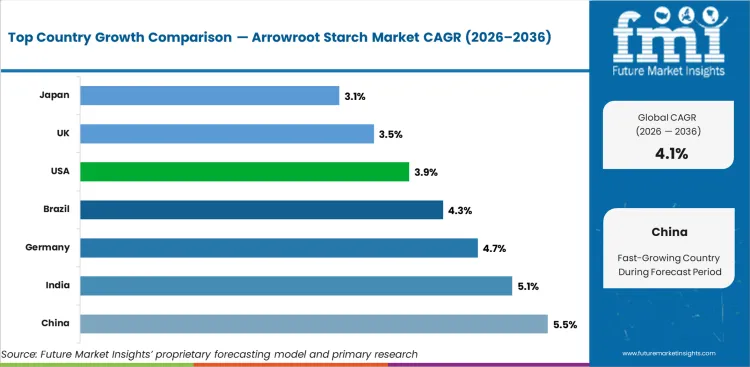
- North America and Western Europe have the highest demand for arrowroot overall, thanks to food manufacturers and specialty stores. The Asia Pacific region has the highest CAGR, thanks to urban health-food adoption.
- China is growing the fastest, at 5.5% CAGR, thanks to the growth of clean-label packaged food and e-commerce specialty retail.
- India's economy grows at a rate of 5.1% per year, thanks to both domestic demand for specialty baking and the growth of arrowroot export production capacity.
- As clean-label reformulation continues to gain ground, mature markets like the US and UK grow at a rate of 3.5% to 3.9% CAGR.
The arrowroot starch market is projected to grow globally at a CAGR of 4.1% from 2026 to 2036. Among the top markets, China leads at 5.54%, India records 5.12%, Germany records 4.71%, Brazil records 4.30%, United States records 3.90%. The analysis spans over 30 countries, with the leading markets detailed below.
Demand Outlook for Arrowroot Starch Market in the United States
The United States is projected to grow at 3.9% CAGR through 2036, shaped by clean-label reformulation at Nestle, Gerber, Hain Celestial, and private-label food manufacturers, grain-free specialty baking at Bob's Red Mill, Authentic Foods, and Arrowhead Mills, and organic retail category expansion at Whole Foods, Sprouts, and Thrive Market.
- Clean-label reformulation at Nestle, Gerber, and Hain Celestial drives bulk procurement demand.
- Bob's Red Mill, Authentic Foods, and Arrowhead Mills lead specialty retail brand competition.
- Whole Foods, Sprouts, and Thrive Market drive organic arrowroot category growth.
Future Outlook for Arrowroot Starch Market in the United Kingdom
The United Kingdom demonstrates steady growth at 3.5% CAGR through 2036, supported by clean-label reformulation at major food manufacturers, grain-free specialty baking growth, and organic retail expansion at Waitrose, Planet Organic, and Holland and Barrett. Domestic specialty brands including Doves Farm and Shipton Mill lead gluten-free bakery positioning. UK food regulation on modified starch labeling incentivizes arrowroot substitution.
- Doves Farm and Shipton Mill lead UK specialty gluten-free retail branded positioning.
- Waitrose, Planet Organic, and Holland and Barrett drive premium organic category.
- UK food regulation on modified starch labels incentivizes arrowroot substitution.
Opportunity Analysis of Arrowroot Starch Market in Germany
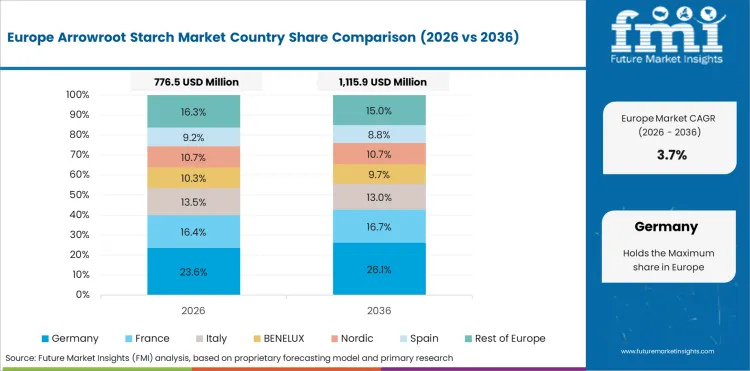
Germany is projected to grow at 4.7% CAGR through 2036, propelled by clean-label food manufacturer reformulation, grain-free specialty retail expansion at Alnatura and dm-drogerie, and Bio-Siegel organic certification driving premium category. Domestic specialty brands including Bauckhof and Rapunzel compete alongside imports from Bob's Red Mill and Authentic Foods. EU organic regulation under Regulation EU 2018/848 shapes certification requirements.
- Alnatura and dm-drogerie drive specialty retail category expansion at scale.
- Bauckhof and Rapunzel lead domestic organic-specialty branded positioning.
- EU Regulation 2018/848 organic certification shapes premium category pricing.
In-depth Analysis of Arrowroot Starch Market in Japan
Japan is projected to grow at 3.1% CAGR through 2036, reflecting specialty food manufacturer usage in confectionery and traditional bakery, gluten-free category development driven by health-conscious urban consumers, and premium imported positioning. Domestic distribution through Kaldi Coffee Farm, Seijo Ishii, and specialty supermarkets drives retail demand. Imported brands including Bob's Red Mill and Authentic Foods maintain premium retail positioning.
- Kaldi Coffee Farm and Seijo Ishii specialty retail drives imported arrowroot category.
- Specialty confectionery and traditional wagashi applications sustain industrial demand.
- Gluten-free category development at Tokyu Store and Aeon drives premium retail.
Sales Analysis of Arrowroot Starch Market in China
China is projected to grow at 5.5% CAGR through 2036, propelled by clean-label packaged food development, specialty retail category expansion at Ole and BHG Supermarkets, and e-commerce premium positioning at Tmall and JD.com. Domestic brands including Cofco and Yihai Kerry compete with imports from Bob's Red Mill and Authentic Foods. Tmall Global cross-border channels accelerate imported specialty arrowroot reach.
- Tmall, JD.com, and Pinduoduo drive e-commerce specialty category growth.
- Ole and BHG Supermarkets lead premium offline specialty retail positioning.
- Cofco and Yihai Kerry lead domestic branded competition against imports.
In-depth Analysis of Arrowroot Starch Market in India
India grows at 5.1% CAGR through 2036, supported by both domestic consumption growth and export production capacity. Indian arrowroot cultivation in Kerala, Tamil Nadu, and Karnataka supplies both domestic food manufacturing and export markets. Domestic brands including 24 Mantra Organic, Conscious Food, and Pro Nature lead specialty retail. Nature's Basket, Foodhall, and Amazon India drive premium distribution.
- Kerala, Tamil Nadu, and Karnataka arrowroot cultivation supports both domestic and export supply.
- 24 Mantra Organic and Conscious Food lead domestic organic specialty retail positioning.
- Nature's Basket and Foodhall drive premium metropolitan retail distribution.
Competitive Landscape and Strategic Positioning
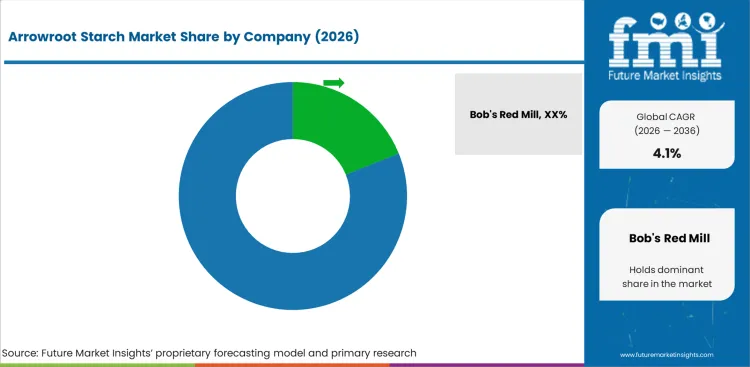
- Bob's Red Mill and NOW Foods together own more than 30% of the North American retail arrowroot branded share. They got this by positioning themselves as specialty bakers and distributing their products widely through specialty stores.
- Doves Farm (UK), Bauckhof (Germany), and Tropical Traditions (USA) are examples of regional specialists that have strong brand presence in their own areas.
- Nestle, Gerber, and Hain Celestial are three companies that make private-label and food products. Together, they account for more than 60% of all arrowroot volume
Specialty retail brands, suppliers of industrial ingredients, and tropical origin commodity producers all play a role in the arrowroot starch market. Bob's Red Mill is the most popular brand in North America for baking specialty. It has a strong direct-to-consumer channel on Thrive Market, Amazon, and Bob's Red Mill online.
NOW Foods has a significant share of the North American market for branded products through its specialty supplement and baking retail positioning. Authentic Foods makes professional-grade arrowroot mixes for gluten-free specialty baking.
Nature's Way has a wider retail distribution that helps the natural food category. For specialty retail, Tropical Traditions puts a lot of emphasis on sourcing from multiple places and getting organic certification. Doves Farm and Shipton Mill are the best places in the UK to buy gluten-free foods.
Some of the things that make it hard to get into the market are developing a network for sourcing tropical goods, building infrastructure for organic certification, and competing for shelf space in specialty stores. Strategic priorities include expanding organic certification, developing the e-commerce DTC channel, and buying goods from multiple sources to deal with supply volatility.
Major Industry Players
Key global companies leading the arrowroot starch market include:
- Bob's Red Mill (USA), NOW Foods (USA), Authentic Foods (USA), and Nature's Way (USA) were identified as some of the star players in the arrowroot starch market, given their specialty retail presence, organic certification coverage, and product ranges spanning specialty baking, thickening, and bulk procurement grades.
- Tropical Traditions (USA), Doves Farm (UK), and Bauckhof (Germany) have established strong regional positions by emphasizing multi-origin sourcing, organic certification, and specialty gluten-free retail positioning across North American and European markets.
- Arrowhead Mills (USA), Rapunzel (Germany), and 24 Mantra Organic (India), among others, have distinguished themselves by securing strong footholds in specialized niche areas focused on Paleo-certified, non-GMO, and organic arrowroot positioning, underscoring their momentum in premium specialty retail.
Competitive Benchmarking: Arrowroot Starch Market
| Company | Specialty Retail Reach | Organic Certification | Multi-Origin Sourcing | Geographic Footprint |
|---|---|---|---|---|
| Bob's Red Mill | Strong | High | Medium | North America, Global |
| NOW Foods | Strong | High | Medium | North America |
| Authentic Foods | Medium | High | Low | North America |
| Nature's Way | Medium | Medium | Low | North America |
| Tropical Traditions | Medium | High | High | North America |
| Doves Farm | Strong | High | Medium | UK, Europe |
| Bauckhof | Medium | High | Medium | Germany, Europe |
| Arrowhead Mills | Medium | Medium | Low | North America |
| Rapunzel | Medium | High | Low | Germany, Europe |
| 24 Mantra Organic | Low | High | Low | India |
Source: Future Market Insights competitive analysis, 2026.
Key Developments in Arrowroot Starch Market
- In 2025, Bob’s Red Mill expanded its arrowroot‑starch sourcing and supply‑chain reach, including stronger ties to major arrowroot‑producing regions such as India and Southeast Asia, to support growing organic‑and gluten‑free product lines and reduce supply‑chain volatility.
- In 2025, gluten‑free flour‑and‑blend suppliers such as Authentic Foods broadened their arrowroot‑based formulations for commercial gluten‑free baking, targeting foodservice and specialty‑bakery operators seeking professional‑grade, label‑friendly blends for cakes, breads, and pastries.
Key Players in the Arrowroot Starch Market
Major Global Players:
- Bob's Red Mill
- NOW Foods
- Authentic Foods
- Nature's Way
- Tropical Traditions
- Doves Farm
- Bauckhof
Emerging Players/Startups
- Arrowhead Mills
- Rapunzel
- 24 Mantra Organic
Scope of the report
| Metric | Value |
|---|---|
| Quantitative Units | USD 3.05 billion to USD 4.56 billion, at a CAGR of 4.1% |
| Market Definition | The arrowroot starch market encompasses commercial-grade arrowroot powder and starch extracted from Maranta arundinacea and related tropical tubers, used as thickening agent, binding agent, and gluten-free flour substitute. Product scope covers conventional, organic, and specialty-grade arrowroot sold through business-to-business food manufacturer channels, foodservice distribution, and consumer retail. |
| Regions Covered | North America, Latin America, Europe, East Asia, South Asia and Pacific, Middle East and Africa |
| Countries Covered | India, China, USA, UK, Germany, Japan, South Korea, Brazil, 30 plus countries |
| Key Companies Profiled | Bob's Red Mill, NOW Foods, Authentic Foods, Nature's Way, Tropical Traditions, Doves Farm, Bauckhof, Arrowhead Mills, Rapunzel, 24 Mantra Organic |
| Forecast Period | 2026 to 2036 |
| Approach | Hybrid bottom-up and top-down methodology starting with verified arrowroot starch transaction data, projecting adoption velocity across segments and regions. |
Market Segmentation Analysis
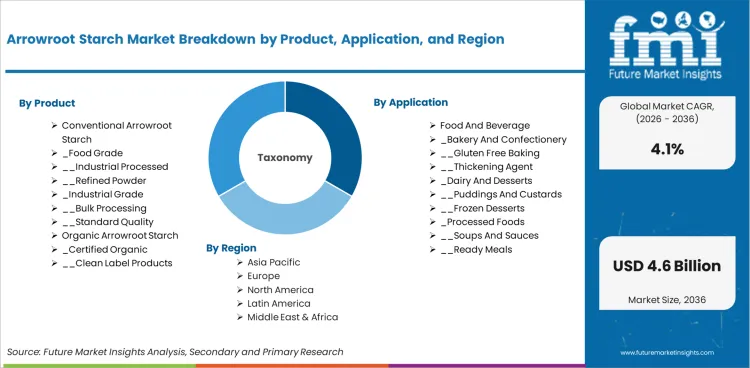
Arrowroot Starch Market Market Segmented by Product:
- Conventional Arrowroot Starch
- Food Grade
- Industrial Processed
- Refined Powder
- Industrial Grade
- Bulk Processing
- Standard Quality
- Food Grade
- Organic Arrowroot Starch
- Certified Organic
- Clean Label Products
- Premium Grade
- Unrefined
- Minimally Processed
- Natural Variants
- Certified Organic
Arrowroot Starch Market Market Segmented by Application:
- Food And Beverage
- Bakery And Confectionery
- Gluten Free Baking
- Thickening Agent
- Dairy And Desserts
- Puddings And Custards
- Frozen Desserts
- Processed Foods
- Soups And Sauces
- Ready Meals
- Bakery And Confectionery
- Pharmaceuticals
- Tablet Binding
- Disintegrant Use
- Filler Applications
- Tablet Binding
- Personal Care And Cosmetics
- Skin Care Products
- Powder Formulations
- Natural Cosmetics
- Hair Care Products
- Dry Shampoos
- Scalp Treatments
- Skin Care Products
Arrowroot Starch Market Market Segmented by End Use:
- Food Manufacturers
- Large Scale Manufacturers
- Processed Food Companies
- Bakery Producers
- Small Scale Producers
- Artisanal Brands
- Local Producers
- Large Scale Manufacturers
- Pharmaceutical Companies
- Generic Drug Manufacturers
- Tablet Producers
- Capsule Manufacturers
- Generic Drug Manufacturers
- Personal Care Manufacturers
- Cosmetic Brands
- Natural Product Brands
- Organic Product Manufacturers
- Cosmetic Brands
Arrowroot Starch Market Market Segmented by Distribution Channel:
- Business To Business
- Direct Sales
- Bulk Contracts
- Long Term Supply Agreements
- Distributors And Wholesalers
- Ingredient Suppliers
- Industrial Distributors
- Direct Sales
- Business To Consumer
- Retail Stores
- Supermarkets And Hypermarkets
- Specialty Stores
- Online Retail
- E Commerce Platforms
- Brand Owned Websites
- Retail Stores
Arrowroot Starch Market Market Segmented by Function:
- Thickening Agent
- Food Thickening
- Sauces And Gravies
- Desserts And Fillings
- Food Thickening
- Stabilizer
- Texture Enhancement
- Processed Foods
- Cosmetic Formulations
- Texture Enhancement
- Binding Agent
- Pharmaceutical Binding
- Tablet Formulations
- Capsule Formulations
- Pharmaceutical Binding
Arrowroot Starch Market Market Segmented by Source:
- Natural Plant Based
- Arrowroot Rhizomes
- Traditional Cultivation
- Commercial Cultivation
- Arrowroot Rhizomes
Arrowroot Starch Market Market Segmented by Pricing Tier:
- Mid Range
- Standard Quality Products
- Industrial Grade Supply
- Standard Quality Products
- Economy
- Bulk Commodity Products
- Low Cost Supply
- Bulk Commodity Products
- Premium
- Organic And Specialty Products
- Certified Organic
- High Purity Starch
- Organic And Specialty Products
Arrowroot Starch Market Market by Region:
- North America
- USA
- Canada
- Mexico
- Latin America
- Brazil
- Chile
- Rest of Latin America
- Western Europe
- Germany
- UK
- Italy
- Spain
- France
- Nordic
- BENELUX
- Rest of Western Europe
- Eastern Europe
- Russia
- Poland
- Hungary
- Balkan & Baltic
- Rest of Eastern Europe
- East Asia
- China
- Japan
- South Korea
- South Asia and Pacific
- India
- ASEAN
- Australia & New Zealand
- Rest of South Asia and Pacific
- Middle East & Africa
- Kingdom of Saudi Arabia
- Other GCC Countries
- Turkiye
- South Africa
- Other African Union
- Rest of Middle East & Africa
Bibliography
- 1. Food and Agriculture Organization. (2025). FAO Tropical Roots and Tubers Statistics. FAO.
- 2. USA Department of Agriculture. (2024). USDA National Organic Program Certification Data. USDA NOP.
- 3. European Commission. (2024). EU Organic Regulation 2018/848 Implementation Guidance. European Commission.
- 4. Food Safety and Standards Authority of India. (2025). FSSAI Specialty Starch and Flour Regulations. FSSAI.
- 5. International Tropical Roots and Tubers Society. (2024). Global Arrowroot Production and Trade Analysis. ITRTS.
This bibliography is provided for reader reference.
This Report Addresses
- Market sizing and revenue forecasting for arrowroot starch products from 2026 to 2036.
- Segmentation analysis across all product, application, end-use, and distribution-channel axes covered in Section 4.
- Regional and country-level insights covering over 30 markets with comparative growth analysis.
- Regulatory analysis covering the key frameworks shaping product specifications and procurement priorities in major markets.
- Competitive landscape assessment covering market structure, vendor positioning, and recent developments.
- Investment opportunity mapping across supplier, brand-owner, and channel verticals.
- Supply chain tracking from raw material sourcing to finished product distribution.
- Data delivery in PDF and Excel formats with quarterly refresh access.
Frequently Asked Questions
How large is the demand for Arrowroot Starch Market in the global market in 2026?
Demand for arrowroot starch market in the global market is estimated to be valued at USD 3.05 billion in 2026.
What will be the market size of Arrowroot Starch Market by 2036?
Market size for arrowroot starch market is projected to reach USD 4.56 billion by 2036.
What is the expected demand growth for Arrowroot Starch Market between 2026 and 2036?
Demand for arrowroot starch market is expected to grow at a CAGR of 4.1% between 2026 and 2036.
Which Product is poised to lead global sales by 2026?
Conventional Arrowroot Starch accounts for 60.0% in 2026, reflecting established manufacturing infrastructure and proven performance advantages.
How is Business To Business driving Arrowroot Starch Market adoption?
Business To Business represents 70.0% of distribution channel demand as dominant operators and procurement organizations drive volume.
What is driving demand in the top-growth country?
China registers a 5.54% CAGR through 2036, propelled by policy mandates, category adoption, and procurement-scale investment.
What does Arrowroot Starch Market definition mean in this report?
The arrowroot starch market oot starch market encompasses commercial-grade arrowroot powder and starch extracted from Maranta arundinacea and related tropical tubers, used as thickening agent, binding agent, and gluten-free flour substitute. Product scope covers conventional, organic, and specialty-grade arrowroot sold through business-to-business food manufacturer channels, foodservice distribution, and consumer retail.
How does FMI build and validate the Arrowroot Starch Market forecast?
Forecasting models apply a hybrid bottom-up methodology starting with verified transaction data, cross-validated against industry sales statistics and manufacturer financial disclosures.
Preview the report firsthand - request a free sample
Get SampleGet the brochure for pricing and purchase details.
Get PDFTable of Content
- Executive Summary
- Global Market Outlook
- Demand-side Trends
- Supply-side Trends
- Technology Roadmap Analysis
- Analysis and Recommendations
- Market Overview
- Market Coverage / Taxonomy
- Market Definition / Scope / Limitations
- Research Methodology
- Chapter Orientation
- Analytical Lens and Working Hypotheses
- Market Structure, Signals, and Trend Drivers
- Benchmarking and Cross-market Comparability
- Market Sizing, Forecasting, and Opportunity Mapping
- Research Design and Evidence Framework
- Desk Research Programme (Secondary Evidence)
- Company Annual and Sustainability Reports
- Peer-reviewed Journals and Academic Literature
- Corporate Websites, Product Literature, and Technical Notes
- Earnings Decks and Investor Briefings
- Statutory Filings and Regulatory Disclosures
- Technical White Papers and Standards Notes
- Trade Journals, Industry Magazines, and Analyst Briefs
- Conference Proceedings, Webinars, and Seminar Materials
- Government Statistics Portals and Public Data Releases
- Press Releases and Reputable Media Coverage
- Specialist Newsletters and Curated Briefings
- Sector Databases and Reference Repositories
- FMI Internal Proprietary Databases and Historical Market Datasets
- Subscription Datasets and Paid Sources
- Social Channels, Communities, and Digital Listening Inputs
- Additional Desk Sources
- Expert Input and Fieldwork (Primary Evidence)
- Primary Modes
- Qualitative Interviews and Expert Elicitation
- Quantitative Surveys and Structured Data Capture
- Blended Approach
- Why Primary Evidence is Used
- Field Techniques
- Interviews
- Surveys
- Focus Groups
- Observational and In-context Research
- Social and Community Interactions
- Stakeholder Universe Engaged
- C-suite Leaders
- Board Members
- Presidents and Vice Presidents
- R&D and Innovation Heads
- Technical Specialists
- Domain Subject-matter Experts
- Scientists
- Physicians and Other Healthcare Professionals
- Governance, Ethics, and Data Stewardship
- Research Ethics
- Data Integrity and Handling
- Primary Modes
- Tooling, Models, and Reference Databases
- Desk Research Programme (Secondary Evidence)
- Data Engineering and Model Build
- Data Acquisition and Ingestion
- Cleaning, Normalisation, and Verification
- Synthesis, Triangulation, and Analysis
- Quality Assurance and Audit Trail
- Market Background
- Market Dynamics
- Drivers
- Restraints
- Opportunity
- Trends
- Scenario Forecast
- Demand in Optimistic Scenario
- Demand in Likely Scenario
- Demand in Conservative Scenario
- Opportunity Map Analysis
- Product Life Cycle Analysis
- Supply Chain Analysis
- Investment Feasibility Matrix
- Value Chain Analysis
- PESTLE and Porter’s Analysis
- Regulatory Landscape
- Regional Parent Market Outlook
- Production and Consumption Statistics
- Import and Export Statistics
- Market Dynamics
- Global Market Analysis 2021 to 2025 and Forecast, 2026 to 2036
- Historical Market Size Value (USD Million) Analysis, 2021 to 2025
- Current and Future Market Size Value (USD Million) Projections, 2026 to 2036
- Y-o-Y Growth Trend Analysis
- Absolute $ Opportunity Analysis
- Global Market Pricing Analysis 2021 to 2025 and Forecast 2026 to 2036
- Global Market Analysis 2021 to 2025 and Forecast 2026 to 2036, By Product
- Introduction / Key Findings
- Historical Market Size Value (USD Million) Analysis By Product , 2021 to 2025
- Current and Future Market Size Value (USD Million) Analysis and Forecast By Product , 2026 to 2036
- Conventional Arrowroot Starch
- Food Grade
- Industrial Processed
- Refined Powder
- Industrial Grade
- Bulk Processing
- Standard Quality
- Organic Arrowroot Starch
- Certified Organic
- Clean Label Products
- Premium Grade
- Unrefined
- Minimally Processed
- Conventional Arrowroot Starch
- Y-o-Y Growth Trend Analysis By Product , 2021 to 2025
- Absolute $ Opportunity Analysis By Product , 2026 to 2036
- Global Market Analysis 2021 to 2025 and Forecast 2026 to 2036, By Application
- Introduction / Key Findings
- Historical Market Size Value (USD Million) Analysis By Application, 2021 to 2025
- Current and Future Market Size Value (USD Million) Analysis and Forecast By Application, 2026 to 2036
- Food And Beverage
- Bakery And Confectionery
- Gluten Free Baking
- Thickening Agent
- Dairy And Desserts
- Puddings And Custards
- Frozen Desserts
- Processed Foods
- Soups And Sauces
- Ready Meals
- Pharmaceuticals
- Tablet Binding
- Disintegrant Use
- Filler Applications
- Personal Care And Cosmetics
- Skin Care Products
- Powder Formulations
- Natural Cosmetics
- Hair Care Products
- Dry Shampoos
- Food And Beverage
- Y-o-Y Growth Trend Analysis By Application, 2021 to 2025
- Absolute $ Opportunity Analysis By Application, 2026 to 2036
- Global Market Analysis 2021 to 2025 and Forecast 2026 to 2036, By End Use
- Introduction / Key Findings
- Historical Market Size Value (USD Million) Analysis By End Use, 2021 to 2025
- Current and Future Market Size Value (USD Million) Analysis and Forecast By End Use, 2026 to 2036
- Food Manufacturers
- Large Scale Manufacturers
- Processed Food Companies
- Bakery Producers
- Small Scale Producers
- Artisanal Brands
- Local Producers
- Pharmaceutical Companies
- Generic Drug Manufacturers
- Tablet Producers
- Capsule Manufacturers
- Personal Care Manufacturers
- Cosmetic Brands
- Natural Product Brands
- Organic Product Manufacturers
- Food Manufacturers
- Y-o-Y Growth Trend Analysis By End Use, 2021 to 2025
- Absolute $ Opportunity Analysis By End Use, 2026 to 2036
- Global Market Analysis 2021 to 2025 and Forecast 2026 to 2036, By Distribution Channel
- Introduction / Key Findings
- Historical Market Size Value (USD Million) Analysis By Distribution Channel, 2021 to 2025
- Current and Future Market Size Value (USD Million) Analysis and Forecast By Distribution Channel, 2026 to 2036
- Business To Business
- Direct Sales
- Bulk Contracts
- Long Term Supply Agreements
- Distributors And Wholesalers
- Ingredient Suppliers
- Industrial Distributors
- Business To Consumer
- Retail Stores
- Supermarkets And Hypermarkets
- Specialty Stores
- Online Retail
- E Commerce Platforms
- Business To Business
- Y-o-Y Growth Trend Analysis By Distribution Channel, 2021 to 2025
- Absolute $ Opportunity Analysis By Distribution Channel, 2026 to 2036
- Global Market Analysis 2021 to 2025 and Forecast 2026 to 2036, By Function
- Introduction / Key Findings
- Historical Market Size Value (USD Million) Analysis By Function, 2021 to 2025
- Current and Future Market Size Value (USD Million) Analysis and Forecast By Function, 2026 to 2036
- Thickening Agent
- Food Thickening
- Sauces And Gravies
- Desserts And Fillings
- Stabilizer
- Texture Enhancement
- Processed Foods
- Cosmetic Formulations
- Binding Agent
- Pharmaceutical Binding
- Tablet Formulations
- Capsule Formulations
- Thickening Agent
- Y-o-Y Growth Trend Analysis By Function, 2021 to 2025
- Absolute $ Opportunity Analysis By Function, 2026 to 2036
- Global Market Analysis 2021 to 2025 and Forecast 2026 to 2036, By Source
- Introduction / Key Findings
- Historical Market Size Value (USD Million) Analysis By Source, 2021 to 2025
- Current and Future Market Size Value (USD Million) Analysis and Forecast By Source, 2026 to 2036
- Natural Plant Based
- Arrowroot Rhizomes
- Traditional Cultivation
- Commercial Cultivation
- Natural Plant Based
- Y-o-Y Growth Trend Analysis By Source, 2021 to 2025
- Absolute $ Opportunity Analysis By Source, 2026 to 2036
- Global Market Analysis 2021 to 2025 and Forecast 2026 to 2036, By Pricing Tier
- Introduction / Key Findings
- Historical Market Size Value (USD Million) Analysis By Pricing Tier, 2021 to 2025
- Current and Future Market Size Value (USD Million) Analysis and Forecast By Pricing Tier, 2026 to 2036
- Mid Range
- Standard Quality Products
- Industrial Grade Supply
- Economy
- Bulk Commodity Products
- Low Cost Supply
- Premium
- Organic And Specialty Products
- Certified Organic
- High Purity Starch
- Mid Range
- Y-o-Y Growth Trend Analysis By Pricing Tier, 2021 to 2025
- Absolute $ Opportunity Analysis By Pricing Tier, 2026 to 2036
- Global Market Analysis 2021 to 2025 and Forecast 2026 to 2036, By Region
- Introduction
- Historical Market Size Value (USD Million) Analysis By Region, 2021 to 2025
- Current Market Size Value (USD Million) Analysis and Forecast By Region, 2026 to 2036
- North America
- Latin America
- Western Europe
- Eastern Europe
- East Asia
- South Asia and Pacific
- Middle East & Africa
- Market Attractiveness Analysis By Region
- North America Market Analysis 2021 to 2025 and Forecast 2026 to 2036, By Country
- Historical Market Size Value (USD Million) Trend Analysis By Market Taxonomy, 2021 to 2025
- Market Size Value (USD Million) Forecast By Market Taxonomy, 2026 to 2036
- By Country
- USA
- Canada
- Mexico
- By Product
- By Application
- By End Use
- By Distribution Channel
- By Function
- By Source
- By Pricing Tier
- By Country
- Market Attractiveness Analysis
- By Country
- By Product
- By Application
- By End Use
- By Distribution Channel
- By Function
- By Source
- By Pricing Tier
- Key Takeaways
- Latin America Market Analysis 2021 to 2025 and Forecast 2026 to 2036, By Country
- Historical Market Size Value (USD Million) Trend Analysis By Market Taxonomy, 2021 to 2025
- Market Size Value (USD Million) Forecast By Market Taxonomy, 2026 to 2036
- By Country
- Brazil
- Chile
- Rest of Latin America
- By Product
- By Application
- By End Use
- By Distribution Channel
- By Function
- By Source
- By Pricing Tier
- By Country
- Market Attractiveness Analysis
- By Country
- By Product
- By Application
- By End Use
- By Distribution Channel
- By Function
- By Source
- By Pricing Tier
- Key Takeaways
- Western Europe Market Analysis 2021 to 2025 and Forecast 2026 to 2036, By Country
- Historical Market Size Value (USD Million) Trend Analysis By Market Taxonomy, 2021 to 2025
- Market Size Value (USD Million) Forecast By Market Taxonomy, 2026 to 2036
- By Country
- Germany
- UK
- Italy
- Spain
- France
- Nordic
- BENELUX
- Rest of Western Europe
- By Product
- By Application
- By End Use
- By Distribution Channel
- By Function
- By Source
- By Pricing Tier
- By Country
- Market Attractiveness Analysis
- By Country
- By Product
- By Application
- By End Use
- By Distribution Channel
- By Function
- By Source
- By Pricing Tier
- Key Takeaways
- Eastern Europe Market Analysis 2021 to 2025 and Forecast 2026 to 2036, By Country
- Historical Market Size Value (USD Million) Trend Analysis By Market Taxonomy, 2021 to 2025
- Market Size Value (USD Million) Forecast By Market Taxonomy, 2026 to 2036
- By Country
- Russia
- Poland
- Hungary
- Balkan & Baltic
- Rest of Eastern Europe
- By Product
- By Application
- By End Use
- By Distribution Channel
- By Function
- By Source
- By Pricing Tier
- By Country
- Market Attractiveness Analysis
- By Country
- By Product
- By Application
- By End Use
- By Distribution Channel
- By Function
- By Source
- By Pricing Tier
- Key Takeaways
- East Asia Market Analysis 2021 to 2025 and Forecast 2026 to 2036, By Country
- Historical Market Size Value (USD Million) Trend Analysis By Market Taxonomy, 2021 to 2025
- Market Size Value (USD Million) Forecast By Market Taxonomy, 2026 to 2036
- By Country
- China
- Japan
- South Korea
- By Product
- By Application
- By End Use
- By Distribution Channel
- By Function
- By Source
- By Pricing Tier
- By Country
- Market Attractiveness Analysis
- By Country
- By Product
- By Application
- By End Use
- By Distribution Channel
- By Function
- By Source
- By Pricing Tier
- Key Takeaways
- South Asia and Pacific Market Analysis 2021 to 2025 and Forecast 2026 to 2036, By Country
- Historical Market Size Value (USD Million) Trend Analysis By Market Taxonomy, 2021 to 2025
- Market Size Value (USD Million) Forecast By Market Taxonomy, 2026 to 2036
- By Country
- India
- ASEAN
- Australia & New Zealand
- Rest of South Asia and Pacific
- By Product
- By Application
- By End Use
- By Distribution Channel
- By Function
- By Source
- By Pricing Tier
- By Country
- Market Attractiveness Analysis
- By Country
- By Product
- By Application
- By End Use
- By Distribution Channel
- By Function
- By Source
- By Pricing Tier
- Key Takeaways
- Middle East & Africa Market Analysis 2021 to 2025 and Forecast 2026 to 2036, By Country
- Historical Market Size Value (USD Million) Trend Analysis By Market Taxonomy, 2021 to 2025
- Market Size Value (USD Million) Forecast By Market Taxonomy, 2026 to 2036
- By Country
- Kingdom of Saudi Arabia
- Other GCC Countries
- Turkiye
- South Africa
- Other African Union
- Rest of Middle East & Africa
- By Product
- By Application
- By End Use
- By Distribution Channel
- By Function
- By Source
- By Pricing Tier
- By Country
- Market Attractiveness Analysis
- By Country
- By Product
- By Application
- By End Use
- By Distribution Channel
- By Function
- By Source
- By Pricing Tier
- Key Takeaways
- Key Countries Market Analysis
- USA
- Pricing Analysis
- Market Share Analysis, 2025
- By Product
- By Application
- By End Use
- By Distribution Channel
- By Function
- By Source
- By Pricing Tier
- Canada
- Pricing Analysis
- Market Share Analysis, 2025
- By Product
- By Application
- By End Use
- By Distribution Channel
- By Function
- By Source
- By Pricing Tier
- Mexico
- Pricing Analysis
- Market Share Analysis, 2025
- By Product
- By Application
- By End Use
- By Distribution Channel
- By Function
- By Source
- By Pricing Tier
- Brazil
- Pricing Analysis
- Market Share Analysis, 2025
- By Product
- By Application
- By End Use
- By Distribution Channel
- By Function
- By Source
- By Pricing Tier
- Chile
- Pricing Analysis
- Market Share Analysis, 2025
- By Product
- By Application
- By End Use
- By Distribution Channel
- By Function
- By Source
- By Pricing Tier
- Germany
- Pricing Analysis
- Market Share Analysis, 2025
- By Product
- By Application
- By End Use
- By Distribution Channel
- By Function
- By Source
- By Pricing Tier
- UK
- Pricing Analysis
- Market Share Analysis, 2025
- By Product
- By Application
- By End Use
- By Distribution Channel
- By Function
- By Source
- By Pricing Tier
- Italy
- Pricing Analysis
- Market Share Analysis, 2025
- By Product
- By Application
- By End Use
- By Distribution Channel
- By Function
- By Source
- By Pricing Tier
- Spain
- Pricing Analysis
- Market Share Analysis, 2025
- By Product
- By Application
- By End Use
- By Distribution Channel
- By Function
- By Source
- By Pricing Tier
- France
- Pricing Analysis
- Market Share Analysis, 2025
- By Product
- By Application
- By End Use
- By Distribution Channel
- By Function
- By Source
- By Pricing Tier
- India
- Pricing Analysis
- Market Share Analysis, 2025
- By Product
- By Application
- By End Use
- By Distribution Channel
- By Function
- By Source
- By Pricing Tier
- ASEAN
- Pricing Analysis
- Market Share Analysis, 2025
- By Product
- By Application
- By End Use
- By Distribution Channel
- By Function
- By Source
- By Pricing Tier
- Australia & New Zealand
- Pricing Analysis
- Market Share Analysis, 2025
- By Product
- By Application
- By End Use
- By Distribution Channel
- By Function
- By Source
- By Pricing Tier
- China
- Pricing Analysis
- Market Share Analysis, 2025
- By Product
- By Application
- By End Use
- By Distribution Channel
- By Function
- By Source
- By Pricing Tier
- Japan
- Pricing Analysis
- Market Share Analysis, 2025
- By Product
- By Application
- By End Use
- By Distribution Channel
- By Function
- By Source
- By Pricing Tier
- South Korea
- Pricing Analysis
- Market Share Analysis, 2025
- By Product
- By Application
- By End Use
- By Distribution Channel
- By Function
- By Source
- By Pricing Tier
- Russia
- Pricing Analysis
- Market Share Analysis, 2025
- By Product
- By Application
- By End Use
- By Distribution Channel
- By Function
- By Source
- By Pricing Tier
- Poland
- Pricing Analysis
- Market Share Analysis, 2025
- By Product
- By Application
- By End Use
- By Distribution Channel
- By Function
- By Source
- By Pricing Tier
- Hungary
- Pricing Analysis
- Market Share Analysis, 2025
- By Product
- By Application
- By End Use
- By Distribution Channel
- By Function
- By Source
- By Pricing Tier
- Kingdom of Saudi Arabia
- Pricing Analysis
- Market Share Analysis, 2025
- By Product
- By Application
- By End Use
- By Distribution Channel
- By Function
- By Source
- By Pricing Tier
- Turkiye
- Pricing Analysis
- Market Share Analysis, 2025
- By Product
- By Application
- By End Use
- By Distribution Channel
- By Function
- By Source
- By Pricing Tier
- South Africa
- Pricing Analysis
- Market Share Analysis, 2025
- By Product
- By Application
- By End Use
- By Distribution Channel
- By Function
- By Source
- By Pricing Tier
- USA
- Market Structure Analysis
- Competition Dashboard
- Competition Benchmarking
- Market Share Analysis of Top Players
- By Regional
- By Product
- By Application
- By End Use
- By Distribution Channel
- By Function
- By Source
- By Pricing Tier
- Competition Analysis
- Competition Deep Dive
- Bob's Red Mill
- Overview
- Product Portfolio
- Profitability by Market Segments (Product/Age /Sales Channel/Region)
- Sales Footprint
- Strategy Overview
- Marketing Strategy
- Product Strategy
- Channel Strategy
- NOW Foods
- Authentic Foods
- Nature's Way
- Tropical Traditions
- Pure Organic Ingredients
- Frontier Co-op
- Anthony's Goods
- Arrowhead Mills
- Barry Farm Foods
- Bob's Red Mill
- Competition Deep Dive
- Assumptions & Acronyms Used


