

- Industry Size (2026)
- USD 1261.4 Mn
- Forecast (2036)
- USD 2195.9 Mn
- CAGR (2026 to 2036)
- 5.7%
Arthroscopic Burrs and Blades Market Forecast and Outlook 2026 to 2036
The arthroscopic burrs and blades market is projected at USD 1,261.4 million in 2026 and USD 2,195.9 million by 2036 at a 5.7% CAGR. These tools sit inside operating rooms where turnover time, tray standardization, and case mix control daily usage. Surgeons select profiles by bone density, access angle, and debris management rather than by catalog breadth. Hospitals lock references into procedure cards, which fixes brands across service lines. Sterile processing limits rework through single use policies and traceability. Case volume planning drives reorder frequency. Purchasing reviews pack formats, shelf life, and vendor fill rates. Training burden and instrument hand feel influence preference during adoption and retention.
Factory and channel behavior shape availability and cost more than headline specifications. Production focuses on grind consistency, coating adhesion, and runout control to protect cut quality. Batch release relies on dimensional checks and balance verification. Packaging design aims to reduce handling damage and tray sorting errors. Distributors stage stock near surgery centers to meet short lead times. Returns rise when labeling or compatibility creates tray confusion. Portfolio breadth matters where surgeons keep multiple profiles approved. Margin follows yield, scrap control, and stable scheduling rather than promotional cycles. Long term agreements with hospital groups smooth demand and protect planning accuracy.
Quick Stats for Arthroscopic Burrs and Blades Market
- Arthroscopic Burrs and Blades Market Value (2026): USD 1,261.4 million
- Arthroscopic Burrs and Blades Market Forecast Value (2036): USD 2,195.9 million
- Arthroscopic Burrs and Blades Market Forecast CAGR (2026-2036): 5.7%
- Leading Type in Arthroscopic Burrs and Blades Market: Disposable burrs
- Key Growth Regions in Arthroscopic Burrs and Blades Market: Asia Pacific, North America, Europe
- Top Players in Arthroscopic Burrs and Blades Market: Stryker, Smith & Nephew, Arthrex, DePuy Synthes, ConMed
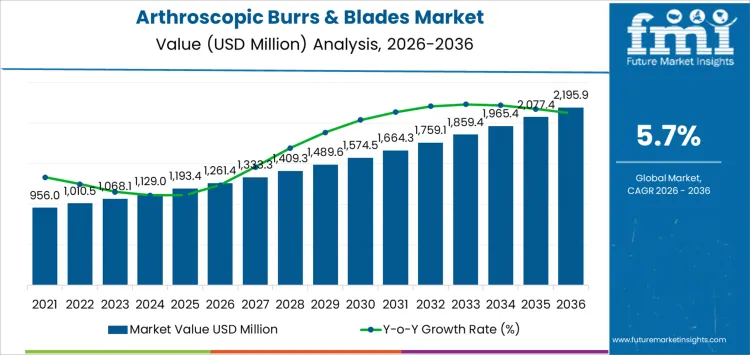
What Is the Growth Forecast for the Arthroscopic Burrs and Blades Market through 2036?
Clinical procedure mix and standardization of surgical instruments influence purchasing decisions in the arthroscopic burrs and blades segment more than overall arthroscopy volumes. In the near term, demand is strongest in knee, shoulder, and hip surgeries where cutting precision and operating time directly affect outcomes, surgeon efficiency, and operating room throughput. Hospitals and ambulatory surgery centers typically select specific burr and blade families during major platform evaluations and then stay committed through long contracting periods. As minimally invasive techniques expand into a wider set of indications and more orthopedic cases shift to outpatient settings, usage increases steadily. Growth is shaped by broader penetration in sports medicine and degenerative joint treatment, with ordering patterns closely linked to case mix, surgeon preference, and service line planning rather than short purchasing cycles.
In the later phase, market dynamics are driven by reliability and consistency rather than rapid innovation. Buyers increasingly prioritize predictable cutting performance, smooth balance, and controlled wear across high procedure volumes. Suppliers gain advantage by offering versatile product ranges that support multiple joints using shared handpieces and standardized interfaces. At the same time, purchasing teams place greater scrutiny on traceability, packaging quality, and sterilization compatibility to reduce risk in high-throughput surgical environments. Overall expansion reflects cumulative adoption across hospitals, surgical programs, and care networks. Suppliers that deliver consistent performance, dependable supply, and strong clinical support are most likely to secure long-term positions in operating room inventories.
Arthroscopic Burrs & Blades Market Key Takeaways
| Metric | Value |
|---|---|
| Market Value (2026) | USD 1,261.4 million |
| Forecast Value (2036) | USD 2,195.9 million |
| Forecast CAGR (2026-2036) | 5.7% |
How Is the Arthroscopic Burrs and Blades Market Supporting Precision Bone and Tissue Resection?
Arthroscopic burrs and blades are used in minimally invasive joint surgery to cut bone, cartilage, and soft tissue through small portals. Surgeons depend on them for controlled resection in knee, shoulder, and hip procedures where visibility and access are limited. Earlier instruments were reused across many cases, which increased wear and reduced cutting consistency. Current practice favors single use or tightly managed reprocessing cycles to keep performance predictable. Product selection depends on cutting profile, diameter, shank compatibility, and debris evacuation behavior. Hospitals evaluate them by cut speed, heat generation, and reliability during long procedures. Use is tied to case volume growth in sports medicine and degenerative joint treatment, where procedure time and outcome consistency affect operating room scheduling and resource use.
Purchasing decisions involve surgeons, sterile processing, and supply chain teams together because instrument choice affects both clinical workflow and reprocessing cost. Earlier sourcing focused on mixed inventories, which complicated tray setup and inventory control. Current programs seek standardized sets that reduce picking errors and simplify training. Manufacturers compete on machining quality, edge retention, and lot consistency rather than on catalog breadth. Providers assess total cost through instrument turnover time, tray count, and case duration, not unit price alone. Vendors add value through set optimization and usage tracking. Over time, demand follows shift toward outpatient arthroscopy and higher case throughput, where reliable cutting performance and predictable instrument logistics support both clinical outcomes and facility efficiency targets.
What Factors Are Shaping the Demand for Arthroscopic Burrs and Blades Market in 2026?
Specification in Arthroscopic Burrs and Blades Market is determined by surgical protocol standardization, infection control policy, and operating room efficiency targets rather than by routine instrument replacement. Once a hospital or surgical network approves a specific instrument strategy, it becomes embedded in procedure kits, sterilization workflows, and procurement frameworks. This links demand to procedure volume growth, kit rationalization programs, and shifts in sterilization policy. Segment structure reflects differences in reuse policy, cutting profile, and clinical risk management. Buyers prioritize cutting consistency, procedural reliability, and supply continuity because instrument performance affects operating time, complication risk, and reprocessing workload. Volume development therefore follows service line expansion and policy decisions rather than short term purchasing cycles.
How Does Product Type Selection Influence Operating Room Workflow and Cost Control in the Arthroscopic Burrs and Blades Market?
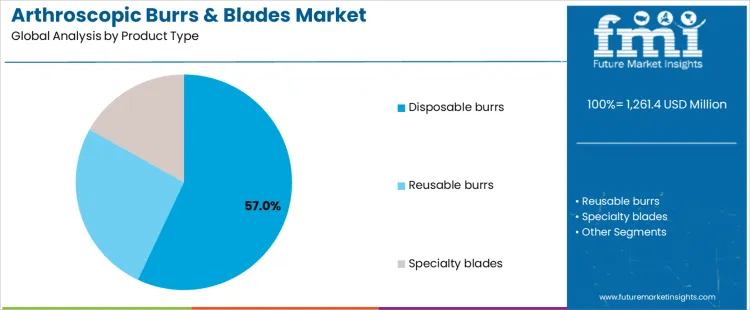
Disposable burrs represent about 57% of demand in the Arthroscopic Burrs and Blades Market because they eliminate reprocessing steps and reduce cross contamination risk. These instruments support predictable performance in each procedure and simplify inventory management within surgical kits. Reusable burrs are applied where sterilization capacity and cost control priorities justify repeated use, though they require inspection, tracking, and performance monitoring over their service life. Specialty blades address defined cutting tasks and anatomical constraints, which increases specification depth and limits interchangeability. Each category establishes different logistics, quality assurance, and training requirements within the operating room environment.
From a financial and governance perspective, product type choice fixes the balance between per procedure cost and central sterile workload. Disposable instruments concentrate cost in consumables while reducing labor and equipment use in reprocessing departments. Reusable systems shift cost toward capital equipment, inspection protocols, and tracking systems. Specialty blades increase case specific preparation and inventory complexity. Once a hospital standardizes its approach, change is avoided because procedure kits, contracts, and staff training are aligned to that model. Demand by product type therefore follows infection control policy and cost accounting frameworks rather than short term pricing movements.
Why does Application Mix Determine Volume Concentration and Instrument Specification in the Arthroscopic Burrs and Blades Market?
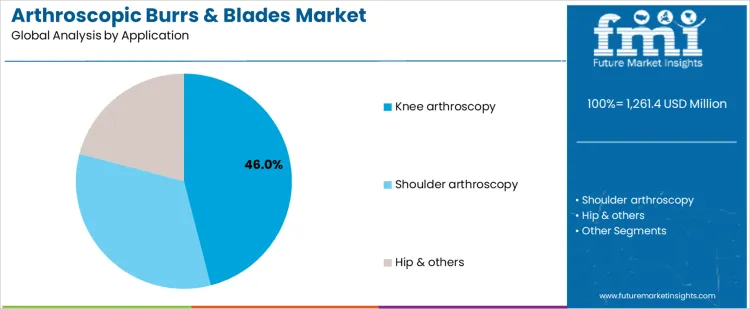
Knee arthroscopy accounts for about 46% of demand in the Arthroscopic Burrs and Blades Market because it is one of the most frequently performed minimally invasive orthopedic procedures and requires consistent bone and soft tissue shaping. This creates high, repeatable instrument usage across hospitals and ambulatory centers. Shoulder arthroscopy involves a wider range of procedures and anatomical variation, which increases the need for different burr profiles and blade types. Hip and other arthroscopic procedures are performed at lower volumes and often require specialized access and cutting tools, which limits unit demand but raises specification strictness.
Application mix also shapes procurement and standardization practice. High volume knee programs drive bulk purchasing and standardized kits. Shoulder procedures require broader instrument sets and more frequent configuration changes. Hip and specialty cases are often supported through smaller, targeted orders aligned to surgeon preference and case mix. The resulting demand structure concentrates volume in knee surgery while technical diversity increases in other joints. Segment shares therefore move with procedure mix trends, expansion of outpatient surgery centers, and clinical practice patterns rather than with short term hospital capital spending.
How Is the Arthroscopic Burrs and Blades Market Being Defined by Surgical Precision and Operating Room Efficiency?
Demand for arthroscopic burrs and blades is shaped by how surgeons balance cutting performance with procedure time and tissue control. In minimally invasive orthopedic procedures, instrument reliability and predictability directly influence outcomes and operating room schedules. Buyers focus on cutting consistency, sharpness retention, and compatibility with existing handpieces and consoles. Selection decisions involve surgeons, surgical services managers, and supply chain teams. This positions burrs and blades as performance-critical tools rather than interchangeable disposables, making consistency, packaging quality, and dependable supply central to purchasing decisions.
How Is Procedure Standardization Changing Product Expectations in The Arthroscopic Burrs and Blades Market?
Orthopedic departments increasingly standardize surgical techniques and instrument sets across surgeons and facilities to reduce variability and training burden. This is changing expectations in the Arthroscopic Burrs and Blades Market toward products that deliver predictable behavior across a wide range of cases. Surgeons and staff prefer burrs and blades with consistent cutting feel and clear identification to avoid setup errors. This supports smoother case flow and reduces intraoperative adjustments. As a result, suppliers are evaluated on portfolio consistency, clear labeling, and reliable performance rather than on niche or highly specialized designs.
Where Is Ongoing Volume Demand Being Built in The Arthroscopic Burrs and Blades Market?
Ongoing volume demand is being built in high-throughput orthopedic centers, ambulatory surgery centers, and hospital departments that perform large numbers of arthroscopic procedures each year. Each procedure consumes disposable or limited-use cutting tools, creating steady and predictable demand. The Arthroscopic Burrs and Blades Market also benefits when hospitals standardize on a single supplier across multiple sites. There is opportunity for suppliers that support instrument set optimization, staff training, and inventory management. Being embedded in standard procedure trays creates recurring demand tied to surgical case volumes rather than to capital spending cycles.
Why Do Cost Pressure and Preference for Familiar Instruments Limit Supplier Switching in The Arthroscopic Burrs and Blades Market?
Surgical teams often develop strong preferences for specific instruments based on tactile feel and cutting behavior. Changing products requires retraining and may introduce uncertainty during procedures. The Arthroscopic Burrs and Blades Market also faces strong cost control pressure from hospital procurement teams, which sometimes favors lower-cost options even when surgeons prefer premium tools. Balancing surgeon preference and purchasing policy slows change. In addition, many hospitals negotiate long-term supply contracts, which further reduces switching frequency. These factors create stable supplier positions and make competitive displacement gradual rather than rapid.
What is the Demand for Arthroscopic Burrs and Blades by Country?
| Country | CAGR |
|---|---|
| USA | 7.9% |
| Brazil | 8.4% |
| China | 8.9% |
| India | 9.1% |
| Germany | 6.1% |
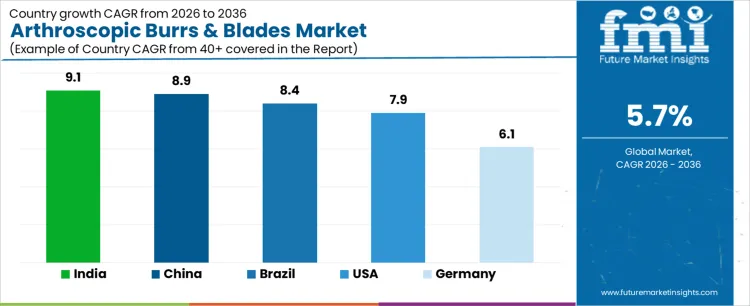
Demand for arthroscopic burrs and blades is increasing as sports medicine, orthopedic, and minimally invasive surgery volumes continue to rise across both public and private healthcare systems. India leads with a 9.1% CAGR, supported by higher incidence of joint injuries, expansion of orthopedic specialty hospitals, and wider adoption of minimally invasive surgical techniques. China follows at 8.9%, driven by growing surgical caseloads, hospital modernization, and investment in arthroscopy equipment. Brazil records 8.4%, reflecting growth in private healthcare and sports injury treatment. The USA grows at 7.9%, shaped by steady procedure volumes and technology upgrades. Germany, at 6.1%, reflects a mature orthopedic surgery market with stable replacement driven demand.
How Are Procedure Volumes Shaping Demand in the Arthroscopic Burrs and Blades Market in the USA?
Procedure volume planning across orthopedic service lines uses a 7.9% CAGR assumption for arthroscopic burrs and blades demand in USA. Purchasing authority sits with analysis committees and surgical supply teams. Product choice emphasizes cutting efficiency, heat control, and compatibility with existing handpieces. Once a platform is qualified, surgeons standardize usage across cases. Sports medicine and ambulatory centers account for a large share of throughput. Inventory models favor consignment and case cart kits. Import brands compete on performance metrics while suppliers focus on availability. Training and preference cards influence item mix. Budget timing follows case growth and service line expansion. Revision surgery rates shape replacement volume. Commercial success depends on contracts with hospital networks and inclusion in bundled supply lists.
How Are Private Hospital Networks Influencing Demand in the Arthroscopic Burrs and Blades Market in Brazil?
Private hospital chains and sports medicine centers plan procurement against an 8.4% CAGR for arthroscopic burrs and blades in Brazil. Group purchasing offices control vendor access and contract terms. Case mix growth in knee and shoulder work drives unit flow. Product selection balances cutting life, debris control, and compatibility with existing handpieces. Import lines dominate premium trays while regional suppliers cover standard sets. Consignment models support busy operating lists. Training visits and surgeon councils influence acceptance. Inventory rules favor complete case kits. Budget release follows expansion of ambulatory sites. Public facilities move slower. Revision volume contributes steady demand. Commercial success depends on network agreements and reliable distribution coverage. Pricing pressure remains and tender cycles shape timing for awards and renewals.
What Is Driving Scale Adoption in the Arthroscopic Burrs and Blades Market in China?
Platform standardization across high volume hospitals sizes demand forecasts around an 8.9% CAGR for arthroscopic burrs and blades in China. Provincial purchasing lists and tenders govern access. Domestic manufacturers supply most routine items while international brands hold complex geometries. Volume concentrates in sports medicine centers and trauma units. Product choice focuses on consistency, heat control, and debris evacuation. Once approved, items replicate across many operating rooms. Distribution scale and training coverage influence share. Inventory plans emphasize case kits and rapid replenishment. Capital budgets matter less than procedure counts. Surgeons follow committee selections. Replacement volume tracks throughput. Commercial success depends on inclusion in group catalogs and dependable logistics during peak seasons. Regional service teams coordinate installs and manage recalls and upgrades.
Why Are Chain Hospital Programs Driving Growth in the Arthroscopic Burrs and Blades Market in India?
Capacity additions and case growth set planning baselines near a 9.1% CAGR for arthroscopic burrs and blades in India. Chain hospitals and ambulatory centers lead purchasing. Tender committees define approved brands and price bands. Product choice emphasizes durability, heat control, and compatibility with mixed handpiece fleets. Import lines serve premium rooms while domestic sets cover high volume lists. Consignment supports rapid turnover. Training camps and preference cards guide adoption. Inventory focuses on complete trays. Budget release follows site openings and block expansions. Public facilities adopt slower. Replacement demand follows throughput. Commercial success depends on chain contracts and dependable after sales coverage. Surgeon councils influence mix, and logistics partners manage cold chain and returns during peak scheduling periods each quarter cycle.
How Are Guideline and Procurement Systems Shaping Demand in the Arthroscopic Burrs and Blades Market in Germany?
Guideline driven procurement models reference a 6.1% CAGR for arthroscopic burrs and blades in Germany. University hospitals and regional centers dominate purchasing. Evaluation prioritizes evidence, cutting precision, and thermal control. Framework contracts and health technology reviews shape access. Import brands lead premium trays while local distribution supports availability. Case volumes grow modestly in sports medicine. Inventory rules emphasize traceability and kit completeness. Surgeons follow standardized preference cards. Budget cycles and audit schedules affect timing. Replacement demand follows throughput rather than fashion. Training support influences acceptance. Commercial success depends on framework inclusion and reliable service response across federal states. Public payers maintain pressure, and purchasing groups expect consistent documentation and predictable delivery windows for elective schedules each month cycle planning reviews.
How Do Instrument Makers Compete for Surgeon Preference in the Arthroscopic Burrs and Blades Market?
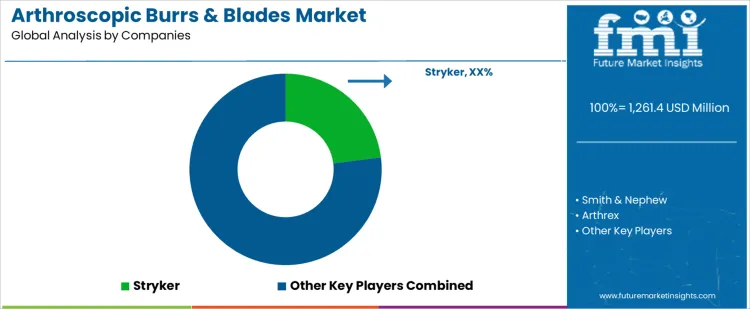
Arthroscopic burrs and blades selection follows procedure mix, surgeon technique, and console compatibility rather than simple catalog comparison. Orthopedic teams define resection style, bone density range, cutting speed targets, and irrigation flow before approving instruments. Stryker, Smith and Nephew, Arthrex, DePuy Synthes, ConMed compete through different platform strategies and clinical relationships. Once a surgeon standardizes handpieces and console settings, instrument families stay fixed for long periods. Stryker and DePuy Synthes benefit from large installed bases of power systems. Arthrex builds around sports medicine workflows and surgeon training programs. Smith and Nephew aligns tools with its arthroscopy visualization and pump platforms. ConMed serves facilities that value cross compatibility and flexible instrument portfolios. Tray setup, sterilization cycles, and staff familiarity reinforce existing choices.
Competitive outcomes reflect cutting performance, reliability in use, and supply continuity rather than unit price. Surgeons assess tactile feedback, clog resistance, heat generation, and edge life during routine cases. Central sterile teams examine packaging formats, reprocessing limits, and identification marking. Purchasing groups review contract coverage and availability across case volumes. Stryker secures positions where console standardization governs accessory choice. Arthrex holds share in sports medicine centers tied to its procedure ecosystems. Smith and Nephew gains leverage through integrated arthroscopy towers and disposables. DePuy Synthes competes in hospitals aligned to its broader orthopedic portfolios. ConMed attracts accounts that prefer mixed vendor setups and cost control. Market positions vary by hospital type, surgeon training background, and case mix composition.
Key Players in the Arthroscopic Burrs and Blades Market
- Stryker
- Smith & Nephew
- Arthrex
- DePuy Synthes
- ConMed
- Others
Scope of the Report
| Items | Values |
|---|---|
| Quantitative Units (2026) | USD Million |
| Product Type | Disposable burrs; Reusable burrs; Specialty blades |
| Application | Knee arthroscopy; Shoulder arthroscopy; Hip & others |
| End User | Hospitals; ASCs; Orthopedic clinics |
| Region | Asia Pacific; Europe; North America; Latin America; Middle East & Africa |
| Countries Covered | USA, Canada, Mexico, Germany, United Kingdom, France, Italy, Spain, Nordic, BENELUX, China, Japan, South Korea, India, Australia & New Zealand, ASEAN, Brazil, Chile, Saudi Arabia, Turkey, South Africa, Rest of regions |
| Key Companies Profiled | Stryker; Smith & Nephew; Arthrex; DePuy Synthes; ConMed |
| Additional Attributes | Dollar by sales by product and application, disposable versus reusable mix, case volume driven consumption rates, tray standardization impact, reprocessing versus single use economics, instrument compatibility by console type, supply contract coverage, pack format and shelf life constraints, usage tracking and inventory turnover patterns |
Arthroscopic Burrs and Blades Market Segmentation
Product Type:
- Disposable burrs
- Reusable burrs
- Specialty blades
Application:
- Knee arthroscopy
- Shoulder arthroscopy
- Hip & others
End User:
- Hospitals
- ASCs
- Orthopedic clinics
Region:
- Asia Pacific
- China
- Japan
- South Korea
- India
- Australia & New Zealand
- ASEAN
- Rest of Asia Pacific
- Europe
- Germany
- United Kingdom
- France
- Italy
- Spain
- Nordic
- BENELUX
- Rest of Europe
- North America
- USA
- Canada
- Mexico
- Latin America
- Brazil
- Chile
- Rest of Latin America
- Middle East & Africa
- Kingdom of Saudi Arabia
- Other GCC Countries
- Turkey
- South Africa
- Other African Union
- Rest of Middle East & Africa
Bibliography
- Ina, J. G., Thompson, A. L., Cabarcas, B. C., Krych, A. J., & Hevesi, M. (2025). Dry arthroscopic hip labral repair to minimize use of irrigation fluid. Arthroscopy Techniques, 14(6), 103509. doi:10.1016/j.eats.2025.103509
- Shah, S., Stavinoha, T., Nepple, J. J., Crepeau, A. E., & Carsen, S. (2024). The evolving role and technique of hip arthroscopy in children and adolescents. Journal of the Pediatric Orthopaedic Society of North America, 7, 100064. doi:10.1016/j.jposna.2024.100064
- World Health Organization. (2024). Global report on infection prevention and control 2024. World Health Organization.
Frequently Asked Questions
How big is the arthroscopic burrs & blades market in 2026?
The global arthroscopic burrs & blades market is estimated to be valued at USD 1,261.4 million in 2026.
What will be the size of arthroscopic burrs & blades market in 2036?
The market size for the arthroscopic burrs & blades market is projected to reach USD 2,195.9 million by 2036.
How much will be the arthroscopic burrs & blades market growth between 2026 and 2036?
The arthroscopic burrs & blades market is expected to grow at a 5.7% CAGR between 2026 and 2036.
What are the key product types in the arthroscopic burrs & blades market?
The key product types in arthroscopic burrs & blades market are disposable burrs, reusable burrs and specialty blades.
Which application segment to contribute significant share in the arthroscopic burrs & blades market in 2026?
In terms of application, knee arthroscopy segment to command 46.0% share in the arthroscopic burrs & blades market in 2026.
Preview the report firsthand - request a free sample
Get SampleGet the brochure for pricing and purchase details.
Get PDFTable of Content
- Executive Summary
- Global Market Outlook
- Demand-side Trends
- Supply-side Trends
- Technology Roadmap Analysis
- Analysis and Recommendations
- Market Overview
- Market Coverage / Taxonomy
- Market Definition / Scope / Limitations
- Market Background
- Market Dynamics
- Drivers
- Restraints
- Opportunity
- Trends
- Scenario Forecast
- Demand in Optimistic Scenario
- Demand in Likely Scenario
- Demand in Conservative Scenario
- Opportunity Map Analysis
- Product Life Cycle Analysis
- Supply Chain Analysis
- Investment Feasibility Matrix
- Value Chain Analysis
- PESTLE and Porter’s Analysis
- Regulatory Landscape
- Regional Parent Market Outlook
- Production and Consumption Statistics
- Import and Export Statistics
- Market Dynamics
- Global Market Analysis 2021 to 2025 and Forecast, 2026 to 2036
- Historical Market Size Value (USD Million) Analysis, 2021 to 2025
- Current and Future Market Size Value (USD Million) Projections, 2026 to 2036
- Y-o-Y Growth Trend Analysis
- Absolute $ Opportunity Analysis
- Global Market Pricing Analysis 2021 to 2025 and Forecast 2026 to 2036
- Global Market Analysis 2021 to 2025 and Forecast 2026 to 2036, By Product Type
- Introduction / Key Findings
- Historical Market Size Value (USD Million) Analysis By Product Type , 2021 to 2025
- Current and Future Market Size Value (USD Million) Analysis and Forecast By Product Type , 2026 to 2036
- Disposable burrs
- Reusable burrs
- Specialty blades
- Disposable burrs
- Y-o-Y Growth Trend Analysis By Product Type , 2021 to 2025
- Absolute $ Opportunity Analysis By Product Type , 2026 to 2036
- Global Market Analysis 2021 to 2025 and Forecast 2026 to 2036, By Application
- Introduction / Key Findings
- Historical Market Size Value (USD Million) Analysis By Application, 2021 to 2025
- Current and Future Market Size Value (USD Million) Analysis and Forecast By Application, 2026 to 2036
- Knee arthroscopy
- Shoulder arthroscopy
- Hip & others
- Knee arthroscopy
- Y-o-Y Growth Trend Analysis By Application, 2021 to 2025
- Absolute $ Opportunity Analysis By Application, 2026 to 2036
- Global Market Analysis 2021 to 2025 and Forecast 2026 to 2036, By End User
- Introduction / Key Findings
- Historical Market Size Value (USD Million) Analysis By End User, 2021 to 2025
- Current and Future Market Size Value (USD Million) Analysis and Forecast By End User, 2026 to 2036
- Hospitals
- ASCs
- Orthopedic clinics
- Hospitals
- Y-o-Y Growth Trend Analysis By End User, 2021 to 2025
- Absolute $ Opportunity Analysis By End User, 2026 to 2036
- Global Market Analysis 2021 to 2025 and Forecast 2026 to 2036, By Region
- Introduction
- Historical Market Size Value (USD Million) Analysis By Region, 2021 to 2025
- Current Market Size Value (USD Million) Analysis and Forecast By Region, 2026 to 2036
- North America
- Latin America
- Western Europe
- Eastern Europe
- East Asia
- South Asia and Pacific
- Middle East & Africa
- Market Attractiveness Analysis By Region
- North America Market Analysis 2021 to 2025 and Forecast 2026 to 2036, By Country
- Historical Market Size Value (USD Million) Trend Analysis By Market Taxonomy, 2021 to 2025
- Market Size Value (USD Million) Forecast By Market Taxonomy, 2026 to 2036
- By Country
- USA
- Canada
- Mexico
- By Product Type
- By Application
- By End User
- By Country
- Market Attractiveness Analysis
- By Country
- By Product Type
- By Application
- By End User
- Key Takeaways
- Latin America Market Analysis 2021 to 2025 and Forecast 2026 to 2036, By Country
- Historical Market Size Value (USD Million) Trend Analysis By Market Taxonomy, 2021 to 2025
- Market Size Value (USD Million) Forecast By Market Taxonomy, 2026 to 2036
- By Country
- Brazil
- Chile
- Rest of Latin America
- By Product Type
- By Application
- By End User
- By Country
- Market Attractiveness Analysis
- By Country
- By Product Type
- By Application
- By End User
- Key Takeaways
- Western Europe Market Analysis 2021 to 2025 and Forecast 2026 to 2036, By Country
- Historical Market Size Value (USD Million) Trend Analysis By Market Taxonomy, 2021 to 2025
- Market Size Value (USD Million) Forecast By Market Taxonomy, 2026 to 2036
- By Country
- Germany
- UK
- Italy
- Spain
- France
- Nordic
- BENELUX
- Rest of Western Europe
- By Product Type
- By Application
- By End User
- By Country
- Market Attractiveness Analysis
- By Country
- By Product Type
- By Application
- By End User
- Key Takeaways
- Eastern Europe Market Analysis 2021 to 2025 and Forecast 2026 to 2036, By Country
- Historical Market Size Value (USD Million) Trend Analysis By Market Taxonomy, 2021 to 2025
- Market Size Value (USD Million) Forecast By Market Taxonomy, 2026 to 2036
- By Country
- Russia
- Poland
- Hungary
- Balkan & Baltic
- Rest of Eastern Europe
- By Product Type
- By Application
- By End User
- By Country
- Market Attractiveness Analysis
- By Country
- By Product Type
- By Application
- By End User
- Key Takeaways
- East Asia Market Analysis 2021 to 2025 and Forecast 2026 to 2036, By Country
- Historical Market Size Value (USD Million) Trend Analysis By Market Taxonomy, 2021 to 2025
- Market Size Value (USD Million) Forecast By Market Taxonomy, 2026 to 2036
- By Country
- China
- Japan
- South Korea
- By Product Type
- By Application
- By End User
- By Country
- Market Attractiveness Analysis
- By Country
- By Product Type
- By Application
- By End User
- Key Takeaways
- South Asia and Pacific Market Analysis 2021 to 2025 and Forecast 2026 to 2036, By Country
- Historical Market Size Value (USD Million) Trend Analysis By Market Taxonomy, 2021 to 2025
- Market Size Value (USD Million) Forecast By Market Taxonomy, 2026 to 2036
- By Country
- India
- ASEAN
- Australia & New Zealand
- Rest of South Asia and Pacific
- By Product Type
- By Application
- By End User
- By Country
- Market Attractiveness Analysis
- By Country
- By Product Type
- By Application
- By End User
- Key Takeaways
- Middle East & Africa Market Analysis 2021 to 2025 and Forecast 2026 to 2036, By Country
- Historical Market Size Value (USD Million) Trend Analysis By Market Taxonomy, 2021 to 2025
- Market Size Value (USD Million) Forecast By Market Taxonomy, 2026 to 2036
- By Country
- Kingdom of Saudi Arabia
- Other GCC Countries
- Turkiye
- South Africa
- Other African Union
- Rest of Middle East & Africa
- By Product Type
- By Application
- By End User
- By Country
- Market Attractiveness Analysis
- By Country
- By Product Type
- By Application
- By End User
- Key Takeaways
- Key Countries Market Analysis
- USA
- Pricing Analysis
- Market Share Analysis, 2025
- By Product Type
- By Application
- By End User
- Canada
- Pricing Analysis
- Market Share Analysis, 2025
- By Product Type
- By Application
- By End User
- Mexico
- Pricing Analysis
- Market Share Analysis, 2025
- By Product Type
- By Application
- By End User
- Brazil
- Pricing Analysis
- Market Share Analysis, 2025
- By Product Type
- By Application
- By End User
- Chile
- Pricing Analysis
- Market Share Analysis, 2025
- By Product Type
- By Application
- By End User
- Germany
- Pricing Analysis
- Market Share Analysis, 2025
- By Product Type
- By Application
- By End User
- UK
- Pricing Analysis
- Market Share Analysis, 2025
- By Product Type
- By Application
- By End User
- Italy
- Pricing Analysis
- Market Share Analysis, 2025
- By Product Type
- By Application
- By End User
- Spain
- Pricing Analysis
- Market Share Analysis, 2025
- By Product Type
- By Application
- By End User
- France
- Pricing Analysis
- Market Share Analysis, 2025
- By Product Type
- By Application
- By End User
- India
- Pricing Analysis
- Market Share Analysis, 2025
- By Product Type
- By Application
- By End User
- ASEAN
- Pricing Analysis
- Market Share Analysis, 2025
- By Product Type
- By Application
- By End User
- Australia & New Zealand
- Pricing Analysis
- Market Share Analysis, 2025
- By Product Type
- By Application
- By End User
- China
- Pricing Analysis
- Market Share Analysis, 2025
- By Product Type
- By Application
- By End User
- Japan
- Pricing Analysis
- Market Share Analysis, 2025
- By Product Type
- By Application
- By End User
- South Korea
- Pricing Analysis
- Market Share Analysis, 2025
- By Product Type
- By Application
- By End User
- Russia
- Pricing Analysis
- Market Share Analysis, 2025
- By Product Type
- By Application
- By End User
- Poland
- Pricing Analysis
- Market Share Analysis, 2025
- By Product Type
- By Application
- By End User
- Hungary
- Pricing Analysis
- Market Share Analysis, 2025
- By Product Type
- By Application
- By End User
- Kingdom of Saudi Arabia
- Pricing Analysis
- Market Share Analysis, 2025
- By Product Type
- By Application
- By End User
- Turkiye
- Pricing Analysis
- Market Share Analysis, 2025
- By Product Type
- By Application
- By End User
- South Africa
- Pricing Analysis
- Market Share Analysis, 2025
- By Product Type
- By Application
- By End User
- USA
- Market Structure Analysis
- Competition Dashboard
- Competition Benchmarking
- Market Share Analysis of Top Players
- By Regional
- By Product Type
- By Application
- By End User
- Competition Analysis
- Competition Deep Dive
- Stryker
- Overview
- Product Portfolio
- Profitability by Market Segments (Product/Age /Sales Channel/Region)
- Sales Footprint
- Strategy Overview
- Marketing Strategy
- Product Strategy
- Channel Strategy
- Smith & Nephew
- Arthrex
- DePuy Synthes
- ConMed
- Others
- Stryker
- Competition Deep Dive
- Assumptions & Acronyms Used
- Research Methodology


