

- Market Size (2026)
- USD 2.1 Bn
- Forecast (2036)
- USD 3.6 Bn
- CAGR (2026 to 2036)
- 5.4%
How big is Asphalt Emulsifiers Market in 2026?
USD 2.1 billion in 2026 and USD 3.6 billion by 2036 at a 5.4% CAGR.
Demand for asphalt emulsifiers is forecast to rise from USD 2.1 billion in 2026 to USD 3.6 billion by 2036 at a 5.4% CAGR. Repeated resurfacing and preservation return qualified road-treatment recipes to production across successive maintenance cycles. FHWA stated in April 2026 that the National Highway System covers 222,000 system miles and permits NHPP funding for resurfacing, rehabilitation and preservation. That scale sustains a recurring project base that reaches emulsifier manufacturers after local plants qualify the required emulsion chemistry.
Country programs determine how quickly preservation work becomes repeat chemical orders at local emulsion plants. Mexico illustrates the faster execution route because SICT stated in January 2026 that its national conservation program would intervene on 18,000 km of toll-free federal roads. That concentrated workload raises stocking needs near active paving windows, while mature markets place more weight on continuity across existing specifications. Chemical producers therefore compete on local availability and formulation support as much as on the emulsifier itself.
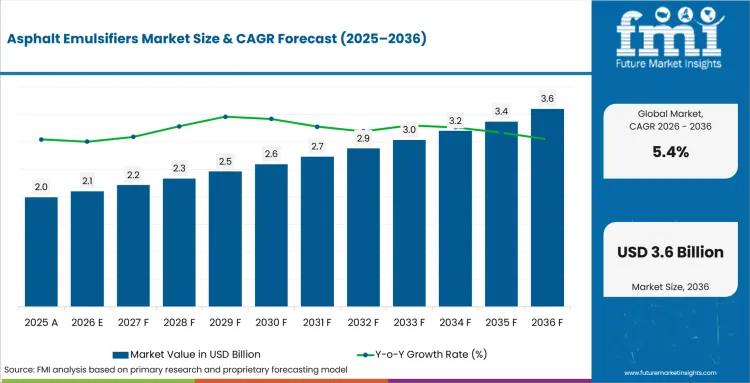
Key Takeaways of Asphalt Emulsifiers Market
- Road preservation and resurfacing programs sustain recurring emulsifier orders because approved asphalt-emulsion recipes return across multiple maintenance cycles.
- By emulsifier type, cationic emulsifiers are estimated to hold 46.0% in 2026 owing to broad coverage across paving formulations.
- Rapid setting is likely to capture 28.0% share in 2026 attributable to spray treatments that require controlled early breaking.
- The application category is forecast to be led by tack coats at 29.0% share in 2026 due to repeated interlayer bonding during overlays.
- Binder chemistry and aggregate mineralogy raise formulation approval work as emulsion stability must coexist with the required field break.
- Nouryon, Arkema, Ingevity, Evonik, Kao Corporation, BASF, ArrMaz / Arkema and Chemoran are the notable companies profiled in this market.
Analyst Perspective
"Emulsion plants judge an emulsifier by whether the formulation survives storage and pumping yet breaks on schedule with local binder and aggregate. The stronger commercial offer combines compatible chemistry with fast trial support and seasonal inventory, since a lower unit price loses value once qualification must be repeated."
- Nikhil Kaitwade, Principal Consultant, Future Market Insights
How is the Asphalt Emulsifiers Market segmented?
The asphalt emulsifiers market is segmented by emulsifier type, emulsion setting, application, end use, sales channel and region.
Emulsifier type covers cationic, anionic, non-ionic, polymeric and specialty quick-set emulsifiers. Emulsion setting includes rapid, medium, slow and micro-surfacing or slurry seal. Applications cover tack coats, chip seals, slurry seals, cold mix asphalt and recycling or stabilization. End uses include road construction, road maintenance, airport runways, industrial paving and rural road programs. Sales channels comprise emulsion plant supply, direct chemical supply, distributors and contractor-approved formulations. Regions cover North America, Latin America, Europe, East Asia, South Asia and Pacific, and Middle East and Africa.
How do tack coats anchor the application category?
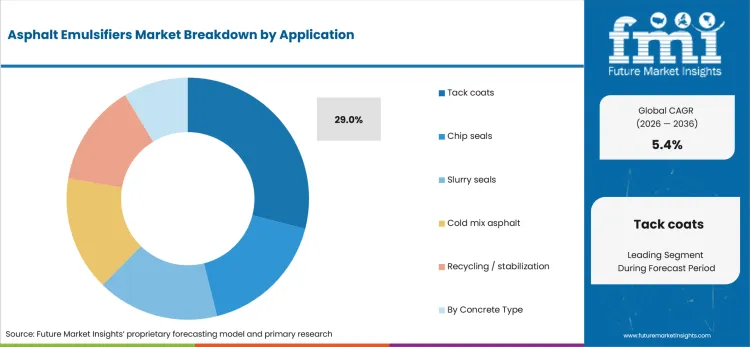
Tack coats bond an existing pavement surface to a new asphalt layer during overlays. Repeated use in resurfacing makes interlayer adhesion important despite low material volume per square yard.
- By application, tack coats are forecast to represent 29.0% in 2026 driven by recurring interlayer bonding during overlays. Caltrans stated in March 2026 that thin maintenance overlays use asphaltic emulsion or binder tack coats to promote pavement-layer adhesion.
- Contractors need a uniform residual film beneath the new asphalt layer because weak bonding can allow slippage under traffic. Calibration and material acceptance therefore remain necessary before paving begins on each overlay.
What makes cationic emulsifiers central to the emulsifier type category?
Cationic chemistry suits many acidic asphalt-emulsion recipes used across sprayed and mixed pavement treatments. New York State DOT's May 2025 specification lists cationic grades across rapid, medium and slow setting classes, giving plants a documented range for different paving treatments.
- Based on emulsifier type, cationic emulsifiers are projected to account for 46.0% in 2026 owing to their coverage across several emulsion setting classes.
- Aggregate mineralogy still determines dosage and final chemistry because charge interaction controls coating plus breaking behavior. Plants can remain within one chemistry family more often, but each binder-aggregate combination must still pass local storage and field-performance checks.
Why does rapid setting lead the emulsion setting category?
Rapid-setting emulsions suit spray treatments needing water separation and early adhesion soon after binder reaches the pavement, yet the emulsion must remain stable during storage and pumping at the plant.
- In 2026, rapid setting is expected to lead emulsion setting with 28.0% share because spray treatments need controlled early breaking across active preservation programs.
- MassDOT's June 2026 approved-supplier list names RS-1h as its standard asphalt-emulsion tack grade for qualified producers. That defined grade gives plants a repeat setting target during qualification and seasonal production, while actual emulsifier dosage still depends on binder chemistry and operating conditions.
What supports road construction in the end use category?
Road construction pulls emulsifier demand from new paving and rehabilitation as treatments consume asphalt emulsions. Caltrans documented in May 2026 that partial-depth recycling can use emulsified asphalt in cold central-plant or cold in-place processes, extending demand into rehabilitation plant recipes.
- Road construction is set to lead the end use category with 39.0% share in 2026 due to recurring roadway rehabilitation specifications across public networks.
- Emulsion producers must match binder and aggregate to each project specification before a recipe enters recurring production. Recycling work adds coating and curing requirements that differ from sprayed surface treatments, so technical qualification determines whether road volume becomes emulsifier orders.
What are the drivers, restraints and opportunities in the Asphalt Emulsifiers Market?
Recurring pavement preservation supports plant demand, while formulation sensitivity slows switching and recycling specifications create room for application-specific emulsifier chemistry.
- Driver: Multi-year preservation programs keep tack coats and surface treatments returning to qualified emulsion plants.
- Restraint: Binder and aggregate variation raises testing work because the same emulsifier dose cannot be transferred blindly across recipes.
- Opportunity: Recycling and specialty-setting applications reward chemistry that controls coating and curing around reclaimed materials.
Recurring Preservation Programs Sustain Plant Orders
County preservation programs translate road budgets into repeat emulsion production as the same treatment types return across scheduled maintenance cycles. Santa Clara County's September 2025 program specified chip seal followed by slurry seal or micro-surfacing on county roads, keeping qualified emulsion recipes active across paving seasons and replenishing emulsifier chemistry. Plants can retain accepted grades longer, reducing repeat qualification work as maintenance contracts move between scheduled treatment sections.
Material Compatibility Raises Qualification Costs
Switching recipes raises cost because storage stability and field break behavior must be checked again against local binder and aggregate. A failed trial can interrupt loading schedules or force another plant run, so chemistry price alone does not determine the switching decision. McLennan County's February 2025 bid lists multiple cationic and polymer-modified emulsion grades under TxDOT requirements, illustrating how grade-specific purchasing narrows acceptable formulation windows.
Recycling Specifications Create Application-Specific Openings
Deep-recycling specifications are increasing the importance of emulsion performance during pavement rehabilitation projects. DNIT required at least 2% asphalt emulsion in its December 2025 deep-recycling specification, making the emulsion a core component of the recycling process. Successful formulations must provide reliable coating and curing characteristics across varying reclaimed-material streams.
Which country CAGRs are profiled in the Asphalt Emulsifiers Market?
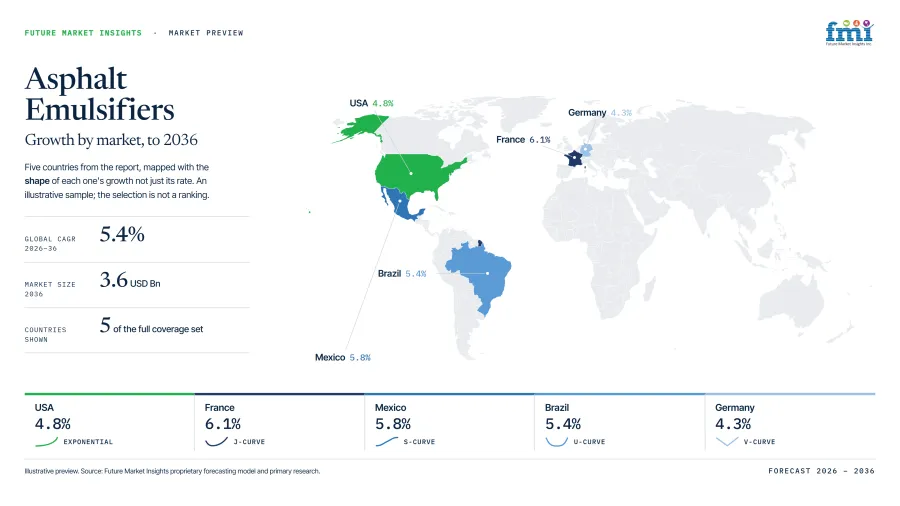
| Country | CAGR |
|---|---|
| France | 6.1% |
| Mexico | 5.8% |
| Brazil | 5.4% |
| USA | 4.8% |
| Germany | 4.3% |
How do country-level CAGRs compare in the Asphalt Emulsifiers Market?
The 1.8-point CAGR range forms a compact upper group around France and Mexico, with Brazil between that group and the more mature USA-Germany pair. The spacing reflects different preservation workloads and qualification systems rather than a simple ranking of current market size or installed emulsion capacity across the five profiled countries.
- France combines a documented pavement backlog with strict surface-treatment performance requirements.
- Mexico's nationwide maintenance program makes regional stocking important across separated paving corridors.
- Brazilian federal corridors pair micro-surfacing demand with long distances between plants and projects.
- USA state DOT approval systems reward continuity but slow switching between qualified recipes.
- Germany's mature preservation planning rewards documented performance and dependable technical service.
Comparable CAGRs can therefore produce different entry timing as qualification and service needs vary.
The full report provides country-level CAGR analysis across North America, Latin America, Europe, East Asia, South Asia, Oceania and the Middle East and Africa.
Country-wise Analysis
- State DOTs control asphalt-emulsion acceptance through approved grades, and climate plus aggregate differences force plants to repeat local qualification before changing chemistry across regional paving seasons. Asphalt emulsifier demand in USA is forecast to rise at 4.8% CAGR over the forecast period, supported by established emulsion plants and distributors that stock seasonal preservation grades. Project timing can compress orders into short construction windows, so formulation support must remain available near active plants. Caltrans reported in August 2025 that its US 395 project would rejuvenate 20 miles with fog and chip seals, favoring chemistry producers that support approved recipes during scheduled work.
- Brazilian emulsion plants serve long federal corridors where changing binder sources and aggregate properties raise formulation work across remote maintenance programs. DNIT reported in January 2026 that 34 kilometers of BR-364/MT near Brasnorte received micro-surfacing and new road markings, giving nearby plants a current emulsion-based preservation workload. Regional storage reduces delivery distance, but one formulation cannot be assumed to perform identically across distant material sources. The Brazilian asphalt emulsifiers sector is projected to record 5.4% CAGR during the assessment period, aided by recurring federal-road rehabilitation. Producers need regional inventory plus field testing to convert corridor work into repeat orders without extending plant qualification schedules.
- SICT reported in May 2026 that MegaBachetón covered 37,854 km of toll-free federal roads, concentrating preservation activity across widely separated Mexican corridors. Different binder and aggregate sources limit formulation uniformity, so one national program still requires local plant adjustments and dependable regional stock across individual paving zones and seasonal production windows. Asphalt emulsifier sales in Mexico are forecast to expand at 5.8% CAGR by 2036, supported by repeat road-conservation work across the federal network. Technical teams that can tune breaking behavior near active paving zones reduce delivery and trial delays, improving the chance that program volume becomes recurring chemical orders.
- German road authorities use established specifications and material-performance records during plant qualification, which gives accepted emulsions a stable route into recurring maintenance work. Recipe changes face a higher evidence burden because producers must document performance against local binder and aggregate conditions. The Federal Ministry for Transport reported in May 2025 that annual pavement preservation averages about 5% of federal lane length, providing a regular renewal base. Germany is estimated to post 4.3% CAGR over the forecast period, supported by recurring preservation rather than rapid chemistry turnover. Road-material producers therefore value documented performance and dependable technical service when comparing alternative emulsifier formulations.
- French preservation programs face a visible pavement backlog, while annual budgeting determines how quickly treatment need becomes work for asphalt-emulsion plants. Adoption of asphalt emulsifiers in France is estimated to expand at 6.1% CAGR through 2036, supported by recurring surface treatments that keep approved formulations in routine production. Local emulsifier choices must balance predictable breaking with storage stability across changing project conditions. Responsive trial support becomes more valuable when scheduled maintenance releases work in concentrated periods instead of evenly across the year. The transport ministry reported in May 2025 that 31.4% of non-concession national-road pavement needed surface maintenance, quantifying the preservation workload behind those formulation decisions.
Who are the notable companies in the Asphalt Emulsifiers Market?
Nouryon, Arkema, Ingevity, Evonik, Kao Corporation, BASF, ArrMaz / Arkema and Chemoran are the notable companies serving this market.
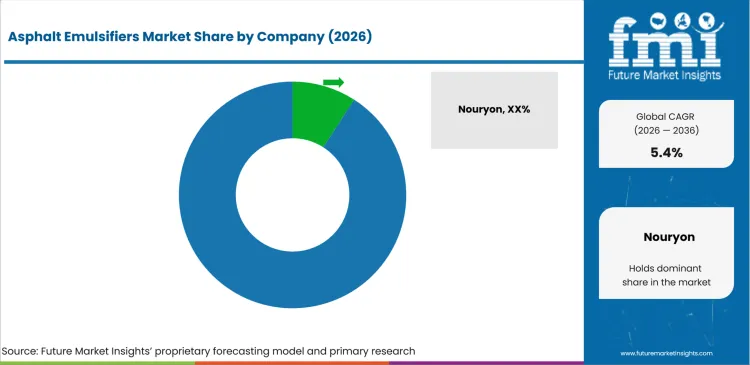
The asphalt emulsifiers field is concentrated around road-chemistry specialists and broader specialty chemical platforms that pair chemistry with formulation support. Entry depends on documented emulsifier performance plus plant qualification evidence under state or national specifications. Regional inventory adds another barrier because maintenance programs can compress deliveries into short paving seasons. Companies without technical support and dependable replenishment struggle to turn broad product ranges into routine plant orders.
- Asphalt-focused formulation platforms include Nouryon, Ingevity and ArrMaz / Arkema across multiple preservation and recycling applications.
- Dedicated specialty-chemical portfolios include Arkema, Evonik and Kao Corporation with documented bitumen-emulsion chemistry and road-treatment support.
- Adjacent or specialized positions include BASF and Chemoran where polymer modification or road-binder expertise complements core emulsifier chemistry.
Competitive Benchmarking: Asphalt Emulsifiers Market
| Company | Asphalt-Emulsifier Chemistry Breadth | Pavement-Preservation Formulation Depth | Emulsion-Plant Technical Support | Geographic Reach |
|---|---|---|---|---|
| Nouryon | High | High | High | North America, Europe, Asia and Latin America |
| Arkema | High | High | High | Americas, Europe and Asia-Pacific |
| Ingevity | High | High | High | Americas, Europe and Asia |
| Evonik | High | Medium | Medium | Europe, Americas and Asia-Pacific |
| Kao Corporation | Medium | High | Medium | Asia and Americas |
| BASF | Low | Medium | Medium | North America and Europe |
| ArrMaz / Arkema | High | High | High | Americas, Europe and Asia-Pacific |
| Chemoran | Medium | High | Medium | Europe and selected international road markets |
Key Developments in the Asphalt Emulsifiers Market
- In April 2026, Ingevity completed the sale of its Ozark Materials road-markings business to PPG for approximately USD 65 million. Ingevity stated that the transaction did not affect Pavement Technologies and reaffirmed its commitment to paving customers, leaving asphalt and pavement-preservation chemistry inside the retained portfolio.
- In September 2025, Kao Chemicals presented ASFIER S-106 LN for slow-setting asphalt emulsions and ASFIER N-100L for rapid-setting chip seal and tack coat applications at an international symposium in Thailand. Kao also stated that ASFIER N-100L held certification from Thailand's Department of Highways for road-treatment use.
- In June 2025, Nouryon hosted the International Conference on Bitumen Emulsion in New Delhi with CSIR-CRRI and PHDCCI. The event drew more than 400 delegates and included the launch of a laboratory study on bituminous-emulsion cold recycling alongside Nouryon's regional asphalt application capability.
Key Players in the Asphalt Emulsifiers Market
Asphalt Emulsifier and Pavement-Chemistry Specialists
- Nouryon
- Ingevity
- ArrMaz / Arkema
- Chemoran
Diversified Specialty-Chemical Platforms
- Arkema
- Evonik
- Kao Corporation
Adjacent Polymer and Formulation Platform
- BASF
Asphalt Emulsifiers Market - Report Scope
| Coverage field | Report scope |
|---|---|
| Market breakdown | By emulsifier type, emulsion setting, application, end use, sales channel and region. |
| Quantitative Units | Revenue in USD billion and CAGR in %. |
| Market Definition | Revenue includes sales of asphalt emulsifier chemicals used to formulate road-grade bitumen or asphalt emulsions within the listed segmentation. Finished asphalt emulsion, asphalt binder, downstream paving services and adjacent additives acting only outside an emulsifier function are excluded. |
| Regions Covered | North America, Latin America, Europe, East Asia, South Asia and Pacific, and Middle East and Africa. |
| Countries Covered | France, Mexico, Brazil, USA, Germany, and 20+ countries included in the full report. |
| Key Companies Profiled | Nouryon, Arkema, Ingevity, Evonik, Kao Corporation, BASF, ArrMaz / Arkema and Chemoran. |
| Forecast Period | 2026 to 2036. |
| Approach | Primary and secondary research with market triangulation. |
Asphalt Emulsifiers Market - Research Methodology
| Method | Approach |
|---|---|
| Primary Research | FMI analysts gathered input from manufacturers, service providers, technology developers, distributors, end users, procurement teams, and subject-matter experts. Interviews examined purchasing decisions, product or service evaluation, adoption barriers, approval requirements, pricing considerations, and expectations for technical or commercial support. Respondents were also asked what evidence is required before a trial, pilot, or initial order develops into regular purchasing. |
| Desk Research | Desk research covered government statistics, regulatory publications, trade data, industry associations, technical literature, standards, company filings, product information, and official corporate announcements. Sources were reviewed for relevance, publication date, geographic coverage, and consistency with the defined market scope. Claims relating to performance, applications, approvals, capacity, investment, and commercial activity were retained only when supported by credible public evidence. |
| Market Sizing and Forecasting | The market model combined the baseline value with historical performance, segment structure, pricing and volume indicators, adoption levels, company participation, and country-level demand conditions. Forecast assumptions considered economic activity, investment trends, regulatory developments, technology adoption, purchasing cycles, supply availability, and barriers to wider market use. Segment and regional estimates were reconciled before the final market total was calculated. |
| Data Validation | Estimates were checked against multiple independent indicators, including public data, company activity, trade patterns, industry developments, and findings from primary interviews. Validation also tested whether products, services, applications, and company revenues fell within the defined market boundaries. Adjacent categories, unsupported claims, overlapping revenues, and activities without direct market relevance were excluded to reduce double counting and maintain consistency across segments and countries. |
Asphalt Emulsifiers Market by Segments
Asphalt Emulsifiers Market segmented by Emulsifier Type:
- Cationic emulsifiers
- Anionic emulsifiers
- Non-ionic emulsifiers
- Polymeric emulsifiers
- Specialty quick-set emulsifiers
Asphalt Emulsifiers Market segmented by Emulsion Setting:
- Rapid setting
- Medium setting
- Slow setting
- Micro-surfacing / slurry seal
Asphalt Emulsifiers Market segmented by Application:
- Tack coats
- Chip seals
- Slurry seals
- Cold mix asphalt
- Recycling / stabilization
Asphalt Emulsifiers Market segmented by End Use:
- Road construction
- Road maintenance
- Airport runways
- Industrial paving
- Rural road programs
Asphalt Emulsifiers Market segmented by Sales Channel:
- Emulsion plant supply
- Direct chemical supply
- Distributors
- Contractor-approved formulations
Asphalt Emulsifiers Market by Region:
- North America
- United States
- Canada
- Latin America
- Brazil
- Mexico
- Chile
- Rest of Latin America
- Western Europe
- Germany
- United Kingdom
- Italy
- Spain
- France
- Nordics
- Benelux
- Rest of Western Europe
- Eastern Europe
- Russia
- Poland
- Hungary
- Balkan and Baltic States
- Rest of Eastern Europe
- East Asia
- China
- Japan
- South Korea
- South Asia and Pacific
- India
- ASEAN
- Australia and New Zealand
- Rest of South Asia and Pacific
- Middle East and Africa
- Kingdom of Saudi Arabia
- Other GCC Countries
- Türkiye
- South Africa
- Other African Union Countries
- Rest of Middle East and Africa
Research Sources and Bibliography
- Federal Highway Administration. (2026, April 9). Implementation Guidance for the National Highway Performance Program (NHPP) as Revised by the Infrastructure Investment and Jobs Act
- Secretaría de Infraestructura, Comunicaciones y Transportes. (2026, January 21). Programa Nacional de Conservación de Carreteras y 'Bachetón' 2026 tendrá inversión de 50 mil mdp; generará 100 mil empleos: SICT
- New York State Department of Transportation. (2025, May 1). STANDARD SPECIFICATIONS (US CUSTOMARY UNITS) VOLUME 4 SECTION 700 CONSTRUCTION AND MATERIALS
- Massachusetts Department of Transportation. (2026, June 29). Asphalt Emulsion Suppliers (M3.03.0)
- California Department of Transportation. (2026, March 17). CHAPTER 11 THIN MAINTENANCE OVERLAYS
- California Department of Transportation. (2026, May 4). CHAPTER 14 PARTIAL DEPTH RECYCLING
- County of Santa Clara Roads and Airports Department. (2025, September 4). 2025 Pavement preservation project on various county roads
- McLennan County. (2025, February 6). BID 25-005 ASPHALT EMULSIONS
- Departamento Nacional de Infraestrutura de Transportes. (2025, December 23). DNIT 463/2025 - ES - Pavimentação - Reciclagem de pavimento asfáltico in situ com emulsão asfáltica - Especificação de serviço
- California Department of Transportation. (2025, August 21). Caltrans to Rejuvenate 20 Miles of Mountain Highway on USA 395
- Departamento Nacional de Infraestrutura de Transportes. (2026, January 2). Avanço nos serviços de Infraestrutura Rodoviária no Centro-Oeste do país com qualidade e confiabilidade
- Secretaría de Infraestructura, Comunicaciones y Transportes. (2026, May 10). Megabacheton 2026 da mantenimiento a 37 mil 854 km de la Red Carretera Federal Libre de Peaje
- Bundesministerium für Verkehr. (2025, May 6). Erhaltungsbedarfsprognose für die Bundesfernstraßen
- Ministère de la Transition écologique. (2025, May 19). Interview : « Les réseaux de transports doivent être modernisés pour répondre aux nouveaux défis »
- Ingevity. (2026, April 15). Ingevity announces sale of Ozark Materials road markings business to PPG, strengthening strategic focus
- Kao Chemicals. (2025, September 4). Kao Chemicals participated in an international symposium on asphalt technology in Thailand
- Nouryon. (2025, July). Building sustainable roads: Nouryon leads global dialogue on bitumen emulsion in India
- Arkema Specialty Surfactants. (Retrieved August 14, 2026). Advanced Materials for the Asphalt & Bitumen Industry | Road Science® | Arkema
- Evonik. (Retrieved August 14, 2026). Asphalt
- BASF. (2025, February 25). Advancing Pavement Performance: Legacy of Butonal® NX 4190
- Colas Ireland. (Retrieved August 14, 2026). Chemoran
This bibliography is provided for reader reference and is not exhaustive. The full report contains the complete reference list and detailed citations
This Report Answers
- What are the asphalt emulsifiers market values for 2026 and 2036?
- Which preservation programs create recurring demand for asphalt emulsifier chemistry?
- Why do cationic emulsifiers lead the emulsifier type category?
- How does rapid setting shape tack and chip-seal formulations?
- Why do tack coats hold the leading application share across recurring resurfacing and overlay projects?
- How do France, Mexico, Brazil, USA and Germany differ in forecast growth and market-entry conditions?
- Which companies combine emulsifier chemistry with pavement-preservation formulation and technical support?
- How do binder compatibility and aggregate mineralogy limit switching between qualified asphalt-emulsion recipes?
- Where do recycling specifications create additional demand for application-specific asphalt emulsifier chemistry?
Frequently Asked Questions
How big is the Asphalt Emulsifiers Market in 2026?
The asphalt emulsifiers market is expected to be valued at USD 2.1 billion in 2026 and reach USD 3.6 billion by 2036. Recurring resurfacing and preservation programs keep qualified emulsion formulations active across repeated regional maintenance cycles.
What is the CAGR of the Asphalt Emulsifiers Market from 2026 to 2036?
The asphalt emulsifiers market is projected to grow at a CAGR of 5.4% between 2026 and 2036. Expansion is tied to repeated pavement-preservation work that replenishes emulsifier chemistry as approved recipes return to production.
Which emulsifier type leads the Asphalt Emulsifiers Market?
The cationic emulsifiers are expected to hold around 46.0% share in 2026. Their broad fit across rapid, medium and slow setting formulations reduces chemistry-family changes while plants adapt dosage to local binder and aggregate.
How much value will the Asphalt Emulsifiers Market add between 2026 and 2036?
The asphalt emulsifiers market is expected to add USD 1.5 billion in value between 2026 and 2036. The increase reflects recurring preservation and resurfacing demand as qualified emulsion recipes return across successive maintenance cycles.
Which companies are active in the Asphalt Emulsifiers Market?
The asphalt emulsifiers market includes Nouryon, Arkema, Ingevity, Evonik, Kao Corporation, BASF, ArrMaz / Arkema and Chemoran. These companies compete on emulsifier chemistry breadth plus formulation support and local availability for specification-led pavement treatments.
Preview the report firsthand - request a free sample
Get SampleGet the brochure for pricing and purchase details.
Get PDFTable of Content
- Key Takeaways
- Market Size and CAGR
- Top Growth Driver
- Fastest Growing Segment
- Leading Region
- Key Companies
- Emerging Opportunities
- Executive Summary
- Global Market Outlook
- Demand-side Trends
- Supply-side Trends
- Technology Roadmap Analysis
- Analysis and Recommendations
- Analyst Perspective (What is happening? Why now? What should investors know?)
- Key Questions Answered
- How large is the market?
- What is the CAGR?
- What are key trends?
- Which region dominates?
- Who are the leaders?
- Market Overview
- Market Coverage / Taxonomy
- Market Definition / Scope / Limitations
- Research Methodology
- Chapter Orientation
- Analytical Lens and Working Hypotheses
- Market Structure, Signals, and Trend Drivers
- Benchmarking and Cross-market Comparability
- Market Sizing, Forecasting, and Opportunity Mapping
- Research Design and Evidence Framework
- Desk Research Programme (Secondary Evidence)
- Expert Input and Fieldwork (Primary Evidence)
- Tooling, Models, and Reference Databases
- Data Engineering and Model Build
- Quality Assurance and Audit Trail
- Market Background
- Market Dynamics (Drivers, Restraints, Opportunity, Trends)
- Scenario Forecast (Optimistic, Likely, Conservative)
- Impact Analysis
- AI Impact
- Sustainability Impact
- Regulatory Impact
- Technology Impact
- Consumer / Buyer Analysis
- Purchase Drivers
- Adoption Barriers
- Buyer Journey
- Opportunity Map Analysis
- Product Life Cycle Analysis
- Supply Chain Analysis
- Investment Feasibility Matrix
- Value Chain Analysis
- PESTLE and Porter's Analysis
- Regulatory Landscape
- Regional Parent Market Outlook
- Production and Consumption Statistics
- Import and Export Statistics
- Global Market Analysis and Forecast, 2021 to 2036
- Historical Market Size Value (USD Billion) Analysis, 2021 to 2025
- Current and Future Market Size Value (USD Billion) Projections, 2026 to 2036
- Y-o-Y Growth Trend Analysis
- Absolute $ Opportunity Analysis
- Global Market Pricing Analysis, 2021 to 2036
- Global Market Analysis and Forecast, By Emulsifier Type, 2021 to 2036
- Introduction / Key Findings
- Historical Market Size Value (USD Billion) Analysis By Emulsifier Type, 2021 to 2025
- Current and Future Market Size Value (USD Billion) Analysis and Forecast By Emulsifier Type, 2026 to 2036
- Cationic emulsifiers
- Anionic emulsifiers
- Non-ionic emulsifiers
- Polymeric emulsifiers
- Specialty quick-set emulsifiers
- Cationic emulsifiers
- Y-o-Y Growth Trend Analysis By Emulsifier Type, 2021 to 2025
- Absolute $ Opportunity Analysis By Emulsifier Type, 2026 to 2036
- Global Market Analysis and Forecast, By Emulsion Setting, 2021 to 2036
- Introduction / Key Findings
- Historical Market Size Value (USD Billion) Analysis By Emulsion Setting, 2021 to 2025
- Current and Future Market Size Value (USD Billion) Analysis and Forecast By Emulsion Setting, 2026 to 2036
- Rapid setting
- Medium setting
- Slow setting
- Micro-surfacing / slurry seal
- Rapid setting
- Y-o-Y Growth Trend Analysis By Emulsion Setting, 2021 to 2025
- Absolute $ Opportunity Analysis By Emulsion Setting, 2026 to 2036
- Global Market Analysis and Forecast, By Application, 2021 to 2036
- Introduction / Key Findings
- Historical Market Size Value (USD Billion) Analysis By Application, 2021 to 2025
- Current and Future Market Size Value (USD Billion) Analysis and Forecast By Application, 2026 to 2036
- Tack coats
- Chip seals
- Slurry seals
- Cold mix asphalt
- Recycling / stabilization
- Tack coats
- Y-o-Y Growth Trend Analysis By Application, 2021 to 2025
- Absolute $ Opportunity Analysis By Application, 2026 to 2036
- Global Market Analysis and Forecast, By End Use, 2021 to 2036
- Introduction / Key Findings
- Historical Market Size Value (USD Billion) Analysis By End Use, 2021 to 2025
- Current and Future Market Size Value (USD Billion) Analysis and Forecast By End Use, 2026 to 2036
- Road construction
- Road maintenance
- Airport runways
- Industrial paving
- Rural road programs
- Road construction
- Y-o-Y Growth Trend Analysis By End Use, 2021 to 2025
- Absolute $ Opportunity Analysis By End Use, 2026 to 2036
- Global Market Analysis and Forecast, By Sales Channel, 2021 to 2036
- Introduction / Key Findings
- Historical Market Size Value (USD Billion) Analysis By Sales Channel, 2021 to 2025
- Current and Future Market Size Value (USD Billion) Analysis and Forecast By Sales Channel, 2026 to 2036
- Emulsion plant supply
- Direct chemical supply
- Distributors
- Contractor-approved formulations
- Emulsion plant supply
- Y-o-Y Growth Trend Analysis By Sales Channel, 2021 to 2025
- Absolute $ Opportunity Analysis By Sales Channel, 2026 to 2036
- Global Market Analysis and Forecast, By Region, 2021 to 2036
- Introduction
- Historical Market Size Value (USD Billion) Analysis By Region, 2021 to 2025
- Current Market Size Value (USD Billion) Analysis and Forecast By Region, 2026 to 2036
- North America
- Latin America
- Western Europe
- Eastern Europe
- East Asia
- South Asia and Pacific
- Middle East & Africa
- Market Attractiveness Analysis By Region
- North America Market Analysis and Forecast, By Country, 2021 to 2036
- Historical Market Size Value (USD Billion) Trend Analysis By Market Taxonomy, 2021 to 2025
- Market Size Value (USD Billion) Forecast By Market Taxonomy, 2026 to 2036
- By Country
- USA
- Canada
- By Emulsifier Type
- By Emulsion Setting
- By Application
- By End Use
- By Sales Channel
- By Country
- Market Attractiveness Analysis
- By Country
- By Emulsifier Type
- By Emulsion Setting
- By Application
- By End Use
- By Sales Channel
- Key Takeaways
- Latin America Market Analysis and Forecast, By Country
- Historical Market Size Value (USD Billion) Trend Analysis By Market Taxonomy, 2021 to 2025
- Market Size Value (USD Billion) Forecast By Market Taxonomy, 2026 to 2036
- By Country
- Brazil
- Mexico
- Chile
- Rest of Latin America
- By Emulsifier Type
- By Emulsion Setting
- By Application
- By End Use
- By Sales Channel
- By Country
- Market Attractiveness Analysis
- By Country
- By Emulsifier Type
- By Emulsion Setting
- By Application
- By End Use
- By Sales Channel
- Key Takeaways
- Western Europe Market Analysis and Forecast, By Country
- Historical Market Size Value (USD Billion) Trend Analysis By Market Taxonomy, 2021 to 2025
- Market Size Value (USD Billion) Forecast By Market Taxonomy, 2026 to 2036
- By Country
- Germany
- UK
- Italy
- Spain
- France
- Nordic
- BENELUX
- Rest of Western Europe
- By Emulsifier Type
- By Emulsion Setting
- By Application
- By End Use
- By Sales Channel
- By Country
- Market Attractiveness Analysis
- By Country
- By Emulsifier Type
- By Emulsion Setting
- By Application
- By End Use
- By Sales Channel
- Key Takeaways
- Eastern Europe Market Analysis and Forecast, By Country
- Historical Market Size Value (USD Billion) Trend Analysis By Market Taxonomy, 2021 to 2025
- Market Size Value (USD Billion) Forecast By Market Taxonomy, 2026 to 2036
- By Country
- Russia
- Poland
- Hungary
- Balkan & Baltic
- Rest of Eastern Europe
- By Emulsifier Type
- By Emulsion Setting
- By Application
- By End Use
- By Sales Channel
- By Country
- Market Attractiveness Analysis
- By Country
- By Emulsifier Type
- By Emulsion Setting
- By Application
- By End Use
- By Sales Channel
- Key Takeaways
- East Asia Market Analysis and Forecast, By Country
- Historical Market Size Value (USD Billion) Trend Analysis By Market Taxonomy, 2021 to 2025
- Market Size Value (USD Billion) Forecast By Market Taxonomy, 2026 to 2036
- By Country
- China
- Japan
- South Korea
- By Emulsifier Type
- By Emulsion Setting
- By Application
- By End Use
- By Sales Channel
- By Country
- Market Attractiveness Analysis
- By Country
- By Emulsifier Type
- By Emulsion Setting
- By Application
- By End Use
- By Sales Channel
- Key Takeaways
- South Asia and Pacific Market Analysis and Forecast, By Country
- Historical Market Size Value (USD Billion) Trend Analysis By Market Taxonomy, 2021 to 2025
- Market Size Value (USD Billion) Forecast By Market Taxonomy, 2026 to 2036
- By Country
- India
- ASEAN
- Australia & New Zealand
- Rest of South Asia and Pacific
- By Emulsifier Type
- By Emulsion Setting
- By Application
- By End Use
- By Sales Channel
- By Country
- Market Attractiveness Analysis
- By Country
- By Emulsifier Type
- By Emulsion Setting
- By Application
- By End Use
- By Sales Channel
- Key Takeaways
- Middle East & Africa Market Analysis and Forecast, By Country
- Historical Market Size Value (USD Billion) Trend Analysis By Market Taxonomy, 2021 to 2025
- Market Size Value (USD Billion) Forecast By Market Taxonomy, 2026 to 2036
- By Country
- Kingdom of Saudi Arabia
- Other GCC Countries
- Türkiye
- South Africa
- Other African Union
- Rest of Middle East & Africa
- By Emulsifier Type
- By Emulsion Setting
- By Application
- By End Use
- By Sales Channel
- By Country
- Market Attractiveness Analysis
- By Country
- By Emulsifier Type
- By Emulsion Setting
- By Application
- By End Use
- By Sales Channel
- Key Takeaways
- Key Countries Market Analysis
- USA
- Pricing Analysis
- Market Share Analysis, 2025
- By Emulsifier Type
- By Emulsion Setting
- By Application
- By End Use
- By Sales Channel
- Canada
- Pricing Analysis
- Market Share Analysis, 2025
- By Emulsifier Type
- By Emulsion Setting
- By Application
- By End Use
- By Sales Channel
- Mexico
- Pricing Analysis
- Market Share Analysis, 2025
- By Emulsifier Type
- By Emulsion Setting
- By Application
- By End Use
- By Sales Channel
- Brazil
- Pricing Analysis
- Market Share Analysis, 2025
- By Emulsifier Type
- By Emulsion Setting
- By Application
- By End Use
- By Sales Channel
- Chile
- Pricing Analysis
- Market Share Analysis, 2025
- By Emulsifier Type
- By Emulsion Setting
- By Application
- By End Use
- By Sales Channel
- Germany
- Pricing Analysis
- Market Share Analysis, 2025
- By Emulsifier Type
- By Emulsion Setting
- By Application
- By End Use
- By Sales Channel
- UK
- Pricing Analysis
- Market Share Analysis, 2025
- By Emulsifier Type
- By Emulsion Setting
- By Application
- By End Use
- By Sales Channel
- Italy
- Pricing Analysis
- Market Share Analysis, 2025
- By Emulsifier Type
- By Emulsion Setting
- By Application
- By End Use
- By Sales Channel
- Spain
- Pricing Analysis
- Market Share Analysis, 2025
- By Emulsifier Type
- By Emulsion Setting
- By Application
- By End Use
- By Sales Channel
- France
- Pricing Analysis
- Market Share Analysis, 2025
- By Emulsifier Type
- By Emulsion Setting
- By Application
- By End Use
- By Sales Channel
- India
- Pricing Analysis
- Market Share Analysis, 2025
- By Emulsifier Type
- By Emulsion Setting
- By Application
- By End Use
- By Sales Channel
- ASEAN
- Pricing Analysis
- Market Share Analysis, 2025
- By Emulsifier Type
- By Emulsion Setting
- By Application
- By End Use
- By Sales Channel
- Australia & New Zealand
- Pricing Analysis
- Market Share Analysis, 2025
- By Emulsifier Type
- By Emulsion Setting
- By Application
- By End Use
- By Sales Channel
- China
- Pricing Analysis
- Market Share Analysis, 2025
- By Emulsifier Type
- By Emulsion Setting
- By Application
- By End Use
- By Sales Channel
- Japan
- Pricing Analysis
- Market Share Analysis, 2025
- By Emulsifier Type
- By Emulsion Setting
- By Application
- By End Use
- By Sales Channel
- South Korea
- Pricing Analysis
- Market Share Analysis, 2025
- By Emulsifier Type
- By Emulsion Setting
- By Application
- By End Use
- By Sales Channel
- Russia
- Pricing Analysis
- Market Share Analysis, 2025
- By Emulsifier Type
- By Emulsion Setting
- By Application
- By End Use
- By Sales Channel
- Poland
- Pricing Analysis
- Market Share Analysis, 2025
- By Emulsifier Type
- By Emulsion Setting
- By Application
- By End Use
- By Sales Channel
- Hungary
- Pricing Analysis
- Market Share Analysis, 2025
- By Emulsifier Type
- By Emulsion Setting
- By Application
- By End Use
- By Sales Channel
- Kingdom of Saudi Arabia
- Pricing Analysis
- Market Share Analysis, 2025
- By Emulsifier Type
- By Emulsion Setting
- By Application
- By End Use
- By Sales Channel
- Türkiye
- Pricing Analysis
- Market Share Analysis, 2025
- By Emulsifier Type
- By Emulsion Setting
- By Application
- By End Use
- By Sales Channel
- South Africa
- Pricing Analysis
- Market Share Analysis, 2025
- By Emulsifier Type
- By Emulsion Setting
- By Application
- By End Use
- By Sales Channel
- USA
- Market Structure Analysis
- Competition Dashboard
- Competition Benchmarking
- Market Share Analysis of Top Players
- By Regional
- By Emulsifier Type
- By Emulsion Setting
- By Application
- By End Use
- By Sales Channel
- Emerging Startups
- Innovation Benchmarking
- Competition Analysis
- Competition Deep Dive
- Nouryon
- Overview
- Product Portfolio
- Profitability by Market Segments
- Sales Footprint
- Strategy Overview
- Marketing Strategy
- Product Strategy
- Channel Strategy
- Arkema
- Ingevity
- Evonik
- Kao Corporation
- BASF
- Huntsman
- Croda
- ArrMaz / Arkema
- Chemoran
- Nouryon
- Case Studies
- Success Stories
- Recent Developments
- Competition Deep Dive
- Assumptions & Acronyms Used


