

- Market Size (2026)
- USD 646.9 Mn
- Forecast (2036)
- USD 1074.0 Mn
- CAGR (2026 to 2036)
- 5.2%
How big is At-Home Test Kit Packaging Market in 2026?
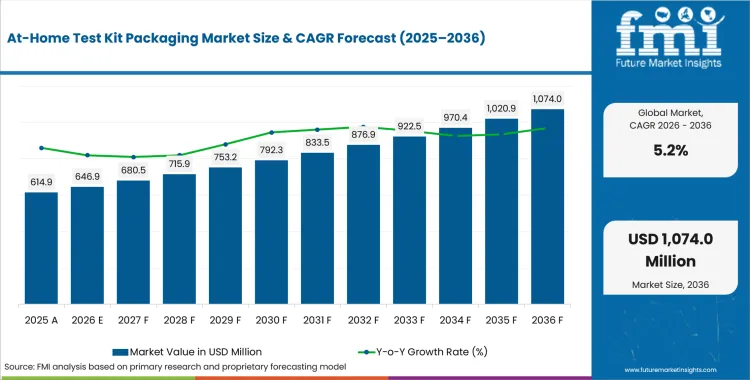
USD 646.9 million in 2026 and USD 1,074.0 million by 2036 at a 5.2% CAGR.
Demand for at-home test kit packaging is projected to rise at a 5.2% CAGR by 2036, driving industry valuation from USD 646.9 million in 2026 to USD 1,074.0 million during the forecast period. Home use shifts component order, lay-user instructions and parcel protection into the package specification. In October 2025, the FDA granted ACON Laboratories traditional authorization for an OTC four-analyte RSV, influenza A/B and COVID home test. A four-analyte kit requires packaging engineers to separate more test elements and instructions distinguishable during assembly and home use. Medical device packaging companies earn repeat orders after the complete configuration passes line and distribution qualification.
Artwork variation becomes expensive if a home-test family changes analytes or country instructions without changing the core tray. In January 2025, the FDA granted Wondfo USA traditional authorization for the Welllife COVID-19 / Influenza A&B Home Test, another multi-analyte OTC home format. The authorization adds a consumer configuration that must keep collection steps and result interpretation clear outside a clinic. For in-vitro diagnostics companies, qualified structures can carry controlled label and insert changes without forcing new tooling for each variant.
Key Takeaways
- Home-use diagnostic approvals increase demand for packaging that organizes test components, protects reagents and presents instructions in a sequence a lay user can follow.
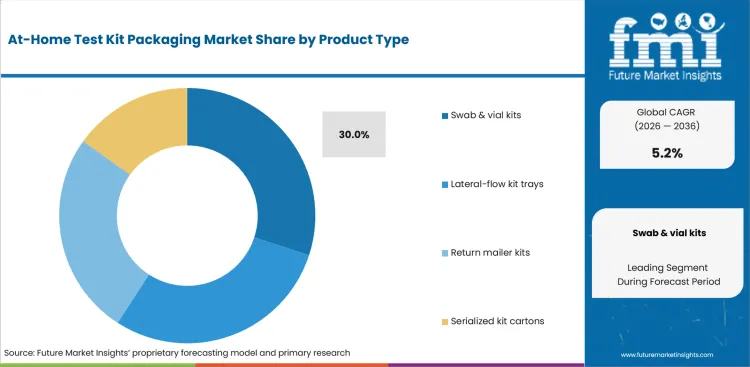
- By product type, swab & vial kits are estimated to hold 30.0% in 2026, owing to repeated collection, transfer and small-component retention requirements.
- Based on material, polymer systems are projected to account for 36.0% in 2026, supported by thermoformed and molded formats that locate components with low parcel weight.
- Child-resistant packaging is likely to capture 29.0% share in 2026, attributable to selected kits placing small liquid containers in household settings.
- Qualification, labeling and line-change work can delay package switching even if an alternative structure offers a lower unit price.
- Some of the key players in this market include Nelipak, Amcor, Oliver Healthcare Packaging, TekniPlex Healthcare, DuPont, SGD Pharma, Gerresheimer, and Sonoco ThermoSafe.
Analyst Perspective
"At-home test kit packaging earns repeat business once one qualified structure can absorb new analytes, labels and country instructions without changing component geometry. The commercial advantage is lower requalification work with lay-user sequencing, barrier performance and parcel protection preserved."
- Nandini Roy Choudhury, Principal Consultant, Future Market Insights
How is the at-home test kit packaging market segmented?
The at-home test kit packaging market is segmented by product type, material, compliance feature, end use, sales channel and region.
Product type covers swab & vial kits, lateral-flow kit trays, return mailer kits and serialized kit cartons. Material includes polymer systems, glass, aluminium & foil and fiber-based structures. Compliance features cover child-resistant, tamper-evident, serialization-ready and cold-chain-assured formats. End use includes hospital & clinical, retail pharmacy, clinical trials and OTC & D2C health. Sales channels include direct pharma contracts, specialty distributors and online B2B procurement.
What makes swab & vial kits central to the product type category?
Home collection requires packaging that separates swabs, containers and instructions during parcel distribution. In March 2025, the FDA authorized Visby Medical's entirely at-home test for chlamydia, gonorrhea and trichomoniasis. Users collect a vaginal swab and run the test without trained staff, so package sequencing must remain clearer than in point-of-care diagnostics workflows.
- By product type, swab & vial kits are estimated to hold 30.0% in 2026, attributable to collection and transfer steps that require secure component retention and an obvious use sequence.
- Diagnostic manufacturers qualify pocket geometry, fitments and instruction placement against the complete kit so parcel movement does not change the intended handling order.
Why do polymer systems lead the material category?
Polymer systems suit kits that need light trays, films and molded retention features. Barrier testing determines whether polymer surfaces can contact reagents. In June 2025, TekniPlex Healthcare began production at a 200,000-square-foot Madison facility serving medical and diagnostic-device applications. The ISO 13485 site shows process control required before pharmaceutical plastic packaging enters a regulated specification.
- In 2026, polymer systems are expected to lead material with 36.0% share, owing to thermoforming and molding routes that hold kit components in place without heavy secondary structures.
- Barrier films, foil and glass remain necessary in applications for which reagent chemistry or shelf-life testing rules out a polymer-only package.
What supports child-resistant packaging in the compliance feature category?
Household storage makes access control relevant for kits containing a liquid vial or closure. Risk assessment determines whether that control belongs on the container or outer pack. Child-resistant containers limit the control to components whose household exposure warrants it. In October 2025, SGD Pharma said Ensiemo was available with tamper-evident and child-resistant caps, documenting that route for small liquid containers.
- By compliance feature, child-resistant formats are forecast to represent 29.0% in 2026, given household exposure risks from liquid containers and test components.
- Package engineers separate child resistance from tamper evidence and serialization because each control addresses a different failure mode during home storage and use.
Why do direct pharma contracts lead the sales channel category?
Direct contracts become common once dimensions, artwork and change notification enter an approved bill of materials. Diagnostic companies need pharmaceutical packaging support before a structural or printed revision reaches qualification. In March 2026, Nelipak opened an Asia-Pacific Technical Development Center in Singapore for package design and validation, giving regional programs a direct concept-to-qualification route.
- Direct pharma contracts are set to lead the sales channel category with 54.0% share in 2026, because validated specifications and controlled changes favor a direct manufacturer relationship.
- Specialty distributors suit standard components, whereas trays, printed barriers and multi-region kits require a direct route for technical changes and replenishment.
What are the drivers, restraints and opportunities in the At-Home Test Kit Packaging Market?
More OTC and home-use test formats expand qualified kit demand, but package changes carry validation work and regional supply gaps leave room for configurable platforms.
- Driver: Each newly authorized home-test configuration requires a packaging bill of materials that organizes components, instructions and parcel protection for lay use.
- Restraint: A tray, barrier or artwork change can reopen quality-system review, line trials and compatibility work until a regulated program accepts the replacement.
- Opportunity: Regional development centers and stocked healthcare formats can reduce prototype, validation and replenishment time for test families that reuse a common package structure.
Regulatory authorization is the point at which a home-test concept starts requiring repeatable commercial packaging. In March 2026, the FDA granted GenBody's COVID-19 Ag Home Test traditional marketing authorization. Once a test enters an OTC home route, its manufacturer must lock component placement, consumer instructions and distribution protection into a reproducible kit. Tamper-evident packaging is specified if opening must remain visible ahead of testing.
Package substitution is slow because medical-device quality systems control changes that can affect fit, labeling or barrier performance. In March 2026, Amcor's Winterbourne site achieved ISO 13485:2016 certification after strengthening risk management, supplier standards and procedures. The certification shows the records behind a tray, film or printed change. A lower quote loses value if a diagnostic company must repeat line trials, artwork review or compatibility work before replenishment.
Regional service capacity can shorten qualification and replenishment for programs that use repeatable healthcare formats. Amcor opened a healthcare warehouse and distribution facility in Costa Rica in August 2025 for trays, lids, forming films, bags, pouches and labels. Local stock can reduce customs and restocking delays for programs serving the Americas. Temperature-controlled packaging solutions extend the revenue route for specimens or reagents that need controlled conditions outside the inner kit.
Which country CAGRs are profiled in the At-Home Test Kit Packaging Market?
| Country | CAGR |
|---|---|
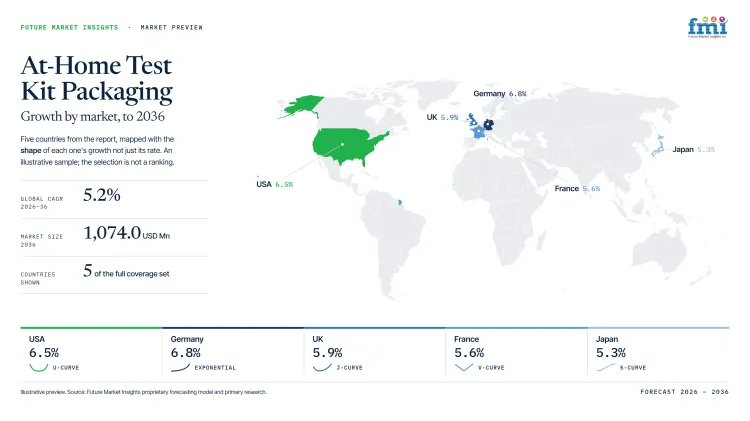
| Germany | 6.8% |
| USA | 6.5% |
| South Korea | 6.2% |
| UK | 5.9% |
| France | 5.6% |
| Japan | 5.3% |
How do country-level CAGRs compare in the At-Home Test Kit Packaging Market?
The profiled countries span a 1.5 percentage-point range. Germany leads at 6.8%, followed closely by USA at 6.5%. South Korea forms the next band at 6.2%, while UK at 5.9% and France at 5.6% sit in a moderate-growth band. Japan is the lowest of the group at 5.3%. The gaps are small enough that supplier execution can matter more than the ranking alone.
- Germany's tray platforms reduce changeover work as test families add retail variants.
- USA parcel distribution rewards compact structures that protect components without increasing shipment volume.
- South Korea's local diagnostic production rewards tooling reuse for several test families.
- UK direct-to-consumer channels place greater weight on mailability and predictable replenishment speed.
- France's routine self-test economics penalize assembly steps that provide no handling benefit.
- Japan home-test programs place high weight on user instructions and on retailer communication around correct use.
Qualification and distribution conditions produce different economics even with comparable country CAGRs. The full report provides country-level CAGR analysis across North America, Latin America, Europe, East Asia, South Asia, Oceania and the Middle East and Africa.
Country-wise Analysis
- Germany's self-test channel reaches pharmacies and retailers more freely than under the earlier dispensing restriction, which gives eligible diagnostic tests a wider route to consumers. The Federal Ministry of Health confirms that the restriction ended on February 20, 2025, and Germany is set to post 6.8% CAGR over the forecast period because legal access broadens the number of home-test programs that can reach retail. CE marking and proof of suitability for lay users still govern self-tests, so German-language instructions and conformity records must move with package revisions and favor structures that can absorb artwork updates without reopening the complete component qualification.
- Large US retailers cycle respiratory-test SKUs by analyte and season, so a common tray geometry reduces requalification work as labels and instructions change. In August 2025, the FDA granted Access Bio traditional authorization for the CareSuperb COVID-19/Flu A&B Antigen Combo Home Test, adding another multi-analyte OTC home format that must retain clear consumer instructions through high-volume retail replenishment. At-home test kit packaging demand in USA is forecast to grow at 6.5% CAGR over the forecast period owing to that broader program base, while FDA labeling and shelf-life records make structural revisions expensive enough to reward companies that isolate printed variation from the qualified tray.
- South Korean diagnostic companies are preparing for a broader self-test menu, and the Ministry of Food and Drug Safety proposed in March 2026 to extend self-testing to sexually transmitted infections, drugs of abuse and influenza with clearer outer-pack identification. In South Korea, at-home test kit packaging demand could advance at 6.2% CAGR through 2036 tied to more consumer test programs and the need for faster Korean-language artwork changes. Category-specific warnings fragment print demand even where internal kit geometry stays stable, so packaging companies that reuse tooling and separate printed variation from the structural pack can revise labels faster without forcing a new qualification route for every category extension.
- Great Britain gives self-test businesses mature pharmacy and direct channels, but post-market records must follow each device after launch and through later package changes. The MHRA published new post-market surveillance guidance on January 15, 2025 covering medical devices including IVDs, which raises the cost of uncontrolled artwork and instruction revisions since incident records stay linked to the approved device. Adoption of at-home test kit packaging in UK is projected to expand at 5.9% CAGR through 2036 aided by established home-diagnostic routes, and disciplined version control gives packaging companies an advantage by protecting replenishment schedules without reopening records for avoidable print changes.
- French pharmacies give self-test brands an established consumer route, which makes packaging cost and instruction clarity visible beside the retail price of routine tests. France's at-home test kit packaging outlook is likely to register 5.6% CAGR over the assessment period supported by a pharmacy channel that already handles self-testing products, though extra secondary structures face pressure if they add assembly without improving safe use. Assurance Maladie stated on March 10, 2025 that nasal COVID-19 self-tests are sold over the counter in pharmacies and must be used according to the supplied guide, so light cartons and stable inserts remain better suited to repeat pharmacy replenishment than elaborate packs.
- Home-test programs place high weight on user instructions and on retailer communication around correct use. Demand for at-home test kit packaging in Japan is forecast to expand at 5.3% CAGR from 2026 to 2036. A January 16, 2025 document from Japan’s health ministry proposed revisions to OTC SARS-CoV-2 and combined influenza test guidance. The proposal included changes to package inserts and explanatory material. The main constraint is frequent sensitivity to precise wording and use instructions rather than simple format availability. Suppliers need to design compact packs with stable component placement and artwork systems that can implement approved Japanese-language changes accurately.
Who are the notable companies in the At-Home Test Kit Packaging Market?
Key companies operating in the at-home test kit packaging market include Nelipak, Amcor, Oliver Healthcare Packaging, TekniPlex Healthcare, DuPont, SGD Pharma, Gerresheimer, and Sonoco ThermoSafe.
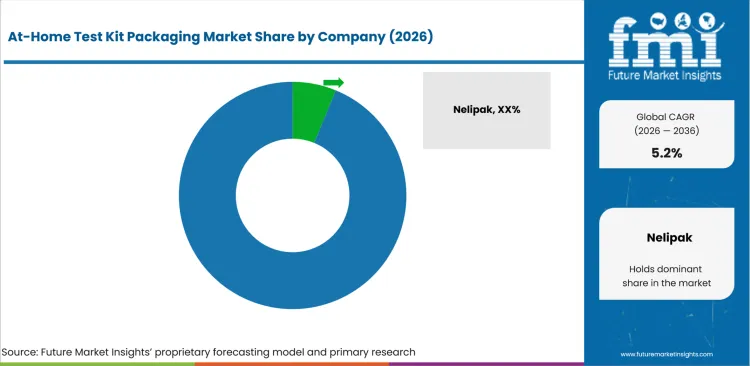
Competition is divided by the qualification task a company can own. Nelipak, Amcor, Oliver Healthcare Packaging and TekniPlex Healthcare cover formed, flexible or sterile-barrier design and conversion. DuPont supplies medical-grade barrier materials. SGD Pharma and Gerresheimer focus on primary containers. Sonoco ThermoSafe enters programs that need temperature-qualified transport beyond the inner kit.
- Kit and sterile-barrier engineering: Nelipak, Amcor, Oliver Healthcare Packaging and TekniPlex Healthcare provide rigid or flexible structures, cleanroom conversion and package-development support.
- Primary containment and material control: DuPont, SGD Pharma and Gerresheimer provide barrier materials, vials and glass or polymer systems for selected kit architectures.
- Temperature-assured outer transport: Sonoco ThermoSafe qualifies parcel systems for programs whose sample stability depends on controlled conditions beyond the consumer kit.
Competitive Benchmarking: At-Home Test Kit Packaging Market
| Company | Kit & Barrier Format Engineering | Safety & Integrity Controls | Qualification & Logistics Support | Geographic Reach |
|---|---|---|---|---|
| Nelipak | High | High | High | Americas, Europe and Asia-Pacific |
| Amcor | High | High | High | Global |
| Oliver Healthcare Packaging | High | High | High | Americas, Europe and Asia-Pacific |
| TekniPlex Healthcare | High | High | High | North America, Europe and Asia-Pacific |
| DuPont | Medium | High | Medium | Global |
| SGD Pharma | Low | High | Medium | Europe, Asia and North America via partner network |
| Gerresheimer | Medium | High | Medium | Europe, Americas and Asia |
| Sonoco ThermoSafe | Low | High | High | Americas, EMEA and Asia |
Scoring basis: High format engineering requires documented multi-format healthcare packaging plus active design or conversion support for regulated applications. Medium requires two relevant format families with narrower engineering depth. Low identifies one specialized documented route. High safety control requires several documented cleanroom, barrier, closure or qualified thermal controls. Medium covers a narrower control set, and Low identifies one limited route. High qualification support requires validation, testing or documented technical-service infrastructure. Medium indicates partial technical support, and Low indicates mainly component supply. Geographic reach is descriptive and is not scored.
Key Developments in the At-Home Test Kit Packaging Market
- In April 2025, Nelipak expanded its direct Asia-Pacific healthcare-packaging support and in-region resources for sterile-barrier customers, including diagnostic applications.
- In April 2025, Amcor completed its all-stock combination with Berry Global, broadening the corporate group’s flexible, rigid and healthcare packaging portfolio.
- In April 2026, Gerresheimer partnered with Milliken to apply LeneX UltraGuard additive technology to pharmaceutical polymer packaging that requires higher protection and process consistency.
Key Players in the At-Home Test Kit Packaging Market
Kit and Sterile-Barrier Packaging Platforms
- Nelipak
- Amcor
- Oliver Healthcare Packaging
- TekniPlex Healthcare
Primary Containment and Medical-Grade Materials
- DuPont
- SGD Pharma
- Gerresheimer
Temperature-Assurance Specialist
- Sonoco ThermoSafe
At-Home Test Kit Packaging Market - Report Scope
| Coverage field | Report scope |
|---|---|
| Market breakdown | By product type, material, compliance feature, end use, sales channel and region. |
| Quantitative Units | USD million. |
| Market Definition | Packaging used to organize, protect, label and distribute diagnostic test kits intended for complete home use or home sample collection. |
| Regions Covered | North America, Latin America, Western Europe, Eastern Europe, East Asia, South Asia and Pacific, and Middle East and Africa. |
| Countries Covered | Germany, USA, South Korea, UK, France, and 20+ countries included in the full report. |
| Key Companies Profiled | Nelipak, Amcor, Oliver Healthcare Packaging, TekniPlex Healthcare, DuPont, SGD Pharma, Gerresheimer, Sonoco ThermoSafe. |
| Forecast Period | 2026 to 2036. |
| Approach | Primary and secondary research with market triangulation. |
At-Home Test Kit Packaging Market - Research Methodology
| Method | Approach |
|---|---|
| Primary Research | FMI analysts gathered input from manufacturers, service providers, technology developers, distributors, end users, procurement teams, and subject-matter experts. Interviews examined purchasing decisions, product or service evaluation, adoption barriers, approval requirements, pricing considerations, and expectations for technical or commercial support. Respondents were also asked what evidence is required before a trial, pilot, or initial order develops into regular purchasing. |
| Desk Research | Desk research covered government statistics, regulatory publications, trade data, industry associations, technical literature, standards, company filings, product information, and official corporate announcements. Sources were reviewed for relevance, publication date, geographic coverage, and consistency with the defined market scope. Claims relating to performance, applications, approvals, capacity, investment, and commercial activity were retained only when supported by credible public evidence. |
| Market Sizing and Forecasting | The market model combined the baseline value with historical performance, segment structure, pricing and volume indicators, adoption levels, company participation, and country-level demand conditions. Forecast assumptions considered economic activity, investment trends, regulatory developments, technology adoption, purchasing cycles, supply availability, and barriers to wider market use. Segment and regional estimates were reconciled before the final market total was calculated. |
| Data Validation | Estimates were checked against multiple independent indicators, including public data, company activity, trade patterns, industry developments, and findings from primary interviews. Validation also tested whether products, services, applications, and company revenues fell within the defined market boundaries. Adjacent categories, unsupported claims, overlapping revenues, and activities without direct market relevance were excluded to reduce double counting and maintain consistency across segments and countries. |
At-Home Test Kit Packaging Market by Segments
At-Home Test Kit Packaging Market segmented by Product Type:
- Swab & vial kits
- Lateral-flow kit trays
- Return mailer kits
- Serialized kit cartons
At-Home Test Kit Packaging Market segmented by Material:
- Polymer systems
- Glass
- Aluminium & foil
- Fiber-based
At-Home Test Kit Packaging Market segmented by Compliance Feature:
- Child-resistant
- Tamper-evident
- Serialization-ready
- Cold chain assured
At-Home Test Kit Packaging Market segmented by End Use:
- Hospital & clinical
- Retail pharmacy
- Clinical trials
- OTC & D2C health
At-Home Test Kit Packaging Market segmented by Sales Channel:
- Direct pharma contracts
- Specialty distributors
- Online B2B
At-Home Test Kit Packaging Market by Region:
- North America
- United States
- Canada
- Latin America
- Brazil
- Mexico
- Argentina
- Chile
- Western Europe
- Germany
- France
- United Kingdom
- Italy
- Spain
- Benelux
- Nordics
- Eastern Europe
- Poland
- Czech Republic
- Romania
- Hungary
- East Asia
- China
- Japan
- South Korea
- South Asia and Pacific
- India
- ASEAN
- Australia and New Zealand
- Middle East and Africa
- GCC Countries
- South Africa
- Türkiye
- Israel
Research Sources and Bibliography
- USA Food and Drug Administration. (2026, August). COVID-19 Tests Granted Traditional Marketing Authorization by the FDA.
- USA Food and Drug Administration. (2025, March 28). FDA Grants Marketing Authorization of First Home Test for Chlamydia, Gonorrhea and Trichomoniasis.
- TekniPlex Healthcare. (2025, June 12). TekniPlex Healthcare Opens New Flagship Barrier Protection Systems Facility in Madison, Wisconsin.
- SGD Pharma. (2025, October 22). SGD Pharma presents new innovations at CPHI Frankfurt 2025.
- Nelipak. (2026, March 11). Nelipak announces opening of Asia-Pacific Technical Development Center.
- Amcor. (2026, March 16). Amcor Winterbourne achieves ISO 13485:2016 certification, strengthening its commitment to healthcare packaging.
- Amcor. (2025, August 18). Amcor expands healthcare packaging network in Costa Rica.
- Bundesministerium für Gesundheit. (2025, September 19). Änderungen der Medizinprodukte-Abgabeverordnung: Aufhebung der Abgabebeschränkung bestimmter In-vitro-Diagnostika.
- Ministry of Food and Drug Safety, Republic of Korea. (2026, March 25). 식약처, 성병·마약류·독감 등 자가검사용 키트 확대 추진.
- Medicines and Healthcare products Regulatory Agency. (2025, January 15). Medical devices: post-market surveillance requirements.
- Assurance Maladie. (2025, March 10). Les autotests antigéniques sur prélèvement nasal pour dépister le Covid-19.
- Nelipak. (2025, April 7). Nelipak® Healthcare Packaging expands commitment to serve customers in Asia-Pacific Region with its sterile barrier medical packaging products.
- Amcor. (2025, April 30). Amcor completes combination with Berry Global; Positioned to significantly enhance value for customers and shareholders.
- Gerresheimer. (2026, April 20). Gerresheimer and Milliken Partner to Advance Performance and Protection with LeneX UltraGuard® Technology.
- Amcor. (2025, April 10). Amcor builds cutting-edge coating facility, enhancing healthcare packaging access in Asia Pacific.
- Nelipak. (2025, July 24). Nelipak breaks ground on new healthcare packaging facility in Grecia, Alajuela.
- Nelipak. (2025, September 3). Cook Medical and Nelipak create healthcare packaging solutions enabled by Tyvek® with Renewable Attribution.
- Oliver Healthcare Packaging. (2025, September 30). Oliver Healthcare Packaging Introduces LumaPeel: Their New Peelable Sealant Technology.
- SGD Pharma. (2026, March 17). SGD Pharma advances its North American pharmaceutical glass offering in new collaboration with Prince Sterilization Services, LCC - debuting its My Sterinity Nasal range at DCAT Week 2026.
- Nelipak. (2025, December 8). Nelipak Acquires Merrill’s Packaging. Strengthens presence in growing healthcare manufacturing and innovation hubs.
- Amcor. (2026, June 1). Amcor achieves cleanroom certification in Puerto Rico.
- Oliver Healthcare Packaging. (2025, May 15). Oliver Healthcare Packaging Opens State-of-the-Art Manufacturing Facility in Johor to Meet the Needs of Pharmaceutical and Medical Device Companies in Asia-Pacific.
- TekniPlex Healthcare. (2026, January 15). At Pharmapack, TekniPlex Healthcare to Unveil Expanded Multidose Packaging Capabilities and Advanced Barrier Materials for Pharmaceutical Applications.
- DuPont. (2025, June 5). DuPont Expands Healthcare Manufacturing Site in Costa Rica, Adding Sterile Packaging Capacity.
- SGD Pharma. (2025, August 28). A Strategic Step Forward: Alphial S.r.l. Joins SGD Pharma.
- Gerresheimer. (2026, July 23). Gerresheimer nimmt neues Werk in Zhenjiang Dagang, China, in Betrieb.
- Sonoco Products Company. (2025, November 3). Sonoco Completes Sale of ThermoSafe Unit to Arsenal Capital Partners.
This bibliography is provided for reader reference and is not exhaustive. The full report contains the complete reference list and detailed citations
This Report Answers
- What is the at-home test kit packaging market size in 2026 and what value is forecast for 2036?
- Why do swab & vial kits lead the product type category?
- Why do polymer systems hold the largest material share?
- How does child-resistant packaging affect selected home-test kit designs?
- Why do direct pharma contracts lead the sales channel category?
- How do country CAGRs compare for Germany, USA, South Korea, UK and France?
- Which qualification and labeling requirements can slow package changes?
- Which companies compete in formed packs, primary containment and temperature-assured transport?
Frequently Asked Questions
How big is the at-home test kit packaging market in 2026?
The at-home test kit packaging market is valued at USD 646.9 million in 2026 and is projected to reach USD 1,074.0 million by 2036. Growth follows regulated home-test formats that require controlled component organization and consumer instructions.
What is the CAGR of the at-home test kit packaging market from 2026 to 2036?
The at-home test kit packaging market is projected to grow at a CAGR of 5.2% between 2026 and 2036. Expansion follows new OTC test authorizations and repeat qualification of trays, barriers, labels and parcel-ready kit structures.
Which product type leads the at-home test kit packaging market?
The swab & vial kits segment is expected to hold 30.0% of the at-home test kit packaging market in 2026, driven by secure component retention. The format also keeps collection and transfer steps visible to home users.
Which material leads the at-home test kit packaging market?
The polymer systems segment is expected to hold 36.0% of the at-home test kit packaging market in 2026, attributable to lightweight molded and thermoformed structures. These formats also hold small components in place during automated assembly and parcel distribution.
Which companies are active in the at-home test kit packaging market?
Key companies operating in the market include Nelipak, Amcor, Oliver Healthcare Packaging, TekniPlex Healthcare, DuPont, SGD Pharma, Gerresheimer, and Sonoco ThermoSafe. Their positions differ by kit engineering, sterile barriers, primary containment and temperature-qualified transport support.
Preview the report firsthand - request a free sample
Get SampleGet the brochure for pricing and purchase details.
Get PDFTable of Content
- Key Takeaways
- Market Size and CAGR
- Top Growth Driver
- Fastest Growing Segment
- Leading Region
- Key Companies
- Emerging Opportunities
- Executive Summary
- Global Market Outlook
- Demand-side Trends
- Supply-side Trends
- Technology Roadmap Analysis
- Analysis and Recommendations
- Analyst Perspective (What is happening? Why now? What should investors know?)
- Key Questions Answered
- How large is the market?
- What is the CAGR?
- What are key trends?
- Which region dominates?
- Who are the leaders?
- Market Overview
- Market Coverage / Taxonomy
- Market Definition / Scope / Limitations
- Research Methodology
- Chapter Orientation
- Analytical Lens and Working Hypotheses
- Market Structure, Signals, and Trend Drivers
- Benchmarking and Cross-market Comparability
- Market Sizing, Forecasting, and Opportunity Mapping
- Research Design and Evidence Framework
- Desk Research Programme (Secondary Evidence)
- Expert Input and Fieldwork (Primary Evidence)
- Tooling, Models, and Reference Databases
- Data Engineering and Model Build
- Quality Assurance and Audit Trail
- Market Background
- Market Dynamics (Drivers, Restraints, Opportunity, Trends)
- Scenario Forecast (Optimistic, Likely, Conservative)
- Impact Analysis
- AI Impact
- Sustainability Impact
- Regulatory Impact
- Technology Impact
- Consumer / Buyer Analysis
- Purchase Drivers
- Adoption Barriers
- Buyer Journey
- Opportunity Map Analysis
- Product Life Cycle Analysis
- Supply Chain Analysis
- Investment Feasibility Matrix
- Value Chain Analysis
- PESTLE and Porter's Analysis
- Regulatory Landscape
- Regional Parent Market Outlook
- Production and Consumption Statistics
- Import and Export Statistics
- Global Market Analysis and Forecast, 2021 to 2036
- Historical Market Size Value (USD Million) Analysis, 2021 to 2025
- Current and Future Market Size Value (USD Million) Projections, 2026 to 2036
- Y-o-Y Growth Trend Analysis
- Absolute $ Opportunity Analysis
- Global Market Pricing Analysis, 2021 to 2036
- Global Market Analysis and Forecast, By Product Type, 2021 to 2036
- Introduction / Key Findings
- Historical Market Size Value (USD Million) Analysis By Product Type, 2021 to 2025
- Current and Future Market Size Value (USD Million) Analysis and Forecast By Product Type, 2026 to 2036
- Swab & vial kits
- Lateral-flow kit trays
- Return mailer kits
- Serialized kit cartons
- Swab & vial kits
- Y-o-Y Growth Trend Analysis By Product Type, 2021 to 2025
- Absolute $ Opportunity Analysis By Product Type, 2026 to 2036
- Global Market Analysis and Forecast, By Material, 2021 to 2036
- Introduction / Key Findings
- Historical Market Size Value (USD Million) Analysis By Material, 2021 to 2025
- Current and Future Market Size Value (USD Million) Analysis and Forecast By Material, 2026 to 2036
- Polymer systems
- Glass
- Aluminium & foil
- Fiber-based
- Polymer systems
- Y-o-Y Growth Trend Analysis By Material, 2021 to 2025
- Absolute $ Opportunity Analysis By Material, 2026 to 2036
- Global Market Analysis and Forecast, By Compliance Feature, 2021 to 2036
- Introduction / Key Findings
- Historical Market Size Value (USD Million) Analysis By Compliance Feature, 2021 to 2025
- Current and Future Market Size Value (USD Million) Analysis and Forecast By Compliance Feature, 2026 to 2036
- Child-resistant
- Tamper-evident
- Serialization-ready
- Cold chain assured
- Child-resistant
- Y-o-Y Growth Trend Analysis By Compliance Feature, 2021 to 2025
- Absolute $ Opportunity Analysis By Compliance Feature, 2026 to 2036
- Global Market Analysis and Forecast, By End Use, 2021 to 2036
- Introduction / Key Findings
- Historical Market Size Value (USD Million) Analysis By End Use, 2021 to 2025
- Current and Future Market Size Value (USD Million) Analysis and Forecast By End Use, 2026 to 2036
- Hospital & clinical
- Retail pharmacy
- Clinical trials
- OTC & D2C health
- Hospital & clinical
- Y-o-Y Growth Trend Analysis By End Use, 2021 to 2025
- Absolute $ Opportunity Analysis By End Use, 2026 to 2036
- Global Market Analysis and Forecast, By Sales Channel, 2021 to 2036
- Introduction / Key Findings
- Historical Market Size Value (USD Million) Analysis By Sales Channel, 2021 to 2025
- Current and Future Market Size Value (USD Million) Analysis and Forecast By Sales Channel, 2026 to 2036
- Direct pharma contracts
- Specialty distributors
- Online B2B
- Direct pharma contracts
- Y-o-Y Growth Trend Analysis By Sales Channel, 2021 to 2025
- Absolute $ Opportunity Analysis By Sales Channel, 2026 to 2036
- Global Market Analysis and Forecast, By Region, 2021 to 2036
- Introduction
- Historical Market Size Value (USD Million) Analysis By Region, 2021 to 2025
- Current Market Size Value (USD Million) Analysis and Forecast By Region, 2026 to 2036
- North America
- Latin America
- Western Europe
- Eastern Europe
- East Asia
- South Asia and Pacific
- Middle East & Africa
- Market Attractiveness Analysis By Region
- North America Market Analysis and Forecast, By Country, 2021 to 2036
- Historical Market Size Value (USD Million) Trend Analysis By Market Taxonomy, 2021 to 2025
- Market Size Value (USD Million) Forecast By Market Taxonomy, 2026 to 2036
- By Country
- USA
- Canada
- By Product Type
- By Material
- By Compliance Feature
- By End Use
- By Sales Channel
- By Country
- Market Attractiveness Analysis
- By Country
- By Product Type
- By Material
- By Compliance Feature
- By End Use
- By Sales Channel
- Key Takeaways
- Latin America Market Analysis and Forecast, By Country
- Historical Market Size Value (USD Million) Trend Analysis By Market Taxonomy, 2021 to 2025
- Market Size Value (USD Million) Forecast By Market Taxonomy, 2026 to 2036
- By Country
- Brazil
- Mexico
- Chile
- Rest of Latin America
- By Product Type
- By Material
- By Compliance Feature
- By End Use
- By Sales Channel
- By Country
- Market Attractiveness Analysis
- By Country
- By Product Type
- By Material
- By Compliance Feature
- By End Use
- By Sales Channel
- Key Takeaways
- Western Europe Market Analysis and Forecast, By Country
- Historical Market Size Value (USD Million) Trend Analysis By Market Taxonomy, 2021 to 2025
- Market Size Value (USD Million) Forecast By Market Taxonomy, 2026 to 2036
- By Country
- Germany
- UK
- Italy
- Spain
- France
- Nordic
- BENELUX
- Rest of Western Europe
- By Product Type
- By Material
- By Compliance Feature
- By End Use
- By Sales Channel
- By Country
- Market Attractiveness Analysis
- By Country
- By Product Type
- By Material
- By Compliance Feature
- By End Use
- By Sales Channel
- Key Takeaways
- Eastern Europe Market Analysis and Forecast, By Country
- Historical Market Size Value (USD Million) Trend Analysis By Market Taxonomy, 2021 to 2025
- Market Size Value (USD Million) Forecast By Market Taxonomy, 2026 to 2036
- By Country
- Russia
- Poland
- Hungary
- Balkan & Baltic
- Rest of Eastern Europe
- By Product Type
- By Material
- By Compliance Feature
- By End Use
- By Sales Channel
- By Country
- Market Attractiveness Analysis
- By Country
- By Product Type
- By Material
- By Compliance Feature
- By End Use
- By Sales Channel
- Key Takeaways
- East Asia Market Analysis and Forecast, By Country
- Historical Market Size Value (USD Million) Trend Analysis By Market Taxonomy, 2021 to 2025
- Market Size Value (USD Million) Forecast By Market Taxonomy, 2026 to 2036
- By Country
- China
- Japan
- South Korea
- By Product Type
- By Material
- By Compliance Feature
- By End Use
- By Sales Channel
- By Country
- Market Attractiveness Analysis
- By Country
- By Product Type
- By Material
- By Compliance Feature
- By End Use
- By Sales Channel
- Key Takeaways
- South Asia and Pacific Market Analysis and Forecast, By Country
- Historical Market Size Value (USD Million) Trend Analysis By Market Taxonomy, 2021 to 2025
- Market Size Value (USD Million) Forecast By Market Taxonomy, 2026 to 2036
- By Country
- India
- ASEAN
- Australia & New Zealand
- Rest of South Asia and Pacific
- By Product Type
- By Material
- By Compliance Feature
- By End Use
- By Sales Channel
- By Country
- Market Attractiveness Analysis
- By Country
- By Product Type
- By Material
- By Compliance Feature
- By End Use
- By Sales Channel
- Key Takeaways
- Middle East & Africa Market Analysis and Forecast, By Country
- Historical Market Size Value (USD Million) Trend Analysis By Market Taxonomy, 2021 to 2025
- Market Size Value (USD Million) Forecast By Market Taxonomy, 2026 to 2036
- By Country
- Kingdom of Saudi Arabia
- Other GCC Countries
- Türkiye
- South Africa
- Other African Union
- Rest of Middle East & Africa
- By Product Type
- By Material
- By Compliance Feature
- By End Use
- By Sales Channel
- By Country
- Market Attractiveness Analysis
- By Country
- By Product Type
- By Material
- By Compliance Feature
- By End Use
- By Sales Channel
- Key Takeaways
- Key Countries Market Analysis
- USA
- Pricing Analysis
- Market Share Analysis, 2025
- By Product Type
- By Material
- By Compliance Feature
- By End Use
- By Sales Channel
- Canada
- Pricing Analysis
- Market Share Analysis, 2025
- By Product Type
- By Material
- By Compliance Feature
- By End Use
- By Sales Channel
- Mexico
- Pricing Analysis
- Market Share Analysis, 2025
- By Product Type
- By Material
- By Compliance Feature
- By End Use
- By Sales Channel
- Brazil
- Pricing Analysis
- Market Share Analysis, 2025
- By Product Type
- By Material
- By Compliance Feature
- By End Use
- By Sales Channel
- Chile
- Pricing Analysis
- Market Share Analysis, 2025
- By Product Type
- By Material
- By Compliance Feature
- By End Use
- By Sales Channel
- Germany
- Pricing Analysis
- Market Share Analysis, 2025
- By Product Type
- By Material
- By Compliance Feature
- By End Use
- By Sales Channel
- UK
- Pricing Analysis
- Market Share Analysis, 2025
- By Product Type
- By Material
- By Compliance Feature
- By End Use
- By Sales Channel
- Italy
- Pricing Analysis
- Market Share Analysis, 2025
- By Product Type
- By Material
- By Compliance Feature
- By End Use
- By Sales Channel
- Spain
- Pricing Analysis
- Market Share Analysis, 2025
- By Product Type
- By Material
- By Compliance Feature
- By End Use
- By Sales Channel
- France
- Pricing Analysis
- Market Share Analysis, 2025
- By Product Type
- By Material
- By Compliance Feature
- By End Use
- By Sales Channel
- India
- Pricing Analysis
- Market Share Analysis, 2025
- By Product Type
- By Material
- By Compliance Feature
- By End Use
- By Sales Channel
- ASEAN
- Pricing Analysis
- Market Share Analysis, 2025
- By Product Type
- By Material
- By Compliance Feature
- By End Use
- By Sales Channel
- Australia & New Zealand
- Pricing Analysis
- Market Share Analysis, 2025
- By Product Type
- By Material
- By Compliance Feature
- By End Use
- By Sales Channel
- China
- Pricing Analysis
- Market Share Analysis, 2025
- By Product Type
- By Material
- By Compliance Feature
- By End Use
- By Sales Channel
- Japan
- Pricing Analysis
- Market Share Analysis, 2025
- By Product Type
- By Material
- By Compliance Feature
- By End Use
- By Sales Channel
- South Korea
- Pricing Analysis
- Market Share Analysis, 2025
- By Product Type
- By Material
- By Compliance Feature
- By End Use
- By Sales Channel
- Russia
- Pricing Analysis
- Market Share Analysis, 2025
- By Product Type
- By Material
- By Compliance Feature
- By End Use
- By Sales Channel
- Poland
- Pricing Analysis
- Market Share Analysis, 2025
- By Product Type
- By Material
- By Compliance Feature
- By End Use
- By Sales Channel
- Hungary
- Pricing Analysis
- Market Share Analysis, 2025
- By Product Type
- By Material
- By Compliance Feature
- By End Use
- By Sales Channel
- Kingdom of Saudi Arabia
- Pricing Analysis
- Market Share Analysis, 2025
- By Product Type
- By Material
- By Compliance Feature
- By End Use
- By Sales Channel
- Türkiye
- Pricing Analysis
- Market Share Analysis, 2025
- By Product Type
- By Material
- By Compliance Feature
- By End Use
- By Sales Channel
- South Africa
- Pricing Analysis
- Market Share Analysis, 2025
- By Product Type
- By Material
- By Compliance Feature
- By End Use
- By Sales Channel
- USA
- Market Structure Analysis
- Competition Dashboard
- Competition Benchmarking
- Market Share Analysis of Top Players
- By Regional
- By Product Type
- By Material
- By Compliance Feature
- By End Use
- By Sales Channel
- Emerging Startups
- Innovation Benchmarking
- Competition Analysis
- Competition Deep Dive
- Nelipak
- Overview
- Product Portfolio
- Profitability by Market Segments
- Sales Footprint
- Strategy Overview
- Marketing Strategy
- Product Strategy
- Channel Strategy
- SGD Pharma
- Schott
- va-Q-tec
- Berry Global
- Aptar Pharma
- Sonoco ThermoSafe
- Amcor
- Gerresheimer
- West Pharmaceutical
- Nelipak
- Case Studies
- Success Stories
- Recent Developments
- Competition Deep Dive
- Assumptions & Acronyms Used


