

- Industry Size (2026)
- USD 421.61 Mn
- Forecast (2036)
- USD 740.92 Mn
- CAGR (2026 to 2036)
- 5.80%
Bamboo Fiber Tableware and Kitchenware Market Size, Market Forecast and Outlook By FMI
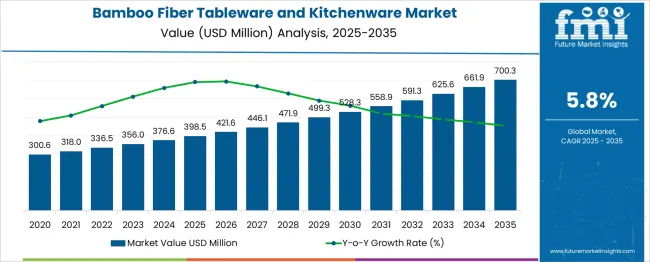
The bamboo fiber tableware and kitchenware market was valued at USD 398.50 million in 2025, projected to reach USD 421.61 million in 2026, and is forecast to expand to USD 740.92 million by 2036 at a 5.80% CAGR. Consumer preference for plant-based, biodegradable alternatives to plastic tableware and melamine kitchenware is driving sustained adoption of bamboo fiber composite products in residential dining and food preparation applications. Single-use plastic bans across the European Union, several Asian jurisdictions, and select North American municipalities are converting disposable plastic tableware demand into reusable bamboo fiber product procurement, creating a regulatory pull mechanism that accelerates consumer switching.
The absolute dollar opportunity of approximately USD 319 million over the forecast period reflects steady penetration growth from early-adopter eco-conscious consumer segments into mainstream household kitchenware procurement. Bamboo fiber composite technology improvements are expanding the product range from basic plates and bowls into heat-resistant cooking utensils, insulated serving ware, and children-specific tableware sets that command higher per-unit pricing. Commercial foodservice operators adopting reusable bamboo tableware for dine-in service to meet corporate sustainability targets are generating institutional procurement volumes with higher order values than individual retail purchases.
Summary of Bamboo Fiber Tableware and Kitchenware Market
- Bamboo Fiber Tableware and Kitchenware Market Definition
- Bamboo fiber tableware and kitchenware are dining, serving, and food preparation products made from processed bamboo fiber composites, designed as sustainable alternatives to plastic and melamine for residential and commercial use.
- Demand Drivers in the Market
- Single-use plastic bans across the EU, multiple Asian jurisdictions, and North American municipalities are converting disposable plastic tableware demand into reusable bamboo fiber product procurement through regulatory enforcement mechanisms.
- Bamboo fiber composite technology improvements are expanding the product range into heat-resistant cooking utensils and insulated serving ware that command premium pricing above basic plate and bowl categories.
- Commercial foodservice operators adopting reusable bamboo tableware for dine-in service to meet corporate sustainability reporting targets are generating institutional procurement volumes with higher order values than individual retail purchases.
- Key Segments Analyzed in the FMI Report
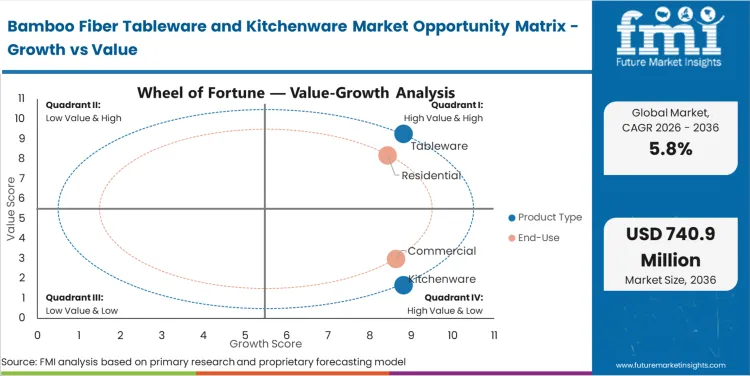
- Tableware by Product Type: 61.3% share in 2026, as plates, bowls, and cups constitute the highest-volume product categories directly displacing single-use plastic and melamine alternatives in both residential and commercial dining settings.
- Residential by End-Use: 68.7% share in 2026, reflecting the consumer-driven adoption of bamboo fiber products as household plastic replacement purchases through retail and e-commerce channels.
- China: 7.8% compound growth driven by domestic bamboo resource availability, manufacturing cost advantages, and urban consumer eco-product demand.
- Analyst Opinion at FMI
- Rahul Pandita, Principal Analyst for Consumer goods, opinis that "The bamboo fiber tableware market is transitioning from niche eco-brand positioning to mainstream retail shelf presence as plastic ban enforcement creates structural demand shifts that benefit all bamboo composite product categories. Manufacturers who cannot demonstrate food contact safety certification under EU Regulation 1935/2004 and FDA 21 CFR compliance face market access barriers in regulated markets where bamboo-melamine composite safety concerns have triggered enforcement actions. The critical product risk centers on formaldehyde migration testing, as bamboo fiber products containing melamine-formaldehyde binding agents face regulatory scrutiny that could restrict market access if testing protocols tighten.
- Strategic Implications / Executive Takeaways
- Bamboo tableware manufacturers must secure food contact material safety certifications under EU and FDA frameworks to maintain market access in jurisdictions with active enforcement against non-compliant bamboo composite products.
- Housewares retailers must establish bamboo fiber product testing and compliance verification programmes to manage liability exposure from food contact safety regulations affecting bamboo-melamine composite formulations.
- Commercial foodservice operators must evaluate bamboo tableware durability and dishwasher cycle ratings against total replacement cost projections when transitioning from disposable to reusable tableware programmes.
China sets the pace at a 7.8% CAGR, driven by domestic bamboo resource availability, manufacturing cost advantages, and growing urban consumer demand for eco-friendly household products. India follows at 7.3% as plastic ban enforcement in multiple states and growing middle-class eco-consciousness generate bamboo tableware retail demand. Germany registers 6.7% growth under strict single-use plastic directive implementation and consumer preference for certified sustainable kitchenware. France maintains 6.1% supported by Agec Law anti-waste provisions driving reusable tableware adoption. UK expands at 5.5% anchored by retailer sustainability pledges and consumer demand for plastic-free kitchen products. USA tracks at 4.9% driven by municipal plastic ban adoption and direct-to-consumer eco-product brand growth. Brazil registers 4.4% with growing eco-conscious consumer segments and bamboo cultivation expansion.
Bamboo Fiber Tableware and Kitchenware Market Key Takeaways
| Metric | Details |
|---|---|
| Industry Size (2026) | USD 421.61 Million |
| Industry Value (2036) | USD 740.92 Million |
| CAGR (2026-2036) | 5.80% |
Source: Future Market Insights, 2026
Bamboo Fiber Tableware and Kitchenware Market Definition
Bamboo fiber tableware and kitchenware encompasses dining, serving, and food preparation products manufactured from processed bamboo fiber composites, including plates, bowls, cups, cutting boards, utensils, serving trays, and storage containers designed as sustainable alternatives to plastic, melamine, and conventional ceramic tableware for residential and commercial foodservice applications.
Bamboo Fiber Tableware and Kitchenware Market Inclusions
Market scope includes bamboo fiber composite plates, bowls, cups, cutting boards, utensil sets, serving trays, food storage containers, and children-specific bamboo tableware sets. Coverage spans residential household retail, commercial foodservice procurement, and hospitality industry reusable tableware applications across offline and online distribution channels.
Bamboo Fiber Tableware and Kitchenware Market Exclusions
Raw bamboo timber products, bamboo flooring, bamboo textile fiber, bamboo charcoal products, and disposable bamboo leaf plates without fiber composite processing are excluded. Conventional wooden kitchenware without bamboo fiber content falls outside analytical parameters.
Bamboo Fiber Tableware and Kitchenware Market Research Methodology
- Primary Research: Analysts engaged with housewares retail category managers, commercial foodservice procurement directors, and bamboo product manufacturer export sales teams to map the specification and purchasing triggers for bamboo fiber tableware adoption.
- Desk Research: Data collection phases aggregated single-use plastic ban implementation timelines, retail eco-product category sales data, and commercial foodservice sustainability procurement mandate schedules.
- Market-Sizing and Forecasting: Baseline values derive from a bottom-up aggregation of bamboo fiber tableware and kitchenware unit shipments multiplied by average retail prices across product type and distribution channel categories, applying region-specific plastic ban and consumer adoption curves.
- Data Validation and Update Cycle: Projections are tested against publicly reported eco-product category revenues from leading housewares retailers and bamboo product manufacturer export statistics.
Why is the Bamboo Fiber Tableware and Kitchenware Market Growing?
The bamboo fiber tableware and kitchenware market is witnessing strong growth as sustainability, aesthetic appeal, and health-conscious consumer trends drive demand for eco-friendly alternatives to plastic and ceramic products. The increasing awareness of the environmental impact of disposable and non-biodegradable kitchenware has positioned bamboo fiber as a preferred material due to its renewable nature and minimal carbon footprint.
Rising disposable incomes, growing urbanization, and evolving lifestyle preferences have further contributed to the adoption of bamboo fiber products, especially in premium and wellness-oriented households.
Future growth is expected to be supported by innovation in designs, improved durability through material enhancements, and broader retail penetration, which are collectively paving the way for mass-market adoption and diversification across both developed and emerging economies.
Segmental Analysis
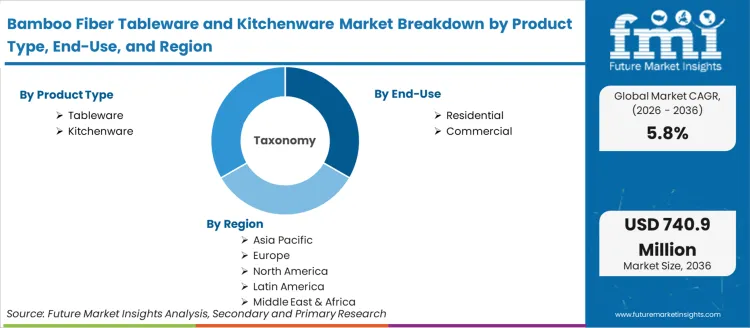
The bamboo fiber tableware and kitchenware market is segmented by product type, end-use, and distribution channel and geographic regions. The bamboo fiber tableware and kitchenware market is divided by product type into Tableware and Kitchenware. The end-use of the bamboo fiber tableware and kitchenware market is classified into Residential and Commercial.
The distribution channel of the bamboo fiber tableware and kitchenware market is segmented into Offline and Online. Regionally, the bamboo fiber tableware and kitchenware industry is classified into North America, Latin America, Western Europe, Eastern Europe, Balkan & Baltic Countries, Russia & Belarus, Central Asia, East Asia, South Asia & Pacific, and the Middle East & Africa.
Insights into the Tableware Product Type Segment
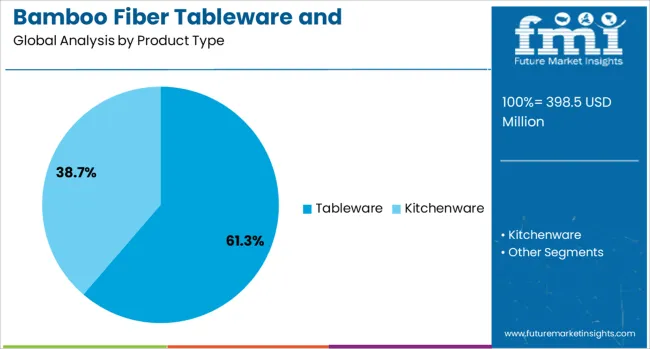
When segmented by product type, tableware is projected to hold 61.30% of the total market revenue in 2026, making it the leading product segment. The high frequency of use has driven this dominance, the need for aesthetically pleasing and functional dining solutions, and the growing cultural emphasis on sustainable dining practices.
Tableware made from bamboo fiber has been increasingly chosen for its lightweight, non-toxic, and biodegradable properties that align with consumer values around health and the environment. Manufacturers have focused on offering diverse designs and color options, making bamboo fiber tableware an attractive choice for both daily use and special occasions.
The ability to combine durability with a premium feel has further strengthened its appeal among households and hospitality establishments, reinforcing its leadership within the product landscape.
Insights into the Residential End Use Segment
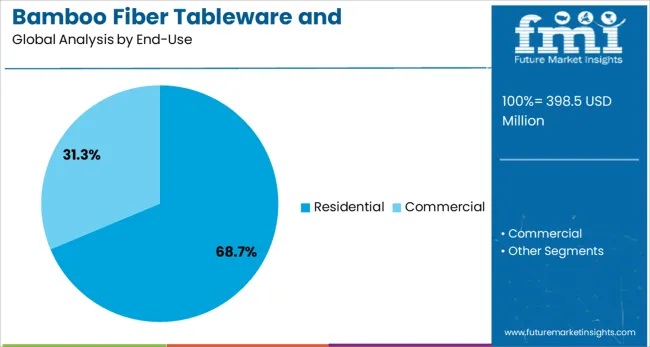
Segmented by end use, the residential segment is expected to account for 68.70% of the market revenue in 2026, maintaining its position as the leading consumer group. This predominance has been supported by growing consumer awareness about sustainable living, increasing willingness to invest in eco-friendly products, and the suitability of bamboo fiber kitchenware for everyday household needs.
Residential consumers have increasingly adopted bamboo fiber products as part of a broader lifestyle shift toward reducing plastic usage and embracing natural materials. The availability of affordable options across both online and offline retail channels has made it accessible to a wide demographic. Premium designs have appealed to high-income households seeking unique and responsible dining solutions.
This combination of environmental consciousness and aesthetic demand has firmly positioned residential consumers as the primary driver of market growth.
Insights into the Offline Distribution Channel Segment
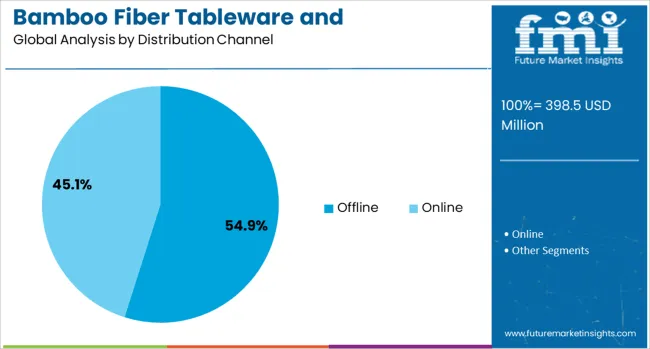
When segmented by distribution channel, offline sales are projected to capture 54.90% of the market revenue in 2026, establishing themselves as the leading channel. This leadership has been influenced by consumer preference for physically examining product quality, texture, and design before purchase, which is particularly important for kitchenware and tableware.
Retailers and specialty stores have strategically allocated prominent shelf space to eco-friendly products, supported by in-store promotions and visual merchandising that effectively communicate the sustainability narrative. Additionally, offline channels such as home goods stores and supermarkets have cultivated trust and convenience through immediate product availability and personalized service.
This tangible shopping experience has continued to appeal to consumers despite the growth of e-commerce, maintaining offline’s strong foothold in the market.
What are the Drivers, Restraints, and Key Trends of the Bamboo Fiber Tableware and Kitchenware Market?
The bamboo fiber tableware and kitchenware market is experiencing steady growth as demand for biodegradable alternatives to plastic products rises. In 2025, consumer and commercial sectors increasingly adopted bamboo-based plates, bowls, and utensils due to environmental concerns and changing regulations.
By 2026, hospitality and foodservice industries expanded their use of bamboo fiber products to align with eco-conscious branding and waste-reduction goals. Manufacturers offering durable, food-safe bamboo fiber solutions designed for both retail and professional applications are well positioned to capture this market shift.
Plastic Restrictions Encourage Bamboo Fiber Product Adoption
Regulatory restrictions on single-use plastics have significantly influenced the uptake of bamboo fiber tableware and kitchenware. In 2025, many markets in Europe and North America shifted toward bamboo-based alternatives in restaurants and catering services. By 2026, hotels and hospitality brands widely adopted bamboo utensils, plates, and cups to comply with environmental standards while appealing to sustainability-conscious consumers.
These developments show that compliance and functional quality are shaping adoption trends. Manufacturers delivering certified bamboo fiber products with durability and compostability are likely to maintain a strong position in the market.
Commercial Foodservice Channels Expand Bamboo Product Applications
Rising use in commercial foodservice is creating major opportunities for bamboo fiber products. In 2025, catering companies and cafés integrated bamboo dinnerware to reinforce environmentally friendly practices. By 2026, large hospitality chains and quick-service restaurants embraced reusable bamboo sets to reduce reliance on plastic while improving brand value.
This transition illustrates that bamboo fiber can become a mainstream material in large-scale dining operations. Suppliers offering customizable, bulk-ready bamboo products with consistent quality and appealing designs are poised to benefit from these expanding opportunities.
High Production Costs Impacting Competitive Price Positioning
Production of bamboo fiber tableware involves intensive processing, including fiber extraction and molding with natural binders, which adds cost pressure. Manufacturers in 2025 and 2026 faced difficulties in balancing premium pricing against consumer expectations for affordability. Retailers have reported slower adoption in price-sensitive regions where alternatives such as melamine or plastic remain dominant.
Margins have been further affected by rising labor expenses and raw material fluctuations. These pricing constraints have restricted market penetration, especially for small and medium producers unable to leverage economies of scale. Without strategic optimization in sourcing and manufacturing, price competitiveness remains an unresolved challenge.
Customizable Aesthetic Designs Enhancing Consumer Purchase Behavior
The market in 2025 and 2026 observed an emphasis on customization for bamboo fiber kitchenware, with brands launching patterned collections for premium dining and hospitality sectors. Retailers introduced thematic sets and seasonal editions, responding to the preference for personalized dining aesthetics in high-end households and boutique restaurants. Enhanced color retention techniques and textural variety have been adopted, making bamboo fiber items visually competitive with ceramic and glassware.
Market response has been positive in online retail channels where curated designs are marketed as exclusive collections. This trend positions design-oriented strategies as a strong differentiator for companies aiming at higher-margin consumer segments.
Analysis of Bamboo Fiber Tableware and Kitchenware Market By Key Countries
.webp "Top Country Growth Comparison Bamboo Fiber Tableware And Kitchenware Market Cagr (2026 2036)")
| Country | CAGR |
|---|---|
| China | 7.8% |
| India | 7.3% |
| Germany | 6.7% |
| France | 6.1% |
| UK | 5.5% |
| USA | 4.9% |
| Brazil | 4.4% |
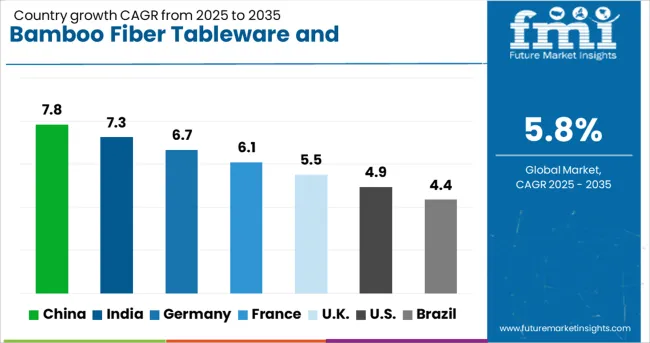
The global bamboo fiber tableware and kitchenware market is projected to grow at a CAGR of 5.8% from 2025 to 2035. China leads with 7.8%, followed by India at 7.3% and Germany at 6.7%. France records 6.1%, while the United Kingdom posts 5.5%. Growth is driven by rising adoption of eco-friendly tableware, increasing consumer preference for biodegradable alternatives, and regulatory emphasis on reducing plastic waste. China and India dominate due to robust manufacturing ecosystems and domestic demand for sustainable products. Germany focuses on premium bamboo designs, while France and the UK emphasize aesthetics and safety compliance in food-contact materials.
Demand Forecast for Bamboo Fiber Tableware and Kitchenware in China
China is projected to grow at 7.8%, supported by large-scale production capacity and high domestic demand for eco-friendly kitchen products. Manufacturers innovate with durable bamboo fiber composites to replace single-use plastics. Integration of vibrant designs enhances consumer appeal in export markets. Growing e-commerce penetration accelerates the adoption of sustainable kitchenware in households.
- Durable bamboo composites dominate replacements for single-use plastics.
- Export-driven designs combine functionality with aesthetic appeal.
- E-commerce platforms strengthen direct-to-consumer product accessibility.
Bamboo Fiber Tableware and Kitchenware Market Growth Outlook in India
India is forecast to grow at 7.3%, fueled by urban lifestyle changes and government initiatives promoting biodegradable products. Affordable bamboo-based kitchenware dominates demand in middle-income households. Local manufacturers focus on scaling production while maintaining cost efficiency. Rising popularity of eco-friendly gifting trends further boosts market penetration.
- Affordable bamboo fiber products dominate mass-market household adoption.
- Government programs accelerate adoption of plastic-free alternatives.
- Eco-friendly gifting trends drive demand for premium bamboo designs.
Future Outlook for Bamboo Fiber Tableware and Kitchenware Market in Germany
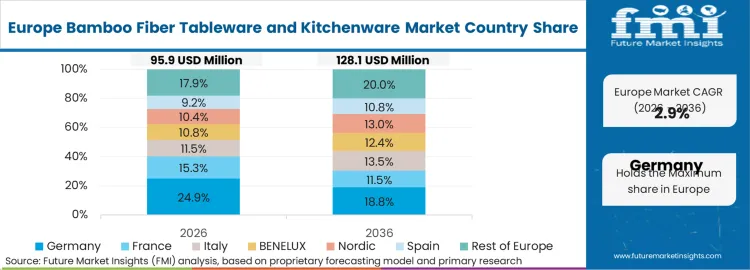
Germany is projected to grow at 6.7%, driven by strong consumer preference for sustainable lifestyle products. Premium bamboo kitchenware integrated with minimalist designs dominates high-end markets. Manufacturers invest in BPA-free, food-safe coatings to meet EU compliance standards. Retail chains expand offerings of biodegradable tableware aligned with zero-waste movements.
- Premium bamboo products dominate luxury and lifestyle-driven segments.
- BPA-free coatings ensure compliance with strict EU safety standards.
- Retail expansion supports sustainable alternatives in mainstream channels.
Analysis of Bamboo Fiber Tableware and Kitchenware Market in France
France is forecast to grow at 6.1%, supported by growing demand for eco-luxury products and zero-plastic kitchen solutions. Manufacturers introduce microwave-safe bamboo fiber products for convenience-focused consumers. Rising café culture promotes adoption of sustainable tableware in foodservice establishments. Design innovation combining modern aesthetics with functionality attracts premium buyers.
- Microwave-safe bamboo fiber products dominate convenience-oriented markets.
- Café chains adopt sustainable tableware to reinforce green branding.
- Innovative designs enhance adoption in premium home and hospitality sectors.
Growth Analysis of Bamboo Fiber Tableware and Kitchenware Market in the United Kingdom
The UK is projected to grow at 5.5%, driven by strong demand for biodegradable products in the retail and HoReCa sectors. Eco-certified bamboo fiber kitchenware dominates sustainable product lines. Manufacturers invest in vibrant, customizable designs targeting home décor enthusiasts. Growing e-commerce penetration and private-label offerings fuel broader adoption.
- Eco-certified bamboo fiber products dominate retail and hospitality segments.
- Customizable designs cater to consumer preferences for personalization.
- Private-label collaborations strengthen visibility in major online marketplaces.
Competitive Landscape of Bamboo Fiber Tableware and Kitchenware Market
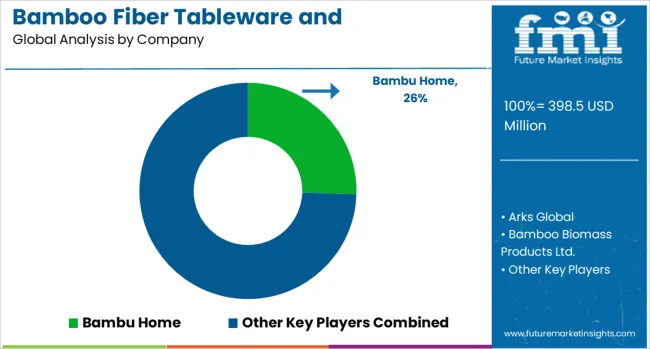
The bamboo fiber tableware and kitchenware market is fragmented, with multiple established and emerging players driving competition through innovation and eco-focused product portfolios. Bambu Home holds a notable position with its premium-quality, sustainable tableware collections designed for durability and style.
The brand’s emphasis on certified organic bamboo and handcrafted products enhances its market leadership among environmentally conscious consumers. Key players include Arks Global, Bamboo Biomass Products Ltd., Bamboo India, Bamboo Studio, Bamboovement, Better Earth Eco Products, ChopValue Manufacturing Ltd., Ecolife Innovations Ltd., EcoSouLife, Ekobo, Green Pioneer, HUSK’SWARE, Lysas Eco Products Co. Ltd., and Natural Home Brands, each offering diverse bamboo-based products such as plates, bowls, cups, cutlery, and storage solutions.
These companies differentiate through unique design aesthetics, heat-resistant materials, and biodegradable product lines tailored for residential and commercial applications. Market growth is driven by increasing consumer preference for sustainable and reusable alternatives to plastic, combined with the rising adoption of eco-friendly products in hospitality and foodservice sectors. Brands are focusing on product innovation, including dishwasher-safe designs, modern styling, and enhanced durability.
Additionally, the expansion of e-commerce platforms and partnerships with retail chains are creating new opportunities for global reach. Emerging players are entering niche segments, offering customizable and premium bamboo kitchenware targeting luxury and gifting markets, thereby intensifying competition in this fast-growing category.
Scope of the Report
| Metric | Value |
|---|---|
| Quantitative Units | USD 421.61 Million to USD 740.92 Million, at a CAGR of 5.80% |
| Market Definition | Bamboo fiber tableware and kitchenware are dining, serving, and food preparation products made from processed bamboo fiber composites, designed as sustainable alternatives to plastic and melamine for residential and commercial use. |
| Segmentation | Product Type: Tableware and Kitchenware; End-Use: Residential and Commercial; Distribution Channel: Offline and Online |
| Regions Covered | North America, Latin America, Europe, East Asia, South Asia, Oceania, Middle East & Africa |
| Countries Covered | China, India, Germany, France, UK, USA, Brazil, and 40 plus countries |
| Key Companies Profiled | Bambu Home, Arks Global, Bamboo Biomass Products Ltd., Bamboo India, Bamboo Studio, Bamboovement, Better Earth Eco Products, ChopValue Manufacturing Ltd., Ecolife Innovations Ltd., EcoSouLife, Ekobo, Green Pioneer, Natural Home Brands |
| Forecast Period | 2026 to 2036 |
| Approach | Forecasting models apply a bottom-up methodology starting with installed base metrics and projecting conversion rates to technology adoption. |
Bamboo Fiber Tableware and Kitchenware Market by Segments
Product Type:
- Tableware
- Kitchenware
End-Use:
- Residential
- Commercial
Distribution Channel:
- Offline
- Online
Region:
- North America
- USA
- Canada
- Mexico
- Latin America
- Brazil
- Chile
- Rest of Latin America
- Western Europe
- Germany
- UK
- Italy
- Spain
- France
- Nordic
- BENELUX
- Rest of Western Europe
- Eastern Europe
- Russia
- Poland
- Hungary
- Balkan & Baltic
- Rest of Eastern Europe
- East Asia
- China
- Japan
- South Korea
- South Asia and Pacific
- India
- ASEAN
- Australia & New Zealand
- Rest of South Asia and Pacific
- Middle East & Africa
- Kingdom of Saudi Arabia
- Other GCC Countries
- Turkiye
- South Africa
- Other African Union
- Rest of Middle East & Africa
Bibliography
- 1. European Commission. (2024). Single-Use Plastics Directive Implementation: Member State Progress Report. European Commission.
- 2. European Food Safety Authority. (2024). Scientific Opinion on Bamboo-Based Food Contact Materials: Migration Testing Requirements. EFSA.
- 3. USA Food and Drug Administration. (2024). Food Contact Substance Notification: Bamboo Fiber Composite Materials Guidance. FDA.
- 4. Bureau of Indian Standards. (2024). IS 15495: Bamboo Mat Board and Bamboo Composite Products Standards. BIS.
- 5. China National Bamboo Research Centre. (2024). Bamboo Product Industry: Annual Production and Export Statistics. CNBRC.
- 6. Ministere de la Transition Ecologique. (2024). Loi AGEC Anti-Waste Implementation: Reusable Tableware Provisions. French Government.
This bibliography is provided for reader reference. The full FMI report contains the complete reference list with primary research documentation.
Frequently Asked Questions
How large is the demand for Bamboo Fiber Tableware and Kitchenware in the global market in 2026?
Demand for bamboo fiber tableware and kitchenware in the global market is estimated to be valued at USD 421.61 million in 2026.
What will be the market size by 2036?
Market size for bamboo fiber tableware and kitchenware is projected to reach USD 740.92 million by 2036.
What is the expected CAGR between 2026 and 2036?
Demand is expected to grow at a CAGR of 5.80% between 2026 and 2036.
Which Product Type is poised to lead global sales by 2026?
Tableware accounts for 61.3% share in 2026 as plates, bowls, and cups directly displace plastic and melamine in dining settings.
How is Residential positioned as an End-Use in 2026?
Residential represents 68.7% share in 2026 reflecting consumer-driven adoption as household plastic replacement purchases.
What is driving demand in China?
Domestic bamboo resource availability, manufacturing cost advantages, and urban eco-product demand fuel the fastest growth at 7.8% CAGR through 2036.
What is included in the scope of this report?
The market covers bamboo fiber plates, bowls, cups, cutting boards, utensils, trays, storage containers, and children-specific sets across residential, commercial, and hospitality channels.
What is excluded from the scope of this report?
Raw bamboo timber, bamboo flooring, bamboo textiles, bamboo charcoal, disposable bamboo leaf plates, and conventional wooden kitchenware are excluded.
Preview the report firsthand - request a free sample
Get SampleGet the brochure for pricing and purchase details.
Get PDFTable of Content
- Executive Summary
- Global Market Outlook
- Demand-side Trends
- Supply-side Trends
- Technology Roadmap Analysis
- Analysis and Recommendations
- Market Overview
- Market Coverage / Taxonomy
- Market Definition / Scope / Limitations
- Research Methodology
- Chapter Orientation
- Analytical Lens and Working Hypotheses
- Market Structure, Signals, and Trend Drivers
- Benchmarking and Cross-market Comparability
- Market Sizing, Forecasting, and Opportunity Mapping
- Research Design and Evidence Framework
- Desk Research Programme (Secondary Evidence)
- Company Annual and Sustainability Reports
- Peer-reviewed Journals and Academic Literature
- Corporate Websites, Product Literature, and Technical Notes
- Earnings Decks and Investor Briefings
- Statutory Filings and Regulatory Disclosures
- Technical White Papers and Standards Notes
- Trade Journals, Industry Magazines, and Analyst Briefs
- Conference Proceedings, Webinars, and Seminar Materials
- Government Statistics Portals and Public Data Releases
- Press Releases and Reputable Media Coverage
- Specialist Newsletters and Curated Briefings
- Sector Databases and Reference Repositories
- FMI Internal Proprietary Databases and Historical Market Datasets
- Subscription Datasets and Paid Sources
- Social Channels, Communities, and Digital Listening Inputs
- Additional Desk Sources
- Expert Input and Fieldwork (Primary Evidence)
- Primary Modes
- Qualitative Interviews and Expert Elicitation
- Quantitative Surveys and Structured Data Capture
- Blended Approach
- Why Primary Evidence is Used
- Field Techniques
- Interviews
- Surveys
- Focus Groups
- Observational and In-context Research
- Social and Community Interactions
- Stakeholder Universe Engaged
- C-suite Leaders
- Board Members
- Presidents and Vice Presidents
- R&D and Innovation Heads
- Technical Specialists
- Domain Subject-matter Experts
- Scientists
- Physicians and Other Healthcare Professionals
- Governance, Ethics, and Data Stewardship
- Research Ethics
- Data Integrity and Handling
- Primary Modes
- Tooling, Models, and Reference Databases
- Desk Research Programme (Secondary Evidence)
- Data Engineering and Model Build
- Data Acquisition and Ingestion
- Cleaning, Normalisation, and Verification
- Synthesis, Triangulation, and Analysis
- Quality Assurance and Audit Trail
- Market Background
- Market Dynamics
- Drivers
- Restraints
- Opportunity
- Trends
- Scenario Forecast
- Demand in Optimistic Scenario
- Demand in Likely Scenario
- Demand in Conservative Scenario
- Opportunity Map Analysis
- Product Life Cycle Analysis
- Supply Chain Analysis
- Investment Feasibility Matrix
- Value Chain Analysis
- PESTLE and Porter’s Analysis
- Regulatory Landscape
- Regional Parent Market Outlook
- Production and Consumption Statistics
- Import and Export Statistics
- Market Dynamics
- Global Market Analysis 2021 to 2025 and Forecast, 2026 to 2036
- Historical Market Size Value (USD Million) Analysis, 2021 to 2025
- Current and Future Market Size Value (USD Million) Projections, 2026 to 2036
- Y-o-Y Growth Trend Analysis
- Absolute $ Opportunity Analysis
- Global Market Pricing Analysis 2021 to 2025 and Forecast 2026 to 2036
- Global Market Analysis 2021 to 2025 and Forecast 2026 to 2036, By Product Type
- Introduction / Key Findings
- Historical Market Size Value (USD Million) Analysis By Product Type , 2021 to 2025
- Current and Future Market Size Value (USD Million) Analysis and Forecast By Product Type , 2026 to 2036
- Tableware
- Kitchenware
- Tableware
- Y-o-Y Growth Trend Analysis By Product Type , 2021 to 2025
- Absolute $ Opportunity Analysis By Product Type , 2026 to 2036
- Global Market Analysis 2021 to 2025 and Forecast 2026 to 2036, By End-Use
- Introduction / Key Findings
- Historical Market Size Value (USD Million) Analysis By End-Use, 2021 to 2025
- Current and Future Market Size Value (USD Million) Analysis and Forecast By End-Use, 2026 to 2036
- Residential
- Commercial
- Residential
- Y-o-Y Growth Trend Analysis By End-Use, 2021 to 2025
- Absolute $ Opportunity Analysis By End-Use, 2026 to 2036
- Global Market Analysis 2021 to 2025 and Forecast 2026 to 2036, By Distribution Channel
- Introduction / Key Findings
- Historical Market Size Value (USD Million) Analysis By Distribution Channel, 2021 to 2025
- Current and Future Market Size Value (USD Million) Analysis and Forecast By Distribution Channel, 2026 to 2036
- Offline
- Online
- Offline
- Y-o-Y Growth Trend Analysis By Distribution Channel, 2021 to 2025
- Absolute $ Opportunity Analysis By Distribution Channel, 2026 to 2036
- Global Market Analysis 2021 to 2025 and Forecast 2026 to 2036, By Region
- Introduction
- Historical Market Size Value (USD Million) Analysis By Region, 2021 to 2025
- Current Market Size Value (USD Million) Analysis and Forecast By Region, 2026 to 2036
- North America
- Latin America
- Western Europe
- Eastern Europe
- East Asia
- South Asia and Pacific
- Middle East & Africa
- Market Attractiveness Analysis By Region
- North America Market Analysis 2021 to 2025 and Forecast 2026 to 2036, By Country
- Historical Market Size Value (USD Million) Trend Analysis By Market Taxonomy, 2021 to 2025
- Market Size Value (USD Million) Forecast By Market Taxonomy, 2026 to 2036
- By Country
- USA
- Canada
- Mexico
- By Product Type
- By End-Use
- By Distribution Channel
- By Country
- Market Attractiveness Analysis
- By Country
- By Product Type
- By End-Use
- By Distribution Channel
- Key Takeaways
- Latin America Market Analysis 2021 to 2025 and Forecast 2026 to 2036, By Country
- Historical Market Size Value (USD Million) Trend Analysis By Market Taxonomy, 2021 to 2025
- Market Size Value (USD Million) Forecast By Market Taxonomy, 2026 to 2036
- By Country
- Brazil
- Chile
- Rest of Latin America
- By Product Type
- By End-Use
- By Distribution Channel
- By Country
- Market Attractiveness Analysis
- By Country
- By Product Type
- By End-Use
- By Distribution Channel
- Key Takeaways
- Western Europe Market Analysis 2021 to 2025 and Forecast 2026 to 2036, By Country
- Historical Market Size Value (USD Million) Trend Analysis By Market Taxonomy, 2021 to 2025
- Market Size Value (USD Million) Forecast By Market Taxonomy, 2026 to 2036
- By Country
- Germany
- UK
- Italy
- Spain
- France
- Nordic
- BENELUX
- Rest of Western Europe
- By Product Type
- By End-Use
- By Distribution Channel
- By Country
- Market Attractiveness Analysis
- By Country
- By Product Type
- By End-Use
- By Distribution Channel
- Key Takeaways
- Eastern Europe Market Analysis 2021 to 2025 and Forecast 2026 to 2036, By Country
- Historical Market Size Value (USD Million) Trend Analysis By Market Taxonomy, 2021 to 2025
- Market Size Value (USD Million) Forecast By Market Taxonomy, 2026 to 2036
- By Country
- Russia
- Poland
- Hungary
- Balkan & Baltic
- Rest of Eastern Europe
- By Product Type
- By End-Use
- By Distribution Channel
- By Country
- Market Attractiveness Analysis
- By Country
- By Product Type
- By End-Use
- By Distribution Channel
- Key Takeaways
- East Asia Market Analysis 2021 to 2025 and Forecast 2026 to 2036, By Country
- Historical Market Size Value (USD Million) Trend Analysis By Market Taxonomy, 2021 to 2025
- Market Size Value (USD Million) Forecast By Market Taxonomy, 2026 to 2036
- By Country
- China
- Japan
- South Korea
- By Product Type
- By End-Use
- By Distribution Channel
- By Country
- Market Attractiveness Analysis
- By Country
- By Product Type
- By End-Use
- By Distribution Channel
- Key Takeaways
- South Asia and Pacific Market Analysis 2021 to 2025 and Forecast 2026 to 2036, By Country
- Historical Market Size Value (USD Million) Trend Analysis By Market Taxonomy, 2021 to 2025
- Market Size Value (USD Million) Forecast By Market Taxonomy, 2026 to 2036
- By Country
- India
- ASEAN
- Australia & New Zealand
- Rest of South Asia and Pacific
- By Product Type
- By End-Use
- By Distribution Channel
- By Country
- Market Attractiveness Analysis
- By Country
- By Product Type
- By End-Use
- By Distribution Channel
- Key Takeaways
- Middle East & Africa Market Analysis 2021 to 2025 and Forecast 2026 to 2036, By Country
- Historical Market Size Value (USD Million) Trend Analysis By Market Taxonomy, 2021 to 2025
- Market Size Value (USD Million) Forecast By Market Taxonomy, 2026 to 2036
- By Country
- Kingdom of Saudi Arabia
- Other GCC Countries
- Turkiye
- South Africa
- Other African Union
- Rest of Middle East & Africa
- By Product Type
- By End-Use
- By Distribution Channel
- By Country
- Market Attractiveness Analysis
- By Country
- By Product Type
- By End-Use
- By Distribution Channel
- Key Takeaways
- Key Countries Market Analysis
- USA
- Pricing Analysis
- Market Share Analysis, 2025
- By Product Type
- By End-Use
- By Distribution Channel
- Canada
- Pricing Analysis
- Market Share Analysis, 2025
- By Product Type
- By End-Use
- By Distribution Channel
- Mexico
- Pricing Analysis
- Market Share Analysis, 2025
- By Product Type
- By End-Use
- By Distribution Channel
- Brazil
- Pricing Analysis
- Market Share Analysis, 2025
- By Product Type
- By End-Use
- By Distribution Channel
- Chile
- Pricing Analysis
- Market Share Analysis, 2025
- By Product Type
- By End-Use
- By Distribution Channel
- Germany
- Pricing Analysis
- Market Share Analysis, 2025
- By Product Type
- By End-Use
- By Distribution Channel
- UK
- Pricing Analysis
- Market Share Analysis, 2025
- By Product Type
- By End-Use
- By Distribution Channel
- Italy
- Pricing Analysis
- Market Share Analysis, 2025
- By Product Type
- By End-Use
- By Distribution Channel
- Spain
- Pricing Analysis
- Market Share Analysis, 2025
- By Product Type
- By End-Use
- By Distribution Channel
- France
- Pricing Analysis
- Market Share Analysis, 2025
- By Product Type
- By End-Use
- By Distribution Channel
- India
- Pricing Analysis
- Market Share Analysis, 2025
- By Product Type
- By End-Use
- By Distribution Channel
- ASEAN
- Pricing Analysis
- Market Share Analysis, 2025
- By Product Type
- By End-Use
- By Distribution Channel
- Australia & New Zealand
- Pricing Analysis
- Market Share Analysis, 2025
- By Product Type
- By End-Use
- By Distribution Channel
- China
- Pricing Analysis
- Market Share Analysis, 2025
- By Product Type
- By End-Use
- By Distribution Channel
- Japan
- Pricing Analysis
- Market Share Analysis, 2025
- By Product Type
- By End-Use
- By Distribution Channel
- South Korea
- Pricing Analysis
- Market Share Analysis, 2025
- By Product Type
- By End-Use
- By Distribution Channel
- Russia
- Pricing Analysis
- Market Share Analysis, 2025
- By Product Type
- By End-Use
- By Distribution Channel
- Poland
- Pricing Analysis
- Market Share Analysis, 2025
- By Product Type
- By End-Use
- By Distribution Channel
- Hungary
- Pricing Analysis
- Market Share Analysis, 2025
- By Product Type
- By End-Use
- By Distribution Channel
- Kingdom of Saudi Arabia
- Pricing Analysis
- Market Share Analysis, 2025
- By Product Type
- By End-Use
- By Distribution Channel
- Turkiye
- Pricing Analysis
- Market Share Analysis, 2025
- By Product Type
- By End-Use
- By Distribution Channel
- South Africa
- Pricing Analysis
- Market Share Analysis, 2025
- By Product Type
- By End-Use
- By Distribution Channel
- USA
- Market Structure Analysis
- Competition Dashboard
- Competition Benchmarking
- Market Share Analysis of Top Players
- By Regional
- By Product Type
- By End-Use
- By Distribution Channel
- Competition Analysis
- Competition Deep Dive
- Bambu Home
- Overview
- Product Portfolio
- Profitability by Market Segments (Product/Age /Sales Channel/Region)
- Sales Footprint
- Strategy Overview
- Marketing Strategy
- Product Strategy
- Channel Strategy
- Arks Global
- Bamboo Biomass Products Ltd.
- Bamboo India
- Bamboo Studio
- Bamboovement
- Better Earth Eco Products
- ChopValue Manufacturing Ltd.
- Ecolife Innovations Ltd.
- EcoSouLife
- Ekobo
- Green Pioneer
- HUSK’SWARE
- Lysas Eco Products Co. Ltd.
- Natural Home Brands
- Bambu Home
- Competition Deep Dive
- Assumptions & Acronyms Used


