

- Industry Size (2026)
- USD 51.1 Mn
- Forecast (2036)
- USD 71.4 Mn
- CAGR (2026 to 2036)
- 3.4%
Basic Violet 10 Market Size, Market Forecast and Outlook By FMI
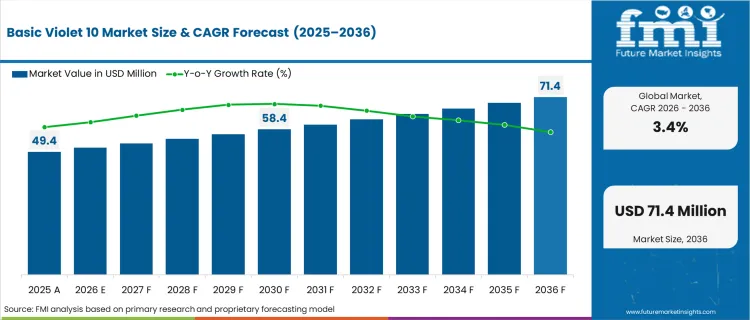
The basic violet 10 market was valued at USD 49.4 million in 2025, projected to reach USD 51.1 million in 2026, and is forecast to expand to USD 71.4 million by 2036 at a 3.4% CAGR. Textile dyeing operations in Asia and biological staining reagent demand from clinical and research laboratories sustain baseline consumption of Basic Violet 10, also known as Rhodamine B. Ink and printing applications provide a secondary demand channel, while cosmetic use faces increasing regulatory restriction in several jurisdictions due to safety concerns. Environmental discharge regulations governing dye effluent treatment are tightening in major producing countries, which adds compliance costs to manufacturers and shifts production toward facilities with advanced wastewater treatment capability.
Summary of Basic Violet 10 Market
- Market Snapshot
- The basic violet 10 market is valued at USD 49.4 million in 2025 and is projected to reach USD 71.4 million by 2036.
- The industry is expected to grow at a 3.4% CAGR from 2026 to 2036, creating an incremental opportunity of USD 20.3 million.
- The market functions as a specialty chemical category where application-specific purity certification, regulatory compliance status, and environmental discharge capability determine manufacturer market access.
- Demand and Growth Drivers
- Demand is sustained by textile dyeing operations in India, China, and Southeast Asia where Basic Violet 10 provides color fastness properties for synthetic fabric applications.
- Biological and histological staining reagent demand from clinical pathology laboratories and academic research institutions maintains a stable, premium-priced consumption channel.
- Ink manufacturing for printing and marking applications provides a secondary volume channel, particularly in developing markets where low-cost dye-based inks retain market share.
- As per FMI, among countries tracked, China leads at 4.6% CAGR, followed by India at 4.3%, Germany at 3.9%, Brazil at 3.6%, and USA at 3.2%.
- Product and Segment View
- The market covers Basic Violet 10 in powder and liquid forms, graded by purity for textile, analytical, reagent, and industrial applications.
- Applications span textile dyeing, biological and histological staining, ink and printing, and specialty chemical uses including fluorescent tracing.
- Based on FMI's basic violet 10 market report, Liquid leads by Form with 62.0% share in 2026.
- Dye leads by Application with 42.0% share in 2026.
- The scope includes market scope includes basic violet 10 in powder and liquid forms across all application grades. the analysis covers global and regional market sizes, . Excluded are other rhodamine dye variants (rhodamine 6g, rhodamine 123) with distinct chemical structures are excluded.
- Geography and Competitive Outlook
- China and India are the fastest-growing markets, while Japan and UK remain mature demand bases with replacement-cycle purchasing patterns.
- Competition is shaped by manufacturing scale, distribution networks, and compliance capabilities, with key players including KOHINOOR GROUP, Ranbar, Mayur Dye Chem, Tianjin Xiangrui Dyestuff, Dezhou Hongqiao Dyestuff Chemical.
- Analyst Opinion at FMI
- Nikhil Kaitwade, Principal Consultant for Chemicals and Materials, opines,: 'In my analysis, I have observed that the Basic Violet 10 market is undergoing a regulatory-driven contraction in food and cosmetic applications while maintaining stability in textile and laboratory channels. Manufacturers who invest in wastewater treatment capability and analytical-grade purification will capture the premium end of the market. Those who cannot meet tightening environmental discharge standards will face production shutdowns that concentrate market share among compliant facilities.'
- Strategic Implications / Executive Takeaways
- Dye manufacturers must invest in wastewater treatment systems that comply with tightening effluent discharge standards in China and India to maintain production continuity.
- Laboratory reagent distributors should secure multi-source supply agreements to mitigate the risk of environmental enforcement-driven production shutdowns at primary suppliers.
- Textile dye formulators must monitor regulatory developments in target export markets to ensure Basic Violet 10 formulations comply with application-specific restrictions.
Basic Violet 10 Market Key Takeaways
| Metric | Details |
|---|---|
| Industry Size (2026) | USD 51.1 million |
| Industry Value (2036) | USD 71.4 million |
| CAGR (2026-2036) | 3.4% |
Source: Future Market Insights, 2026
Based on FMI analysis, the Basic Violet 10 market is shifting from a broadly used synthetic dye toward a more regulated specialty chemical where application-specific purity grades and environmental compliance determine market access. Food-grade and cosmetic-grade applications face increasing prohibition in the European Union, the United States, and parts of Asia, which narrows the addressable market for non-industrial grades. Laboratory and biological staining applications sustain demand for high-purity analytical-grade material at premium pricing.
Country-level growth trajectories vary based on local regulatory frameworks and industrial maturity. China leads the expansion at 4.6% CAGR, followed by India at 4.3%, Germany at 3.9%, Brazil at 3.6%, USA at 3.2%, UK at 2.9%, Japan at 2.6%. Mature markets such as Japan and UK continue to generate steady replacement demand while China and India benefit from expanding capacity and industrial investment.
Basic Violet 10 Market Key Takeaways
Power in the Basic Violet 10 value chain concentrates at the manufacturer level in China and India, where integrated synthesis and purification operations control cost and quality. Downstream buyers in textile dyeing and laboratory reagent distribution depend on a concentrated supplier base with limited alternative sourcing options.
Pricing asymmetry separates textile-grade Basic Violet 10, priced as a commodity dye, from analytical and reagent-grade material, which commands premiums of three to eight times above textile grades based on purity certification and lot-to-lot consistency requirements.
Sourcing fragility exists in the concentration of production in China and India, where environmental enforcement campaigns periodically shut down dye manufacturing facilities that fail wastewater compliance inspections. These shutdowns create supply disruptions that cascade to global customers without diversified sourcing.
Brand and compliance risks center on regulatory prohibition in food and cosmetic applications. Manufacturers and distributors that fail to restrict supply to permitted applications face enforcement actions and reputational damage. Laboratory reagent suppliers must maintain lot-specific certificates of analysis to satisfy customer quality requirements.
Geographic leverage reflects the production-consumption pattern of the global dye industry. China leads both production and consumption. India follows with domestic textile demand and emerging export capacity. Germany maintains demand through laboratory reagent channels. Brazil consumes for textile applications. The United States and United Kingdom generate steady demand through laboratory and specialty chemical procurement.
For C-suite executives, Basic Violet 10 is a mature specialty chemical where the market is contracting in prohibited applications and stable in permitted ones. The strategic question is whether to invest in environmental compliance to maintain production competitiveness, or to shift capacity toward alternative dye chemistries with fewer regulatory constraints.
Basic Violet 10 Market Definition
Basic Violet 10 (Rhodamine B) is a synthetic organic dye of the xanthene class, available in powder and liquid forms. The compound serves textile dyeing, biological and histological staining, ink manufacturing, and specialty chemical applications. Industrial procurement is segmented by purity grade across textile, analytical, and reagent specifications.
Basic Violet 10 Market Inclusions
Market scope includes Basic Violet 10 in powder and liquid forms across all application grades. The analysis covers global and regional market sizes, forecast period 2026 to 2036, segmentation by form, application, and geography.
Basic Violet 10 Market Exclusions
Other rhodamine dye variants (Rhodamine 6G, Rhodamine 123) with distinct chemical structures are excluded. Downstream dyed textile products and printed materials are omitted. Fluorescent tracer applications using Rhodamine B in environmental monitoring are excluded unless procured as a chemical reagent.
Basic Violet 10 Market Research Methodology
- Primary Research: Analysts engaged with procurement managers, manufacturing engineers, and supply chain directors to map the decision triggers driving product upgrades and supplier qualification cycles in the basic violet 10 space.
- Desk Research: Data collection aggregated regulatory filings, trade statistics, industry standards ratification schedules, and publicly available financial disclosures from leading participants.
- Market-Sizing and Forecasting: Baseline values derive from a bottom-up aggregation of production volumes and trade flows, applying region-specific adoption curves to project future demand velocity.
- Data Validation and Update Cycle: Projections are tested against publicly reported capital expenditure guidance and production capacity announcements from leading industry participants.
Basic Violet 10 Market Drivers, Restraints, Opportunities
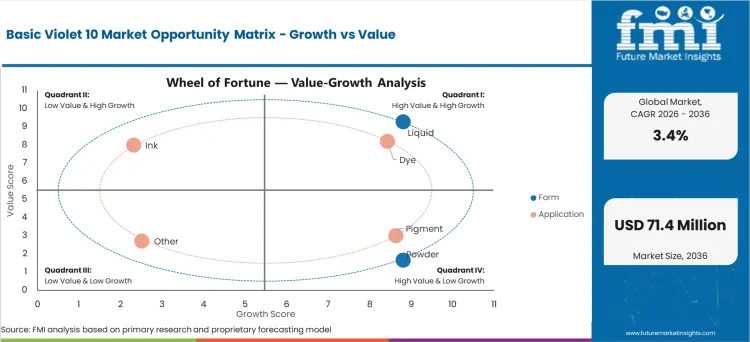
Future Market Insights analysis positions the Basic Violet 10 market as a mature specialty dye category where demand is sustained by established industrial and laboratory applications but constrained by regulatory restriction of non-industrial uses. The market exists at its current valuation because Basic Violet 10 provides specific colorimetric and fluorescent properties that are codified in textile dyeing protocols and laboratory staining procedures.
The tension in this market lies between the ongoing utility of Basic Violet 10 in permitted applications and the environmental and regulatory pressures that constrain its production and use. Manufacturers in China and India face tightening wastewater discharge standards for dye effluent that require capital investment in treatment systems. Smaller producers unable to absorb these compliance costs exit the market, which consolidates production among larger, better-capitalized facilities.
- Textile sector baseline demand: Synthetic fabric dyeing operations in India and China consume the largest share of Basic Violet 10 output. Color fastness performance on polyester and nylon substrates sustains specification preference despite the availability of alternative dye chemistries in certain applications.
- Laboratory reagent stability: As per FMI, analytical and reagent-grade Basic Violet 10 demand from clinical and research laboratories remains stable, driven by established staining protocols in histopathology and microbiology that specify Rhodamine B as a standard reagent.
- Regulatory restriction impact: Food and cosmetic applications of Basic Violet 10 face prohibition in the EU, the United States, and Japan due to safety concerns. FMI analysts note this regulatory tightening narrows the addressable market but concentrates remaining demand in industrial and laboratory applications where the compound is not substituted.
Why is the Basic Violet 10 Market Growing?
The Basic Violet 10 market grows by enabling manufacturers to achieve superior color performance and application efficiency while reducing formulation complexity in diverse industrial operations. Manufacturing facilities face mounting pressure to improve color quality and production consistency, with Basic Violet 10 systems typically providing 30-45% color uniformity improvement over conventional dye methods, making these specialized products essential for competitive manufacturing operations. The textile and printing industries' need for vibrant colorant solutions creates demand for advanced dye products that can maintain color fastness, achieve excellent application consistency, and ensure reliable performance across diverse industrial requirements and processing conditions.
Industrial modernization initiatives promoting advanced manufacturing and sustainable production drive adoption in textile processing, printing operations, and chemical formulation facilities, where colorant performance has a direct impact on product quality and operational efficiency. The global shift toward high-performance materials and specialized coloration implementation accelerates Basic Violet 10 demand as manufacturing facilities seek dye solutions that minimize color variation and maximize application versatility. However, limited awareness of optimal application protocols and higher initial material costs compared to conventional dyes may limit adoption rates among smaller manufacturers and regions with traditional dyeing practices and limited technical support infrastructure.
What Is the Market Segmentation for Basic Violet 10?
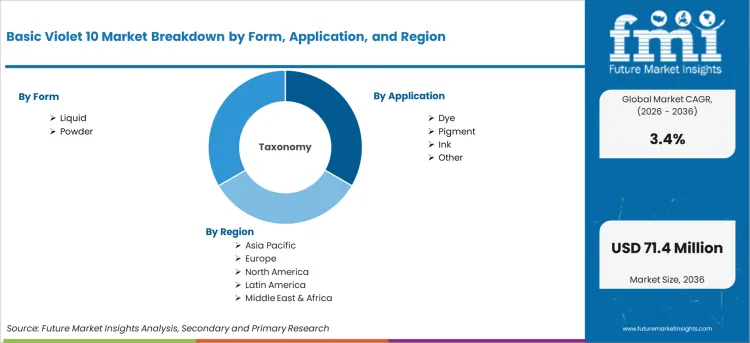
The market is segmented by form, application, and region. By form, the market is divided into Liquid and Powder. Based on application, the market is categorized into Dye, Pigment, Ink, and Other. Regionally, the market is divided into Asia Pacific, Europe, North America, Latin America, and Middle East & Africa.
By Form, the Liquid Segment Accounts for a Dominant Market Share
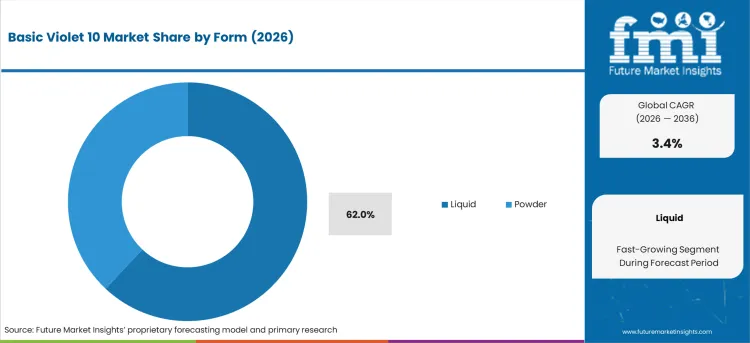
The Liquid segment represents the dominant force in the Basic Violet 10 market, capturing approximately 62% of total market share in 2025. This advanced category encompasses solution-based formulations, ready-to-use configurations, and specialized liquid preparations optimized for industrial processing applications, delivering superior mixing characteristics and application consistency in dye processing operations. The Liquid segment's market leadership stems from its proven ease of handling, enhanced application efficiency, and compatibility with diverse processing equipment across textile manufacturing, printing operations, and chemical formulation facilities.
The Powder segment maintains a substantial 38% market share, serving applications that require concentrated formulations through dry powder systems and specialized processing requirements that provide extended storage stability and customized dilution capabilities.
Key advantages driving the Liquid segment include:
- Enhanced mixing performance with superior dissolution characteristics and uniform distribution properties
- Superior application efficiency across diverse processing conditions including automated systems and continuous operations
- Optimized handling characteristics enabling reduced processing time and simplified application procedures
- Broad compatibility with existing processing infrastructure minimizing equipment modification requirements
By Application, the Dye Segment Accounts for the Largest Market Share
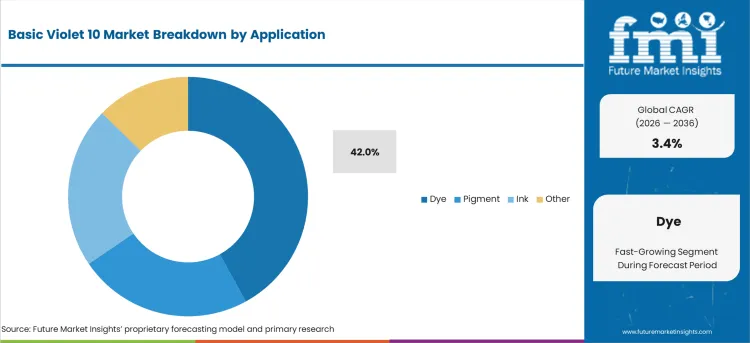
Dye applications dominate the Basic Violet 10 market with approximately 42% market share in 2025, reflecting the extensive adoption of Basic Violet 10 across textile dyeing processes, fabric coloration systems, and industrial dyeing operations. The Dye segment's market leadership is reinforced by widespread implementation in textile manufacturing facilities, garment production systems, and specialty fabric processing, which provide essential color performance capabilities and consistency in industrial dyeing environments.
The Pigment segment represents 28% market share through specialized applications including coating formulations and colorant preparations. The Ink segment accounts for 18% market share encompassing printing applications and specialty ink formulations. The Other segment constitutes 12% market share, covering diverse industrial applications including specialty chemicals and custom formulations.
Key market dynamics supporting application preferences include:
- Dye operations requiring high-performance colorants with consistent color reproduction and reliable fastness properties
- Pigment applications demanding specialized formulations and enhanced stability characteristics for coating and coloration systems
- Ink segments emphasizing color intensity while maintaining processing compatibility for printing applications
- Growing adoption across diverse industrial applications seeking color improvements through advanced dye technology and application optimization
What are the Drivers, Restraints, and Key Trends of the Basic Violet 10 Market?
The market is driven by three concrete demand factors tied to industrial efficiency and color performance. First, textile industry expansion creates increasing requirements for specialty colorants, with global textile production exceeding 100 million tons annually in major markets worldwide, requiring reliable Basic Violet 10 systems for fabric dyeing, garment coloration, and specialty textile applications. Second, printing industry growth and quality enhancement initiatives drive adoption of high-performance dye technology, with Basic Violet 10 improving color intensity by 30-45% while reducing processing variability in printing applications used extensively in commercial printing and specialty ink formulations. Third, chemical manufacturing modernization and product development acceleration accelerate deployment across industrial facilities, with Basic Violet 10 integrating seamlessly with advanced processing systems and enabling efficient color formulation capabilities in specialty chemical environments.
Market restraints include regulatory compliance requirements affecting chemical manufacturing and application-specific usage segments, particularly where environmental regulations constrain traditional dye applications and where safety standards require specialized handling procedures for dye processing systems. Technical expertise requirements for optimal formulation development pose adoption challenges for facilities lacking experienced chemical engineers, as dye performance depends heavily on proper concentration ratios, processing parameters, and application techniques that vary significantly across material types and end-use requirements. Limited availability of specialized technical support in emerging manufacturing markets creates additional barriers, as manufacturing facilities require training in formulation optimization procedures, quality control methods, and application-specific customization to achieve target performance levels.
Key trends indicate accelerated adoption in Asian manufacturing hubs, particularly China and India, where textile manufacturing capabilities and chemical processing infrastructure are expanding rapidly through government industrialization programs and international investment in manufacturing development. Technology advancement trends toward eco-friendly formulations with reduced environmental impact, advanced color matching systems for improved consistency, and modular processing systems enabling customizable dye properties are driving next-generation product development. However, the market thesis could face disruption if sustainable alternative colorants achieve breakthrough capabilities in cost-effectiveness and performance characteristics, potentially reducing demand for traditional synthetic dye solutions in specific industrial applications.
How Does the Demand for Basic Violet 10 Vary Across Regions?
.webp "Top Country Growth Comparison Basic Violet 10 Market Cagr (2026 2036)")
| Country | CAGR (2026-2036) |
|---|---|
| China | 4.6% |
| India | 4.3% |
| Germany | 3.9% |
| Brazil | 3.6% |
| USA | 3.2% |
| UK | 2.9% |
| Japan | 2.6% |
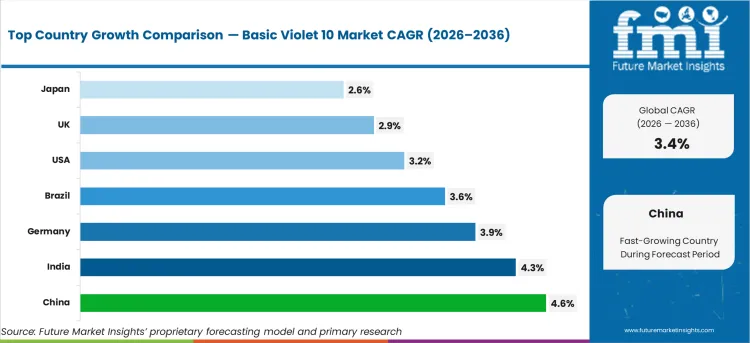
The Basic Violet 10 market is gaining momentum worldwide, with China taking the lead thanks to aggressive textile manufacturing expansion and chemical industry development programs. Close behind, India benefits from growing industrial infrastructure capabilities and government manufacturing initiatives, positioning itself as a strategic growth hub in the Asia-Pacific region. Brazil shows strong advancement, where expanding textile operations and chemical manufacturing infrastructure development strengthen its role in South American industrial supply chains. The USA demonstrates robust growth through advanced manufacturing initiatives and chemical sector investment, signaling continued adoption in specialized colorant applications. Meanwhile, Japan stands out for its precision manufacturing expertise and advanced chemical technology integration, while UK and Germany continue to record consistent progress driven by textile manufacturing centers and chemical processing facilities. Together, China and India anchor the global expansion story, while established markets build stability and technology leadership into the market's growth path.
The report covers an in-depth analysis of 40+ countries, the top-performing countries are highlighted below.
How Does the Demand for Basic Violet 10 Perform in China?
China demonstrates the strongest growth potential in the Basic Violet 10 Market with a CAGR of 4.6% through 2036. The country's leadership position stems from comprehensive textile manufacturing expansion, intensive chemical industry development programs, and aggressive industrial modernization targets driving adoption of advanced dye technologies. Growth is concentrated in major manufacturing regions, including Guangdong, Jiangsu, Zhejiang, and Shandong, where textile manufacturers, chemical companies, and printing facilities are implementing Basic Violet 10 systems for color enhancement and production optimization. Distribution channels through industrial chemical distributors, dye specialists, and direct manufacturer relationships expand deployment across textile manufacturing clusters, chemical development zones, and printing production centers. The country's chemical industry modernization initiative provides policy support for advanced dye technology adoption, including subsidies for manufacturing equipment procurement and processing infrastructure upgrades.
Key market factors:
- Manufacturing intensity in textile and chemical development zones with comprehensive industrial upgrading programs
- Government support through industrialization schemes providing 20-30% equipment subsidies for advanced dye technology adoption
- Comprehensive supply chain ecosystem including established chemical distributors and technical service providers with proven capabilities
- Technology integration featuring advanced manufacturing facilities, automated processing lines, and quality control systems enabling precision dye operations
What Are the Trends in the Demand for Basic Violet 10 in India?
In major industrial regions including Mumbai, Delhi, Bangalore, and Chennai, the adoption of Basic Violet 10 systems is accelerating across textile manufacturers, chemical facilities, and printing operations, driven by government industrialization initiatives and increasing focus on manufacturing competitiveness. The market demonstrates strong growth momentum with a CAGR of 4.3% through 2036, linked to comprehensive manufacturing sector expansion and increasing investment in advanced chemical capabilities. Indian manufacturers are implementing Basic Violet 10 technology and modern processing platforms to improve color performance while meeting quality requirements in industrial environments serving domestic and export markets. The country's Make in India initiative creates sustained demand for advanced dye solutions, while increasing emphasis on manufacturing modernization drives adoption of specialized colorant systems that enhance production quality.
- Leading industrial development regions, including Pune, Hyderabad, Ahmedabad, and Surat, driving Basic Violet 10 system adoption across textile manufacturing clusters
- Government incentive programs enabling 25-40% capital subsidy support for advanced manufacturing equipment procurement and technology upgrades
- Technology collaboration agreements accelerating deployment with international dye manufacturers and chemical technology providers
- Policy support through manufacturing excellence initiatives and industrial competitiveness programs linked to advanced dye adoption
How Is the Demand for Basic Violet 10 Evolving in Germany?
Germany's advanced chemical sector demonstrates sophisticated implementation of Basic Violet 10 systems, with documented case studies showing 35-40% color consistency improvement in textile operations through optimized dye strategies. The country's manufacturing infrastructure in major industrial regions, including Bavaria, Baden-Württemberg, North Rhine-Westphalia, and Lower Saxony, showcases integration of advanced dye technologies with existing processing equipment, leveraging expertise in chemical manufacturing and textile production. German manufacturers emphasize quality standards and process optimization, creating demand for reliable Basic Violet 10 solutions that support production commitments and stringent color quality requirements. The market maintains strong growth through focus on manufacturing excellence and facility modernization, with a CAGR of 3.9% through 2036.
Key development areas:
- Chemical manufacturing centers enabling precision dye operations with comprehensive quality assurance programs
- Technical training infrastructure providing skilled manufacturing workforce with documented 90% optimal process utilization rates
- Strategic partnerships between dye suppliers and manufacturing companies expanding integrated solution offerings
- Integration of digital manufacturing systems and comprehensive process monitoring capabilities for optimized dye operations
What Is the Outlook for Basic Violet 10 in Brazil?
The Brazilian market leads in Latin American Basic Violet 10 adoption based on expanding textile manufacturing operations and growing chemical infrastructure in major production centers. The country shows solid potential with a CAGR of 3.6% through 2036, driven by industrial sector investment and increasing domestic demand for advanced colorant materials across textile, printing, and chemical sectors. Brazilian manufacturers are adopting Basic Violet 10 technology for compliance with international quality standards, particularly in textile applications requiring specialized color properties and in printing applications where dye performance impacts production economics. Technology deployment channels through industrial distributors, chemical representatives, and equipment financing programs expand coverage across manufacturing supply chains and industrial facilities.
Leading market segments:
- Textile manufacturing operations in São Paulo and southern industrial regions implementing advanced dye programs
- Technology partnerships with international dye manufacturers achieving 74% color consistency improvement targets in manufacturing operations
- Strategic collaborations between textile companies and chemical suppliers enabling advanced dye technology adoption
- Focus on manufacturing competitiveness and export market development incentivizing specialized colorant investment
How Does the Demand for Basic Violet 10 Vary in the USA?
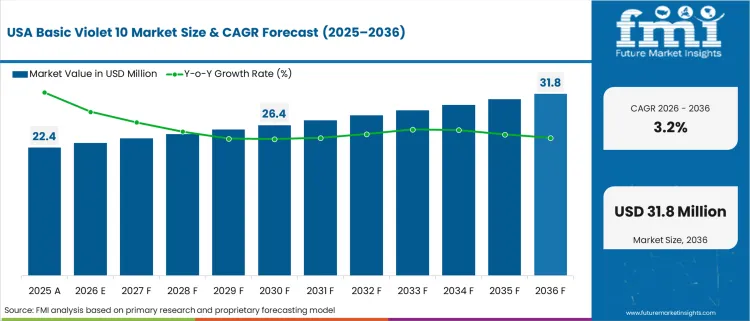
The USA market leads in advanced Basic Violet 10 applications based on integration with sophisticated manufacturing systems and comprehensive processing platforms for enhanced operational efficiency. The country shows solid potential with a CAGR of 3.2% through 2036, driven by chemical industry expansion and increasing adoption of advanced dye technologies across textile manufacturing, printing applications, and specialty chemical sectors. American manufacturers are implementing Basic Violet 10 systems for high-precision applications, particularly in specialty textile production demanding specialized color properties and in printing applications where color consistency directly impacts product quality. Technology deployment channels through industrial distributors, chemical specialists, and direct manufacturer relationships expand coverage across diverse manufacturing operations.
Leading market segments:
- Specialty chemical manufacturing operations in Northeast and Southeast regions implementing advanced dye programs for textile and printing applications
- Technology partnerships with dye manufacturers achieving 91% color quality compliance rates in critical applications
- Strategic collaborations between manufacturing companies and chemical suppliers enabling advanced dye technology deployment
- Focus on manufacturing productivity and quality consistency driving specialized colorant adoption across textile and printing sectors
How Is the Demand for Basic Violet 10 Performing in the UK?
The UK market demonstrates consistent implementation focused on textile manufacturing and printing operations, with documented integration of Basic Violet 10 systems achieving 28-34% color performance improvements in manufacturing operations. The country maintains steady growth momentum with a CAGR of 2.9% through 2036, driven by manufacturing presence and textile industry requirements for advanced colorant capabilities in specialized applications. Major industrial regions, including London, Manchester, Birmingham, and Scotland, showcase deployment of advanced dye technologies that integrate with existing manufacturing infrastructure and support quality requirements in textile and printing supply chains.
Key market characteristics:
- Textile manufacturing clusters and printing facilities driving advanced dye technology requirements
- Technology partnerships enabling 82% optimal process implementation through technical support programs
- Collaboration between dye suppliers and manufacturing facilities ensuring consistent performance and technical assistance
- Emphasis on manufacturing efficiency and color consistency supporting specialized dye adoption in competitive industrial sectors
What Are the Trends in the Demand for Basic Violet 10 in Japan?
Japan's Basic Violet 10 market demonstrates sophisticated implementation focused on textile manufacturing and specialty chemical production, with documented integration of advanced dye systems achieving 32-36% color consistency improvement in precision manufacturing operations. The country maintains steady growth momentum with a CAGR of 2.6% through 2036, driven by manufacturing excellence culture and emphasis on quality optimization principles aligned with precision manufacturing philosophies. Major industrial regions, including Tokyo, Osaka, Nagoya, and Yokohama, showcase advanced deployment of specialized dye technologies that integrate seamlessly with automated manufacturing systems and comprehensive quality control protocols.
Key market characteristics:
- Textile manufacturing operations and specialty chemical production driving advanced dye technology requirements with emphasis on color consistency
- Technology partnerships enabling 93% manufacturing compliance through optimized dye strategies and process control
- Collaboration between dye manufacturers and industrial companies ensuring integrated solution development and technical support
- Emphasis on manufacturing efficiency and continuous improvement supporting specialized dye technology adoption across diverse industrial applications
Europe Market Split by Country
The Basic Violet 10 market in Europe is projected to grow from USD 17.4 million in 2026 to USD 24.3 million by 2036, registering a CAGR of 3.4% over the forecast period. Germany is expected to maintain its leadership position with a 31.2% market share in 2026, declining slightly to 30.8% by 2036, supported by its extensive chemical manufacturing infrastructure and major industrial centers, including leading textile manufacturers and specialty chemical production facilities.
France follows with a 18.8% share in 2026, projected to reach 19.2% by 2036, driven by comprehensive manufacturing facility modernization and chemical development programs in major production regions. The United Kingdom holds a 15.9% share in 2026, expected to reach 16.2% by 2036 through textile manufacturing excellence and chemical processing facilities. Italy commands a 13.6% share in both 2026 and 2036, backed by textile manufacturing programs and chemical production operations. Spain accounts for 9.7% in 2026, rising to 9.9% by 2036 on textile expansion and chemical sector growth. The Rest of Europe region is anticipated to hold 10.8% in 2026, expanding to 11.1% by 2036, attributed to increasing Basic Violet 10 adoption in Nordic manufacturing institutions and emerging Central & Eastern European textile production operations.
Advanced Formulation Systems Dominate Manufacturing Requirements in Japan
The Japanese Basic Violet 10 market demonstrates a mature and quality-focused landscape, characterized by sophisticated integration of advanced formulation systems with existing precision manufacturing infrastructure across textile producers, chemical manufacturers, and printing operations. Japan's emphasis on manufacturing excellence and color precision drives demand for dye systems that support quality commitments and performance effectiveness targets in competitive manufacturing environments. The market benefits from strong partnerships between international dye providers and domestic industrial distributors including major trading companies, creating comprehensive service ecosystems that prioritize technical support and application optimization programs. Manufacturing centers in Tokyo, Osaka, Nagoya, and other major industrial areas showcase advanced chemical implementations where Basic Violet 10 systems achieve 92% color compliance through optimized processing parameters and comprehensive quality control systems.
International Providers Lead Technical Services in South Korea
The South Korean Basic Violet 10 market is characterized by growing international technology provider presence, with companies maintaining significant positions through comprehensive technical support and application optimization capabilities for textile manufacturing and chemical processing applications. The market demonstrates increasing emphasis on manufacturing automation and color enhancement, as Korean manufacturers increasingly demand advanced dye solutions that integrate with domestic industrial infrastructure and sophisticated production management systems deployed across major manufacturing complexes. Regional industrial distributors are gaining market share through strategic partnerships with international manufacturers, offering specialized services including technical training programs and application-specific dye solutions for textile and chemical operations. The competitive landscape shows increasing collaboration between multinational dye companies and Korean manufacturing technology specialists, creating hybrid service models that combine international product development expertise with local technical support capabilities and rapid response systems.
What Is the Competitive Landscape of the Basic Violet 10 Market?
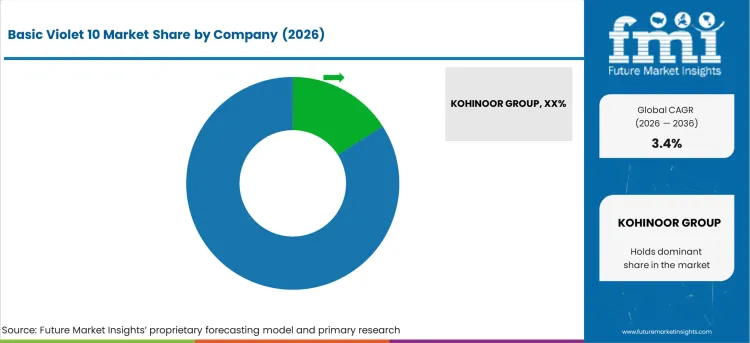
The Basic Violet 10 market features approximately 12-15 meaningful players with moderate fragmentation, where the top three companies control roughly 38-45% of global market share through established distribution networks and comprehensive product portfolios. Competition centers on color consistency, product stability reliability, and technical support capabilities rather than price competition alone. KOHINOOR GROUP leads with approximately 16% market share through its comprehensive dye portfolio and specialized chemical manufacturing expertise.
Market leaders include KOHINOOR GROUP, Ranbar, and Mayur Dye Chem, which maintain competitive advantages through regional distribution infrastructure, advanced formulation technology, and deep expertise in dye manufacturing across multiple industrial sectors, creating trust and reliability advantages with textile manufacturers and chemical processing operations. These companies leverage research and development capabilities in formulation optimization technology and ongoing technical support relationships to defend market positions while expanding into emerging manufacturing markets and specialized application segments.
Challengers encompass Tianjin Xiangrui Dyestuff and Dezhou Hongqiao Dyestuff Chemical, which compete through specialized product offerings and strong presence in key manufacturing markets. Product specialists, including Hebei Ruixin Chemical, Xincheng Weiye Chemical, and Tianjin No.3 Dyestuff Chemical Factory, focus on specific formulation configurations or regional markets, offering differentiated capabilities in custom dye solutions, rapid delivery services, and competitive pricing structures.
Regional players create competitive pressure through localized production advantages and rapid response capabilities, particularly in high-growth markets including China and India, where proximity to manufacturing clusters provides advantages in technical support responsiveness and customer relationships. Market dynamics favor companies that combine proven color performance with comprehensive manufacturing offerings that address the complete dye processing cycle from formulation development through application optimization and quality assurance.
Who Are the Key Players in the Basic Violet 10 Market?
- KOHINOOR GROUP
- Ranbar
- Mayur Dye Chem
- Tianjin Xiangrui Dyestuff
- Dezhou Hongqiao Dyestuff Chemical
- Hebei Ruixin Chemical
- Xincheng Weiye Chemical
- Tianjin No.3 Dyestuff Chemical Factory
Scope of the Report
| Metric | Value |
|---|---|
| Quantitative Units | USD 51.1 million to USD 71.4 million, at a CAGR of 3.4% |
| Market Definition | Basic Violet 10 (Rhodamine B) is a synthetic organic dye of the xanthene class, available in powder and liquid forms. The compound serves textile dyeing, biological and histological staining, ink manufacturing, and specialty chemical applications. Industrial procurement is segmented by purity grade across textile, analytical, and reagent specifications. |
| Segmentation | Form: Liquid, Powder; Application: Dye, Pigment, Ink, Other |
| Regions Covered | North America, Latin America, Europe, East Asia, South Asia, Oceania, Middle East & Africa |
| Countries Covered | China, India, Germany, Brazil, USA, UK, Japan, and 40 plus countries |
| Key Companies Profiled | KOHINOOR GROUP, Ranbar, Mayur Dye Chem, Tianjin Xiangrui Dyestuff, Dezhou Hongqiao Dyestuff Chemical, Hebei Ruixin Chemical, Xincheng Weiye Chemical, Tianjin No.3 Dyestuff Chemical Factory |
| Forecast Period | 2026 to 2036 |
| Approach | Forecasting models apply a bottom-up methodology starting with global installed base metrics and projecting conversion rates to specialized applications. Cross-validation uses publicly reported expenditure guidance from leading industry participants. |
Basic Violet 10 Market by Segments
Form:
- Liquid
- Powder
Application:
- Dye
- Pigment
- Ink
- Other
Region:
- Asia Pacific
- China
- India
- Japan
- South Korea
- Australia & New Zealand
- ASEAN
- Rest of Asia Pacific
- Europe
- Germany
- United Kingdom
- France
- Italy
- Spain
- Netherlands
- Nordic
- BENELUX
- Rest of Europe
- North America
- United States
- Canada
- Mexico
- Latin America
- Brazil
- Argentina
- Rest of Latin America
- Middle East & Africa
- Kingdom of Saudi Arabia
- Other GCC Countries
- Turkey
- South Africa
- Other African Union
- Rest of Middle East & Africa
Bibliography
- 1. European Chemicals Agency. (2024). Basic Violet 10 (Rhodamine B) REACH substance evaluation. ECHA.
- 2. United States Food and Drug Administration. (2024). Color additive regulations: Listed and delisted color additives. FDA.
- 3. Central Pollution Control Board of India. (2024). Effluent discharge standards for dye and dye intermediate manufacturing. CPCB.
- 4. International Organization for Standardization. (2023). ISO 105-C06:2023 Textiles: Tests for colour fastness. ISO.
- 5. World Health Organization. (2024). International Chemical Safety Card: Rhodamine B. WHO.
- 6. Ministry of Ecology and Environment, China. (2024). Discharge standard of water pollutants for dyeing and finishing of textile industry. MEE.
This bibliography is provided for reader reference. The full Future Market Insights report contains the complete reference list with primary research documentation.
Frequently Asked Questions
How large is the demand for Basic Violet 10 in the global market in 2026?
Demand for basic violet 10 in the global market is estimated to be valued at USD 51.1 million in 2026.
What will be the market size of Basic Violet 10 in the global market by 2036?
Market size for basic violet 10 is projected to reach USD 71.4 million by 2036.
What is the expected demand growth for Basic Violet 10 in the global market between 2026 and 2036?
Demand for basic violet 10 is expected to grow at a CAGR of 3.4% between 2026 and 2036.
Which Form is poised to lead global sales by 2026?
Liquid accounts for 62.0% in 2026 based on undefined.
How is the role of Dye in driving Basic Violet 10 adoption in 2026?
Dye holds 42.0% of Application share in 2026, driven by undefined.
What is driving demand in China?
China leads growth at 4.6% CAGR, supported by dominant production base and largest textile dyeing consumption market with environmental compliance driving manufacturer consolidation.
What is India's growth outlook in this report?
India is projected to grow at a CAGR of 4.3% during 2026 to 2036.
What is Basic Violet 10 Market and what is it mainly used for?
Basic Violet 10 (Rhodamine B) is a synthetic organic dye of the xanthene class, available in powder and liquid forms. The compound serves textile dyeing, biological and histological staining, ink manufacturing, and specialty chemical applications.
Preview the report firsthand - request a free sample
Get SampleGet the brochure for pricing and purchase details.
Get PDFTable of Content
- Executive Summary
- Global Market Outlook
- Demand-side Trends
- Supply-side Trends
- Technology Roadmap Analysis
- Analysis and Recommendations
- Market Overview
- Market Coverage / Taxonomy
- Market Definition / Scope / Limitations
- Research Methodology
- Chapter Orientation
- Analytical Lens and Working Hypotheses
- Market Structure, Signals, and Trend Drivers
- Benchmarking and Cross-market Comparability
- Market Sizing, Forecasting, and Opportunity Mapping
- Research Design and Evidence Framework
- Desk Research Programme (Secondary Evidence)
- Company Annual and Sustainability Reports
- Peer-reviewed Journals and Academic Literature
- Corporate Websites, Product Literature, and Technical Notes
- Earnings Decks and Investor Briefings
- Statutory Filings and Regulatory Disclosures
- Technical White Papers and Standards Notes
- Trade Journals, Industry Magazines, and Analyst Briefs
- Conference Proceedings, Webinars, and Seminar Materials
- Government Statistics Portals and Public Data Releases
- Press Releases and Reputable Media Coverage
- Specialist Newsletters and Curated Briefings
- Sector Databases and Reference Repositories
- FMI Internal Proprietary Databases and Historical Market Datasets
- Subscription Datasets and Paid Sources
- Social Channels, Communities, and Digital Listening Inputs
- Additional Desk Sources
- Expert Input and Fieldwork (Primary Evidence)
- Primary Modes
- Qualitative Interviews and Expert Elicitation
- Quantitative Surveys and Structured Data Capture
- Blended Approach
- Why Primary Evidence is Used
- Field Techniques
- Interviews
- Surveys
- Focus Groups
- Observational and In-context Research
- Social and Community Interactions
- Stakeholder Universe Engaged
- C-suite Leaders
- Board Members
- Presidents and Vice Presidents
- R&D and Innovation Heads
- Technical Specialists
- Domain Subject-matter Experts
- Scientists
- Physicians and Other Healthcare Professionals
- Governance, Ethics, and Data Stewardship
- Research Ethics
- Data Integrity and Handling
- Primary Modes
- Tooling, Models, and Reference Databases
- Desk Research Programme (Secondary Evidence)
- Data Engineering and Model Build
- Data Acquisition and Ingestion
- Cleaning, Normalisation, and Verification
- Synthesis, Triangulation, and Analysis
- Quality Assurance and Audit Trail
- Market Background
- Market Dynamics
- Drivers
- Restraints
- Opportunity
- Trends
- Scenario Forecast
- Demand in Optimistic Scenario
- Demand in Likely Scenario
- Demand in Conservative Scenario
- Opportunity Map Analysis
- Product Life Cycle Analysis
- Supply Chain Analysis
- Investment Feasibility Matrix
- Value Chain Analysis
- PESTLE and Porter’s Analysis
- Regulatory Landscape
- Regional Parent Market Outlook
- Production and Consumption Statistics
- Import and Export Statistics
- Market Dynamics
- Global Market Analysis 2021 to 2025 and Forecast, 2026 to 2036
- Historical Market Size Value (USD Million) Analysis, 2021 to 2025
- Current and Future Market Size Value (USD Million) Projections, 2026 to 2036
- Y-o-Y Growth Trend Analysis
- Absolute $ Opportunity Analysis
- Global Market Pricing Analysis 2021 to 2025 and Forecast 2026 to 2036
- Global Market Analysis 2021 to 2025 and Forecast 2026 to 2036, By Form
- Introduction / Key Findings
- Historical Market Size Value (USD Million) Analysis By Form , 2021 to 2025
- Current and Future Market Size Value (USD Million) Analysis and Forecast By Form , 2026 to 2036
- Liquid
- Powder
- Liquid
- Y-o-Y Growth Trend Analysis By Form , 2021 to 2025
- Absolute $ Opportunity Analysis By Form , 2026 to 2036
- Global Market Analysis 2021 to 2025 and Forecast 2026 to 2036, By Application
- Introduction / Key Findings
- Historical Market Size Value (USD Million) Analysis By Application, 2021 to 2025
- Current and Future Market Size Value (USD Million) Analysis and Forecast By Application, 2026 to 2036
- Dye
- Pigment
- Ink
- Other
- Dye
- Y-o-Y Growth Trend Analysis By Application, 2021 to 2025
- Absolute $ Opportunity Analysis By Application, 2026 to 2036
- Global Market Analysis 2021 to 2025 and Forecast 2026 to 2036, By Region
- Introduction
- Historical Market Size Value (USD Million) Analysis By Region, 2021 to 2025
- Current Market Size Value (USD Million) Analysis and Forecast By Region, 2026 to 2036
- North America
- Latin America
- Western Europe
- Eastern Europe
- East Asia
- South Asia and Pacific
- Middle East & Africa
- Market Attractiveness Analysis By Region
- North America Market Analysis 2021 to 2025 and Forecast 2026 to 2036, By Country
- Historical Market Size Value (USD Million) Trend Analysis By Market Taxonomy, 2021 to 2025
- Market Size Value (USD Million) Forecast By Market Taxonomy, 2026 to 2036
- By Country
- USA
- Canada
- Mexico
- By Form
- By Application
- By Country
- Market Attractiveness Analysis
- By Country
- By Form
- By Application
- Key Takeaways
- Latin America Market Analysis 2021 to 2025 and Forecast 2026 to 2036, By Country
- Historical Market Size Value (USD Million) Trend Analysis By Market Taxonomy, 2021 to 2025
- Market Size Value (USD Million) Forecast By Market Taxonomy, 2026 to 2036
- By Country
- Brazil
- Chile
- Rest of Latin America
- By Form
- By Application
- By Country
- Market Attractiveness Analysis
- By Country
- By Form
- By Application
- Key Takeaways
- Western Europe Market Analysis 2021 to 2025 and Forecast 2026 to 2036, By Country
- Historical Market Size Value (USD Million) Trend Analysis By Market Taxonomy, 2021 to 2025
- Market Size Value (USD Million) Forecast By Market Taxonomy, 2026 to 2036
- By Country
- Germany
- UK
- Italy
- Spain
- France
- Nordic
- BENELUX
- Rest of Western Europe
- By Form
- By Application
- By Country
- Market Attractiveness Analysis
- By Country
- By Form
- By Application
- Key Takeaways
- Eastern Europe Market Analysis 2021 to 2025 and Forecast 2026 to 2036, By Country
- Historical Market Size Value (USD Million) Trend Analysis By Market Taxonomy, 2021 to 2025
- Market Size Value (USD Million) Forecast By Market Taxonomy, 2026 to 2036
- By Country
- Russia
- Poland
- Hungary
- Balkan & Baltic
- Rest of Eastern Europe
- By Form
- By Application
- By Country
- Market Attractiveness Analysis
- By Country
- By Form
- By Application
- Key Takeaways
- East Asia Market Analysis 2021 to 2025 and Forecast 2026 to 2036, By Country
- Historical Market Size Value (USD Million) Trend Analysis By Market Taxonomy, 2021 to 2025
- Market Size Value (USD Million) Forecast By Market Taxonomy, 2026 to 2036
- By Country
- China
- Japan
- South Korea
- By Form
- By Application
- By Country
- Market Attractiveness Analysis
- By Country
- By Form
- By Application
- Key Takeaways
- South Asia and Pacific Market Analysis 2021 to 2025 and Forecast 2026 to 2036, By Country
- Historical Market Size Value (USD Million) Trend Analysis By Market Taxonomy, 2021 to 2025
- Market Size Value (USD Million) Forecast By Market Taxonomy, 2026 to 2036
- By Country
- India
- ASEAN
- Australia & New Zealand
- Rest of South Asia and Pacific
- By Form
- By Application
- By Country
- Market Attractiveness Analysis
- By Country
- By Form
- By Application
- Key Takeaways
- Middle East & Africa Market Analysis 2021 to 2025 and Forecast 2026 to 2036, By Country
- Historical Market Size Value (USD Million) Trend Analysis By Market Taxonomy, 2021 to 2025
- Market Size Value (USD Million) Forecast By Market Taxonomy, 2026 to 2036
- By Country
- Kingdom of Saudi Arabia
- Other GCC Countries
- Turkiye
- South Africa
- Other African Union
- Rest of Middle East & Africa
- By Form
- By Application
- By Country
- Market Attractiveness Analysis
- By Country
- By Form
- By Application
- Key Takeaways
- Key Countries Market Analysis
- USA
- Pricing Analysis
- Market Share Analysis, 2025
- By Form
- By Application
- Canada
- Pricing Analysis
- Market Share Analysis, 2025
- By Form
- By Application
- Mexico
- Pricing Analysis
- Market Share Analysis, 2025
- By Form
- By Application
- Brazil
- Pricing Analysis
- Market Share Analysis, 2025
- By Form
- By Application
- Chile
- Pricing Analysis
- Market Share Analysis, 2025
- By Form
- By Application
- Germany
- Pricing Analysis
- Market Share Analysis, 2025
- By Form
- By Application
- UK
- Pricing Analysis
- Market Share Analysis, 2025
- By Form
- By Application
- Italy
- Pricing Analysis
- Market Share Analysis, 2025
- By Form
- By Application
- Spain
- Pricing Analysis
- Market Share Analysis, 2025
- By Form
- By Application
- France
- Pricing Analysis
- Market Share Analysis, 2025
- By Form
- By Application
- India
- Pricing Analysis
- Market Share Analysis, 2025
- By Form
- By Application
- ASEAN
- Pricing Analysis
- Market Share Analysis, 2025
- By Form
- By Application
- Australia & New Zealand
- Pricing Analysis
- Market Share Analysis, 2025
- By Form
- By Application
- China
- Pricing Analysis
- Market Share Analysis, 2025
- By Form
- By Application
- Japan
- Pricing Analysis
- Market Share Analysis, 2025
- By Form
- By Application
- South Korea
- Pricing Analysis
- Market Share Analysis, 2025
- By Form
- By Application
- Russia
- Pricing Analysis
- Market Share Analysis, 2025
- By Form
- By Application
- Poland
- Pricing Analysis
- Market Share Analysis, 2025
- By Form
- By Application
- Hungary
- Pricing Analysis
- Market Share Analysis, 2025
- By Form
- By Application
- Kingdom of Saudi Arabia
- Pricing Analysis
- Market Share Analysis, 2025
- By Form
- By Application
- Turkiye
- Pricing Analysis
- Market Share Analysis, 2025
- By Form
- By Application
- South Africa
- Pricing Analysis
- Market Share Analysis, 2025
- By Form
- By Application
- USA
- Market Structure Analysis
- Competition Dashboard
- Competition Benchmarking
- Market Share Analysis of Top Players
- By Regional
- By Form
- By Application
- Competition Analysis
- Competition Deep Dive
- KOHINOOR GROUP
- Overview
- Product Portfolio
- Profitability by Market Segments (Product/Age /Sales Channel/Region)
- Sales Footprint
- Strategy Overview
- Marketing Strategy
- Product Strategy
- Channel Strategy
- Ranbar
- Mayur Dye Chem
- Tianjin Xiangrui Dyestuff
- Dezhou Hongqiao Dyestuff Chemical
- Hebei Ruixin Chemical
- Xincheng Weiye Chemical
- Tianjin No.3 Dyestuff Chemical Factory
- KOHINOOR GROUP
- Competition Deep Dive
- Assumptions & Acronyms Used


