

- Market Size (2026)
- USD 1920.60 Mn
- Forecast (2036)
- USD 4716.40 Mn
- CAGR (2026 to 2036)
- 9.4%
Bio Based Cosmetic Surfactants Market Size, Market Forecast and Outlook By FMI
USD 1,920.60 million in 2026 and USD 4,716.40 million by 2036 at a 9.4% CAGR.
The bio based cosmetic surfactants industry value is predicted to rise from USD 1,755.58 million in 2025 to USD 4,716.40 million by 2036 at 9.4% CAGR, led by personal care brands reformulating cleansing systems toward renewable-origin ingredients. Liquid is expected to hold 62.0% share in 2026, supported by pumpable handling needs across cleanser and shampoo production lines. Direct to Formulators is projected to secure 58.0% share in 2026, guided by formulation support and trial-stage technical service.
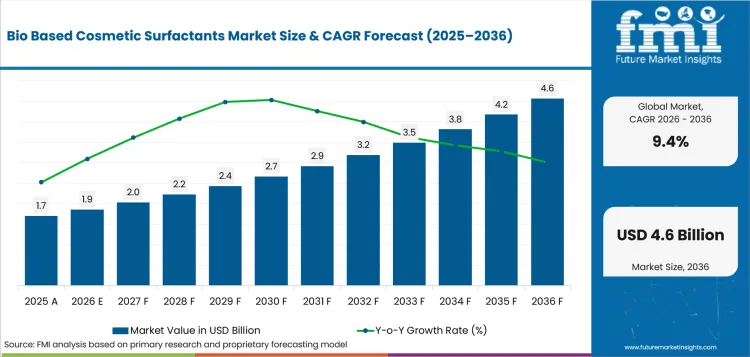
| Metric | Value |
|---|---|
| 2026 Market Size | USD 1,920.60 million |
| 2036 Market Size | USD 4,716.40 million |
| Forecast CAGR | 9.4% from 2026 to 2036 |
| Leading Form | Liquid |
| Liquid Share in 2026 | 62.0% |
| Leading Sales Channel | Direct to Formulators |
| Direct to Formulators Share in 2026 | 58.0% |
| Country with Higher CAGR | India |
| India CAGR | 10.4% by 2036 |
Summary of the Bio Based Cosmetic Surfactants Market
| Market Signal | Commercial Impact |
|---|---|
| Demand and Growth Drivers | Demand for bio-based cosmetic surfactants is increasing as cosmetic brands shift toward renewable ingredients while maintaining product performance.
|
| Product and Segment View | Liquid formulations, direct sales to formulators, and nonionic surfactants lead their respective segment categories.
|
| Geography and Growth Outlook | India and China are expected to remain the key growth markets for bio-based cosmetic surfactants.
|
| Competitive Landscape | Competition is increasingly centered on surfactant portfolios, technical support, and performance validation.
|
| Analyst Perspective | Bio-based cosmetic surfactants are evolving from sustainability-driven ingredients into performance and formulation-risk decisions.
- Nikhil Kaitwade, Principal Consultant for Industrial Automation at FMI |
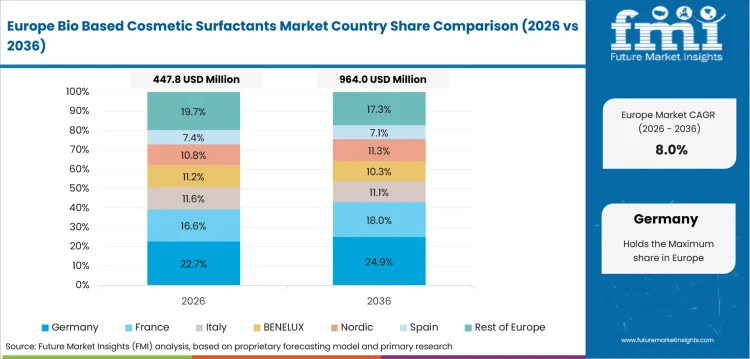
Cosmetic ingredient documentation is gaining weight across beauty manufacturing. FDA summary data updated in 2026 showed 15,309 unique active cosmetic facility registrations and 1,102,092 unique active cosmetic product listings under MoCRA as of March 31, 2026, raising dossier discipline for ingredient suppliers. Personal Care Products Council reported in 2026 that the USA personal care products industry generated USD 495.6 billion in total economic output in 2024, supporting ingredient demand across manufacturing and distribution. Cosmetics Europe reported the European cosmetics and personal care market value at EUR 110 billion in retail sales in 2025, reinforcing a large reformulation base for mild and renewable cleansing chemistry. Bio based surfactant suppliers gain value as brands need surfactants that support foam and substantiated natural-origin claims.
Which factors support expansion in the Bio Based Cosmetic Surfactants Market?
Finished cosmetic reformulation and service-led ingredient qualification support market value across beauty and personal care supply chains.
- Mild cleansing claims push formulators toward renewable-origin surfactant systems, while the beauty and personal care surfactants signals adjacent rinse-off product demand.
- Baby care and sensitive skin lines increase qualification pressure for surfactants with complete safety files and low-irritation positioning.
- Waterless and concentrated formats create demand for surfactants that can foam and disperse under lower water content.
- Direct technical engagement expands as cosmetic labs ask suppliers to solve foam and preservative stability together.
Why is the Bio Based Cosmetic Surfactants Market growing?
Mild cleansing reformulation increases demand as brands need surfactants protecting skin comfort while supporting renewable-origin claims.
Daily use frequency keeps surfactant quality central to personal care development, as Personal Care Products Council stated in 2026, people use about 6 to 12 personal care products each day. Ingredient suppliers gain preference if safety files, INCI clarity and formulation guidance can be supplied before pilot batching. Bio based surfactant suppliers therefore gain positions in cleansing products that need both sensory performance and defensible documentation.
How is the Bio Based Cosmetic Surfactants Market segmented?
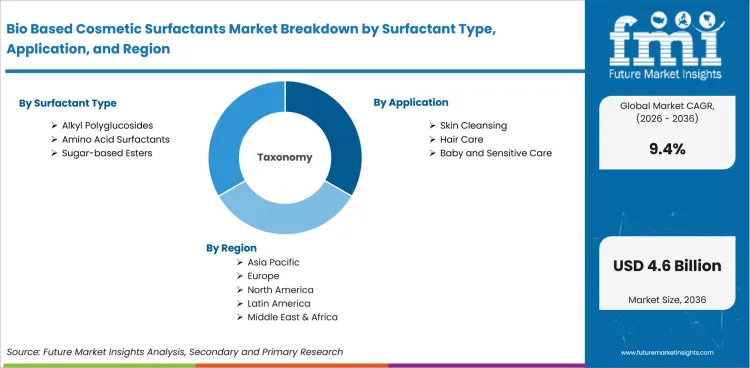
Bio Based Cosmetic Surfactants Market is segmented by surfactant type, application, ionic nature, form, and sales channel.
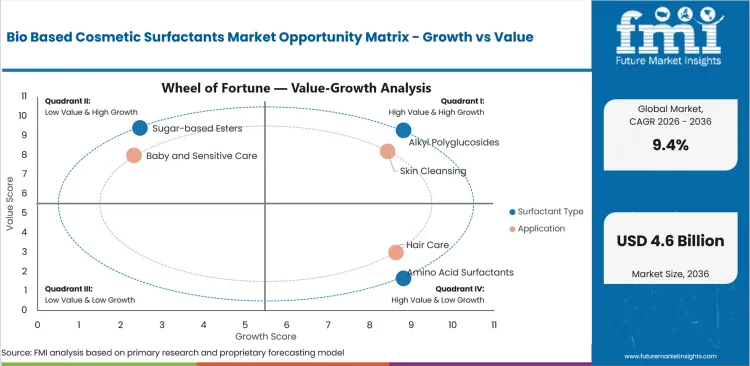
- Alkyl Polyglucosides are projected to account for 37.0% share in 2026, influenced by mild foam, renewable carbon positioning, and compatibility across facial cleansing and body wash systems.
- Skin Cleansing is expected to hold 41.0% share in 2026, shaped by high surfactant loading in facial wash and daily-use cleanser formats.
- Nonionic is anticipated to account for 46.0% share in 2026, led by APG and sugar-based chemistry use across mild cleansing formulations.
- Liquid is projected to hold 62.0% share by form in 2026, supported by pumpable handling and reduced dust risk in cosmetic plants.
- Direct to Formulators is expected to represent 58.0% share by sales channel in 2026, guided by technical support needs during early ingredient qualification.
Why do alkyl polyglucosides dominate the Bio Based Cosmetic Surfactants Market by surfactant type?
- Alkyl Polyglucosides are projected to account for 37.0% share in 2026, driven by mild foam and compatibility with facial wash and body wash systems.
- Amino Acid Surfactants gain demand as premium cleansing formulas need gentler sensory profiles and lower residue perception across scalp care and sensitive skin products.
Which application leads the Bio Based Cosmetic Surfactants Market?
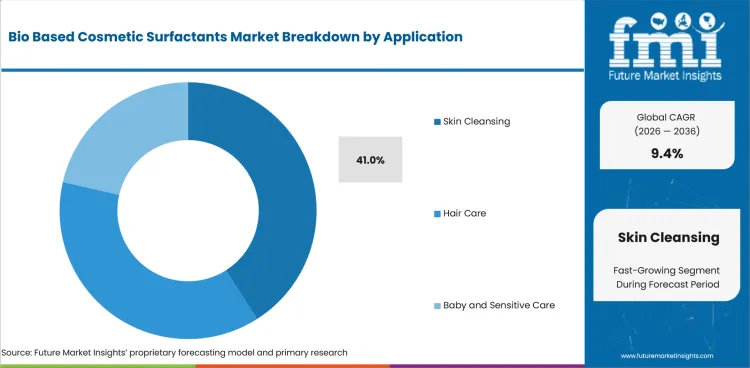
- Skin Cleansing is expected to hold 41.0% share in 2026, shaped by frequent consumer use and higher surfactant loading across facial wash and body wash products.
- Hair Care creates additional demand as sulfate-free shampoos and scalp-care launches need surfactant blends that balance foam and mild after-feel.
Which ionic nature leads the Bio Based Cosmetic Surfactants Market?
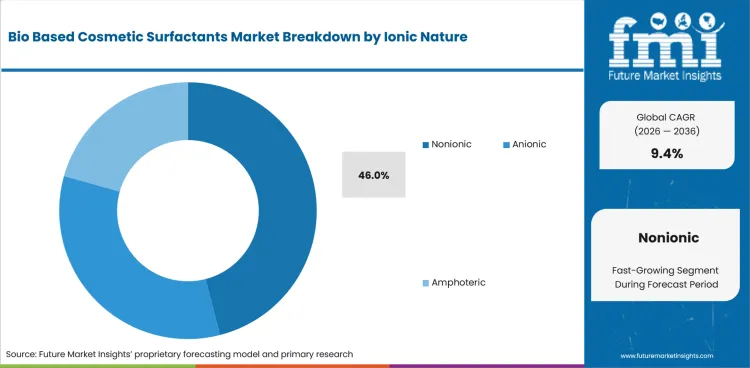
- Nonionic is anticipated to account for 46.0% share in 2026, guided by APG and sugar chemistry compatibility across mild cleansing systems.
- Anionic and amphoteric systems remain active as formulators need foam structure and cost balance across mass-market cleansing products.
Which form leads the Bio Based Cosmetic Surfactants Market?
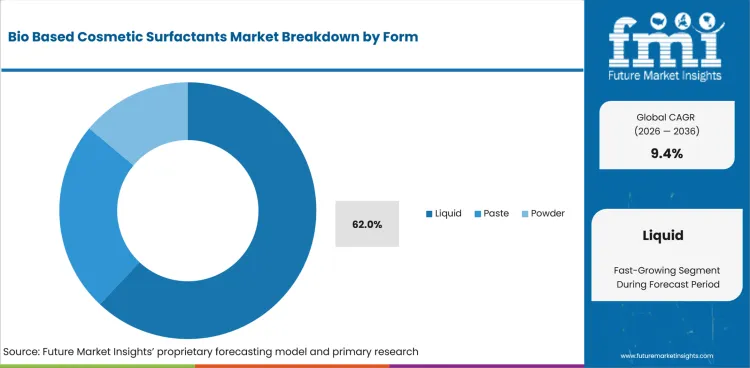
- Liquid is projected to hold 62.0% share in 2026, supported by pumpable ingredient handling and shorter batch changes in personal care plants.
- Paste and powder formats gain use in concentrated cleansers and low-water concepts requiring greater handling discipline during manufacturing.
Which sales channel leads the Bio Based Cosmetic Surfactants Market?
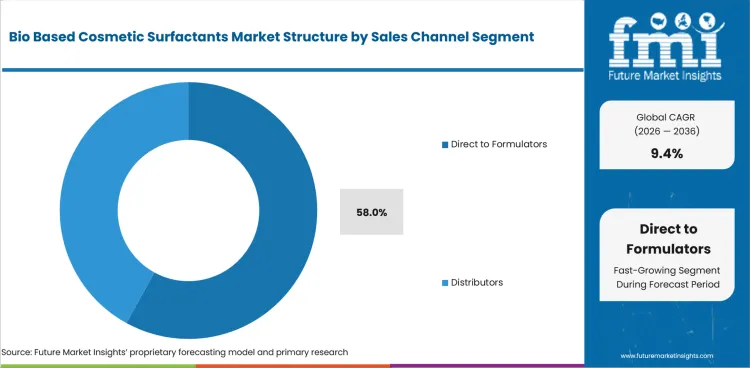
- Direct to formulators is expected to represent 58.0% share in 2026, guided by buyer preference for application support and formulation troubleshooting.
- Distributors remain active among indie brands and regional accounts that need sample speed and support across smaller trial volumes.
What are the drivers, restraints, and opportunities in the Bio Based Cosmetic Surfactants Market?
Mild cleansing reformulation and documentation-led ingredient approval are shaping bio based surfactant buying decisions.
- Driver: Cosmetic brands need renewable-origin surfactants that maintain foam and after-feel across rinse-off cleansing formulas.
- Restraint: Higher ingredient costs can delay conversion in mass-market products competing heavily on shelf price.
- Opportunity: Direct technical service can improve supplier renewal rates as formulators ask for documentation and blend support.
Mild Cleansing Reformulation Advances Ingredient Demand
Cosmetic ingredient trials are rising as brands seek renewable-origin cleansing systems that support low-irritation claims. Personal Care Products Council reported that USA personal care companies invested more than USD 1.3 billion in domestic R&D in 2023, as cited in its 2026 economic impact release. R&D spending supports surfactant testing, mildness claims, and formula improvement across skin cleansing and baby care launches. Bio based surfactant suppliers gain share if technical teams can help brands reduce evaluation cycles without sacrificing foam or stability.
Claim Substantiation Burden Limits Weakly Documented Ingredients
Sustainability claims need clearer proof before brand teams accept renewable-origin ingredients. European Commission material states that 53.3% of environmental claims reviewed in the EU were vague or unfounded, while 40% were unsubstantiated. Cosmetic buyers therefore examine biodegradability and safety files before approving surfactant substitution. Suppliers lacking complete documentation can lose trials even if ingredient origin appears attractive.
Eco-Design Pressure Creates Formulation Openings
Eco-design pressure across personal care packaging can shift formula briefs toward lower-impact ingredients. Eurostat reported in 2025 that the EU generated 79.7 million tonnes of packaging waste in 2023, equal to 177.8 kg per inhabitant. Cosmetic brands working on recyclable packs often review ingredient claims and rinse-off formula profiles together. Bio based surfactant suppliers can use these reformulation windows to support mildness and cleaner documentation.
Which countries show higher CAGRs in the Bio Based Cosmetic Surfactants Market?
India 10.4% CAGR, China 10.1% CAGR, South Korea 9.9% CAGR, United States 9.1% CAGR, Germany 9.0% CAGR, France 8.8% CAGR, United Kingdom 8.7% CAGR, and Japan 8.6% CAGR through 2036.
.webp "Top Country Growth Comparison Bio Based Cosmetic Surfactants Market Cagr (2026 2036)")
| Country | CAGR |
|---|---|
| India | 10.4% |
| China | 10.1% |
| South Korea | 9.9% |
| United States | 9.1% |
| Germany | 9.0% |
| France | 8.8% |
| United Kingdom | 8.7% |
| Japan | 8.6% |
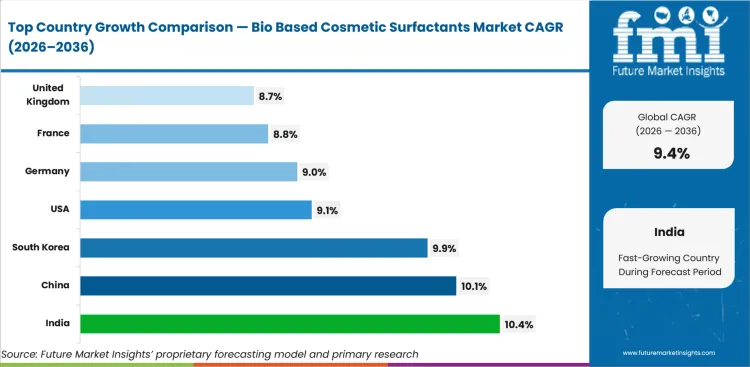
Source: Future Market Insights, 2026.
How do country-level CAGRs compare in the Bio Based Cosmetic Surfactants Market?
India records 10.4% CAGR while Japan records 8.6% CAGR among profiled markets.
- India is forecast to record 10.4% CAGR by 2036 as online beauty growth and active domestic brand formation increase formulation trials.
- China is expected to expand at 10.1% CAGR from 2026 to 2036, led by cosmetics retail scale and local skincare brand activity.
- South Korea is projected to grow at 9.9% CAGR through 2036 since K-beauty exporters need mild cleansing inputs and export-ready documentation.
- United States is estimated to rise at 9.1% CAGR by 2036, reflected by MoCRA documentation and high personal care product activity.
- Germany is expected to advance at 9.0% CAGR over the forecast period since certification-led beauty brands test low-irritation surfactant blends.
- France is forecast to grow at 8.8% CAGR by 2036, supported by premium beauty manufacturing and dermocosmetic formulation depth.
- United Kingdom is projected to post 8.7% CAGR by 2036, guided by premium beauty sales and dual UK-EU documentation work.
- Japan is expected to record 8.6% CAGR by 2036, driven by mildness and trusted sensory performance in established beauty lines.
How is the Bio Based Cosmetic Surfactants Market growing in India?
A 10.4% CAGR through 2036 reflects online beauty demand and shorter domestic brand trials.
Country Market Snapshot Table
| Parameter | Value |
|---|---|
| Market Size in 2025 (Value) | USD 113.2 million |
| Market Size in 2026 (Value) | USD 125.0 million |
| Market Forecast in 2036 (Value) | USD 336.2 million |
| CAGR (2026 to 2036) | 10.4% |
| Years Considered | 2021 to 2036 |
| Base Year | 2025 |
| Forecast Period | 2026 to 2036 |
| Units Considered | Value (USD million) |
| Leading Sub-Region | Western India and southern personal care manufacturing corridors |
India Bio Based Cosmetic Surfactants Market Outlook
India bio based cosmetic surfactants market is driven by online beauty brands and short sampling cycles. Domestic brands need mild cleansing systems that support sulfate-free claims and affordable plant-scale production.
Buyers are expected to favor suppliers offering short trials and cost-controlled blends. Regional manufacturing access will stay important as brands balance premium urban demand with mass-market price sensitivity.
Key Growth Drivers
- Online beauty acceleration creates a wide ingredient trial base, supported by IBEF reporting 39% value growth in beauty e-commerce and quick commerce sales between June and November 2024.
- Domestic brand creation supports small-batch formulation work, reinforced by CII’s 2025 beauty products overview citing around 2.5 thousand beauty and cosmetic startups.
- Local surfactant expertise helps formulators test APG and sugar ester blends without long import-led trial cycles.
- Urban premium cleansing launches encourage suppliers to offer mildness testing and fragrance compatibility support.
Key Restraints
- Mass-market brands can delay conversion if renewable-origin surfactants raise formula cost beyond acceptable retail price bands.
- Fragmented manufacturing can slow dossier discipline as smaller contract manufacturers may lack advanced mildness and stability testing.
- Export-linked beauty suppliers face pricing pressure in overseas channels, illustrated by 2025 trade commentary citing tariff exposure for roughly 55% of Indian exports to the USA
What makes India unique
India combines domestic surfactant manufacturing knowledge and active indie brand trial activity.
Key Companies
- Galaxy Surfactants
- Rossari Biotech
- Fine Organic Industries
- India Glycols
- BASF
- Croda
- Evonik
Sales & Marketing Channels
- Direct technical sales to large personal care manufacturers
- Distributor-led sampling for indie beauty brands
- Application lab support for sulfate-free and sensitive skin formulations
- Regional technical visits for contract manufacturers
- Online brand-development partnerships
- Trial-based selling through local formulation teams
Country Segment Breakdown Table
| Segment | Sub-Segments |
|---|---|
| By Surfactant Type | Alkyl Polyglucosides · Amino Acid Surfactants · Sugar-based Esters · Other Bio-based Surfactants |
| By Application | Skin Cleansing · Hair Care · Baby and Sensitive Care · Color Cosmetics and Other |
| By Ionic Nature | Nonionic · Anionic · Amphoteric · Other |
| By Form | Liquid · Paste · Powder |
| By Sales Channel | Direct to Formulators · Distributors |
| Key Sub-Regions Covered, Beauty Manufacturing Corridors | Western India · Southern India · National Capital Region · Gujarat · Maharashtra · Tamil Nadu |
Bio Based Cosmetic Surfactants Market
How is India Bio Based Cosmetic Surfactants Market growing?
Industry in India is projected to rise at 10.4% CAGR from 2026 to 2036, supported by online beauty launches and local formulation activity.
Who leads India Bio Based Cosmetic Surfactants Market?
Galaxy Surfactants leads India, while Rossari Biotech, Fine Organic Industries, India Glycols, BASF, Croda, and Evonik compete through local manufacturing and formulation support.
What is driving adoption in India Bio Based Cosmetic Surfactants Market?
Sulfate-free cleansing launches and contract manufacturing demand are moving formulators toward bio-based surfactant blends.
What is the Bio Based Cosmetic Surfactants Market outlook in China?
A 10.1% CAGR through 2036 reflects cosmetics retail scale and domestic skincare brand activity.
Country Market Snapshot Table
| Parameter | Value |
|---|---|
| Market Size in 2025 (Value) | USD 249.8 million |
| Market Size in 2026 (Value) | USD 275.0 million |
| Market Forecast in 2036 (Value) | USD 719.8 million |
| CAGR (2026 to 2036) | 10.1% |
| Years Considered | 2021 to 2036 |
| Base Year | 2025 |
| Forecast Period | 2026 to 2036 |
| Units Considered | Value (USD million) |
| Leading Sub-Region | East China beauty and personal care manufacturing corridors |
China Bio Based Cosmetic Surfactants Market Outlook
China bio based cosmetic surfactants sector is shaped by domestic skincare brands and short product-refresh cycles. Formulators need surfactants that support local documentation checks and sensory differentiation.
Suppliers with regional labs and short sample access are expected to gain share. Local distributors will remain important for emerging brands that need speed before full-scale qualification.
Key Growth Drivers
- Cosmetics retail activity supports surfactant demand, reflected by National Bureau of Statistics data showing cosmetics retail sales of 381.3 billion yuan from January to October 2025, up 4.6% year-on-year.
- Ingredient administration supports raw-material innovation, reinforced by NMPA adding two filed new cosmetic ingredients to List II in 2025 after the ingredients completed a three-year safety monitoring period.
- Domestic skincare brands test multiple surfactant blends to balance foam density and sensitive-skin claims.
- Regional application support helps brands reduce trial time across facial wash and body cleansing lines.
Key Restraints
- Price competition can limit premium surfactant use in high-volume mass cleansing products.
- Domestic brands can shift suppliers quickly if bio-based blends fail foam or viscosity targets during pilot batches.
- Retail softness in selective channels can pressure new launches, indicated by National Bureau of Statistics reporting brand-exclusive stores declined 0.6% year-on-year in 2025.
What makes China unique
China stands apart through large cosmetics retail demand and short domestic skincare launch cycles.
Key Companies
- Guangzhou Tinci Materials Technology
- Sino Lion
- Zhejiang Zanyu Technology
- Kao Chemicals Shanghai
- BASF
- Clariant
- Croda
Sales & Marketing Channels
- Direct formulation support for large beauty manufacturers
- Distributor access for domestic skincare brands
- Trade-show sampling through personal care ingredient events
- Technical service partnerships with regional labs
- Multi-brand framework supply agreements
- Application demonstrations for cleansing systems
Country Segment Breakdown Table
| Segment | Sub-Segments |
|---|---|
| By Surfactant Type | Alkyl Polyglucosides · Amino Acid Surfactants · Sugar-based Esters · Other Bio-based Surfactants |
| By Application | Skin Cleansing · Hair Care · Baby and Sensitive Care · Color Cosmetics and Other |
| By Ionic Nature | Nonionic · Anionic · Amphoteric · Other |
| By Form | Liquid · Paste · Powder |
| By Sales Channel | Direct to Formulators · Distributors |
| Key Sub-Regions Covered, Beauty Manufacturing Corridors | East China · South China · Shanghai · Hangzhou · Jiangsu · Guangdong |
Bio Based Cosmetic Surfactants Market
How is China Bio Based Cosmetic Surfactants Market growing?
Industry in China is projected to rise at 10.1% CAGR from 2026 to 2036, guided by domestic skincare demand and cosmetics retail scale.
Who leads China Bio Based Cosmetic Surfactants Market?
Guangzhou Tinci Materials Technology leads China, while Sino Lion, Zhejiang Zanyu Technology, Kao Chemicals Shanghai, BASF, Clariant, and Croda compete through mild surfactants and beauty ingredient supply.
What is driving adoption in China Bio Based Cosmetic Surfactants Market?
Local skincare launches and sensory-led cleanser development are moving buyers toward mild nonionic and APG-based surfactant systems.
What is the Bio Based Cosmetic Surfactants Market outlook in South Korea?
A 9.9% CAGR through 2036 reflects K-beauty export demand and short formulation testing.
Country Market Snapshot Table
| Parameter | Value |
|---|---|
| Market Size in 2025 (Value) | USD 86.4 million |
| Market Size in 2026 (Value) | USD 95.0 million |
| Market Forecast in 2036 (Value) | USD 244.2 million |
| CAGR (2026 to 2036) | 9.9% |
| Years Considered | 2021 to 2036 |
| Base Year | 2025 |
| Forecast Period | 2026 to 2036 |
| Units Considered | Value (USD million) |
| Leading Sub-Region | Seoul-Incheon beauty and ODM corridor |
South Korea Bio Based Cosmetic Surfactants Market Outlook
South Korea bio based cosmetic surfactants industry is influenced by export-led K-beauty, ODM speed, and sensitive-skin product positioning. Ingredient suppliers need to support rapid formula screening across texture and export-market documentation.
Brands are expected to prefer suppliers that can provide small pilot quantities, sensory comparison, and timely technical troubleshooting. Export orientation keeps documentation and regulatory support central to supplier selection.
Key Growth Drivers
- K-beauty export demand supports mild cleansing ingredient need, with Ministry of Food and Drug Safety reporting cosmetic exports of USD 10.2 billion in 2024, up 20.6% year-on-year.
- National export momentum supports beauty supplier confidence, underlined by MOTIR reporting Korea’s total exports reached USD 709.7 billion in 2025, up 3.8% year-on-year.
- ODM manufacturers test bio-based surfactant blends quickly to support global launches across cleanser and sensitive-skin lines.
- Export brands value documentation packages that support USA, EU, China, and Japan market access.
Key Restraints
- Formula approval can slow if one surfactant system must satisfy several export-market documentation needs.
- Premium ingredient adoption can face limits if exporters need cost discipline for large-volume cleanser formats.
- China exposure can create planning risk, evidenced by MOTIR reporting Korea’s exports to China declined 1.7% to USD 130.8 billion in 2025.
What makes South Korea unique
South Korea is distinct for ODM responsiveness and demand for mild yet sensory-rich cleansing systems.
Key Companies
- Miwon Commercial
- KCI
- Aekyung Chemical
- LG Chem
- BASF
- Evonik
- Croda
Sales & Marketing Channels
- Direct supply to ODM and OEM formulators
- Distributor-led sample programs for indie beauty brands
- Export-documentation support for global launches
- Application lab partnerships around mild cleansing
- Technical seminars for formulation teams
- Trial supply programs for cleanser launches
Country Segment Breakdown Table
| Segment | Sub-Segments |
|---|---|
| By Surfactant Type | Alkyl Polyglucosides · Amino Acid Surfactants · Sugar-based Esters · Other Bio-based Surfactants |
| By Application | Skin Cleansing · Hair Care · Baby and Sensitive Care · Color Cosmetics and Other |
| By Ionic Nature | Nonionic · Anionic · Amphoteric · Other |
| By Form | Liquid · Paste · Powder |
| By Sales Channel | Direct to Formulators · Distributors |
| Key Sub-Regions Covered, Beauty Manufacturing Corridors | Seoul-Incheon · Gyeonggi · Busan · Chungcheong · Daegu · Incheon |
Bio Based Cosmetic Surfactants Market
How is South Korea Bio Based Cosmetic Surfactants Market growing?
Industry in South Korea is projected to rise at 9.9% CAGR from 2026 to 2036, led by K-beauty exports and ODM formulation programs.
Who leads South Korea Bio Based Cosmetic Surfactants Market?
Miwon Commercial leads South Korea, while KCI, Aekyung Chemical, LG Chem, BASF, Evonik, and Croda compete through personal care ingredients and export-oriented support.
What is driving adoption in South Korea Bio Based Cosmetic Surfactants Market?
K-beauty exporters and ODM manufacturers are using bio-based surfactants to support mild cleansing and global launch files.
How is the Bio Based Cosmetic Surfactants Market performing in the United States?
A 9.1% CAGR through 2036 reflects MoCRA documentation and large personal care output.
Country Market Snapshot Table
| Parameter | Value |
|---|---|
| Market Size in 2025 (Value) | USD 320.8 million |
| Market Size in 2026 (Value) | USD 350.0 million |
| Market Forecast in 2036 (Value) | USD 836.2 million |
| CAGR (2026 to 2036) | 9.1% |
| Years Considered | 2021 to 2036 |
| Base Year | 2025 |
| Forecast Period | 2026 to 2036 |
| Units Considered | Value (USD million) |
| Leading Sub-Region | Northeast and Midwest personal care manufacturing corridors |
United States Bio Based Cosmetic Surfactants Market Outlook
United States bio based cosmetic surfactants demand is influenced by MoCRA documentation, private-label cleansing launches, and consumer interest in sulfate-free formulas. Ingredient suppliers need to provide safety files and reliable plant-scale performance.
Large brands are expected to favor direct technical relationships. Regional and specialty suppliers will compete by offering timely troubleshooting for cleanser and baby care formats.
Key Growth Drivers
- MoCRA filing discipline raises technical supplier value, supported by FDA data showing 15,309 active facility registrations and 1,102,092 active product listings as of March 31, 2026.
- Personal care output creates a large demand base, substantiated by PCPC reporting USD 495.6 billion in total economic output from the USA personal care products industry in 2024.
- Sulfate-free and sensitive-skin product launches increase demand for surfactant blends protecting foam and after-feel.
- Domestic specialty producers expand local access for amphoteric and bio-based cleansing chemistries.
Key Restraints
- Mass-market retail pricing can limit adoption of higher-cost renewable-origin surfactant systems.
- Small brands can struggle to manage dossier and supplier qualification work before commercial launch.
- Retail volatility can limit premium formulation risk, shown by Census advance data reporting USA retail and food services sales of USD 715.4 billion in April 2025.
What makes the United States unique
United States demand is differentiated by MoCRA filing discipline and domestic specialty surfactant manufacturing.
Key Companies
- Colonial Chemical
- Stepan
- Pilot Chemical
- Innospec
- Lubrizol
- BASF
- Evonik
Sales & Marketing Channels
- Direct technical sales to multinational brands
- Distributor programs for indie beauty and contract manufacturers
- Application support for sulfate-free product lines
- Regional supply agreements with specialty manufacturers
- Trial-based selling for private-label launches
- Regulatory-file support for MoCRA workflows
Country Segment Breakdown Table
| Segment | Sub-Segments |
|---|---|
| By Surfactant Type | Alkyl Polyglucosides · Amino Acid Surfactants · Sugar-based Esters · Other Bio-based Surfactants |
| By Application | Skin Cleansing · Hair Care · Baby and Sensitive Care · Color Cosmetics and Other |
| By Ionic Nature | Nonionic · Anionic · Amphoteric · Other |
| By Form | Liquid · Paste · Powder |
| By Sales Channel | Direct to Formulators · Distributors |
| Key Sub-Regions Covered, Beauty Manufacturing Corridors | Northeast · Midwest · Southeast · California · Texas · New Jersey |
Bio Based Cosmetic Surfactants Market
How is United States Bio Based Cosmetic Surfactants Market growing?
Industry in the United States is projected to rise at 9.1% CAGR from 2026 to 2036, supported by MoCRA documentation and private-label cleansing launches.
Who leads United States Bio Based Cosmetic Surfactants Market?
Colonial Chemical and Stepan lead United States, while Pilot Chemical, Innospec, Lubrizol, BASF, and Evonik compete through domestic specialty surfactant manufacturing and personal care formulation service.
What is driving adoption in United States Bio Based Cosmetic Surfactants Market?
MoCRA documentation and domestic specialty chemistry supply are moving buyers toward service-led surfactant qualification.
What is the Bio Based Cosmetic Surfactants Market forecast for Germany?
A 9.0% CAGR through 2036 reflects APG capability and European retail scale.
Country Market Snapshot Table
| Parameter | Value |
|---|---|
| Market Size in 2025 (Value) | USD 165.1 million |
| Market Size in 2026 (Value) | USD 180.0 million |
| Market Forecast in 2036 (Value) | USD 426.1 million |
| CAGR (2026 to 2036) | 9.0% |
| Years Considered | 2021 to 2036 |
| Base Year | 2025 |
| Forecast Period | 2026 to 2036 |
| Units Considered | Value (USD million) |
| Leading Sub-Region | Rhine-Ruhr and southern cosmetic ingredient corridors |
Germany Bio Based Cosmetic Surfactants Market Outlook
Germany bio based cosmetic surfactants demand is supported by certification-led beauty and local ingredient supplier capability. Formulators test renewable-origin surfactants carefully to protect sensory identity and trust-led claims.
Suppliers with complete technical dossiers and local formulation support are expected to gain preference. Certification demands can extend trial timelines, yet established ingredient competence supports long-term adoption.
Key Growth Drivers
- European market scale supports formulation investment, as Cosmetics Europe reported the regional cosmetics and personal care market at EUR 110 billion in retail sales in 2025.
- Personal care product depth supports surfactant use, with Cosmetics Europe valuing European skin care at EUR 32.3 billion in 2025.
- Local ingredient leadership helps formulators test APG and amino acid surfactant systems with nearby technical support.
- Certification-focused brands favor suppliers able to provide renewable-origin proof and biodegradability support.
Key Restraints
- Sensory expectations can extend reformulation work if bio-based systems alter fragrance release or rinse feel.
- Conservative brand qualification can delay supplier switching even after successful pilot batches.
- Green-claim scrutiny raises compliance burden, evidenced by European Commission material stating 40% of green claims lack supporting evidence.
What makes Germany unique
Germany’s advantage comes from established natural beauty demand and certification-focused buyer behavior.
Key Companies
- BASF
- Evonik
- Zschimmer & Schwarz
- Schill+Seilacher
- Stockmeier Chemie
- Croda
- Clariant
Sales & Marketing Channels
- Direct supply to established personal care manufacturers
- Distributor support for certified natural beauty brands
- Application lab engagement around APG and nonionic blends
- Technical documentation support for sustainability claims
- Trial programs for sensitive skin cleansers
- Regional distributor coverage for specialty formulators
Country Segment Breakdown Table
| Segment | Sub-Segments |
|---|---|
| By Surfactant Type | Alkyl Polyglucosides · Amino Acid Surfactants · Sugar-based Esters · Other Bio-based Surfactants |
| By Application | Skin Cleansing · Hair Care · Baby and Sensitive Care · Color Cosmetics and Other |
| By Ionic Nature | Nonionic · Anionic · Amphoteric · Other |
| By Form | Liquid · Paste · Powder |
| By Sales Channel | Direct to Formulators · Distributors |
| Key Sub-Regions Covered, Beauty Manufacturing Corridors | Rhine-Ruhr · Bavaria · Baden-Württemberg · Hesse · Hamburg · Berlin-Brandenburg |
Bio Based Cosmetic Surfactants Market
How is Germany Bio Based Cosmetic Surfactants Market growing?
Industry in Germany is projected to rise at 9.0% CAGR from 2026 to 2036, reflected by certified beauty demand and established ingredient expertise.
Who leads Germany Bio Based Cosmetic Surfactants Market?
BASF and Evonik lead Germany, while Zschimmer & Schwarz, Schill+Seilacher, Stockmeier Chemie, Croda, and Clariant compete through personal care ingredients and regional technical access.
What is driving adoption in Germany Bio Based Cosmetic Surfactants Market?
Certified natural beauty brands and local formulation teams are supporting adoption of APG and other mild nonionic surfactant systems.
What is driving Bio Based Cosmetic Surfactants Market growth in France?
An 8.8% CAGR through 2036 reflects dermocosmetic depth and export-linked formulation work.
Country Market Snapshot Table
| Parameter | Value |
|---|---|
| Market Size in 2025 (Value) | USD 142.5 million |
| Market Size in 2026 (Value) | USD 155.0 million |
| Market Forecast in 2036 (Value) | USD 360.3 million |
| CAGR (2026 to 2036) | 8.8% |
| Years Considered | 2021 to 2036 |
| Base Year | 2025 |
| Forecast Period | 2026 to 2036 |
| Units Considered | Value (USD million) |
| Leading Sub-Region | Paris-Orléans-Chartres beauty manufacturing corridor |
France Bio Based Cosmetic Surfactants Market Outlook
France bio based cosmetic surfactants market is influenced by premium beauty, dermocosmetic development, and sensory-led product identity. Brands need surfactants preserving fragrance release, and after-feel while supporting natural-origin claims.
Suppliers with co-development capability are expected to gain wider access. Reformulation risk remains high in heritage products relying on established sensory performance.
Key Growth Drivers
- Premium beauty scale supports ingredient trials, reflected by Cosmetics Europe reporting French cosmetics and personal care retail sales of EUR 14.5 billion in 2025.
- Export depth supports supplier qualification, with Cosmetics Europe reporting European cosmetics and personal care exports of EUR 29.8 billion in 2025.
- Dermocosmetic and luxury cleansing programs require surfactants that balance mildness and brand sensory identity.
- Technical co-creation helps suppliers enter facial cleanser and sensitive-skin product briefs.
Key Restraints
- Heritage brands can reject bio-based substitutions if sensory drift affects foam, viscosity, or fragrance release.
- Premium formulas need extended testing across packaging and preservative packages.
- Export exposure can raise approval caution, as France and Spain accounted for nearly 50% of total global exports from Europe at over EUR 14.7 billion in 2025.
What makes France unique
France is marked by dermocosmetic formulation depth and export-led ingredient expectations.
Key Companies
- Seppic
- Solvay
- Gattefossé
- Roquette Beauté
- Arkema
- BASF
- Croda
Sales & Marketing Channels
- Direct co-development with premium beauty houses
- Distributor access for dermocosmetic laboratories
- Application support for sensory-led cleansing systems
- Export documentation assistance for global launches
- Lab trials for premium rinse-off formulas
- Technical support for natural-origin claims
Country Segment Breakdown Table
| Segment | Sub-Segments |
|---|---|
| By Surfactant Type | Alkyl Polyglucosides · Amino Acid Surfactants · Sugar-based Esters · Other Bio-based Surfactants |
| By Application | Skin Cleansing · Hair Care · Baby and Sensitive Care · Color Cosmetics and Other |
| By Ionic Nature | Nonionic · Anionic · Amphoteric · Other |
| By Form | Liquid · Paste · Powder |
| By Sales Channel | Direct to Formulators · Distributors |
| Key Sub-Regions Covered, Beauty Manufacturing Corridors | Paris Region · Centre-Val de Loire · Auvergne-Rhône-Alpes · Provence-Alpes-Côte d’Azur · Normandy · Hauts-de-France |
Bio Based Cosmetic Surfactants Market
How is France Bio Based Cosmetic Surfactants Market growing?
Industry in France is projected to rise at 8.8% CAGR from 2026 to 2036, supported by premium cleansing formulas and dermocosmetic development.
Who leads France Bio Based Cosmetic Surfactants Market?
Seppic and Solvay lead France, while Gattefossé, Roquette Beauté, Arkema, BASF, and Croda compete through beauty ingredient manufacturing and co-development support.
What is driving adoption in France Bio Based Cosmetic Surfactants Market?
Premium beauty houses and dermocosmetic brands are using bio based surfactants to maintain mildness and export-ready product files.
How is the Bio Based Cosmetic Surfactants Market performing in the United Kingdom?
An 8.7% CAGR through 2036 reflects premium cleansing and dual documentation needs.
Country Market Snapshot Table
| Parameter | Value |
|---|---|
| Market Size in 2025 (Value) | USD 133.4 million |
| Market Size in 2026 (Value) | USD 145.0 million |
| Market Forecast in 2036 (Value) | USD 333.9 million |
| CAGR (2026 to 2036) | 8.7% |
| Years Considered | 2021 to 2036 |
| Base Year | 2025 |
| Forecast Period | 2026 to 2036 |
| Units Considered | Value (USD million) |
| Leading Sub-Region | England personal care and specialty ingredient corridors |
United Kingdom Bio Based Cosmetic Surfactants Market Outlook
United Kingdom bio based cosmetic surfactants industry is backed by indie beauty launches and cross-border documentation needs. Brands often need surfactant systems that satisfy UK and EU technical files together.
Ingredient suppliers with local application support and sample speed are expected to gain share. Smaller brands can move quickly, yet documentation and cost checks can slow full conversion.
Key Growth Drivers
- Beauty spending supports surfactant demand, with CTPA reporting Great Britain toiletries and beauty sales of GBP 10.3 billion in 2024, up 8.4% year-on-year.
- Skincare-led launches support gentle cleansing inputs, reinforced by CTPA reporting skincare sales grew 12.2% in 2024.
- Indie brands create demand for distributor-led samples and formulation guidance across facial cleanser and scalp care.
- Local ingredient suppliers and distributors help brands manage short trial cycles before retail listing.
Key Restraints
- Dual UK-EU documentation can slow ingredient switching for brands selling across both markets.
- Smaller brands can reject premium bio-based ingredients if formula costs threaten margin targets.
- Haircare softness can reduce near-term surfactant conversion, shown by CTPA reporting haircare grew only 4.6% in 2024, making it one of the slower toiletries and beauty segments.
What makes United Kingdom unique
United Kingdom buyers stand out through indie brand speed and dual regulatory documentation requirements.
Key Companies
- Croda
- Innospec
- Stephenson
- Alchemy Ingredients
- Airedale Chemical
- BASF
- Evonik
Sales & Marketing Channels
- Direct technical engagement with premium brands
- Distributor sampling for indie beauty companies
- Application support for sulfate-free cleansing
- Documentation assistance for UK and EU product files
- Regional account support for contract manufacturers
- Lab-based troubleshooting for cleanser launches
Country Segment Breakdown Table
| Segment | Sub-Segments |
|---|---|
| By Surfactant Type | Alkyl Polyglucosides · Amino Acid Surfactants · Sugar-based Esters · Other Bio-based Surfactants |
| By Application | Skin Cleansing · Hair Care · Baby and Sensitive Care · Color Cosmetics and Other |
| By Ionic Nature | Nonionic · Anionic · Amphoteric · Other |
| By Form | Liquid · Paste · Powder |
| By Sales Channel | Direct to Formulators · Distributors |
| Key Sub-Regions Covered, Beauty Manufacturing Corridors | England · Yorkshire · London · Midlands · Scotland · Wales |
Bio Based Cosmetic Surfactants Market
How is United Kingdom Bio Based Cosmetic Surfactants Market growing?
Industry in the United Kingdom is projected to rise at 8.7% CAGR from 2026 to 2036, aided by premium cleansing and dual documentation work.
Who leads United Kingdom Bio Based Cosmetic Surfactants Market?
Croda and Innospec lead United Kingdom, while Stephenson, Alchemy Ingredients, Airedale Chemical, BASF, and Evonik compete through personal care surfactants and application support.
What is driving adoption in United Kingdom Bio Based Cosmetic Surfactants Market?
Indie beauty brands and premium cleanser developers are using bio based surfactants to balance mildness claims with UK and EU product files.
What is the Bio Based Cosmetic Surfactants Market forecast for Japan?
An 8.6% CAGR through 2036 reflects mildness-led demand and slower substitution in established formulas.
Country Market Snapshot Table
| Parameter | Value |
|---|---|
| Market Size in 2025 (Value) | USD 124.3 million |
| Market Size in 2026 (Value) | USD 135.0 million |
| Market Forecast in 2036 (Value) | USD 308.1 million |
| CAGR (2026 to 2036) | 8.6% |
| Years Considered | 2021 to 2036 |
| Base Year | 2025 |
| Forecast Period | 2026 to 2036 |
| Units Considered | Value (USD million) |
| Leading Sub-Region | Kanto and Kansai cosmetic manufacturing corridors |
Japan Bio Based Cosmetic Surfactants Market Outlook
Japan bio based cosmetic surfactants demand is guided by mildness and long-term skin comfort. Established brands test renewable-origin surfactants carefully to protect sensory reliability and repeat purchase behavior.
Suppliers with application data and local support are expected to gain gradual adoption. Legacy formula performance can slow substitution even if natural-origin claims are commercially attractive.
Key Growth Drivers
- E-commerce supports targeted beauty launches, with METI reporting Japan’s domestic B-to-C e-commerce market reached JPY 26.1 trillion in 2024, up 5.1% from the prior year.
- Cross-border beauty demand supports premium positioning, as METI reported Chinese consumer purchases from Japanese businesses through cross-border e-commerce reached JPY 2.6372 trillion in 2024, up 8.5%.
- Japanese buyers value mild foam and consistent after-feel across facial cleansing and scalp care systems.
- Local technical support helps suppliers prove sensory stability before established brands approve replacement.
Key Restraints
- Legacy formulas can resist conversion if bio-based systems alter rinse feel or foam density.
- Qualification timelines can lengthen as brands compare mildness and preservative stability.
- Manufacturing softness can affect ingredient switching budgets, with Statistics Bureau of Japan reporting chemical industry production and shipments fell 3.8% and 3.3% respectively in its 2024 handbook.
What makes Japan unique
Japan’s market character comes from established beauty brands and careful ingredient qualification standards.
Key Companies
- Kao Corporation
- NOF Corporation
- Nikko Chemicals
- Nippon Surfactant Industries
- Ajinomoto Health & Beauty
- ADEKA
- BASF Japan
Sales & Marketing Channels
- Direct supply to established beauty manufacturers
- Distributor support for specialty and premium brands
- Application testing for foam and after-feel
- Technical files for sensitive skin and scalp care launches
- Qualified supplier programs
- Local lab validation for legacy formula changes
Country Segment Breakdown Table
| Segment | Sub-Segments |
|---|---|
| By Surfactant Type | Alkyl Polyglucosides · Amino Acid Surfactants · Sugar-based Esters · Other Bio-based Surfactants |
| By Application | Skin Cleansing · Hair Care · Baby and Sensitive Care · Color Cosmetics and Other |
| By Ionic Nature | Nonionic · Anionic · Amphoteric · Other |
| By Form | Liquid · Paste · Powder |
| By Sales Channel | Direct to Formulators · Distributors |
| Key Sub-Regions Covered, Beauty Manufacturing Corridors | Kanto · Kansai · Chubu · Kyushu · Tohoku · Setouchi |
Bio Based Cosmetic Surfactants Market
How is Japan Bio Based Cosmetic Surfactants Market growing?
Industry in Japan is projected to rise at 8.6% CAGR from 2026 to 2036, led by mildness-focused facial cleansing and premium scalp-care demand.
Who leads Japan Bio Based Cosmetic Surfactants Market?
Kao Corporation leads Japan, while NOF Corporation, Nikko Chemicals, Nippon Surfactant Industries, Ajinomoto Health & Beauty, ADEKA, and BASF Japan compete through surfactant manufacturing and sensory validation.
What is driving adoption in Japan Bio Based Cosmetic Surfactants Market?
Facial cleansing, scalp care, and sensitive-skin formulas are moving formulators toward mild bio based surfactants with stable rinse feel.
Who are the leading companies in the Bio Based Cosmetic Surfactants Market?
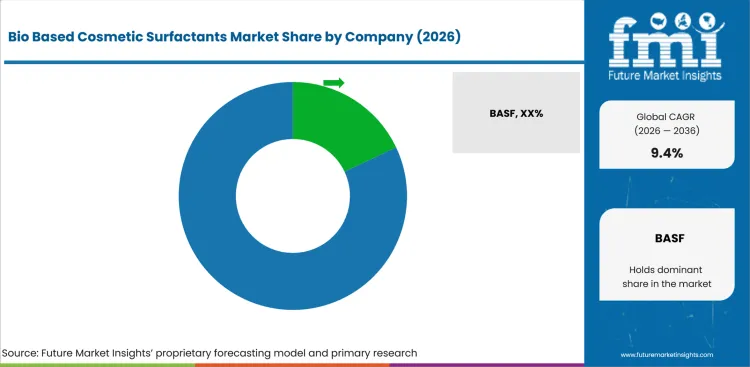
BASF, Evonik, Clariant, Croda, and Solvay.
- Established ingredient companies hold an advantage through application laboratories and regulatory documentation teams.
- Surfactant specialists gain wider acceptance by connecting mildness claims with foam and sensory performance.
- Regional suppliers win in country markets by offering timely field response and sample-ready technical support.
- Service-ready suppliers improve renewal chances through formulation troubleshooting and buyer documentation support.
Ingredient companies compete by combining bio-based surfactant portfolios and application service. BASF has a wide position through personal care ingredient depth and global customer coverage. Evonik competes through biosurfactants and specialty care ingredients. Clariant, Croda, and Solvay compete based on natural-origin chemistry and sustainability documentation.
Manufacturing and technical service depth act as clearer competitive separators as beauty brands move beyond basic ingredient substitution. Galaxy Surfactants and Stepan compete based on surfactant know-how and regional supply support. Seppic, Colonial Chemical, and Kao Corporation add competition depending on mild cleansing applications, specialty chemistries, and local formulation support. Buyers compare supplier performance through foam stability and dossier quality.
Smaller and regional suppliers can win through local formulation knowledge and timely sample access. India, China, and South Korea create opportunities for suppliers with application laboratories and distributor networks. United States and Europe create demand for documentation and claim substantiation. Companies that prove surfactant performance under real formulation conditions should gain more durable supply contracts.
How do top Bio Based Cosmetic Surfactants companies compare?
BASF and Evonik score well on portfolio depth while Croda and Clariant compete through natural-origin positioning and formulation service.
| Company | Alignment with Market Title | Bio-Based Portfolio Depth | Formulation Service Depth | Documentation Support | Channel Reach | Geographic Footprint |
|---|---|---|---|---|---|---|
| BASF | Very High | Extensive | Extensive | Extensive | Extensive | Global |
| Evonik | Very High | Extensive | Extensive | Extensive | Wide | Global |
| Clariant | Very High | Extensive | Wide | Wide | Wide | Global |
| Croda | Very High | Wide | Extensive | Extensive | Wide | Global |
| Solvay | High | Wide | Wide | Wide | Moderate | Europe and Global |
| Galaxy Surfactants | High | Wide | Wide | Moderate | Wide | India and Global |
| Stepan | High | Moderate | Wide | Wide | Wide | Americas and Europe |
| Seppic | High | Moderate | Wide | Wide | Moderate | Europe and Global |
| Colonial Chemical | Moderate to High | Moderate | Wide | Moderate | Wide | United States and Export |
| Kao Corporation | Moderate to High | Moderate | Wide | Wide | Wide | Japan and Global |
Source: Future Market Insights competitive analysis, 2026.
Who are the key players in the Bio Based Cosmetic Surfactants Market?
BASF, Evonik and Clariant are listed with Croda and Solvay among other suppliers.
Key global companies leading the Bio Based Cosmetic Surfactants Market include:
- BASF
- Evonik
- Clariant
- Croda
- Solvay
- Galaxy Surfactants
- Stepan
- Seppic
- Colonial Chemical
- Kao Corporation
Key Developments in Bio Based Cosmetic Surfactants Market
- In January 2024, Evonik manufactured the first product from its industrial-scale rhamnolipid biosurfactant facility in Slovakia, expanding fermentation-based supply for beauty, personal care, and cleaning applications.
- In September 2025, Colonial Chemical announced two new reactors and an expanded Tennessee production facility, with the expansion scheduled to increase overall surfactant production capacity by 15%.
- In May 2024, Evonik officially inaugurated its industrial-scale biosurfactant plant in Slovakia, expanding commercial availability of rhamnolipid ingredients for beauty and personal care applications.
Key Players in the Bio Based Cosmetic Surfactants Market
Global Personal Care Ingredient Leaders
- BASF
- Evonik
- Clariant
- Croda
Specialty Surfactant Suppliers
- Solvay
- Galaxy Surfactants
- Stepan
- Colonial Chemical
Beauty Application and Natural-Origin Specialists
- Seppic
- Kao Corporation
- Innospec
Biosurfactant and Mild Cleansing Specialists
- Evonik
- AmphiStar
Bio Based Cosmetic Surfactants Market - Report Scope
| Parameter | Details |
|---|---|
| Forecast period | 2026 to 2036 |
| Historical period | 2021 to 2025 |
| Quantitative unit | Revenue in USD million |
| By surfactant type | Alkyl Polyglucosides, Amino Acid Surfactants, Sugar-based Esters, Other Bio-based Surfactants |
| By application | Skin Cleansing, Hair Care, Baby and Sensitive Care, Color Cosmetics and Other |
| By ionic nature | Nonionic, Anionic, Amphoteric, Other |
| By form | Liquid, Paste, Powder |
| By sales channel | Direct to Formulators, Distributors |
| Regions covered | North America, Latin America, Europe, East Asia, South Asia and Pacific, Middle East and Africa |
| Countries covered | India, China, South Korea, United States, Germany, France, United Kingdom, Japan |
| Key companies profiled | BASF, Evonik, Clariant, Croda, Solvay, Galaxy Surfactants, Stepan, Seppic, Colonial Chemical, Kao Corporation |
| Approach | Bottom-up ingredient consumption approach using surfactant loading, formulation intensity, application mix, service share, and country-level beauty manufacturing exposure |
Source: Future Market Insights competitive analysis, 2026.
Bio Based Cosmetic Surfactants Market - Scope & Definition
| Attribute | Detail |
|---|---|
| Market Definition | Surface-active ingredients made fully or partly from renewable carbon sources for cosmetic and personal care formulations, including cleansing, foaming, emulsifying, and solubilizing functions |
| Functions Covered | Foam creation, detergency, wetting, mild cleansing, viscosity support, emulsification, solubilization, and sensory improvement |
| Applications Covered | Skin cleansing, hair care, baby and sensitive care, color cosmetics, and selected other cosmetic applications |
| End-Use Industries | Cosmetic brands, personal care manufacturers, contract manufacturers, ingredient distributors, dermocosmetic companies, and indie beauty companies |
| Grades Covered | Cosmetic-grade, natural-origin, bio-based, biodegradable-supporting, mild-cleansing, amino acid-based, APG-based, and sugar-derived surfactant grades |
| Inclusions | All commercially traded bio based cosmetic surfactants across surfactant type, application, ionic nature, form, sales channel, and country-level cosmetic ingredient use |
| Exclusions | Finished cosmetic products, fossil-only surfactants, household detergents, industrial cleaning agents, agricultural adjuvants, oral drug excipients, soap noodles used without cosmetic surfactant positioning, and pharmaceutical excipients |
Bio Based Cosmetic Surfactants Market - Research Methodology
| Method | Description |
|---|---|
| Primary Research | FMI analyst interviews with cosmetic formulators, surfactant suppliers, ingredient distributors, contract manufacturers, brand technical teams, and personal care application specialists across selected markets |
| Desk Research | Review of cosmetic regulation, official beauty statistics, ingredient listings, company disclosures, product literature, safety guidance, and standards used in natural-origin cosmetic claims |
| Market Sizing & Forecasting | Bottom-up ingredient consumption approach using surfactant loading, application-level formulation intensity, average realized pricing, sales-channel share, country beauty demand, and regional manufacturing exposure |
| Data Validation | Cross-verification using supplier portfolios, official cosmetics data, country retail indicators, company developments, ingredient documentation signals, and adjacent personal care surfactant demand checks |
Bio Based Cosmetic Surfactants Market Breakdown by Surfactant Type, Application, Ionic Nature, Form, Sales Channel, and Region
Bio Based Cosmetic Surfactants Market Segmented by Surfactant Type
- Alkyl Polyglucosides
- Amino Acid Surfactants
- Sugar-based Esters
- Other Bio-based Surfactants
Bio Based Cosmetic Surfactants Market Segmented by Application
- Skin Cleansing
- Hair Care
- Baby and Sensitive Care
- Color Cosmetics and Other
Bio Based Cosmetic Surfactants Market Segmented by Ionic Nature
- Nonionic
- Anionic
- Amphoteric
- Other
Bio Based Cosmetic Surfactants Market Segmented by Form
- Liquid
- Paste
- Powder
Bio Based Cosmetic Surfactants Market Segmented by Sales Channel
- Direct to Formulators
- Distributors
Bio Based Cosmetic Surfactants Market by Region
- North America
- Latin America
- Europe
- East Asia
- South Asia and Pacific
- Middle East and Africa
Research Sources and Bibliography
- BASF. (2026, March). BASF wins Fountain Award Gold at PCHi 2026 for next-generation personal care solutions.
- Colonial Chemical. (2025, September). Capacity expansion with addition of two new reactors and expanded production facility.
- Confederation of Indian Industry. (2025). Beauty and personal care industry overview and startup landscape.
- Cosmetic, Toiletry and Perfumery Association. (2025). GB market: Cosmetic industry in figures.
- Cosmetics Europe. (2026). European cosmetics and personal care industry data: Market performance 2025.
- European Commission. (2025). Green claims: Protecting consumers from misleading environmental claims.
- Eurostat. (2025, October). Packaging waste statistics.
- Evonik Industries. (2024, January). Evonik manufactures first product from industrial-scale rhamnolipid biosurfactant facility.
- Evonik Industries. (2024, May). Evonik inaugurates industrial-scale biosurfactant plant in Slovakia.
- Food and Drug Administration. (2026, April). Registration and listing of cosmetic product facilities and products.
- India Brand Equity Foundation. (2025, February). Beauty e-commerce and quick commerce sales momentum in India.
- Japan Ministry of Economy, Trade and Industry. (2025, August). Results of FY2024 e-commerce market survey compiled.
- Ministry of Food and Drug Safety, Republic of Korea. (2025). Cosmetics export performance in 2024.
- Ministry of Trade, Industry and Resources, Republic of Korea. (2026, January). Korea’s annual exports reach new highs in 2025.
- National Bureau of Statistics of China. (2025, November). Total retail sales of consumer goods in October 2025.
- National Bureau of Statistics of China. (2026, January). Total retail sales of consumer goods in December 2025.
- National Medical Products Administration. (2025, June). IECIC administration announcement.
- Personal Care Products Council. (2026, May). U.S. personal care products industry drives nearly USD 500 billion in economic output.
- Statistics Bureau of Japan. (2024). Statistical handbook of Japan 2024.
- United States Census Bureau. (2025, May). Advance monthly sales for retail and food services, April 2025.
This bibliography is provided for reader reference and is not exhaustive. The full report contains the complete reference list and detailed citations.
This Report Answers
- Market size estimates for 2026 and forecasts through 2036 for the Bio Based Cosmetic Surfactants Market.
- Insights across regional and country-level cosmetic ingredient markets.
- Analysis of demand drivers and purchasing behavior.
- Evaluation of surfactant types, applications, ionic nature, forms, and sales channels.
- Assessment of cosmetic documentation, mild cleansing, and natural-origin claim impacts.
- Identification of opportunities across liquid forms and direct technical service.
- Evaluation of distributor and direct-to-formulator sales models.
- Country-level analysis covering India, China, South Korea, United States, Germany, France, United Kingdom, and Japan.
- Assessment of competition, including leading personal care ingredient suppliers and specialty surfactant companies.
- Analysis of formulation decision drivers and renewal criteria.
- Regional outlooks across North America, Europe, East Asia, South Asia and Pacific, Latin America, and Middle East and Africa.
- Delivery of market data, forecasts, and supporting analysis in report-ready format.
Frequently Asked Questions
What is the growth prospect for bio based cosmetic surfactants?
Demand for bio based cosmetic surfactants is expected to rise at a measured pace as beauty brands reformulate rinse-off products toward mild and renewable-origin ingredient systems.
Which companies are expected to shape the Bio Based Cosmetic Surfactants Market?
BASF, Evonik, Clariant, Croda, Solvay, Galaxy Surfactants, Stepan, Seppic, Colonial Chemical, and Kao Corporation are expected to shape competition through surfactant portfolios and formulation support.
Why are cosmetic ingredient companies investing in bio based surfactants?
Cosmetic ingredient companies are investing in bio based surfactants to serve brand demand for sulfate-free cleansing and clearer documentation support.
Why are direct-to-formulator sales channels important in the Bio Based Cosmetic Surfactants Market?
Direct-to-formulator sales channels support ingredient qualification through application testing and formulation troubleshooting.
Which chemical formats are gaining attention in bio based cosmetic surfactants?
Liquid APG blends, amino acid surfactants, and sugar-based ester systems are gaining attention across mild cleansing and sensitive-skin formulas.
How do regulations influence bio based cosmetic surfactant demand?
Regulations influence demand through cosmetic product files and claim substantiation needs.
Why is liquid form important for bio based cosmetic surfactants?
Liquid form is important since pumpable handling supports dosing control and shorter plant changeovers.
What role does direct technical service play in bio based cosmetic surfactant adoption?
Direct technical service supports adoption by connecting ingredient supply with foam and stability testing.
Preview the report firsthand - request a free sample
Get SampleGet the brochure for pricing and purchase details.
Get PDFTable of Content
- Key Takeaways
- Market Size and CAGR
- Top Growth Driver
- Fastest Growing Segment
- Leading Region
- Key Companies
- Emerging Opportunities
- Executive Summary
- Global Market Outlook
- Demand-side Trends
- Supply-side Trends
- Technology Roadmap Analysis
- Analysis and Recommendations
- Analyst Perspective (What is happening? Why now? What should investors know?)
- Key Questions Answered
- How large is the market?
- What is the CAGR?
- What are key trends?
- Which region dominates?
- Who are the leaders?
- Market Overview
- Market Coverage / Taxonomy
- Market Definition / Scope / Limitations
- Research Methodology
- Chapter Orientation
- Analytical Lens and Working Hypotheses
- Market Structure, Signals, and Trend Drivers
- Benchmarking and Cross-market Comparability
- Market Sizing, Forecasting, and Opportunity Mapping
- Research Design and Evidence Framework
- Desk Research Programme (Secondary Evidence)
- Expert Input and Fieldwork (Primary Evidence)
- Tooling, Models, and Reference Databases
- Data Engineering and Model Build
- Quality Assurance and Audit Trail
- Market Background
- Market Dynamics (Drivers, Restraints, Opportunity, Trends)
- Scenario Forecast (Optimistic, Likely, Conservative)
- Impact Analysis
- AI Impact
- Sustainability Impact
- Regulatory Impact
- Technology Impact
- Consumer / Buyer Analysis
- Purchase Drivers
- Adoption Barriers
- Buyer Journey
- Opportunity Map Analysis
- Product Life Cycle Analysis
- Supply Chain Analysis
- Investment Feasibility Matrix
- Value Chain Analysis
- PESTLE and Porter's Analysis
- Regulatory Landscape
- Regional Parent Market Outlook
- Production and Consumption Statistics
- Import and Export Statistics
- Global Market Analysis and Forecast, 2021 to 2036
- Historical Market Size Value (USD Million) Analysis, 2021 to 2025
- Current and Future Market Size Value (USD Million) Projections, 2026 to 2036
- Y-o-Y Growth Trend Analysis
- Absolute $ Opportunity Analysis
- Global Market Pricing Analysis, 2021 to 2036
- Global Market Analysis and Forecast, By Surfactant Type, 2021 to 2036
- Introduction / Key Findings
- Historical Market Size Value (USD Million) Analysis By Surfactant Type, 2021 to 2025
- Current and Future Market Size Value (USD Million) Analysis and Forecast By Surfactant Type, 2026 to 2036
- Alkyl Polyglucosides
- Amino Acid Surfactants
- Sugar-based Esters
- Alkyl Polyglucosides
- Y-o-Y Growth Trend Analysis By Surfactant Type, 2021 to 2025
- Absolute $ Opportunity Analysis By Surfactant Type, 2026 to 2036
- Global Market Analysis and Forecast, By Application, 2021 to 2036
- Introduction / Key Findings
- Historical Market Size Value (USD Million) Analysis By Application, 2021 to 2025
- Current and Future Market Size Value (USD Million) Analysis and Forecast By Application, 2026 to 2036
- Skin Cleansing
- Hair Care
- Baby and Sensitive Care
- Skin Cleansing
- Y-o-Y Growth Trend Analysis By Application, 2021 to 2025
- Absolute $ Opportunity Analysis By Application, 2026 to 2036
- Global Market Analysis and Forecast, By Ionic Nature, 2021 to 2036
- Introduction / Key Findings
- Historical Market Size Value (USD Million) Analysis By Ionic Nature, 2021 to 2025
- Current and Future Market Size Value (USD Million) Analysis and Forecast By Ionic Nature, 2026 to 2036
- Nonionic
- Anionic
- Amphoteric
- Nonionic
- Y-o-Y Growth Trend Analysis By Ionic Nature, 2021 to 2025
- Absolute $ Opportunity Analysis By Ionic Nature, 2026 to 2036
- Global Market Analysis and Forecast, By Form, 2021 to 2036
- Introduction / Key Findings
- Historical Market Size Value (USD Million) Analysis By Form, 2021 to 2025
- Current and Future Market Size Value (USD Million) Analysis and Forecast By Form, 2026 to 2036
- Liquid
- Paste
- Powder
- Liquid
- Y-o-Y Growth Trend Analysis By Form, 2021 to 2025
- Absolute $ Opportunity Analysis By Form, 2026 to 2036
- Global Market Analysis and Forecast, By Sales Channel, 2021 to 2036
- Introduction / Key Findings
- Historical Market Size Value (USD Million) Analysis By Sales Channel, 2021 to 2025
- Current and Future Market Size Value (USD Million) Analysis and Forecast By Sales Channel, 2026 to 2036
- Direct to Formulators
- Distributors
- Direct to Formulators
- Y-o-Y Growth Trend Analysis By Sales Channel, 2021 to 2025
- Absolute $ Opportunity Analysis By Sales Channel, 2026 to 2036
- Global Market Analysis and Forecast, By Region, 2021 to 2036
- Introduction
- Historical Market Size Value (USD Million) Analysis By Region, 2021 to 2025
- Current Market Size Value (USD Million) Analysis and Forecast By Region, 2026 to 2036
- North America
- Latin America
- Western Europe
- Eastern Europe
- East Asia
- South Asia and Pacific
- Middle East & Africa
- Market Attractiveness Analysis By Region
- North America Market Analysis and Forecast, By Country, 2021 to 2036
- Historical Market Size Value (USD Million) Trend Analysis By Market Taxonomy, 2021 to 2025
- Market Size Value (USD Million) Forecast By Market Taxonomy, 2026 to 2036
- By Country
- USA
- Canada
- Mexico
- By Surfactant Type
- By Application
- By Ionic Nature
- By Form
- By Sales Channel
- By Country
- Market Attractiveness Analysis
- By Country
- By Surfactant Type
- By Application
- By Ionic Nature
- By Form
- By Sales Channel
- Key Takeaways
- Latin America Market Analysis and Forecast, By Country
- Historical Market Size Value (USD Million) Trend Analysis By Market Taxonomy, 2021 to 2025
- Market Size Value (USD Million) Forecast By Market Taxonomy, 2026 to 2036
- By Country
- Brazil
- Chile
- Rest of Latin America
- By Surfactant Type
- By Application
- By Ionic Nature
- By Form
- By Sales Channel
- By Country
- Market Attractiveness Analysis
- By Country
- By Surfactant Type
- By Application
- By Ionic Nature
- By Form
- By Sales Channel
- Key Takeaways
- Western Europe Market Analysis and Forecast, By Country
- Historical Market Size Value (USD Million) Trend Analysis By Market Taxonomy, 2021 to 2025
- Market Size Value (USD Million) Forecast By Market Taxonomy, 2026 to 2036
- By Country
- Germany
- UK
- Italy
- Spain
- France
- Nordic
- BENELUX
- Rest of Western Europe
- By Surfactant Type
- By Application
- By Ionic Nature
- By Form
- By Sales Channel
- By Country
- Market Attractiveness Analysis
- By Country
- By Surfactant Type
- By Application
- By Ionic Nature
- By Form
- By Sales Channel
- Key Takeaways
- Eastern Europe Market Analysis and Forecast, By Country
- Historical Market Size Value (USD Million) Trend Analysis By Market Taxonomy, 2021 to 2025
- Market Size Value (USD Million) Forecast By Market Taxonomy, 2026 to 2036
- By Country
- Russia
- Poland
- Hungary
- Balkan & Baltic
- Rest of Eastern Europe
- By Surfactant Type
- By Application
- By Ionic Nature
- By Form
- By Sales Channel
- By Country
- Market Attractiveness Analysis
- By Country
- By Surfactant Type
- By Application
- By Ionic Nature
- By Form
- By Sales Channel
- Key Takeaways
- East Asia Market Analysis and Forecast, By Country
- Historical Market Size Value (USD Million) Trend Analysis By Market Taxonomy, 2021 to 2025
- Market Size Value (USD Million) Forecast By Market Taxonomy, 2026 to 2036
- By Country
- China
- Japan
- South Korea
- By Surfactant Type
- By Application
- By Ionic Nature
- By Form
- By Sales Channel
- By Country
- Market Attractiveness Analysis
- By Country
- By Surfactant Type
- By Application
- By Ionic Nature
- By Form
- By Sales Channel
- Key Takeaways
- South Asia and Pacific Market Analysis and Forecast, By Country
- Historical Market Size Value (USD Million) Trend Analysis By Market Taxonomy, 2021 to 2025
- Market Size Value (USD Million) Forecast By Market Taxonomy, 2026 to 2036
- By Country
- India
- ASEAN
- Australia & New Zealand
- Rest of South Asia and Pacific
- By Surfactant Type
- By Application
- By Ionic Nature
- By Form
- By Sales Channel
- By Country
- Market Attractiveness Analysis
- By Country
- By Surfactant Type
- By Application
- By Ionic Nature
- By Form
- By Sales Channel
- Key Takeaways
- Middle East & Africa Market Analysis and Forecast, By Country
- Historical Market Size Value (USD Million) Trend Analysis By Market Taxonomy, 2021 to 2025
- Market Size Value (USD Million) Forecast By Market Taxonomy, 2026 to 2036
- By Country
- Kingdom of Saudi Arabia
- Other GCC Countries
- Türkiye
- South Africa
- Other African Union
- Rest of Middle East & Africa
- By Surfactant Type
- By Application
- By Ionic Nature
- By Form
- By Sales Channel
- By Country
- Market Attractiveness Analysis
- By Country
- By Surfactant Type
- By Application
- By Ionic Nature
- By Form
- By Sales Channel
- Key Takeaways
- Key Countries Market Analysis
- USA
- Pricing Analysis
- Market Share Analysis, 2025
- By Surfactant Type
- By Application
- By Ionic Nature
- By Form
- By Sales Channel
- Canada
- Pricing Analysis
- Market Share Analysis, 2025
- By Surfactant Type
- By Application
- By Ionic Nature
- By Form
- By Sales Channel
- Mexico
- Pricing Analysis
- Market Share Analysis, 2025
- By Surfactant Type
- By Application
- By Ionic Nature
- By Form
- By Sales Channel
- Brazil
- Pricing Analysis
- Market Share Analysis, 2025
- By Surfactant Type
- By Application
- By Ionic Nature
- By Form
- By Sales Channel
- Chile
- Pricing Analysis
- Market Share Analysis, 2025
- By Surfactant Type
- By Application
- By Ionic Nature
- By Form
- By Sales Channel
- Germany
- Pricing Analysis
- Market Share Analysis, 2025
- By Surfactant Type
- By Application
- By Ionic Nature
- By Form
- By Sales Channel
- UK
- Pricing Analysis
- Market Share Analysis, 2025
- By Surfactant Type
- By Application
- By Ionic Nature
- By Form
- By Sales Channel
- Italy
- Pricing Analysis
- Market Share Analysis, 2025
- By Surfactant Type
- By Application
- By Ionic Nature
- By Form
- By Sales Channel
- Spain
- Pricing Analysis
- Market Share Analysis, 2025
- By Surfactant Type
- By Application
- By Ionic Nature
- By Form
- By Sales Channel
- France
- Pricing Analysis
- Market Share Analysis, 2025
- By Surfactant Type
- By Application
- By Ionic Nature
- By Form
- By Sales Channel
- India
- Pricing Analysis
- Market Share Analysis, 2025
- By Surfactant Type
- By Application
- By Ionic Nature
- By Form
- By Sales Channel
- ASEAN
- Pricing Analysis
- Market Share Analysis, 2025
- By Surfactant Type
- By Application
- By Ionic Nature
- By Form
- By Sales Channel
- Australia & New Zealand
- Pricing Analysis
- Market Share Analysis, 2025
- By Surfactant Type
- By Application
- By Ionic Nature
- By Form
- By Sales Channel
- China
- Pricing Analysis
- Market Share Analysis, 2025
- By Surfactant Type
- By Application
- By Ionic Nature
- By Form
- By Sales Channel
- Japan
- Pricing Analysis
- Market Share Analysis, 2025
- By Surfactant Type
- By Application
- By Ionic Nature
- By Form
- By Sales Channel
- South Korea
- Pricing Analysis
- Market Share Analysis, 2025
- By Surfactant Type
- By Application
- By Ionic Nature
- By Form
- By Sales Channel
- Russia
- Pricing Analysis
- Market Share Analysis, 2025
- By Surfactant Type
- By Application
- By Ionic Nature
- By Form
- By Sales Channel
- Poland
- Pricing Analysis
- Market Share Analysis, 2025
- By Surfactant Type
- By Application
- By Ionic Nature
- By Form
- By Sales Channel
- Hungary
- Pricing Analysis
- Market Share Analysis, 2025
- By Surfactant Type
- By Application
- By Ionic Nature
- By Form
- By Sales Channel
- Kingdom of Saudi Arabia
- Pricing Analysis
- Market Share Analysis, 2025
- By Surfactant Type
- By Application
- By Ionic Nature
- By Form
- By Sales Channel
- Türkiye
- Pricing Analysis
- Market Share Analysis, 2025
- By Surfactant Type
- By Application
- By Ionic Nature
- By Form
- By Sales Channel
- South Africa
- Pricing Analysis
- Market Share Analysis, 2025
- By Surfactant Type
- By Application
- By Ionic Nature
- By Form
- By Sales Channel
- USA
- Market Structure Analysis
- Competition Dashboard
- Competition Benchmarking
- Market Share Analysis of Top Players
- By Regional
- By Surfactant Type
- By Application
- By Ionic Nature
- By Form
- By Sales Channel
- Emerging Startups
- Innovation Benchmarking
- Competition Analysis
- Competition Deep Dive
- BASF
- Overview
- Product Portfolio
- Profitability by Market Segments (Product/Region/Sales Channel)
- Sales Footprint
- Strategy Overview
- Marketing Strategy
- Product Strategy
- Channel Strategy
- Evonik
- Clariant
- Croda
- Solvay
- Galaxy Surfactants
- ·Stepan
- BASF
- Case Studies
- Success Stories
- Recent Developments
- Competition Deep Dive
- Assumptions & Acronyms Used


