

- Market Size (2026)
- USD 81.2 Mn
- Forecast (2036)
- USD 181.9 Mn
- CAGR (2026 to 2036)
- 8.4%
How big is Bio-Based Spray Oils Market in 2026?
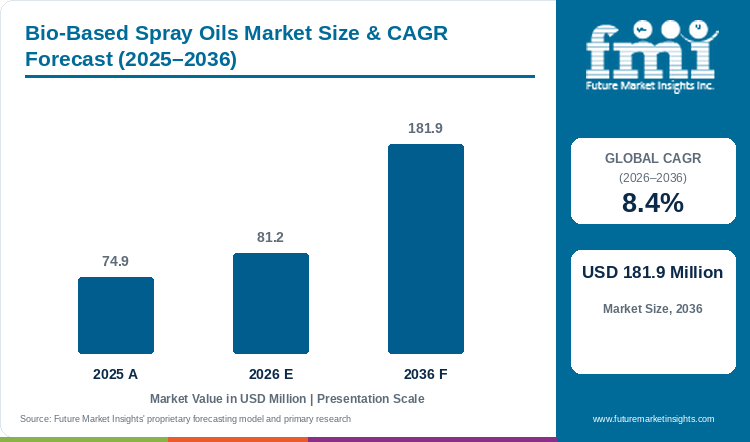
Sales in the bio-based spray oils market are projected to grow at 8.4% CAGR through 2036. Market size rises from USD 74.9 million in 2025 to USD 81.2 million in 2026 and is expected to reach USD 181.9 million by 2036.
As per FMI survey, the bio-based spray oils market increased from USD 74.9 million in 2025 to USD 81.2 million in 2026 and reach USD 181.9 million by 2036 at 8.4% CAGR. They are used with herbicides, fungicides and biostimulants for improving spreading, retention and penetration in the same spray pass. Better distribution is expected to support repeat consumption. A March 2026 University of Minnesota review reported that missing a required adjuvant reduced weed control by 30% to 90%, whereas use of a wrong class lowered control by 5% to 50%.[1] This is likely to increase demand for compatible products having clear mixing guidance.
Trend patterns are developing in foliar tank mixtures and lower-volume systems requiring stable droplet and emulsion behavior. The USA is projected to rise at 8.0% CAGR during 2026 to 2036, while South Korea follows at 7.7%. Broadacre use is likely to support higher prospects in the USA, whereas automated spraying can create growth avenues in South Korea. In August 2026, the U.S. Environmental Protection Agency combined runoff and spray-drift calculations within one application.[2] FMI analysis finds opportunity for products fitting nozzle setup and water condition. Application evidence can improve adoption, while weak compatibility could impede growth.
Key Takeaways
- Increasing spray-performance requirements are supporting demand as renewable oils improve deposition, retention, penetration and drift control under label conditions.
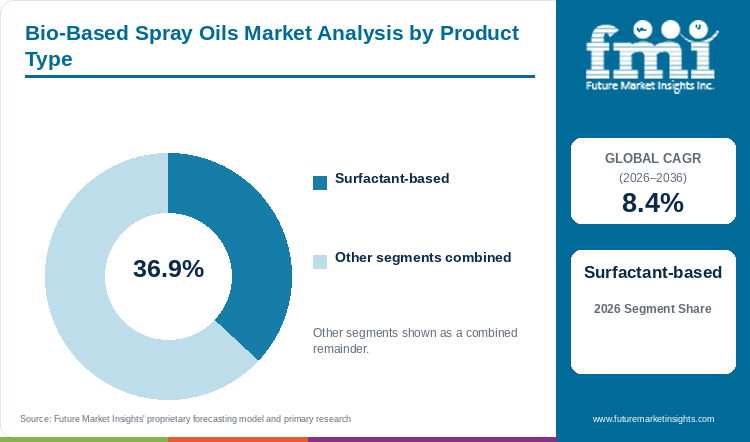
- Based on product type, surfactant-based products are projected to account for 36.9% in 2026, supported by increasing requirement for wetting and emulsification.
- By function, efficacy enhancement is estimated to hold 47.3% in 2026, owing to increasing need for better coverage, uptake and spray response.
- In 2026, cereals and grains are expected to lead crop type with 41.2% share, driven by repeated herbicide and fungicide application across broadacre farms.
- USA is projected to expand at 8.0% CAGR through 2036, while South Korea is estimated at 7.7% owing to automated spraying adoption.
- Notable companies include Loveland Products, Oro Agri, Croda, Clariant, Stepan Company, Evonik, Syensqo, and Wilbur-Ellis.
Analyst Perspective
“I see low-volume spraying increasing demand for bio-based oils that remains stable under concentrated mixtures and changing water condition. Crop-specific field evidence will decide wider adoption because applicators cannot compromise deposition, retention and crop safety.”
- Nikhil Kaitwade, Principal Consultant, Future Market Insights.
How is the bio-based spray oils market segmented?
Bio-based spray oils market is segmented by product type, function, crop type, application method, sales channel and region. In 2026, surfactant-based products, efficacy enhancement, cereals and grains, foliar tank-mix and agri-input distributors are estimated to lead with 36.9%, 47.3%, 41.2%, 49.1% and 42.4% shares, respectively.
Bio-based spray oils market is segmented by product type, function, crop type, application method, sales channel and region.
By product type: surfactant-based, oil-based, polymer-based, mineral or carrier-based, and others.
By function: efficacy enhancement, loss and drift reduction, handling and compatibility, and others.
By crop type: cereals and grains, fruits and vegetables, oilseeds and pulses, turf and ornamentals, and others.
By application method: foliar tank-mix, granule or dry blend, fertigation, and others.
By sales channel: agri-input distributors, cooperatives, agri-retail chains, online or direct-to-farm, and others.
By region: North America, Latin America, Western Europe, Eastern Europe, East Asia, South Asia and Pacific, and Middle East and Africa.
What supports surfactant-based products within the product type category?
Based on product type, surfactant-based is projected to account for 36.9% in 2026, supported by flexible wetting and emulsification.
Surfactants are used for lowering surface tension and helping oil to mix with water in crop-protection formulations. Due to this property, surfactant-based products are applied across in-can formulations and tank-mix use alongside seedling defense primers. In July 2026, Clariant described Hostacerin L 020 SG Vita as a 100% bio-based nonionic emulsifier having renewable carbon index of 100%.[3] FMI research indicates that this development supports the movement of formulators towards renewable emulsification products. Wider application in wetting, spreading and oil-water stability is expected to support the surfactant-based segment over the forecast period.
- Surfactant-based products are projected to hold 36.9% of product type demand because wetting and emulsification is required across several formulation types.
- Formulators are also testing emulsion stability, crop safety and active-ingredient compatibility before using a product across regular spray programs.
Why does efficacy enhancement lead demand by function?
By function, efficacy enhancement is estimated to hold 47.3% in 2026, owing to measurable spray-response improvement.
Efficacy enhancement is gaining preference as applicators are looking for better coverage, uptake and weed control from the same spray pass. In May 2025, Iowa State University Extension reported that adding specialized adjuvants delays droplet drying and improves foliar absorption across variable field conditions.[4] Such field results are expected to support bio-based spray oils used alongside nutrient release modifiers where water condition can change the pesticide response. Owing to measurable field performance, efficacy enhancement is anticipated to maintain its higher share during the assessment period.
- Efficacy enhancement is estimated at 47.3% of functional demand because applicators are looking for visible improvement in biological spray performance.
- Increasing focus on weed control, spray coverage and active uptake is expected to maintain higher adoption of efficacy-enhancing products.
How do cereals and grains shape the crop type category?
In 2026, cereals and grains are expected to lead crop type with 41.2% share, driven by repeated broadacre spraying.
Cereals and grains account for a large treated area as herbicide and fungicide applications are repeated across broadacre farms. USDA estimated 95.2 million acres of corn and 45.5 million acres of wheat planted in the USA during 2025.[5] Large cultivated area allows even a small improvement in wetting and retention to become important across the complete spray program. Seed oil adjuvants are therefore witnessing use alongside biofertilizers where repeated crop protection passes requires stable application performance. This is expected to support cereals and grains segment throughout the forecast period.
- Cereals and grains are forecast to represent 41.2% of crop type demand as repeated crop-protection passes are used across large cultivated areas.
- Broadacre buyers are expected to prefer products having a clear application rate, crop-safety guidance and measurable response under field conditions.
Which conditions support foliar tank-mix application use?
Foliar tank-mix is projected to hold 49.1% share in 2026, enabled by point-of-use adjustment for local spray conditions.
Foliar tank-mix products are added at the point of application according to water quality, nozzle setup, carrier volume and pesticide label. In January 2026, North Dakota State University Extension highlighted that selecting recommended herbicide adjuvants and verifying mixing compatibility is critical to prevent crop injury.[6] Apart from that, tank mix adjuvants allow applicators to change the spray mixture according to local conditions, often paired with root moisture polymers to maintain droplet hydration. Such flexibility is anticipated to support foliar tank-mix application during the forecast period.
- Foliar tank-mix is projected at 49.1% of application demand because applicators can adjust the spray mixture according to local field conditions.
- Product labels remain important for selecting the required adjuvant class, use rate, mixture limit and crop-safety condition.
What keeps agri-input distributors relevant in sales channels?
Agri-input distributors are set to lead sales channel with 42.4% share in 2026, underpinned by local matching support.
Agri-input distributors remain important because selection of an adjuvant changes with pesticide label, water condition, nozzle, weather and crop stage. In August 2026, Wilbur-Ellis published application guidance connecting adjuvant choice with deposition, spreading, retention and off-target movement.[7] This guidance explains why local product matching remains part of agricultural surfactants sales. Distributors also support product availability during the required crop timing. These factors are expected to maintain the share of agri-input distributors in the market.
- Agri-input distributors are projected to hold 42.4% of sales because local advisers support the selection of compatible products for different spray programs.
- Availability of products with field timing and label-specific guidance is also expected to support the share of agri-input distributors.
What are the drivers, restraints, and opportunities in the bio-based spray oils market?
In the bio-based spray oils market, the key driver is spray precision, the key restraint is compatibility, and the key opportunity is low-volume application.
- Driver: Drift mitigation and efficacy requirements increase adoption of adjuvants that control droplet behavior and deposition.
- Restraint: Label-specific compatibility and crop-safety risk can delay switching or repeat use.
- Opportunity: Drone spraying and biological crop protection create demand for renewable low-volume adjuvant systems.
Spray Precision Raises Documentation Needs
Spray precision is receiving higher attention as pesticide labels require runoff, drift-control and application planning. In December 2025, the Council of Producers and Distributors of Agrotechnology reported that its certification program verified over 220 adjuvants across 480 registered products to document drift and application performance.[8] Precision spraying systems are further allowing applicators to place spray more accurately on the crop. These developments are expected to drive demand for bio-based spray oils and spray drift control adjuvants having documented drift and deposition performance.
Compatibility Limits Automatic Product Switching
Compatibility is one of the major factors restricting replacement of one spray oil with another. Water hardness, crop stage, active ingredient and mixture order can change field performance and can also result in crop injury when combining oils with Trichoderma metabolites. In January 2026, the Weed Science Society of America reported that biological actives and microbial mixtures require rigorous compatibility screening to avoid antagonism and crop injury.[9] High testing requirements and the inability of a single product to perform across every tank mixture may hamper faster product switching in the market.
Low-Volume Application Creates New Value
Low-volume application contains more active ingredient in every droplet, due to which foam, spreading and drift becomes important. In 2026, Syensqo introduced its Aeromate line of bio-based drift control tank-mix adjuvants designed specifically for unmanned aerial and low-volume applications.[10] The product supports uniform canopy coverage and droplet retention under concentrated aerial spray conditions. Rising adoption of drones and bioinsecticides is expected to create growth opportunities for bio-based spray oils that remain stable in concentrated spray mixtures.
Which country CAGRs are profiled in the bio-based spray oils market?
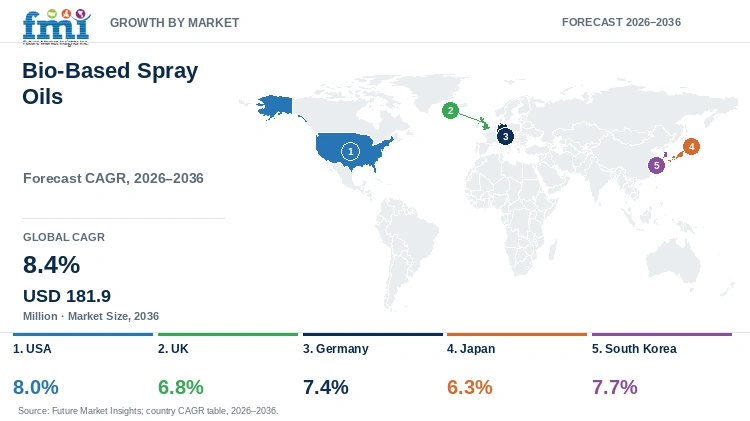
| Country | CAGR |
|---|---|
| USA | 8.0% |
| UK | 6.8% |
| Germany | 7.4% |
| Japan | 6.3% |
| South Korea | 7.7% |
How do country-level CAGRs compare in the bio-based spray oils market?
As per the analysis from FMI, country outlook remains positive where regulation, agronomic support and automated equipment are changing the selection of spray inputs.
The USA and South Korea are witnessing faster adoption through compliance tools and automated spraying, while European demand is guided by authorization and pesticide-reduction targets.
- USA demand is supported by label mitigation tools and established dealer channels for broadacre application.
- The UK links pesticide reduction targets with integrated pest management and precision application support.
- Germany uses a current authorization database and a separate listing route for adjuvants.
- Japan is expanding drone-compatible pesticide registrations under crop and use-specific controls.
- South Korea combines contractor spraying with national drift-control instructions for drone operators.
Full report country CAGRs cover: North America; Latin America; Western Europe; Eastern Europe; East Asia; South Asia and Pacific; Middle East and Africa.
Country-wise Analysis
- By 2036, the USA is projected to grow at 8.0% CAGR, supported by broadacre spraying and changes in pesticide-label mitigation. In September 2026, the USDA Economic Research Service reported that national farm expenditures on agricultural chemicals and application inputs remain a major operating cost, driving demand for precision application aids.[11] Such operating pressures are increasing the requirement for adjuvant directions that fit approved pesticide use. Bio-based spray oils with droplet data, crop-safety evidence and dealer support are expected to witness higher use across broadacre application alongside soil rejuvenation enzymes.
- Bio-based spray oil demand in the UK is forecast to rise at 6.8% CAGR through 2036, owing to pesticide-reduction targets and precision application. The UK Pesticides National Action Plan set a minimum target to reduce each arable pesticide-load indicator by 10% by 2030, while arable farming accounts for around 85% to 90% of agricultural and horticultural pesticide use.[12] This is increasing preference for products supported by drift, retention and compatibility data. Agronomist support and integrated pest management programs are expected to fuel adoption under approved label and weather conditions.
- Germany’s bio-based spray oils outlook is anticipated to advance at 7.4% CAGR over the assessment period, supported by product authorization and adjuvant listing. The Federal Office of Consumer Protection and Food Safety published its concise plant-protection list in May 2026 and continues monthly update of the authorized-product database.[13] The portal also carries separate information for adjuvants and drone use in vineyards. Availability of current authorization information is expected to support formulators and advisers in selecting spray aids according to crop and equipment.
- Adoption of bio-based spray oils in Japan is estimated to expand at 6.3% CAGR through 2036, influenced by crop-specific registration and labor-saving equipment. Japan’s agriculture ministry published its count of pesticides suitable for drone use as of April 1, 2026 and continues to expand applications through registration trials.[14] FMI data suggests that drone tanks use smaller liquid volume, due to which concentrated formulation and stable emulsion becomes important. This is expected to support demand for bio-based spray oils having clear dilution, foam-control and crop-use instructions.
- Sales of bio-based spray oils in South Korea are forecast to expand at 7.7% CAGR through 2036, aided by contractor spraying and drift-control instructions. The agriculture ministry guidance limits multirotor pesticide application to a flight height of 2 to 3 meters and speed below 15 kilometers per hour.[15] Operators are also required to stop spraying while hovering or turning. Such operating conditions are increasing the need for predictable droplets and stable concentrated mixtures, which is expected to support repeat use of suitable bio-based spray oils.
Who are the notable companies in the bio-based spray oils market?
Loveland Products, Oro Agri, Croda, Clariant, Stepan Company, Evonik, Syensqo, and Wilbur-Ellis are notable companies profiled in this market.
Bio-based spray oils market includes farm-use adjuvant suppliers, renewable surfactant companies and providers of droplet-control technologies. Loveland Products, Oro Agri and Wilbur-Ellis offer packaged adjuvants through agronomic channels. Croda, Clariant and Stepan Company supply surfactants and emulsifiers used in crop-protection formulations. Evonik and Syensqo provide technologies for deposition, retention and drift control. In the FMI report, competitive position is connected with droplet data and ease of adding the product into regular spray operations. Buyers are giving preference to products having label fit, crop-safety evidence, water tolerance and local application support.
- Branded farm-use platforms: Loveland Products, Oro Agri, and Wilbur-Ellis connect packaged adjuvants with agronomic selling.
- Renewable formulation ingredients: Croda, Clariant, and Stepan Company provide surfactants, emulsifiers, and formulation support.
- Specialty droplet control: Evonik and Syensqo supply deposition, drift-control, and polymer technologies for demanding applications.
Competitive Benchmarking: Bio-Based Spray Oils Market
| Company | Renewable chemistry | Drift control | Formulation breadth | Geographic reach |
|---|---|---|---|---|
| Loveland Products | High | High | High | High |
| Oro Agri | High | Medium | Medium | High |
| Croda | High | High | High | High |
| Clariant | High | High | High | High |
| Stepan Company | High | High | High | High |
| Evonik | High | High | High | High |
| Syensqo | High | High | Medium | High |
| Wilbur-Ellis | High | High | High | Medium |
High represents wider documented capability, while Medium represents more limited documented capability. These ratings indicate available product and application coverage and does not represent company rank or market share.
Key Developments in the Bio-Based Spray Oils Market
- In August 2026, Wilbur-Ellis published application guidance connecting adjuvant choice with deposition, spreading, retention, and off-target movement.[7]
- In July 2026, Clariant issued a crop-protection edition of Hostacerin L 020 SG Vita, a 100% bio-based nonionic emulsifier for in-can and tank-mix use.[3]
- In April 2025, Stepan Company presented tank-mix adjuvant, biological formulation, and foliar wetting work at ISAA 2025.[16]
- In March 2025, Evonik announced ISAA presentations on drone adjuvants and bio-based multifunctional technologies, including biodegradable sophorolipid chemistry.[17]
Key Players in the Bio-Based Spray Oils Market
Branded farm-use adjuvant platforms
- Loveland Products
- Oro Agri
- Wilbur-Ellis
Renewable surfactant and formulation specialists
- Croda
- Clariant
- Stepan Company
Specialty drift and deposition technologies
- Evonik
- Syensqo
Bio-Based Spray Oils Market - Report Scope
| Coverage field | Report scope |
|---|---|
| Market breakdown | Product type; function; crop type; application method; sales channel; and region. |
| Quantitative units | USD million. |
| Market definition | Supplier revenue from bio-based spray oils and adjuvant formulations used in crop-protection or foliar-input delivery. Standalone petroleum spray oils are excluded. |
| Regions covered | North America; Latin America; Western Europe; Eastern Europe; East Asia; South Asia and Pacific; Middle East and Africa. |
| Countries covered | USA, UK, Germany, Japan, South Korea, and additional countries in the full report. |
| Key companies profiled | Loveland Products, Oro Agri, Croda, Clariant, Stepan Company, Evonik, Syensqo, Wilbur-Ellis. |
| Forecast period | 2026 to 2036. |
| Approach | The market report covers supplier activity, segment structure, application routes, and country adoption conditions within the stated boundary. |
Bio-Based Spray Oils Market - Research Methodology
| Method | Approach |
|---|---|
| Primary Research | Analysts gathered input from manufacturers, service providers, technology developers, distributors, end users, procurement teams, and subject-matter experts. Interviews examined purchasing decisions, product or service evaluation, adoption barriers, approval requirements, pricing considerations, and expectations for technical or commercial support. Respondents were also asked what evidence is required before a trial, pilot, or initial order develops into regular purchasing. |
| Desk Research | Desk research covered government statistics, regulatory publications, trade data, industry associations, technical literature, standards, company filings, product information, and official corporate announcements. Sources were reviewed for relevance, publication date, geographic coverage, and consistency with the defined market scope. Claims relating to performance, applications, approvals, capacity, investment, and commercial activity were retained only when supported by credible public evidence. |
| Market Sizing and Forecasting | The market model combined the baseline value with historical performance, segment structure, pricing and volume indicators, adoption levels, company participation, and country-level demand conditions. The forecast considers economic activity, investment trends, regulatory developments, technology adoption, purchasing cycles, supply availability, and barriers to wider market use. Segment and regional estimates were reconciled before the final market total was calculated. |
| Data Validation | Estimates were checked against multiple independent indicators, including public data, company activity, trade patterns, industry developments, and findings from primary interviews. Validation also tested whether products, services, applications, and company revenues fell within the defined market boundaries. Adjacent categories, unsupported claims, overlapping revenues, and activities without direct market relevance were excluded to reduce double counting and maintain consistency across segments and countries. |
Bio-Based Spray Oils Market by Segments
Bio-Based Spray Oils Market segmented by Product Type:
- Surfactant-based
- Oil-based
- Polymer-based
- Mineral or carrier-based
- Others
Bio-Based Spray Oils Market segmented by Function:
- Efficacy enhancement
- Loss and drift reduction
- Handling and compatibility
- Others
Bio-Based Spray Oils Market segmented by Crop Type:
- Cereals and grains
- Fruits and vegetables
- Oilseeds and pulses
- Turf and ornamentals
- Others
Bio-Based Spray Oils Market segmented by Application Method:
- Foliar tank-mix
- Granule or dry blend
- Fertigation
- Others
Bio-Based Spray Oils Market segmented by Sales Channel:
- Agri-input distributors
- Cooperatives
- Agri-retail chains
- Online or direct-to-farm
- Others
Bio-Based Spray Oils Market by Region
- North America
- United States
- Canada
- Latin America
- Brazil
- Mexico
- Argentina
- Chile
- Western Europe
- Germany
- France
- United Kingdom
- Italy
- Spain
- Benelux
- Nordics
- Eastern Europe
- Poland
- Czech Republic
- Romania
- Hungary
- East Asia
- China
- Japan
- South Korea
- South Asia and Pacific
- India
- ASEAN
- Australia and New Zealand
- Middle East and Africa
- GCC Countries
- South Africa
- Türkiye
- Israel
Research Sources and Bibliography
- [1] University of Minnesota Extension. (2026, March 23). Strategic Farming: Spray water quality and herbicide efficacy.
- [2] U.S. Environmental Protection Agency. (2026, August 10). Pesticide App for Label Mitigations.
- [3] Clariant. (2026, July 7). Hostacerin L 020 SG Vita: Emulsifier for crop protection formulations.
- [4] Iowa State University Extension and Outreach. (2025, May 14). Herbicides and variable weather: Managing spray droplet drying and plant absorption.
- [5] U.S. Department of Agriculture, National Agricultural Statistics Service. (2025, June 30). Acreage.
- [6] North Dakota State University Extension. (2026, January 16). Recommended herbicide adjuvants and application technologies.
- [7] Wilbur-Ellis. (2026, August 7). Better fungicide performance starts with adjuvants and application timing.
- [8] Council of Producers and Distributors of Agrotechnology. (2025, December 3). Adjuvant certification program and application standards.
- [9] Weed Science Society of America. (2026, January 26). Formulation and application technology committee report: Adjuvant compatibility and biological systems.
- [10] Syensqo. (2026). Aeromate drift control and tank-mix adjuvant technologies for unmanned aerial application.
- [11] U.S. Department of Agriculture, Economic Research Service. (2026, September 3). Farm Sector Income Forecast: Production Expenses.
- [12] Department for Environment, Food and Rural Affairs. (2025, October 24). NAP target explainer.
- [13] German Federal Office of Consumer Protection and Food Safety. (2026, May). Authorised plant protection products.
- [14] Ministry of Agriculture, Forestry and Fisheries of Japan. (2026, April 1). Agricultural drone use status.
- [15] Republic of Korea Ministry of Agriculture, Food and Rural Affairs. (2026). Drone pesticide applicator guidance.
- [16] Stepan Company. (2025, April 2). Stepan Agricultural Solutions at ISAA 2025.
- [17] Evonik Industries. (2025, March 19). Evonik at ISAA 2025 with sustainable agriculture solutions.
This bibliography is provided for reader reference. The full report contains the complete reference list and detailed citations.
This Report Answers
- What is Bio-Based Spray Oils Market worth during 2026?
- What value is Bio-Based Spray Oils Market projected by 2036?
- Which product type holds notable Bio-Based Spray Oils Market share?
- Which function holds notable Bio-Based Spray Oils Market share?
- Which countries have notable Bio-Based Spray Oils Market growth?
- Which companies are notable in Bio-Based Spray Oils Market today?
Frequently Asked Questions
How large is the Bio-Based Spray Oils Market expected to be in 2026?
Future Market Insights estimates that the bio-based spray oils market will reach USD 81.2 million in 2026. The market is projected to expand further and reach USD 181.9 million by 2036.
What CAGR is forecast for the Bio-Based Spray Oils Market through 2036?
As per FMI, the bio-based spray oils market is projected to grow at an 8.4% CAGR from 2026 to 2036. Growth is supported by tighter spray-control requirements and wider low-volume application.
Which product type holds a notable bio-based spray oils demand share in 2026?
Future Market Insights projects surfactant-based products to hold 36.9% of product type demand in 2026. The segment benefits from use in wetting, spreading and emulsification across spray formulations.
Which crop type holds a notable bio-based spray oils share in 2026?
FMI finds that cereals and grains will hold 41.2% of crop type demand in 2026. Demand is supported by repeated herbicide and fungicide application across broadacre farms.
Which country has a notable bio-based spray oils expansion outlook during the forecast period?
Future Market Insights predicts the USA to expand at an 8.0% CAGR during the 2026 to 2036 assessment period. Growth is supported by broadacre spraying and more explicit label-mitigation planning.
Which companies are active in the Bio-Based Spray Oils Market during 2026?
As per FMI analysis, notable companies include Loveland Products, Oro Agri, Croda, Clariant, Stepan Company, Evonik, Syensqo, and Wilbur-Ellis. These companies are focusing on farm-use portfolios, renewable formulation chemistry, drift control, and agronomic support.
Preview the report firsthand - request a free sample
Get SampleGet the brochure for pricing and purchase details.
Get PDFTable of Content
- Key Takeaways
- Market Size and CAGR
- Top Growth Driver
- Fastest Growing Segment
- Leading Region
- Key Companies
- Emerging Opportunities
- Executive Summary
- Global Market Outlook
- Demand-side Trends
- Supply-side Trends
- Technology Roadmap Analysis
- Analysis and Recommendations
- Analyst Perspective (What is happening? Why now? What should investors know?)
- Key Questions Answered
- How large is the market?
- What is the CAGR?
- What are key trends?
- Which region dominates?
- Who are the leaders?
- Market Overview
- Market Coverage / Taxonomy
- Market Definition / Scope / Limitations
- Research Methodology
- Chapter Orientation
- Analytical Lens and Working Hypotheses
- Market Structure, Signals, and Trend Drivers
- Benchmarking and Cross-market Comparability
- Market Sizing, Forecasting, and Opportunity Mapping
- Research Design and Evidence Framework
- Desk Research Programme (Secondary Evidence)
- Expert Input and Fieldwork (Primary Evidence)
- Tooling, Models, and Reference Databases
- Data Engineering and Model Build
- Quality Assurance and Audit Trail
- Market Background
- Market Dynamics (Drivers, Restraints, Opportunity, Trends)
- Scenario Forecast (Optimistic, Likely, Conservative)
- Impact Analysis
- AI Impact
- Sustainability Impact
- Regulatory Impact
- Technology Impact
- Consumer / Buyer Analysis
- Purchase Drivers
- Adoption Barriers
- Buyer Journey
- Opportunity Map Analysis
- Product Life Cycle Analysis
- Supply Chain Analysis
- Investment Feasibility Matrix
- Value Chain Analysis
- PESTLE and Porter's Analysis
- Regulatory Landscape
- Regional Parent Market Outlook
- Production and Consumption Statistics
- Import and Export Statistics
- Global Market Analysis and Forecast, 2021 to 2036
- Historical Market Size Value (USD Million) Analysis, 2021 to 2025
- Current and Future Market Size Value (USD Million) Projections, 2026 to 2036
- Y-o-Y Growth Trend Analysis
- Absolute $ Opportunity Analysis
- Global Market Pricing Analysis, 2021 to 2036
- Global Market Analysis and Forecast, By Product Type, 2021 to 2036
- Introduction / Key Findings
- Historical Market Size Value (USD Million) Analysis By Product Type, 2021 to 2025
- Current and Future Market Size Value (USD Million) Analysis and Forecast By Product Type, 2026 to 2036
- Surfactant-based
- Oil-based
- Polymer-based
- Mineral or carrier-based
- Others
- Y-o-Y Growth Trend Analysis By Product Type, 2021 to 2025
- Absolute $ Opportunity Analysis By Product Type, 2026 to 2036
- Global Market Analysis and Forecast, By Function, 2021 to 2036
- Introduction / Key Findings
- Historical Market Size Value (USD Million) Analysis By Function, 2021 to 2025
- Current and Future Market Size Value (USD Million) Analysis and Forecast By Function, 2026 to 2036
- Efficacy enhancement
- Loss and drift reduction
- Handling and compatibility
- Others
- Y-o-Y Growth Trend Analysis By Function, 2021 to 2025
- Absolute $ Opportunity Analysis By Function, 2026 to 2036
- Global Market Analysis and Forecast, By Crop Type, 2021 to 2036
- Introduction / Key Findings
- Historical Market Size Value (USD Million) Analysis By Crop Type, 2021 to 2025
- Current and Future Market Size Value (USD Million) Analysis and Forecast By Crop Type, 2026 to 2036
- Cereals and grains
- Fruits and vegetables
- Oilseeds and pulses
- Turf and ornamentals
- Others
- Y-o-Y Growth Trend Analysis By Crop Type, 2021 to 2025
- Absolute $ Opportunity Analysis By Crop Type, 2026 to 2036
- Global Market Analysis and Forecast, By Application Method, 2021 to 2036
- Introduction / Key Findings
- Historical Market Size Value (USD Million) Analysis By Application Method, 2021 to 2025
- Current and Future Market Size Value (USD Million) Analysis and Forecast By Application Method, 2026 to 2036
- Foliar tank-mix
- Granule or dry blend
- Fertigation
- Others
- Y-o-Y Growth Trend Analysis By Application Method, 2021 to 2025
- Absolute $ Opportunity Analysis By Application Method, 2026 to 2036
- Global Market Analysis and Forecast, By Sales Channel, 2021 to 2036
- Introduction / Key Findings
- Historical Market Size Value (USD Million) Analysis By Sales Channel, 2021 to 2025
- Current and Future Market Size Value (USD Million) Analysis and Forecast By Sales Channel, 2026 to 2036
- Agri-input distributors
- Cooperatives
- Agri-retail chains
- Online or direct-to-farm
- Others
- Y-o-Y Growth Trend Analysis By Sales Channel, 2021 to 2025
- Absolute $ Opportunity Analysis By Sales Channel, 2026 to 2036
- Global Market Analysis and Forecast, By Region, 2021 to 2036
- Introduction
- Historical Market Size Value (USD Million) Analysis By Region, 2021 to 2025
- Current Market Size Value (USD Million) Analysis and Forecast By Region, 2026 to 2036
- North America
- Latin America
- Western Europe
- Eastern Europe
- East Asia
- South Asia and Pacific
- Middle East and Africa
- Market Attractiveness Analysis By Region
- North America Market Analysis and Forecast, By Country, 2021 to 2036
- Historical Market Size Value (USD Million) Trend Analysis By Market Taxonomy, 2021 to 2025
- Market Size Value (USD Million) Forecast By Market Taxonomy, 2026 to 2036
- By Country
- United States
- Canada
- By Product Type
- By Function
- By Crop Type
- By Application Method
- By Sales Channel
- By Country
- Market Attractiveness Analysis
- By Country
- By Product Type
- By Function
- By Crop Type
- By Application Method
- By Sales Channel
- Key Takeaways
- Latin America Market Analysis and Forecast, By Country
- Historical Market Size Value (USD Million) Trend Analysis By Market Taxonomy, 2021 to 2025
- Market Size Value (USD Million) Forecast By Market Taxonomy, 2026 to 2036
- By Country
- Brazil
- Mexico
- Argentina
- Chile
- By Product Type
- By Function
- By Crop Type
- By Application Method
- By Sales Channel
- By Country
- Market Attractiveness Analysis
- By Country
- By Product Type
- By Function
- By Crop Type
- By Application Method
- By Sales Channel
- Key Takeaways
- Western Europe Market Analysis and Forecast, By Country
- Historical Market Size Value (USD Million) Trend Analysis By Market Taxonomy, 2021 to 2025
- Market Size Value (USD Million) Forecast By Market Taxonomy, 2026 to 2036
- By Country
- Germany
- France
- United Kingdom
- Italy
- Spain
- Benelux
- Nordics
- By Product Type
- By Function
- By Crop Type
- By Application Method
- By Sales Channel
- By Country
- Market Attractiveness Analysis
- By Country
- By Product Type
- By Function
- By Crop Type
- By Application Method
- By Sales Channel
- Key Takeaways
- Eastern Europe Market Analysis and Forecast, By Country
- Historical Market Size Value (USD Million) Trend Analysis By Market Taxonomy, 2021 to 2025
- Market Size Value (USD Million) Forecast By Market Taxonomy, 2026 to 2036
- By Country
- Poland
- Czech Republic
- Romania
- Hungary
- By Product Type
- By Function
- By Crop Type
- By Application Method
- By Sales Channel
- By Country
- Market Attractiveness Analysis
- By Country
- By Product Type
- By Function
- By Crop Type
- By Application Method
- By Sales Channel
- Key Takeaways
- East Asia Market Analysis and Forecast, By Country
- Historical Market Size Value (USD Million) Trend Analysis By Market Taxonomy, 2021 to 2025
- Market Size Value (USD Million) Forecast By Market Taxonomy, 2026 to 2036
- By Country
- China
- Japan
- South Korea
- By Product Type
- By Function
- By Crop Type
- By Application Method
- By Sales Channel
- By Country
- Market Attractiveness Analysis
- By Country
- By Product Type
- By Function
- By Crop Type
- By Application Method
- By Sales Channel
- Key Takeaways
- South Asia and Pacific Market Analysis and Forecast, By Country
- Historical Market Size Value (USD Million) Trend Analysis By Market Taxonomy, 2021 to 2025
- Market Size Value (USD Million) Forecast By Market Taxonomy, 2026 to 2036
- By Country
- India
- ASEAN
- Australia and New Zealand
- By Product Type
- By Function
- By Crop Type
- By Application Method
- By Sales Channel
- By Country
- Market Attractiveness Analysis
- By Country
- By Product Type
- By Function
- By Crop Type
- By Application Method
- By Sales Channel
- Key Takeaways
- Middle East and Africa Market Analysis and Forecast, By Country
- Historical Market Size Value (USD Million) Trend Analysis By Market Taxonomy, 2021 to 2025
- Market Size Value (USD Million) Forecast By Market Taxonomy, 2026 to 2036
- By Country
- GCC Countries
- South Africa
- Türkiye
- Israel
- By Product Type
- By Function
- By Crop Type
- By Application Method
- By Sales Channel
- By Country
- Market Attractiveness Analysis
- By Country
- By Product Type
- By Function
- By Crop Type
- By Application Method
- By Sales Channel
- Key Takeaways
- Key Countries Market Analysis
- United States
- Pricing Analysis
- Market Share Analysis, 2025
- By Product Type
- By Function
- By Crop Type
- By Application Method
- By Sales Channel
- Canada
- Pricing Analysis
- Market Share Analysis, 2025
- By Product Type
- By Function
- By Crop Type
- By Application Method
- By Sales Channel
- Mexico
- Pricing Analysis
- Market Share Analysis, 2025
- By Product Type
- By Function
- By Crop Type
- By Application Method
- By Sales Channel
- Brazil
- Pricing Analysis
- Market Share Analysis, 2025
- By Product Type
- By Function
- By Crop Type
- By Application Method
- By Sales Channel
- Chile
- Pricing Analysis
- Market Share Analysis, 2025
- By Product Type
- By Function
- By Crop Type
- By Application Method
- By Sales Channel
- Germany
- Pricing Analysis
- Market Share Analysis, 2025
- By Product Type
- By Function
- By Crop Type
- By Application Method
- By Sales Channel
- United Kingdom
- Pricing Analysis
- Market Share Analysis, 2025
- By Product Type
- By Function
- By Crop Type
- By Application Method
- By Sales Channel
- Italy
- Pricing Analysis
- Market Share Analysis, 2025
- By Product Type
- By Function
- By Crop Type
- By Application Method
- By Sales Channel
- Spain
- Pricing Analysis
- Market Share Analysis, 2025
- By Product Type
- By Function
- By Crop Type
- By Application Method
- By Sales Channel
- France
- Pricing Analysis
- Market Share Analysis, 2025
- By Product Type
- By Function
- By Crop Type
- By Application Method
- By Sales Channel
- India
- Pricing Analysis
- Market Share Analysis, 2025
- By Product Type
- By Function
- By Crop Type
- By Application Method
- By Sales Channel
- ASEAN
- Pricing Analysis
- Market Share Analysis, 2025
- By Product Type
- By Function
- By Crop Type
- By Application Method
- By Sales Channel
- Australia and New Zealand
- Pricing Analysis
- Market Share Analysis, 2025
- By Product Type
- By Function
- By Crop Type
- By Application Method
- By Sales Channel
- China
- Pricing Analysis
- Market Share Analysis, 2025
- By Product Type
- By Function
- By Crop Type
- By Application Method
- By Sales Channel
- Japan
- Pricing Analysis
- Market Share Analysis, 2025
- By Product Type
- By Function
- By Crop Type
- By Application Method
- By Sales Channel
- South Korea
- Pricing Analysis
- Market Share Analysis, 2025
- By Product Type
- By Function
- By Crop Type
- By Application Method
- By Sales Channel
- Poland
- Pricing Analysis
- Market Share Analysis, 2025
- By Product Type
- By Function
- By Crop Type
- By Application Method
- By Sales Channel
- Hungary
- Pricing Analysis
- Market Share Analysis, 2025
- By Product Type
- By Function
- By Crop Type
- By Application Method
- By Sales Channel
- Türkiye
- Pricing Analysis
- Market Share Analysis, 2025
- By Product Type
- By Function
- By Crop Type
- By Application Method
- By Sales Channel
- South Africa
- Pricing Analysis
- Market Share Analysis, 2025
- By Product Type
- By Function
- By Crop Type
- By Application Method
- By Sales Channel
- United States
- Market Structure Analysis
- Competition Dashboard
- Competition Benchmarking
- Market Share Analysis of Top Players
- By Regional
- By Product Type
- By Function
- By Crop Type
- By Application Method
- By Sales Channel
- Emerging Startups
- Innovation Benchmarking
- Competition Analysis
- Competition Deep Dive
- Loveland Products
- Overview
- Product Portfolio
- Profitability by Market Segments
- Sales Footprint
- Strategy Overview
- Marketing Strategy
- Product Strategy
- Channel Strategy
- Oro Agri
- Croda
- Clariant
- Stepan Company
- Evonik
- Syensqo
- Wilbur-Ellis
- Loveland Products
- Case Studies
- Success Stories
- Recent Developments
- Competition Deep Dive
- Assumptions & Acronyms Used


