

- Industry Size (2026)
- USD 956.6 Mn
- Forecast (2036)
- USD 2203.1 Mn
- CAGR (2026 to 2036)
- 8.7%
Bio-Based Surfactants for Detergents Market Forecast and Outlook 2026 to 2036
The bio-based surfactants for detergents market is valued at USD 956.6 million in 2026 and is forecasted to reach USD 2,203.1 million by 2036, expanding at a CAGR of 8.7%. Growth is driven by regulatory pressure to reduce petrochemical surfactants, rising consumer preference for plant-derived ingredients, and sustainability commitments from detergent manufacturers. Household and institutional cleaning brands increasingly reformulate products to improve biodegradability, reduce aquatic toxicity, and lower carbon intensity while maintaining cleaning efficiency.
Alkyl polyglucosides represent leading surfactant-type demand due to renewable feedstock origin, strong detergency, and favorable skin compatibility. APGs deliver effective soil removal, high foam stability, and performance across a wide temperature and water hardness range. Preference reflects suitability for concentrated and liquid detergent formats, compatibility with enzymes, and compliance with eco-label standards. Household laundry detergents represent leading application demand, supported by high consumption volumes and continuous reformulation toward mild and environmentally aligned chemistries.
China, India, USA, Germany, and Brazil emerge as fastest-growing countries, supported by scale of detergent production and regulatory convergence. Competitive landscape includes BASF SE, Evonik Industries, Croda International, Clariant AG, and Kao Chemicals. These suppliers focus on sugar-based surfactants, feedstock traceability, and formulation support aligned with next-generation detergent performance and sustainability requirements.
Quick Stats for Bio-Based Surfactants for Detergents
- Bio-Based Surfactants for Detergents Value (2026): USD 956.6 million
- Bio-Based Surfactants for Detergents Forecast Value (2036): USD 2,203.1 million
- Bio-Based Surfactants for Detergents Forecast CAGR (2026 to 2036): 8.7%
- Leading Surfactant Type in Global Demand: Alkyl Polyglucosides (APG)
- Fastest-Growing Countries: China, India, USA, Germany, Brazil
- Top Players in Global Demand: BASF SE, Evonik Industries, Croda International, Clariant AG, Kao Chemicals
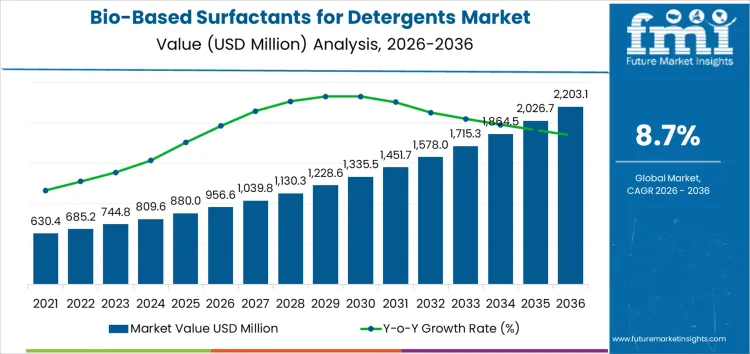
Bio-Based Surfactants for Detergents Market Key Takeaways
| Metric | Value |
|---|---|
| Market Value (2026) | USD 956.6 million |
| Market Forecast Value (2036) | USD 2,203.1 million |
| Forecast CAGR (2026 to 2036) | 8.7% |
Why is the Demand for Bio-Based Surfactants for Detergents Market Growing?
Demand for bio-based surfactants for detergents is growing globally due to rising consumer and regulatory expectations for environmental sustainability, reduced toxicity, and improved biodegradability. Conventional surfactants derived from petrochemicals raise concerns related to persistence in aquatic environments and potential impact on ecosystems. Governments and standards bodies across various regions set stricter criteria for wastewater discharge, biodegradation performance, and restricted substance lists, which motivates manufacturers to adopt surfactants sourced from renewable feedstocks such as plant oils, sugars, and microbial fermentation.
Household and industrial detergent formulators integrate bio-based surfactants to meet clean label, eco-friendly product positioning and to comply with environmental certifications that appeal to environmentally conscious buyers. Growth in laundry, dishwashing, hard surface cleaning, and institutional sanitation applications expands overall detergent volumes requiring sustainable ingredients. Advances in formulation technology improve performance attributes such as foaming, emulsification, and soil removal while reducing skin irritation and aquatic toxicity. Supply chain partners align procurement strategies with corporate sustainability commitments and lifecycle impact reduction goals. Bio-based surfactants also enable reduced reliance on volatile organic compounds and hazardous co-solvents, reinforcing continued uptake across global detergent markets.
How Are the Segments Classified in the Bio-Based Surfactants for Detergents Market?
Demand for bio-based surfactants for detergents globally is shaped by biodegradability requirements, renewable feedstock adoption, and reduction of petrochemical-derived ingredients. Formulators evaluate surface activity, foaming behavior, soil removal efficiency, and compatibility with existing detergent systems. Adoption patterns reflect gradual replacement of conventional surfactants across household, institutional, and specialty detergent formulations emphasizing environmental performance and regulatory alignment.
Which Surfactant Type Represents the Largest Share of Global Demand?
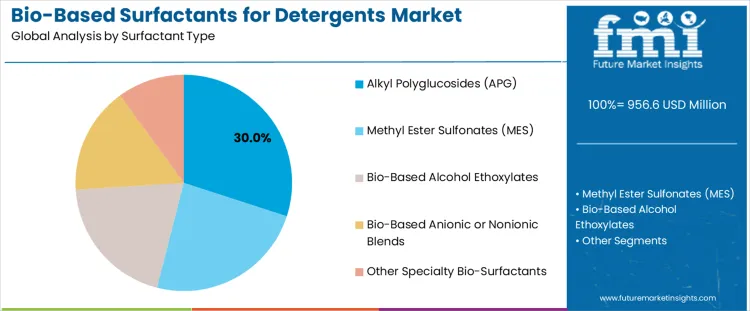
Alkyl polyglucosides hold 30.0%, representing the largest share of global demand. These surfactants provide strong detergency, mild skin compatibility, and excellent biodegradability across liquid and powder formulations. Methyl ester sulfonates account for 24.0%, supporting high detergency and cost efficiency in laundry applications. Bio-based alcohol ethoxylates hold 20.0%, offering balanced wetting and emulsification performance. Bio-based anionic or nonionic blends account for 16.0%, enabling formulation flexibility. Other specialty bio-surfactants hold 10.0%. Surfactant-type distribution reflects preference for scalable, high-performance glucose-derived systems.
Key Points:
- Alkyl polyglucosides lead due to performance and biodegradability.
- MES supports cost-effective laundry formulations.
- Bio-based blends provide formulation versatility.
Which Application Accounts for the Highest Share of Global Adoption?
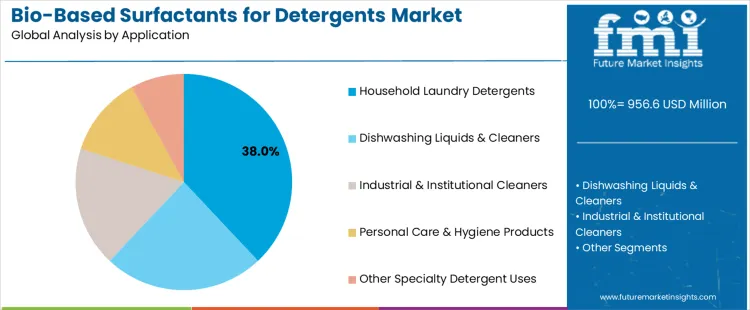
Household laundry detergents hold 38.0%, accounting for the highest share of global adoption. These products consume large surfactant volumes and face sustainability labeling requirements. Dishwashing liquids and cleaners account for 24.0%, requiring effective grease removal and skin-friendly profiles. Industrial and institutional cleaners hold 18.0%, addressing regulatory and worker safety considerations. Personal care and hygiene products account for 12.0%, emphasizing mildness and renewable sourcing. Other specialty detergent uses hold 8.0%. Application distribution reflects concentration of surfactant consumption within everyday cleaning products.
Key Points:
- Laundry detergents dominate due to volume intensity.
- Dishwashing products prioritize grease removal and mildness.
- Institutional cleaners adopt bio-based formulations for compliance.
Which Feedstock Source Drives the Largest Share of Global Demand?
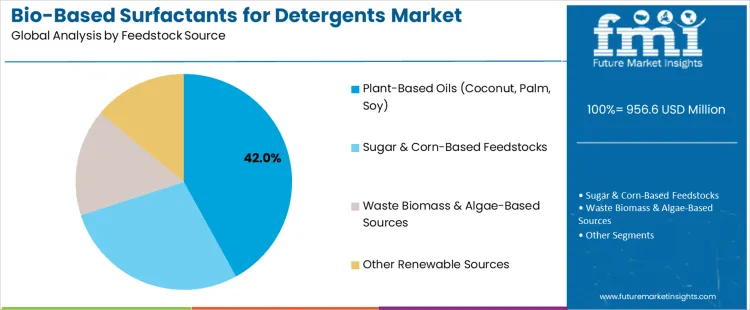
Plant-based oils hold 42.0%, driving the largest share of global demand. Coconut, palm, and soy oils provide reliable fatty alcohol and ester inputs for surfactant synthesis. Sugar and corn-based feedstocks account for 28.0%, supporting glucose-derived surfactant pathways. Waste biomass and algae-based sources hold 16.0%, reflecting emerging circular feedstock strategies. Other renewable sources account for 14.0%. Feedstock distribution reflects availability, processing maturity, and scalability of plant-derived raw materials.
Key Points:
- Plant oils dominate due to supply reliability.
- Sugar-based feedstocks support glucose-derived surfactants.
- Alternative biomass sources reflect emerging sustainability pathways.
What are the Key Dynamics in the Bio-Based Surfactants for Detergents Market?
Global demand rises as detergent manufacturers and formulators adopt bio-based surfactants to reduce reliance on petroleum-derived ingredients, improve biodegradability, and align with sustainability commitments. Bio-based surfactants deliver cleaning, foaming, and emulsification performance in household and industrial detergents while supporting reduced aquatic toxicity and improved environmental profiles. Adoption reflects tightening regulatory frameworks on biodegradability and chemical safety, consumer preference for greener products, and expansion of eco-certification programs across regions. Usage spans laundry, dishwashing, hard surface cleaning, and institutional cleaning applications in both developed and emerging markets.
How do sustainability mandates and consumer preference shape global demand?
Regulatory bodies in Europe, North America, Asia-Pacific, and Latin America increasingly require detergents to meet criteria for biodegradability, reduced aquatic toxicity, and traceable renewable content. Manufacturers respond by integrating surfactants derived from plant oils, sugars, and fermentation processes to satisfy environmental standards and ecolabel programs. Consumer awareness of environmental impact and demand for transparent ingredient lists drive retail adoption of bio-based detergents and natural formulations. Retail brands emphasize renewable carbon content and certification claims to support differentiation in competitive categories. Institutional buyers also adopt greener cleaning solutions to meet corporate ESG reporting requirements, reinforcing market expansion.
How does performance parity, cost dynamics, and formulation complexity influence market scalability?
Bio-based surfactants must achieve performance comparable to conventional surfactants across diverse soil types, water conditions, and detergent formats. Meeting cleaning efficacy while maintaining product stability, foaming behavior, and consumer sensorial expectations requires careful formulation design. Raw material costs and availability for bio-based feedstocks vary by region and seasonal harvest cycles, influencing pricing and supply consistency. Cost premiums relative to petroleum-derived alternatives affect adoption in price-sensitive segments and emerging economies. Integration into existing manufacturing processes may require adjustment of processing conditions and quality control protocols. Global growth depends on continued innovation in high-performance, cost-competitive bio-based surfactants and harmonized sustainability standards that support broad use across household and industrial detergent markets worldwide.
How Is Demand for Bio-Based Surfactants for Detergents Evolving?
Demand for bio-based surfactants for detergents is increasing globally due to sustainability mandates, biodegradability requirements, and reduced petrochemical dependence. China leads with a 9.8% CAGR, supported by scale of detergent manufacturing and green chemistry adoption. India follows at 9.4%, driven by growth in household cleaning products and regulatory focus on biodegradable inputs. USA records an 8.0% CAGR, reflecting brand sustainability commitments and reformulation of consumer detergents. Germany posts 7.2%, shaped by precautionary chemical regulation and environmental labeling standards. Brazil records 7.0%, supported by renewable feedstock availability and expansion of domestic detergent production. Growth reflects steady transition toward renewable surfactant systems worldwide.
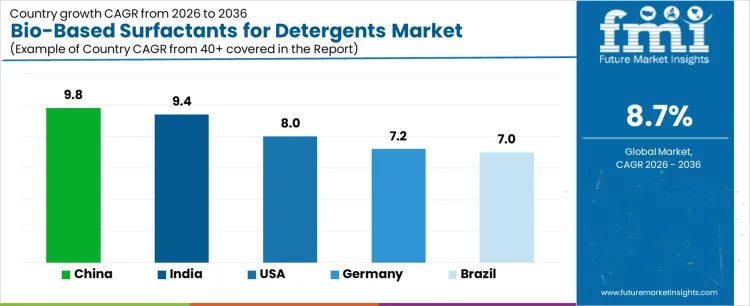
| Country | CAGR (%) |
|---|---|
| China | 9.8% |
| India | 9.4% |
| USA | 8.0% |
| Germany | 7.2% |
| Brazil | 7.0% |
What factors are driving strong adoption of bio-based surfactants in China?
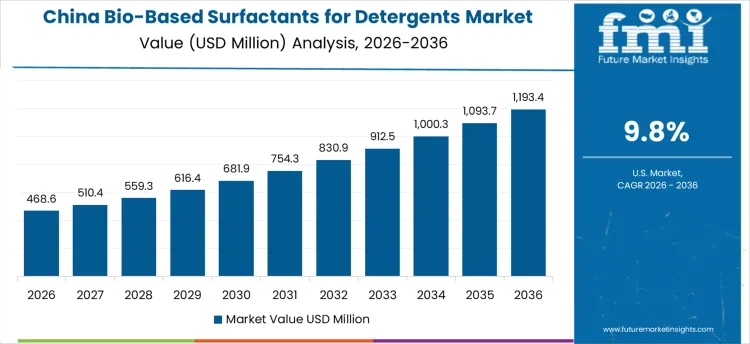
China demand is driven by large-scale production of household and industrial detergents and regulatory encouragement for greener formulations. CAGR of 9.8% reflects substitution of petroleum-derived surfactants with fatty alcohol sulfates, alkyl polyglucosides, and ester-based alternatives. Detergent producers respond to eco-labeling requirements and wastewater discharge standards. Centralized manufacturing enables rapid formulation changes across product lines. Domestic oleochemical capacity supports feedstock availability and cost control. Growth remains scale-driven and policy-aligned, supported by environmental compliance and consumer preference shifts.
- Large detergent manufacturing base
- Substitution of petrochemical surfactants
- Eco-labeling and wastewater compliance
- Strong domestic oleochemical supply
How is India sustaining high growth in bio-based surfactant usage?
India demand reflects expansion of detergent consumption and increased emphasis on biodegradable cleaning products. CAGR of 9.4% is supported by adoption of plant-derived surfactants in laundry and dishwashing formulations. Regulatory focus on river pollution reduction influences detergent chemistry choices. Cost-sensitive formulations favor locally sourced bio-based feedstocks. Multinational brands introduce global sustainability standards into domestic products. Growth remains volume-led and compliance-focused, aligned with rising household consumption and environmental priorities.
- Growth in household detergent consumption
- Emphasis on biodegradability and water safety
- Use of locally sourced renewable feedstocks
- Adoption of global brand sustainability standards
What regulatory and commercial drivers shape demand growth in the USA?
USA demand is shaped by consumer safety expectations, sustainability branding, and ingredient transparency requirements. CAGR of 8.0% reflects reformulation of detergents to include bio-based surfactants with lower toxicity and improved biodegradability. Retailers and brands promote plant-based claims and certified ingredients. Regulatory oversight encourages reduced aquatic toxicity. Performance parity with conventional surfactants supports adoption. Growth remains brand-led and compliance-driven, aligned with consumer preference for environmentally responsible products.
- Consumer demand for plant-based detergents
- Ingredient transparency and certification needs
- Reduced aquatic toxicity requirements
- Performance-compatible bio-based formulations
Why does Germany show steady growth in bio-based surfactant adoption?
Germany demand reflects precautionary chemical policy and strong environmental labeling frameworks. CAGR of 7.2% is supported by adoption of surfactants compliant with EU ecolabel and biodegradability criteria. Detergent manufacturers prioritize lifecycle impact reduction and renewable content. Integration occurs within certified production systems emphasizing traceability. Regulatory scrutiny ensures consistent compliance. Growth remains efficiency-led and compliance-focused, aligned with sustainability standards and consumer trust expectations.
- EU ecolabel and biodegradability compliance
- Lifecycle impact and renewable content focus
- Certified and traceable production systems
- Strong regulatory oversight
What supports continued demand growth for bio-based surfactants in Brazil?
Brazil demand is driven by availability of renewable feedstocks and expansion of domestic detergent manufacturing. CAGR of 7.0% reflects use of bio-based surfactants derived from vegetable oils and sugars. Environmental regulations encourage biodegradable formulations. Cost advantages from local feedstock sourcing support adoption. Urbanization increases detergent consumption volumes. Growth remains resource-driven and application-aligned, supported by renewable chemistry integration and rising consumer awareness.
- Abundant renewable feedstock availability
- Expansion of domestic detergent production
- Regulatory encouragement for biodegradable products
- Growing urban household consumption
What is the competitive landscape of demand for bio-based surfactants for detergents?
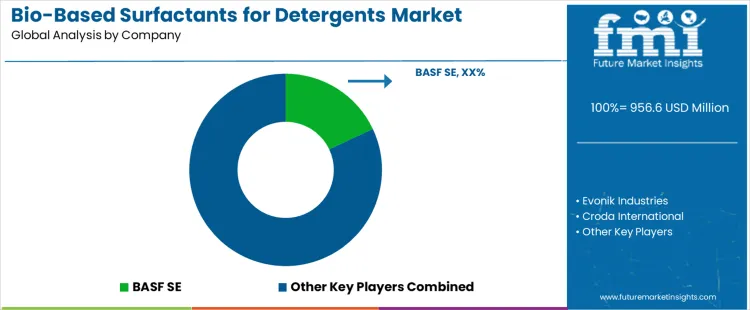
Demand for bio-based surfactants for detergents is driven by sustainability commitments, regulatory scrutiny on petrochemical inputs, and consumer preference for environmentally responsible cleaning products. Applications span household laundry, dishwashing, and institutional cleaning formulations requiring effective soil removal, foaming control, and biodegradability. Buyers evaluate surfactant performance, compatibility with enzymes and builders, renewable carbon content, and lifecycle environmental impact. Procurement teams prioritize consistent raw material sourcing, scalability across global detergent production, and compliance with eco-label and biodegradability standards. Trend in the global market reflects increased use of plant-derived feedstocks, reduced reliance on fossil-based surfactants, and formulation shifts supporting low-temperature washing and water efficiency.
BASF SE maintains strong positioning through a broad portfolio of bio-based and mass-balance surfactants used across global detergent brands. Evonik Industries supplies specialty bio-based surfactants emphasizing mildness, performance stability, and sustainability credentials. Croda International focuses on high-value bio-derived surfactants aligned with premium and eco-labeled detergent formulations. Clariant AG supports demand with renewable-content surfactants designed for performance detergents and institutional cleaning products. Kao Chemicals contributes plant-based surfactant technologies integrated into consumer and professional detergent systems, supported by formulation expertise. Competitive differentiation depends on renewable feedstock integration, formulation performance, supply reliability, and ability to meet evolving environmental and regulatory requirements.
Key Players in the Bio-Based Surfactants for Detergents Market
- BASF SE
- Evonik Industries
- Croda International
- Clariant AG
- Kao Chemicals
Scope of the Report
| Items | Values |
|---|---|
| Quantitative Units | USD million |
| Surfactant Type | Alkyl Polyglucosides (APG); Methyl Ester Sulfonates (MES); Bio-Based Alcohol Ethoxylates; Bio-Based Anionic or Nonionic Blends; Other Specialty Bio-Surfactants |
| Application | Household Laundry Detergents; Dishwashing Liquids & Cleaners; Industrial & Institutional Cleaners; Personal Care & Hygiene Products; Other Specialty Detergent Uses |
| Feedstock Source | Plant-Based Oils (Coconut, Palm, Soy); Sugar & Corn-Based Feedstocks; Waste Biomass & Algae-Based Sources; Other Renewable Sources |
| Regions Covered | Asia Pacific, Europe, North America, Latin America, Middle East & Africa |
| Countries Covered | China, India, USA, Germany, Brazil, and 40+ countries |
| Key Companies Profiled | BASF SE; Evonik Industries; Croda International; Clariant AG; Kao Chemicals |
| Additional Attributes | Dollar sales by surfactant type and application; adoption trends for plant-based and sugar-derived surfactant chemistries; performance metrics for detergency, foaming, and biodegradability; compatibility with household, industrial, and personal care formulations; feedstock sustainability and supply considerations; regulatory and eco-label standards influencing bio-based surfactant selection. |
Bio-Based Surfactants for Detergents Market by Segment
By Surfactant Type:
- Alkyl Polyglucosides (APG)
- Methyl Ester Sulfonates (MES)
- Bio-Based Alcohol Ethoxylates
- Bio-Based Anionic or Nonionic Blends
- Other Specialty Bio-Surfactants
By Application:
- Household Laundry Detergents
- Dishwashing Liquids & Cleaners
- Industrial & Institutional Cleaners
- Personal Care & Hygiene Products
- Other Specialty Detergent Uses
By Feedstock Source:
- Plant-Based Oils (Coconut, Palm, Soy)
- Sugar & Corn-Based Feedstocks
- Waste Biomass & Algae-Based Sources
- Other Renewable Sources
By Region:
- Asia Pacific
- China
- Japan
- South Korea
- India
- Australia & New Zealand
- ASEAN
- Rest of Asia Pacific
- Europe
- Germany
- United Kingdom
- France
- Italy
- Spain
- Nordic
- BENELUX
- Rest of Europe
- North America
- United States
- Canada
- Mexico
- Latin America
- Brazil
- Chile
- Rest of Latin America
- Middle East & Africa
- Kingdom of Saudi Arabia
- Other GCC Countries
- Turkey
- South Africa
- Other African Union
- Rest of Middle East & Africa
Bibliography
- European Commission. (2023). Detergents regulation and biodegradability requirements for surfactants in cleaning products. European Commission.
- Organization for Economic Co-operation and Development. (2023). Bio-based chemicals and sustainable surfactant pathways for consumer and industrial detergents. OECD Publishing.
- United States Environmental Protection Agency. (2024). Safer Choice criteria for surfactants and detergent ingredients. USA Environmental Protection Agency.
- World Health Organization. (2023). Environmental and health considerations for surfactants in household and institutional detergents. World Health Organization.
Frequently Asked Questions
How big is the bio-based surfactants for detergents market in 2026?
The global bio-based surfactants for detergents market is estimated to be valued at USD 956.6 million in 2026.
What will be the size of bio-based surfactants for detergents market in 2036?
The market size for the bio-based surfactants for detergents market is projected to reach USD 2,203.1 million by 2036.
How much will be the bio-based surfactants for detergents market growth between 2026 and 2036?
The bio-based surfactants for detergents market is expected to grow at a 8.7% CAGR between 2026 and 2036.
What are the key product types in the bio-based surfactants for detergents market?
The key product types in bio-based surfactants for detergents market are alkyl polyglucosides (apg), methyl ester sulfonates (mes), bio-based alcohol ethoxylates, bio-based anionic or nonionic blends and other specialty bio-surfactants.
Which application segment to contribute significant share in the bio-based surfactants for detergents market in 2026?
In terms of application, household laundry detergents segment to command 38.0% share in the bio-based surfactants for detergents market in 2026.
Preview the report firsthand - request a free sample
Get SampleGet the brochure for pricing and purchase details.
Get PDFTable of Content
- Executive Summary
- Global Market Outlook
- Demand-side Trends
- Supply-side Trends
- Technology Roadmap Analysis
- Analysis and Recommendations
- Market Overview
- Market Coverage / Taxonomy
- Market Definition / Scope / Limitations
- Market Background
- Market Dynamics
- Drivers
- Restraints
- Opportunity
- Trends
- Scenario Forecast
- Demand in Optimistic Scenario
- Demand in Likely Scenario
- Demand in Conservative Scenario
- Opportunity Map Analysis
- Product Life Cycle Analysis
- Supply Chain Analysis
- Investment Feasibility Matrix
- Value Chain Analysis
- PESTLE and Porter’s Analysis
- Regulatory Landscape
- Regional Parent Market Outlook
- Production and Consumption Statistics
- Import and Export Statistics
- Market Dynamics
- Global Market Analysis 2021 to 2025 and Forecast, 2026 to 2036
- Historical Market Size Value (USD Million) Analysis, 2021 to 2025
- Current and Future Market Size Value (USD Million) Projections, 2026 to 2036
- Y-o-Y Growth Trend Analysis
- Absolute $ Opportunity Analysis
- Global Market Pricing Analysis 2021 to 2025 and Forecast 2026 to 2036
- Global Market Analysis 2021 to 2025 and Forecast 2026 to 2036, By Surfactant Type
- Introduction / Key Findings
- Historical Market Size Value (USD Million) Analysis By Surfactant Type , 2021 to 2025
- Current and Future Market Size Value (USD Million) Analysis and Forecast By Surfactant Type , 2026 to 2036
- Alkyl Polyglucosides (APG)
- Methyl Ester Sulfonates (MES)
- Bio-Based Alcohol Ethoxylates
- Bio-Based Anionic or Nonionic Blends
- Other Specialty Bio-Surfactants
- Alkyl Polyglucosides (APG)
- Y-o-Y Growth Trend Analysis By Surfactant Type , 2021 to 2025
- Absolute $ Opportunity Analysis By Surfactant Type , 2026 to 2036
- Global Market Analysis 2021 to 2025 and Forecast 2026 to 2036, By Application
- Introduction / Key Findings
- Historical Market Size Value (USD Million) Analysis By Application, 2021 to 2025
- Current and Future Market Size Value (USD Million) Analysis and Forecast By Application, 2026 to 2036
- Household Laundry Detergents
- Dishwashing Liquids & Cleaners
- Industrial & Institutional Cleaners
- Personal Care & Hygiene Products
- Other Specialty Detergent Uses
- Household Laundry Detergents
- Y-o-Y Growth Trend Analysis By Application, 2021 to 2025
- Absolute $ Opportunity Analysis By Application, 2026 to 2036
- Global Market Analysis 2021 to 2025 and Forecast 2026 to 2036, By Feedstock Source
- Introduction / Key Findings
- Historical Market Size Value (USD Million) Analysis By Feedstock Source, 2021 to 2025
- Current and Future Market Size Value (USD Million) Analysis and Forecast By Feedstock Source, 2026 to 2036
- Plant-Based Oils (Coconut, Palm, Soy)
- Sugar & Corn-Based Feedstocks
- Waste Biomass & Algae-Based Sources
- Other Renewable Sources
- Plant-Based Oils (Coconut, Palm, Soy)
- Y-o-Y Growth Trend Analysis By Feedstock Source, 2021 to 2025
- Absolute $ Opportunity Analysis By Feedstock Source, 2026 to 2036
- Global Market Analysis 2021 to 2025 and Forecast 2026 to 2036, By Region
- Introduction
- Historical Market Size Value (USD Million) Analysis By Region, 2021 to 2025
- Current Market Size Value (USD Million) Analysis and Forecast By Region, 2026 to 2036
- North America
- Latin America
- Western Europe
- Eastern Europe
- East Asia
- South Asia and Pacific
- Middle East & Africa
- Market Attractiveness Analysis By Region
- North America Market Analysis 2021 to 2025 and Forecast 2026 to 2036, By Country
- Historical Market Size Value (USD Million) Trend Analysis By Market Taxonomy, 2021 to 2025
- Market Size Value (USD Million) Forecast By Market Taxonomy, 2026 to 2036
- By Country
- USA
- Canada
- Mexico
- By Surfactant Type
- By Application
- By Feedstock Source
- By Country
- Market Attractiveness Analysis
- By Country
- By Surfactant Type
- By Application
- By Feedstock Source
- Key Takeaways
- Latin America Market Analysis 2021 to 2025 and Forecast 2026 to 2036, By Country
- Historical Market Size Value (USD Million) Trend Analysis By Market Taxonomy, 2021 to 2025
- Market Size Value (USD Million) Forecast By Market Taxonomy, 2026 to 2036
- By Country
- Brazil
- Chile
- Rest of Latin America
- By Surfactant Type
- By Application
- By Feedstock Source
- By Country
- Market Attractiveness Analysis
- By Country
- By Surfactant Type
- By Application
- By Feedstock Source
- Key Takeaways
- Western Europe Market Analysis 2021 to 2025 and Forecast 2026 to 2036, By Country
- Historical Market Size Value (USD Million) Trend Analysis By Market Taxonomy, 2021 to 2025
- Market Size Value (USD Million) Forecast By Market Taxonomy, 2026 to 2036
- By Country
- Germany
- UK
- Italy
- Spain
- France
- Nordic
- BENELUX
- Rest of Western Europe
- By Surfactant Type
- By Application
- By Feedstock Source
- By Country
- Market Attractiveness Analysis
- By Country
- By Surfactant Type
- By Application
- By Feedstock Source
- Key Takeaways
- Eastern Europe Market Analysis 2021 to 2025 and Forecast 2026 to 2036, By Country
- Historical Market Size Value (USD Million) Trend Analysis By Market Taxonomy, 2021 to 2025
- Market Size Value (USD Million) Forecast By Market Taxonomy, 2026 to 2036
- By Country
- Russia
- Poland
- Hungary
- Balkan & Baltic
- Rest of Eastern Europe
- By Surfactant Type
- By Application
- By Feedstock Source
- By Country
- Market Attractiveness Analysis
- By Country
- By Surfactant Type
- By Application
- By Feedstock Source
- Key Takeaways
- East Asia Market Analysis 2021 to 2025 and Forecast 2026 to 2036, By Country
- Historical Market Size Value (USD Million) Trend Analysis By Market Taxonomy, 2021 to 2025
- Market Size Value (USD Million) Forecast By Market Taxonomy, 2026 to 2036
- By Country
- China
- Japan
- South Korea
- By Surfactant Type
- By Application
- By Feedstock Source
- By Country
- Market Attractiveness Analysis
- By Country
- By Surfactant Type
- By Application
- By Feedstock Source
- Key Takeaways
- South Asia and Pacific Market Analysis 2021 to 2025 and Forecast 2026 to 2036, By Country
- Historical Market Size Value (USD Million) Trend Analysis By Market Taxonomy, 2021 to 2025
- Market Size Value (USD Million) Forecast By Market Taxonomy, 2026 to 2036
- By Country
- India
- ASEAN
- Australia & New Zealand
- Rest of South Asia and Pacific
- By Surfactant Type
- By Application
- By Feedstock Source
- By Country
- Market Attractiveness Analysis
- By Country
- By Surfactant Type
- By Application
- By Feedstock Source
- Key Takeaways
- Middle East & Africa Market Analysis 2021 to 2025 and Forecast 2026 to 2036, By Country
- Historical Market Size Value (USD Million) Trend Analysis By Market Taxonomy, 2021 to 2025
- Market Size Value (USD Million) Forecast By Market Taxonomy, 2026 to 2036
- By Country
- Kingdom of Saudi Arabia
- Other GCC Countries
- Turkiye
- South Africa
- Other African Union
- Rest of Middle East & Africa
- By Surfactant Type
- By Application
- By Feedstock Source
- By Country
- Market Attractiveness Analysis
- By Country
- By Surfactant Type
- By Application
- By Feedstock Source
- Key Takeaways
- Key Countries Market Analysis
- USA
- Pricing Analysis
- Market Share Analysis, 2025
- By Surfactant Type
- By Application
- By Feedstock Source
- Canada
- Pricing Analysis
- Market Share Analysis, 2025
- By Surfactant Type
- By Application
- By Feedstock Source
- Mexico
- Pricing Analysis
- Market Share Analysis, 2025
- By Surfactant Type
- By Application
- By Feedstock Source
- Brazil
- Pricing Analysis
- Market Share Analysis, 2025
- By Surfactant Type
- By Application
- By Feedstock Source
- Chile
- Pricing Analysis
- Market Share Analysis, 2025
- By Surfactant Type
- By Application
- By Feedstock Source
- Germany
- Pricing Analysis
- Market Share Analysis, 2025
- By Surfactant Type
- By Application
- By Feedstock Source
- UK
- Pricing Analysis
- Market Share Analysis, 2025
- By Surfactant Type
- By Application
- By Feedstock Source
- Italy
- Pricing Analysis
- Market Share Analysis, 2025
- By Surfactant Type
- By Application
- By Feedstock Source
- Spain
- Pricing Analysis
- Market Share Analysis, 2025
- By Surfactant Type
- By Application
- By Feedstock Source
- France
- Pricing Analysis
- Market Share Analysis, 2025
- By Surfactant Type
- By Application
- By Feedstock Source
- India
- Pricing Analysis
- Market Share Analysis, 2025
- By Surfactant Type
- By Application
- By Feedstock Source
- ASEAN
- Pricing Analysis
- Market Share Analysis, 2025
- By Surfactant Type
- By Application
- By Feedstock Source
- Australia & New Zealand
- Pricing Analysis
- Market Share Analysis, 2025
- By Surfactant Type
- By Application
- By Feedstock Source
- China
- Pricing Analysis
- Market Share Analysis, 2025
- By Surfactant Type
- By Application
- By Feedstock Source
- Japan
- Pricing Analysis
- Market Share Analysis, 2025
- By Surfactant Type
- By Application
- By Feedstock Source
- South Korea
- Pricing Analysis
- Market Share Analysis, 2025
- By Surfactant Type
- By Application
- By Feedstock Source
- Russia
- Pricing Analysis
- Market Share Analysis, 2025
- By Surfactant Type
- By Application
- By Feedstock Source
- Poland
- Pricing Analysis
- Market Share Analysis, 2025
- By Surfactant Type
- By Application
- By Feedstock Source
- Hungary
- Pricing Analysis
- Market Share Analysis, 2025
- By Surfactant Type
- By Application
- By Feedstock Source
- Kingdom of Saudi Arabia
- Pricing Analysis
- Market Share Analysis, 2025
- By Surfactant Type
- By Application
- By Feedstock Source
- Turkiye
- Pricing Analysis
- Market Share Analysis, 2025
- By Surfactant Type
- By Application
- By Feedstock Source
- South Africa
- Pricing Analysis
- Market Share Analysis, 2025
- By Surfactant Type
- By Application
- By Feedstock Source
- USA
- Market Structure Analysis
- Competition Dashboard
- Competition Benchmarking
- Market Share Analysis of Top Players
- By Regional
- By Surfactant Type
- By Application
- By Feedstock Source
- Competition Analysis
- Competition Deep Dive
- BASF SE
- Overview
- Product Portfolio
- Profitability by Market Segments (Product/Age /Sales Channel/Region)
- Sales Footprint
- Strategy Overview
- Marketing Strategy
- Product Strategy
- Channel Strategy
- Evonik Industries
- Croda International
- Clariant AG
- Kao Chemicals
- BASF SE
- Competition Deep Dive
- Assumptions & Acronyms Used
- Research Methodology


