

- Market Size (2026)
- USD 4.4 Bn
- Forecast (2036)
- USD 6.9 Bn
- CAGR (2026 to 2036)
- 4.7%
How big is Bridge Saw Machine Market in 2026?
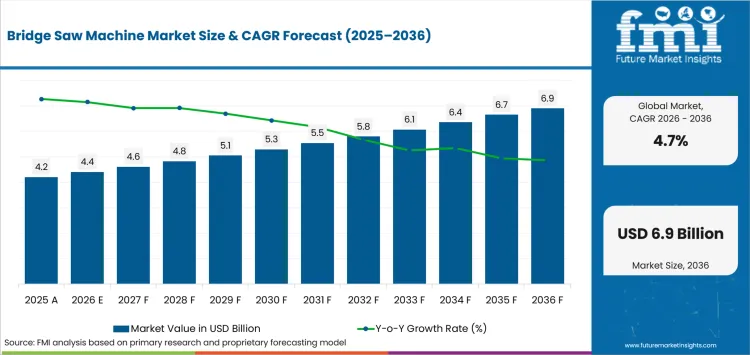
USD 4.4 billion in 2026 and USD 6.9 billion by 2036 at a 4.7% CAGR.
Demand in the bridge saw machine market is anticipated to push valuation from USD 4.4 billion in 2026 to USD 6.9 billion by 2036, expanding at a 4.7% CAGR over the forecast period. Fabricators gain more usable capacity as digital cutting reduces slab repositioning between programmed operations. CMS described the brembana sprint BT in May 2025 as a five-axis bridge-milling line with automatic loading and unloading. The layout reduces manual slab transfers and strengthens the case for flexible equipment in mixed-material shops handling engineered stone slabs.
Country conditions change replacement timing even where the digital-cutting logic is similar. USA Census data placed July 2026 housing starts at 1.239 million annualized units, 13.5% below July 2025. The decline makes firm workload visibility more important for high-specification machine approval. South Korea carries the faster profiled CAGR, whereas mature USA countertop applications depend more on replacement economics and service response.
Key Takeaways
- Digital job preparation and repeatable positioning support bridge saw purchases where fabricators need higher output with fewer manual slab-handling steps.
- By machine type, CNC bridge saws are estimated to hold 35.0% in 2026 owing to programmable cuts for short-run and custom slab work.
- In 2026, granite is expected to lead material cut with 28.0% share because hard stone sustains demand for rigid wet-cutting systems.
- Countertop fabrication is set to lead the end use category with 34.0% share in 2026 due to frequent miters, openings and digital job changes.
- Installed cost, programming, utilities and service access can postpone advanced-machine purchases in shops with uneven order books or limited technical support.
- Some of the key players in this market include Breton, Biesse, CMS Stone Technology, Park Industries, Donatoni Macchine, ZhongLi Machinery, Blue Elephant CNC, and VEEGOO US.
Analyst Perspective
"Bridge saw payback depends on the minutes removed from slab setup, repositioning and downstream rework after installation. Higher-axis machines earn their premium as software, wet cutting and service response keep programmed capacity productive."
- Nikhil Kaitwade, Principal Consultant, Future Market Insights
How is the bridge saw machine market segmented?
The bridge saw machine market is segmented by machine type, material cut, end use, automation, sales channel and region.
The taxonomy covers machine type, material cut, end use, automation, sales channel and region. Machine types include CNC, manual, 5-axis, monoblock and saw-waterjet systems. Materials include granite, marble, quartz or engineered stone, ceramic slabs and other stone. End uses include countertop fabrication, stone-processing plants, construction stone shops, monuments and tile or slab processing. Automation ranges from manual to CNC-controlled and robot-assisted loading. Sales channels include machinery OEMs, dealers, factory-direct sales and aftermarket service.
What makes CNC bridge saws central to the machine type category?
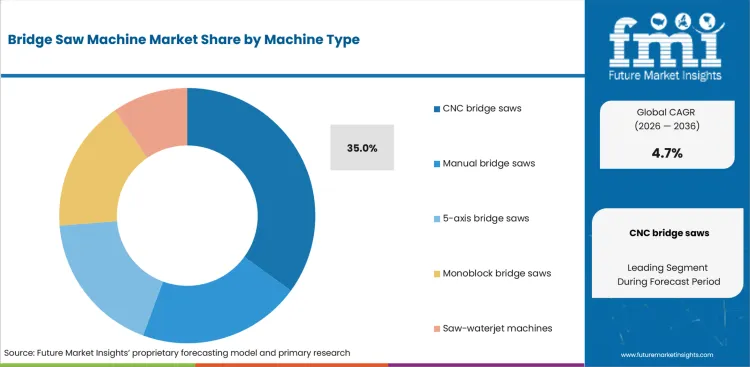
CNC bridge saws suit shops that alternate between straight cuts and programmed angles over short production runs. CMS introduced the five-axis brembana kosmos in September 2025 with integrated CAD/CAM, nesting and automatic slab positioning. Those functions cut setup work on frequent geometry changes and make stone processing machines easier to use on mixed custom jobs.
- Based on machine type, CNC bridge saws are projected to account for 35.0% in 2026 due to programmed positioning on repeat and custom slab work.
- Adoption depends on quick job loading, reliable slab-position checks and straightforward recovery from programming errors without stopping downstream finishing work.
Why does granite lead the material cut category?
Granite exposes poor setup quickly since hard stone demands stable feed, cooling and machine rigidity during the cut. ZhongLi Machinery released a four-axis PLC bridge saw in January 2026 for granite, marble, porcelain and quartz processing. Shops with steady granite work also purchase stone cutting saw blades matched to hardness, thickness and planned cut geometry.
- By material cut, granite is estimated to hold 28.0% in 2026 owing to established countertop and architectural demand for rigid wet-cutting systems.
- Edge damage can erase labor savings from automation, so fabricators judge granite capability by cut stability, water delivery and blade control.
How does countertop fabrication shape the end use category?
Countertop shops need one cutting cell to manage miters, sink openings and vein-sensitive layouts over short production runs. OSHA documented seven serious silica-related citations at a Georgia countertop fabricator in July 2025. The enforcement action links cutting productivity to wet processes, exposure controls and worker training. Demand for sink cutout machines therefore shapes how shops assess the wider cutting workflow.
- In 2026, countertop fabrication is expected to lead end use with 34.0% share because miters, cutouts and mixed slab jobs favor programmable cutting.
- Automation earns more value if digital templates, slab images and finishing instructions pass cleanly between cutting and downstream countertop operations.
What supports CNC-controlled leadership in the automation category?
CNC control keeps geometry repeatable as job files and material recipes change from one slab to the next. ZhongLi Machinery launched a five-axis cutting and polishing center in March 2026 that integrates bridge-saw cutting, milling, engraving and polishing. The multi-process design fits broader industrial automation spending aimed at removing manual transfers between programmed operations.
- CNC-controlled systems are set to lead automation with 43.0% share in 2026 due to repeatable motion control and digital job integration.
- Programming speed, camera accuracy and remote support determine commercial value if difficult controls leave available machine capacity unused in daily production.
What are the drivers, restraints and opportunities in the Bridge Saw Machine Market?
Mixed-material digital production supports demand, installed-cost and silica-control obligations slow conversion, and service-backed automation expands the addressable shop base.
- Driver: Fabricators need repeatable cutting and fewer manual handling steps as job geometry and slab material mix become more varied.
- Restraint: Capital approval must cover utilities, software, tooling, training and exposure-control requirements instead of the machine price alone.
- Opportunity: Compact multi-process cells and stronger service networks can extend CNC adoption into shops unable to justify a large automated line.
Programmable Cutting Raises Useful Throughput
Fabricators buy automation to turn more shift time into finished parts instead of repeated setup and rework. CMS documented productivity gains of up to 35% during brembana electa demonstrations in January 2025. Bridge saw operators apply the same test to programming and tool changes, with industrial robots becoming relevant if slab handling is the actual production bottleneck.
Installed Requirements Can Delay Capital Approval
Advanced cells require utilities, software, tooling and trained operators beyond the machine purchase. OSHA cited Art Stone-Granite & Marble in May 2025 for two repeat and 13 serious violations involving silica and related workplace protections. Wet cutting is one element of exposure control, so installation planning may also require ventilation, respiratory protection and training during final capital approval.
Service-Backed Automation Widens the Buyer Base
Advanced machines are easier to justify if installation and fault recovery are predictable. Donatoni Group stated in April 2026 that Donatoni Service became a subsidiary with its own headquarters, 55 technicians and a spare-parts warehouse. Concentrating production on one CNC cell raises downtime costs, making local parts and remote diagnostics important for smaller fabricators with limited maintenance depth.
Which country CAGRs are profiled in the Bridge Saw Machine Market?
| Country | CAGR |
|---|---|
| South Korea | 6.2% |
| Mexico | 5.9% |
| Brazil | 5.6% |
| Italy | 5.3% |
| USA | 5.0% |
| Germany | 4.7% |
| Japan | 4.3% |
How do country-level CAGRs compare in the Bridge Saw Machine Market?
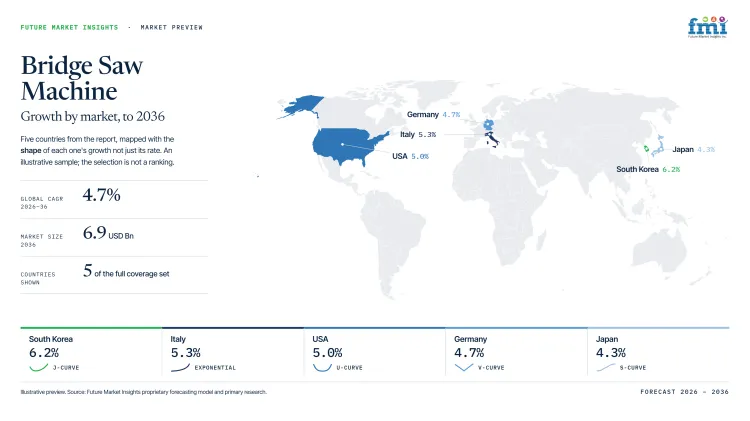
The profiled country CAGRs span 1.9 percentage points from 6.2% in South Korea to 4.3% in Japan. South Korea and Mexico form the fastest-growth group above 5.8%. Brazil and Italy sit in a second band above 5.0%, while the USA is at 5.0%. Germany and Japan expand more moderately. These differences should be read as changes in equipment spending pace rather than as rankings of current market size.
- South Korea values compact automation for short runs and changing slab specifications.
- Mexico relies on dealer reach outside major industrial centers.
- Brazil makes local parts stocks valuable as long technician travel extends downtime.
- Italy's dense machinery base raises the technical threshold for new entrants.
- USA replacement decisions depend on countertop workloads, installed-base age and exposure controls.
- Japanese buyers operate in a market where precision and compact factory layouts can matter more than maximum machine scale.
- Germany german stone processors often evaluate machinery through lifecycle cost and technical compliance.
Similar CAGRs translate into different purchasing conditions and service requirements. The full report provides country-level CAGR analysis across North America, Latin America, Europe, East Asia, South Asia, Oceania and the Middle East and Africa.
Country-wise Analysis
- South Korean stone shops often need compact CNC equipment because project mixes can change faster than floor plans or staffing can be adjusted, especially in urban fabrication sites handling short production runs. The Ministry of Data and Statistics said in August 2026 that domestic building contract value rose 7.1% during 2025, and South Korea is projected to grow at 6.2% CAGR by 2036 attributable to flexible replacement capacity and local commissioning. Local technicians can shorten setup for wet cutting and camera calibration, but uneven project loading can suppress utilization unless machine programs switch efficiently between countertop, architectural and other stone jobs.
- Distributor reach shapes Mexican equipment purchases since industrial processors and smaller construction-linked shops have very different access to credit, technicians and replacement parts outside the largest manufacturing centers. INEGI's February 2026 construction survey covered 3,836 economic units for July 2025, which confirms a broad operating base without one national purchasing pattern and gives regional dealers room to differentiate through installation coverage. Mexico is estimated to post 5.9% CAGR over the forecast period tied to dealer-led access and gradual automation, and limited financing favors modular CNC configurations that can be commissioned reliably in manageable capital steps with locally stocked parts.
- Long service distances shape bridge saw purchases in Brazil since a stopped cutting cell can lose valuable production time before specialized technicians or components arrive, especially outside the largest industrial centers. Bridge saw machine sales in Brazil are forecast to expand at 5.6% CAGR by 2036 supported by a large construction workforce, with IBGE reporting in June 2026 that construction employed 2.5 million people during 2024 and sustained a broad downstream fabrication base. Regional parts stocks and remote diagnostics shorten recovery time, but import lead times and exchange-rate exposure favor companies that place trained service capacity near major stone-processing centers.
- Italy's dense stone-machinery cluster gives fabricators direct access to experienced domestic alternatives, so new equipment is compared on software, mechanics and application support before price, with local demonstrations raising the technical baseline for entry. ICE stated at Marmomac in September 2025 that Italy remained the world's second-largest exporter in the sector, confirming a demanding production base with accessible trials and technical service for stone processors. Adoption of bridge saw machines in Italy is estimated to expand at 5.3% CAGR through 2036 aided by export-oriented processing, yet entrants need a visible programming, handling or lifecycle advantage since standard five-axis specifications provide little separation in this mature field.
- USA countertop shops evaluate bridge saws against digital templating, wet processing and labor requirements so each higher-specification machine fits the full custom-job workflow from slab positioning through downstream finishing. Bridge saw machine demand in the USA is forecast to rise at 5.0% CAGR over the forecast period given replacement needs, with OSHA's March 2026 follow-up inspections citing Stone Atlanta Countertops and GT Stone Granite for repeat and serious silica-related violations that keep exposure controls inside the capital case. Applications training and fast parts supply shorten commissioning and downtime, yet exposure-control obligations and installed cost lengthen approval for manufacturers selling into a mature equipment base with established production routines.
- German stone processors often evaluate machinery through lifecycle cost and technical compliance. They also look for ways to maintain output with a limited skilled workforce. Demand for Bridge Saw Machine in Germany is forecast to rise at 4.7% CAGR from 2026 to 2036. Destatis reported that 238,063 dwellings were permitted in 2025. The 2024 figure was 215,289, while the 2022 level remained much higher. The market therefore combines some construction stabilization with a cautious capital environment. The main friction is proving productivity gains against energy and labor costs while financing remains expensive. Suppliers need durable machines with clear service commitments. Operator training and simpler automation can reduce setup without creating a difficult software burden.
- Japanese buyers operate in a market where precision and compact factory layouts can matter more than maximum machine scale. Adoption of Bridge Saw Machine in Japan is forecast to expand at 4.3% CAGR from 2026 to 2036. Japan’s MLIT reported approximately 792,000 new housing starts in 2024. Starts were down 3.4% from the prior year, while Tokyo office building-start floor area increased 18.2%. This uneven construction mix favors selective replacement and application-led investment. The main constraint is conservative capital approval when workload visibility is uncertain. Suppliers need compact footprints and dependable accuracy. Strong local service must support configurations used across both interior and architectural stone work.
Who are the notable companies in the Bridge Saw Machine Market?
Breton, Biesse, CMS Stone Technology, Park Industries, Donatoni Macchine, ZhongLi Machinery, Blue Elephant CNC and VEEGOO US are notable companies serving this market.
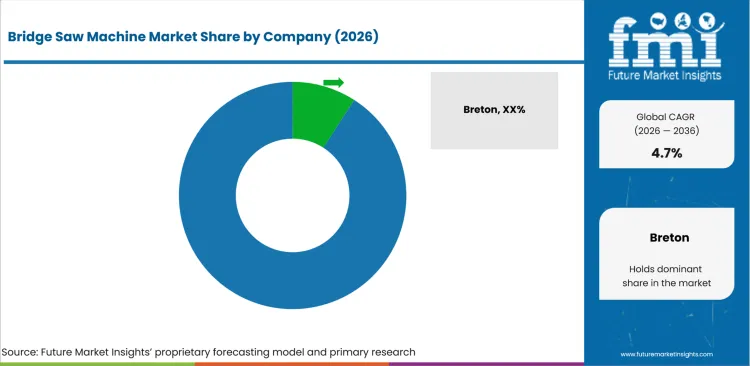
The competitive field includes global multi-process groups, fabricator-focused machinery specialists and expanding CNC challengers. Entry barriers come from service coverage, software maturity and reliable cutting on natural stone, quartz and ceramic tiles instead of company scale alone.
- Integrated stone-processing platforms: Breton, Biesse and CMS Stone Technology pair multi-axis cutting with wider CNC, waterjet, software or handling programs.
- Fabricator-focused machinery specialists: Park Industries and Donatoni Macchine differentiate through countertop applications, installation support and service infrastructure near professional shops.
- Expanding CNC challengers: ZhongLi Machinery, Blue Elephant CNC and VEEGOO US sell multi-axis stone systems into export markets at varied capital levels.
Bridge-saw automation can overlap with industrial robotics for slab handling and with stone crushing equipment at upstream material preparation. Neither adjacent category replaces qualification of the cutting cell itself.
Competitive Benchmarking: Bridge Saw Machine Market
| Company | 5-Axis / Sawjet Coverage | Workflow Automation & Software | Fabricator Service Reach | Geographic Reach |
|---|---|---|---|---|
| Breton | High | High | High | Europe, North America, Asia and international stone markets |
| Biesse | High | High | High | Europe, North America, Asia and global group network |
| CMS Stone Technology | High | High | High | Europe, North America and international distributor network |
| Park Industries | High | High | High | United States and North America |
| Donatoni Macchine | High | High | High | Europe, North America and international stone markets |
| ZhongLi Machinery | High | Medium | Medium | Asia-Pacific, Europe, North America and export markets |
| Blue Elephant CNC | High | Medium | Medium | Asia-based production with international export coverage |
| VEEGOO US | Medium | High | Medium | United States, Asia and international stone markets |
Scoring basis: High five-axis or sawjet coverage requires documented multi-axis cutting plus an extended bridge-saw or combined cutting route. Medium requires one current multi-axis route, and Low identifies a narrower documented route. High automation requires integrated programming or positioning functions. Medium identifies a defined CNC layer, and Low identifies limited automation. High service reach requires documented technical support in multiple major markets. Medium reflects defined regional support, and Low identifies a narrower footprint. Ratings measure documented bridge-saw capability, not corporate reputation.
Key Developments in the Bridge Saw Machine Market
- In July 2026, ZhongLi Machinery announced TUV certification for its five-axis CNC bridge saw, sawjet and cutting-polishing center series for export markets.
- In September 2025, VEEGOO US debuted its 5+1-axis Universal CNC Center at Marmomac for stone fabrication and multi-process slab machining.
- In May 2025, Biesse completed the USA integration of GMM USA, Bavelloni America and Techni Waterjet, consolidating stone and waterjet support under one operating structure.
Key Players in the Bridge Saw Machine Market
Integrated Digital Fabrication Platforms
- Breton
- Biesse
- CMS Stone Technology
Fabricator-Focused Stone Machinery Specialists
- Park Industries
- Donatoni Macchine
Expanding Multi-Axis CNC Suppliers
- ZhongLi Machinery
- Blue Elephant CNC
- VEEGOO US
Bridge Saw Machine Market - Report Scope
| Coverage field | Report scope |
|---|---|
| Market breakdown | By machine type, material cut, end use, automation, sales channel and region. |
| Quantitative Units | USD billion. |
| Market Definition | Bridge-type stone cutting machines used to cut, profile or combine cutting with secondary CNC operations on natural and engineered slab materials. |
| Regions Covered | North America, Latin America, Western Europe, Eastern Europe, East Asia, South Asia and Pacific, and Middle East and Africa. |
| Countries Covered | South Korea, Mexico, Brazil, Italy, USA, and 20+ countries included in the full report. |
| Key Companies Profiled | Breton, Biesse, CMS Stone Technology, Park Industries, Donatoni Macchine, ZhongLi Machinery, Blue Elephant CNC, VEEGOO US. |
| Forecast Period | 2026 to 2036. |
| Approach | Primary and secondary research with market triangulation. |
Bridge Saw Machine Market - Research Methodology
| Method | Approach |
|---|---|
| Primary Research | FMI analysts gathered input from manufacturers, service providers, technology developers, distributors, end users, procurement teams, and subject-matter experts. Interviews examined purchasing decisions, product or service evaluation, adoption barriers, approval requirements, pricing considerations, and expectations for technical or commercial support. Respondents were also asked what evidence is required before a trial, pilot, or initial order develops into regular purchasing. |
| Desk Research | Desk research covered government statistics, regulatory publications, trade data, industry associations, technical literature, standards, company filings, product information, and official corporate announcements. Sources were reviewed for relevance, publication date, geographic coverage, and consistency with the defined market scope. Claims relating to performance, applications, approvals, capacity, investment, and commercial activity were retained only when supported by credible public evidence. |
| Market Sizing and Forecasting | The market model combined the baseline value with historical performance, segment structure, pricing and volume indicators, adoption levels, company participation, and country-level demand conditions. Forecast assumptions considered economic activity, investment trends, regulatory developments, technology adoption, purchasing cycles, supply availability, and barriers to wider market use. Segment and regional estimates were reconciled before the final market total was calculated. |
| Data Validation | Estimates were checked against multiple independent indicators, including public data, company activity, trade patterns, industry developments, and findings from primary interviews. Validation also tested whether products, services, applications, and company revenues fell within the defined market boundaries. Adjacent categories, unsupported claims, overlapping revenues, and activities without direct market relevance were excluded to reduce double counting and maintain consistency across segments and countries. |
Bridge Saw Machine Market by Segments
Bridge Saw Machine Market segmented by Machine Type:
- CNC bridge saws
- Manual bridge saws
- 5-axis bridge saws
- Monoblock bridge saws
- Saw-waterjet machines
Bridge Saw Machine Market segmented by Material Cut:
- Granite
- Marble
- Quartz/engineered stone
- Ceramic slabs
- Concrete/other stone
Bridge Saw Machine Market segmented by End Use:
- Countertop fabrication
- Stone processing plants
- Construction stone shops
- Monument production
- Tile/slab processing
Bridge Saw Machine Market segmented by Automation:
- CNC-controlled
- Semi-automatic
- Manual
- Robot-assisted loading
Bridge Saw Machine Market segmented by Sales Channel:
- Machinery OEMs
- Stone equipment dealers
- Direct factory sales
- Aftermarket/service
Bridge Saw Machine Market by Region:
- North America
- United States
- Canada
- Latin America
- Brazil
- Mexico
- Chile
- Rest of Latin America
- Western Europe
- Germany
- United Kingdom
- Italy
- Spain
- France
- Nordics
- Benelux
- Rest of Western Europe
- Eastern Europe
- Russia
- Poland
- Hungary
- Balkan and Baltic States
- Rest of Eastern Europe
- East Asia
- China
- Japan
- South Korea
- South Asia and Pacific
- India
- ASEAN
- Australia and New Zealand
- Rest of South Asia and Pacific
- Middle East and Africa
- Kingdom of Saudi Arabia
- Other GCC Countries
- Türkiye
- South Africa
- Other African Union Countries
- Rest of Middle East and Africa
Research Sources and Bibliography
- CMS Stone Technology. (2025, May 29). Cutting lines for furniture? Discover the CMS solution!
- USA Census Bureau. (2026, August 18). Monthly New Residential Construction, July 2026.
- CMS Stone Technology. (2025, September 18). Dreams come true: discover how with the new brembana kosmos!
- ZhongLi Machinery. (2026, January 12). New Release | Customized 4 Axis PLC Bridge Saw.
- USA Department of Labor, Occupational Safety and Health Administration. (2025, July 10). US Labor Department cites Georgia counter manufacturer for exposing workers to hazardous levels of crystalline silica.
- ZhongLi Machinery. (2026, March 30). New Release--5 Axis Stone CNC Cutting And Polishing Machine Center.
- CMS Stone Technology. (2025, January 30). 35% increase in productivity? Discover the high-performance machining of brembana electa.
- USA Department of Labor, Occupational Safety and Health Administration. (2025, May 14). US Department of Labor cites Georgia stone product manufacturer for exposing workers to respirable crystalline silica.
- Donatoni Group. (2026, April 22). 2026.
- Ministry of Data and Statistics, Republic of Korea. (2026, August 28).
- Instituto Nacional de Estadística y Geografía. (2026, February 24). Encuesta Nacional de Empresas Constructoras 2025, datos al mes de diciembre.
- Instituto Brasileiro de Geografia e Estatística. (2026, June 10). Annual Survey of Construction Industry 2024.
- Italian Trade Agency. (2025, September 24). Dichiarazione del presidente Agenzia ICE Matteo Zoppas in occasione di MARMOMAC.
- USA Department of Labor, Occupational Safety and Health Administration. (2026, March 26). US Department of Labor cites Georgia stone product manufacturers for exposing workers to respirable crystalline silica, other safety violations.
- ZhongLi Machinery. (2026, July 22). ZhongLi 5 Axis CNC Stone Bridge Saw & Sawjet Machine Earned Official TUV Certification.
- Biesse. (2025, May 12). Biesse completes the Stone, Glass, Metal portfolio in USA Market.
- VEEGOO US. (2025, September 28). Leading Smart Maker VEEGOO US Debuts as Highlight at Machinery Hall.
- Breton. (2025, September 23). Breton & ZOLLER take stone fabrication productivity to the next level.
- Biesse. (2026, February 2). Mexican Market: Biesse strenghthens its presence in Latina America throught expansion in Mexico.
- CMS Stone Technology. (2025, October 29). Discover the new version of brembana maxima: more flexibility, more power, and no compromises.
- Park Industries. (2025, October 3). Park Industries Unveils SPARTAN Sink & Seam CNC Router at ParkFest 2025.
- Biesse. (2025, May 25). Biesse at Ligna: focus on wood within a comprehensive multimaterial portfolio.
- Breton. (2025, November 7). Breton and Tianjing Equipment set the course for the future of ultra-thin diamond wire cutting machines.
- Breton. (2025, May 14). Breton Showrooms in North America.
- Biesse. (2026, April 22). Pieterman-GMT Agreement: Biesse Strengthens Its Presence in the Benelux for Natural Stone and Glass Processing.
- CMS. (2025, May 15). CMS SpA and Hufschmied Zerspanungssysteme GmbH - Together for more efficient machining.
- Park Industries. (2025, February 13). Park Industries® Announces Fabricator Exchange (FabX).
- Donatoni Group. (2025, February 21). Riva marbles expands its fleet of machines with the new Donatoni ES47.
- ZhongLi Machinery. (2026, July 28). New Release | Stone Surface CNC Grinding Machine.
- Blue Elephant CNC. (2025, March 18). New Release: 5 Axis Granite CNC Bridge Saw Stone Cutting Line.
- VEEGOO US. (2025, August 29). Marmomac 2025 | Veegoo Tech's Intelligent Slab Storage & Fabrication Solution.
This bibliography is provided for reader reference and is not exhaustive. The full report contains the complete reference list and detailed citations
This Report Answers
- What is the bridge saw machine market size in 2026 and what value is forecast by 2036?
- Which operating conditions support replacement and expansion demand for bridge saw machines?
- Why do CNC bridge saws hold the leading position by machine type?
- How do granite and countertop workflows affect machine configuration and utilization?
- What capital, training and silica-control requirements can delay adoption?
- How do country growth rates differ among South Korea, Mexico, Brazil, Italy and the USA?
- Which companies compete through integrated platforms, fabricator service or expanding CNC portfolios?
- What should stone fabricators compare beyond purchase price when selecting a bridge saw machine?
Frequently Asked Questions
How big is the bridge saw machine market in 2026?
The bridge saw machine market is valued at USD 4.4 billion in 2026 and is projected to reach USD 6.9 billion by 2036. Growth is tied to digital cutting, mixed-material fabrication and replacement of older manual equipment.
What is the CAGR of the bridge saw machine market from 2026 to 2036?
The bridge saw machine market is projected to grow at a CAGR of 4.7% between 2026 and 2036. Expansion is supported by CNC programming, labor-saving material handling and repeatable slab-cutting accuracy.
Which machine type leads the bridge saw machine market?
The CNC bridge saw segment is expected to hold 35.0% of the bridge saw machine market in 2026, driven by programmed positioning on custom and serial slab jobs. Faster setup also raises usable machine time between frequent geometry changes.
Which end use holds a leading share in the bridge saw machine market?
The countertop fabrication segment is expected to hold 34.0% of the bridge saw machine market in 2026, attributable to frequent miters, cutouts and mixed-material jobs. Flexible programming reduces repeated setup between custom orders and downstream finishing steps.
Which companies are active in the bridge saw machine market?
Key companies operating in the market include Breton, Biesse, CMS Stone Technology, Park Industries, Donatoni Macchine, ZhongLi Machinery, Blue Elephant CNC, and VEEGOO US. Their competition centers on multi-axis machinery, software integration, application support and service coverage.
Preview the report firsthand - request a free sample
Get SampleGet the brochure for pricing and purchase details.
Get PDFTable of Content
- Key Takeaways
- Market Size and CAGR
- Top Growth Driver
- Fastest Growing Segment
- Leading Region
- Key Companies
- Emerging Opportunities
- Executive Summary
- Global Market Outlook
- Demand-side Trends
- Supply-side Trends
- Technology Roadmap Analysis
- Analysis and Recommendations
- Analyst Perspective (What is happening? Why now? What should investors know?)
- Key Questions Answered
- How large is the market?
- What is the CAGR?
- What are key trends?
- Which region dominates?
- Who are the leaders?
- Market Overview
- Market Coverage / Taxonomy
- Market Definition / Scope / Limitations
- Research Methodology
- Chapter Orientation
- Analytical Lens and Working Hypotheses
- Market Structure, Signals, and Trend Drivers
- Benchmarking and Cross-market Comparability
- Market Sizing, Forecasting, and Opportunity Mapping
- Research Design and Evidence Framework
- Desk Research Programme (Secondary Evidence)
- Expert Input and Fieldwork (Primary Evidence)
- Tooling, Models, and Reference Databases
- Data Engineering and Model Build
- Quality Assurance and Audit Trail
- Market Background
- Market Dynamics (Drivers, Restraints, Opportunity, Trends)
- Scenario Forecast (Optimistic, Likely, Conservative)
- Impact Analysis
- AI Impact
- Sustainability Impact
- Regulatory Impact
- Technology Impact
- Consumer / Buyer Analysis
- Purchase Drivers
- Adoption Barriers
- Buyer Journey
- Opportunity Map Analysis
- Product Life Cycle Analysis
- Supply Chain Analysis
- Investment Feasibility Matrix
- Value Chain Analysis
- PESTLE and Porter's Analysis
- Regulatory Landscape
- Regional Parent Market Outlook
- Production and Consumption Statistics
- Import and Export Statistics
- Global Market Analysis and Forecast, 2021 to 2036
- Historical Market Size Value (USD Billion) Analysis, 2021 to 2025
- Current and Future Market Size Value (USD Billion) Projections, 2026 to 2036
- Y-o-Y Growth Trend Analysis
- Absolute $ Opportunity Analysis
- Global Market Pricing Analysis, 2021 to 2036
- Global Market Analysis and Forecast, By Machine Type, 2021 to 2036
- Introduction / Key Findings
- Historical Market Size Value (USD Billion) Analysis By Machine Type, 2021 to 2025
- Current and Future Market Size Value (USD Billion) Analysis and Forecast By Machine Type, 2026 to 2036
- CNC bridge saws
- Manual bridge saws
- 5-axis bridge saws
- Monoblock bridge saws
- Saw-waterjet machines
- CNC bridge saws
- Y-o-Y Growth Trend Analysis By Machine Type, 2021 to 2025
- Absolute $ Opportunity Analysis By Machine Type, 2026 to 2036
- Global Market Analysis and Forecast, By Material Cut, 2021 to 2036
- Introduction / Key Findings
- Historical Market Size Value (USD Billion) Analysis By Material Cut, 2021 to 2025
- Current and Future Market Size Value (USD Billion) Analysis and Forecast By Material Cut, 2026 to 2036
- Granite
- Marble
- Quartz/engineered stone
- Ceramic slabs
- Concrete/other stone
- Granite
- Y-o-Y Growth Trend Analysis By Material Cut, 2021 to 2025
- Absolute $ Opportunity Analysis By Material Cut, 2026 to 2036
- Global Market Analysis and Forecast, By End Use, 2021 to 2036
- Introduction / Key Findings
- Historical Market Size Value (USD Billion) Analysis By End Use, 2021 to 2025
- Current and Future Market Size Value (USD Billion) Analysis and Forecast By End Use, 2026 to 2036
- Countertop fabrication
- Stone processing plants
- Construction stone shops
- Monument production
- Tile/slab processing
- Countertop fabrication
- Y-o-Y Growth Trend Analysis By End Use, 2021 to 2025
- Absolute $ Opportunity Analysis By End Use, 2026 to 2036
- Global Market Analysis and Forecast, By Automation, 2021 to 2036
- Introduction / Key Findings
- Historical Market Size Value (USD Billion) Analysis By Automation, 2021 to 2025
- Current and Future Market Size Value (USD Billion) Analysis and Forecast By Automation, 2026 to 2036
- CNC-controlled
- Semi-automatic
- Manual
- Robot-assisted loading
- CNC-controlled
- Y-o-Y Growth Trend Analysis By Automation, 2021 to 2025
- Absolute $ Opportunity Analysis By Automation, 2026 to 2036
- Global Market Analysis and Forecast, By Sales Channel, 2021 to 2036
- Introduction / Key Findings
- Historical Market Size Value (USD Billion) Analysis By Sales Channel, 2021 to 2025
- Current and Future Market Size Value (USD Billion) Analysis and Forecast By Sales Channel, 2026 to 2036
- Machinery OEMs
- Stone equipment dealers
- Direct factory sales
- Aftermarket/service
- Machinery OEMs
- Y-o-Y Growth Trend Analysis By Sales Channel, 2021 to 2025
- Absolute $ Opportunity Analysis By Sales Channel, 2026 to 2036
- Global Market Analysis and Forecast, By Region, 2021 to 2036
- Introduction
- Historical Market Size Value (USD Billion) Analysis By Region, 2021 to 2025
- Current Market Size Value (USD Billion) Analysis and Forecast By Region, 2026 to 2036
- North America
- Latin America
- Western Europe
- Eastern Europe
- East Asia
- South Asia and Pacific
- Middle East & Africa
- Market Attractiveness Analysis By Region
- North America Market Analysis and Forecast, By Country, 2021 to 2036
- Historical Market Size Value (USD Billion) Trend Analysis By Market Taxonomy, 2021 to 2025
- Market Size Value (USD Billion) Forecast By Market Taxonomy, 2026 to 2036
- By Country
- USA
- Canada
- By Machine Type
- By Material Cut
- By End Use
- By Automation
- By Sales Channel
- By Country
- Market Attractiveness Analysis
- By Country
- By Machine Type
- By Material Cut
- By End Use
- By Automation
- By Sales Channel
- Key Takeaways
- Latin America Market Analysis and Forecast, By Country
- Historical Market Size Value (USD Billion) Trend Analysis By Market Taxonomy, 2021 to 2025
- Market Size Value (USD Billion) Forecast By Market Taxonomy, 2026 to 2036
- By Country
- Brazil
- Mexico
- Chile
- Rest of Latin America
- By Machine Type
- By Material Cut
- By End Use
- By Automation
- By Sales Channel
- By Country
- Market Attractiveness Analysis
- By Country
- By Machine Type
- By Material Cut
- By End Use
- By Automation
- By Sales Channel
- Key Takeaways
- Western Europe Market Analysis and Forecast, By Country
- Historical Market Size Value (USD Billion) Trend Analysis By Market Taxonomy, 2021 to 2025
- Market Size Value (USD Billion) Forecast By Market Taxonomy, 2026 to 2036
- By Country
- Germany
- UK
- Italy
- Spain
- France
- Nordic
- BENELUX
- Rest of Western Europe
- By Machine Type
- By Material Cut
- By End Use
- By Automation
- By Sales Channel
- By Country
- Market Attractiveness Analysis
- By Country
- By Machine Type
- By Material Cut
- By End Use
- By Automation
- By Sales Channel
- Key Takeaways
- Eastern Europe Market Analysis and Forecast, By Country
- Historical Market Size Value (USD Billion) Trend Analysis By Market Taxonomy, 2021 to 2025
- Market Size Value (USD Billion) Forecast By Market Taxonomy, 2026 to 2036
- By Country
- Russia
- Poland
- Hungary
- Balkan & Baltic
- Rest of Eastern Europe
- By Machine Type
- By Material Cut
- By End Use
- By Automation
- By Sales Channel
- By Country
- Market Attractiveness Analysis
- By Country
- By Machine Type
- By Material Cut
- By End Use
- By Automation
- By Sales Channel
- Key Takeaways
- East Asia Market Analysis and Forecast, By Country
- Historical Market Size Value (USD Billion) Trend Analysis By Market Taxonomy, 2021 to 2025
- Market Size Value (USD Billion) Forecast By Market Taxonomy, 2026 to 2036
- By Country
- China
- Japan
- South Korea
- By Machine Type
- By Material Cut
- By End Use
- By Automation
- By Sales Channel
- By Country
- Market Attractiveness Analysis
- By Country
- By Machine Type
- By Material Cut
- By End Use
- By Automation
- By Sales Channel
- Key Takeaways
- South Asia and Pacific Market Analysis and Forecast, By Country
- Historical Market Size Value (USD Billion) Trend Analysis By Market Taxonomy, 2021 to 2025
- Market Size Value (USD Billion) Forecast By Market Taxonomy, 2026 to 2036
- By Country
- India
- ASEAN
- Australia & New Zealand
- Rest of South Asia and Pacific
- By Machine Type
- By Material Cut
- By End Use
- By Automation
- By Sales Channel
- By Country
- Market Attractiveness Analysis
- By Country
- By Machine Type
- By Material Cut
- By End Use
- By Automation
- By Sales Channel
- Key Takeaways
- Middle East & Africa Market Analysis and Forecast, By Country
- Historical Market Size Value (USD Billion) Trend Analysis By Market Taxonomy, 2021 to 2025
- Market Size Value (USD Billion) Forecast By Market Taxonomy, 2026 to 2036
- By Country
- Kingdom of Saudi Arabia
- Other GCC Countries
- Türkiye
- South Africa
- Other African Union
- Rest of Middle East & Africa
- By Machine Type
- By Material Cut
- By End Use
- By Automation
- By Sales Channel
- By Country
- Market Attractiveness Analysis
- By Country
- By Machine Type
- By Material Cut
- By End Use
- By Automation
- By Sales Channel
- Key Takeaways
- Key Countries Market Analysis
- USA
- Pricing Analysis
- Market Share Analysis, 2025
- By Machine Type
- By Material Cut
- By End Use
- By Automation
- By Sales Channel
- Canada
- Pricing Analysis
- Market Share Analysis, 2025
- By Machine Type
- By Material Cut
- By End Use
- By Automation
- By Sales Channel
- Mexico
- Pricing Analysis
- Market Share Analysis, 2025
- By Machine Type
- By Material Cut
- By End Use
- By Automation
- By Sales Channel
- Brazil
- Pricing Analysis
- Market Share Analysis, 2025
- By Machine Type
- By Material Cut
- By End Use
- By Automation
- By Sales Channel
- Chile
- Pricing Analysis
- Market Share Analysis, 2025
- By Machine Type
- By Material Cut
- By End Use
- By Automation
- By Sales Channel
- Germany
- Pricing Analysis
- Market Share Analysis, 2025
- By Machine Type
- By Material Cut
- By End Use
- By Automation
- By Sales Channel
- UK
- Pricing Analysis
- Market Share Analysis, 2025
- By Machine Type
- By Material Cut
- By End Use
- By Automation
- By Sales Channel
- Italy
- Pricing Analysis
- Market Share Analysis, 2025
- By Machine Type
- By Material Cut
- By End Use
- By Automation
- By Sales Channel
- Spain
- Pricing Analysis
- Market Share Analysis, 2025
- By Machine Type
- By Material Cut
- By End Use
- By Automation
- By Sales Channel
- France
- Pricing Analysis
- Market Share Analysis, 2025
- By Machine Type
- By Material Cut
- By End Use
- By Automation
- By Sales Channel
- India
- Pricing Analysis
- Market Share Analysis, 2025
- By Machine Type
- By Material Cut
- By End Use
- By Automation
- By Sales Channel
- ASEAN
- Pricing Analysis
- Market Share Analysis, 2025
- By Machine Type
- By Material Cut
- By End Use
- By Automation
- By Sales Channel
- Australia & New Zealand
- Pricing Analysis
- Market Share Analysis, 2025
- By Machine Type
- By Material Cut
- By End Use
- By Automation
- By Sales Channel
- China
- Pricing Analysis
- Market Share Analysis, 2025
- By Machine Type
- By Material Cut
- By End Use
- By Automation
- By Sales Channel
- Japan
- Pricing Analysis
- Market Share Analysis, 2025
- By Machine Type
- By Material Cut
- By End Use
- By Automation
- By Sales Channel
- South Korea
- Pricing Analysis
- Market Share Analysis, 2025
- By Machine Type
- By Material Cut
- By End Use
- By Automation
- By Sales Channel
- Russia
- Pricing Analysis
- Market Share Analysis, 2025
- By Machine Type
- By Material Cut
- By End Use
- By Automation
- By Sales Channel
- Poland
- Pricing Analysis
- Market Share Analysis, 2025
- By Machine Type
- By Material Cut
- By End Use
- By Automation
- By Sales Channel
- Hungary
- Pricing Analysis
- Market Share Analysis, 2025
- By Machine Type
- By Material Cut
- By End Use
- By Automation
- By Sales Channel
- Kingdom of Saudi Arabia
- Pricing Analysis
- Market Share Analysis, 2025
- By Machine Type
- By Material Cut
- By End Use
- By Automation
- By Sales Channel
- Türkiye
- Pricing Analysis
- Market Share Analysis, 2025
- By Machine Type
- By Material Cut
- By End Use
- By Automation
- By Sales Channel
- South Africa
- Pricing Analysis
- Market Share Analysis, 2025
- By Machine Type
- By Material Cut
- By End Use
- By Automation
- By Sales Channel
- USA
- Market Structure Analysis
- Competition Dashboard
- Competition Benchmarking
- Market Share Analysis of Top Players
- By Regional
- By Machine Type
- By Material Cut
- By End Use
- By Automation
- By Sales Channel
- Emerging Startups
- Innovation Benchmarking
- Competition Analysis
- Competition Deep Dive
- Breton
- Overview
- Product Portfolio
- Profitability by Market Segments
- Sales Footprint
- Strategy Overview
- Marketing Strategy
- Product Strategy
- Channel Strategy
- Biesse Intermac
- CMS Stone Technology
- Prussiani Engineering
- GMM
- Park Industries
- Thibaut
- Denver SpA
- Achilli
- Donatoni Macchine
- Breton
- Case Studies
- Success Stories
- Recent Developments
- Competition Deep Dive
- Assumptions & Acronyms Used


