

- Market Size (2026)
- USD 14.6 Bn
- Forecast (2036)
- USD 26.9 Bn
- CAGR (2026 to 2036)
- 6.3%
How big is Engineered Stone Slabs Market in 2026?
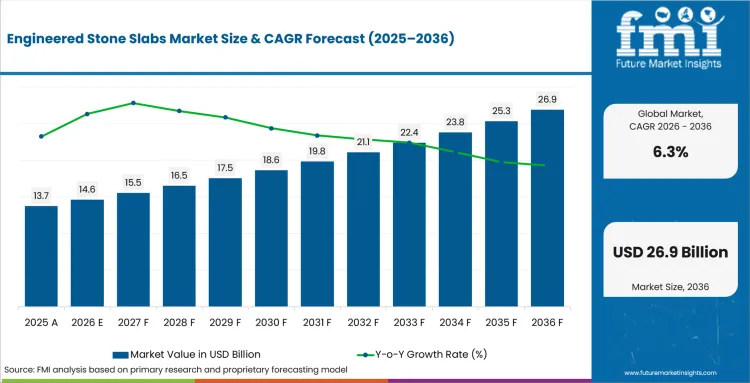
USD 14.6 billion in 2026 and USD 26.9 billion by 2036 at a 6.3% CAGR.
Sales of engineered stone slabs are estimated to rise at 6.3% CAGR through 2036, increasing valuation from USD 14.6 billion in 2026 to USD 26.9 billion by 2036. Renovation programs support measured countertop projects, but workshop approval now considers material composition beside decorative appearance and dependable replacement stock across regional dealer channels. In July 2025, the USA Department of Labor's Occupational Safety and Health Administration (OSHA) cited a countertop manufacturer in Powder Springs, for exposing workers to hazardous levels of respirable crystalline silica during stone fabrication activities. OSHA issued seven serious citations, alleging failures related to silica exposure control, respiratory protection, air monitoring, and worker training. The enforcement route gives fabrication shops direct reasons to review silica content and dust-control guidance across building material channels serving scheduled interior projects through regional fabrication planning.
Professional renovation activity sustains recurring slab orders despite cautious household spending across new construction and discretionary upgrades throughout regional interior programs. Midyear project conditions clarify the work reaching fabrication shops; the National Kitchen and Bath Association forecast professional-led renovations to grow 2.0% in August 2025. Professional projects coordinate countertops with ceramic tile systems across kitchens and bathrooms that share measured installation schedules and finish requirements across cabinet and wall finishes. Commercial interiors compare slab performance with building envelope materials; consistent samples and available thicknesses protect specifications against remakes and delayed replacement pieces through phased regional fabrication networks and dealer routes.
Key Takeaways of Engineered Stone Slabs Market
- Residential remodeling and commercial interiors sustain recurring slab specifications across counters and coordinated vertical surfaces.
- Quartz slabs are expected to hold 58.0% in 2026, supported by established regional fabrication practices.
- 20-30 mm formats are projected to hold 43.0% in 2026, supported by familiar countertop structures.
- Polished finishes are anticipated to hold 41.0% in 2026, reflecting visual depth across prominent interiors.
- Silica controls raise workshop costs and encourage lower-silica quartz or porcelain alternatives through qualified regional fabrication channels.
- Caesarstone; Cosentino; Cambria; LX Hausys; Vicostone; Quantra Quartz; Wilsonart; and Santamargherita compete through differentiated portfolios.
Analyst Perspective
“Engineered stone slabs compete through design continuity and safe fabrication across regulated interior projects and changing material portfolios. Material legality and silica content influence specifications beside thickness availability, workshop capability and replacement stock. Manufacturers offering quartz, porcelain and lower-silica alternatives can protect approved designs as local rules reshape material selection.”
- Nikhil Kaitwade, Principal Analyst, Future Market Insights
How is the Engineered Stone Slabs Market segmented?
The engineered stone slabs industry is segmented by slab type, thickness, finish, application, sales channel, and region.
Slab type separates quartz and sintered stone from porcelain and engineered marble alternatives used across different processing and installation routes. Recycled glass or composite slabs complete the material category for projects requiring another composition choice with controlled decorative appearance. Thickness distinguishes lightweight panels from standard countertop formats and heavier profiles used for substantial edges or additional structural support. Finish categories cover polished and honed surfaces beside textured or leathered treatments with matte or patterned visual designs. Applications and sales channels connect countertops and cladding with fabricators and dealers across regional networks shaped by legal availability and local commercial purchasing requirements.
How do quartz slabs shape demand within the slab type category?
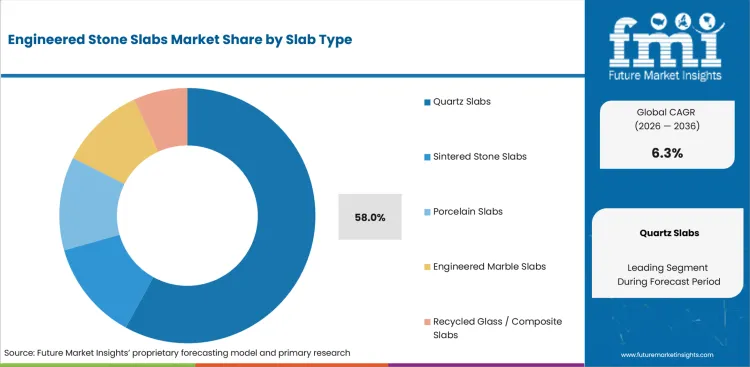
Quartz slabs give designers repeatable veining and color across coordinated kitchens and material composition now belongs within the same specification decision. Caesarstone introduced eight ICON designs in July 2025 with approximately 80% recycled content and less than 1% crystalline silica. The revised composition preserves familiar slab formats; construction aggregate inputs continue to influence appearance and cutting behavior across composite production.
- Quartz slabs are projected to hold 58.0% share in 2026 owing to established fabrication routines across common countertop projects. Coordinated islands and perimeter counters need repeatable patterns, so dealers can quote familiar thicknesses and edge treatments for phased commercial installations or later regional replacements without changing the approved material family.
- Designers adopt quartz slabs for controlled appearance and predictable replacement across phased interior projects with several connected surfaces. Lower-silica formulations preserve available colors and reduce exposure concerns during workshop cutting, although legal status and qualified fabrication continue to govern adoption across regulated regional markets and professional interiors throughout project approval.
Why does the 20-30 mm category remain central to thickness selection?
Thickness affects edge appearance and cabinet loading alongside transport weight and crew handling requirements across measured countertop projects. The 20-30 mm range supports substantial profiles without separate build-ups, and common machinery accommodates familiar edge finishing. Bathroom vanity systems use comparable dimensions; structural support and seam placement govern selection of thinner panels or heavier slabs during measured project planning across layouts.
- By thickness, 20-30 mm slabs are estimated to hold 43.0% share in 2026 owing to standard countertop structures and edge preferences. LX Hausys presented VIATERA colors in 20 mm and 30 mm formats during February 2025. Those options balance handling weight with visual depth across established fabrication routines and cabinet configurations.
- Regional workshops favor this thickness through lifting equipment and edge-finishing routines suited to repeated residential projects across connected countertop layouts. Large wall panels and weight-sensitive renovations follow another route; thinner porcelain formats reduce handling pressure and reinforcement requirements across vertical installations with constrained access during scheduled interior work and repairs.
How does polished finish support the finish category?
Polished surfaces intensify color and vein contrast across prominent counters receiving continuous visual attention throughout residential and commercial interiors. The finish provides a familiar showroom reference for comparing brands and samples under consistent lighting. Its role differs from flooring surfaces requiring greater slip consideration, and fabricators must preserve matching sheen around edges and cutouts throughout installation and later repair work.
- The finish category is forecast to be led by polished surfaces at 41.0% share in 2026 due to direct sample comparison. Physical displays help designers assess color depth and pattern movement; honed or textured alternatives address glare and tactile needs in quieter residential or hospitality interiors inside one material family.
- Design teams need finish variation without changing the material family across coordinated interior projects using related surfaces. Cambria added polished and satin options across designs in August 2025 for residential and commercial applications. The paired finishes support different light responses, although installers must prevent scratches and uneven refinishing during handling.
What supports kitchen countertops within the application category?
Kitchen countertops combine decorative exposure with repeated contact from heat and food preparation, so full-scale pattern review matters across coordinated islands and perimeter runs. Cambria opened a High Point showroom in October 2025 displaying over 100 designs across interiors. The broad display supports coordinated slab selection and integrated sink bowls requiring accurate cutouts and seam planning across measured cabinet layouts.
- In 2026, kitchen countertops are expected to lead application with 45.0% share because renovation packages require coordinated islands and perimeter runs. Countertops consume visible slab area and need matching pieces across cabinet layouts, so their position reflects repeatable measured projects rather than universal use across kitchen designs in every region.
- Designers adopt engineered slabs for consistent patterns and easier coordination across several kitchen surfaces using connected cabinet layouts. Fabricators support adoption through templates and controlled cutting; uncertain cabinet readiness or slab sequencing can cause remakes and disrupt installation crews across scheduled residential renovation stages involving connected work areas and trades.
Why do fabricators shape the sales channel category?
Fabricators convert slabs into measured components and control the handoff between specification and final installation across each project. Their work covers templating and cutting alongside edge finishing and site coordination for connected pieces. Dealers depend on local workshops for installed counters or panels, and wall covering projects require accurate anchors with planned seam placement across measured vertical installations and repairs.
- Fabricators are set to lead the sales channel with 38.0% share in 2026 due to direct control over measurement and cutting. Regional workshops manage breakage and replacement scheduling across connected pieces, so their position reflects workflow responsibility rather than showroom traffic or decorative sample exposure across each active service territory.
- Workshop safety documentation affects acceptance of quartz-rich slab orders through production schedules and trained fabrication capacity. OSHA cited two Georgia stone manufacturers in March 2026 for silica-program and other safety failures. The enforcement route strengthens requirements for trained crews and dust controls; qualified capacity protects schedules against regional production delays.
What are the drivers, restraints, and opportunities in the Engineered Stone Slabs Market?
Renovation specifications sustain demand; silica controls limit quartz fabrication; multi-material portfolios support lawful substitution across regulated markets.
- Driver: Professional kitchen and bath projects sustain slab specifications across counters and coordinated interior surface programs.
- Restraint: Silica exposure controls increase workshop investment and restrict quartz-rich products across regulated markets with enforcement.
- Opportunity: Porcelain and lower-silica surfaces preserve design choices across projects requiring different compositions and fabrication routes.
Professional renovation sustains slab orders through measured counters and coordinated surfaces that require trained installation across projects. Spending expectations clarify the volume of interior projects reaching fabrication shops and regional installation networks. The National Kitchen and Bath Association projected USD 235 billion in United States kitchen and bath spending during February 2025. Professional remodeling volume supports repeat orders through established measurement workflows despite selective household budgets and cautious new-construction activity.
Crystalline silica exposure limits quartz fabrication through engineering controls and respiratory programs that raise workshop investment and training requirements. Recent enforcement gives fabrication businesses a direct measure of the weight attached to those obligations. OSHA cited a Georgia stone manufacturer in May 2025 for repeat and serious silica violations with proposed penalties near USD 120,000. Smaller workshops can lose quartz capacity if equipment costs or documented programs exceed available resources.
Material substitution protects active design programs as silica rules narrow conventional quartz routes across regulated fabrication markets. Producers need alternatives that preserve color direction and standard dimensions without disrupting established fabrication and installation plans. Caesarstone added eight porcelain designs and introduced a 20 mm slab option during November 2025. The expanded range gives designers another composition for interior and exterior applications; reliable conversion depends on suitable tooling and installation guidance.
Which country CAGRs are profiled in the Engineered Stone Slabs Market?
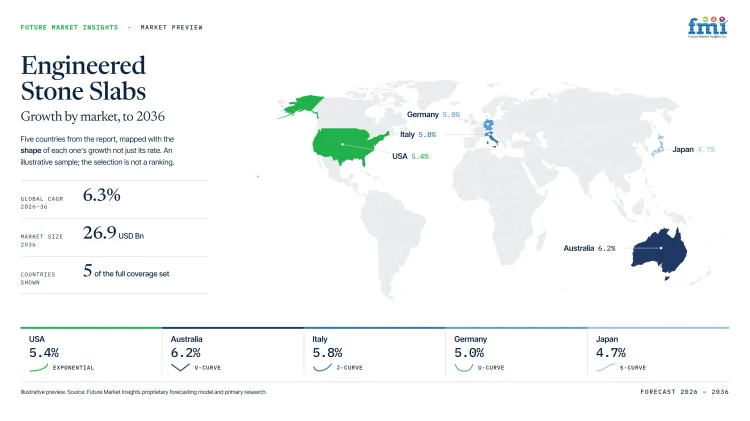
| Country | CAGR |
|---|---|
| United States | 5.4% |
| Germany | 5.0% |
| Japan | 4.7% |
| Italy | 5.8% |
| Australia | 6.2% |
How do country-level CAGRs compare in the Engineered Stone Slabs Market?
The country forecasts remain closely grouped across a 1.5-point spread, yet similar rates conceal different routes to material approval. Australia redirects specifications toward permitted porcelain and sintered products under a national engineered stone prohibition. Italy relies on domestic processing and design channels, although permit timing affects immediate interior conversion. United States and Germany depend on professional fabrication networks under different housing and compliance pressures. Japan combines precise processing with compact renovation sites, so the comparison reflects composition rules and service capacity rather than uniform demand across specification and installation routes.
- Australia redirects surface demand toward permitted porcelain and sintered products through composition records and qualified installation.
- Italy combines processing expertise with design-led channels, although housing approvals control the timing of interior specifications.
- United States renovation networks support measured countertop projects, but silica controls raise workshop investment requirements.
- Germany relies on documented performance and distribution; weaker dwelling completions intensify competition for qualified residential projects.
- Japan favors precise fabrication and compact installations that limit disruption across occupied urban renovation and commercial projects.
Comparable growth rates can therefore produce different entry routes through material rules and available fabrication capacity. The full report provides country-level CAGR analysis across North America, Latin America, Europe, East Asia, South Asia, Oceania and the Middle East and Africa.
Country-wise Analysis
- United States slab purchasing moves through fabricators serving contractors and cabinet dealers across defined installation territories. In the United States, engineered stone slab demand is predicted to advance at 5.4% CAGR through 2036, supported by renovation work and established dealer networks. New-housing activity defines an additional project pool but does not prove final material selection across interior projects. The USA Census Bureau reported in July 2026 that annualized housing starts reached 1.427 million and permits reached 1.367 million during June. Qualified fabrication supports coordinated interiors, but silica-control investment can restrict quartz capacity and extend workshop lead times during demand peaks.
- German specifications require technical documentation and dependable regional distribution for residential or commercial fabrication work. Germany's engineered stone slabs outlook is anticipated to advance at 5.0% CAGR over the assessment period, influenced by renovation demand and established processing skills. Dwelling completions define the available project pool but do not prove final countertop selection across individual homes. Destatis reported in May 2026 that 206,586 dwellings were completed during 2025, down 18.0% from the previous year. Renovation enables surface replacement, but softer completions intensify competition for documented projects across dealer networks and qualified regional workshops serving measured interior projects across regional markets.
- Japanese renovation sites often provide limited storage and handling space for full slabs inside occupied urban properties. The Japan engineered stone slabs sector is projected to record 4.7% CAGR during the assessment period, supported by kitchen renewal and premium commercial fit-outs. National housing activity provides a direct measure of the new-build project pool reaching interior specification stages. Japan's transport ministry reported in January 2026 that housing starts reached 740,667 during 2025, down 6.5% annually. Skilled processing enables accurate cutouts, but lower construction activity rewards compact formats and dependable samples that reduce disruption across repeat urban projects through established dealer networks.
- Italian specifications benefit from domestic stone-processing districts and design channels serving residential or hospitality interiors. Adoption of engineered stone slabs in Italy is estimated to expand at 5.8% CAGR through 2036, reinforced by renovation activity and export-oriented fabrication knowledge. Permit timing controls how quickly approved housing reaches interior surface selection through regional construction schedules and showroom ordering cycles. Istat reported in April 2026 that authorized dwelling numbers increased 4.5% sequentially during the fourth quarter of 2025. Local manufacturing supports skilled finishing and dealer access, but approval delays can prevent permitted dwellings from generating immediate slab orders across regional construction schedules.
- Australia prohibits regulated engineered stone supply and installation and permits qualifying porcelain or sintered slab products. By 2036, Australia is projected to grow at 6.2% CAGR, attributable to substitution within permitted material categories. Importers must document composition through laboratory evidence; alternative labels do not establish legal status at the border. Australian Border Force guidance updated in July 2025 excludes resin-free porcelain and sintered products from the engineered stone import prohibition. Permitted alternatives sustain interior orders, but fabricator retraining and suitable tooling remain necessary for handling. Distributors need qualified installers and composition records for commercial renovation programs across regional service territories.
Who are the notable companies in the Engineered Stone Slabs Market?
Caesarstone, Cosentino, Cambria, LX Hausys, Vicostone, Quantra Quartz, Wilsonart, and Santamargherita are the notable companies shaping this market.
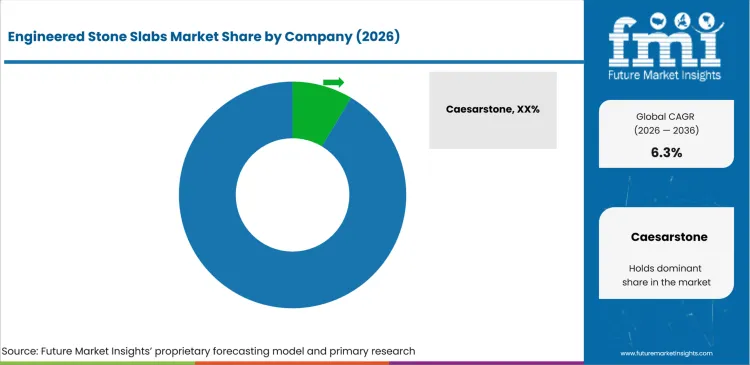
The engineered stone slab field combines visible surface brands with fragmented regional fabrication and dealer networks across interior projects. Competition centers on color continuity and compliant composition alongside thickness availability and replacement stock across multi-piece installations. Entry remains possible through specialist fabrication, but broader coverage requires technical documents and qualified workshops in each service territory. Regulated markets raise service thresholds; bathroom cabinet systems also require compatible dimensions throughout measured cabinet and countertop coordination programs across connected residential and commercial interiors.
- Caesarstone and Cosentino provide multi-material portfolios that help designers preserve visual direction across quartz and porcelain specifications. Architects need documented composition and fabrication guidance beside local inventory; regulatory changes can redirect material selection during active interior projects and scheduled installations.
- Cambria and Vicostone compete through quartz collections supported by professional dealer routes and broad decorative choices. Designers compare sample accuracy with matched slab availability; large islands and perimeter counters require consistent pattern movement through fabrication and scheduled regional replacement work.
- Quantra Quartz and Santamargherita serve export channels through integrated engineered-surface portfolios; Wilsonart and LX Hausys add broader material distribution routes. Regional fabricators value dependable stock and technical guidance; those capabilities determine whether specified designs can reach installation without avoidable substitutions.
Competitive Benchmarking: Engineered Stone Slabs Market
| Company | Material Portfolio | Fabrication Resources | Channel Access | Geographic Reach |
|---|---|---|---|---|
| Caesarstone | High | High | High | Global or multi-region |
| Cosentino | High | High | High | Global or multi-region |
| Cambria | Low | High | High | North America |
| LX Hausys | High | High | High | North America and selected exports |
| Vicostone | Low | High | High | More than 40 countries |
| Quantra Quartz | Low | High | Medium | Export-led markets |
| Wilsonart | High | High | High | Americas and Europe |
| Santamargherita | Medium | High | High | More than 70 countries |
Scoring basis: High requires three material families, formal manuals, or authorized programs. Medium requires two families, technical documents, or distributor coverage. Low confirms one family, limited guidance, or regional access.
Key Developments in the Engineered Stone Slabs Market
- In August 2025, Wilsonart introduced ten quartz designs and expanded solid-surface options for residential and commercial interiors. Large-scale veining and warmer colors support coordinated counters with connected vertical surfaces across the same design program.
- In February 2025, Cambria launched four natural quartz designs with satin and polished options for kitchen and bathroom interiors. The paired finishes extend warm neutral and expressive patterns across islands with coordinated perimeter counters.
- In March 2025, LX Hausys presented VIATERA quartz with TERACANTO porcelain and HIMACS solid surfaces during KBIS. The display placed more than a dozen launches or previews across kitchen and bathroom applications within a multi-material program for dealer and fabricator review.
- In July 2025, Vicostone announced ten quartz colors for its fall collection in 20 mm and 30 mm formats. Warm and dramatic patterns broadened choices across standard countertop thicknesses available through authorized distribution routes.
Engineered Stone Slabs Market - Report Scope
| Coverage field | Report scope |
|---|---|
| Market breakdown | Slab type, thickness, finish, application, sales channel, and region. |
| Quantitative Units | Revenue in USD Billion and CAGR in %. |
| Market Definition | Engineered slabs made from quartz-mineral composites, sintered or porcelain materials, engineered marble, and recycled glass or composite inputs for interior and selected exterior surfaces. |
| Regions Covered | North America, Latin America, Western Europe, Eastern Europe, East Asia, South Asia and Pacific, and Middle East and Africa. |
| Countries Covered | United States, Germany, Japan, Italy, and Australia. |
| Key Companies Profiled | Caesarstone, Cosentino, Cambria, LX Hausys, Vicostone, Quantra Quartz, Wilsonart, and Santamargherita |
| Forecast Period | 2026 to 2036. |
| Approach | Hybrid bottom-up and top-down market sizing supported by primary interviews and official desk research. |
Engineered Stone Slabs Market - Research Methodology
| Method | Approach |
|---|---|
| Primary Research | FMI analysts gathered input from manufacturers, service providers, technology developers, distributors, end users, procurement teams, and subject-matter experts. Interviews examined purchasing decisions, product or service evaluation, adoption barriers, approval requirements, pricing considerations, and expectations for technical or commercial support. Respondents were also asked what evidence is required before a trial, pilot, or initial order develops into regular purchasing. |
| Desk Research | Desk research covered government statistics, regulatory publications, trade data, industry associations, technical literature, standards, company filings, product information, and official corporate announcements. Sources were reviewed for relevance, publication date, geographic coverage, and consistency with the defined market scope. Claims relating to performance, applications, approvals, capacity, investment, and commercial activity were retained only when supported by credible public evidence. |
| Market Sizing and Forecasting | The market model combined the baseline value with historical performance, segment structure, pricing and volume indicators, adoption levels, company participation, and country-level demand conditions. Forecast assumptions considered economic activity, investment trends, regulatory developments, technology adoption, purchasing cycles, supply availability, and barriers to wider market use. Segment and regional estimates were reconciled before the final market total was calculated. |
| Data Validation | Estimates were checked against multiple independent indicators, including public data, company activity, trade patterns, industry developments, and findings from primary interviews. Validation also tested whether products, services, applications, and company revenues fell within the defined market boundaries. Adjacent categories, unsupported claims, overlapping revenues, and activities without direct market relevance were excluded to reduce double counting and maintain consistency across segments and countries. |
Engineered Stone Slabs Market by Segments
Engineered Stone Slabs Market segmented by Slab Type:
- Quartz Slabs
- Sintered Stone Slabs
- Porcelain Slabs
- Engineered Marble Slabs
- Recycled Glass / Composite Slabs
Engineered Stone Slabs Market segmented by Thickness:
- 20-30 mm
- 12-20 mm
- <12 mm
- >30 mm
Engineered Stone Slabs Market segmented by Finish:
- Polished
- Honed
- Textured / Leathered
- Matte
- Veined / Patterned Designs
Engineered Stone Slabs Market segmented by Application:
- Kitchen Countertops
- Bathroom Vanities
- Flooring
- Wall Cladding
- Commercial Surfaces
Engineered Stone Slabs Market segmented by Sales Channel:
- Fabricators
- Kitchen & Bath Dealers
- Building Material Distributors
- Retail / Home Centers
Engineered Stone Slabs Market by Region:
- North America
- United States
- Canada
- Latin America
- Brazil
- Mexico
- Argentina
- Chile
- Western Europe
- Germany
- France
- United Kingdom
- Italy
- Spain
- Benelux
- Nordics
- Eastern Europe
- Poland
- Czech Republic
- Romania
- Hungary
- East Asia
- China
- Japan
- South Korea
- South Asia and Pacific
- India
- ASEAN
- Australia and New Zealand
- Middle East and Africa
- GCC Countries
- South Africa
- Türkiye
- Israel
Research Sources and Bibliography
- Occupational Safety and Health Administration. (2025, July 10). US Labor Department cites Georgia counter manufacturer for exposing workers to hazardous levels of crystalline silica.
- National Kitchen & Bath Association. (2025, August 5). 2025 Kitchen & Bath Market Outlook - July Update.
- Caesarstone. (2025, July 8). Caesarstone ICON™: Introducing a new era of surface design.
- LX Hausys. (2025, February 26). LX Hausys unveils new VIATERA quartz colors and technology for 2025.
- Cambria. (2025, August 20). Four new Cambria designs capture the beauty of nature and the power of innovation.
- Cambria. (2025, October 16). Cambria returns to High Point Market with new showroom and inspiring applications.
- Occupational Safety and Health Administration. (2026, March 26). US Department of Labor cites Georgia stone product manufacturers for exposing workers to respirable crystalline silica, other safety violations.
- National Kitchen & Bath Association. (2025, February 5). 2025 Kitchen & Bath Market Outlook.
- Occupational Safety and Health Administration. (2025, May 14). US Department of Labor cites Georgia stone product manufacturer for exposing workers to respirable crystalline silica.
- Caesarstone. (2025, November 3). Caesarstone elevates porcelain collection with launch of new colors and thicker slabs.
- USA Census Bureau. (2026, July 17). Monthly new residential construction, June 2026.
- Federal Statistical Office of Germany. (2026, May 22). 18,0 % weniger fertiggestellte Wohnungen im Jahr 2025.
- Ministry of Land, Infrastructure, Transport and Tourism. (2026, January 30). [Building starts statistics report for 2025].
- Italian National Institute of Statistics. (2026, April 15). Building permits indicators - Q4 2025.
- Australian Border Force. (2025, July 9). Engineered stone.
- Wilsonart. (2025, August 4). Wilsonart elevates surface design with innovative quartz and solid surface introductions.
- Cambria. (2025, February 25). Cambria unveils four new quartz designs: Elevating elegance, innovation, and timeless style.
- LX Hausys. (2025, March 5). LX Hausys showcases an array of innovative surface solutions and experiences at KBIS 2025.
- Vicostone. (2025, July 21). Vicostone launches 10 new quartz colors for fall 2025.
- Cosentino. (2025, May 9). Cosentino unveils its new Dallas City showroom.
- Pokarna Engineered Stone Limited. (n.d.). Quantra Quartz products and applications.
- Cambria. (2025, January 22). Cambria showcases innovation and design excellence at TISE 2025.
- Wilsonart. (2025, June 12). Wilsonart celebrates grand opening of new Denver distribution and design center.
This bibliography is provided for reader reference and is not exhaustive. The full report contains the complete reference list and detailed citations
This Report Answers
- What is the current size of the global Engineered Stone Slabs market, and how is it expected to grow?
- Which product, application, and end-use segments hold leading positions in the market?
- How do quality standards, certifications, and manufacturing controls influence product adoption and competitiveness?
- Why do distribution channels and procurement routes differ across regions and customer groups?
- Which leading companies are diversifying their product portfolios and market strategies?
- What regulatory, environmental, and material-related factors restrict the growth of quartz-based engineered stone slabs?
- How do alternative surface materials such as natural stone, porcelain, and solid surfaces compete with engineered stone slabs?
- What key performance, cost, sustainability, and supplier criteria should procurement teams compare when selecting engineered stone slab products?
Frequently Asked Questions
How big is the Engineered Stone Slabs Market in 2026?
The engineered stone slabs market is valued at USD 14.6 billion in 2026 and is projected to reach USD 26.9 billion by 2036, supported by renovation-driven countertop specifications and coordinated commercial interior programs across established regional fabrication and dealer networks.
What is the CAGR of the Engineered Stone Slabs Market from 2026 to 2036?
The engineered stone slabs market grows at a CAGR of 6.3% between 2026 and 2036, driven by professional renovation specifications and coordinated countertop and cladding projects that sustain recurring slab orders across regional fabrication shops and established dealer distribution channels serving kitchen and bathroom interiors.
Which slab type leads the Engineered Stone Slabs Market?
Quartz slabs lead the engineered stone slabs market with 58.0% share in 2026, supported by established regional fabrication practices and repeatable veining that let designers coordinate islands and perimeter counters with predictable replacement pieces across phased commercial and residential renovation projects.
How much will the Engineered Stone Slabs Market add between 2026 and 2036?
The engineered stone slabs market is set to add USD 12.3 billion between 2026 and 2036, growing from USD 14.6 billion to USD 26.9 billion as renovation-led countertop demand and coordinated commercial interior programs expand across regional fabrication and dealer distribution networks worldwide.
Who are the leading companies in the Engineered Stone Slabs Market?
Eight companies lead the engineered stone slabs market, including Caesarstone, Cosentino, Cambria, LX Hausys, Vicostone, Quantra Quartz, Wilsonart, and Santamargherita, competing through differentiated quartz, porcelain, and sintered stone portfolios across regional fabrication capacity, dealer channel access, and multi-country distribution networks serving residential and commercial interior projects.
Preview the report firsthand - request a free sample
Get SampleGet the brochure for pricing and purchase details.
Get PDFTable of Content
- Key Takeaways
- Market Size and CAGR
- Top Growth Driver
- Fastest Growing Segment
- Leading Region
- Key Companies
- Emerging Opportunities
- Executive Summary
- Global Market Outlook
- Demand-side Trends
- Supply-side Trends
- Technology Roadmap Analysis
- Analysis and Recommendations
- Analyst Perspective (What is happening? Why now? What should investors know?)
- Key Questions Answered
- How large is the market?
- What is the CAGR?
- What are key trends?
- Which region dominates?
- Who are the leaders?
- Market Overview
- Market Coverage / Taxonomy
- Market Definition / Scope / Limitations
- Research Methodology
- Chapter Orientation
- Analytical Lens and Working Hypotheses
- Market Structure, Signals, and Trend Drivers
- Benchmarking and Cross-market Comparability
- Market Sizing, Forecasting, and Opportunity Mapping
- Research Design and Evidence Framework
- Desk Research Programme (Secondary Evidence)
- Expert Input and Fieldwork (Primary Evidence)
- Tooling, Models, and Reference Databases
- Data Engineering and Model Build
- Quality Assurance and Audit Trail
- Market Background
- Market Dynamics (Drivers, Restraints, Opportunity, Trends)
- Scenario Forecast (Optimistic, Likely, Conservative)
- Impact Analysis
- AI Impact
- Sustainability Impact
- Regulatory Impact
- Technology Impact
- Consumer / Buyer Analysis
- Purchase Drivers
- Adoption Barriers
- Buyer Journey
- Opportunity Map Analysis
- Product Life Cycle Analysis
- Supply Chain Analysis
- Investment Feasibility Matrix
- Value Chain Analysis
- PESTLE and Porter's Analysis
- Regulatory Landscape
- Regional Parent Market Outlook
- Production and Consumption Statistics
- Import and Export Statistics
- Global Market Analysis and Forecast, 2021 to 2036
- Historical Market Size Value (USD Billion) Analysis, 2021 to 2025
- Current and Future Market Size Value (USD Billion) Projections, 2026 to 2036
- Y-o-Y Growth Trend Analysis
- Absolute $ Opportunity Analysis
- Global Market Pricing Analysis, 2021 to 2036
- Global Market Analysis and Forecast, By Slab Type, 2021 to 2036
- Introduction / Key Findings
- Historical Market Size Value (USD Billion) Analysis By Slab Type, 2021 to 2025
- Current and Future Market Size Value (USD Billion) Analysis and Forecast By Slab Type, 2026 to 2036
- Quartz Slabs
- Sintered Stone Slabs
- Porcelain Slabs
- Engineered Marble Slabs
- Recycled Glass / Composite Slabs
- Quartz Slabs
- Y-o-Y Growth Trend Analysis By Slab Type, 2021 to 2025
- Absolute $ Opportunity Analysis By Slab Type, 2026 to 2036
- Global Market Analysis and Forecast, By Thickness, 2021 to 2036
- Introduction / Key Findings
- Historical Market Size Value (USD Billion) Analysis By Thickness, 2021 to 2025
- Current and Future Market Size Value (USD Billion) Analysis and Forecast By Thickness, 2026 to 2036
- 20–30 mm
- 12–20 mm
- <12 mm
- >30 mm
- 20–30 mm
- Y-o-Y Growth Trend Analysis By Thickness, 2021 to 2025
- Absolute $ Opportunity Analysis By Thickness, 2026 to 2036
- Global Market Analysis and Forecast, By Finish, 2021 to 2036
- Introduction / Key Findings
- Historical Market Size Value (USD Billion) Analysis By Finish, 2021 to 2025
- Current and Future Market Size Value (USD Billion) Analysis and Forecast By Finish, 2026 to 2036
- Polished
- Honed
- Textured / Leathered
- Matte
- Veined / Patterned Designs
- Polished
- Y-o-Y Growth Trend Analysis By Finish, 2021 to 2025
- Absolute $ Opportunity Analysis By Finish, 2026 to 2036
- Global Market Analysis and Forecast, By Application, 2021 to 2036
- Introduction / Key Findings
- Historical Market Size Value (USD Billion) Analysis By Application, 2021 to 2025
- Current and Future Market Size Value (USD Billion) Analysis and Forecast By Application, 2026 to 2036
- Kitchen Countertops
- Bathroom Vanities
- Flooring
- Wall Cladding
- Commercial Surfaces
- Kitchen Countertops
- Y-o-Y Growth Trend Analysis By Application, 2021 to 2025
- Absolute $ Opportunity Analysis By Application, 2026 to 2036
- Global Market Analysis and Forecast, By Sales Channel, 2021 to 2036
- Introduction / Key Findings
- Historical Market Size Value (USD Billion) Analysis By Sales Channel, 2021 to 2025
- Current and Future Market Size Value (USD Billion) Analysis and Forecast By Sales Channel, 2026 to 2036
- Fabricators
- Kitchen & Bath Dealers
- Building Material Distributors
- Retail / Home Centers
- Fabricators
- Y-o-Y Growth Trend Analysis By Sales Channel, 2021 to 2025
- Absolute $ Opportunity Analysis By Sales Channel, 2026 to 2036
- Global Market Analysis and Forecast, By Region, 2021 to 2036
- Introduction
- Historical Market Size Value (USD Billion) Analysis By Region, 2021 to 2025
- Current Market Size Value (USD Billion) Analysis and Forecast By Region, 2026 to 2036
- North America
- Latin America
- Western Europe
- Eastern Europe
- East Asia
- South Asia and Pacific
- Middle East & Africa
- Market Attractiveness Analysis By Region
- North America Market Analysis and Forecast, By Country, 2021 to 2036
- Historical Market Size Value (USD Billion) Trend Analysis By Market Taxonomy, 2021 to 2025
- Market Size Value (USD Billion) Forecast By Market Taxonomy, 2026 to 2036
- By Country
- USA
- Canada
- By Slab Type
- By Thickness
- By Finish
- By Application
- By Sales Channel
- By Country
- Market Attractiveness Analysis
- By Country
- By Slab Type
- By Thickness
- By Finish
- By Application
- By Sales Channel
- Key Takeaways
- Latin America Market Analysis and Forecast, By Country
- Historical Market Size Value (USD Billion) Trend Analysis By Market Taxonomy, 2021 to 2025
- Market Size Value (USD Billion) Forecast By Market Taxonomy, 2026 to 2036
- By Country
- Brazil
- Mexico
- Chile
- Rest of Latin America
- By Slab Type
- By Thickness
- By Finish
- By Application
- By Sales Channel
- By Country
- Market Attractiveness Analysis
- By Country
- By Slab Type
- By Thickness
- By Finish
- By Application
- By Sales Channel
- Key Takeaways
- Western Europe Market Analysis and Forecast, By Country
- Historical Market Size Value (USD Billion) Trend Analysis By Market Taxonomy, 2021 to 2025
- Market Size Value (USD Billion) Forecast By Market Taxonomy, 2026 to 2036
- By Country
- Germany
- UK
- Italy
- Spain
- France
- Nordic
- BENELUX
- Rest of Western Europe
- By Slab Type
- By Thickness
- By Finish
- By Application
- By Sales Channel
- By Country
- Market Attractiveness Analysis
- By Country
- By Slab Type
- By Thickness
- By Finish
- By Application
- By Sales Channel
- Key Takeaways
- Eastern Europe Market Analysis and Forecast, By Country
- Historical Market Size Value (USD Billion) Trend Analysis By Market Taxonomy, 2021 to 2025
- Market Size Value (USD Billion) Forecast By Market Taxonomy, 2026 to 2036
- By Country
- Russia
- Poland
- Hungary
- Balkan & Baltic
- Rest of Eastern Europe
- By Slab Type
- By Thickness
- By Finish
- By Application
- By Sales Channel
- By Country
- Market Attractiveness Analysis
- By Country
- By Slab Type
- By Thickness
- By Finish
- By Application
- By Sales Channel
- Key Takeaways
- East Asia Market Analysis and Forecast, By Country
- Historical Market Size Value (USD Billion) Trend Analysis By Market Taxonomy, 2021 to 2025
- Market Size Value (USD Billion) Forecast By Market Taxonomy, 2026 to 2036
- By Country
- China
- Japan
- South Korea
- By Slab Type
- By Thickness
- By Finish
- By Application
- By Sales Channel
- By Country
- Market Attractiveness Analysis
- By Country
- By Slab Type
- By Thickness
- By Finish
- By Application
- By Sales Channel
- Key Takeaways
- South Asia and Pacific Market Analysis and Forecast, By Country
- Historical Market Size Value (USD Billion) Trend Analysis By Market Taxonomy, 2021 to 2025
- Market Size Value (USD Billion) Forecast By Market Taxonomy, 2026 to 2036
- By Country
- India
- ASEAN
- Australia & New Zealand
- Rest of South Asia and Pacific
- By Slab Type
- By Thickness
- By Finish
- By Application
- By Sales Channel
- By Country
- Market Attractiveness Analysis
- By Country
- By Slab Type
- By Thickness
- By Finish
- By Application
- By Sales Channel
- Key Takeaways
- Middle East & Africa Market Analysis and Forecast, By Country
- Historical Market Size Value (USD Billion) Trend Analysis By Market Taxonomy, 2021 to 2025
- Market Size Value (USD Billion) Forecast By Market Taxonomy, 2026 to 2036
- By Country
- Kingdom of Saudi Arabia
- Other GCC Countries
- Türkiye
- South Africa
- Other African Union
- Rest of Middle East & Africa
- By Slab Type
- By Thickness
- By Finish
- By Application
- By Sales Channel
- By Country
- Market Attractiveness Analysis
- By Country
- By Slab Type
- By Thickness
- By Finish
- By Application
- By Sales Channel
- Key Takeaways
- Key Countries Market Analysis
- USA
- Pricing Analysis
- Market Share Analysis, 2025
- By Slab Type
- By Thickness
- By Finish
- By Application
- By Sales Channel
- Canada
- Pricing Analysis
- Market Share Analysis, 2025
- By Slab Type
- By Thickness
- By Finish
- By Application
- By Sales Channel
- Mexico
- Pricing Analysis
- Market Share Analysis, 2025
- By Slab Type
- By Thickness
- By Finish
- By Application
- By Sales Channel
- Brazil
- Pricing Analysis
- Market Share Analysis, 2025
- By Slab Type
- By Thickness
- By Finish
- By Application
- By Sales Channel
- Chile
- Pricing Analysis
- Market Share Analysis, 2025
- By Slab Type
- By Thickness
- By Finish
- By Application
- By Sales Channel
- Germany
- Pricing Analysis
- Market Share Analysis, 2025
- By Slab Type
- By Thickness
- By Finish
- By Application
- By Sales Channel
- UK
- Pricing Analysis
- Market Share Analysis, 2025
- By Slab Type
- By Thickness
- By Finish
- By Application
- By Sales Channel
- Italy
- Pricing Analysis
- Market Share Analysis, 2025
- By Slab Type
- By Thickness
- By Finish
- By Application
- By Sales Channel
- Spain
- Pricing Analysis
- Market Share Analysis, 2025
- By Slab Type
- By Thickness
- By Finish
- By Application
- By Sales Channel
- France
- Pricing Analysis
- Market Share Analysis, 2025
- By Slab Type
- By Thickness
- By Finish
- By Application
- By Sales Channel
- India
- Pricing Analysis
- Market Share Analysis, 2025
- By Slab Type
- By Thickness
- By Finish
- By Application
- By Sales Channel
- ASEAN
- Pricing Analysis
- Market Share Analysis, 2025
- By Slab Type
- By Thickness
- By Finish
- By Application
- By Sales Channel
- Australia & New Zealand
- Pricing Analysis
- Market Share Analysis, 2025
- By Slab Type
- By Thickness
- By Finish
- By Application
- By Sales Channel
- China
- Pricing Analysis
- Market Share Analysis, 2025
- By Slab Type
- By Thickness
- By Finish
- By Application
- By Sales Channel
- Japan
- Pricing Analysis
- Market Share Analysis, 2025
- By Slab Type
- By Thickness
- By Finish
- By Application
- By Sales Channel
- South Korea
- Pricing Analysis
- Market Share Analysis, 2025
- By Slab Type
- By Thickness
- By Finish
- By Application
- By Sales Channel
- Russia
- Pricing Analysis
- Market Share Analysis, 2025
- By Slab Type
- By Thickness
- By Finish
- By Application
- By Sales Channel
- Poland
- Pricing Analysis
- Market Share Analysis, 2025
- By Slab Type
- By Thickness
- By Finish
- By Application
- By Sales Channel
- Hungary
- Pricing Analysis
- Market Share Analysis, 2025
- By Slab Type
- By Thickness
- By Finish
- By Application
- By Sales Channel
- Kingdom of Saudi Arabia
- Pricing Analysis
- Market Share Analysis, 2025
- By Slab Type
- By Thickness
- By Finish
- By Application
- By Sales Channel
- Türkiye
- Pricing Analysis
- Market Share Analysis, 2025
- By Slab Type
- By Thickness
- By Finish
- By Application
- By Sales Channel
- South Africa
- Pricing Analysis
- Market Share Analysis, 2025
- By Slab Type
- By Thickness
- By Finish
- By Application
- By Sales Channel
- USA
- Market Structure Analysis
- Competition Dashboard
- Competition Benchmarking
- Market Share Analysis of Top Players
- By Regional
- By Slab Type
- By Thickness
- By Finish
- By Application
- By Sales Channel
- Emerging Startups
- Innovation Benchmarking
- Competition Analysis
- Competition Deep Dive
- Caesarstone
- Overview
- Product Portfolio
- Profitability by Market Segments
- Sales Footprint
- Strategy Overview
- Marketing Strategy
- Product Strategy
- Channel Strategy
- Cosentino
- Cambria
- LX Hausys
- Vicostone
- Pokarna
- Quantra Quartz
- Diresco
- Wilsonart
- Santa Margherita
- Caesarstone
- Case Studies
- Success Stories
- Recent Developments
- Competition Deep Dive
- Assumptions & Acronyms Used


