

- Market Size (2026)
- USD 51.0 Mn
- Forecast (2036)
- USD 138.4 Mn
- CAGR (2026 to 2036)
- 10.5%
How big is Cellobiose Functional Sugars Market in 2026?
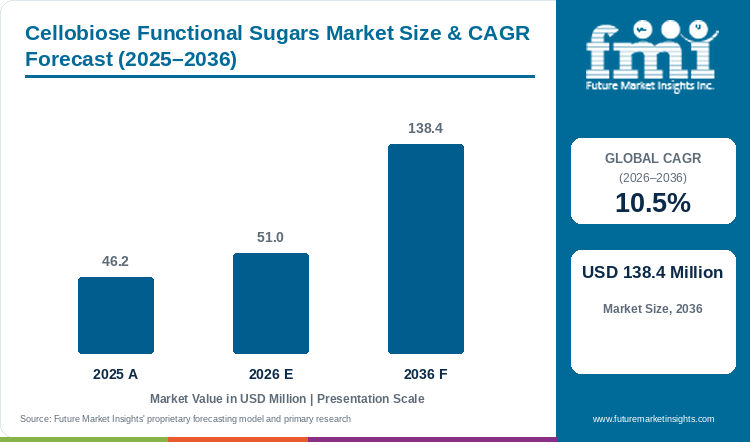
After recording 2025 sales of USD 46.2 million, cellobiose functional sugars demand is estimated at USD 51.0 million for 2026 and is predicted to attain USD 138.4 million by 2036 under an anticipated 10.5% yearly growth rate.
After 2025 shipments worth USD 46.2 million, global 2026 demand for cellobiose functional sugars is estimated at USD 51.0 million before climbing toward a predicted 2036 valuation of USD 138.4 million via an anticipated 10.5% CAGR that yields USD 87.4 million in new supplier turnover. Industrial bakeries and biopharmaceutical lyophilization plants specify beta-1,4 linked glucose disaccharides when recipes require structural sucrose-like dry bulk (featuring a glycemic index of 27 alongside an insulin index of 13) and protein glass-transition stabilization within EFSA's 20-gram daily digestive tolerance guidance. To manufacture these non-hygroscopic crystals without mineral-acid wood-pulp waste, Enzymatic Sucrose-Phosphate Phosphorylase Synthesis is expected to command 54.6% of 2026 feedstock & production process volume alongside isomaltulose functional carbohydrates. During June 2026, joint OECD and FAO commodity economists projected in their ten-year agricultural outlook that industrial food processors across high-income economies will steadily substitute caloric refined sugars with low-insulinemic functional carbohydrates through 2035 [1].
Key Market Trends & Insights
- By feedstock & production process: Enzymatic Sucrose-Phosphate Phosphorylase Synthesis (expected at 54.6% in 2026) leads industrial tonnage because cellobiose phosphorylase cascades eliminate harsh mineral-acid cellulose digestion.
- By purity & grade: Food & Novel-Food Grade (≥99% Dry Matter) (projected at 67.4% in 2026) concentrates commercial shipments as European and Asian food processors formulate low-insulinemic bakery fillings and dry beverage mixes.
- By application: Low-Glycemic & Low-Insulinemic Bulk Sweetener (estimated at 44.8% in 2026) represents the largest application pillar since human small-intestinal brush-border lactase-phlorizin hydrolase only partially cleaves beta-1,4 glucosidic bonds.
Regional Highlights
- Top national growth velocity: South Korea is predicted to pace national growth at a 12.2% CAGR through 2036 on strong metabolic-health bakery and cosmeceutical humectant adoption.
- Secondary high-growth corridors: Australia is anticipated to advance at 11.7% annually while Dutch demand is projected to grow by 11.4% per annum as dairy-biotech and clean-label food exporters reformulate dry premixes.
- Core industrial manufacturing bases: United States demand is expected to progress by 10.3% yearly while German refineries are projected to post 10.0% and Japanese mills are estimated to record 9.7% on sugar-beet and wood-pulp bioconversion.
Market Size & Forecast
Table 1: Market Size and Forecast for the Cellobiose Functional Sugars Market (USD million and CAGR percentage), 2025 to 2036
| Metric | Value |
|---|---|
| 2025 Market Size | USD 46.2 million |
| Estimated Market Size in 2026 | USD 51.0 million |
| Projected Market Size by 2036 | USD 138.4 million |
| CAGR, 2026 to 2036 | 10.5% |
| Added Revenue, 2026 to 2036 | USD 87.4 million |
During December 2025, EFSA scientific panels updated European Union guidance on novel food evaluations for ingredients not significantly consumed in the Union prior to May 1997 [2]. European Union authorization of cellobiose on the Union list of novel foods under Commission Implementing Regulation (EU) 2023/943 has expanded commercial bakery and beverage supply chains in Europe, while United States demand centers on pharmaceutical and bioprocess excipients after FDA ceased evaluating cellobiose GRAS Notice GRN 1180 at the notifier's request in September 2024. Because beta-1,4 linked glucose rings exhibit low water solubility saturation and minimal Maillard browning below 120 degrees Celsius, lyophilization scientists also deploy ultra-pure cellobiose alongside nutraceutical excipient compounds to stabilize monoclonal antibodies and live biotherapeutic capsules.
Bioconversion Output and Grade Realization Sizing
Table 2: Bioconversion Output and Grade Realization Indicators for the Cellobiose Functional Sugars Market (USD million, metric tons, and USD per kilogram), mixed historical and forecast years from 2025 to 2036
| Metric | 2025 | 2026 | 2036 |
|---|---|---|---|
| Market size (USD million) | 46.2 | 51.0 | 138.4 |
| Global cellobiose shipment volume (metric tons) | 4,150 to 4,480 | 4,650 to 5,020 | 14,200 to 15,400 |
| Food & novel-food grade volume (metric tons) | 2,800 to 3,020 | 3,130 to 3,380 | 9,600 to 10,400 |
| Blended realized B2B price (USD per kilogram) | 10.30 to 11.10 | 10.15 to 10.95 | 9.00 to 9.75 |
Operational note: Volume and price indicators aggregate bulk food-grade cellobiose (USD 7.50-9.80/kg) alongside higher-margin pharmaceutical cryoprotectant and cosmetic humectant grades.
Closed-loop phosphate recycling inside two-enzyme phosphorolysis reactors is expected to lift annual cellobiose shipments from a 2026 range of 4,650-5,020 metric tons to a projected 2036 volume of 14,200-15,400 metric tons. Federal GRAS Notices inventory records updated through October 2026 by FDA reviewers document 1,360 filings while recording that evaluation of cellobiose notice GRN 1180 ceased at the notifier's request on September 9, 2024 without a no-questions letter [3]. While food & novel-food grade off-take scales from 3,130-3,380 metric tons during 2026 to an anticipated 9,600-10,400 metric tons in 2036 alongside specialty dietary fibers, unit B2B realizations are forecast to moderate from USD 10.15-10.95 per kg down to USD 9.00-9.75 per kg.
Per Capita & Industrial Formulation-Site Sizing
Table 3: Per Capita and Formulation-Site Spending Indicators for the Cellobiose Functional Sugars Market (USD and gram metrics), mixed historical and forecast years from 2025 to 2036
| Metric | 2025 | 2026 | 2036 |
|---|---|---|---|
| World population (billion) | 8.23 | 8.30 | 8.95 |
| Spend per 1,000 people (USD) | 5.61 | 6.14 | 15.46 |
| Annual spend per active formulation plant (USD thousand) | 48.0 to 53.5 | 52.0 to 58.0 | 118.0 to 132.0 |
| Typical dosage in low-glycemic bakery & table-top blends (% w/w) | 5.0% to 12.0% | 5.5% to 13.0% | 7.0% to 15.0% |
Table 4: Biorefinery and Excipient-Grade Benchmark Indicators for the Cellobiose Functional Sugars Market (USD and percentages), mixed reporting years from 2025 to 2026
| Benchmark Indicator | Reported / Modeled Value | Institutional Reference Basis |
|---|---|---|
| Market size, 2026 | USD 51.0 million | Report value |
| Active food, bioprocess, and cosmetic formulation plants | 920 facilities | 2025 industry registry |
| Enzymatic sucrose-phosphate phosphorylase revenue, 2026 | USD 27.8 million | 54.6% process share |
| Food & novel-food grade (≥99% dry matter) revenue, 2026 | USD 34.4 million | 67.4% grade share |
Across 920 active food and bioprocess formulation sites worldwide, yearly procurement per plant is pegged at USD 52.0-58.0 thousand during 2026 and is predicted to attain USD 118.0-132.0 thousand by 2036 as bakery dosages rise from 5.5% to 15.0% w/w. When contrasted against erythritol bulk sweeteners that crystallize harshly and trigger cooling sensations in pastry creams, food-grade cellobiose is projected to deliver 2026 sales of USD 34.4 million by providing neutral body and clean sucrose-like texture.
Analyst Perspective
"Dual-enzyme phosphorylase cascades allow sugar-beet refiners to manufacture food-grade cellobiose at commercial tonnage without cellulosic acid waste. Expanding usage beyond niche bakery and lyophilization accounts still depends on harmonizing maximum daily intake limits across international novel-food registries."
- Nandini Roy Choudhury, Principal Consultant, Future Market Insights.
How is the cellobiose functional sugars market segmented?
The cellobiose functional sugars market is segmented by feedstock & production process, purity & grade, application, and region. In 2026, Enzymatic Sucrose-Phosphate Phosphorylase Synthesis is projected at 54.6%, Food & Novel-Food Grade (≥99% Dry Matter) at 67.4%, and Low-Glycemic & Low-Insulinemic Bulk Sweetener at 44.8%.
By feedstock & production process: Enzymatic Sucrose-Phosphate Phosphorylase Synthesis, Cellulase Controlled Hydrolysis of Cotton/Wood Pulp, and Sugar Beet Fiber Bioconversion.
By purity & grade: Food & Novel-Food Grade (≥99% Dry Matter), Pharmaceutical Excipient & Bioprocess Grade, and Cosmetic Moisture-Retaining Humectant Grade.
By application: Low-Glycemic & Low-Insulinemic Bulk Sweetener, Butyrate-Producing Colonic Prebiotic Fiber, and Lyophilization Cryoprotectant for Biologics/Probiotics.
How Does Enzymatic Sucrose-Phosphate Phosphorylase Synthesis Capture Over Half of Process Volume?
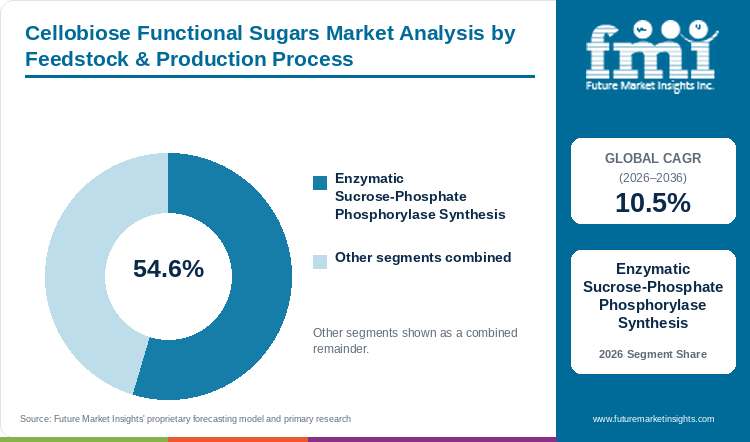
Enzymatic Sucrose-Phosphate Phosphorylase Synthesis is expected to command 54.6% of 2026 feedstock & production process volume, linked to bioreactor phosphorolysis.
Table 5: Feedstock & Production Process Share for the Cellobiose Functional Sugars Market (percentage share), 2026
| Feedstock & Production Process | Share (2026) |
|---|---|
| Enzymatic Sucrose-Phosphate Phosphorylase Synthesis | 54.6% |
| Other Segments Combined | 45.4%* |
| Total | 100.0% |
*Note: Combined share of remaining feedstock & production process categories totaling 100.0% of 2026 market demand.
Table 6: Feedstock & Production Process Leadership and Market Growth for the Cellobiose Functional Sugars Market (segment and CAGR percentage), 2026 to 2036
| Metric | Value |
|---|---|
| Global CAGR (2026 to 2036) | 10.5% |
| Leading Segment | Enzymatic Sucrose-Phosphate Phosphorylase Synthesis |
Coupling sucrose phosphorylase with cellobiose phosphorylase in a one-pot aqueous reactor converts food-grade sucrose and glucose into beta-1,4 cellobiose while recycling inorganic phosphate in a closed catalytic loop. By contrast, controlled endo-beta-glucanase hydrolysis of delignified wood pulp or cotton linters generates heterogeneous cello-oligosaccharide mixtures contaminated with monomeric glucose and trace lignocellulosic ash. European sugar-beet refiners operating enzymatic phosphorolysis lines alongside tagatose rare monosaccharides crystallize cellobiose directly from the reaction broth at or above 99.0% dry-matter purity. Lower downstream demineralization expense is projected to keep enzymatic sucrose-phosphate phosphorylase synthesis ahead of lignocellulosic hydrolysis through 2036.
- Closed-loop phosphate recycling and simplified crystallization are estimated to give Enzymatic Sucrose-Phosphate Phosphorylase Synthesis 54.6% of 2026 process revenue.
- Pfeifer & Langen GmbH & Co. KG subsidiary SAVANNA Ingredients produces non-GMO beet-derived cellobiose at Elsdorf featuring a glycemic index of 27 and an insulin index of 13 alongside 100% OECD 302 B biodegradability [4].
What Enables Food & Novel-Food Grade (≥99% Dry Matter) to Dominate Purity & Grade Sales?
Food & Novel-Food Grade (≥99% Dry Matter) is slated for 67.4% of 2026 purity & grade sales, enabled by European regulatory authorizations.
Commercial food processors in Europe require crystalline cellobiose meeting Commission Implementing Regulation (EU) 2023/943 specifications of at least 99.0% dry-matter purity, below 0.1 g/100 g ash content, and at most 1.0% loss on drying. High-volume orders from diabetic confectionery and meal-replacement shake packers dwarf the smaller kilogram lot sizes purchased by biopharmaceutical lyophilization suites. At the same time, endotoxin-controlled pharmaceutical grades and topical cosmetic humectant grades are anticipated to command three-to-fivefold price premiums where formulators pair cellobiose with fermented bioactive ingredients. Multi-ton food contracts are nevertheless expected to anchor more than two-thirds of total value turnover across the forecast period.
- Multi-ton bulk procurement by bakery and nutrition brands is forecast to secure 67.4% of 2026 purity & grade turnover for Food & Novel-Food Grade (≥99% Dry Matter).
- Nippon Paper Industries Co. Ltd. manufactures wood-derived KC FLOCK and NP Fiber food-additive cellulose grades with moisture at or below 7.0% and particle sizes from 6 to 45 microns for bakery and tablet formulations [5].
Why Does Low-Glycemic & Low-Insulinemic Bulk Sweetener Lead Application Revenue?
Low-Glycemic & Low-Insulinemic Bulk Sweetener is estimated to generate 44.8% of 2026 application revenue, backed by small-intestinal enzymatic resistance.
As documented in EFSA novel-food safety assessments and producer specifications, human small-intestinal brush-border lactase-phlorizin hydrolase exhibits measurable but limited cellobiase activity, resulting in a low glycemic index of 27 and an insulin index of 13 while intakes above 20 grams per day can cause dose-related gastrointestinal effects. Food technologists utilize cellobiose to provide structural crumb volume and moisture balance in reduced-sugar biscuits and sports energy bars without provoking reactive hypoglycemia. Unabsorbed cellobiose subsequently travels to the ascending colon where butyrogenic Clostridia cluster XIVa and Bacteroides ferment it alongside soluble prebiotic fibers. Biologics lyophilization and probiotic freeze-drying are predicted to expand as high-margin secondary applications because beta-1,4 pyranose rings form stable vitrified glasses around labile proteins.
- Providing sucrose-like dry bulk with moderated glycemic (GI 27) and insulinemic (index 13) responses within recommended daily serving limits is anticipated to enable Low-Glycemic & Low-Insulinemic Bulk Sweetener to claim 44.8% of 2026 application demand.
- During May 2026, Tokyo Chemical Industry Co. Ltd. published technical documentation on water-soluble cello-oligosaccharides (D-(+)-Cellobiose C0056 through cellopentaose) detailing resistance to salivary amylase and prebiotic utilization by Bifidobacterium breve [6].
What are the drivers, restraints, and opportunities in the cellobiose functional sugars market?
Rising demand for low-insulinemic bulk sweeteners and butyrogenic colonic prebiotics is projected to drive cellobiose functional sugars growth through 2036, while reducing-end Maillard reactivity at high baking temperatures restrains high-heat caramel applications, and biologic lyophilization cryoprotection creates high-margin excipient opportunities.
- Driver: Expanding metabolic-health food reformulation and clinical validation of colonic butyrate production are expected to propel B2B procurement of beta-1,4 linked functional disaccharides.
- Restraint: Free anomeric hydroxyl groups on cellobiose undergo Maillard browning with amino acids during high-temperature extrusion and restrict usage in clear protein beverages.
- Opportunity: Qualifying low-endotoxin cellobiose as a lyophilization stabilizer for probiotic capsules and lipid-nanoparticle biologics is anticipated to capture premium bioprocess margins.
Growth Analysis and Future Potential: Qualitative Demand Catalysts
September 2026 commodity dispatches from USDA ERS sugar analysts in the Sugar and Sweeteners Outlook documented official 2025/26 and 2026/27 supply and use projections across domestic beet and cane sweetener deliveries [7]. Bakery and nutrition formulators are replacing maltodextrin and refined sucrose with low-glycemic beta-1,4 disaccharides (GI 27 and insulin index 13) that undergo partial small-intestinal brush-border hydrolysis within regulated serving limits. When colonic microbiota ferment cellobiose alongside fructo-oligosaccharide prebiotic powders, luminal butyrate concentrations rise and strengthen intestinal epithelial tight junctions. This dual low-insulinemic and butyrogenic profile is projected to allow food processors to combine sugar-reduction and digestive-health positioning on a single clean-label ingredient line.
Risk Assessment of the Cellobiose Functional Sugars Market: Operational and Formulation Friction
Unlike non-reducing trehalose or sucrose, cellobiose possesses a free hemiacetal reducing group on its terminal glucose ring that reacts with lysine residues in whey and soy proteins above 120 degrees Celsius. Formulators baking high-protein nutrition bars or retorting neutral-pH dairy beverages must carefully buffer pH and thermal dwell times to avoid unwanted Maillard darkening and bitter pyrazine off-notes. Furthermore, aqueous solubility of approximately 14 grams per 100 milliliters at 20 degrees Celsius limits high-Brix liquid syrup formulations compared with xylitol polyol sweeteners. Updated January 2026 dietary guidance from the World Health Organization advises restricting free sugars below 10% of total daily energy intake and ideally under 5% to reduce cardiometabolic and dental risks [8].
Commercial Opportunity Analysis: Formulation Differentiation and Value-Add Formats
In March 2026, Roquette Frères announced its 2025 full-year results with turnover rising 8% to EUR 4.9 billion and Current EBITDA climbing 13% to EUR 612 million on strong cellulose excipient and specialty fiber demand following its IFF Pharma Solutions acquisition [9]. Purifying cellobiose to low-endotoxin excipient and dermocosmetic humectant specifications is expected to allow manufacturers to capture gross margins triple those of bulk bakery sweeteners. In freeze-dried lactic acid bacteria and postbiotic skin serums, equatorial hydroxyl groups on beta-1,4 linked cellobiose form dense hydrogen-bond networks that prevent lipid-bilayer fusion during vacuum sublimation and epidermal dehydration. Suppliers that pair compendial bioprocess documentation with personal care active ingredients secure recurring contracts with contract development and manufacturing organizations.
Cellobiose Functional Sugars Market by Country (2026 to 2036)
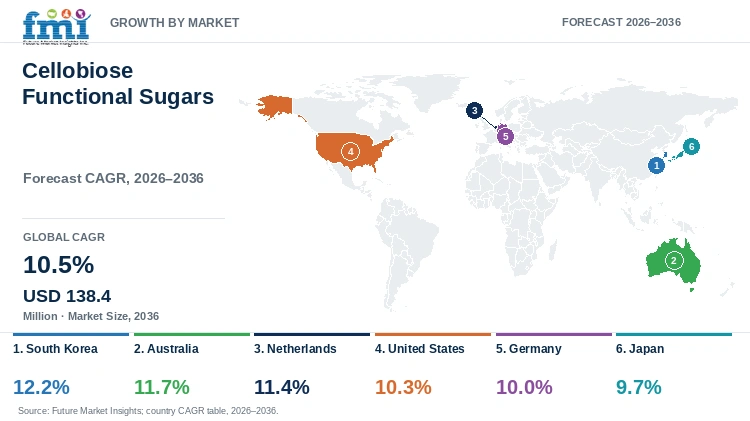
South Korea is predicted to outpace major cellobiose functional sugars economies at 12.2% per annum to 2036 above Australian demand (anticipated at 11.7%) plus Dutch consumption (forecast at 11.4%). Meanwhile, American shipments (expected at 10.3%) alongside German output (projected at 10.0%) and Japanese turnover (estimated at 9.7%) scale from established biorefinery and pulp-hydrolysis foundations.
Table 7: Country CAGR and Primary Growth Levers for the Cellobiose Functional Sugars Market (CAGR percentage and operational drivers), 2026 to 2036
| Country | CAGR (2026 to 2036) | Primary Growth Lever |
|---|---|---|
| South Korea | 12.2% | Zero-sugar bakery reformulation and K-beauty microbiome humectant serum adoption |
| Australia | 11.7% | Clean-label low-GI dairy and sports nutrition manufacturing across Victoria and NSW |
| Netherlands | 11.4% | USD 129 billion Dutch food-sector output and probiotic export formulation |
| United States | 10.3% | Biologic lyophilization excipient demand and specialty tablet-binder adoption |
| Germany | 10.0% | Rhineland sugar-beet enzymatic phosphorolysis scale and EU Novel Food authorization |
| Japan | 9.7% | Integrated paper-mill cellulose hydrolysis and high-speed excipient tableting R&D |
Source: Future Market Insights analysis
South Korea Cellobiose Functional Sugars Market Outlook (2026 to 2036)
National food-safety inspectors in Osong supervise 35,000 Korean food processors and 31,000 importers under the Food Safety Management System while enforcing Good Manufacturing Practice traceability across domestic dairy and bakery channels [10]. What distinguishes South Korea from European beet-refining markets is the rapid convergence of zero-sugar cafe bakery franchises and K-beauty dermocosmetic laboratories using cellobiose as an epidermal moisture-binding humectant. Seoul contract cosmetic labs and low-glycemic protein bar makers formulate anhydrous beta-1,4 cellobiose powders at moderated serving doses below 20 grams per day, lifting domestic consumption at a predicted 12.2% annual rate through 2036. However, absence of domestic phosphorylase reactors leaves Korean formulators reliant on imported European and Japanese shipments.
Key takeaway: In South Korea, rapid retail adoption of low-insulinemic pastries and moisture-binding K-beauty serums is predicted to sustain 12.2% yearly growth through 2036.
Australia Cellobiose Functional Sugars Market Outlook (2026 to 2036)
Australian cellobiose functional sugars demand is anticipated to expand at an 11.7% yearly clip until 2036, supported by export-oriented dairy and sports-nutrition manufacturing across Victoria and New South Wales. Unlike Northern Hemisphere markets focused on domestic confectionery, Australia is uniquely oriented toward certified low-glycemic-index nutritional powder canisters exported into Southeast Asian pharmacy chains. During October 2026, Food Standards Australia New Zealand (FSANZ) updated its Novel foods business guidance under Standards 1.1.1 and 1.5.1, detailing pre-market safety assessments and 15-month exclusive permissions in Schedule 25 table S25-2 [11]. Commercial friction stems from lengthy maritime container transit times out of European sugar-beet refineries and stringent biosecurity inspections at Melbourne and Sydney terminals.
Key takeaway: In Australia, certified low-glycemic sports nutrition and export dairy fortification are anticipated to support 11.7% annual demand growth.
Netherlands Cellobiose Functional Sugars Market Outlook (2026 to 2036)
Rather than competing in bulk retail table-top sweeteners, the Netherlands operates as Europe's premier dairy-biotech and probiotic freeze-drying formulation corridor anchored around Wageningen and Rotterdam. Dutch clinical nutrition and probiotic capsule formulators procure European-authorized novel-food cellobiose crystals as both a slow-fermenting colonic butyrate substrate and a non-hygroscopic lyophilization excipient carrier, supporting a forecast 11.4% yearly expansion rate until 2036. October 2026 European statistical releases confirm that Dutch manufacturing recorded the highest annual industrial output expansion in the European Union at 9.8% year-on-year and 2.6% month-on-month during August 2026 [12]. Even so, rising industrial nitrogen-emission compliance costs and natural-gas surcharges constrain domestic spray-drying margins across North Brabant.
Key takeaway: In the Netherlands, USD 129 billion food-sector output and probiotic lyophilization demand are forecast to sustain an 11.4% yearly expansion rate.
United States Cellobiose Functional Sugars Market Outlook (2026 to 2036)
October 2026 federal commodity outlook figures detail domestic cane and beet output alongside industrial food deliveries across the United States from 2025/26 through 2026/27 [13]. The United States differs from European novel-food markets because FDA ceased evaluating cellobiose GRAS Notice GRN 1180 at the notifier's request in September 2024, centering American demand on cGMP biopharmaceutical lyophilization suites and solid-dosage excipients across Massachusetts and California. Contract development and manufacturing organizations specify low-endotoxin crystalline cellobiose to protect freeze-dried live biotherapeutic capsules and diagnostic reagents, lifting domestic revenue at an expected 10.3% annual rate between 2026 and 2036. Nevertheless, abundant domestic corn-derived allulose and erythritol create intense bulk price competition in grocery beverage aisles, confining food-grade cellobiose to specialty baked goods.
Key takeaway: In the United States, biologic cryoprotection and low-insulinemic nutrition bar formulations are expected to anchor 10.3% yearly market expansion.
Germany Cellobiose Functional Sugars Market Outlook (2026 to 2036)
Germany is uniquely positioned as Europe's upstream enzymatic production anchor, where Rhineland sugar-beet refineries in Elsdorf convert domestic beet sucrose directly into novel-food cellobiose via sucrose-phosphate phosphorylase cascades. European Commission updates to the Union list of novel foods under Implementing Regulation (EU) 2017/2470 and Implementing Regulation (EU) 2023/943 authorize cellobiose placement across specified European food categories [14]. German confectionery and isotonic beverage processors integrate domestically refined beta-1,4 disaccharides into clean-label product lines across regional dairy and bakery plants, supporting a projected 10.0% yearly growth pace to 2036. However, statutory maximum inclusion levels under Union Novel Food specifications and fluctuating Rhineland sugar-beet contracting prices cap short-term volume spikes across discount supermarkets.
Key takeaway: In Germany, domestic sugar-beet enzymatic synthesis in Elsdorf and Union Novel Food authorization are projected to underpin a 10.0% CAGR.
Japan Cellobiose Functional Sugars Market Outlook (2026 to 2036)
Unlike European producers that rely on sucrose phosphorolysis, Japan uniquely commercialized industrial cellobiose and functional cellulose derivatives by applying proprietary enzymatic depolymerization to bleached wood pulp inside integrated paper-mill biorefineries. In August 2025, Asahi Kasei Corporation detailed in its Microcrystalline Cellulose technical brochure how its Nobeoka and Kurashiki plants engineer high-compactibility Ceolus grades with nitrite levels at or below 0.1 ppm for pharmaceuticals and nutraceuticals [15]. Japanese geriatric nutrition formulators and artisanal bakery chains value beta-1,4 cellobiose for resisting oral cariogenic fermentation while promoting colonic butyrate generation, supporting an estimated 9.7% compound annual clip to 2036. Still, high domestic trehalose utilization moderates incremental volume share gains across traditional wagashi factories.
Key takeaway: In Japan, integrated wood-pulp biorefineries and clinical geriatric fiber fortification are estimated to support 9.7% annual market expansion.
Full report country CAGRs cover: North America; Latin America; Western Europe; Eastern Europe; East Asia; South Asia and Pacific; Middle East and Africa.
Who are the notable companies in the cellobiose functional sugars market?
Pfeifer & Langen GmbH & Co. KG (Savanna Ingredients), Nippon Paper Industries Co. Ltd., Nagase Viita Co. Ltd., Merck KGaA, Tokyo Chemical Industry Co. Ltd., Südzucker AG, Roquette Frères, and Biosynth AG are the notable companies in the cellobiose functional sugars market.
Competitive positioning in the cellobiose functional sugars market divides between enzymatic sugar-beet bioconverters and wood-pulp cellulase refiners alongside global pharmaceutical excipient suppliers. European sugar-beet innovators Pfeifer & Langen GmbH & Co. KG (operating via Savanna Ingredients) and Südzucker AG alongside Japanese enzymatic leader Nagase Viita Co. Ltd. scale phosphorylase and disaccharide bioconversion for food and novel-food markets. Lignocellulosic and glycoscience specialists including Nippon Paper Industries Co. Ltd. together with Tokyo Chemical Industry Co. Ltd. and Biosynth AG produce high-purity cellobiose and cello-oligosaccharides via controlled cellulose hydrolysis. Meanwhile, Merck KGaA and Roquette Frères supply compendial bioprocess cryoprotectants and oral dosage excipients worldwide.
- Enzymatic Disaccharide & Sugar-Beet Bioconversion Specialists: Pfeifer & Langen GmbH & Co. KG (Savanna Ingredients), Südzucker AG, and Nagase Viita Co. Ltd. convert sucrose and starch feedstocks into food-grade functional disaccharides.
- Cellulosic Hydrolysis & Specialty Glycoscience Manufacturers: Nippon Paper Industries Co. Ltd., Tokyo Chemical Industry Co. Ltd., and Biosynth AG manufacture wood-pulp-derived and analytical-grade beta-1,4 disaccharides.
- Global Pharmaceutical Excipient & Bioprocess Platforms: Merck KGaA and Roquette Frères deliver low-endotoxin lyophilization stabilizers and tableting carbohydrate excipients to global life-science accounts.
Competitive Benchmarking: Cellobiose Functional Sugars Market
Table 8: Competitive Benchmarking for the Cellobiose Functional Sugars Market (qualitative capability ratings), 2026
| Company | Bioconversion Scale | Novel-Food & Regulatory Dossiers | Bioprocess Excipient Purity | Geographic Reach |
|---|---|---|---|---|
| Pfeifer & Langen (Savanna Ingredients) | High | High | Medium | High |
| Nippon Paper Industries Co., Ltd. | High | Medium | Medium | Medium |
| Nagase Viita Co., Ltd. | High | High | High | High |
| Merck KGaA | Medium | Medium | High | High |
| TCI (Tokyo Chemical Industry) | Medium | Medium | High | High |
| Südzucker AG | High | High | Medium | High |
| Roquette Frères | High | High | High | High |
| Biosynth AG | Medium | Medium | High | High |
Scoring basis: Bioconversion Scale is rated High where a producer operates multi-ton enzymatic phosphorolysis or industrial pulp-hydrolysis reactors, and Medium for fine-chemical batch synthesis. Novel-Food & Regulatory Dossiers reflects ownership of European Union Novel Food authorizations under Implementing Regulation (EU) 2023/943 and Japanese food-ingredient clearances alongside pharmaceutical excipient filings. Bioprocess Excipient Purity evaluates documented low-endotoxin and multi-compendial specifications suited for biologic lyophilization and sterile bioprocessing.
Key Developments in the Cellobiose Functional Sugars Market
- Roquette Frères expanded its direct-compression and orodispersible solid-tablet excipient portfolio (including PEARLITOL mannitol and SweetPearl maltitol alongside StarLac) in 2026 to support oral dosage uniformity [16].
- In September 2026, Roquette Frères reported H1 2026 turnover growth of 9% to EUR 2,586 million and an 18% Current EBITDA increase to EUR 337 million driven by pharmaceutical cellulose excipients and specialty dietary fibers [17].
- Südzucker AG marked its 100th corporate anniversary in February 2026 by expanding its European beet-sugar specialty excipient (COMPRI) and upcycled sugar-beet fiber (BeetKraft) platforms across Germany and neighboring European markets [18].
Key Players in the Cellobiose Functional Sugars Market
Enzymatic Disaccharide & Sugar-Beet Bioconversion Specialists
- Pfeifer & Langen GmbH & Co. KG (Savanna Ingredients)
- Südzucker AG
- Nagase Viita Co., Ltd.
Cellulosic Hydrolysis & Specialty Glycoscience Manufacturers
- Nippon Paper Industries Co., Ltd.
- TCI (Tokyo Chemical Industry Co., Ltd.)
- Biosynth AG
Global Pharmaceutical Excipient & Bioprocess Platforms
- Merck KGaA
- Roquette Frères
Cellobiose Functional Sugars Market - Report Scope
Table 9: Report Scope for the Cellobiose Functional Sugars Market (coverage fields and definitions), 2026 to 2036
| Coverage field | Report scope |
|---|---|
| Market breakdown | Feedstock & Production Process; Purity & Grade; Application; Region |
| Quantitative Units | USD Million |
| Market Definition | Includes B2B supplier revenue from purified cellobiose (beta-D-glucopyranosyl-(1->4)-D-glucose) sold across food/novel-food, pharmaceutical excipient, and cosmetic humectant grades within the listed segmentation. Category Scope Note: The valuation captures bulk and specialty ingredient shipments where Enzymatic Sucrose-Phosphate Phosphorylase Synthesis is expected to command 54.6% of 2026 process output, excluding insoluble microcrystalline cellulose, carboxymethyl cellulose thickeners, and downstream retail sales of finished baked goods, biologic drugs, or topical cosmetics. |
| Regions Covered | North America; Latin America; Western Europe; Eastern Europe; East Asia; South Asia and Pacific; Middle East and Africa |
| Countries Covered | South Korea, Australia, Netherlands, United States, Germany, Japan, and additional countries in the full report |
| Key Companies Covered | Pfeifer & Langen GmbH & Co. KG (Savanna Ingredients), Nippon Paper Industries Co., Ltd., Nagase Viita Co., Ltd., Merck KGaA, TCI (Tokyo Chemical Industry Co., Ltd.), Südzucker AG, Roquette Frères, Biosynth AG |
| Forecast Period | 2026 to 2036 |
| Approach | Primary and secondary research with rigorous market triangulation. |
Cellobiose Functional Sugars Market - Research Methodology
Table 10: Research Methodology for the Cellobiose Functional Sugars Market (research methods and approach), 2026 edition
| Method | Approach |
|---|---|
| Primary Research | Primary interviews were conducted with enzymatic beet-sugar bioconversion engineers, wood-pulp cellulase process directors, diabetic bakery formulators, biologic lyophilization scientists, and regulatory affairs specialists to validate yield economics and grade pricing. |
| Secondary Research | Secondary research included company annual reports, investor presentations, European Union Novel Food regulations and EFSA opinions, FDA GRAS notices, OECD-FAO and USDA ERS sugar outlooks, and verified corporate technical disclosures. |
| Market Sizing and Forecasting | Market sizing and forecasting for the 2026 to 2036 horizon were constructed via top-down and bottom-up models reconciling enzymatic reactor capacities, cellulose hydrolysis output, and grade-level B2B price realizations. |
| Data Triangulation and Validation | Estimates are triangulated against national beet-sugar refining volumes, specialty excipient procurement registries, colonic butyrate clinical trial dosages, and historical disaccharide adoption trends to prevent overlap with bulk cellulose derivatives. |
| Country Forecasting Model | Country-level CAGRs are modeled through FMI's functional carbohydrate econometric engine, calibrating national growth rates around the 10.5% global CAGR using EU Novel Food uptake, Asia-Pacific zero-sugar bakery launches, and regional biopharmaceutical freeze-drying capacity. |
| Operational Benchmark Traceability | Operational benchmarks (global cellobiose metric tonnage, food-grade volume, realized USD per kilogram pricing, and bakery w/w dosage rates) represent modeled estimates derived from EFSA Novel Food intake dossiers, OECD-FAO sugar statistics, and producer capacity filings. |
Cellobiose Functional Sugars Market by Segments
Cellobiose Functional Sugars Market segmented by Feedstock & Production Process:
- Enzymatic Sucrose-Phosphate Phosphorylase Synthesis
- Cellulase Controlled Hydrolysis of Cotton/Wood Pulp
- Sugar Beet Fiber Bioconversion
Cellobiose Functional Sugars Market segmented by Purity & Grade:
- Food & Novel-Food Grade (≥99% Dry Matter)
- Pharmaceutical Excipient & Bioprocess Grade
- Cosmetic Moisture-Retaining Humectant Grade
Cellobiose Functional Sugars Market segmented by Application:
- Low-Glycemic & Low-Insulinemic Bulk Sweetener
- Butyrate-Producing Colonic Prebiotic Fiber
- Lyophilization Cryoprotectant for Biologics/Probiotics
Cellobiose Functional Sugars Market by Region
- North America
- United States
- Canada
- Latin America
- Brazil
- Mexico
- Argentina
- Chile
- Western Europe
- Germany
- France
- United Kingdom
- Italy
- Spain
- Benelux
- Nordics
- Eastern Europe
- Poland
- Czech Republic
- Romania
- Hungary
- East Asia
- China
- Japan
- South Korea
- South Asia and Pacific
- India
- ASEAN
- Australia and New Zealand
- Middle East and Africa
- GCC Countries
- South Africa
- Türkiye
- Israel
Research Sources and Bibliography
- [1] Organisation for Economic Co-operation and Development & Food and Agriculture Organization. (2026, June 29). Sugar: OECD-FAO Agricultural Outlook 2026-2035. OECD Publishing.
- [2] European Food Safety Authority. (2025, December 17). Novel food. European Food Safety Authority.
- [3] U.S. Food and Drug Administration. (2026, October 15). GRAS Notices. U.S. Food and Drug Administration.
- [4] SAVANNA Ingredients GmbH & Co. KG. (2025, June 01). Cellobiose (EN) – SAVANNA Ingredients. SAVANNA Ingredients GmbH & Co. KG.
- [5] Nippon Paper Industries Co., Ltd. (2025, September 29). KC FLOCK® | Chemicals | PRODUCTS | Nippon Paper Group. Nippon Paper Group.
- [6] Tokyo Chemical Industry Co., Ltd. (2026, May 14). Cello-oligosaccharides Derived from Cellulose Degradation (Cellodextrins). Tokyo Chemical Industry Co., Ltd. (Brochure GG055E).
- [7] U.S. Department of Agriculture, Economic Research Service. (2026, September 17). Sugar and Sweeteners Outlook: September 2026. U.S. Department of Agriculture.
- [8] World Health Organization. (2026, January 26). Healthy diet. World Health Organization.
- [9] Roquette Frères. (2026, March 19). Roquette 2025 Full-Year Results Announcement. Roquette Frères.
- [10] Ministry of Food and Drug Safety. (2025, November 14). Food Safety Management System. Ministry of Food and Drug Safety Republic of Korea.
- [11] Food Standards Australia New Zealand. (2026, October 16). Novel foods. Food Standards Australia New Zealand.
- [12] Eurostat. (2026, October 15). Industrial production down by 0.5% in the euro area and by 0.3% in the EU. Statistical Office of the European Union (Eurostat).
- [13] U.S. Department of Agriculture, Economic Research Service. (2026, October 16). Sugar and Sweeteners Outlook: October 2026. U.S. Department of Agriculture.
- [14] European Commission. (2026, July 20). Union list of novel foods - Food Safety - European Commission. European Commission Directorate-General for Health and Food Safety.
- [15] Asahi Kasei Corporation. (2025, August 01). Asahi Kasei Microcrystalline Cellulose(MCC). Asahi Kasei Corporation Functional Additives Division.
- [16] Roquette Frères. (2026, February 10). Premium Excipients for Solid Tablets - Roquette. Roquette Frères.
- [17] Roquette Frères. (2026, September 24). Strategic Transformation Supports Roquette's H1 2026 Performance. Roquette Frères.
- [18] Südzucker AG. (2026, February 11). 100 years Südzucker Group – Part of Your Life. Südzucker AG.
- [19] Merck KGaA. (2026, April 01). Parteck® Pharmaceutical Excipients | Merck. Merck KGaA.
- [20] Biosynth AG. (2025, November 18). Cellooligosaccharides. Biosynth AG.
This bibliography is provided for reader reference and is not exhaustive. The full report contains the complete reference list and detailed citations.
This Report Answers
- How large is the cellobiose functional sugars market in 2026 and what is forecast for 2036?
- Which low-insulinemic and prebiotic catalysts support demand for cellobiose functional sugars?
- Why does Enzymatic Sucrose-Phosphate Phosphorylase Synthesis lead the feedstock & production process category?
- Why does Food & Novel-Food Grade (≥99% Dry Matter) lead the purity & grade category globally?
- How do growth rates differ across South Korea, Australia, the Netherlands, the United States, Germany, and Japan?
- Which leading companies manufacture cellobiose functional sugars and bioprocess grades today?
- What limits adoption or supplier switching in the cellobiose functional sugars market?
- What should food and bioprocess buyers evaluate before purchasing cellobiose functional sugars?
Frequently Asked Questions
How big is the cellobiose functional sugars market in 2026, and what is forecast for 2036?
Worldwide cellobiose functional sugars demand is pegged at USD 51.0 million for 2026 (up from 2025 sales of USD 46.2 million) and is predicted to attain 2036 turnover of USD 138.4 million as bakery and bioprocess formulators adopt beta-1,4 linked functional disaccharides.
What CAGR is projected for the cellobiose functional sugars market through 2036?
As per FMI, global cellobiose functional sugars turnover is expected to compound by 10.5% annually over 2026 to 2036, delivering an estimated USD 87.4 million increase in annual market revenue between 2026 and 2036 across food and pharmaceutical channels.
Which feedstock & production process segment leads the cellobiose functional sugars market?
Enzymatic Sucrose-Phosphate Phosphorylase Synthesis is expected to command 54.6% of 2026 process volume because dual-enzyme phosphorolysis cascades convert beet or cane sucrose into high-purity cellobiose without mineral-acid hydrolysis waste.
Which purity & grade segment holds the largest share in 2026?
Food & Novel-Food Grade (≥99% Dry Matter) is projected to secure 67.4% of 2026 grade turnover following European Union Novel Food authorizations for low-glycemic baked goods and powdered beverages.
Which country exhibits the fastest growth pace through 2036?
Future Market Insights identifies South Korea as the top-performing national market with a predicted 12.2% yearly growth rate through 2036, backed by zero-sugar bakery reformulation and K-beauty humectant serum launches.
Who are the notable companies in the cellobiose functional sugars market?
Notable market participants include Pfeifer & Langen GmbH & Co. KG (Savanna Ingredients), Nippon Paper Industries Co., Ltd., Nagase Viita Co., Ltd., Merck KGaA, TCI (Tokyo Chemical Industry Co., Ltd.), Südzucker AG, Roquette Frères, and Biosynth AG.
Preview the report firsthand - request a free sample
Get SampleGet the brochure for pricing and purchase details.
Get PDFTable of Content
- Key Takeaways
- Market Size and CAGR
- Top Growth Driver
- Fastest Growing Segment
- Leading Region
- Key Companies
- Emerging Opportunities
- Executive Summary
- Global Market Outlook
- Demand-side Trends
- Supply-side Trends
- Technology Roadmap Analysis
- Analysis and Recommendations
- Analyst Perspective (What is happening? Why now? What should investors know?)
- Key Questions Answered
- How large is the market?
- What is the CAGR?
- What are key trends?
- Which region dominates?
- Who are the leaders?
- Market Overview
- Market Coverage / Taxonomy
- Market Definition / Scope / Limitations
- Research Methodology
- Chapter Orientation
- Analytical Lens and Working Hypotheses
- Market Structure, Signals, and Trend Drivers
- Benchmarking and Cross-market Comparability
- Market Sizing, Forecasting, and Opportunity Mapping
- Research Design and Evidence Framework
- Desk Research Programme (Secondary Evidence)
- Expert Input and Fieldwork (Primary Evidence)
- Tooling, Models, and Reference Databases
- Data Engineering and Model Build
- Quality Assurance and Audit Trail
- Market Background
- Market Dynamics (Drivers, Restraints, Opportunity, Trends)
- Scenario Forecast (Optimistic, Likely, Conservative)
- Impact Analysis
- AI Impact
- Sustainability Impact
- Regulatory Impact
- Technology Impact
- Consumer / Buyer Analysis
- Purchase Drivers
- Adoption Barriers
- Buyer Journey
- Opportunity Map Analysis
- Product Life Cycle Analysis
- Supply Chain Analysis
- Investment Feasibility Matrix
- Value Chain Analysis
- PESTLE and Porter's Analysis
- Regulatory Landscape
- Regional Parent Market Outlook
- Production and Consumption Statistics
- Import and Export Statistics
- Global Market Analysis and Forecast, 2021 to 2036
- Historical Market Size Value (USD Million) Analysis, 2021 to 2025
- Current and Future Market Size Value (USD Million) Projections, 2026 to 2036
- Y-o-Y Growth Trend Analysis
- Absolute $ Opportunity Analysis
- Global Market Pricing Analysis, 2021 to 2036
- Global Market Analysis and Forecast, By Feedstock & Production Process, 2021 to 2036
- Introduction / Key Findings
- Historical Market Size Value (USD Million) Analysis By Feedstock & Production Process, 2021 to 2025
- Current and Future Market Size Value (USD Million) Analysis and Forecast By Feedstock & Production Process, 2026 to 2036
- Enzymatic Sucrose-Phosphate Phosphorylase Synthesis
- Cellulase Controlled Hydrolysis of Cotton/Wood Pulp
- Sugar Beet Fiber Bioconversion
- Y-o-Y Growth Trend Analysis By Feedstock & Production Process, 2021 to 2025
- Absolute $ Opportunity Analysis By Feedstock & Production Process, 2026 to 2036
- Global Market Analysis and Forecast, By Purity & Grade, 2021 to 2036
- Introduction / Key Findings
- Historical Market Size Value (USD Million) Analysis By Purity & Grade, 2021 to 2025
- Current and Future Market Size Value (USD Million) Analysis and Forecast By Purity & Grade, 2026 to 2036
- Food & Novel-Food Grade (≥99% Dry Matter)
- Pharmaceutical Excipient & Bioprocess Grade
- Cosmetic Moisture-Retaining Humectant Grade
- Y-o-Y Growth Trend Analysis By Purity & Grade, 2021 to 2025
- Absolute $ Opportunity Analysis By Purity & Grade, 2026 to 2036
- Global Market Analysis and Forecast, By Application, 2021 to 2036
- Introduction / Key Findings
- Historical Market Size Value (USD Million) Analysis By Application, 2021 to 2025
- Current and Future Market Size Value (USD Million) Analysis and Forecast By Application, 2026 to 2036
- Low-Glycemic & Low-Insulinemic Bulk Sweetener
- Butyrate-Producing Colonic Prebiotic Fiber
- Lyophilization Cryoprotectant for Biologics/Probiotics
- Y-o-Y Growth Trend Analysis By Application, 2021 to 2025
- Absolute $ Opportunity Analysis By Application, 2026 to 2036
- Global Market Analysis and Forecast, By Region, 2021 to 2036
- Introduction
- Historical Market Size Value (USD Million) Analysis By Region, 2021 to 2025
- Current Market Size Value (USD Million) Analysis and Forecast By Region, 2026 to 2036
- North America
- Latin America
- Western Europe
- Eastern Europe
- East Asia
- South Asia and Pacific
- Middle East and Africa
- Market Attractiveness Analysis By Region
- North America Market Analysis and Forecast, By Country, 2021 to 2036
- Historical Market Size Value (USD Million) Trend Analysis By Market Taxonomy, 2021 to 2025
- Market Size Value (USD Million) Forecast By Market Taxonomy, 2026 to 2036
- By Country
- United States
- Canada
- By Feedstock & Production Process
- By Purity & Grade
- By Application
- By Country
- Market Attractiveness Analysis
- By Country
- By Feedstock & Production Process
- By Purity & Grade
- By Application
- Key Takeaways
- Latin America Market Analysis and Forecast, By Country
- Historical Market Size Value (USD Million) Trend Analysis By Market Taxonomy, 2021 to 2025
- Market Size Value (USD Million) Forecast By Market Taxonomy, 2026 to 2036
- By Country
- Brazil
- Mexico
- Argentina
- Chile
- By Feedstock & Production Process
- By Purity & Grade
- By Application
- By Country
- Market Attractiveness Analysis
- By Country
- By Feedstock & Production Process
- By Purity & Grade
- By Application
- Key Takeaways
- Western Europe Market Analysis and Forecast, By Country
- Historical Market Size Value (USD Million) Trend Analysis By Market Taxonomy, 2021 to 2025
- Market Size Value (USD Million) Forecast By Market Taxonomy, 2026 to 2036
- By Country
- Germany
- France
- United Kingdom
- Italy
- Spain
- Benelux
- Nordics
- By Feedstock & Production Process
- By Purity & Grade
- By Application
- By Country
- Market Attractiveness Analysis
- By Country
- By Feedstock & Production Process
- By Purity & Grade
- By Application
- Key Takeaways
- Eastern Europe Market Analysis and Forecast, By Country
- Historical Market Size Value (USD Million) Trend Analysis By Market Taxonomy, 2021 to 2025
- Market Size Value (USD Million) Forecast By Market Taxonomy, 2026 to 2036
- By Country
- Poland
- Czech Republic
- Romania
- Hungary
- By Feedstock & Production Process
- By Purity & Grade
- By Application
- By Country
- Market Attractiveness Analysis
- By Country
- By Feedstock & Production Process
- By Purity & Grade
- By Application
- Key Takeaways
- East Asia Market Analysis and Forecast, By Country
- Historical Market Size Value (USD Million) Trend Analysis By Market Taxonomy, 2021 to 2025
- Market Size Value (USD Million) Forecast By Market Taxonomy, 2026 to 2036
- By Country
- China
- Japan
- South Korea
- By Feedstock & Production Process
- By Purity & Grade
- By Application
- By Country
- Market Attractiveness Analysis
- By Country
- By Feedstock & Production Process
- By Purity & Grade
- By Application
- Key Takeaways
- South Asia and Pacific Market Analysis and Forecast, By Country
- Historical Market Size Value (USD Million) Trend Analysis By Market Taxonomy, 2021 to 2025
- Market Size Value (USD Million) Forecast By Market Taxonomy, 2026 to 2036
- By Country
- India
- ASEAN
- Australia and New Zealand
- By Feedstock & Production Process
- By Purity & Grade
- By Application
- By Country
- Market Attractiveness Analysis
- By Country
- By Feedstock & Production Process
- By Purity & Grade
- By Application
- Key Takeaways
- Middle East and Africa Market Analysis and Forecast, By Country
- Historical Market Size Value (USD Million) Trend Analysis By Market Taxonomy, 2021 to 2025
- Market Size Value (USD Million) Forecast By Market Taxonomy, 2026 to 2036
- By Country
- GCC Countries
- South Africa
- Türkiye
- Israel
- By Feedstock & Production Process
- By Purity & Grade
- By Application
- By Country
- Market Attractiveness Analysis
- By Country
- By Feedstock & Production Process
- By Purity & Grade
- By Application
- Key Takeaways
- Key Countries Market Analysis
- United States
- Pricing Analysis
- Market Share Analysis, 2025
- By Feedstock & Production Process
- By Purity & Grade
- By Application
- Canada
- Pricing Analysis
- Market Share Analysis, 2025
- By Feedstock & Production Process
- By Purity & Grade
- By Application
- Mexico
- Pricing Analysis
- Market Share Analysis, 2025
- By Feedstock & Production Process
- By Purity & Grade
- By Application
- Brazil
- Pricing Analysis
- Market Share Analysis, 2025
- By Feedstock & Production Process
- By Purity & Grade
- By Application
- Chile
- Pricing Analysis
- Market Share Analysis, 2025
- By Feedstock & Production Process
- By Purity & Grade
- By Application
- Germany
- Pricing Analysis
- Market Share Analysis, 2025
- By Feedstock & Production Process
- By Purity & Grade
- By Application
- United Kingdom
- Pricing Analysis
- Market Share Analysis, 2025
- By Feedstock & Production Process
- By Purity & Grade
- By Application
- Italy
- Pricing Analysis
- Market Share Analysis, 2025
- By Feedstock & Production Process
- By Purity & Grade
- By Application
- Spain
- Pricing Analysis
- Market Share Analysis, 2025
- By Feedstock & Production Process
- By Purity & Grade
- By Application
- France
- Pricing Analysis
- Market Share Analysis, 2025
- By Feedstock & Production Process
- By Purity & Grade
- By Application
- India
- Pricing Analysis
- Market Share Analysis, 2025
- By Feedstock & Production Process
- By Purity & Grade
- By Application
- ASEAN
- Pricing Analysis
- Market Share Analysis, 2025
- By Feedstock & Production Process
- By Purity & Grade
- By Application
- Australia and New Zealand
- Pricing Analysis
- Market Share Analysis, 2025
- By Feedstock & Production Process
- By Purity & Grade
- By Application
- China
- Pricing Analysis
- Market Share Analysis, 2025
- By Feedstock & Production Process
- By Purity & Grade
- By Application
- Japan
- Pricing Analysis
- Market Share Analysis, 2025
- By Feedstock & Production Process
- By Purity & Grade
- By Application
- South Korea
- Pricing Analysis
- Market Share Analysis, 2025
- By Feedstock & Production Process
- By Purity & Grade
- By Application
- Poland
- Pricing Analysis
- Market Share Analysis, 2025
- By Feedstock & Production Process
- By Purity & Grade
- By Application
- Hungary
- Pricing Analysis
- Market Share Analysis, 2025
- By Feedstock & Production Process
- By Purity & Grade
- By Application
- Türkiye
- Pricing Analysis
- Market Share Analysis, 2025
- By Feedstock & Production Process
- By Purity & Grade
- By Application
- South Africa
- Pricing Analysis
- Market Share Analysis, 2025
- By Feedstock & Production Process
- By Purity & Grade
- By Application
- Australia
- Pricing Analysis
- Market Share Analysis, 2025
- By Feedstock & Production Process
- By Purity & Grade
- By Application
- Netherlands
- Pricing Analysis
- Market Share Analysis, 2025
- By Feedstock & Production Process
- By Purity & Grade
- By Application
- United States
- Market Structure Analysis
- Competition Dashboard
- Competition Benchmarking
- Market Share Analysis of Top Players
- By Regional
- By Feedstock & Production Process
- By Purity & Grade
- By Application
- Emerging Startups
- Innovation Benchmarking
- Competition Analysis
- Competition Deep Dive
- Pfeifer & Langen (Savanna Ingredients)
- Overview
- Product Portfolio
- Profitability by Market Segments
- Sales Footprint
- Strategy Overview
- Marketing Strategy
- Product Strategy
- Channel Strategy
- Nippon Paper Industries Co., Ltd.
- Nagase Viita Co., Ltd.
- Merck KGaA
- TCI (Tokyo Chemical Industry)
- Südzucker AG
- Roquette Frères
- Biosynth AG
- Pfeifer & Langen GmbH & Co. KG (Savanna Ingredients)
- TCI (Tokyo Chemical Industry Co., Ltd.)
- Pfeifer & Langen (Savanna Ingredients)
- Case Studies
- Success Stories
- Recent Developments
- Competition Deep Dive
- Assumptions & Acronyms Used


