

- Market Size (2026)
- USD 860.7 Mn
- Forecast (2036)
- USD 1570.7 Mn
- CAGR (2026 to 2036)
- 6.2%
How big is Char Forming Additives Market in 2026?
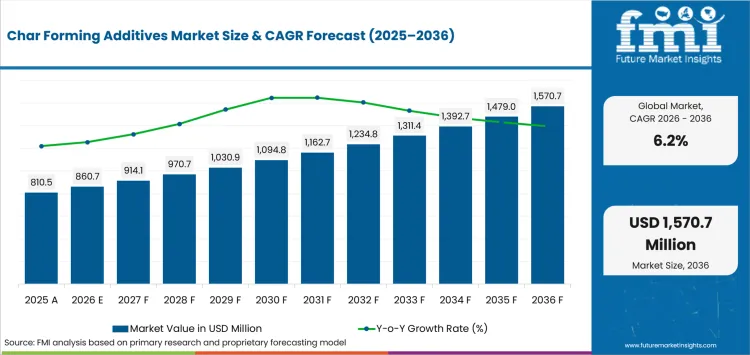
USD 860.7 million in 2026 and USD 1,570.7 million by 2036 at a 6.2% CAGR.
Sales of char forming additives are estimated to rise at 6.2% CAGR through 2036, increasing valuation from USD 860.7 million in 2026 to USD 1,570.7 million by 2036. Finished formulations must pass material-specific fire tests without losing process stability across the intended resin system. NIST reported in March 2025 that 66 full-scale tests across 18 combustible solids produced distinct charring and fire-growth behavior. Those differences make commercial formulation qualification recurring work for engineering plastics compounders using char-forming additives.
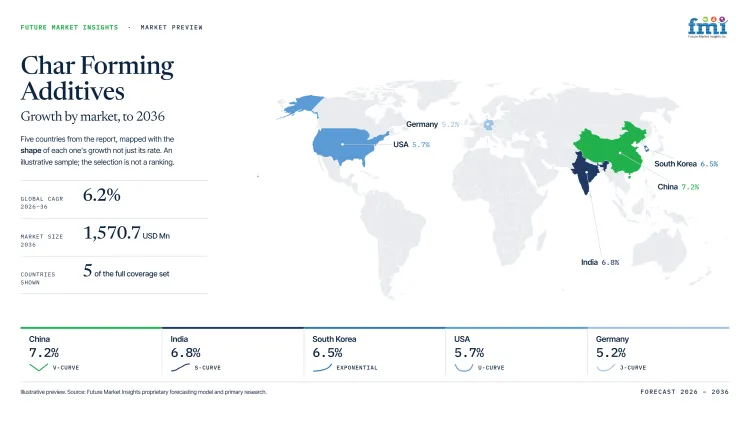
Country demand diverges with the number of electrical and mobility formulations entering local qualification programs. South Korea is forecast at 6.5% CAGR versus 5.2% in Germany and 4.9% in Japan. South Korea's MOTIR reported in January 2026 that domestic automobile exports reached a record USD 72 billion in 2025, with eco-friendly vehicle exports rising 11 percent year-on-year, expanding the qualification workload for flame-retardant materials across cable and mobility platforms. That volume expands qualification work for flame-retardant materials without proving additive orders on its own.
Key Takeaways of Char Forming Additives Market
- Fire-performance specifications increase demand as compounders need protective char without losing resin processing or finished-part durability.
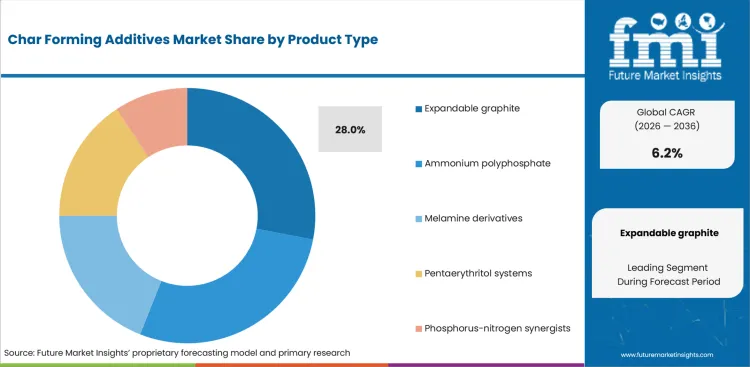
- Based on chemistry, expandable graphite is projected to account for 28.0% in 2026 due to rapid physical expansion that builds a barrier residue.
- Polyolefins are likely to capture 31.0% share of polymer use in 2026 attributable to recurring fire-protection needs across cable and molded electrical formulations.
- In 2026, intumescence is expected to lead function with 34.0% share because expanding char limits heat transfer toward protected substrates.
- High additive loading and multi-component recipes can extend qualification cycles by changing viscosity, mechanical properties or moisture response.
- Clariant, Budenheim, ICL Group, LANXESS, BASF, Nabaltec, Huber Advanced Materials and Nofia Solutions make up the verified company set.
Analyst Perspective
"Formulators should compare char stability at the required fire classification with resin viscosity and finished-part properties ahead of additive price. Technical service earns its margin by reducing repeat tests and preserving an approved recipe during production-scale changes."
- Nikhil Kaitwade, Principal Consultant, Future Market Insights
How is the Char Forming Additives Market segmented?
The char forming additives market is segmented by chemistry, polymer use, function, end use and sales channel.
The char forming additives market is segmented by chemistry, polymer use, function, end use and sales channel. Chemistry includes expandable graphite, ammonium polyphosphate, melamine derivatives, pentaerythritol systems and phosphorus-nitrogen synergists. Polymer use covers polyolefins, PVC, polyamides, epoxy or thermosets and rubber or elastomers. Function includes intumescence, barrier char formation, smoke suppression, drip resistance and thermal insulation. End use covers wire & cable, building products, automotive plastics, electronics and coatings. Sales channels include compounders, additive distributors, direct OEM or formulator sales and masterbatch suppliers.
What makes expandable graphite central to the chemistry category?
Expandable graphite rapidly builds a physical barrier as heated particles expand across the burning surface. A November 2025 SEC filing for Zentek identified expandable graphite as the active intumescent material in a licensed coating that achieved Class A ASTM E84 performance. Char cohesion then determines whether the expanded layer remains protective throughout continued fire exposure in service testing.
- Based on chemistry, expandable graphite is projected to account for 28.0% in 2026 due to direct barrier formation at the polymer surface.
- Formulators favor the chemistry in dark-colored compounds and coatings that tolerate graphite particles as expansion temperature must match the host material processing window.
How does intumescence shape demand within the function category?
Intumescence depends on acid generation and carbon formation matching gas release inside the host material thermal window during heating. The package must also preserve viscosity during application and mechanical performance after the protected material enters service.
- Intumescence is set to lead the function category with 34.0% share in 2026 due to its direct role in forming an insulating char layer.
- Coating and insulation formulators need the expanding layer to retain cohesion without unacceptable moisture or processing penalties. Clariant introduced Exolit AP 422 A in June 2026 for intumescent coatings and insulation with less than 0.1% melamine.
What supports wire & cable demand within the end use category?
Final cable geometry can change fire response, so cable compounders check flame spread beside extrusion behavior and electrical performance. Resin-level screening therefore cannot replace finished-construction testing during final commercial approval for regulated cable classes. UL Solutions warned in April 2025 that a communications cable failed UL 1666 riser flame requirements.
- In 2026, wire & cable is expected to lead end use with 32.0% share because fire classifications are evaluated on finished cable constructions.
- Material changes can reopen qualification as cable manufacturers must preserve smoke behavior and repeatable extrusion alongside electrical properties during commercial production cycles at scale.
Why do compounders matter within the sales channel category?
Compounders convert active chemistry into production-ready pellets while controlling dispersion and resin rheology across repeated manufacturing lots. Their process records help customers reproduce an approved recipe as masterbatch suppliers provide controlled additive letdown for downstream lines.
- By sales channel, compounders are forecast to represent 36.0% in 2026 driven by their direct responsibility for formulation trials and repeat production consistency.
- Application laboratories reduce trial cycles by testing additive loading against the customer polymer and process conditions. Budenheim completed QolorTech integration in April 2026 and combined additive chemistry with compounding assets plus application laboratories at Vaassen during scale-up.
What are the drivers, restraints and opportunities in the Char Forming Additives Market?
Fire-test specifications increase formulation demand as multi-property qualification slows approval and regional application support shortens reformulation work for lower-concern char-forming systems.
- Driver: Fire and smoke requirements force polymer formulations to deliver measured condensed-phase protection before commercial approval.
- Restraint: Additive packages can change electrical or mechanical performance and trigger repeated testing across the finished formulation.
- Opportunity: Local application laboratories and distribution support can shorten reformulation cycles for lower-concern phosphorus systems.
Fire-Test Specifications Increase Formulation Work
Cable and engineering-plastic compounders treat fire response as a formulation property because approval tests evaluate finished materials under application conditions. Char-forming additives enter that buying cycle once protective residue meets the fire target without disrupting extrusion or finished-part performance. BASF began commercial production of flame-retardant TPU in Shanghai during March 2026 for EV charging cables that require fire performance alongside mechanical properties.
Multi-Property Qualification Extends Approval Cycles
A stronger flame response can reduce another service property and raise qualification costs for the finished component, forcing formulators to repeat electrical and aging tests. LANXESS presented reactive and polymeric flame retardants in October 2025 that target migration plus processing and mechanical performance alongside the required fire response. Those tradeoffs lengthen approval as new chemistry changes the property balance already accepted for the finished component during routine production.
Application Support Shortens Reformulation Work
Replacing established flame-retardant chemistry with halogen-free systems requires commercial application support because formulators must rebuild a tested production recipe without losing processing stability, migration control or the required fire result. Nofia Solutions reported in January 2025 that LANXESS would distribute its polymeric flame retardants across key application segments using a global sales network and technical support for qualification and supply.
Which country CAGRs are profiled in the Char Forming Additives Market?
| Country | CAGR |
|---|---|
| South Korea | 6.5% |
| United States | 5.7% |
| Italy | 5.4% |
| Germany | 5.2% |
| Japan | 4.9% |
How do country-level CAGRs compare in the Char Forming Additives Market?
The 1.6-point range separates South Korea from a compact middle band across the United States, Italy and Germany as national electrical qualification workloads differ. Japan remains close to Germany, and the full spacing reflects different national service routes and replacement cycles instead of a simple comparison of current market size.
- South Korean charging-cable programs combine domestic material engineering with demanding export specifications.
- United States cable replacements face finished-product fire testing and repeated electrical qualification.
- Italian high-voltage programs rely on distributor laboratories to preserve approved cable formulations.
- German rail applications require documented EN 45545 performance for accepted electrical substitutions.
- Japanese electronics programs favor polymeric alternatives that preserve reliability across long product cycles.
Similar CAGRs produce different entry costs as approval time and local technical coverage vary. The full report provides country-level CAGR analysis across North America, Latin America, Europe, East Asia, South Asia, Oceania and the Middle East and Africa.
Country-wise Analysis
- South Korean cable and connector programs pair domestic electrical-safety expectations with export specifications for higher-voltage charging and electronics-heavy vehicles across production transfers and sourcing changes. LG Chem reported in May 2025 that its ultra-high-molecular-weight PVC had been shown in EV charging cables with improved flame retardancy and heat resistance. In South Korea, char forming additive demand is predicted to advance at 6.5% CAGR through 2036 supported by local polymer engineering around charging infrastructure. Domestic material expertise can shorten formulation trials but export customers still require electrical and heat-aging validation for a new additive package to earn repeat orders across multiple vehicle platforms.
- United States compounders routinely qualify fire-retardant recipes against finished cable or building assemblies instead of resin data alone under national customer specifications. The United States is estimated to post 5.7% CAGR over the forecast period reinforced by domestic supply depth for mineral and phosphorus systems. J.M. Huber completed its acquisition of R.J. Marshall's ATH and antimony-free flame-retardant assets in May 2025. Broader local availability can reduce sourcing delays during a planned formulation change or replacement program. Altered processing or fire behavior can force cable producers to repeat approval work and delay regular commercial production, making qualification cost a material factor during launches.
- In October 2025, Huber Advanced Materials named Safic Alcan its exclusive distributor across eight European countries — Belgium, France, Ireland, Italy, Luxembourg, Netherlands, Turkey, and the United Kingdom — effective January 2026, with regional formulators relying on distributor laboratories for halogen-free grade access. Char forming additive sales in Italy are forecast to expand at 5.4% CAGR by 2036 aided by channel access that keeps qualified grades available. The expanded distributor route lowers search time for halogen-free grades across regional cable and coating production networks. Fragmented application requirements still force separate trials until a new additive reaches recurring production at each manufacturing account. Distributor laboratories therefore matter most for smaller customers that cannot maintain full in-house fire-testing support during routine qualification.
- German rail and electrical programs demand documented end-use performance as safety-critical connector or housing materials enter routine production. Adoption of char forming additives in Germany is estimated to expand at 5.2% CAGR through 2036 supported by established polymer testing and technical service. Local laboratories give formulators a practical route to compare fire response with processing and electrical behavior. BASF reported in May 2026 that several flame-retardant engineering plastics met EN 45545 requirements for railway applications. Long approval cycles still favor non-halogenated alternatives with stable processing records as transport programs avoid chemistry changes that could reopen qualification late in a platform cycle.
- Japanese electronics programs use long validation cycles for connectors and housings that must preserve electrical reliability across export product platforms. Japan's char forming additives outlook is anticipated to advance at 4.9% CAGR over the assessment period supported by electronics applications that prioritize material stability. Local technical centers and established resin companies can test new phosphorus systems against demanding electrical specifications ahead of wider approval. The same long product cycles raise switching costs and keep established automotive plastics formulations in approval programs for longer. LANXESS demonstrated that route in August 2025 by introducing Nofia AT2000 in Tokyo as an antimony-trioxide substitute for polyamide electronic parts.
Who are the notable companies in the Char Forming Additives Market?
Clariant, Budenheim, ICL Group, LANXESS, BASF, Nabaltec, Huber Advanced Materials and Nofia Solutions are the notable companies serving this market.
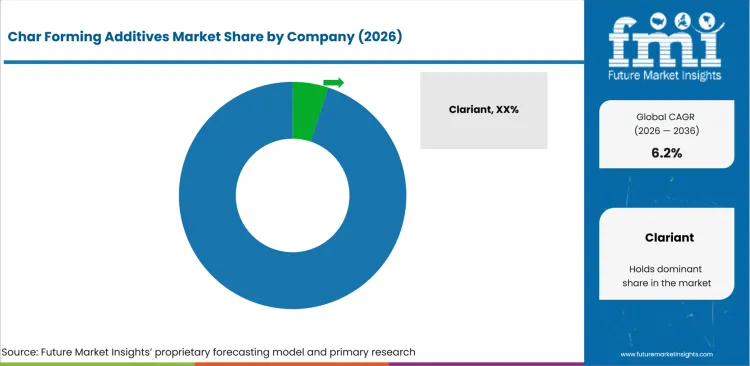
Competition is fragmented across phosphorus specialists, mineral producers and polymeric developers that address different routes to passive fire protection and polymer flame retardancy. No single company type covers every resin or end use, so qualification records and application testing often matter more than corporate scale during entry.
- Clariant and Budenheim combine phosphorus-centered chemistry with application support for intumescent and halogen-free polymer programs.
- ICL Group, LANXESS and BASF connect broader flame-retardant portfolios with validation across multiple polymer and end-use requirements.
- Nabaltec and Huber Advanced Materials cover mineral fire-retardant routes, while Nofia Solutions supplies polymeric phosphorus chemistry for migration-sensitive applications.
Competitive Benchmarking: Char Forming Additives Market
| Company | Char-Forming Chemistry Breadth | Polymer / End-Use Validation | Formulation and Technical Service | Geographic Reach |
|---|---|---|---|---|
| Clariant | High | High | High | Europe, China and global sales |
| Budenheim | High | High | High | Europe and international customers |
| ICL Group | Medium | High | High | Americas, Europe and Asia |
| LANXESS | Medium | High | High | Germany with global sales |
| BASF | Medium | High | High | Global engineering-plastics operations |
| Nabaltec | Low | High | High | Germany, USA and exports |
| Huber Advanced Materials | High | High | High | North America and Europe |
| Nofia Solutions | Medium | High | Medium | Belgium, North America, Europe and Asia |
Scoring basis: High chemistry breadth requires at least three documented routes, Medium requires two and Low requires one within the defined market. High validation requires evidence across three polymer or end-use groups, Medium requires two and Low requires one verified group. High technical service requires dedicated application laboratories plus qualification support, while Medium records one verified support route and Low reflects a documented service limitation. Geographic reach records verified operating or sales regions and remains descriptive rather than scored within the benchmark.
Key Developments in the Char Forming Additives Market
- In June 2026, Clariant previewed an enhanced Exolit AP 435 for water-based fire protection and invited development partners to prepare the grade for future regulatory requirements.
- In May 2025, Budenheim joined the Horizon Europe PLANETS project to develop safer flame retardants for polyurethane insulation foams with research and industrial partners.
- In January 2025, Nofia Solutions BV completed its acquisition of FRX Polymers, Inc. from FRX Innovations and began operating all Nofia flame-retardant products under the Nofia Solutions name, headquartered in Antwerp, Belgium.
Key Players in the Char Forming Additives Market
Phosphorus and Intumescent Formulation Platforms
- Clariant
- Budenheim
- ICL Group
- LANXESS
Polymer and Mineral Fire-Protection Platforms
- BASF
- Nabaltec
- Huber Advanced Materials
Polymeric Non-Halogenated Specialists
- Nofia Solutions
Char Forming Additives Market - Report Scope
| Coverage field | Report scope |
|---|---|
| Market breakdown | By chemistry, polymer use, function, end use, sales channel and region. |
| Quantitative Units | Revenue in USD million and CAGR in %. |
| Market Definition | Commercial additives that form or reinforce protective char in polymer compounds and coatings during fire exposure. |
| Regions Covered | North America, Latin America, Europe, East Asia, South Asia and Pacific, and Middle East and Africa. |
| Countries Covered | South Korea, United States, Italy, Germany, Japan, and 20+ countries included in the full report. |
| Key Companies Profiled | Clariant, Budenheim, ICL Group, LANXESS, BASF, Nabaltec, Huber Advanced Materials, and Nofia Solutions. |
| Forecast Period | 2026 to 2036. |
| Approach | Primary and secondary research with market triangulation. |
Char Forming Additives Market - Research Methodology
| Method | Approach |
|---|---|
| Primary Research | FMI analysts gathered input from manufacturers, service providers, technology developers, distributors, end users, procurement teams, and subject-matter experts. Interviews examined purchasing decisions, product or service evaluation, adoption barriers, approval requirements, pricing considerations, and expectations for technical or commercial support. Respondents were also asked what evidence is required before a trial, pilot, or initial order develops into regular purchasing. |
| Desk Research | Desk research covered government statistics, regulatory publications, trade data, industry associations, technical literature, standards, company filings, product information, and official corporate announcements. Sources were reviewed for relevance, publication date, geographic coverage, and consistency with the defined market scope. Claims relating to performance, applications, approvals, capacity, investment, and commercial activity were retained only when supported by credible public evidence. |
| Market Sizing and Forecasting | The market model combined the baseline value with historical performance, segment structure, pricing and volume indicators, adoption levels, company participation, and country-level demand conditions. Forecast assumptions considered economic activity, investment trends, regulatory developments, technology adoption, purchasing cycles, supply availability, and barriers to wider market use. Segment and regional estimates were reconciled before the final market total was calculated. |
| Data Validation | Estimates were checked against multiple independent indicators, including public data, company activity, trade patterns, industry developments, and findings from primary interviews. Validation also tested whether products, services, applications, and company revenues fell within the defined market boundaries. Adjacent categories, unsupported claims, overlapping revenues, and activities without direct market relevance were excluded to reduce double counting and maintain consistency across segments and countries. |
Char Forming Additives Market by Segments
Char Forming Additives Market segmented by Chemistry:
- Expandable graphite
- Ammonium polyphosphate
- Melamine derivatives
- Pentaerythritol systems
- Phosphorus-nitrogen synergists
Char Forming Additives Market segmented by Polymer Use:
- Polyolefins
- PVC
- Polyamides
- Epoxy / thermosets
- Rubber / elastomers
Char Forming Additives Market segmented by Function:
- Intumescence
- Barrier char formation
- Smoke suppression
- Drip resistance
- Thermal insulation
Char Forming Additives Market segmented by End Use:
- Wire & cable
- Building products
- Automotive plastics
- Electronics
- Coatings
Char Forming Additives Market segmented by Sales Channel:
- Compounders
- Additive distributors
- Direct OEM / formulator
- Masterbatch suppliers
Char Forming Additives Market by Region:
- North America
- United States
- Canada
- Latin America
- Brazil
- Mexico
- Chile
- Rest of Latin America
- Western Europe
- Germany
- United Kingdom
- Italy
- Spain
- France
- Nordics
- Benelux
- Rest of Western Europe
- Eastern Europe
- Russia
- Poland
- Hungary
- Balkan and Baltic States
- Rest of Eastern Europe
- East Asia
- China
- Japan
- South Korea
- South Asia and Pacific
- India
- ASEAN
- Australia and New Zealand
- Rest of South Asia and Pacific
- Middle East and Africa
- Kingdom of Saudi Arabia
- Other GCC Countries
- Türkiye
- South Africa
- Other African Union Countries
- Rest of Middle East and Africa
Research Sources and Bibliography
- National Institute of Standards and Technology. (2025, March 26). Impact of Material Composition on Ignitability and Fire Growth.
- Ministry of Trade, Industry and Resources, Republic of Korea. (2026, January 15). Automobile Exports Hit Record High of $72 Billion in 2025.
- Zentek Ltd. (2025, November 5). Zentek Announces the Development of a New Graphite Gel-Based Fire-Retardant Product and an Exclusive Licence with Altek Advanced Materials Inc. for the US Market.
- Clariant. (2026, June 5). A new, safer solution with exceptional fire performance: Clariant's Exolit™ AP 422 A.
- UL Solutions. (2025, April 15). UL Solutions Warns of Potentially Hazardous Communications Cables.
- Budenheim. (2026, April 23). Budenheim Unites Additive Chemistry and Masterbatch Activities in the Netherlands.
- BASF. (2026, March 2). BASF starts commercial production of Elastollan® Flame-Retardant (FR) TPU grade in Shanghai.
- LANXESS. (2025, October 3). LANXESS at K 2025: Focus on additives, colorants and pigments.
- Nofia Solutions. (2025, January 21). LANXESS to Distribute Nofia® Branded Flame Retardants in Key Segments.
- LG Chem. (2025, May 30). Material Racing Toward the Future: Ultra-high Molecular Weight PVC.
- J.M. Huber Corporation. (2025, May 9). J.M. Huber Corporation Announces Acquisition of The R.J. Marshall Company’s Alumina Trihydrate (ATH), Antimony-Free Flame Retardant and Molybdate-Based Smoke Suppressant Assets.
- Huber Advanced Materials. (2025, October 1). Huber Advanced Materials Reshapes Its Distribution Network as Safic Alcan Expands European Responsibilities.
- BASF. (2026, May 4). BASF Engineering Plastics Meet EN 45545 Railway Standard.
- LANXESS. (2025, August 19). ランクセス、「ランクセス・ソリューションズ・デー東京」を開催.
- ICL Group. (2026, February 18). ICL Reports Fourth Quarter and Full Year 2025 Results.
- Nabaltec AG. (2026). Annual Report 2025.
- Nofia Solutions. (2026). About us. Retrieved August 12, 2026.
- Clariant. (2026, June 5). Celebrating 50 years of flame retardants: Exolit™ AP leads the way to a more sustainable future.
- Budenheim. (2025, May 19). Budenheim Joined EU Horizon Project to Rethink Flame Retardants for a Safer Future.
- Nofia Solutions. (2026). From the beginnings to an industry leader. Retrieved August 12, 2026.
This bibliography is provided for reader reference and is not exhaustive. The full report contains the complete reference list and detailed citations
This Report Answers
- How large is the char forming additives market in 2026 and 2036?
- Which fire-test conditions turn char-forming chemistry into recurring formulation work?
- Why does expandable graphite account for 28.0% of the chemistry category in 2026?
- How does intumescence change the balance between fire protection and processing performance?
- Why does wire & cable represent 32.0% of end use in 2026?
- How do qualification routes differ across the five profiled country markets?
- Which technical tradeoffs extend approval cycles for char-forming additive packages?
- Which eight companies cover phosphorus, mineral and polymeric flame-retardant routes?
- What should formulators compare beyond additive price during supplier qualification?
Frequently Asked Questions
How big is the Char Forming Additives Market in 2026?
The Char Forming Additives Market is valued at USD 860.7 million in 2026 and is projected to reach USD 1,570.7 million by 2036. Compounders need formulations that satisfy defined fire tests without compromising processing or finished-part performance.
What is the CAGR of the Char Forming Additives Market from 2026 to 2036?
The Char Forming Additives Market is projected to expand at a 6.2% CAGR between 2026 and 2036. Ongoing formulation work across cable, coatings and engineering plastics supports recurring demand for fire-performance additives.
Which chemistry leads the Char Forming Additives Market?
Expandable graphite is projected to account for 28.0% of the Char Forming Additives Market in 2026. Its leading share reflects its ability to form a protective barrier char in compatible coatings and polymer compounds.
Which end use dominates the Char Forming Additives Market?
Wire & cable is projected to account for 32.0% of the Char Forming Additives Market in 2026. Its position reflects recurring flame and smoke qualification requirements alongside electrical performance and stable processing.
Which companies are active in the Char Forming Additives Market?
Active companies include Clariant, Budenheim and ICL Group. LANXESS, BASF and Nabaltec work alongside Huber Advanced Materials and Nofia Solutions through chemistry development and application support.
Preview the report firsthand - request a free sample
Get SampleGet the brochure for pricing and purchase details.
Get PDFTable of Content
- Key Takeaways
- Market Size and CAGR
- Top Growth Driver
- Fastest Growing Segment
- Leading Region
- Key Companies
- Emerging Opportunities
- Executive Summary
- Global Market Outlook
- Demand-side Trends
- Supply-side Trends
- Technology Roadmap Analysis
- Analysis and Recommendations
- Analyst Perspective (What is happening? Why now? What should investors know?)
- Key Questions Answered
- How large is the market?
- What is the CAGR?
- What are key trends?
- Which region dominates?
- Who are the leaders?
- Market Overview
- Market Coverage / Taxonomy
- Market Definition / Scope / Limitations
- Research Methodology
- Chapter Orientation
- Analytical Lens and Working Hypotheses
- Market Structure, Signals, and Trend Drivers
- Benchmarking and Cross-market Comparability
- Market Sizing, Forecasting, and Opportunity Mapping
- Research Design and Evidence Framework
- Desk Research Programme (Secondary Evidence)
- Expert Input and Fieldwork (Primary Evidence)
- Tooling, Models, and Reference Databases
- Data Engineering and Model Build
- Quality Assurance and Audit Trail
- Market Background
- Market Dynamics (Drivers, Restraints, Opportunity, Trends)
- Scenario Forecast (Optimistic, Likely, Conservative)
- Impact Analysis
- AI Impact
- Sustainability Impact
- Regulatory Impact
- Technology Impact
- Consumer / Buyer Analysis
- Purchase Drivers
- Adoption Barriers
- Buyer Journey
- Opportunity Map Analysis
- Product Life Cycle Analysis
- Supply Chain Analysis
- Investment Feasibility Matrix
- Value Chain Analysis
- PESTLE and Porter's Analysis
- Regulatory Landscape
- Regional Parent Market Outlook
- Production and Consumption Statistics
- Import and Export Statistics
- Global Market Analysis and Forecast, 2021 to 2036
- Historical Market Size Value (USD Million) Analysis, 2021 to 2025
- Current and Future Market Size Value (USD Million) Projections, 2026 to 2036
- Y-o-Y Growth Trend Analysis
- Absolute $ Opportunity Analysis
- Global Market Pricing Analysis, 2021 to 2036
- Global Market Analysis and Forecast, By Product Type, 2021 to 2036
- Introduction / Key Findings
- Historical Market Size Value (USD Million) Analysis By Product Type, 2021 to 2025
- Current and Future Market Size Value (USD Million) Analysis and Forecast By Product Type, 2026 to 2036
- Expandable graphite
- Ammonium polyphosphate
- Melamine derivatives
- Pentaerythritol systems
- Phosphorus-nitrogen synergists
- Expandable graphite
- Y-o-Y Growth Trend Analysis By Product Type, 2021 to 2025
- Absolute $ Opportunity Analysis By Product Type, 2026 to 2036
- Global Market Analysis and Forecast, By Polymer Type, 2021 to 2036
- Introduction / Key Findings
- Historical Market Size Value (USD Million) Analysis By Polymer Type, 2021 to 2025
- Current and Future Market Size Value (USD Million) Analysis and Forecast By Polymer Type, 2026 to 2036
- Polyolefins
- PVC
- Polyamides
- Epoxy or thermosets
- Rubber or elastomers
- Polyolefins
- Y-o-Y Growth Trend Analysis By Polymer Type, 2021 to 2025
- Absolute $ Opportunity Analysis By Polymer Type, 2026 to 2036
- Global Market Analysis and Forecast, By Mechanism, 2021 to 2036
- Introduction / Key Findings
- Historical Market Size Value (USD Million) Analysis By Mechanism, 2021 to 2025
- Current and Future Market Size Value (USD Million) Analysis and Forecast By Mechanism, 2026 to 2036
- Intumescence
- Barrier char formation
- Smoke suppression
- Drip resistance
- Thermal insulation
- Intumescence
- Y-o-Y Growth Trend Analysis By Mechanism, 2021 to 2025
- Absolute $ Opportunity Analysis By Mechanism, 2026 to 2036
- Global Market Analysis and Forecast, By End Use, 2021 to 2036
- Introduction / Key Findings
- Historical Market Size Value (USD Million) Analysis By End Use, 2021 to 2025
- Current and Future Market Size Value (USD Million) Analysis and Forecast By End Use, 2026 to 2036
- Wire & cable
- Building products
- Automotive plastics
- Electronics
- Coatings
- Wire & cable
- Y-o-Y Growth Trend Analysis By End Use, 2021 to 2025
- Absolute $ Opportunity Analysis By End Use, 2026 to 2036
- Global Market Analysis and Forecast, By Sales Channel, 2021 to 2036
- Introduction / Key Findings
- Historical Market Size Value (USD Million) Analysis By Sales Channel, 2021 to 2025
- Current and Future Market Size Value (USD Million) Analysis and Forecast By Sales Channel, 2026 to 2036
- Compounders
- Additive distributors
- Direct OEM or formulator
- Masterbatch suppliers
- Compounders
- Y-o-Y Growth Trend Analysis By Sales Channel, 2021 to 2025
- Absolute $ Opportunity Analysis By Sales Channel, 2026 to 2036
- Global Market Analysis and Forecast, By Region, 2021 to 2036
- Introduction
- Historical Market Size Value (USD Million) Analysis By Region, 2021 to 2025
- Current Market Size Value (USD Million) Analysis and Forecast By Region, 2026 to 2036
- North America
- Latin America
- Western Europe
- Eastern Europe
- East Asia
- South Asia and Pacific
- Middle East & Africa
- Market Attractiveness Analysis By Region
- North America Market Analysis and Forecast, By Country, 2021 to 2036
- Historical Market Size Value (USD Million) Trend Analysis By Market Taxonomy, 2021 to 2025
- Market Size Value (USD Million) Forecast By Market Taxonomy, 2026 to 2036
- By Country
- USA
- Canada
- By Product Type
- By Polymer Type
- By Mechanism
- By End Use
- By Sales Channel
- By Country
- Market Attractiveness Analysis
- By Country
- By Product Type
- By Polymer Type
- By Mechanism
- By End Use
- By Sales Channel
- Key Takeaways
- Latin America Market Analysis and Forecast, By Country
- Historical Market Size Value (USD Million) Trend Analysis By Market Taxonomy, 2021 to 2025
- Market Size Value (USD Million) Forecast By Market Taxonomy, 2026 to 2036
- By Country
- Brazil
- Mexico
- Chile
- Rest of Latin America
- By Product Type
- By Polymer Type
- By Mechanism
- By End Use
- By Sales Channel
- By Country
- Market Attractiveness Analysis
- By Country
- By Product Type
- By Polymer Type
- By Mechanism
- By End Use
- By Sales Channel
- Key Takeaways
- Western Europe Market Analysis and Forecast, By Country
- Historical Market Size Value (USD Million) Trend Analysis By Market Taxonomy, 2021 to 2025
- Market Size Value (USD Million) Forecast By Market Taxonomy, 2026 to 2036
- By Country
- Germany
- UK
- Italy
- Spain
- France
- Nordic
- BENELUX
- Rest of Western Europe
- By Product Type
- By Polymer Type
- By Mechanism
- By End Use
- By Sales Channel
- By Country
- Market Attractiveness Analysis
- By Country
- By Product Type
- By Polymer Type
- By Mechanism
- By End Use
- By Sales Channel
- Key Takeaways
- Eastern Europe Market Analysis and Forecast, By Country
- Historical Market Size Value (USD Million) Trend Analysis By Market Taxonomy, 2021 to 2025
- Market Size Value (USD Million) Forecast By Market Taxonomy, 2026 to 2036
- By Country
- Russia
- Poland
- Hungary
- Balkan & Baltic
- Rest of Eastern Europe
- By Product Type
- By Polymer Type
- By Mechanism
- By End Use
- By Sales Channel
- By Country
- Market Attractiveness Analysis
- By Country
- By Product Type
- By Polymer Type
- By Mechanism
- By End Use
- By Sales Channel
- Key Takeaways
- East Asia Market Analysis and Forecast, By Country
- Historical Market Size Value (USD Million) Trend Analysis By Market Taxonomy, 2021 to 2025
- Market Size Value (USD Million) Forecast By Market Taxonomy, 2026 to 2036
- By Country
- China
- Japan
- South Korea
- By Product Type
- By Polymer Type
- By Mechanism
- By End Use
- By Sales Channel
- By Country
- Market Attractiveness Analysis
- By Country
- By Product Type
- By Polymer Type
- By Mechanism
- By End Use
- By Sales Channel
- Key Takeaways
- South Asia and Pacific Market Analysis and Forecast, By Country
- Historical Market Size Value (USD Million) Trend Analysis By Market Taxonomy, 2021 to 2025
- Market Size Value (USD Million) Forecast By Market Taxonomy, 2026 to 2036
- By Country
- India
- ASEAN
- Australia & New Zealand
- Rest of South Asia and Pacific
- By Product Type
- By Polymer Type
- By Mechanism
- By End Use
- By Sales Channel
- By Country
- Market Attractiveness Analysis
- By Country
- By Product Type
- By Polymer Type
- By Mechanism
- By End Use
- By Sales Channel
- Key Takeaways
- Middle East & Africa Market Analysis and Forecast, By Country
- Historical Market Size Value (USD Million) Trend Analysis By Market Taxonomy, 2021 to 2025
- Market Size Value (USD Million) Forecast By Market Taxonomy, 2026 to 2036
- By Country
- Kingdom of Saudi Arabia
- Other GCC Countries
- Türkiye
- South Africa
- Other African Union
- Rest of Middle East & Africa
- By Product Type
- By Polymer Type
- By Mechanism
- By End Use
- By Sales Channel
- By Country
- Market Attractiveness Analysis
- By Country
- By Product Type
- By Polymer Type
- By Mechanism
- By End Use
- By Sales Channel
- Key Takeaways
- Key Countries Market Analysis
- USA
- Pricing Analysis
- Market Share Analysis, 2025
- By Product Type
- By Polymer Type
- By Mechanism
- By End Use
- By Sales Channel
- Canada
- Pricing Analysis
- Market Share Analysis, 2025
- By Product Type
- By Polymer Type
- By Mechanism
- By End Use
- By Sales Channel
- Mexico
- Pricing Analysis
- Market Share Analysis, 2025
- By Product Type
- By Polymer Type
- By Mechanism
- By End Use
- By Sales Channel
- Brazil
- Pricing Analysis
- Market Share Analysis, 2025
- By Product Type
- By Polymer Type
- By Mechanism
- By End Use
- By Sales Channel
- Chile
- Pricing Analysis
- Market Share Analysis, 2025
- By Product Type
- By Polymer Type
- By Mechanism
- By End Use
- By Sales Channel
- Germany
- Pricing Analysis
- Market Share Analysis, 2025
- By Product Type
- By Polymer Type
- By Mechanism
- By End Use
- By Sales Channel
- UK
- Pricing Analysis
- Market Share Analysis, 2025
- By Product Type
- By Polymer Type
- By Mechanism
- By End Use
- By Sales Channel
- Italy
- Pricing Analysis
- Market Share Analysis, 2025
- By Product Type
- By Polymer Type
- By Mechanism
- By End Use
- By Sales Channel
- Spain
- Pricing Analysis
- Market Share Analysis, 2025
- By Product Type
- By Polymer Type
- By Mechanism
- By End Use
- By Sales Channel
- France
- Pricing Analysis
- Market Share Analysis, 2025
- By Product Type
- By Polymer Type
- By Mechanism
- By End Use
- By Sales Channel
- India
- Pricing Analysis
- Market Share Analysis, 2025
- By Product Type
- By Polymer Type
- By Mechanism
- By End Use
- By Sales Channel
- ASEAN
- Pricing Analysis
- Market Share Analysis, 2025
- By Product Type
- By Polymer Type
- By Mechanism
- By End Use
- By Sales Channel
- Australia & New Zealand
- Pricing Analysis
- Market Share Analysis, 2025
- By Product Type
- By Polymer Type
- By Mechanism
- By End Use
- By Sales Channel
- China
- Pricing Analysis
- Market Share Analysis, 2025
- By Product Type
- By Polymer Type
- By Mechanism
- By End Use
- By Sales Channel
- Japan
- Pricing Analysis
- Market Share Analysis, 2025
- By Product Type
- By Polymer Type
- By Mechanism
- By End Use
- By Sales Channel
- South Korea
- Pricing Analysis
- Market Share Analysis, 2025
- By Product Type
- By Polymer Type
- By Mechanism
- By End Use
- By Sales Channel
- Russia
- Pricing Analysis
- Market Share Analysis, 2025
- By Product Type
- By Polymer Type
- By Mechanism
- By End Use
- By Sales Channel
- Poland
- Pricing Analysis
- Market Share Analysis, 2025
- By Product Type
- By Polymer Type
- By Mechanism
- By End Use
- By Sales Channel
- Hungary
- Pricing Analysis
- Market Share Analysis, 2025
- By Product Type
- By Polymer Type
- By Mechanism
- By End Use
- By Sales Channel
- Kingdom of Saudi Arabia
- Pricing Analysis
- Market Share Analysis, 2025
- By Product Type
- By Polymer Type
- By Mechanism
- By End Use
- By Sales Channel
- Türkiye
- Pricing Analysis
- Market Share Analysis, 2025
- By Product Type
- By Polymer Type
- By Mechanism
- By End Use
- By Sales Channel
- South Africa
- Pricing Analysis
- Market Share Analysis, 2025
- By Product Type
- By Polymer Type
- By Mechanism
- By End Use
- By Sales Channel
- USA
- Market Structure Analysis
- Competition Dashboard
- Competition Benchmarking
- Market Share Analysis of Top Players
- By Regional
- By Product Type
- By Polymer Type
- By Mechanism
- By End Use
- By Sales Channel
- Emerging Startups
- Innovation Benchmarking
- Competition Analysis
- Competition Deep Dive
- Clariant
- Overview
- Product Portfolio
- Profitability by Market Segments
- Sales Footprint
- Strategy Overview
- Marketing Strategy
- Product Strategy
- Channel Strategy
- Budenheim
- ICL Group
- Lanxess
- BASF
- Nabaltec
- Huber Advanced Materials
- J.M. Huber
- Shandong Haiwang
- FRX Innovations
- Clariant
- Case Studies
- Success Stories
- Recent Developments
- Competition Deep Dive
- Assumptions & Acronyms Used


