

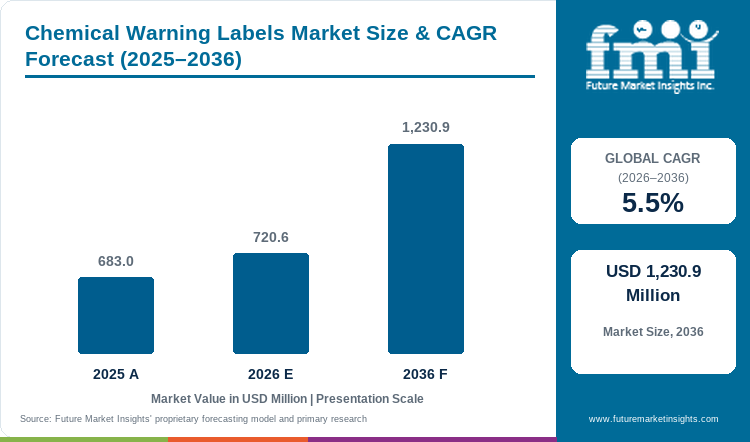
- Market Size (2026)
- USD 720.6 Mn
- Forecast (2036)
- USD 1230.9 Mn
- CAGR (2026 to 2036)
- 5.5%
How big is Chemical Warning Labels Market in 2026?
USD 720.6 million in 2026 and USD 1,230.9 million by 2036 at a 5.5% CAGR.
Sales of chemical warning labels are estimated to rise at 5.5% CAGR through 2036, increasing valuation from USD 683.0 million in 2025 to USD 720.6 million in 2026, and reaching USD 1,230.9 million by 2036. OSHA moved the compliance dates for its updated Hazard Communication Standard on January 15 2026. Chemical makers and importers are checking labels as those dates shift. Each check can call for new artwork or fresh stock. This work keeps demand active beyond one rule update.
Germany and Great Britain need separate label control. Germany follows EU CLP rules for chemical labels. Great Britain uses its own GB CLP system. HSE removed one GB substance notice duty on May 21 2026. Other class and label duties still apply. Suppliers serving both areas need two approved content sets. One label material can still work when it meets both strength needs.
Key Takeaways
- Chemical makers replace warning labels when hazard classes or required warning words change under new rules.
- The label type category is forecast to be led by GHS hazard labels at 34.0% share in 2026, supported by standard hazard use.
- Polyester is projected to hold 29.0% of material demand in 2026, due to strong film that keeps warning text clear during plant use.
- By printing method, thermal transfer is forecast to represent 31.0% in 2026, driven by clear print for data that changes by job.
- Testing can slow label replacement when new warning text also needs a new film, adhesive or print setup.
- Key players include Brady Corporation, Avery Dennison, 3M, CCL Industries and UPM Adhesive Materials. The list also includes TSC Auto ID, SATO, Labelmaster, Seton and Weber Packaging Solutions.
Analyst Perspective
"Suppliers win repeat orders by handling rule changes and label strength together. Buyers save time by approving strong label stock that can take new artwork without full retesting."
- Nandini Roy Choudhury, Principal Consultant, Future Market Insights
How is the chemical warning labels market segmented?
Chemical Warning Labels Market is segmented by Label Type, Material, Printing Method, End Use, Sales Channel, and Region.
The market uses label type, material, printing method, end use, sales channel and region. Label types cover GHS hazard, HMIS - NFPA, drum, lab chemical and pipe marker. Materials include polyester, vinyl, paper, polypropylene and metalized - harsh environment stock. Printing includes thermal transfer, digital, flexographic, laser printable and pre-printed stock. End uses cover chemical manufacturing, laboratories, warehousing - logistics, oil & gas and pharma. Sales channels include industrial label suppliers, safety product distributors, e-commerce - catalog and custom print service.
What supports GHS hazard labels within the label type category?
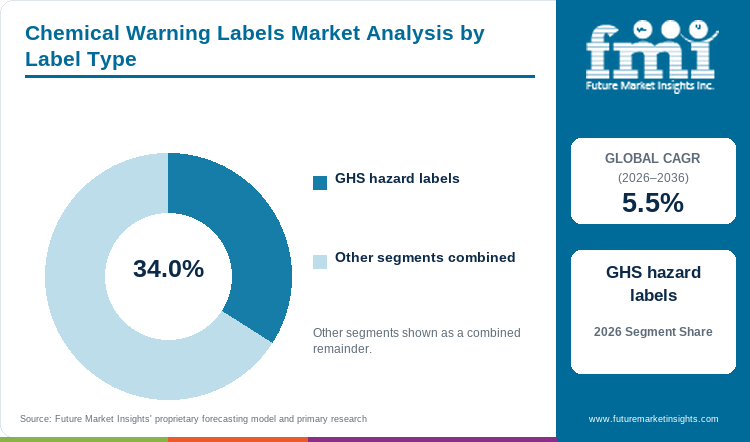
GHS hazard labels turn hazard classes into standard safety label formats for containers and work areas. Pictograms and signal words give staff one clear system. HMIS - NFPA labels and pipe markers handle site marking. Drum and lab labels handle smaller packs. GHS labels follow chemicals from supply to use.
- Based on label type, GHS hazard labels are projected to account for 34.0% in 2026, supported by standard chemical hazard use.
- UNECE GHS Revision 10 keeps labels and safety data sheets at the center of chemical hazard warnings.
How does polyester influence material selection for chemical warning labels?
Polyester keeps warning text clear after splashes, moisture and repeated handling. Its stable film works with self-adhesive labels on hard containers. Vinyl suits uneven surfaces. Paper suits dry or short-life use. Polypropylene and metalized stock handle tougher exposure. Buyers choose polyester when labels must stay clear through normal use.
- By material, polyester is estimated to hold 29.0% in 2026, attributed to strong film on chemical containers and work surfaces.
- UPM Adhesive Materials launched UPM Endurance in June 2026. It targets oil and chemical labels on hard surfaces.
Why does thermal transfer remain important within the printing method category?
Thermal transfer lets plants print changing warning data without long pre-print runs. Approved films and thermal transfer ribbons protect barcodes and hazard text. Digital and flexographic printing suit larger or color-rich runs. Laser printable and pre-printed stock suit simple jobs. Plants use thermal transfer when job data changes but print must stay clear.
- In 2026, thermal transfer is expected to lead printing method with 31.0% share, shaped by durable print and short print runs.
- TSC Auto ID expanded its TH DH printer line in January 2026. The update added more media and RFID choices for label jobs.
What makes chemical manufacturing central to the end use category?
Chemical makers create supplier labels when hazard classes become printed warnings. This work starts before drums and small packs move downstream. Labels are part of industrial chemical packaging because pack and warning move together. Labs and drug makers use smaller runs. Warehouses and oil & gas sites need labels that survive transfer and field use.
- By end use, chemical manufacturing is forecast to represent 31.0% in 2026, linked to supplier-label duties at plants and import.
- OSHA changed label update rules for chemical suppliers in 2024. It also added specific rules for small chemical containers.
What supports industrial label suppliers within the sales channel category?
Industrial label suppliers help plants choose film, adhesive and print methods. They match these parts to drums and work containers before production. They also provide printed labels when fixed graphics and changing data share one design. Safety distributors make repeat buying easier. E-commerce and catalog channels suit repeat stock orders. Custom printers handle artwork or run-size changes.
- Industrial label suppliers are set to lead the sales channel with 36.0% share in 2026, supported by stock choice and repeat supply.
- UPM Adhesive Materials and Mark Andy renewed their Americas partnership in April 2026. The deal covers label stock for several press types.
What are the drivers, restraints and opportunities in the Chemical Warning Labels Market?
Regulatory revisions sustain label replacement, qualification work can delay changeovers, and controlled on-demand printing reduces obsolete stock during frequent content updates.
- Driver: Changes to hazard rules create repeat artwork work and label replacement for chemicals that are already in use.
- Restraint: Material tests and content checks can slow a label change when one product is sold under several rule systems.
- Opportunity: Approved local printing can cut old stock and shorten the move from new warning text to usable labels.
Regulatory revisions create repeat replacement demand
Chemical suppliers change warning labels when legal hazard classes or required warning parts change. The European Commission revised CLP rules in December 2024. The change set clearer display rules for some label content. Plants must place approved artwork on the right pack before old stock reaches its final use date. Old stock can lose value once that date passes. Chemical makers match label files with plant production and shipping plans. The printed warning must match the current hazard class. Good file control helps suppliers order new labels on time and avoid mixing old and new text. It also lets them keep the same tested label stock when only the wording changes.
Qualification work can slow a necessary label revision
A new hazard statement may not pass an old label test. The label must still stick well and keep its print. It must also handle heat, water or chemical contact. HSE guidance keeps GB CLP labels tied to required words and pictograms. Global teams need separate files when EU and GB content differs. A new label may need printer and surface tests before a plant can use it. The work grows when industrial adhesives or label films also change. Reusing a tested label base can cut this extra work. It keeps local wording correct without forcing a full test for every update. Plants need records that link each approved build to the right product.
On-demand printing can reduce obsolete approved stock
Chemical sites lose money when pre-printed labels become old before use. Approved templates can send new content to local print queues soon after a rule change. Plants do not have to wait for a full pre-print order. Brady updated its mobile label software in February 2026. The release added printer support and layout changes. Similar industrial printers let plants print changing data near the point of use. The sales chance is not the printer alone. Suppliers can pair local print control with label stock that already passed material tests. Faster updates can cut wasted stock and repeat work. Plants still keep the records needed for label approval, use and later checks.
Which country CAGRs are profiled in the Chemical Warning Labels Market?
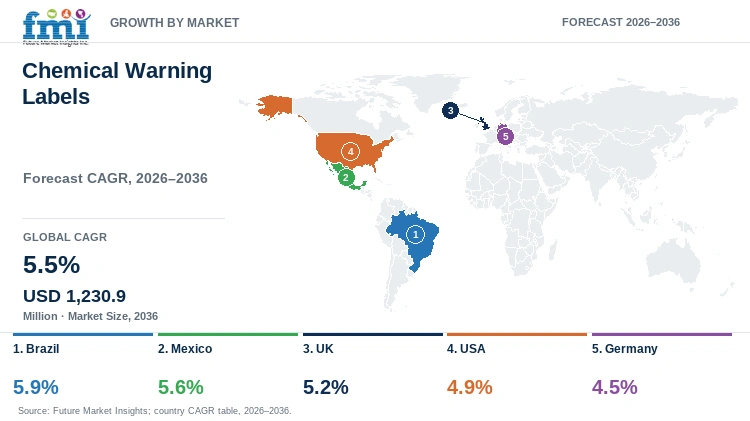
| Country | CAGR |
|---|---|
| Brazil | 5.9% |
| Mexico | 5.6% |
| UK | 5.2% |
| USA | 4.9% |
| Germany | 4.5% |
How do country-level CAGRs compare in the Chemical Warning Labels Market?
Brazil and Mexico are expected to witness expansion at 5.9% and 5.6% CAGR. The UK follows at 5.2%. The USA and Germany stay below 5.0%. The 1.4-point range compares forecast speed, not current size. Different rules create different label needs.
- Brazil uses GHS-based workplace rules that keep Portuguese warning text and local label control important during repeat orders.
- Mexico uses a national standard linked in part to GHS, so exporters must manage Spanish hazard text with care.
- UK suppliers keep GB chemical content, while some products also need a separate EU-approved label for sale.
- US plants are using revised HCS rules that change small-container labels and some shipment label duties.
- German firms follow EU CLP rules and language needs that make strong artwork control important for each label version.
Similar CAGRs can still create different buying needs because each country uses its own rules, packs and label process. The full report covers North America, Latin America, Western Europe and Eastern Europe. It also covers East Asia, South Asia and Pacific, and the Middle East and Africa.
Country-wise Analysis
- Brazilian chemical sites use NR-26 rules for GHS warning labels. By 2036, Brazil is projected to grow at 5.9% CAGR, linked to repeat hazard updates. The Ministry of Labor updated NR-26 in June 2025. The rule keeps preventive labels in the national safety system. Portuguese wording must match approved safety data for each product. Chemical use can stress films and adhesives on containers. Plants using label applicators still need clear warnings on each pack. Local artwork control can cut repeat-order errors. Each plant needs a record for every approved Portuguese label. That record helps the next order use the right file.
- Mexican industrial sites use NOM-018-STPS-2015 for chemical hazard communication. Chemical warning label demand is forecast to rise at 5.6% CAGR over the forecast period, tied to this national rule base. The official standards site lists the NOM as current and records an October 2018 start date. Exporters may serve markets using newer GHS versions. Each Spanish version needs clear file control. Some smart labels add tracking data but do not replace the required hazard warning. Separate local and export files can cut artwork errors. They also help repeat orders use the right Spanish warning file for each local market.
- Great Britain uses GB CLP for chemicals placed on the market. The UK chemical warning labels sector is projected to record 5.2% CAGR during the assessment period, shaped by changes in label rules. HSE removed the substance notice duty on May 21 2026. Other GB CLP supplier duties still apply. Firms trading with the EU must manage two approved content sets. One tested label stock can serve both routes when strength needs match. The hard task is keeping GB and EU files apart. Controlled GB templates support repeat orders without mixing versions and can limit needless reprints before shipment.
- US chemical makers are using the revised Hazard Communication Standard while older stock remains in use. The USA is estimated to post 4.9% CAGR over the forecast period, supported by repeat compliance work in a mature chemical base. OSHA changed label update rules in May 2024 and added rules for small containers. Plants must turn those rules into clear labels without stopping production. Existing stock still needs to resist chemicals and handling. The main task is matching supplier labels with worksite plans and inventory. Controlled templates can shorten updates, cut needless replacement work and keep the right label with each product.
- German chemical suppliers use EU CLP rules before dangerous products enter the market. In Germany, chemical warning label demand is predicted to advance at 4.5% CAGR through 2036, influenced by detailed label rules. BAuA lists pictograms, signal words, hazard statements and safety statements as core label parts. Products sold in several languages can need more artwork files. Buyers prefer one tested label stock base. The hard task is keeping text current without creating too many label builds. Strong file and print control supports planned replacement with fewer material tests. It also keeps each language version in order during repeat orders.
Who are the notable companies in the Chemical Warning Labels Market?
Brady Corporation, Avery Dennison, 3M, CCL Industries, UPM Adhesive Materials, TSC Auto ID, SATO, Labelmaster, Seton, and Weber Packaging Solutions are active within the defined chemical warning label supply boundary.
Firms compete through three routes: safety labels, label stock and plant print systems. Brady owns Seton, so those names share a business route. Material firms compete on film and adhesive strength. Printer firms handle changing data. Sellers need proof of rule fit and label strength.
- Brady Corporation and Labelmaster serve safety label work. Seton and Weber Packaging Solutions also serve regulated chemical labeling needs.
- Avery Dennison and 3M supply film and label materials. CCL Industries and UPM Adhesive Materials add converting work and strong films.
- TSC Auto ID and SATO supply plant printers. They also support auto-ID tasks for changing label data.
Competitive Benchmarking: Chemical Warning Labels Market
| Company | Hazard-Label Solution Depth | Durable Media Capability | On-Demand Print Integration | Geographic Reach |
|---|---|---|---|---|
| Brady Corporation | High | High | High | Global |
| Avery Dennison | Medium | High | Medium | Global |
| 3M | Medium | High | Low | Global |
| CCL Industries | High | High | High | Global |
| UPM Adhesive Materials | Medium | High | Medium | Americas, Europe and Asia-Pacific |
| TSC Auto ID | Low | Low | High | Global |
| SATO | Low | Medium | High | Global |
| Labelmaster | High | Medium | Medium | North America with international DG support |
| Seton | High | Medium | Low | North America and selected international channels |
| Weber Packaging Solutions | High | High | High | North America with international group coverage |
Scoring basis: High needs broad current proof. Medium needs clear but narrower proof. Low marks a limited role. Geographic reach is stated in words and not scored.
Key Developments in the Chemical Warning Labels Market
- In August 2026, Brady Corporation completed the Honeywell PSS purchase. The deal added mobile computing, scanning, RFID and workflow software to its ID platform.
- In March 2026, UPM Adhesive Materials announced a new cutting and distribution terminal near New Delhi. The site adds local label stock service in India.
- In March 2026, Weber Packaging Solutions bought AT Information Products. The deal expanded thermal inkjet labeling and coding work in North America.
Key Players in the Chemical Warning Labels Market
Compliance-ready label and safety specialists
- Brady Corporation
- Labelmaster
- Seton
- Weber Packaging Solutions
Durable material and converting platforms
- Avery Dennison
- 3M
- CCL Industries
- UPM Adhesive Materials
Industrial print and auto-ID systems
- TSC Auto ID
- SATO
Chemical Warning Labels Market - Report Scope
| Coverage field | Report scope |
|---|---|
| Market breakdown | By label type, material, printing method, end use, sales channel and region. |
| Quantitative Units | USD million. |
| Market Definition | Physical warning and hazard labels used to communicate chemical risk on containers, workplace packages and industrial identification points are included. Printer hardware, label-design software, SDS services and unrelated safety signage are excluded. |
| Regions Covered | North America, Latin America, Western Europe, Eastern Europe, East Asia, South Asia and Pacific, and Middle East and Africa. |
| Countries Covered | Brazil, Mexico, UK, USA, Germany, and 20+ countries included in the full report. |
| Key Companies Profiled | Brady Corporation, Avery Dennison, 3M, CCL Industries, UPM Adhesive Materials, TSC Auto ID, SATO, Labelmaster, Seton, Weber Packaging Solutions. |
| Forecast Period | 2026 to 2036. |
| Approach | Primary and secondary research with market triangulation. |
Chemical Warning Labels Market - Research Methodology
| Method | Approach |
|---|---|
| Primary Research | FMI analysts gathered input from manufacturers, service providers, technology developers, distributors, end users, procurement teams, and subject-matter experts. Interviews examined purchasing decisions, product or service evaluation, adoption barriers, approval requirements, pricing considerations, and expectations for technical or commercial support. Respondents were also asked what evidence is required before a trial, pilot, or initial order develops into regular purchasing. |
| Desk Research | Desk research covered government statistics, regulatory publications, trade data, industry associations, technical literature, standards, company filings, product information, and official corporate announcements. Sources were reviewed for relevance, publication date, geographic coverage, and consistency with the defined market scope. Claims relating to performance, applications, approvals, capacity, investment, and commercial activity were retained only when supported by credible public evidence. |
| Market Sizing and Forecasting | The market model combined the baseline value with historical performance, segment structure, pricing and volume indicators, adoption levels, company participation, and country-level demand conditions. Forecast assumptions considered economic activity, investment trends, regulatory developments, technology adoption, purchasing cycles, supply availability, and barriers to wider market use. Segment and regional estimates were reconciled before the final market total was calculated. |
| Data Validation | Estimates were checked against multiple independent indicators, including public data, company activity, trade patterns, industry developments, and findings from primary interviews. Validation also tested whether products, services, applications, and company revenues fell within the defined market boundaries. Adjacent categories, unsupported claims, overlapping revenues, and activities without direct market relevance were excluded to reduce double counting and maintain consistency across segments and countries. |
Chemical Warning Labels Market by Segments
Chemical Warning Labels Market segmented by Label Type:
- GHS hazard labels
- HMIS - NFPA labels
- Drum labels
- Laboratory chemical labels
- Pipe marker labels
Chemical Warning Labels Market segmented by Material:
- Polyester
- Vinyl
- Paper
- Polypropylene
- Metalized - harsh environment
Chemical Warning Labels Market segmented by Printing Method:
- Thermal transfer
- Digital print
- Flexographic
- Laser printable
- Pre-printed stock
Chemical Warning Labels Market segmented by End Use:
- Chemical manufacturing
- Laboratories
- Warehousing - logistics
- Oil & gas
- Pharma
Chemical Warning Labels Market segmented by Sales Channel:
- Industrial label suppliers
- Safety product distributors
- E-commerce - catalog
- Custom print service
Chemical Warning Labels Market by Region:
- North America
- United States
- Canada
- Latin America
- Brazil
- Mexico
- Argentina
- Chile
- Rest of Latin America
- Western Europe
- Germany
- France
- United Kingdom
- Italy
- Spain
- Benelux
- Nordics
- Rest of Western Europe
- Eastern Europe
- Poland
- Czech Republic
- Romania
- Hungary
- Rest of Eastern Europe
- East Asia
- China
- Japan
- South Korea
- South Asia and Pacific
- India
- ASEAN
- Australia and New Zealand
- Rest of South Asia and Pacific
- Middle East and Africa
- GCC Countries
- South Africa
- Türkiye
- Israel
- Rest of Middle East and Africa
Research Sources and Bibliography
- Occupational Safety and Health Administration. (2026, January 15). HCS 2024 Compliance date extension notice.
- Health and Safety Executive. (2026, May 20). Changes to the GB CLP Regulation.
- United Nations Economic Commission for Europe. (2023, July 27). Globally Harmonized System of Classification and Labelling of Chemicals (GHS Rev. 10, 2023).
- UPM Adhesive Materials. (2026, June 8). UPM delivers purpose-built adhesive solutions for demanding label applications.
- TSC Auto ID. (2026, January 21). TSC Auto ID Strengthens Breadth and Depth of TH DH Series.
- Occupational Safety and Health Administration. (2024, May 20). Hazard Communication Standard; Final Rule.
- UPM Adhesive Materials. (2026, April 8). UPM and Mark Andy renew strategic partnership in the Americas for seventh consecutive year.
- European Commission, Directorate-General for Environment. (2024, December 10). Revised Regulation on Classification, Labelling and Packaging of Chemicals enters into force.
- Health and Safety Executive. (n.d.). Labelling and packaging.
- Brady Corporation. (2026, February). Express Labels Mobile - Release Notes.
- Bundesanstalt für Arbeitsschutz und Arbeitsmedizin. (n.d.). Kennzeichnungselemente.
- Secretaría de Economía, Mexico. (n.d.). NOM-018-STPS-2015.
- Ministério do Trabalho e Emprego, Brazil. (2025, June 2). Norma Regulamentadora No. 26 (NR-26).
- Brady Corporation. (2026, August 3). Brady Corporation Completes Acquisition of Honeywell Productivity Solutions and Services Business.
- UPM Adhesive Materials. (2026, March 30). UPM strengthens presence in India with a new Adhesive Materials terminal near New Delhi.
- Weber Packaging Solutions. (2026, March 10). Weber acquires ATIP to expand thermal inkjet capabilities in N.A..
- Avery Dennison. (2026, September 15). Avery Dennison announces new Active Bluetooth Low Energy label range.
- CCL Industries. (2026, June 1). CCL Industries Closing of Sleever International Acquisition.
- UPM Adhesive Materials. (2026, May 5). UPM introduces a new portfolio of label solutions designed for packaging recyclability.
- Labelmaster Software Knowledge Center. (2026, June 12). DGIS 5.8 Release Notes.
- SATO Corporation. (2026, January 22). SATO Publishes Results of Digital Product Passport Proof of Concept.
- Avery Dennison. (2026, July 16). AD CleanFlake RFID tags from Avery Dennison receive RecyClass Technology Approval for PET bottle recyclability.
- 3M. (2026, June 22). 3M launches Ask 3M, an AI-powered tool for faster access to technical expertise.
- CCL Industries. (2026, May 1). CCL Industries Closing of ALT Technologies Acquisition.
- SATO Corporation. (2026, June 23). SATO acquires Hiranoya Bussan as a wholly-owned subsidiary to strengthen its smart packaging business.
- Labelmaster Software Knowledge Center. (2026, March 6). DGIS 5.7 Release Notes (03/8/26).
- Brady Corporation. (2026, September 3). Brady Corporation Reports 2026 Fourth Quarter and Record Full Year Results.
- UPM Adhesive Materials. (2026, August 10). UPM showcases adhesive expertise and premium label solutions at LOUPE 2026 in Chicago.
- TSC Auto ID. (2026, May 20). TSC Auto ID and TEKLYNX Expand RAIN RFID Capabilities with Enhanced CODESOFT Functionalities.
- SATO Corporation. (2026, May 21). SATO's Flagship Industrial Label Printer CL4-SXR Wins Red Dot Design Award 2026.
This bibliography is provided for reader reference and is not exhaustive. The full report contains the complete reference list and detailed citations
This Report Answers
- What is the chemical warning labels market worth in 2026 and 2036?
- How do changes in hazard rules lead to repeat label replacement?
- Why do GHS hazard labels account for 34.0% of label type?
- How does polyester keep warning text clear on chemical containers?
- Why does thermal transfer account for 31.0% of printing method?
- How do growth rates differ in Brazil, Mexico, UK, USA and Germany?
- What can slow a label change after new content is approved?
- Which companies supply labels, materials, converting services and print systems?
- How can local printing reduce old pre-printed label stock?
Frequently Asked Questions
How big is the chemical warning labels market in 2026?
The market is worth USD 720.6 million in 2026. It is projected to reach USD 1,230.9 million by 2036. Rule changes keep label updates active.
What is the CAGR of the chemical warning labels market from 2026 to 2036?
The market is projected to grow at 5.5% CAGR from 2026 to 2036. Repeat hazard updates and strong labels support this path.
Which label type leads the chemical warning labels market?
GHS hazard labels are expected to hold 34.0% of label type demand in 2026. Standard pictograms and warning words suit many chemical tasks.
Which material holds a dominant share in the chemical warning labels market?
Polyester is estimated to hold 29.0% of material demand in 2026. Its film keeps warning text clear through water, rubbing and chemical contact.
Which printing method holds a dominant share in the chemical warning labels market?
Thermal transfer is projected to hold 31.0% of printing method demand in 2026. Plants use it for changing data that still needs a lasting print.
What are the profiled country CAGRs for Brazil, Mexico, UK, USA and Germany?
Brazil is projected to grow at 5.9% CAGR through 2036. Mexico follows at 5.6% and the UK at 5.2%. National rules shape different label needs.
Which companies are active in the chemical warning labels market?
Key companies include Brady Corporation, Avery Dennison, 3M, CCL Industries and UPM Adhesive Materials. Other key names are TSC Auto ID, SATO, Labelmaster, Seton and Weber Packaging Solutions. Their roles cover labels, materials, converting and print systems.
Preview the report firsthand - request a free sample
Get SampleGet the brochure for pricing and purchase details.
Get PDFTable of Content
- Key Takeaways
- Market Size and CAGR
- Top Growth Driver
- Fastest Growing Segment
- Leading Region
- Key Companies
- Emerging Opportunities
- Executive Summary
- Global Market Outlook
- Demand-side Trends
- Supply-side Trends
- Technology Roadmap Analysis
- Analysis and Recommendations
- Analyst Perspective (What is happening? Why now? What should investors know?)
- Key Questions Answered
- How large is the market?
- What is the CAGR?
- What are key trends?
- Which region dominates?
- Who are the leaders?
- Market Overview
- Market Coverage / Taxonomy
- Market Definition / Scope / Limitations
- Research Methodology
- Chapter Orientation
- Analytical Lens and Working Hypotheses
- Market Structure, Signals, and Trend Drivers
- Benchmarking and Cross-market Comparability
- Market Sizing, Forecasting, and Opportunity Mapping
- Research Design and Evidence Framework
- Desk Research Programme (Secondary Evidence)
- Expert Input and Fieldwork (Primary Evidence)
- Tooling, Models, and Reference Databases
- Data Engineering and Model Build
- Quality Assurance and Audit Trail
- Market Background
- Market Dynamics (Drivers, Restraints, Opportunity, Trends)
- Scenario Forecast (Optimistic, Likely, Conservative)
- Impact Analysis
- AI Impact
- Sustainability Impact
- Regulatory Impact
- Technology Impact
- Consumer / Buyer Analysis
- Purchase Drivers
- Adoption Barriers
- Buyer Journey
- Opportunity Map Analysis
- Product Life Cycle Analysis
- Supply Chain Analysis
- Investment Feasibility Matrix
- Value Chain Analysis
- PESTLE and Porter's Analysis
- Regulatory Landscape
- Regional Parent Market Outlook
- Production and Consumption Statistics
- Import and Export Statistics
- Global Market Analysis and Forecast, 2021 to 2036
- Historical Market Size Value (USD Million) Analysis, 2021 to 2025
- Current and Future Market Size Value (USD Million) Projections, 2026 to 2036
- Y-o-Y Growth Trend Analysis
- Absolute $ Opportunity Analysis
- Global Market Pricing Analysis, 2021 to 2036
- Global Market Analysis and Forecast, By Label Type, 2021 to 2036
- Introduction / Key Findings
- Historical Market Size Value (USD Million) Analysis By Label Type, 2021 to 2025
- Current and Future Market Size Value (USD Million) Analysis and Forecast By Label Type, 2026 to 2036
- GHS hazard labels
- HMIS - NFPA labels
- Drum labels
- Laboratory chemical labels
- Pipe marker labels
- Y-o-Y Growth Trend Analysis By Label Type, 2021 to 2025
- Absolute $ Opportunity Analysis By Label Type, 2026 to 2036
- Global Market Analysis and Forecast, By Material, 2021 to 2036
- Introduction / Key Findings
- Historical Market Size Value (USD Million) Analysis By Material, 2021 to 2025
- Current and Future Market Size Value (USD Million) Analysis and Forecast By Material, 2026 to 2036
- Polyester
- Vinyl
- Paper
- Polypropylene
- Metalized - harsh environment
- Y-o-Y Growth Trend Analysis By Material, 2021 to 2025
- Absolute $ Opportunity Analysis By Material, 2026 to 2036
- Global Market Analysis and Forecast, By Printing Method, 2021 to 2036
- Introduction / Key Findings
- Historical Market Size Value (USD Million) Analysis By Printing Method, 2021 to 2025
- Current and Future Market Size Value (USD Million) Analysis and Forecast By Printing Method, 2026 to 2036
- Thermal transfer
- Digital print
- Flexographic
- Laser printable
- Pre-printed stock
- Y-o-Y Growth Trend Analysis By Printing Method, 2021 to 2025
- Absolute $ Opportunity Analysis By Printing Method, 2026 to 2036
- Global Market Analysis and Forecast, By End Use, 2021 to 2036
- Introduction / Key Findings
- Historical Market Size Value (USD Million) Analysis By End Use, 2021 to 2025
- Current and Future Market Size Value (USD Million) Analysis and Forecast By End Use, 2026 to 2036
- Chemical manufacturing
- Laboratories
- Warehousing - logistics
- Oil & gas
- Pharma
- Y-o-Y Growth Trend Analysis By End Use, 2021 to 2025
- Absolute $ Opportunity Analysis By End Use, 2026 to 2036
- Global Market Analysis and Forecast, By Sales Channel, 2021 to 2036
- Introduction / Key Findings
- Historical Market Size Value (USD Million) Analysis By Sales Channel, 2021 to 2025
- Current and Future Market Size Value (USD Million) Analysis and Forecast By Sales Channel, 2026 to 2036
- Industrial label suppliers
- Safety product distributors
- E-commerce - catalog
- Custom print service
- Y-o-Y Growth Trend Analysis By Sales Channel, 2021 to 2025
- Absolute $ Opportunity Analysis By Sales Channel, 2026 to 2036
- Global Market Analysis and Forecast, By Region, 2021 to 2036
- Introduction
- Historical Market Size Value (USD Million) Analysis By Region, 2021 to 2025
- Current Market Size Value (USD Million) Analysis and Forecast By Region, 2026 to 2036
- North America
- Latin America
- Western Europe
- Eastern Europe
- East Asia
- South Asia and Pacific
- Middle East and Africa
- Market Attractiveness Analysis By Region
- North America Market Analysis and Forecast, By Country, 2021 to 2036
- Historical Market Size Value (USD Million) Trend Analysis By Market Taxonomy, 2021 to 2025
- Market Size Value (USD Million) Forecast By Market Taxonomy, 2026 to 2036
- By Country
- United States
- Canada
- By Label Type
- By Material
- By Printing Method
- By End Use
- By Sales Channel
- By Country
- Market Attractiveness Analysis
- By Country
- By Label Type
- By Material
- By Printing Method
- By End Use
- By Sales Channel
- Key Takeaways
- Latin America Market Analysis and Forecast, By Country
- Historical Market Size Value (USD Million) Trend Analysis By Market Taxonomy, 2021 to 2025
- Market Size Value (USD Million) Forecast By Market Taxonomy, 2026 to 2036
- By Country
- Brazil
- Mexico
- Argentina
- Chile
- Rest of Latin America
- By Label Type
- By Material
- By Printing Method
- By End Use
- By Sales Channel
- By Country
- Market Attractiveness Analysis
- By Country
- By Label Type
- By Material
- By Printing Method
- By End Use
- By Sales Channel
- Key Takeaways
- Western Europe Market Analysis and Forecast, By Country
- Historical Market Size Value (USD Million) Trend Analysis By Market Taxonomy, 2021 to 2025
- Market Size Value (USD Million) Forecast By Market Taxonomy, 2026 to 2036
- By Country
- Germany
- France
- United Kingdom
- Italy
- Spain
- Benelux
- Nordics
- Rest of Western Europe
- By Label Type
- By Material
- By Printing Method
- By End Use
- By Sales Channel
- By Country
- Market Attractiveness Analysis
- By Country
- By Label Type
- By Material
- By Printing Method
- By End Use
- By Sales Channel
- Key Takeaways
- Eastern Europe Market Analysis and Forecast, By Country
- Historical Market Size Value (USD Million) Trend Analysis By Market Taxonomy, 2021 to 2025
- Market Size Value (USD Million) Forecast By Market Taxonomy, 2026 to 2036
- By Country
- Poland
- Czech Republic
- Romania
- Hungary
- Rest of Eastern Europe
- By Label Type
- By Material
- By Printing Method
- By End Use
- By Sales Channel
- By Country
- Market Attractiveness Analysis
- By Country
- By Label Type
- By Material
- By Printing Method
- By End Use
- By Sales Channel
- Key Takeaways
- East Asia Market Analysis and Forecast, By Country
- Historical Market Size Value (USD Million) Trend Analysis By Market Taxonomy, 2021 to 2025
- Market Size Value (USD Million) Forecast By Market Taxonomy, 2026 to 2036
- By Country
- China
- Japan
- South Korea
- By Label Type
- By Material
- By Printing Method
- By End Use
- By Sales Channel
- By Country
- Market Attractiveness Analysis
- By Country
- By Label Type
- By Material
- By Printing Method
- By End Use
- By Sales Channel
- Key Takeaways
- South Asia and Pacific Market Analysis and Forecast, By Country
- Historical Market Size Value (USD Million) Trend Analysis By Market Taxonomy, 2021 to 2025
- Market Size Value (USD Million) Forecast By Market Taxonomy, 2026 to 2036
- By Country
- India
- ASEAN
- Australia and New Zealand
- Rest of South Asia and Pacific
- By Label Type
- By Material
- By Printing Method
- By End Use
- By Sales Channel
- By Country
- Market Attractiveness Analysis
- By Country
- By Label Type
- By Material
- By Printing Method
- By End Use
- By Sales Channel
- Key Takeaways
- Middle East and Africa Market Analysis and Forecast, By Country
- Historical Market Size Value (USD Million) Trend Analysis By Market Taxonomy, 2021 to 2025
- Market Size Value (USD Million) Forecast By Market Taxonomy, 2026 to 2036
- By Country
- GCC Countries
- South Africa
- Türkiye
- Israel
- Rest of Middle East and Africa
- By Label Type
- By Material
- By Printing Method
- By End Use
- By Sales Channel
- By Country
- Market Attractiveness Analysis
- By Country
- By Label Type
- By Material
- By Printing Method
- By End Use
- By Sales Channel
- Key Takeaways
- Key Countries Market Analysis
- United States
- Pricing Analysis
- Market Share Analysis, 2025
- By Label Type
- By Material
- By Printing Method
- By End Use
- By Sales Channel
- Canada
- Pricing Analysis
- Market Share Analysis, 2025
- By Label Type
- By Material
- By Printing Method
- By End Use
- By Sales Channel
- Mexico
- Pricing Analysis
- Market Share Analysis, 2025
- By Label Type
- By Material
- By Printing Method
- By End Use
- By Sales Channel
- Brazil
- Pricing Analysis
- Market Share Analysis, 2025
- By Label Type
- By Material
- By Printing Method
- By End Use
- By Sales Channel
- Chile
- Pricing Analysis
- Market Share Analysis, 2025
- By Label Type
- By Material
- By Printing Method
- By End Use
- By Sales Channel
- Germany
- Pricing Analysis
- Market Share Analysis, 2025
- By Label Type
- By Material
- By Printing Method
- By End Use
- By Sales Channel
- United Kingdom
- Pricing Analysis
- Market Share Analysis, 2025
- By Label Type
- By Material
- By Printing Method
- By End Use
- By Sales Channel
- Italy
- Pricing Analysis
- Market Share Analysis, 2025
- By Label Type
- By Material
- By Printing Method
- By End Use
- By Sales Channel
- Spain
- Pricing Analysis
- Market Share Analysis, 2025
- By Label Type
- By Material
- By Printing Method
- By End Use
- By Sales Channel
- France
- Pricing Analysis
- Market Share Analysis, 2025
- By Label Type
- By Material
- By Printing Method
- By End Use
- By Sales Channel
- India
- Pricing Analysis
- Market Share Analysis, 2025
- By Label Type
- By Material
- By Printing Method
- By End Use
- By Sales Channel
- ASEAN
- Pricing Analysis
- Market Share Analysis, 2025
- By Label Type
- By Material
- By Printing Method
- By End Use
- By Sales Channel
- Australia and New Zealand
- Pricing Analysis
- Market Share Analysis, 2025
- By Label Type
- By Material
- By Printing Method
- By End Use
- By Sales Channel
- China
- Pricing Analysis
- Market Share Analysis, 2025
- By Label Type
- By Material
- By Printing Method
- By End Use
- By Sales Channel
- Japan
- Pricing Analysis
- Market Share Analysis, 2025
- By Label Type
- By Material
- By Printing Method
- By End Use
- By Sales Channel
- South Korea
- Pricing Analysis
- Market Share Analysis, 2025
- By Label Type
- By Material
- By Printing Method
- By End Use
- By Sales Channel
- Poland
- Pricing Analysis
- Market Share Analysis, 2025
- By Label Type
- By Material
- By Printing Method
- By End Use
- By Sales Channel
- Hungary
- Pricing Analysis
- Market Share Analysis, 2025
- By Label Type
- By Material
- By Printing Method
- By End Use
- By Sales Channel
- Türkiye
- Pricing Analysis
- Market Share Analysis, 2025
- By Label Type
- By Material
- By Printing Method
- By End Use
- By Sales Channel
- South Africa
- Pricing Analysis
- Market Share Analysis, 2025
- By Label Type
- By Material
- By Printing Method
- By End Use
- By Sales Channel
- United States
- Market Structure Analysis
- Competition Dashboard
- Competition Benchmarking
- Market Share Analysis of Top Players
- By Regional
- By Label Type
- By Material
- By Printing Method
- By End Use
- By Sales Channel
- Emerging Startups
- Innovation Benchmarking
- Competition Analysis
- Competition Deep Dive
- Brady Corporation
- Overview
- Product Portfolio
- Profitability by Market Segments
- Sales Footprint
- Strategy Overview
- Marketing Strategy
- Product Strategy
- Channel Strategy
- Avery Dennison
- 3M
- CCL Industries
- UPM Adhesive Materials
- TSC Auto ID
- SATO
- Labelmaster
- Seton
- Weber Packaging Solutions
- Brady Corporation
- Case Studies
- Success Stories
- Recent Developments
- Competition Deep Dive
- Assumptions & Acronyms Used


