
- Market Size (2026)
- USD 14.5 Bn
- Forecast (2036)
- USD 21.1 Bn
- CAGR (2026 to 2036)
- 3.8%
How Big Is the Coffee Substitute Market in 2026?
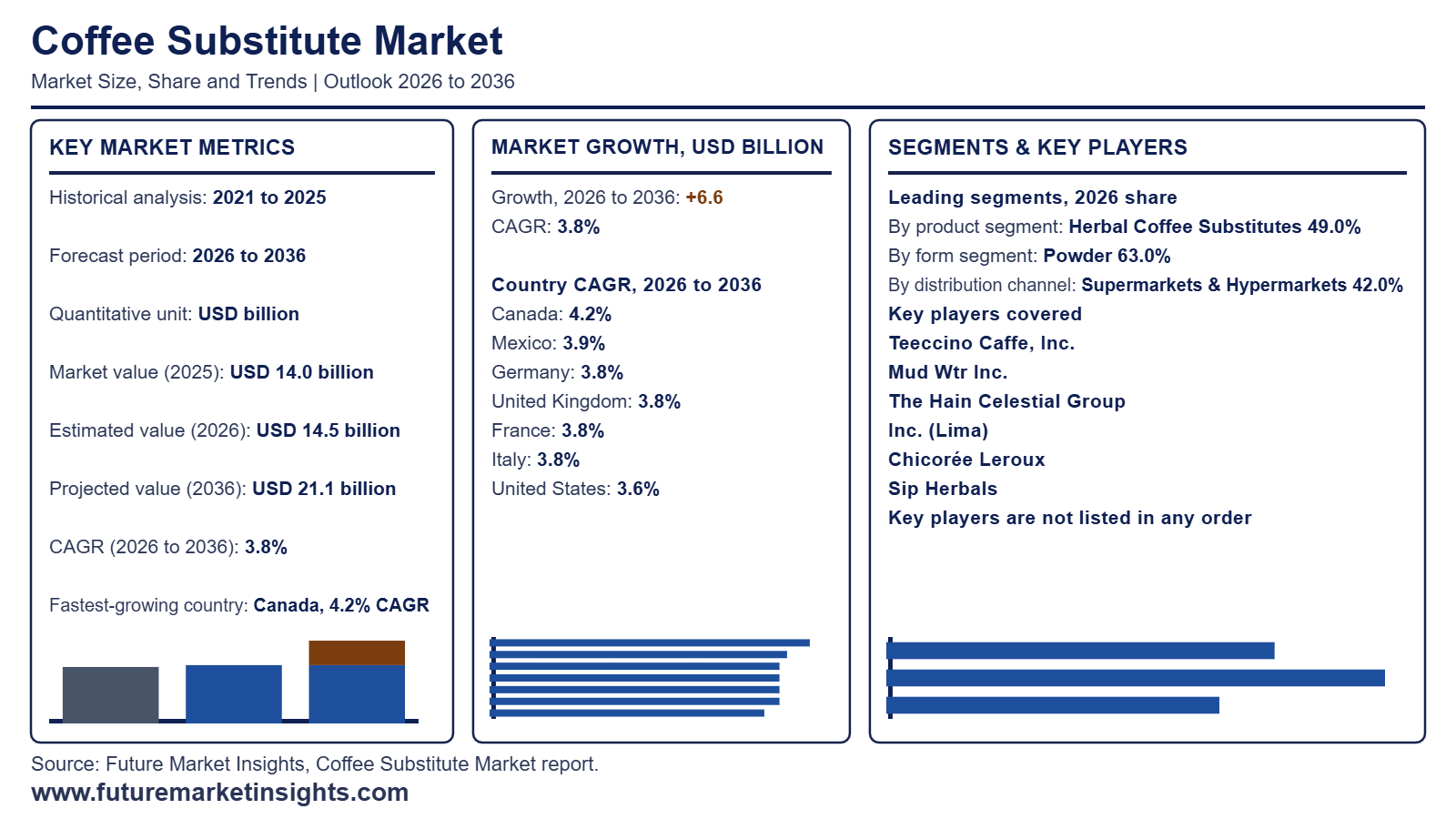
Global coffee substitute market evolved from a 2025 valuation of USD 14.0 billion to USD 14.5 billion in 2026, and as per Future Market Insights (FMI) analysis is set to achieve USD 21.1 billion by 2036, reflecting a 3.8% CAGR and generating USD 6.6 billion in incremental dollar opportunity over the ten-year period.
| Market Metric | Valuation / Share / Forecast Benchmark |
|---|---|
| 2025 Market Size (Historical) | USD 14.0 billion |
| 2026 Market Size (Estimated) | USD 14.5 billion |
| 2036 Market Size (Projected) | USD 21.1 billion |
| Compound Annual Growth Rate (2026 to 2036) | 3.8% CAGR |
| Incremental Dollar Opportunity (2026 to 2036) | USD 6.6 billion |
| Dominant Product Segment (2026 Share) | Herbal Coffee Substitutes (49.0% in 2026) | Other Segment Combined (51.0%) | Total (100.0%) |
| Dominant Form Segment (2026 Share) | Powder (63.0% in 2026) | Other Segment Combined (37.0%) | Total (100.0%) |
| Dominant Distribution Channel (2026 Share) | Supermarkets & Hypermarkets (42.0% in 2026) | Other Segment Combined (58.0%) | Total (100.0%) |
| Largest Country Markets (2026 Valuation) | United States (USD 3.63 billion), Germany (USD 1.74 billion), France (USD 1.45 billion) |
| Fastest-Growing Country Markets (2026 to 2036) | Canada (4.2% CAGR), Mexico (3.9% CAGR), Germany, UK, France & Italy (3.8% CAGR each) |
| Leading Active Market Players | Teeccino Caffe, Inc., Mud Wtr Inc., The Hain Celestial Group, Inc. (Lima), Chicorée Leroux, Sip Herbals |
Source: Future Market Insights analysis of the coffee substitute market, 2026.
This Report Answers
- How large the coffee substitute market is in 2026 and what it reaches by 2036
- Which product, form and distribution channel segments lead in 2026
- What is driving demand and what is holding the category back
- Which countries grow fastest between 2026 and 2036
- What Teeccino Caffe and other leading players have launched
- How the coffee substitute market is defined, segmented and measured
Executive Market Overview
Consumer interest in reducing caffeine intake and digestive acidity is expanding retail space for roasted chicory and dandelion, providing comforting roasted coffee flavor without sleep disruption. herbal tea infusions. FMI finds that buyer conversion from conventional roast coffee to roasted chicory and dandelion is driven by elevated conventional coffee shelf prices and heightened consumer tracking of daily stimulant intake. Survey data released by the National Coffee Association (September 2026) confirms that 66.0% of American adults drank coffee in the past day and 83.0% of those drinkers prepared their beverages at home in 2026, while the Coffee Association of Canada (February 2026) reported in February 2026 that 71.0% of Canadian adults consumed coffee daily while shifting toward promotion-led grocery packs and at-home preparation.
Traditional brewed grain substitutes require filter equipment or steeping time, which limits workplace and commuter adoption unless brands offer rapid-dissolve formats. In FMI's view, manufacturers are lifting unit margins by combining microground botanicals and prebiotic chicory products into instant stick packs, single-serve K-Cup pods, and beanless oat-milk lattes. In June 2025, Teeccino Caffe, Inc. (June 2025) commercialized its Instant Teeccino range blending microground roasted herbs with dehydrated extracts, following the January 2025 launch by Minus Coffee via BevNET (January 2025) of an instant beanless Vanilla Oat Milk Latte delivering 50 mg of caffeine and 6 grams of pea protein per serving. Market sizing covers packaged Herbal Coffee Substitutes, Grain Based Coffee Substitutes, and Plant Based Coffee Substitutes in Powder and Liquid forms across retail channels, while excluding conventional and decaffeinated bean coffee, standalone leaf tea, and foodservice prepared beverage sales.
Analyst Perspective
"Coffee substitute brands will generate stronger repeat revenue from instant microground powders and single-serve brewer pods than from loose filter grounds, as household buyers demand 30-second preparation at a competitive cost per cup. The key commercial risk is allergen and stimulant ambiguity across barley, rye, and cacao blends, where undeclared gluten or residual caffeine triggers retail delisting."
- Nandini Roy Choudhury, Principal Consultant, Future Market Insights (FMI)
Key Market Trends & Insights
- Microground Instant Herbal and Upcycled Beanless Latte Rollouts:Beverage formulators are eliminating French-press steeping friction by spray-drying and microgrinding roasted chicory and dandelion into instant powders that dissolve in hot or cold water. On 30 June 2025, Teeccino Caffe, Inc. (June 2025) launched its New Instant Teeccino line combining microground roasted herbs with dehydrated botanical extracts, while Minus Coffee via BevNET (January 2025) introduced its instant beanless Vanilla Oat Milk Latte with 50 mg of caffeine, 100 mg of L-theanine, and 6 grams of pea protein in January 2025.
- Retail Grocery Expansion and Venture Backing for Specialty Coffee Alternatives:Direct-to-consumer botanical and mushroom coffee substitute brands are securing institutional venture growth capital and trade-show retail sampling to transition into mainstream supermarket aisles. In May 2025, LvlUp Ventures (May 2025) selected roasted-root coffee alternative brand Sip Herbals for its CPG Fund investment portfolio to scale multichannel fulfillment, following Mud Wtr Inc. via CPG Media (February 2025) executing its retail sampling debut at Natural Products Expo West in February 2025.
- European Regulatory Scrutiny on Caffeine Intake and Allergen Transparency:Food safety regulators across Europe and the United Kingdom are tightening monitoring of dietary caffeine exposure and cereal gluten disclosures on roasted beverage labels. In March 2025, the European Food Safety Authority (March 2025) initiated its 2025 to 2026 analytical monitoring pilot covering caffeine (FL-no 16.016) use levels in food and beverages, while the UK Food Standards Agency (October 2025) published core survey findings across 964 participants reinforcing written disclosure rules for 14 regulated allergens including wheat and barley.
What Are the Main Drivers, Restraints, and Opportunities?
Household coffee price inflation and afternoon caffeine-reduction habits drive core trial of roasted alternatives, whereas cereal gluten allergens and European portfolio restructuring restrain shelf stability, leaving single-serve pods and instant chicory sticks as the primary growth opportunity through 2036.
Driver: Conventional Coffee Price Inflation and Afternoon Caffeine Management
Households are substituting second and third daily cups of roast coffee with caffeine-free chicory and roasted grain beverages owing to rising retail coffee prices and sleep-focused caffeine limits. FMI observes that price-sensitive shoppers increasingly compare per-cup costs across hot beverage aisles. Official statistical releases from Istat (October 2026) in October 2026 confirm that Italian household expenditure on coffee rose 14.6% year-on-year in 2025, while Dandy Blend (August 2026) documented growing summer and afternoon consumer substitution of excess caffeine with instant dandelion-and-barley root beverages in August 2026.
Restraint: Gluten Allergen Friction in Grain Blends and Corporate Divestiture Uncertainty
Roasted grain substitutes formulated with malted barley or rye face repeat-purchase barriers among gluten-avoidant shoppers, while corporate restructuring can disrupt European health-food distribution and natural tea extracts. Consumer research published by the UK Food Standards Agency (October 2025) across 780 adults and 184 parents managing food hypersensitivities confirms that unclear cereal gluten labeling blocks product trial. On the supply side, The The The Hain Celestial Group, Inc. Form 8-K (October 2026) disclosed on 15 October 2026 that its September 2026 agreement to divest its European businesses including the Lima Yannoh grain-coffee brand remained delayed due to an unfulfilled credit-agreement amendment condition.
Opportunity: Single-Serve Brewer Pods, Nespresso-Compatible Capsules, and Instant Lattes
Suppliers packaging roasted botanicals into single-serve pods and espresso capsules can capture household brewer occasions without requiring consumers to learn new preparation routines. Compatibility with installed pod machines removes the primary convenience barrier holding back herbal substitutes, allowing brand formulators to pair roasted chicory grounds with oat-based beverages across daily breakfast occasions. In early 2026, Chicorée Leroux (January 2026) introduced Nespresso-compatible chicory capsules and instant sticks, while Sip Herbals (January 2026) and Teeccino Caffe, Inc. (October 2026) expanded K-Cup pods for grocery shelves. Convenient single-serve packaging expands consumer trial among busy household shoppers seeking caffeine-free alternatives.
How Is the Coffee Substitute Market Segmented?
Coffee Substitute Market is segmented by Product and Form. Forecast period from 2026 to 2036.
| Segmentation Axis | Sub-Segments Covered | 2026 Leading Segment & Share | Remainder & Total Alignment (2026 to 2036) |
|---|---|---|---|
| Product | Herbal Coffee Substitutes, Grain Based Coffee Substitutes, Plant Based Coffee Substitutes | Herbal Coffee Substitutes (49.0% share in 2026) | Other Segment Combined (51.0% share) | Total (100.0%) |
| Form | Powder, Liquid | Powder (63.0% share in 2026) | Other Segment Combined (37.0% share) | Total (100.0%) |
| Distribution Channel | Supermarkets & Hypermarkets, Convenience Stores, Specialty Stores, Online | Supermarkets & Hypermarkets (42.0% share in 2026) | Other Segment Combined (58.0% share) | Total (100.0%) |
| Region | North America, Latin America, Western Europe, Eastern Europe, East Asia, South Asia and Pacific, Middle East and Africa | North America & Western Europe (67.0% combined share) | Canada (4.2% CAGR) & Mexico (3.9% CAGR) lead national growth |
Source: Future Market Insights analysis of the coffee substitute market, 2026.
Why Does the Herbal Coffee Substitutes Segment Lead by Product?
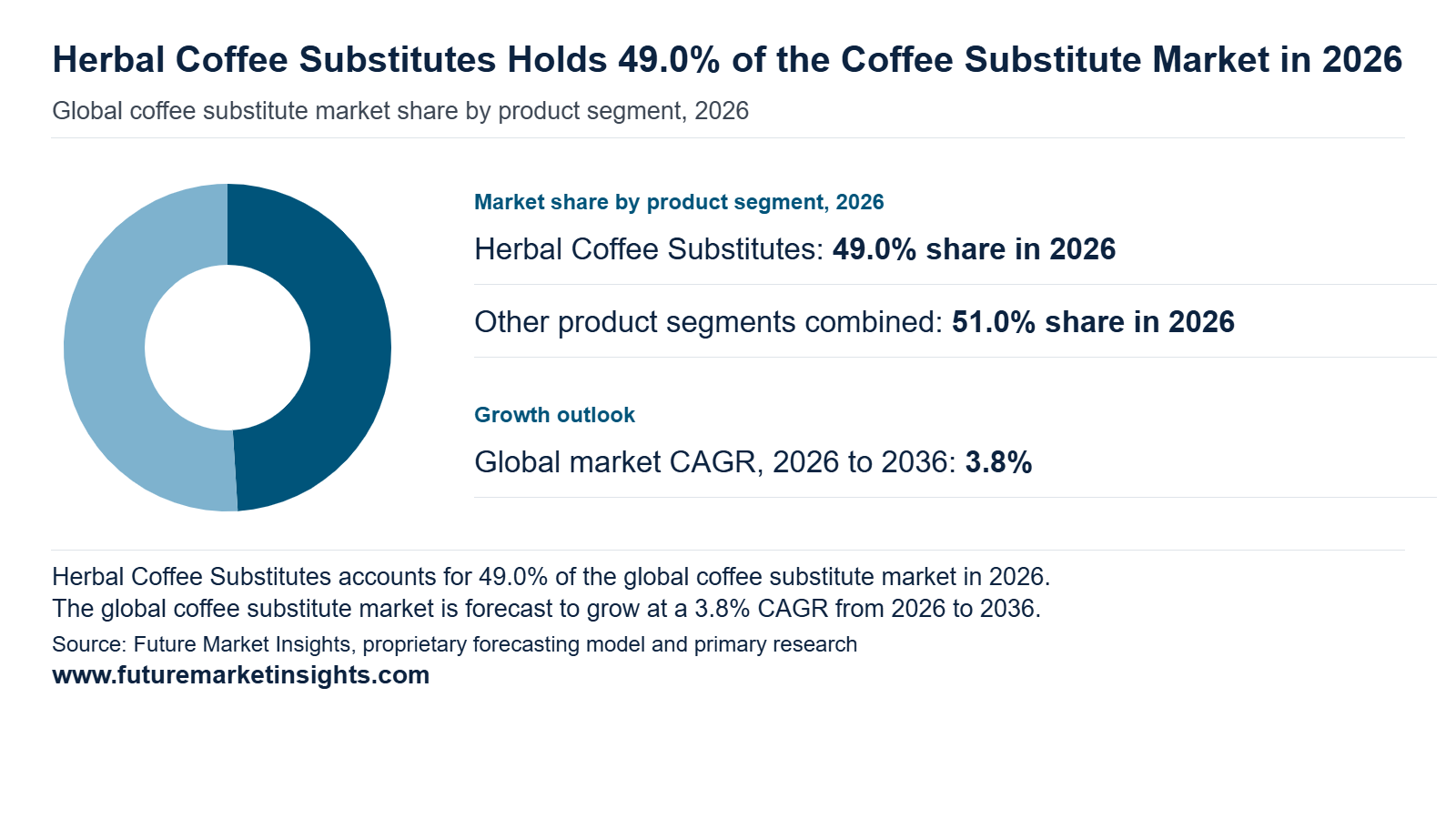
Herbal Coffee Substitutes capture 49.0% of the Product category in 2026, driven by rising demand for roasted chicory and dandelion roots that deliver dark, full-bodied morning brews without caffeine when blended with botanical extracts. Unlike barley or rye grain blends that require gluten allergen warnings and pure root qualify for gluten-free and paleo shelf tags. Product disclosures from Teeccino Caffe, Inc. (June 2025) and Rishi Tea and Botanicals (April 2025) confirm that certified organic roasted root and adaptogenic mushroom blends anchor repeat specialty and grocery orders through 2036.
Why Does the Powder Segment Lead by Form?
Powder varieties secure a leading 63.0% share of Form revenue in 2026, favored for lower ambient shipping weight, long pantry shelf life, and customizable scoop dosing compared with liquid extracts made from chicory roots. chicory roots. Dry formats span spray-dried soluble granules, microground instant sticks, and filter-brew grounds. Commercial launches from Minus Coffee via BevNET (January 2025) and product specifications from Anthonys Goods (January 2026)Urban Platter (January 2026) confirm that soluble powders remain the primary household format through 2036.
Why Does the Supermarkets & Hypermarkets Segment Lead by Distribution Channel?
Supermarkets and hypermarkets hold 42.0% of the Distribution Channel category in 2026, leading shelf distribution as health-conscious shoppers purchase coffee alternatives in mainstream tea and beverage aisles next to decaffeinated roast coffee and ready-to-drink coffee multipacks, allowing shoppers to compare per-serving costs during routine weekly replenishment. Retail expansion milestones from Mud Wtr Inc. via CPG Media (February 2025) and European grocery filings from The The The Hain Celestial Group, Inc. Form 10-K (September 2026) confirm that mass-market supermarket listings remain essential for scaling volume beyond direct-to-consumer subscriptions through 2036.
Regional & Country Outlook
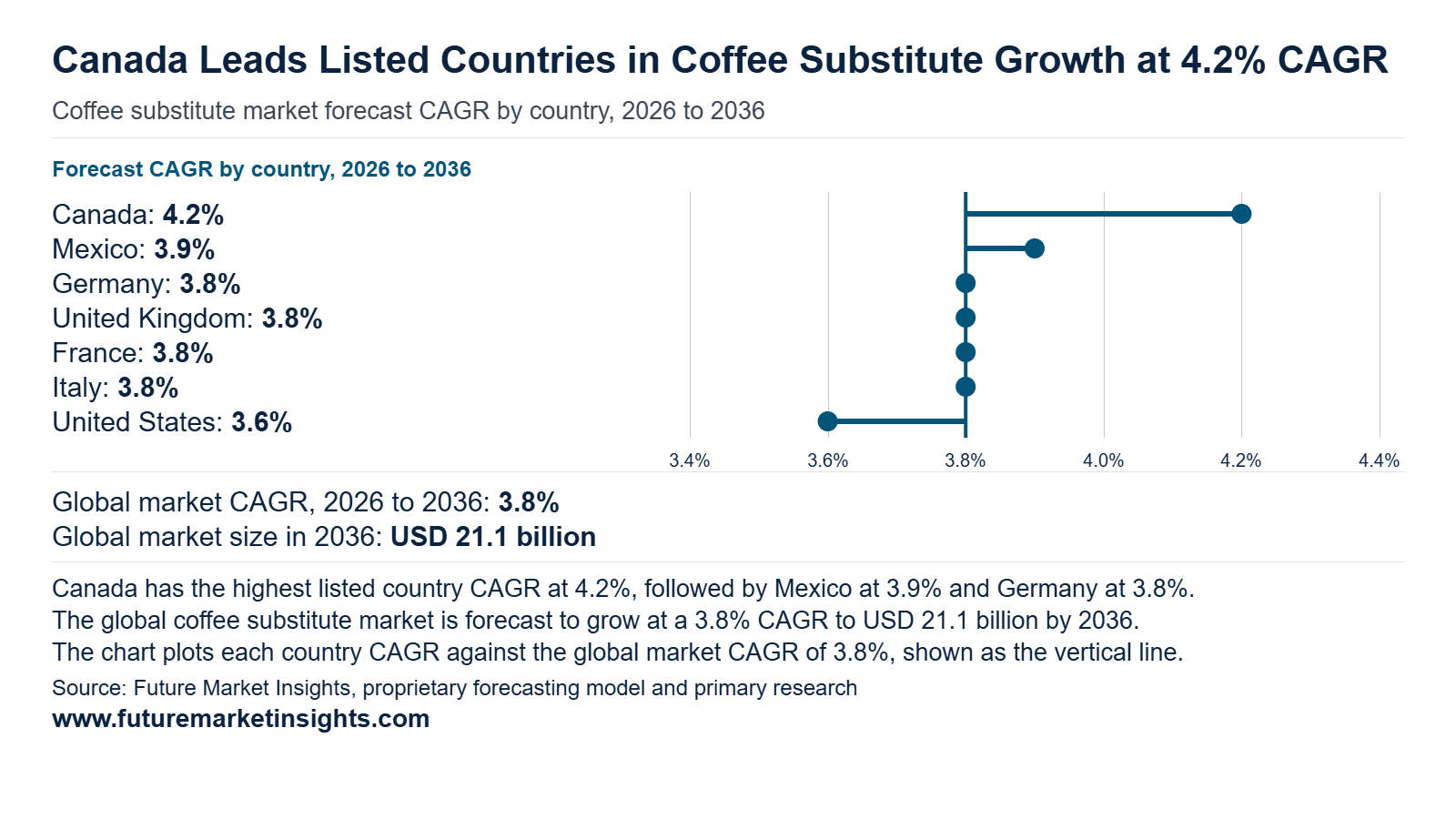
North America and Western Europe represent the core revenue centers for the global coffee substitute market through 2036, combining high at-home hot-beverage consumption in the United States and Canada with century-old roasted chicory and grain-coffee traditions in France and Germany. FMI projects the seven profiled countries below to account for 71.0% of global market value in 2026 (USD 10.30 billion), expanding to USD 14.92 billion by 2036 as consumers rotate between roasted root infusions and matcha powders. Canada leads national growth rates at a 4.2% CAGR, followed by Mexico at 3.9% CAGR, while the United States generates the largest 10-year dollar addition at +USD 1.54 billion.
| Country | 2026 Revenue | 2036 Revenue | 10-Year Addition | 2026 to 2036 CAGR | Global Share (2026 -> 2036) |
|---|---|---|---|---|---|
| Canada | USD 0.87 billion | USD 1.31 billion | +USD 0.44 billion | 4.2% | 6.0% -> 6.2% |
| Mexico | USD 0.58 billion | USD 0.85 billion | +USD 0.27 billion | 3.9% | 4.0% -> 4.0% |
| Germany | USD 1.74 billion | USD 2.53 billion | +USD 0.79 billion | 3.8% | 12.0% -> 12.0% |
| United Kingdom | USD 1.16 billion | USD 1.69 billion | +USD 0.53 billion | 3.8% | 8.0% -> 8.0% |
| France | USD 1.45 billion | USD 2.11 billion | +USD 0.66 billion | 3.8% | 10.0% -> 10.0% |
| Italy | USD 0.87 billion | USD 1.26 billion | +USD 0.39 billion | 3.8% | 6.0% -> 6.0% |
| United States | USD 3.63 billion | USD 5.17 billion | +USD 1.54 billion | 3.6% | 25.0% -> 24.5% |
Source: Future Market Insights analysis of the coffee substitute market, 2026.
United States
Demand for coffee substitute in United States is projected to rise from USD 3.63 billion in 2026 to USD 5.17 billion by 2036, advancing at a 3.6% CAGR and adding USD 1.54 billion in new revenue. FMI observes that United States growth is anchored by high at-home beverage preparation and rapid consumer adoption of adaptogenic mushroom and roasted root formats. National tracking released by the National Coffee Association (September 2026) in September 2026 confirms that 83.0% of past-day American coffee drinkers prepared their drinks at home, creating direct pantry demand for instant launches from Teeccino Caffe, Inc. (June 2025) and LvlUp Ventures (May 2025) portfolio brand Sip Herbals. FMI expects single-serve K-Cup pod compatibility and supermarket end-cap placements to drive steady United States sales through 2036.
Germany
Buyer adoption of coffee substitute across Germany is estimated to expand from USD 1.74 billion in 2026 to USD 2.53 billion by 2036, spurred by a 3.8% CAGR and generating USD 0.79 billion in commercial expansion. FMI finds that German demand rests on an established malted barley and rye habit where shoppers evaluate grain substitutes against a high daily coffee benchmark. Industry consumption data from Deutscher Kaffeeverband (January 2026) records German per-capita roast coffee intake at 161 liters annually, while Lima Food (January 2026) markets organic Yannoh Instant grain-and-chicory blends across German natural food stores. FMI anticipates sustained consumer demand for organic caffeine-free evening beverages to preserve Germany's 12.0% global share through 2036.
France
Coffee substitute industry in France is set to scale from USD 1.45 billion in 2026 to USD 2.11 billion by 2036, driven by a 3.8% CAGR and adding USD 0.66 billion in incremental market value. In FMI's assessment, French demand benefits from domestic chicory cultivation in Hauts-de-France and official statistical recognition of coffee substitutes as a staple household basket item. Price index tracking published by INSEE (February 2026) in February 2026 monitors a dedicated consumer price series (011815262) for coffee and coffee substitutes, while Chicorée Leroux (January 2026) processes roasted and liquid%-chicory capsule formats in Orchies. FMI projects single-serve capsule innovation and organic soluble chicory lines to sustain French retail demand through 2036.
United Kingdom
Sales of coffee substitute throughout United Kingdom are projected to increase from USD 1.16 billion in 2026 to USD 1.69 billion by 2036, progressing at a 3.8% CAGR and creating USD 0.53 billion in additional revenue. FMI believes British demand is driven by public-health caffeine limits during pregnancy and consumer scrutiny of botanical ingredient disclosures. Clinical dietary guidance from the National Health Service (January 2026) advises limiting daily caffeine intake to 200 milligrams during pregnancy while cautioning against licorice-root herbal infusions, and the UK Food Standards Agency (October 2025) reinforced allergen transparency across 964 surveyed consumers in October 2025. FMI expects clearly labeled, licorice-free roasted chicory and dandelion powders to capture growing British supermarket shelf space through 2036.
Canada
Consumption of coffee substitute across Canada is estimated to climb from USD 0.87 billion in 2026 to USD 1.31 billion by 2036, reflecting a 4.2% CAGR and contributing USD 0.44 billion over the forecast decade. FMI's analysis indicates that Canadian shoppers are adopting multi-serving soluble chicory and botanical powders as a result of retail roast-coffee inflation and a shift toward home beverage preparation with plant-based milk creamers. Survey findings published by the Coffee Association of Canada (February 2026) on 17 February 2026 show that 71.0% of Canadian adults drank coffee the prior day in 2025 while increasing promotional and at-home pantry purchases. FMI projects value-sized soluble root canisters and bilingual clean-label packs to drive Canadian grocery replenishment through 2036.
Italy
Revenue generated by coffee substitute suppliers in Italy is forecast to expand from USD 0.87 billion in 2026 to USD 1.26 billion by 2036, anchored by a 3.8% CAGR and generating USD 0.39 billion in new category sales. FMI notes that Italian households have a long-standing habit of preparing roasted barley (caffè d'orzo) and chicory beverages in moka pots and instant cups, which is gaining momentum due to sharp increases in conventional espresso spending. Household expenditure data released by Istat (October 2026) on 8 October 2026 confirms that Italian family spending on coffee rose 14.6% in 2025 compared with 2024. In FMI's view, espresso-compatible roasted barley and chicory pods will expand Italian household penetration through 2036.
Mexico
Buyer procurement of coffee substitute throughout Mexico is tracking from USD 0.58 billion in 2026 to USD 0.85 billion by 2036, exhibiting a 3.9% CAGR and contributing USD 0.27 billion to national market value. FMI observes that Mexican consumers are highly accustomed to stir-in hot beverage powders, creating an intuitive preparation bridge for soluble chicory and grain substitutes. Commodity reporting from the USDA Foreign Agricultural Service Mexico (May 2025) (MX2025-0023) confirms that soluble coffee accounted for 57.0% of Mexico's domestic coffee consumption in marketing year 2024/25. FMI expects modern supermarket chains and pharmacy wellness aisles in Mexico to expand soluble roasted-root and beanless latte listings through 2036.
Competitive Environment and Notable Companies
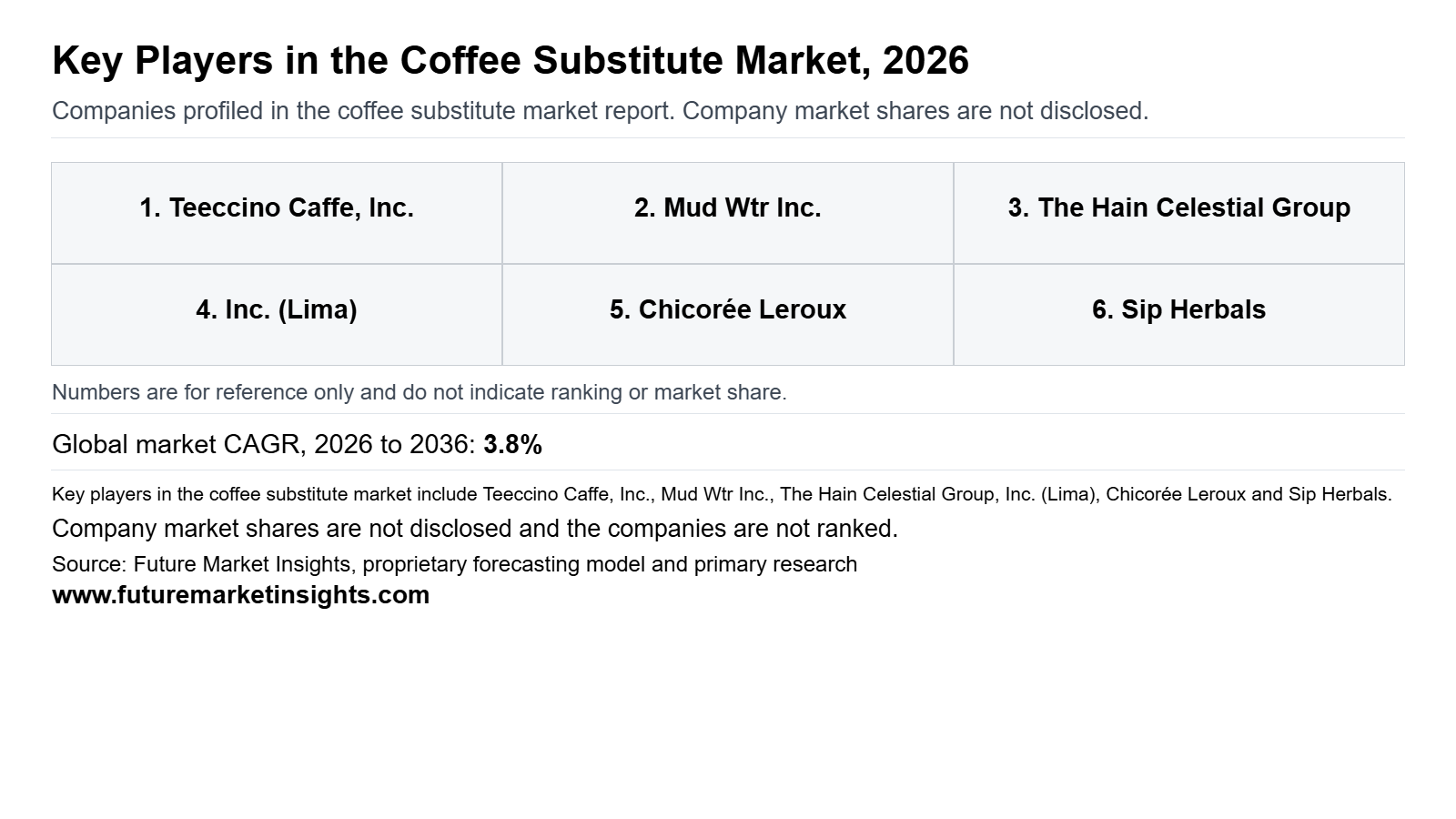
Notable companies operating in the global coffee substitute market include Teeccino Caffe, Inc., Mud Wtr Inc., The The The Hain Celestial Group, Inc. (Lima), Chicorée Leroux, Sip Herbals and Minus Coffee, Postum, Dandy Blend and Crio Bru. Competition spans three distinct business models: heritage European chicory and grain roasters operating industrial extraction and spray-drying plants, North American botanical and mushroom coffee-alternative brands scaling from direct-to-consumer subscriptions into retail grocery aisles, and upcycled beanless coffee innovators.
How Are Companies Positioned in the Coffee Substitute Market?
Teeccino Caffe, Inc. (June 2025), Sip Herbals (January 2026), Mud Wtr Inc. via CPG Media (February 2025), Dandy Blend (August 2026), and Crio Bru (January 2026) position themselves as specialty caffeine-free or low-caffeine lifestyle brands across North American natural and mass retail. Chicorée Leroux (January 2026) and The The The Hain Celestial Group, Inc. Form 10-K (September 2026) (via Lima Yannoh) anchor European grocery shelves, while Minus Coffee via BevNET (January 2025) competes in functionalized beanless instant lattes.
What Matters When a Buyer Selects a Coffee Substitute Supplier?
Supermarket category managers and specialty distributors evaluate suppliers on explicit caffeine milligram declarations, cereal gluten allergen separation, instant cold-and-hot solubility, and single-serve brewer compatibility. Postum (January 2026) and Lima Food (January 2026) disclose wheat and barley clearly on grain recipes, whereas Anthonys Goods (January 2026) and Teeccino Caffe, Inc. (June 2025) verify gluten-free status for pure chicory and herbal lines.
Which Capabilities Distinguish Product Offers?
Format versatility separates multi-channel leaders from single-SKU sellers. Chicorée Leroux (January 2026) spans soluble powders and liquid concentrates; Teeccino Caffe, Inc. (June 2025) offers filter grounds, large brew bags, and microground instant packets; Sip Herbals (January 2026) supplies K-Cup compatible roasted-root pods; and Urban Platter (January 2026) offers both 150-gram liquid chicory extracts and soluble powders.
How Does Geographic Reach Affect Competition?
North American brands scale through direct e-commerce and national retail chains such as Target and Sprouts, whereas European producers rely on domestic agricultural processing in northern France and Belgium. Corporate ownership shifts also shape regional continuity, asThe The The Hain Celestial Group, Inc. Form 8-K (September 2026) signed an agreement in September 2026 to divest its European business including Lima, with The The The Hain Celestial Group, Inc. Form 8-K (October 2026) noting ongoing lender discussions in October 2026.
| Verified Company Evidence (2025 to 2026) | Commercial Effect | Buyer Action |
|---|---|---|
| 30 June 2025: Teeccino Caffe, Inc. launched New Instant Teeccino combining microground roasted herbs with dehydrated extracts (Teeccino Caffe, Inc., June 2025). | Eliminates brewing equipment friction while preserving full-bodied roasted herbal flavor. | Stock instant microground herbal sachets and traditional filter-ground alternatives. |
| 29 May 2025: LvlUp Ventures backed roasted-root coffee substitute brand Sip Herbals through its CPG Fund to expand multichannel fulfillment (LvlUp Ventures, May 2025). | Strengthens inventory readiness and omnichannel retail scaling for K-Cup and loose-roast SKUs. | Evaluate venture-backed specialty root brands for natural and conventional grocery end-caps. |
| 15 October 2026: The Hain Celestial Group, Inc. reported on Form 8-K that its proposed European business sale (including Lima Yannoh) awaited credit-agreement consent (The Hain Celestial Group, Inc. Form 8-K, October 2026). | Creates a transitional ownership variable for European organic roasted-grain coffee distribution. | Monitor closing confirmation and distributor continuity clauses for Lima Yannoh SKUs in Europe. |
Source: Verified corporate disclosures and Future Market Insights analysis, 2026.
| Company | Core Positioning | Verified Activity & Source Attribution |
|---|---|---|
| Teeccino Caffe, Inc. | Roasted chicory, dandelion, carob, and mushroom herbal coffee in grounds, tea bags, and instant formats | Launched New Instant Teeccino on 30 June 2025 and expanded 2026 caffeine-free holiday sampler boxes (Teeccino Caffe, Inc., June 2025). |
| Mud Wtr Inc. | Organic cacao, spice, and adaptogenic mushroom coffee alternative (:rise blends) | Executed retail sampling debut at Natural Products Expo West in February 2025 following U.S. retail expansion (Mud Wtr Inc. via CPG Media, February 2025). |
| Chicorée Leroux | French processor of soluble, roasted, liquid, and capsule chicory beverages in Hauts-de-France | Markets 10-count Nespresso-compatible capsules containing 80% French soluble chicory in 2026 (Chicorée Leroux, January 2026). |
| Sip Herbals | Caffeine-free and gluten-free roasted chicory, dandelion, and carob Faux Joe blends and pods | Secured LvlUp Ventures CPG Fund investment in May 2025 and markets 12-count K-Cup compatible pods (LvlUp Ventures, May 2025). |
| Minus Coffee | Upcycled beanless coffee innovator offering instant functional oat-milk lattes and cold brews | Launched beanless Instant Vanilla Oat Milk Latte with 50 mg caffeine and 6g pea protein in January 2025 (Minus Coffee via BevNET, January 2025). |
| The Hain Celestial Group, Inc. | Owner of European organic grain-and-chicory coffee brand Lima (Yannoh Filter and Yannoh Instant) | Signed September 2026 agreement to divest international business; updated closing conditions on Form 8-K in October 2026 (The Hain Celestial Group, Inc. Form 8-K, October 2026). |
| Rishi Tea and Botanicals | Organic direct-trade botanical and adaptogenic mushroom coffee-alternative infusions | Published 2025 Garden Direct field report and expanded 2026 caffeine-free roasted botanical blends (Rishi Tea and Botanicals, April 2025). |
| Dandy Blend | Instant caffeine-free herbal beverage formulated from extracts of roasted barley, rye, chicory, and dandelion | Expanded summer 2026 consumer hydration and afternoon caffeine-swap campaigns across North America (Dandy Blend, August 2026). |
| Crio Bru | 100% pure roasted and ground cacao brewed in French presses and drip coffee makers | Markets roasted brewed cacao seasonal sampler kits across direct online and retail channels in 2026 (Crio Bru, January 2026). |
Source: Verified corporate disclosures and Future Market Insights analysis, 2026.
Key takeaways
- Valued at USD 14.5 billion in 2026, on course for USD 21.1 billion by 2036.
- The decade adds USD 6.6 billion in new value at a 3.8% CAGR.
- The product segment is led by Herbal Coffee Substitutes at 49.0% of 2026 revenue.
- 63.0% of form revenue goes to Powder in 2026.
- Canada grows fastest at 4.2% CAGR, ahead of Mexico at 3.9%.
Coffee Substitute Market Report Scope and Research Methodology
FMI sizes the global coffee substitute market by reconciling retail supermarket scanner data, specialty health-food store turnover, and direct-to-consumer e-commerce shipments of packaged roasted botanical and grain alternatives across each tracked country. Revenue is measured at the packaged product sale level in Powder and Liquid forms, ensuring that only products formulated and positioned as coffee replacements are included while excluding conventional roast and ground coffee, decaffeinated bean coffee, standalone leaf teas, and prepared foodservice cup revenues. National and segment estimates are cross-checked against official consumer price index baskets, national beverage association surveys, and corporate SEC and product filings so that all sub-segments and countries reconcile to the global market total from 2026 to 2036.
| Coverage Field | Report Scope |
|---|---|
| Market definition | Revenue from packaged coffee substitutes made from roasted herbs, roots, grains, mushrooms, cacao, or upcycled non-coffee plant bases. |
| Product segment | Herbal Coffee Substitutes, Grain Based Coffee Substitutes, and Plant Based Coffee Substitutes (Dominant: Herbal Coffee Substitutes at 49.0% share in 2026; Other Segment Combined at 51.0%). |
| Form segment | Powder and Liquid (Dominant: Powder at 63.0% share in 2026; Other Segment Combined at 37.0%). |
| Distribution channels | Supermarkets & Hypermarkets, Convenience Stores, Specialty Stores, and Online (Dominant: Supermarkets & Hypermarkets at 42.0% share in 2026). |
| Ingredients included | Roasted chicory root, dandelion root, carob, malted barley, rye, wheat bran, functional mushrooms, brewed cacao, and upcycled beanless bases. |
| Packaging formats | Soluble powder jars and canisters, single-serve instant sticks, filter-brew pouches, K-Cup pods, Nespresso-compatible capsules, and liquid extract bottles. |
| End users | At-home household consumers, workplace pantry buyers, and pregnancy or caffeine-sensitive demographic groups. |
| Exclusions | Conventional and decaffeinated coffee-bean products, standalone herbal or green leaf teas not positioned as coffee substitutes, and foodservice prepared drinks. |
| Quantitative units | USD billion for global and national market valuations. |
| Base and historical years | 2025 (Historical: USD 14.0 billion); 2026 (Estimated: USD 14.5 billion). |
| Forecast period | 2026 to 2036 (Projected 2036 valuation: USD 21.1 billion at a 3.8% CAGR). |
| Regions covered | North America, Latin America, Western Europe, Eastern Europe, East Asia, South Asia and Pacific, and Middle East and Africa. |
| Countries profiled | United States, Germany, France, United Kingdom, Canada, Italy, and Mexico. |
| Companies covered | Teeccino Caffe, Inc., Mud Wtr Inc., The Hain Celestial Group, Inc. (Lima), Chicorée Leroux, Sip Herbals, Minus Coffee, Rishi Tea and Botanicals, Postum, Dandy Blend, Crio Bru, Anthonys Goods, and Urban Platter. |
Source: Future Market Insights analysis of the coffee substitute market, 2026.
Research Sources and Bibliography
- Anthonys Goods. (2026, January 10).Instant Chicory Root Gluten-Free and Non-GMO Product Specification. https://anthonysgoods.com/products/instant-chicory-root-gluten-free-non-gmo
- Chicorée Leroux. (2026, January 12).Capsule Chicory Coffee (80% Soluble Chicory of French Origin) Product Disclosure. https://www.leroux.com/en/produits/capsule-chicory-coffee/
- Coffee Association of Canada. (2026, February 17).Coffee Consumption Remained Strong in Canada in 2025, Despite Rising Prices. https://coffeeassoc.com/coffee-consumption-remained-strong-in-canada-in-2025-despite-rising-prices/
- Crio Bru. (2026, January 15).Crio Bru Brewed Cacao Seasonal Sampler Kit and Roasted Cacao Specifications. https://criobru.com/collections/seasonal-flavors/products/seasonal-sampler-kit
- Dandy Blend. (2026, August 7).How to Stay Hydrated in Summer 2026 and Cut Excess Caffeine With Dandy Blend. https://dandyblend.com/how-to-stay-hydrated-summer-2026/
- Deutscher Kaffeeverband. (2026, January 18).Wie viel Kaffee wird in Deutschland getrunken: Annual Per-Capita Consumption Benchmark. https://www.kaffeeverband.de/de/faq/wie-viel-kaffee-wird-in-deutschland-getrunken
- European Food Safety Authority. (2025, March 6).Open Call for Food Additives and Food Flavourings Analytical and Use Level (Caffeine 16.016 Pilot 2025-2026). https://www.efsa.europa.eu/en/call/open-call-food-additivesfood-flavourings-analytical-use-level-and-presence-data-during-first
- INSEE. (2026, February 27).Annual Consumer Price Index Series 011815262: Coffee and Coffee Substitutes in France. https://www.insee.fr/fr/statistiques/serie/011815262
- Istat. (2026, October 8).Spese per consumi delle famiglie: Anno 2025 (Household Coffee Expenditure). https://www.istat.it/comunicato-stampa/spese-per-consumi-delle-famiglie-anno-2025/
- Lima Food. (2026, January 20).Yannoh Filter Roasted Grain and Chicory Coffee Alternative Specification. https://www.limafood.com/en/products/coffee-alternatives-teas/yannoh-filter/
- Lima Food. (2026, January 22).Yannoh Instant Organic Grain and Chicory Beverage Portfolio. https://www.limafood.com/en/products/coffee-alternatives-teas/yannoh-instant/
- LvlUp Ventures. (2025, May 29).CPG Fund Backs Three Bold Brands Shaping the Future of Consumer Products (Sip Herbals). https://www.lvlup.vc/post/lvlup-ventures-cpg-fund-backs-three-bold-brands-shaping-the-future-of-consumer-products
- Minus Coffee via BevNET. (2025, January 3).New Products: Minus Coffee Goes Instant With Beanless Vanilla Oat Milk Latte. https://www.bevnet.com/news/2025/new-products-minus-coffee-goes-instant-nestle-vies-for-more-glp-1-users/
- Mud Wtr Inc. via CPG Media. (2025, February 18).MUD\WTR Makes Its Debut at Expo West 2025 With Dual Booth Presence and Retail Sampling. https://www.cpgmedia.com/newswire/2025/02/18/mudwtr-makes-its-debut-at-expo-west-2025-with-dual-booth-presence-cold-plunge-experience-and-founder-shane-heath-in-attendance
- National Coffee Association. (2026, September 15).NCA: Coffee Tops Beverage Charts Again, At-Home Preparation Reaches 83%. https://www.ncausa.org/Newsroom/NCA-Coffee-tops-beverage-charts-again-specialty-coffee-hits-new-high
- National Health Service. (2026, January 14).Foods to Avoid in Pregnancy: Caffeine Threshold and Herbal Infusion Guidance. https://www.nhs.uk/pregnancy/keeping-well/foods-to-avoid/
- Postum. (2026, January 16).Postum Original Roasted Wheat Bran and Molasses Warm Beverage Jar. https://postum.com/products/original
- Rishi Tea and Botanicals. (2025, April 21).Garden Direct Spring Harvest Field Report and Organic Botanical Sourcing. https://www.rishi-tea.com/blogs/journal/garden-direct-spring-harvest-field-report
- Sip Herbals. (2026, January 19).Signature Roast Herbal Coffee Pods (K-Cup Compatible) Specification. https://sipherbals.com/products/signature-roast-single-serve-pods
- Teeccino Caffe, Inc. (2025, June 30).Brew or Steep: New Instant Teeccino Has Arrived. https://teeccino.com/blogs/news/brew-steep-or-stir-new-instant-teeccino-has-arrived
- Teeccino Caffe, Inc. (2026, October 23).35 Herbal Coffee & Herbal Tea Gifts: Caffeine-Free Gift Guide 2026. https://teeccino.com/pages/holiday-gift-guide
- The Hain Celestial Group, Inc. Form 10-K. (2026, September 14).Annual Report on Form 10-K for Fiscal Year Ended June 30, 2026. https://www.sec.gov/Archives/edgar/data/910406/000119312526390505/hain-20260630.htm
- The Hain Celestial Group, Inc. Form 8-K. (2026, September 14).Current Report on Form 8-K: International Business Sale Agreement Including Lima. https://www.sec.gov/Archives/edgar/data/910406/000119312526389814/hain-20260912.htm
- The Hain Celestial Group, Inc. Form 8-K. (2026, October 15).Current Report on Form 8-K: International Business Sale Credit-Agreement Update. https://www.sec.gov/Archives/edgar/data/910406/000119312526422226/hain-20261009.htm
- UK Food Standards Agency. (2025, October 7).Allergen Information for Non-Prepacked Foods: Key Findings From Consumers and Food Service Workers. https://science.food.gov.uk/article/142304-allergen-information-for-non-prepacked-foods-key-findings-from-consumers-and-food-service-workers
- Urban Platter. (2026, January 24).Chicory Liquid Extract 150g Product Specification. https://urbanplatter.com/products/urban-platter-chicory-liquid-extract-150g-ready-to-use-instant-caffeine-free-chicory-extract-coffee-alternative-add-to-coffee-quick-dissolve-chicory-root-extract-liquid-for-reducing-caffein
- Urban Platter. (2026, January 25).Instant Chicory Root Powder 150g Soluble Beverage Specification. https://urbanplatter.com/products/urban-platter-instant-chicory-root-powder-150g-caffeine-free-instantly-soluble-add-to-coffee-quick-dissolve-chicory-root-powder-for-reducing-caffeine-intake
- USDA Foreign Agricultural Service Mexico. (2025, May 20).Coffee Annual: Mexico (MX2025-0023). https://apps.fas.usda.gov/newgainapi/api/Report/DownloadReportByFileName?fileName=Coffee+Annual_Mexico+City_Mexico_MX2025-0023.pdf
Table of Content
- Key Takeaways
- Market Size and CAGR
- Top Growth Driver
- Fastest Growing Segment
- Leading Region
- Key Companies
- Emerging Opportunities
- Executive Summary
- Global Market Outlook
- Demand-side Trends
- Supply-side Trends
- Technology Roadmap Analysis
- Analysis and Recommendations
- Analyst Perspective (What is happening? Why now? What should investors know?)
- Key Questions Answered
- How large is the market?
- What is the CAGR?
- What are key trends?
- Which region dominates?
- Who are the leaders?
Read More...
- Market Overview
- Market Coverage / Taxonomy
- Market Definition / Scope / Limitations
- Research Methodology
- Chapter Orientation
- Analytical Lens and Working Hypotheses
- Market Structure, Signals, and Trend Drivers
- Benchmarking and Cross-market Comparability
- Market Sizing, Forecasting, and Opportunity Mapping
- Research Design and Evidence Framework
- Desk Research Programme (Secondary Evidence)
- Expert Input and Fieldwork (Primary Evidence)
- Tooling, Models, and Reference Databases
- Data Engineering and Model Build
- Quality Assurance and Audit Trail
- Market Background
- Market Dynamics (Drivers, Restraints, Opportunity, Trends)
- Scenario Forecast (Optimistic, Likely, Conservative)
- Impact Analysis
- AI Impact
- Sustainability Impact
- Regulatory Impact
- Technology Impact
- Consumer / Buyer Analysis
- Purchase Drivers
- Adoption Barriers
- Buyer Journey
- Opportunity Map Analysis
- Product Life Cycle Analysis
- Supply Chain Analysis
- Investment Feasibility Matrix
- Value Chain Analysis
- PESTLE and Porter's Analysis
- Regulatory Landscape
- Regional Parent Market Outlook
- Production and Consumption Statistics
- Import and Export Statistics
- Global Market Analysis and Forecast, 2021 to 2036
- Historical Market Size Value (USD Billion) Analysis, 2021 to 2025
- Current and Future Market Size Value (USD Billion) Projections, 2026 to 2036
- Y-o-Y Growth Trend Analysis
- Absolute $ Opportunity Analysis
- Global Market Pricing Analysis, 2021 to 2036
- Global Market Analysis and Forecast, By Product, 2021 to 2036
- Introduction / Key Findings
- Historical Market Size Value (USD Billion) Analysis By Product, 2021 to 2025
- Current and Future Market Size Value (USD Billion) Analysis and Forecast By Product, 2026 to 2036
- Herbal Coffee Substitutes
- Grain Based Coffee Substitutes
- Plant Based Coffee Substitutes
- Y-o-Y Growth Trend Analysis By Product, 2021 to 2025
- Absolute $ Opportunity Analysis By Product, 2026 to 2036
- Global Market Analysis and Forecast, By Form, 2021 to 2036
- Introduction / Key Findings
- Historical Market Size Value (USD Billion) Analysis By Form, 2021 to 2025
- Current and Future Market Size Value (USD Billion) Analysis and Forecast By Form, 2026 to 2036
- Powder
- Liquid
- Y-o-Y Growth Trend Analysis By Form, 2021 to 2025
- Absolute $ Opportunity Analysis By Form, 2026 to 2036
- Global Market Analysis and Forecast, By Distribution Channel, 2021 to 2036
- Introduction / Key Findings
- Historical Market Size Value (USD Billion) Analysis By Distribution Channel, 2021 to 2025
- Current and Future Market Size Value (USD Billion) Analysis and Forecast By Distribution Channel, 2026 to 2036
- Supermarkets & Hypermarkets
- Convenience Stores
- Specialty Stores
- Online
- Y-o-Y Growth Trend Analysis By Distribution Channel, 2021 to 2025
- Absolute $ Opportunity Analysis By Distribution Channel, 2026 to 2036
- Global Market Analysis and Forecast, By Region, 2021 to 2036
- Introduction
- Historical Market Size Value (USD Billion) Analysis By Region, 2021 to 2025
- Current Market Size Value (USD Billion) Analysis and Forecast By Region, 2026 to 2036
- North America
- Western Europe
- East Asia
- South Asia and Pacific
- Market Attractiveness Analysis By Region
- North America Market Analysis and Forecast, By Country, 2021 to 2036
- Historical Market Size Value (USD Billion) Trend Analysis By Market Taxonomy, 2021 to 2025
- Market Size Value (USD Billion) Forecast By Market Taxonomy, 2026 to 2036
- By Country
- United States
- Canada
- By Product
- By Form
- By Distribution Channel
- By Country
- Market Attractiveness Analysis
- By Country
- By Product
- By Form
- By Distribution Channel
- Key Takeaways
- Western Europe Market Analysis and Forecast, By Country
- Historical Market Size Value (USD Billion) Trend Analysis By Market Taxonomy, 2021 to 2025
- Market Size Value (USD Billion) Forecast By Market Taxonomy, 2026 to 2036
- By Country
- United Kingdom
- Germany
- France
- By Product
- By Form
- By Distribution Channel
- By Country
- Market Attractiveness Analysis
- By Country
- By Product
- By Form
- By Distribution Channel
- Key Takeaways
- East Asia Market Analysis and Forecast, By Country
- Historical Market Size Value (USD Billion) Trend Analysis By Market Taxonomy, 2021 to 2025
- Market Size Value (USD Billion) Forecast By Market Taxonomy, 2026 to 2036
- By Country
- China
- Japan
- South Korea
- By Product
- By Form
- By Distribution Channel
- By Country
- Market Attractiveness Analysis
- By Country
- By Product
- By Form
- By Distribution Channel
- Key Takeaways
- South Asia and Pacific Market Analysis and Forecast, By Country
- Historical Market Size Value (USD Billion) Trend Analysis By Market Taxonomy, 2021 to 2025
- Market Size Value (USD Billion) Forecast By Market Taxonomy, 2026 to 2036
- By Country
- India
- Australia
- Rest of world aggregate
- By Product
- By Form
- By Distribution Channel
- By Country
- Market Attractiveness Analysis
- By Country
- By Product
- By Form
- By Distribution Channel
- Key Takeaways
- Key Countries Market Analysis
- United States
- Pricing Analysis
- Market Share Analysis, 2025
- By Product
- By Form
- By Distribution Channel
- Canada
- Pricing Analysis
- Market Share Analysis, 2025
- By Product
- By Form
- By Distribution Channel
- Germany
- Pricing Analysis
- Market Share Analysis, 2025
- By Product
- By Form
- By Distribution Channel
- United Kingdom
- Pricing Analysis
- Market Share Analysis, 2025
- By Product
- By Form
- By Distribution Channel
- France
- Pricing Analysis
- Market Share Analysis, 2025
- By Product
- By Form
- By Distribution Channel
- India
- Pricing Analysis
- Market Share Analysis, 2025
- By Product
- By Form
- By Distribution Channel
- China
- Pricing Analysis
- Market Share Analysis, 2025
- By Product
- By Form
- By Distribution Channel
- Japan
- Pricing Analysis
- Market Share Analysis, 2025
- By Product
- By Form
- By Distribution Channel
- South Korea
- Pricing Analysis
- Market Share Analysis, 2025
- By Product
- By Form
- By Distribution Channel
- Australia
- Pricing Analysis
- Market Share Analysis, 2025
- By Product
- By Form
- By Distribution Channel
- United States
- Market Structure Analysis
- Competition Dashboard
- Competition Benchmarking
- Market Share Analysis of Top Players
- By Regional
- By Product
- By Form
- By Distribution Channel
- Emerging Startups
- Innovation Benchmarking
- Competition Analysis
- Competition Deep Dive
- Teeccino Caffe, Inc.
- Overview
- Product Portfolio
- Profitability by Market Segments
- Sales Footprint
- Strategy Overview
- Marketing Strategy
- Product Strategy
- Channel Strategy
- Mud Wtr Inc.
- Chicorée Leroux
- Sip Herbals
- Minus Coffee
- The Hain Celestial Group, Inc.
- Rishi Tea and Botanicals
- Dandy Blend
- Crio Bru
- Teeccino Caffe, Inc.
- Case Studies
- Success Stories
- Recent Developments
- Competition Deep Dive
- Assumptions & Acronyms Used
List of Tables
- Table 1: Global Market Value (USD Billion) Forecast by Region, 2021 to 2036
- Table 2: Global Market Value (USD Billion) Forecast by Product, 2021 to 2036
- Table 3: Global Market Value (USD Billion) Forecast by Form, 2021 to 2036
- Table 4: Global Market Value (USD Billion) Forecast by Distribution Channel, 2021 to 2036
- Table 5: North America Market Value (USD Billion) Forecast by Country, 2021 to 2036
- Table 6: North America Market Value (USD Billion) Forecast by Product, 2021 to 2036
- Table 7: North America Market Value (USD Billion) Forecast by Form, 2021 to 2036
- Table 8: North America Market Value (USD Billion) Forecast by Distribution Channel, 2021 to 2036
- Table 9: Western Europe Market Value (USD Billion) Forecast by Country, 2021 to 2036
- Table 10: Western Europe Market Value (USD Billion) Forecast by Product, 2021 to 2036
- Table 11: Western Europe Market Value (USD Billion) Forecast by Form, 2021 to 2036
- Table 12: Western Europe Market Value (USD Billion) Forecast by Distribution Channel, 2021 to 2036
- Table 13: East Asia Market Value (USD Billion) Forecast by Country, 2021 to 2036
- Table 14: East Asia Market Value (USD Billion) Forecast by Product, 2021 to 2036
- Table 15: East Asia Market Value (USD Billion) Forecast by Form, 2021 to 2036
- Table 16: East Asia Market Value (USD Billion) Forecast by Distribution Channel, 2021 to 2036
- Table 17: South Asia and Pacific Market Value (USD Billion) Forecast by Country, 2021 to 2036
- Table 18: South Asia and Pacific Market Value (USD Billion) Forecast by Product, 2021 to 2036
- Table 19: South Asia and Pacific Market Value (USD Billion) Forecast by Form, 2021 to 2036
- Table 20: South Asia and Pacific Market Value (USD Billion) Forecast by Distribution Channel, 2021 to 2036
List of Figures
- Figure 1: Global Market Pricing Analysis
- Figure 2: Global Market Value (USD Billion) Forecast 2021-2036
- Figure 3: Global Market Value Share and BPS Analysis by Product, 2026 and 2036
- Figure 4: Global Market Y-o-Y Growth Comparison by Product, 2026-2036
- Figure 5: Global Market Attractiveness Analysis by Product
- Figure 6: Global Market Value Share and BPS Analysis by Form, 2026 and 2036
- Figure 7: Global Market Y-o-Y Growth Comparison by Form, 2026-2036
- Figure 8: Global Market Attractiveness Analysis by Form
- Figure 9: Global Market Value Share and BPS Analysis by Distribution Channel, 2026 and 2036
- Figure 10: Global Market Y-o-Y Growth Comparison by Distribution Channel, 2026-2036
- Figure 11: Global Market Attractiveness Analysis by Distribution Channel
- Figure 12: Global Market Value (USD Billion) Share and BPS Analysis by Region, 2026 and 2036
- Figure 13: Global Market Y-o-Y Growth Comparison by Region, 2026-2036
- Figure 14: Global Market Attractiveness Analysis by Region
- Figure 15: North America Market Incremental Dollar Opportunity, 2026-2036
- Figure 16: Western Europe Market Incremental Dollar Opportunity, 2026-2036
- Figure 17: East Asia Market Incremental Dollar Opportunity, 2026-2036
- Figure 18: South Asia and Pacific Market Incremental Dollar Opportunity, 2026-2036
- Figure 19: North America Market Value Share and BPS Analysis by Country, 2026 and 2036
- Figure 20: North America Market Value Share and BPS Analysis by Product, 2026 and 2036
- Figure 21: North America Market Y-o-Y Growth Comparison by Product, 2026-2036
- Figure 22: North America Market Attractiveness Analysis by Product
- Figure 23: North America Market Value Share and BPS Analysis by Form, 2026 and 2036
- Figure 24: North America Market Y-o-Y Growth Comparison by Form, 2026-2036
- Figure 25: North America Market Attractiveness Analysis by Form
- Figure 26: North America Market Value Share and BPS Analysis by Distribution Channel, 2026 and 2036
- Figure 27: North America Market Y-o-Y Growth Comparison by Distribution Channel, 2026-2036
- Figure 28: North America Market Attractiveness Analysis by Distribution Channel
- Figure 29: Western Europe Market Value Share and BPS Analysis by Country, 2026 and 2036
- Figure 30: Western Europe Market Value Share and BPS Analysis by Product, 2026 and 2036
- Figure 31: Western Europe Market Y-o-Y Growth Comparison by Product, 2026-2036
- Figure 32: Western Europe Market Attractiveness Analysis by Product
- Figure 33: Western Europe Market Value Share and BPS Analysis by Form, 2026 and 2036
- Figure 34: Western Europe Market Y-o-Y Growth Comparison by Form, 2026-2036
- Figure 35: Western Europe Market Attractiveness Analysis by Form
- Figure 36: Western Europe Market Value Share and BPS Analysis by Distribution Channel, 2026 and 2036
- Figure 37: Western Europe Market Y-o-Y Growth Comparison by Distribution Channel, 2026-2036
- Figure 38: Western Europe Market Attractiveness Analysis by Distribution Channel
- Figure 39: East Asia Market Value Share and BPS Analysis by Country, 2026 and 2036
- Figure 40: East Asia Market Value Share and BPS Analysis by Product, 2026 and 2036
- Figure 41: East Asia Market Y-o-Y Growth Comparison by Product, 2026-2036
- Figure 42: East Asia Market Attractiveness Analysis by Product
- Figure 43: East Asia Market Value Share and BPS Analysis by Form, 2026 and 2036
- Figure 44: East Asia Market Y-o-Y Growth Comparison by Form, 2026-2036
- Figure 45: East Asia Market Attractiveness Analysis by Form
- Figure 46: East Asia Market Value Share and BPS Analysis by Distribution Channel, 2026 and 2036
- Figure 47: East Asia Market Y-o-Y Growth Comparison by Distribution Channel, 2026-2036
- Figure 48: East Asia Market Attractiveness Analysis by Distribution Channel
- Figure 49: South Asia and Pacific Market Value Share and BPS Analysis by Country, 2026 and 2036
- Figure 50: South Asia and Pacific Market Value Share and BPS Analysis by Product, 2026 and 2036
- Figure 51: South Asia and Pacific Market Y-o-Y Growth Comparison by Product, 2026-2036
- Figure 52: South Asia and Pacific Market Attractiveness Analysis by Product
- Figure 53: South Asia and Pacific Market Value Share and BPS Analysis by Form, 2026 and 2036
- Figure 54: South Asia and Pacific Market Y-o-Y Growth Comparison by Form, 2026-2036
- Figure 55: South Asia and Pacific Market Attractiveness Analysis by Form
- Figure 56: South Asia and Pacific Market Value Share and BPS Analysis by Distribution Channel, 2026 and 2036
- Figure 57: South Asia and Pacific Market Y-o-Y Growth Comparison by Distribution Channel, 2026-2036
- Figure 58: South Asia and Pacific Market Attractiveness Analysis by Distribution Channel
- Figure 59: Global Market - Tier Structure Analysis
- Figure 60: Global Market - Company Share Analysis
Frequently Asked Questions
How big is the coffee market in 2026?
Future Market Insights estimates the global coffee substitute market valuation at USD 14.5 billion in 2026, rising from USD 14.0 billion in 2025 across retail and online channels.
How fast is the coffee substitute market expected to grow through 2036?
FMI projects the global coffee substitute market to expand at a3.8% CAGR from 2026 to 2036, reaching USD 21.1 billion by 2036 and generating USD 6.6 billion in incremental revenue.
Which Product segment leads the coffee substitute market?
Herbal Coffee Substitutes command 49.0% of Product revenue in 2026, as roasted chicory and dandelion roots replicate coffee bitterness without caffeine or gluten.
Which Form segment leads the coffee substitute market?
Powder represents 63.0% of Form revenue in 2026, favored by consumers for compact ambient storage and rapid stir-in or filter preparation.
Which Distribution Channel leads the coffee substitute market?
Supermarkets & Hypermarkets generate 42.0% of sales channel turnover in 2026, driven by mainstream hot-beverage shelf placement and regular household replenishment.
Which country is the largest coffee substitute market?
United States is the largest national market globally, accounting for 25.0% of global revenue in 2026 (USD 3.63 billion) and projected to reach USD 5.17 billion by 2036.
Which countries are expected to grow fastest in the coffee substitute market?
Canada is projected to grow fastest at a 4.2% CAGR from 2026 to 2036, followed by Mexico at 3.9% CAGR and Germany, the United Kingdom and France 3.8% CAGR each.
What drives demand for coffee substitutes?
Demand rests on household efforts to manage daily caffeine intake and offset rising conventional roast-coffee prices, reinforced by microground instant herbal formats, single-serve brewer pods, and upcycled beanless lattes.
Preview the report firsthand - request a free sample
Get SampleGet the brochure for pricing and purchase details.
Get PDF
