

- Industry Size (2026)
- USD 793.0 Bn
- Forecast (2036)
- USD 1316.5 Bn
- CAGR (2026 to 2036)
- 5.2%
Chicory Market Size, Market Forecast and Outlook By FMI
Summary of the Chicory Market
- Demand and Growth Drivers
- Shifting consumer preferences toward health-conscious and sustainable alternatives are likely to support demand for chicory products as retail and food service channels expand product assortments.
- Clean-label and plant-based trends are expected to sustain demand growth across developed and emerging markets during the forecast period.
- Distribution channel diversification, including online retail and specialty stores, is likely to expand consumer access and drive volume growth.
- Product and Segment View
- Chicory inulin is likely to remain a leading product segment with 58.0% share, supported by demand from mainstream consumer categories.
- Food & beverages is likely to lead the application segment with 64.0% share, reflecting consumer preference for accessibility and convenience.
- Emerging product categories and niche applications are expected to gain share incrementally as formulation technology and distribution access improve.
- Geography and Competitive Outlook
- China is likely to remain a key market owing to high consumer spending and early adoption of new product formats.
- India is likely to sustain demand on account of growing retail penetration and evolving consumer preferences.
- Companies that can combine product innovation with scalable distribution are likely to gain traction during the forecast period.
- Analyst Opinion
- The Chicory market is evolving from a niche product space into a mainstream consumer category with clear commercial trajectories.
- Adoption is being shaped by consumer health awareness and willingness to pay for quality differentiation.
- The market is also benefiting from expanding product variety and improved ingredient sourcing.
- Demand is further supported by the need for products that balance taste, nutrition, sustainability, and accessibility across both retail and food service channels.
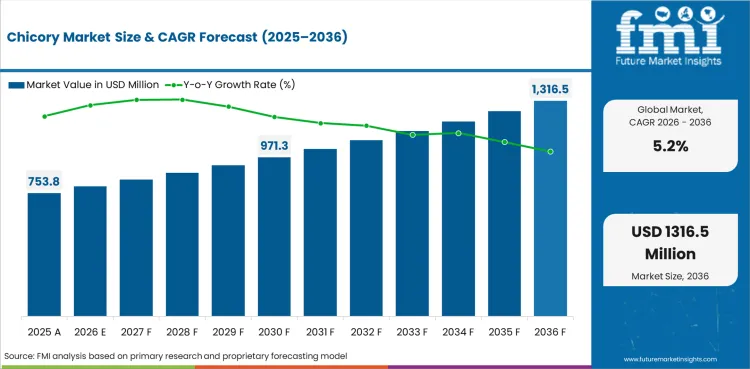
Key Takeaways, Market Size, and Forecast
- The Chicory market was valued at USD 753.8 million in 2025.
- By 2036, the Chicory Market is expected to be worth USD 1.32 billion.
- From 2026 to 2036, the market is projected to expand at a CAGR of 5.2%.
- The market is projected to create an incremental opportunity of USD 523.5 million between 2026 and 2036.
- In 2026, Chicory inulin is expected to account for 58.0% of the product segment, driven by demand for core application requirements.
- China (7.0%) and India (6.5%) are two of the fastest growing markets in the world.
Chicory Market Definition
The chicory market encompasses consumer products, ingredients, and formulations that address the core requirements of product applications across application, and related end-use categories. The market covers products segmented by product, application, end use, distribution channel, spanning the forecast period from 2026 to 2036.
Chicory Market Inclusions
Market scope encompasses all commercially relevant chicory products categorized by Product, Application, End Use, Distribution Channel. The revenue scope covers the period from 2026 to 2036 across North America, Latin America, Europe, East Asia, South Asia and Pacific, and Middle East and Africa.
Chicory Market Exclusions
The scope does not include unprocessed raw ingredients sold in bulk commodity channels, non-branded products without commercial distribution, or products marketed under categories outside the defined scope.
Chicory Market Research Methodology
- Primary Research: FMI analysts talked to product developers, retail buyers, and distribution partners in important markets.
- Desk Research: This is when you put together information from trade magazines, industry groups, and reports from manufacturers.
- Market sizing and forecasting: Adding up from the bottom up across categories like product, application, end use, and distribution channel, with regional adoption curves.
- Data validation: Cross-checked quarterly against retail tracking data and manufacturer disclosures.
Why is the Chicory Market Growing?
- Structured demand is growing in both retail and food service channels as more people choose health-conscious, plant-based, and sustainable products.
- China is the fastest-growing country, with a 7.0% increase, thanks to strong consumer spending and the early adoption of new product formats.
- Innovations in product formulation, packaging, and distribution are making the market bigger than just the usual consumer groups.
The chicory market is growing steadily, thanks to structural demand factors that are unlikely to change during the forecast period. Consumers are becoming more aware of where ingredients come from, how they affect health, and how they affect the environment. This is changing the way people shop in both high-end and regular stores.
58.0% of the product segment is made up of chicory inulin. This shows how consumers like to use products and how flexible the format is for different uses and ways of making them.
Structural growth factors include the modernization of retail and the growth of digital commerce. As the infrastructure for distribution gets better in developing markets and online shopping becomes more popular in developed markets, the number of people who can buy these products grows.
Market Segmentation Analysis
- The chicory market is segmented across 4 primary dimensions: Product, Application, End Use, Distribution Channel.
- Chicory inulin holds 58.0% of the product segment, reflecting its position as the primary consumer category.
- Food & beverages leads the application segment with 64.0% share, reflecting consumer channel preferences.
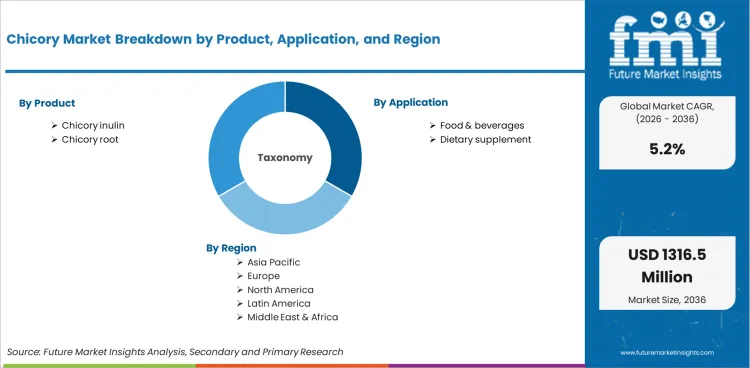
The market for chicory is organized across product, end-use, and channel dimensions. Segmentation by product includes Chicory inulin, Chicory root. By application, the market includes Food & beverages, Dietary supplement.
Insights into the Chicory inulin Product Segment
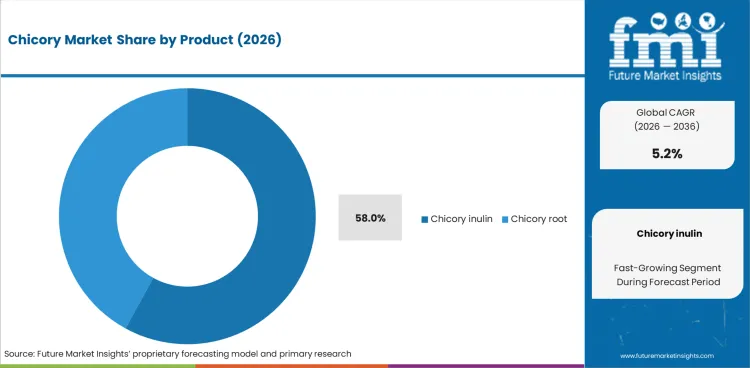
Chicory inulin is expected to make up 58.0% of the product segment by 2026. This product format is good because people are already familiar with it, it can be used in many ways, and it is well-positioned in both retail and food service distribution channels.
Consumer tastes are always changing, and new ways of making things are expected to make the taste, texture, and nutritional profiles of this group better. The growth of retail availability in emerging markets is likely to keep volume growth going.
Insights into the Food & beverages Application Segment
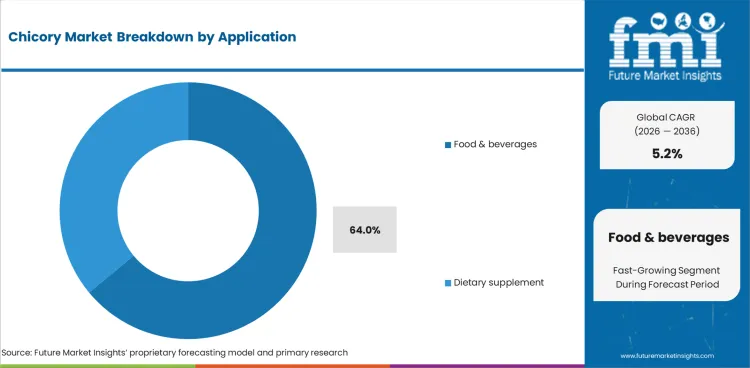
Food and drinks make up 64.0% of the application segment. This channel gets a lot of customers, has competitive prices, and can offer a wide range of products that encourage people to try them and buy them again.
Chicory Market Drivers, Restraints, and Opportunities
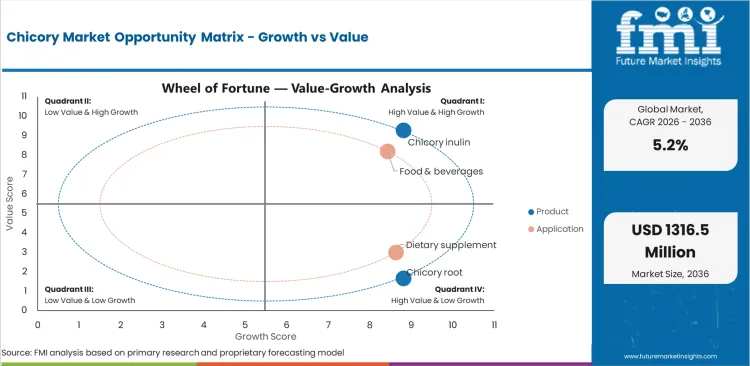
- People are becoming more aware of their health and are more interested in sustainable options. This is creating a structured demand for products that are clearly different from traditional ones.
- The higher price compared to traditional options makes it hard for price-sensitive consumers to adopt the product, which limits growth to health-conscious and high-end retail channels.
- During the forecast period, the growth of retail distribution and product awareness in emerging markets is expected to speed up adoption.
There are both demand-side growth factors and supply-side constraints that affect the chicory market. Consumer preferences are still changing for the better, but the high cost of ingredients and problems with distribution slow down the rate of adoption in some price-sensitive groups.
Consumer Health Awareness and Product Innovation
Demand shows that consumers are changing the way they buy things to focus more on health, sustainability, and ingredient transparency. The market for differentiated products gets bigger as more people learn about them.
Price Premium and Distribution Gaps
The price difference between premium products and regular ones makes people less likely to adopt them. People's willingness to pay varies a lot depending on where they live, how much money they make, and how much they know about the product.
Emerging Market Retail Expansion
The growth is due to more retail infrastructure being built in Asia, Latin America, and the Middle East. As modern trade and e-commerce access improve, more people in these areas are expected to start using them.
Analysis of Chicory Market By Key Countries
.webp "Top Country Growth Comparison Chicory Market Cagr (2026 2036)")
| Country | CAGR |
|---|---|
| China | 7.0% |
| India | 6.5% |
| Germany | 6.0% |
| Brazil | 5.5% |
| USA | 4.9% |
| UK | 4.4% |
| Japan | 3.9% |
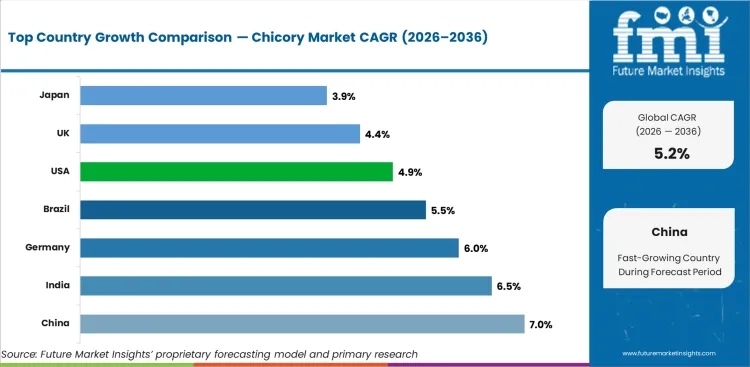
- China is in first place with a 7.0% CAGR, reflecting high consumer spending and early product adoption.
- India at 6.5% shows strong demand because of evolving consumer preferences and retail expansion.
- Germany (6.0%) and Brazil (5.5%) sustain growth through product innovation and distribution development.
- USA at 4.9% shows that consumer market development is creating new demand opportunities.
The global chicory market is expected to grow at a rate of 5.2% per year from 2026 to 2036. The study covers more than 30 countries, and the main markets are listed below.
Demand Outlook for Chicory Market in China
China will grow by 7.0% through 2036. This is supported by consumer spending trends, retail infrastructure development, and increasing product awareness.
- Consumer preference evolution supports demand through retail and food service channels.
- Product variety expansion accelerates consumer trial and repeat purchase.
- Brand investment supports development of next-generation product formats.
Future Outlook for Chicory Market in India
India will grow by 6.5% through 2036. This is supported by consumer spending trends, retail infrastructure development, and increasing product awareness.
- Consumer preference evolution supports demand through retail and food service channels.
- Product variety expansion accelerates consumer trial and repeat purchase.
- Brand investment supports development of next-generation product formats.
Opportunity Analysis of Chicory Market in Germany
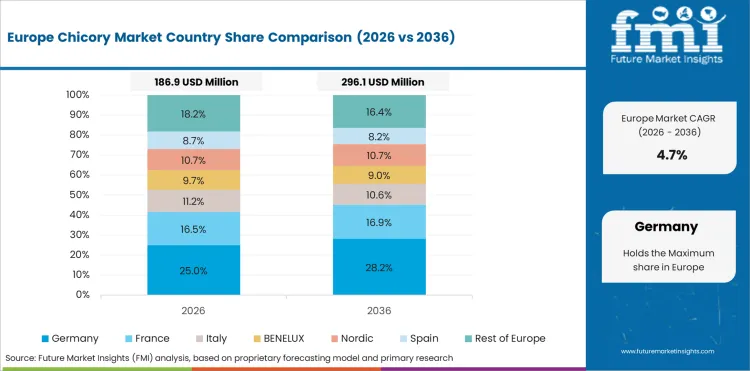
Germany will grow by 6.0% through 2036. This is supported by consumer spending trends, retail infrastructure development, and increasing product awareness.
- Consumer preference evolution supports demand through retail and food service channels.
- Product variety expansion accelerates consumer trial and repeat purchase.
- Brand investment supports development of next-generation product formats.
In-depth Analysis of Chicory Market in Brazil
Brazil will grow by 5.5% through 2036. This is supported by consumer spending trends, retail infrastructure development, and increasing product awareness.
- Consumer preference evolution supports demand through retail and food service channels.
- Product variety expansion accelerates consumer trial and repeat purchase.
- Brand investment supports development of next-generation product formats.
Sales Analysis of Chicory Market in USA
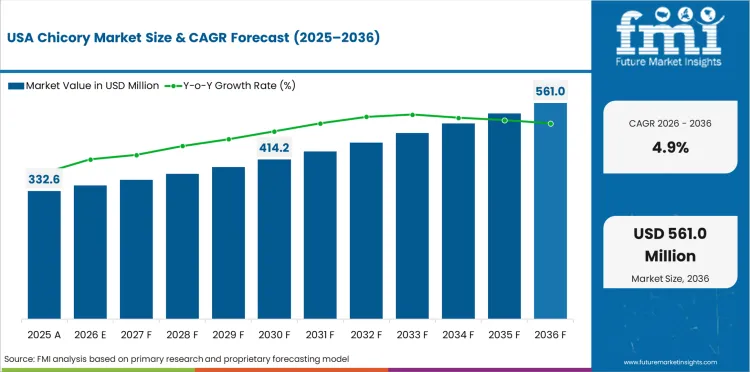
The US will grow by 4.9% through 2036. This is supported by consumer spending trends, retail infrastructure development, and increasing product awareness.
- Consumer preference evolution supports demand through retail and food service channels.
- Product variety expansion accelerates consumer trial and repeat purchase.
- Brand investment supports development of next-generation product formats.
Demand Outlook for Chicory Market in the United Kingdom
The UK will grow by 4.4% through 2036. This is supported by consumer spending trends, retail infrastructure development, and increasing product awareness.
- Consumer preference evolution supports demand through retail and food service channels.
- Product variety expansion accelerates consumer trial and repeat purchase.
- Brand investment supports development of next-generation product formats.
Future Outlook for Chicory Market in Japan
Japan will grow by 3.9% through 2036. This is supported by consumer spending trends, retail infrastructure development, and increasing product awareness.
- Consumer preference evolution supports demand through retail and food service channels.
- Product variety expansion accelerates consumer trial and repeat purchase.
- Brand investment supports development of next-generation product formats.
Competitive Landscape and Strategic Positioning
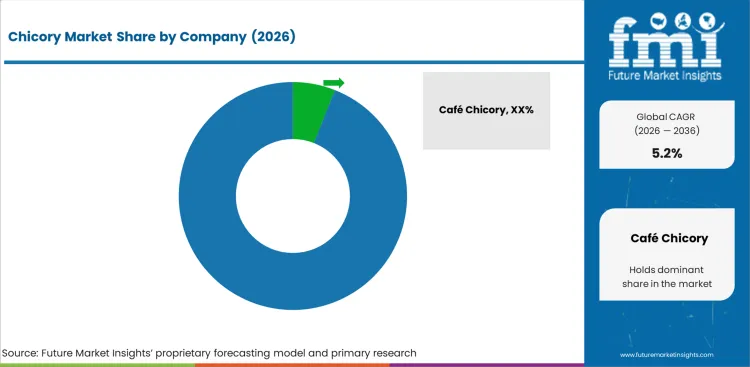
- Café Chicory is the leader in the market with approximately 6.0% share, supported by strong brand recognition, broad distribution, and product innovation capabilities.
- Rootz Chicory, Nutra Chicory, and Chicory Co offer competitive product ranges that address diverse consumer preferences and retail channel requirements.
- New entrants are focusing on specialized applications and niche market segments where premium positioning and ingredient differentiation create competitive advantage.
Café Chicory leads the market through brand equity, distribution scale, and product development capabilities. The competitive landscape is moderately concentrated, with established players competing on product quality, brand positioning, and distribution reach.
Barriers to entry include brand development costs, distribution access requirements, and formulation development complexity. Strategic priorities include product innovation, distribution expansion, and sustainability improvement.
Key Companies in the Chicory Market
Key global companies leading the chicory market include:
- Café Chicory, Rootz Chicory, Nutra Chicory, Chicory Co all have strong brand portfolios, distribution networks, and product development capabilities across key markets.
- Farm2Food, Chicory Harvest have established regional strength through targeted product positioning and local distribution partnerships.
Competitive Benchmarking: Chicory Market
| Company | Product Range | Brand Strength | Distribution Access | Geographic Footprint |
|---|---|---|---|---|
| Café Chicory | High | Strong | Strong | Global |
| Rootz Chicory | High | Strong | Strong | Global |
| Nutra Chicory | High | Strong | Strong | Global |
| Chicory Co | Medium | Medium | Moderate | Regional |
| Farm2Food | Medium | Medium | Moderate | Regional |
| Chicory Harvest | Medium | Medium | Moderate | Regional |
Source: Future Market Insights competitive analysis, 2026.
Key Developments in Chicory Market
- In 2025, BENEO and other chicory processors strengthened inulin production capabilities in Europe to support demand for prebiotic fiber ingredients in food and beverage applications.
- In 2025, the chicory market saw increased focus on sustainable sourcing and clean-label formulations, with manufacturers expanding the use of chicory-derived ingredients in functional and health-oriented products.
Key Players in the Chicory Market
Major Global Players
- Café Chicory
- Rootz Chicory
- Nutra Chicory
- Chicory Co
- Farm2Food
- Chicory Harvest
Emerging Players/Startups
-
Emerging regional players and startups
Report Scope and Coverage
| Quantitative Units | USD 793.0 million to USD 1.32 billion, at a CAGR of 5.2% |
|---|---|
| Market Definition | The chicory market encompasses consumer products and ingredients across product, application, end use, distribution channel categories. |
| Regions Covered | North America, Latin America, Europe, East Asia, South Asia and Pacific, Middle East and Africa |
| Countries Covered | China, India, Germany, Brazil, USA, UK, Japan, 30 plus countries |
| Key Companies Profiled | Café Chicory, Rootz Chicory, Nutra Chicory, Chicory Co, Farm2Food, Chicory Harvest |
| Forecast Period | 2026 to 2036 |
| Approach | Hybrid bottom-up and top-down methodology starting with verified transaction data, projecting adoption velocity across segments and regions. |
Segmentation
Chicory Market Market Segmented by Product:
- Chicory inulin
- Chicory root
Chicory Market Market Segmented by Application:
- Food & beverages
- Dietary supplement
Chicory Market Market Segmented by End Use:
- Food Industry
- Beverage Manufacturers
- Coffee Substitute Brands
- Health Beverage Brands
- Processed Food Manufacturers
- Bakery Producers
- Dairy Producers
- Beverage Manufacturers
- Nutraceutical Industry
- Supplement Manufacturers
- Digestive Health Products
- Prebiotic Products
- Contract Manufacturers
- Private Label
- Third Party Production
- Supplement Manufacturers
- Feed Industry
- Feed Producers
- Commercial Feed
- Specialty Feed
- Pet Food Manufacturers
- Premium Pet Food
- Economy Pet Food
- Feed Producers
Chicory Market Market Segmented by Distribution Channel:
- Direct Sales
- Manufacturer Sales
- Bulk Supply
- Contract Supply
- Manufacturer Sales
- Distributor Network
- Ingredient Distributors
- Regional Distributors
- Global Distributors
- Retail Channel
- Supermarkets
- Health Stores
- Ingredient Distributors
- Online Channel
- E-Commerce Platforms
- Business to Business Platforms
- Direct to Consumer Platforms
- E-Commerce Platforms
Chicory Market Market by Region:
- North America
- USA
- Canada
- Mexico
- Latin America
- Brazil
- Chile
- Rest of Latin America
- Western Europe
- Germany
- UK
- Italy
- Spain
- France
- Nordic
- BENELUX
- Rest of Western Europe
- Eastern Europe
- Russia
- Poland
- Hungary
- Balkan & Baltic
- Rest of Eastern Europe
- East Asia
- China
- Japan
- South Korea
- South Asia and Pacific
- India
- ASEAN
- Australia & New Zealand
- Rest of South Asia and Pacific
- Middle East & Africa
- Kingdom of Saudi Arabia
- Other GCC Countries
- Turkiye
- South Africa
- Other African Union
- Rest of Middle East & Africa
Research Sources and Bibliography
- Food and Agriculture Organization. (2025). FAO Global Food and Beverage Market Report. FAO.
- European Commission. (2025). EU Food Safety and Consumer Health Regulations. EC.
- USA Department of Agriculture. (2025). USDA Economic Research Service Reports. USDA.
- World Health Organization. (2025). WHO Nutrition and Health Guidelines. WHO.
- International Food Information Council. (2025). IFIC Consumer Food Survey. IFIC.
This bibliography is provided for reader reference. The full Future Market Insights report contains the complete reference list with publication dates, URLs, and supporting data for all cited works.
This Report Answers
- Estimating the size of the market and revenue from 2026 to 2036.
- Segmentation by product, application, end use, distribution channel.
- Insights about more than 30 markets in the region.
- Analysis of consumer trends, product innovation, and distribution dynamics.
- Assessment of the competitive landscape.
- Finding investment opportunities across product segments and geographic markets.
- Keeping track of the supply chain.
- Delivery of data in PDF and Excel formats.
Frequently Asked Questions
What is the global market demand for Chicory in 2026?
In 2026, the global market for chicory is expected to be worth USD 793.0 million.
How big will the market for Chicory be in 2036?
By 2036, the market for chicory is expected to be worth USD 1.32 billion.
How much do you think demand for Chicory will grow between 2026 and 2036?
Between 2026 and 2036, the demand for chicory is expected to grow at a CAGR of 5.2%.
Which Product segment is likely to be the best seller in the world by 2026?
Chicory inulin is expected to account for 58.0% of the market in 2026, reflecting its strong consumer preference and broad distribution.
What is causing demand to rise in China?
China will grow at a rate of 7.0% per year through 2036, supported by high consumer spending and early adoption of new product formats.
What is causing demand to rise in India?
India will grow at a rate of 6.5% per year through 2036, supported by evolving consumer preferences and retail infrastructure development.
What does this report mean by "Chicory Market definition"?
The chicory market includes consumer products and ingredients categorized by product, application, end use, distribution channel.
How does FMI make the Chicory forecast and check it?
Forecasting models use a hybrid bottom-up and top-down approach, starting with verified transaction data and checking it against retail tracking data and manufacturer disclosures.
Preview the report firsthand - request a free sample
Get SampleGet the brochure for pricing and purchase details.
Get PDFTable of Content
- Executive Summary
- Global Market Outlook
- Demand-side Trends
- Supply-side Trends
- Technology Roadmap Analysis
- Analysis and Recommendations
- Market Overview
- Market Coverage / Taxonomy
- Market Definition / Scope / Limitations
- Research Methodology
- Chapter Orientation
- Analytical Lens and Working Hypotheses
- Market Structure, Signals, and Trend Drivers
- Benchmarking and Cross-market Comparability
- Desk Research Programme (Secondary Evidence)
- Company Annual and Sustainability Reports
- Peer-reviewed Journals and Academic Literature
- Corporate Websites, Product Literature, and Technical Notes
- Earnings Decks and Investor Briefings
- Statutory Filings and Regulatory Disclosures
- Technical White Papers and Standards Notes
- Trade Journals, Industry Magazines, and Analyst Briefs
- Conference Proceedings, Webinars, and Seminar Materials
- Government Statistics Portals and Public Data Releases
- Press Releases and Reputable Media Coverage
- Specialist Newsletters and Curated Briefings
- Sector Databases and Reference Repositories
- FMI Internal Proprietary Databases and Historical Market Datasets
- Subscription Datasets and Paid Sources
- Social Channels, Communities, and Digital Listening Inputs
- Additional Desk Sources
- Expert Input and Fieldwork (Primary Evidence)
- Primary Modes
- Qualitative Interviews and Expert Elicitation
- Quantitative Surveys and Structured Data Capture
- Blended Approach
- Why Primary Evidence is Used
- Field Techniques
- Interviews
- Surveys
- Focus Groups
- Observational and In-context Research
- Social and Community Interactions
- Stakeholder Universe Engaged
- C-suite Leaders
- Board Members
- Presidents and Vice Presidents
- R&D and Innovation Heads
- Technical Specialists
- Domain Subject-matter Experts
- Scientists
- Physicians and Other Healthcare Professionals
- Governance, Ethics, and Data Stewardship
- Research Ethics
- Demand in Likely Scenario
- Demand in Conservative Scenario
- Opportunity Map Analysis
- Product Life Cycle Analysis
- Supply Chain Analysis
- Investment Feasibility Matrix
- Value Chain Analysis
- PESTLE and Porter’s Analysis
- Regulatory Landscape
- Regional Parent Market Outlook
- Production and Consumption Statistics
- Import and Export Statistics
- Primary Modes
- Global Market Analysis 2021 to 2025 and Forecast, 2026 to 2036
- Historical Market Size Value (USD Million) Analysis, 2021 to 2025
- Current and Future Market Size Value (USD Million) Projections, 2026 to 2036
- Y-o-Y Growth Trend Analysis
- Absolute $ Opportunity Analysis
- Global Market Pricing Analysis 2021 to 2025 and Forecast 2026 to 2036
- Global Market Analysis 2021 to 2025 and Forecast 2026 to 2036, By Product
- Introduction / Key Findings
- Historical Market Size Value (USD Million) Analysis By Product , 2021 to 2025
- Current and Future Market Size Value (USD Million) Analysis and Forecast By Product , 2026 to 2036
- Chicory inulin
- Chicory root
- Chicory inulin
- Y-o-Y Growth Trend Analysis By Product , 2021 to 2025
- Absolute $ Opportunity Analysis By Product , 2026 to 2036
- Global Market Analysis 2021 to 2025 and Forecast 2026 to 2036, By Application
- Introduction / Key Findings
- Historical Market Size Value (USD Million) Analysis By Application, 2021 to 2025
- Current and Future Market Size Value (USD Million) Analysis and Forecast By Application, 2026 to 2036
- Food & beverages
- Dietary supplement
- Food & beverages
- Y-o-Y Growth Trend Analysis By Application, 2021 to 2025
- Absolute $ Opportunity Analysis By Application, 2026 to 2036
- Global Market Analysis 2021 to 2025 and Forecast 2026 to 2036, By End Use
- Introduction / Key Findings
- Historical Market Size Value (USD Million) Analysis By End Use, 2021 to 2025
- Current and Future Market Size Value (USD Million) Analysis and Forecast By End Use, 2026 to 2036
- Food Industry
- Beverage Manufacturers
- Coffee Substitute Brands
- Health Beverage Brands
- Processed Food Manufacturers
- Bakery Producers
- Dairy Producers
- Nutraceutical Industry
- Supplement Manufacturers
- Digestive Health Products
- Prebiotic Products
- Contract Manufacturers
- Private Label
- Feed Industry
- Feed Producers
- Commercial Feed
- Specialty Feed
- Pet Food Manufacturers
- Premium Pet Food
- Food Industry
- Y-o-Y Growth Trend Analysis By End Use, 2021 to 2025
- Absolute $ Opportunity Analysis By End Use, 2026 to 2036
- Global Market Analysis 2021 to 2025 and Forecast 2026 to 2036, By Distribution Channel
- Introduction / Key Findings
- Historical Market Size Value (USD Million) Analysis By Distribution Channel, 2021 to 2025
- Current and Future Market Size Value (USD Million) Analysis and Forecast By Distribution Channel, 2026 to 2036
- Direct Sales
- Manufacturer Sales
- Bulk Supply
- Contract Supply
- Distributor Network
- Ingredient Distributors
- Regional Distributors
- Global Distributors
- Retail Channel
- Supermarkets
- Online Channel
- E-Commerce Platforms
- Business to Business Platforms
- Direct to Consumer Platforms
- Direct Sales
- Y-o-Y Growth Trend Analysis By Distribution Channel, 2021 to 2025
- Absolute $ Opportunity Analysis By Distribution Channel, 2026 to 2036
- Global Market Analysis 2021 to 2025 and Forecast 2026 to 2036, By Region
- Introduction
- Historical Market Size Value (USD Million) Analysis By Region, 2021 to 2025
- Current Market Size Value (USD Million) Analysis and Forecast By Region, 2026 to 2036
- North America
- Latin America
- Western Europe
- Eastern Europe
- East Asia
- South Asia and Pacific
- Middle East & Africa
- Market Attractiveness Analysis By Region
- North America Market Analysis 2021 to 2025 and Forecast 2026 to 2036, By Country
- Historical Market Size Value (USD Million) Trend Analysis By Market Taxonomy, 2021 to 2025
- Market Size Value (USD Million) Forecast By Market Taxonomy, 2026 to 2036
- By Country
- USA
- Canada
- Mexico
- By Product
- By Application
- By End Use
- By Distribution Channel
- By Country
- Market Attractiveness Analysis
- By Country
- By Product
- By Application
- By End Use
- By Distribution Channel
- Key Takeaways
- Latin America Market Analysis 2021 to 2025 and Forecast 2026 to 2036, By Country
- Historical Market Size Value (USD Million) Trend Analysis By Market Taxonomy, 2021 to 2025
- Market Size Value (USD Million) Forecast By Market Taxonomy, 2026 to 2036
- By Country
- Brazil
- Chile
- Rest of Latin America
- By Product
- By Application
- By End Use
- By Distribution Channel
- By Country
- Market Attractiveness Analysis
- By Country
- By Product
- By Application
- By End Use
- By Distribution Channel
- Key Takeaways
- Western Europe Market Analysis 2021 to 2025 and Forecast 2026 to 2036, By Country
- Historical Market Size Value (USD Million) Trend Analysis By Market Taxonomy, 2021 to 2025
- Market Size Value (USD Million) Forecast By Market Taxonomy, 2026 to 2036
- By Country
- Germany
- UK
- Italy
- Spain
- France
- Nordic
- BENELUX
- Rest of Western Europe
- By Product
- By Application
- By End Use
- By Distribution Channel
- By Country
- Market Attractiveness Analysis
- By Country
- By Product
- By Application
- By End Use
- By Distribution Channel
- Key Takeaways
- Eastern Europe Market Analysis 2021 to 2025 and Forecast 2026 to 2036, By Country
- Historical Market Size Value (USD Million) Trend Analysis By Market Taxonomy, 2021 to 2025
- Market Size Value (USD Million) Forecast By Market Taxonomy, 2026 to 2036
- By Country
- Russia
- Poland
- Hungary
- Balkan & Baltic
- Rest of Eastern Europe
- By Product
- By Application
- By End Use
- By Distribution Channel
- By Country
- Market Attractiveness Analysis
- By Country
- By Product
- By Application
- By End Use
- By Distribution Channel
- Key Takeaways
- East Asia Market Analysis 2021 to 2025 and Forecast 2026 to 2036, By Country
- Historical Market Size Value (USD Million) Trend Analysis By Market Taxonomy, 2021 to 2025
- Market Size Value (USD Million) Forecast By Market Taxonomy, 2026 to 2036
- By Country
- China
- Japan
- South Korea
- By Product
- By Application
- By End Use
- By Distribution Channel
- By Country
- Market Attractiveness Analysis
- By Country
- By Product
- By Application
- By End Use
- By Distribution Channel
- Key Takeaways
- South Asia and Pacific Market Analysis 2021 to 2025 and Forecast 2026 to 2036, By Country
- Historical Market Size Value (USD Million) Trend Analysis By Market Taxonomy, 2021 to 2025
- Market Size Value (USD Million) Forecast By Market Taxonomy, 2026 to 2036
- By Country
- India
- ASEAN
- Australia & New Zealand
- Rest of South Asia and Pacific
- By Product
- By Application
- By End Use
- By Distribution Channel
- By Country
- Market Attractiveness Analysis
- By Country
- By Product
- By Application
- By End Use
- By Distribution Channel
- Key Takeaways
- Middle East & Africa Market Analysis 2021 to 2025 and Forecast 2026 to 2036, By Country
- Historical Market Size Value (USD Million) Trend Analysis By Market Taxonomy, 2021 to 2025
- Market Size Value (USD Million) Forecast By Market Taxonomy, 2026 to 2036
- By Country
- Kingdom of Saudi Arabia
- Other GCC Countries
- Turkiye
- South Africa
- Other African Union
- Rest of Middle East & Africa
- By Product
- By Application
- By End Use
- By Distribution Channel
- By Country
- Market Attractiveness Analysis
- By Country
- By Product
- By Application
- By End Use
- By Distribution Channel
- Key Takeaways
- Key Countries Market Analysis
- USA
- Pricing Analysis
- Market Share Analysis, 2025
- By Product
- By Application
- By End Use
- By Distribution Channel
- Canada
- Pricing Analysis
- Market Share Analysis, 2025
- By Product
- By Application
- By End Use
- By Distribution Channel
- Mexico
- Pricing Analysis
- Market Share Analysis, 2025
- By Product
- By Application
- By End Use
- By Distribution Channel
- Brazil
- Pricing Analysis
- Market Share Analysis, 2025
- By Product
- By Application
- By End Use
- By Distribution Channel
- Chile
- Pricing Analysis
- Market Share Analysis, 2025
- By Product
- By Application
- By End Use
- By Distribution Channel
- Germany
- Pricing Analysis
- Market Share Analysis, 2025
- By Product
- By Application
- By End Use
- By Distribution Channel
- UK
- Pricing Analysis
- Market Share Analysis, 2025
- By Product
- By Application
- By End Use
- By Distribution Channel
- Italy
- Pricing Analysis
- Market Share Analysis, 2025
- By Product
- By Application
- By End Use
- By Distribution Channel
- Spain
- Pricing Analysis
- Market Share Analysis, 2025
- By Product
- By Application
- By End Use
- By Distribution Channel
- France
- Pricing Analysis
- Market Share Analysis, 2025
- By Product
- By Application
- By End Use
- By Distribution Channel
- India
- Pricing Analysis
- Market Share Analysis, 2025
- By Product
- By Application
- By End Use
- By Distribution Channel
- ASEAN
- Pricing Analysis
- Market Share Analysis, 2025
- By Product
- By Application
- By End Use
- By Distribution Channel
- Australia & New Zealand
- Pricing Analysis
- Market Share Analysis, 2025
- By Product
- By Application
- By End Use
- By Distribution Channel
- China
- Pricing Analysis
- Market Share Analysis, 2025
- By Product
- By Application
- By End Use
- By Distribution Channel
- Japan
- Pricing Analysis
- Market Share Analysis, 2025
- By Product
- By Application
- By End Use
- By Distribution Channel
- South Korea
- Pricing Analysis
- Market Share Analysis, 2025
- By Product
- By Application
- By End Use
- By Distribution Channel
- Russia
- Pricing Analysis
- Market Share Analysis, 2025
- By Product
- By Application
- By End Use
- By Distribution Channel
- Poland
- Pricing Analysis
- Market Share Analysis, 2025
- By Product
- By Application
- By End Use
- By Distribution Channel
- Hungary
- Pricing Analysis
- Market Share Analysis, 2025
- By Product
- By Application
- By End Use
- By Distribution Channel
- Kingdom of Saudi Arabia
- Pricing Analysis
- Market Share Analysis, 2025
- By Product
- By Application
- By End Use
- By Distribution Channel
- Turkiye
- Pricing Analysis
- Market Share Analysis, 2025
- By Product
- By Application
- By End Use
- By Distribution Channel
- South Africa
- Pricing Analysis
- Market Share Analysis, 2025
- By Product
- By Application
- By End Use
- By Distribution Channel
- USA
- Market Structure Analysis
- Competition Dashboard
- Competition Benchmarking
- Market Share Analysis of Top Players
- By Regional
- By Product
- By Application
- By End Use
- By Distribution Channel
- Competition Analysis
- Competition Deep Dive
- Café Chicory
- Overview
- Product Portfolio
- Profitability by Market Segments (Product/Age /Sales Channel/Region)
- Sales Footprint
- Strategy Overview
- Marketing Strategy
- Product Strategy
- Channel Strategy
- Rootz Chicory
- Nutra Chicory
- Chicory Co
- Farm2Food
- Chicory Harvest
- Café Chicory
- Competition Deep Dive
- Assumptions & Acronyms Used


