

- Market Size (2026)
- USD 9.8 Bn
- Forecast (2036)
- USD 28.6 Bn
- CAGR (2026 to 2036)
- 11.3%
How big is the Cognitive Radio Market in 2026?
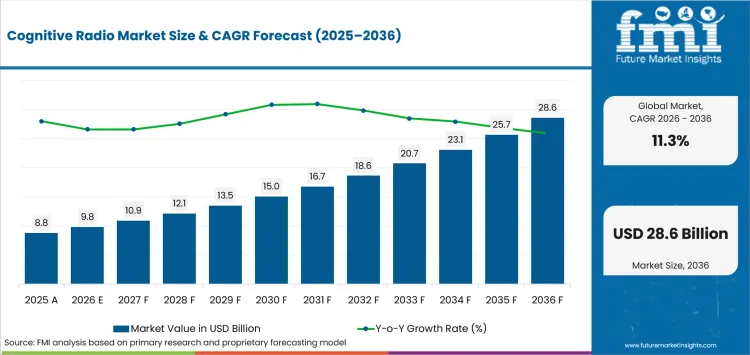
USD 9.8 billion in 2026 and USD 28.6 billion by 2036 at an 11.3% CAGR.
Demand for cognitive radio is set to climb from USD 9.8 billion in 2026, expanding at a CAGR of 11.3% through 2036, as reconfigurable, policy aware spectrum access becomes central to defense communications and commercial network planning. Growth is anchored in the shift toward dynamic spectrum sharing, where hardware must sense, adapt, and yield to protected transmissions without manual intervention. Defense agencies are pushing reconfigurable radios that pair adaptive waveforms with policy engines capable of proving, through documented coexistence testing, that new transmissions will not disrupt incumbent radar or other mission critical operations. Network operators are pursuing similar capability as regulators press for faster repurposing of federal spectrum toward commercial use, a mandate that is compressing engineering timelines and raising the bar for verifiable safe operation evidence during deployment approval.
Restraints center on the cost and complexity of certifying adaptive systems against strict interference thresholds, along with the slow pace at which legacy infrastructure can absorb reconfigurable hardware. Opportunity lies in policy engine software, coexistence testing services, and modular radio platforms that can be recertified as spectrum rules evolve rather than replaced outright. Segment level activity spans hardware platforms, software and policy control layers, and testing or certification services, each shaped by how quickly incumbent protection requirements tighten. Regionally, North America leads on the strength of active federal spectrum reallocation programs, while adoption elsewhere tracks the maturity of national spectrum sharing frameworks.
Key Takeaways of Cognitive Radio Market
- Defense modernization and shared-spectrum programs increase demand for radios that adapt parameters without interrupting protected users or mission traffic.
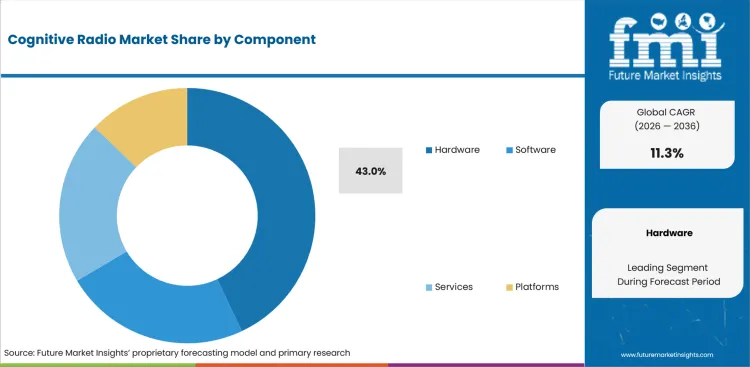
- Hardware is projected to represent 43.0% by component in 2026 due to spending on reconfigurable transceivers and sensing modules.
- Military and defense is estimated to account for 36.0% of application demand in 2026 as contested operations require resilient communications.
- Defense organizations are forecast to hold 38.0% of end-user demand in 2026 owing to secure waveform and interoperability requirements.
- Sensing errors and coexistence failures remain material restraints as incorrect channel decisions can disrupt protected services during field operation.
- BAE Systems plc, RTX Corporation, Thales S.A., L3Harris Technologies, Inc., Nokia Corporation, Telefonaktiebolaget LM Ericsson, Rohde & Schwarz GmbH & Co. KG and Keysight Technologies, Inc. are the companies assessed.
Analyst Perspective
“Radio qualification fails if sensing logic cannot separate weak incumbents from transient interference during mobility. Commercial advantage rests on proving policy-controlled fallback behavior across the exact bands and mission profiles planned for operation.”
- Sudip Saha, Principal Consultant, Future Market Insights
How is the Cognitive Radio Market segmented?
The cognitive radio market is segmented by component, application, end user, distribution channel, frequency band and region.
The cognitive radio market is segmented by component, application, end user, distribution channel, frequency band and region. Component analysis covers hardware, software, services and platforms with RF transceivers, spectrum sensors, management software, algorithms, integration services and embedded or cloud platforms. Applications include military and defense, telecommunications, public safety and transportation alongside end users comprising defense organizations, telecommunication operators, government agencies and industrial enterprises. Distribution channels include direct sales, system integrators, authorized distributors and online sales with frequency bands covering UHF, VHF, SHF and EHF systems.
How does hardware shape demand within the component category?
Programmable RF transceivers set receiver sensitivity and processing latency so cognitive software can approve a frequency or power change. Spectrum-monitoring systems must distinguish weak incumbent signals from transient noise during mobile acceptance testing across several mission bands.
- Hardware is set to lead the component category with 43.0% share in 2026 due to spending on reconfigurable transceivers and onboard processing modules.
- Radio developers also need repeatable evidence that sensing works inside open-radio architectures under realistic interference conditions. In January 2025, NTIA awarded DeepSig USD 9.998 million to integrate AI-enabled spectrum awareness into production-ready open radio units.
What supports military and defense demand within the application category?
Military networks use tactical communications with adaptive waveforms to preserve command links during jamming and channel changes. Electronic warfare teams test waveform recovery and channel selection across joint land and maritime missions. In September 2025, BAE Systems began fielding AN/ARC-231A radios across selected United States Army rotary-wing aircraft.
- In 2026, military and defense is expected to lead the application category with 36.0% share because contested missions require resilient voice and data links.
- Defense programs favor radios that accept secure waveform upgrades across several platforms without replacing the installed hardware base and rely on regional maintenance teams for encryption changes and repairs during overseas deployments.
How do defense organizations evaluate systems within the end-user category?
Defense organizations manage tactical radios through long platform lifecycles that require encrypted interoperability and controlled software updates. Qualification links cybersecurity testing with operator training and mission-specific integration as revised configurations enter operational service.
- The defense organizations segment is likely to capture 38.0% share in 2026 attributable to coordinated requirements across army, naval and air-force programs.
- Program offices also need configurable terminals that remain compatible across allied fleets and mission systems. In January 2026, Data Link Solutions received a USD 248 million contract for hundreds of MIDS JTRS terminals serving more than 45 platform types worldwide.
What drives direct sales within the distribution channel category?
Direct contracting gives national-security program offices one accountable route for software-defined radio systems and classified technical documentation. In September 2025, Thales secured Malaysia's first order for more than 100 land-based HF XL radio stations with integration and training.
- By distribution channel, direct sales is estimated to hold 44.0% in 2026 owing to negotiated qualification and long-duration support requirements.
- Sensitive deployments require controlled secure software delivery and onsite acceptance work across restricted locations that general sales channels cannot coordinate reliably. Direct contracting leaves one integrator accountable for later configuration changes, classified support and long-term field maintenance.
What are the drivers, restraints and opportunities in the Cognitive Radio Market?
Shared-spectrum rules support deployment while sensing errors delay approval and repeatable simulation provides a practical qualification route.
- Driver: Controlled spectrum-sharing frameworks require adaptive radios to follow location-specific access rules across regulated wireless networks.
- Restraint: Hidden incumbents can trigger incorrect channel decisions that increase coexistence testing and fallback-design requirements.
- Opportunity: AI-assisted simulation can test sensing logic against repeatable mobility, interference and policy conditions during pre-deployment qualification.
Shared-access frameworks replace permanent assignments with policy-controlled access that changes by location and incumbent activity. A November 2024 NTIA report describes automated Spectrum Access Systems protecting incumbents within CBRS networks and requiring radios to enforce access decisions.
Adaptive radios can misclassify weak incumbent signals during mobility or heavy interference across congested operating bands. Qualification teams therefore test hidden-node behavior and safe fallback operation before regulators or mission owners approve field deployment.
Repeatable network digital twins let engineers replay mobility and interference conditions without consuming scarce field-test time. Ericsson's April 2026 MRSS work documents millisecond scheduling between 5G and 6G for controlled coexistence testing.
Which country CAGRs are profiled in the Cognitive Radio Market?
| Country | CAGR |
|---|---|
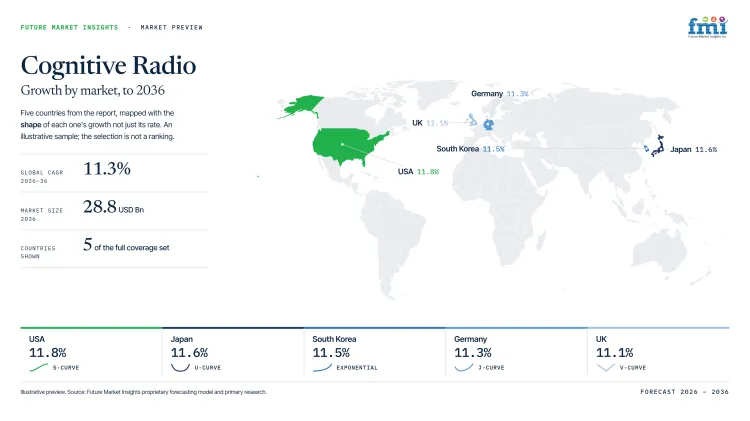
| USA | 11.8% |
| Japan | 11.6% |
| South Korea | 11.5% |
| Germany | 11.3% |
| United Kingdom | 11.1% |
How do country-level CAGRs compare in the Cognitive Radio Market?
The displayed country CAGRs span 0.7 percentage point and describe forecast pace rather than current market size. Their close spacing reflects different licensing routes and engineering support conditions across advanced wireless systems.
- USA combines federal spectrum repurposing with defense modernization that supports adaptive-access testing across commercial and mission networks.
- Japan connects national wireless laboratories with domestic equipment developers that evaluate coordinated control across advanced frequency bands.
- South Korea combines operator expertise with government-funded research that expands upper-mid-band experimentation and standards preparation.
- Germany uses local frequency assignments that support private wireless deployments across industrial sites and research campuses.
- The United Kingdom applies shared-access licensing that supports localized networks under site-specific technical coordination requirements.
Comparable CAGRs can produce different market entry conditions. The full report provides country-level CAGR analysis across North America, Latin America, Europe, East Asia, South Asia and Pacific, and the Middle East and Africa.
Country-wise Analysis
- Federal test ranges and commercial network laboratories let United States integrators evaluate adaptive access against representative radar emissions before deployment across military bases and private 5G environments supported by regional engineering and maintenance teams. In January 2025, NTIA awarded USD 117.4 million across nine open-radio projects including DeepSig's spectrum-sensing work for future sharing and other radio-unit commercialization efforts with mobile-network partners during development across several regions. By 2036, the USA is projected to grow at 11.8% CAGR supported by federal spectrum programs yet mission-protection reviews and scarce representative emitters continue extending approval schedules for contested-band radio systems during operational deployment.
- National wireless laboratories connect Japanese equipment developers with metropolitan engineering centers that maintain calibrated antennas and high-frequency test systems for dense urban trials across domestic service networks and regional maintenance routes throughout major cities. Japan is estimated to post 11.6% CAGR over the forecast period influenced by electronics expertise and public research infrastructure that supports coordinated switching across millimeter-wave and terahertz links for domestic network developers and operators. In May 2026, NICT demonstrated automatic switching between 60 GHz and 300 GHz links as conditions changed yet short propagation ranges and strict antenna alignment continue restricting deployment outside controlled test sites.
- Major mobile operators work with government-funded laboratories and equipment companies that coordinate upper-mid-band experiments and standards preparation across metropolitan engineering clusters supported by university test facilities and specialized network teams across several national programs. In March 2025, MSIT reported that Korea's three mobile carriers joined Samsung Electronics and LG Electronics plus ETRI in unified 6G proposals covering AI integration and software-based networking for national standards development work. The South Korean cognitive radio sector is projected to record 11.5% CAGR during the assessment period reinforced by coordinated standards work yet evolving 3GPP specifications and limited specialist capacity delay commercial equipment decisions nationwide.
- Local 3.7 GHz assignments let German factories and research campuses deploy private networks through experienced integrators that manage radio planning and site coordination across industrial regions with specialized engineering teams and service hubs nationwide. In Germany, cognitive radio demand is predicted to advance at 11.3% CAGR through 2036 aided by campus-network licensing and established support for site-specific coverage and interference control across industrial facilities and research campuses nationwide. In November 2025, Bundesnetzagentur recorded 484 applications and 484 assignments under the local licensing route yet application fees and specialized planning requirements continue limiting smaller deployment programs across less densely served regions.
- Shared Access licensing lets British factories and venues deploy localized wireless systems through regional integrators that manage regulator-defined coordination around fixed links and existing licensees across varied operating environments with dedicated engineering support teams. In July 2025, Ofcom increased usable spectrum within 3.8 GHz to 4.2 GHz for local industrial and public-service connectivity under updated technical conditions across regional private-network projects and public venues across several regions. The United Kingdom's cognitive radio outlook is anticipated to advance at 11.1% CAGR over the assessment period shaped by flexible local access yet first-come coordination and site-specific restrictions lengthen regional deployment planning nationwide.
Who are the notable companies in the Cognitive Radio Market?
BAE Systems plc, RTX Corporation, Thales S.A., L3Harris Technologies, Inc., Nokia Corporation, Telefonaktiebolaget LM Ericsson, Rohde & Schwarz GmbH & Co. KG and Keysight Technologies, Inc. are the notable companies serving this market.
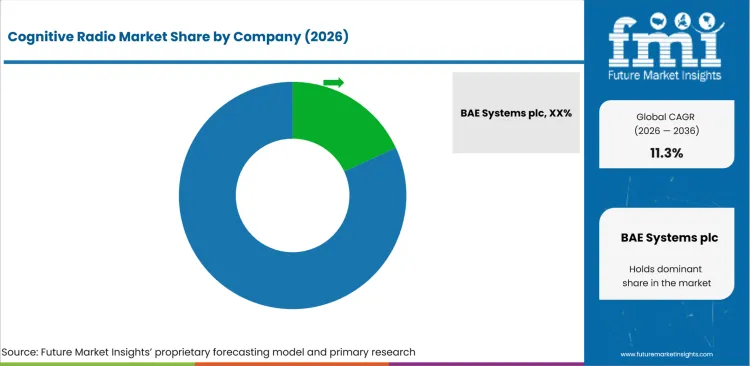
The competitive field remains fragmented as defense-radio primes, mobile-network groups and RF test specialists follow different qualification routes. Defense programs prioritize secure waveforms and field support whereas telecom deployments place greater weight on software integration and spectrum efficiency. Newcomers face substantial entry barriers through requirements for interoperability, policy control and service coverage across every intended operating band.
- BAE Systems plc, RTX Corporation, Thales S.A. and L3Harris Technologies, Inc. compete through fielded defense-radio programs and secure waveform integration.
- Nokia Corporation and Telefonaktiebolaget LM Ericsson develop radio-access software that coordinates spectrum use across successive mobile generations.
- Rohde & Schwarz GmbH & Co. KG and Keysight Technologies, Inc. provide RF simulation and coexistence-testing environments for adaptive-radio qualification.
Competitive Benchmarking: Cognitive Radio Market
| Company | Software-Defined System Evidence | Adaptive Spectrum Depth | Deployment Readiness | Geographic Reach |
|---|---|---|---|---|
| BAE Systems plc | High | Medium | High | Global |
| RTX Corporation | High | High | High | United States and allied markets |
| Thales S.A. | High | Medium | High | Europe and Asia-Pacific |
| L3Harris Technologies, Inc. | High | High | High | Global |
| Nokia Corporation | Medium | High | Medium | Global |
| Telefonaktiebolaget LM Ericsson | Medium | High | Medium | Global |
| Rohde & Schwarz GmbH & Co. KG | Medium | High | Medium | Global |
| Keysight Technologies, Inc. | Medium | High | Medium | Global |
Key Developments in the Cognitive Radio Market
- In May 2026, RTX Corporation received an Office of Naval Research contract to develop software-defined naval radar controls for multi-mission operation and 5G spectrum sharing.
- In March 2026, Rohde & Schwarz GmbH & Co. KG completed its acquisition of Software Radio Systems to expand software-defined mobile communications and AI-based testing.
- In February 2025, Keysight Technologies and Ericsson established a centimeter-wave test setup for pre-6G radio features and coexistence studies across 7 GHz to 15 GHz.
Key Players in the Cognitive Radio Market
Defense Radio and Spectrum-Dominance Platforms
- BAE Systems plc
- RTX Corporation
- Thales S.A.
- L3Harris Technologies, Inc.
Telecom Spectrum-Sharing Platforms
- Nokia Corporation
- Telefonaktiebolaget LM Ericsson
RF Test and Validation Specialists
- Rohde & Schwarz GmbH & Co. KG
- Keysight Technologies, Inc.
Cognitive Radio Market - Report Scope
| Coverage field | Report scope |
|---|---|
| Market breakdown | By component, application, end user, distribution channel, frequency band and region. |
| Quantitative Units | Revenue in USD billion and CAGR in %. |
| Market Definition | Cognitive radio hardware, software, services and platforms that sense operating conditions and adapt radio parameters within defined technical and regulatory controls. |
| Regions Covered | North America, Latin America, Europe, East Asia, South Asia and Pacific, and Middle East and Africa. |
| Countries Covered | USA, Japan, South Korea, Germany, United Kingdom, and 20+ countries included in the full report. |
| Key Companies Profiled | BAE Systems plc, RTX Corporation, Thales S.A., L3Harris Technologies, Inc., Nokia Corporation, Telefonaktiebolaget LM Ericsson, Rohde & Schwarz GmbH & Co. KG and Keysight Technologies, Inc. |
| Forecast Period | 2026 to 2036. |
| Approach | Primary and secondary research with market triangulation. |
Cognitive Radio Market - Research Methodology
| Method | Approach |
|---|---|
| Primary Research | FMI analysts gathered input from manufacturers, service providers, technology developers, distributors, end users, procurement teams, and subject-matter experts. Interviews examined purchasing decisions, product or service evaluation, adoption barriers, approval requirements, pricing considerations, and expectations for technical or commercial support. Respondents were also asked what evidence is required before a trial, pilot, or initial order develops into regular purchasing. |
| Desk Research | Desk research covered government statistics, regulatory publications, trade data, industry associations, technical literature, standards, company filings, product information, and official corporate announcements. Sources were reviewed for relevance, publication date, geographic coverage, and consistency with the defined market scope. Claims relating to performance, applications, approvals, capacity, investment, and commercial activity were retained only when supported by credible public evidence. |
| Market Sizing and Forecasting | The market model combined the baseline value with historical performance, segment structure, pricing and volume indicators, adoption levels, company participation, and country-level demand conditions. Forecast assumptions considered economic activity, investment trends, regulatory developments, technology adoption, purchasing cycles, supply availability, and barriers to wider market use. Segment and regional estimates were reconciled before the final market total was calculated. |
| Data Validation | Estimates were checked against multiple independent indicators, including public data, company activity, trade patterns, industry developments, and findings from primary interviews. Validation also tested whether products, services, applications, and company revenues fell within the defined market boundaries. Adjacent categories, unsupported claims, overlapping revenues, and activities without direct market relevance were excluded to reduce double counting and maintain consistency across segments and countries. |
Cognitive Radio Market by Segments
Cognitive Radio Market segmented by Component:
- Hardware
- RF Transceivers
- Spectrum Sensors
- Software
- Spectrum Management Software
- Cognitive Radio Algorithms
- Services
- Integration Services
- Managed Services
- Platforms
- Embedded Platforms
- Cloud-Based Platforms
Cognitive Radio Market segmented by Application:
- Military & Defense
- Tactical Communications
- Electronic Warfare
- Telecommunications
- 5G Network Optimization
- Dynamic Spectrum Access
- Public Safety
- Emergency Response
- Disaster Recovery
- Transportation
- Intelligent Transport Systems
- Railway Communications
Cognitive Radio Market segmented by End User:
- Defense Organizations
- Army
- Naval Forces
- Air Force
- Telecommunication Operators
- Mobile Network Operators
- Internet Service Providers
- Government Agencies
- Public Safety Agencies
- Regulatory Authorities
- Industrial Enterprises
- Manufacturing Facilities
- Energy & Utilities
Cognitive Radio Market segmented by Distribution Channel:
- Direct Sales
- Government Contracts
- Enterprise Sales
- System Integrators
- Defense Integrators
- Telecom Integrators
- Authorized Distributors
- Regional Distributors
- Value-Added Resellers
- Online Sales
- Manufacturer Websites
- B2B Marketplaces
Cognitive Radio Market segmented by Frequency Band:
- Ultra High Frequency (UHF)
- 300 MHz-1 GHz
- Public Safety UHF Systems
- Very High Frequency (VHF)
- 30-300 MHz
- Marine and Aviation Communications
- Super High Frequency (SHF)
- 3-30 GHz
- 5G Millimeter-Wave Systems
- Extremely High Frequency (EHF)
- 30-300 GHz
- Satellite Communications
Cognitive Radio Market by Region:
- North America
- United States
- Canada
- Mexico
- Latin America
- Brazil
- Chile
- Rest of Latin America
- Western Europe
- Germany
- United Kingdom
- Italy
- Spain
- France
- Nordics
- Benelux
- Rest of Western Europe
- Eastern Europe
- Russia
- Poland
- Hungary
- Balkan and Baltic States
- Rest of Eastern Europe
- East Asia
- China
- Japan
- South Korea
- South Asia and Pacific
- India
- ASEAN
- Australia and New Zealand
- Rest of South Asia and Pacific
- Middle East and Africa
- Kingdom of Saudi Arabia
- Other GCC Countries
- Türkiye
- South Africa
- Other African Union Countries
- Rest of Middle East and Africa
Research Sources and Bibliography
- National Telecommunications and Information Administration. (2026, April 14). Plan to Repurpose 2.7 GHz Band Clears Key Milestone, Fueling USA 6G Leadership
- National Telecommunications and Information Administration. (2025, January 10). Biden-Harris Administration Awards $117 Million For Wireless Innovation
- BAE Systems. (2025, September 4). USA Army begins fielding BAE Systems’ mission-critical software-defined radios across rotary-wing aviation fleet.
- BAE Systems. (2026, January 28). Data Link Solutions awarded $248 million USA Navy contract to deliver tactical radio system to USA and coalition forces.
- Thales. (2025, September 10). DSEI 2025: Thales wins with Malaysia its first export contract for its land-based High-Frequency XL radio systems.
- Boulware, D. M., & Romaniello, A. W. (2024, November 18). An Analysis of Aggregate CBRS SAS Data from April 2021 to July 2024.
- Ericsson. (2026, April 23). Multi-RAT spectrum sharing (MRSS) for efficient 5G-6G coexistence.
- National Institute of Information and Communications Technology. (2026, May 27).
- Ministry of Science and ICT. (2025, March 18). The 3GPP 6G International Conference (a major global mobile communication standard development body) Concluded Successfully, Marked by Achievements Such As Korea’s Appointment to Chair Positions.
- Bundesnetzagentur. (2025, November). Übersicht der Zuteilungsinhaber für Frequenzzuteilungen für lokale Frequenznutzungen November 2025.
- Ofcom. (2025, July 17). Statement: Optimal use of 3.9 GHz spectrum.
- RTX. (2026, May 18). RTX’s Raytheon awarded contract to further develop next-generation software-defined radar capability.
- Rohde & Schwarz. (2026, March 5). Rohde & Schwarz acquires Software Radio Systems (SRS), specialists in software defined mobile communications solutions.
- Keysight Technologies. (2025, February 28). Keysight and Ericsson Collaborate to Establish a Pre-6G Test Setup Using Centimeter Wave Spectrum
- L3Harris Technologies. (2026, July 16). L3Harris and Shield AI Complete Autonomous Electronic Warfare Flight Test
- Nokia. (2026, July 15). Nokia defines the next era of radio with the industry’s first AI-native RAN platform.
- RTX. (2026, February 10). RTX BBN Technologies leads multi-team effort to demonstrate secure, real-time spectrum coexistence for 5G, defense radar.
- L3Harris Technologies. (2024, August). L3Harris AN/PRC-163 Multi-channel Handheld Radio.
- DeepSig. (2026, July 13). DeepSig Unveils a New Way to See Signals.
- VIAVI Solutions Inc. (2025, November 4). VIAVI Takes First Place at CHALLENGE.GOV Electronic Warfare (EW) Battlefield Realism Prize Challenge.
This bibliography is provided for reader reference and is not exhaustive. The full report contains the complete reference list and detailed citations.
This Report Answers
- How large is the cognitive radio market in 2026 and 2036?
- Which component holds the approved 2026 share?
- How do military applications affect system qualification?
- Why do defense organizations require controlled waveform updates?
- Why does direct sales remain the primary distribution route?
- How do national spectrum rules shape deployment conditions?
- How do the eight profiled companies compare?
- Which recent developments affect cognitive radio capabilities?
Frequently Asked Questions
How big is the Cognitive Radio Market in 2026?
In 2026, the cognitive radio market is valued at USD 9.8 billion across hardware and software alongside services and platforms. Defense and telecom programs purchase these systems to manage spectrum access without disrupting protected users across regulated defense, telecom and public-safety networks.
What is the CAGR of the Cognitive Radio Market from 2026 to 2036?
The cognitive radio market is projected to expand at 11.3% CAGR from 2026 to 2036 and reach USD 28.6 billion. Software-defined modernization supports the forecast, although sensing reliability and coexistence testing continue to delay operational approval across regulated field deployments.
Which component is projected to account for 43.0% of the Cognitive Radio Market?
Hardware is projected to account for 43.0% of component demand within the cognitive radio market during 2026. Reconfigurable transceivers and sensing modules provide dependable signal observations that support safe changes in operating parameters during mobile field operation across congested bands.
Which application is projected to account for 36.0% of the Cognitive Radio Market?
Military and defense is estimated to account for 36.0% of application demand within the cognitive radio market during 2026. Contested operations require resilient links that preserve command traffic during interference and rapid channel changes across joint land and maritime missions.
Which end user is projected to account for 38.0% of the Cognitive Radio Market?
Defense organizations are forecast to hold 38.0% of end-user demand within the cognitive radio market during 2026. Long platform lifecycles require encrypted interoperability and controlled waveform updates across allied fleets and mission systems during long service periods and later upgrades.
Which distribution channel is projected to account for 44.0% of the Cognitive Radio Market?
Direct sales is expected to represent 44.0% of distribution demand within the cognitive radio market during 2026. Sensitive programs use direct contracts to coordinate integration, acceptance testing and long-term configuration support across operating sites throughout classified and regulated program lifecycles.
How do profiled country CAGRs compare in the Cognitive Radio Market?
The cognitive radio market country outlook spans 0.7 percentage point from 11.8% CAGR in the USA to 11.1% CAGR in the United Kingdom. Close forecast spacing masks different licensing routes, service networks and coordination burdens across national deployments for local network deployment.
Which companies are active in the Cognitive Radio Market?
Key players are assessed across the cognitive radio market through defense radios, telecom software and RF validation roles. The group includes BAE Systems plc, RTX Corporation, Thales S.A., L3Harris Technologies, Nokia, Ericsson, Rohde & Schwarz and Keysight across distinct development and deployment support functions.
Preview the report firsthand - request a free sample
Get SampleGet the brochure for pricing and purchase details.
Get PDFTable of Content
- Key Takeaways
- Market Size and CAGR
- Top Growth Driver
- Fastest Growing Segment
- Leading Region
- Key Companies
- Emerging Opportunities
- Executive Summary
- Global Market Outlook
- Demand-side Trends
- Supply-side Trends
- Technology Roadmap Analysis
- Analysis and Recommendations
- Analyst Perspective (What is happening? Why now? What should investors know?)
- Key Questions Answered
- How large is the market?
- What is the CAGR?
- What are key trends?
- Which region dominates?
- Who are the leaders?
- Market Overview
- Market Coverage / Taxonomy
- Market Definition / Scope / Limitations
- Research Methodology
- Chapter Orientation
- Analytical Lens and Working Hypotheses
- Market Structure, Signals, and Trend Drivers
- Benchmarking and Cross-market Comparability
- Market Sizing, Forecasting, and Opportunity Mapping
- Research Design and Evidence Framework
- Desk Research Programme (Secondary Evidence)
- Expert Input and Fieldwork (Primary Evidence)
- Tooling, Models, and Reference Databases
- Data Engineering and Model Build
- Quality Assurance and Audit Trail
- Market Background
- Market Dynamics (Drivers, Restraints, Opportunity, Trends)
- Scenario Forecast (Optimistic, Likely, Conservative)
- Impact Analysis
- AI Impact
- Sustainability Impact
- Regulatory Impact
- Technology Impact
- Consumer / Buyer Analysis
- Purchase Drivers
- Adoption Barriers
- Buyer Journey
- Opportunity Map Analysis
- Product Life Cycle Analysis
- Supply Chain Analysis
- Investment Feasibility Matrix
- Value Chain Analysis
- PESTLE and Porter's Analysis
- Regulatory Landscape
- Regional Parent Market Outlook
- Production and Consumption Statistics
- Import and Export Statistics
- Global Market Analysis and Forecast, 2021 to 2036
- Historical Market Size Value (USD Billion) Analysis, 2021 to 2025
- Current and Future Market Size Value (USD Billion) Projections, 2026 to 2036
- Y-o-Y Growth Trend Analysis
- Absolute $ Opportunity Analysis
- Global Market Pricing Analysis, 2021 to 2036
- Global Market Analysis and Forecast, By Component, 2021 to 2036
- Introduction / Key Findings
- Historical Market Size Value (USD Billion) Analysis By Component, 2021 to 2025
- Current and Future Market Size Value (USD Billion) Analysis and Forecast By Component, 2026 to 2036
- Hardware
- RF Transceivers
- Spectrum Sensors
- Software
- Spectrum Management Software
- Cognitive Radio Algorithms
- Services
- Integration Services
- Managed Services
- Platforms
- Embedded Platforms
- Cloud-Based Platforms
- Hardware
- Y-o-Y Growth Trend Analysis By Component, 2021 to 2025
- Absolute $ Opportunity Analysis By Component, 2026 to 2036
- Global Market Analysis and Forecast, By Application, 2021 to 2036
- Introduction / Key Findings
- Historical Market Size Value (USD Billion) Analysis By Application, 2021 to 2025
- Current and Future Market Size Value (USD Billion) Analysis and Forecast By Application, 2026 to 2036
- Military & Defense
- Tactical Communications
- Electronic Warfare
- Telecommunications
- 5G Network Optimization
- Dynamic Spectrum Access
- Public Safety
- Emergency Response Networks
- Disaster Recovery Communications
- Transportation
- Intelligent Transportation Systems
- Railway Communications
- Military & Defense
- Y-o-Y Growth Trend Analysis By Application, 2021 to 2025
- Absolute $ Opportunity Analysis By Application, 2026 to 2036
- Global Market Analysis and Forecast, By End User, 2021 to 2036
- Introduction / Key Findings
- Historical Market Size Value (USD Billion) Analysis By End User, 2021 to 2025
- Current and Future Market Size Value (USD Billion) Analysis and Forecast By End User, 2026 to 2036
- Defense Organizations
- Army
- Naval & Air Force
- Telecommunication Operators
- Mobile Network Operators
- Internet Service Providers
- Government Agencies
- Public Safety Agencies
- Regulatory Authorities
- Industrial Enterprises
- Manufacturing Facilities
- Energy & Utilities
- Defense Organizations
- Y-o-Y Growth Trend Analysis By End User, 2021 to 2025
- Absolute $ Opportunity Analysis By End User, 2026 to 2036
- Global Market Analysis and Forecast, By Distribution Channel, 2021 to 2036
- Introduction / Key Findings
- Historical Market Size Value (USD Billion) Analysis By Distribution Channel, 2021 to 2025
- Current and Future Market Size Value (USD Billion) Analysis and Forecast By Distribution Channel, 2026 to 2036
- Direct Sales
- Government Contracts
- Enterprise Sales
- System Integrators
- Defense Integrators
- Telecom Integrators
- Authorized Distributors
- Regional Distributors
- Value-Added Resellers
- Online Sales
- Manufacturer Websites
- B2B Marketplaces
- Direct Sales
- Y-o-Y Growth Trend Analysis By Distribution Channel, 2021 to 2025
- Absolute $ Opportunity Analysis By Distribution Channel, 2026 to 2036
- Global Market Analysis and Forecast, By Frequency Band, 2021 to 2036
- Introduction / Key Findings
- Historical Market Size Value (USD Billion) Analysis By Frequency Band, 2021 to 2025
- Current and Future Market Size Value (USD Billion) Analysis and Forecast By Frequency Band, 2026 to 2036
- Ultra High Frequency (UHF)
- 300 MHz-1 GHz
- Public Safety UHF
- Very High Frequency (VHF)
- 30-300 MHz
- Marine & Aviation VHF
- Super High Frequency (SHF)
- 3-30 GHz
- 5G Millimeter Wave
- Extremely High Frequency (EHF)
- 30-300 GHz
- Satellite Communications
- Ultra High Frequency (UHF)
- Y-o-Y Growth Trend Analysis By Frequency Band, 2021 to 2025
- Absolute $ Opportunity Analysis By Frequency Band, 2026 to 2036
- Global Market Analysis and Forecast, By Region, 2021 to 2036
- Introduction
- Historical Market Size Value (USD Billion) Analysis By Region, 2021 to 2025
- Current Market Size Value (USD Billion) Analysis and Forecast By Region, 2026 to 2036
- North America
- Latin America
- Western Europe
- Eastern Europe
- East Asia
- South Asia and Pacific
- Middle East & Africa
- Market Attractiveness Analysis By Region
- North America Market Analysis and Forecast, By Country, 2021 to 2036
- Historical Market Size Value (USD Billion) Trend Analysis By Market Taxonomy, 2021 to 2025
- Market Size Value (USD Billion) Forecast By Market Taxonomy, 2026 to 2036
- By Country
- USA
- Canada
- By Component
- By Application
- By End User
- By Distribution Channel
- By Frequency Band
- By Country
- Market Attractiveness Analysis
- By Country
- By Component
- By Application
- By End User
- By Distribution Channel
- By Frequency Band
- Key Takeaways
- Latin America Market Analysis and Forecast, By Country
- Historical Market Size Value (USD Billion) Trend Analysis By Market Taxonomy, 2021 to 2025
- Market Size Value (USD Billion) Forecast By Market Taxonomy, 2026 to 2036
- By Country
- Brazil
- Mexico
- Chile
- Rest of Latin America
- By Component
- By Application
- By End User
- By Distribution Channel
- By Frequency Band
- By Country
- Market Attractiveness Analysis
- By Country
- By Component
- By Application
- By End User
- By Distribution Channel
- By Frequency Band
- Key Takeaways
- Western Europe Market Analysis and Forecast, By Country
- Historical Market Size Value (USD Billion) Trend Analysis By Market Taxonomy, 2021 to 2025
- Market Size Value (USD Billion) Forecast By Market Taxonomy, 2026 to 2036
- By Country
- Germany
- UK
- Italy
- Spain
- France
- Nordic
- BENELUX
- Rest of Western Europe
- By Component
- By Application
- By End User
- By Distribution Channel
- By Frequency Band
- By Country
- Market Attractiveness Analysis
- By Country
- By Component
- By Application
- By End User
- By Distribution Channel
- By Frequency Band
- Key Takeaways
- Eastern Europe Market Analysis and Forecast, By Country
- Historical Market Size Value (USD Billion) Trend Analysis By Market Taxonomy, 2021 to 2025
- Market Size Value (USD Billion) Forecast By Market Taxonomy, 2026 to 2036
- By Country
- Russia
- Poland
- Hungary
- Balkan & Baltic
- Rest of Eastern Europe
- By Component
- By Application
- By End User
- By Distribution Channel
- By Frequency Band
- By Country
- Market Attractiveness Analysis
- By Country
- By Component
- By Application
- By End User
- By Distribution Channel
- By Frequency Band
- Key Takeaways
- East Asia Market Analysis and Forecast, By Country
- Historical Market Size Value (USD Billion) Trend Analysis By Market Taxonomy, 2021 to 2025
- Market Size Value (USD Billion) Forecast By Market Taxonomy, 2026 to 2036
- By Country
- China
- Japan
- South Korea
- By Component
- By Application
- By End User
- By Distribution Channel
- By Frequency Band
- By Country
- Market Attractiveness Analysis
- By Country
- By Component
- By Application
- By End User
- By Distribution Channel
- By Frequency Band
- Key Takeaways
- South Asia and Pacific Market Analysis and Forecast, By Country
- Historical Market Size Value (USD Billion) Trend Analysis By Market Taxonomy, 2021 to 2025
- Market Size Value (USD Billion) Forecast By Market Taxonomy, 2026 to 2036
- By Country
- India
- ASEAN
- Australia & New Zealand
- Rest of South Asia and Pacific
- By Component
- By Application
- By End User
- By Distribution Channel
- By Frequency Band
- By Country
- Market Attractiveness Analysis
- By Country
- By Component
- By Application
- By End User
- By Distribution Channel
- By Frequency Band
- Key Takeaways
- Middle East & Africa Market Analysis and Forecast, By Country
- Historical Market Size Value (USD Billion) Trend Analysis By Market Taxonomy, 2021 to 2025
- Market Size Value (USD Billion) Forecast By Market Taxonomy, 2026 to 2036
- By Country
- Kingdom of Saudi Arabia
- Other GCC Countries
- Türkiye
- South Africa
- Other African Union
- Rest of Middle East & Africa
- By Component
- By Application
- By End User
- By Distribution Channel
- By Frequency Band
- By Country
- Market Attractiveness Analysis
- By Country
- By Component
- By Application
- By End User
- By Distribution Channel
- By Frequency Band
- Key Takeaways
- Key Countries Market Analysis
- USA
- Pricing Analysis
- Market Share Analysis, 2025
- By Component
- By Application
- By End User
- By Distribution Channel
- By Frequency Band
- Canada
- Pricing Analysis
- Market Share Analysis, 2025
- By Component
- By Application
- By End User
- By Distribution Channel
- By Frequency Band
- Mexico
- Pricing Analysis
- Market Share Analysis, 2025
- By Component
- By Application
- By End User
- By Distribution Channel
- By Frequency Band
- Brazil
- Pricing Analysis
- Market Share Analysis, 2025
- By Component
- By Application
- By End User
- By Distribution Channel
- By Frequency Band
- Chile
- Pricing Analysis
- Market Share Analysis, 2025
- By Component
- By Application
- By End User
- By Distribution Channel
- By Frequency Band
- Germany
- Pricing Analysis
- Market Share Analysis, 2025
- By Component
- By Application
- By End User
- By Distribution Channel
- By Frequency Band
- UK
- Pricing Analysis
- Market Share Analysis, 2025
- By Component
- By Application
- By End User
- By Distribution Channel
- By Frequency Band
- Italy
- Pricing Analysis
- Market Share Analysis, 2025
- By Component
- By Application
- By End User
- By Distribution Channel
- By Frequency Band
- Spain
- Pricing Analysis
- Market Share Analysis, 2025
- By Component
- By Application
- By End User
- By Distribution Channel
- By Frequency Band
- France
- Pricing Analysis
- Market Share Analysis, 2025
- By Component
- By Application
- By End User
- By Distribution Channel
- By Frequency Band
- India
- Pricing Analysis
- Market Share Analysis, 2025
- By Component
- By Application
- By End User
- By Distribution Channel
- By Frequency Band
- ASEAN
- Pricing Analysis
- Market Share Analysis, 2025
- By Component
- By Application
- By End User
- By Distribution Channel
- By Frequency Band
- Australia & New Zealand
- Pricing Analysis
- Market Share Analysis, 2025
- By Component
- By Application
- By End User
- By Distribution Channel
- By Frequency Band
- China
- Pricing Analysis
- Market Share Analysis, 2025
- By Component
- By Application
- By End User
- By Distribution Channel
- By Frequency Band
- Japan
- Pricing Analysis
- Market Share Analysis, 2025
- By Component
- By Application
- By End User
- By Distribution Channel
- By Frequency Band
- South Korea
- Pricing Analysis
- Market Share Analysis, 2025
- By Component
- By Application
- By End User
- By Distribution Channel
- By Frequency Band
- Russia
- Pricing Analysis
- Market Share Analysis, 2025
- By Component
- By Application
- By End User
- By Distribution Channel
- By Frequency Band
- Poland
- Pricing Analysis
- Market Share Analysis, 2025
- By Component
- By Application
- By End User
- By Distribution Channel
- By Frequency Band
- Hungary
- Pricing Analysis
- Market Share Analysis, 2025
- By Component
- By Application
- By End User
- By Distribution Channel
- By Frequency Band
- Kingdom of Saudi Arabia
- Pricing Analysis
- Market Share Analysis, 2025
- By Component
- By Application
- By End User
- By Distribution Channel
- By Frequency Band
- Türkiye
- Pricing Analysis
- Market Share Analysis, 2025
- By Component
- By Application
- By End User
- By Distribution Channel
- By Frequency Band
- South Africa
- Pricing Analysis
- Market Share Analysis, 2025
- By Component
- By Application
- By End User
- By Distribution Channel
- By Frequency Band
- USA
- Market Structure Analysis
- Competition Dashboard
- Competition Benchmarking
- Market Share Analysis of Top Players
- By Regional
- By Component
- By Application
- By End User
- By Distribution Channel
- By Frequency Band
- Emerging Startups
- Innovation Benchmarking
- Competition Analysis
- Competition Deep Dive
- BAE Systems plc
- Overview
- Product Portfolio
- Profitability by Market Segments
- Sales Footprint
- Strategy Overview
- Marketing Strategy
- Product Strategy
- Channel Strategy
- Raytheon Technologies Corporation
- Thales Group
- Northrop Grumman Corporation
- L3Harris Technologies, Inc.
- Nokia Corporation
- Ericsson AB
- Rohde & Schwarz GmbH & Co. KG
- Keysight Technologies, Inc.
- Viavi Solutions Inc.
- BAE Systems plc
- Case Studies
- Success Stories
- Recent Developments
- Competition Deep Dive
- Assumptions & Acronyms Used


