

- Market Size (2026)
- USD 66.6 Mn
- Forecast (2036)
- USD 169.6 Mn
- CAGR (2026 to 2036)
- 9.8%
How big is Compost Finishing Additives Market in 2026?
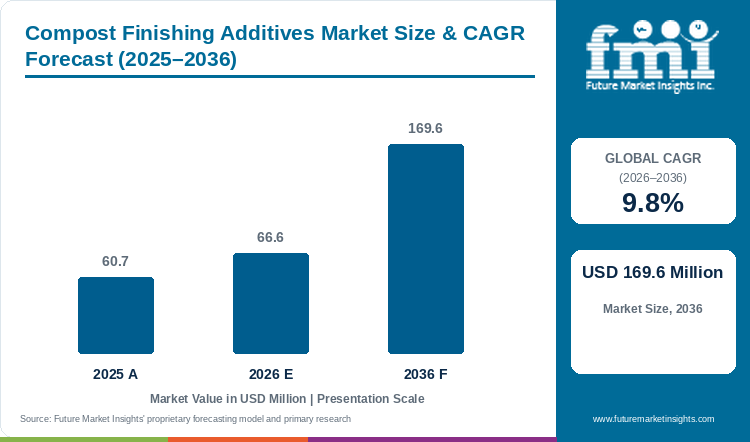
The global compost finishing additives market evolved from a 2025 valuation of USD 60.7 million to USD 66.6 million in 2026, and is set to achieve USD 169.6 million by 2036, reflecting a 9.8% CAGR.
Municipal landfill bans on food scraps and stricter livestock manure runoff laws are flooding commercial composting yards with woody biomass, forcing plant managers to shorten windrow curing cycles without failing maturity audits. For instance, dairy-manure composting experiments by Gong et al. in PLOS ONE in August 2025 showed that dosing exogenous cellulase and xylanase enzymes accelerated organic matter humification and reshaped bacterial community succession over a 30-day curing cycle [1]. Because cutting 10 to 16 days off curing residency time allows a facility to process more batches per year on the same concrete pad, global compost finishing additives market size expands beyond USD 60.7 million in 2025, standing at USD 66.6 million in 2026 and advancing to USD 169.6 million through 2036 on a 9.8% compound annual growth rate while creating USD 103.0 million in added annual market value over the decade. However, premature dosing during peak thermophilic heat still denatures unbuffered liquid sprays, which is why facilities formulating granulated organic fertilizers help Cellulolytic Enzyme Blends capture a projected 41.9% share of product-type demand in 2026.
Key Market Trends & Insights
- By product type: Cellulolytic Enzyme Blends are projected to capture 41.9% of product-type demand in 2026 because targeted beta-glucosidase cleavage breaks down residual crop-straw fibers.
- By crop type: High-tonnage wheat and maize residue incorporation prior to seasonal drilling gives Cereals & Grains an expected 36.6% crop-type share in 2026.
- By application method: In 2026, Windrow & Pre-Plant Soil Incorporation is estimated to command 44.3% within application methods through turner-mounted spray bars and bulk spreader workflows.
- By farm type: Large Commercial Farms are anticipated to secure 41.2% among farm types in 2026 since large estates operate dedicated windrow curing pads and laboratory carbon-to-nitrogen ratio testing.
- By sales channel: In 2026, the Agri-Input Distributors channel is forecast to account for 37.1% through agronomic batch testing and cold-chain biological inventory management.
Regional Highlights
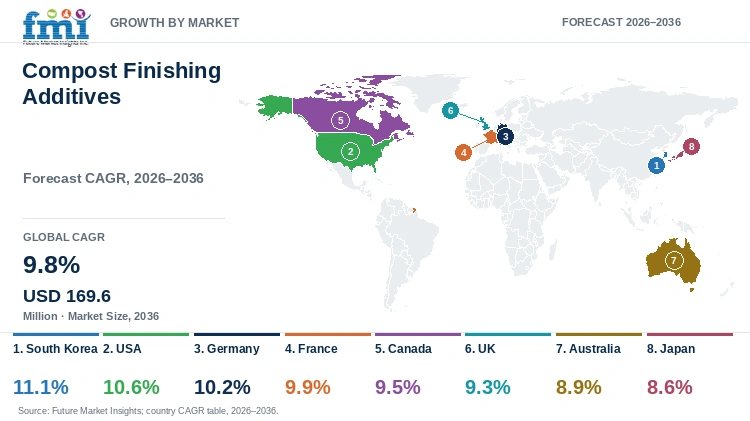
- East Asia and North America regulatory pace: Mandatory livestock-manure maturity testing places South Korea first at an 11.1% annual rate through 2036, while municipal organics diversion drives 10.6% yearly growth in the USA.
- Europe and Oceania biowaste standards: Biowaste purity rules support forecast annual growth of 10.2% in Germany and 9.9% in France ahead of Canada with 9.5%, whereas the UK (9.3%) and Australia (8.9%) outpace pelletized manure programs in Japan (8.6%).
Market Size & Forecast
Table 1: Market Size and Forecast for the Compost Finishing Additives Market (USD million and CAGR percentage), 2025 to 2036
| Metric | Value |
|---|---|
| 2025 Market Size | USD 60.7 million |
| Estimated Market Size in 2026 | USD 66.6 million |
| Projected Market Size by 2036 | USD 169.6 million |
| CAGR, 2026 to 2036 | 9.8% |
| Added Revenue, 2026 to 2036 | USD 103.0 million |
Commercial composters face severe financial losses whenever an unfinished windrow fails statutory germination or stability inspections and has to be re-piled or landfilled. As a matter of fact, Germany's Federal Ministry for the Environment confirmed in April 2025 that amended Bioabfallverordnung rules taking effect in May 2025 enforce a strict 0.5% plastics control limit on incoming biowaste prior to biological conditioning [2]. Once mechanical screening removes physical trash, operators combine enzymatic finishing agents with specialty fertilizer additives to pull the carbon-to-nitrogen ratio below 15:1 and neutralize phytotoxic organic acids before agricultural sale.
Commercial Composting Throughput and Additive Dosing Sizing
Table 2: Commercial Composting Throughput and Additive Dosing Sizing for the Compost Finishing Additives Market (USD million and operational ranges), 2025 to 2036
| Metric | 2025 | 2026 | 2036 |
|---|---|---|---|
| Market size (USD million) | 60.7 | 66.6 | 169.6 |
| Conditioned commercial compost tonnage (million metric tons) | 38.0 to 43.0 | 41.5 to 47.0 | 92.0 to 105.0 |
| Curing-time reduction from enzymatic dosing (days) | 10 to 16 | 11 to 17 | 14 to 21 |
| Average additive treatment cost per metric ton of compost (USD) | 1.40 to 1.65 | 1.42 to 1.68 | 1.60 to 1.85 |
Operational note: Treated compost tonnage and per-ton dosing costs reconcile U.S. EPA organics diversion benchmarks and European Compost Network stability tiers against commercial cellulase application rates.
Spending USD 1.42 to 1.68 per metric ton of compost on finishing additives in 2026 is economically justified for plant operators because trimming 11 to 17 days off the curing cycle frees up loader equipment and pad space for fresh tipping-fee waste. However, dosing hydrolytic enzymes too early in the sanitization phase wastes money because core pile temperatures above 65 degrees Celsius denature protein catalysts. Therefore, operators wait until windrow temperatures drop below 55 degrees Celsius and co-apply enzymes with microbial biofertilizer inoculants so cured humus delivers live nitrogen-fixing bacilli into field soils.
Per Capita & Composting-Facility Sizing
Table 3: Per Capita and Facility Valuation Indicators for the Compost Finishing Additives Market (USD), 2025 to 2036
| Metric | 2025 | 2026 | 2036 |
|---|---|---|---|
| World population (billion) | 8.2 | 8.3 | 9.0 |
| Market value per 1,000 people (USD) | 7.4 | 8.0 | 18.8 |
| Annual additive expenditure per permitted compost facility (USD thousand) | 6.8 to 8.4 | 7.3 to 9.1 | 15.5 to 19.2 |
| Certified maturity-tested batch share (%) | 54.0% to 58.0% | 56.0% to 60.0% | 71.0% to 76.0% |
Table 4: Composting Facility & Segment Allocation Indicators for the Compost Finishing Additives Market (USD and percentages), 2026
| Metric | Value | Institutional Reference Basis |
|---|---|---|
| Market size, 2026 | USD 66.6 million | 2026 global market valuation baseline |
| Permitted commercial & livestock composting plants globally | 8,600 facilities | Global biowaste & manure composting registry |
| Cellulolytic enzyme blends allocation, 2026 | USD 27.9 million | 41.9% product type segment allocation |
| Windrow & pre-plant soil incorporation allocation, 2026 | USD 29.5 million | 44.3% application method segment allocation |
Expected rise in certified maturity-tested batches from 56.0%-60.0% in 2026 to 71.0%-76.0% by 2036 reflects growing buyer refusal to accept unverified, weed-seed-laden bulk compost on commercial farms. Because row-crop and orchard agronomists pay premium prices only when organic amendments guarantee uniform cation-exchange capacity and zero volatile fatty acid toxicity, permitted facilities are more than doubling annual additive budgets by 2036. In addition, regional soil blenders fortify finished humus with agricultural biostimulant formulations to convert bulk manure piles into high-margin, pelletized soil conditioners.
Analyst Perspective
"Compost operators do not pay for laboratory enzyme activity in isolation; they pay for verified reductions in curing residency days and guaranteed pass rates on statutory germination and Solvita maturity audits. Formulators that pair thermotolerant cellulases with clear moisture-and-temperature dosing windows will capture recurring distributor programs."
- Nikhil Kaitwade, Principal Consultant, Future Market Insights.
How is the compost finishing additives market segmented?
The compost finishing additives market is segmented by product type, crop type, application method, farm type, and sales channel. In 2026, Cellulolytic Enzyme Blends are projected at 41.9%, Cereals & Grains at 36.6%, Windrow & Pre-Plant Soil Incorporation at 44.3%, Large Commercial Farms at 41.2%, and Agri-Input Distributors at 37.1%.
By product type: Cellulolytic Enzyme Blends, Ligninolytic & Hemicellulolytic Blends, Thermophilic & Mesophilic Enzyme-Microbe Consortia, and Humic & Organic Maturation Conditioners.
By crop type: Cereals & Grains, Fruits & Vegetables, Oilseeds & Pulses, and Turf, Ornamentals & Nursery Substrates.
By application method: Windrow & Pre-Plant Soil Incorporation, In-Vessel & Static-Pile Curing Dosing, Post-Maturation Granulation & Pellet Conditioning, and Liquid Compost Tea & Drip Extraction.
By farm type: Large Commercial Farms, Mid-Size Arable & Mixed Farms, Greenhouses, Nurseries & Protected Cropping, and Smallholder & Cooperative Operations.
By sales channel: Agri-Input Distributors, Agricultural & Composting Cooperatives, Agri-Retail Chains, and Direct-to-Facility & Online B2B.
Why do Cellulolytic Enzyme Blends anchor the product type category?
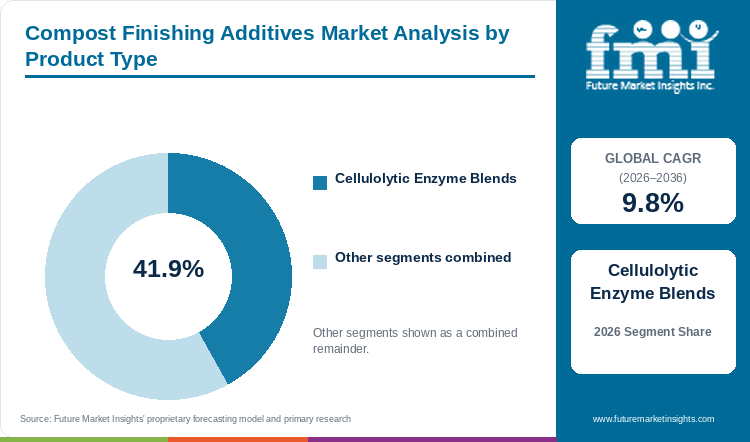
Cellulolytic Enzyme Blends are projected to capture 41.9% of product-type demand in 2026 because multi-enzyme hydrolysis rapidly breaks down recalcitrant crop straw and woody fibers.
Table 5: Product Type Share for the Compost Finishing Additives Market (percentage share), 2026
| Product Type | Share (2026) |
|---|---|
| Cellulolytic Enzyme Blends | 41.9% |
| Other Segments Combined | 58.1%* |
| Total | 100.0% |
*Calculated as the balance remaining after deducting the leading segment's reported share from 100.0%.
Table 6: Product Type Leadership and Market Growth for the Compost Finishing Additives Market (segment and CAGR percentage), 2026 to 2036
| Metric | Value |
|---|---|
| Global CAGR (2026 to 2036) | 9.8% |
| Leading Segment | Cellulolytic Enzyme Blends |
Once thermophilic bacteria exhaust simple sugars during the first two weeks of composting, undegraded wheat straw and woody livestock bedding stall pile maturation and generate high volumes of coarse screen overs. By dosing multi-component cellulase preparations that cleave crystalline cellulose into soluble cellobiose and glucose, operators feed cooling-phase actinomycetes that convert stubborn fibers into dark humic substances. To prevent pH fluctuations from deactivating these proteins, formulators sourcing industrial hydrolytic enzymes stabilize liquid and granular cellulase blends with polyol buffers and clay carriers.
- Within the product type segment, Cellulolytic Enzyme Blends are projected to secure 41.9% in 2026 through measurable reductions in coarse screen overs and shorter curing turnarounds.
- Higher cellulase activity directly boosts seed germination pass rates; for instance, February 2026 composting experiments by Zhang et al. showed that dosing spent mushroom substrate extracts containing laccase and carboxymethyl cellulase raised cellulase and sucrase activity by 13.70% to 75.56% and lifted seed germination indices by 22.90% [3].
What sustains Cereals & Grains at the top of the crop type category?
Broadacre straw residue conditioning and pre-seeding organic matter incorporation position Cereals & Grains at an expected 36.6% crop-type share in 2026.
Plowing raw, high-carbon wheat straw or corn stalks directly back into arable fields causes soil microbes to lock up available nitrogen, starving newly emerging cereal seedlings during early tillering. To avoid this yield penalty, broadacre grain farmers incorporate enzyme-finished manure and straw compost ahead of drilling, which restores topsoil aggregate stability and water retention without immobilizing mineral nitrogen. Furthermore, agronomists pairing cellulase treatments with commercial xylanase enzyme preparations break down stubborn hemicellulose sheaths so finished compost flows evenly through high-speed spinner spreaders.
- In 2026, the Cereals & Grains segment is anticipated to capture 36.6% of crop-type demand when arable wheat and maize growers accelerate post-harvest straw humification.
- Encapsulated inoculants are making cereal-straw composting much faster; for example, an April 2026 bioprocess study by Senadheera et al. found that a biodegradable microbial biocapsule for rice straw composting achieved 26.8% dry-matter degradation within 15 days and raised humus content to 4.1% versus 1.8% in controls [4].
Why is Windrow & Pre-Plant Soil Incorporation the principal application method?
In 2026, Windrow & Pre-Plant Soil Incorporation is estimated to command 44.3% within application methods through turner-mounted spray booms and bulk field-spreading logistics.
Open-air windrows and direct pre-plant soil spreading process the vast majority of agricultural manure and municipal green waste because enclosed in-vessel drums require heavy capital investment. By mounting simple spray booms inside self-propelled straddle turners, operators meter liquid or water-dispersible finishing enzymes directly onto freshly sheared fiber surfaces during routine cooling turns without adding extra labor passes. In addition, spreading conditioned compost prior to planting alongside rhizosphere nutrient boosters builds root-zone humus without risking the emitter clogging seen in drip-irrigated compost teas.
- Because spray bars retrofit directly onto existing straddle turners at low capital cost, Windrow & Pre-Plant Soil Incorporation is projected to capture 44.3% among application methods in 2026.
- Mechanical particle sizing during windrow turning strongly influences enzymatic efficiency; as a matter of fact, November 2025 aerobic corn-cob decomposition experiments by Liu et al. verified that keeping substrate particle size between 1 mm and 2 cm maximized humification and elevated tomato seedling biomass [5].
How do Large Commercial Farms shape farm type demand?
Large Commercial Farms are anticipated to secure 41.2% among farm types in 2026 as large estates operate dedicated windrow pads and batch maturity testing.
Large commercial arable estates and integrated dairy or poultry operations generate tens of thousands of tons of slurry solids and harvest straw every year, turning raw waste storage into a major environmental compliance liability. Because these large farms already own tractor-pulled windrow turners and dedicated curing pads, they can dose bulk enzymatic additives directly on-site and spread stabilized compost across thousands of hectares at low per-acre cost. Conversely, smaller family farms and greenhouse nurseries lack turning machinery and prefer to buy pre-finished bagged compost from off-site blenders.
- Mechanized windrow turning fleets and nutrient-management audits put Large Commercial Farms at a forecast 41.2% share within farm-type demand in 2026.
- Co-composting farmyard manure with humic-rich carbon sources further improves nutrient retention on large estates; for instance, a February 2026 agroecosystem review by Nussipov et al. documented that combining livestock manure with low-rank coal and microbial inoculants cuts nitrogen volatilization and rebuilds soil cation-exchange capacity [6].
What gives Agri-Input Distributors the lead in sales channel?
Feedstock diagnostic services and cold-chain biological logistics give Agri-Input Distributors a forecast 37.1% share across sales channels in 2026.
Unlike synthetic NPK fertilizers with fixed nutrient analysis, compost finishing enzymes and microbial consortia fail if the dosage is not matched to the specific lignin content and moisture level of the raw windrow. Consequently, composters and large farms rely on regional agri-input distributors whose field agronomists test raw pile carbon-to-nitrogen ratios and prescribe customized cellulase and humic dosing schedules. In addition, regional distributors operate climate-controlled warehouses that prevent liquid enzyme denaturation and microbial spore die-off during summer storage.
- Within sales channels, Agri-Input Distributors are estimated to capture 37.1% of 2026 demand since composters rely on local dealers for bundled Solvita maturity testing and cold-room delivery.
- Global fermentation leaders are expanding through these specialist dealer networks; for example, in June 2026, Novonesis partnered with Rovensa Next to distribute biological plant and soil solutions through agricultural dealers across the USA [7].
What are the drivers, restraints, and opportunities in the compost finishing additives market?
In the compost finishing additives market, mandatory livestock-manure maturity laws and municipal biowaste diversion accelerate enzymatic curing demand, whereas thermophilic inoculation mistiming restrains field efficacy and certified humic-enzyme bundles create margin opportunities.
- Driver: Statutory compost maturity testing and national organics recycling mandates compel processors to shorten windrow curing cycles using cellulolytic and ligninolytic enzymes.
- Restraint: Dosing during peak thermophilic heat or across moisture-depleted piles denatures enzymes and creates inconsistent field germination results.
- Opportunity: Co-formulating stage-specific enzyme consortia with humic conditioners and expanded fermentation capacity generates repeat contracts across regulated composters.
Growth Analysis and Future Potential: Qualitative Demand Catalysts
Seasonal swings in municipal green waste and farmyard manure composition create wide variations in finished compost quality, forcing commercial processors to use enzymatic finishing additives to hit consistent stability specifications. For instance, a January 2026 multi-country study by Amery et al. analyzing 107 commercial composts across the North Sea Region found that organic matter content varied five-fold and that oxygen uptake rate and carbon-to-nitrogen ratio governed final compost quality [8]. To eliminate batch-to-batch inconsistency and pass commercial stability audits two weeks faster, yard managers monitoring pile maturity with laboratory soil testing equipment dose standardized cellulolytic and hemicellulolytic blends during the cooling phase.
Risk Assessment of the Compost Finishing Additives Market: Operational and Formulation Friction
Biological finishing additives frequently underperform in unsupervised on-farm trials when operators spray temperature-sensitive enzymes or microbes into piles that are either too hot or too dry. As a matter of fact, September 2025 green-waste composting trials by Wang et al. established that lignocellulose-degrading compound microbial inoculation timing materially altered humification efficiency across thermophilic and cooling phases [9]. Whenever mistimed dosing produces unevenly cured compost with unpredictable nitrogen release compared with controlled and slow-release fertilizers, risk-averse row-crop growers pause repeat additive orders.
Commercial Opportunity Analysis: Formulation Differentiation and Value-Add Formats
Formulators are capturing higher gross margins by combining late-stage hydrolytic enzymes with oxidized lignite humates that convert dusty, low-value manure piles into uniform, high-value fertility granules. To support rising global demand for cost-effective industrial enzymes, Novonesis committed in September 2026 to building a next-generation enzyme production facility in Padra, India [10]. By pairing lower-cost bulk cellulases from expanded fermentation plants with humic acid soil conditioners, additive suppliers enable livestock cooperatives to market dust-free, nutrient-chelated compost pellets into commercial horticulture and turf channels.
Compost Finishing Additives Market by Country (2026 to 2036)
Mandatory livestock-manure maturity laws position South Korea at the top of evaluated country markets at an 11.1% compound annual pace through 2036 followed by 10.6% in the USA and 10.2% in Germany, whereas Japan records an 8.6% yearly rate. Regional uptake differs based on statutory biowaste plastic contamination caps, winter frost curing windows, and pelletized manure transport subsidies.
Table 7: Country CAGR and Primary Growth Levers for the Compost Finishing Additives Market (CAGR percentage and operational drivers), 2026 to 2036
| Country | CAGR (2026 to 2036) | Primary Growth Lever |
|---|---|---|
| South Korea | 11.1% | Mandatory municipal livestock-manure maturity certification and ammonia-reduction co-additives |
| USA | 10.6% | Domestic biological manufacturing scale-up and large-scale windrow curing across dairy and arable states |
| Germany | 10.2% | May 2025 Bioabfallverordnung 0.5% plastics cap and strict RAL GZ 251 compost stability audits |
| France | 9.9% | Loi AGEC mandatory biowaste source separation and NF U44-051 organic soil amendment compliance |
| Canada | 9.5% | CFIA Fertilizers Act compost maturity standards and prairie cereal residue conditioning |
| UK | 9.3% | REAL Compost Certification Scheme PAS 100 phytotoxicity and stability verification |
| Australia | 8.9% | AS 4454 composted soil conditioner standards and broadacre wheat stubble humification |
| Japan | 8.6% | Greenhouse-gas-quantified green-waste and livestock manure pellet composting programs |
Source: Future Market Insights analysis
South Korea Compost Finishing Additives Market Outlook (2026 to 2036)
Unlike western countries where broadacre farms have ample land to age manure piles slowly, dense rural-urban proximity in South Korea subjects livestock farmers to strict municipal compost maturity inspections and odor fines before field spreading is permitted. According to a January 2026 review by Yoo on livestock manure valorization in South Korea, annual manure generation exceeded 50.7 million tons with 85.1% directed to aerobic composting and solid fuel conversion under national greenhouse gas reduction targets [11]. Compost finishing additive consumption in South Korea is projected to climb 11.1% per annum from 2026 to 2036, driven by regional cattle and swine cooperatives dosing cellulolytic enzymes and biochar co-additives to pass mandatory maturity audits.
Key takeaway: In South Korea, compulsory livestock-manure maturity testing and 50.7-million-ton manure management programs underpin 11.1% yearly additive expansion.
USA Compost Finishing Additives Market Outlook (2026 to 2036)
Expenditure on compost finishing additives in the USA is anticipated to rise 10.6% per year through 2036, supported by commercial windrow processors in California and the Midwest accelerating green-waste and dairy-manure curing. Municipal organics diversion laws and corporate soil-health programs are expanding windrow volumes across the USA, creating strong demand for domestic biological supply that avoids import freight delays. For example, Syngenta opened a state-of-the-art biologicals production facility in Orangeburg, South Carolina in May 2025 with annual capacity of 16,000 tons of biostimulants and biological soil inputs [12]. Even so, extreme moisture differences between arid western feedlots and humid eastern yards require regional distributor formulation adjustments.
Key takeaway: In the USA, domestic biological manufacturing expansion and municipal organics diversion mandates are anticipated to sustain 10.6% annual growth.
Germany Compost Finishing Additives Market Outlook (2026 to 2036)
Strict environmental permitting makes building new open-air composting yards in Germany difficult, forcing existing Biogut plants to combine May 2025 statutory plastics pre-screening with faster Rottegrad IV and V curing to raise annual tonnage. To supply European biological demand at industrial scale, BASF Agricultural Solutions commissioned its new fermentation plant in Ludwigshafen in May 2026 for biological and biotechnology-based crop and soil products [13]. However, regional composting associations in Germany reject any additive that alters RAL GZ 251 heavy-metal or hygiene compliance. In Germany, compost finishing additive consumption is forecast to record a 10.2% compound annual rate over the 2026-to-2036 horizon around domestic fermentation supply and municipal green-waste conditioning.
Key takeaway: In Germany, Bioabfallverordnung purity enforcement and domestic industrial fermentation capacity are forecast to support certified compost-finishing enzyme adoption.
France Compost Finishing Additives Market Outlook (2026 to 2036)
Mandatory household and commercial biowaste source separation in France under the Anti-Waste for a Circular Economy (AGEC) law has sharply increased inflows of fibrous green waste and woody vineyard prunings at regional composting platforms. Because woody stalks resist conventional bacterial breakdown, agricultural cooperatives in France are partnering with major biological formulators to access concentrated ligninolytic and cellulase blends. For instance, Syngenta outlined its global biologicals expansion strategy in June 2025, integrating natural compound repositories and microbial fermentation partnerships for European arable and vineyard growers [14]. Compost finishing additive shipments in France are expected to grow at a 9.9% annual pace from 2026 to 2036 because cured batches must meet strict NF U44-051 amendment standards.
Key takeaway: In France, mandatory biowaste source separation and NF U44-051 amendment specifications are expected to drive cooperative demand for ligninolytic curing blends.
Canada Compost Finishing Additives Market Outlook (2026 to 2036)
Short post-harvest autumn windows across western grain belts in Canada mean that conventional windrow microbes stall as soon as ambient temperatures drop, leaving wheat straw and feedlot manure half-cured before winter freeze-up. Consequently, composters and bioprocess operators in Canada prioritize cold-active cellulolytic enzymes and humic extracts that accelerate microbial acclimatization at lower temperatures. As a matter of fact, February 2026 bioprocess trials by Santos et al. at the Université de Sherbrooke in Canada showed that mature compost extracts containing humic substances and trace metals halved microbial lag phases and boosted methane oxidation rates by up to 63% [15]. Usage of compost finishing additives in Canada is predicted to advance 9.5% per year through 2036, owing to prairie residue conditioning demand.
Key takeaway: In Canada, short autumn curing windows and prairie residue management programs are predicted to favor cold-active cellulolytic finishing formulations.
UK Compost Finishing Additives Market Outlook (2026 to 2036)
Green-waste and food-waste processors in the UK operate under strict BSI PAS 100 certification rules, where excess volatile fatty acids or residual phytotoxicity trigger immediate batch rejection and block agricultural sales. At the same time, arable estates in the UK are integrating finished compost and biologicals into regenerative rotations to cut synthetic nitrogen use. For example, an August 2026 Corteva Agriscience update from the Groundswell regenerative agriculture event in Hertfordshire in the UK highlighted grower adoption of biological soil and crop inputs [16]. In the UK, compost finishing additive demand is estimated to expand by 9.3% per annum over the ten-year period to 2036 under PAS 100 stability audits and on-farm soil-health schemes.
Key takeaway: In the UK, BSI PAS 100 phytotoxicity and stability thresholds and regenerative soil programs are estimated to anchor batch-traceable additive procurement.
Australia Compost Finishing Additives Market Outlook (2026 to 2036)
Sales of commercial compost finishing additives in Australia are slated to grow 8.9% yearly across the ten-year window to 2036 through municipal Food Organics and Garden Organics (FOGO) processors conditioning woody green waste under national soil conditioner standards. Because dryland wheat and canola soils across New South Wales and Western Australia suffer from chronic low organic matter and moisture loss, growers blend humified feedlot manure with biological conditioners to improve topsoil water holding. According to economic analysis released by Novonesis in September 2026, the biosolutions sector in Australia could nearly triple from AUD 4.6 billion to AUD 13.1 billion by 2035 across agricultural and industrial applications [17]. Even so, seasonal drought across interior cropping zones can delay pre-plant spreading.
Key takeaway: In Australia, municipal FOGO biowaste expansion and domestic biosolutions investment are slated to sustain demand for drought-resilient compost conditioning.
Japan Compost Finishing Additives Market Outlook (2026 to 2036)
Geographic separation between livestock-heavy prefectures in Kyushu or Hokkaido and horticultural vegetable districts in Japan forces cooperatives to convert wet manure into odor-free, high-density pellets that are economical to ship. At the same time, municipal green-waste managers in Japan are adopting quantitative greenhouse gas accounting to minimize methane and nitrous oxide release during pile curing. For instance, a June 2026 study by Kuronuma et al. at Chiba University in Japan quantified greenhouse gas emission factors across pruned branch and fallen leaf composting while verifying germination indices for petunia cultivation [18]. Adoption of commercial compost finishing additives in Japan is likely to progress at an 8.6% yearly rate through 2036, attributed to pellet-binder humic and cellulase dosing.
Key takeaway: In Japan, low-emission horticultural green-waste composting and inter-prefectural manure pellet transport are likely to guide finishing additive demand.
Full report country CAGRs cover: North America; Latin America; Western Europe; Eastern Europe; East Asia; South Asia and Pacific; Middle East and Africa.
Who are the notable companies in the compost finishing additives market?
Novonesis, BASF, Syngenta, Andermatt Group, Locus Agricultural Solutions, Suståne Natural Fertilizer, Huma, Inc., and Lallemand Plant Care are the notable companies in the compost finishing additives market.
Commercial rivalry across compost finishing additives depends on whether a supplier controls upstream enzyme fermentation or downstream humic conditioning and agronomic dealer channels. Novonesis and BASF with Lallemand Plant Care operate industrial submerged and solid-state fermentation reactors that manufacture high-titer cellulases and xylanases plus thermotolerant *Bacillus* or *Trichoderma* strains. Syngenta and Andermatt Group with Locus Agricultural Solutions focus on formulating multi-strain biological consortia and distributing them through commercial crop-input retail networks. Meanwhile, Suståne Natural Fertilizer and Huma, Inc. specialize in aerobic compost stabilization and leonardite-derived humic soil conditioners that upgrade finished compost into granulated fertilizers.
- Industrial Enzyme & Microbial Fermentation Platforms: Novonesis and BASF with Lallemand Plant Care produce high-activity cellulolytic and hemicellulolytic enzymes and spore-forming microbial inoculants.
- Agricultural Biological & Residue-Conditioning Formulators: Syngenta and Andermatt Group as well as Locus Agricultural Solutions supply multi-strain biological consortia and biostimulant packages through farm-input dealer networks.
- Humic & Aerobic Compost Maturation Specialists: Suståne Natural Fertilizer and Huma, Inc. engineer stabilized organic-humic soil conditioners and granulated compost fertility inputs.
Competitive Benchmarking: Compost Finishing Additives Market
Table 8: Competitive Benchmarking for the Compost Finishing Additives Market (qualitative capability ratings), 2026
| Company | Hydrolytic Enzyme Activity | Curing-Pile Thermostability | Compost & Farm Channel Reach | Geographic Reach |
|---|---|---|---|---|
| Novonesis | High | High | High | High |
| BASF | High | High | High | High |
| Syngenta | High | Medium | High | High |
| Andermatt Group | Medium | High | High | High |
| Locus Agricultural Solutions | High | Medium | High | Medium |
| Suståne Natural Fertilizer | Medium | High | High | Medium |
| Huma, Inc. | Medium | High | High | High |
| Lallemand Plant Care | High | High | High | High |
Scoring basis: Capability tiers evaluate documented cellulase and xylanase enzyme or microbial consortia activity and functional stability across 40 to 60 degree Celsius cooling windrows plus agricultural distributor access. Geographic reach reflects multi-region fermentation and commercialization footprints.
Key Developments in the Compost Finishing Additives Market
- Direct regional agronomy support is critical for converting Mediterranean orchard and vineyard composters; for instance, Andermatt Group established its Italian subsidiary Andermatt Italia in February 2025 to expand biological soil and crop input distribution [19].
- Integration of biological soil conditioners with verified farm carbon credits creates a second revenue stream for growers; for example, Syngenta and Groundwork BioAg entered a strategic partnership in July 2026 to market mycorrhizal biological and soil-carbon solutions across Europe and Latin America [20].
- Computational screening is shortening the time required to formulate stress-tolerant soil and residue biologicals; notably, Syngenta Group announced an artificial-intelligence research collaboration with TraitSeq in January 2025 to accelerate next-generation biostimulant development [21].
Key Players in the Compost Finishing Additives Market
Industrial Enzyme & Microbial Fermentation Platforms
- Novonesis
- BASF
- Lallemand Plant Care
Agricultural Biological & Residue-Conditioning Formulators
- Syngenta
- Andermatt Group
- Locus Agricultural Solutions
Humic & Aerobic Compost Maturation Specialists
- Suståne Natural Fertilizer
- Huma, Inc.
Compost Finishing Additives Market - Report Scope
Table 9: Report Scope for the Compost Finishing Additives Market (coverage fields and definitions), 2026 to 2036
| Coverage field | Report scope |
|---|---|
| Market breakdown | Product Type; Crop Type; Application Method; Farm Type; Sales Channel; Region |
| Quantitative Units | USD Million |
| Market Definition | Includes commercial supplier revenue from separately identifiable cellulolytic and ligninolytic enzyme blends, enzyme-microbe consortia, and humic/organic maturation conditioners sold for late-stage compost curing, windrow finishing, pellet conditioning, and pre-plant compost incorporation. Category Scope Note: Excludes bulk commodity sales of finished compost, raw unconditioned manure, synthetic NPK fertilizers, foliar crop fungicides, seed-coating polymers, and mechanical windrow-turning machinery. |
| Regions Covered | North America; Latin America; Western Europe; Eastern Europe; East Asia; South Asia and Pacific; Middle East and Africa |
| Countries Covered | South Korea, USA, Germany, France, Canada, UK, Australia, Japan, and additional countries in the full report |
| Key Companies Covered | Novonesis, BASF, Syngenta, Andermatt Group, Locus Agricultural Solutions, Suståne Natural Fertilizer, Huma, Inc., Lallemand Plant Care |
| Forecast Period | 2026 to 2036 |
| Approach | Primary and secondary research with top-down and bottom-up market triangulation. |
Compost Finishing Additives Market - Research Methodology
Table 10: Research Methodology for the Compost Finishing Additives Market (research methods and approach), 2026 edition
| Method | Approach |
|---|---|
| Primary Research | Structured interviews with commercial windrow and in-vessel compost plant operators, industrial enzyme fermentation directors, livestock-waste extension specialists, and agri-input distributors across North America, Europe, and East Asia to validate per-ton dosing costs and maturity test endpoints. |
| Secondary Research | Analysis of German BMUV Bioabfallverordnung amendments, North Sea Region compost quality surveys, South Korean livestock-manure valorization studies, Japanese green-waste GHG emission factor studies, PubMed enzymatic composting trials, and corporate fermentation disclosures. |
| Market Sizing and Forecasting | Bottom-up conditioned commercial and on-farm compost tonnage multiplied by average enzymatic and microbial finishing treatment expenditure per metric ton from 2025 to 2036. |
| Country Forecasting Model | Econometric country projections weight regulated biowaste and livestock-manure composting capacity, statutory maturity/germination certification mandates, and domestic organic-resource fertilizer substitution programs across eight national markets. |
| Operational Benchmark Traceability | Commercial composting throughput and facility expenditure indicators in Tables 2, 3, and 4 trace to North Sea Region compost quality audits, Korean manure valorization logs, and industrial enzyme formulator price schedules. |
| Data Triangulation and Validation | Demand estimates are cross-checked against industrial cellulase/xylanase and agricultural microbial fermentation allocations without double counting bulk finished compost sales, foliar crop sprays, or seed-applied carbon inoculants. |
Compost Finishing Additives Market by Segments
Compost Finishing Additives Market segmented by Product Type:
- Cellulolytic Enzyme Blends
- Ligninolytic & Hemicellulolytic Blends
- Thermophilic & Mesophilic Enzyme-Microbe Consortia
- Humic & Organic Maturation Conditioners
Compost Finishing Additives Market segmented by Crop Type:
- Cereals & Grains
- Fruits & Vegetables
- Oilseeds & Pulses
- Turf, Ornamentals & Nursery Substrates
Compost Finishing Additives Market segmented by Application Method:
- Windrow & Pre-Plant Soil Incorporation
- In-Vessel & Static-Pile Curing Dosing
- Post-Maturation Granulation & Pellet Conditioning
- Liquid Compost Tea & Drip Extraction
Compost Finishing Additives Market segmented by Farm Type:
- Large Commercial Farms
- Mid-Size Arable & Mixed Farms
- Greenhouses, Nurseries & Protected Cropping
- Smallholder & Cooperative Operations
Compost Finishing Additives Market segmented by Sales Channel:
- Agri-Input Distributors
- Agricultural & Composting Cooperatives
- Agri-Retail Chains
- Direct-to-Facility & Online B2B
Compost Finishing Additives Market by Region
- North America
- United States
- Canada
- Latin America
- Brazil
- Mexico
- Argentina
- Chile
- Western Europe
- Germany
- France
- United Kingdom
- Italy
- Spain
- Benelux
- Nordics
- Eastern Europe
- Poland
- Czech Republic
- Romania
- Hungary
- East Asia
- China
- Japan
- South Korea
- South Asia and Pacific
- India
- ASEAN
- Australia and New Zealand
- Middle East and Africa
- GCC Countries
- South Africa
- Türkiye
- Israel
Research Sources and Bibliography
- [1] Gong, P., et al. (2025, August 29). Impacts of cellulase and xylanase addition on antibiotic resistance and microbial community during dairy manure composting. PLOS ONE (10.1371/journal.pone.0328055).
- [2] Federal Ministry for the Environment, Nature Conservation, Nuclear Safety and Consumer Protection (BMUV). (2025, April 22). Weniger Kunststoffe im Bioabfall ab Mai 2025. German Federal Ministry for the Environment.
- [3] Zhang, H., et al. (2026, February 15). A novel enzyme-based strategy for improving compost quality using extracts from spent mushroom substrate. PubMed (PMID 41633183).
- [4] Senadheera, U. E., et al. (2026, April 17). A novel solid-state, multi-layered biodegradable microbial inoculant system for rice straw composting: biocapsule design, characterization, and performance evaluation. PubMed (PMID 42078523).
- [5] Liu, Q., et al. (2025, November 17). Impact of Particle Size on the Aerobic Decomposition and Fertilizer Efficiency of Corn Cobs: A Sustainable Waste-to-Resource Approach. PubMed (PMID 41300400).
- [6] Nussipov, D., et al. (2026, February 19). Resource recovery from low-rank coal and livestock manure for sustainable agroecosystems: a review. PubMed (PMID 41711903).
- [7] Novonesis. (2026, June 11). Rovensa Next to distribute Novonesis' biosolutions for Plant Health in the United States. Novonesis Corporate News.
- [8] Amery, F., et al. (2026, January 15). Compost organic matter content varied five-fold and determined compost quality across 107 composts of the North Sea Region. PubMed (PMID 41289752).
- [9] Wang, X., Qiu, M., & Zhang, L. (2025, September 09). Effects of inoculation timing with lignocellulose-degrading compound microbial inoculum on green waste composting. PubMed (PMID 40925533).
- [10] Novonesis. (2026, September 02). Novonesis to build next generation enzyme production facility in India | Novonesis. Novonesis Corporate News.
- [11] Yoo, J. (2026, January 15). Recent advances in livestock manure biochar Development in Korea: A review. PubMed (PMID 41207208).
- [12] Syngenta US. (2025, May 21). Syngenta opens state-of-the-art biologicals production facility in Orangeburg, South Carolina. Syngenta US Newsroom.
- [13] BASF SE. (2026, May 11). BASF Agricultural Solutions successfully commissions new fermentation plant for crop protection products in Ludwigshafen. BASF Global Media Releases.
- [14] Syngenta Group. (2025, June 30). Syngenta to become global leader in biologicals; expanding nature inspired solutions for farmers. Syngenta Media Releases.
- [15] Santos, J. J. D. N., et al. (2026, February 28). Use of compost extract as acclimatization accelerator for methane oxidation biosystems. PubMed (PMID 41579696).
- [16] Corteva Agriscience. (2026, August 04). Corteva Biologicals Reflects on a Successful Groundswell Debut. Corteva Agriscience UK Newsroom.
- [17] Novonesis. (2026, September 30). Australia's biosolutions sector could nearly triple to AUD$ 13.1 billion by 2035. Novonesis Corporate News.
- [18] Kuronuma, T., et al. (2026, June 30). From green waste to horticultural resources: A novel approach to quantifying greenhouse gas emission factors for decision-making. PubMed (PMID 42378980).
- [19] Andermatt Group AG. (2025, February 06). Expanding Sustainability: Andermatt Group Establishes Italian Subsidiary - Andermatt Group AG. Andermatt Group Corporate News.
- [20] Syngenta Group. (2026, July 14). Syngenta and Groundwork BioAg enter partnership to bring innovation in biologicals and soil carbon solutions to farmers. Syngenta Media Releases.
- [21] Syngenta Group. (2025, January 09). Artificial intelligence is speeding up the development of the next generation of biostimulants. Syngenta Media Releases.
- [22] BASF SE. (2025, September 22). Cutting CO2e emissions by 30 percent without compromising yield: BASF shares new findings on rice from Global Carbon Field Trials. BASF Global Media Releases.
- [23] Novonesis. (2026, June 17). Biosolutions could grow to more than €10.8 billion and add more than 75,000 jobs in Türkiye by 2035. Novonesis Corporate News.
This bibliography is provided for reader reference and is not exhaustive. The full report contains the complete reference list and detailed citations.
This Report Answers
- How large is the compost finishing additives market in 2026 and what is forecast for 2036?
- Which biowaste-processing and livestock-manure pressures support spending on finishing formulations?
- Why do Cellulolytic Enzyme Blends lead the product type category?
- Why do Cereals & Grains account for the largest crop type share?
- How do growth rates compare across South Korea, the USA, Germany, France, and Canada?
- Which companies supply industrial enzymes, microbial consortia, and humic maturation conditioners?
- What substrate moisture and inoculation-timing hurdles slow additive qualification?
- What batch-maturity evidence should composters and large farms request before purchasing?
Frequently Asked Questions
How big is the compost finishing additives market in 2026, and what is forecast for 2036?
Global compost finishing additives industry valuation stands at USD 66.6 million in 2026 up from USD 60.7 million in 2025, with projections reaching USD 169.6 million by 2036 as commercial windrow and livestock-manure processors accelerate late-stage fiber humification.
What is the CAGR for the compost finishing additives market from 2026 to 2036?
A 9.8% compound annual growth rate is estimated across the 2026 to 2036 horizon, generating USD 103.0 million in added annual revenue as municipal biowaste and livestock composting plants standardize curing time.
Which product type segment leads the compost finishing additives market?
Cellulolytic Enzyme Blends are projected to capture 41.9% of product-type demand in 2026 because targeted enzymatic cleavage rapidly breaks down residual straw and stalks during windrow cooling.
Which crop type segment leads the compost finishing additives market?
Cereals & Grains are expected to represent 36.6% across the crop-type category in 2026 on the back of high-volume wheat and maize residue incorporation prior to seasonal seeding.
Which country has a notable growth outlook during the assessment period?
South Korea paces evaluated national markets at a projected 11.1% CAGR through 2036, supported by mandatory municipal livestock-manure maturity testing and domestic organic-fertilizer substitution.
Who are the key players in the market?
Novonesis, BASF, Syngenta, Andermatt Group, Locus Agricultural Solutions, Suståne Natural Fertilizer, Huma, Inc., and Lallemand Plant Care supply hydrolytic enzymes and microbial consortia plus humic maturation conditioners.
Preview the report firsthand - request a free sample
Get SampleGet the brochure for pricing and purchase details.
Get PDFTable of Content
- Key Takeaways
- Market Size and CAGR
- Top Growth Driver
- Fastest Growing Segment
- Leading Region
- Key Companies
- Emerging Opportunities
- Executive Summary
- Global Market Outlook
- Demand-side Trends
- Supply-side Trends
- Technology Roadmap Analysis
- Analysis and Recommendations
- Analyst Perspective (What is happening? Why now? What should investors know?)
- Key Questions Answered
- How large is the market?
- What is the CAGR?
- What are key trends?
- Which region dominates?
- Who are the leaders?
- Market Overview
- Market Coverage / Taxonomy
- Market Definition / Scope / Limitations
- Research Methodology
- Chapter Orientation
- Analytical Lens and Working Hypotheses
- Market Structure, Signals, and Trend Drivers
- Benchmarking and Cross-market Comparability
- Market Sizing, Forecasting, and Opportunity Mapping
- Research Design and Evidence Framework
- Desk Research Programme (Secondary Evidence)
- Expert Input and Fieldwork (Primary Evidence)
- Tooling, Models, and Reference Databases
- Data Engineering and Model Build
- Quality Assurance and Audit Trail
- Market Background
- Market Dynamics (Drivers, Restraints, Opportunity, Trends)
- Scenario Forecast (Optimistic, Likely, Conservative)
- Impact Analysis
- AI Impact
- Sustainability Impact
- Regulatory Impact
- Technology Impact
- Consumer / Buyer Analysis
- Purchase Drivers
- Adoption Barriers
- Buyer Journey
- Opportunity Map Analysis
- Product Life Cycle Analysis
- Supply Chain Analysis
- Investment Feasibility Matrix
- Value Chain Analysis
- PESTLE and Porter's Analysis
- Regulatory Landscape
- Regional Parent Market Outlook
- Production and Consumption Statistics
- Import and Export Statistics
- Global Market Analysis and Forecast, 2021 to 2036
- Historical Market Size Value (USD Million) Analysis, 2021 to 2025
- Current and Future Market Size Value (USD Million) Projections, 2026 to 2036
- Y-o-Y Growth Trend Analysis
- Absolute $ Opportunity Analysis
- Global Market Pricing Analysis, 2021 to 2036
- Global Market Analysis and Forecast, By Product Type, 2021 to 2036
- Introduction / Key Findings
- Historical Market Size Value (USD Million) Analysis By Product Type, 2021 to 2025
- Current and Future Market Size Value (USD Million) Analysis and Forecast By Product Type, 2026 to 2036
- Cellulolytic Enzyme Blends
- Ligninolytic & Hemicellulolytic Blends
- Thermophilic & Mesophilic Enzyme-Microbe Consortia
- Humic & Organic Maturation Conditioners
- Y-o-Y Growth Trend Analysis By Product Type, 2021 to 2025
- Absolute $ Opportunity Analysis By Product Type, 2026 to 2036
- Global Market Analysis and Forecast, By Crop Type, 2021 to 2036
- Introduction / Key Findings
- Historical Market Size Value (USD Million) Analysis By Crop Type, 2021 to 2025
- Current and Future Market Size Value (USD Million) Analysis and Forecast By Crop Type, 2026 to 2036
- Cereals & Grains
- Fruits & Vegetables
- Oilseeds & Pulses
- Turf, Ornamentals & Nursery Substrates
- Y-o-Y Growth Trend Analysis By Crop Type, 2021 to 2025
- Absolute $ Opportunity Analysis By Crop Type, 2026 to 2036
- Global Market Analysis and Forecast, By Application Method, 2021 to 2036
- Introduction / Key Findings
- Historical Market Size Value (USD Million) Analysis By Application Method, 2021 to 2025
- Current and Future Market Size Value (USD Million) Analysis and Forecast By Application Method, 2026 to 2036
- Windrow & Pre-Plant Soil Incorporation
- In-Vessel & Static-Pile Curing Dosing
- Post-Maturation Granulation & Pellet Conditioning
- Liquid Compost Tea & Drip Extraction
- Y-o-Y Growth Trend Analysis By Application Method, 2021 to 2025
- Absolute $ Opportunity Analysis By Application Method, 2026 to 2036
- Global Market Analysis and Forecast, By Farm Type, 2021 to 2036
- Introduction / Key Findings
- Historical Market Size Value (USD Million) Analysis By Farm Type, 2021 to 2025
- Current and Future Market Size Value (USD Million) Analysis and Forecast By Farm Type, 2026 to 2036
- Large Commercial Farms
- Mid-Size Arable & Mixed Farms
- Greenhouses, Nurseries & Protected Cropping
- Smallholder & Cooperative Operations
- Y-o-Y Growth Trend Analysis By Farm Type, 2021 to 2025
- Absolute $ Opportunity Analysis By Farm Type, 2026 to 2036
- Global Market Analysis and Forecast, By Sales Channel, 2021 to 2036
- Introduction / Key Findings
- Historical Market Size Value (USD Million) Analysis By Sales Channel, 2021 to 2025
- Current and Future Market Size Value (USD Million) Analysis and Forecast By Sales Channel, 2026 to 2036
- Agri-Input Distributors
- Agricultural & Composting Cooperatives
- Agri-Retail Chains
- Direct-to-Facility & Online B2B
- Y-o-Y Growth Trend Analysis By Sales Channel, 2021 to 2025
- Absolute $ Opportunity Analysis By Sales Channel, 2026 to 2036
- Global Market Analysis and Forecast, By Region, 2021 to 2036
- Introduction
- Historical Market Size Value (USD Million) Analysis By Region, 2021 to 2025
- Current Market Size Value (USD Million) Analysis and Forecast By Region, 2026 to 2036
- North America
- Latin America
- Western Europe
- Eastern Europe
- East Asia
- South Asia and Pacific
- Middle East and Africa
- Market Attractiveness Analysis By Region
- North America Market Analysis and Forecast, By Country, 2021 to 2036
- Historical Market Size Value (USD Million) Trend Analysis By Market Taxonomy, 2021 to 2025
- Market Size Value (USD Million) Forecast By Market Taxonomy, 2026 to 2036
- By Country
- United States
- Canada
- By Product Type
- By Crop Type
- By Application Method
- By Farm Type
- By Sales Channel
- By Country
- Market Attractiveness Analysis
- By Country
- By Product Type
- By Crop Type
- By Application Method
- By Farm Type
- By Sales Channel
- Key Takeaways
- Latin America Market Analysis and Forecast, By Country
- Historical Market Size Value (USD Million) Trend Analysis By Market Taxonomy, 2021 to 2025
- Market Size Value (USD Million) Forecast By Market Taxonomy, 2026 to 2036
- By Country
- Brazil
- Mexico
- Argentina
- Chile
- By Product Type
- By Crop Type
- By Application Method
- By Farm Type
- By Sales Channel
- By Country
- Market Attractiveness Analysis
- By Country
- By Product Type
- By Crop Type
- By Application Method
- By Farm Type
- By Sales Channel
- Key Takeaways
- Western Europe Market Analysis and Forecast, By Country
- Historical Market Size Value (USD Million) Trend Analysis By Market Taxonomy, 2021 to 2025
- Market Size Value (USD Million) Forecast By Market Taxonomy, 2026 to 2036
- By Country
- Germany
- France
- United Kingdom
- Italy
- Spain
- Benelux
- Nordics
- By Product Type
- By Crop Type
- By Application Method
- By Farm Type
- By Sales Channel
- By Country
- Market Attractiveness Analysis
- By Country
- By Product Type
- By Crop Type
- By Application Method
- By Farm Type
- By Sales Channel
- Key Takeaways
- Eastern Europe Market Analysis and Forecast, By Country
- Historical Market Size Value (USD Million) Trend Analysis By Market Taxonomy, 2021 to 2025
- Market Size Value (USD Million) Forecast By Market Taxonomy, 2026 to 2036
- By Country
- Poland
- Czech Republic
- Romania
- Hungary
- By Product Type
- By Crop Type
- By Application Method
- By Farm Type
- By Sales Channel
- By Country
- Market Attractiveness Analysis
- By Country
- By Product Type
- By Crop Type
- By Application Method
- By Farm Type
- By Sales Channel
- Key Takeaways
- East Asia Market Analysis and Forecast, By Country
- Historical Market Size Value (USD Million) Trend Analysis By Market Taxonomy, 2021 to 2025
- Market Size Value (USD Million) Forecast By Market Taxonomy, 2026 to 2036
- By Country
- China
- Japan
- South Korea
- By Product Type
- By Crop Type
- By Application Method
- By Farm Type
- By Sales Channel
- By Country
- Market Attractiveness Analysis
- By Country
- By Product Type
- By Crop Type
- By Application Method
- By Farm Type
- By Sales Channel
- Key Takeaways
- South Asia and Pacific Market Analysis and Forecast, By Country
- Historical Market Size Value (USD Million) Trend Analysis By Market Taxonomy, 2021 to 2025
- Market Size Value (USD Million) Forecast By Market Taxonomy, 2026 to 2036
- By Country
- India
- ASEAN
- Australia and New Zealand
- By Product Type
- By Crop Type
- By Application Method
- By Farm Type
- By Sales Channel
- By Country
- Market Attractiveness Analysis
- By Country
- By Product Type
- By Crop Type
- By Application Method
- By Farm Type
- By Sales Channel
- Key Takeaways
- Middle East and Africa Market Analysis and Forecast, By Country
- Historical Market Size Value (USD Million) Trend Analysis By Market Taxonomy, 2021 to 2025
- Market Size Value (USD Million) Forecast By Market Taxonomy, 2026 to 2036
- By Country
- GCC Countries
- South Africa
- Türkiye
- Israel
- By Product Type
- By Crop Type
- By Application Method
- By Farm Type
- By Sales Channel
- By Country
- Market Attractiveness Analysis
- By Country
- By Product Type
- By Crop Type
- By Application Method
- By Farm Type
- By Sales Channel
- Key Takeaways
- Key Countries Market Analysis
- United States
- Pricing Analysis
- Market Share Analysis, 2025
- By Product Type
- By Crop Type
- By Application Method
- By Farm Type
- By Sales Channel
- Canada
- Pricing Analysis
- Market Share Analysis, 2025
- By Product Type
- By Crop Type
- By Application Method
- By Farm Type
- By Sales Channel
- Mexico
- Pricing Analysis
- Market Share Analysis, 2025
- By Product Type
- By Crop Type
- By Application Method
- By Farm Type
- By Sales Channel
- Brazil
- Pricing Analysis
- Market Share Analysis, 2025
- By Product Type
- By Crop Type
- By Application Method
- By Farm Type
- By Sales Channel
- Chile
- Pricing Analysis
- Market Share Analysis, 2025
- By Product Type
- By Crop Type
- By Application Method
- By Farm Type
- By Sales Channel
- Germany
- Pricing Analysis
- Market Share Analysis, 2025
- By Product Type
- By Crop Type
- By Application Method
- By Farm Type
- By Sales Channel
- United Kingdom
- Pricing Analysis
- Market Share Analysis, 2025
- By Product Type
- By Crop Type
- By Application Method
- By Farm Type
- By Sales Channel
- Italy
- Pricing Analysis
- Market Share Analysis, 2025
- By Product Type
- By Crop Type
- By Application Method
- By Farm Type
- By Sales Channel
- Spain
- Pricing Analysis
- Market Share Analysis, 2025
- By Product Type
- By Crop Type
- By Application Method
- By Farm Type
- By Sales Channel
- France
- Pricing Analysis
- Market Share Analysis, 2025
- By Product Type
- By Crop Type
- By Application Method
- By Farm Type
- By Sales Channel
- India
- Pricing Analysis
- Market Share Analysis, 2025
- By Product Type
- By Crop Type
- By Application Method
- By Farm Type
- By Sales Channel
- ASEAN
- Pricing Analysis
- Market Share Analysis, 2025
- By Product Type
- By Crop Type
- By Application Method
- By Farm Type
- By Sales Channel
- Australia and New Zealand
- Pricing Analysis
- Market Share Analysis, 2025
- By Product Type
- By Crop Type
- By Application Method
- By Farm Type
- By Sales Channel
- China
- Pricing Analysis
- Market Share Analysis, 2025
- By Product Type
- By Crop Type
- By Application Method
- By Farm Type
- By Sales Channel
- Japan
- Pricing Analysis
- Market Share Analysis, 2025
- By Product Type
- By Crop Type
- By Application Method
- By Farm Type
- By Sales Channel
- South Korea
- Pricing Analysis
- Market Share Analysis, 2025
- By Product Type
- By Crop Type
- By Application Method
- By Farm Type
- By Sales Channel
- Poland
- Pricing Analysis
- Market Share Analysis, 2025
- By Product Type
- By Crop Type
- By Application Method
- By Farm Type
- By Sales Channel
- Hungary
- Pricing Analysis
- Market Share Analysis, 2025
- By Product Type
- By Crop Type
- By Application Method
- By Farm Type
- By Sales Channel
- Türkiye
- Pricing Analysis
- Market Share Analysis, 2025
- By Product Type
- By Crop Type
- By Application Method
- By Farm Type
- By Sales Channel
- South Africa
- Pricing Analysis
- Market Share Analysis, 2025
- By Product Type
- By Crop Type
- By Application Method
- By Farm Type
- By Sales Channel
- Australia
- Pricing Analysis
- Market Share Analysis, 2025
- By Product Type
- By Crop Type
- By Application Method
- By Farm Type
- By Sales Channel
- United States
- Market Structure Analysis
- Competition Dashboard
- Competition Benchmarking
- Market Share Analysis of Top Players
- By Regional
- By Product Type
- By Crop Type
- By Application Method
- By Farm Type
- By Sales Channel
- Emerging Startups
- Innovation Benchmarking
- Competition Analysis
- Competition Deep Dive
- Novonesis
- Overview
- Product Portfolio
- Profitability by Market Segments
- Sales Footprint
- Strategy Overview
- Marketing Strategy
- Product Strategy
- Channel Strategy
- BASF
- Syngenta
- Andermatt Group
- Locus Agricultural Solutions
- Suståne Natural Fertilizer
- Huma, Inc.
- Lallemand Plant Care
- Novonesis
- Case Studies
- Success Stories
- Recent Developments
- Competition Deep Dive
- Assumptions & Acronyms Used


