

- Market Size (2026)
- USD 418.4 Mn
- Forecast (2036)
- USD 707.9 Mn
- CAGR (2026 to 2036)
- 5.4%
How big is Concealers Market in 2026?
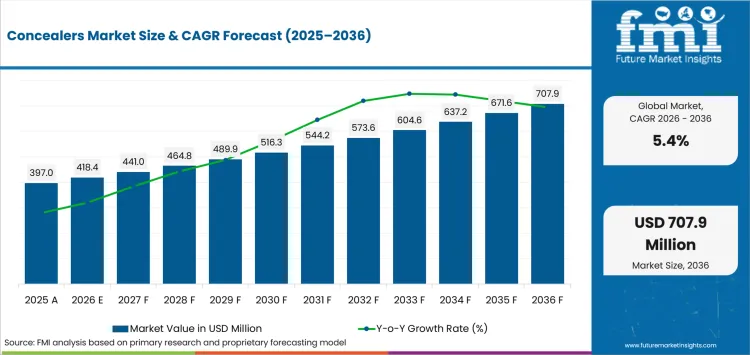
USD 418.4 million in 2026 and USD 707.9 million by 2036 at a 5.4% CAGR.
Demand in the concealers market is projected to grow from USD 418.4 million in 2026 to USD 707.9 million by 2036, reflecting a 5.4% CAGR. Demand is supported by targeted complexion correction that fits daily makeup routines without requiring full-foundation application. Concealers also compete with BB creams that provide lighter coverage across larger facial areas. In August 2026, The Estée Lauder Companies partnered with the University of Leeds to advance color science for foundation and concealer shade matching. Improved shade accuracy can increase consumer confidence and make repeat purchases more likely once users identify a suitable tone.
Commercialization becomes more complex as brands expand shade assortments across multiple markets. Each shade must be documented, tracked, and maintained within the regulatory framework of the countries where it is sold. FDA data as of June 30, 2026 listed 1,298,361 active cosmetic products under MoCRA. The scale of product registration activity highlights the importance of disciplined documentation and product-record management. Wider shade ranges can strengthen replenishment opportunities and consumer reach, they also increase the regulatory and operational burden associated with maintaining active SKUs.
Key Takeaways of Concealers Market
- Targeted correction gains repeat use as concealers cover under-eye darkness and local discoloration without requiring a full-face foundation routine.
- In 2026, core - classic lines are expected to lead product type with 38.0% share because familiar correction jobs simplify repeat shade replenishment.
- By nature, conventional formulas are estimated to hold 50.0% in 2026 owing to broad ingredient choice suited to mass and prestige ranges.
- Cream & balm is set to lead the format category with 35.0% share in 2026 due to controlled placement for targeted coverage.
- Shade mismatch and country-specific records raise assortment cost as every additional tone needs compliant labeling and enough replenishment to justify continued stocking.
- Key players in the concealers market include L'Oréal, The Estée Lauder Companies Inc., Coty Inc., Shiseido Company, Limited, e.l.f. Beauty, Inc., Amorepacific Corporation, Kao Corporation, and Beiersdorf AG.
Analyst Perspective
"Concealer margins depend on how quickly each shade becomes a repeat purchase since slow tones still carry stock and compliance work. Strong assortments pair reliable coverage with usable shade guidance and replenishment discipline so range breadth does not turn into slow inventory."
- Rahul Pandita, Principal Consultant, Future Market Insights
How is the Concealers Market segmented?
The concealers market is segmented by product type, nature, format, price positioning, sales channel and region.
Product type covers core - classic lines, targeted treatment lines, sensitive & gentle lines, premium & clinical lines and kits & sets. Nature separates conventional, vegan & cruelty-free, natural & organic, dermocosmetic / clinical and fragrance-free & sensitive offers. Formats include cream & balm, liquid & serum, stick & solid, spray & mist, sheet & patch and powder. Price positioning spans mass, masstige, premium and professional tiers. Sales channels include e-commerce & DTC, specialty beauty retail, pharmacies & drugstores, supermarkets & hypermarkets and salons & spas.
What makes Core - classic lines central to the Product type category?
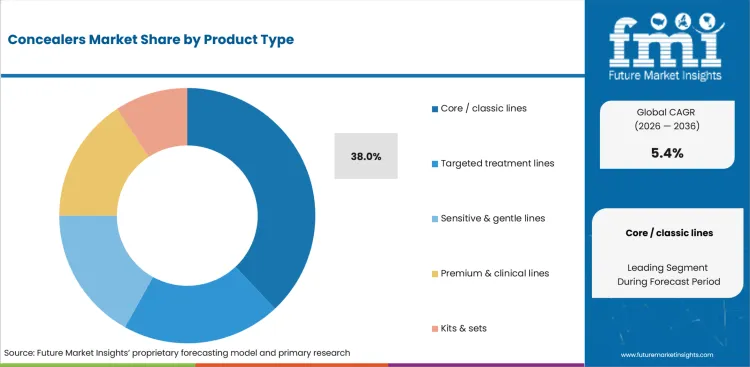
Core - classic lines reduce repurchase friction through familiar shade names and finish behavior used for frequent targeted correction. Familiar franchise cues also make shade replacement easier following a successful first product match.
- Based on product type, core - classic lines are projected to account for 38.0% in 2026 due to familiar correction jobs that simplify repurchase.
- Kao Corporation announced in October 2025 that a new KATE base-makeup line would include Jelly Leap Concealer in nine shades plus clear. The release keeps targeted correction inside an established face-makeup franchise and gives repeat users another familiar reference for shade selection.
Why does Conventional lead the Nature category?
Conventional formulas give cosmetic chemical formulators more freedom to adjust pigment loading and wear without tying every SKU to a specialist claim. That flexibility serves both mass and prestige ranges while vegan or clinical positions narrow some formulation choices.
- By nature, conventional formulas are estimated to hold 50.0% in 2026 owing to broad formulation choice for established price tiers.
- Coty said in August 2025 that Consumer Beauty plans included new multi-use cosmetics beside work on its scaled color platform. A broad color base lets the company vary texture and finish without rebuilding every formula around a specialist positioning.
How does Cream & Balm hold the lead in the Format category?
Cream and balm textures place concentrated pigment precisely prior to blending during targeted under-eye or blemish correction. Their emollient structure also fits skincare expectations for comfortable movement during repeated daily wear near the eye area.
- In 2026, cream & balm is expected to lead format with 35.0% share because its viscosity supports controlled placement and buildable opacity.
- Shiseido announced in January 2025 that Synchro Skin Radiant Lifting Concealer would launch globally in May as a six-shade stick with long-wear hydration. The competing stick format shows that high-coverage pigment systems still depend on controlled placement and comfortable wear outside cream textures.
What supports Mass in the Price positioning category?
Mass pricing lowers the cost of testing undertone and finish before a user settles on a repeat shade. Affordable replacement also makes seasonal shade changes easier without turning each trial into a premium purchase decision.
- By price positioning, mass is forecast to represent 31.0% in 2026 driven by lower trial cost and frequent shade replenishment.
- e.l.f. Beauty announced in May 2025 that its cosmetics would enter 776 Kruidvat and 183 Trekpleister stores in the Netherlands plus 271 Kruidvat stores in Belgium. The rollout gives value-focused complexion products more physical trial points beside premium cosmetics in high-traffic drugstore networks.
What drives E-commerce & DTC in the Sales channel category?
Digital shelves display more shades than compact store fixtures and keep swatches beside the purchase decision. Online shoppers have less first-order color confidence, so beauty and personal care commerce needs guidance that narrows undertone and depth quickly.
- E-commerce & DTC is set to lead the sales channel category with 28.0% share in 2026 due to wider shade visibility online.
- The Estée Lauder Companies announced in December 2025 that Bobbi Brown Cosmetics entered the USA Amazon Premium Beauty store with its complexion range. Wider prestige access makes repeat ordering easier once a shopper already knows the correct shade.
What are the drivers, restraints and opportunities in the concealers market?
Multi-use correction broadens demand while shade and documentation burdens pressure wide assortments. Personalized shade guidance improves the odds that first purchases become replenishment.
- Driver: Concealers earn more routine use once targeted coverage extends beyond isolated blemishes into under-eye and localized face correction.
- Restraint: Wider shade ranges raise inventory and compliance work since slow tones require accurate labels and current local product records.
- Opportunity: Personalized shade guidance raises first-order confidence by narrowing undertone and depth before consumers commit to a full-size complexion product.
Multi-use concealers earn more routine occasions once coverage extends beyond isolated blemishes into under-eye and localized face correction. The Estée Lauder Companies reported in May 2025 that Double Wear Stay-in-Place 24-hour Concealer had launched in February as a multi-use matte companion to its foundation franchise. Familiar base users therefore gain targeted correction without changing the broader complexion routine they already understand.
Wide shade ranges become expensive until slower tones generate enough sales to recover recordkeeping and inventory costs. FDA's March 2025 MoCRA summary states that each marketed cosmetic product must be listed and updated annually by its responsible person. Slow-moving shades therefore need enough repeat demand to justify compliant cosmetic packaging, current product records and inventory that may remain unsold between retailer resets.
Shade guidance can raise first-order confidence by narrowing undertone and depth during initial concealer evaluation. Amorepacific reopened AMORE YONGSAN in May 2026 with AI-based skin analysis and made-to-order base makeup services. Concealer brands can apply the same decision logic online, provided the recommended tone stays easy to identify through make-up products packaging during later replenishment. A confirmed match also gives DTC channels a cleaner replenishment path following the first order.
Which country CAGRs are profiled in the Concealers Market?
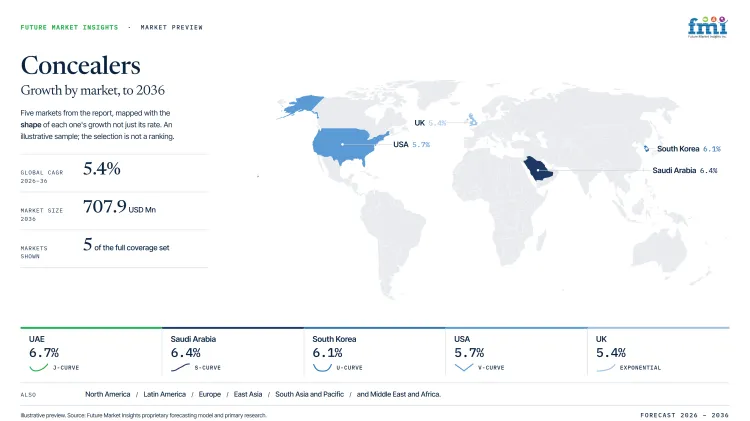
| Country | CAGR |
|---|---|
| UAE | 6.7% |
| Saudi Arabia | 6.4% |
| South Korea | 6.1% |
| USA | 5.7% |
| UK | 5.4% |
How do country-level CAGRs compare in the concealers market?
The profiled markets span 1.3 percentage points from the UAE to the UK and form operating groups. UAE, Saudi Arabia and South Korea occupy the upper band through faster assortment renewal patterns. The USA and UK follow as mature retail depth shifts competition toward shade productivity and compliant replenishment.
- Dubai's import gateway rewards UAE ranges that replenish trend-led shades once product clearance is complete.
- Saudi chains give registered shades broader reach once claims files and Arabic information are complete.
- South Korean formulation teams shorten complexion cycles and train shoppers to expect frequent texture changes.
- US retailers scale proven shades nationally and slower tones absorb product records plus fixture costs.
- British online channels widen shade access but notification workflow controls how quickly SKUs reach sale.
The full country outlook carries CAGR analysis for North America, Latin America, Europe, East Asia, South Asia, Oceania and the Middle East and Africa.
Country-wise Analysis
- Dubai routes most imported cosmetics through a regulated gateway that can delay trend-led concealer shades until registration and testing records are complete. UAE concealer demand is forecast to rise at 6.7% CAGR through 2036 owing to premium beauty traffic and frequent assortment refreshes. Dubai Municipality stated in October 2025 that its entry points handle over 90% of UAE imports and monitor more than 500,000 imported products. Fast local distribution shortens the gap between registration and shelf placement for shades tied to brief social-media discovery cycles. Slow shades can strand inventory once demand fades, so local range discipline carries more value than releasing every global tone.
- Imported concealers reach Saudi national beauty chains once safety and claims files match current SFDA requirements for local distribution. The SFDA adopted updated Gulf cosmetic safety and claims regulations in June 2025, changing which documents importers must maintain for distribution. Saudi Arabia is estimated to post 6.4% CAGR over the forecast period due to wider beauty access and faster retailer assortment resets. Arabic product information and disciplined distributor stock control give registered shades a clearer route from digital interest to repeat purchase. The growth case weakens for global variants that lack enough local turnover to justify continued registration and national shelf space.
- Short product cycles define South Korean complexion retail with cushion formats and customized base makeup keeping shade experimentation familiar to shoppers. Deep domestic formulation capacity lets local brands revise textures and undertones quickly without waiting for decisions from distant global teams. MFDS documented in May 2026 that 2025 cosmetics exports rose 11.8% and moved Korea from third to second among global cosmetics exporters. Concealer sales in South Korea are anticipated to advance at 6.1% CAGR through 2036 tied to fast domestic renewal and informed beauty discovery. Imported brands face a timing disadvantage once local preferences have shifted toward a new finish before global shade approvals arrive.
- Large US mass and specialty retailers can give new concealer lines national visibility quickly through stores, marketplaces and brand-owned digital channels. FDA data published for June 30 2026 counted 16,398 active cosmetic facility registrations under MoCRA. Digital shade tools give unfamiliar tones a stronger first-purchase route by reducing uncertainty and letting retailers replenish proven shades following early sell-through. The USA concealers sector is expected to maintain 5.7% CAGR through 2036 given deep retail access and frequent replenishment. Slow shades continue to carry records and fixture costs, which makes synchronized product data more useful than one-time launch compliance during national expansion.
- Great Britain pairs mature beauty chains with heavy online purchasing, so every active concealer SKU depends on an accurate Responsible Person notification record. UK concealer demand is projected to grow at 5.4% CAGR during the assessment period aided by broad digital access and regular shade replenishment. OPSS recorded 325,496 cosmetic notifications in 2025-2026 and said the total increased 11% from the previous reporting year. High notification volume rewards operators that prepare safety assessments and product files ahead of retailer resets instead of repairing records following launch. A strong online audience does not offset delayed notification work since a shade generates no sales until compliant stock is available.
Who are the notable companies in the concealers market?
L'Oréal, The Estée Lauder Companies Inc., Coty Inc., Shiseido Company, Limited, e.l.f. Beauty, Inc., Amorepacific Corporation, Kao Corporation, and Beiersdorf AG are the notable companies serving this market.
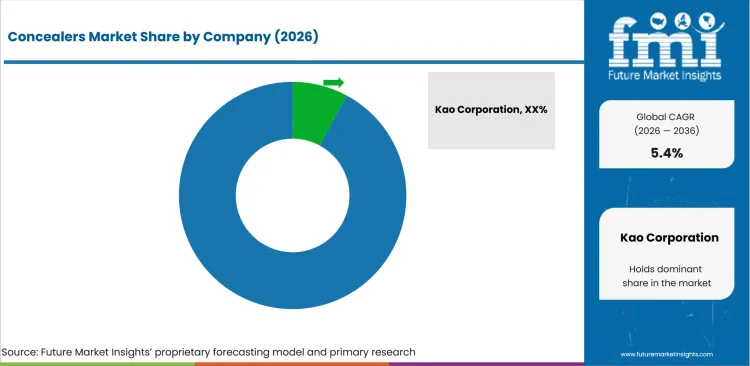
Global complexion portfolios compete with digital specialists and Asia-focused brands as shade depth, retailer access and compliant records determine whether new assortments convert into repeat orders.
- L'Oréal, The Estée Lauder Companies Inc., Coty Inc. and Shiseido Company, Limited use broad multi-brand complexion portfolios in prestige or mass retail.
- e.l.f. Beauty, Inc., Amorepacific Corporation and Kao Corporation use digital execution or Asia-centered makeup platforms for faster shade renewal.
- Beiersdorf AG participates through Chantecaille, whose selective prestige distribution provides a narrower route into premium complexion demand.
Competitive Benchmarking: Concealers Market
| Company | Concealer Portfolio Depth | Complexion Benefit Integration | Omnichannel Beauty Reach | Geographic Reach |
|---|---|---|---|---|
| L'Oréal | High | High | High | Global |
| The Estée Lauder Companies Inc. | High | High | High | Global |
| Coty Inc. | Medium | High | High | Americas, Europe and selected Asia-Pacific markets |
| Shiseido Company, Limited | High | High | High | Global |
| e.l.f. Beauty, Inc. | High | High | High | North America, Europe, GCC and selected international markets |
| Amorepacific Corporation | Medium | High | High | South Korea, East Asia and selected international markets |
| Kao Corporation | High | High | High | Japan and wider Asia |
| Beiersdorf AG | Low | Medium | Medium | Europe, North America and selected Asian prestige channels |
Scoring basis: High concealer depth requires multiple current dedicated lines. Medium identifies one current family and Low reflects documented limited scope. High benefit integration requires several documented functions. Medium requires one combined benefit within a verified complexion offer. High omnichannel reach requires physical and digital distribution in several markets. Medium identifies narrower documented channel breadth.
Key Developments in the Concealers Market
- In January 2025, Shiseido Company, Limited announced the full renewal of Perfect Cover with expanded coverage for visible skin concerns.
- In June 2026, L’Oréal and OpenAI announced Maybelline makeup virtual try-on inside ChatGPT through ModiFace for digital shade and look evaluation.
- In May 2026, e.l.f. Beauty, Inc. partnered with SURVIVOR 50 and placed Camo Concealer among three hero products in its finale vignette series.
Key Players in the Concealers Market
Global multi-brand complexion platforms
- L'Oréal
- The Estée Lauder Companies Inc.
- Coty Inc.
- Shiseido Company, Limited
Digital and Asia-centered makeup platforms
- e.l.f. Beauty, Inc.
- Amorepacific Corporation
- Kao Corporation
Selective prestige beauty participant
- Beiersdorf AG
Concealers Market - Report Scope
| Coverage field | Report scope |
|---|---|
| Market breakdown | By product type, nature, format, price positioning, sales channel and region. |
| Quantitative Units | USD Million. |
| Market Definition | Commercial complexion-correction products used to conceal under-eye darkness, discoloration, blemishes and localized tone variation through liquid, cream, balm, stick, powder and related formats. |
| Regions Covered | North America, Latin America, Europe, East Asia, South Asia and Pacific, and Middle East and Africa. |
| Countries Covered | UAE, Saudi Arabia, South Korea, USA, UK, and 20+ countries included in the full report. |
| Key Companies Profiled | L'Oréal, The Estée Lauder Companies Inc., Coty Inc., Shiseido Company, Limited, e.l.f. Beauty, Inc., Amorepacific Corporation, Kao Corporation, and Beiersdorf AG. |
| Forecast Period | 2026 to 2036. |
| Approach | Primary and secondary research with market triangulation. |
Concealers Market - Research Methodology
| Method | Approach |
|---|---|
| Primary Research | FMI analysts gathered input from manufacturers, service providers, technology developers, distributors, end users, procurement teams, and subject-matter experts. Interviews examined purchasing decisions, product or service evaluation, adoption barriers, approval requirements, pricing considerations, and expectations for technical or commercial support. Respondents were also asked what evidence is required before a trial, pilot, or initial order develops into regular purchasing. |
| Desk Research | Desk research covered government statistics, regulatory publications, trade data, industry associations, technical literature, standards, company filings, product information, and official corporate announcements. Sources were reviewed for relevance, publication date, geographic coverage, and consistency with the defined market scope. Claims relating to performance, applications, approvals, capacity, investment, and commercial activity were retained only when supported by credible public evidence. |
| Market Sizing and Forecasting | The market model combined the baseline value with historical performance, segment structure, pricing and volume indicators, adoption levels, company participation, and country-level demand conditions. Forecast assumptions considered economic activity, investment trends, regulatory developments, technology adoption, purchasing cycles, supply availability, and barriers to wider market use. Segment and regional estimates were reconciled before the final market total was calculated. |
| Data Validation | Estimates were checked against multiple independent indicators, including public data, company activity, trade patterns, industry developments, and findings from primary interviews. Validation also tested whether products, services, applications, and company revenues fell within the defined market boundaries. Adjacent categories, unsupported claims, overlapping revenues, and activities without direct market relevance were excluded to reduce double counting and maintain consistency across segments and countries. |
Concealers Market by Segments
Concealers Market segmented by Product Type:
- Core - classic lines
- Targeted treatment lines
- Sensitive & gentle lines
- Premium & clinical lines
- Kits & sets
Concealers Market segmented by Nature:
- Conventional
- Vegan & cruelty-free
- Natural & organic
- Dermocosmetic / clinical
- Fragrance-free & sensitive
Concealers Market segmented by Format:
- Cream & balm
- Liquid & serum
- Stick & solid
- Spray & mist
- Sheet & patch
- Powder
Concealers Market segmented by Price Positioning:
- Mass
- Masstige
- Premium
- Professional
Concealers Market segmented by Sales Channel:
- E-commerce & DTC
- Specialty beauty retail
- Pharmacies & drugstores
- Supermarkets & hypermarkets
- Salons & spas
Concealers Market by Region:
- North America
- United States
- Canada
- Latin America
- Brazil
- Mexico
- Chile
- Rest of Latin America
- Western Europe
- Germany
- United Kingdom
- Italy
- Spain
- France
- Nordics
- Benelux
- Rest of Western Europe
- Eastern Europe
- Russia
- Poland
- Hungary
- Balkan and Baltic States
- Rest of Eastern Europe
- East Asia
- China
- Japan
- South Korea
- South Asia and Pacific
- India
- ASEAN
- Australia and New Zealand
- Rest of South Asia and Pacific
- Middle East and Africa
- Kingdom of Saudi Arabia
- Other GCC Countries
- Türkiye
- South Africa
- Other African Union Countries
- Rest of Middle East and Africa
Research Sources and Bibliography
- USA Food and Drug Administration. (2025, March 13). FDA Provides Summary Data on the Registration and Listing of Cosmetic Product Facilities and Products.
- USA Food and Drug Administration. (2026, June 30 data). Registration & Listing of Cosmetic Product Facilities and Products.
- Office for Product Safety and Standards. (2026, August 5). OPSS Delivery Report 2025-2026.
- Dubai Municipality. (2025, October 27). Product safety at Beautyworld Middle East 2025.
- Saudi Food and Drug Authority. (2025, June 24). SFDA adopts new updates to Gulf technical regulations governing cosmetic products.
- Ministry of Food and Drug Safety. (2026, May 28). '25년 화장품 무역수지 흑자 첫 100억 달러 돌파, 세계 2위 화장품 수출국 달성.
- The Estée Lauder Companies Inc. (2026, August 14). The Estée Lauder Companies and University of Leeds Partner to Advance the Future of Complexion Shade Matching.
- The Estée Lauder Companies Inc. (2025, May 1). The Estée Lauder Companies Reports Fiscal 2025 Third Quarter Results.
- The Estée Lauder Companies Inc. (2025, December 11). Bobbi Brown Cosmetics Launches in the USA Amazon Premium Beauty Store.
- The Estée Lauder Companies Inc. (2025, October 29). M·A·C Cosmetics to Launch in Sephora USA.
- The Estée Lauder Companies Inc. (2026, May 1). The Estée Lauder Companies Reports Fiscal 2026 Third Quarter Results.
- Coty Inc. (2025, August 20). Coty Reports FY25 and Q4 Results.
- Coty Inc. (2026, May 4). Coty partners with Pencil to build end-to-end Gen AI content system.
- Coty Inc. (2026, May 20). Coty Launches Marc Jacobs Beauty: One Of The Most-requested Luxury Comebacks.
- e.l.f. Beauty, Inc. (2025, May 15). e.l.f. Beauty Expands International Footprint, Launching e.l.f. Cosmetics in the Netherlands and Belgium.
- e.l.f. Beauty, Inc. (2025, November 20). e.l.f. Beauty Launches in the Gulf Cooperation Council Exclusively with Sephora.
- e.l.f. Beauty, Inc. (2026, May 20). e.l.f. Cosmetics Partners with SURVIVOR 50 Finale for Fandom-Fueled e.l.f.ie Advantage Vignette Series.
- Shiseido Company, Limited. (2025, January 23). 素肌になじみ、光を味方に。 SHISEIDOより、美しさとスキンケア性を備えたコンシーラーが登場。.
- Shiseido Company, Limited. (2025, January 31). Marking 30 Years of Innovation: Perfect Cover's Complete Renewal for Seamless and Natural-Looking Coverage.
- Shiseido Company, Limited. (2026, May 26). SHISEIDO launches Essence SkinSmooth Foundation and setting powder.
- Amorepacific Corporation. (2026, May 7). Amorepacific Opens Flagship Store AMORE YONGSAN.
- Amorepacific Corporation. (2025, May 20). HERA adds 'Black Cushion Custom Match' to its customized cosmetics service.
- Kao Corporation. (2025, June 4). KATE, Japan's No.1 Makeup Brand, Launches Strategic Initiatives to Strengthen Business and Brand Recognition Across Asia.
- L'Oréal. (2026, June 17). L'Oréal and OpenAI join forces for Transformation in Beauty with AI.
- L'Oréal. (2025, February 7). L'Oréal groupe signs an exclusive agreement with Jacquemus.
- Beiersdorf AG. (2026, March 3). Our Stories - Beiersdorf Annual Report 2025.
- Beiersdorf AG. (2026, March 3). Research and Development - Beiersdorf Annual Report 2025.
This bibliography is provided for reader reference and is not exhaustive. The full report contains the complete reference list and detailed citations
This Report Answers
- What is the concealers market size in 2026 and what value is forecast by 2036?
- Why do core - classic lines hold the leading product type position?
- How do conventional formulas support broad concealer assortment development?
- How do format and digital sales channels change shade trial and replenishment?
- Why do the UAE, Saudi Arabia and South Korea form the faster profiled growth group?
- Which companies show current concealer or targeted complexion-correction activity?
- How do shade mismatch and annual product records limit wider assortments?
- How are beauty companies changing shade guidance and complexion discovery?
Frequently Asked Questions
How big is the concealers market in 2026?
The concealers market is valued at USD 418.4 million in 2026 and is projected to reach USD 707.9 million by 2036. Targeted correction broadens daily use because one compact product can address under-eye darkness and localized discoloration.
What is the CAGR of the concealers market from 2026 to 2036?
The concealers market is projected to grow at a CAGR of 5.4% between 2026 and 2036. Expansion follows repeat correction routines and better shade discovery once users can reorder a proven match through physical or digital channels.
Which product type leads the concealers market?
The core - classic lines segment is expected to hold 38.0% of the concealers market in 2026, attributable to familiar shade systems and repeat correction jobs. Recognized franchises reduce repurchase friction once users know the correct tone and expected finish for repeated correction.
Which countries are projected to record the highest growth in the concealers market?
UAE is projected to grow at 6.7% CAGR, followed by Saudi Arabia at 6.4% and South Korea at 6.1% through 2036. Faster assortment renewal and deeper beauty access support the upper group despite different local registration routes.
Which companies are active in the concealers market?
Key companies in the concealers market include L'Oréal, The Estée Lauder Companies Inc., Coty Inc., Shiseido Company, Limited, e.l.f. Beauty, Inc., Amorepacific Corporation, Kao Corporation, and Beiersdorf AG. Their positions differ through complexion depth and retail reach plus disciplined shade management for replenishment.
Preview the report firsthand - request a free sample
Get SampleGet the brochure for pricing and purchase details.
Get PDFTable of Content
- Key Takeaways
- Market Size and CAGR
- Top Growth Driver
- Fastest Growing Segment
- Leading Region
- Key Companies
- Emerging Opportunities
- Executive Summary
- Global Market Outlook
- Demand-side Trends
- Supply-side Trends
- Technology Roadmap Analysis
- Analysis and Recommendations
- Analyst Perspective (What is happening? Why now? What should investors know?)
- Key Questions Answered
- How large is the market?
- What is the CAGR?
- What are key trends?
- Which region dominates?
- Who are the leaders?
- Market Overview
- Market Coverage / Taxonomy
- Market Definition / Scope / Limitations
- Research Methodology
- Chapter Orientation
- Analytical Lens and Working Hypotheses
- Market Structure, Signals, and Trend Drivers
- Benchmarking and Cross-market Comparability
- Market Sizing, Forecasting, and Opportunity Mapping
- Research Design and Evidence Framework
- Desk Research Programme (Secondary Evidence)
- Expert Input and Fieldwork (Primary Evidence)
- Tooling, Models, and Reference Databases
- Data Engineering and Model Build
- Quality Assurance and Audit Trail
- Market Background
- Market Dynamics (Drivers, Restraints, Opportunity, Trends)
- Scenario Forecast (Optimistic, Likely, Conservative)
- Impact Analysis
- AI Impact
- Sustainability Impact
- Regulatory Impact
- Technology Impact
- Consumer / Buyer Analysis
- Purchase Drivers
- Adoption Barriers
- Buyer Journey
- Opportunity Map Analysis
- Product Life Cycle Analysis
- Supply Chain Analysis
- Investment Feasibility Matrix
- Value Chain Analysis
- PESTLE and Porter's Analysis
- Regulatory Landscape
- Regional Parent Market Outlook
- Production and Consumption Statistics
- Import and Export Statistics
- Global Market Analysis and Forecast, 2021 to 2036
- Historical Market Size Value (USD Million) Analysis, 2021 to 2025
- Current and Future Market Size Value (USD Million) Projections, 2026 to 2036
- Y-o-Y Growth Trend Analysis
- Absolute $ Opportunity Analysis
- Global Market Pricing Analysis, 2021 to 2036
- Global Market Analysis and Forecast, By Product Type, 2021 to 2036
- Introduction / Key Findings
- Historical Market Size Value (USD Million) Analysis By Product Type, 2021 to 2025
- Current and Future Market Size Value (USD Million) Analysis and Forecast By Product Type, 2026 to 2036
- Core / classic lines
- Targeted treatment lines
- Sensitive & gentle lines
- Premium & clinical lines
- Kits & sets
- Core / classic lines
- Y-o-Y Growth Trend Analysis By Product Type, 2021 to 2025
- Absolute $ Opportunity Analysis By Product Type, 2026 to 2036
- Global Market Analysis and Forecast, By Nature, 2021 to 2036
- Introduction / Key Findings
- Historical Market Size Value (USD Million) Analysis By Nature, 2021 to 2025
- Current and Future Market Size Value (USD Million) Analysis and Forecast By Nature, 2026 to 2036
- Conventional
- Vegan & cruelty-free
- Natural & organic
- Dermocosmetic / clinical
- Fragrance-free & sensitive
- Conventional
- Y-o-Y Growth Trend Analysis By Nature, 2021 to 2025
- Absolute $ Opportunity Analysis By Nature, 2026 to 2036
- Global Market Analysis and Forecast, By Format, 2021 to 2036
- Introduction / Key Findings
- Historical Market Size Value (USD Million) Analysis By Format, 2021 to 2025
- Current and Future Market Size Value (USD Million) Analysis and Forecast By Format, 2026 to 2036
- Cream & balm
- Liquid & serum
- Stick & solid
- Spray & mist
- Sheet & patch
- Powder
- Cream & balm
- Y-o-Y Growth Trend Analysis By Format, 2021 to 2025
- Absolute $ Opportunity Analysis By Format, 2026 to 2036
- Global Market Analysis and Forecast, By Price Positioning, 2021 to 2036
- Introduction / Key Findings
- Historical Market Size Value (USD Million) Analysis By Price Positioning, 2021 to 2025
- Current and Future Market Size Value (USD Million) Analysis and Forecast By Price Positioning, 2026 to 2036
- Mass
- Masstige
- Premium
- Professional
- Mass
- Y-o-Y Growth Trend Analysis By Price Positioning, 2021 to 2025
- Absolute $ Opportunity Analysis By Price Positioning, 2026 to 2036
- Global Market Analysis and Forecast, By Sales Channel, 2021 to 2036
- Introduction / Key Findings
- Historical Market Size Value (USD Million) Analysis By Sales Channel, 2021 to 2025
- Current and Future Market Size Value (USD Million) Analysis and Forecast By Sales Channel, 2026 to 2036
- E-commerce & DTC
- Specialty beauty retail
- Pharmacies & drugstores
- Supermarkets & hypermarkets
- Salons & spas
- E-commerce & DTC
- Y-o-Y Growth Trend Analysis By Sales Channel, 2021 to 2025
- Absolute $ Opportunity Analysis By Sales Channel, 2026 to 2036
- Global Market Analysis and Forecast, By Region, 2021 to 2036
- Introduction
- Historical Market Size Value (USD Million) Analysis By Region, 2021 to 2025
- Current Market Size Value (USD Million) Analysis and Forecast By Region, 2026 to 2036
- North America
- Latin America
- Western Europe
- Eastern Europe
- East Asia
- South Asia and Pacific
- Middle East & Africa
- Market Attractiveness Analysis By Region
- North America Market Analysis and Forecast, By Country, 2021 to 2036
- Historical Market Size Value (USD Million) Trend Analysis By Market Taxonomy, 2021 to 2025
- Market Size Value (USD Million) Forecast By Market Taxonomy, 2026 to 2036
- By Country
- USA
- Canada
- By Product Type
- By Nature
- By Format
- By Price Positioning
- By Sales Channel
- By Country
- Market Attractiveness Analysis
- By Country
- By Product Type
- By Nature
- By Format
- By Price Positioning
- By Sales Channel
- Key Takeaways
- Latin America Market Analysis and Forecast, By Country
- Historical Market Size Value (USD Million) Trend Analysis By Market Taxonomy, 2021 to 2025
- Market Size Value (USD Million) Forecast By Market Taxonomy, 2026 to 2036
- By Country
- Brazil
- Mexico
- Chile
- Rest of Latin America
- By Product Type
- By Nature
- By Format
- By Price Positioning
- By Sales Channel
- By Country
- Market Attractiveness Analysis
- By Country
- By Product Type
- By Nature
- By Format
- By Price Positioning
- By Sales Channel
- Key Takeaways
- Western Europe Market Analysis and Forecast, By Country
- Historical Market Size Value (USD Million) Trend Analysis By Market Taxonomy, 2021 to 2025
- Market Size Value (USD Million) Forecast By Market Taxonomy, 2026 to 2036
- By Country
- Germany
- UK
- Italy
- Spain
- France
- Nordic
- BENELUX
- Rest of Western Europe
- By Product Type
- By Nature
- By Format
- By Price Positioning
- By Sales Channel
- By Country
- Market Attractiveness Analysis
- By Country
- By Product Type
- By Nature
- By Format
- By Price Positioning
- By Sales Channel
- Key Takeaways
- Eastern Europe Market Analysis and Forecast, By Country
- Historical Market Size Value (USD Million) Trend Analysis By Market Taxonomy, 2021 to 2025
- Market Size Value (USD Million) Forecast By Market Taxonomy, 2026 to 2036
- By Country
- Russia
- Poland
- Hungary
- Balkan & Baltic
- Rest of Eastern Europe
- By Product Type
- By Nature
- By Format
- By Price Positioning
- By Sales Channel
- By Country
- Market Attractiveness Analysis
- By Country
- By Product Type
- By Nature
- By Format
- By Price Positioning
- By Sales Channel
- Key Takeaways
- East Asia Market Analysis and Forecast, By Country
- Historical Market Size Value (USD Million) Trend Analysis By Market Taxonomy, 2021 to 2025
- Market Size Value (USD Million) Forecast By Market Taxonomy, 2026 to 2036
- By Country
- China
- Japan
- South Korea
- By Product Type
- By Nature
- By Format
- By Price Positioning
- By Sales Channel
- By Country
- Market Attractiveness Analysis
- By Country
- By Product Type
- By Nature
- By Format
- By Price Positioning
- By Sales Channel
- Key Takeaways
- South Asia and Pacific Market Analysis and Forecast, By Country
- Historical Market Size Value (USD Million) Trend Analysis By Market Taxonomy, 2021 to 2025
- Market Size Value (USD Million) Forecast By Market Taxonomy, 2026 to 2036
- By Country
- India
- ASEAN
- Australia & New Zealand
- Rest of South Asia and Pacific
- By Product Type
- By Nature
- By Format
- By Price Positioning
- By Sales Channel
- By Country
- Market Attractiveness Analysis
- By Country
- By Product Type
- By Nature
- By Format
- By Price Positioning
- By Sales Channel
- Key Takeaways
- Middle East & Africa Market Analysis and Forecast, By Country
- Historical Market Size Value (USD Million) Trend Analysis By Market Taxonomy, 2021 to 2025
- Market Size Value (USD Million) Forecast By Market Taxonomy, 2026 to 2036
- By Country
- Kingdom of Saudi Arabia
- Other GCC Countries
- Türkiye
- South Africa
- Other African Union
- Rest of Middle East & Africa
- By Product Type
- By Nature
- By Format
- By Price Positioning
- By Sales Channel
- By Country
- Market Attractiveness Analysis
- By Country
- By Product Type
- By Nature
- By Format
- By Price Positioning
- By Sales Channel
- Key Takeaways
- Key Countries Market Analysis
- USA
- Pricing Analysis
- Market Share Analysis, 2025
- By Product Type
- By Nature
- By Format
- By Price Positioning
- By Sales Channel
- Canada
- Pricing Analysis
- Market Share Analysis, 2025
- By Product Type
- By Nature
- By Format
- By Price Positioning
- By Sales Channel
- Mexico
- Pricing Analysis
- Market Share Analysis, 2025
- By Product Type
- By Nature
- By Format
- By Price Positioning
- By Sales Channel
- Brazil
- Pricing Analysis
- Market Share Analysis, 2025
- By Product Type
- By Nature
- By Format
- By Price Positioning
- By Sales Channel
- Chile
- Pricing Analysis
- Market Share Analysis, 2025
- By Product Type
- By Nature
- By Format
- By Price Positioning
- By Sales Channel
- Germany
- Pricing Analysis
- Market Share Analysis, 2025
- By Product Type
- By Nature
- By Format
- By Price Positioning
- By Sales Channel
- UK
- Pricing Analysis
- Market Share Analysis, 2025
- By Product Type
- By Nature
- By Format
- By Price Positioning
- By Sales Channel
- Italy
- Pricing Analysis
- Market Share Analysis, 2025
- By Product Type
- By Nature
- By Format
- By Price Positioning
- By Sales Channel
- Spain
- Pricing Analysis
- Market Share Analysis, 2025
- By Product Type
- By Nature
- By Format
- By Price Positioning
- By Sales Channel
- France
- Pricing Analysis
- Market Share Analysis, 2025
- By Product Type
- By Nature
- By Format
- By Price Positioning
- By Sales Channel
- India
- Pricing Analysis
- Market Share Analysis, 2025
- By Product Type
- By Nature
- By Format
- By Price Positioning
- By Sales Channel
- ASEAN
- Pricing Analysis
- Market Share Analysis, 2025
- By Product Type
- By Nature
- By Format
- By Price Positioning
- By Sales Channel
- Australia & New Zealand
- Pricing Analysis
- Market Share Analysis, 2025
- By Product Type
- By Nature
- By Format
- By Price Positioning
- By Sales Channel
- China
- Pricing Analysis
- Market Share Analysis, 2025
- By Product Type
- By Nature
- By Format
- By Price Positioning
- By Sales Channel
- Japan
- Pricing Analysis
- Market Share Analysis, 2025
- By Product Type
- By Nature
- By Format
- By Price Positioning
- By Sales Channel
- South Korea
- Pricing Analysis
- Market Share Analysis, 2025
- By Product Type
- By Nature
- By Format
- By Price Positioning
- By Sales Channel
- Russia
- Pricing Analysis
- Market Share Analysis, 2025
- By Product Type
- By Nature
- By Format
- By Price Positioning
- By Sales Channel
- Poland
- Pricing Analysis
- Market Share Analysis, 2025
- By Product Type
- By Nature
- By Format
- By Price Positioning
- By Sales Channel
- Hungary
- Pricing Analysis
- Market Share Analysis, 2025
- By Product Type
- By Nature
- By Format
- By Price Positioning
- By Sales Channel
- Kingdom of Saudi Arabia
- Pricing Analysis
- Market Share Analysis, 2025
- By Product Type
- By Nature
- By Format
- By Price Positioning
- By Sales Channel
- Türkiye
- Pricing Analysis
- Market Share Analysis, 2025
- By Product Type
- By Nature
- By Format
- By Price Positioning
- By Sales Channel
- South Africa
- Pricing Analysis
- Market Share Analysis, 2025
- By Product Type
- By Nature
- By Format
- By Price Positioning
- By Sales Channel
- USA
- Market Structure Analysis
- Competition Dashboard
- Competition Benchmarking
- Market Share Analysis of Top Players
- By Regional
- By Product Type
- By Nature
- By Format
- By Price Positioning
- By Sales Channel
- Emerging Startups
- Innovation Benchmarking
- Competition Analysis
- Competition Deep Dive
- Kao Corporation
- Overview
- Product Portfolio
- Profitability by Market Segments
- Sales Footprint
- Strategy Overview
- Marketing Strategy
- Product Strategy
- Channel Strategy
- L'Oreal
- e.l.f. Beauty
- Estee Lauder Companies
- Coty
- Procter & Gamble
- Beiersdorf
- Unilever
- Amorepacific
- Shiseido
- Kao Corporation
- Case Studies
- Success Stories
- Recent Developments
- Competition Deep Dive
- Assumptions & Acronyms Used


