

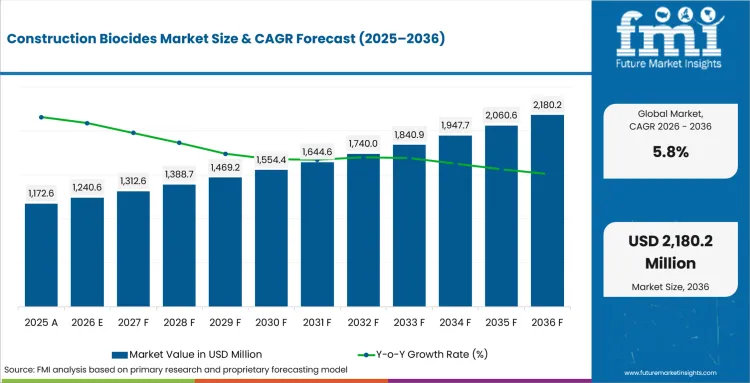
- Market Size (2026)
- USD 1240.6 Mn
- Forecast (2036)
- USD 2180.2 Mn
- CAGR (2026 to 2036)
- 5.8%
How big is Construction Biocides Market in 2026?
USD 1,240.6 million in 2026 and USD 2,180.2 million by 2036 at a 5.8% CAGR.
Demand for construction biocides is projected to expand at 5.8% CAGR between 2026 and 2036, increasing valuation from USD 1240.6 million in 2026 to USD 2180.2 million by 2036. Companies making construction chemicals must track registration changes alongside storage protection and finished-material performance requirements across portfolios. EPA reported in April 2025 that more than 1,200 registrants had joined MyPest for real-time case tracking. Formulators need regulatory capacity to change active ingredients or labeled uses across established product families.
Commercial conversion depends on compatibility across paints and treated building materials used throughout construction projects. Producers compare specialty chemicals through efficacy records and authorized uses during formulation approval across plants. Regional performance depends on registration routes, distributor coverage and application support instead of chemistry availability alone.
Key Takeaways of Construction Biocides Market
- Registration rules and labeled use conditions increasingly determine which preservatives reach coatings and other protected construction materials.
- Isothiazolinones are projected to represent 31.0% share in 2026 due to effective low-dose control across water-based formulations.
- In-can preservation is estimated to account for 29.0% share in 2026 owing to spoilage risks during storage and distribution.
- Paints and coatings are forecast to capture 38.0% share in 2026 driven by separate wet-state and dry-film protection needs.
- Active restrictions and worker-exposure controls increase reformulation work across exterior coatings and applied building products.
- LANXESS, Arxada, THOR, Clariant, Vink Chemicals, SANITIZED, Microban International and BASF focus on preservation depth and application support.
Analyst Perspective
"Construction biocide value comes from protecting water-based formulations without complicating worker exposure controls during mixing or site application. Coatings manufacturers gain repeatable qualification as challenge tests align with approved labels and technical support across product families."
- Nikhil Kaitwade, Principal Consultant, Future Market Insights
How is the Construction Biocides Market segmented?
The construction biocides industry is segmented by chemistry, function, application, end use, sales channel and region.
Chemistry covers isothiazolinones, carbamates, triazines, quaternary ammonium compounds, IPBC and silver or mineral biocide products. Function includes in-can preservation, dry-film preservation, algae or fungi control, mold inhibition and antibacterial protection. Applications cover paints and coatings, adhesives and sealants, concrete admixtures, wood protection and roof or facade treatments. End uses include residential, commercial, infrastructure, construction chemicals and building maintenance with sales through direct chemical supply, formulator supply and chemical distributors.
What role do isothiazolinones play within the chemistry category?
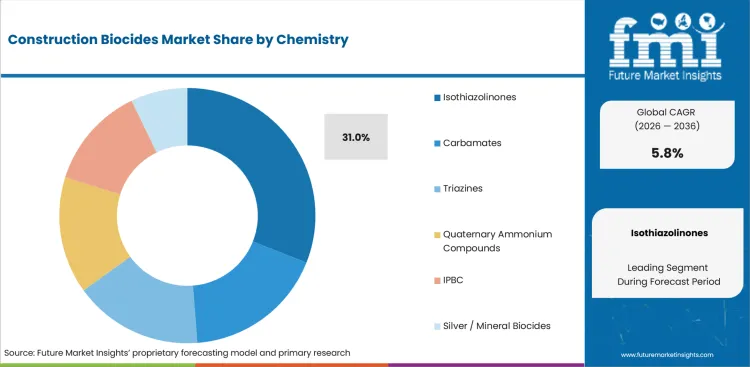
Isothiazolinones serve as familiar antimicrobial additives across water-based construction formulations used by paint and coatings manufacturers. Vink Chemicals described Vinkocide CMIO in October 2025 as an additive that preserves industrial wood-treatment fluids exposed to fungal contamination.
- Based on chemistry, isothiazolinones are projected to account for 31.0% in 2026 due to familiar dosing across paints and liquid construction compounds.
- Qualification laboratories favor established isothiazolinone packages once challenge testing confirms microbial control across the intended pH range and storage period. Consistent results reduce formula changes during commercial scale-up and shorten approvals across related water-based product families.
Why does in-can preservation remain central to the function category?
Water-based coatings can spoil during manufacture or storage and lose viscosity through regional distribution cycles. In-can preservation protects stored formulas without changing the appearance or handling properties required at construction sites.
- By function, in-can preservation is estimated to hold 29.0% in 2026 owing to the direct cost of spoiled batches and contaminated processing equipment during commercial storage.
- Paint manufacturers compare pH stability and microbial challenge results during routine formula approval programs across regional plants. Arxada announced in April 2026 that it would present a single-SKU wet-state solution for bacterial and fungal control, giving formulation teams a simpler route to stored-coating qualification.
How are paints and coatings positioned within the application category?
Paints and coatings need microbial control inside the container and across the exposed film during commercial building service. Separate wet-state and dry-film failure points require distinct efficacy tests across decorative finishes and related adhesives and sealants.
- By application, paints and coatings are forecast to represent 38.0% in 2026 driven by separate wet-state and dry-film protection needs. Vink Chemicals reported in February 2025 that its coatings portfolio covered pot and film preservation.
- Coatings manufacturers run microbial challenge and weathering programs during seasonal reformulation work so storage protection does not conceal weak performance on exposed building surfaces.
What supports residential construction within the end-use category?
Residential projects expose coatings and construction sealants to recurring moisture across bathrooms, facades and exterior wood. Occupied-site renovation also favors preservation systems that retain handling properties without adding complex mixing or re-entry procedures for contractors.
- Residential construction is projected to hold 28.0% share in 2026 owing to recurring maintenance across occupied buildings and frequent use of protected finishes.
- Applicators favor qualified preservation systems that retain workability and joint performance across repainting cycles without adding complex site handling requirements during planned renovation work. Clear labels support consistent application across contractor networks that manage repeated maintenance work in occupied buildings.
What are the drivers, restraints and opportunities in the Construction Biocides Market?
Driver: Product authorization supports documented preservation. Restraint: Active restrictions raise reformulation costs. Opportunity: Controlled-release systems reduce exterior wash-off.
- Driver: Product authorization links each active ingredient to approved construction uses and required efficacy documentation.
- Restraint: Dry-film restrictions require repeated efficacy and weathering work throughout regulated coating family qualification programs.
- Opportunity: Controlled-release preservation can limit active migration across exterior surfaces exposed to recurring rainfall during service.
Authorization systems tie antimicrobial actives to use conditions across construction materials such as concrete admixtures. EPA's June 2026 manual requires efficacy data supporting non-public-health material-preservative claims across paints and coatings.
Dry-film coatings rely on a narrower approved active set across regulated exterior and interior applications. ECHA's July 2026 database lists carbendazim product-type 7 approval as expired on January 31, 2025. The expiry narrows dry-film options and requires formulators to repeat efficacy testing with approved alternatives.
Controlled-release delivery can limit active migration across exterior surfaces exposed to repeated rainfall during service. Coatings manufacturers compare biocide portfolio profiles with weathering results to document fungal and algal protection.
Which country CAGRs are profiled in the Construction Biocides Market?
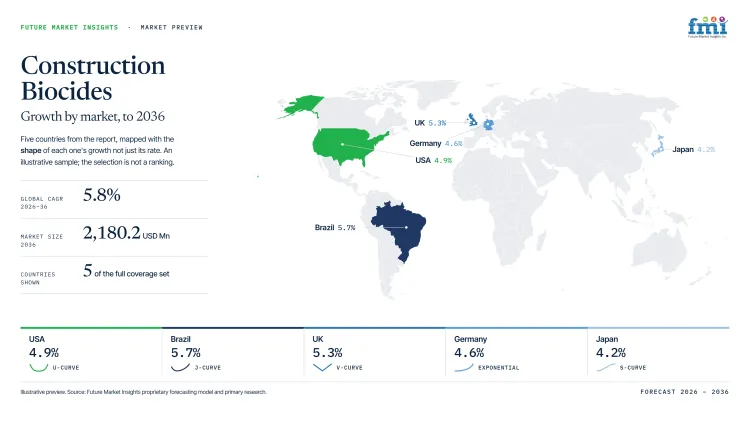
| Country | CAGR |
|---|---|
| United States | 4.9% |
| United Kingdom | 5.3% |
| Germany | 4.6% |
| Brazil | 5.7% |
| Japan | 4.2% |
How do country-level CAGRs compare in the Construction Biocides Market?
The country range spans 1.5 percentage points across two practical growth bands for profiled markets. Forecast rates describe expansion through 2036 and do not measure current market size or near-term revenue contribution.
- Brazil and the United Kingdom form the upper band through wood preservatives registration and active-substance authorization routes.
- Federal labels and state distribution rules moderate United States expansion despite its broad commercial base and laboratory access.
- Germany's reporting obligations increase regulatory service work despite established coatings channels and domestic formulation capacity.
- Japan's plant-level qualification requirements and detailed production reporting support controlled growth through established domestic coatings networks.
- The spacing reflects different approval workloads and service networks instead of a uniform construction cycle.
Comparable CAGRs can produce different market entry conditions. The full report provides country-level CAGR analysis across North America, Latin America, Europe, East Asia, South Asia and Pacific, and the Middle East and Africa.
Country-wise Analysis
- Federal pesticide labels connect antimicrobial actives with approved building uses and worker-protection measures across coatings, sealants and treated materials sold through national construction channels. EPA reported in January 2025 that interim decisions reduced application rates for paint preservatives and several caulks or sealants and added closed-loading and protective-equipment requirements. The United States' construction biocides outlook is anticipated to advance at 4.9% CAGR over the assessment period, supported by national distribution and experienced testing laboratories. Revised application rates and state distribution rules can require extra exposure studies and territory-specific labels across commercial product families serving large contractor and building-maintenance accounts.
- Great Britain maintains a separate approval route for active-substance and product-type combinations used across paints and treated building materials sold through regional distributors. The Health and Safety Executive reported in May 2026 that amendments affected up to 173 combinations and 105 timely applications qualified for postponed expiries. In the United Kingdom, construction biocide demand is predicted to advance at 5.3% CAGR through 2036, shaped by established coatings channels and specialist technical service. Separate Great Britain and Northern Ireland requirements complicate inventory planning and label maintenance for imported formulations across annual distributor contracts and multi-country product families in regional sales.
- Germany requires manufacturers and importers to report annual quantities for every biocidal product placed on the national market through a centralized reporting process that supports enforcement and market transparency. BAuA stated in February 2025 that the obligation covered all products manufactured or imported during 2024 and every contained active substance. Construction biocide demand in Germany is forecast to rise at 4.6% CAGR over the forecast period, supported by an established coatings base and specialist distribution. Authorization files and annual quantity submissions raise regulatory service costs and extend laboratory testing cycles for smaller formulators serving regional construction accounts nationwide.
- Brazil requires registration for wood preservatives and their active ingredients used in construction timber and maintenance products entering domestic distribution channels through specialist laboratories and licensed commercial routes. IBAMA stated in February 2026 that the service covers domestic and imported products with an estimated completion period of up to ninety calendar days. By 2036, Brazil is projected to grow at 5.7% CAGR, reinforced by humid building conditions and regional chemical distribution. Import logistics and limited testing capacity can extend qualification beyond major industrial centers and lengthen service routes for widely dispersed construction projects across national contractor networks nationwide.
- Japan combines plant-specific formulation qualification with detailed production reporting across domestic coatings plants serving residential and commercial construction programs through established technical-service channels and controlled trial protocols. The Japan Paint Manufacturers Association recorded 397,524 tonnes of water-based paint production for 2025 in its July 2026 annual data revision. Japan is estimated to post 4.2% CAGR over the forecast period, influenced by dependable domestic formulation and distribution capability. Separate facility approvals and imported-active documentation can extend validation across specialized product families and multiple production sites during complex national release planning under domestic labels serving several construction coatings categories.
Who are the notable companies in the Construction Biocides Market?
LANXESS, Arxada, THOR, Clariant, Vink Chemicals, SANITIZED, Microban International and BASF are the notable companies shaping this market.
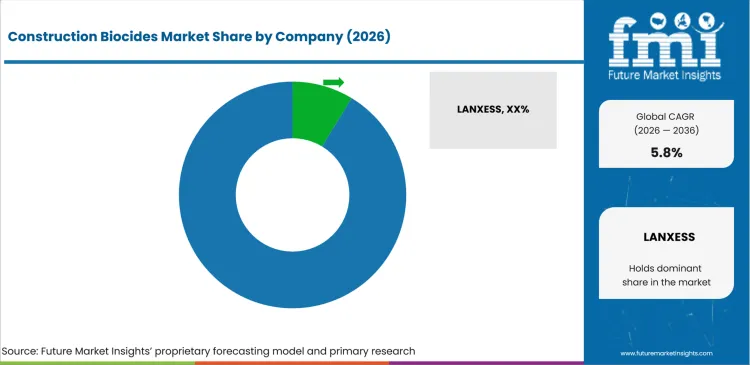
The construction biocides field is moderately concentrated among global preservation platforms and fragmented across regional formulation channels. Competition centers on wet-state depth and dry-film coverage across facade systems and other exposed building applications. Narrow specialists can enter through one qualified use, but wider participation requires multi-region documentation and laboratory support.
- LANXESS, Arxada and THOR combine broad preservation portfolios with international regulatory support across construction applications.
- Clariant and Vink Chemicals focus on preservation for coatings, and BASF supports water-based polymer dispersions through formulation guidance.
- SANITIZED and Microban International support antimicrobial paint systems through application guidance for construction surfaces and programs.
Competitive Benchmarking: Construction Biocides Market
| Company | Preservation Portfolio Breadth | Construction Application Breadth | Technical Support Depth | Geographic Reach |
|---|---|---|---|---|
| LANXESS | High | High | Medium | Global |
| Arxada | High | High | High | Global |
| THOR | High | High | Medium | Global |
| Clariant | Medium | High | Medium | Global |
| Vink Chemicals | High | High | High | Europe and selected export markets |
| SANITIZED | Medium | High | Medium | Global |
| Microban International | Medium | Low | Medium | Global |
| BASF | Low | Medium | Medium | Global |
Key Developments in the Construction Biocides Market
- In May 2026, THOR appointed Algol Chemicals to distribute Acticide biocides across Finland and the Baltic states through local support for paint and coating formulators.
- In April 2026, LANXESS introduced Klarix EXIT for water-based paints and related products that need lower residual CIT or MIT following production.
- In September 2025, Microban International partnered with Curie Co to combine organic-acid preservation platforms with Additive GS technology for paints and coatings.
- In May 2025, SANITIZED appointed Prakash Chemicals to distribute preservation technologies for coatings and construction chemicals across western, northern and central India.
Construction Biocides Market - Report Scope
| Coverage field | Report scope |
|---|---|
| Market breakdown | By chemistry, function, application, end use, sales channel and region. |
| Quantitative Units | Revenue in USD million and CAGR in %. |
| Market Definition | The market covers biocidal ingredients and formulated preservation systems sold for microbial control in construction materials and building applications. |
| Regions Covered | North America, Latin America, Europe, East Asia, South Asia and Pacific, and Middle East and Africa. |
| Countries Covered | United States, United Kingdom, Germany, Brazil, Japan, and 20+ countries included in the full report. |
| Key Companies Profiled | LANXESS, Arxada, THOR, Clariant, Vink Chemicals, SANITIZED, Microban International and BASF |
| Forecast Period | 2026 to 2036. |
| Approach | Primary and secondary research with market triangulation. |
Construction Biocides Market - Research Methodology
| Method | Approach |
|---|---|
| Primary Research | FMI analysts gathered input from manufacturers, service providers, technology developers, distributors, end users, procurement teams, and subject-matter experts. Interviews examined purchasing decisions, product or service evaluation, adoption barriers, approval requirements, pricing considerations, and expectations for technical or commercial support. Respondents were also asked what evidence is required before a trial, pilot, or initial order develops into regular purchasing. |
| Desk Research | Desk research covered government statistics, regulatory publications, trade data, industry associations, technical literature, standards, company filings, product information, and official corporate announcements. Sources were reviewed for relevance, publication date, geographic coverage, and consistency with the defined market scope. Claims relating to performance, applications, approvals, capacity, investment, and commercial activity were retained only when supported by credible public evidence. |
| Market Sizing and Forecasting | The market model combined the baseline value with historical performance, segment structure, pricing and volume indicators, adoption levels, company participation, and country-level demand conditions. Forecast assumptions considered economic activity, investment trends, regulatory developments, technology adoption, purchasing cycles, supply availability, and barriers to wider market use. Segment and regional estimates were reconciled before the final market total was calculated. |
| Data Validation | Estimates were checked against multiple independent indicators, including public data, company activity, trade patterns, industry developments, and findings from primary interviews. Validation also tested whether products, services, applications, and company revenues fell within the defined market boundaries. Adjacent categories, unsupported claims, overlapping revenues, and activities without direct market relevance were excluded to reduce double counting and maintain consistency across segments and countries. |
Construction Biocides Market by Segments
Construction Biocides Market segmented by chemistry:
- Isothiazolinones
- Carbamates
- Triazines
- Quaternary ammonium compounds
- IPBC
- Silver / mineral biocides
Construction Biocides Market segmented by function:
- In-can preservation
- Dry-film preservation
- Algae / fungi control
- Mold inhibition
- Antibacterial surface protection
Construction Biocides Market segmented by application:
- Paints and coatings
- Adhesives and sealants
- Concrete admixtures
- Wood protection
- Roof or facade treatments
Construction Biocides Market segmented by end use:
- Residential construction
- Commercial construction
- Infrastructure
- Construction chemicals
- Building maintenance
Construction Biocides Market segmented by sales channel:
- Direct chemical supply
- Formulator supply
- Chemical distributors
Construction Biocides Market by Region:
- North America
- United States
- Canada
- Latin America
- Brazil
- Mexico
- Argentina
- Chile
- Western Europe
- Germany
- France
- United Kingdom
- Italy
- Spain
- Benelux
- Nordics
- Eastern Europe
- Poland
- Czech Republic
- Romania
- Hungary
- East Asia
- China
- Japan
- South Korea
- South Asia and Pacific
- India
- ASEAN
- Australia and New Zealand
- Middle East and Africa
- GCC Countries
- South Africa
- Türkiye
- Israel
Research Sources and Bibliography
- USA Environmental Protection Agency. (2026, June 10). Pesticide Registration Manual: Chapter 4 - Additional Considerations for Antimicrobial Products
- USA Environmental Protection Agency. (2025, January 8). EPA Announces Interim Decisions on Chlorothalonil, Thiophanate-methyl, and Carbendazim
- USA Environmental Protection Agency. (2025, April 18). EPA Launches Updated Pesticide Registration Tracking App for Companies
- Bundesanstalt für Arbeitsschutz und Arbeitsmedizin. (2025, February 20). Mengenmitteilung gemäß §16 ChemBiozidDV für das Jahr 2024
- Japan Paint Manufacturers Association. (2026, July 3). 2025年(1~12月合計)塗料生産・出荷・在庫数量及び平均単価表(確報値から年報値へ修正)
- Health and Safety Executive. (2026, May). Announcements of GB expiry date postponements
- Instituto Brasileiro do Meio Ambiente e dos Recursos Naturais Renováveis. (2026, February 9). Solicitar o registro de produtos preservativos de madeiras
- Vink Chemicals. (2025, October 23). Reliable preservation of wood preservative solutions with Vinkocide® CMIO
- Clariant. (2026, March 4). Nipacide CI 15R
- Vink Chemicals. (2025, February 20). Vink Chemicals at the ECS 2025 - Solutions from Vink Chemicals for the protection of paints and coatings
- European Chemicals Agency. (2026, July 21). Information on biocides
- THOR. (2026, May 1). Algol Chemicals To Distribute THOR Solutions in Finland and Baltic Region
- SANITIZED AG. (2025, May 6). Welcome to our new distributor: Prakash Chemicals Private Limited
- Arxada. (2026, April 20). Arxada to exhibit at ACS 2026, unveiling new innovations for the paints & coatings industry
- LANXESS. (2026, April 22). LANXESS to showcase its biocidal and oxidation portfolio for the first time at CHEMUK
- Microban International. (2025, September 15). Microban and Curie Co Partner to enhance cleaning, paints, and coatings solutions
- BASF SE. (2025, May 26). Technical Information: Preservation of Polymer Dispersions
- Clariant. (2026, February 6). Nipacide GRTp
This bibliography is provided for reader reference and is not exhaustive. The full report contains the complete reference list and detailed citations
This Report Answers
- How large is the construction biocides market in 2026 and 2036?
- Which chemistry captures the largest construction biocide share during 2026?
- Why does in-can preservation remain central to construction formulation decisions?
- How do paints and coatings shape construction biocide application demand?
- Which regulations influence reformulation and occupational exposure controls for construction biocides?
- How do country growth rates differ across profiled construction biocide markets?
- Which companies compete through preservation breadth and construction application support?
- Which recent developments changed construction biocide distribution and formulation options?
Frequently Asked Questions
How big is the Construction Biocides Market in 2026?
The construction biocides market is valued at USD 1240.6 million in 2026 and is forecast to reach USD 2180.2 million by 2036. Growth is supported by recurring reformulation requirements across water-based paints and coatings that sustain preservation demand as registration rules and labeled use conditions determine which actives reach construction materials worldwide.
What is the CAGR of the Construction Biocides Market from 2026 to 2036?
The construction biocides market grows at a CAGR of 5.8% between 2026 and 2036, supported by authorization systems that link antimicrobial actives to approved construction uses and required efficacy documentation across paints, adhesives, sealants and treated building materials as formulators expand qualified preservation portfolios through regulated commercial channels.
Which chemistry leads the Construction Biocides Market?
Isothiazolinones account for 31.0% of the construction biocides market by chemistry in 2026, driven by effective low-dose microbial control across water-based formulations that allows qualification laboratories to confirm challenge testing results and reduce formula changes during commercial scale-up across related paint and coatings product families.
How much will the Construction Biocides Market add between 2026 and 2036?
The construction biocides market is set to add USD 939.6 million between 2026 and 2036, growing from USD 1240.6 million to USD 2180.2 million as biocidal ingredients and formulated preservation systems enter authorized construction applications across residential, commercial, and infrastructure end-use channels through direct supply and distributor networks globally.
Who are the leading companies in the Construction Biocides Market?
Eight companies shape the construction biocides market, including LANXESS, Arxada, THOR, Clariant, Vink Chemicals, SANITIZED, Microban International, and BASF, competing through preservation portfolio breadth, construction application coverage, technical and regulatory support depth, and geographic reach across wet-state and dry-film protection channels worldwide.
Preview the report firsthand - request a free sample
Get SampleGet the brochure for pricing and purchase details.
Get PDFTable of Content
- Key Takeaways
- Market Size and CAGR
- Top Growth Driver
- Fastest Growing Segment
- Leading Region
- Key Companies
- Emerging Opportunities
- Executive Summary
- Global Market Outlook
- Demand-side Trends
- Supply-side Trends
- Technology Roadmap Analysis
- Analysis and Recommendations
- Analyst Perspective (What is happening? Why now? What should investors know?)
- Key Questions Answered
- How large is the market?
- What is the CAGR?
- What are key trends?
- Which region dominates?
- Who are the leaders?
- Market Overview
- Market Coverage / Taxonomy
- Market Definition / Scope / Limitations
- Research Methodology
- Chapter Orientation
- Analytical Lens and Working Hypotheses
- Market Structure, Signals, and Trend Drivers
- Benchmarking and Cross-market Comparability
- Market Sizing, Forecasting, and Opportunity Mapping
- Research Design and Evidence Framework
- Desk Research Programme (Secondary Evidence)
- Expert Input and Fieldwork (Primary Evidence)
- Tooling, Models, and Reference Databases
- Data Engineering and Model Build
- Quality Assurance and Audit Trail
- Market Background
- Market Dynamics (Drivers, Restraints, Opportunity, Trends)
- Scenario Forecast (Optimistic, Likely, Conservative)
- Impact Analysis
- AI Impact
- Sustainability Impact
- Regulatory Impact
- Technology Impact
- Consumer / Buyer Analysis
- Purchase Drivers
- Adoption Barriers
- Buyer Journey
- Opportunity Map Analysis
- Product Life Cycle Analysis
- Supply Chain Analysis
- Investment Feasibility Matrix
- Value Chain Analysis
- PESTLE and Porter's Analysis
- Regulatory Landscape
- Regional Parent Market Outlook
- Production and Consumption Statistics
- Import and Export Statistics
- Global Market Analysis and Forecast, 2021 to 2036
- Historical Market Size Value (USD Million) Analysis, 2021 to 2025
- Current and Future Market Size Value (USD Million) Projections, 2026 to 2036
- Y-o-Y Growth Trend Analysis
- Absolute $ Opportunity Analysis
- Global Market Pricing Analysis, 2021 to 2036
- Global Market Analysis and Forecast, By Chemistry, 2021 to 2036
- Introduction / Key Findings
- Historical Market Size Value (USD Million) Analysis By Chemistry, 2021 to 2025
- Current and Future Market Size Value (USD Million) Analysis and Forecast By Chemistry, 2026 to 2036
- Isothiazolinones
- Carbamates
- Triazines
- Quaternary Ammonium Compounds
- IPBC
- Silver / Mineral Biocides
- Isothiazolinones
- Y-o-Y Growth Trend Analysis By Chemistry, 2021 to 2025
- Absolute $ Opportunity Analysis By Chemistry, 2026 to 2036
- Global Market Analysis and Forecast, By Function, 2021 to 2036
- Introduction / Key Findings
- Historical Market Size Value (USD Million) Analysis By Function, 2021 to 2025
- Current and Future Market Size Value (USD Million) Analysis and Forecast By Function, 2026 to 2036
- In-can Preservation
- Dry-film Preservation
- Algae / Fungi Control
- Mold Inhibition
- Anti-bacterial Surface Protection
- In-can Preservation
- Y-o-Y Growth Trend Analysis By Function, 2021 to 2025
- Absolute $ Opportunity Analysis By Function, 2026 to 2036
- Global Market Analysis and Forecast, By Application, 2021 to 2036
- Introduction / Key Findings
- Historical Market Size Value (USD Million) Analysis By Application, 2021 to 2025
- Current and Future Market Size Value (USD Million) Analysis and Forecast By Application, 2026 to 2036
- Paints & Coatings
- Adhesives & Sealants
- Concrete Admixtures
- Wood Protection
- Roof / Facade Treatments
- Paints & Coatings
- Y-o-Y Growth Trend Analysis By Application, 2021 to 2025
- Absolute $ Opportunity Analysis By Application, 2026 to 2036
- Global Market Analysis and Forecast, By End Use, 2021 to 2036
- Introduction / Key Findings
- Historical Market Size Value (USD Million) Analysis By End Use, 2021 to 2025
- Current and Future Market Size Value (USD Million) Analysis and Forecast By End Use, 2026 to 2036
- Residential Construction
- Commercial Construction
- Infrastructure
- Construction Chemicals
- Building Maintenance
- Residential Construction
- Y-o-Y Growth Trend Analysis By End Use, 2021 to 2025
- Absolute $ Opportunity Analysis By End Use, 2026 to 2036
- Global Market Analysis and Forecast, By Sales Channel, 2021 to 2036
- Introduction / Key Findings
- Historical Market Size Value (USD Million) Analysis By Sales Channel, 2021 to 2025
- Current and Future Market Size Value (USD Million) Analysis and Forecast By Sales Channel, 2026 to 2036
- Direct Chemical Supply
- Formulator Supply
- Chemical Distributors
- Direct Chemical Supply
- Y-o-Y Growth Trend Analysis By Sales Channel, 2021 to 2025
- Absolute $ Opportunity Analysis By Sales Channel, 2026 to 2036
- Global Market Analysis and Forecast, By Region, 2021 to 2036
- Introduction
- Historical Market Size Value (USD Million) Analysis By Region, 2021 to 2025
- Current Market Size Value (USD Million) Analysis and Forecast By Region, 2026 to 2036
- North America
- Latin America
- Western Europe
- Eastern Europe
- East Asia
- South Asia and Pacific
- Middle East & Africa
- Market Attractiveness Analysis By Region
- North America Market Analysis and Forecast, By Country, 2021 to 2036
- Historical Market Size Value (USD Million) Trend Analysis By Market Taxonomy, 2021 to 2025
- Market Size Value (USD Million) Forecast By Market Taxonomy, 2026 to 2036
- By Country
- USA
- Canada
- By Chemistry
- By Function
- By Application
- By End Use
- By Sales Channel
- By Country
- Market Attractiveness Analysis
- By Country
- By Chemistry
- By Function
- By Application
- By End Use
- By Sales Channel
- Key Takeaways
- Latin America Market Analysis and Forecast, By Country
- Historical Market Size Value (USD Million) Trend Analysis By Market Taxonomy, 2021 to 2025
- Market Size Value (USD Million) Forecast By Market Taxonomy, 2026 to 2036
- By Country
- Brazil
- Mexico
- Chile
- Rest of Latin America
- By Chemistry
- By Function
- By Application
- By End Use
- By Sales Channel
- By Country
- Market Attractiveness Analysis
- By Country
- By Chemistry
- By Function
- By Application
- By End Use
- By Sales Channel
- Key Takeaways
- Western Europe Market Analysis and Forecast, By Country
- Historical Market Size Value (USD Million) Trend Analysis By Market Taxonomy, 2021 to 2025
- Market Size Value (USD Million) Forecast By Market Taxonomy, 2026 to 2036
- By Country
- Germany
- UK
- Italy
- Spain
- France
- Nordic
- BENELUX
- Rest of Western Europe
- By Chemistry
- By Function
- By Application
- By End Use
- By Sales Channel
- By Country
- Market Attractiveness Analysis
- By Country
- By Chemistry
- By Function
- By Application
- By End Use
- By Sales Channel
- Key Takeaways
- Eastern Europe Market Analysis and Forecast, By Country
- Historical Market Size Value (USD Million) Trend Analysis By Market Taxonomy, 2021 to 2025
- Market Size Value (USD Million) Forecast By Market Taxonomy, 2026 to 2036
- By Country
- Russia
- Poland
- Hungary
- Balkan & Baltic
- Rest of Eastern Europe
- By Chemistry
- By Function
- By Application
- By End Use
- By Sales Channel
- By Country
- Market Attractiveness Analysis
- By Country
- By Chemistry
- By Function
- By Application
- By End Use
- By Sales Channel
- Key Takeaways
- East Asia Market Analysis and Forecast, By Country
- Historical Market Size Value (USD Million) Trend Analysis By Market Taxonomy, 2021 to 2025
- Market Size Value (USD Million) Forecast By Market Taxonomy, 2026 to 2036
- By Country
- China
- Japan
- South Korea
- By Chemistry
- By Function
- By Application
- By End Use
- By Sales Channel
- By Country
- Market Attractiveness Analysis
- By Country
- By Chemistry
- By Function
- By Application
- By End Use
- By Sales Channel
- Key Takeaways
- South Asia and Pacific Market Analysis and Forecast, By Country
- Historical Market Size Value (USD Million) Trend Analysis By Market Taxonomy, 2021 to 2025
- Market Size Value (USD Million) Forecast By Market Taxonomy, 2026 to 2036
- By Country
- India
- ASEAN
- Australia & New Zealand
- Rest of South Asia and Pacific
- By Chemistry
- By Function
- By Application
- By End Use
- By Sales Channel
- By Country
- Market Attractiveness Analysis
- By Country
- By Chemistry
- By Function
- By Application
- By End Use
- By Sales Channel
- Key Takeaways
- Middle East & Africa Market Analysis and Forecast, By Country
- Historical Market Size Value (USD Million) Trend Analysis By Market Taxonomy, 2021 to 2025
- Market Size Value (USD Million) Forecast By Market Taxonomy, 2026 to 2036
- By Country
- Kingdom of Saudi Arabia
- Other GCC Countries
- Türkiye
- South Africa
- Other African Union
- Rest of Middle East & Africa
- By Chemistry
- By Function
- By Application
- By End Use
- By Sales Channel
- By Country
- Market Attractiveness Analysis
- By Country
- By Chemistry
- By Function
- By Application
- By End Use
- By Sales Channel
- Key Takeaways
- Key Countries Market Analysis
- USA
- Pricing Analysis
- Market Share Analysis, 2025
- By Chemistry
- By Function
- By Application
- By End Use
- By Sales Channel
- Canada
- Pricing Analysis
- Market Share Analysis, 2025
- By Chemistry
- By Function
- By Application
- By End Use
- By Sales Channel
- Mexico
- Pricing Analysis
- Market Share Analysis, 2025
- By Chemistry
- By Function
- By Application
- By End Use
- By Sales Channel
- Brazil
- Pricing Analysis
- Market Share Analysis, 2025
- By Chemistry
- By Function
- By Application
- By End Use
- By Sales Channel
- Chile
- Pricing Analysis
- Market Share Analysis, 2025
- By Chemistry
- By Function
- By Application
- By End Use
- By Sales Channel
- Germany
- Pricing Analysis
- Market Share Analysis, 2025
- By Chemistry
- By Function
- By Application
- By End Use
- By Sales Channel
- UK
- Pricing Analysis
- Market Share Analysis, 2025
- By Chemistry
- By Function
- By Application
- By End Use
- By Sales Channel
- Italy
- Pricing Analysis
- Market Share Analysis, 2025
- By Chemistry
- By Function
- By Application
- By End Use
- By Sales Channel
- Spain
- Pricing Analysis
- Market Share Analysis, 2025
- By Chemistry
- By Function
- By Application
- By End Use
- By Sales Channel
- France
- Pricing Analysis
- Market Share Analysis, 2025
- By Chemistry
- By Function
- By Application
- By End Use
- By Sales Channel
- India
- Pricing Analysis
- Market Share Analysis, 2025
- By Chemistry
- By Function
- By Application
- By End Use
- By Sales Channel
- ASEAN
- Pricing Analysis
- Market Share Analysis, 2025
- By Chemistry
- By Function
- By Application
- By End Use
- By Sales Channel
- Australia & New Zealand
- Pricing Analysis
- Market Share Analysis, 2025
- By Chemistry
- By Function
- By Application
- By End Use
- By Sales Channel
- China
- Pricing Analysis
- Market Share Analysis, 2025
- By Chemistry
- By Function
- By Application
- By End Use
- By Sales Channel
- Japan
- Pricing Analysis
- Market Share Analysis, 2025
- By Chemistry
- By Function
- By Application
- By End Use
- By Sales Channel
- South Korea
- Pricing Analysis
- Market Share Analysis, 2025
- By Chemistry
- By Function
- By Application
- By End Use
- By Sales Channel
- Russia
- Pricing Analysis
- Market Share Analysis, 2025
- By Chemistry
- By Function
- By Application
- By End Use
- By Sales Channel
- Poland
- Pricing Analysis
- Market Share Analysis, 2025
- By Chemistry
- By Function
- By Application
- By End Use
- By Sales Channel
- Hungary
- Pricing Analysis
- Market Share Analysis, 2025
- By Chemistry
- By Function
- By Application
- By End Use
- By Sales Channel
- Kingdom of Saudi Arabia
- Pricing Analysis
- Market Share Analysis, 2025
- By Chemistry
- By Function
- By Application
- By End Use
- By Sales Channel
- Türkiye
- Pricing Analysis
- Market Share Analysis, 2025
- By Chemistry
- By Function
- By Application
- By End Use
- By Sales Channel
- South Africa
- Pricing Analysis
- Market Share Analysis, 2025
- By Chemistry
- By Function
- By Application
- By End Use
- By Sales Channel
- USA
- Market Structure Analysis
- Competition Dashboard
- Competition Benchmarking
- Market Share Analysis of Top Players
- By Regional
- By Chemistry
- By Function
- By Application
- By End Use
- By Sales Channel
- Emerging Startups
- Innovation Benchmarking
- Competition Analysis
- Competition Deep Dive
- LANXESS
- Overview
- Product Portfolio
- Profitability by Market Segments
- Sales Footprint
- Strategy Overview
- Marketing Strategy
- Product Strategy
- Channel Strategy
- Arxada
- Troy Corporation
- Thor Group
- Dow
- BASF
- Clariant
- Vink Chemicals
- Lonza
- Kop-Coat
- LANXESS
- Case Studies
- Success Stories
- Recent Developments
- Competition Deep Dive
- Assumptions & Acronyms Used


