

- Market Size (2026)
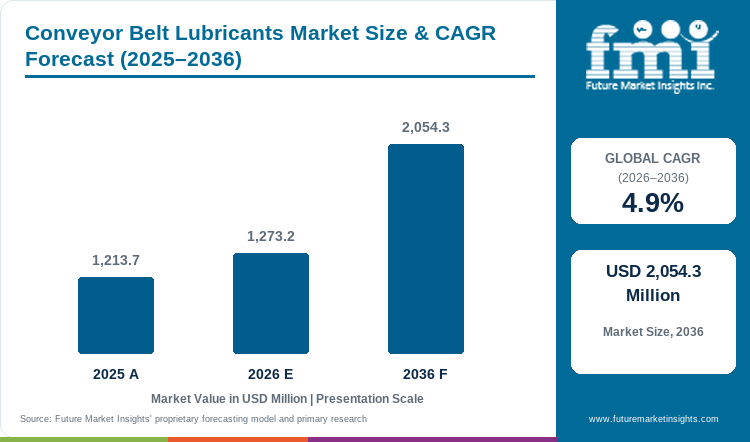
- USD 1273.2 Mn
- Forecast (2036)
- USD 2054.3 Mn
- CAGR (2026 to 2036)
- 4.9%
How big is Conveyor Belt Lubricants Market in 2026?
USD 1,273.2 million in 2026 and USD 2,054.3 million by 2036, expanding at 4.9% CAGR.
Sales of conveyor belt lubricants are estimated to rise at 4.9% CAGR through 2036, increasing valuation from USD 1,213.7 million in 2025 to USD 1,273.2 million in 2026, and reaching USD 2,054.3 million by 2036. Plants are using lubrication to keep product flow steady and reduce cleaning work. EHEDG updated its food-grade lubricant guide in May 2026 for plant and maintenance teams. The guide links clear lubricant records to food processing equipment used near food or packaging.
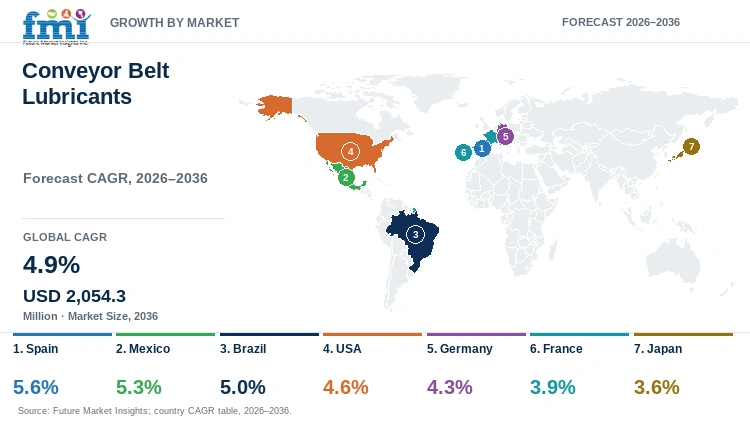
Spain is projected to grow at 5.6% CAGR through 2036 compared with 3.6% for Japan. Spain reported more than 27,000 food industries in March 2026 and more than 440 PERTE Agroalimentario plant-upgrade projects. Those projects add automated conveyor systems that need steady dosing and clear line records. Japanese food plants take more time to test a new formula before changing a stable process.
Key Takeaways
- Food and beverage plants use controlled lubrication to cut friction while limiting water use and cleaning work.
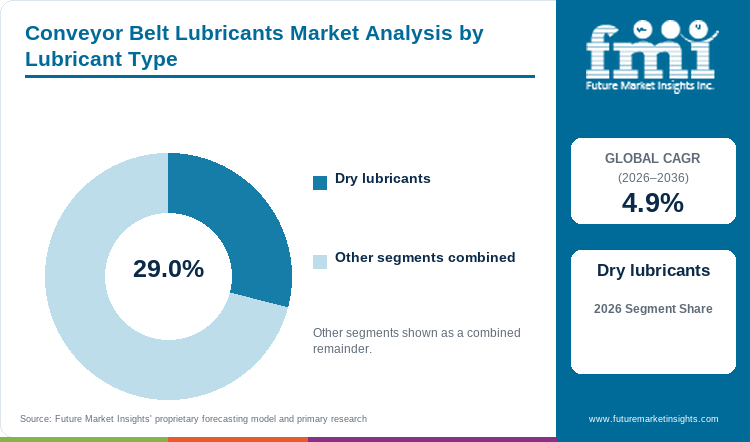
- Based on lubricant type, dry lubricants are projected to account for 29.0% in 2026, supported by lower-water use on suitable lines.
- In 2026, plastic modular belts are expected to lead conveyor type with 31.0% share, influenced by washdown needs and plastic-safe lubricant use.
- By end use, food and beverage is forecast to represent 37.0% in 2026, attributable to long run times and strict hygiene controls.
- Plant trials slow switching because belt fit and package movement must pass the same approval checks as dose control and food-contact records.
- Some of the key players in this market include Ecolab, Klüber Lubrication, FUCHS SE, Interflon, SKF, Diversey, Chem-Trend, Lubriplate Lubricants Co., CRC Industries, and MOLYKOTE / DuPont.
Analyst Perspective
"Plant teams approve a lubricant when it keeps friction stable at the belt and package contact point. Plants value lower water use if cleaning records and line reliability stay strong."
- Nikhil Kaitwade, Principal Consultant, Future Market Insights
How is the conveyor belt lubricants market segmented?
The conveyor belt lubricants market is segmented by Lubricant Type, Conveyor Type, End Use, Form, Sales Channel, and Region.
The market uses six main segments: lubricant type, conveyor type, end use, form, sales channel and region. Lubricant type covers dry, wet, silicone-based, synthetic chain and food-grade products. Conveyor type covers plastic modular belts, metal chains and roller conveyors. It also covers bottle/can lines and food processing belts. End use covers food and beverage, packaging and warehousing. It also covers automotive assembly and pharmaceutical plants.
What makes dry lubricants central to the lubricant type category?
Dry lubricants use little or no water to carry lubricant on suitable bottling lines. In March 2026 Ecolab published a DryExx conveyor case with engineered control and lower line water use. Plants test bottle stability and conveyor fit before approving a switch. The case for dry film lubricants is stronger on lines that save water without adding cleaning work.
- By lubricant type, dry lubricants are estimated to hold 29.0% in 2026, supported by lower-water use on suitable lines.
- In March 2026 Ecolab linked dry conveyor lubrication with controlled dosing and lower line water use.
How do plastic modular belts influence selection within the conveyor type category?
Plastic modular belts need frequent washdown on food and beverage lines. Lubricants must cut friction without harming plastic belt parts or trapping dirt. Current eCFR rules cover lubricants that may touch food by accident under 21 CFR 178.3570. Plant teams review those rules during lubricant approval. They test beverage processing equipment for belt fit and food-contact controls before wider use.
- Within conveyor type, plastic modular belts are anticipated to take 31.0% share in 2026, influenced by washdown needs and plastic-safe lubrication.
- Food plants check lubricant records and belt fit before they use a tested formula on more conveyor lines.
How does food and beverage shape the end use category?
Food and beverage lines use conveyor lubricant close to exposed food and primary packaging. In April 2026 Lubriplate received H1 and HT1 registration plus ISO 21469 certification for HTO. The record lowers approval risk for plant teams. They still test food grade lubricants for residue and washdown results on the actual line.
- Food and beverage is expected to represent 37.0% of end-use demand in 2026, driven by long run times and food-contact controls.
- Certification lowers approval risk, but plants still test residue and washdown results on the conveyor they run.
What supports liquid concentrate leadership within the form category?
Liquid concentrates suit long conveyor runs that use central dilution equipment. Operators can change the mix for line speed and water conditions without storing large ready-to-use volumes. In February 2026 Klüber Lubrication received NSF H1 registration for Klüberfood NH1 94-52 TSG. The record gives plant teams a clear product identity. It supports lubrication systems that need steady dose control.
- For form, liquid concentrate is predicted to reach 38.0% share in 2026, linked to central use and adjustable dosing on busy lines.
- Poor dilution control can raise foam and cleaning work enough to weaken the cost case for concentrates.
What drives lubricant suppliers within the sales channel category?
Lubricant suppliers guide product choice and plant trials during a conveyor change. They match lubricant thickness and food-contact status with heat needs before a test starts. In February 2026 FUCHS LUBRICANTES received H1 and ISO 21469 certification for RENOFORM CMO 3004. The records give plant teams another approval check. They give industrial lubricants a clearer route than product supply alone.
- Lubricant suppliers are projected to hold 39.0% of sales channel revenue in 2026, supported by product advice and plant trial support.
- Industrial distributors keep repeat supply available, while direct contracts suit multi-site groups that use one approved lubricant.
What are the drivers, restraints and opportunities in the Conveyor Belt Lubricants Market?
Plants are reducing friction and water use, qualification risk slows switching, and precision dosing gives suppliers a service-led revenue route.
- Driver: Plant teams compare lubricant cost with line uptime and water use while checking residue and cleaning work.
- Restraint: A product switch can fail if the lubricant harms belt fit or package movement and makes cleaning harder.
- Opportunity: Metered dosing links lubricant use with line data and service checks so teams can keep each dose steady.
Stable lines and lower water use support repeat demand
Plant managers balance friction control with water use and cleaning needs on busy conveyor lines. Too little lubricant raises wear and can stop production, while too much leaves residue and adds cleaning work. EHEDG updated its H1 and HT1 lubricant guide in May 2026 for food production and maintenance staff. The guide ties lubricant choice to clear plant records near food areas. Packaging plants treat packaging machinery and conveyors as one line because poor belt movement can stop nearby equipment. Plant teams check floor slip risk and make sure water savings do not weaken package control. Suppliers win repeat orders by showing steady product movement and lower cleaning work with results the plant can verify.
Product approval can slow an otherwise useful change
Conveyor lubrication works inside a larger line system, so results change with belt material and package surface. Cleaner chemistry and water hardness can move the same formula outside its useful friction range. Current eCFR rules allow incidental-contact lubricants on food machinery under the conditions in 21 CFR 178.3570. Plant teams check formula details and food-contact status before widening a trial. Daily washdown tests reveal foam or film transfer and show whether the lubricant stays stable with normal cleaners. A lower price cannot offset bottle instability or residue that adds cleaning work. Plants may test more than one line speed before approving wider use. Approval can take longer because a failure adds maintenance work and can disrupt production schedules.
Precise dosing gives suppliers a clear service role
Precise dosing sends lubricant to the points that need it and can cut overspray. Ecolab published a 2026 winery case using DryExx GF on a bottling conveyor with lower water use and cleaner floors. Controlled application produced the gain without adding more lubricant. Plants compare dose records with packaging equipment results and cleaning work. Service teams fix blocked points or excess flow before friction changes, and maintenance teams check dosing systems during daily work. Clear records help teams repeat the same service across shifts and sites and guide later line changes. Suppliers gain a stronger service role when dose settings and maintenance checks stay consistent across normal production shifts and site changes.
Which country CAGRs are profiled in the Conveyor Belt Lubricants Market?
| Country | CAGR |
|---|---|
| Spain | 5.6% |
| Mexico | 5.3% |
| Brazil | 5.0% |
| USA | 4.6% |
| Germany | 4.3% |
| France | 3.9% |
| Japan | 3.6% |
How do country-level CAGRs compare in the Conveyor Belt Lubricants Market?
Spain and Mexico form the upper forecast band, with Brazil close behind. USA and Germany make up the middle range because mature plants use longer product tests. France and Japan grow at slower rates because plant approval takes more time. The 2.0-point range compares forecast speed and does not show current market size.
- Spain combines a large food base with public plant-upgrade funds that support more automated line control.
- Mexico needs fast field support because food and beverage plants face changing water conditions over long service distances.
- Brazil tracks industrial water use at national level, making water cost part of plant operating decisions.
- US multi-site standards reward repeatable trials and fast service once a lubricant wins approval for wider use.
- German food plants favor clear engineering records and keep proven operating standards until a new lubricant passes careful tests.
- French water policy gives lower-water lubrication a stronger case during factory upgrades and water-saving reviews.
- Japanese plants invest in productivity while strict operating rules keep lubricant changes tied to careful line testing.
Similar CAGRs can still lead to different buying conditions. Line age, water cost, service access and approval rules vary by country. The full report provides country-level CAGR analysis for North America, Latin America, Western Europe and Eastern Europe. It also covers East Asia, South Asia and Pacific, and the Middle East and Africa.
Country-wise Analysis
- Spain has more than 27,000 food industries, and public programs are funding plant upgrades. Spain is projected to record 5.6% CAGR through 2036, supported by automation that needs steady line control. La Moncloa reported in March 2026 that PERTE Agroalimentario had backed more than 440 upgrade projects. New equipment gives plants a good time to review lubricant dose and conveyor settings. Regional processors need simple systems that do not add maintenance work. Startup teams need local help during a change. Suppliers can pair lubricant trials with converting automation so startup data can guide later plant standards. Clear settings can make the same process easier to repeat at more sites.
- Mexico's beverage and packaged-food plants face changing water conditions and long service distances. Conveyor belt lubricant demand in Mexico is forecast to rise at 5.3% CAGR through 2036, influenced by careful water use. Plants test local water hardness before setting dilution and dose levels. CONAGUA reported in February 2026 that 7.4% of national territory faced moderate-to-exceptional drought on January 15. The same formula may need different settings at another site, and long routes make delayed service more costly during a switch. Fast field support can move trials to more plants. Suppliers can cut dosing errors by giving teams clear settings and quick support after startup.
- Brazilian plants treat water use as a direct cost because national rules track industrial withdrawals. Brazil is estimated to post 5.0% CAGR over the forecast period, shaped by food output and tighter water control. ANA reported in August 2026 that industry made up 9.9% of water taken for use in 2024. Food and beverage plants can compare wet lubrication with lower-water options during line reviews. Complex dosing systems need trained service staff nearby. Service coverage is thinner outside major industrial centers. Suppliers can train distributors to keep dose settings stable after startup and turn successful trials into repeat use at more plants.
- US processors use one approved maintenance formula at several plants after a controlled trial. Conveyor belt lubricant demand in the USA is predicted to advance at 4.6% CAGR through 2036, reinforced by a large food-processing base. One approved formula can then move to many sites. USDA Economic Research Service reported 42,708 food and beverage processing establishments in 2022 on a page updated in January 2025. Large plant networks need the same records and service level at each location. Corporate approval raises the need for trial data that plant teams can repeat without changing work steps from site to site. A common test plan can shorten later approvals.
- German food plants put strong weight on equipment fit and careful technical review before changing a production standard. Germany's conveyor belt lubricant outlook is anticipated to advance at 4.3% CAGR over the assessment period, linked to steady food output. Destatis reported in January 2026 that ready-meal production reached 1.7 million tonnes in 2024 and rose 25.6% from 2019. Higher output keeps conveyors running for longer periods each day. Established plants avoid chemistry changes without controlled production tests. Older equipment can extend approval time because teams want to avoid new process changes. Suppliers need clear fit records before regular buying begins. Plant engineers can then compare trial results with existing operating limits.
- French food and beverage plants are reviewing water use as national policy moves into plant action. Conveyor belt lubricant sales in France are forecast to expand at 3.9% CAGR by 2036, supported by lower-water operation. The policy does not require a certain conveyor lubricant, but it makes water savings more important during plant upgrades. The ecological transition ministry reported in April 2026 that all Plan eau measures had started and 77% were in place. Plants still need proof that lower-water use keeps bottles stable and sanitation effective. Suppliers must show both results during site trials. Those checks decide whether a new lubricant becomes the plant standard.
- Japanese food makers combine productivity work with strict hygiene and maintenance rules. Adoption of conveyor belt lubricants in Japan is estimated to expand at 3.6% CAGR through 2036, influenced by tests on established lines. MAFF says Japan supports food makers with robots, AI and IoT to raise output under labor limits. New automation can change conveyor speed and expose new friction points. Plants avoid changes that add needless variation to stable work. Plant operators expect clear records from local trials. Suppliers need local technical support and repeatable tests before maintenance teams accept a new lubricant. Careful trials protect stable production while new equipment changes line conditions.
Who are the notable companies in the Conveyor Belt Lubricants Market?
Ecolab, Klüber Lubrication, FUCHS SE, Interflon, SKF, Diversey, Chem-Trend, Lubriplate Lubricants Co., CRC Industries, and MOLYKOTE / DuPont are active within the defined conveyor lubrication boundary.
Competition includes food-plant service groups, lubricant makers and dosing equipment suppliers. New entrants need a lubricant that works on the conveyor and clear records for plant review. Food-grade certificates support use near production areas. Dosing skill matters because plants want steady flow with less waste. Fast line support can outweigh a small price gap during a plant change.
- Ecolab and Diversey link conveyor lubrication with food-plant hygiene. Their teams also support water control and line service.
- Klüber Lubrication and FUCHS SE compete on food-grade records and chain lubricants. Interflon serves the same need alongside Lubriplate Lubricants Co.
- SKF and Chem-Trend support dosing and automatic lubrication. CRC Industries and MOLYKOTE / DuPont serve wider maintenance channels.
Competitive Benchmarking: Conveyor Belt Lubricants Market
| Company | Conveyor Chemistry Breadth | Food-Grade Chain Coverage | Dosing and Line Integration | Geographic Reach |
|---|---|---|---|---|
| Ecolab | High | High | High | Global food and beverage service network |
| Klüber Lubrication | High | High | Medium | Global |
| FUCHS SE | High | High | Medium | Global |
| Interflon | Medium | High | Medium | International technical-sales network |
| SKF | Medium | Medium | High | Global industrial service network |
| Diversey | High | High | High | Global through Solenis operations |
| Chem-Trend | Medium | Medium | High | Global specialty-chemical network |
| Lubriplate Lubricants Co. | High | High | Low | North America-led with international distribution |
| CRC Industries | Low | Medium | Low | Broad industrial distribution in multiple regions |
| MOLYKOTE / DuPont | High | High | Medium | Global DuPont distribution and technical support |
Scoring basis: High chemistry breadth needs public proof of several conveyor or chain products. Medium covers a smaller range and Low marks narrow coverage. High food-grade coverage needs several formal registrations from accepted bodies. High dosing integration needs proof of metering or automatic lubrication. Medium and Low show less public proof for these skills.
Key Developments in the Conveyor Belt Lubricants Market
- In April 2026, Lubriplate Lubricants Co. received NSF H1 and HT1 registration for HTO. The company also received ISO 21469 certification for food-processing lubrication.
- In February 2026, FUCHS LUBRICANTES S.A.U. received NSF H1 registration for RENOFORM CMO 3004. ISO 21469 certification also covered its food-processing use.
- In February 2026, Klüber Lubrication received NSF H1 registration for Klüberfood NH1 94-52 TSG. The record covers incidental-contact food-processing use.
Key Players in the Conveyor Belt Lubricants Market
Integrated hygiene and conveyor-line service
- Ecolab
- Diversey
Specialty food-grade and high-performance lubricants
- Klüber Lubrication
- FUCHS SE
- Interflon
- Lubriplate Lubricants Co.
Application systems and maintenance channels
- SKF
- Chem-Trend
- CRC Industries
- MOLYKOTE / DuPont
Conveyor Belt Lubricants Market - Report Scope
| Coverage field | Report scope |
|---|---|
| Market breakdown | By lubricant type, conveyor type, end use, form, sales channel and region. |
| Quantitative Units | USD million. |
| Market Definition | Purpose-formulated lubricants sold for conveyor belts and chains are included. Conveyor equipment, stand-alone dosing hardware, separately sold cleaners and general lubricants without a conveyor use are excluded. |
| Regions Covered | North America, Latin America, Western Europe, Eastern Europe, East Asia, South Asia and Pacific, and Middle East and Africa. |
| Countries Covered | Spain, Mexico, Brazil, USA, Germany, France, Japan, and 20+ countries included in the full report. |
| Key Companies Profiled | Ecolab, Klüber Lubrication, FUCHS SE, Interflon, SKF, Diversey, Chem-Trend, Lubriplate Lubricants Co., CRC Industries, MOLYKOTE / DuPont. |
| Forecast Period | 2026 to 2036. |
| Approach | Primary and secondary research with market triangulation. |
Conveyor Belt Lubricants Market - Research Methodology
| Method | Approach |
|---|---|
| Primary Research | FMI analysts gathered input from manufacturers, service providers, technology developers, distributors, end users, procurement teams, and subject-matter experts. Interviews examined purchasing decisions, product or service evaluation, adoption barriers, approval requirements, pricing considerations, and expectations for technical or commercial support. Respondents were also asked what evidence is required before a trial, pilot, or initial order develops into regular purchasing. |
| Desk Research | Desk research covered government statistics, regulatory publications, trade data, industry associations, technical literature, standards, company filings, product information, and official corporate announcements. Sources were reviewed for relevance, publication date, geographic coverage, and consistency with the defined market scope. Claims relating to performance, applications, approvals, capacity, investment, and commercial activity were retained only when supported by credible public evidence. |
| Market Sizing and Forecasting | The market model combined the baseline value with historical performance, segment structure, pricing and volume indicators, adoption levels, company participation, and country-level demand conditions. Forecast assumptions considered economic activity, investment trends, regulatory developments, technology adoption, purchasing cycles, supply availability, and barriers to wider market use. Segment and regional estimates were reconciled before the final market total was calculated. |
| Data Validation | Estimates were checked against multiple independent indicators, including public data, company activity, trade patterns, industry developments, and findings from primary interviews. Validation also tested whether products, services, applications, and company revenues fell within the defined market boundaries. Adjacent categories, unsupported claims, overlapping revenues, and activities without direct market relevance were excluded to reduce double counting and maintain consistency across segments and countries. |
Conveyor Belt Lubricants Market by Segments
Conveyor Belt Lubricants Market segmented by Lubricant Type:
- Dry lubricants
- Wet lubricants
- Silicone-based lubricants
- Synthetic chain lubricants
- Food-grade belt lubricants
Conveyor Belt Lubricants Market segmented by Conveyor Type:
- Plastic modular belts
- Metal chains
- Roller conveyors
- Bottle/can lines
- Food processing belts
Conveyor Belt Lubricants Market segmented by End Use:
- Food and beverage
- Packaging
- Warehousing
- Automotive assembly
- Pharmaceuticals
Conveyor Belt Lubricants Market segmented by Form:
- Liquid concentrate
- Ready-to-use spray
- Dry film
- Automatic dosing fluid
Conveyor Belt Lubricants Market segmented by Sales Channel:
- Lubricant suppliers
- Industrial distributors
- OEM/service providers
- Direct plant contracts
Conveyor Belt Lubricants Market by Region:
- North America
- United States
- Canada
- Latin America
- Brazil
- Mexico
- Chile
- Rest of Latin America
- Western Europe
- Germany
- United Kingdom
- Italy
- Spain
- France
- Nordics
- Benelux
- Rest of Western Europe
- Eastern Europe
- Russia
- Poland
- Hungary
- Balkan and Baltic States
- Rest of Eastern Europe
- East Asia
- China
- Japan
- South Korea
- South Asia and Pacific
- India
- ASEAN
- Australia and New Zealand
- Rest of South Asia and Pacific
- Middle East and Africa
- Kingdom of Saudi Arabia
- Other GCC Countries
- Türkiye
- South Africa
- Other African Union Countries
- Rest of Middle East and Africa
Research Sources and Bibliography
- European Hygienic Engineering & Design Group. (2026, May). Use of H1 & HT1 Registered Lubricants, Part 1.
- U.S. Department of Agriculture Economic Research Service. (2025, January 5). Processing & Marketing - Food and Beverage Manufacturing.
- La Moncloa. (2026, March 9). Planas: España ha pasado de ser importadora neta a potencia exportadora y gastronómica mundial.
- Ecolab. (2026, March 2). Dryexx Conveyor Lubricant, A Long Line of Savings.
- Interflon. (2026, January 27). PFAS-Free NSF H1 Food Grade Lubricants - NSF 537 Certified.
- NSF International. (2026, April 7). Certificate of Conformity: HTO.
- Electronic Code of Federal Regulations. (2026, September 17). 21 CFR 178.3570 - Lubricants with incidental food contact.
- NSF International. (2026, February 18). Certificate of Conformity: RENOFORM CMO 3004.
- NSF International. (2026, February 18). Certificate of Registration: Klüberfood NH1 94-52 TSG.
- Ecolab. (2026). DryExx GF Reduced Water Usage while also improving cleaning, safety & bottle appearance.
- Comisión Nacional del Agua. (2026, February 2). Libres de sequía, más de dos mil municipios en 13 estados de la República Mexicana.
- Agência Nacional de Águas e Saneamento Básico. (2026, August 13). Água e indústria: monitoramento, outorgas e gestão hídrica no Brasil.
- Federal Statistical Office of Germany. (2026, January 14). Produktion von Fertiggerichten binnen fünf Jahren mengenmäßig um 25,6 % gestiegen.
- Ministère de la Transition écologique. (2026, April 9). Plan eau : 3 ans après, 100% des mesures initiées dont 77% mises en oeuvre.
- Ministry of Agriculture, Forestry and Fisheries of Japan. (2026).
- FUCHS SE. (2026, August 12). FUCHS announces grand opening of Americas Technology Center in Massachusetts.
- HACCP International. (2026, March 31). Register of Certified Products by Manufacturer.
- Ecolab. (2026). Annual Savings - DryExx GF brewery case study.
- DuPont. (2026, August 31). DuPont Highlights Vespel High-Performance Materials at CSEAC 2026 to Enable Next-Generation Semiconductor Manufacturing.
This bibliography is provided for reader reference and is not exhaustive. The full report contains the complete reference list and detailed citations
This Report Answers
- How large is the conveyor belt lubricants market in 2026 and 2036?
- What plant needs lead to repeat conveyor lubricant purchases?
- Which lubricant type holds 29.0% of 2026 revenue?
- Which conveyor type holds 31.0% of 2026 demand?
- Why does food and beverage account for 37.0% of end-use demand?
- What approval risks can delay a conveyor lubricant switch?
- How do country growth rates differ in Spain, Mexico, Brazil, USA, Germany, France and Japan?
- Which companies compete on chemistry and food-grade records as well as service and dosing support?
Frequently Asked Questions
How big is the conveyor belt lubricants market in 2026?
The conveyor belt lubricants market is valued at USD 1,273.2 million in 2026. It is projected to reach USD 2,054.3 million by 2036 as plant teams seek friction control without harder cleaning work.
What is the CAGR of the conveyor belt lubricants market from 2026 to 2036?
The conveyor belt lubricants market is projected to grow at 4.9% CAGR between 2026 and 2036. Regular belt use and lower-water systems support the forecast.
Which lubricant type leads the conveyor belt lubricants market in 2026?
The dry lubricants segment is projected to account for 29.0% of lubricant type revenue in the conveyor belt lubricants market in 2026. Suitable bottling lines use less water while keeping package movement stable.
Which conveyor type leads the conveyor belt lubricants market in 2026?
The plastic modular belts segment is expected to represent 31.0% of conveyor type demand in the conveyor belt lubricants market in 2026. Plants need lubricants that control friction without harming plastic belt parts during washdown.
Which end use leads the conveyor belt lubricants market in 2026?
The food and beverage segment is forecast to hold 37.0% of end-use demand in the conveyor belt lubricants market in 2026. Long production runs and strict hygiene checks make lubrication a regular maintenance task.
Which countries are projected to record the highest growth in the conveyor belt lubricants market?
Spain is projected to grow at 5.6% CAGR, followed by Mexico at 5.3% and Brazil at 5.0% through 2036. Each country still needs local water plans and reliable field service for plant trials.
Which companies are active in the conveyor belt lubricants market?
Key companies include Ecolab, Klüber Lubrication, FUCHS SE, Interflon, SKF, Diversey, Chem-Trend, Lubriplate Lubricants Co., CRC Industries, and MOLYKOTE / DuPont. They compete on lubricant chemistry, food-grade records, dosing support and service coverage.
Preview the report firsthand - request a free sample
Get SampleGet the brochure for pricing and purchase details.
Get PDFTable of Content
- Key Takeaways
- Market Size and CAGR
- Top Growth Driver
- Fastest Growing Segment
- Leading Region
- Key Companies
- Emerging Opportunities
- Executive Summary
- Global Market Outlook
- Demand-side Trends
- Supply-side Trends
- Technology Roadmap Analysis
- Analysis and Recommendations
- Analyst Perspective (What is happening? Why now? What should investors know?)
- Key Questions Answered
- How large is the market?
- What is the CAGR?
- What are key trends?
- Which region dominates?
- Who are the leaders?
- Market Overview
- Market Coverage / Taxonomy
- Market Definition / Scope / Limitations
- Research Methodology
- Chapter Orientation
- Analytical Lens and Working Hypotheses
- Market Structure, Signals, and Trend Drivers
- Benchmarking and Cross-market Comparability
- Market Sizing, Forecasting, and Opportunity Mapping
- Research Design and Evidence Framework
- Desk Research Programme (Secondary Evidence)
- Expert Input and Fieldwork (Primary Evidence)
- Tooling, Models, and Reference Databases
- Data Engineering and Model Build
- Quality Assurance and Audit Trail
- Market Background
- Market Dynamics (Drivers, Restraints, Opportunity, Trends)
- Scenario Forecast (Optimistic, Likely, Conservative)
- Impact Analysis
- AI Impact
- Sustainability Impact
- Regulatory Impact
- Technology Impact
- Consumer / Buyer Analysis
- Purchase Drivers
- Adoption Barriers
- Buyer Journey
- Opportunity Map Analysis
- Product Life Cycle Analysis
- Supply Chain Analysis
- Investment Feasibility Matrix
- Value Chain Analysis
- PESTLE and Porter's Analysis
- Regulatory Landscape
- Regional Parent Market Outlook
- Production and Consumption Statistics
- Import and Export Statistics
- Global Market Analysis and Forecast, 2021 to 2036
- Historical Market Size Value (USD Million) Analysis, 2021 to 2025
- Current and Future Market Size Value (USD Million) Projections, 2026 to 2036
- Y-o-Y Growth Trend Analysis
- Absolute $ Opportunity Analysis
- Global Market Pricing Analysis, 2021 to 2036
- Global Market Analysis and Forecast, By Lubricant Type, 2021 to 2036
- Introduction / Key Findings
- Historical Market Size Value (USD Million) Analysis By Lubricant Type, 2021 to 2025
- Current and Future Market Size Value (USD Million) Analysis and Forecast By Lubricant Type, 2026 to 2036
- Dry lubricants
- Wet lubricants
- Silicone-based lubricants
- Synthetic chain lubricants
- Food-grade belt lubricants
- Y-o-Y Growth Trend Analysis By Lubricant Type, 2021 to 2025
- Absolute $ Opportunity Analysis By Lubricant Type, 2026 to 2036
- Global Market Analysis and Forecast, By Conveyor Type, 2021 to 2036
- Introduction / Key Findings
- Historical Market Size Value (USD Million) Analysis By Conveyor Type, 2021 to 2025
- Current and Future Market Size Value (USD Million) Analysis and Forecast By Conveyor Type, 2026 to 2036
- Plastic modular belts
- Metal chains
- Roller conveyors
- Bottle/can lines
- Food processing belts
- Y-o-Y Growth Trend Analysis By Conveyor Type, 2021 to 2025
- Absolute $ Opportunity Analysis By Conveyor Type, 2026 to 2036
- Global Market Analysis and Forecast, By End Use, 2021 to 2036
- Introduction / Key Findings
- Historical Market Size Value (USD Million) Analysis By End Use, 2021 to 2025
- Current and Future Market Size Value (USD Million) Analysis and Forecast By End Use, 2026 to 2036
- Food and beverage
- Packaging
- Warehousing
- Automotive assembly
- Pharmaceuticals
- Y-o-Y Growth Trend Analysis By End Use, 2021 to 2025
- Absolute $ Opportunity Analysis By End Use, 2026 to 2036
- Global Market Analysis and Forecast, By Form, 2021 to 2036
- Introduction / Key Findings
- Historical Market Size Value (USD Million) Analysis By Form, 2021 to 2025
- Current and Future Market Size Value (USD Million) Analysis and Forecast By Form, 2026 to 2036
- Liquid concentrate
- Ready-to-use spray
- Dry film
- Automatic dosing fluid
- Y-o-Y Growth Trend Analysis By Form, 2021 to 2025
- Absolute $ Opportunity Analysis By Form, 2026 to 2036
- Global Market Analysis and Forecast, By Sales Channel, 2021 to 2036
- Introduction / Key Findings
- Historical Market Size Value (USD Million) Analysis By Sales Channel, 2021 to 2025
- Current and Future Market Size Value (USD Million) Analysis and Forecast By Sales Channel, 2026 to 2036
- Lubricant suppliers
- Industrial distributors
- OEM/service providers
- Direct plant contracts
- Y-o-Y Growth Trend Analysis By Sales Channel, 2021 to 2025
- Absolute $ Opportunity Analysis By Sales Channel, 2026 to 2036
- Global Market Analysis and Forecast, By Region, 2021 to 2036
- Introduction
- Historical Market Size Value (USD Million) Analysis By Region, 2021 to 2025
- Current Market Size Value (USD Million) Analysis and Forecast By Region, 2026 to 2036
- North America
- Latin America
- Western Europe
- Eastern Europe
- East Asia
- South Asia and Pacific
- Middle East and Africa
- Market Attractiveness Analysis By Region
- North America Market Analysis and Forecast, By Country, 2021 to 2036
- Historical Market Size Value (USD Million) Trend Analysis By Market Taxonomy, 2021 to 2025
- Market Size Value (USD Million) Forecast By Market Taxonomy, 2026 to 2036
- By Country
- United States
- Canada
- By Lubricant Type
- By Conveyor Type
- By End Use
- By Form
- By Sales Channel
- By Country
- Market Attractiveness Analysis
- By Country
- By Lubricant Type
- By Conveyor Type
- By End Use
- By Form
- By Sales Channel
- Key Takeaways
- Latin America Market Analysis and Forecast, By Country
- Historical Market Size Value (USD Million) Trend Analysis By Market Taxonomy, 2021 to 2025
- Market Size Value (USD Million) Forecast By Market Taxonomy, 2026 to 2036
- By Country
- Brazil
- Mexico
- Chile
- Rest of Latin America
- By Lubricant Type
- By Conveyor Type
- By End Use
- By Form
- By Sales Channel
- By Country
- Market Attractiveness Analysis
- By Country
- By Lubricant Type
- By Conveyor Type
- By End Use
- By Form
- By Sales Channel
- Key Takeaways
- Western Europe Market Analysis and Forecast, By Country
- Historical Market Size Value (USD Million) Trend Analysis By Market Taxonomy, 2021 to 2025
- Market Size Value (USD Million) Forecast By Market Taxonomy, 2026 to 2036
- By Country
- Germany
- United Kingdom
- Italy
- Spain
- France
- Nordics
- Benelux
- Rest of Western Europe
- By Lubricant Type
- By Conveyor Type
- By End Use
- By Form
- By Sales Channel
- By Country
- Market Attractiveness Analysis
- By Country
- By Lubricant Type
- By Conveyor Type
- By End Use
- By Form
- By Sales Channel
- Key Takeaways
- Eastern Europe Market Analysis and Forecast, By Country
- Historical Market Size Value (USD Million) Trend Analysis By Market Taxonomy, 2021 to 2025
- Market Size Value (USD Million) Forecast By Market Taxonomy, 2026 to 2036
- By Country
- Russia
- Poland
- Hungary
- Balkan and Baltic States
- Rest of Eastern Europe
- By Lubricant Type
- By Conveyor Type
- By End Use
- By Form
- By Sales Channel
- By Country
- Market Attractiveness Analysis
- By Country
- By Lubricant Type
- By Conveyor Type
- By End Use
- By Form
- By Sales Channel
- Key Takeaways
- East Asia Market Analysis and Forecast, By Country
- Historical Market Size Value (USD Million) Trend Analysis By Market Taxonomy, 2021 to 2025
- Market Size Value (USD Million) Forecast By Market Taxonomy, 2026 to 2036
- By Country
- China
- Japan
- South Korea
- By Lubricant Type
- By Conveyor Type
- By End Use
- By Form
- By Sales Channel
- By Country
- Market Attractiveness Analysis
- By Country
- By Lubricant Type
- By Conveyor Type
- By End Use
- By Form
- By Sales Channel
- Key Takeaways
- South Asia and Pacific Market Analysis and Forecast, By Country
- Historical Market Size Value (USD Million) Trend Analysis By Market Taxonomy, 2021 to 2025
- Market Size Value (USD Million) Forecast By Market Taxonomy, 2026 to 2036
- By Country
- India
- ASEAN
- Australia and New Zealand
- Rest of South Asia and Pacific
- By Lubricant Type
- By Conveyor Type
- By End Use
- By Form
- By Sales Channel
- By Country
- Market Attractiveness Analysis
- By Country
- By Lubricant Type
- By Conveyor Type
- By End Use
- By Form
- By Sales Channel
- Key Takeaways
- Middle East and Africa Market Analysis and Forecast, By Country
- Historical Market Size Value (USD Million) Trend Analysis By Market Taxonomy, 2021 to 2025
- Market Size Value (USD Million) Forecast By Market Taxonomy, 2026 to 2036
- By Country
- Kingdom of Saudi Arabia
- Other GCC Countries
- Türkiye
- South Africa
- Other African Union Countries
- Rest of Middle East and Africa
- By Lubricant Type
- By Conveyor Type
- By End Use
- By Form
- By Sales Channel
- By Country
- Market Attractiveness Analysis
- By Country
- By Lubricant Type
- By Conveyor Type
- By End Use
- By Form
- By Sales Channel
- Key Takeaways
- Key Countries Market Analysis
- United States
- Pricing Analysis
- Market Share Analysis, 2025
- By Lubricant Type
- By Conveyor Type
- By End Use
- By Form
- By Sales Channel
- Canada
- Pricing Analysis
- Market Share Analysis, 2025
- By Lubricant Type
- By Conveyor Type
- By End Use
- By Form
- By Sales Channel
- Mexico
- Pricing Analysis
- Market Share Analysis, 2025
- By Lubricant Type
- By Conveyor Type
- By End Use
- By Form
- By Sales Channel
- Brazil
- Pricing Analysis
- Market Share Analysis, 2025
- By Lubricant Type
- By Conveyor Type
- By End Use
- By Form
- By Sales Channel
- Chile
- Pricing Analysis
- Market Share Analysis, 2025
- By Lubricant Type
- By Conveyor Type
- By End Use
- By Form
- By Sales Channel
- Germany
- Pricing Analysis
- Market Share Analysis, 2025
- By Lubricant Type
- By Conveyor Type
- By End Use
- By Form
- By Sales Channel
- United Kingdom
- Pricing Analysis
- Market Share Analysis, 2025
- By Lubricant Type
- By Conveyor Type
- By End Use
- By Form
- By Sales Channel
- Italy
- Pricing Analysis
- Market Share Analysis, 2025
- By Lubricant Type
- By Conveyor Type
- By End Use
- By Form
- By Sales Channel
- Spain
- Pricing Analysis
- Market Share Analysis, 2025
- By Lubricant Type
- By Conveyor Type
- By End Use
- By Form
- By Sales Channel
- France
- Pricing Analysis
- Market Share Analysis, 2025
- By Lubricant Type
- By Conveyor Type
- By End Use
- By Form
- By Sales Channel
- India
- Pricing Analysis
- Market Share Analysis, 2025
- By Lubricant Type
- By Conveyor Type
- By End Use
- By Form
- By Sales Channel
- ASEAN
- Pricing Analysis
- Market Share Analysis, 2025
- By Lubricant Type
- By Conveyor Type
- By End Use
- By Form
- By Sales Channel
- Australia and New Zealand
- Pricing Analysis
- Market Share Analysis, 2025
- By Lubricant Type
- By Conveyor Type
- By End Use
- By Form
- By Sales Channel
- China
- Pricing Analysis
- Market Share Analysis, 2025
- By Lubricant Type
- By Conveyor Type
- By End Use
- By Form
- By Sales Channel
- Japan
- Pricing Analysis
- Market Share Analysis, 2025
- By Lubricant Type
- By Conveyor Type
- By End Use
- By Form
- By Sales Channel
- South Korea
- Pricing Analysis
- Market Share Analysis, 2025
- By Lubricant Type
- By Conveyor Type
- By End Use
- By Form
- By Sales Channel
- Russia
- Pricing Analysis
- Market Share Analysis, 2025
- By Lubricant Type
- By Conveyor Type
- By End Use
- By Form
- By Sales Channel
- Poland
- Pricing Analysis
- Market Share Analysis, 2025
- By Lubricant Type
- By Conveyor Type
- By End Use
- By Form
- By Sales Channel
- Hungary
- Pricing Analysis
- Market Share Analysis, 2025
- By Lubricant Type
- By Conveyor Type
- By End Use
- By Form
- By Sales Channel
- Kingdom of Saudi Arabia
- Pricing Analysis
- Market Share Analysis, 2025
- By Lubricant Type
- By Conveyor Type
- By End Use
- By Form
- By Sales Channel
- Türkiye
- Pricing Analysis
- Market Share Analysis, 2025
- By Lubricant Type
- By Conveyor Type
- By End Use
- By Form
- By Sales Channel
- South Africa
- Pricing Analysis
- Market Share Analysis, 2025
- By Lubricant Type
- By Conveyor Type
- By End Use
- By Form
- By Sales Channel
- United States
- Market Structure Analysis
- Competition Dashboard
- Competition Benchmarking
- Market Share Analysis of Top Players
- By Regional
- By Lubricant Type
- By Conveyor Type
- By End Use
- By Form
- By Sales Channel
- Emerging Startups
- Innovation Benchmarking
- Competition Analysis
- Competition Deep Dive
- Ecolab
- Overview
- Product Portfolio
- Profitability by Market Segments
- Sales Footprint
- Strategy Overview
- Marketing Strategy
- Product Strategy
- Channel Strategy
- Klüber Lubrication
- FUCHS SE
- Interflon
- SKF
- Diversey
- Chem-Trend
- Lubriplate Lubricants Co.
- CRC Industries
- MOLYKOTE / DuPont
- Ecolab
- Case Studies
- Success Stories
- Recent Developments
- Competition Deep Dive
- Assumptions & Acronyms Used


