

- Industry Size (2026)
- USD 1840.3 Mn
- Forecast (2036)
- USD 3490.0 Mn
- CAGR (2026 to 2036)
- 7.40%
Cosmetic Glass Ampoule Market Forecast and Outlook 2026 to 2036
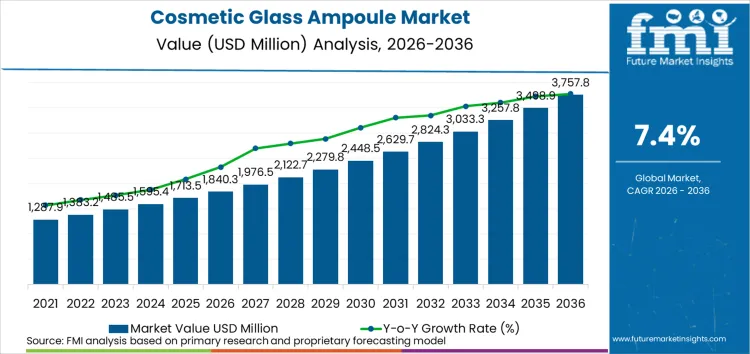
The global cosmetic glass ampoule market is estimated at USD 1,840.3 million in 2026 and is projected to reach USD 3,490.0 million by 2036, expanding at a CAGR of 7.40% during the forecast period. According to Future Market Insights, the market’s evolution between 2026 and 2036 will be shaped less by overall cosmetic volume growth and more by the premiumization and technical sophistication of cosmetic formulations. FMI believes that ampoules are increasingly specified as integral parts of formulation stability systems, rather than interchangeable primary packaging, fundamentally influencing supplier qualification and material selection strategies among cosmetic brands.
A key growth driver, as per FMI’s opinion, is the rising use of concentrated and sensitive cosmetic actives, particularly in anti-aging, brightening, hydration, and therapeutic skin solutions. These formulations are highly susceptible to oxidation, contamination, and light exposure, accelerating adoption of single-dose and controlled multi-dose glass ampoules that offer superior barrier performance and dosing precision compared to plastic alternatives.
Recent developments reflect this shift, with leading glass packaging manufacturers expanding capabilities in borosilicate and low-extractable glass, advanced forming techniques, and decorative treatments such as printed, frosted, and tinted ampoules. At the same time, sustainability considerations are accelerating adoption of lightweight glass, recyclable compositions, and low-carbon manufacturing processes, particularly as cosmetic brands respond to environmental disclosure requirements and consumer scrutiny. “Our solution will help cosmetics manufacturers to promote the acceptance of glass containers amongst consumers.” “We have not seen any comparable system on the market that offers both a spray function and also serves as ampoule breaker,” says Wenke Hermanns, business development manager at Lutz Packaging. “Our solution makes it easier to handle glass ampoules and will help cosmetics manufacturers to promote the acceptance of glass containers amongst consumers.”
FMI expects these formulation-driven, standards-aligned, and sustainability-led trends to structurally elevate the functional and strategic importance of cosmetic glass ampoules over the coming decade. As cosmetic products continue to move toward high-efficacy, science-led positioning, glass ampoules are expected to transition permanently from premium packaging accents to core enablers of product integrity, performance assurance, and brand credibility within the global cosmetics value chain.
Summary of Cosmetic Glass Ampoule Market
What Is Growth Outlook for the Cosmetic Glass Ampoule Market as per Future Market Insights Projection?
Future Market Insights projects the cosmetic glass ampoule market to expand at a CAGR of 7.40% from 2026 to 2036, increasing from USD 1,840.3 million in 2026 to USD 3,490.0 million by 2036. Market growth is driven by rising demand for high-concentration cosmetic formulations, premium skincare regimes, and single-dose delivery formats that ensure product stability, hygiene, and controlled application.
Increasing use of ampoule-based packaging in anti-aging, hydration, repair, and therapeutic skincare treatments, alongside expanding haircare and specialty cosmetic applications is reinforcing sustained demand across both professional and consumer channels.
FMI Research Approach: FMI models demand using historical cosmetic packaging volumes, ampoule penetration rates by product category, and formulation concentration trends across skincare, haircare, and body care. Forecasts integrate adoption curves for single-dose versus multi-dose ampoules, capacity preferences, and closure configurations, with sensitivity to premiumization, dermo cosmetic growth, and sustainability-driven packaging shifts through 2036.
How Do FMI Analysts Perceive the Cosmetic Glass Ampoule Market to Evolve?
FMI analysts observe that the cosmetic glass ampoule market is evolving from a niche, professional-use packaging format into a mainstream premium cosmetic delivery platform. Growth is increasingly shaped by demand for precision dosing, enhanced formulation protection, and aesthetic differentiation.
Manufacturers are expanding portfolios across snap-off, break-seal, twist-off, and resealable ampoules, while integrating droppers and pumps to support multi-dose use cases. Preference for Type I and Type II glass is rising due to superior chemical resistance and low extractables, particularly for active-rich and sensitive formulations. Design-led differentiation such as printed, frosted, and custom-shaped ampoules is becoming a key brand strategy, alongside sustainability initiatives focused on recyclable, lightweight, and low-carbon glass manufacturing.
FMI Research Approach: FMI analyzes market evolution by evaluating shifts in glass type selection, closure integration, capacity optimization, and design innovation. The assessment incorporates brand-level packaging strategies, contract manufacturing trends, and supplier capabilities across premium, dermo cosmetic, and specialty cosmetic segments.
Which Country Holds Largest Share in Global Cosmetic Glass Ampoule Market?
Future Market Insights notes that the United States holds the largest share of the global cosmetic glass ampoule market by value. Market leadership is supported by strong demand for premium skincare, high adoption of ampoule-based treatments in professional and at-home routines, and the presence of leading cosmetic brands and packaging suppliers. Advanced retail channels and consumer willingness to pay for efficacy-driven products further reinforce market dominance.
FMI Research Approach: Country-level analysis incorporates cosmetic production output, premium skincare penetration, packaging supplier presence, distribution channel dynamics, and regulatory standards influencing cosmetic packaging quality and material selection.
How Large Will the Cosmetic Glass Ampoule Market Be by 2036?
The global cosmetic glass ampoule market is projected to reach USD 3,490.0 million by 2036, driven by sustained expansion in skincare, haircare, body care, and fragrance-based specialty cosmetics.
FMI Research Approach: FMI calculates long-term market size by modeling ampoule consumption per finished cosmetic product across applications, weighted by glass type, capacity, closure configuration, and distribution channel. Forecasts exclude plastic ampoules, vials, and non-glass cosmetic containers to maintain strict scope alignment.
How Are Premiumization and Sustainability Trends Fueling Cosmetic Glass Ampoule Adoption?
According to FMI analysts, increasing premiumization in cosmetics combined with heightened focus on formulation efficacy, hygiene, and sustainability is accelerating adoption of glass ampoules. Single-dose formats address consumer concerns around contamination and product freshness, while glass material aligns with luxury positioning and recyclability goals.
Simultaneously, sustainability expectations are prompting manufacturers to adopt lightweight glass, recyclable designs, and low-carbon manufacturing processes without compromising performance or aesthetics. These dynamics are positioning cosmetic glass ampoules as both a functional and branding-critical packaging solution.
FMI Research Approach: FMI incorporates premium pricing trends, sustainability commitments, and packaging innovation pipelines into demand models. The analysis evaluates how design features, material choices, and environmental considerations influence adoption across cosmetic product categories.
Cosmetic Glass Ampoule Market Key Takeaways
| Metric | Details |
|---|---|
| Market Size (2026) | USD 1,840.3 Million |
| Market Value (2036) | USD 3,490.0 Million |
| CAGR (2026 to 2036) | 7.40% |
Source: Future Market Insights (FMI) analysis, based on proprietary forecasting model and primary research.
Which Factors Drive Adoption of Cosmetic Glass Ampoule Market?
The adoption of cosmetic glass ampoules is being driven by the shift in the beauty and personal care industry towards high-performance, single-dose products that emphasize product stability, hygiene, and premiumization over traditional multi-use packaging. The skincare and dermo-cosmetic brands are increasingly opting for glass ampoules for their concentrated serums, active-packed treatments, and clinical-grade products due to the rising consumer demand for potent, preservative-free products with visible efficacy. This is further driven by the increasing preference for professional skincare regimens, the growing trend of dermatology-backed beauty products, and increased concerns about contamination and oxidation sensitivity in cosmetic products. For instance, Gerresheimer AG offers pharmaceutical-grade glass ampoule packaging solutions that are specifically designed for cosmetic use, allowing for superior barrier protection, accurate dosing, and improved product integrity for high-end skincare products.
FMI analysis indicates that cosmetic brands adopting glass ampoules supported by standardized filling processes, material purity certifications, and compatibility with automated packaging lines achieve stronger brand credibility and faster market acceptance. The expanding role of premiumization, sustainable glass packaging initiatives, and innovation in break-safe and user-friendly ampoule designs is further accelerating uptake by ensuring consistent product performance and elevated consumer experience, positioning cosmetic glass ampoules as strategic packaging solutions rather than niche or purely aesthetic components.
How is the Cosmetic Glass Ampoule Market Segmented?
The cosmetic glass ampoule market has been segmented based on product type, glass type, and capacity. In terms of product type, the market is divided into single-dose glass ampoules and multi-dose glass ampoules. Single-dose ampoules are primarily used for unitized cosmetic formulations, while multi-dose ampoules support repeated usage across professional and consumer applications.
Cosmetic Glass Ampoule Market By Glass Type
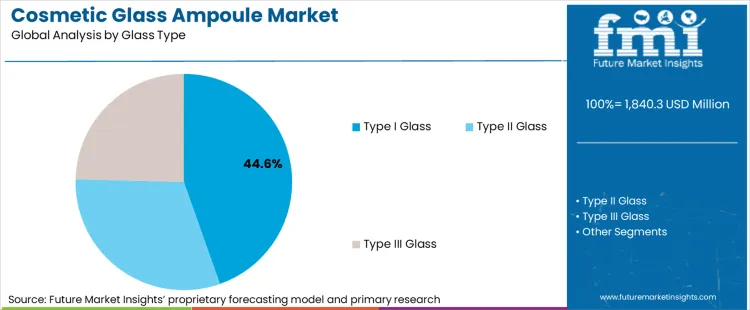
Based on glass type, the market is categorized into Type I glass, Type II glass, and Type III glass. These classifications are determined by the chemical resistance, purity, and suitability of the glass for storing sensitive cosmetic formulations, including serums, actives, and concentrated treatments.
Cosmetic Glass Ampoule Market By Capacity
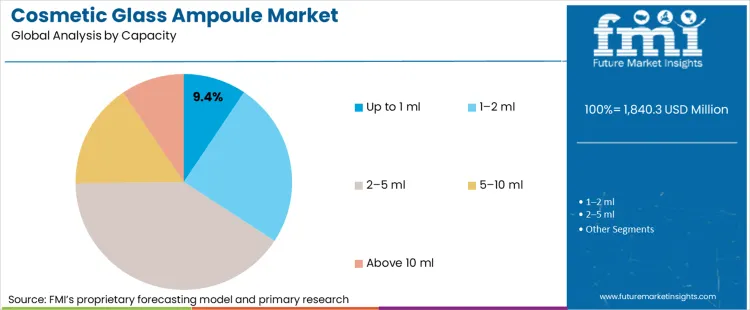
By capacity, the cosmetic glass ampoule market is segmented into up to 1 ml, 1-2 ml, 2-5 ml, 5-10 ml, and above 10 ml formats. Capacity selection is influenced by formulation concentration, intended usage pattern, dosage control requirements, and target consumer or professional application. Different capacity formats allow cosmetic brands to address both single-use precision dosing and extended-use treatment regimens across skincare and aesthetic product portfolios.
What Trends Are Shaping Industry Evolution?
In addition to their superior looks, cosmetic glass ampoules are increasingly being chosen for their capacity to protect and deliver high-concentration products accurately. The growing demand for high-concentration actives in the skincare, haircare, and therapeutic body care markets is driving the preference for ampoules that can reduce oxidation, contamination, and the need for preservatives. This is further cementing the position of glass ampoules as a functional packaging solution rather than a cosmetic one, especially in anti-aging, brightening, and repair products.
The choice of material is becoming more functional, with brands favoring glass types that provide stability and compliance for formulations. Type I borosilicate and low-extractable glass offerings are gaining popularity for sensitive products because of their superior chemical resistance and low interaction values. Simultaneously, treated and surface-coated soda-lime glass is finding more use in mass-premium segments where cost-effectiveness needs to be achieved without compromising safety and performance.
The move towards standardized capacities and dosing sizes is also transforming the design and manufacturing approach for ampoules. The demand is highest for small-volume packaging with capacities up to 5 ml, which are ideal for single-dose skin care regimens and professional aesthetic procedures. Multi-dose ampoules with resealable, dropper-enabled, or pump-action closure systems are also gaining traction as companies attempt to maximize product lifespan while preserving sanitation and hygiene, especially in the hair care and specialty cosmetic segments.
Innovation in design is increasingly being aligned with sustainability goals as companies face pressure from the environment and brand-level ESG initiatives. Lightweight glass, recyclable packaging, and eco-friendly manufacturing processes are being emphasized without compromising on barrier properties and aesthetics. Amber and colored glass packaging options are also gaining popularity to safeguard light-sensitive products, while printed and customized ampoule designs are selectively used to emphasize brand differentiation in high-end and limited-edition product offerings.
Distribution dynamics are evolving as cosmetic glass ampoules gain traction across both professional and consumer-facing channels. Direct B2B sales to dermatology clinics, aesthetic centers, and contract manufacturers remain central to volume demand, while online retail and brand-owned channels are accelerating consumer access to ampoule-based skincare. Pharmacies and specialty beauty stores continue to play a critical role in validating ampoules as efficacy-driven, clinic-inspired cosmetic solutions.
Geographically, East Asia and Europe continue to anchor innovation and consumption, supported by advanced skincare markets and strong dermo cosmetic ecosystems. South Korea, China, and Japan are driving rapid product launch cycles and design innovation, while Europe maintains steady demand through pharmaceutical-grade packaging standards and premium skincare brands. This global expansion is reinforcing the need for scalable, quality-assured ampoule manufacturing capable of meeting diverse regulatory and aesthetic expectations.
How Is the Cosmetic Glass Ampoule Market Evolving Globally?
The demand for cosmetic glass ampoules is steadily increasing as more consumers worldwide accept high-end skincare, dermo-cosmetic, and professional beauty products. The driving factor is the growing preference for single-use, contamination-free packaging options that maintain the potency of high-performance active ingredients like peptides, vitamins, and bio-actives. Glass ampoules are being positioned as a functional and premium packaging option for clinical skincare, high-end beauty, and cosmeceutical products.
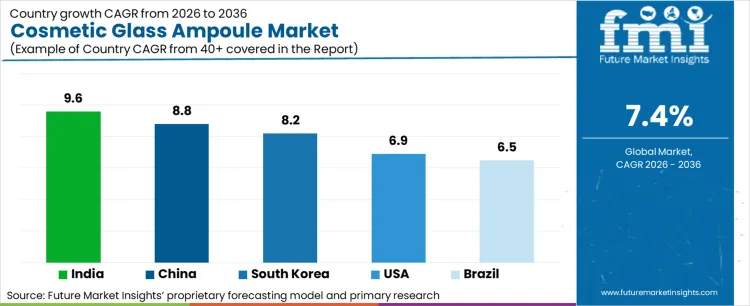
Market evolution is shaped by factors including growth in dermatology-led skincare, expansion of professional salon and clinic-based treatments, and rising consumer trust in pharmaceutical-style packaging for cosmetics. India records a 9.6% CAGR, China records 8.8% CAGR, South Korea records 8.2% CAGR, the United States records 6.9% CAGR, and Brazil records 6.5% CAGR during the forecast period. Adoption remains driven by product safety, formulation stability, and premium brand positioning rather than cost efficiency alone.
| Country | CAGR (2026 to 2036) |
|---|---|
| India | 9.6% |
| China | 8.8% |
| South Korea | 8.2% |
| United States | 6.9% |
| Brazil | 6.5% |
India: How Is Professional Skincare Expansion Driving Ampoule Demand?
India represents the fastest-growing cosmetic glass ampoule market, supported by rapid expansion of dermatology clinics, aesthetic treatment centers, and premium skincare brands. Rising awareness of targeted skincare regimens and increasing adoption of single-use treatment formats are accelerating demand for ampoule-based products among urban consumers.
The Indian cosmetic glass ampoule market is projected to grow at a 9.6% CAGR during the study period. Growth is reinforced by increasing penetration of cosmeceuticals, professional facial treatments, and at-home clinical skincare routines. Domestic and international brands are actively introducing glass ampoule formats to convey efficacy, hygiene, and pharmaceutical-grade quality.
China: Is Premiumization of Skincare Boosting Ampoule Adoption?
China’s cosmetic glass ampoule market is driven by strong demand for high-performance skincare products positioned around visible results and advanced formulations. Consumers increasingly associate glass ampoules with potency, authenticity, and scientific credibility, particularly in anti-aging and skin-repair segments.
Reflecting this trend, the Chinese cosmetic glass ampoule market is expected to grow at an 8.8% CAGR during the forecast period. Growth is supported by digital-first beauty brands, strong e-commerce penetration, and influencer-driven education around active ingredient stability and dosing precision offered by ampoule packaging.
South Korea: Does Innovation Leadership Sustain Market Growth?
South Korea’s cosmetic glass ampoule market benefits from the country’s leadership in skincare innovation and formulation science. Ampoules are deeply embedded in Korean beauty routines, particularly for concentrated treatments addressing hydration, brightening, and skin barrier repair.
The South Korean market is projected to grow at an 8.2% CAGR during the study period. Growth is sustained by continuous product innovation, premium packaging aesthetics, and strong export demand for K-beauty brands that rely on glass ampoules to reinforce product efficacy and differentiation in global markets.
United States Cosmetic Glass Ampoule Market Shaped by Clinical Skincare Trends
The USA cosmetic glass ampoule market is set to grow at a 6.9% CAGR during the forecast period, driven by the convergence of dermatology, aesthetics, and consumer skincare. Glass ampoules are increasingly adopted by medical-grade skincare brands and professional treatment lines that emphasize ingredient integrity and controlled dosing.
Another factor shaping adoption is the USA consumer’s growing trust in science-backed beauty products. Brands leverage glass ampoule packaging to communicate purity, stability, and premium value, particularly in anti-aging, post-procedure care, and sensitive-skin formulations.
Brazil: Is Rising Aesthetic Awareness Supporting Market Expansion?
Brazil’s cosmetic glass ampoule market is expanding as consumers increasingly invest in advanced skincare alongside aesthetic procedures and professional beauty treatments. Demand is particularly strong for hair care and skin treatment ampoules used in salons and aesthetic clinics.
The Brazilian cosmetic glass ampoule market is expected to grow at a 6.5% CAGR during the study period. Growth is supported by a strong beauty culture, expanding professional salon networks, and rising availability of premium cosmetic products positioned around treatment efficacy and visible results.
What Strategic Moves Are Defining the Competitive Landscape?
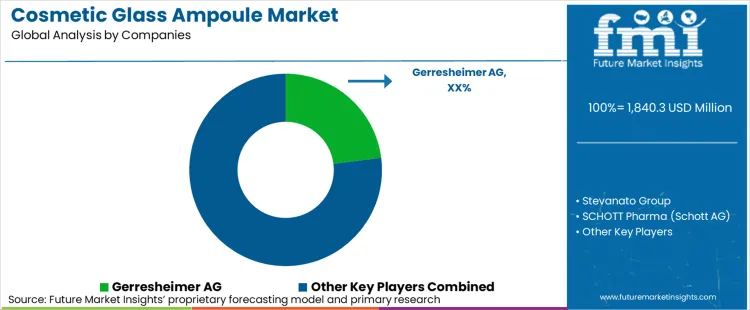
The competitive landscape of the global cosmetic glass ampoule market is increasingly defined by integration of high-precision glass manufacturing and enhanced production capabilities, as major suppliers seek to balance demand from premium cosmetics brands with operational efficiency. Rather than competing solely on volume, leading glass packaging manufacturers are emphasizing high-value engineering, quality control, and strategic alliances to deliver ampoules that meet stringent cosmetic performance and aesthetic expectations.
Another defining strategic move is the collaboration and alignment of primary packaging technologies across the pharmaceutical and cosmetic sectors. Players with diversified glass primary packaging portfolios are leveraging synergies between pharmaceutical-grade sterile production methods and cosmetic ampoule aesthetics, enabling cross-segment capacity utilization and access to broader customer bases.
Manufacturers are also pursuing targeted capacity modernization and sustainability initiatives in their moulded glass operations to enhance energy efficiency and reduce environmental impact. Investments in advanced melting furnaces and oxy-hybrid technologies support improved throughput and lower carbon intensity, reinforcing competitiveness as cosmetic brands increasingly emphasize eco-responsible packaging solutions.
In the evolving competitive environment, integration of ready-to-fill production platforms and strategic unit realignments are emerging as key differentiators. Companies that can support turnkey packaging formats from ampoule manufacture to ready-to-use filling systems strengthen their value proposition to both multinational beauty brands and niche premium formulators. These strategic moves are shifting competition from commodity-focused glass supply toward integrated, high-quality packaging solutions that meet both functional and brand-centric requirements.
Key Industry Developments:
- In May 2025, Gerresheimer AG completed a major expansion and modernization project at its Lohr glass production facility, installing a state-of-the-art oxy-hybrid melting furnace that increases capacity and reduces CO₂ emissions by up to 40 %, supporting enhanced production efficiency and sustainability in glass primary packaging.
- In November 2025, Stevanato Group reported strong third quarter 2025 financial results, with record revenue growth from high-value solutions including EZ-fill vials and glass containment products, underscoring its expanded production capacity and market demand for premium primary packaging formats.
Key Companies
- Gerresheimer AG
- Stevanato Group
- SCHOTT Pharma (Schott AG)
- NAF-VSM
- APG Pharma
- Linuo Pharmaceutical Packaging
- Nipro (Primary Packaging Division)
- Essco Glass
- Infochroma AG
- NORBULB Sprinkler Elemente GmbH
- Pharma-Glas Koniakowsky & Kuehr GmbH
- QGT Quarzglastechnik GmbH & Co. KG
- IQS GmbH
- PPI Pharma Packaging GmbH
- Jinan Munan Glass Co., Ltd.
Market Definition
The global cosmetic glass ampoule market refers to the primary packaging ecosystem comprising sealed glass containers used for the storage, protection, and application of concentrated cosmetic and personal care formulations. Cosmetic glass ampoules are engineered to preserve formulation stability, prevent contamination, and enable precise single-dose or short-term usage of high-potency skincare and dermocosmetic products. The market increasingly reflects premiumization trends, with emphasis on material purity, aesthetic presentation, and compatibility with sensitive cosmetic formulations.
The market includes glass ampoules manufactured from cosmetic- and pharmaceutical-grade glass used for skincare, haircare, and professional cosmetic applications. It covers ampoules of various capacities and break mechanisms supplied to mass, premium, and professional cosmetic brands for consumer and in-clinic use, regardless of secondary packaging or branding format.
On the other hand, the market excludes plastic ampoules, cosmetic bottles, jars, droppers, and other non-ampoule packaging formats. Pharmaceutical ampoules intended exclusively for injectable or medicinal use, as well as decorative glass containers without dosage functionality, are also excluded from the defined market scope.
Scope Of Report
| Items | Values |
|---|---|
| Quantitative Units | USD million |
| By Product Type | Single-Dose Glass Ampoules (Snap-Off Ampoules; Break-Seal Ampoules; Twist-Off Ampoules); Multi-Dose Glass Ampoules (Resealable Ampoules; Dropper-Integrated Ampoules; Pump-Integrated Ampoules) |
| By Glass Type | Type I Glass (Borosilicate Glass; Low-Extractable Glass); Type II Glass (Treated Soda-Lime Glass; Surface-Coated Glass); Type III Glass (Standard Soda-Lime Glass; Strengthened Soda-Lime Glass) |
| By Capacity | Up to 1 ml; 1-2 ml; 2-5 ml; 5-10 ml; Above 10 ml |
| End Use (Application) | Skincare (Anti-Aging; Brightening & Whitening; Hydration & Repair; Acne & Sensitive Skin Care); Haircare (Hair Growth; Scalp Care; Hair Repair); Body Care (Skin Firming; Stretch Mark Treatment; Therapeutic Skin Solutions); Fragrance & Specialty Cosmetics (Concentrated Fragrances; Limited-Edition Cosmetics) |
| Regions Covered | North America, Europe, East Asia, South Asia, Latin America, Middle East & Africa |
| Countries Covered | United States, Germany, France, Italy, China, India, South Korea, and 40+ countries |
| Key Companies Profiled | Gerresheimer AG; Stevanato Group; SCHOTT Pharma (Schott AG); Nipro Corporation; Linuo Pharmaceutical Packaging; Others |
| Additional Attributes | Revenue analysis by product type, glass type, capacity, closure type, distribution channel, and design & sustainability features; assessment of barrier integrity, cosmetic formulation compatibility, and protection against contamination; evaluation of premiumization trends, aesthetic differentiation, and customization in cosmetic packaging; analysis of sustainability initiatives including recyclable and lightweight glass and low-carbon manufacturing; procurement dynamics driven by luxury branding requirements, regulatory compliance, supply reliability, and long-term partnerships between cosmetic brands and primary packaging manufacturers. |
Key Segments
By Product Type
- Single-Dose Glass Ampoules
- Snap-Off Ampoules
- Break-Seal Ampoules
- Twist-Off Ampoules
- Multi-Dose Glass Ampoules
- Resealable Ampoules
- Dropper-Integrated Ampoules
- Pump-Integrated Ampoules
By Glass Type
- Type I Glass
- Borosilicate Glass
- Low-Extractable Glass
- Type II Glass
- Treated Soda-Lime Glass
- Surface-Coated Glass
- Type III Glass
- Standard Soda-Lime Glass
- Strengthened Soda-Lime Glass
By Capacity
- Up to 1 ml
- 1-2 ml
- 2-5 ml
- 5-10 ml
- Above 10 ml
By Application
- Skincare
- Anti-Aging
- Brightening & Whitening
- Hydration & Repair
- Acne & Sensitive Skin Care
- Haircare
- Hair Growth
- Scalp Care
- Hair Repair
- Body Care
- Skin Firming
- Stretch Mark Treatment
- Therapeutic Skin Solutions
- Fragrance & Specialty Cosmetics
- Concentrated Fragrances
- Limited-Edition Cosmetics
By Closure Type
- Snap-Off Closure
- Break-Seal Closure
- Crimped Closure
- Dropper Closure
- Pump Closure
- Screw Cap / Resealable Closure
By Distribution Channel
- Direct Sales (B2B)
- Specialty Beauty Stores
- Pharmacies & Drugstores
- Online Retail
- Brand-Owned Channels
By Design & Sustainability
- Glass Color
- Clear Glass
- Amber Glass
- Tinted / Colored Glass
- Design Features
- Printed Ampoules
- Frosted Ampoules
- Custom Shapes
- Sustainability Features
- Recyclable Glass
- Lightweight Glass
- Low-Carbon Manufacturing
Bibliography
- European Commission. (2009). Regulation (EC) No 1223/2009 on Cosmetic Products. Official Journal of the European Union.
- Scientific Committee on Consumer Safety (SCCS). (2021). The SCCS Notes of Guidance for the Testing of Cosmetic Ingredients and Their Safety Evaluation (11th Revision). European Commission.
- Cosmetics Europe. (2022). Packaging Compatibility and Stability Testing for Cosmetic Products. Cosmetics Europe - The Personal Care Association.
- European Directorate for the Quality of Medicines & HealthCare (EDQM). (2023). Glass Containers: Quality, Surface Treatment, and Safety Considerations for Cosmetic and Personal Care Applications. Council of Europe.
- International Organization for Standardization (ISO). (2015). ISO 22716: Cosmetics-Good Manufacturing Practices (GMP). ISO.
- Society of Cosmetic Chemists (SCC). (2020). Stability Testing of Cosmetic Products in Primary Packaging Systems. SCC Technical Monograph.
- International Organization for Standardization. (2024). Primary packaging for cosmetic and personal care liquids - Small-volume containers including ampoules: Safety, compatibility, and integrity requirements. ISO TC 217 Cosmetics.
- European Committee for Standardization (CEN). (2024). Packaging for cosmetic products - Small glass and plastic ampoule containers: Performance, sealing, and product protection standards. CEN TC 261.
- FEVE - European Container Glass Federation. (2024). Glass ampoules for cosmetic and dermal formulations: Material purity, barrier protection, and sustainability performance. FEVE.
- Society of Cosmetic Chemists (SCC). (2024). Packaging compatibility and stability considerations for concentrated cosmetic formulations in ampoule formats. SCC.
- ASTM International. (2024). Standard test methods for container closure integrity, break resistance, and product compatibility for small cosmetic containers. ASTM Committee D10 on Packaging.
- Sustainable Packaging Coalition. (2024). Sustainable design and recyclability considerations for small-format cosmetic primary packaging including ampoules. SPC.
Frequently Asked Questions
How big is the cosmetic glass ampoule market in 2026?
The global cosmetic glass ampoule market is estimated to be valued at USD 1,840.3 million in 2026.
What will be the size of the cosmetic glass ampoule market in 2036?
The cosmetic glass ampoule market is projected to reach USD 3,490.0 million by 2036.
How much will the cosmetic glass ampoule market grow between 2026 and 2036?
The cosmetic glass ampoule market is expected to grow at a 7.40% CAGR between 2026 and 2036.
What are the key product types in the cosmetic glass ampoule market?
Key product types include single-dose glass ampoules (snap-off, break-seal, and twist-off) and multi-dose glass ampoules, such as resealable, dropper-integrated, and pump-integrated formats.
Which glass types are commonly used for cosmetic glass ampoules?
Cosmetic glass ampoules are commonly manufactured using Type I borosilicate glass, Type II treated soda-lime glass, and Type III soda-lime glass, selected based on formulation sensitivity and extractability requirements.
Which application segment drives demand for cosmetic glass ampoules?
The skincare segment drives the largest share of demand, particularly for anti-aging, hydration & repair, and brightening formulations that require high product protection and precise dosing.
Preview the report firsthand - request a free sample
Get SampleGet the brochure for pricing and purchase details.
Get PDFTable of Content
- Executive Summary
- Global Market Outlook
- Demand-side Trends
- Supply-side Trends
- Technology Roadmap Analysis
- Analysis and Recommendations
- Market Overview
- Market Coverage / Taxonomy
- Market Definition / Scope / Limitations
- Research Methodology
- Chapter Orientation
- Analytical Lens and Working Hypotheses
- Market Structure, Signals, and Trend Drivers
- Benchmarking and Cross-market Comparability
- Market Sizing, Forecasting, and Opportunity Mapping
- Research Design and Evidence Framework
- Desk Research Programme (Secondary Evidence)
- Company Annual and Sustainability Reports
- Peer-reviewed Journals and Academic Literature
- Corporate Websites, Product Literature, and Technical Notes
- Earnings Decks and Investor Briefings
- Statutory Filings and Regulatory Disclosures
- Technical White Papers and Standards Notes
- Trade Journals, Industry Magazines, and Analyst Briefs
- Conference Proceedings, Webinars, and Seminar Materials
- Government Statistics Portals and Public Data Releases
- Press Releases and Reputable Media Coverage
- Specialist Newsletters and Curated Briefings
- Sector Databases and Reference Repositories
- FMI Internal Proprietary Databases and Historical Market Datasets
- Subscription Datasets and Paid Sources
- Social Channels, Communities, and Digital Listening Inputs
- Additional Desk Sources
- Expert Input and Fieldwork (Primary Evidence)
- Primary Modes
- Qualitative Interviews and Expert Elicitation
- Quantitative Surveys and Structured Data Capture
- Blended Approach
- Why Primary Evidence is Used
- Field Techniques
- Interviews
- Surveys
- Focus Groups
- Observational and In-context Research
- Social and Community Interactions
- Stakeholder Universe Engaged
- C-suite Leaders
- Board Members
- Presidents and Vice Presidents
- R&D and Innovation Heads
- Technical Specialists
- Domain Subject-matter Experts
- Scientists
- Physicians and Other Healthcare Professionals
- Governance, Ethics, and Data Stewardship
- Research Ethics
- Data Integrity and Handling
- Primary Modes
- Tooling, Models, and Reference Databases
- Desk Research Programme (Secondary Evidence)
- Data Engineering and Model Build
- Data Acquisition and Ingestion
- Cleaning, Normalisation, and Verification
- Synthesis, Triangulation, and Analysis
- Quality Assurance and Audit Trail
- Market Background
- Market Dynamics
- Drivers
- Restraints
- Opportunity
- Trends
- Scenario Forecast
- Demand in Optimistic Scenario
- Demand in Likely Scenario
- Demand in Conservative Scenario
- Opportunity Map Analysis
- Product Life Cycle Analysis
- Supply Chain Analysis
- Investment Feasibility Matrix
- Value Chain Analysis
- PESTLE and Porter’s Analysis
- Regulatory Landscape
- Regional Parent Market Outlook
- Production and Consumption Statistics
- Import and Export Statistics
- Market Dynamics
- Global Market Analysis 2021 to 2025 and Forecast, 2026 to 2036
- Historical Market Size Value (USD Million) Analysis, 2021 to 2025
- Current and Future Market Size Value (USD Million) Projections, 2026 to 2036
- Y-o-Y Growth Trend Analysis
- Absolute $ Opportunity Analysis
- Global Market Pricing Analysis 2021 to 2025 and Forecast 2026 to 2036
- Global Market Analysis 2021 to 2025 and Forecast 2026 to 2036, By Product Type
- Introduction / Key Findings
- Historical Market Size Value (USD Million) Analysis By Product Type , 2021 to 2025
- Current and Future Market Size Value (USD Million) Analysis and Forecast By Product Type , 2026 to 2036
- Single-Dose Glass Ampoules
- Multi-Dose Glass Ampoules
- Single-Dose Glass Ampoules
- Y-o-Y Growth Trend Analysis By Product Type , 2021 to 2025
- Absolute $ Opportunity Analysis By Product Type , 2026 to 2036
- Global Market Analysis 2021 to 2025 and Forecast 2026 to 2036, By Glass Type
- Introduction / Key Findings
- Historical Market Size Value (USD Million) Analysis By Glass Type, 2021 to 2025
- Current and Future Market Size Value (USD Million) Analysis and Forecast By Glass Type, 2026 to 2036
- Type I Glass
- Type II Glass
- Type III Glass
- Type I Glass
- Y-o-Y Growth Trend Analysis By Glass Type, 2021 to 2025
- Absolute $ Opportunity Analysis By Glass Type, 2026 to 2036
- Global Market Analysis 2021 to 2025 and Forecast 2026 to 2036, By Capacity
- Introduction / Key Findings
- Historical Market Size Value (USD Million) Analysis By Capacity, 2021 to 2025
- Current and Future Market Size Value (USD Million) Analysis and Forecast By Capacity, 2026 to 2036
- Up to 1 ml
- 1–2 ml
- 2–5 ml
- 5–10 ml
- Above 10 ml
- Up to 1 ml
- Y-o-Y Growth Trend Analysis By Capacity, 2021 to 2025
- Absolute $ Opportunity Analysis By Capacity, 2026 to 2036
- Global Market Analysis 2021 to 2025 and Forecast 2026 to 2036, By Region
- Introduction
- Historical Market Size Value (USD Million) Analysis By Region, 2021 to 2025
- Current Market Size Value (USD Million) Analysis and Forecast By Region, 2026 to 2036
- North America
- Latin America
- Western Europe
- Eastern Europe
- East Asia
- South Asia and Pacific
- Middle East & Africa
- Market Attractiveness Analysis By Region
- North America Market Analysis 2021 to 2025 and Forecast 2026 to 2036, By Country
- Historical Market Size Value (USD Million) Trend Analysis By Market Taxonomy, 2021 to 2025
- Market Size Value (USD Million) Forecast By Market Taxonomy, 2026 to 2036
- By Country
- USA
- Canada
- Mexico
- By Product Type
- By Glass Type
- By Capacity
- By Country
- Market Attractiveness Analysis
- By Country
- By Product Type
- By Glass Type
- By Capacity
- Key Takeaways
- Latin America Market Analysis 2021 to 2025 and Forecast 2026 to 2036, By Country
- Historical Market Size Value (USD Million) Trend Analysis By Market Taxonomy, 2021 to 2025
- Market Size Value (USD Million) Forecast By Market Taxonomy, 2026 to 2036
- By Country
- Brazil
- Chile
- Rest of Latin America
- By Product Type
- By Glass Type
- By Capacity
- By Country
- Market Attractiveness Analysis
- By Country
- By Product Type
- By Glass Type
- By Capacity
- Key Takeaways
- Western Europe Market Analysis 2021 to 2025 and Forecast 2026 to 2036, By Country
- Historical Market Size Value (USD Million) Trend Analysis By Market Taxonomy, 2021 to 2025
- Market Size Value (USD Million) Forecast By Market Taxonomy, 2026 to 2036
- By Country
- Germany
- UK
- Italy
- Spain
- France
- Nordic
- BENELUX
- Rest of Western Europe
- By Product Type
- By Glass Type
- By Capacity
- By Country
- Market Attractiveness Analysis
- By Country
- By Product Type
- By Glass Type
- By Capacity
- Key Takeaways
- Eastern Europe Market Analysis 2021 to 2025 and Forecast 2026 to 2036, By Country
- Historical Market Size Value (USD Million) Trend Analysis By Market Taxonomy, 2021 to 2025
- Market Size Value (USD Million) Forecast By Market Taxonomy, 2026 to 2036
- By Country
- Russia
- Poland
- Hungary
- Balkan & Baltic
- Rest of Eastern Europe
- By Product Type
- By Glass Type
- By Capacity
- By Country
- Market Attractiveness Analysis
- By Country
- By Product Type
- By Glass Type
- By Capacity
- Key Takeaways
- East Asia Market Analysis 2021 to 2025 and Forecast 2026 to 2036, By Country
- Historical Market Size Value (USD Million) Trend Analysis By Market Taxonomy, 2021 to 2025
- Market Size Value (USD Million) Forecast By Market Taxonomy, 2026 to 2036
- By Country
- China
- Japan
- South Korea
- By Product Type
- By Glass Type
- By Capacity
- By Country
- Market Attractiveness Analysis
- By Country
- By Product Type
- By Glass Type
- By Capacity
- Key Takeaways
- South Asia and Pacific Market Analysis 2021 to 2025 and Forecast 2026 to 2036, By Country
- Historical Market Size Value (USD Million) Trend Analysis By Market Taxonomy, 2021 to 2025
- Market Size Value (USD Million) Forecast By Market Taxonomy, 2026 to 2036
- By Country
- India
- ASEAN
- Australia & New Zealand
- Rest of South Asia and Pacific
- By Product Type
- By Glass Type
- By Capacity
- By Country
- Market Attractiveness Analysis
- By Country
- By Product Type
- By Glass Type
- By Capacity
- Key Takeaways
- Middle East & Africa Market Analysis 2021 to 2025 and Forecast 2026 to 2036, By Country
- Historical Market Size Value (USD Million) Trend Analysis By Market Taxonomy, 2021 to 2025
- Market Size Value (USD Million) Forecast By Market Taxonomy, 2026 to 2036
- By Country
- Kingdom of Saudi Arabia
- Other GCC Countries
- Turkiye
- South Africa
- Other African Union
- Rest of Middle East & Africa
- By Product Type
- By Glass Type
- By Capacity
- By Country
- Market Attractiveness Analysis
- By Country
- By Product Type
- By Glass Type
- By Capacity
- Key Takeaways
- Key Countries Market Analysis
- USA
- Pricing Analysis
- Market Share Analysis, 2025
- By Product Type
- By Glass Type
- By Capacity
- Canada
- Pricing Analysis
- Market Share Analysis, 2025
- By Product Type
- By Glass Type
- By Capacity
- Mexico
- Pricing Analysis
- Market Share Analysis, 2025
- By Product Type
- By Glass Type
- By Capacity
- Brazil
- Pricing Analysis
- Market Share Analysis, 2025
- By Product Type
- By Glass Type
- By Capacity
- Chile
- Pricing Analysis
- Market Share Analysis, 2025
- By Product Type
- By Glass Type
- By Capacity
- Germany
- Pricing Analysis
- Market Share Analysis, 2025
- By Product Type
- By Glass Type
- By Capacity
- UK
- Pricing Analysis
- Market Share Analysis, 2025
- By Product Type
- By Glass Type
- By Capacity
- Italy
- Pricing Analysis
- Market Share Analysis, 2025
- By Product Type
- By Glass Type
- By Capacity
- Spain
- Pricing Analysis
- Market Share Analysis, 2025
- By Product Type
- By Glass Type
- By Capacity
- France
- Pricing Analysis
- Market Share Analysis, 2025
- By Product Type
- By Glass Type
- By Capacity
- India
- Pricing Analysis
- Market Share Analysis, 2025
- By Product Type
- By Glass Type
- By Capacity
- ASEAN
- Pricing Analysis
- Market Share Analysis, 2025
- By Product Type
- By Glass Type
- By Capacity
- Australia & New Zealand
- Pricing Analysis
- Market Share Analysis, 2025
- By Product Type
- By Glass Type
- By Capacity
- China
- Pricing Analysis
- Market Share Analysis, 2025
- By Product Type
- By Glass Type
- By Capacity
- Japan
- Pricing Analysis
- Market Share Analysis, 2025
- By Product Type
- By Glass Type
- By Capacity
- South Korea
- Pricing Analysis
- Market Share Analysis, 2025
- By Product Type
- By Glass Type
- By Capacity
- Russia
- Pricing Analysis
- Market Share Analysis, 2025
- By Product Type
- By Glass Type
- By Capacity
- Poland
- Pricing Analysis
- Market Share Analysis, 2025
- By Product Type
- By Glass Type
- By Capacity
- Hungary
- Pricing Analysis
- Market Share Analysis, 2025
- By Product Type
- By Glass Type
- By Capacity
- Kingdom of Saudi Arabia
- Pricing Analysis
- Market Share Analysis, 2025
- By Product Type
- By Glass Type
- By Capacity
- Turkiye
- Pricing Analysis
- Market Share Analysis, 2025
- By Product Type
- By Glass Type
- By Capacity
- South Africa
- Pricing Analysis
- Market Share Analysis, 2025
- By Product Type
- By Glass Type
- By Capacity
- USA
- Market Structure Analysis
- Competition Dashboard
- Competition Benchmarking
- Market Share Analysis of Top Players
- By Regional
- By Product Type
- By Glass Type
- By Capacity
- Competition Analysis
- Competition Deep Dive
- Gerresheimer AG
- Overview
- Product Portfolio
- Profitability by Market Segments (Product/Age /Sales Channel/Region)
- Sales Footprint
- Strategy Overview
- Marketing Strategy
- Product Strategy
- Channel Strategy
- Stevanato Group
- SCHOTT Pharma (Schott AG)
- NAF-VSM
- APG Pharma
- Gerresheimer AG
- Competition Deep Dive
- Assumptions & Acronyms Used


