

- Industry Size (2026)
- USD 1.2 Bn
- Forecast (2036)
- USD 3.8 Bn
- CAGR (2026 to 2036)
- 12.7%
CPLA for Packaging Market Forecast and Outlook 2026 to 2036
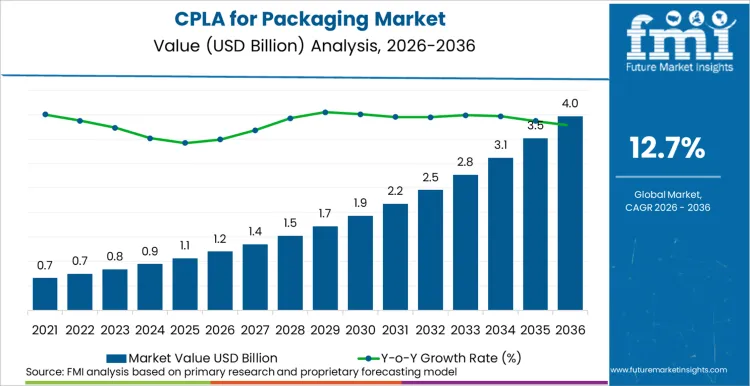
The CPLA for packaging market opens 2026 at USD 1.2 billion and is projected to reach USD 3.8 billion by 2036 at a 12.70% CAGR. Demand is created by pack formats that require heat resistance, compostability certification, and mechanical stability in service. Packaging owners define temperature tolerance, rigidity targets, and sealing behavior during pack architecture work. Once a format enters an approved claims scope, later material changes require renewed conformity testing and labeling authorization. Volume growth follows adoption in hot-fill containers, food service items, and rigid packaging where disposal pathways are governed by retailer and municipal acceptance rules.
Access to the CPLA for packaging market is governed by inclusion in approved pack constructions held by brand owners and retailers. Entry depends on documented compostability outcomes, performance at elevated temperatures, and compatibility with existing forming equipment. Approved formats remain stable across extended cycles because on-pack statements and compliance files attach to complete constructions. Supplier changes occur during packaging platform updates rather than routine sourcing.
Revenue development reflects the number of packaging programs converted to heat-resistant compostable structures. Competitive position depends on early participation in packaging design programs and continued acceptance within controlled material frameworks used across multi-category portfolios.
CPLA for Packaging Market Quick Stats
- CPLA for Packaging Market Value (2026): USD 1.2 billion
- CPLA for Packaging Market Forecast Value (2036): USD 3.8 billion
- CPLA for Packaging Market Forecast CAGR 2026 to 2036: 12.7%
- Leading End Use in CPLA for Packaging Market: Foodservice and takeaway
- Key Growth Regions in CPLA for Packaging Market: India, China, USA, Germany, Japan
- Top Players in CPLA for Packaging Market: NatureWorks, Sulapac, Danimer Scientific, Eco-Products, Hisun Biomaterials, Kingfa Sci. & Tech., Mitsubishi Chemical Group
What is the Growth Forecast for the CPLA for Packaging Market through 2036?
Tooling choices, heat resistance targets, and end of life pathways set the design space for rigid and semi rigid compostable packs. The CPLA for packaging market in 2026 stands near USD 1.2 billion, rising from USD 638.0 million in 2021 as thermoformed trays, lids, and serviceware move to higher temperature tolerant biopolymers. Buyers evaluate CPLA through crystallinity control, demolding speed, warp resistance, and seal interface behavior. Qualification happens on specific forming lines and mold sets. Platform adoption locks material choice for multiple years. The value track passes USD 1,871.3 million in 2031 and reaches USD 3.8 billion in 2036, matching a 12.70% growth profile supported by wider category conversion and thicker section designs where heat stability is required.
Supply planning and conversion yield determine commercial behavior in the CPLA for packaging market. Volumes move under multi year programs tied to molds, cutlery sets, and food service assortments. Stock policy favors continuity of certified grades and predictable pellet behavior. Cost structure reflects lactide sourcing, compounding yield, crystallization control, and inspection load. Converters monitor cycle time, scrap, and dimensional stability after heat exposure. Annual values pass USD 2,678.7 million in 2033 and USD 3,402.3 million in 2035 as more operators standardize heat resistant compostable formats. The approach to USD 3.8 billion in 2036 comes from broader portfolio coverage, higher mass per unit in many items, and longer agreements that place this material into fixed packaging specifications across large product ranges.
CPLA for Packaging Market Key Takeaways
| Metric | Value |
|---|---|
| Market Value (2026) | USD 1.2 billion |
| Forecast Value (2036) | USD 3.8 billion |
| Forecast CAGR 2026 to 2036 | 12.7% |
Source: FMI’s proprietary forecasting model and primary research
How Is the CPLA for Packaging Market Being Used to Balance Heat Resistance, Processing Stability, and Compostability Claims?
Packaging converters treat the CPLA for packaging market as part of certification governance and performance risk control rather than as a simple material substitution. Programs specify crystallized PLA packaging materials and heat resistant compostable packaging solutions to achieve higher temperature tolerance while keeping declared disposal pathways valid.
Qualification teams rely on compostability testing and certification services and thermal deformation resistance validation protocols to confirm that crystallization levels do not block disintegration or sorting acceptance. Engineering groups evaluate bio based rigid packaging structures and compostable thermoforming sheet materials to keep forming windows and cycle times stable. The focus remains on dimensional stability, impact resistance, and seal behavior because packaging that survives hot fill but fails composting audits creates compliance exposure and claim withdrawal risk.
Release governance places compostable packaging compliance documentation frameworks inside shipment approval rather than inside marketing review. Selection criteria for CPLA packaging material suppliers include crystallinity control, feedstock traceability, and lot to lot thermal consistency. Life cycle assessment for compostable packaging systems is used to verify that processing steps do not undermine declared environmental claims.
Waste stream compatibility for compostable rigid packaging shapes material choice because misrouted items defeat recovery objectives. Heat exposure performance testing for CPLA containers defines acceptance gates for warpage, cracking, and seal failure. Audit readiness for compostable packaging claims sets ongoing surveillance requirements. This makes CPLA specification a certification and risk management decision rather than a short term cost or design optimization exercise.
How Do Heat-Resistance Requirements and Regulatory Substitution Mandates Shape Demand in the CPLA for Packaging Market by End Use and Packaging Type in 2026?
In the CPLA for Packaging Market, material selection is driven by service temperature limits, food contact compliance, and substitution timelines for conventional plastics rather than by resin pricing alone. Operators running quick service restaurant supply chains, institutional catering programs, and single-use replacement portfolios require materials that hold shape under hot-fill and hot-serve conditions while meeting compostability labeling rules. By end use, demand spans foodservice and takeaway, coffee chains and QSR, mass foodservice, premium compostables, institutional catering, and other uses. By packaging type, usage covers cups, lids and cutlery packs, rigid food containers, thermoformed packs, heat-resistant containers, and other formats. Portfolio structure reflects service temperature exposure, line compatibility, and certification maintenance effort.
Why Does Foodservice and Takeaway Define Most Qualification Volume?
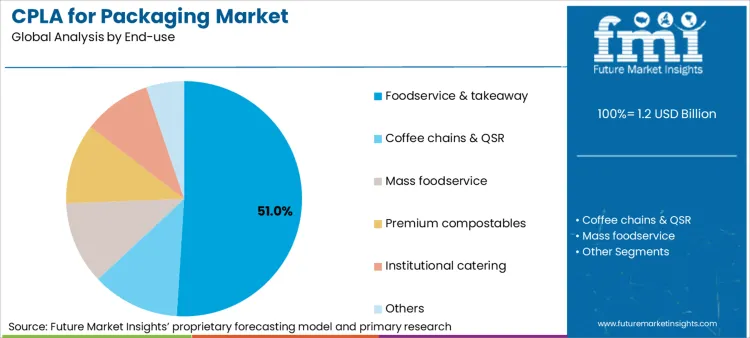
Foodservice and takeaway represent about 51% share, placing this segment at the center of most conversion programs. High outlet density, frequent product handling, and exposure to hot beverages and meals impose strict requirements on stiffness retention and deformation resistance. Coffee chains and QSR follow, with strong focus on lid fit, cup rim stability, and stacking performance. Mass foodservice prioritizes unit cost control and high-speed forming. Premium compostables emphasize appearance and material story. Institutional catering operates under fixed procurement frameworks. Packaging engineers qualify end uses through heat deflection, drop testing, and nesting behavior. Operations teams qualify through forming yield and line efficiency. Quality teams qualify through warpage and leakage rates.
End-use focus fixes forming temperatures, mold designs, and inspection criteria. Expanding into a new service category requires fresh tooling trials and updated performance documentation. Procurement aligns supply to secure continuity of the approved grade. Certification files and food contact declarations follow the same application mapping. Commercial planning grows menus and pack variants within the same service segment rather than rotating categories. Demand therefore concentrates in foodservice and takeaway programs where temperature exposure, volume scale, and regulatory visibility converge.
Why Do Cups and Thermoformed Packs Lead Packaging Type Adoption?
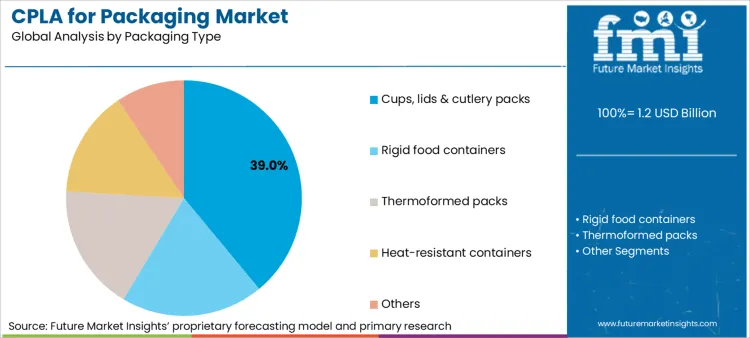
Cups, lids and cutlery packs account for about 39% share, reflecting their high turnover and direct exposure to hot beverages and meals. This format requires predictable rim stiffness, controlled wall thickness, and stable stacking behavior. Rigid food containers follow where portioning and transport stability matter. Thermoformed packs serve high-volume operations that need consistent geometry and fast cycle times. Heat-resistant containers address specialized hot-fill or hot-hold use cases. Other formats remain limited. Converting teams evaluate types through cycle time, scrap rate, and mold release behavior. Operations teams evaluate through packing density and handling damage. Compliance teams evaluate through migration limits and labeling accuracy.
Packaging type selection locks in tooling families, forming windows, and quality inspection methods. A change in format requires new molds, new line settings, and revised validation files. Production scheduling aligns sheet gauges and storage conditions to the selected family. Supplier qualification and incoming inspection follow. Field performance tracking assumes the same stiffness and heat response profile. Growth occurs by scaling approved formats across more outlets and regions rather than introducing new shapes. Demand therefore concentrates in cup and thermoformed formats that balance thermal stability, production efficiency, and certification continuity across large foodservice networks.
Why Are Converting Line Stability and Pack Function Requirements Driving CPLA Usage?
Packaging converters depend on materials that hold shape, seal reliably, and maintain stiffness during filling, stacking, and transport. At the same time, food packaging operations and quick service packaging formats are tightening acceptance rules for material disposal pathways. These pressures converge in CPLA structures, where modified PLA must still behave like conventional thermoform and sheet materials during cutting, forming, and sealing. Packaging certification programs and material compliance frameworks evaluate finished articles rather than base resin alone. Demand grows because packers want rigid and semi rigid packaging that can run on existing forming and sealing lines without slowing output or increasing scrap.
What Is Preventing Rapid Standardization of CPLA Packaging Formats?
Feedstock quality differences from biopolymer resin producers and formulation work in compounding operations create variation in heat resistance, impact strength, and forming windows. Requirements for hot fill food containers differ from those for cold beverage cups and lids, which blocks reuse of one material grade across categories. Approval also depends on package testing laboratories and customer line trials, which extend timelines. These dependencies keep CPLA part designs application specific. Converters face multiple grades, extended validation cycles, and limited ability to consolidate material platforms even when tooling and pack shapes appear similar.
How Are Packaging Platform Strategies Changing CPLA Material Development?
Material suppliers and converters are moving toward families of CPLA grades tuned for specific forming temperatures, wall thickness ranges, and cycle speeds. Thermoforming equipment teams and process engineering groups now participate earlier to define acceptable shrink, release behavior, and stackability. Testing and validation partners are involved upstream to lock material and part designs before volume programs begin. Development is shifting toward repeatable packaging systems supported by shared performance data and defined processing ranges. Competitive advantage comes from offering proven CPLA material platforms that reduce line risk, shorten customer trials, and stabilize production planning.
What is the Demand for CPLA for Packaging by Country?
| Country | CAGR (%) |
|---|---|
| Germany | 11.8% |
| USA | 12.2% |
| China | 14.8% |
| Japan | 10.0% |
| India | 15.6% |
Source: FMI’s proprietary forecasting model and primary research
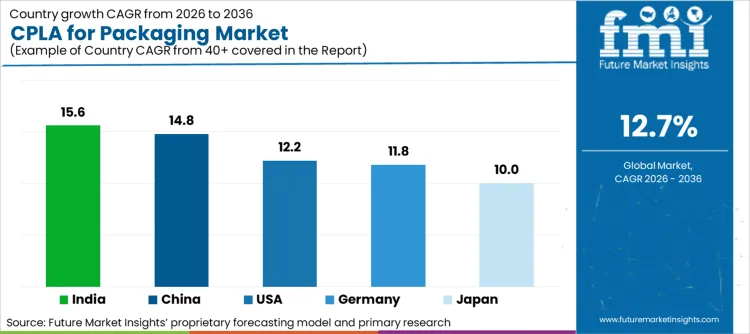
The demand for CPLA for packaging is rising across food service, disposable tableware, and consumer goods packaging where compostability, heat resistance, and material performance are critical. India leads at 15.6% CAGR, supported by growing adoption of eco-friendly packaging, rapid expansion in food delivery services, and regulatory support for biodegradable materials. China follows at 14.8%, driven by large scale adoption in retail and food packaging. The USA grows at 12.2%, shaped by corporate sustainability initiatives and consumer preference for compostable packaging. Germany records 11.8%, reflecting strict environmental regulations and adoption in food and specialty packaging segments. Japan posts 10.0%, within a mature market emphasizing compliance, material quality, and certified compostable solutions.
How Foodservice Volume Drives the CPLA for Packaging Market in Germany
High-demand foodservice operations are influencing the CPLA for packaging market in Germany, which is growing at an 11.8% CAGR. Material selection emphasizes heat resistance, structural integrity, and certified compostability to meet performance and environmental standards.
Technical teams evaluate dimensional stability, seal strength, and compatibility with automated filling and packaging systems. Once validated, CPLA products are deployed across multiple production lines and packaging formats. Volume growth follows adoption by retail chains, catering services, and institutional programs. Supplier participation depends on certification verification, audit compliance, and technical support for integration. Commercial success relies on consistent material performance, reproducibility, and operational reliability across production facilities.
How High-Throughput Packaging Lines Influence the CPLA for Packaging Market in the USA
In the United States, the CPLA for packaging market is expanding at a 12.2% CAGR due to increasing demand from automated, high-volume foodservice and retail packaging lines. Evaluation focuses on heat tolerance, structural rigidity, and certified compostability. Engineers assess seal strength, dimensional stability, and process compatibility with filling and sealing equipment. Once approved, materials are implemented across multiple production lines and packaging applications.
Supplier access relies on certification accuracy, technical documentation, and support for process integration. Volume growth follows expansion of e-commerce, retail, and institutional packaging programs. Commercial success depends on reproducible material performance, operational reliability, and quality consistency across production facilities.
How Urban E-Commerce Growth Shapes the CPLA for Packaging Market in China
Rapid expansion of urban e-commerce and logistics operations is driving the CPLA for packaging market in China at a 14.8% CAGR. Materials are evaluated for heat resistance, structural performance, barrier properties, and certified compostability under high-speed production conditions. Technical teams assess seal integrity, dimensional stability, and compatibility with automated filling and packaging systems. Once validated, products are applied across multiple production lines and packaging formats. Supplier participation depends on audit compliance, documentation verification, and operational support. Volume growth is linked to urban distribution, e-commerce packaging programs, and large-scale foodservice adoption. Commercial advantage relies on reproducible material performance, operational reliability, and integration support for high-throughput operations.
How Product Safety and Application Requirements Guide the CPLA for Packaging Market in Japan
In Japan, the CPLA for packaging market is progressing at a 10% CAGR due to stringent food safety and application requirements. Materials are assessed for mechanical integrity, heat tolerance, barrier efficiency, and certified compostability. Testing includes dimensional stability, seal strength, and compatibility with automated filling and packaging systems. Once validated, products are deployed across multiple production lines for retail, institutional, and foodservice applications. Supplier participation depends on certification completeness, audit compliance, and technical support. Volume growth follows adoption by packaged food programs, retail chains, and sustainability-focused initiatives. Commercial success depends on consistent material performance, reproducibility, and operational reliability across facilities.
How Platform Expansion and Production Scaling Drive the CPLA for Packaging Market in India
India’s CPLA for packaging market is growing at a 15.6% CAGR due to rapid e-commerce expansion and large-scale foodservice and retail packaging programs. Materials are selected for structural integrity, heat resistance, seal durability, and certified compostability under automated filling and packaging operations. Engineers assess dimensional stability, thermal performance, and compatibility with high-speed production lines. Once validated, CPLA products are implemented across multiple production lines and distribution programs. Supplier participation depends on certification verification, audit compliance, and technical support. Volume growth aligns with platform expansion, fleet adoption, and high-volume production programs. Commercial advantage relies on reproducible performance, operational reliability, and consistent technical support across manufacturing facilities.
What Strategies Are Companies Using in the CPLA for Packaging Market?
Material compostability, thermal performance, and processing reliability drive adoption in the CPLA for Packaging Market. NatureWorks, Sulapac, Danimer Scientific, Eco-Products, Hisun Biomaterials, Kingfa Sci. & Tech., and Mitsubishi Chemical Group compete during pilot extrusion, thermoforming trials, and packaging line validation. Once incorporated into food service, disposable, or industrial packaging, heat resistance, dimensional stability, and certified compostability anchor supplier selection. NatureWorks emphasizes high-performance PLA-based CPLA for industrial and food-contact applications.
Sulapac delivers bio-based composites suitable for rigid and flexible packaging. Danimer Scientific provides CPLA films and molded products optimized for composting processes. Eco-Products targets disposable packaging applications requiring heat stability. Hisun Biomaterials supplies functional biopolymer resins for molded items. Kingfa Sci. & Tech. delivers high-performance composites for packaging formats. Mitsubishi Chemical Group focuses on scalable CPLA production with consistent thermal and mechanical performance.
Processing stability, product consistency, and certification support shape competitive positioning in the CPLA for Packaging Market. Engineers assess dimensional tolerance, thermal resistance, mechanical strength, and compostability verification during validation. Suppliers capable of reproducible production, scalable output, and technical guidance gain preference. NatureWorks secures adoption through industrial-scale validation and technical support.
Sulapac maintains share in sustainable rigid packaging solutions. Danimer Scientific competes in molded and thermoformed compostable packaging. Eco-Products captures adoption in disposable consumer items. Hisun Biomaterials provides industrial-grade CPLA for food contact. Kingfa Sci. & Tech. supports functional packaging applications requiring reliable performance. Mitsubishi Chemical Group delivers large-scale production with validated compostable compliance. Market positions vary by product type, application, production scale, and regional environmental regulations.
Key Players in CPLA for Packaging Market
- NatureWorks LLC
- Sulapac Oy
- Danimer Scientific, Inc.
- Eco-Products, Inc.
- Hisun Biomaterials Co., Ltd.
- Kingfa Sci. & Tech. Co., Ltd.
- Mitsubishi Chemical Group Corporation
Scope of the Report
| Items | Values |
|---|---|
| Quantitative Units (2026) | USD billion |
| End-use | Foodservice and takeaway, coffee chains and QSR, mass foodservice, premium compostables, institutional catering, others |
| Packaging Type | Cups, lids and cutlery packs, rigid food containers, thermoformed packs, heat-resistant containers, others |
| Material Grade | CPLA compounds, CPLA blends, CPLA resin, CPLA, others |
| Processing Technology | Crystallization and heat-set moulding, injection moulding optimisation, high-cavity moulding, precision moulding, others |
| Regions Covered | Asia Pacific, Europe, North America, Latin America, Middle East & Africa |
| Countries Covered | United States, Canada, Mexico, Germany, United Kingdom, France, Italy, Spain, Nordics, BENELUX, China, Japan, South Korea, India, Australia & New Zealand, ASEAN, Brazil, Chile, Saudi Arabia, Turkey, South Africa, and other regional markets |
| Key Companies Profiled | NatureWorks, Sulapac, Danimer Scientific, Eco-Products, Hisun Biomaterials, Kingfa Sci. & Tech., Mitsubishi Chemical Group |
| Additional Attributes | Dollar sales by end-use, packaging type, material grade, and processing technology, heat resistance and dimensional stability performance benchmarks, compostability certification and audit governance, tooling and mould qualification cycles, forming yield and scrap rate tracking, compatibility with thermoforming and injection moulding lines, multi-year foodservice and retail packaging program contracts, service temperature compliance testing, and regional demand patterns across foodservice, takeaway, and rigid packaging applications |
CPLA for Packaging Market Segmentation
End-use:
- Foodservice & takeaway
- Coffee chains & QSR
- Mass foodservice
- Premium compostables
- Institutional catering
- Others
Packaging Type:
- Cups, lids & cutlery packs
- Rigid food containers
- Thermoformed packs
- Heat-resistant containers
- Others
Material Grade:
- CPLA compounds
- CPLA blends
- CPLA resin
- CPLA
- Others
Processing Technology:
- Crystallization & heat-set moulding
- Injection moulding optimisation
- High-cavity moulding
- Precision moulding
- Others
Region
- Asia Pacific
- China
- Japan
- South Korea
- India
- Australia & New Zealand
- ASEAN
- Rest of Asia Pacific
- Europe
- Germany
- United Kingdom
- France
- Italy
- Spain
- Nordic
- BENELUX
- Rest of Europe
- North America
- United States
- Canada
- Mexico
- Latin America
- Brazil
- Chile
- Rest of Latin America
- Middle East & Africa
- Kingdom of Saudi Arabia
- Other GCC Countries
- Turkey
- South Africa
- Other African Union
- Rest of Middle East & Africa
Bibliography
- European Commission. (2024). Packaging and packaging waste. European Commission.
- European Commission. (2023). Policy framework on biobased, biodegradable and compostable plastics. European Commission.
- European Committee for Standardization. (2024). EN 13432: Packaging - Requirements for packaging recoverable through composting and biodegradation. CEN.
- International Organization for Standardization. (2023). ISO 17088: Specifications for compostable plastics. ISO.
-
Frequently Asked Questions
- How big is the CPLA for packaging market in 2026? The CPLA for packaging market is projected to be valued at USD 1.2 billion in 2026.
- What will be the size of the CPLA for packaging market in 2036? The market size for CPLA for packaging is projected to reach USD 3.8 billion by 2036.
- How fast will the CPLA for packaging market grow between 2026 and 2036? Demand for CPLA for packaging is projected to grow at a 12.7% CAGR between 2026 and 2036.
- Which end-use segment holds a significant share in the CPLA for packaging market in 2026? In terms of end use, foodservice and takeaway are expected to account for a 51% share in 2026.
- Which packaging type category contributes a major share in the CPLA for packaging market in 2026? Cups, lids and cutlery packs are expected to represent a 39% share in the CPLA for packaging market in 2026.
Frequently Asked Questions
How big is the cpla for packaging market in 2026?
The global cpla for packaging market is estimated to be valued at USD 1.2 billion in 2026.
What will be the size of cpla for packaging market in 2036?
The market size for the cpla for packaging market is projected to reach USD 4.0 billion by 2036.
How much will be the cpla for packaging market growth between 2026 and 2036?
The cpla for packaging market is expected to grow at a 12.7% CAGR between 2026 and 2036.
What are the key product types in the cpla for packaging market?
The key product types in cpla for packaging market are foodservice & takeaway, coffee chains & qsr, mass foodservice, premium compostables, institutional catering and others.
Which packaging type segment to contribute significant share in the cpla for packaging market in 2026?
In terms of packaging type, cups, lids & cutlery packs segment to command 39.0% share in the cpla for packaging market in 2026.
Preview the report firsthand - request a free sample
Get SampleGet the brochure for pricing and purchase details.
Get PDFTable of Content
- Executive Summary
- Global Market Outlook
- Demand-side Trends
- Supply-side Trends
- Technology Roadmap Analysis
- Analysis and Recommendations
- Market Overview
- Market Coverage / Taxonomy
- Market Definition / Scope / Limitations
- Market Background
- Market Dynamics
- Drivers
- Restraints
- Opportunity
- Trends
- Scenario Forecast
- Demand in Optimistic Scenario
- Demand in Likely Scenario
- Demand in Conservative Scenario
- Opportunity Map Analysis
- Product Life Cycle Analysis
- Supply Chain Analysis
- Investment Feasibility Matrix
- Value Chain Analysis
- PESTLE and Porter’s Analysis
- Regulatory Landscape
- Regional Parent Market Outlook
- Production and Consumption Statistics
- Import and Export Statistics
- Market Dynamics
- Global Market Analysis 2021 to 2025 and Forecast, 2026 to 2036
- Historical Market Size Value (USD Million) Analysis, 2021 to 2025
- Current and Future Market Size Value (USD Million) Projections, 2026 to 2036
- Y-o-Y Growth Trend Analysis
- Absolute $ Opportunity Analysis
- Global Market Pricing Analysis 2021 to 2025 and Forecast 2026 to 2036
- Global Market Analysis 2021 to 2025 and Forecast 2026 to 2036, By End-use
- Introduction / Key Findings
- Historical Market Size Value (USD Million) Analysis By End-use , 2021 to 2025
- Current and Future Market Size Value (USD Million) Analysis and Forecast By End-use , 2026 to 2036
- Foodservice & takeaway
- Coffee chains & QSR
- Mass foodservice
- Premium compostables
- Institutional catering
- Others
- Foodservice & takeaway
- Y-o-Y Growth Trend Analysis By End-use , 2021 to 2025
- Absolute $ Opportunity Analysis By End-use , 2026 to 2036
- Global Market Analysis 2021 to 2025 and Forecast 2026 to 2036, By Packaging Type
- Introduction / Key Findings
- Historical Market Size Value (USD Million) Analysis By Packaging Type, 2021 to 2025
- Current and Future Market Size Value (USD Million) Analysis and Forecast By Packaging Type, 2026 to 2036
- Cups, lids & cutlery packs
- Rigid food containers
- Thermoformed packs
- Heat-resistant containers
- Others
- Cups, lids & cutlery packs
- Y-o-Y Growth Trend Analysis By Packaging Type, 2021 to 2025
- Absolute $ Opportunity Analysis By Packaging Type, 2026 to 2036
- Global Market Analysis 2021 to 2025 and Forecast 2026 to 2036, By Material Grade
- Introduction / Key Findings
- Historical Market Size Value (USD Million) Analysis By Material Grade, 2021 to 2025
- Current and Future Market Size Value (USD Million) Analysis and Forecast By Material Grade, 2026 to 2036
- CPLA compounds
- CPLA blends
- CPLA resin
- CPLA
- Others
- CPLA compounds
- Y-o-Y Growth Trend Analysis By Material Grade, 2021 to 2025
- Absolute $ Opportunity Analysis By Material Grade, 2026 to 2036
- Global Market Analysis 2021 to 2025 and Forecast 2026 to 2036, By Processing Technology
- Introduction / Key Findings
- Historical Market Size Value (USD Million) Analysis By Processing Technology, 2021 to 2025
- Current and Future Market Size Value (USD Million) Analysis and Forecast By Processing Technology, 2026 to 2036
- Crystallization & heat-set moulding
- Injection moulding optimisation
- High-cavity moulding
- Precision moulding
- Others
- Crystallization & heat-set moulding
- Y-o-Y Growth Trend Analysis By Processing Technology, 2021 to 2025
- Absolute $ Opportunity Analysis By Processing Technology, 2026 to 2036
- Global Market Analysis 2021 to 2025 and Forecast 2026 to 2036, By Region
- Introduction
- Historical Market Size Value (USD Million) Analysis By Region, 2021 to 2025
- Current Market Size Value (USD Million) Analysis and Forecast By Region, 2026 to 2036
- North America
- Latin America
- Western Europe
- Eastern Europe
- East Asia
- South Asia and Pacific
- Middle East & Africa
- Market Attractiveness Analysis By Region
- North America Market Analysis 2021 to 2025 and Forecast 2026 to 2036, By Country
- Historical Market Size Value (USD Million) Trend Analysis By Market Taxonomy, 2021 to 2025
- Market Size Value (USD Million) Forecast By Market Taxonomy, 2026 to 2036
- By Country
- USA
- Canada
- Mexico
- By End-use
- By Packaging Type
- By Material Grade
- By Processing Technology
- By Country
- Market Attractiveness Analysis
- By Country
- By End-use
- By Packaging Type
- By Material Grade
- By Processing Technology
- Key Takeaways
- Latin America Market Analysis 2021 to 2025 and Forecast 2026 to 2036, By Country
- Historical Market Size Value (USD Million) Trend Analysis By Market Taxonomy, 2021 to 2025
- Market Size Value (USD Million) Forecast By Market Taxonomy, 2026 to 2036
- By Country
- Brazil
- Chile
- Rest of Latin America
- By End-use
- By Packaging Type
- By Material Grade
- By Processing Technology
- By Country
- Market Attractiveness Analysis
- By Country
- By End-use
- By Packaging Type
- By Material Grade
- By Processing Technology
- Key Takeaways
- Western Europe Market Analysis 2021 to 2025 and Forecast 2026 to 2036, By Country
- Historical Market Size Value (USD Million) Trend Analysis By Market Taxonomy, 2021 to 2025
- Market Size Value (USD Million) Forecast By Market Taxonomy, 2026 to 2036
- By Country
- Germany
- UK
- Italy
- Spain
- France
- Nordic
- BENELUX
- Rest of Western Europe
- By End-use
- By Packaging Type
- By Material Grade
- By Processing Technology
- By Country
- Market Attractiveness Analysis
- By Country
- By End-use
- By Packaging Type
- By Material Grade
- By Processing Technology
- Key Takeaways
- Eastern Europe Market Analysis 2021 to 2025 and Forecast 2026 to 2036, By Country
- Historical Market Size Value (USD Million) Trend Analysis By Market Taxonomy, 2021 to 2025
- Market Size Value (USD Million) Forecast By Market Taxonomy, 2026 to 2036
- By Country
- Russia
- Poland
- Hungary
- Balkan & Baltic
- Rest of Eastern Europe
- By End-use
- By Packaging Type
- By Material Grade
- By Processing Technology
- By Country
- Market Attractiveness Analysis
- By Country
- By End-use
- By Packaging Type
- By Material Grade
- By Processing Technology
- Key Takeaways
- East Asia Market Analysis 2021 to 2025 and Forecast 2026 to 2036, By Country
- Historical Market Size Value (USD Million) Trend Analysis By Market Taxonomy, 2021 to 2025
- Market Size Value (USD Million) Forecast By Market Taxonomy, 2026 to 2036
- By Country
- China
- Japan
- South Korea
- By End-use
- By Packaging Type
- By Material Grade
- By Processing Technology
- By Country
- Market Attractiveness Analysis
- By Country
- By End-use
- By Packaging Type
- By Material Grade
- By Processing Technology
- Key Takeaways
- South Asia and Pacific Market Analysis 2021 to 2025 and Forecast 2026 to 2036, By Country
- Historical Market Size Value (USD Million) Trend Analysis By Market Taxonomy, 2021 to 2025
- Market Size Value (USD Million) Forecast By Market Taxonomy, 2026 to 2036
- By Country
- India
- ASEAN
- Australia & New Zealand
- Rest of South Asia and Pacific
- By End-use
- By Packaging Type
- By Material Grade
- By Processing Technology
- By Country
- Market Attractiveness Analysis
- By Country
- By End-use
- By Packaging Type
- By Material Grade
- By Processing Technology
- Key Takeaways
- Middle East & Africa Market Analysis 2021 to 2025 and Forecast 2026 to 2036, By Country
- Historical Market Size Value (USD Million) Trend Analysis By Market Taxonomy, 2021 to 2025
- Market Size Value (USD Million) Forecast By Market Taxonomy, 2026 to 2036
- By Country
- Kingdom of Saudi Arabia
- Other GCC Countries
- Turkiye
- South Africa
- Other African Union
- Rest of Middle East & Africa
- By End-use
- By Packaging Type
- By Material Grade
- By Processing Technology
- By Country
- Market Attractiveness Analysis
- By Country
- By End-use
- By Packaging Type
- By Material Grade
- By Processing Technology
- Key Takeaways
- Key Countries Market Analysis
- USA
- Pricing Analysis
- Market Share Analysis, 2025
- By End-use
- By Packaging Type
- By Material Grade
- By Processing Technology
- Canada
- Pricing Analysis
- Market Share Analysis, 2025
- By End-use
- By Packaging Type
- By Material Grade
- By Processing Technology
- Mexico
- Pricing Analysis
- Market Share Analysis, 2025
- By End-use
- By Packaging Type
- By Material Grade
- By Processing Technology
- Brazil
- Pricing Analysis
- Market Share Analysis, 2025
- By End-use
- By Packaging Type
- By Material Grade
- By Processing Technology
- Chile
- Pricing Analysis
- Market Share Analysis, 2025
- By End-use
- By Packaging Type
- By Material Grade
- By Processing Technology
- Germany
- Pricing Analysis
- Market Share Analysis, 2025
- By End-use
- By Packaging Type
- By Material Grade
- By Processing Technology
- UK
- Pricing Analysis
- Market Share Analysis, 2025
- By End-use
- By Packaging Type
- By Material Grade
- By Processing Technology
- Italy
- Pricing Analysis
- Market Share Analysis, 2025
- By End-use
- By Packaging Type
- By Material Grade
- By Processing Technology
- Spain
- Pricing Analysis
- Market Share Analysis, 2025
- By End-use
- By Packaging Type
- By Material Grade
- By Processing Technology
- France
- Pricing Analysis
- Market Share Analysis, 2025
- By End-use
- By Packaging Type
- By Material Grade
- By Processing Technology
- India
- Pricing Analysis
- Market Share Analysis, 2025
- By End-use
- By Packaging Type
- By Material Grade
- By Processing Technology
- ASEAN
- Pricing Analysis
- Market Share Analysis, 2025
- By End-use
- By Packaging Type
- By Material Grade
- By Processing Technology
- Australia & New Zealand
- Pricing Analysis
- Market Share Analysis, 2025
- By End-use
- By Packaging Type
- By Material Grade
- By Processing Technology
- China
- Pricing Analysis
- Market Share Analysis, 2025
- By End-use
- By Packaging Type
- By Material Grade
- By Processing Technology
- Japan
- Pricing Analysis
- Market Share Analysis, 2025
- By End-use
- By Packaging Type
- By Material Grade
- By Processing Technology
- South Korea
- Pricing Analysis
- Market Share Analysis, 2025
- By End-use
- By Packaging Type
- By Material Grade
- By Processing Technology
- Russia
- Pricing Analysis
- Market Share Analysis, 2025
- By End-use
- By Packaging Type
- By Material Grade
- By Processing Technology
- Poland
- Pricing Analysis
- Market Share Analysis, 2025
- By End-use
- By Packaging Type
- By Material Grade
- By Processing Technology
- Hungary
- Pricing Analysis
- Market Share Analysis, 2025
- By End-use
- By Packaging Type
- By Material Grade
- By Processing Technology
- Kingdom of Saudi Arabia
- Pricing Analysis
- Market Share Analysis, 2025
- By End-use
- By Packaging Type
- By Material Grade
- By Processing Technology
- Turkiye
- Pricing Analysis
- Market Share Analysis, 2025
- By End-use
- By Packaging Type
- By Material Grade
- By Processing Technology
- South Africa
- Pricing Analysis
- Market Share Analysis, 2025
- By End-use
- By Packaging Type
- By Material Grade
- By Processing Technology
- USA
- Market Structure Analysis
- Competition Dashboard
- Competition Benchmarking
- Market Share Analysis of Top Players
- By Regional
- By End-use
- By Packaging Type
- By Material Grade
- By Processing Technology
- Competition Analysis
- Competition Deep Dive
- NatureWorks LLC
- Overview
- Product Portfolio
- Profitability by Market Segments (Product/Age /Sales Channel/Region)
- Sales Footprint
- Strategy Overview
- Marketing Strategy
- Product Strategy
- Channel Strategy
- Sulapac Oy
- Danimer Scientific, Inc.
- Eco-Products, Inc.
- Hisun Biomaterials Co., Ltd.
- Kingfa Sci. & Tech. Co., Ltd.
- Mitsubishi Chemical Group Corporation
- NatureWorks LLC
- Competition Deep Dive
- Assumptions & Acronyms Used
- Research Methodology


