

- Market Size (2026)
- USD 840.2 Mn
- Forecast (2036)
- USD 3169.9 Mn
- CAGR (2026 to 2036)
- 14.2%
How big is Dosa & Idli Batter Market in 2026?
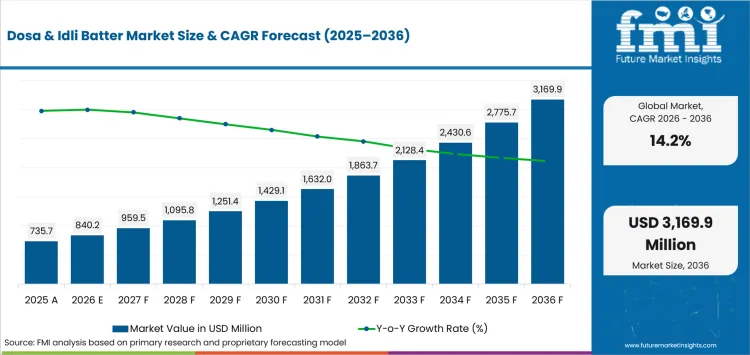
USD 840.2 million in 2026 and USD 3169.9 million by 2036 at a 14.2% CAGR.
Sales of dosa & idli batter is projected to rise from USD 840.2 million in 2026 to USD 3169.9 million by 2036 at 14.2% CAGR. Demand is supported by households that prefer ready-to-cook convenience while retaining the taste and preparation characteristics of traditional fermented foods. The commercial proposition is similar to batter-based premixes and other processed food categories where consumers outsource soaking, grinding, and fermentation rather than the final cooking step. In January 2025, CSIR-CFTRI offered a ready-to-use dosa batter process for retail packs to interested entrepreneurs. The availability of standardized production technology can help expand packaged-batter manufacturing and improve product consistency, supporting wider retail distribution without removing the final cooking stage from the consumer.
Country economics differ because chilled distribution must match the density of households already familiar with the meal. Singapore provides a clear case: Department of Statistics data put Indian residents at 9.0% of the resident population at end-June 2025. That concentration gives ethnic food retailers a compact replenishment base, whereas longer distances in the USA and Australia raise the cost of serving dispersed demand. Format choice therefore changes by geography even under the same forecast.
Key Takeaways
- Convenience demand converts into repeat purchasing after prepared batter removes soaking, grinding and fermentation without changing the household cooking ritual.
- Dosa batter is estimated to account for 44.0% of product type in 2026, with quick pan preparation widening use beyond breakfast.
- Within claim - nature, conventional is projected at 58.0% in 2026 because familiar rice-lentil recipes avoid a certification premium for mainstream purchases.
- Fresh is forecast to hold 33.0% of format in 2026, since chilled fermentation character remains closest to the home-prepared eating experience.
- Short refrigerated life limits fresh-batter expansion whenever route density, store rotation or household consumption fails to absorb inventory before quality declines.
- Key players in the dosa & idli batter market include iD Fresh Food (India) Private Limited, Orkla India Limited, Milky Mist Dairy Food Limited, GRM Overseas Limited, Madhusudan Masala Limited, Vitagreen Products Private Limited, Jhandewalas Foods Limited, and Tata Consumer Products Limited.
Analyst Perspective
"Operators should compare fermentation consistency, shelf-life economics and store-level sell-through before comparing nominal unit price. Commercial value is earned through a format that reaches the household with the expected texture and enough remaining life to avoid waste."
- Nandini Roy Choudhury, Principal Consultant, Future Market Insights
How is the dosa & idli batter market segmented?
The market is assessed by product type, claim - nature, format, packaging format, sales channel and region.
Product type covers dosa batter, idli batter, multigrain and millet batters, and organic batters. Claim - nature includes conventional, clean label, organic, gluten-free, and high-protein or fortified propositions. Format separates fresh, frozen, ambient packaged, chilled, and par-baked or thaw-and-serve products. Packaging format covers multipack, single-serve, family or loaf pack, and bulk foodservice. Sales channel includes supermarkets and hypermarkets, artisan and specialty bakeries, convenience and forecourt, online and DTC, and foodservice distributors.
Why does conventional lead the claim - nature category?
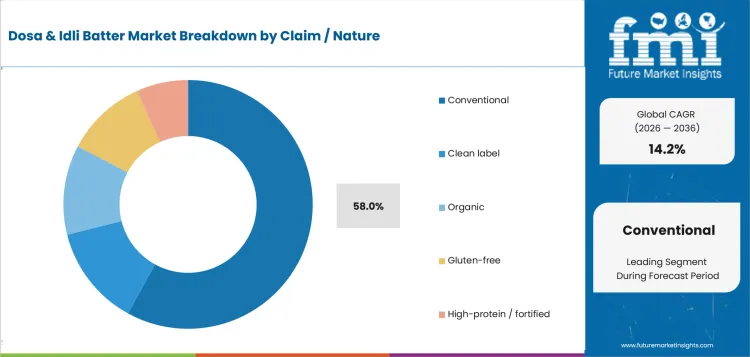
Conventional batter keeps the purchase close to familiar rice-and-lentil recipes. organic foods and gluten-free food claims require a clearer reason to pay more. Mainstream volume therefore starts with taste, texture and availability before certification becomes decisive.
- Conventional represents 58.0% of claim - nature in 2026, attributable to a familiar formulation that requires little explanation at first purchase or repeat purchase.
- Jhandewalas Foods filed its 2024-25 annual report in August 2025 with rava idli mix inside its expanding packaged-food range. That filing shows continued investment in familiar breakfast preparations.
Why does dosa batter lead the product type category?
Dosa batter fits fast pan cooking and several meal occasions without requiring steaming equipment. The same pan can handle thin dosas or thicker preparations. That operating advantage overlaps with the broader convenience foods category, where preparation time affects repeat purchase.
- By product type, dosa batter is estimated to hold 44.0% in 2026 because pour-and-spread preparation fits frequent household use.
- Madhusudan Masala stated in its May 2025 earnings call that the 77 GREEN instant-mix range includes both idli and dosa. The filing confirms packaged competition beside fresh batter.
Why does fresh lead the format category?
Fresh batter competes on fermentation character and cooking texture from pack opening through the final cook, which makes chilled food packaging part of route economics. Frozen food formats widen distance but change thawing, inventory and eating-quality trade-offs.
- The fresh segment is projected to account for 33.0% of format in 2026 due to consumer preference for refrigerated batter close to home preparation.
- Orkla India stated in November 2025 that its fresh ready-to-use batter had been in market for about two years. The disclosure confirms active commercial testing of the chilled format.
Why do supermarkets & hypermarkets lead the sales channel category?
Supermarkets and hypermarkets offer chilled cabinets, regular grocery traffic and store-level replenishment data in one route. Those conditions make slow inventory visible before short-life batter becomes a write-off. High-turn stores also reduce the time each pouch spends in inventory.
- Supermarkets & hypermarkets hold 38.0% of sales channel in 2026 because cold storage and repeat visits improve chilled inventory rotation.
- Singapore Food Agency data, updated in May 2026, record 717 licensed physical supermarkets. That dense modern-retail base gives packaged batter more refrigerated points of sale within a compact geography.
What are the drivers, restraints and opportunities in the Dosa & Idli Batter Market?
Preparation outsourcing raises demand, fresh-product economics limit distance, and route-specific formats give manufacturers the clearest path to wider distribution.
- Driver: Households buy prepared batter to remove soaking, grinding and fermentation and retain a freshly cooked meal.
- Restraint: Chilled batter loses economic reach where route density cannot protect sell-through and remaining shelf life.
- Opportunity: Shelf-stable mixes, local plants and nutrition-led recipes can serve demand that fresh distribution cannot reach economically.
Packaged Convenience Converts Existing Breakfast Habits
The driver is preparation work that can be removed without changing the final meal. Orkla India disclosed in June 2025 that its portfolio exceeded 400 products and averaged about 2.3 million units sold daily in fiscal 2025. Those figures cover the wider portfolio, not batter alone, but they show the channel scale available to convenience foods that fit established South Indian breakfast habits.
Fresh-Batter Expansion Depends on Route Economics
Fresh batter needs enough throughput to cover refrigeration, frequent delivery and unsold inventory risk. In February 2026, Orkla India said its fresh idli-dosa batter business had reached a margin position that allowed expansion into additional metro towns. The sequence is commercially important: distribution breadth follows proven unit economics instead of preceding it.
Longer-Life Formats Widen the Addressable Route
The opportunity is to match product life to the distance between production and consumption. GRM Overseas presented Faashta in August 2025 as a ready-to-cook and ready-to-eat platform planned to include dosa and idli mixes. Nutrition-led extensions can borrow cues from plant-based protein and plant-based food categories, provided cooking texture and familiar flavour remain intact.
Which country CAGRs are profiled in the Dosa & Idli Batter Market?
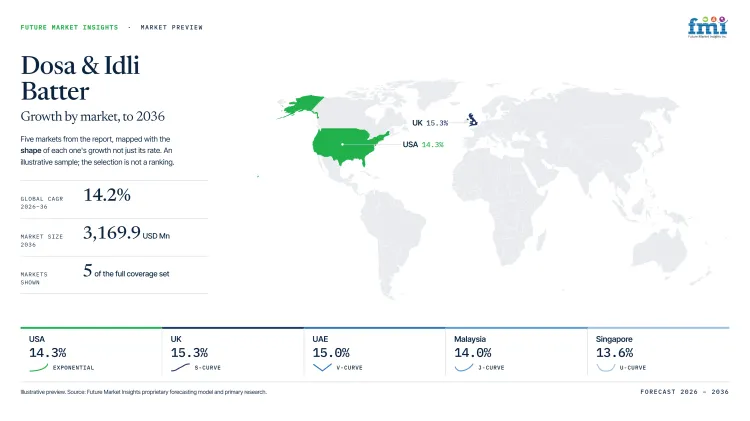
| Country | CAGR |
|---|---|
| UK | 15.3% from 2026 to 2036 |
| UAE | 14.9% from 2026 to 2036 |
| Australia | 14.6% from 2026 to 2036 |
| USA | 14.3% from 2026 to 2036 |
| Malaysia | 14.0% from 2026 to 2036 |
| Singapore | 13.6% from 2026 to 2036 |
| Canada | 13.3% from 2026 to 2036 |
How do country-level CAGRs compare in the Dosa & Idli Batter Market?
The forecasts span 2.0 percentage points from the UK to Canada. UK, UAE and Australia form the upper group above 14.5%. USA and Malaysia sit near the middle. Singapore and Canada are slower in percentage terms. The narrow spread makes route design, format life and retailer access more useful than headline CAGR alone for sequencing entry.
- UK offers specialist South Asian grocery demand alongside mainstream retail and fast home-delivery coverage in its largest cities.
- UAE concentrates a large Indian consumer base in Gulf metros where local production can shorten refrigerated delivery cycles.
- Australia offers strong metropolitan demand, yet the distance between major cities makes national fresh distribution expensive to duplicate.
- USA mixes ethnic grocery, warehouse retail and online delivery, which makes regional production nodes more practical than one national route.
- Malaysia has familiar breakfast demand, though value pricing and competing local preparations increase the burden on packaged-batter differentiation.
- Singapore pairs compact geography with dense food retail, allowing frequent replenishment even with a smaller absolute consumer base.
- Canada concentrates South Asian demand in major metros, leaving longer inter-city routes to favor regional chilled hubs or longer-life formats.
Comparable CAGRs therefore hide different cost structures for freshness, distribution and retailer coverage. The same format can be attractive in one country and uneconomic in another. The full report provides country-level CAGR analysis across North America, Latin America, Europe, East Asia, South Asia, Oceania and the Middle East and Africa.
Country-wise Analysis
- UK chilled grocery demand is strongest where specialist South Asian stores overlap with mainstream supermarkets and rapid-delivery services in large cities. The country's dosa & idli batter outlook is projected to expand at 15.3% CAGR over the assessment period, tied to broad category familiarity and multiple retail routes. In November 2025, the Office for National Statistics identified Indian as the most common non-EU+ nationality among long-term immigrants in the year ending June 2025, and that continuing consumer inflow gives brands a replenishment base, though falling overall immigration and costly nationwide chilled distribution limit how quickly fresh ranges can move beyond dense urban clusters.
- UAE demand is concentrated in Dubai, Abu Dhabi and the northern emirates, where high temperatures make uninterrupted refrigeration a practical condition for fresh batter. The Embassy of India stated in September 2025 that about 4.3 million Indian nationals lived in the UAE during 2024, equal to roughly 35% of the population, and the concentration gives familiar South Indian products a large addressable base. Dosa & idli batter sales in the UAE are forecast to expand at 14.9% CAGR through 2036, because local manufacturing can shorten delivery loops, yet heat exposure and cold-chain execution leave less room for weak store rotation than ambient mixes face.
- Australian launches work best through Sydney, Melbourne and other major metros because city-to-city distance makes one chilled route expensive to stretch nationally. Australian Bureau of Statistics data released in April 2026 counted 971,020 India-born residents at June 2025, making India the country's largest overseas-born group and a base for familiar breakfast products. Australia is estimated to post 14.6% CAGR over the forecast period, aided by that demographic depth, and the faster commercial route is selective metropolitan coverage first, and fresh-batter expansion into smaller cities depends on regional production, reliable refrigerated transport or formats with enough life to absorb long distribution legs.
- USA retail access is split among Indian grocers, warehouse clubs, mainstream supermarkets and online delivery, so chilled batter needs regional replenishment instead of one coast-to-coast schedule. Demand is forecast to grow at 14.3% CAGR during the forecast period, given a large diaspora and broad channel choice, but refrigerated freight and uneven household density raise the cost of national fresh coverage. The USA Census Bureau published in April 2026 that the Asian Indian population reached 5.6 million in 2024, and that scale can support regional production nodes, and companies without those nodes may need frozen or shelf-stable products to serve lower-density areas economically.
- Malaysian households already encounter fermented rice and pulse breakfasts beside a broad range of local convenience foods, which lowers the education needed for dosa and idli but keeps price comparison intense. Department of Statistics Malaysia reported in May 2026 that Indians represented 6.5% of the citizen population in the first quarter of 2026, giving the category a stable cultural base without making it a mass-market default. Malaysia could advance at 14.0% CAGR through 2036, aided by familiar food habits, and brands still need pack sizes and price points that fit local grocery spending because chilled products compete with freshly prepared alternatives sold close to the eating occasion.
- Singapore's compact urban geography lets refrigerated food travel from production to store on short routes, with high retail density supporting frequent restocking. Dosa & idli batter demand is likely to register 13.6% CAGR over the forecast period, propelled by dense distribution and familiar South Asian eating occasions instead of long-distance logistics. Department of Statistics data list population density at 8,300 people per square kilometre in 2025, and that physical concentration favors short replenishment cycles, though Singapore's smaller absolute population caps the volume available to any one brand and makes shelf productivity important for retailers deciding which chilled batter ranges retain cabinet space.
- Canadian demand is concentrated in Toronto, Vancouver and other metropolitan areas, but the distance between those clusters raises the cost of maintaining one fresh-batter network. Statistics Canada documented in December 2025 that 2.57 million people identified as South Asian in the 2021 Census, equal to 7.1% of Canada's population, with India-born residents forming the largest birthplace group within that population. Canada is on track to deliver 13.3% CAGR through 2036, since major-city density gives brands viable launch hubs, but expansion beyond them favors regional co-packing, frozen inventory or longer-life formats that tolerate slower inter-city replenishment without sacrificing cooking performance in smaller cities.
Who are the notable companies in the Dosa & Idli Batter Market?
iD Fresh Food (India) Private Limited, Orkla India Limited, Milky Mist Dairy Food Limited, GRM Overseas Limited, Madhusudan Masala Limited, Vitagreen Products Private Limited, Jhandewalas Foods Limited, and Tata Consumer Products Limited.
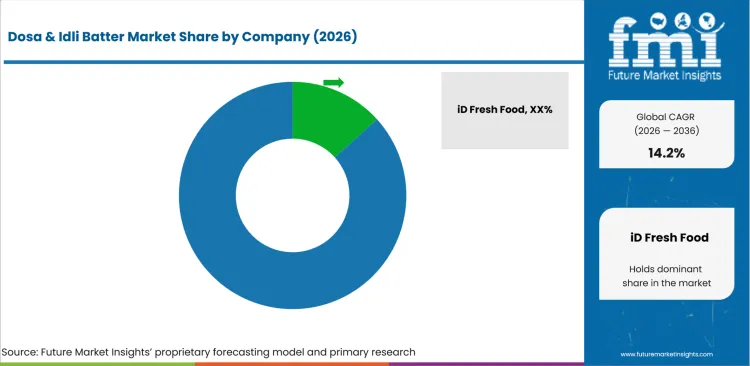
Competition divides between refrigerated batter and shelf-stable mix platforms. iD Fresh Food, Orkla India and Milky Mist anchor chilled routes. The remaining five companies rely more heavily on dry mixes or broader breakfast portfolios. Entry barriers come from fermentation control, cold-chain coverage, retail access and short-life working capital.
- Fresh and chilled platforms: iD Fresh Food (India) Private Limited, Orkla India Limited and Milky Mist Dairy Food Limited.
- Ready-to-cook and instant-mix platforms: GRM Overseas Limited, Madhusudan Masala Limited and Vitagreen Products Private Limited.
- Scaled packaged-food platforms: Jhandewalas Foods Limited and Tata Consumer Products Limited.
Competitive Benchmarking: Dosa & Idli Batter Market
| Company | Prepared Batter / Mix Depth | Recipe and Claim Breadth | Route-to-Market Control | Geographic Reach |
|---|---|---|---|---|
| iD Fresh Food (India) Private Limited | High | High | High | India, Gulf, UK, USA and Singapore |
| Orkla India Limited | High | Medium | High | India and international MTR markets |
| Milky Mist Dairy Food Limited | Medium | Medium | High | India and selected export markets |
| GRM Overseas Limited | Medium | Medium | High | India and multi-country distributor network |
| Madhusudan Masala Limited | Medium | Medium | Medium | India, focused on western and northern distribution |
| Vitagreen Products Private Limited | Medium | Medium | Medium | India through the Madhusudan distribution network |
| Jhandewalas Foods Limited | Low | Low | High | India through a broad distributor and retail network |
| Tata Consumer Products Limited | Low | Medium | High | India with a national packaged-food network |
Scoring basis: High prepared-batter or mix depth requires three or more documented in-scope formats, Medium two, and Low one. Recipe breadth uses the same three, two and one threshold. High route control requires several documented channels or owned chilled logistics, Medium one established multi-city route, and Low a narrower documented route.
Key Developments in the Dosa & Idli Batter Market
- In April 2026, Orkla India Limited launched separate MTR Minute Fresh dosa batter and rice rava idli batter in Hyderabad through quick-commerce, ecommerce and selected retail channels.
- In March 2025, Milky Mist Dairy Food Limited acquired Asal Food Products Private Limited through a common-control transaction, bringing the ready-to-cook subsidiary under the listed group structure.
- In February 2025, GRM Overseas Limited signed distributor agreements in Georgia, Chile and Morocco and prepared Faashta ready-to-cook products that included dosa and idli mixes.
Key Players in the Dosa & Idli Batter Market
Fresh-Batter and Chilled-Food Platforms
- iD Fresh Food (India) Private Limited
- Orkla India Limited
- Milky Mist Dairy Food Limited
Ready-to-Cook and Instant-Mix Platforms
- GRM Overseas Limited
- Madhusudan Masala Limited
- Vitagreen Products Private Limited
Scaled Packaged-Food Platforms
- Jhandewalas Foods Limited
- Tata Consumer Products Limited
Dosa & Idli Batter Market - Report Scope
| Coverage field | Report scope |
|---|---|
| Market breakdown | By product type, claim - nature, format, packaging format, sales channel and region. |
| Quantitative Units | USD million. |
| Market Definition | Revenue includes prepared dosa and idli batter plus in-scope packaged batter or mix preparations, while excluding cooked downstream idli or dosa revenue and adjacent substitute foods. |
| Regions Covered | North America, Latin America, Western Europe, Eastern Europe, East Asia, South Asia and Pacific, Middle East and Africa. |
| Countries Covered | UK, UAE, Australia, USA, Malaysia, Singapore, Canada, and more than twenty-five additional countries in the full report. |
| Key Companies Profiled | iD Fresh Food (India) Private Limited, Orkla India Limited, Milky Mist Dairy Food Limited, GRM Overseas Limited, Madhusudan Masala Limited, Vitagreen Products Private Limited, Jhandewalas Foods Limited, and Tata Consumer Products Limited. |
| Forecast Period | 2026 to 2036. |
| Approach | A hybrid bottom-up and top-down framework reconciles supplier evidence, channel access, format availability and country demand within the defined revenue boundary. |
Dosa & Idli Batter Market - Research Methodology
| Method | Approach |
|---|---|
| Primary Research | FMI structures expert discussions around product boundaries, purchase triggers, refrigeration economics, pack choice, retail access and repeat-order conditions. No fixed respondent count is asserted here. |
| Desk Research | Desk research reviews official demographic data, food-retail statistics, regulator filings, company announcements, certification records and current public disclosures that directly fit the defined product scope. |
| Market Sizing and Forecasting | Sizing reconciles in-scope supplier and channel evidence with format availability, diaspora concentration, category penetration and the economics of fresh, frozen and ambient distribution. |
| Data Validation | Validation checks numerical consistency, source fit, company activity and duplication before qualitative findings are reconciled with the forecast framework. |
Dosa & Idli Batter Market by Segments
Dosa & Idli Batter Market segmented by Product Type:
- Dosa batter
- Idli batter
- Multigrain & millet batters
- Organic batters
Dosa & Idli Batter Market segmented by Claim - nature:
- Conventional
- Clean label
- Organic
- Gluten-free
- High-protein / fortified
Dosa & Idli Batter Market segmented by Format:
- Fresh
- Frozen
- Ambient packaged
- Chilled
- Par-baked / thaw-and-serve
Dosa & Idli Batter Market segmented by Packaging Format:
- Multipack
- Single-serve
- Family / loaf pack
- Bulk foodservice
Dosa & Idli Batter Market segmented by Sales Channel:
- Supermarkets & hypermarkets
- Artisan & specialty bakeries
- Convenience & forecourt
- Online & DTC
- Foodservice distributors
Dosa & Idli Batter Market by Region:
- North America
- United States
- Canada
- Latin America
- Brazil
- Mexico
- Argentina
- Chile
- Western Europe
- Germany
- France
- United Kingdom
- Italy
- Spain
- Benelux
- Nordics
- Eastern Europe
- Poland
- Czech Republic
- Romania
- Hungary
- East Asia
- China
- Japan
- South Korea
- South Asia and Pacific
- India
- ASEAN
- Australia and New Zealand
- Middle East and Africa
- GCC Countries
- South Africa
- Türkiye
- Israel
Research Sources and Bibliography
- CSIR-Central Food Technological Research Institute. (2025, January). Demonstration of free technology on ready-to-use dosa batter in retail packs.
- Singapore Department of Statistics. (2025). Population in brief / population trends 2025.
- Singapore Department of Statistics. (2026, May 28). Food establishments: supermarkets.
- Madhusudan Masala Limited. (2025, June 3). H2 & FY25 post earnings conference call transcript.
- Jhandewalas Foods Limited. (2025, August 4). Annual report 2024-25.
- Orkla India Limited. (2025, November 13). Q2 FY26 earnings materials.
- Orkla India Limited. (2025, June 11). Draft red herring prospectus.
- Orkla India Limited. (2026, February 17). Q3 FY26 earnings call transcript.
- GRM Overseas Limited. (2025, August 12). Investor presentation.
- Office for National Statistics. (2025, November 27). Long-term international migration, provisional: year ending June 2025.
- Embassy of India, Abu Dhabi. (2025, September 18). Indian community in UAE.
- Australian Bureau of Statistics. (2026, April 29). Australia's population by country of birth.
- USA Census Bureau. (2026, April 21). Asian American, Native Hawaiian, and Pacific Islander Heritage Month: May 2026.
- Department of Statistics Malaysia. (2026, May). Demographic statistics, Malaysia, first quarter 2026.
- Singapore Department of Statistics. (2026). Population and population structure: latest data.
- Statistics Canada. (2025, December 8). Portrait of the South Asian populations in Canada.
- Orkla India Limited. (2026, April 29). MTR launches Minute Fresh batter in Hyderabad.
- Securities and Exchange Board of India. (2025, July 24). Milky Mist Dairy Food Limited draft red herring prospectus.
- GRM Overseas Limited. (2025, February 14). Q3 FY25 performance and global distribution update.
- Apax Partners. (2026, January 5). iD Fresh Food secures strategic investment from Apax funds.
- Tata Consumer Products Limited. (2026, May 17). Integrated annual report 2025-26.
- ECOCERT India / iD Fresh Food (India) Private Limited. (2026, May). NPOP scope certificate: iD Fresh Organic Idly & Dosa Batter.
- International Finance Corporation. (2026, August 28). Milky Mist 2026 environmental and social review summary.
- National Stock Exchange of India. (2026, February 4). GRM Overseas Limited integrated filing, third quarter FY26.
- Madhusudan Masala Limited. (2026, January 19). Investor presentation.
- National Stock Exchange of India. (2026, February 2). Orkla India Limited prior intimation.
All bibliography destinations were checked against the original organisation, regulator or filing host. Internal Future Market Insights links are navigation references and are not used as evidence.
This Report Answers
- How large is the dosa & idli batter market in 2026 and 2036?
- What growth rate is projected between 2026 and 2036?
- Why does dosa batter lead product type demand?
- Why does conventional lead the claim - nature category?
- Why does fresh lead the format category?
- Which sales channel holds the leading 2026 share?
- How do the profiled country CAGRs compare?
- What limits the economics of fresh refrigerated batter?
- Which companies are active in prepared batter and adjacent idli-dosa mixes?
Frequently Asked Questions
How big is the dosa & idli batter market in 2026?
The dosa & idli batter market is valued at USD 840.2 million in 2026 and is projected to reach USD 3,169.9 million by 2036. Growth comes from households outsourcing soaking, grinding and fermentation and retaining final cooking at home.
What is the CAGR of the dosa & idli batter market from 2026 to 2036?
The dosa & idli batter market is projected to grow at a CAGR of 14.2% between 2026 and 2036. Expansion depends on convenient preparation, wider retail access and formats that fit local refrigeration and distribution economics.
Which product type leads the dosa & idli batter market?
Dosa batter is expected to hold 44.0% of product type demand in 2026, attributable to fast pan preparation and flexible meal use. The format avoids the steaming equipment required for idli and can support frequent household use.
Which format leads the dosa & idli batter market?
Fresh is projected to hold 33.0% of format demand in 2026 because chilled batter preserves familiar fermentation character and cooking texture. Its commercial reach depends on refrigeration, rapid stock rotation and enough remaining shelf life at purchase.
Which companies are active in the dosa & idli batter market?
Key companies operating in the market include iD Fresh Food (India) Private Limited, Orkla India Limited, Milky Mist Dairy Food Limited, GRM Overseas Limited, Madhusudan Masala Limited, Vitagreen Products Private Limited, Jhandewalas Foods Limited, and Tata Consumer Products Limited. They compete through format and distribution.
Preview the report firsthand - request a free sample
Get SampleGet the brochure for pricing and purchase details.
Get PDFTable of Content
- Key Takeaways
- Market Size and CAGR
- Top Growth Driver
- Fastest Growing Segment
- Leading Region
- Key Companies
- Emerging Opportunities
- Executive Summary
- Global Market Outlook
- Demand-side Trends
- Supply-side Trends
- Technology Roadmap Analysis
- Analysis and Recommendations
- Analyst Perspective (What is happening? Why now? What should investors know?)
- Key Questions Answered
- How large is the market?
- What is the CAGR?
- What are key trends?
- Which region dominates?
- Who are the leaders?
- Market Overview
- Market Coverage / Taxonomy
- Market Definition / Scope / Limitations
- Research Methodology
- Chapter Orientation
- Analytical Lens and Working Hypotheses
- Market Structure, Signals, and Trend Drivers
- Benchmarking and Cross-market Comparability
- Market Sizing, Forecasting, and Opportunity Mapping
- Research Design and Evidence Framework
- Desk Research Programme (Secondary Evidence)
- Expert Input and Fieldwork (Primary Evidence)
- Tooling, Models, and Reference Databases
- Data Engineering and Model Build
- Quality Assurance and Audit Trail
- Market Background
- Market Dynamics (Drivers, Restraints, Opportunity, Trends)
- Scenario Forecast (Optimistic, Likely, Conservative)
- Impact Analysis
- AI Impact
- Sustainability Impact
- Regulatory Impact
- Technology Impact
- Consumer / Buyer Analysis
- Purchase Drivers
- Adoption Barriers
- Buyer Journey
- Opportunity Map Analysis
- Product Life Cycle Analysis
- Supply Chain Analysis
- Investment Feasibility Matrix
- Value Chain Analysis
- PESTLE and Porter's Analysis
- Regulatory Landscape
- Regional Parent Market Outlook
- Production and Consumption Statistics
- Import and Export Statistics
- Global Market Analysis and Forecast, 2021 to 2036
- Historical Market Size Value (USD Million) Analysis, 2021 to 2025
- Current and Future Market Size Value (USD Million) Projections, 2026 to 2036
- Y-o-Y Growth Trend Analysis
- Absolute $ Opportunity Analysis
- Global Market Pricing Analysis, 2021 to 2036
- Global Market Analysis and Forecast, By Product Type, 2021 to 2036
- Introduction / Key Findings
- Historical Market Size Value (USD Million) Analysis By Product Type, 2021 to 2025
- Current and Future Market Size Value (USD Million) Analysis and Forecast By Product Type, 2026 to 2036
- Dosa batter
- Idli batter
- Multigrain & millet batters
- Organic batters
- Dosa batter
- Y-o-Y Growth Trend Analysis By Product Type, 2021 to 2025
- Absolute $ Opportunity Analysis By Product Type, 2026 to 2036
- Global Market Analysis and Forecast, By Claim / Nature, 2021 to 2036
- Introduction / Key Findings
- Historical Market Size Value (USD Million) Analysis By Claim / Nature, 2021 to 2025
- Current and Future Market Size Value (USD Million) Analysis and Forecast By Claim / Nature, 2026 to 2036
- Conventional
- Clean label
- Organic
- Gluten-free
- High-protein / fortified
- Conventional
- Y-o-Y Growth Trend Analysis By Claim / Nature, 2021 to 2025
- Absolute $ Opportunity Analysis By Claim / Nature, 2026 to 2036
- Global Market Analysis and Forecast, By Format, 2021 to 2036
- Introduction / Key Findings
- Historical Market Size Value (USD Million) Analysis By Format, 2021 to 2025
- Current and Future Market Size Value (USD Million) Analysis and Forecast By Format, 2026 to 2036
- Fresh
- Frozen
- Ambient packaged
- Chilled
- Par-baked / thaw-and-serve
- Fresh
- Y-o-Y Growth Trend Analysis By Format, 2021 to 2025
- Absolute $ Opportunity Analysis By Format, 2026 to 2036
- Global Market Analysis and Forecast, By Packaging Format, 2021 to 2036
- Introduction / Key Findings
- Historical Market Size Value (USD Million) Analysis By Packaging Format, 2021 to 2025
- Current and Future Market Size Value (USD Million) Analysis and Forecast By Packaging Format, 2026 to 2036
- Multipack
- Single-serve
- Family / loaf pack
- Bulk foodservice
- Multipack
- Y-o-Y Growth Trend Analysis By Packaging Format, 2021 to 2025
- Absolute $ Opportunity Analysis By Packaging Format, 2026 to 2036
- Global Market Analysis and Forecast, By Sales Channel, 2021 to 2036
- Introduction / Key Findings
- Historical Market Size Value (USD Million) Analysis By Sales Channel, 2021 to 2025
- Current and Future Market Size Value (USD Million) Analysis and Forecast By Sales Channel, 2026 to 2036
- Supermarkets & hypermarkets
- Artisan & specialty bakeries
- Convenience & forecourt
- Online & DTC
- Foodservice distributors
- Supermarkets & hypermarkets
- Y-o-Y Growth Trend Analysis By Sales Channel, 2021 to 2025
- Absolute $ Opportunity Analysis By Sales Channel, 2026 to 2036
- Global Market Analysis and Forecast, By Region, 2021 to 2036
- Introduction
- Historical Market Size Value (USD Million) Analysis By Region, 2021 to 2025
- Current Market Size Value (USD Million) Analysis and Forecast By Region, 2026 to 2036
- North America
- Latin America
- Western Europe
- Eastern Europe
- East Asia
- South Asia and Pacific
- Middle East & Africa
- Market Attractiveness Analysis By Region
- North America Market Analysis and Forecast, By Country, 2021 to 2036
- Historical Market Size Value (USD Million) Trend Analysis By Market Taxonomy, 2021 to 2025
- Market Size Value (USD Million) Forecast By Market Taxonomy, 2026 to 2036
- By Country
- USA
- Canada
- By Product Type
- By Claim / Nature
- By Format
- By Packaging Format
- By Sales Channel
- By Country
- Market Attractiveness Analysis
- By Country
- By Product Type
- By Claim / Nature
- By Format
- By Packaging Format
- By Sales Channel
- Key Takeaways
- Latin America Market Analysis and Forecast, By Country
- Historical Market Size Value (USD Million) Trend Analysis By Market Taxonomy, 2021 to 2025
- Market Size Value (USD Million) Forecast By Market Taxonomy, 2026 to 2036
- By Country
- Brazil
- Mexico
- Chile
- Rest of Latin America
- By Product Type
- By Claim / Nature
- By Format
- By Packaging Format
- By Sales Channel
- By Country
- Market Attractiveness Analysis
- By Country
- By Product Type
- By Claim / Nature
- By Format
- By Packaging Format
- By Sales Channel
- Key Takeaways
- Western Europe Market Analysis and Forecast, By Country
- Historical Market Size Value (USD Million) Trend Analysis By Market Taxonomy, 2021 to 2025
- Market Size Value (USD Million) Forecast By Market Taxonomy, 2026 to 2036
- By Country
- Germany
- UK
- Italy
- Spain
- France
- Nordic
- BENELUX
- Rest of Western Europe
- By Product Type
- By Claim / Nature
- By Format
- By Packaging Format
- By Sales Channel
- By Country
- Market Attractiveness Analysis
- By Country
- By Product Type
- By Claim / Nature
- By Format
- By Packaging Format
- By Sales Channel
- Key Takeaways
- Eastern Europe Market Analysis and Forecast, By Country
- Historical Market Size Value (USD Million) Trend Analysis By Market Taxonomy, 2021 to 2025
- Market Size Value (USD Million) Forecast By Market Taxonomy, 2026 to 2036
- By Country
- Russia
- Poland
- Hungary
- Balkan & Baltic
- Rest of Eastern Europe
- By Product Type
- By Claim / Nature
- By Format
- By Packaging Format
- By Sales Channel
- By Country
- Market Attractiveness Analysis
- By Country
- By Product Type
- By Claim / Nature
- By Format
- By Packaging Format
- By Sales Channel
- Key Takeaways
- East Asia Market Analysis and Forecast, By Country
- Historical Market Size Value (USD Million) Trend Analysis By Market Taxonomy, 2021 to 2025
- Market Size Value (USD Million) Forecast By Market Taxonomy, 2026 to 2036
- By Country
- China
- Japan
- South Korea
- By Product Type
- By Claim / Nature
- By Format
- By Packaging Format
- By Sales Channel
- By Country
- Market Attractiveness Analysis
- By Country
- By Product Type
- By Claim / Nature
- By Format
- By Packaging Format
- By Sales Channel
- Key Takeaways
- South Asia and Pacific Market Analysis and Forecast, By Country
- Historical Market Size Value (USD Million) Trend Analysis By Market Taxonomy, 2021 to 2025
- Market Size Value (USD Million) Forecast By Market Taxonomy, 2026 to 2036
- By Country
- India
- ASEAN
- Australia & New Zealand
- Rest of South Asia and Pacific
- By Product Type
- By Claim / Nature
- By Format
- By Packaging Format
- By Sales Channel
- By Country
- Market Attractiveness Analysis
- By Country
- By Product Type
- By Claim / Nature
- By Format
- By Packaging Format
- By Sales Channel
- Key Takeaways
- Middle East & Africa Market Analysis and Forecast, By Country
- Historical Market Size Value (USD Million) Trend Analysis By Market Taxonomy, 2021 to 2025
- Market Size Value (USD Million) Forecast By Market Taxonomy, 2026 to 2036
- By Country
- Kingdom of Saudi Arabia
- Other GCC Countries
- Türkiye
- South Africa
- Other African Union
- Rest of Middle East & Africa
- By Product Type
- By Claim / Nature
- By Format
- By Packaging Format
- By Sales Channel
- By Country
- Market Attractiveness Analysis
- By Country
- By Product Type
- By Claim / Nature
- By Format
- By Packaging Format
- By Sales Channel
- Key Takeaways
- Key Countries Market Analysis
- USA
- Pricing Analysis
- Market Share Analysis, 2025
- By Product Type
- By Claim / Nature
- By Format
- By Packaging Format
- By Sales Channel
- Canada
- Pricing Analysis
- Market Share Analysis, 2025
- By Product Type
- By Claim / Nature
- By Format
- By Packaging Format
- By Sales Channel
- Mexico
- Pricing Analysis
- Market Share Analysis, 2025
- By Product Type
- By Claim / Nature
- By Format
- By Packaging Format
- By Sales Channel
- Brazil
- Pricing Analysis
- Market Share Analysis, 2025
- By Product Type
- By Claim / Nature
- By Format
- By Packaging Format
- By Sales Channel
- Chile
- Pricing Analysis
- Market Share Analysis, 2025
- By Product Type
- By Claim / Nature
- By Format
- By Packaging Format
- By Sales Channel
- Germany
- Pricing Analysis
- Market Share Analysis, 2025
- By Product Type
- By Claim / Nature
- By Format
- By Packaging Format
- By Sales Channel
- UK
- Pricing Analysis
- Market Share Analysis, 2025
- By Product Type
- By Claim / Nature
- By Format
- By Packaging Format
- By Sales Channel
- Italy
- Pricing Analysis
- Market Share Analysis, 2025
- By Product Type
- By Claim / Nature
- By Format
- By Packaging Format
- By Sales Channel
- Spain
- Pricing Analysis
- Market Share Analysis, 2025
- By Product Type
- By Claim / Nature
- By Format
- By Packaging Format
- By Sales Channel
- France
- Pricing Analysis
- Market Share Analysis, 2025
- By Product Type
- By Claim / Nature
- By Format
- By Packaging Format
- By Sales Channel
- India
- Pricing Analysis
- Market Share Analysis, 2025
- By Product Type
- By Claim / Nature
- By Format
- By Packaging Format
- By Sales Channel
- ASEAN
- Pricing Analysis
- Market Share Analysis, 2025
- By Product Type
- By Claim / Nature
- By Format
- By Packaging Format
- By Sales Channel
- Australia & New Zealand
- Pricing Analysis
- Market Share Analysis, 2025
- By Product Type
- By Claim / Nature
- By Format
- By Packaging Format
- By Sales Channel
- China
- Pricing Analysis
- Market Share Analysis, 2025
- By Product Type
- By Claim / Nature
- By Format
- By Packaging Format
- By Sales Channel
- Japan
- Pricing Analysis
- Market Share Analysis, 2025
- By Product Type
- By Claim / Nature
- By Format
- By Packaging Format
- By Sales Channel
- South Korea
- Pricing Analysis
- Market Share Analysis, 2025
- By Product Type
- By Claim / Nature
- By Format
- By Packaging Format
- By Sales Channel
- Russia
- Pricing Analysis
- Market Share Analysis, 2025
- By Product Type
- By Claim / Nature
- By Format
- By Packaging Format
- By Sales Channel
- Poland
- Pricing Analysis
- Market Share Analysis, 2025
- By Product Type
- By Claim / Nature
- By Format
- By Packaging Format
- By Sales Channel
- Hungary
- Pricing Analysis
- Market Share Analysis, 2025
- By Product Type
- By Claim / Nature
- By Format
- By Packaging Format
- By Sales Channel
- Kingdom of Saudi Arabia
- Pricing Analysis
- Market Share Analysis, 2025
- By Product Type
- By Claim / Nature
- By Format
- By Packaging Format
- By Sales Channel
- Türkiye
- Pricing Analysis
- Market Share Analysis, 2025
- By Product Type
- By Claim / Nature
- By Format
- By Packaging Format
- By Sales Channel
- South Africa
- Pricing Analysis
- Market Share Analysis, 2025
- By Product Type
- By Claim / Nature
- By Format
- By Packaging Format
- By Sales Channel
- USA
- Market Structure Analysis
- Competition Dashboard
- Competition Benchmarking
- Market Share Analysis of Top Players
- By Regional
- By Product Type
- By Claim / Nature
- By Format
- By Packaging Format
- By Sales Channel
- Emerging Startups
- Innovation Benchmarking
- Competition Analysis
- Competition Deep Dive
- iD Fresh Food
- Overview
- Product Portfolio
- Profitability by Market Segments
- Sales Footprint
- Strategy Overview
- Marketing Strategy
- Product Strategy
- Channel Strategy
- MTR Foods
- Shastha Foods
- Milky Mist
- Aachi Group
- Gits Food Products
- Maiyas Beverages & Foods
- Haldiram's
- iD Fresh Food
- Case Studies
- Success Stories
- Recent Developments
- Competition Deep Dive
- Assumptions & Acronyms Used


