

- Industry Size (2025)
- USD 76.8 Mn
- Forecast (2035)
- USD 302.7 Mn
- CAGR (2025 to 2035)
- 14.7%
Dual Wavelength Raman Probe Market Forecast and Outlook 2025 to 2035
The global demand for dual wavelength Raman probes is forecast to rise from USD 76.8 million in 2025 to USD 302.7 million by 2035, generating USD 225.9 million in new sales and advancing at a CAGR of 14.7%. The sales of dual wavelength Raman probes are expanding nearly 3.9 times over the decade as analytical laboratories and research institutions upgrade from single to dual wavelength configurations for enhanced molecular fingerprinting, fluorescence suppression, and spectral versatility. Growth in the dual wavelength Raman probes market is being sustained by the need for advanced spectroscopic systems in pharmaceutical development, chemical analysis, and materials science, where analytical precision and wavelength complementarity directly influence data integrity and experimental outcomes.
Dual wavelength configurations enable researchers to capture broader molecular spectra, reduce fluorescence interference, and improve data quality across biological, chemical, and composite materials. The transition from single wavelength instruments is particularly evident in universities, government research facilities, and corporate laboratories that require adaptable systems capable of performing under varied measurement environments.
Quick Stats for Dual Wavelength Raman Probe Market
- Dual Wavelength Raman Probe Market Value (2025): USD 76.8 million
- Dual Wavelength Raman Probe Market Forecast Value (2035): USD 302.7 million
- Dual Wavelength Raman Probe Market Forecast CAGR: 14.7%
- Leading Wavelength Combination in Dual Wavelength Raman Probe Market: 532nm/1064nm
- Key Growth Regions in Dual Wavelength Raman Probe Market: Asia Pacific, Europe, and North America
- Top Key Players in Dual Wavelength Raman Probe Market: InPhotonics, Spectra Solutions, RPMC Lasers, Innovative Photonic Solutions, B&W Tek, DropSens, Optosky, Metrohm
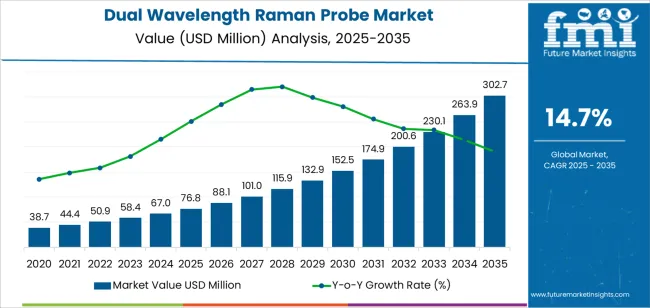
The market demonstrates strong momentum across developed and emerging research economies, where analytical laboratories are transitioning from single wavelength methods to dual wavelength systems that offer superior analytical performance and experimental flexibility. Dual wavelength Raman probe technology addresses critical research challenges including fluorescence interference mitigation in biological samples, enhanced molecular fingerprinting in complex materials, and comprehensive spectral analysis across diverse sample types and measurement conditions.
The scientific research sector shift toward multi-modal characterization techniques and high-throughput analysis creates steady demand for analytical instruments capable of providing complementary spectroscopic information with minimal sample preparation and consistent measurement quality across diverse applications. Research scientists are adopting dual wavelength Raman probes for advanced material studies where spectral complementarity directly impacts analytical depth and experimental insight requirements.
Research institutions and analytical laboratories are investing in dual wavelength Raman probe systems to enhance analytical capabilities through improved spectral information and expanded characterization versatility. The integration of advanced optical components and intelligent wavelength switching enables these instruments to achieve analytical performance levels exceeding single wavelength configurations while maintaining measurement sensitivity standards. The initial instrument cost considerations for advanced spectroscopy systems and technical expertise requirements for optimal measurement protocols may pose challenges to market expansion in budget-constrained research facilities and regions with limited access to specialized training programs and application support resources.
Dual Wavelength Raman Probe Market Year-over-Year Forecast (2025-2035)
Between 2025 and 2030, the market is projected to expand from USD 76.8 million to USD 132.9 million, resulting in a value increase of USD 56.1 million, which represents 24.8% of the total forecast growth for the decade. This phase of development will be shaped by rising demand for advanced spectroscopic analytical tools in research laboratories, product innovation in optical component technology and detection systems, as well as expanding integration with portable instrumentation platforms and automated analysis software. Companies are establishing competitive positions through investment in wavelength optimization technologies, miniaturized optical designs, and strategic market expansion across academic research institutions, pharmaceutical development facilities, and materials characterization laboratories.
From 2030 to 2035, the market is forecast to grow from USD 132.9 million to USD 302.7 million, adding another USD 169.8 million, which constitutes 75.2% of the overall ten-year expansion. This period is expected to be characterized by the expansion of intelligent Raman systems, including AI-enhanced spectral analysis and automated wavelength selection configurations tailored for specific application types and sample requirements, strategic collaborations between optical component manufacturers and analytical instrument companies, and an enhanced focus on measurement sensitivity optimization and field deployment capabilities. The growing focus on analytical precision and research productivity will drive demand for advanced, high-performance dual wavelength Raman probe solutions across diverse scientific and industrial applications.
Dual Wavelength Raman Probe Market Key Takeaways
| Metric | Value |
|---|---|
| Market Value (2025) | USD 76.8 million |
| Market Forecast Value (2035) | USD 302.7 million |
| Forecast CAGR (2025-2035) | 14.7% |
Why is the Dual Wavelength Raman Probe Market Growing?
The dual wavelength Raman probe market grows by enabling researchers to achieve superior analytical depth and spectral complementarity while reducing measurement limitations in complex sample characterization. Research facilities face mounting pressure to improve analytical capabilities and measurement throughput, with dual wavelength Raman systems typically providing enhanced spectral information and reduced fluorescence interference compared to single wavelength approaches, making these specialized instruments essential for comprehensive analytical operations. The scientific research and industrial analysis sectors need for versatile molecular characterization creates demand for advanced Raman solutions that can minimize fluorescence backgrounds, achieve complementary spectral data, and ensure consistent measurement quality across diverse sample types and experimental conditions.
Research innovation initiatives promoting multi-modal characterization and advanced spectroscopy drive adoption in university laboratories, pharmaceutical research facilities, and materials development operations, where analytical versatility has a direct impact on research insights and experimental success rates. The global shift toward comprehensive analytical principles and data-driven research implementation accelerates dual wavelength Raman probe demand as research institutions seek spectroscopic tools that maximize analytical information and minimize measurement artifacts. The limited awareness of optimal wavelength selection strategies and higher instrument costs compared to basic Raman systems may limit adoption rates among smaller research groups and regions with traditional analytical approaches and limited access to advanced spectroscopy training and technical application support.
What factors drive the dominance of the 532 nm/1064 nm wavelength combination and the scientific research application segment in the dual wavelength Raman probe market?
The market is segmented by wavelength combination, application, and region. By wavelength combination, the market is divided into 532nm/1064nm, 785nm/1064nm, 532nm/785nm, and others. Based on application, the market is categorized into scientific research, environmental monitoring, and process control. Regionally, the market is divided into Asia Pacific, Europe, North America, Latin America, and Middle East & Africa.
By Wavelength Combination, the 532nm/1064nm Segment Accounts for a Dominant Market Share
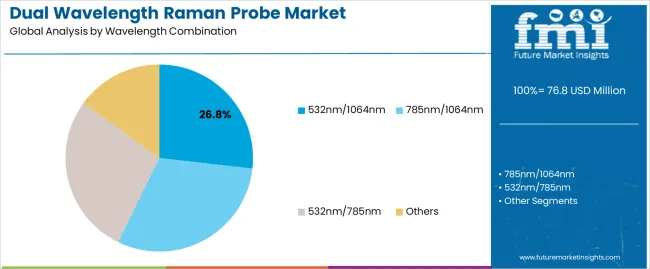
The 532nm/1064nm segment represents the dominant force in the market, capturing approximately 26.8% of total market share in 2025. This category encompasses visible and near-infrared wavelength pairing optimized for broad analytical versatility, delivering complementary spectral information and effective fluorescence management across diverse sample types. The 532nm/1064nm segment market leadership stems from its balanced analytical capabilities, wide material compatibility, and proven performance across biological samples, pharmaceutical compounds, and materials characterization applications.
The 785nm/1064nm segment maintains a substantial 24.0% market share, serving researchers who require near-infrared wavelength combinations through reduced fluorescence excitation and deeper sample penetration capabilities suited for biological tissues and fluorescent materials. The 532nm/785nm segment represents 22.0% market share through specialized applications requiring visible to near-infrared coverage and intermediate wavelength spacing for enhanced spectral discrimination.
Key advantages driving the 532nm/1064nm segment include:
- Simplified analytical procedures with broad sample compatibility and established measurement protocols
- Proven performance versatility across diverse material types including organic compounds and inorganic materials
- Optimized spectral coverage enabling complementary information from visible and near-infrared excitation
- Broad application compatibility with existing analytical workflows minimizing method development requirements
By Application, the Scientific Research Segment Accounts for the Largest Market Share
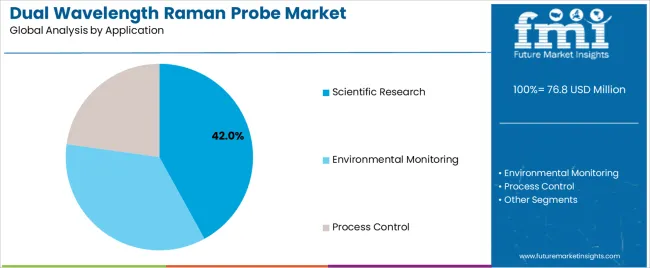
Scientific research applications dominate the market with approximately 42.0% market share in 2025, reflecting the extensive utilization of advanced Raman spectroscopy across academic research institutions, corporate research laboratories, and government research facilities. The scientific research segment market leadership is reinforced by widespread implementation in pharmaceutical development, materials characterization, and fundamental science investigations, which provide essential analytical insights and molecular information in knowledge generation environments.
The environmental monitoring segment represents 32.0% market share through specialized applications including water quality analysis, air pollution monitoring, and soil contamination assessment requiring field-deployable analytical capabilities and rapid screening features. Process control accounts for 26.0% market share, driven by adoption in chemical manufacturing, pharmaceutical production, and quality assurance operations where real-time molecular analysis supports process optimization and quality verification.
Key market dynamics supporting application preferences include:
- Scientific research operations requiring comprehensive analytical capabilities with versatile spectral information across diverse research questions
- Environmental monitoring applications demanding portable instrumentation and rapid analysis for field screening and compliance verification
- Process control environments emphasizing real-time molecular information and automated quality monitoring in manufacturing operations
- Growing adoption across diverse sectors seeking analytical improvements through advanced dual wavelength spectroscopy technology
What are the Drivers, Restraints, and Key Trends of the Dual Wavelength Raman Probe Market?
The market is driven by three concrete demand factors tied to analytical capabilities and research productivity. First, scientific research intensity expansion creates increasing requirements for advanced spectroscopic tools, with global research institutions implementing comprehensive analytical programs requiring reliable dual wavelength Raman probe systems for molecular characterization, materials analysis, and pharmaceutical development. Second, analytical complexity growth and fluorescence interference challenges drive adoption of dual wavelength technology, with advanced Raman systems improving spectral quality while reducing measurement artifacts in fluorescent samples and complex matrices. Third, research innovation initiatives and multi-modal characterization requirements accelerate deployment across research facilities, with dual wavelength Raman probes integrating effectively into analytical workflows and enabling enhanced spectroscopic insights in diverse research applications.
Market restraints include instrument cost barriers affecting research facilities in resource-limited settings and budget-constrained academic programs, particularly where single wavelength systems remain adequate for straightforward analytical requirements and where funding constraints limit adoption of premium spectroscopic instrumentation. Technical expertise requirements for optimal wavelength selection pose adoption challenges for laboratories lacking spectroscopy specialists, as dual wavelength Raman effectiveness depends heavily on proper wavelength pairing, measurement parameter optimization, and spectral interpretation skills that vary significantly across research disciplines. Limited availability of application-specific training programs in emerging research markets creates additional barriers, as analytical scientists require specialized knowledge in wavelength selection principles, fluorescence management techniques, and data interpretation methods to achieve optimal analytical outcomes.
Key trends indicate accelerated adoption in Asian research centers, particularly China and India, where scientific research infrastructure and analytical capabilities are expanding rapidly through government research investment programs and academic institution development initiatives. Technology advancement trends toward miniaturized optical systems with portable configurations, intelligent wavelength switching for automated optimization, and integrated chemometric software enabling advanced data analysis are driving next-generation instrument development. The market thesis could face disruption if alternative analytical technologies including surface-enhanced Raman spectroscopy achieve breakthrough capabilities in sensitivity enhancement, potentially reducing demand for conventional dual wavelength systems in specific analytical scenarios.
Analysis of the Dual Wavelength Raman Probe Market by Key Country
| Country | CAGR (2025-2035) |
|---|---|
| China | 19.8% |
| India | 18.4% |
| Germany | 16.9% |
| Brazil | 15.4% |
| USA | 14.0% |
| UK | 12.5% |
| Japan | 11.0% |
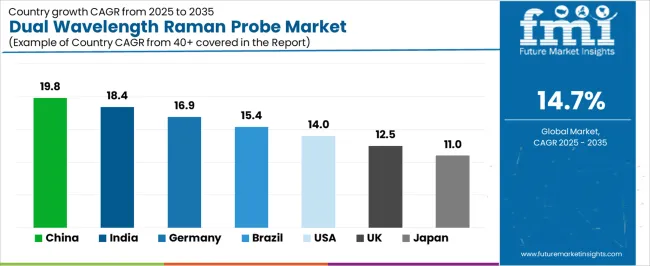
The market is gaining momentum worldwide, with China taking the leads to aggressive research infrastructure expansion and scientific instrumentation investment programs. Close behind, India benefits from growing academic research capabilities and government science initiatives, positioning itself as a strategic growth hub in the Asia-Pacific region. Brazil shows strong advancement, where expanding research facilities and analytical capability development strengthen its role in South American scientific instrumentation markets. The USA demonstrates robust growth through advanced research programs and pharmaceutical development, signaling continued adoption in sophisticated analytical applications. Meanwhile, Japan stands out for its analytical technology expertise and research excellence integration, while UK and Germany continue to record consistent progress driven by academic research centers and pharmaceutical development facilities. Together, China and India anchor the global expansion story, while established markets build stability and technological leadership into the market growth path.
The report covers an in-depth analysis of 40+ countries, top-performing countries are highlighted below.
Why does China lead global market expansion?
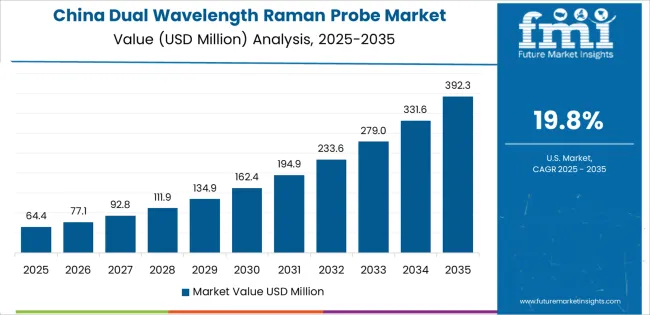
China demonstrates the strongest growth potential in the market with a CAGR of 19.8% through 2035. The country leadership position stems from comprehensive research infrastructure expansion, intensive scientific capability development programs, and aggressive analytical instrumentation investment targets driving adoption of advanced spectroscopy technologies. Growth is concentrated in major research regions, including Beijing, Shanghai, Jiangsu, and Guangdong, where universities, research institutes, and pharmaceutical companies are implementing dual wavelength Raman probe systems for analytical capability enhancement and research quality improvement. Distribution channels through scientific instrument distributors, analytical equipment specialists, and direct manufacturer relationships expand deployment across research clusters, pharmaceutical development centers, and materials characterization facilities. The country science and technology development strategies provide policy support for advanced instrumentation adoption, including funding for research equipment procurement and scientific capability upgrading programs.
Key market factors:
- Research infrastructure intensity in major science and technology regions with comprehensive analytical capability development programs
- Government support through research funding schemes providing equipment procurement support for advanced analytical instrumentation
- Comprehensive scientific ecosystem including established instrument distributors and technical service providers with proven capabilities
- Research integration featuring modern laboratory facilities, analytical networks, and data management platforms enabling advanced spectroscopic investigations
Why is India emerging as a high-growth market?
In major research regions including Bangalore, Hyderabad, Mumbai, and Delhi science zones, the adoption of dual wavelength Raman probe systems is accelerating across academic institutions, pharmaceutical research facilities, and materials science laboratories, driven by research excellence initiatives and increasing focus on analytical capabilities. The market demonstrates strong growth momentum with a CAGR of 18.4% through 2035, linked to comprehensive research sector expansion and increasing investment in scientific instrumentation capabilities. Indian research institutions are implementing dual wavelength Raman probe technology and advanced analytical platforms to improve research quality while meeting international scientific standards in analytical characterization serving domestic research programs and collaborative international projects. The country science and technology policies create steady demand for advanced spectroscopic solutions, while increasing focus on research excellence drives adoption of sophisticated analytical instruments that enhance scientific competitiveness.
- Leading research development regions, including IIT campuses, central research institutes, and pharmaceutical research centers, driving dual wavelength Raman probe adoption across scientific research networks
- Government research programs enabling instrumentation procurement support for academic institutions and national laboratories
- Technology collaboration agreements accelerating deployment with international instrument manufacturers and analytical solution providers
- Policy support through research excellence initiatives and scientific capability programs linked to advanced instrumentation adoption
How does Germany maintain regional leadership?
Germany advanced research sector demonstrates sophisticated implementation of dual wavelength Raman probe systems, with documented scientific publications showing significant analytical advancements in research investigations through optimized spectroscopic strategies. The country research infrastructure in major scientific centers, including Bavaria, Baden-Wurttemberg, North Rhine-Westphalia, and Hesse, showcases integration of advanced analytical technologies with existing research capabilities, leveraging expertise in spectroscopy and materials characterization. German research institutions emphasize analytical excellence standards and measurement quality, creating demand for reliable spectroscopic solutions that support research commitments and stringent analytical requirements. The market maintains strong growth through focus on scientific innovation and research excellence, with a CAGR of 16.9% through 2035.
Key development areas:
- Research excellence centers enabling advanced spectroscopic investigations with comprehensive analytical protocols and quality assurance programs
- Scientific expertise infrastructure providing skilled researchers with documented high analytical competency rates
- Strategic partnerships between instrument manufacturers and research institutions expanding integrated solution offerings
- Integration of digital research systems and comprehensive data management capabilities for optimized analytical workflows
Why does Brazil show strong research development?
The Brazilian market leads in Latin American dual wavelength Raman probe adoption based on expanding research infrastructure and growing analytical capabilities in major academic centers. The country shows solid potential with a CAGR of 15.4% through 2035, driven by research sector investment and increasing demand for advanced analytical instrumentation across university research programs, agricultural research institutes, and pharmaceutical development sectors. Brazilian research institutions are adopting dual wavelength Raman probe technology for alignment with international research standards, particularly in materials characterization requiring advanced spectroscopy and in pharmaceutical development where analytical quality impacts research outcomes. Technology deployment channels through scientific instrument distributors, analytical equipment suppliers, and research procurement programs expand coverage across academic networks and research facilities.
Leading market segments:
- University research operations in Sao Paulo and southeastern research regions implementing advanced spectroscopy programs
- Technology partnerships with international instrument manufacturers achieving analytical capability improvement targets in research investigations
- Strategic collaborations between research institutions and instrument suppliers enabling advanced analytical technology adoption
- Focus on research excellence and scientific competitiveness incentivizing advanced spectroscopic instrumentation investment
How does the United States demonstrate strong research innovation?
The USA market leads in advanced dual wavelength Raman probe applications based on integration with sophisticated research programs and comprehensive analytical protocols for enhanced scientific insights. The country shows solid potential with a CAGR of 14.0% through 2035, driven by research leadership and increasing adoption of advanced spectroscopic technologies across academic research institutions, pharmaceutical development companies, and national laboratory facilities. American research organizations are implementing dual wavelength Raman probe systems for cutting-edge analytical requirements, particularly in pharmaceutical development demanding comprehensive molecular characterization and in materials research where spectral complementarity directly impacts scientific understanding. Technology deployment channels through specialized instrument distributors, research equipment suppliers, and direct manufacturer relationships expand coverage across diverse research operations.
Leading market segments:
- Leading research universities and national laboratories implementing comprehensive spectroscopy programs for advanced research investigations
- Research partnerships with instrument manufacturers achieving high analytical quality in challenging characterization applications
- Strategic collaborations between academic institutions and technology companies enabling advanced spectroscopic capability deployment
- Focus on scientific excellence and research productivity driving advanced instrumentation adoption across research sectors
How does the United Kingdom demonstrate steady research adoption?
The UK market demonstrates consistent implementation focused on research excellence and analytical innovation, with documented research outcomes showing analytical improvements in scientific investigations. The country maintains steady growth momentum with a CAGR of 12.5% through 2035, driven by academic research strength and analytical capability requirements in university research groups. Major research regions, including London, Cambridge, Oxford, and Scotland, showcase deployment of advanced spectroscopic technologies that integrate with existing research infrastructure and support analytical requirements in scientific investigations.
Key market characteristics:
- University research groups and national research facilities driving advanced spectroscopy technology requirements
- Research partnerships enabling optimal implementation through collaborative development programs
- Collaboration between instrument suppliers and research institutions ensuring consistent performance and technical assistance
- Focus on research quality and analytical excellence supporting advanced instrumentation adoption in scientific programs
How does Japan demonstrate research technology integration?
Japan market demonstrates sophisticated implementation focused on analytical excellence and advanced research, with documented integration of sophisticated spectroscopic systems achieving analytical advancements in scientific investigations. The country maintains steady growth momentum with a CAGR of 11.0% through 2035, driven by research quality culture and focus on analytical precision principles aligned with scientific excellence standards. Major research regions, including Tokyo, Osaka, Kyoto, and Tsukuba, showcase advanced deployment of spectroscopic technologies that integrate seamlessly with research programs and comprehensive quality management frameworks.
Key market characteristics:
- Academic research institutions and corporate research laboratories driving advanced spectroscopy technology requirements with focus on analytical quality
- Research partnerships enabling high measurement precision through optimized analytical protocols and quality control
- Collaboration between instrument manufacturers and research organizations ensuring integrated solution development and technical support
- Focus on scientific excellence and analytical rigor supporting advanced spectroscopic technology adoption across research facilities
What is the market split by country in Europe?
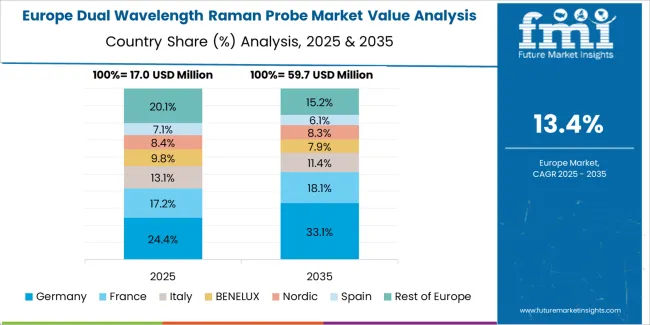
The dual wavelength Raman probe market in Europe is projected to grow from USD 20.1 million in 2025 to USD 87.0 million by 2035, registering a CAGR of 15.8% over the forecast period. Germany is expected to maintain its leadership position with a 32.4% market share in 2025, declining slightly to 31.7% by 2035, supported by its extensive research infrastructure and major scientific centers, including Bavaria, Baden-Wurttemberg, and North Rhine-Westphalia research regions.
France follows with a 24.8% share in 2025, projected to reach 25.2% by 2035, driven by comprehensive research programs and analytical excellence centers in major scientific regions. The United Kingdom holds a 20.5% share in 2025, expected to reach 20.8% by 2035 through university research strength and pharmaceutical development facilities. Italy commands a 12.7% share in both 2025 and 2035, backed by research infrastructure development and scientific capability programs. Spain accounts for 5.2% in 2025, rising to 5.4% by 2035 on research expansion and analytical capability growth. The Rest of Europe region is anticipated to hold 4.4% in 2025, expanding to 5.2% by 2035, attributed to increasing dual wavelength Raman probe adoption in Nordic countries and emerging Central & Eastern European research institutions.
Why do advanced spectroscopic systems dominate research requirements in Japan?
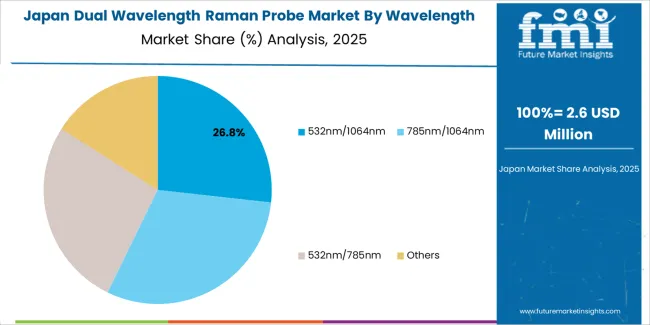
The Japanese market demonstrates a mature and quality-focused landscape, characterized by sophisticated integration of advanced spectroscopic systems with existing research infrastructure across university laboratories, corporate research facilities, and national research institutes. Japan focus on analytical excellence and measurement precision drives demand for high-quality spectroscopic instruments that support research commitments and analytical standards in competitive scientific environments. The market benefits from strong partnerships between international instrument providers and domestic scientific distributors including major trading companies, creating comprehensive service ecosystems that prioritize technical support and application development programs. Research centers in Tokyo, Osaka, Kyoto, and other major scientific areas showcase advanced analytical implementations where dual wavelength Raman probe systems achieve high measurement quality through optimized spectroscopic configurations and comprehensive calibration protocols.
Why do international providers lead technical services in South Korea?
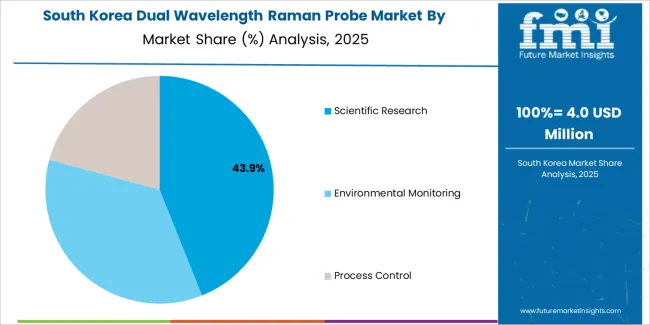
The South Korean market is characterized by growing international instrument provider presence, with companies maintaining significant positions through comprehensive technical support and application development capabilities for research operations and analytical laboratory applications. The market demonstrates increasing focus on research quality and analytical innovation, as Korean research institutions increasingly demand advanced spectroscopic solutions that integrate with domestic research infrastructure and sophisticated laboratory management systems deployed across major research complexes. Regional scientific distributors are gaining market share through strategic partnerships with international manufacturers, offering specialized services including application training programs and method-specific analytical solutions for pharmaceutical and materials research operations. The competitive landscape shows increasing collaboration between multinational instrument companies and Korean research specialists, creating hybrid service models that combine international product development expertise with local technical support capabilities and rapid response systems.
What factors define the competitive landscape of the dual wavelength Raman probe market?
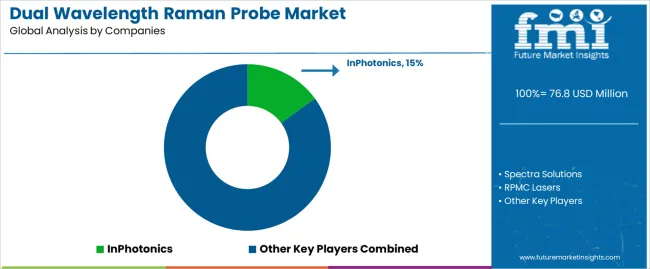
The market features approximately 15-20 meaningful players with moderate fragmentation, where leading companies control market share through established distribution networks and comprehensive product portfolios. Competition centers on analytical performance consistency, optical quality, and technical support capabilities rather than price competition alone. Market leaders maintain competitive advantages through proven optical engineering expertise and established relationships with research institutions and analytical laboratories.
Market leaders include specialized photonics companies and analytical instrument manufacturers with focused expertise and comprehensive spectroscopic capabilities, which maintain competitive advantages through technical innovation, optical component quality, and deep application knowledge across multiple research disciplines, creating trust and reliability advantages with academic research operations and analytical laboratory facilities. These companies leverage research and development capabilities in optical design optimization, wavelength combination development, and ongoing technical support relationships to defend market positions while expanding into emerging research markets and specialized application segments.
Challengers encompass regional analytical instrument providers and spectroscopy specialists, which compete through differentiated product offerings and strong regional presence in key research markets. Product specialists focus on specific wavelength configurations or application segments, offering specialized capabilities in custom optical solutions, rapid delivery services, and competitive pricing structures for standard instrument configurations.
Regional players and emerging photonics companies create competitive pressure through specialized optical expertise and application responsiveness capabilities, particularly in high-growth markets including China and India, where proximity to research facilities provides advantages in technical support responsiveness and customer relationships. Market dynamics favor companies that combine proven analytical performance with comprehensive application support offerings that address the complete measurement cycle from method development through data interpretation and results validation.
Global Dual Wavelength Raman Probe Market - Stakeholder Contribution Framework
Dual wavelength Raman probes represent advanced spectroscopic instruments that enable researchers to achieve comprehensive molecular characterization and reduced fluorescence interference while improving analytical depth, delivering superior spectral information and measurement versatility with enhanced analytical capabilities and experimental flexibility in demanding research applications. With the market projected to grow from USD 76.8 million in 2025 to USD 302.7 million by 2035 at a 14.7% CAGR, these specialized analytical instruments offer compelling advantages - spectral complementarity, fluorescence management, and analytical versatility - making them essential for scientific research applications (42.0% market share), environmental monitoring operations (32.0% share), and analytical facilities seeking alternatives to single wavelength systems that compromise analytical depth through limited spectral information and increased fluorescence interference. Scaling market adoption and technology deployment requires coordinated action across research policy, scientific infrastructure development, instrument manufacturers, research institutions, and scientific investment capital.
How Governments Could Spur Research Excellence and Technology Access?
- Research Infrastructure Programs: Include advanced analytical instrumentation in research funding schemes, provide equipment procurement support for academic institutions, and establish analytical facility networks that encourage comprehensive spectroscopic capability development in research ecosystems.
- Research & Innovation Funding: Fund university research on optical component development, spectroscopic methodology advancement, and analytical application optimization in diverse research fields. Invest in industry-academic partnerships that advance practical spectroscopy knowledge for diverse sample types and measurement requirements.
- Infrastructure Development Incentives: Provide grants for establishing shared analytical facilities, offer equipment financing programs for spectroscopic instrumentation adoption in research institutions, and support facility development that ensures reliable access to advanced analytical capabilities across scientific disciplines.
- Standards & Quality Programs: Establish analytical performance standards for spectroscopic measurements, develop training programs for research scientists and analytical specialists, and create standardized evaluation protocols that facilitate assessment of instrument capabilities across different research applications.
- Scientific Innovation Programs: Promote research excellence through analytical capability incentives, support collaborative research initiatives that integrate advanced spectroscopy with scientific programs, and establish programs that reward analytical innovations through evidence-based research practices.
How Industry Bodies Could Support Market Development?
- Quality Standards & Certification: Define standardized testing protocols for instrument performance, measurement recommendations, and analytical metrics across 532nm/1064nm (26.8% market dominance) and alternative wavelength combination systems, enabling reliable instrument comparison and informed purchasing decisions.
- Best Analytical Practices: Develop comprehensive guidelines for wavelength selection, measurement optimization, and data interpretation protocols in research operations, ensuring consistent analytical performance and maximum measurement value across different instrument platforms and sample types.
- Technical Integration Standards: Create documentation frameworks for optical specifications, measurement protocols, and data format guidelines that facilitate seamless integration across research operations and analytical workflow systems.
- Technical Training & Certification: Establish education programs for research scientists, analytical chemists, and laboratory personnel on optimal measurement techniques, spectral interpretation methods, and troubleshooting strategies that ensure successful dual wavelength Raman probe implementation.
How Instrument Manufacturers and Technology Companies Could Strengthen the Ecosystem?
- Advanced Product Development: Develop next-generation optical systems with enhanced sensitivity, optimized wavelength combinations with improved spectral coverage, and intelligent measurement platforms that extend analytical capabilities while maintaining optical performance in demanding applications.
- Application Development Innovation: Provide comprehensive method libraries with validated protocols, automated measurement software for simplified operations, and integrated chemometric platforms that ensure consistent analytical results across measurement configurations.
- Application-Specific Solutions: Offer spectroscopic systems tailored for scientific research operations, specialized configurations for environmental monitoring requirements, and customized optical designs that address specific analytical challenges while maintaining measurement efficiency objectives.
- Technical Support Services: Build comprehensive customer support programs including application development assistance, method optimization guidance, and measurement troubleshooting support that help researchers achieve optimal analytical results while maintaining measurement quality standards.
How Research Institutions Could Maximize Instrument Value?
- Application-Focused Implementation: Develop specialized protocols for scientific research applications (42.0% market dominance), environmental monitoring operations (32.0% share), with measurement configurations optimized for each application specific analytical requirements and research expectations.
- Geographic Research Strategy: Establish analytical capabilities in high-growth markets like China (19.8% CAGR) and India (18.4% CAGR), while maintaining research excellence in established scientific markets like Germany (16.9% CAGR) and USA (14.0% CAGR).
- Analytical Differentiation: Invest in application development programs, measurement optimization systems, and comprehensive data analysis protocols that provide superior analytical insights and enable competitive positioning in research markets.
- Research Collaboration Models: Develop strategic partnerships through shared analytical facilities, collaborative method development programs, and publication collaborations that strengthen research networks and institutional reputation.
How Investors and Financial Enablers Could Unlock Value?
- Instrument Manufacturing Development: Finance established spectroscopic instrument manufacturers for production capacity expansion, optical technology implementation, and quality system upgrades that serve growing demand in scientific research and environmental monitoring markets.
- Research Infrastructure Investment: Provide capital for establishing analytical facilities, shared instrumentation centers, and technical support systems that enhance research access while ensuring consistent analytical quality across scientific regions.
- Innovation & Technology Investment: Back technology companies developing advanced optical systems, intelligent measurement platforms, and integrated analytical solutions that enhance spectroscopic performance while addressing sensitivity concerns and application versatility requirements.
- Market Development & Integration: Support strategic partnerships between instrument manufacturers and research institutions, finance training program development, and enable market consolidation that creates comprehensive analytical solution providers serving multiple research segments.
Key Players in the Dual Wavelength Raman Probe Market
- InPhotonics
- Spectra Solutions
- RPMC Lasers
- Innovative Photonic Solutions
- B&W Tek
- DropSens
- Optosky
- Metrohm
Scope of the Report
| Item | Value |
|---|---|
| Quantitative Units | USD 76.8 million |
| Wavelength Combination | 532nm/1064nm, 785nm/1064nm, 532nm/785nm, Others |
| Application | Scientific Research, Environmental Monitoring, Process Control |
| Regions Covered | Asia Pacific, Europe, North America, Latin America, Middle East & Africa |
| Country Covered | China, India, Germany, Brazil, USA., UK, Japan, and 40+ countries |
| Key Companies Profiled | InPhotonics, Spectra Solutions, RPMC Lasers, Innovative Photonic Solutions, B&W Tek, DropSens, Optosky, Metrohm |
| Additional Attributes | Dollar sales by wavelength combination and application categories, regional adoption trends across Asia Pacific, Europe, and North America, competitive landscape with photonics manufacturers and analytical instrument networks, research facility requirements and technical specifications, integration with analytical workflows and data management systems, innovations in optical component technology and wavelength switching platforms, and development of specialized spectroscopic solutions with enhanced analytical performance and measurement versatility capabilities. |
Dual Wavelength Raman Probe Market by Segments
Wavelength Combination:
- 532nm/1064nm
- 785nm/1064nm
- 532nm/785nm
- Others
Application:
- Scientific Research
- Environmental Monitoring
- Process Control
Region:
- Asia Pacific
- China
- India
- Japan
- South Korea
- Australia & New Zealand
- ASEAN
- Rest of Asia Pacific
- Europe
- Germany
- United Kingdom
- France
- Italy
- Spain
- Netherlands
- Nordic
- BENELUX
- Rest of Europe
- North America
- United States
- Canada
- Mexico
- Latin America
- Brazil
- Argentina
- Rest of Latin America
- Middle East & Africa
- Kingdom of Saudi Arabia
- Other GCC Countries
- Turkey
- South Africa
- Other African Union
- Rest of Middle East & Africa
Frequently Asked Questions
How big is the dual wavelength raman probe market in 2025?
The global dual wavelength raman probe market is estimated to be valued at USD 76.8 million in 2025.
What will be the size of dual wavelength raman probe market in 2035?
The market size for the dual wavelength raman probe market is projected to reach USD 302.7 million by 2035.
How much will be the dual wavelength raman probe market growth between 2025 and 2035?
The dual wavelength raman probe market is expected to grow at a 14.7% CAGR between 2025 and 2035.
What are the key product types in the dual wavelength raman probe market?
The key product types in dual wavelength raman probe market are 532nm/1064nm, 785nm/1064nm, 532nm/785nm and others.
Which application segment to contribute significant share in the dual wavelength raman probe market in 2025?
In terms of application, scientific research segment to command 42.0% share in the dual wavelength raman probe market in 2025.
Preview the report firsthand - request a free sample
Get SampleGet the brochure for pricing and purchase details.
Get PDFTable of Content
- Executive Summary
- Global Market Outlook
- Demand-side Trends
- Supply-side Trends
- Technology Roadmap Analysis
- Analysis and Recommendations
- Market Overview
- Market Coverage / Taxonomy
- Market Definition / Scope / Limitations
- Market Background
- Market Dynamics
- Drivers
- Restraints
- Opportunity
- Trends
- Scenario Forecast
- Demand in Optimistic Scenario
- Demand in Likely Scenario
- Demand in Conservative Scenario
- Opportunity Map Analysis
- Product Life Cycle Analysis
- Supply Chain Analysis
- Investment Feasibility Matrix
- Value Chain Analysis
- PESTLE and Porter’s Analysis
- Regulatory Landscape
- Regional Parent Market Outlook
- Production and Consumption Statistics
- Import and Export Statistics
- Market Dynamics
- Global Market Analysis 2020 to 2024 and Forecast, 2025 to 2035
- Historical Market Size Value (USD Million) Analysis, 2020 to 2024
- Current and Future Market Size Value (USD Million) Projections, 2025 to 2035
- Y-o-Y Growth Trend Analysis
- Absolute $ Opportunity Analysis
- Global Market Pricing Analysis 2020 to 2024 and Forecast 2025 to 2035
- Global Market Analysis 2020 to 2024 and Forecast 2025 to 2035, By Wavelength Combination
- Introduction / Key Findings
- Historical Market Size Value (USD Million) Analysis By Wavelength Combination , 2020 to 2024
- Current and Future Market Size Value (USD Million) Analysis and Forecast By Wavelength Combination , 2025 to 2035
- 532nm/1064nm
- 785nm/1064nm
- 532nm/785nm
- Others
- Y-o-Y Growth Trend Analysis By Wavelength Combination , 2020 to 2024
- Absolute $ Opportunity Analysis By Wavelength Combination , 2025 to 2035
- Global Market Analysis 2020 to 2024 and Forecast 2025 to 2035, By Application
- Introduction / Key Findings
- Historical Market Size Value (USD Million) Analysis By Application, 2020 to 2024
- Current and Future Market Size Value (USD Million) Analysis and Forecast By Application, 2025 to 2035
- Scientific Research
- Environmental Monitoring
- Process Control
- Y-o-Y Growth Trend Analysis By Application, 2020 to 2024
- Absolute $ Opportunity Analysis By Application, 2025 to 2035
- Global Market Analysis 2020 to 2024 and Forecast 2025 to 2035, By Region
- Introduction
- Historical Market Size Value (USD Million) Analysis By Region, 2020 to 2024
- Current Market Size Value (USD Million) Analysis and Forecast By Region, 2025 to 2035
- North America
- Latin America
- Western Europe
- Eastern Europe
- East Asia
- South Asia and Pacific
- Middle East & Africa
- Market Attractiveness Analysis By Region
- North America Market Analysis 2020 to 2024 and Forecast 2025 to 2035, By Country
- Historical Market Size Value (USD Million) Trend Analysis By Market Taxonomy, 2020 to 2024
- Market Size Value (USD Million) Forecast By Market Taxonomy, 2025 to 2035
- By Country
- USA
- Canada
- Mexico
- By Wavelength Combination
- By Application
- By Country
- Market Attractiveness Analysis
- By Country
- By Wavelength Combination
- By Application
- Key Takeaways
- Latin America Market Analysis 2020 to 2024 and Forecast 2025 to 2035, By Country
- Historical Market Size Value (USD Million) Trend Analysis By Market Taxonomy, 2020 to 2024
- Market Size Value (USD Million) Forecast By Market Taxonomy, 2025 to 2035
- By Country
- Brazil
- Chile
- Rest of Latin America
- By Wavelength Combination
- By Application
- By Country
- Market Attractiveness Analysis
- By Country
- By Wavelength Combination
- By Application
- Key Takeaways
- Western Europe Market Analysis 2020 to 2024 and Forecast 2025 to 2035, By Country
- Historical Market Size Value (USD Million) Trend Analysis By Market Taxonomy, 2020 to 2024
- Market Size Value (USD Million) Forecast By Market Taxonomy, 2025 to 2035
- By Country
- Germany
- UK
- Italy
- Spain
- France
- Nordic
- BENELUX
- Rest of Western Europe
- By Wavelength Combination
- By Application
- By Country
- Market Attractiveness Analysis
- By Country
- By Wavelength Combination
- By Application
- Key Takeaways
- Eastern Europe Market Analysis 2020 to 2024 and Forecast 2025 to 2035, By Country
- Historical Market Size Value (USD Million) Trend Analysis By Market Taxonomy, 2020 to 2024
- Market Size Value (USD Million) Forecast By Market Taxonomy, 2025 to 2035
- By Country
- Russia
- Poland
- Hungary
- Balkan & Baltic
- Rest of Eastern Europe
- By Wavelength Combination
- By Application
- By Country
- Market Attractiveness Analysis
- By Country
- By Wavelength Combination
- By Application
- Key Takeaways
- East Asia Market Analysis 2020 to 2024 and Forecast 2025 to 2035, By Country
- Historical Market Size Value (USD Million) Trend Analysis By Market Taxonomy, 2020 to 2024
- Market Size Value (USD Million) Forecast By Market Taxonomy, 2025 to 2035
- By Country
- China
- Japan
- South Korea
- By Wavelength Combination
- By Application
- By Country
- Market Attractiveness Analysis
- By Country
- By Wavelength Combination
- By Application
- Key Takeaways
- South Asia and Pacific Market Analysis 2020 to 2024 and Forecast 2025 to 2035, By Country
- Historical Market Size Value (USD Million) Trend Analysis By Market Taxonomy, 2020 to 2024
- Market Size Value (USD Million) Forecast By Market Taxonomy, 2025 to 2035
- By Country
- India
- ASEAN
- Australia & New Zealand
- Rest of South Asia and Pacific
- By Wavelength Combination
- By Application
- By Country
- Market Attractiveness Analysis
- By Country
- By Wavelength Combination
- By Application
- Key Takeaways
- Middle East & Africa Market Analysis 2020 to 2024 and Forecast 2025 to 2035, By Country
- Historical Market Size Value (USD Million) Trend Analysis By Market Taxonomy, 2020 to 2024
- Market Size Value (USD Million) Forecast By Market Taxonomy, 2025 to 2035
- By Country
- Kingdom of Saudi Arabia
- Other GCC Countries
- Turkiye
- South Africa
- Other African Union
- Rest of Middle East & Africa
- By Wavelength Combination
- By Application
- By Country
- Market Attractiveness Analysis
- By Country
- By Wavelength Combination
- By Application
- Key Takeaways
- Key Countries Market Analysis
- USA
- Pricing Analysis
- Market Share Analysis, 2024
- By Wavelength Combination
- By Application
- Canada
- Pricing Analysis
- Market Share Analysis, 2024
- By Wavelength Combination
- By Application
- Mexico
- Pricing Analysis
- Market Share Analysis, 2024
- By Wavelength Combination
- By Application
- Brazil
- Pricing Analysis
- Market Share Analysis, 2024
- By Wavelength Combination
- By Application
- Chile
- Pricing Analysis
- Market Share Analysis, 2024
- By Wavelength Combination
- By Application
- Germany
- Pricing Analysis
- Market Share Analysis, 2024
- By Wavelength Combination
- By Application
- UK
- Pricing Analysis
- Market Share Analysis, 2024
- By Wavelength Combination
- By Application
- Italy
- Pricing Analysis
- Market Share Analysis, 2024
- By Wavelength Combination
- By Application
- Spain
- Pricing Analysis
- Market Share Analysis, 2024
- By Wavelength Combination
- By Application
- France
- Pricing Analysis
- Market Share Analysis, 2024
- By Wavelength Combination
- By Application
- India
- Pricing Analysis
- Market Share Analysis, 2024
- By Wavelength Combination
- By Application
- ASEAN
- Pricing Analysis
- Market Share Analysis, 2024
- By Wavelength Combination
- By Application
- Australia & New Zealand
- Pricing Analysis
- Market Share Analysis, 2024
- By Wavelength Combination
- By Application
- China
- Pricing Analysis
- Market Share Analysis, 2024
- By Wavelength Combination
- By Application
- Japan
- Pricing Analysis
- Market Share Analysis, 2024
- By Wavelength Combination
- By Application
- South Korea
- Pricing Analysis
- Market Share Analysis, 2024
- By Wavelength Combination
- By Application
- Russia
- Pricing Analysis
- Market Share Analysis, 2024
- By Wavelength Combination
- By Application
- Poland
- Pricing Analysis
- Market Share Analysis, 2024
- By Wavelength Combination
- By Application
- Hungary
- Pricing Analysis
- Market Share Analysis, 2024
- By Wavelength Combination
- By Application
- Kingdom of Saudi Arabia
- Pricing Analysis
- Market Share Analysis, 2024
- By Wavelength Combination
- By Application
- Turkiye
- Pricing Analysis
- Market Share Analysis, 2024
- By Wavelength Combination
- By Application
- South Africa
- Pricing Analysis
- Market Share Analysis, 2024
- By Wavelength Combination
- By Application
- USA
- Market Structure Analysis
- Competition Dashboard
- Competition Benchmarking
- Market Share Analysis of Top Players
- By Regional
- By Wavelength Combination
- By Application
- Competition Analysis
- Competition Deep Dive
- InPhotonics
- Overview
- Product Portfolio
- Profitability by Market Segments (Product/Age /Sales Channel/Region)
- Sales Footprint
- Strategy Overview
- Marketing Strategy
- Product Strategy
- Channel Strategy
- Spectra Solutions
- RPMC Lasers
- Innovative Photonic Solutions
- B&W Tek
- DropSens
- Optosky
- Metrohm
- InPhotonics
- Competition Deep Dive
- Assumptions & Acronyms Used
- Research Methodology


