

- Market Size (2026)
- USD 417.9 Mn
- Forecast (2036)
- USD 649.0 Mn
- CAGR (2026 to 2036)
- 4.5%
How big is Edge Control Gels Market in 2026?
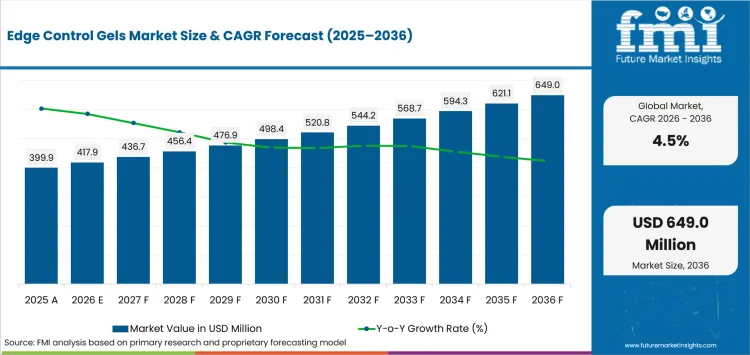
USD 417.9 million in 2026 and USD 649.0 million by 2036 at a 4.5% CAGR.
Demand for edge control gels is projected to expand at 4.5% CAGR between 2026 and 2036 with valuation rising from USD 417.9 million to USD 649.0 million. Frequent touch-ups make edge control a repeat-use purchase between wash days. Henkel reported in August 2025 that got2b growth included a glued wax stick and tinted gels for brows and edges. The launches put sleek hairline finishing inside a scaled styling portfolio. Performance still has to avoid visible flakes or hard residue for trial to become routine replenishment.
Country conditions change how the forecast converts into sales. The Office for National Statistics recorded a 1.6% rise in Great Britain retail volumes during the first quarter of 2026. Cosmetics and toiletries stores increased during all three months. Active store traffic can raise trial for edge products. Notification and label requirements still determine how quickly a formula reaches local shelves.
Key Takeaways
- Repeat hairline finishing sustains demand through between-wash-day use that requires hold without visible residue.
- Based on product type, core - classic lines are projected to account for 35.0% in 2026 due to routine use and familiar performance expectations.
- By nature, conventional formulas are estimated to hold 60.0% in 2026 owing to broad formulation freedom for hold and finish requirements.
- In 2026, cream & balm formats are expected to lead format with 27.0% share because controlled placement supports precise hairline styling.
- Residue risk and country-specific cosmetic requirements can slow repeat purchase or launch timing even after a formula proves its styling result.
- Some of the key players in this market include Mielle Organics, Kitsch, Camille Rose, Church & Dwight, Olaplex, Henkel, Unilever, L'Oreal, Procter & Gamble, and Wella Company.
Analyst Perspective
"The useful benchmark is hold after touch-up plus the residue left during restyling. Repeat purchase is more defensible when the hairline stays shaped and the formula releases cleanly between wash days."
- Rahul Pandita, Principal Consultant, Future Market Insights
How is the edge control gels market segmented?
The edge control gels market is segmented by product type, nature, format, price positioning, sales channel and region.
Product type covers core - classic lines, targeted treatment lines, sensitive & gentle lines, premium & clinical lines and kits & sets. Nature covers conventional, vegan & cruelty-free, natural & organic, dermocosmetic - clinical and fragrance-free & sensitive. Format spans cream & balm, liquid & serum, stick & solid, spray & mist, sheet & patch and powder. Price positioning covers mass, masstige, premium and professional. Sales channels include specialty beauty retail, e-commerce & DTC, pharmacies & drugstores, supermarkets & hypermarkets and salons & spas.
Why do core - classic lines lead the product type category?
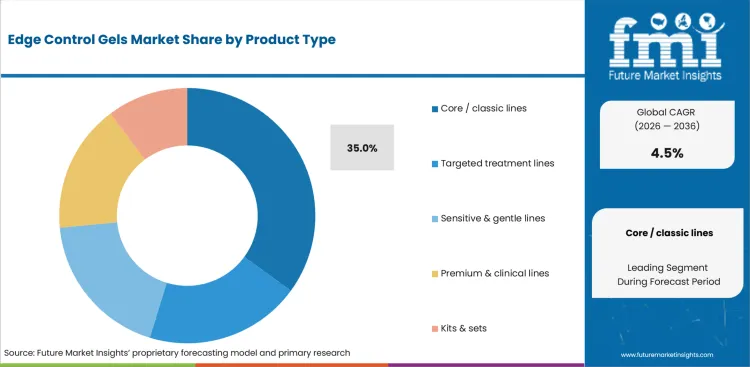
Routine users need a familiar finish that works with baby hairs and protective styles. Hair styling products compete on hold and finish at the same decision point. In March 2025 Target told investors that its beauty business had nearly doubled since 2019 and expanded assortments included Camille Rose. Mainstream shelf expansion gives textured-hair staples more chances to turn first purchase into routine use.
- By product type, core - classic lines are estimated to hold 35.0% in 2026 driven by familiar use that supports repeat replenishment.
- Familiarity with the task makes a core edge SKU easier to keep visible beside broader textured-hair styling.
Why does conventional lead the nature category?
Conventional formulas give chemists wide room to balance grip with slip and washout. Natural cosmetics offer a separate claim path that requires disciplined wording. France's DGCCRF clarified in October 2025 that free-from cosmetic claims must be precise and verifiable. The guidance raises the proof burden for nature-led positioning without changing the core styling job.
- Conventional is projected to hold 60.0% share in 2026 owing to broad ingredient options for hold and finish control.
- Brands using natural or free-from claims must keep those claims specific enough for local authorities to verify against the formula.
How does cream & balm lead the format category?
Hairline styling rewards controlled pickup on a narrow application area. Cream and balm textures give more placement time than many thin hair serum formats. Henkel introduced got2b Curled in April 2025 with foam and jelly formats plus a styling cream. The launch shows a large styling portfolio testing several textures for curl definition and finishing work.
- Cream & balm is set to lead the format category with 27.0% share in 2026 due to controlled placement and easy reworking.
- Foams and jellies widen format choice but a controllable cream texture still gives the user more time to shape the hairline.
What supports mass in the price positioning category?
Frequent touch-ups favor accessible pricing for a product that can be replenished often. Mass beauty and personal care shelves also place edge products beside familiar haircare brands. Target said in January 2026 that more than 90% of its spring beauty finds were priced below USD 20. The retailer also expanded shelf space for textured-hair care. That price structure strengthens the mass route for routine edge purchases.
- Based on price positioning, mass is projected to account for 41.0% in 2026 owing to accessible tickets and wide replenishment routes.
- Frequent-use shoppers can compare the same styling job at lower prices. Premium offers need a clear hold or care difference.
Why does specialty beauty retail lead the sales channel category?
Hold claims alone do not resolve an edge product choice. Shoppers also compare residue and texture fit. Specialty stores can place several dedicated formulas beside professional hair care. The Office for National Statistics reported in May 2026 that cosmetics and toiletries stores increased for a fourth consecutive month. Active store traffic gives comparison-led beauty categories more chances to convert trial.
- In 2026, specialty beauty retail is expected to lead sales channel with 24.0% share because assortment depth improves comparison and guidance.
- Digital reviews can support replenishment. A specialist shelf can shorten the first-purchase decision for shoppers moving from general gel to dedicated edge control.
What are the drivers, restraints and opportunities in the Edge Control Gels Market?
Repeat textured-hair styling supports demand. Residue and cosmetic compliance constrain conversion. Demonstration-led retail gives differentiated formats a clearer route to trial.
- Driver: Repeated styling raises demand for hold that also fits the user's wider haircare routine.
- Restraint: Ingredient restrictions can force formula review ahead of a common European launch.
- Opportunity: Live styling education can make precision formats easier to judge at first purchase.
Care expectations raise the performance floor
Edge control earns repeat demand once hold fits the rest of the hair routine. Unilever's 2025 annual report said Dove's renovated haircare range used Bio-Protein Care in eight markets and turnover increased after launch. The result came from broader hair care routines instead of edge gels alone. It still raises the performance benchmark for a narrow styling SKU sold beside care-led products.
EU ingredient restrictions can reset formula work
European launches can stall if a leave-on styling formula fails current ingredient rules. Commission Regulation (EU) 2025/877 added newly classified CMR substances to prohibited or restricted cosmetic lists and applies from September 1 2025. Formula teams must screen cosmetic chemicals ahead of packaging and notification work. A late ingredient change can reset regional launch timing for one edge-control SKU.
Live demonstration shortens a technique-heavy first purchase
A live application makes brush load and finish visible during product evaluation. Wella Professionals opened House of Wella in September 2025 for 250 influencers plus press and industry guests. Hair artistry showed styling results during the event. Edge brands can use the same demonstration logic to explain personal care ingredients or precision formats in specialty retail.
Which country CAGRs are profiled in the Edge Control Gels Market?
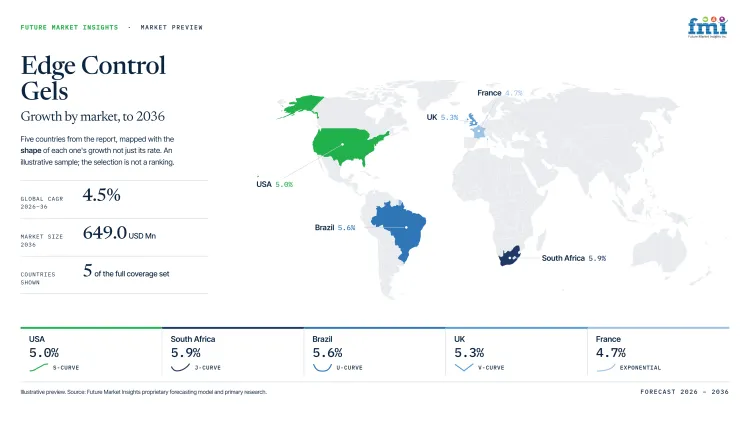
| Country | CAGR |
|---|---|
| South Africa | 5.9% |
| Brazil | 5.6% |
| United Kingdom | 5.3% |
| United States | 5.0% |
| France | 4.7% |
| Canada | 4.3% |
How do country-level CAGRs compare in the Edge Control Gels Market?
The 1.6-point spread separates two growth patterns. South Africa and Brazil have more room to extend formal beauty distribution and form the upper band. The United Kingdom and United States pair deeper retail access with mid-range rates. France and Canada grow more slowly as compliance work and shelf productivity carry more weight.
- South Africa has more runway for formal retail from a smaller base.
- Brazil pairs textured-hair relevance with a large domestic beauty consumer base.
- United Kingdom retailers rotate specialist assortments quickly after weak sell-through.
- Broad outlet coverage makes United States growth depend more on turnover.
- France gives defensible claims greater weight inside mature selective beauty channels.
- Canada places more pressure on inventory discipline in a smaller national market.
CAGR alone cannot set commercial priority. Country analysis covers North America, Latin America, Western Europe, Eastern Europe, East Asia, South Asia and Pacific and Middle East and Africa.
Country-wise Analysis
- Distributor access often determines whether South African beauty businesses can turn product interest into steady retail availability. The South African edge control gels sector is projected to record 5.9% CAGR during the assessment period due to formal channel development. The dtic reported in August 2026 that twelve supported cosmetics companies generated sales and trade leads at the Organic cosmetics expo in Johannesburg. The same statement identified capacity and legislation as barriers for emerging exporters. Distributor introductions can widen retailer access for supported South African cosmetics brands entering formal channels. Small production runs can interrupt replenishment once a listing begins. Local brands gain a specialist route if texture relevance survives the move into formal retail.
- For Brazilian cosmetic launches, brands and importers work inside Anvisa's current electronic petition flow. Edge control gel sales in Brazil are forecast to expand at 5.6% CAGR by 2036 driven by local beauty consumption and textured-hair use. Anvisa stated in April 2025 that exempt cosmetic petitions must be filed through Solicita and Datavisa under the current codes. The digital route gives local teams a clear filing path. The process also requires regulatory operating work before products can enter retail channels. Experienced Brazilian regulatory partners can reduce avoidable resubmission during notification and petition workflows. Portuguese product communication must preserve the styling claim following local pack changes so compliance work does not hide the product's main use.
- A large notified-product catalogue and fast-moving specialist retail define the United Kingdom cosmetics channel. The Office for Product Safety and Standards reported in July 2026 that the UK database held 861,686 cosmetic notifications as of May 28. In the United Kingdom, edge control gel demand is predicted to advance at 5.3% CAGR through 2036 owing to active specialist retail and product turnover. The notified catalogue raises assortment competition for a narrow styling SKU. Retailers can replace weak listings quickly when products fail to sustain repeat purchase. Clear hold claims and reliable stock improve the case for repeat listing. Broad beauty traffic alone does not protect a product that fails to earn repeat purchase.
- United States edge-control purchasing already spans mass retail and specialty beauty alongside DTC. FDA data published in 2026 listed 1 298 361 active cosmetic products under MoCRA as of June 30. The United States edge control gels outlook is anticipated to advance at 5.0% CAGR over the assessment period supported by broad channel access and repeated styling. The scale of the notified catalogue raises the shelf-turnover test for a dedicated edge SKU. Distribution breadth is a weak differentiator by itself without clear product performance or repeat-purchase support. Clear texture guidance gives retailers a more concrete basis for comparison. Low-residue performance can protect a listing in assortments crowded with general gels and smoothing products.
- Selective retail and e-commerce give French edge products access to a mature beauty channel. Claims and product files face close regulatory review under France’s cosmetics control framework. In February 2026 the DGCCRF said its control campaign examined more than 200 cosmetic product information files. Adoption of edge control gels in France is estimated to expand at 4.7% CAGR through 2036 attributable to mature beauty usage and specialty distribution. The slower rate leaves less room for weak documentation to be offset by rapid volume growth. Brands that align claims with product files reduce listing risk. Clear pack copy can then explain why a dedicated edge formula earns shelf space beside general styling gels within mature assortments.
- In Canada, established mass and online channels give edge products wide retail access. Health Canada updated the Cosmetic Ingredient Hotlist in August 2025 and changed several cosmetic ingredient conditions. Canada is estimated to post 4.3% CAGR over the forecast period aided by stable retail access. The Hotlist review can change formula screening before a launch is scaled. Slower category growth raises the cost of inventory errors for brands and distributors. Compliance work must be recovered through consistent sell-through across established Canadian retail channels. Beauty packaging has to keep ingredient information current without crowding the hairline use case. Retailers have less reason to widen assortments faster than national demand can support.
Who are the notable companies in the Edge Control Gels Market?
Mielle Organics, Kitsch, Camille Rose, Church & Dwight, Olaplex, Henkel, Unilever, L'Oreal, Procter & Gamble, and Wella Company are the notable companies profiled in this market.
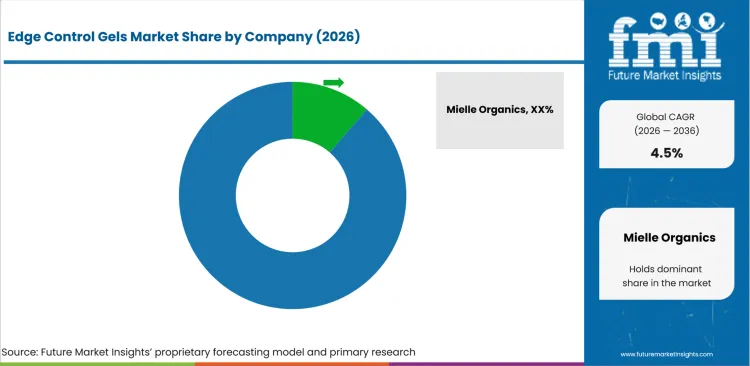
Competition spans dedicated textured-hair brands and broad styling platforms. Mielle Organics and Camille Rose operate closest to the edge-control task. Henkel has direct edge exposure through got2b and owns Olaplex following its July 2026 acquisition. Kitsch competes through portable sleek-styling formats. Wella Company influences premium finishing through professional haircare. Unilever and L'Oreal bring global haircare portfolios. Procter & Gamble competes through a global haircare business that includes styling aids and treatments. Church & Dwight enters through Batiste with limited dedicated edge activity.
- Mielle Organics and Camille Rose focus on textured-hair routines with explicit hairline styling relevance.
- Henkel and Kitsch serve sleek styling with formats that address flyaways or edge-adjacent precision work.
- Olaplex and Wella Company shape premium and professional expectations for smooth finish and hair condition.
- Unilever and L'Oreal bring global haircare platforms. Procter & Gamble and Church & Dwight add broad consumer reach with less direct edge exposure.
Competitive Benchmarking: Edge Control Gels Market
| Company | Edge & Hairline Relevance | Texture-Care Depth | Channel Breadth | Geographic Reach |
|---|---|---|---|---|
| Mielle Organics | High | High | High | North America and international retail |
| Kitsch | Medium | Medium | High | 27 countries and 20,000+ retail locations |
| Camille Rose | High | High | High | North America with international e-commerce |
| Church & Dwight | Low | Low | High | North America and international consumer markets |
| Olaplex | Low | Medium | High | 60+ countries |
| Henkel | High | High | High | Global |
| Unilever | Medium | High | High | Global |
| L'Oreal | Medium | High | High | Global |
| Procter & Gamble | Medium | High | High | Global |
| Wella Company | Low | Medium | High | Global professional and retail channels |
High edge relevance requires a current dedicated edge or hairline offer. Medium covers documented sleek or flyaway styling. Low denotes a current broader haircare platform without dedicated edge positioning. High texture-care depth requires a direct curly or textured-hair platform. Medium covers multi-texture styling and Low covers broader general haircare. High channel breadth requires several current retail or professional routes. Medium requires two documented routes and Low indicates one.
Key Developments in the Edge Control Gels Market
- In May 2026, Unilever launched TRESemmé Professional in the United Kingdom and Ireland with six salon-quality systems. The launch puts science-led haircare into a mass brand that competes for styling spend but does not establish direct edge-control leadership.
- In September 2025, Wella Professionals introduced the SmoothFiller in-salon smoothing service. The service expands Wella's anti-frizz offer inside a professional channel that shapes high-performance finishing expectations beyond dedicated edge gels.
- In June 2025, L'Oreal signed an agreement to acquire Color Wow. The transaction increases exposure to frizz-control and finishing use cases that overlap with edge evaluation without proving dedicated edge-gel share.
Key Players in the Edge Control Gels Market
Texture-Led Edge Specialists
- Mielle Organics
- Camille Rose
Styling and Format Platforms
- Kitsch
- Henkel
- Wella Company
- Olaplex
Scaled Consumer Haircare Groups
- Unilever
- L'Oreal
- Procter & Gamble
- Church & Dwight
Edge Control Gels Market - Report Scope
| Coverage field | Report scope |
|---|---|
| Market breakdown | By product type, nature, format, price positioning, sales channel and region. |
| Quantitative Units | USD million. |
| Market Definition | Revenue from dedicated edge-control gels and equivalent named edge-control formats used for hairline shaping and finishing. General styling substitutes and salon services are excluded. |
| Regions Covered | North America, Latin America, Western Europe, Eastern Europe, East Asia, South Asia and Pacific and Middle East and Africa. |
| Countries Covered | South Africa, Brazil, United Kingdom, United States, France, Canada and 25+ additional countries included in the full report. |
| Key Companies Profiled | Mielle Organics, Kitsch, Camille Rose, Church & Dwight, Olaplex, Henkel, Unilever, L'Oreal, Procter & Gamble, Wella Company. |
| Forecast Period | 2026 to 2036. |
| Approach | Primary and secondary research with market triangulation. |
Edge Control Gels Market - Research Methodology
| Method | Approach |
|---|---|
| Primary Research | FMI analysts gathered input from manufacturers, service providers, technology developers, distributors, end users, procurement teams, and subject-matter experts. Interviews examined purchasing decisions, product or service evaluation, adoption barriers, approval requirements, pricing considerations, and expectations for technical or commercial support. Respondents were also asked what evidence is required before a trial, pilot, or initial order develops into regular purchasing. |
| Desk Research | Desk research covered government statistics, regulatory publications, trade data, industry associations, technical literature, standards, company filings, product information, and official corporate announcements. Sources were reviewed for relevance, publication date, geographic coverage, and consistency with the defined market scope. Claims relating to performance, applications, approvals, capacity, investment, and commercial activity were retained only when supported by credible public evidence. |
| Market Sizing and Forecasting | The market model combined the baseline value with historical performance, segment structure, pricing and volume indicators, adoption levels, company participation, and country-level demand conditions. Forecast assumptions considered economic activity, investment trends, regulatory developments, technology adoption, purchasing cycles, supply availability, and barriers to wider market use. Segment and regional estimates were reconciled before the final market total was calculated. |
| Data Validation | Estimates were checked against multiple independent indicators, including public data, company activity, trade patterns, industry developments, and findings from primary interviews. Validation also tested whether products, services, applications, and company revenues fell within the defined market boundaries. Adjacent categories, unsupported claims, overlapping revenues, and activities without direct market relevance were excluded to reduce double counting and maintain consistency across segments and countries. |
Edge Control Gels Market by Segments
Edge Control Gels Market segmented by Product Type:
- Core - classic lines
- Targeted treatment lines
- Sensitive & gentle lines
- Premium & clinical lines
- Kits & sets
Edge Control Gels Market segmented by Nature:
- Conventional
- Vegan & cruelty-free
- Natural & organic
- Dermocosmetic - clinical
- Fragrance-free & sensitive
Edge Control Gels Market segmented by Format:
- Cream & balm
- Liquid & serum
- Stick & solid
- Spray & mist
- Sheet & patch
- Powder
Edge Control Gels Market segmented by Price Positioning:
- Mass
- Masstige
- Premium
- Professional
Edge Control Gels Market segmented by Sales Channel:
- Specialty beauty retail
- E-commerce & DTC
- Pharmacies & drugstores
- Supermarkets & hypermarkets
- Salons & spas
Edge Control Gels Market by Region:
- North America
- United States
- Canada
- Latin America
- Brazil
- Mexico
- Argentina
- Chile
- Western Europe
- Germany
- Italy
- France
- Nordics
- Benelux
- Rest of Western Europe
- Eastern Europe
- Russia
- Poland
- Hungary
- Balkan and Baltic States
- Rest of Eastern Europe
- East Asia
- China
- Japan
- South Korea
- South Asia and Pacific
- India
- ASEAN
- Australia and New Zealand
- Rest of South Asia and Pacific
- Middle East and Africa
- Kingdom of Saudi Arabia
- Other GCC Countries
- Türkiye
- South Africa
- Other African Union Countries
- Rest of Middle East and Africa
Research Sources and Bibliography
- Henkel. (2025, August 7). Transcript: H1 2025 conference call
- Office for National Statistics. (2026, April 24). Retail sales, Great Britain: March 2026
- Target Corporation. (2026, January 28). Target Unveils Largest Spring Beauty Assortment Ever - Making Trend-Driven, Expert-Backed Beauty More Accessible
- Direction générale de la concurrence, de la consommation et de la répression des fraudes. (2025, October 1). Allégations "sans" dans les produits cosmétiques : précisions des autorités de contrôle
- Henkel. (2025, April 2). göt2b announces new Curled product portfolio and introduces SherriAnn Cole as new Curled Brand Ambassador
- Target Corporation. (2025, March 4). Q4 2024 Target Corp Earnings Call And Financial Community Meeting
- Office for National Statistics. (2026, May 22). Retail sales, Great Britain: April 2026
- Unilever. (2026, March 3). Unilever Annual Report and Accounts 2025
- European Commission. (2025, May 13). Commission Regulation (EU) 2025/877 of 12 May 2025 amending Regulation (EC) No 1223/2009 of the European Parliament and of the Council as regards the use in cosmetic products of certain substances classified as carcinogenic, mutagenic or toxic for reproduction
- Wella Professionals. (2025, October 10). Here’s Your Peek Behind the Doors at the House of Wella
- Department of Trade, Industry and Competition. (2026, August 10). Cosmetics Companies Hail Gauteng Expo Success After Trade Leads and Sales
- Agência Nacional de Vigilância Sanitária. (2025, April 7). Peticionamento de cosméticos isentos de registro deve ser feito exclusivamente pelo Solicita/Datavisa
- Office for Product Safety and Standards. (2026, July 17). New data on UK cosmetic product safety notifications
- USA Food and Drug Administration. (2026, February 11). Registration & Listing of Cosmetic Product Facilities and Products
- Direction générale de la concurrence, de la consommation et de la répression des fraudes. (2026, February 2). Cosmétiques : des TPE nouvelles dans le secteur qui méconnaissent trop souvent la réglementation
- Health Canada. (2025, August 14). Changes to the Cosmetic Ingredient Hotlist
- Mielle Organics. (2025, January 6). A Guide on How to Do Edges
- Kitsch. (n.d.). Our Story
- Church & Dwight Co., Inc.. (2026, February 12). Form 10-K Annual Report
- Olaplex Holdings, Inc. (2026, March 5). Form 10-K for the year ended December 31, 2025
- L'Oreal. (2026, March 18). 2025 Universal Registration Document
- L'Oreal. (2025, June 30). L’Oréal signs an agreement to acquire Color Wow, one of the world’s fastest growing professional haircare brands
- Wella Professionals. (2025, September 1). SmoothFiller: A New Era of Keratin Hair Treatments
- Henkel. (2026, July 7). Henkel successfully closes acquisition of premium hair care brand OLAPLEX
- Unilever. (2026, July 9). TRESemmé’s transformation: introducing the brand’s new science-led salon-quality haircare
- Target Corporation. (2026, February 19). Target SoHo Ushers in Spring in NYC Style
- Wella Professionals. (2025, July 28). Make It You with Wella - A New Era Begins
- Target Corporation. (2025, July 11). Strengthening Connections, Celebrating Culture: Target at Essence Fest
- Olaplex Holdings, Inc. (2025, August 26). OLAPLEX Acquires Biotech Company Purvala
- Church & Dwight Co., Inc. (2025, May 1). Church & Dwight Reports First Quarter 2025 Results
- The Procter & Gamble Company. (2026, August 4). Form 10-K for the fiscal year ended June 30, 2026
- Procter & Gamble. (2024, December 16). Celebrating the Leaders of Brand Success: The 2024 P&G Best of Brand Awards and Brand Mastery Society Induction
- BeautyMatter. (2025). 2025 Winners
This bibliography is provided for reader reference and is not exhaustive. The full report contains the complete reference list and detailed citations.
This Report Answers
- How large is the edge control gels market in 2026 and what value is forecast for 2036?
- Which operating conditions support repeat purchase of dedicated edge-control products?
- Why do core - classic lines hold the leading product type share in 2026?
- Why do conventional formulas lead the nature category in 2026?
- How does cream & balm format affect precision hairline application?
- Why does specialty beauty retail hold the leading sales channel share?
- How do profiled country growth rates differ from South Africa to Canada?
- Which companies have direct edge relevance and which operate at the edge of scope?
- What labeling and compliance issues can slow multi-country launches?
- How do live demonstrations improve conversion for technique-heavy edge products?
Frequently Asked Questions
How big is the edge control gels market in 2026?
The edge control gels market is valued at USD 417.9 million in 2026 and is projected to reach USD 649.0 million by 2036. Repeat hairline styling supports replenishment once hold stays clean and flexible.
What is the CAGR of the edge control gels market from 2026 to 2036?
The edge control gels market is projected to grow at a CAGR of 4.5% between 2026 and 2036. Expansion is supported by repeat styling and wider specialty beauty access.
Which product type leads the edge control gels market?
The core - classic lines segment is expected to hold 35.0% of the edge control gels market in 2026 driven by routine hairline use. Familiar application also reduces explanation at first purchase and supports replenishment.
Which nature segment leads the edge control gels market?
The conventional segment is expected to hold 60.0% of the edge control gels market in 2026 supported by broad formulation options. Formulators can balance grip with finish and accessible pricing without a narrower nature claim.
Which companies are active in the edge control gels market?
Key companies operating in the edge control gels market include Mielle Organics, Kitsch, Camille Rose, Church & Dwight, Olaplex, Henkel, Unilever, L'Oreal, Procter & Gamble, and Wella Company. Their exposure ranges from dedicated edge products to broad haircare platforms.
Preview the report firsthand - request a free sample
Get SampleGet the brochure for pricing and purchase details.
Get PDFTable of Content
- Key Takeaways
- Market Size and CAGR
- Top Growth Driver
- Fastest Growing Segment
- Leading Region
- Key Companies
- Emerging Opportunities
- Executive Summary
- Global Market Outlook
- Demand-side Trends
- Supply-side Trends
- Technology Roadmap Analysis
- Analysis and Recommendations
- Analyst Perspective (What is happening? Why now? What should investors know?)
- Key Questions Answered
- How large is the market?
- What is the CAGR?
- What are key trends?
- Which region dominates?
- Who are the leaders?
- Market Overview
- Market Coverage / Taxonomy
- Market Definition / Scope / Limitations
- Research Methodology
- Chapter Orientation
- Analytical Lens and Working Hypotheses
- Market Structure, Signals, and Trend Drivers
- Benchmarking and Cross-market Comparability
- Market Sizing, Forecasting, and Opportunity Mapping
- Research Design and Evidence Framework
- Desk Research Programme (Secondary Evidence)
- Expert Input and Fieldwork (Primary Evidence)
- Tooling, Models, and Reference Databases
- Data Engineering and Model Build
- Quality Assurance and Audit Trail
- Market Background
- Market Dynamics (Drivers, Restraints, Opportunity, Trends)
- Scenario Forecast (Optimistic, Likely, Conservative)
- Impact Analysis
- AI Impact
- Sustainability Impact
- Regulatory Impact
- Technology Impact
- Consumer / Buyer Analysis
- Purchase Drivers
- Adoption Barriers
- Buyer Journey
- Opportunity Map Analysis
- Product Life Cycle Analysis
- Supply Chain Analysis
- Investment Feasibility Matrix
- Value Chain Analysis
- PESTLE and Porter's Analysis
- Regulatory Landscape
- Regional Parent Market Outlook
- Production and Consumption Statistics
- Import and Export Statistics
- Global Market Analysis and Forecast, 2021 to 2036
- Historical Market Size Value (USD Million) Analysis, 2021 to 2025
- Current and Future Market Size Value (USD Million) Projections, 2026 to 2036
- Y-o-Y Growth Trend Analysis
- Absolute $ Opportunity Analysis
- Global Market Pricing Analysis, 2021 to 2036
- Global Market Analysis and Forecast, By Product Type, 2021 to 2036
- Introduction / Key Findings
- Historical Market Size Value (USD Million) Analysis By Product Type, 2021 to 2025
- Current and Future Market Size Value (USD Million) Analysis and Forecast By Product Type, 2026 to 2036
- Core / classic lines
- Targeted treatment lines
- Sensitive & gentle lines
- Premium & clinical lines
- Kits & sets
- Core / classic lines
- Y-o-Y Growth Trend Analysis By Product Type, 2021 to 2025
- Absolute $ Opportunity Analysis By Product Type, 2026 to 2036
- Global Market Analysis and Forecast, By Nature, 2021 to 2036
- Introduction / Key Findings
- Historical Market Size Value (USD Million) Analysis By Nature, 2021 to 2025
- Current and Future Market Size Value (USD Million) Analysis and Forecast By Nature, 2026 to 2036
- Conventional
- Vegan & cruelty-free
- Natural & organic
- Dermocosmetic / clinical
- Fragrance-free & sensitive
- Conventional
- Y-o-Y Growth Trend Analysis By Nature, 2021 to 2025
- Absolute $ Opportunity Analysis By Nature, 2026 to 2036
- Global Market Analysis and Forecast, By Format, 2021 to 2036
- Introduction / Key Findings
- Historical Market Size Value (USD Million) Analysis By Format, 2021 to 2025
- Current and Future Market Size Value (USD Million) Analysis and Forecast By Format, 2026 to 2036
- Cream & balm
- Liquid & serum
- Stick & solid
- Spray & mist
- Sheet & patch
- Powder
- Cream & balm
- Y-o-Y Growth Trend Analysis By Format, 2021 to 2025
- Absolute $ Opportunity Analysis By Format, 2026 to 2036
- Global Market Analysis and Forecast, By Price Positioning, 2021 to 2036
- Introduction / Key Findings
- Historical Market Size Value (USD Million) Analysis By Price Positioning, 2021 to 2025
- Current and Future Market Size Value (USD Million) Analysis and Forecast By Price Positioning, 2026 to 2036
- Mass
- Masstige
- Premium
- Professional
- Mass
- Y-o-Y Growth Trend Analysis By Price Positioning, 2021 to 2025
- Absolute $ Opportunity Analysis By Price Positioning, 2026 to 2036
- Global Market Analysis and Forecast, By Sales Channel, 2021 to 2036
- Introduction / Key Findings
- Historical Market Size Value (USD Million) Analysis By Sales Channel, 2021 to 2025
- Current and Future Market Size Value (USD Million) Analysis and Forecast By Sales Channel, 2026 to 2036
- Specialty beauty retail
- E-commerce & DTC
- Pharmacies & drugstores
- Supermarkets & hypermarkets
- Salons & spas
- Specialty beauty retail
- Y-o-Y Growth Trend Analysis By Sales Channel, 2021 to 2025
- Absolute $ Opportunity Analysis By Sales Channel, 2026 to 2036
- Global Market Analysis and Forecast, By Region, 2021 to 2036
- Introduction
- Historical Market Size Value (USD Million) Analysis By Region, 2021 to 2025
- Current Market Size Value (USD Million) Analysis and Forecast By Region, 2026 to 2036
- North America
- Latin America
- Western Europe
- Eastern Europe
- East Asia
- South Asia and Pacific
- Middle East & Africa
- Market Attractiveness Analysis By Region
- North America Market Analysis and Forecast, By Country, 2021 to 2036
- Historical Market Size Value (USD Million) Trend Analysis By Market Taxonomy, 2021 to 2025
- Market Size Value (USD Million) Forecast By Market Taxonomy, 2026 to 2036
- By Country
- USA
- Canada
- By Product Type
- By Nature
- By Format
- By Price Positioning
- By Sales Channel
- By Country
- Market Attractiveness Analysis
- By Country
- By Product Type
- By Nature
- By Format
- By Price Positioning
- By Sales Channel
- Key Takeaways
- Latin America Market Analysis and Forecast, By Country
- Historical Market Size Value (USD Million) Trend Analysis By Market Taxonomy, 2021 to 2025
- Market Size Value (USD Million) Forecast By Market Taxonomy, 2026 to 2036
- By Country
- Brazil
- Mexico
- Chile
- Rest of Latin America
- By Product Type
- By Nature
- By Format
- By Price Positioning
- By Sales Channel
- By Country
- Market Attractiveness Analysis
- By Country
- By Product Type
- By Nature
- By Format
- By Price Positioning
- By Sales Channel
- Key Takeaways
- Western Europe Market Analysis and Forecast, By Country
- Historical Market Size Value (USD Million) Trend Analysis By Market Taxonomy, 2021 to 2025
- Market Size Value (USD Million) Forecast By Market Taxonomy, 2026 to 2036
- By Country
- Germany
- UK
- Italy
- Spain
- France
- Nordic
- BENELUX
- Rest of Western Europe
- By Product Type
- By Nature
- By Format
- By Price Positioning
- By Sales Channel
- By Country
- Market Attractiveness Analysis
- By Country
- By Product Type
- By Nature
- By Format
- By Price Positioning
- By Sales Channel
- Key Takeaways
- Eastern Europe Market Analysis and Forecast, By Country
- Historical Market Size Value (USD Million) Trend Analysis By Market Taxonomy, 2021 to 2025
- Market Size Value (USD Million) Forecast By Market Taxonomy, 2026 to 2036
- By Country
- Russia
- Poland
- Hungary
- Balkan & Baltic
- Rest of Eastern Europe
- By Product Type
- By Nature
- By Format
- By Price Positioning
- By Sales Channel
- By Country
- Market Attractiveness Analysis
- By Country
- By Product Type
- By Nature
- By Format
- By Price Positioning
- By Sales Channel
- Key Takeaways
- East Asia Market Analysis and Forecast, By Country
- Historical Market Size Value (USD Million) Trend Analysis By Market Taxonomy, 2021 to 2025
- Market Size Value (USD Million) Forecast By Market Taxonomy, 2026 to 2036
- By Country
- China
- Japan
- South Korea
- By Product Type
- By Nature
- By Format
- By Price Positioning
- By Sales Channel
- By Country
- Market Attractiveness Analysis
- By Country
- By Product Type
- By Nature
- By Format
- By Price Positioning
- By Sales Channel
- Key Takeaways
- South Asia and Pacific Market Analysis and Forecast, By Country
- Historical Market Size Value (USD Million) Trend Analysis By Market Taxonomy, 2021 to 2025
- Market Size Value (USD Million) Forecast By Market Taxonomy, 2026 to 2036
- By Country
- India
- ASEAN
- Australia & New Zealand
- Rest of South Asia and Pacific
- By Product Type
- By Nature
- By Format
- By Price Positioning
- By Sales Channel
- By Country
- Market Attractiveness Analysis
- By Country
- By Product Type
- By Nature
- By Format
- By Price Positioning
- By Sales Channel
- Key Takeaways
- Middle East & Africa Market Analysis and Forecast, By Country
- Historical Market Size Value (USD Million) Trend Analysis By Market Taxonomy, 2021 to 2025
- Market Size Value (USD Million) Forecast By Market Taxonomy, 2026 to 2036
- By Country
- Kingdom of Saudi Arabia
- Other GCC Countries
- Türkiye
- South Africa
- Other African Union
- Rest of Middle East & Africa
- By Product Type
- By Nature
- By Format
- By Price Positioning
- By Sales Channel
- By Country
- Market Attractiveness Analysis
- By Country
- By Product Type
- By Nature
- By Format
- By Price Positioning
- By Sales Channel
- Key Takeaways
- Key Countries Market Analysis
- USA
- Pricing Analysis
- Market Share Analysis, 2025
- By Product Type
- By Nature
- By Format
- By Price Positioning
- By Sales Channel
- Canada
- Pricing Analysis
- Market Share Analysis, 2025
- By Product Type
- By Nature
- By Format
- By Price Positioning
- By Sales Channel
- Mexico
- Pricing Analysis
- Market Share Analysis, 2025
- By Product Type
- By Nature
- By Format
- By Price Positioning
- By Sales Channel
- Brazil
- Pricing Analysis
- Market Share Analysis, 2025
- By Product Type
- By Nature
- By Format
- By Price Positioning
- By Sales Channel
- Chile
- Pricing Analysis
- Market Share Analysis, 2025
- By Product Type
- By Nature
- By Format
- By Price Positioning
- By Sales Channel
- Germany
- Pricing Analysis
- Market Share Analysis, 2025
- By Product Type
- By Nature
- By Format
- By Price Positioning
- By Sales Channel
- UK
- Pricing Analysis
- Market Share Analysis, 2025
- By Product Type
- By Nature
- By Format
- By Price Positioning
- By Sales Channel
- Italy
- Pricing Analysis
- Market Share Analysis, 2025
- By Product Type
- By Nature
- By Format
- By Price Positioning
- By Sales Channel
- Spain
- Pricing Analysis
- Market Share Analysis, 2025
- By Product Type
- By Nature
- By Format
- By Price Positioning
- By Sales Channel
- France
- Pricing Analysis
- Market Share Analysis, 2025
- By Product Type
- By Nature
- By Format
- By Price Positioning
- By Sales Channel
- India
- Pricing Analysis
- Market Share Analysis, 2025
- By Product Type
- By Nature
- By Format
- By Price Positioning
- By Sales Channel
- ASEAN
- Pricing Analysis
- Market Share Analysis, 2025
- By Product Type
- By Nature
- By Format
- By Price Positioning
- By Sales Channel
- Australia & New Zealand
- Pricing Analysis
- Market Share Analysis, 2025
- By Product Type
- By Nature
- By Format
- By Price Positioning
- By Sales Channel
- China
- Pricing Analysis
- Market Share Analysis, 2025
- By Product Type
- By Nature
- By Format
- By Price Positioning
- By Sales Channel
- Japan
- Pricing Analysis
- Market Share Analysis, 2025
- By Product Type
- By Nature
- By Format
- By Price Positioning
- By Sales Channel
- South Korea
- Pricing Analysis
- Market Share Analysis, 2025
- By Product Type
- By Nature
- By Format
- By Price Positioning
- By Sales Channel
- Russia
- Pricing Analysis
- Market Share Analysis, 2025
- By Product Type
- By Nature
- By Format
- By Price Positioning
- By Sales Channel
- Poland
- Pricing Analysis
- Market Share Analysis, 2025
- By Product Type
- By Nature
- By Format
- By Price Positioning
- By Sales Channel
- Hungary
- Pricing Analysis
- Market Share Analysis, 2025
- By Product Type
- By Nature
- By Format
- By Price Positioning
- By Sales Channel
- Kingdom of Saudi Arabia
- Pricing Analysis
- Market Share Analysis, 2025
- By Product Type
- By Nature
- By Format
- By Price Positioning
- By Sales Channel
- Türkiye
- Pricing Analysis
- Market Share Analysis, 2025
- By Product Type
- By Nature
- By Format
- By Price Positioning
- By Sales Channel
- South Africa
- Pricing Analysis
- Market Share Analysis, 2025
- By Product Type
- By Nature
- By Format
- By Price Positioning
- By Sales Channel
- USA
- Market Structure Analysis
- Competition Dashboard
- Competition Benchmarking
- Market Share Analysis of Top Players
- By Regional
- By Product Type
- By Nature
- By Format
- By Price Positioning
- By Sales Channel
- Emerging Startups
- Innovation Benchmarking
- Competition Analysis
- Competition Deep Dive
- Mielle Organics
- Overview
- Product Portfolio
- Profitability by Market Segments
- Sales Footprint
- Strategy Overview
- Marketing Strategy
- Product Strategy
- Channel Strategy
- Kitsch
- Camille Rose
- Church & Dwight
- Olaplex
- Henkel
- Unilever
- L'Oreal
- Procter & Gamble
- Wella Company
- Mielle Organics
- Case Studies
- Success Stories
- Recent Developments
- Competition Deep Dive
- Assumptions & Acronyms Used


