

- Market Size (2026)
- USD 1.2 Bn
- Forecast (2036)
- USD 2.3 Bn
- CAGR (2026 to 2036)
- 6.7%
How big is Electromagnetic Shielding Polymers EV Components Market in 2026?
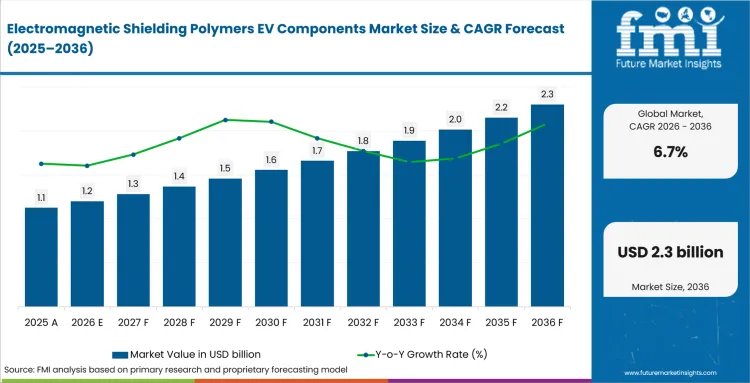
USD 1.2 billion in 2026 and USD 2.3 billion by 2036 at a 6.7% CAGR.
Sales of electromagnetic shielding polymers for EV components are estimated to rise at 6.7% CAGR through 2036, increasing valuation from USD 1.2 billion in 2026 to USD 2.3 billion by 2036. The shift toward 800-volt traction systems places faster switching devices inside smaller EV power modules and raises shielding demands around nearby control circuits. In August 2025, onsemi announced that selected Xiaomi YU7 models use its EliteSiC M3e technology within an advanced 800-volt drive platform. The platform combines higher power density with a smaller traction-system footprint, increasing the value of molded enclosures that manage interference without restoring metal weight. Revenue depends on automotive qualification across the finished assembly; material-coupon conductivity cannot prove reliable continuity across seams and connector openings throughout the component service life.
Vehicle compatibility depends on the complete current path across molded walls, joints, fasteners, cable entries, and grounding interfaces. Regulatory updates guide polymer selection by requiring each enclosure to perform inside the finished vehicle rather than as an isolated material sample. In September 2025, UNECE published a proposal for Supplement 1 to the seventh amendment series of UN Regulation 10 on electromagnetic compatibility. The proposal reinforces vehicle-level evaluation across emissions and immunity requirements without presenting commercial demand as a regulatory outcome. OEM approval requires compounders to pair conductive shielding coatings with stable seam design and aging evidence across lighter polymer enclosures. Qualification timelines also depend on repeated enclosure tests during design changes and later production transfers.
Key Takeaways of Electromagnetic Shielding Polymers EV Components Market
- Denser EV power electronics support demand by placing high-current switching devices beside sensitive control and communication circuits inside compact molded housings.
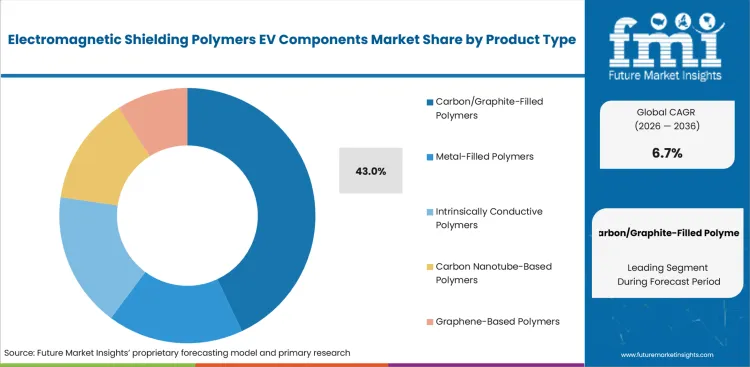
- Carbon/graphite-filled polymers are estimated to account for 43.0% share in 2026 owing to balanced conductivity and moldability across complex component geometries.
- Power electronics are projected to capture 28.0% share in 2026 supported by inverter and converter assemblies that combine thermal loads with strict compatibility requirements.
- Battery electric vehicles are anticipated to represent 48.0% share in 2026 underpinned by extensive high-voltage electronic content across propulsion and charging systems.
- Seam continuity and grounding design constrain qualification, and conductive filler cost lengthens the validation work required for platform awards.
- The competitive outlook includes Avient Corporation, RTP Company, SABIC, Henkel AG & Co. KGaA, Parker-Hannifin Corporation, 3M Company, Rogers Corporation, and Celanese Corporation.
Analyst Perspective
“Electromagnetic shielding polymers earn a place in EV components by reducing enclosure weight without weakening continuity at seams, connectors, or grounding points. The decisive proof comes from assembled inverter, battery-control, and charging housings tested through heat and vibration aging. Compounders that combine formulation control with vehicle-level application engineering can convert one platform approval into repeat business; weak change control can erase the original metal-replacement advantage.”
- Nikhil Kaitwade, Principal Analyst, Future Market Insights
How is the Electromagnetic Shielding Polymers EV Components Market segmented?
The Electromagnetic Shielding Polymers EV Components Market is segmented by Product Type, Application, Vehicle Type, End User, Distribution Channel, and Region.
The framework separates material chemistry from the component function that converts conductivity into vehicle-level performance. Product type distinguishes carbon-filled compounds, metal-filled systems, intrinsically conductive polymers, nanotube formulations, and graphene alternatives with different processing limits. Application tracks power electronics, battery housings, sensors, drive systems, and charging assemblies exposed to distinct frequency and temperature conditions. Vehicle type compares electronic intensity across BEV and hybrid architectures with different high-voltage conversion and charging content. End user identifies the organization controlling specifications and production approval, and distribution channel separates direct program supply from development-volume access through specialist intermediaries. Regional analysis compares manufacturing depth and technical support across operating markets with different service and qualification requirements. Adjacent electroactive polymers provide useful material context without changing the defined revenue boundary for conductive shielding components.
Why do carbon/graphite-filled polymers hold the principal product type position?
Carbon and graphite fillers create conductive pathways and preserve injection-molded geometry that can remove secondary enclosure operations. Vehicle engineers must balance filler loading against melt flow and impact strength across thin walls and mounting features. In June 2026, Avient expanded its Therma-Tech portfolio with eight natural-graphite formulations for automotive heat sinks and molded housings. The new grades strengthen a scalable graphite-processing route, but EMC shielding systems require separate assembly-level attenuation evidence.
- In 2026, carbon/graphite-filled polymers are expected to lead product type with 43.0% share because adaptable filler loading supports complex molded housings. The position reflects practical metal replacement across geometries that require balanced attenuation and processing economics. Excessive conductive content can weaken thin walls and mounting features, so formulators must preserve flow and impact strength across each design.
- Automotive engineering teams adopt carbon-filled compounds for housings that combine shielding and heat spreading with integrated mounting features. Medium-volume complex geometries strengthen the commercial advantage over stamped assemblies requiring several secondary operations and tooling steps. Added grounding tabs can restore component weight and assembly cost if the molded design cannot maintain a continuous current path.
What supports power electronics within the application category?
Inverters and onboard chargers combine rapid switching with substantial heat inside compact conversion packages and integrated charger systems. Housing materials enter the same design review as potting systems and electrical-isolation features across the complete assembly. Thermal cycling can change interfaces around shielding and dielectric materials throughout the vehicle service life. In November 2025, Henkel launched two thermal potting materials for EV inverters and onboard chargers. The release deepens integrated power electronics design and requires shielding to remain stable beside sustained heat and vibration.
- By application, power electronics are forecast to represent 28.0% in 2026 driven by concentrated electromagnetic emissions around conversion equipment. Engineers evaluate shielding beside dielectric strength and thermal cycling across the complete assembled package during production qualification. Fasteners and cable entries can interrupt continuity despite acceptable compound testing during repeated series-validation work.
- Vehicle manufacturers prioritize molded shielding around inverter controls and converter modules that face strict packaging limits. Polymer solutions reduce component count by integrating bosses and connector features directly into the housing geometry. Adoption remains sensitive to heat aging and creepage requirements that demand electrical and mechanical review within one engineering program.
Why are battery electric vehicles central to the vehicle type category?
Battery electric platforms concentrate high-voltage conversion and electronic supervision across propulsion and charging systems throughout each vehicle architecture. Each electronic interface adds another path that enclosure designers must control through material selection and grounding architecture. In June 2026, SABIC presented specialty thermoplastics for battery packs and inverter housings at Battery Show Europe. The displayed components widen the molded material set requiring coordinated battery filter systems and enclosure-level shielding validation.
- By vehicle type, battery electric vehicles are estimated to hold 48.0% in 2026 owing to extensive inverter and charging electronics across each platform. The position reflects greater electronic component intensity rather than vehicle sales volume across the complete category. Every housing requires evidence across operating frequencies and temperatures before sourcing progresses toward series production.
- Battery electric vehicles use shielding across inverters, converters, charging systems, battery controls, and sensor housings within the same platform. Platform reuse can produce recurring material volume across later vehicle programs following successful qualification and production release. Different molding geometries alter joints and wall thickness across each component design and its intended mounting points. Compound developers must preserve electrical performance across those geometry changes and the related grounding paths.
How do automotive OEMs shape the end user category?
Automotive OEMs define vehicle-level EMC targets that connect batteries, inverters, sensors, harnesses, and communication modules. Component evidence cannot reveal every interaction created by the assembled vehicle and its grounding architecture. In June 2025, ISO published ISO 11451-2:2025 for radiated immunity testing of passenger and commercial vehicles. The standard separates complete-vehicle immunity from component testing and gives OEM engineering teams another approval layer. The same platform review can coordinate fire-safe EV plastics with conductive enclosure compounds without confusing thermal protection with attenuation performance.
- The end user category is forecast to be led by automotive OEMs at 42.0% share in 2026 due to direct control over platform specifications. Automotive OEM influence extends beyond material price throughout the complete vehicle qualification and series-production process across platforms. Repeat orders require approved compounds to preserve traceable test results and stable production controls across several manufacturing locations.
- OEM programs favor compounders that support material simulation and prototype molding across several design revisions. Early application work reduces late electromagnetic failures near production launch and clarifies responsibility among engineering teams. Adoption can stall if regional support or approved manufacturing capacity cannot protect the platform schedule during corrective work and production transfers.
What keeps direct OEM supply ahead within distribution channel?
Direct supply gives vehicle programs accountable formulation control and coordinated engineering support during approved production changes. The channel becomes more valuable as component teams need joint material development during decisions on series tooling. In June 2025, BASF announced that KOSTAL uses a new PPA grade in high-current connectors for electric cars. The commercial application demonstrates how direct material collaboration protects design continuity across inverter busbar laminates and related high-voltage components.
- Direct OEM supply is set to lead the distribution channel with 38.0% share in 2026 due to approved-grade control and coordinated engineering support. Direct agreements protect formulation continuity across several production years and assign responsibility for manufacturing changes. Distributors remain useful for development volumes, but series awards require accountable batch control and corrective action.
- Vehicle programs use direct agreements to manage documentation and formulation changes across regional production plants. Compounders can align awarded capacity with faster technical escalation during qualification and later production changes. Delayed launches can reduce planned volume across dedicated assets and specialist application teams, creating material concentration risk across awarded programs.
What are the drivers, restraints, and opportunities in the Electromagnetic Shielding Polymers EV Components Market?
Higher switching density supports demand for molded shielding around compact EV power electronics. Weak seam continuity and grounding design restrain conversion. Co-designed polymer housings offer a credible route to combine shielding with thermal and mechanical functions.
- Driver: Higher switching density raises interference-control requirements around compact traction inverters and integrated power-conversion units.
- Restraint: Weak seam continuity and uncertain grounding paths can erase compound-level attenuation across the finished enclosure.
- Opportunity: Co-designed housings can integrate shielding and thermal functions and reduce metal parts plus secondary assembly operations.
Higher switching density increases shielding requirements around traction inverters and integrated conversion units operating inside compact electronic packages. Smaller footprints place strong electromagnetic emissions beside sensitive control circuits under substantial thermal loads throughout each drive cycle. In May 2026, Infineon introduced a 1300-volt silicon-carbide inverter module for continuous operation at temperatures reaching 205°C. The module combines higher voltage capability with demanding thermal conditions inside a compact power package. The compact inverter architecture strengthens demand for harness-level shielding and molded enclosures that control interference without adding metal mass.
Assembly-level continuity remains a material restraint across joints and cable entries that interrupt the conductive path. Grounding interfaces can erase compound attenuation during finished-enclosure testing under realistic mounting and aging conditions. Automotive programs therefore need component methods that cover the intended frequency environment rather than one isolated coupon result. In June 2025, ISO published ISO 11452-1:2025 to establish general principles for narrowband radiated immunity testing across vehicle components and production-representative configurations.
Integrated polymer housings offer a practical route for vehicle teams already planning to replace metal control-unit covers. The component must preserve structural strength and repeatable assembly so shielding functions can be added without extra hardware. In December 2025, SABIC introduced an LNP THERMOCOMP compound for lightweight electric vehicle control-unit housings. The development establishes a current metal-replacement route that shielding formulations can extend through coordinated electrical and thermal validation across finished assemblies.
Which country CAGRs are profiled in the Electromagnetic Shielding Polymers EV Components Market?
| Country | CAGR |
|---|---|
| Canada | 8.2% |
| South Korea | 7.8% |
| UK | 7.1% |
| Germany | 6.2% |
| Japan | 5.8% |
| USA | 5.4% |
| Brazil | 5.0% |
How do country-level CAGRs compare in the Electromagnetic Shielding Polymers EV Components Market?
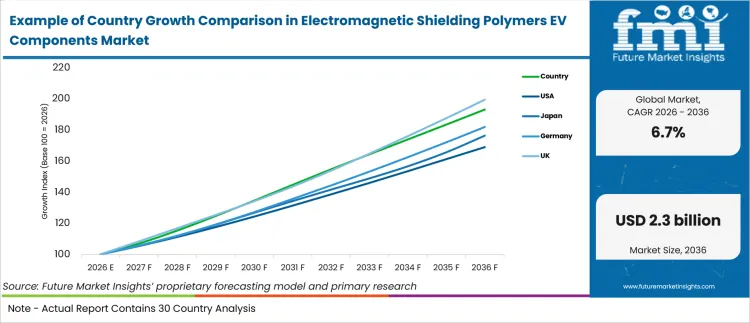
The profiled country rates cover a 3.2 percentage-point spread from 8.2% to 5.0% across the outlook. Canada and South Korea form a narrow 0.4-point band shaped by concentrated component programs and nearby engineering support. The UK carries a separate 7.1% case as funded electrification projects connect material developers with power-electronics work. Germany and Japan differ by 0.4 point across documentation-heavy qualification routes and controlled material changes. The USA and Brazil form distinct manufacturing cases that require regional service and inventory planning rather than identical market-entry models. Each rate therefore needs interpretation through local platform access and technical support capacity within the relevant manufacturing corridor.
- Canada combines Ontario component development with cross-border supply routes that favor compounders offering local testing support and dependable regional stock.
- South Korea links dense vehicle clusters with power-conversion research that rewards resident engineering teams and rapid material-sample availability.
- The UK connects public electrification funding with selected domestic platforms, giving material developers focused routes into power-electronics and lightweight-component projects.
- Germany offers several engineering corridors and established test capacity, although long documentation cycles raise the cost of introducing unfamiliar conductive formulations.
- Japan supports battery and power-system development through controlled supplier networks that value production consistency but extend qualification for material changes.
- The USA provides several regional platform opportunities, yet dispersed plants and different OEM specifications increase travel and application-engineering costs.
- Brazil adds local vehicle assembly and supplier localization, but imported specialty compounds and limited EMC test access continue to constrain expansion.
Country CAGRs describe the profiled growth outlook rather than local market size or guaranteed purchasing activity. Compounders should compare each rate with nearby molding capacity and platform access across the relevant production corridor. The full report provides country-level CAGR analysis across North America, Latin America, Europe, East Asia, South Asia, Oceania and the Middle East and Africa.
Country-wise Analysis
- Ontario’s EV component corridor gives material developers access to vehicle and semiconductor-packaging programs across manufacturing cities. Canada’s electromagnetic shielding polymers for EV components outlook is anticipated to advance at 8.2% CAGR over the assessment period, supported by local component development. Federal support connects electrified component manufacturing with advanced packaging methods used around battery and power electronics. In January 2025, Innovation Science and Economic Development Canada funded Linamar’s project for EV parts manufacturing and battery semiconductor packaging. The project gives conductive housing developers a route to prototype components requiring stable geometry and repeatable electrical controls. Ontario’s engineering base supports shorter correction cycles across awarded platforms and component plants during local vehicle development. Specialty compounds may cross long domestic distances or international borders on the route to western customers and smaller assembly sites. New entrants need regional stock and local application engineers to protect qualification schedules during design changes and production transfers.
- South Korea combines vehicle manufacturing with a local electronics base that can test materials beside finished power systems. Nearby material teams and component plants support short engineering loops across established industrial corridors nationwide. In February 2026, the Ministry of Trade Industry and Resources announced 30 electric and hydrogen vehicle projects including a gallium-nitride power-conversion system. By 2036, electromagnetic shielding polymer demand for EV components in South Korea is projected to grow at 7.8% CAGR, reinforced by concentrated engineering networks. The project set gives domestic component programs a route to test lighter conductive housings around compact conversion equipment. Local production shortens engineering feedback across prototypes and series changes throughout connected factories and supplier laboratories. Foreign compounders face demanding local validation cycles alongside relationship-based sourcing across established automotive accounts and engineering teams. Entry plans need Korean technical support and inventory access so formulations can progress from laboratory screening to platform approval.
- The United Kingdom combines targeted automotive support with fewer vehicle platforms than Germany or the United States. Electromagnetic shielding polymer sales for EV components in the UK are forecast to expand at 7.1% CAGR by 2036, influenced by funded development routes. Public competitions cover power electronics and lightweight manufacturing within zero-emission vehicle projects and manufacturing work. In July 2025, the Department for Business and Trade published the DRIVE35 Innovation programme for collaborative and individual automotive research projects. The programme gives conductive-housing developers a route into battery and conversion-system work ahead of series tooling. Domestic engineering access can shorten material testing across selected programs during repeated design reviews and prototype changes. Concentrated assembly limits the number of platform awards and increases exposure to several large customers. Commercial plans should prioritize funded projects with visible production paths and nearby electromagnetic-compatibility testing capacity.
- German automotive programs require engineering-led qualification and extensive documentation for unfamiliar materials entering series production. Local e-drive development integrates power electronics with clearly defined component interfaces across scalable vehicle platforms and production programs. The German electromagnetic shielding polymers for EV components sector is projected to record 6.2% CAGR during the assessment period, supported by established engineering corridors. In June 2025, ZF introduced its SELECT e-drive platform with an 800-volt system and modular inverter technology developed in Friedrichshafen and Zweibrücken. The platform provides a direct route for lightweight shielding around compact inverter and converter enclosures. Established laboratories support detailed enclosure testing throughout surrounding vehicle and component programs during qualification work. Long approval schedules and strict change control remain material frictions for unfamiliar conductive formulations in series production. Entrants need documented assembly performance and nearby application engineers to secure broader coverage across several vehicle programs.
- Japanese OEMs emphasize repeatability and long-term material control across battery and electronic components entering series production. National planning treats batteries and power-control systems as one connected manufacturing base rather than separate industries. In June 2026, METI revised its battery strategy into the Battery and Power Industry Strategy with a target of 150 GWh annual domestic capacity. Japan’s electromagnetic shielding polymers for EV components market is estimated to post 5.8% CAGR over the forecast period, underpinned by continued power-system development. The strategy expands engineering work around battery electronics and related enclosure materials entering domestic vehicle programs. Established supplier relationships support platform reuse across approved components and reduce reformulation risk during production transfers. Conservative material-change procedures slow unfamiliar conductive compounds and increase the need for local test support. Entry requires stable production documentation throughout the complete vehicle qualification cycle and supplier review process.
- United States vehicle programs span several OEM architectures and widely separated production sites across major automotive states. Power-semiconductor awards create direct qualification routes for onboard chargers and surrounding electronic housings across multiple vehicle platforms. In December 2025, Wolfspeed announced that its silicon-carbide MOSFETs would power onboard charger systems for Toyota battery electric vehicles. Adoption of electromagnetic shielding polymers for EV components in the United States is estimated to expand at 5.4% CAGR through 2036, aided by several domestic platform routes. The charger award increases engineering work around compact conversion assemblies requiring dependable attenuation and thermal control. Regional production offers several customer entry points for compounders with local technical teams and approved stock. Fragmented specifications and long travel distances raise application-support costs across multi-site programs and repeated qualification activity. Material companies need approved regional capacity and must coordinate conductive polymers with enclosure design across platform changes.
- Brazilian EV programs increasingly combine local assembly with imported specialty materials and tooling for high-voltage components. In Brazil, electromagnetic shielding polymer demand for EV components is predicted to advance at 5.0% CAGR through 2036, shaped by gradual supplier localization. Local production gives material companies earlier engineering contact during component design and sourcing decisions across vehicle programs. In January 2026, BYD reported that its Camaçari plant had produced nearly 18,000 vehicles and planned to add more local suppliers during 2026. Additional sourcing brings qualification work for electronic housings and power components into local component programs. Local production supports closer technical contact during design changes and production transfers across domestic plants. Import lead times and limited specialist EMC testing remain material obstacles for unfamiliar formulations during qualification. Entrants need disciplined inventory planning and laboratory partnerships to support broader platform work across Brazil.
Who are the notable companies in the Electromagnetic Shielding Polymers EV Components Market?
Avient Corporation, RTP Company, SABIC, Henkel AG & Co. KGaA, Parker-Hannifin Corporation, 3M Company, Rogers Corporation, and Celanese Corporation are the notable companies shaping this market.
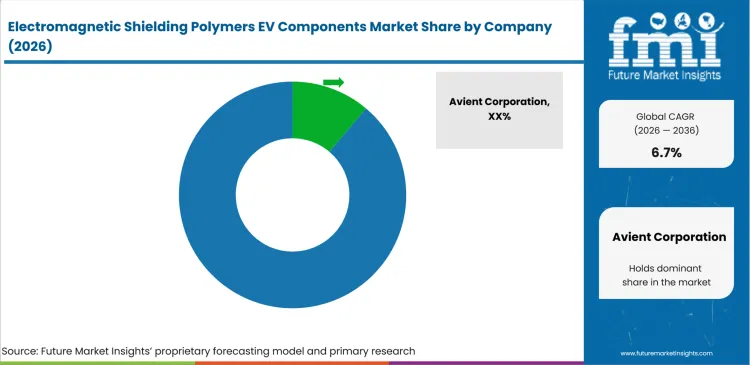
Competition is divided between compounders that formulate conductive thermoplastics and specialists that complete the shield at seams or localized interference paths. No participant controls every material layer across an EV enclosure, so platform awards often combine compounds with films, gaskets, or absorbers from different companies. Avient, RTP Company, SABIC, and Celanese compete for molded housing specifications through filler control and application engineering. Henkel, Parker-Hannifin, 3M, and Rogers compete around interface performance and localized attenuation across complex electronic assemblies. Entry remains possible through one qualified component, but expansion requires regional test support and stable formulation control across production transfers.
- Avient Corporation and RTP Company provide ready-to-mold conductive thermoplastics across several resin and filler systems. SABIC adds engineered compounds for high-voltage battery and power components within the same competitive group. The compounder group competes through formulation breadth and application engineering that balance attenuation with flow and impact performance.
- Henkel and Parker-Hannifin combine shielding materials with thermal interfaces and conductive gasketing around electronic assemblies. 3M supplies polymer-based absorbers and films for localized automotive interference paths around sensitive modules and cable routes. The interface-material group competes through coordinated formats that address seams and local noise without redesigning the complete molded housing.
- Rogers Corporation provides conductive silicone and polymeric interface materials for electrified-vehicle enclosures and electronic assemblies. Celanese offers steel-fiber and carbon-fiber polymer systems for automotive control-unit housings and nearby electronic components. Their expansion depends on component-specific validation; broad automotive material portfolios cannot establish finished-enclosure shielding performance.
Competitive Benchmarking: Electromagnetic Shielding Polymers EV Components Market
| Company | Conductive Polymer Depth | EV Component Engineering | Shielding System Breadth | Geographic Reach |
|---|---|---|---|---|
| Avient Corporation | High | High | Medium | Global |
| RTP Company | High | High | Medium | Multi-country |
| SABIC | High | High | Medium | Global |
| Henkel AG & Co. KGaA | Medium | High | High | Global |
| Parker-Hannifin Corporation | Medium | High | High | Global |
| 3M Company | Medium | Medium | High | Global |
| Rogers Corporation | Medium | Medium | Medium | Global |
| Celanese Corporation | High | High | Medium | Global |
Key Developments in the Electromagnetic Shielding Polymers EV Components Market
- In October 2025, Henkel launched an automotive EMI shielding film as a process-efficient alternative to metal housings for complex electronics. The development adds a dedicated film route for localized shielding across compact assemblies that cannot accept heavier formed metal. Automotive teams must validate adhesion and attenuation beside thermal interfaces as a condition for adopting the film across inverters or control modules in series production.
- In April 2025, DuPont expanded its silver-nanowire portfolio into transparent EMI shielding for automotive smart surfaces and sensor-related applications. The development provides a material route for curved interfaces that cannot use opaque metal coverage. Vehicle engineers can assess the technology around camera or LiDAR surfaces, although qualification must confirm stable adhesion and attenuation after environmental cycling across the complete component.
- In March 2026, Panasonic Industry launched FineX as a transparent conductive film for electromagnetic-wave shielding across flexible and curved interfaces. The film combines high light transmission with low electrical resistance and configurable conductive mesh patterns. Transparent vehicle-interface designers can evaluate the material for signal-transmitting surfaces, but production approval depends on lamination durability and frequency-specific attenuation across the finished component geometry during repeated environmental cycles.
- In March 2026, SABIC introduced specialty materials for automotive radar and electronic-control-unit housings and identified EMI shielding as a linked design requirement. The portfolio adds a thermally conductive compound for compact control housings that operate beside sensitive electronics. Vehicle programs can combine metal replacement with electrical protection, although finished assemblies require attenuation testing across seams and connector openings during production qualification.
Electromagnetic Shielding Polymers EV Components Market - Report Scope
| Coverage field | Report scope |
|---|---|
| Market breakdown | Product Type, Application, Vehicle Type, End User, Distribution Channel, and Region. |
| Market Definition | Conductive polymer compounds and polymer-based component solutions used to control electromagnetic interference across electric-vehicle batteries, power electronics, charging systems, sensors, and high-voltage electronics. |
| Regions Covered | North America, Latin America, Europe, East Asia, South Asia, Oceania, and Middle East and Africa. |
| Countries Covered | Canada, South Korea, United Kingdom, Germany, Japan, United States, and Brazil. |
| Key Companies Profiled | Avient Corporation, RTP Company, SABIC, Henkel AG & Co. KGaA, Parker-Hannifin Corporation, 3M Company, Rogers Corporation, and Celanese Corporation |
| Forecast Period | 2026 to 2036. |
| Approach | Hybrid bottom-up and top-down market sizing supported by primary interviews and official desk research. |
Electromagnetic Shielding Polymers EV Components Market - Research Methodology
| Method | Approach |
|---|---|
| Primary Research | FMI analysts gathered input from manufacturers, service providers, technology developers, distributors, end users, procurement teams, and subject-matter experts. Interviews examined purchasing decisions, product or service evaluation, adoption barriers, approval requirements, pricing considerations, and expectations for technical or commercial support. Respondents were also asked what evidence is required before a trial, pilot, or initial order develops into regular purchasing. |
| Desk Research | Desk research covered government statistics, regulatory publications, trade data, industry associations, technical literature, standards, company filings, product information, and official corporate announcements. Sources were reviewed for relevance, publication date, geographic coverage, and consistency with the defined market scope. Claims relating to performance, applications, approvals, capacity, investment, and commercial activity were retained only when supported by credible public evidence. |
| Market Sizing and Forecasting | The market model combined the baseline value with historical performance, segment structure, pricing and volume indicators, adoption levels, company participation, and country-level demand conditions. Forecast assumptions considered economic activity, investment trends, regulatory developments, technology adoption, purchasing cycles, supply availability, and barriers to wider market use. Segment and regional estimates were reconciled before the final market total was calculated. |
| Data Validation | Estimates were checked against multiple independent indicators, including public data, company activity, trade patterns, industry developments, and findings from primary interviews. Validation also tested whether products, services, applications, and company revenues fell within the defined market boundaries. Adjacent categories, unsupported claims, overlapping revenues, and activities without direct market relevance were excluded to reduce double counting and maintain consistency across segments and countries. |
Electromagnetic Shielding Polymers EV Components Market by Segments
Electromagnetic Shielding Polymers EV Components Market segmented by Product Type:
- Carbon/Graphite-Filled Polymers
- Metal-Filled Polymers
- Intrinsically Conductive Polymers
- Carbon Nanotube-Based Polymers
- Graphene-Based Polymers
Electromagnetic Shielding Polymers EV Components Market segmented by Application:
- Power Electronics
- Battery Pack Enclosures
- EV Sensors
- Electric Drive Systems
- Charging Systems
Electromagnetic Shielding Polymers EV Components Market segmented by Vehicle Type:
- Battery Electric Vehicles (BEVs)
- Plug-in Hybrid Electric Vehicles (PHEVs)
- Hybrid Electric Vehicles (HEVs)
Electromagnetic Shielding Polymers EV Components Market segmented by End User:
- Automotive OEMs
- Tier 1 Automotive Suppliers
- Battery and Energy Storage Manufacturers
- EV Component Manufacturers
- Specialty Polymer Compounders
Electromagnetic Shielding Polymers EV Components Market segmented by Distribution Channel:
- Direct OEM Supply
- Tier 1 Supplier Networks
- Specialty Polymer Distributors
- Direct Compounder Sales
- Online and B2B Procurement
Electromagnetic Shielding Polymers EV Components Market by Region:
- North America
- United States
- Canada
- Latin America
- Brazil
- Mexico
- Argentina
- Chile
- Western Europe
- Germany
- France
- United Kingdom
- Italy
- Spain
- Benelux
- Nordics
- Eastern Europe
- Poland
- Czech Republic
- Romania
- Hungary
- East Asia
- China
- Japan
- South Korea
- South Asia and Pacific
- India
- ASEAN
- Australia and New Zealand
- Middle East and Africa
- GCC Countries
- South Africa
- Türkiye
- Israel
Research Sources and Bibliography
- onsemi. (2025, August 4). onsemi Powers Xiaomi’s YU7 Electric SUV Line-Up.
- United Nations Economic Commission for Europe. (2025, September). (GRE) - Proposal for Supplement 1 to the 07 series of amendments to UN Regulation No. 10 (Electromagnetic Compatibility).
- Avient Corporation. (2026, June 2). Avient Expands Therma-Tech™ Portfolio with Natural Graphite Based Thermally Conductive Formulations, Supporting Lightweighting and Electrification Goals
- Henkel AG & Co. KGaA. (2025, November 7). Henkel launches new thermal potting solutions for electric vehicle components.
- SABIC. (2026, June 9). SABIC showcases at the Battery Show Europe its full EV battery material ecosystem for higher performance from pack to power components.
- BASF SE. (2025, June 3). Less electro-corrosion, more color: New Ultramid® Advanced N for high-voltage connectors in electric cars
- Infineon Technologies AG. (2026, May 29). Infineon sets new benchmark for electric vehicle inverters and introduces first silicon carbide power module operating at 205°C.
- International Organization for Standardization. (2025, June). ISO 11452-1:2025 Road vehicles - Component test methods for electrical disturbances from narrowband radiated electromagnetic energy - Part 1: General principles and terminology.
- SABIC. (2025, December 8). SABIC’s new LNP™ THERMOCOMP™ compound with non-halogenated flame retardance helps boost EVCU safety and protection.
- Innovation, Science and Economic Development Canada. (2025, January 28). Government of Canada further strengthening the electric vehicle manufacturing sector.
- Ministry of Trade, Industry and Resources. (2026, February 6). MOTIR to Invest KRW 464.5 Billion in Korea’s Automotive Industry in 2026.
- Department for Business and Trade. (2025, July 14). DRIVE35 Funding Programme: Innovation.
- ZF Friedrichshafen AG. (2025, June 3). SELECT platform gives car manufacturers a choice: ZF introduces more flexible concept for e-drives.
- Ministry of Economy, Trade and Industry. (2026, June 2). “Battery Industry Strategy” Revised as the “Battery and Power Industry Strategy”.
- Wolfspeed, Inc. (2025, December 9). Wolfspeed Powers Toyota’s Electric Vehicle Platforms with Highly Reliable Silicon Carbide Components.
- BYD Auto do Brasil. (2026, January 8). BYD retoma produção em Camaçari e chega a quase 20 mil veículos produzidos.
- Henkel AG & Co. KGaA. (2025, October 6). Henkel showcases next-generation electronics solutions with focus on electromagnetic interference (EMI) shielding, thermal management, debonding and pad printing.
- DuPont. (2025, April 16). Transforming the Future of Mobility: DuPont Unveils Silver Nanowire Products in South Korea.
- Panasonic Industry Europe GmbH. (2026, March 11). FineX. Makes shielding clear.
- SABIC. (2026, March 18). SABIC debuts specialty materials for enhanced auto design, function and circularity at PIAE 2026.
- International Organization for Standardization. (2025, June). ISO 11451-2:2025 Road vehicles - Vehicle test methods for electrical disturbances from narrowband radiated electromagnetic energy - Part 2: Off-vehicle radiation sources.
- Avient Corporation. (2026). Surround™ EMI/RFI shielding formulations.
- Parker-Hannifin Corporation. (2025). Annual report for the fiscal year ended June 30, 2025.
This bibliography is provided for reader reference and is not exhaustive. The full report contains the complete reference list and detailed citations
This Report Answers
- How large is the electromagnetic shielding polymers EV components market in 2026 and 2036?
- Which EV electronic conditions support demand for molded electromagnetic shielding polymers?
- Why do carbon/graphite-filled polymers hold the principal product type share in 2026?
- How does power electronics influence shielding requirements across compact conversion assemblies?
- Why do battery electric vehicles account for the principal vehicle type share?
- How do country growth rates differ across Canada, South Korea, Europe, Japan, the USA, and Brazil?
- Which companies provide conductive compounds and integrated shielding interface materials?
- What limits enclosure-level attenuation across seams, cable entries, and grounding paths?
- How does direct OEM supply support qualification and production continuity?
Frequently Asked Questions
How big is the Electromagnetic Shielding Polymers EV Components Market in 2026?
The electromagnetic shielding polymers EV components market is valued at USD 1.2 billion in 2026 and is forecast to reach USD 2.3 billion by 2036. Growth is driven by denser EV power electronics placing high-current switching devices beside sensitive control circuits inside compact molded housings that require reliable attenuation across regulated vehicle programs.
What is the CAGR of the Electromagnetic Shielding Polymers EV Components Market from 2026 to 2036?
The electromagnetic shielding polymers EV components market grows at a CAGR of 6.7% between 2026 and 2036, supported by higher switching density around compact traction inverters and integrated power-conversion units that raise interference-control requirements across molded enclosures without restoring the weight of metal housings.
Which product type leads the Electromagnetic Shielding Polymers EV Components Market?
Carbon/graphite-filled polymers account for 43.0% of the electromagnetic shielding polymers EV components market by product type in 2026, driven by adaptable filler loading that supports complex molded housings requiring balanced attenuation, thermal spreading, and processing economics across automotive qualification programs.
How much will the Electromagnetic Shielding Polymers EV Components Market add between 2026 and 2036?
The electromagnetic shielding polymers EV components market is set to add USD 1.1 billion between 2026 and 2036, growing from USD 1.2 billion to USD 2.3 billion as conductive polymer compounds enter recurring platform programs across inverter, battery-control, charging, and sensor housings in battery electric vehicles.
Who are the leading companies in the Electromagnetic Shielding Polymers EV Components Market?
Eight companies lead the electromagnetic shielding polymers EV components market, including Avient Corporation, RTP Company, SABIC, Henkel, Parker-Hannifin, 3M, Rogers Corporation, and Celanese, competing through conductive compound formulation, interface materials, and application engineering across molded EV enclosures and power-electronics assemblies worldwide.
Preview the report firsthand - request a free sample
Get SampleGet the brochure for pricing and purchase details.
Get PDFTable of Content
- Key Takeaways
- Market Size and CAGR
- Top Growth Driver
- Fastest Growing Segment
- Leading Region
- Key Companies
- Emerging Opportunities
- Executive Summary
- Global Market Outlook
- Demand-side Trends
- Supply-side Trends
- Technology Roadmap Analysis
- Analysis and Recommendations
- Analyst Perspective (What is happening? Why now? What should investors know?)
- Key Questions Answered
- How large is the market?
- What is the CAGR?
- What are key trends?
- Which region dominates?
- Who are the leaders?
- Market Overview
- Market Coverage / Taxonomy
- Market Definition / Scope / Limitations
- Research Methodology
- Chapter Orientation
- Analytical Lens and Working Hypotheses
- Market Structure, Signals, and Trend Drivers
- Benchmarking and Cross-market Comparability
- Market Sizing, Forecasting, and Opportunity Mapping
- Research Design and Evidence Framework
- Desk Research Programme (Secondary Evidence)
- Expert Input and Fieldwork (Primary Evidence)
- Tooling, Models, and Reference Databases
- Data Engineering and Model Build
- Quality Assurance and Audit Trail
- Market Background
- Market Dynamics (Drivers, Restraints, Opportunity, Trends)
- Scenario Forecast (Optimistic, Likely, Conservative)
- Impact Analysis
- AI Impact
- Sustainability Impact
- Regulatory Impact
- Technology Impact
- Consumer / Buyer Analysis
- Purchase Drivers
- Adoption Barriers
- Buyer Journey
- Opportunity Map Analysis
- Product Life Cycle Analysis
- Supply Chain Analysis
- Investment Feasibility Matrix
- Value Chain Analysis
- PESTLE and Porter's Analysis
- Regulatory Landscape
- Regional Parent Market Outlook
- Production and Consumption Statistics
- Import and Export Statistics
- Global Market Analysis and Forecast, 2021 to 2036
- Historical Market Size Value (USD billion) Analysis, 2021 to 2025
- Current and Future Market Size Value (USD billion) Projections, 2026 to 2036
- Y-o-Y Growth Trend Analysis
- Absolute $ Opportunity Analysis
- Global Market Pricing Analysis, 2021 to 2036
- Global Market Analysis and Forecast, By Product Type, 2021 to 2036
- Introduction / Key Findings
- Historical Market Size Value (USD billion) Analysis By Product Type, 2021 to 2025
- Current and Future Market Size Value (USD billion) Analysis and Forecast By Product Type, 2026 to 2036
- Carbon/Graphite-Filled Polymers
- Carbon Black-Filled Polymers
- Graphite-Filled Polymers
- Metal-Filled Polymers
- Nickel-Filled Polymers
- Copper and Silver-Filled Polymers
- Intrinsically Conductive Polymers
- Conductive Polymer Blends
- Conductive Polymer Composites
- Carbon Nanotube-Based Polymers
- Carbon Nanotube-Filled Polymers
- Multi-Wall Carbon Nanotube Composites
- Graphene-Based Polymers
- Graphene-Filled Polymers
- Graphene Nanoplatelet Composites
- Carbon/Graphite-Filled Polymers
- Y-o-Y Growth Trend Analysis By Product Type, 2021 to 2025
- Absolute $ Opportunity Analysis By Product Type, 2026 to 2036
- Global Market Analysis and Forecast, By Application, 2021 to 2036
- Introduction / Key Findings
- Historical Market Size Value (USD billion) Analysis By Application, 2021 to 2025
- Current and Future Market Size Value (USD billion) Analysis and Forecast By Application, 2026 to 2036
- Power Electronics
- Inverter and Converter Housings
- Power Control Modules
- Battery Pack Enclosures
- Battery Module Housings
- Battery Pack Covers and Enclosures
- EV Sensors
- Radar and LiDAR Sensor Housings
- Position and Current Sensor Housings
- Electric Drive Systems
- Electric Motor Housings
- Electric Drive Value (USD billion) Components
- Charging Systems
- On-Board Charger Components
- DC Fast-Charging Components
- Other EV Electronic Components
- Electronic Control Value (USD billion) Housings
- Communication and Telematics Components
- Power Electronics
- Y-o-Y Growth Trend Analysis By Application, 2021 to 2025
- Absolute $ Opportunity Analysis By Application, 2026 to 2036
- Global Market Analysis and Forecast, By Vehicle Type, 2021 to 2036
- Introduction / Key Findings
- Historical Market Size Value (USD billion) Analysis By Vehicle Type, 2021 to 2025
- Current and Future Market Size Value (USD billion) Analysis and Forecast By Vehicle Type, 2026 to 2036
- Battery Electric Vehicles (BEVs)
- Passenger BEVs
- Commercial BEVs
- Plug-in Hybrid Electric Vehicles (PHEVs)
- Passenger PHEVs
- Commercial PHEVs
- Hybrid Electric Vehicles (HEVs)
- Full Hybrid Vehicles
- Mild Hybrid Vehicles
- Electric Commercial Vehicles
- Electric Buses
- Electric Trucks and Vans
- Electric Two-Wheelers
- Electric Motorcycles
- Electric Scooters
- Battery Electric Vehicles (BEVs)
- Y-o-Y Growth Trend Analysis By Vehicle Type, 2021 to 2025
- Absolute $ Opportunity Analysis By Vehicle Type, 2026 to 2036
- Global Market Analysis and Forecast, By End User, 2021 to 2036
- Introduction / Key Findings
- Historical Market Size Value (USD billion) Analysis By End User, 2021 to 2025
- Current and Future Market Size Value (USD billion) Analysis and Forecast By End User, 2026 to 2036
- Automotive OEMs
- Passenger Vehicle OEMs
- Commercial Vehicle OEMs
- Tier 1 Automotive Suppliers
- Powertrain and E-Drive Suppliers
- Electronics and Systems Suppliers
- Battery and Energy Storage Manufacturers
- Battery Cell and Module Manufacturers
- Battery Pack Manufacturers
- EV Component Manufacturers
- Sensor and Control Component Manufacturers
- Charging System Component Manufacturers
- Specialty Polymer Compounders
- Custom Polymer Compounders
- Advanced Materials Manufacturers
- Automotive OEMs
- Y-o-Y Growth Trend Analysis By End User, 2021 to 2025
- Absolute $ Opportunity Analysis By End User, 2026 to 2036
- Global Market Analysis and Forecast, By Distribution Channel, 2021 to 2036
- Introduction / Key Findings
- Historical Market Size Value (USD billion) Analysis By Distribution Channel, 2021 to 2025
- Current and Future Market Size Value (USD billion) Analysis and Forecast By Distribution Channel, 2026 to 2036
- Direct OEM Supply
- Direct Automotive OEM Contracts
- Long-Term Platform Supply Agreements
- Tier 1 Supplier Networks
- Automotive Tier 1 Procurement
- Integrated Component Supply Networks
- Specialty Polymer Distributors
- Regional Polymer Distributors
- Engineering Plastics Distributors
- Direct Compounder Sales
- Custom Compounding Contracts
- Technical Polymer Sales
- Online and B2B Procurement
- Industrial E-Commerce Platforms
- B2B Procurement Portals
- Direct OEM Supply
- Y-o-Y Growth Trend Analysis By Distribution Channel, 2021 to 2025
- Absolute $ Opportunity Analysis By Distribution Channel, 2026 to 2036
- Global Market Analysis and Forecast, By Region, 2021 to 2036
- Introduction
- Historical Market Size Value (USD billion) Analysis By Region, 2021 to 2025
- Current Market Size Value (USD billion) Analysis and Forecast By Region, 2026 to 2036
- North America
- Latin America
- Western Europe
- Eastern Europe
- East Asia
- South Asia and Pacific
- Middle East & Africa
- Market Attractiveness Analysis By Region
- North America Market Analysis and Forecast, By Country, 2021 to 2036
- Historical Market Size Value (USD billion) Trend Analysis By Market Taxonomy, 2021 to 2025
- Market Size Value (USD billion) Forecast By Market Taxonomy, 2026 to 2036
- By Country
- USA
- Canada
- By Product Type
- By Application
- By Vehicle Type
- By End User
- By Distribution Channel
- By Country
- Market Attractiveness Analysis
- By Country
- By Product Type
- By Application
- By Vehicle Type
- By End User
- By Distribution Channel
- Key Takeaways
- Latin America Market Analysis and Forecast, By Country
- Historical Market Size Value (USD billion) Trend Analysis By Market Taxonomy, 2021 to 2025
- Market Size Value (USD billion) Forecast By Market Taxonomy, 2026 to 2036
- By Country
- Brazil
- Mexico
- Chile
- Rest of Latin America
- By Product Type
- By Application
- By Vehicle Type
- By End User
- By Distribution Channel
- By Country
- Market Attractiveness Analysis
- By Country
- By Product Type
- By Application
- By Vehicle Type
- By End User
- By Distribution Channel
- Key Takeaways
- Western Europe Market Analysis and Forecast, By Country
- Historical Market Size Value (USD billion) Trend Analysis By Market Taxonomy, 2021 to 2025
- Market Size Value (USD billion) Forecast By Market Taxonomy, 2026 to 2036
- By Country
- Germany
- UK
- Italy
- Spain
- France
- Nordic
- BENELUX
- Rest of Western Europe
- By Product Type
- By Application
- By Vehicle Type
- By End User
- By Distribution Channel
- By Country
- Market Attractiveness Analysis
- By Country
- By Product Type
- By Application
- By Vehicle Type
- By End User
- By Distribution Channel
- Key Takeaways
- Eastern Europe Market Analysis and Forecast, By Country
- Historical Market Size Value (USD billion) Trend Analysis By Market Taxonomy, 2021 to 2025
- Market Size Value (USD billion) Forecast By Market Taxonomy, 2026 to 2036
- By Country
- Russia
- Poland
- Hungary
- Balkan & Baltic
- Rest of Eastern Europe
- By Product Type
- By Application
- By Vehicle Type
- By End User
- By Distribution Channel
- By Country
- Market Attractiveness Analysis
- By Country
- By Product Type
- By Application
- By Vehicle Type
- By End User
- By Distribution Channel
- Key Takeaways
- East Asia Market Analysis and Forecast, By Country
- Historical Market Size Value (USD billion) Trend Analysis By Market Taxonomy, 2021 to 2025
- Market Size Value (USD billion) Forecast By Market Taxonomy, 2026 to 2036
- By Country
- China
- Japan
- South Korea
- By Product Type
- By Application
- By Vehicle Type
- By End User
- By Distribution Channel
- By Country
- Market Attractiveness Analysis
- By Country
- By Product Type
- By Application
- By Vehicle Type
- By End User
- By Distribution Channel
- Key Takeaways
- South Asia and Pacific Market Analysis and Forecast, By Country
- Historical Market Size Value (USD billion) Trend Analysis By Market Taxonomy, 2021 to 2025
- Market Size Value (USD billion) Forecast By Market Taxonomy, 2026 to 2036
- By Country
- India
- ASEAN
- Australia & New Zealand
- Rest of South Asia and Pacific
- By Product Type
- By Application
- By Vehicle Type
- By End User
- By Distribution Channel
- By Country
- Market Attractiveness Analysis
- By Country
- By Product Type
- By Application
- By Vehicle Type
- By End User
- By Distribution Channel
- Key Takeaways
- Middle East & Africa Market Analysis and Forecast, By Country
- Historical Market Size Value (USD billion) Trend Analysis By Market Taxonomy, 2021 to 2025
- Market Size Value (USD billion) Forecast By Market Taxonomy, 2026 to 2036
- By Country
- Kingdom of Saudi Arabia
- Other GCC Countries
- Türkiye
- South Africa
- Other African Union
- Rest of Middle East & Africa
- By Product Type
- By Application
- By Vehicle Type
- By End User
- By Distribution Channel
- By Country
- Market Attractiveness Analysis
- By Country
- By Product Type
- By Application
- By Vehicle Type
- By End User
- By Distribution Channel
- Key Takeaways
- Key Countries Market Analysis
- USA
- Pricing Analysis
- Market Share Analysis, 2025
- By Product Type
- By Application
- By Vehicle Type
- By End User
- By Distribution Channel
- Canada
- Pricing Analysis
- Market Share Analysis, 2025
- By Product Type
- By Application
- By Vehicle Type
- By End User
- By Distribution Channel
- Mexico
- Pricing Analysis
- Market Share Analysis, 2025
- By Product Type
- By Application
- By Vehicle Type
- By End User
- By Distribution Channel
- Brazil
- Pricing Analysis
- Market Share Analysis, 2025
- By Product Type
- By Application
- By Vehicle Type
- By End User
- By Distribution Channel
- Chile
- Pricing Analysis
- Market Share Analysis, 2025
- By Product Type
- By Application
- By Vehicle Type
- By End User
- By Distribution Channel
- Germany
- Pricing Analysis
- Market Share Analysis, 2025
- By Product Type
- By Application
- By Vehicle Type
- By End User
- By Distribution Channel
- UK
- Pricing Analysis
- Market Share Analysis, 2025
- By Product Type
- By Application
- By Vehicle Type
- By End User
- By Distribution Channel
- Italy
- Pricing Analysis
- Market Share Analysis, 2025
- By Product Type
- By Application
- By Vehicle Type
- By End User
- By Distribution Channel
- Spain
- Pricing Analysis
- Market Share Analysis, 2025
- By Product Type
- By Application
- By Vehicle Type
- By End User
- By Distribution Channel
- France
- Pricing Analysis
- Market Share Analysis, 2025
- By Product Type
- By Application
- By Vehicle Type
- By End User
- By Distribution Channel
- India
- Pricing Analysis
- Market Share Analysis, 2025
- By Product Type
- By Application
- By Vehicle Type
- By End User
- By Distribution Channel
- ASEAN
- Pricing Analysis
- Market Share Analysis, 2025
- By Product Type
- By Application
- By Vehicle Type
- By End User
- By Distribution Channel
- Australia & New Zealand
- Pricing Analysis
- Market Share Analysis, 2025
- By Product Type
- By Application
- By Vehicle Type
- By End User
- By Distribution Channel
- China
- Pricing Analysis
- Market Share Analysis, 2025
- By Product Type
- By Application
- By Vehicle Type
- By End User
- By Distribution Channel
- Japan
- Pricing Analysis
- Market Share Analysis, 2025
- By Product Type
- By Application
- By Vehicle Type
- By End User
- By Distribution Channel
- South Korea
- Pricing Analysis
- Market Share Analysis, 2025
- By Product Type
- By Application
- By Vehicle Type
- By End User
- By Distribution Channel
- Russia
- Pricing Analysis
- Market Share Analysis, 2025
- By Product Type
- By Application
- By Vehicle Type
- By End User
- By Distribution Channel
- Poland
- Pricing Analysis
- Market Share Analysis, 2025
- By Product Type
- By Application
- By Vehicle Type
- By End User
- By Distribution Channel
- Hungary
- Pricing Analysis
- Market Share Analysis, 2025
- By Product Type
- By Application
- By Vehicle Type
- By End User
- By Distribution Channel
- Kingdom of Saudi Arabia
- Pricing Analysis
- Market Share Analysis, 2025
- By Product Type
- By Application
- By Vehicle Type
- By End User
- By Distribution Channel
- Türkiye
- Pricing Analysis
- Market Share Analysis, 2025
- By Product Type
- By Application
- By Vehicle Type
- By End User
- By Distribution Channel
- South Africa
- Pricing Analysis
- Market Share Analysis, 2025
- By Product Type
- By Application
- By Vehicle Type
- By End User
- By Distribution Channel
- USA
- Market Structure Analysis
- Competition Dashboard
- Competition Benchmarking
- Market Share Analysis of Top Players
- By Regional
- By Product Type
- By Application
- By Vehicle Type
- By End User
- By Distribution Channel
- Emerging Startups
- Innovation Benchmarking
- Competition Analysis
- Competition Deep Dive
- Avient Corporation
- Overview
- Product Portfolio
- Profitability by Market Segments
- Sales Footprint
- Strategy Overview
- Marketing Strategy
- Product Strategy
- Channel Strategy
- RTP Company
- Henkel AG & Co. KGaA
- BASF SE
- Covestro AG
- Dow Inc.
- 3M Company
- Rogers Corporation
- Celanese Corporation
- SABIC
- Avient Corporation
- Case Studies
- Success Stories
- Recent Developments
- Competition Deep Dive
- Assumptions & Acronyms Used


