

- Market Size (2026)
- USD 31.5 Mn
- Forecast (2036)
- USD 98.7 Mn
- CAGR (2026 to 2036)
- 12.1%
How big is Electronic Trunk Dendrometers Market in 2026?
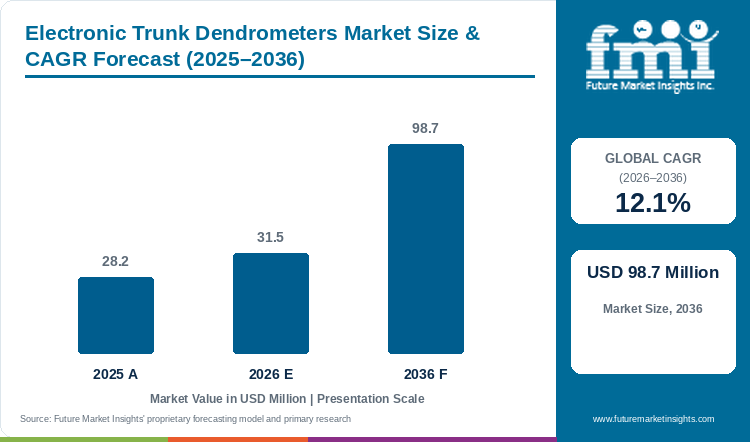
Worldwide valuation for electronic trunk dendrometers stands at USD 31.5 million for 2026 after recording USD 28.2 million during 2025, with 12.1% compound annual growth delivering USD 98.7 million by 2036.
Future Market Insights places 2026 electronic trunk dendrometers valuation at USD 31.5 million compared with USD 28.2 million during 2025, while 12.1% yearly growth through 2036 yields a USD 98.7 million market size and creates USD 67.2 million in incremental value. In its 2025 Sustainability Report, Phytech Inc. documented 43 million tracked trees across 598,000 covered acres where micron-scale dendrometer irrigation recommendations delivered 26.8% water savings and conserved 152 billion gallons of water [1]. Driven by this shift toward direct plant-status feedback across sweet and bitter almond groves, LVDT & Linear Potentiometer Point-Contact Piston Dendrometers claim 56.8% of projected 2026 transducer valuation. However, seasonal radial wood growth still saturates short-stroke piston plungers and requires periodic mechanical resetting.
Key Market Trends & Insights
- By displacement transducer type: LVDT & Linear Potentiometer Point-Contact Piston Dendrometers hold a projected 56.8% share for 2026 backed by sub-micron resolution and quick single-screw trunk anchoring.
- By extracted physiological parameter: Maximum Daily Trunk Shrinkage (MDS) & Daily Growth Rate algorithms represent an estimated 67.4% share in 2026 resulting from real-time tree water deficit alerts that prevent fruit drop.
- By agricultural & forestry application: Automated Closed-Loop Orchard Irrigation for Nut and Pome or Citrus Trees claims an expected 58.2% share during 2026 enabled by direct wireless integration with drip-fertigation manifold valves.
Regional Highlights
- Andean and Iberian orchard automation: Chile paces country-level growth with a 13.6% CAGR through 2036 while Spain follows at 13.1% owing to intensive drip-irrigation retrofits across export fruit valleys.
- European and OECD forestry and nut progression: Italy records a projected 12.3% compound rate and Australia posts 11.8%, whereas United States demand (11.7% rate) and German networks (11.4% rate) expand orchard and TreeNet forest monitoring.
Market Size & Forecast
Table 1: Global Stem-Diameter Transducer Valuation Horizon (USD million and 2026-2036 CAGR)
| Metric | Value |
|---|---|
| 2025 Market Size | USD 28.2 million |
| Estimated Market Size in 2026 | USD 31.5 million |
| Projected Market Size by 2036 | USD 98.7 million |
| CAGR, 2026 to 2036 | 12.1% |
| Added Market Value, 2026 to 2036 | USD 67.2 million |
Tree trunks swell at night as xylem tissues rehydrate from root uptake and contract during midday solar heating when leaf transpiration exceeds soil water supply. In its 2025 technical documentation for the DR1 through DR7 radius dendrometer series, Ecomatik GmbH specified a sensor temperature coefficient below 0.2 micrometers per degree Celsius and power draw of 0.28 microwatt-hours per reading across 11-to-50.8-millimeter linear strokes [2]. Because of this ultra-low energy profile, commercial growers managing processed almond ingredient orchards deploy battery-powered point dendrometers that transmit micron-level stem fluctuations for five years without battery replacement.
Orchard Tree-Sensor Density and Telemetry Fleet Sizing
Table 2: Annual Dendrometer Unit Shipments and Monitored Orchard Tree Counts (2025 to 2036)
| Metric | 2025 | 2026 | 2036 |
|---|---|---|---|
| Market size (USD million) | 28.2 | 31.5 | 98.7 |
| Electronic trunk & stem dendrometers shipped annually (thousand units) | 68.0 to 76.5 | 76.0 to 85.5 | 245.0 to 278.0 |
| Monitored commercial orchard & forest trees worldwide (million trees) | 44.5 to 49.0 | 50.0 to 55.5 | 158.0 to 176.0 |
| Average hardware valuation per installed dendrometer unit (USD) | 370 to 415 | 368 to 412 | 355 to 398 |
Operational note: Annual unit shipments reconcile commercial subscription-hardware orchard piston sensors against research-grade Invar band and carbon-fiber point dendrometers deployed across forest carbon-monitoring plots.
Commercial fruit operations attach three to five wireless point dendrometers per irrigation block to track daily trunk shrinkage relative to meteorological evaporative demand. Furthermore, agronomy teams serving commercial citrus fruit groves pair stem-diameter piston gauges with clip-on fruit caliper sensors to hit target harvest diameter grades.
Per Capita & Monitored Acreage Sizing
Table 3: Covered Orchard Acreage Intensity and Population Ratios for Trunk Dendrometers (2025 to 2036)
| Metric | 2025 | 2026 | 2036 |
|---|---|---|---|
| World population (billion) | 8.2 | 8.3 | 9.0 |
| Market value per 1,000 people (USD) | 3.4 | 3.8 | 11.0 |
| Annual dendrometer valuation per 1,000 monitored orchard acres (USD) | 39,500 to 44,200 | 41,000 to 46,000 | 52,000 to 58,500 |
| Point-contact piston transducer share of installed base (%) | 55.5% to 57.5% | 56.0% to 58.0% | 60.5% to 63.0% |
Table 4: Enrolled Orchard Block and TreeNet Observatory Allocation Benchmarks (2026)
| Metric | Value | Institutional Reference Basis |
|---|---|---|
| Market size, 2026 | USD 31.5 million | 2026 global electronic dendrometer valuation baseline |
| Enrolled commercial orchard fields & forest plots worldwide | 31,500 blocks | Global precision orchard & TreeNet station registry |
| LVDT & potentiometer piston market value, 2026 | USD 17.9 million | 56.8% transducer type segment allocation |
| Closed-loop orchard irrigation market value, 2026 | USD 18.3 million | 58.2% application segment allocation |
Software routines that separate reversible diurnal water-deficit shrinkage from irreversible cambial cell division calculate continuous tree water deficit in micrometers. Growers supplying fresh orchard fruit and vegetable farms rely on these automated stress scores to schedule off-peak night pumping and prevent sunburn or blossom-end rot.
Analyst Perspective
"Micron-resolution point and band dendrometers convert subtle diurnal bark contraction into automated irrigation valve commands and verifiable forest carbon-sequestration logs. Manufacturers that eliminate thermal frame drift with carbon-fiber or Invar mounts while automating zero-growth baseline partitioning will win large-scale orchard and carbon-credit contracts."
- Nikhil Kaitwade, Principal Consultant, Future Market Insights.
How is the electronic trunk dendrometers market segmented?
The electronic trunk dendrometers market is segmented by displacement transducer type, extracted physiological parameter, agricultural & forestry application, and region. In 2026, LVDT & Linear Potentiometer Point-Contact Piston Dendrometers are projected at 56.8%, Maximum Daily Trunk Shrinkage (MDS) & Daily Growth Rate at 67.4%, and Automated Closed-Loop Orchard Irrigation (Almonds, Citrus, Apples) at 58.2%.
By displacement transducer type: LVDT & Linear Potentiometer Point-Contact Piston Dendrometers, Invar-Wire Circumferential Band Dendrometers, and Non-Invasive Fruit-Growth Diameter Clip Gauges.
By extracted physiological parameter: Maximum Daily Trunk Shrinkage (MDS) & Daily Growth Rate, and Multi-Year Forest Carbon-Sequestration Basal Area Increment.
By agricultural & forestry application: Automated Closed-Loop Orchard Irrigation for Nut and Pome or Citrus Trees, Verified Forest Carbon-Credit MRV Monitoring, and Urban Tree Heat-Island & Drought Health Networks.
Why do LVDT & Linear Potentiometer Point-Contact Piston Dendrometers lead by transducer type?
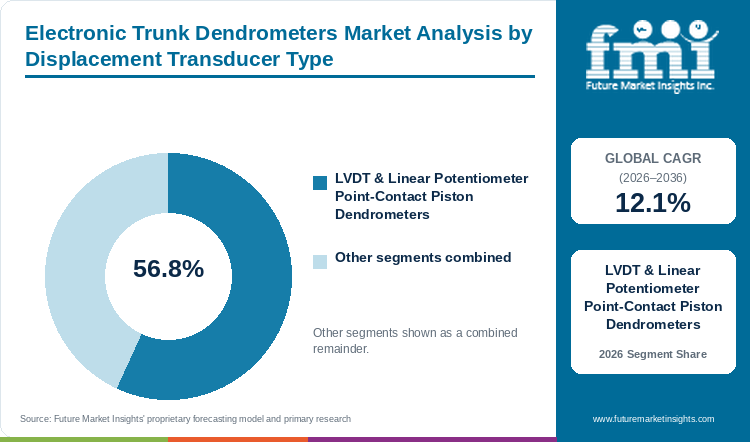
Point-contact LVDT and linear potentiometer piston dendrometers represent 56.8% of projected 2026 transducer valuation, backed by sub-micron sensitivity.
Table 5: 2026 Market Value Allocation by Displacement Transducer Architecture (%)
| Displacement Transducer Type | Share (2026) |
|---|---|
| LVDT & Linear Potentiometer Point-Contact Piston Dendrometers | 56.8% |
| Other Segments Combined | 43.2%* |
| Total | 100.0% |
*Note: Remainder comprises Invar-wire circumferential bands and non-invasive fruit-diameter clip gauges summing to 100.0%.
Table 6: Point-Contact Piston Transducer Benchmark and Ten-Year Compound Rate (2026 to 2036)
| Metric | Value |
|---|---|
| Global CAGR (2026 to 2036) | 12.1% |
| Leading Segment | LVDT & Linear Potentiometer Point-Contact Piston Dendrometers |
Point-contact piston dendrometers anchor a spring-loaded LVDT or sealed conductive-plastic potentiometer onto a stainless-steel or carbon-fiber rod drilled into heartwood so the sensing tip rests lightly against outer bark. Circumferential band cables can bind on rough bark crevices during small diurnal contractions, whereas point pistons resolve 0.2-micrometer radial shifts across commercial macadamia nut plantations and industrial CMOS and MEMS sensing elements.
- LVDT & Linear Potentiometer Point-Contact Piston Dendrometers hold 56.8% of projected 2026 transducer valuation due to frictionless radial tracking and rapid single-bolt mounting.
- In March 2025, Swiss manufacturer Natkon highlighted its ZN12-T-WP carbon-fiber and ZN22-T-IP sealed IP54 point dendrometers achieving sub-micrometer resolution via DecentLab wireless loggers [3].
Why does Maximum Daily Trunk Shrinkage (MDS) & Daily Growth Rate dominate by physiological parameter?
Maximum Daily Trunk Shrinkage (MDS) & Daily Growth Rate extraction accounts for an estimated 67.4% of 2026 parameter valuation, driven by drought-stress indexing.
Algorithms that calculate the amplitude between predawn maximum stem diameter and afternoon minimum diameter yield Maximum Daily Trunk Shrinkage, while peak-to-peak increments isolate irreversible daily cambial growth. In August 2025, forest ecophysiologists led by Roman Zweifel published the Normalized Tree Water Deficit method in New Phytologist (PMC12222926) to quantify relative drought stress across diverse tree sizes and climates without destructive sampling [4]. Agronomy platforms stream these extracted parameters over long-range LoRa and LoRaWAN IoT nodes to rank block-by-block water urgency.
- Maximum Daily Trunk Shrinkage (MDS) & Daily Growth Rate represents an estimated 67.4% of 2026 physiological parameter valuation owing to immediate afternoon stress detection.
- In September 2026, a study in MDPI Agriculture demonstrated that relative trunk diameter fluctuation indicators improved regulated deficit irrigation scheduling in commercial olive orchards compared with discrete thresholds [5].
What keeps Automated Closed-Loop Orchard Irrigation ahead by application?
Automated Closed-Loop Orchard Irrigation claims 58.2% of expected 2026 application market size, enabled by pump energy and water savings.
High-density almond and citrus estates as well as apple orchards connect trunk piston dendrometers directly to automated drip-manifold controllers and variable-rate sensor-based fertilization injectors. Meanwhile, pome-fruit estates supplying non-grape orchard fruit wine estates and almond dairy-alternative supply chains use dendrometer-guided deficit watering before harvest to raise fruit soluble solids and curb hull rot.
- Automated Closed-Loop Orchard Irrigation accounts for an expected 58.2% of 2026 application valuation attributed to 89.6% off-peak electricity pumping execution and higher fruit Brix grades.
- In March 2026, Swiss wireless telemetry specialist Decentlab GmbH detailed how its DL-ZN1-001 T-shape LoRaWAN dendrometer nodes stream hourly sub-micrometer tree-diameter fluctuations from remote canopies to cloud irrigation and forest dashboards [6].
What are the drivers, restraints, and opportunities in the electronic trunk dendrometers market?
Across the electronic trunk dendrometers market, autonomous orchard irrigation and forest carbon MRV networks are projected to accelerate sensor rollouts whereas hygroscopic bark swelling and stroke saturation restrain unattended accuracy and global dendrometer networks create cloud-analytics opportunities.
- Driver: Steep orchard water and pumping electricity tariffs together with verified forest carbon-credit MRV protocols drive large-scale deployment of micron-resolution trunk dendrometers.
- Restraint: Hygroscopic outer-bark swelling during rain events and finite 11-millimeter potentiometer stroke ranges require bark scraping and periodic manual frame resets.
- Opportunity: Cloud-connected Global Dendrometer Network harmonization and dual-sensor wood-versus-bark differential frames open automated forest carbon accounting and urban heat-island contracts.
Growth Analysis and Future Potential: Qualitative Demand Catalysts
Orchard irrigation automation and continental forest carbon-sequestration monitoring are transforming electronic dendrometers from niche academic gauges into high-volume IoT field nodes. During July 2026, Tree Physiology (PMC13358874) published proceedings from the Nordic Dendrometer Meeting in Ås in Norway, announcing the Global Dendrometer Network to standardize sub-hourly radial growth and tree water status records across forest biomes [7]. At the same time, commercial nut and citrus growers rely on automated trunk-shrinkage thresholds to prevent over-irrigation and cut pumping electricity usage.
Risk Assessment of the Electronic Trunk Dendrometers Market: Operational and Formulation Friction
Dead outer rhytidome bark absorbs rainwater and swells independently of living xylem tension, which can mask true tree water deficits unless technicians carefully pare away loose outer bark before mounting piston tips. In July 2025, a Mediterranean forest study in MDPI Forests analyzing intra-annual radial growth in Pinus halepensis and Pinus pinea documented strong hygroscopic bark-hydration noise during autumn rain pulses [8]. In addition to this, fast-growing young orchard trees can exhaust a 10-millimeter linear potentiometer stroke within a single season, requiring manual screw readjustment.
Commercial Opportunity Analysis: Formulation Differentiation and Value-Add Formats
Instrument manufacturers are expanding addressable market value by engineering 64-millimeter non-invasive Invar circumference bands and caliper-style fruit growth dendrometers that pair with trunk pistons. In 2026, EMS Brno commercialized its upgraded DRL26D rotary circumference band dendrometer featuring sub-micrometer resolution and a 64-millimeter increment range with a six-year internal memory and five-year battery life at hourly intervals [9]. Suppliers that combine maintenance-free band sensors with UN Clean Development Mechanism allometric carbon-stock algorithms can monetize verified forest carbon-credit MRV contracts.
Electronic Trunk Dendrometers Market by Country (2026 to 2036)
Backed by 13.6% yearly market growth through 2036, Chile leads country-level expansion in the electronic trunk dendrometers market, followed by Spain at 13.1%.
FMI country projections place Chile at the forefront of global electronic trunk dendrometer expansion with a 13.6% CAGR through 2036, outpacing Spanish demand (13.1% rate) and Italian groves (12.3% rate), whereas Australian estates record 11.8% above United States ranches (11.7% rate) and German forests (11.4% rate). Closed-loop drip automation across water-stressed almond and citrus basins together with European forest phenology networks govern regional installation rates.
Table 7: Six-Country Trunk Dendrometer Growth Rates and Orchard Automation Levers (2026 to 2036)
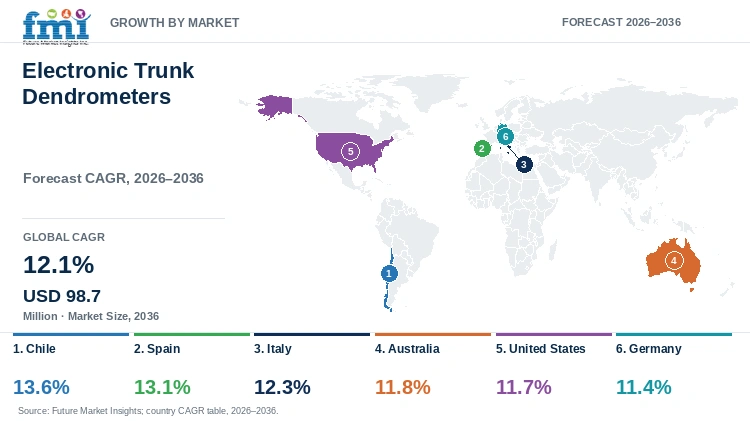
| Country | CAGR (2026 to 2036) | Primary Growth Lever |
|---|---|---|
| Chile | 13.6% | Automated piston dendrometer and fruit-sizing networks across export cherry, avocado, and walnut estates |
| Spain | 13.1% | Andalusian olive and almond maximum daily trunk shrinkage (MDS) deficit irrigation scheduling |
| Italy | 12.3% | South Tyrol apple and Apulian olive/citrus precision irrigation retrofits under national agritech tax credits |
| Australia | 11.8% | Murray-Darling almond, macadamia, and citrus autonomous valve scheduling and bushfire recovery logging |
| United States | 11.7% | California and Arizona nut orchard water stewardship programs and USDA-ARS low-cost apple dendrometry |
| Germany | 11.4% | Bavarian and federal forest drought-mortality monitoring and urban heat-island tree health networks |
Source: Future Market Insights analysis
United States Electronic Trunk Dendrometers Market Outlook (2026 to 2036)
Large-scale almond and pistachio ranches in California and Arizona together with Washington apple estates establish the United States as the top-valued country market for wireless trunk dendrometers. During April 2026, federal horticultural engineers published a low-cost electronic dendrometer evaluation for monitoring diurnal trunk diameter variations across high-density commercial apple orchards [10]. Across the United States, electronic trunk dendrometers valuation is projected to record an 11.7% annual growth trajectory up to 2036 while Western nut ranches join corporate watershed stewardship programs. For instance, Peacock Nuts Company in Arizona saved over 316 million gallons of water annually using dendrometer-guided irrigation, although winter pre-shake harvest machinery still requires temporary sensor unclipping.
Key takeaway: In the United States, Western nut and apple orchard water-stewardship contracts anchor recurring deployments of wireless point and caliper dendrometers.
Germany Electronic Trunk Dendrometers Market Outlook (2026 to 2036)
Domestic sensor manufacturing led by Dachau-based Ecomatik GmbH together with federal and state forest climate-observatory networks sets Germany apart from orchard-dominated markets. In May 2025, dendrochronology researchers published an overview in Frontiers in Ecology and Evolution documenting R-package analytical workflows for high-resolution automated dendrometer time series across European temperate forests [11]. Within Germany, electronic trunk dendrometers valuation is forecast to post an 11.4% yearly expansion rate up to 2036 while municipal forestry departments instrument urban street trees and Norway spruce stands against summer heatwaves. Strict municipal vandalism protection rules across city parks and public botanical gardens favor compact single-screw DR3W and DR6 encapsulated frames mounted well above pedestrian reach.
Key takeaway: In Germany, Dachau-based precision transducer engineering and municipal forest climate-resilience networks sustain steady demand for encapsulated radius dendrometers.
Australia Electronic Trunk Dendrometers Market Outlook (2026 to 2036)
Expansive almond and citrus plantations across the Murray-Darling Basin together with Queensland macadamia belts drive commercial demand for autonomous trunk-shrinkage irrigation sensors in Australia. In July 2025, New South Wales manufacturer ICT International Pty Ltd expanded Australian deployment of its high-precision DBL60 and DBV60 band dendrometers for continuous trunk shrinkage tracking across regional riverland orchard blocks [12]. Across Australia, electronic trunk dendrometers valuation is expected to register an 11.8% yearly growth trajectory up to 2036 while corporate orchard operators automate drip-fertigation manifold valves to buffer volatile water-allocation prices. Intense summer solar radiation across inland Victoria and New South Wales river valleys requires UV-stabilized sensor cables and low-expansion carbon-fiber or Invar mounting frames.
Key takeaway: In Australia, riverland orchard irrigation automation and state agtech demonstration programs sustain strong uptake of wireless stem dendrometers.
Chile Electronic Trunk Dendrometers Market Outlook (2026 to 2036)
Counter-seasonal sweet cherry and avocado estates across O'Higgins and Maule together with Valparaíso walnut orchards position Chile at the top of global electronic trunk dendrometer growth rankings. Orchard physiological guidelines from Washington State University Tree Fruit demonstrate how pairing point trunk dendrometers with fruit caliper gauges detects early water stress and protects harvest size in sweet cherry and pome orchards [13]. Within Chile, valuation for electronic trunk dendrometers is anticipated to expand at a 13.6% annual clip through 2036 while cherry and avocado packers link field irrigation records to supermarket export quality audits. Steep hillside orchard blocks across central valleys require long-range cellular or LoRa repeaters to relay daily shrinkage alerts.
Key takeaway: In Chile, export cherry and avocado sizing and Brix optimization programs propel rapid orchard adoption of closed-loop dendrometry.
Spain Electronic Trunk Dendrometers Market Outlook (2026 to 2036)
Super-high-density olive and almond estates in Andalusia and Extremadura together with Murcia citrus groves rely on Maximum Daily Trunk Shrinkage algorithms to survive multi-year Guadalquivir and Segura drought allocations. In June 2025, forestry investigators at ICIFOR INIA-CSIC in Madrid introduced the Two-Stage Threshold Approach (2STA) in Frontiers in Forests and Global Change, analyzing 1,872 dendrometer records from 104 trees to isolate spring and autumn cambial growth onset within 7 days without hydration curve distortion [14]. Spanish electronic trunk dendrometers valuation is slated to achieve a 13.1% annual expansion trajectory up to 2036 while hydrographic confederations mandate digital plant-water telemetry. Summer bark dust and wild boar activity require ruggedized stainless-steel sensor shields.
Key takeaway: In Spain, Guadalquivir and Segura basin irrigation telemetry rules and Mediterranean olive deficit scheduling propel rapid dendrometer adoption.
Italy Electronic Trunk Dendrometers Market Outlook (2026 to 2036)
High-density apple orchards in South Tyrol and Trentino as well as olive and citrus groves across Apulia and Sicily anchor Italian demand for precision trunk and fruit dendrometers. In 2026, Dynamax Inc. expanded European technical support for its DEX20 through DEX200 temperature-compensated full-bridge strain-gage dendrometers featuring 0.0025-millimeter per degree Celsius thermal stability across 5-to-200-millimeter stem diameters [15]. Italian electronic trunk dendrometers market value is predicted to log a 12.3% yearly growth rate up to 2036 while regional fruit cooperatives combine stem shrinkage alerts with automated frost and drip-irrigation valves. Small average farm parcel sizes across northern mountain valleys and southern coastal plains encourage cooperative-shared LoRaWAN gateway infrastructure.
Key takeaway: In Italy, South Tyrol pome-fruit and southern olive precision irrigation upgrades sustain cooperative procurement of strain-gage and piston dendrometers.
Full report country CAGRs cover: North America; Latin America; Western Europe; Eastern Europe; East Asia; South Asia and Pacific; Middle East and Africa.
Who are the notable companies in the electronic trunk dendrometers market?
Phytech Ltd., Ecomatik GmbH, Natkon, ICT International Pty Ltd, Dynamax Inc., EMS Brno, SupPlant, and Implexx Sense are the notable companies in the electronic trunk dendrometers market.
FMI analysis indicates that market competition divides between cloud-connected autonomous orchard irrigation platforms and precision ecophysiological transducer manufacturers. Israeli agtech platforms Phytech Ltd. and SupPlant deploy tens of thousands of wireless point-contact trunk and fruit dendrometers under recurring orchard automation subscriptions. Meanwhile, European precision engineering transducer makers Ecomatik GmbH and Natkon as well as EMS Brno manufacture sub-micrometer carbon-fiber point pistons and Invar-wire rotary band dendrometers for global forest carbon and TreeNet observatories. At the same time, ICT International Pty Ltd and Dynamax Inc. along with Implexx Sense supply SDI-12 and strain-gage caliper dendrometers to horticultural researchers and specialty crop estates.
- Autonomous Orchard IoT & Closed-Loop Irrigation Platforms: Phytech Ltd. and SupPlant combine high-density wireless trunk piston dendrometers with AI-driven valve automation and mobile grower alerts.
- European Precision LVDT, Potentiometer & Invar-Band Specialists: Ecomatik GmbH and Natkon together with EMS Brno engineer ultra-low-drift carbon-fiber point dendrometers and non-invasive rotary circumference bands.
- Multi-Parameter SDI-12 & Strain-Gage Caliper Instrument Makers: ICT International Pty Ltd and Dynamax Inc. along with Implexx Sense supply temperature-compensated strain-gage clips and digital SDI-12 stem dendrometers.
Competitive Benchmarking: Electronic Trunk Dendrometers Market
Table 8: Vendor Capability Matrix for Point, Band and Caliper Dendrometers (2026)
| Company | Transducer Resolution & Stability | Closed-Loop Irrigation AI | Forest Carbon MRV Suitability | Geographic Reach |
|---|---|---|---|---|
| Phytech Ltd. | High | High | High | High |
| Ecomatik GmbH | High | Medium | High | High |
| Natkon | High | Medium | High | Medium |
| ICT International Pty Ltd | High | High | High | High |
| Dynamax Inc. | High | Medium | Medium | High |
| EMS Brno | High | Medium | High | Medium |
| SupPlant | High | High | Medium | High |
| Implexx Sense | High | Medium | High | Medium |
Evaluation basis: Capability tiers evaluate sub-micrometer displacement resolution and thermal expansion compensation below 0.2 micrometers per degree Celsius across point and band transducers. Closed-loop irrigation and forest carbon ratings reflect automated drip-valve execution and multi-year allometric biomass tracking across Western and Southern Hemisphere networks.
Key Developments in the Electronic Trunk Dendrometers Market
- ICT International Pty Ltd expanded its DEN1 and DEN3 Dendrometer Sensor Meter configurations in 2025 to support up to five DBV60 band dendrometers or DEX fruit caliper gauges per solar logger node [16].
- Implexx Sense broadened its multi-purpose DE-1M and DE-1T LVDT trunk dendrometer portfolio in 2026 to deliver digital SDI-12 maximum daily shrinkage and stem water storage output [17].
- Ecomatik GmbH expanded its Internet of Plants (IoP) wireless LoRaWAN and NB-IoT/LTE-M plug-and-play logging nodes in 2025 for its DR1 through DR7 radius and DC circumference dendrometers [18].
Key Players in the Electronic Trunk Dendrometers Market
Autonomous Orchard IoT & Closed-Loop Irrigation Platforms
- Phytech Ltd. (Plant-Based IoT Dendrometer Network)
- Saturas Ltd. / SupPlant (Orchard Stem-Diameter Autonomous Irrigation)
European Precision LVDT, Potentiometer & Invar-Band Specialists
- Ecomatik GmbH
- Natkon (Zweifel Dendrometers)
- EMS Brno (Environmental Measuring Systems)
Multi-Parameter SDI-12 & Strain-Gage Caliper Instrument Makers
- ICT International Pty Ltd
- Dynamax Inc.
- Implexx Sense
Electronic Trunk Dendrometers Market - Report Scope
Table 9: Taxonomy Coverage and Product Scope for Electronic Trunk Dendrometers (2026 to 2036)
| Coverage field | Report scope |
|---|---|
| Market breakdown | Displacement Transducer Type; Extracted Physiological Parameter; Agricultural & Forestry Application; Region |
| Quantitative Units | USD Million |
| Market Definition | Includes commercial hardware and bundled sensor-node market value from electronic trunk, stem, and fruit dendrometers (LVDT and linear potentiometer point-contact piston gauges, Invar-wire and stainless-steel rotary band dendrometers, and full-bridge strain-gage caliper clips). Category Scope Note: Excludes manual vernier caliper bands without electronic transducers, destructive wood-core increment borers, and standalone soil moisture probes. |
| Regions Covered | North America; Latin America; Western Europe; Eastern Europe; East Asia; South Asia and Pacific; Middle East and Africa |
| Countries Covered | United States, Germany, Australia, Chile, Spain, Italy, and additional countries in the full report |
| Key Companies Covered | Phytech Ltd., Ecomatik GmbH, Natkon, ICT International Pty Ltd, Dynamax Inc., EMS Brno, SupPlant, Implexx Sense |
| Forecast Period | 2026 to 2036 |
| Approach | Primary and secondary research with top-down and bottom-up market triangulation. |
Electronic Trunk Dendrometers Market - Research Methodology
Table 10: Bottom-Up Sensor Shipment and Orchard Acreage Validation Protocol (2026 Edition)
| Method | Approach |
|---|---|
| Primary Research | Structured interviews with orchard irrigation managers, forest ecophysiologists, TreeNet station coordinators, and precision ag-tech hardware engineers across California, Germany, Switzerland, Israel, and Chile to validate transducer pricing and stroke reset intervals. |
| Secondary Research | Analysis of Phytech 2025 sustainability disclosures, Ecomatik and Natkon transducer specifications, EMS Brno DRL26D manuals, USDA-ARS orchard dendrometry studies, and Global Dendrometer Network publications. |
| Market Sizing and Forecasting | Top-down precision orchard automation and forest carbon MRV sensor budgets reconciled against bottom-up annual point, band, and fruit-clip dendrometer shipments from 2026 to 2036. |
| Country Forecasting Model | Econometric country projections weight irrigated nut, citrus, and pome-fruit acreage, hydrographic basin water-metering mandates, and long-term forest ecological monitoring plots across six national markets. |
| Operational Benchmark Traceability | Tree-sensor density and monitored orchard acreage indicators in Tables 2, 3, and 4 trace to Phytech's 43-million-tree / 598,000-acre operational benchmark (113 trees per acre average) and ICIFOR INIA-CSIC forest stand densities. |
| Data Triangulation and Validation | Demand estimates are cross-checked against manufacturer transducer output and wireless logger subscriptions without double counting drip-irrigation pipes, solenoid valves, or weather stations. |
Electronic Trunk Dendrometers Market by Segments
Electronic Trunk Dendrometers Market segmented by Displacement Transducer Type:
- LVDT & Linear Potentiometer Point-Contact Piston Dendrometers
- Invar-Wire Circumferential Band Dendrometers
- Non-Invasive Fruit-Growth Diameter Clip Gauges
Electronic Trunk Dendrometers Market segmented by Extracted Physiological Parameter:
- Maximum Daily Trunk Shrinkage (MDS) & Daily Growth Rate
- Multi-Year Forest Carbon-Sequestration Basal Area Increment
Electronic Trunk Dendrometers Market segmented by Agricultural & Forestry Application:
- Automated Closed-Loop Orchard Irrigation (Almonds, Citrus, Apples)
- Verified Forest Carbon-Credit MRV Monitoring
- Urban Tree Heat-Island & Drought Health Networks
Electronic Trunk Dendrometers Market by Region
- North America
- United States
- Canada
- Latin America
- Chile
- Brazil
- Mexico
- Argentina
- Western Europe
- Germany
- Spain
- Italy
- France
- Switzerland
- United Kingdom
- Eastern Europe
- Czech Republic
- Poland
- Romania
- Hungary
- East Asia
- China
- Japan
- South Korea
- South Asia and Pacific
- Australia
- New Zealand
- India
- Middle East and Africa
- Israel
- South Africa
- Türkiye
- GCC Countries
Research Sources and Bibliography
- [1] Phytech Inc. (2025, June 26). Sustainability Report | Phytech. Phytech Inc.
- [2] Ecomatik GmbH. (2025, January 13). Radius: DR | Ecomatik GmbH. Ecomatik GmbH.
- [3] Natkon. (2025, March 06). Products - Natkon Dendrometers. Natkon.
- [4] Zweifel, R., et al. (2025, August 01). Normalized tree water deficit: an automated dendrometer signal to quantify drought stress in trees. New Phytologist (PubMed Central PMC12222926).
- [5] MDPI Agriculture. (2026, September 22). Improvements of Relative Indicators of Trunk Diameter Fluctuations in Comparison to Discrete Indicators in the Regulated Deficit Irrigation Scheduling of Olive Trees. Agriculture, 16(19), 2043.
- [6] Decentlab GmbH. (2026, March 23). Forests under climate stress: Monitoring with Decentlab dendrometers. Decentlab GmbH.
- [7] Nordic Dendrometer Meeting Consortium. (2026, July 01). From microscopic movements to forest-scale insights: the Nordic Dendrometer Meeting and the emergence of the Global Dendrometer Network. Tree Physiology (PubMed Central PMC13358874).
- [8] MDPI Forests. (2025, July 26). Dendrometer-Based Analysis of Intra-Annual Growth and Water Status in Two Pine Species in a Mediterranean Forest Stand Under a Semi-Arid Climate. Forests, 16(8), 1229.
- [9] EMS Brno (Environmental Measuring Systems s.r.o.). (2026, February 10). Dendrometer DRL26D - EMS Brno. EMS Brno.
- [10] Safre, A., Fazio, G., Black, B., Torres, A., & Yost, K. (2026, April 01). Development and evaluation of a low-cost dendrometer system for monitoring trunk diameter variations in apple trees. USDA Agricultural Research Service.
- [11] Frontiers in Ecology and Evolution. (2025, May 20). Advancing dendrochronology with R: an overview of packages and future perspectives. Frontiers in Ecology and Evolution, 13, 1593675.
- [12] ICT International Pty Ltd. (2025, July 22). Band Dendrometers - ICT International. ICT International.
- [13] Washington State University Tree Fruit Extension. (2025, May 29). Trunk and Fruit dendrometers: Detecting early signs of water stress in fruit trees before visual cues. Washington State University.
- [14] Jankowski, P. A., Calama, R., Aldea, J., García, M., Madrigal, G., & Pardos, M. (2025, June 17). Improving phenological event identification in trees using manually measured dendrometer data: conventional approaches vs. the novel two-stage threshold approach. Frontiers in Forests and Global Change, 8, 1589579.
- [15] Dynamax Inc. (2026, January 18). DEX Fruit & Stem Growth Dendrometer - Dynamax. Dynamax Inc.
- [16] ICT International Pty Ltd. (2025, June 24). DEN Dendrometer Sensor Meters - ICT International. ICT International.
- [17] Implexx Sense. (2026, February 14). Dendrometers multi-purpose sensors - Implexx. Implexx Sense.
- [18] Ecomatik GmbH. (2025, April 09). Growth and plant water status - Ecomatik. Ecomatik GmbH.
- [19] ICT International Pty Ltd. (2025, November 14). DEN5: Dendrometer for differential measurement - ICT International. ICT International.
- [20] Implexx Sense. (2026, February 22). Trunk Dendrometers - Implexx. Implexx Sense.
- [21] EMS Brno (Environmental Measuring Systems s.r.o.). (2026, March 12). Band dendrometer for large trees EMS DRS26. EMS Brno.
This bibliography is provided for reader reference and is not exhaustive. The full report contains the complete reference list and detailed citations.
This Report Answers
- How large is the electronic trunk dendrometers market in 2026 and what is forecast for 2036?
- Which orchard water-stewardship and forest carbon-tracking pressures support dendrometer demand?
- Why do LVDT & Linear Potentiometer Point-Contact Piston Dendrometers lead the transducer category?
- Why does Maximum Daily Trunk Shrinkage (MDS) & Daily Growth Rate lead by physiological parameter?
- How do growth rates differ across Chile, Spain, Italy, Australia, the United States, and Germany?
- Which leading companies manufacture electronic trunk dendrometers and orchard IoT networks today?
- What limits multi-season stroke range or unattended accuracy in the electronic trunk dendrometers market?
- What should orchardists and forestry researchers evaluate before purchasing electronic dendrometers?
Frequently Asked Questions
How big is the electronic trunk dendrometers market in 2026, and what is forecast for 2036?
FMI places 2026 global electronic trunk dendrometers valuation at USD 31.5 million compared with USD 28.2 million during 2025, while 2036 market size hits a projected USD 98.7 million across automated nut and pome-fruit estates.
What is the CAGR for the electronic trunk dendrometers market from 2026 to 2036?
Over the ten-year forecast window from 2026 through 2036, global demand progresses at a 12.1% CAGR and creates USD 67.2 million in cumulative ten-year value expansion as automated drip-valve networks scale across perennial fruit blocks.
Which displacement transducer segment leads the electronic trunk dendrometers market?
LVDT & Linear Potentiometer Point-Contact Piston Dendrometers represent 56.8% of projected 2026 transducer valuation because single-screw point pistons track sub-micrometer radial bark shifts without cable friction.
Which physiological parameter segment leads the electronic trunk dendrometers market?
Maximum Daily Trunk Shrinkage (MDS) & Daily Growth Rate accounts for an estimated 67.4% of 2026 parameter demand as orchardists use afternoon shrinkage amplitudes to trigger deficit watering.
Which country has a notable growth outlook during the assessment period?
Through 13.6% compound annual expansion up to 2036, Chile ranks first in national growth thanks to export cherry and avocado irrigation and fruit-sizing telemetry across O'Higgins and Maule.
Who are the key players in the market?
Leading manufacturers supplying point-contact LVDT pistons and Invar circumference bands or strain-gage caliper clips for autonomous orchard valve control and TreeNet forest observatories include Phytech Ltd., Ecomatik GmbH, Natkon, ICT International Pty Ltd, Dynamax Inc., EMS Brno, SupPlant, and Implexx Sense.
Preview the report firsthand - request a free sample
Get SampleGet the brochure for pricing and purchase details.
Get PDFTable of Content
- Key Takeaways
- Market Size and CAGR
- Top Growth Driver
- Fastest Growing Segment
- Leading Region
- Key Companies
- Emerging Opportunities
- Executive Summary
- Global Market Outlook
- Demand-side Trends
- Supply-side Trends
- Technology Roadmap Analysis
- Analysis and Recommendations
- Analyst Perspective (What is happening? Why now? What should investors know?)
- Key Questions Answered
- How large is the market?
- What is the CAGR?
- What are key trends?
- Which region dominates?
- Who are the leaders?
- Market Overview
- Market Coverage / Taxonomy
- Market Definition / Scope / Limitations
- Research Methodology
- Chapter Orientation
- Analytical Lens and Working Hypotheses
- Market Structure, Signals, and Trend Drivers
- Benchmarking and Cross-market Comparability
- Market Sizing, Forecasting, and Opportunity Mapping
- Research Design and Evidence Framework
- Desk Research Programme (Secondary Evidence)
- Expert Input and Fieldwork (Primary Evidence)
- Tooling, Models, and Reference Databases
- Data Engineering and Model Build
- Quality Assurance and Audit Trail
- Market Background
- Market Dynamics (Drivers, Restraints, Opportunity, Trends)
- Scenario Forecast (Optimistic, Likely, Conservative)
- Impact Analysis
- AI Impact
- Sustainability Impact
- Regulatory Impact
- Technology Impact
- Consumer / Buyer Analysis
- Purchase Drivers
- Adoption Barriers
- Buyer Journey
- Opportunity Map Analysis
- Product Life Cycle Analysis
- Supply Chain Analysis
- Investment Feasibility Matrix
- Value Chain Analysis
- PESTLE and Porter's Analysis
- Regulatory Landscape
- Regional Parent Market Outlook
- Production and Consumption Statistics
- Import and Export Statistics
- Global Market Analysis and Forecast, 2021 to 2036
- Historical Market Size Value (USD Million) Analysis, 2021 to 2025
- Current and Future Market Size Value (USD Million) Projections, 2026 to 2036
- Y-o-Y Growth Trend Analysis
- Absolute $ Opportunity Analysis
- Global Market Pricing Analysis, 2021 to 2036
- Global Market Analysis and Forecast, By Displacement Transducer Type, 2021 to 2036
- Introduction / Key Findings
- Historical Market Size Value (USD Million) Analysis By Displacement Transducer Type, 2021 to 2025
- Current and Future Market Size Value (USD Million) Analysis and Forecast By Displacement Transducer Type, 2026 to 2036
- LVDT & Linear Potentiometer Point-Contact Piston Dendrometers
- Invar-Wire Circumferential Band Dendrometers
- Non-Invasive Fruit-Growth Diameter Clip Gauges
- Y-o-Y Growth Trend Analysis By Displacement Transducer Type, 2021 to 2025
- Absolute $ Opportunity Analysis By Displacement Transducer Type, 2026 to 2036
- Global Market Analysis and Forecast, By Extracted Physiological Parameter, 2021 to 2036
- Introduction / Key Findings
- Historical Market Size Value (USD Million) Analysis By Extracted Physiological Parameter, 2021 to 2025
- Current and Future Market Size Value (USD Million) Analysis and Forecast By Extracted Physiological Parameter, 2026 to 2036
- Maximum Daily Trunk Shrinkage (MDS) & Daily Growth Rate
- Multi-Year Forest Carbon-Sequestration Basal Area Increment
- Y-o-Y Growth Trend Analysis By Extracted Physiological Parameter, 2021 to 2025
- Absolute $ Opportunity Analysis By Extracted Physiological Parameter, 2026 to 2036
- Global Market Analysis and Forecast, By Agricultural & Forestry Application, 2021 to 2036
- Introduction / Key Findings
- Historical Market Size Value (USD Million) Analysis By Agricultural & Forestry Application, 2021 to 2025
- Current and Future Market Size Value (USD Million) Analysis and Forecast By Agricultural & Forestry Application, 2026 to 2036
- Automated Closed-Loop Orchard Irrigation (Almonds, Citrus, Apples)
- Verified Forest Carbon-Credit MRV Monitoring
- Urban Tree Heat-Island & Drought Health Networks
- Y-o-Y Growth Trend Analysis By Agricultural & Forestry Application, 2021 to 2025
- Absolute $ Opportunity Analysis By Agricultural & Forestry Application, 2026 to 2036
- Global Market Analysis and Forecast, By Region, 2021 to 2036
- Introduction
- Historical Market Size Value (USD Million) Analysis By Region, 2021 to 2025
- Current Market Size Value (USD Million) Analysis and Forecast By Region, 2026 to 2036
- North America
- Latin America
- Western Europe
- Eastern Europe
- East Asia
- South Asia and Pacific
- Middle East and Africa
- Market Attractiveness Analysis By Region
- North America Market Analysis and Forecast, By Country, 2021 to 2036
- Historical Market Size Value (USD Million) Trend Analysis By Market Taxonomy, 2021 to 2025
- Market Size Value (USD Million) Forecast By Market Taxonomy, 2026 to 2036
- By Country
- United States
- Canada
- By Displacement Transducer Type
- By Extracted Physiological Parameter
- By Agricultural & Forestry Application
- By Country
- Market Attractiveness Analysis
- By Country
- By Displacement Transducer Type
- By Extracted Physiological Parameter
- By Agricultural & Forestry Application
- Key Takeaways
- Latin America Market Analysis and Forecast, By Country
- Historical Market Size Value (USD Million) Trend Analysis By Market Taxonomy, 2021 to 2025
- Market Size Value (USD Million) Forecast By Market Taxonomy, 2026 to 2036
- By Country
- Chile
- Brazil
- Mexico
- Argentina
- By Displacement Transducer Type
- By Extracted Physiological Parameter
- By Agricultural & Forestry Application
- By Country
- Market Attractiveness Analysis
- By Country
- By Displacement Transducer Type
- By Extracted Physiological Parameter
- By Agricultural & Forestry Application
- Key Takeaways
- Western Europe Market Analysis and Forecast, By Country
- Historical Market Size Value (USD Million) Trend Analysis By Market Taxonomy, 2021 to 2025
- Market Size Value (USD Million) Forecast By Market Taxonomy, 2026 to 2036
- By Country
- Germany
- Spain
- Italy
- France
- Switzerland
- United Kingdom
- By Displacement Transducer Type
- By Extracted Physiological Parameter
- By Agricultural & Forestry Application
- By Country
- Market Attractiveness Analysis
- By Country
- By Displacement Transducer Type
- By Extracted Physiological Parameter
- By Agricultural & Forestry Application
- Key Takeaways
- Eastern Europe Market Analysis and Forecast, By Country
- Historical Market Size Value (USD Million) Trend Analysis By Market Taxonomy, 2021 to 2025
- Market Size Value (USD Million) Forecast By Market Taxonomy, 2026 to 2036
- By Country
- Czech Republic
- Poland
- Romania
- Hungary
- By Displacement Transducer Type
- By Extracted Physiological Parameter
- By Agricultural & Forestry Application
- By Country
- Market Attractiveness Analysis
- By Country
- By Displacement Transducer Type
- By Extracted Physiological Parameter
- By Agricultural & Forestry Application
- Key Takeaways
- East Asia Market Analysis and Forecast, By Country
- Historical Market Size Value (USD Million) Trend Analysis By Market Taxonomy, 2021 to 2025
- Market Size Value (USD Million) Forecast By Market Taxonomy, 2026 to 2036
- By Country
- China
- Japan
- South Korea
- By Displacement Transducer Type
- By Extracted Physiological Parameter
- By Agricultural & Forestry Application
- By Country
- Market Attractiveness Analysis
- By Country
- By Displacement Transducer Type
- By Extracted Physiological Parameter
- By Agricultural & Forestry Application
- Key Takeaways
- South Asia and Pacific Market Analysis and Forecast, By Country
- Historical Market Size Value (USD Million) Trend Analysis By Market Taxonomy, 2021 to 2025
- Market Size Value (USD Million) Forecast By Market Taxonomy, 2026 to 2036
- By Country
- Australia
- New Zealand
- India
- By Displacement Transducer Type
- By Extracted Physiological Parameter
- By Agricultural & Forestry Application
- By Country
- Market Attractiveness Analysis
- By Country
- By Displacement Transducer Type
- By Extracted Physiological Parameter
- By Agricultural & Forestry Application
- Key Takeaways
- Middle East and Africa Market Analysis and Forecast, By Country
- Historical Market Size Value (USD Million) Trend Analysis By Market Taxonomy, 2021 to 2025
- Market Size Value (USD Million) Forecast By Market Taxonomy, 2026 to 2036
- By Country
- Israel
- South Africa
- Türkiye
- GCC Countries
- By Displacement Transducer Type
- By Extracted Physiological Parameter
- By Agricultural & Forestry Application
- By Country
- Market Attractiveness Analysis
- By Country
- By Displacement Transducer Type
- By Extracted Physiological Parameter
- By Agricultural & Forestry Application
- Key Takeaways
- Key Countries Market Analysis
- United States
- Pricing Analysis
- Market Share Analysis, 2025
- By Displacement Transducer Type
- By Extracted Physiological Parameter
- By Agricultural & Forestry Application
- Canada
- Pricing Analysis
- Market Share Analysis, 2025
- By Displacement Transducer Type
- By Extracted Physiological Parameter
- By Agricultural & Forestry Application
- Mexico
- Pricing Analysis
- Market Share Analysis, 2025
- By Displacement Transducer Type
- By Extracted Physiological Parameter
- By Agricultural & Forestry Application
- Brazil
- Pricing Analysis
- Market Share Analysis, 2025
- By Displacement Transducer Type
- By Extracted Physiological Parameter
- By Agricultural & Forestry Application
- Chile
- Pricing Analysis
- Market Share Analysis, 2025
- By Displacement Transducer Type
- By Extracted Physiological Parameter
- By Agricultural & Forestry Application
- Germany
- Pricing Analysis
- Market Share Analysis, 2025
- By Displacement Transducer Type
- By Extracted Physiological Parameter
- By Agricultural & Forestry Application
- United Kingdom
- Pricing Analysis
- Market Share Analysis, 2025
- By Displacement Transducer Type
- By Extracted Physiological Parameter
- By Agricultural & Forestry Application
- Italy
- Pricing Analysis
- Market Share Analysis, 2025
- By Displacement Transducer Type
- By Extracted Physiological Parameter
- By Agricultural & Forestry Application
- Spain
- Pricing Analysis
- Market Share Analysis, 2025
- By Displacement Transducer Type
- By Extracted Physiological Parameter
- By Agricultural & Forestry Application
- France
- Pricing Analysis
- Market Share Analysis, 2025
- By Displacement Transducer Type
- By Extracted Physiological Parameter
- By Agricultural & Forestry Application
- India
- Pricing Analysis
- Market Share Analysis, 2025
- By Displacement Transducer Type
- By Extracted Physiological Parameter
- By Agricultural & Forestry Application
- China
- Pricing Analysis
- Market Share Analysis, 2025
- By Displacement Transducer Type
- By Extracted Physiological Parameter
- By Agricultural & Forestry Application
- Japan
- Pricing Analysis
- Market Share Analysis, 2025
- By Displacement Transducer Type
- By Extracted Physiological Parameter
- By Agricultural & Forestry Application
- South Korea
- Pricing Analysis
- Market Share Analysis, 2025
- By Displacement Transducer Type
- By Extracted Physiological Parameter
- By Agricultural & Forestry Application
- Poland
- Pricing Analysis
- Market Share Analysis, 2025
- By Displacement Transducer Type
- By Extracted Physiological Parameter
- By Agricultural & Forestry Application
- Hungary
- Pricing Analysis
- Market Share Analysis, 2025
- By Displacement Transducer Type
- By Extracted Physiological Parameter
- By Agricultural & Forestry Application
- Türkiye
- Pricing Analysis
- Market Share Analysis, 2025
- By Displacement Transducer Type
- By Extracted Physiological Parameter
- By Agricultural & Forestry Application
- South Africa
- Pricing Analysis
- Market Share Analysis, 2025
- By Displacement Transducer Type
- By Extracted Physiological Parameter
- By Agricultural & Forestry Application
- Australia
- Pricing Analysis
- Market Share Analysis, 2025
- By Displacement Transducer Type
- By Extracted Physiological Parameter
- By Agricultural & Forestry Application
- United States
- Market Structure Analysis
- Competition Dashboard
- Competition Benchmarking
- Market Share Analysis of Top Players
- By Regional
- By Displacement Transducer Type
- By Extracted Physiological Parameter
- By Agricultural & Forestry Application
- Emerging Startups
- Innovation Benchmarking
- Competition Analysis
- Competition Deep Dive
- Phytech Ltd.
- Overview
- Product Portfolio
- Profitability by Market Segments
- Sales Footprint
- Strategy Overview
- Marketing Strategy
- Product Strategy
- Channel Strategy
- Ecomatik GmbH
- Natkon
- ICT International Pty Ltd
- Dynamax Inc.
- EMS Brno
- SupPlant
- Implexx Sense
- Phytech Ltd. (Plant-Based IoT Dendrometer Network)
- Saturas Ltd. / SupPlant (Orchard Stem-Diameter Autonomous Irrigation)
- Natkon (Zweifel Dendrometers)
- EMS Brno (Environmental Measuring Systems)
- Phytech Ltd.
- Case Studies
- Success Stories
- Recent Developments
- Competition Deep Dive
- Assumptions & Acronyms Used


