

- Market Size (2026)
- USD 379.3 Mn
- Forecast (2036)
- USD 940.0 Mn
- CAGR (2026 to 2036)
- 9.5%
How big is Enzymatic Emulsifier Replacement Systems Market in 2026?
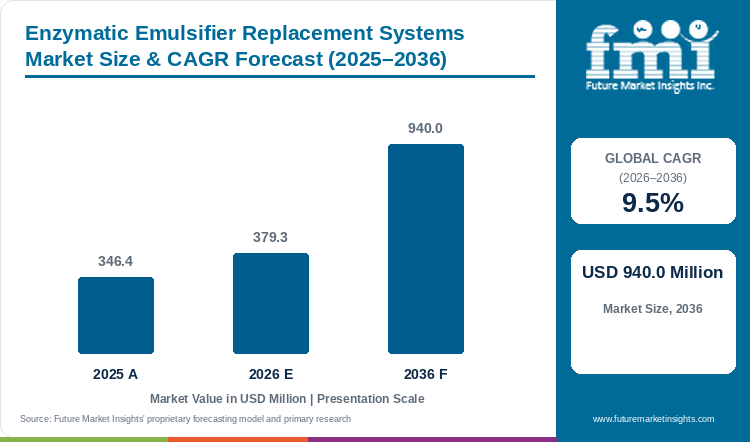
Industry valuation for enzymatic emulsifier replacement systems climbs past a 2025 baseline totaling USD 346.4 million toward a 2026 estimate totaling USD 379.3 million, reaching a 2036 projection totaling USD 940.0 million under a 9.5% CAGR.
Flour mills and wholesale pan-bread bakeries are replacing palm-derived chemical dough strengtheners with gravimetric phospholipase micro-dosing to cut surfactant procurement costs and remove E471 and E472e declarations from retail bread bags. Future Market Insights estimates the global enzymatic emulsifier replacement systems market at a 2026 total of USD 379.3 million versus a 2025 baseline totaling USD 346.4 million, and forecasts category valuation to hit a 2036 total of USD 940.0 million under a 9.5% CAGR as powder formulations represent a projected 36.0% of 2026 type demand. Catalytic micro-dosing cuts dough-conditioning costs by up to half on high-speed pan-loaf lines. Because 20 to 50 parts per million of enzyme replaces 4,000 parts per million of diacetyl tartaric acid esters of mono- and diglycerides (DATEM), enzymatic replacement systems expand at a 9.5% CAGR compared with 4.7% for conventional food emulsifiers. Regulatory approvals are widening adoption across sweet bakery lines after the European Food Safety Authority (EFSA) Panel on Food Enzymes published a February 2025 safety evaluation extending triacylglycerol lipase from Trichoderma reesei strain RF10625 to fine bakery wares [1]. Even so, first-generation lipases still release butyric acid off-flavors when applied to butter-rich brioche and croissant doughs.
Key Market Trends & Insights
- By type: Automated micro-feeder hoppers in flour mills help powder formulations represent a projected 36.0% of 2026 type demand.
- By form: Twelve-month warehouse enzyme stability lets dry powder concentrates account for an estimated 45.0% of 2026 form volume without liquid pump drift.
- By application: High-speed pan-loaf and bun lines make bread & rolls an expected 34.0% of 2026 application consumption through superior proof-box gas retention.
- By claim: High-volume white pan bread cost ceilings explain why standard conventional enzymes constitute an anticipated 52.0% of 2026 claim demand.
- By sales channel: On-site bake-lab rheology calibration helps direct technical sales to industrial bakeries generate a forecast 52.0% of 2026 channel demand.
Regional Highlights
- Primary national growth leader: Automated pan-bread commissaries in Riyadh and Jeddah rank Saudi Arabia at the front of national tables with a forecast 10.8% CAGR through 2036.
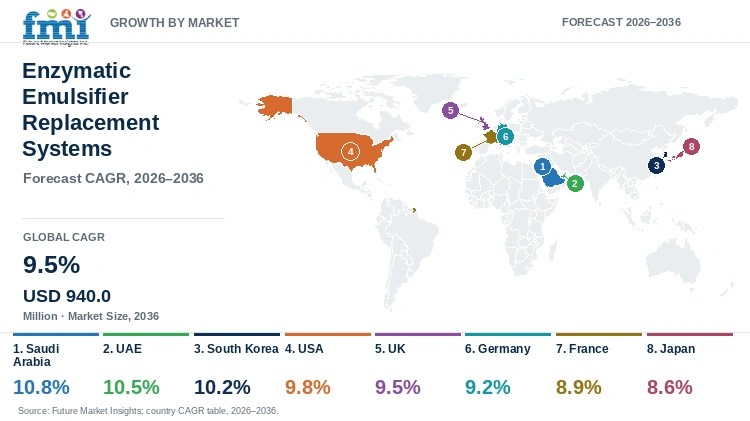
- Comparative country rates: Compound annual growth between 2026 and 2036 hits an anticipated 10.5% across the UAE and 10.2% across South Korea before registering 9.8% in the USA, while the UK logs 9.5% and Germany posts 9.2% ahead of France with 8.9% and Japan with 8.6%.
Market Size & Forecast
Table 1: Market Size and Forecast for the Enzymatic Emulsifier Replacement Systems Market (USD million and CAGR percentage), 2025 to 2036
| Metric | Value |
|---|---|
| 2025 Market Size | USD 346.4 million |
| Estimated Market Size in 2026 | USD 379.3 million |
| Projected Market Size by 2036 | USD 940.0 million |
| CAGR, 2026 to 2036 | 9.5% |
| Added Revenue, 2026 to 2036 | USD 560.7 million |
Wholesale bread plants and bun manufacturers face volatile palm-derived monoglyceride pricing and retailer clean-label mandates to remove E471 and E472e chemical additive numbers from ingredient panels. Conventional chemical emulsifiers require 0.3% to 0.5% inclusion by flour weight, whereas enzymatic phospholipase systems generate surface-active lysophospholipids directly from native wheat flour lipids at 0.002% to 0.005% dosage. IFF introduced POWERFRESH ACE 2000 in August 2025 as a bread fresh-keeping enzyme solution engineered to preserve crumb softness and slice resilience across extended retail shelf cycles [2]. Industrial bakers are pairing lipases with baking enzymes such as maltogenic alpha-amylases to cut synthetic emulsifier spend by 30% to 50% per metric ton of dough.
Flour-Tonnage Treated and Enzyme-Dosage Sizing
Table 2: Flour-Tonnage Treated and Enzyme-Dosage Sizing for the Enzymatic Emulsifier Replacement Systems Market (USD million and operational ranges), 2025 to 2036
| Metric | 2025 | 2026 | 2036 |
|---|---|---|---|
| Market size (USD million) | 346.4 | 379.3 | 940.0 |
| Commercial bakery flour treated (million metric tons) | 42.0 to 48.0 | 46.0 to 52.5 | 108.0 to 124.0 |
| Active enzyme preparation volume (thousand metric tons) | 11.5 to 13.2 | 12.6 to 14.4 | 29.5 to 33.8 |
| Treatment cost per metric ton of flour (USD) | 7.2 to 8.2 | 7.3 to 8.3 | 7.6 to 8.7 |
Operational note: Treated-flour and enzyme-volume ranges apply 20-ppm to 50-ppm commercial phospholipase and glycolipase inclusion rates replacing 3,000-ppm to 5,000-ppm chemical DATEM and SSL doses across industrial yeast-raised dough lines.
Catalytic dough conditioning depends on sufficient endogenous polar galactolipids and phospholipids inside the commercial wheat flour stream across seasonal harvests. Formulators blend specific phospholipase A1 and A2 preparations with phospholipase enzyme carriers so gas-cell lamellae remain elastic during mechanical proof-box transfer and high-speed tunnel-oven spring.
Per Capita & Industrial Bakery Plant Sizing
Table 3: Per Capita and Bakery Plant Spending Indicators for the Enzymatic Emulsifier Replacement Systems Market (USD), 2025 to 2036
| Metric | 2025 | 2026 | 2036 |
|---|---|---|---|
| World population (million) | 8,200.0 | 8,300.0 | 9,000.0 |
| Spend per 1,000 people (USD) | 42.2 | 45.7 | 104.4 |
| Annual spend per industrial bakery plant (USD) | 14,800 to 17,200 | 16,100 to 18,800 | 38,500 to 44,600 |
| Direct multi-plant contract share (%) | 66.0% to 70.0% | 68.0% to 72.0% | 75.0% to 79.0% |
Table 4: Plant & Channel Spending Indicators for the Enzymatic Emulsifier Replacement Systems Market (USD and percentages), 2026
| Metric | Value | Institutional Reference Basis |
|---|---|---|
| Market size, 2026 | USD 379.3 million | 2026 global revenue baseline |
| Industrial & commercial bakeries | 22,000 | Global automated bread & sweet-goods plant registry |
| Market spend per plant | USD 17,240.9 | Annualized enzymatic emulsifier-replacement spend |
| Direct to industrial bakeries revenue, 2026 | USD 197.2 million | 52.0% sales channel allocation |
Substitution of chemical dough strengtheners across high-speed pan-bread lines requires matching enzyme kinetics to seasonal wheat protein fluctuations and mixer shear profiles. Plant technical directors co-dose lipase systems with bread improvers and ascorbic acid oxidants to prevent proof-box collapse and maintain loaf volume when processing lower-protein wheat harvests.
Analyst Perspective
"Industrial bakers do not switch from DATEM to lipases merely to clean up a retail label; they switch when a 30-ppm enzyme blend delivers superior proof-box shock tolerance at a lower cost per ton of flour. Suppliers that eliminate short-chain fatty acid off-notes in butter-rich doughs will capture the next wave of viennoiserie reformulation."
- Nandini Roy Choudhury, Principal Analyst at Future Market Insights
How is the enzymatic emulsifier replacement systems market segmented?
The enzymatic emulsifier replacement systems market is segmented by type, form, application, claim, and sales channel. In 2026, powder is projected at 36.0%, powder / dry at 45.0%, bread & rolls at 34.0%, conventional at 52.0%, and direct to industrial bakeries at 52.0%.
By type: Powder enzyme complexes, hydrate gel dispersions, liquid concentrates, and integrated multi-enzyme blends.
By form: Powder / dry concentrates, liquid enzyme solutions, semi-solid pastes, and granulated blends.
By application: Bread & rolls, industrial buns, laminated viennoiserie, and tortilla wraps.
By claim: Conventional baking grades, clean-label E-number-free systems, organic-compliant enzymes, and non-GMO verified grades.
By sales channel: Direct to industrial bakeries, specialty milling distributors, commercial foodservice commissaries, and retail improver packs.
Why is Powder preferred within Type?
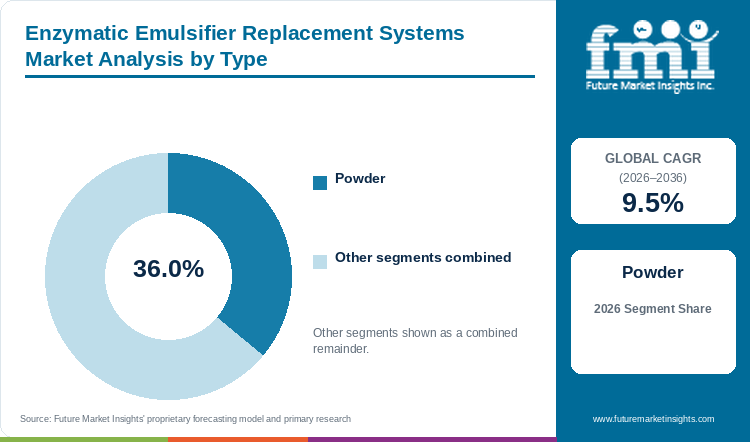
Powder formulations represent a projected 36.0% of 2026 type demand, reinforced by dust-free micro-dosing hoppers.
Table 5: Type Share for the Enzymatic Emulsifier Replacement Systems Market (percentage share), 2026
| Type | Share (2026) |
|---|---|
| Powder | 36.0% |
| Other Segments Combined* | 64.0% |
| Total | 100.0% |
*Calculated as the balance remaining after deducting the leading segment's reported share from 100.0%.
Table 6: Type Leadership and Market Growth for the Enzymatic Emulsifier Replacement Systems Market (segment and CAGR percentage), 2026 to 2036
| Metric | Value |
|---|---|
| Global CAGR (2026 to 2036) | 9.5% |
| Leading Segment | Powder |
Concentrated powdered lipase preparations stabilized on wheat-flour or maltodextrin carriers integrate directly into existing dry micro-ingredient feeders at commercial flour mills and wholesale bakeries. Unlike hydrate gels or liquid emulsions that require heated holding tanks, powdered types blend uniformly with bakery proteases and oxidants.
- Gravimetric micro-dosing accuracy at flour mills helps powder formulations represent a projected 36.0% of 2026 type demand across ambient premix lines.
- AB Enzymes opened a new office and baking application laboratory in Curitiba in June 2026 to expand regional technical validation for powdered VERON baking lipases across South America [3].
How does Powder / Dry lead the Form axis?
Dry powder concentrates account for an estimated 45.0% of 2026 form volume, owing to twelve-month ambient activity retention.
Physical form dictates how a plant operator meters the replacement system onto the mixing line independently of the internal catalytic design. Dry free-flowing powders and dust-free micro-granules feed through gravimetric loss-in-weight screw feeders with flour conditioner packages without retrofitting wet injection nozzles.
- Long ambient shelf stability without cold-chain drums lets dry powder concentrates account for an estimated 45.0% of 2026 form volume.
- Puratos debuted its compact Cubease baking improver format at iba 2025 in May 2025 to simplify industrial dough dosing and cut packaging waste across commercial bakeries [4].
What makes Bread & Rolls the leading Application?
Industrial bread & rolls make up an expected 34.0% of 2026 application consumption, stemming from pan-bread DATEM replacement.
Pan bread and hamburger buns undergo intense mechanical shear during dividing and conveyor transfer into high-humidity proofers. Enzymatic hydrolysis of native wheat digalactosyldiacylglycerols into monogalactosyldiacylglycerols strengthens the liquid-crystalline film around CO2 bubbles, outperforming synthetic SSL in par-baked bread and bagged sandwich loaves.
- Continuous tunnel-oven pan bread and hamburger bun production makes bread & rolls an expected 34.0% of 2026 application consumption globally.
- Mechanistic wheat-lipid research published in the International Journal of Biological Macromolecules in December 2025 verified that targeted lipase dosing in wheat bread raises loaf volume by 15% to 35% and delays crumb firming for up to two days [5].
Why does Conventional maintain its lead within Claim?
Standard conventional enzymes constitute an anticipated 52.0% of 2026 claim demand, associated with commodity pan-loaf cost targets.
Many industrial bakeries adopt lipase systems primarily to slash chemical emulsifier procurement costs by 35% while retaining standard ingredient declarations on value bread bags. Conventional specifications allow formulators to pair 20-ppm phospholipase with reduced levels of mono- and diglycerides or cake enzyme blends to protect batter aeration during extreme summer heat.
- Cost-sensitive private-label sandwich loaf tenders explain why standard conventional enzymes constitute an anticipated 52.0% of 2026 claim demand.
- Technical baking analysis released by IFF in June 2026 showed how industrial bakers balance label simplification against high-speed dough machinability and cost-in-use [6].
Why do Direct to Industrial Bakeries accounts lead Sales Channel?
Direct technical sales to industrial bakeries generate a forecast 52.0% of 2026 channel demand, enabled by dough-rheology trials.
Conversion from 0.4% chemical DATEM to a 30-ppm enzyme system requires farinograph and pilot-oven calibration against the bakery's exact flour ash content and fermentation schedule. Direct account teams from primary biosolution producers conduct on-site line trials to eliminate over-dosing stickiness against clean-label emulsifiers benchmarks.
- Plant-level farinograph and extensograph trials help direct technical sales to industrial bakeries generate a forecast 52.0% of 2026 channel demand.
- Sponge-cake and bakery emulsification trials published in Food Research International in June 2025 demonstrated that enzymatic mono- and diglyceride generation held crumb hardness increases to 26% to 45% over three months of storage versus 104% in untreated controls [7].
What are the drivers, restraints, and opportunities in the enzymatic emulsifier replacement systems market?
Catalytic ppm dosing that cuts chemical DATEM costs and cleans up bread labels drives enzyme adoption, whereas butyric off-flavors in butter pastries limit uptake and selective glycolipases open new growth.
- Driver: Catalytic micro-dosing at 20 to 50 ppm replaces 3,000 to 5,000 ppm of chemical DATEM and SSL while qualifying as a processing aid off the retail ingredient label.
- Restraint: Non-selective lipases cleave short-chain butyric and caproic fatty acids from dairy butter, causing rancid off-flavors in croissants and brioche.
- Opportunity: Substrate-specific third-generation phospholipases and xylanase-lipase complexes extend emulsifier replacement into butter-rich viennoiserie and high-fiber doughs.
Growth Analysis and Future Potential: Qualitative Demand Catalysts
Commercial adoption is driven by the dual economic and regulatory advantage of replacing bulk chemical surfactants with catalytic proteins. Whereas DATEM and distilled monoglycerides must be shipped in multi-ton pallet loads and declared as E472e or E471 on European and Asian bread bags, baking lipases are denatured during oven baking and generally qualify as processing aids exempt from front-of-pack E-number disclosure. Wholesale bakeries are combining phospholipases with alpha-amylase baking enzyme systems to preserve both dough extensibility and 14-day packaged crumb softness. Novonesis reported 8% organic sales growth in August 2026 for the first half of 2026, led by strong Food and Beverage biosolutions demand across global baking accounts [8]. Once an industrial bread plant validates an enzymatic spec, repeat enzyme orders lock in permanently across daily flour runs.
Risk Assessment of the Enzymatic Emulsifier Replacement Systems Market: Operational and Formulation Friction
Substrate dependency and lipid-oxidation off-flavors represent the primary technical barriers restricting 100% emulsifier elimination across all bakery categories. Because lipases act on endogenous flour and fat lipids instead of supplying external surfactant mass, low-fat white pan breads or overly refined flours with <1.0% polar lipids can suffer proof-box gas loss if enzyme dosage is not carefully balanced. Conventional first-generation triacylglycerol lipases hydrolyze tributyrin in butter-fat recipes, releasing free butyric acid that imparts a sharp cheesy off-odor with lipoxygenase oxidation compounds. Gas chromatography-olfactometry analysis published in Food Research International in April 2025 identified 29 odor-active compounds in whole-wheat bread and confirmed that controlling lipase and lipoxygenase pathways is necessary to prevent cardboard-like lipid oxidation off-flavors [9]. Cake batters that rely on alpha-tending monoglycerides for mechanical air incorporation also remain difficult to convert using lipases alone.
Commercial Opportunity Analysis: Formulation Differentiation and Value-Add Formats
Enzyme protein engineering is opening high-margin opportunities in butter-laminated pastries and whole-wheat breads where first-generation lipases previously failed. By mutating the active-site binding pocket to prefer long-chain polar galactolipids over short-chain dairy triglycerides, new baking lipases strengthen dough gluten networks in butter croissants and laminated pastries without generating rancid free fatty acids. Formulators are also pairing novel microbial lipases with arabinoxylan-cleaving xylanases to replace added wheat gluten and chemical conditioners in high-fiber breads across broader industrial enzyme portfolios. Biochemical characterization findings in Applied Biochemistry and Biotechnology in June 2026 demonstrated that purified Microbacterium takaoensis lipase (40 kDa, optimal at 37 degrees Celsius and pH 7.0) significantly improved dough elasticity and scanning-electron-microscopy microstructural uniformity in yeast-raised pizza dough [10]. Multi-enzyme complexes formulated for frozen dough freeze-thaw resilience offer immediate revenue expansion for technical ingredient suppliers.
Enzymatic Emulsifier Replacement Systems Market by Country (2026 to 2036)
Country-level enzyme adoption tracks imported palm-oil emulsifier exposure, industrial pan-bread line speeds, and supermarket clean-label additive policies. Between 2026 and 2036 Saudi Arabia tops the eight country markets with a 10.8% annual rate, followed by 10.5% across the UAE and 10.2% across South Korea before the USA records 9.8%, whilst the UK logs 9.5% and Germany posts 9.2% before France records 8.9% and Japan registers 8.6%.
Table 7: Country CAGR and Primary Growth Levers for the Enzymatic Emulsifier Replacement Systems Market (CAGR percentage and operational drivers), 2026 to 2036
| Country | CAGR (2026 to 2036) | Primary Growth Lever |
|---|---|---|
| Saudi Arabia | 10.8% | Jeddah Food Cluster automated bakery lines and imported DATEM cost substitution |
| UAE | 10.5% | National Food Security Strategy 2051 processing localization and warm-chain stability |
| South Korea | 10.2% | K-Food packaged bakery export shelf-life demands and MFDS enzyme code compliance |
| USA | 9.8% | High-speed commercial pan-bread DATEM replacement and FDA GRAS enzyme dossiers |
| UK | 9.5% | Plant-bakery wrapped bread concentration and FSA regulated-product reforms |
| Germany | 9.2% | Branch-bakery central dough commissaries and EU Regulation 1332/2008 transition |
| France | 8.9% | Clean-label E-number removal in industrial brioche and ANSES processing-aid rules |
| Japan | 8.6% | Imported wheat-flour tolerance stabilization and MHLW additive specification locks |
Source: Future Market Insights analysis
Saudi Arabia Enzymatic Emulsifier Replacement Systems Market Outlook (2026 to 2036)
Commercial bakeries in Riyadh and Dammam rely on imported milling wheat and face high chilled-freight bills when importing bulk palm-oil monoglyceride blocks across Red Sea ports. Greenfield construction of high-speed flatbread and packaged toast commissaries inside dedicated industrial zones places Saudi Arabia in the top national spot at a projected 10.8% CAGR through the 2036 forecast window. According to a May 2026 Saudi Press Agency release MODON industrial estates now host 9,557 manufacturing plants supported by SAR 30,000.0 million in total investment across major food hubs [11]. Conversion from 0.4% chemical DATEM to 30-ppm ambient-stable phospholipase powders cuts landed dough-conditioning costs by more than one third across wholesale bakeries in Saudi Arabia.
Key takeaway: In Saudi Arabia, greenfield food-cluster bread plants and lower landed enzyme freight costs fuel a leading 10.8% annual expansion.
UAE Enzymatic Emulsifier Replacement Systems Market Outlook (2026 to 2036)
Wheat-flour premix exports and warm-climate bakery distribution across Dubai and Sharjah carry UAE enzymatic replacement demand upward by an expected 10.5% CAGR over the decade to 2036. High summer warehouse temperatures frequently cause conventional distilled monoglyceride and SSL powders to cake inside silo hoppers before dough mixing even begins on automated lines. Industrial localization priorities outlined by the UAE Ministry of Industry and Advanced Technology in January 2025 under the National Food Security Strategy 2051 have accelerated domestic flour fortification and automated commissary investments across port free zones [12]. Commercial flour mills in the UAE pre-blend thermostable fungal phospholipases with xylanases directly into bakery flour sacks.
Key takeaway: In the UAE, mill-level flour premix fortification and heat-tolerant enzyme dosing support a 10.5% CAGR.
South Korea Enzymatic Emulsifier Replacement Systems Market Outlook (2026 to 2036)
Industrial baking groups in Seoul and Gyeonggi import almost all of their bread-making wheat from North America and Australia, exposing high-speed dough lines to seasonal gluten and polar-lipid swings across quarterly shipments. Multi-week shelf-life requirements for packaged convenience-store buns and export pastries lift South Korea's enzymatic replacement market by a forecast 10.2% yearly expansion rate to 2036. Export expansion targets released by South Korea's food and agriculture ministry in February 2026 prioritize processed bakery products with extended ambient freshness across overseas retail chains [13]. Combined dosing of phospholipase with maltogenic alpha-amylase allows bakeries in South Korea to replace chemical emulsifiers while meeting strict domestic enzyme purity codes.
Key takeaway: In South Korea, extended export shelf-life targets and imported-wheat rheology buffering sustain a 10.2% annual growth rate.
USA Enzymatic Emulsifier Replacement Systems Market Outlook (2026 to 2036)
Automated pan-bread and hamburger-bun plants running at 150 loaves per minute push USA enzymatic emulsifier replacement demand forward by an anticipated 9.8% yearly growth rate over the 2026 to 2036 window. Wholesale bakeries face simultaneous pressure from retail grocery clean-label scorecards that penalize DATEM and SSL on ingredient panels and from fluctuating domestic flour protein quality. Supply and utilization data in the USDA Economic Research Service July 2026 Wheat Outlook confirmed persistent price and protein spread volatility across Hard Red Winter and Spring wheat harvests [14]. Rapid FDA Generally Recognized as Safe (GRAS) notification pathways enable USA bread plants to qualify high-specificity microbial lipases across national commissary networks.
Key takeaway: In the USA, high-speed pan-loaf shock tolerance and supermarket clean-label scorecards support a 9.8% compound annual growth rate.
UK Enzymatic Emulsifier Replacement Systems Market Outlook (2026 to 2036)
Because CBP mechanical dough development completes mixing in three minutes without bulk fermentation, dough pieces require instant lipid-monolayer stabilization to survive proof-box transfer without gas-cell coalescence on high-speed conveyors. High-intensity Chorleywood Bread Process (CBP) mixing across large wrapped-bread plants drives UK enzymatic replacement sales by an estimated 9.5% yearly expansion rate to 2036. Reformed regulated-product authorization procedures implemented under the April 2025 Food Standards Agency reforms have simplified ministerial register updates for commercial food enzymes across the UK [15]. Plant bakeries across the UK pair fast-acting phospholipase A1 preparations with ascorbic acid to trim imported DATA ester consumption on private-label sandwich loaves and morning goods.
Key takeaway: In the UK, rapid Chorleywood mixing cycles and simplified FSA enzyme register updates support a 9.5% yearly expansion.
Germany Enzymatic Emulsifier Replacement Systems Market Outlook (2026 to 2036)
Central dough commissary consolidation and Europe's largest frozen par-baked roll output expand Germany's enzymatic replacement sector by a predicted 9.2% yearly growth rate over the ten-year period to 2036. Frozen dough pieces experience ice-crystal recrystallization during sub-zero storage that weakens gluten networks unless endogenous polar wheat galactolipids are enzymatically converted before blast freezing. Structural industry figures published via the national craft-bakery federation in Germany in April 2025 showed sector turnover climbing to EUR 17,920.0 million across 8,912 enterprises as large multi-branch commissaries gained share across regional retail networks [16]. Improver houses in Germany formulate specialized phospholipase-xylanase premixes that guarantee crisp oven spring when supermarket staff bake off frozen rolls in store.
Key takeaway: In Germany, multi-branch bakery consolidation and frozen par-baked roll conditioning generate a 9.2% compound annual growth rate.
France Enzymatic Emulsifier Replacement Systems Market Outlook (2026 to 2036)
Supermarket chains in France aggressively market zero-E-number viennoiserie, forcing industrial bakeries in Vendee and Brittany to replace mono- and diglycerides inside butter-rich doughs across national retail brands. Consumer rejection of E471 and E472e additive numbers on packaged brioche and pain de mie propels France's enzymatic replacement market by a projected 8.9% CAGR to 2036. Soft-wheat agricultural producer price indices published by INSEE in August 2026 confirmed persistent raw-material cost pressure across domestic milling and commercial baking supply chains in France [17]. Bakeries in France specify third-generation selective glycolipases that strengthen butter-enriched brioche crumb without cleaving short-chain tributary fats into rancid butyric acid notes during ambient storage.
Key takeaway: In France, E-number-free packaged brioche reformulation and butter-selective glycolipases maintain a projected 8.9% CAGR.
Japan Enzymatic Emulsifier Replacement Systems Market Outlook (2026 to 2036)
Ultra-soft Pullman sandwich loaves and chilled convenience-store sweet buns lift Japan's enzymatic emulsifier replacement market by a likely 8.6% yearly growth rate from 2026 to 2036. Wholesale bread manufacturers in Tokyo and Osaka require dough-conditioning systems that preserve silky crumb elasticity for four days without synthetic sorbitan or monoglyceride aftertastes. Technical food-enzyme research published by Amano Enzyme in Enzyme Wave Volume 29 in May 2026 detailed new microbial lipase and transglutaminase applications for clean-label bakery texture modification in Japan [18]. Suppliers win ten-year industrial milling and bakery accounts in Japan by calibrating enzyme activity to imported hard wheat varieties from North America under strict national additive standards.
Key takeaway: In Japan, ultra-soft Pullman bread texture standards and domestic microbial lipase engineering support an 8.6% yearly growth rate.
Full report country CAGRs cover: North America; Latin America; Western Europe; Eastern Europe; East Asia; South Asia and Pacific; Middle East and Africa.
Who are the notable companies in the enzymatic emulsifier replacement systems market?
Novonesis, IFF, AB Enzymes, dsm-firmenich, Kerry Group, Puratos, Corbion, and Amano Enzyme are the notable companies in the enzymatic emulsifier replacement systems market.
Industry rivalry separates primary microbial enzyme fermenters from integrated bakery-improver formulators. Primary biosolution producers engineer proprietary Trichoderma and Aspergillus lipase strains and hold global patent estates on phospholipase specificity. Integrated bakery-improver houses blend those active enzymes with ascorbic acid and specialty flours to deliver turnkey DATEM-replacement systems.
- Primary Microbial Lipase & Biosolution Fermenters: Novonesis and IFF with AB Enzymes and dsm-firmenich ferment and purify proprietary phospholipase and glycolipase enzymes.
- Integrated Bakery Improver & Clean-Label Formulators: Kerry Group and Puratos with Corbion combine enzymatic activity with functional carriers to replace DATEM and SSL on plant bakery lines.
- Specialty Enzyme & Emulsifier Comparators: Amano Enzyme and Palsgaard with Louis Dreyfus Company supply specialty microbial lipases and benchmark hybrid emulsifier-enzyme systems.
Competitive Benchmarking: Enzymatic Emulsifier Replacement Systems Market
Table 8: Competitive Benchmarking for the Enzymatic Emulsifier Replacement Systems Market (qualitative capability ratings), 2026
| Company | Direct Lipase Substitution | Bakery Pilot-Trial Support | Butter & Dough Adaptability | Geographic Reach |
|---|---|---|---|---|
| Novonesis | High | High | High | High |
| IFF | High | High | High | High |
| AB Enzymes | High | High | High | High |
| dsm-firmenich | High | Medium | High | High |
| Kerry Group | Medium | High | High | High |
| Puratos | Medium | High | High | High |
| Corbion | Medium | High | Medium | Medium |
| Amano Enzyme | Medium | Medium | Medium | Medium |
Scoring basis: Ratings reflect patented phospholipase and glycolipase fermentation depth and on-site pilot-bakery rheology testing and butter-dough specificity across world milling regions.
Key Developments in the Enzymatic Emulsifier Replacement Systems Market
- In June 2025, dsm-firmenich completed the EUR 1,500.0 million sale of its stake in the Feed Enzymes Alliance to Novonesis to sharpen its strategic focus on human food and bakery biosolutions [19].
- In September 2025, BASF and Louis Dreyfus Company completed the sale and purchase transaction transferring BASF's Food and Health Performance Ingredients business to Louis Dreyfus Company [20].
- In July 2026, Corbion reported 8.5% second-quarter organic sales growth to EUR 337.4 million (EUR 631.1 million for H1 2026), supported by volume/mix expansion in Functional Ingredients and Solutions for bakery preservation and dough conditioning [21].
Key Players in the Enzymatic Emulsifier Replacement Systems Market
Primary Microbial Lipase and Biosolution Fermenters
- Novonesis
- IFF
- AB Enzymes
Integrated Bakery Improver and Clean-Label Formulators
- dsm-firmenich
- Kerry Group
- Puratos
Specialty Enzyme and Preservation Producers
- Corbion
- Amano Enzyme
Enzymatic Emulsifier Replacement Systems Market - Report Scope
Table 9: Report Scope for the Enzymatic Emulsifier Replacement Systems Market (coverage fields and definitions), 2026 to 2036
| Coverage field | Report scope |
|---|---|
| Market breakdown | Type; Form; Application; Claim; Sales Channel |
| Quantitative Units | USD Million |
| Market Definition | Includes commercial supplier revenue from phospholipase, triacylglycerol lipase, glycolipase, and integrated multi-enzyme systems sold to replace chemical emulsifiers (such as DATEM, SSL, CSL, and mono- and diglycerides) in bakery applications. Category Scope Note: Excludes standalone chemical emulsifiers sold separately, non-enzymatic hydrocolloids, and finished baked goods. |
| Regions Covered | North America; Latin America; Western Europe; Eastern Europe; East Asia; South Asia and Pacific; Middle East and Africa |
| Countries Covered | Saudi Arabia, UAE, South Korea, USA, UK, Germany, France, Japan, and additional countries in the full report |
| Key Companies Covered | Novonesis, IFF, AB Enzymes, dsm-firmenich, Kerry Group, Puratos, Corbion, Amano Enzyme |
| Forecast Period | 2026 to 2036 |
| Approach | Primary and secondary research with top-down and bottom-up market triangulation. |
Enzymatic Emulsifier Replacement Systems Market - Research Methodology
Table 10: Research Methodology for the Enzymatic Emulsifier Replacement Systems Market (research methods and approach), 2026 edition
| Method | Approach |
|---|---|
| Primary Research | Structured interviews with industrial baking R&D vice presidents, flour-mill enzyme formulators, microbial fermentation directors, and plant bakery quality managers to validate ppm dosage ratios, DATEM displacement percentages, and butter-dough off-flavor thresholds. |
| Secondary Research | Analysis of EFSA Panel on Food Enzymes scientific opinions, FDA GRAS enzyme notices, corporate financial filings (Novonesis, IFF, Corbion, dsm-firmenich), and peer-reviewed dough rheology studies in PubMed. |
| Market Sizing and Forecasting | Top-down global baking enzyme expenditure models reconciled against bottom-up commercial flour tonnage treated, active ppm dosage rates, and per-ton enzyme treatment costs from 2026 to 2036. |
| Country Forecasting Model | Econometric country projections weight industrial pan-bread line concentration, imported-wheat protein variability, E-number clean-label retail pressure, and greenfield food-cluster investments across eight national markets. |
| Operational Benchmark Traceability | Treated-flour and plant spending indicators in Tables 2, 3, and 4 trace to EFSA food-enzyme intake models, USDA ERS wheat milling datasets, and national bakery federation plant registries. |
| Data Triangulation and Validation | Demand estimates are cross-checked against primary enzyme fermentation revenues and commercial bakery improver sales without double counting standalone chemical emulsifiers or bulk added wheat gluten. |
Enzymatic Emulsifier Replacement Systems Market by Segments
Enzymatic Emulsifier Replacement Systems Market segmented by Type:
- Powder
- Hydrate / gel
- Liquid
- Integrated blends
Enzymatic Emulsifier Replacement Systems Market segmented by Form:
- Powder / dry
- Liquid
- Paste / semi-solid
Enzymatic Emulsifier Replacement Systems Market segmented by Application:
- Bread & rolls
- Cakes & muffins
- Biscuits & cookies
Enzymatic Emulsifier Replacement Systems Market segmented by Claim:
- Conventional
- Clean label
- Organic
- Non-GMO certified
Enzymatic Emulsifier Replacement Systems Market segmented by Sales Channel:
- Direct to industrial bakeries
- Ingredient distributors
- Foodservice & artisan supply
- Online B2B
- Commercial mill supply
Enzymatic Emulsifier Replacement Systems Market by Region
- North America
- United States
- Canada
- Latin America
- Brazil
- Mexico
- Argentina
- Chile
- Western Europe
- Germany
- France
- United Kingdom
- Italy
- Spain
- Benelux
- Nordics
- Eastern Europe
- Poland
- Czech Republic
- Romania
- Hungary
- East Asia
- China
- Japan
- South Korea
- South Asia and Pacific
- India
- ASEAN
- Australia and New Zealand
- Middle East and Africa
- GCC Countries
- South Africa
- Türkiye
- Israel
Research Sources and Bibliography
- [1] EFSA Panel on Food Enzymes. (2025, February 28). Safety Evaluation of an Extension of Use of the Food Enzyme Triacylglycerol Lipase from the Genetically Modified Trichoderma reesei Strain RF10625. EFSA Journal, 23(2), e9283.
- [2] International Flavors & Fragrances Inc. (2025, August 13). IFF Launches POWERFRESH ACE 2000, a Bread Fresh-Keeping Enzyme Solution for Commercial Bakeries. IFF Newsroom.
- [3] AB Enzymes GmbH. (2026, June 1). AB Enzymes Opens New Office and Baking Application Laboratory in Curitiba, Brazil. AB Enzymes (Associated British Foods plc).
- [4] Puratos Group. (2025, May 12). Puratos Brings a Trio of Baking and Cubease Improver Innovations to iba 2025. Puratos NV.
- [5] Patel, M., Kumar, V., & Sharma, S. (2025, December 28). Enhancing Functional and Nutritional Properties of Wheat Flour and Bakery Products Using Lipases: A Mechanistic Review. International Journal of Biological Macromolecules (PubMed PMID 41551819).
- [6] International Flavors & Fragrances Inc. (2026, June 4). Label-Friendly by Design: How Enzymes Are Changing the Future of Industrial Baking and Emulsifier Replacement. IFF Food Bioscience.
- [7] Pruvot, L., Monie, A., Clemens, K., Perez, E., Franceschi, S., Balayssac, S., & Delample, M. (2025, June 9). Recycling Lipases as a Promising Strategy in Sponge Cake and Bakery Development. Food Research International, 217, 116739 (PubMed PMID 40597470).
- [8] Novonesis Group. (2026, August 19). H1 2026 Results: Novonesis Delivered Strong 8% Organic Sales Growth and Increases Full-Year Outlook. Novonesis A/S.
- [9] Zhang, L., Wang, Y., & Chen, H. (2025, April 20). Impact of Lipase and Lipoxygenase Activity on the Aroma Profile and Lipid Oxidation Pathway of Whole Wheat Bread. Food Research International (PubMed PMID 40253167).
- [10] Rao, K. N., Verma, P., & Gupta, R. (2026, June 8). Isolation and Characterization of a Novel Microbacterium takaoensis Lipase for Clean-Label Dough Improvement. Applied Biochemistry and Biotechnology (PubMed PMID 42260724).
- [11] Saudi Press Agency / MODON. (2026, May 5). MODON Boosts Industrial Security and Supply Chain Sustainability with SAR 30 Billion Investments Across 9,557 Facilities. Saudi Press Agency.
- [12] UAE Ministry of Industry and Advanced Technology. (2025, January 2). UAE Industrial Sector: Cornerstone of Sustainable Economic Growth and National Food Security Localization. United Arab Emirates MoIAT.
- [13] Ministry of Agriculture, Food and Rural Affairs of South Korea. (2026, February 27). The Strategic Plan for Global Expansion of K-Food Exports and Processed Bakery Innovation. Republic of Korea MAFRA.
- [14] U.S. Department of Agriculture, Economic Research Service. (2026, July 14). Wheat Outlook: July 2026 Domestic Supply, Milling Utilization, and Price Analysis. USDA Economic Research Service (WHS-26g).
- [15] UK Food Standards Agency. (2025, April 1). Guidance on Using the Register of Food Additive and Regulated Product Authorisations in the UK. GOV.UK Food Standards Agency.
- [16] Lebensmittel Praxis / Zentralverband des Deutschen Baeckerhandwerks. (2025, April 14). Handwerk unter Druck: Baeckereien steigern Umsatz auf 17,92 Milliarden Euro bei 8.912 Betrieben. Lebensmittel Praxis.
- [17] Institut national de la statistique et des etudes economiques (INSEE). (2026, August 27). Annual and Monthly Agricultural Producer Price Indices (IPPAP): Soft Wheat Series 010776425. INSEE Republic of France.
- [18] Amano Enzyme Inc. (2026, May 15). Announcement of the Publication of Enzyme Wave Vol. 29: Industrial Food and Baking Enzyme Advances. Amano Enzyme Inc.
- [19] dsm-firmenich AG. (2025, June 2). dsm-firmenich Completes Sale of Its Stake in Feed Enzymes Alliance to Novonesis for EUR 1.5 Billion. dsm-firmenich Media Releases.
- [20] BASF SE & Louis Dreyfus Company. (2025, September 30). BASF and Louis Dreyfus Company Complete Sale and Purchase Transaction for BASF Food and Health Performance Ingredients Business. BASF SE News Releases.
- [21] Corbion N.V. (2026, July 31). Corbion Announces Half-Year 2026 Results: Q2 Organic Sales Growth of 8.5% to EUR 337.4 Million. Corbion N.V. Press Releases.
- [22] Kerry Group plc. (2025, September 24). Kerry Establishes New Biotechnology Innovation Centre in Leipzig to Accelerate Enzyme and Fermentation Solutions. Kerry Group plc.
- [23] AB Enzymes GmbH. (2026, April 16). AB Enzymes Wins Innovation Award 2026 for Enzyme-Driven Side-Stream Valorisation and Lipid Recovery. AB Enzymes GmbH.
This bibliography is provided for reader reference and is not exhaustive. The full report contains the complete reference list and detailed citations.
This Report Answers
- What is the enzymatic emulsifier replacement systems market size in 2026 and 2036?
- Which bakery cost and clean-label pressures support demand for enzymatic emulsifier alternatives?
- Why does Powder lead the type segmentation in 2026?
- Why does Powder / dry lead the form segmentation in 2026?
- How do the eight evaluated country CAGRs differ from 2026 to 2036?
- Which companies provide microbial lipases, integrated improvers, or competing emulsifiers?
- What prevents industrial bakers from replacing chemical emulsifiers in butter-rich doughs?
- What should a bakery buyer verify before approving a lipase replacement system?
Frequently Asked Questions
How big is the enzymatic emulsifier replacement systems market in 2026, and what is forecast for 2036?
From a 2025 baseline totaling USD 346.4 million, global enzymatic emulsifier replacement systems market value reaches an estimated 2026 total of USD 379.3 million and is forecast to hit a 2036 total of USD 940.0 million.
What is the CAGR for the enzymatic emulsifier replacement systems market from 2026 to 2036?
Global demand is projected to expand at a 9.5% CAGR from 2026 through 2036, generating USD 560.7 million in additional yearly enzyme system revenue over the ten-year horizon.
Which type segment leads the enzymatic emulsifier replacement systems market?
Powder formulations represent a projected 36.0% of 2026 type demand because dry enzyme concentrates integrate smoothly into flour-mill and bakery premix dosers.
Which form segment leads the enzymatic emulsifier replacement systems market?
Dry powder concentrates account for an estimated 45.0% of 2026 form volume thanks to long ambient storage stability and compatibility with gravimetric powder feeders.
Which country has a notable growth outlook during the assessment period?
Greenfield industrial bakery buildouts in the Jeddah Food Cluster place Saudi Arabia first among analyzed national markets with a projected 10.8% compound annual growth rate from 2026 to 2036.
Who are the key players in the market?
Novonesis, IFF, AB Enzymes, dsm-firmenich, Kerry Group, Puratos, Corbion, and Amano Enzyme are the notable companies in the enzymatic emulsifier replacement systems market.
Preview the report firsthand - request a free sample
Get SampleGet the brochure for pricing and purchase details.
Get PDFTable of Content
- Key Takeaways
- Market Size and CAGR
- Top Growth Driver
- Fastest Growing Segment
- Leading Region
- Key Companies
- Emerging Opportunities
- Executive Summary
- Global Market Outlook
- Demand-side Trends
- Supply-side Trends
- Technology Roadmap Analysis
- Analysis and Recommendations
- Analyst Perspective (What is happening? Why now? What should investors know?)
- Key Questions Answered
- How large is the market?
- What is the CAGR?
- What are key trends?
- Which region dominates?
- Who are the leaders?
- Market Overview
- Market Coverage / Taxonomy
- Market Definition / Scope / Limitations
- Research Methodology
- Chapter Orientation
- Analytical Lens and Working Hypotheses
- Market Structure, Signals, and Trend Drivers
- Benchmarking and Cross-market Comparability
- Market Sizing, Forecasting, and Opportunity Mapping
- Research Design and Evidence Framework
- Desk Research Programme (Secondary Evidence)
- Expert Input and Fieldwork (Primary Evidence)
- Tooling, Models, and Reference Databases
- Data Engineering and Model Build
- Quality Assurance and Audit Trail
- Market Background
- Market Dynamics (Drivers, Restraints, Opportunity, Trends)
- Scenario Forecast (Optimistic, Likely, Conservative)
- Impact Analysis
- AI Impact
- Sustainability Impact
- Regulatory Impact
- Technology Impact
- Consumer / Buyer Analysis
- Purchase Drivers
- Adoption Barriers
- Buyer Journey
- Opportunity Map Analysis
- Product Life Cycle Analysis
- Supply Chain Analysis
- Investment Feasibility Matrix
- Value Chain Analysis
- PESTLE and Porter's Analysis
- Regulatory Landscape
- Regional Parent Market Outlook
- Production and Consumption Statistics
- Import and Export Statistics
- Global Market Analysis and Forecast, 2021 to 2036
- Historical Market Size Value (USD Million) Analysis, 2021 to 2025
- Current and Future Market Size Value (USD Million) Projections, 2026 to 2036
- Y-o-Y Growth Trend Analysis
- Absolute $ Opportunity Analysis
- Global Market Pricing Analysis, 2021 to 2036
- Global Market Analysis and Forecast, By Type, 2021 to 2036
- Introduction / Key Findings
- Historical Market Size Value (USD Million) Analysis By Type, 2021 to 2025
- Current and Future Market Size Value (USD Million) Analysis and Forecast By Type, 2026 to 2036
- Powder
- Hydrate / gel
- Liquid
- Integrated blends
- Y-o-Y Growth Trend Analysis By Type, 2021 to 2025
- Absolute $ Opportunity Analysis By Type, 2026 to 2036
- Global Market Analysis and Forecast, By Form, 2021 to 2036
- Introduction / Key Findings
- Historical Market Size Value (USD Million) Analysis By Form, 2021 to 2025
- Current and Future Market Size Value (USD Million) Analysis and Forecast By Form, 2026 to 2036
- Powder / dry
- Liquid
- Paste / semi-solid
- Y-o-Y Growth Trend Analysis By Form, 2021 to 2025
- Absolute $ Opportunity Analysis By Form, 2026 to 2036
- Global Market Analysis and Forecast, By Application, 2021 to 2036
- Introduction / Key Findings
- Historical Market Size Value (USD Million) Analysis By Application, 2021 to 2025
- Current and Future Market Size Value (USD Million) Analysis and Forecast By Application, 2026 to 2036
- Bread & rolls
- Cakes & muffins
- Biscuits & cookies
- Y-o-Y Growth Trend Analysis By Application, 2021 to 2025
- Absolute $ Opportunity Analysis By Application, 2026 to 2036
- Global Market Analysis and Forecast, By Claim, 2021 to 2036
- Introduction / Key Findings
- Historical Market Size Value (USD Million) Analysis By Claim, 2021 to 2025
- Current and Future Market Size Value (USD Million) Analysis and Forecast By Claim, 2026 to 2036
- Conventional
- Clean label
- Organic
- Non-GMO certified
- Y-o-Y Growth Trend Analysis By Claim, 2021 to 2025
- Absolute $ Opportunity Analysis By Claim, 2026 to 2036
- Global Market Analysis and Forecast, By Sales Channel, 2021 to 2036
- Introduction / Key Findings
- Historical Market Size Value (USD Million) Analysis By Sales Channel, 2021 to 2025
- Current and Future Market Size Value (USD Million) Analysis and Forecast By Sales Channel, 2026 to 2036
- Direct to industrial bakeries
- Ingredient distributors
- Foodservice & artisan supply
- Online B2B
- Commercial mill supply
- Y-o-Y Growth Trend Analysis By Sales Channel, 2021 to 2025
- Absolute $ Opportunity Analysis By Sales Channel, 2026 to 2036
- Global Market Analysis and Forecast, By Region, 2021 to 2036
- Introduction
- Historical Market Size Value (USD Million) Analysis By Region, 2021 to 2025
- Current Market Size Value (USD Million) Analysis and Forecast By Region, 2026 to 2036
- North America
- Latin America
- Western Europe
- Eastern Europe
- East Asia
- South Asia and Pacific
- Middle East and Africa
- Market Attractiveness Analysis By Region
- North America Market Analysis and Forecast, By Country, 2021 to 2036
- Historical Market Size Value (USD Million) Trend Analysis By Market Taxonomy, 2021 to 2025
- Market Size Value (USD Million) Forecast By Market Taxonomy, 2026 to 2036
- By Country
- United States
- Canada
- By Type
- By Form
- By Application
- By Claim
- By Sales Channel
- By Country
- Market Attractiveness Analysis
- By Country
- By Type
- By Form
- By Application
- By Claim
- By Sales Channel
- Key Takeaways
- Latin America Market Analysis and Forecast, By Country
- Historical Market Size Value (USD Million) Trend Analysis By Market Taxonomy, 2021 to 2025
- Market Size Value (USD Million) Forecast By Market Taxonomy, 2026 to 2036
- By Country
- Brazil
- Mexico
- Argentina
- Chile
- By Type
- By Form
- By Application
- By Claim
- By Sales Channel
- By Country
- Market Attractiveness Analysis
- By Country
- By Type
- By Form
- By Application
- By Claim
- By Sales Channel
- Key Takeaways
- Western Europe Market Analysis and Forecast, By Country
- Historical Market Size Value (USD Million) Trend Analysis By Market Taxonomy, 2021 to 2025
- Market Size Value (USD Million) Forecast By Market Taxonomy, 2026 to 2036
- By Country
- Germany
- France
- United Kingdom
- Italy
- Spain
- Benelux
- Nordics
- By Type
- By Form
- By Application
- By Claim
- By Sales Channel
- By Country
- Market Attractiveness Analysis
- By Country
- By Type
- By Form
- By Application
- By Claim
- By Sales Channel
- Key Takeaways
- Eastern Europe Market Analysis and Forecast, By Country
- Historical Market Size Value (USD Million) Trend Analysis By Market Taxonomy, 2021 to 2025
- Market Size Value (USD Million) Forecast By Market Taxonomy, 2026 to 2036
- By Country
- Poland
- Czech Republic
- Romania
- Hungary
- By Type
- By Form
- By Application
- By Claim
- By Sales Channel
- By Country
- Market Attractiveness Analysis
- By Country
- By Type
- By Form
- By Application
- By Claim
- By Sales Channel
- Key Takeaways
- East Asia Market Analysis and Forecast, By Country
- Historical Market Size Value (USD Million) Trend Analysis By Market Taxonomy, 2021 to 2025
- Market Size Value (USD Million) Forecast By Market Taxonomy, 2026 to 2036
- By Country
- China
- Japan
- South Korea
- By Type
- By Form
- By Application
- By Claim
- By Sales Channel
- By Country
- Market Attractiveness Analysis
- By Country
- By Type
- By Form
- By Application
- By Claim
- By Sales Channel
- Key Takeaways
- South Asia and Pacific Market Analysis and Forecast, By Country
- Historical Market Size Value (USD Million) Trend Analysis By Market Taxonomy, 2021 to 2025
- Market Size Value (USD Million) Forecast By Market Taxonomy, 2026 to 2036
- By Country
- India
- ASEAN
- Australia and New Zealand
- By Type
- By Form
- By Application
- By Claim
- By Sales Channel
- By Country
- Market Attractiveness Analysis
- By Country
- By Type
- By Form
- By Application
- By Claim
- By Sales Channel
- Key Takeaways
- Middle East and Africa Market Analysis and Forecast, By Country
- Historical Market Size Value (USD Million) Trend Analysis By Market Taxonomy, 2021 to 2025
- Market Size Value (USD Million) Forecast By Market Taxonomy, 2026 to 2036
- By Country
- GCC Countries
- South Africa
- Türkiye
- Israel
- By Type
- By Form
- By Application
- By Claim
- By Sales Channel
- By Country
- Market Attractiveness Analysis
- By Country
- By Type
- By Form
- By Application
- By Claim
- By Sales Channel
- Key Takeaways
- Key Countries Market Analysis
- United States
- Pricing Analysis
- Market Share Analysis, 2025
- By Type
- By Form
- By Application
- By Claim
- By Sales Channel
- Canada
- Pricing Analysis
- Market Share Analysis, 2025
- By Type
- By Form
- By Application
- By Claim
- By Sales Channel
- Mexico
- Pricing Analysis
- Market Share Analysis, 2025
- By Type
- By Form
- By Application
- By Claim
- By Sales Channel
- Brazil
- Pricing Analysis
- Market Share Analysis, 2025
- By Type
- By Form
- By Application
- By Claim
- By Sales Channel
- Chile
- Pricing Analysis
- Market Share Analysis, 2025
- By Type
- By Form
- By Application
- By Claim
- By Sales Channel
- Germany
- Pricing Analysis
- Market Share Analysis, 2025
- By Type
- By Form
- By Application
- By Claim
- By Sales Channel
- United Kingdom
- Pricing Analysis
- Market Share Analysis, 2025
- By Type
- By Form
- By Application
- By Claim
- By Sales Channel
- Italy
- Pricing Analysis
- Market Share Analysis, 2025
- By Type
- By Form
- By Application
- By Claim
- By Sales Channel
- Spain
- Pricing Analysis
- Market Share Analysis, 2025
- By Type
- By Form
- By Application
- By Claim
- By Sales Channel
- France
- Pricing Analysis
- Market Share Analysis, 2025
- By Type
- By Form
- By Application
- By Claim
- By Sales Channel
- India
- Pricing Analysis
- Market Share Analysis, 2025
- By Type
- By Form
- By Application
- By Claim
- By Sales Channel
- ASEAN
- Pricing Analysis
- Market Share Analysis, 2025
- By Type
- By Form
- By Application
- By Claim
- By Sales Channel
- Australia and New Zealand
- Pricing Analysis
- Market Share Analysis, 2025
- By Type
- By Form
- By Application
- By Claim
- By Sales Channel
- China
- Pricing Analysis
- Market Share Analysis, 2025
- By Type
- By Form
- By Application
- By Claim
- By Sales Channel
- Japan
- Pricing Analysis
- Market Share Analysis, 2025
- By Type
- By Form
- By Application
- By Claim
- By Sales Channel
- South Korea
- Pricing Analysis
- Market Share Analysis, 2025
- By Type
- By Form
- By Application
- By Claim
- By Sales Channel
- Poland
- Pricing Analysis
- Market Share Analysis, 2025
- By Type
- By Form
- By Application
- By Claim
- By Sales Channel
- Hungary
- Pricing Analysis
- Market Share Analysis, 2025
- By Type
- By Form
- By Application
- By Claim
- By Sales Channel
- Türkiye
- Pricing Analysis
- Market Share Analysis, 2025
- By Type
- By Form
- By Application
- By Claim
- By Sales Channel
- South Africa
- Pricing Analysis
- Market Share Analysis, 2025
- By Type
- By Form
- By Application
- By Claim
- By Sales Channel
- Saudi Arabia
- Pricing Analysis
- Market Share Analysis, 2025
- By Type
- By Form
- By Application
- By Claim
- By Sales Channel
- UAE
- Pricing Analysis
- Market Share Analysis, 2025
- By Type
- By Form
- By Application
- By Claim
- By Sales Channel
- United States
- Market Structure Analysis
- Competition Dashboard
- Competition Benchmarking
- Market Share Analysis of Top Players
- By Regional
- By Type
- By Form
- By Application
- By Claim
- By Sales Channel
- Emerging Startups
- Innovation Benchmarking
- Competition Analysis
- Competition Deep Dive
- Novonesis
- Overview
- Product Portfolio
- Profitability by Market Segments
- Sales Footprint
- Strategy Overview
- Marketing Strategy
- Product Strategy
- Channel Strategy
- IFF
- AB Enzymes
- dsm-firmenich
- Kerry Group
- Puratos
- Corbion
- Amano Enzyme
- Novonesis
- Case Studies
- Success Stories
- Recent Developments
- Competition Deep Dive
- Assumptions & Acronyms Used


