

- Industry Size (2026)
- USD 0.98 Bn
- Forecast (2036)
- USD 1.47 Bn
- CAGR (2026 to 2036)
- 4.1%
Felt Gasket Market Size, Forecast and Outlook By FMI
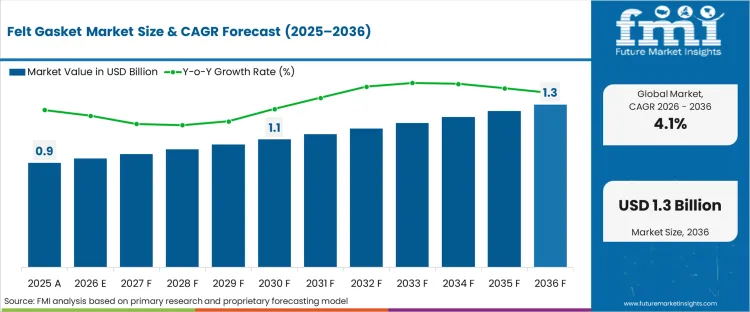
The felt gasket market is estimated at USD 0.94 billion in 2025, reaches USD 0.98 billion in 2026, and is projected to rise to USD 1.47 billion by 2036 at a CAGR of 4.1%. Synthetic felt remains the leading material in 2026 because buyers increasingly prefer dimensional consistency, wear resistance, and better resistance to oils and harsh operating environments. Sealing applications continue to account for the largest revenue share, though vibration damping and acoustic uses are also material demand drivers. The market is supported by machinery maintenance, automotive NVH control, appliance assembly, and the need for compressible sealing materials that can handle irregular surfaces economically.
Summary of Felt Gasket Market
- Key Drivers
- Functional versatility remains the first demand driver. Felt gaskets can seal, cushion, damp vibration, and deliver basic acoustic or thermal insulation in one low-cost material format, which keeps them relevant in assemblies where one component is expected to solve multiple minor engineering problems.
- Industrial maintenance remains the second driver. Many service and replacement applications do not justify premium elastomeric or engineered composite gasket materials, especially where tolerances are forgiving, temperatures are moderate, and replacement is routine.
- The persistence of machinery, automotive, appliance, and light industrial assemblies where compressibility, surface conformity, and damping matter more than high-pressure sealing performance. Felt-based solutions remain commercially viable in these conditions because they are easy to convert, easy to install, and cost-disciplined. Felt is widely used for gaskets, seals, noise reduction, and vibration damping in industrial supply catalogs and converter markets.
- Key Segments Analyzed in the Report
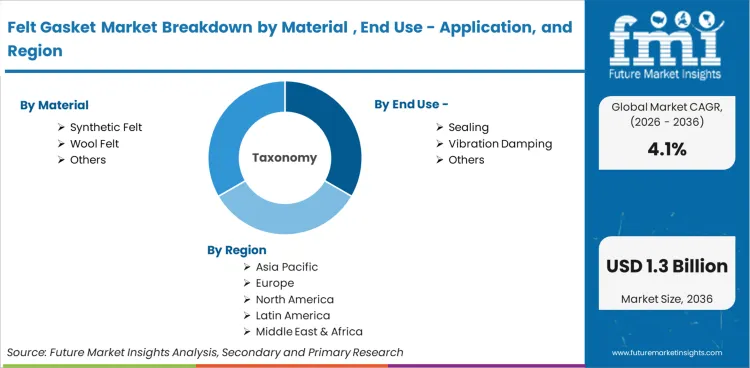
- Material: wool felt, synthetic felt, blended felt
- Application: sealing, vibration damping, thermal and acoustic insulation, others
- End use: industrial machinery, automotive, electronics, furniture and others
- Thickness: below 3 mm, 3 to 6 mm, above 6 mm
- Region: North America, Latin America, Western Europe, Eastern Europe, East Asia, South Asia & Pacific, and Middle East & Africa
- Analyst Opinion
- Nikhil Kaitwade, Principal Consultant at Future Market Insights suggests, “The felt gasket market persists because it solves small but recurring engineering problems at low cost. Felt gaskets are not performance leaders in harsh sealing environments, but they continue to earn their place in assemblies where compressibility, damping, surface compliance, and conversion flexibility matter more than pressure resistance or chemical durability. The market remains relevant because many OEM and maintenance buyers still value fit-for-purpose materials over overengineered alternatives."
Felt Gasket Market Definition
The felt gasket market includes gasket and sealing products manufactured from wool, synthetic, or blended felt materials and used for sealing, cushioning, vibration damping, insulation, and related assembly functions across industrial and consumer applications.
Felt Gasket Market Inclusions
- Revenue from felt gaskets and cut felt sealing formats sold into industrial, automotive, electronics, and furniture uses
- Pre-cut and custom-converted felt sealing products
- Demand linked to replacement, OEM assembly, and maintenance activity
Felt Gasket Market Exclusions
- Rubber, PTFE, graphite, and metallic gaskets outside felt material scope
- Loose felt sheet sold without gasket or sealing application focus
- Adhesive and foam products that are not felt-based gasket solutions
Felt Gasket Market Research Methodology
This study evaluates the market across key segments and regions for the base year 2025 and the forecast period 2026 to 2036. All market values are presented in USD billion. The analysis is built on a review of regulatory references, company disclosures, product and technology developments, trade literature, and industry documentation relevant to the value chain. Market estimates are derived through triangulation of demand-side trends, supply-side positioning, pricing dynamics, application intensity, and regional adoption patterns to establish current market size and forecast potential.
Key Drivers, Restraints, and Trends in Felt Gasket Market
Drivers
Demand is driven by cost-effective sealing, vibration damping, and assembly simplicity in applications where operating conditions remain moderate and installation ease matters. Felt continues to attract demand because it conforms well to uneven surfaces, helps manage noise and vibration, and can be converted into custom shapes without high material cost. Public industrial catalogs and felt converters continue to position felt for gaskets, seals, anti-squeak pads, and sound-deadening functions across machinery, automotive, appliances, and electronics.
Restraints
The main restraint is substitution by higher-performance gasket materials in demanding environments. Where applications involve higher pressure, chemical exposure, elevated temperatures, or stricter sealing reliability, buyers often shift toward elastomers, PTFE, silicone, graphite, or composite materials. Felt also faces pricing pressure in routine maintenance categories, where product differentiation is limited and buyers often treat the item as a low-value consumable. Industrial gasket markets broadly favor specialty materials when performance requirements rise.
Trends
The main trend is the growing use of engineered synthetic felt and more customized pre-cut formats. Suppliers increasingly offer wool, polyester, and blended felt in application-specific densities and thicknesses for damping, cushioning, and anti-noise functions. This reflects a shift away from generic sheet supply toward converted parts tailored for specific OEM or maintenance requirements. Industrial felt suppliers prominently market polyester, wool, and blended formats for vibration damping, sound deadening, and custom die-cut conversion.
Segmental Analysis
Felt Gasket Market Analysis by Material
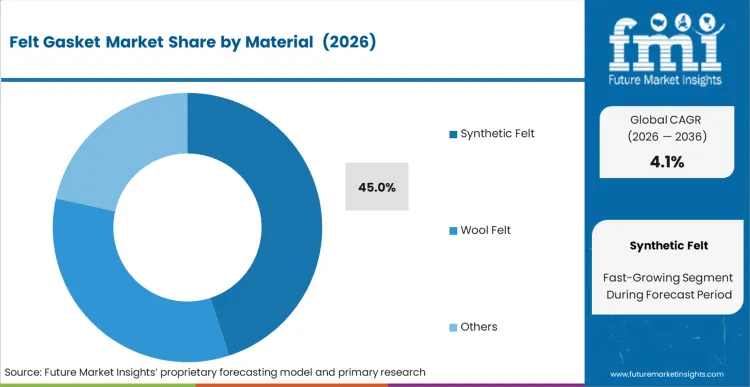
Synthetic felt is expected to remain the leading material segment in 2026 at 45% share because it offers more consistent industrial performance, better moisture resistance, and stronger durability than natural felt in many routine applications. It is also easier to standardize across thickness and density ranges, which makes it attractive for converted industrial parts and repeat-order gasket formats. Supplier catalogs show synthetic and polyester felt widely used in vibration damping, sound reduction, and industrial conversion uses.
Felt Gasket Market Analysis by End Use or Application
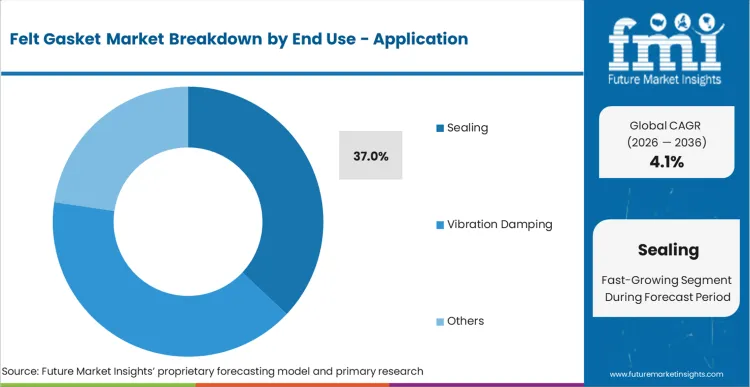
Sealing remains the leading application segment in 2026 at 37% share as it continues to perform well on irregular surfaces and in low-to-moderate duty interfaces where compressibility and surface compliance matter more than extreme sealing strength. The material also retains value in assemblies that need basic dust sealing, light isolation, cushioning, or anti-rattle performance in a single part. Industrial distributors explicitly list felt for gaskets and seals alongside noise and vibration control uses.
Competitive Aligners for Market Players
.webp "Felt Gasket Market Analysis By Company (2)")
Competition is shaped by thickness control, density consistency, conversion accuracy, and the ability to match felt type and construction to specific OEM or maintenance requirements. Buyers in this market typically care less about brand recognition and more about whether the product performs reliably in the intended assembly, arrives in the right dimensions, and can be supplied consistently across repeat orders. This makes manufacturing discipline, conversion capability, and application understanding more important than broad market visibility.
Suppliers tend to win when they can offer clean die-cutting, repeatable tolerances, adhesive backing options, and a material portfolio that covers wool felt, synthetic felt, and blended variants across multiple densities and thicknesses. Competitive strength also improves when vendors can support low-to-medium volume customization, fast turnaround, and application-specific recommendations for sealing, damping, cushioning, insulation, or anti-rattle use cases. In practical terms, the market rewards converters and felt-product suppliers that combine material consistency with flexible fabrication support, because customers often need a part that fits precisely into an existing assembly rather than a standardized off-the-shelf gasket.
Key Players in Felt Gasket Market
- Freudenberg Sealing Technologies
- Saint-Gobain
- Trelleborg AB
- Rogers Corporation
- 3M
- Parker Chomerics
- Lydall
- FilzFelt
- Texon International
- Accurate Felt & Gasket
Strategic Outlook by FMI on Felt Gasket Market
The felt gasket market should maintain steady growth through 2036 as long as industrial maintenance, light sealing, and damping-oriented applications remain large. The strongest value capture will likely come from synthetic felt, tailored thicknesses, and converted parts designed to reduce assembly time.
Scope of the Report
| Metric | Value |
|---|---|
| Market Value | USD 0.94 billion in 2025 to USD 1.47 billion by 2036 |
| CAGR | 4.1% from 2026 to 2036 |
| Base Year | 2025 |
| Forecast Period | 2026 to 2036 |
| Material Segmentation | Wool Felt, Synthetic Felt, Blended Felt |
| Application Segmentation | Sealing, Vibration Damping, Thermal and Acoustic Insulation, Others |
| End Use Segmentation | Industrial Machinery, Automotive, Electronics, Furniture and Others |
| Thickness Segmentation | Below 3 mm, 3 to 6 mm, Above 6 mm |
| Regions Covered | North America, Latin America, Western Europe, Eastern Europe, East Asia, South Asia & Pacific, and Middle East & Africa |
Bibliography
- RAM Gaskets. Current. Felt Gasket Material.
- RAM Gaskets. 2020. Industrial Felt Material Specification Sheet.
- SAE International. AMS3286A. Felt, Firm Pad, White 100% Wool.
- Accurate Felt & Gasket Mfg. Co., Inc. Current. Wool and Synthetic Felt Gasket Materials.
- Hanna Rubber Company. Current. Industrial Wool Felt Supplier & Inventory
Frequently Asked Questions
What is the current size of the felt gasket market?
The felt gasket market is estimated at USD 0.94 billion in 2025.
What is the expected market value of the felt gasket market in 2026?
The market is projected to reach USD 0.98 billion in 2026.
What will be the felt gasket market value by 2036?
The market is forecast to reach USD 1.47 billion by 2036.
What is the projected CAGR of the felt gasket market?
The felt gasket market is projected to grow at a CAGR of 4.1% from 2026 to 2036.
Which material segment leads the felt gasket market in 2026?
Synthetic felt leads the market in 2026 with a 45% share.
Which application segment leads the felt gasket market in 2026?
Sealing remains the leading application segment in 2026 with a 37% share.
Preview the report firsthand - request a free sample
Get SampleGet the brochure for pricing and purchase details.
Get PDFTable of Content
- Executive Summary
- Global Market Outlook
- Demand-side Trends
- Supply-side Trends
- Technology Roadmap Analysis
- Analysis and Recommendations
- Market Overview
- Market Coverage / Taxonomy
- Market Definition / Scope / Limitations
- Research Methodology
- Chapter Orientation
- Analytical Lens and Working Hypotheses
- Market Structure, Signals, and Trend Drivers
- Benchmarking and Cross-market Comparability
- Market Sizing, Forecasting, and Opportunity Mapping
- Research Design and Evidence Framework
- Desk Research Programme (Secondary Evidence)
- Company Annual and Sustainability Reports
- Peer-reviewed Journals and Academic Literature
- Corporate Websites, Product Literature, and Technical Notes
- Earnings Decks and Investor Briefings
- Statutory Filings and Regulatory Disclosures
- Technical White Papers and Standards Notes
- Trade Journals, Industry Magazines, and Analyst Briefs
- Conference Proceedings, Webinars, and Seminar Materials
- Government Statistics Portals and Public Data Releases
- Press Releases and Reputable Media Coverage
- Specialist Newsletters and Curated Briefings
- Sector Databases and Reference Repositories
- FMI Internal Proprietary Databases and Historical Market Datasets
- Subscription Datasets and Paid Sources
- Social Channels, Communities, and Digital Listening Inputs
- Additional Desk Sources
- Expert Input and Fieldwork (Primary Evidence)
- Primary Modes
- Qualitative Interviews and Expert Elicitation
- Quantitative Surveys and Structured Data Capture
- Blended Approach
- Why Primary Evidence is Used
- Field Techniques
- Interviews
- Surveys
- Focus Groups
- Observational and In-context Research
- Social and Community Interactions
- Stakeholder Universe Engaged
- C-suite Leaders
- Board Members
- Presidents and Vice Presidents
- R&D and Innovation Heads
- Technical Specialists
- Domain Subject-matter Experts
- Scientists
- Physicians and Other Healthcare Professionals
- Governance, Ethics, and Data Stewardship
- Research Ethics
- Data Integrity and Handling
- Primary Modes
- Tooling, Models, and Reference Databases
- Desk Research Programme (Secondary Evidence)
- Data Engineering and Model Build
- Data Acquisition and Ingestion
- Cleaning, Normalisation, and Verification
- Synthesis, Triangulation, and Analysis
- Quality Assurance and Audit Trail
- Market Background
- Market Dynamics
- Drivers
- Restraints
- Opportunity
- Trends
- Scenario Forecast
- Demand in Optimistic Scenario
- Demand in Likely Scenario
- Demand in Conservative Scenario
- Opportunity Map Analysis
- Product Life Cycle Analysis
- Supply Chain Analysis
- Investment Feasibility Matrix
- Value Chain Analysis
- PESTLE and Porter’s Analysis
- Regulatory Landscape
- Regional Parent Market Outlook
- Production and Consumption Statistics
- Import and Export Statistics
- Market Dynamics
- Global Market Analysis 2021 to 2025 and Forecast, 2026 to 2036
- Historical Market Size Value (USD Million) Analysis, 2021 to 2025
- Current and Future Market Size Value (USD Million) Projections, 2026 to 2036
- Y-o-Y Growth Trend Analysis
- Absolute $ Opportunity Analysis
- Global Market Pricing Analysis 2021 to 2025 and Forecast 2026 to 2036
- Global Market Analysis 2021 to 2025 and Forecast 2026 to 2036, By Material
- Introduction / Key Findings
- Historical Market Size Value (USD Million) Analysis By Material , 2021 to 2025
- Current and Future Market Size Value (USD Million) Analysis and Forecast By Material , 2026 to 2036
- Synthetic Felt
- Wool Felt
- Others
- Synthetic Felt
- Y-o-Y Growth Trend Analysis By Material , 2021 to 2025
- Absolute $ Opportunity Analysis By Material , 2026 to 2036
- Global Market Analysis 2021 to 2025 and Forecast 2026 to 2036, By End Use - Application
- Introduction / Key Findings
- Historical Market Size Value (USD Million) Analysis By End Use - Application, 2021 to 2025
- Current and Future Market Size Value (USD Million) Analysis and Forecast By End Use - Application, 2026 to 2036
- Sealing
- Vibration Damping
- Others
- Sealing
- Y-o-Y Growth Trend Analysis By End Use - Application, 2021 to 2025
- Absolute $ Opportunity Analysis By End Use - Application, 2026 to 2036
- Global Market Analysis 2021 to 2025 and Forecast 2026 to 2036, By Region
- Introduction
- Historical Market Size Value (USD Million) Analysis By Region, 2021 to 2025
- Current Market Size Value (USD Million) Analysis and Forecast By Region, 2026 to 2036
- North America
- Latin America
- Western Europe
- Eastern Europe
- East Asia
- South Asia and Pacific
- Middle East & Africa
- Market Attractiveness Analysis By Region
- North America Market Analysis 2021 to 2025 and Forecast 2026 to 2036, By Country
- Historical Market Size Value (USD Million) Trend Analysis By Market Taxonomy, 2021 to 2025
- Market Size Value (USD Million) Forecast By Market Taxonomy, 2026 to 2036
- By Country
- USA
- Canada
- Mexico
- By Material
- By End Use - Application
- By Country
- Market Attractiveness Analysis
- By Country
- By Material
- By End Use - Application
- Key Takeaways
- Latin America Market Analysis 2021 to 2025 and Forecast 2026 to 2036, By Country
- Historical Market Size Value (USD Million) Trend Analysis By Market Taxonomy, 2021 to 2025
- Market Size Value (USD Million) Forecast By Market Taxonomy, 2026 to 2036
- By Country
- Brazil
- Chile
- Rest of Latin America
- By Material
- By End Use - Application
- By Country
- Market Attractiveness Analysis
- By Country
- By Material
- By End Use - Application
- Key Takeaways
- Western Europe Market Analysis 2021 to 2025 and Forecast 2026 to 2036, By Country
- Historical Market Size Value (USD Million) Trend Analysis By Market Taxonomy, 2021 to 2025
- Market Size Value (USD Million) Forecast By Market Taxonomy, 2026 to 2036
- By Country
- Germany
- UK
- Italy
- Spain
- France
- Nordic
- BENELUX
- Rest of Western Europe
- By Material
- By End Use - Application
- By Country
- Market Attractiveness Analysis
- By Country
- By Material
- By End Use - Application
- Key Takeaways
- Eastern Europe Market Analysis 2021 to 2025 and Forecast 2026 to 2036, By Country
- Historical Market Size Value (USD Million) Trend Analysis By Market Taxonomy, 2021 to 2025
- Market Size Value (USD Million) Forecast By Market Taxonomy, 2026 to 2036
- By Country
- Russia
- Poland
- Hungary
- Balkan & Baltic
- Rest of Eastern Europe
- By Material
- By End Use - Application
- By Country
- Market Attractiveness Analysis
- By Country
- By Material
- By End Use - Application
- Key Takeaways
- East Asia Market Analysis 2021 to 2025 and Forecast 2026 to 2036, By Country
- Historical Market Size Value (USD Million) Trend Analysis By Market Taxonomy, 2021 to 2025
- Market Size Value (USD Million) Forecast By Market Taxonomy, 2026 to 2036
- By Country
- China
- Japan
- South Korea
- By Material
- By End Use - Application
- By Country
- Market Attractiveness Analysis
- By Country
- By Material
- By End Use - Application
- Key Takeaways
- South Asia and Pacific Market Analysis 2021 to 2025 and Forecast 2026 to 2036, By Country
- Historical Market Size Value (USD Million) Trend Analysis By Market Taxonomy, 2021 to 2025
- Market Size Value (USD Million) Forecast By Market Taxonomy, 2026 to 2036
- By Country
- India
- ASEAN
- Australia & New Zealand
- Rest of South Asia and Pacific
- By Material
- By End Use - Application
- By Country
- Market Attractiveness Analysis
- By Country
- By Material
- By End Use - Application
- Key Takeaways
- Middle East & Africa Market Analysis 2021 to 2025 and Forecast 2026 to 2036, By Country
- Historical Market Size Value (USD Million) Trend Analysis By Market Taxonomy, 2021 to 2025
- Market Size Value (USD Million) Forecast By Market Taxonomy, 2026 to 2036
- By Country
- Kingdom of Saudi Arabia
- Other GCC Countries
- Turkiye
- South Africa
- Other African Union
- Rest of Middle East & Africa
- By Material
- By End Use - Application
- By Country
- Market Attractiveness Analysis
- By Country
- By Material
- By End Use - Application
- Key Takeaways
- Key Countries Market Analysis
- USA
- Pricing Analysis
- Market Share Analysis, 2025
- By Material
- By End Use - Application
- Canada
- Pricing Analysis
- Market Share Analysis, 2025
- By Material
- By End Use - Application
- Mexico
- Pricing Analysis
- Market Share Analysis, 2025
- By Material
- By End Use - Application
- Brazil
- Pricing Analysis
- Market Share Analysis, 2025
- By Material
- By End Use - Application
- Chile
- Pricing Analysis
- Market Share Analysis, 2025
- By Material
- By End Use - Application
- Germany
- Pricing Analysis
- Market Share Analysis, 2025
- By Material
- By End Use - Application
- UK
- Pricing Analysis
- Market Share Analysis, 2025
- By Material
- By End Use - Application
- Italy
- Pricing Analysis
- Market Share Analysis, 2025
- By Material
- By End Use - Application
- Spain
- Pricing Analysis
- Market Share Analysis, 2025
- By Material
- By End Use - Application
- France
- Pricing Analysis
- Market Share Analysis, 2025
- By Material
- By End Use - Application
- India
- Pricing Analysis
- Market Share Analysis, 2025
- By Material
- By End Use - Application
- ASEAN
- Pricing Analysis
- Market Share Analysis, 2025
- By Material
- By End Use - Application
- Australia & New Zealand
- Pricing Analysis
- Market Share Analysis, 2025
- By Material
- By End Use - Application
- China
- Pricing Analysis
- Market Share Analysis, 2025
- By Material
- By End Use - Application
- Japan
- Pricing Analysis
- Market Share Analysis, 2025
- By Material
- By End Use - Application
- South Korea
- Pricing Analysis
- Market Share Analysis, 2025
- By Material
- By End Use - Application
- Russia
- Pricing Analysis
- Market Share Analysis, 2025
- By Material
- By End Use - Application
- Poland
- Pricing Analysis
- Market Share Analysis, 2025
- By Material
- By End Use - Application
- Hungary
- Pricing Analysis
- Market Share Analysis, 2025
- By Material
- By End Use - Application
- Kingdom of Saudi Arabia
- Pricing Analysis
- Market Share Analysis, 2025
- By Material
- By End Use - Application
- Turkiye
- Pricing Analysis
- Market Share Analysis, 2025
- By Material
- By End Use - Application
- South Africa
- Pricing Analysis
- Market Share Analysis, 2025
- By Material
- By End Use - Application
- USA
- Market Structure Analysis
- Competition Dashboard
- Competition Benchmarking
- Market Share Analysis of Top Players
- By Regional
- By Material
- By End Use - Application
- Competition Analysis
- Competition Deep Dive
- Freudenberg Sealing Technologies
- Overview
- Product Portfolio
- Profitability by Market Segments (Product/Age /Sales Channel/Region)
- Sales Footprint
- Strategy Overview
- Marketing Strategy
- Product Strategy
- Channel Strategy
- Saint-Gobain
- Trelleborg AB
- Rogers Corporation
- 3M
- Parker Chomerics
- Freudenberg Sealing Technologies
- Competition Deep Dive
- Assumptions & Acronyms Used


