

- Market Size (2026)
- USD 1.5 Bn
- Forecast (2036)
- USD 5.8 Bn
- CAGR (2026 to 2036)
- 14.5%
How big is the Free-Space Optics (FSO) Communication Market in 2026?
USD 1.5 billion in 2026 and USD 5.8 billion by 2036 at a 14.5% CAGR.
Demand for free-space optics communication is projected to expand at 14.5% CAGR between 2026 and 2036, increasing valuation from USD 1.5 billion in 2026 to USD 5.8 billion by 2036. Telecom operators compare optical transceivers by annual availability and recovery support to judge whether peak throughput can sustain a dependable service level. In March 2026, the UK Space Agency included optical links in its second C-LEO call for high-volume constellation technologies.
Compact terminals must preserve capacity during atmospheric changes and planned maintenance across fixed or mobile routes. In December 2025, NICT reported stable 2 Tbit/s communication across a 7.4-kilometer urban path using small optical terminals. The demonstration places acquisition control and turbulence mitigation inside terminal selection for dependable high-capacity links.
-communication-market-value-analysis.webp "Free Space Optics (fso) Communication Market Value Analysis")
Key Takeaways of Free-Space Optics (FSO) Communication Market
- Telecom and satellite operators need links that enter service without trenching fiber or assigning radio spectrum.
- FSO transceivers are projected to represent 44.0% of product demand in 2026 due to integrated transmit-and-receive functions.
- Telecommunications applications are estimated to account for 38.0% share in 2026 owing to backhaul and building-connectivity requirements.
- Terrestrial free-space optics is forecast to capture 52.0% share in 2026 owing to established fixed-link practices.
- Fog and beam misalignment restrict annual availability unless network designs include path diversity or qualified fallback connectivity.
- Wireless Excellence Limited (CableFree), Cailabs, TESAT, Voyager Technologies, Inc., CACI International Inc., Rocket Lab Corporation, Kepler Communications Inc. and IonQ, Inc. serve terrestrial and space optical roles.
Analyst Perspective
“FSO proposals should be compared by link availability and recovery design instead of peak speed. A terminal becomes useful once its pointing controls and fallback route sustain service during atmospheric losses.”
- Sudip Saha, Principal Consultant, Future Market Insights
How is the Free-Space Optics (FSO) Communication Market segmented?
The free-space optics (FSO) communication industry is segmented by product, application, technology, data rate, end user and region.
The free-space optics (FSO) communication market is segmented by product, application, technology, data rate, end user and region. Product covers FSO transceivers, network equipment, optical components and software or services. Applications include telecommunications, defense and aerospace, enterprise connectivity and disaster recovery. Technology distinguishes terrestrial, airborne and space-based links. Data rates span up to 1 Gbps, 1-10 Gbps and above 10 Gbps. End users include telecom service providers, government and defense agencies, enterprises and data centers.
What supports FSO transceivers within the product category?
-communication-market-analysis-by-product.webp "Free Space Optics (fso) Communication Market Analysis By Product")
FSO transceivers combine laser emission and reception with photonic integrated circuits and network interfaces inside one field terminal. In June 2026, Cailabs reported three French military exercises that maintained 10 Gbps links across several tens of kilometers.
- By product, FSO transceivers are estimated to hold 44.0% in 2026 owing to simpler installation across surveyed point-to-point routes.
- Network operations teams match terminal range and throughput to path loss plus annual availability targets. Remote diagnostics align optical bridges with fallback service during weather interruptions and scheduled maintenance across changing path conditions.
How does telecommunications shape demand within the application category?
Telecommunications teams use FSO across routes that cannot wait for new fiber construction or lack usable radio capacity. The architecture complements wireless backhaul equipment across building links and mobile aggregation without assigning spectrum to the optical path.
- In 2026, telecommunications is expected to lead the application category with 38.0% share owing to fast backhaul restoration across difficult rights-of-way.
- Regional coverage determines whether operators maintain aligned terminals across widely separated climates and service areas. In February 2025, CableFree reported installations in more than 90 countries across its wireless portfolio. Local engineering teams connect optical links with radio fallback and maintenance to limit weather-related downtime.
What drives terrestrial free-space optics within the technology category?
Terrestrial FSO uses surveyed line-of-sight paths between fixed terminals, simplifying obstruction checks and technician access. Airborne and orbital systems require tighter tracking as satellite communication components remain aligned during rapid motion and station handovers.
- The technology category is forecast to be led by terrestrial free-space optics at 52.0% share in 2026 due to established fixed-link service practices.
- Space programs pair optical satellites with several ground stations to reduce cloud exposure across scheduled contact windows. Fixed terrestrial routes allow technician access for realignment and path-clearance checks during planned maintenance.
What role do telecom service providers play within the end-user category?
Telecom service providers integrate FSO within optical networking plans that close short fiber gaps or restore damaged routes quickly. Their network operations centers monitor alignment and dispatch trained technicians across distributed sites during recurring incidents and scheduled maintenance windows.
- The telecom service provider segment is likely to capture 36.0% share in 2026 attributable to recurring service obligations and established network operations.
- Government agencies prioritize secure pointing and mission qualification across controlled networks with documented maintenance procedures. Enterprise data centers compare FSO with high-speed interconnects by installation time and recovery requirements across latency-sensitive campus connections.
What are the drivers, restraints and opportunities in the Free-Space Optics (FSO) Communication Market?
Rapid capacity deployment supports FSO demand despite atmospheric disruption, with hybrid network design expanding viable routes.
- Driver: Telecom and satellite operators need high-throughput links that enter service without trenching fiber or assigning additional radio spectrum.
- Restraint: Fog and structural movement reduce optical power or alignment across exposed terrestrial and ground-to-space paths.
- Opportunity: Automated tracking and independent fallback paths support managed optical networks across routes with uneven weather exposure.
Telecom operators use optical communication networks to add capacity across routes that cannot wait for new fiber construction. RF-over-fiber systems distribute signals to remote antennas, and network plans assign availability targets with support responsibility across each path.
Fog and clouds reduce received optical power across exposed terrestrial and ground-to-space routes. Turbulence adds beam wander and alignment drift. Service-level models must account for weather losses and scheduled realignment against annual availability commitments.
Hybrid network designs retain service during optical fades by using independent radio paths or geographically diverse ground stations. Automated acquisition and remote diagnostics reduce field visits. Integrators package control and recovery support as one managed service.
Which country CAGRs are profiled in the Free-Space Optics (FSO) Communication Market?
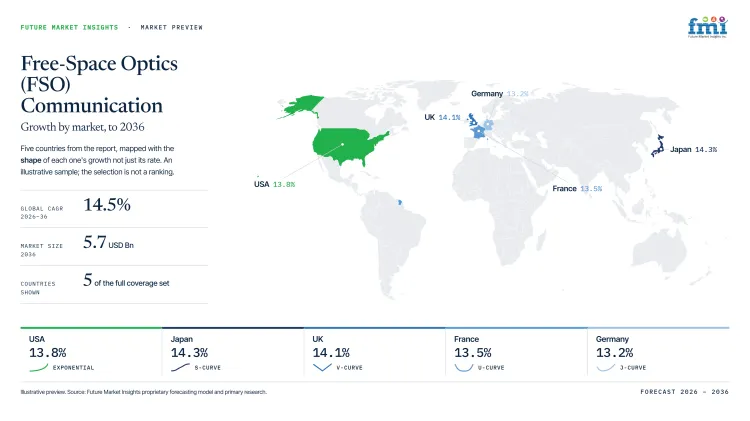
| Country | CAGR |
|---|---|
| Japan | 14.3% |
| United Kingdom | 14.1% |
| United States | 13.8% |
| France | 13.5% |
| Germany | 13.2% |
How do country-level CAGRs compare in the Free-Space Optics (FSO) Communication Market?
The country forecasts are highly concentrated across the free-space optics (FSO) communication market, with just 1.1 percentage points separating Japan and Germany. Japan and the UK form a closely aligned upper group, while the United States, France and Germany follow within a narrow range. The limited spread indicates that interest in high-bandwidth wireless optical communication is expanding across major technology markets at a similar pace. Growth is being supported by rising demand for low-latency connectivity, 5G backhaul solutions, satellite communications and secure data transmission networks.
- Japan benefits from advanced telecommunications infrastructure and strong investment in next-generation optical communication technologies.
- The United Kingdom supports market growth through increasing deployment of high-capacity data networks and smart connectivity projects.
- The United States reflects strong adoption driven by defense, aerospace and high-speed enterprise communication applications.
- France continues to expand through investments in telecommunications modernization and optical networking solutions.
- Germany maintains steady demand supported by industrial digitalization and the need for reliable high-bandwidth communication links.
Comparable CAGRs may still reflect different market conditions because telecommunications infrastructure, spectrum alternatives, defense applications and network investment priorities vary across countries. The full report provides country-level CAGR analysis across North America, Latin America, Europe, East Asia, South Asia, Oceania and the Middle East and Africa.
Country-wise Analysis
- Japan combines JAXA relay infrastructure with satellite manufacturers and precision-optics teams that maintain long-distance tracking across domestic electronics supply chains and specialist service routes serving government and commercial optical relay programs. JAXA reported in January 2025 that LUCAS transmitted 1.8 Gbps across about 40 thousand kilometers, giving terminal engineers operating evidence for acquisition control and continuous tracking across qualified relay missions. Free-space optics communication sales in Japan are forecast to expand at 14.3% CAGR by 2036, reinforced by national relay programs that convert research into terminal orders despite island weather interruptions and strict pointing tolerances across limited domestic contact windows.
- United Kingdom operators combine specialist integrators with national satellite programs and regional engineering partners that install enterprise and government links across distributed service areas with specialist maintenance coverage. The United Kingdom free-space optics communication sector is projected to record 14.1% CAGR during the assessment period, supported by public program funding despite variable weather and limited domestic manufacturing depth for space terminals. The UK Space Agency reported in July 2025 that the first C-LEO call received 52 expressions of interest and advanced three bids to national funding, giving optical inter-satellite suppliers a defined route from program selection to domestic integration orders.
- United States programs combine NASA relay infrastructure with defense purchasing and domestic terminal companies that qualify equipment at established test facilities serving remote sites with restricted maintenance access across nationally distributed regions. NASA reported in April 2026 that the Artemis II laser terminal exchanged 484 gigabytes during its mission, giving integrators operating evidence for ground-station scheduling and weather-aware coordination across distant service locations. The United States free-space optics communication outlook is anticipated to advance at 13.8% CAGR over the assessment period, driven by mature mission programs that convert qualified designs into orders despite national security reviews and specialized field-service requirements.
- France connects CNES optical programs with aerospace integrators and Mediterranean ground infrastructure that test secure satellite communication concepts across nationally coordinated missions serving distributed European public and commercial engineering partners across shared mission networks. Free-space optics communication demand in France is projected to expand at 13.5% CAGR through 2036, supported by coordinated space investment despite cloud exposure and complex multi-partner qualification schedules. CNES reported in February 2026 that France joined Greece and Cyprus on SOLiS for an interoperable link approaching one terabit per second, giving suppliers a program route from geostationary payload integration to distributed ground-station orders across participating countries.
- Germany combines optical ground-station research with domestic terminal production and European space programs supported by regional research centers and specialist service teams across internationally distributed mission infrastructure and institutional project networks serving European programs. DLR reported in February 2025 that a New Zealand station received first light from OSIRIS aboard Flying Laptop, extending German operating experience across remote ground infrastructure and international maintenance routes. Free-space optical communication adoption in Germany is estimated to expand at 13.2% CAGR through 2036, attributable to technical expertise that converts research partnerships into qualified orders despite weather exposure and production-consistency requirements across domestic manufacturing programs.
Who are the notable companies in the Free-Space Optics (FSO) Communication Market?
Wireless Excellence Limited (CableFree), Cailabs, TESAT, Voyager Technologies, Inc., CACI International Inc., Rocket Lab Corporation, Kepler Communications Inc. and IonQ, Inc. are the notable companies serving this market.
-communication-market-analysis-by-company.webp "Free Space Optics (fso) Communication Market Analysis By Company")
The competitive field remains fragmented across terrestrial link integrators and orbital-terminal manufacturers serving different purchasing routes. Entry depends on alignment software, qualified production and field support instead of corporate scale. Fixed-route optical transmitters compete on installation and service cost, but orbital programs prioritize interoperability and repeatable terminal production.
- Wireless Excellence Limited and Cailabs compete with terrestrial systems that combine regional support, atmospheric correction and hybrid radio options.
- TESAT and CACI provide orbital terminals. Rocket Lab and IonQ integrate acquired optical communication businesses into broader space portfolios.
- Voyager Technologies and Kepler Communications compete with relay architectures that connect mobile platforms to orbital or ground infrastructure.
Competitive Benchmarking: Free-Space Optics (FSO) Communication Market
| Company | Terrestrial Deployment Depth | Air and Space Deployment Depth | Network Integration | Geographic Reach |
|---|---|---|---|---|
| Wireless Excellence Limited (CableFree) | High | Low | High | 90+ countries |
| Cailabs | High | High | High | France, United States, South Korea |
| TESAT | Low | High | Medium | Europe, United States, global missions |
| Voyager Technologies, Inc. | Low | Medium | Medium | United States and global networks |
| CACI International Inc. | Low | High | High | United States government programs |
| Rocket Lab Corporation | Low | High | High | United States, Germany, global customers |
| Kepler Communications Inc. | Low | High | High | Canada and global coverage |
| IonQ, Inc. | Low | Medium | High | United States government programs |
Key Developments in the Free-Space Optics (FSO) Communication Market
- In May 2026, CACI advanced to Phase 3 of the United States Space Force Enterprise Space Terminal program. The selection makes terminal interoperability and production readiness decisive capabilities for future government relay contracts.
- In April 2026, Rocket Lab completed its Mynaric acquisition for approximately USD 155.3 million and added laser terminals to its space systems portfolio. The transaction combines spacecraft production with terminal manufacturing and mission support across government and commercial programs.
- In September 2025, Voyager Technologies acquired BridgeComm proprietary technology for defense and commercial optical communication systems. The transaction adds aircraft-to-satellite integration and shortens development for complex mobile communication applications serving defense and commercial customers.
Key Players in the Free-Space Optics (FSO) Communication Market
Integrated Optical Providers
- Wireless Excellence Limited (CableFree)
- Cailabs
- CACI International Inc.
- IonQ, Inc.
Space Terminal Manufacturers
- TESAT
- Rocket Lab Corporation
Optical Relay Networks
- Voyager Technologies, Inc.
- Kepler Communications Inc.
Free-Space Optics (FSO) Communication Market - Report Scope
| Coverage field | Report scope |
|---|---|
| Market breakdown | By product, application, technology, data rate, end user and region. |
| Quantitative Units | Revenue in USD billion and CAGR in %. |
| Market Definition | Free-space optical hardware, equipment, software and services used across terrestrial, airborne and space-based links. |
| Regions Covered | North America, Latin America, Europe, East Asia, South Asia and Pacific, and Middle East and Africa. |
| Countries Covered | Japan, United Kingdom, United States, France, Germany, and 20+ countries included in the full report. |
| Key Companies Profiled | Wireless Excellence Limited (CableFree), Cailabs, TESAT, Voyager Technologies, Inc., CACI International Inc., Rocket Lab Corporation, Kepler Communications Inc. and IonQ, Inc. |
| Forecast Period | 2026 to 2036. |
| Approach | Primary and secondary research with market triangulation. |
Free-Space Optics (FSO) Communication Market - Research Methodology
| Method | Approach |
|---|---|
| Primary Research | FMI analysts gathered input from manufacturers, service providers, technology developers, distributors, end users, procurement teams, and subject-matter experts. Interviews examined purchasing decisions, product or service evaluation, adoption barriers, approval requirements, pricing considerations, and expectations for technical or commercial support. Respondents were also asked what evidence is required before a trial, pilot, or initial order develops into regular purchasing. |
| Desk Research | Desk research covered government statistics, regulatory publications, trade data, industry associations, technical literature, standards, company filings, product information, and official corporate announcements. Sources were reviewed for relevance, publication date, geographic coverage, and consistency with the defined market scope. Claims relating to performance, applications, approvals, capacity, investment, and commercial activity were retained only when supported by credible public evidence. |
| Market Sizing and Forecasting | The market model combined the baseline value with historical performance, segment structure, pricing and volume indicators, adoption levels, company participation, and country-level demand conditions. Forecast assumptions considered economic activity, investment trends, regulatory developments, technology adoption, purchasing cycles, supply availability, and barriers to wider market use. Segment and regional estimates were reconciled before the final market total was calculated. |
| Data Validation | Estimates were checked against multiple independent indicators, including public data, company activity, trade patterns, industry developments, and findings from primary interviews. Validation also tested whether products, services, applications, and company revenues fell within the defined market boundaries. Adjacent categories, unsupported claims, overlapping revenues, and activities without direct market relevance were excluded to reduce double counting and maintain consistency across segments and countries. |
Free-Space Optics (FSO) Communication Market by Segments
Free-Space Optics (FSO) Communication Market segmented by Product:
- FSO Transceivers
- Point-to-Point Transceivers
- Multi-gigabit Transceivers
- Long-range Optical Transceivers
- FSO Network Equipment
- Optical Bridges
- Optical Gateways
- Backhaul Equipment
- Optical Components
- Laser Diodes
- Photodetectors
- Beam Steering Modules
- Software & Services
- Network Management Software
- Installation & Integration Services
- Maintenance & Support Services
Free-Space Optics (FSO) Communication Market segmented by Application:
- Telecommunications
- 5G Backhaul
- Last-mile Connectivity
- Metropolitan Area Networks
- Defense & Aerospace
- Secure Military Communications
- Battlefield Communications
- Satellite Ground Links
- Enterprise Connectivity
- Campus Networks
- Data Center Interconnects
- Building-to-Building Communication
- Disaster Recovery & Temporary Networks
- Emergency Communications
- Remote Site Connectivity
- Event Network Deployment
Free-Space Optics (FSO) Communication Market segmented by Technology:
- Terrestrial Free-space Optics
- Line-of-sight Optical Links
- Building-to-Building Systems
- Campus Connectivity
- Airborne Free-space Optics
- UAV Communications
- Aircraft Communication Links
- High-altitude Platform Systems
- Space-based Optical Communication
- Satellite Laser Communication
- Deep Space Optical Links
- Inter-satellite Optical Links
Free-Space Optics (FSO) Communication Market segmented by Data Rate:
- Up to 1 Gbps
- Enterprise Networks
- Small Business Connectivity
- Surveillance Systems
- 1-10 Gbps
- Mobile Backhaul
- Data Center Connectivity
- Government Networks
- Above 10 Gbps
- Hyperscale Data Centers
- Research Networks
- Defense Applications
Free-Space Optics (FSO) Communication Market segmented by End User:
- Telecom Service Providers
- Mobile Network Operators
- Internet Service Providers
- Fixed Network Operators
- Government & Defense
- Defense Agencies
- Public Safety Organizations
- Space Agencies
- Enterprise & Data Centers
- Cloud Service Providers
- Financial Institutions
- Hyperscale Data Centers
Free-Space Optics (FSO) Communication Market by Region:
- North America
- United States
- Canada
- Latin America
- Brazil
- Mexico
- Chile
- Rest of Latin America
- Western Europe
- Germany
- United Kingdom
- Italy
- Spain
- France
- Nordics
- Benelux
- Rest of Western Europe
- Eastern Europe
- Russia
- Poland
- Hungary
- Balkan and Baltic States
- Rest of Eastern Europe
- East Asia
- China
- Japan
- South Korea
- South Asia and Pacific
- India
- ASEAN
- Australia and New Zealand
- Rest of South Asia and Pacific
- Middle East and Africa
- Kingdom of Saudi Arabia
- Other GCC Countries
- Türkiye
- South Africa
- Other African Union Countries
- Rest of Middle East and Africa
Research Sources and Bibliography
- UK Space Agency. (2026, March 4). UK Space Agency C-LEO Call 2: ARTES Only.
- National Institute of Information and Communications Technology. (2025, December 16). World's First Successful 2 Tbit/s Free-Space Optical Communication Using Small Optical Terminals Mountable on Satellites and HAPS.
- Cailabs. (2026, June 12). TILBA®-LOS: operational optical communication for secure and high-capacity links.
- CableFree. (2025, February 27). Press Release: CableFree at MWC 2025.
- Japan Aerospace Exploration Agency. (2025, January 23). World’s First Successful Transmission of Huge Volume Mission Data Using 1.5 μm Optical Inter-Satellite Communication ~JAXA and NEC's Initiatives in Optical Communication in Space~.
- UK Space Agency. (2025, July 15). UK Space Agency Annual Report 2024-2025.
- National Aeronautics and Space Administration. (2026, April 28). NASA Laser Terminal Enhances Views During Artemis II Mission.
- CNES. (2026, February 26). France, Greece and Cyprus sign cooperation agreement on optical telecommunications.
- German Aerospace Center. (2025, February 24). First Light - New Ground Station for Laser-Based SatCom in New Zealand Goes into Operation.
- CACI International Inc. (2026, May 20). CACI Advances Space Superiority with Next Generation OCT Capabilities.
- Rocket Lab Corporation. (2026, April 14). Rocket Lab Completes Mynaric Acquisition, Adding Laser Optical Communications To Growing Space Systems Portfolio.
- Voyager Technologies, Inc. (2025, September 22). Voyager Enhances Next-Gen Communications With BridgeComm Technologies Acquisition.
- TESAT. (2025, October 27). TESAT GOVERNMENT DELIVERS SCOT80 OPTICAL COMMUNICATION TERMINALS FOR LOCKHEED MARTIN GPS DEMONSTRATION.
- Cailabs. (2026, April 2). CONTEC and Cailabs Deploy CONTEC’s Second Optical Ground Station in South Korea.
- IonQ, Inc. (2026, January 28). IonQ Completes Acquisition of Skyloom, Expanding Quantum Networking and Secure Communications Capabilities.
- Kepler Communications Inc. (2026, March 16). Kepler Deploys First Space-Based, Scalable Cloud Infrastructure Powered by NVIDIA.
This bibliography is provided for reader reference and is not exhaustive. The full report contains the complete reference list and detailed citations.
This Report Answers
- How large is the free-space optics (FSO) communication market in 2026 and 2036?
- Which operating conditions support managed free-space optical links across telecom and satellite networks?
- Why do FSO transceivers account for the largest product share in 2026?
- How do telecommunications applications use FSO across backhaul and last-mile connectivity routes?
- What limits dependable operation across terrestrial and ground-to-space optical paths?
- How do country growth rates differ across Japan, the United Kingdom, the United States, France and Germany?
- Which companies serve terrestrial links and mobile optical communication platforms?
- How do current company capabilities compare across deployment depth and network integration?
- Which recent transactions and program advances have changed the competitive field?
Frequently Asked Questions
How big is the Free-Space Optics (FSO) Communication Market in 2026?
USD 1.5 billion represents the free-space optics (FSO) communication market value in 2026 across terrestrial, airborne and space-based links. The free-space optics (FSO) communication market is projected to reach USD 5.8 billion by 2036 as operators combine optical capacity with tracking controls and dependable recovery routes.
What is the CAGR of the Free-Space Optics (FSO) Communication Market from 2026 to 2036?
A 14.5% CAGR is forecast for the free-space optics (FSO) communication market from 2026 to 2036. The free-space optics (FSO) communication market outlook reflects telecom backhaul and satellite programs that manage atmospheric attenuation with precise alignment and supported fallback connections across demanding service routes.
Which product category is projected to dominate the Free-Space Optics (FSO) Communication Market?
FSO transceivers are projected to account for 44.0% of product demand in the free-space optics (FSO) communication market during 2026. Integrated transmit-and-receive functions reduce field integration work across point-to-point links that require managed interfaces and alignment controls for dependable service.
Which application category is projected to account lead the Free-Space Optics (FSO) Communication Market?
Telecommunications applications are estimated to account for 38.0% of the free-space optics (FSO) communication market during 2026. Operators use optical links for backhaul gaps and building connections that need high capacity without extensive new civil construction or additional radio spectrum.
Which companies are active in the Free-Space Optics (FSO) Communication Market?
Companies representing distinct operating positions within the free-space optics (FSO) communication market across terrestrial and space systems include Wireless Excellence Limited, Cailabs, TESAT, Voyager Technologies, CACI International, Rocket Lab, Kepler Communications and IonQ.
Preview the report firsthand - request a free sample
Get SampleGet the brochure for pricing and purchase details.
Get PDFTable of Content
- Key Takeaways
- Market Size and CAGR
- Top Growth Driver
- Fastest Growing Segment
- Leading Region
- Key Companies
- Emerging Opportunities
- Executive Summary
- Global Market Outlook
- Demand-side Trends
- Supply-side Trends
- Technology Roadmap Analysis
- Analysis and Recommendations
- Analyst Perspective (What is happening? Why now? What should investors know?)
- Key Questions Answered
- How large is the market?
- What is the CAGR?
- What are key trends?
- Which region dominates?
- Who are the leaders?
- Market Overview
- Market Coverage / Taxonomy
- Market Definition / Scope / Limitations
- Research Methodology
- Chapter Orientation
- Analytical Lens and Working Hypotheses
- Market Structure, Signals, and Trend Drivers
- Benchmarking and Cross-market Comparability
- Market Sizing, Forecasting, and Opportunity Mapping
- Research Design and Evidence Framework
- Desk Research Programme (Secondary Evidence)
- Expert Input and Fieldwork (Primary Evidence)
- Tooling, Models, and Reference Databases
- Data Engineering and Model Build
- Quality Assurance and Audit Trail
- Market Background
- Market Dynamics (Drivers, Restraints, Opportunity, Trends)
- Scenario Forecast (Optimistic, Likely, Conservative)
- Impact Analysis
- AI Impact
- Sustainability Impact
- Regulatory Impact
- Technology Impact
- Consumer / Buyer Analysis
- Purchase Drivers
- Adoption Barriers
- Buyer Journey
- Opportunity Map Analysis
- Product Life Cycle Analysis
- Supply Chain Analysis
- Investment Feasibility Matrix
- Value Chain Analysis
- PESTLE and Porter's Analysis
- Regulatory Landscape
- Regional Parent Market Outlook
- Production and Consumption Statistics
- Import and Export Statistics
- Global Market Analysis and Forecast, 2021 to 2036
- Historical Market Size Value (USD Billion) Analysis, 2021 to 2025
- Current and Future Market Size Value (USD Billion) Projections, 2026 to 2036
- Y-o-Y Growth Trend Analysis
- Absolute $ Opportunity Analysis
- Global Market Pricing Analysis, 2021 to 2036
- Global Market Analysis and Forecast, By Product, 2021 to 2036
- Introduction / Key Findings
- Historical Market Size Value (USD Billion) Analysis By Product, 2021 to 2025
- Current and Future Market Size Value (USD Billion) Analysis and Forecast By Product, 2026 to 2036
- FSO Transceivers
- Point-to-Point Transceivers
- Multi-gigabit Transceivers
- Long-range Optical Transceivers
- FSO Network Equipment
- Optical Bridges
- Optical Gateways
- Backhaul Equipment
- Optical Components
- Laser Diodes
- Photodetectors
- Beam Steering Modules
- Software & Services
- Network Management Software
- Installation & Integration Services
- Maintenance & Support Services
- FSO Transceivers
- Y-o-Y Growth Trend Analysis By Product, 2021 to 2025
- Absolute $ Opportunity Analysis By Product, 2026 to 2036
- Global Market Analysis and Forecast, By Application, 2021 to 2036
- Introduction / Key Findings
- Historical Market Size Value (USD Billion) Analysis By Application, 2021 to 2025
- Current and Future Market Size Value (USD Billion) Analysis and Forecast By Application, 2026 to 2036
- Telecommunications
- 5G Backhaul
- Last-mile Connectivity
- Metropolitan Area Networks
- Defense & Aerospace
- Secure Military Communications
- Battlefield Communications
- Satellite Ground Links
- Enterprise Connectivity
- Campus Networks
- Data Center Interconnects
- Building-to-Building Communication
- Disaster Recovery & Temporary Networks
- Emergency Communications
- Remote Site Connectivity
- Event Network Deployment
- Telecommunications
- Y-o-Y Growth Trend Analysis By Application, 2021 to 2025
- Absolute $ Opportunity Analysis By Application, 2026 to 2036
- Global Market Analysis and Forecast, By Technology, 2021 to 2036
- Introduction / Key Findings
- Historical Market Size Value (USD Billion) Analysis By Technology, 2021 to 2025
- Current and Future Market Size Value (USD Billion) Analysis and Forecast By Technology, 2026 to 2036
- Terrestrial Free-space Optics
- Line-of-sight Optical Links
- Building-to-Building Systems
- Campus Connectivity
- Airborne Free-space Optics
- UAV Communications
- Aircraft Communication Links
- High-altitude Platform Systems
- Space-based Optical Communication
- Satellite Laser Communication
- Deep Space Optical Links
- Inter-satellite Optical Links
- Terrestrial Free-space Optics
- Y-o-Y Growth Trend Analysis By Technology, 2021 to 2025
- Absolute $ Opportunity Analysis By Technology, 2026 to 2036
- Global Market Analysis and Forecast, By Data Rate, 2021 to 2036
- Introduction / Key Findings
- Historical Market Size Value (USD Billion) Analysis By Data Rate, 2021 to 2025
- Current and Future Market Size Value (USD Billion) Analysis and Forecast By Data Rate, 2026 to 2036
- Up to 1 Gbps
- Enterprise Networks
- Small Business Connectivity
- Surveillance Systems
- 1-10 Gbps
- Mobile Backhaul
- Data Center Connectivity
- Government Networks
- Above 10 Gbps
- Hyperscale Data Centers
- Research Networks
- Defense Applications
- Up to 1 Gbps
- Y-o-Y Growth Trend Analysis By Data Rate, 2021 to 2025
- Absolute $ Opportunity Analysis By Data Rate, 2026 to 2036
- Global Market Analysis and Forecast, By End User, 2021 to 2036
- Introduction / Key Findings
- Historical Market Size Value (USD Billion) Analysis By End User, 2021 to 2025
- Current and Future Market Size Value (USD Billion) Analysis and Forecast By End User, 2026 to 2036
- Telecom Service Providers
- Mobile Network Operators
- Internet Service Providers
- Fixed Network Operators
- Government & Defense
- Defense Agencies
- Public Safety Organizations
- Space Agencies
- Enterprise & Data Centers
- Cloud Service Providers
- Financial Institutions
- Hyperscale Data Centers
- Telecom Service Providers
- Y-o-Y Growth Trend Analysis By End User, 2021 to 2025
- Absolute $ Opportunity Analysis By End User, 2026 to 2036
- Global Market Analysis and Forecast, By Region, 2021 to 2036
- Introduction
- Historical Market Size Value (USD Billion) Analysis By Region, 2021 to 2025
- Current Market Size Value (USD Billion) Analysis and Forecast By Region, 2026 to 2036
- North America
- Latin America
- Western Europe
- Eastern Europe
- East Asia
- South Asia and Pacific
- Middle East & Africa
- Market Attractiveness Analysis By Region
- North America Market Analysis and Forecast, By Country, 2021 to 2036
- Historical Market Size Value (USD Billion) Trend Analysis By Market Taxonomy, 2021 to 2025
- Market Size Value (USD Billion) Forecast By Market Taxonomy, 2026 to 2036
- By Country
- USA
- Canada
- By Product
- By Application
- By Technology
- By Data Rate
- By End User
- By Country
- Market Attractiveness Analysis
- By Country
- By Product
- By Application
- By Technology
- By Data Rate
- By End User
- Key Takeaways
- Latin America Market Analysis and Forecast, By Country
- Historical Market Size Value (USD Billion) Trend Analysis By Market Taxonomy, 2021 to 2025
- Market Size Value (USD Billion) Forecast By Market Taxonomy, 2026 to 2036
- By Country
- Brazil
- Mexico
- Chile
- Rest of Latin America
- By Product
- By Application
- By Technology
- By Data Rate
- By End User
- By Country
- Market Attractiveness Analysis
- By Country
- By Product
- By Application
- By Technology
- By Data Rate
- By End User
- Key Takeaways
- Western Europe Market Analysis and Forecast, By Country
- Historical Market Size Value (USD Billion) Trend Analysis By Market Taxonomy, 2021 to 2025
- Market Size Value (USD Billion) Forecast By Market Taxonomy, 2026 to 2036
- By Country
- Germany
- UK
- Italy
- Spain
- France
- Nordic
- BENELUX
- Rest of Western Europe
- By Product
- By Application
- By Technology
- By Data Rate
- By End User
- By Country
- Market Attractiveness Analysis
- By Country
- By Product
- By Application
- By Technology
- By Data Rate
- By End User
- Key Takeaways
- Eastern Europe Market Analysis and Forecast, By Country
- Historical Market Size Value (USD Billion) Trend Analysis By Market Taxonomy, 2021 to 2025
- Market Size Value (USD Billion) Forecast By Market Taxonomy, 2026 to 2036
- By Country
- Russia
- Poland
- Hungary
- Balkan & Baltic
- Rest of Eastern Europe
- By Product
- By Application
- By Technology
- By Data Rate
- By End User
- By Country
- Market Attractiveness Analysis
- By Country
- By Product
- By Application
- By Technology
- By Data Rate
- By End User
- Key Takeaways
- East Asia Market Analysis and Forecast, By Country
- Historical Market Size Value (USD Billion) Trend Analysis By Market Taxonomy, 2021 to 2025
- Market Size Value (USD Billion) Forecast By Market Taxonomy, 2026 to 2036
- By Country
- China
- Japan
- South Korea
- By Product
- By Application
- By Technology
- By Data Rate
- By End User
- By Country
- Market Attractiveness Analysis
- By Country
- By Product
- By Application
- By Technology
- By Data Rate
- By End User
- Key Takeaways
- South Asia and Pacific Market Analysis and Forecast, By Country
- Historical Market Size Value (USD Billion) Trend Analysis By Market Taxonomy, 2021 to 2025
- Market Size Value (USD Billion) Forecast By Market Taxonomy, 2026 to 2036
- By Country
- India
- ASEAN
- Australia & New Zealand
- Rest of South Asia and Pacific
- By Product
- By Application
- By Technology
- By Data Rate
- By End User
- By Country
- Market Attractiveness Analysis
- By Country
- By Product
- By Application
- By Technology
- By Data Rate
- By End User
- Key Takeaways
- Middle East & Africa Market Analysis and Forecast, By Country
- Historical Market Size Value (USD Billion) Trend Analysis By Market Taxonomy, 2021 to 2025
- Market Size Value (USD Billion) Forecast By Market Taxonomy, 2026 to 2036
- By Country
- Kingdom of Saudi Arabia
- Other GCC Countries
- Türkiye
- South Africa
- Other African Union
- Rest of Middle East & Africa
- By Product
- By Application
- By Technology
- By Data Rate
- By End User
- By Country
- Market Attractiveness Analysis
- By Country
- By Product
- By Application
- By Technology
- By Data Rate
- By End User
- Key Takeaways
- Key Countries Market Analysis
- USA
- Pricing Analysis
- Market Share Analysis, 2025
- By Product
- By Application
- By Technology
- By Data Rate
- By End User
- Canada
- Pricing Analysis
- Market Share Analysis, 2025
- By Product
- By Application
- By Technology
- By Data Rate
- By End User
- Mexico
- Pricing Analysis
- Market Share Analysis, 2025
- By Product
- By Application
- By Technology
- By Data Rate
- By End User
- Brazil
- Pricing Analysis
- Market Share Analysis, 2025
- By Product
- By Application
- By Technology
- By Data Rate
- By End User
- Chile
- Pricing Analysis
- Market Share Analysis, 2025
- By Product
- By Application
- By Technology
- By Data Rate
- By End User
- Germany
- Pricing Analysis
- Market Share Analysis, 2025
- By Product
- By Application
- By Technology
- By Data Rate
- By End User
- UK
- Pricing Analysis
- Market Share Analysis, 2025
- By Product
- By Application
- By Technology
- By Data Rate
- By End User
- Italy
- Pricing Analysis
- Market Share Analysis, 2025
- By Product
- By Application
- By Technology
- By Data Rate
- By End User
- Spain
- Pricing Analysis
- Market Share Analysis, 2025
- By Product
- By Application
- By Technology
- By Data Rate
- By End User
- France
- Pricing Analysis
- Market Share Analysis, 2025
- By Product
- By Application
- By Technology
- By Data Rate
- By End User
- India
- Pricing Analysis
- Market Share Analysis, 2025
- By Product
- By Application
- By Technology
- By Data Rate
- By End User
- ASEAN
- Pricing Analysis
- Market Share Analysis, 2025
- By Product
- By Application
- By Technology
- By Data Rate
- By End User
- Australia & New Zealand
- Pricing Analysis
- Market Share Analysis, 2025
- By Product
- By Application
- By Technology
- By Data Rate
- By End User
- China
- Pricing Analysis
- Market Share Analysis, 2025
- By Product
- By Application
- By Technology
- By Data Rate
- By End User
- Japan
- Pricing Analysis
- Market Share Analysis, 2025
- By Product
- By Application
- By Technology
- By Data Rate
- By End User
- South Korea
- Pricing Analysis
- Market Share Analysis, 2025
- By Product
- By Application
- By Technology
- By Data Rate
- By End User
- Russia
- Pricing Analysis
- Market Share Analysis, 2025
- By Product
- By Application
- By Technology
- By Data Rate
- By End User
- Poland
- Pricing Analysis
- Market Share Analysis, 2025
- By Product
- By Application
- By Technology
- By Data Rate
- By End User
- Hungary
- Pricing Analysis
- Market Share Analysis, 2025
- By Product
- By Application
- By Technology
- By Data Rate
- By End User
- Kingdom of Saudi Arabia
- Pricing Analysis
- Market Share Analysis, 2025
- By Product
- By Application
- By Technology
- By Data Rate
- By End User
- Türkiye
- Pricing Analysis
- Market Share Analysis, 2025
- By Product
- By Application
- By Technology
- By Data Rate
- By End User
- South Africa
- Pricing Analysis
- Market Share Analysis, 2025
- By Product
- By Application
- By Technology
- By Data Rate
- By End User
- USA
- Market Structure Analysis
- Competition Dashboard
- Competition Benchmarking
- Market Share Analysis of Top Players
- By Regional
- By Product
- By Application
- By Technology
- By Data Rate
- By End User
- Emerging Startups
- Innovation Benchmarking
- Competition Analysis
- Competition Deep Dive
- fSONA Networks Corp.
- Overview
- Product Portfolio
- Profitability by Market Segments
- Sales Footprint
- Strategy Overview
- Marketing Strategy
- Product Strategy
- Channel Strategy
- CableFree
- LightPointe Communications, Inc.
- AOptix Technologies Inc.
- Mostcom Ltd.
- BridgeComm, Inc.
- Wireless Excellence Limited
- Trimble Inc.
- SA Photonics, Inc.
- Mynaric AG
- fSONA Networks Corp.
- Case Studies
- Success Stories
- Recent Developments
- Competition Deep Dive
- Assumptions & Acronyms Used


