

- Market Size (2026)
- USD 2.9 Bn
- Forecast (2036)
- USD 5.2 Bn
- CAGR (2026 to 2036)
- 6.1%
How big is Glandless Circulator Pump Market in 2026?
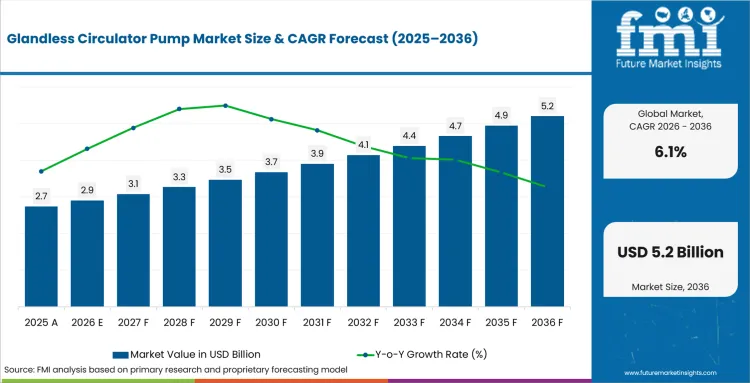
USD 2.9 billion in 2026 and USD 5.2 billion by 2036 at a 6.1% CAGR.
Demand for glandless circulator pumps is projected to expand at 6.1% CAGR between 2026 and 2036, increasing valuation from USD 2.9 billion in 2026 to USD 5.2 billion by 2036. More heat-pump installations expand circulation work across existing buildings and support service demand for electronically controlled pumps.
Current installation volumes provide a direct measure of that operating workload across residential heating systems. MCS and Department for Energy Security and Net Zero deployment data show UK heat-pump installations exceeded 100,000 during 2025, a record year for the technology. Each project requires dependable circulation across residential hydronic systems during changing load conditions and defrost cycles. Service teams therefore compare hydronic pumps against verified flow and available head during every replacement approval.
Key Takeaways of Glandless Circulator Pump Market
- Heat-pump retrofits and efficiency requirements increase demand for electronically controlled circulators across residential and commercial hydronic systems.
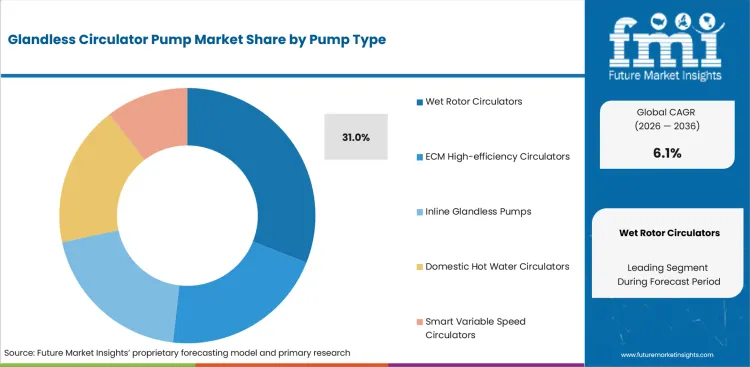
- Wet rotor circulators are projected to represent 31.0% share in 2026 owing to compact construction and quiet operation.
- The 5-20 m³/h range is estimated to account for 39.0% share in 2026 across common building duties.
- Residential heating is forecast to capture 36.0% share in 2026 driven by radiator and floor-heating installations.
- Incorrect sizing and hydraulic imbalance remain material restraints that efficient motors cannot correct during hydronic operation.
- Grundfos, Wilo, Xylem, KSB, DAB Pumps, Taco Comfort Solutions, Armstrong Fluid Technology and Ebara compete through circulator ranges and field support.
Analyst Perspective
"Hydraulic duty should guide glandless circulator selection during replacements that leave little room for system redesign. Manufacturers that simplify model matching without weakening control accuracy should convert more emergency callouts into repeat distributor orders."
- Nikhil Kaitwade, Principal Consultant, Future Market Insights
How is the Glandless Circulator Pump Market segmented?
The glandless circulator pump market is segmented by pump type, flow range, application, control, sales channel, demand type and region.
The market is segmented by pump type, flow range, application, control, sales channel, demand type and region. Pump type includes wet rotor, ECM, inline, domestic hot-water and smart variable-speed designs across several flow bands. Applications cover residential heating, commercial HVAC, district heating, hot-water recirculation and solar or heat-pump systems across varied building duties. Control options include fixed speed, variable speed, differential pressure and building automation and sales routes span distributors, projects, wholesalers and service channels.
Why do wet rotor circulators lead demand within the pump type category?
Wet-rotor construction places the motor rotor inside circulating water and removes the external shaft seal used by dry-rotor designs. The enclosed layout supports quiet operation and compact heating equipment replacements across residential boilers and small commercial circuits.
- The pump type is forecast to be led by wet rotor circulators at 31.0% share in 2026 due to broad fit across domestic hydronic duties.
- Service teams can configure one platform for several legacy duties without carrying many fixed-speed models across local inventories. Nonstandard pipe spacing can require adapters or repiping and extend urgent work inside crowded mechanical rooms.
Why does the 5-20 m³/h segment lead the flow range category?
The 5-20 m³/h band covers homes and light-commercial zones without forcing designers into oversized equipment across routine building duties. Hydronic underfloor heating often uses comparable flows across manifolds serving controlled zones and mixed emitters.
- The 5-20 m³/h segment is likely to capture 39.0% share in 2026 attributable to flexible coverage across common building loads and operating schedules.
- Engineers can standardize selections across several zone counts and preserve enough head for common valves and manifold losses. Available head requires separate verification as nominal flow cannot confirm distribution through restrictive circuits or partly closed control valves.
How does residential heating shape the application category?
Residential heating combines radiator loops and low-temperature floor circuits that need stable circulation across changing winter demand and occupied hours. Air source heat pumps also depend on steady water flow during defrost cycles and low-load operation across common retrofit layouts.
- Based on application, residential heating is projected to account for 36.0% in 2026 due to extensive hydronic infrastructure and recurring retrofit work.
- Compact wet-rotor models help installers serve boiler replacements and heat-pump conversions through familiar connection formats. Older homes often combine emitters with different pressure and temperature needs, so balancing work can extend commissioning.
What supports the variable speed segment within the control category?
Variable-speed controls reduce pump output as valves close or zone demand declines across complete hydronic systems. Building automation systems can extend adjustment through external signals and operating records across larger commercial properties with several controlled zones.
- By control, variable speed is estimated to hold 34.0% in 2026 owing to lower part-load consumption and adaptable pressure control across common systems.
- Facility engineers can tune pressure settings for recurring load patterns and review operating data during scheduled maintenance across mixed terminal units. Poor setpoints can preserve noise or excess electricity use despite efficient motors, which makes commissioning records important during later service.
What are the drivers, restraints and opportunities in the Glandless Circulator Pump Market?
Heat electrification supports controllable circulation as poor hydraulic design weakens performance and digital replacement tools shorten field selection.
- Driver: Heat electrification increases water-based systems that require dependable circulation across changing thermal loads and occupied schedules.
- Restraint: Incorrect duty-point selection produces noise and weak heat delivery despite efficient motors and advanced control settings.
- Opportunity: Digital replacement guides reduce model-selection errors and support consistent commissioning across distributed service organizations.
Heating electrification expands water-based equipment that needs dependable flow across district heating networks and individual buildings. Variable-speed circulators protect thermal delivery and reduce unnecessary pumping energy during common partial-load operating cycles.
Oversized pumps and unbalanced circuits produce noise or weak heat delivery despite efficient motors and electronic controls. Operating data cannot correct hydraulic designs that lack verified flow calculations and available-head checks across complex circuits.
Digital replacement guides connect legacy model numbers with verified duty points during unfamiliar service calls. Smart building controls provide commissioning records that regional service teams reuse across comparable properties and recurring maintenance visits.
Which country CAGRs are profiled in the Glandless Circulator Pump Market?
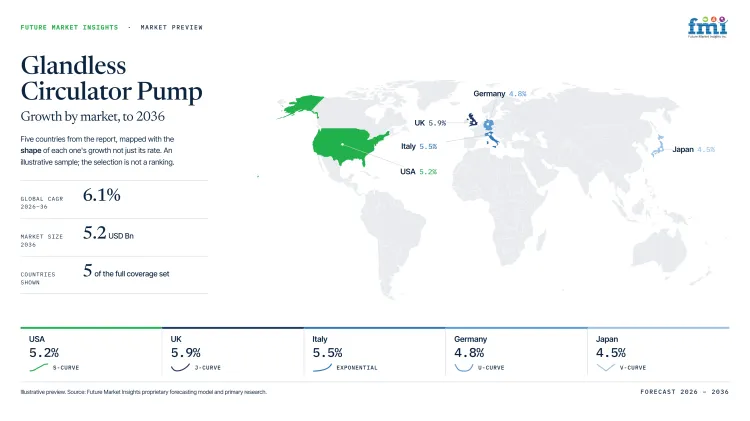
| Country | CAGR |
|---|---|
| United Kingdom | 5.9% |
| Italy | 5.5% |
| United States | 5.2% |
| Germany | 4.8% |
| Japan | 4.5% |
How do country-level CAGRs compare in the Glandless Circulator Pump Market?
The country range spans 1.4 percentage points across five established hydronic heating markets with mature installed bases. Retrofit programs and service capacity alter conversion speed without proving current revenue leadership among countries.
- The United Kingdom occupies the upper band as retrofit activity depends on trained installers and dependable replacement availability.
- Italy remains close to that band through renovation incentives and extensive hydronic systems across existing residential buildings.
- The United States sits in the middle as federal efficiency requirements meet fragmented local installation practices.
- Germany follows within the cluster as heat-pump construction expands alongside replacement work across older building stocks.
- Japan closes the displayed range through strict building-efficiency requirements and detailed commissioning practices for compact hydronic systems.
Comparable CAGRs can produce different market entry conditions due to service coverage and system design. Full report coverage includes North America, Latin America, Europe, East Asia, South Asia and Pacific, Middle East and Africa.
Country-wise Analysis
- United Kingdom heating contractors commission low-temperature retrofits through established merchant networks that stock common residential circulators and replacement fittings. Adoption of glandless circulator pumps in the United Kingdom is estimated to expand at 5.9% CAGR through 2036, supported by recurring retrofit work and established distribution. A June 2026 review found that 47% of surveyed graduates would have skipped heat-pump training without grant support, showing that regional capability remains uneven. Manufacturers need local stock, practical balancing guidance for older pipework and mixed-emitter systems, and installer support during peak winter replacement periods across urban housing and rural service territories.
- Italy combines an extensive boiler base with fiscal incentives for energy upgrades across homes and small commercial buildings served through regional wholesalers. Italy is estimated to post 5.5% CAGR over the forecast period, shaped by established hydronic trades and continuing renovation activity. ENEA reported in July 2026 that its annual review covered Ecobonus and Bonus Casa work completed during 2025, although changing eligibility rules can delay household decisions and contractor scheduling. Manufacturers therefore need compatibility data and concise setup guidance for diverse regional building configurations, seasonal budgeting cycles, and municipal financing approval processes.
- United States contractors prepare circulator selections around regional codes and high-efficiency equipment requirements for boiler and hydronic cooling service work. In the United States, glandless circulator pump demand is predicted to advance at 5.2% CAGR through 2036, reinforced by broad distribution and clearer performance requirements. Taco reported in May 2026 that its Eastern Energy Expo training covered circulator troubleshooting and replacement setup, confirming the availability of technical support. Fragmented local practices still require certified performance data and dependable cross-references for urgent winter repairs across varied boiler circuits and cooling pump systems in multiple jurisdictions and rural areas.
- Germany combines an established hydronic trade with expanding heat-pump use across new residential construction and low-temperature distribution systems. Germany's glandless circulator pump outlook is anticipated to advance at 4.8% CAGR over the assessment period, driven by new-building demand and established engineering channels. Destatis reported in June 2026 that heat pumps served 73.6% of roughly 58,900 residential buildings completed during 2025. Older properties, however, often retain unbalanced circuits and varied pipework, so suppliers need stocked adapters, application engineering, and practical commissioning support for complex replacements across urban apartment buildings, regional villages, and long-planned renovation programs.
- Japan applies mandatory energy-efficiency standards to new homes and buildings through detailed construction approvals and equipment documentation. Glandless circulator pump sales in Japan are forecast to expand at 4.5% CAGR by 2036, influenced by efficient new-building requirements and disciplined commissioning practices. The Ministry of Land, Infrastructure, Transport and Tourism confirmed nationwide application from April 2025. Imported replacement platforms therefore need Japanese-language instructions, circuit-specific records, trained distributors and clear setup guidance for remote service territories, scheduled seasonal maintenance, and planned replacements across smaller regional markets.
Who are the notable companies in the Glandless Circulator Pump Market?
Grundfos, Wilo, Xylem, KSB, DAB Pumps, Taco Comfort Solutions, Armstrong Fluid Technology and Ebara are profiled in this market.
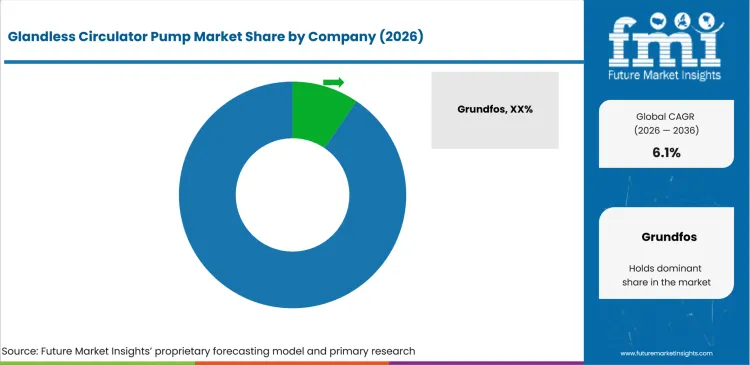
Global pump groups compete beside regional hydronic specialists across replacement and project channels, leaving the field moderately fragmented. New entrants need verified wet-rotor performance plus stocked connection options and technical support that reaches installers during urgent service work.
- Grundfos and Wilo combine broad circulator ranges with digital selection tools and multi-region service coverage for replacement work.
- Xylem and KSB join DAB Pumps and Armstrong Fluid Technology across controlled building-service portfolios for varied heating duties.
- Taco Comfort Solutions and Ebara compete through regional hydronic channels and practical support for boilers and cooling systems.
Competitive Benchmarking: Glandless Circulator Pump Market
| Company | Wet-Rotor Range | Variable-Speed Control | Replacement Support | Geographic Reach |
|---|---|---|---|---|
| Grundfos | High | High | High | Global |
| Wilo | High | High | High | Global |
| Xylem | High | High | Medium | Global |
| KSB | High | High | Medium | Global |
| DAB Pumps | Medium | High | High | Europe and selected exports |
| Taco Comfort Solutions | Medium | High | High | North America |
| Armstrong Fluid Technology | Medium | High | High | Global |
| Ebara | Medium | Medium | Medium | Global |
Scoring basis: Wet-rotor range is High for several families and Medium for two as Low covers one family. Variable-speed control is High for several modes and Medium for modulation as Low covers basic adjustment. Replacement support is High for mapping tools and Medium for cross-references as Low covers dimensional guidance.
Key Developments in the Glandless Circulator Pump Market
- In April 2026, Taco joined Hydrofest 2026 to provide hands-on instruction covering hydronic system design and field performance across regional installer sessions.
- In June 2025, Grundfos launched ALPHA GO with two models covering most standalone replacements and nearly 70% of integrated circulator replacements.
- In March 2025, Wilo introduced Atmos PICO plus for one-family and two-family homes with variable-pressure control and a simplified green-button user interface.
- In March 2025, KSB presented Calio Pro Plus with continuously variable speed and standard Modbus connectivity for building-service applications.
Glandless Circulator Pump Market - Report Scope
| Coverage field | Report scope |
|---|---|
| Market breakdown | By pump type, flow range, application, control, sales channel, demand type and region. |
| Quantitative Units | Revenue in USD billion and CAGR in %. |
| Market Definition | The market covers glandless circulator pumps sold for closed-loop heating, cooling and domestic hot-water circulation applications. |
| Regions Covered | North America, Latin America, Europe, East Asia, South Asia and Pacific, and Middle East and Africa. |
| Countries Covered | United Kingdom, Italy, United States, Germany, Japan, and 20+ countries included in the full report. |
| Key Companies Profiled | Grundfos, Wilo, Xylem, KSB, DAB Pumps, Taco Comfort Solutions, Armstrong Fluid Technology and Ebara. |
| Forecast Period | 2026 to 2036. |
| Approach | Primary and secondary research with market triangulation. |
Glandless Circulator Pump Market - Research Methodology
| Method | Approach |
|---|---|
| Primary Research | FMI analysts gathered input from manufacturers, service providers, technology developers, distributors, end users, procurement teams, and subject-matter experts. Interviews examined purchasing decisions, product or service evaluation, adoption barriers, approval requirements, pricing considerations, and expectations for technical or commercial support. Respondents were also asked what evidence is required before a trial, pilot, or initial order develops into regular purchasing. |
| Desk Research | Desk research covered government statistics, regulatory publications, trade data, industry associations, technical literature, standards, company filings, product information, and official corporate announcements. Sources were reviewed for relevance, publication date, geographic coverage, and consistency with the defined market scope. Claims relating to performance, applications, approvals, capacity, investment, and commercial activity were retained only when supported by credible public evidence. |
| Market Sizing and Forecasting | The market model combined the baseline value with historical performance, segment structure, pricing and volume indicators, adoption levels, company participation, and country-level demand conditions. Forecast assumptions considered economic activity, investment trends, regulatory developments, technology adoption, purchasing cycles, supply availability, and barriers to wider market use. Segment and regional estimates were reconciled before the final market total was calculated. |
| Data Validation | Estimates were checked against multiple independent indicators, including public data, company activity, trade patterns, industry developments, and findings from primary interviews. Validation also tested whether products, services, applications, and company revenues fell within the defined market boundaries. Adjacent categories, unsupported claims, overlapping revenues, and activities without direct market relevance were excluded to reduce double counting and maintain consistency across segments and countries. |
Glandless Circulator Pump Market by Segments
Glandless Circulator Pump Market segmented by Pump Type:
- Wet Rotor Circulators
- ECM High-efficiency Circulators
- Inline Glandless Pumps
- Domestic Hot Water Circulators
- Smart Variable Speed Circulators
Glandless Circulator Pump Market segmented by Flow Range:
- <5 m³/h
- 5-20 m³/h
- 20-50 m³/h
- >50 m³/h
Glandless Circulator Pump Market segmented by Application:
- Residential Heating
- Commercial HVAC
- District Heating
- Domestic Hot Water Recirculation
- Solar Thermal / Heat Pump Systems
Glandless Circulator Pump Market segmented by Control:
- Variable Speed
- Fixed Speed
- Differential Pressure Control
- IoT / Building Automation Enabled
Glandless Circulator Pump Market segmented by Sales Channel:
- HVAC Distributors
- Direct OEM / Project Supply
- Plumbing Wholesalers
- Replacement / Service Channel
Glandless Circulator Pump Market segmented by Demand Type:
- Replacement / Retrofit
- New Installation
Glandless Circulator Pump Market by Region:
- North America
- United States
- Canada
- Latin America
- Brazil
- Chile
- Mexico
- Rest of Latin America
- Western Europe
- Germany
- United Kingdom
- Italy
- Spain
- France
- Nordics
- Benelux
- Rest of Western Europe
- Eastern Europe
- Russia
- Poland
- Hungary
- Balkan and Baltic States
- Rest of Eastern Europe
- East Asia
- China
- Japan
- South Korea
- South Asia and Pacific
- India
- ASEAN
- Australia and New Zealand
- Rest of South Asia and Pacific
- Middle East and Africa
- Kingdom of Saudi Arabia
- Other GCC Countries
- Türkiye
- South Africa
- Other African Union Countries
- Rest of Middle East and Africa
Research Sources and Bibliography
- Department for Energy Security and Net Zero. (2026, June 4). Research reveals strong satisfaction among heat pump trainees.
- Department for Energy Security and Net Zero. (2026, June 4). Commentary for the Heat Training Grant 2025 Mid-scheme Review: Survey of HTG Graduates.
- ENEA. (2026, July 9). Rapporto Annuale sulle Detrazioni Fiscali 2026.
- Taco Comfort Solutions. (2026, May 27). Taco Connects with Industry Professionals and Supports Technical Education at Eastern Energy Expo.
- Statistisches Bundesamt. (2026, June 10). Rund drei Viertel der im Jahr 2025 errichteten Wohngebäude heizen mit Wärmepumpen.
- Ministry of Land, Infrastructure, Transport and Tourism. (2024, April 16). 令和7年4月1日から省エネ基準適合の全面義務化や構造関係規定の見直しなどが施行されます!!
- Taco Comfort Solutions. (2026, April 8). Four Industry Leaders to Host Joint Mechanical Training for Installers.
- Grundfos. (2026, February 6). Grundfos ALPHA GO wins prestigious design award.
- WILO Pumpen Österreich GmbH. (2025, March 17). Premiere auf der ISH: Wilo-Atmos PICO plus rundet Angebot an Heizungspumpen ab.
- KSB SE & Co. KGaA. (2025, March). High-efficiency circulator for building services applications.
This bibliography is provided for reader reference and is not exhaustive. The full report contains the complete reference list and detailed citations
This Report Answers
- How large is the glandless circulator pump market in 2026 and 2036?
- Why do wet rotor circulators hold the largest pump-type share in 2026?
- How does the 5-20 m³/h range influence circulator selection across buildings?
- Which heating applications create the strongest demand for glandless circulator pumps?
- How do country growth rates differ across the ten-year forecast period?
- Which companies provide verified glandless circulator pump capabilities and support?
- Which hydraulic problems limit efficient glandless circulator pump performance?
- How should installers compare replacement circulators during urgent service work?
Frequently Asked Questions
How big is the Glandless Circulator Pump Market in 2026?
The glandless circulator pump market is valued at USD 2.9 billion in 2026 and is forecast to reach USD 5.2 billion by 2036. Growth is supported by rising heat-pump installations that sustain recurring demand for electronically controlled circulators across residential and commercial hydronic replacement channels.
What is the CAGR of the Glandless Circulator Pump Market from 2026 to 2036?
The glandless circulator pump market grows at a CAGR of 6.1% between 2026 and 2036, supported by heat electrification and service teams comparing hydronic pumps against verified flow and available head during every replacement approval across residential and commercial systems.
Which pump type leads the Glandless Circulator Pump Market?
Wet rotor circulators account for 31.0% of the glandless circulator pump market by pump type in 2026, driven by compact construction and quiet operation that support broad fit across domestic hydronic duties and legacy boiler replacements without carrying many fixed-speed models.
How much will the Glandless Circulator Pump Market add between 2026 and 2036?
The glandless circulator pump market is set to add USD 2.3 billion between 2026 and 2036, growing from USD 2.9 billion to USD 5.2 billion as electronically controlled circulators extend across a widening base of heat-pump retrofits and new hydronic installations worldwide.
Who are the leading companies in the Glandless Circulator Pump Market?
Eight companies lead the glandless circulator pump market consistently, including Grundfos, Wilo, Xylem, KSB, DAB Pumps, Taco Comfort Solutions, Armstrong Fluid Technology and Ebara, competing through wet-rotor range breadth, variable-speed control and replacement support across residential and commercial hydronic systems.
Preview the report firsthand - request a free sample
Get SampleGet the brochure for pricing and purchase details.
Get PDFTable of Content
- Key Takeaways
- Market Size and CAGR
- Top Growth Driver
- Fastest Growing Segment
- Leading Region
- Key Companies
- Emerging Opportunities
- Executive Summary
- Global Market Outlook
- Demand-side Trends
- Supply-side Trends
- Technology Roadmap Analysis
- Analysis and Recommendations
- Analyst Perspective (What is happening? Why now? What should investors know?)
- Key Questions Answered
- How large is the market?
- What is the CAGR?
- What are key trends?
- Which region dominates?
- Who are the leaders?
- Market Overview
- Market Coverage / Taxonomy
- Market Definition / Scope / Limitations
- Research Methodology
- Chapter Orientation
- Analytical Lens and Working Hypotheses
- Market Structure, Signals, and Trend Drivers
- Benchmarking and Cross-market Comparability
- Market Sizing, Forecasting, and Opportunity Mapping
- Research Design and Evidence Framework
- Desk Research Programme (Secondary Evidence)
- Expert Input and Fieldwork (Primary Evidence)
- Tooling, Models, and Reference Databases
- Data Engineering and Model Build
- Quality Assurance and Audit Trail
- Market Background
- Market Dynamics (Drivers, Restraints, Opportunity, Trends)
- Scenario Forecast (Optimistic, Likely, Conservative)
- Impact Analysis
- AI Impact
- Sustainability Impact
- Regulatory Impact
- Technology Impact
- Consumer / Buyer Analysis
- Purchase Drivers
- Adoption Barriers
- Buyer Journey
- Opportunity Map Analysis
- Product Life Cycle Analysis
- Supply Chain Analysis
- Investment Feasibility Matrix
- Value Chain Analysis
- PESTLE and Porter's Analysis
- Regulatory Landscape
- Regional Parent Market Outlook
- Production and Consumption Statistics
- Import and Export Statistics
- Global Market Analysis and Forecast, 2021 to 2036
- Historical Market Size Value (USD Billion) Analysis, 2021 to 2025
- Current and Future Market Size Value (USD Billion) Projections, 2026 to 2036
- Y-o-Y Growth Trend Analysis
- Absolute $ Opportunity Analysis
- Global Market Pricing Analysis, 2021 to 2036
- Global Market Analysis and Forecast, By Pump Type, 2021 to 2036
- Introduction / Key Findings
- Historical Market Size Value (USD Billion) Analysis By Pump Type, 2021 to 2025
- Current and Future Market Size Value (USD Billion) Analysis and Forecast By Pump Type, 2026 to 2036
- Wet Rotor Circulators
- ECM High-efficiency Circulators
- Inline Glandless Pumps
- Domestic Hot Water Circulators
- Smart Variable Speed Circulators
- Wet Rotor Circulators
- Y-o-Y Growth Trend Analysis By Pump Type, 2021 to 2025
- Absolute $ Opportunity Analysis By Pump Type, 2026 to 2036
- Global Market Analysis and Forecast, By Flow Range, 2021 to 2036
- Introduction / Key Findings
- Historical Market Size Value (USD Billion) Analysis By Flow Range, 2021 to 2025
- Current and Future Market Size Value (USD Billion) Analysis and Forecast By Flow Range, 2026 to 2036
- 5-20 m³/h
- <5 m³/h
- 20-50 m³/h
- >50 m³/h
- 5-20 m³/h
- Y-o-Y Growth Trend Analysis By Flow Range, 2021 to 2025
- Absolute $ Opportunity Analysis By Flow Range, 2026 to 2036
- Global Market Analysis and Forecast, By Application, 2021 to 2036
- Introduction / Key Findings
- Historical Market Size Value (USD Billion) Analysis By Application, 2021 to 2025
- Current and Future Market Size Value (USD Billion) Analysis and Forecast By Application, 2026 to 2036
- Residential Heating
- Commercial HVAC
- District Heating
- Domestic Hot Water Recirculation
- Solar Thermal / Heat Pump Systems
- Residential Heating
- Y-o-Y Growth Trend Analysis By Application, 2021 to 2025
- Absolute $ Opportunity Analysis By Application, 2026 to 2036
- Global Market Analysis and Forecast, By Control, 2021 to 2036
- Introduction / Key Findings
- Historical Market Size Value (USD Billion) Analysis By Control, 2021 to 2025
- Current and Future Market Size Value (USD Billion) Analysis and Forecast By Control, 2026 to 2036
- Variable Speed
- Fixed Speed
- Differential Pressure Control
- IoT / Building Automation Enabled
- Variable Speed
- Y-o-Y Growth Trend Analysis By Control, 2021 to 2025
- Absolute $ Opportunity Analysis By Control, 2026 to 2036
- Global Market Analysis and Forecast, By Sales Channel, 2021 to 2036
- Introduction / Key Findings
- Historical Market Size Value (USD Billion) Analysis By Sales Channel, 2021 to 2025
- Current and Future Market Size Value (USD Billion) Analysis and Forecast By Sales Channel, 2026 to 2036
- HVAC Distributors
- Direct OEM / Project Supply
- Plumbing Wholesalers
- Replacement / Service Channel
- HVAC Distributors
- Y-o-Y Growth Trend Analysis By Sales Channel, 2021 to 2025
- Absolute $ Opportunity Analysis By Sales Channel, 2026 to 2036
- Global Market Analysis and Forecast, By Demand Type
- Introduction / Key Findings
- Historical Market Size Value (USD Billion) Analysis By Demand Type, 2021 to 2025
- Current and Future Market Size Value (USD Billion) Analysis and Forecast By Demand Type, 2026 to 2036
- Replacement / Retrofit
- New Installation
- Replacement / Retrofit
- Y-o-Y Growth Trend Analysis By Demand Type, 2021 to 2025
- Absolute $ Opportunity Analysis By Demand Type, 2026 to 2036
- Global Market Analysis and Forecast, By Region, 2021 to 2036
- Introduction
- Historical Market Size Value (USD Billion) Analysis By Region, 2021 to 2025
- Current Market Size Value (USD Billion) Analysis and Forecast By Region, 2026 to 2036
- North America
- Latin America
- Western Europe
- Eastern Europe
- East Asia
- South Asia and Pacific
- Middle East & Africa
- Market Attractiveness Analysis By Region
- North America Market Analysis and Forecast, By Country, 2021 to 2036
- Historical Market Size Value (USD Billion) Trend Analysis By Market Taxonomy, 2021 to 2025
- Market Size Value (USD Billion) Forecast By Market Taxonomy, 2026 to 2036
- By Country
- USA
- Canada
- By Pump Type
- By Flow Range
- By Application
- By Control
- By Sales Channel
- By Demand Type
- By Country
- Market Attractiveness Analysis
- By Country
- By Pump Type
- By Flow Range
- By Application
- By Control
- By Sales Channel
- By Demand Type
- Key Takeaways
- Latin America Market Analysis and Forecast, By Country
- Historical Market Size Value (USD Billion) Trend Analysis By Market Taxonomy, 2021 to 2025
- Market Size Value (USD Billion) Forecast By Market Taxonomy, 2026 to 2036
- By Country
- Brazil
- Mexico
- Chile
- Rest of Latin America
- By Pump Type
- By Flow Range
- By Application
- By Control
- By Sales Channel
- By Demand Type
- By Country
- Market Attractiveness Analysis
- By Country
- By Pump Type
- By Flow Range
- By Application
- By Control
- By Sales Channel
- By Demand Type
- Key Takeaways
- Western Europe Market Analysis and Forecast, By Country
- Historical Market Size Value (USD Billion) Trend Analysis By Market Taxonomy, 2021 to 2025
- Market Size Value (USD Billion) Forecast By Market Taxonomy, 2026 to 2036
- By Country
- Germany
- UK
- Italy
- Spain
- France
- Nordic
- BENELUX
- Rest of Western Europe
- By Pump Type
- By Flow Range
- By Application
- By Control
- By Sales Channel
- By Demand Type
- By Country
- Market Attractiveness Analysis
- By Country
- By Pump Type
- By Flow Range
- By Application
- By Control
- By Sales Channel
- By Demand Type
- Key Takeaways
- Eastern Europe Market Analysis and Forecast, By Country
- Historical Market Size Value (USD Billion) Trend Analysis By Market Taxonomy, 2021 to 2025
- Market Size Value (USD Billion) Forecast By Market Taxonomy, 2026 to 2036
- By Country
- Russia
- Poland
- Hungary
- Balkan & Baltic
- Rest of Eastern Europe
- By Pump Type
- By Flow Range
- By Application
- By Control
- By Sales Channel
- By Demand Type
- By Country
- Market Attractiveness Analysis
- By Country
- By Pump Type
- By Flow Range
- By Application
- By Control
- By Sales Channel
- By Demand Type
- Key Takeaways
- East Asia Market Analysis and Forecast, By Country
- Historical Market Size Value (USD Billion) Trend Analysis By Market Taxonomy, 2021 to 2025
- Market Size Value (USD Billion) Forecast By Market Taxonomy, 2026 to 2036
- By Country
- China
- Japan
- South Korea
- By Pump Type
- By Flow Range
- By Application
- By Control
- By Sales Channel
- By Demand Type
- By Country
- Market Attractiveness Analysis
- By Country
- By Pump Type
- By Flow Range
- By Application
- By Control
- By Sales Channel
- By Demand Type
- Key Takeaways
- South Asia and Pacific Market Analysis and Forecast, By Country
- Historical Market Size Value (USD Billion) Trend Analysis By Market Taxonomy, 2021 to 2025
- Market Size Value (USD Billion) Forecast By Market Taxonomy, 2026 to 2036
- By Country
- India
- ASEAN
- Australia & New Zealand
- Rest of South Asia and Pacific
- By Pump Type
- By Flow Range
- By Application
- By Control
- By Sales Channel
- By Demand Type
- By Country
- Market Attractiveness Analysis
- By Country
- By Pump Type
- By Flow Range
- By Application
- By Control
- By Sales Channel
- By Demand Type
- Key Takeaways
- Middle East & Africa Market Analysis and Forecast, By Country
- Historical Market Size Value (USD Billion) Trend Analysis By Market Taxonomy, 2021 to 2025
- Market Size Value (USD Billion) Forecast By Market Taxonomy, 2026 to 2036
- By Country
- Kingdom of Saudi Arabia
- Other GCC Countries
- Türkiye
- South Africa
- Other African Union
- Rest of Middle East & Africa
- By Pump Type
- By Flow Range
- By Application
- By Control
- By Sales Channel
- By Demand Type
- By Country
- Market Attractiveness Analysis
- By Country
- By Pump Type
- By Flow Range
- By Application
- By Control
- By Sales Channel
- By Demand Type
- Key Takeaways
- Key Countries Market Analysis
- USA
- Pricing Analysis
- Market Share Analysis, 2025
- By Pump Type
- By Flow Range
- By Application
- By Control
- By Sales Channel
- By Demand Type
- Canada
- Pricing Analysis
- Market Share Analysis, 2025
- By Pump Type
- By Flow Range
- By Application
- By Control
- By Sales Channel
- By Demand Type
- Mexico
- Pricing Analysis
- Market Share Analysis, 2025
- By Pump Type
- By Flow Range
- By Application
- By Control
- By Sales Channel
- By Demand Type
- Brazil
- Pricing Analysis
- Market Share Analysis, 2025
- By Pump Type
- By Flow Range
- By Application
- By Control
- By Sales Channel
- By Demand Type
- Chile
- Pricing Analysis
- Market Share Analysis, 2025
- By Pump Type
- By Flow Range
- By Application
- By Control
- By Sales Channel
- By Demand Type
- Germany
- Pricing Analysis
- Market Share Analysis, 2025
- By Pump Type
- By Flow Range
- By Application
- By Control
- By Sales Channel
- By Demand Type
- UK
- Pricing Analysis
- Market Share Analysis, 2025
- By Pump Type
- By Flow Range
- By Application
- By Control
- By Sales Channel
- By Demand Type
- Italy
- Pricing Analysis
- Market Share Analysis, 2025
- By Pump Type
- By Flow Range
- By Application
- By Control
- By Sales Channel
- By Demand Type
- Spain
- Pricing Analysis
- Market Share Analysis, 2025
- By Pump Type
- By Flow Range
- By Application
- By Control
- By Sales Channel
- By Demand Type
- France
- Pricing Analysis
- Market Share Analysis, 2025
- By Pump Type
- By Flow Range
- By Application
- By Control
- By Sales Channel
- By Demand Type
- India
- Pricing Analysis
- Market Share Analysis, 2025
- By Pump Type
- By Flow Range
- By Application
- By Control
- By Sales Channel
- By Demand Type
- ASEAN
- Pricing Analysis
- Market Share Analysis, 2025
- By Pump Type
- By Flow Range
- By Application
- By Control
- By Sales Channel
- By Demand Type
- Australia & New Zealand
- Pricing Analysis
- Market Share Analysis, 2025
- By Pump Type
- By Flow Range
- By Application
- By Control
- By Sales Channel
- By Demand Type
- China
- Pricing Analysis
- Market Share Analysis, 2025
- By Pump Type
- By Flow Range
- By Application
- By Control
- By Sales Channel
- By Demand Type
- Japan
- Pricing Analysis
- Market Share Analysis, 2025
- By Pump Type
- By Flow Range
- By Application
- By Control
- By Sales Channel
- By Demand Type
- South Korea
- Pricing Analysis
- Market Share Analysis, 2025
- By Pump Type
- By Flow Range
- By Application
- By Control
- By Sales Channel
- By Demand Type
- Russia
- Pricing Analysis
- Market Share Analysis, 2025
- By Pump Type
- By Flow Range
- By Application
- By Control
- By Sales Channel
- By Demand Type
- Poland
- Pricing Analysis
- Market Share Analysis, 2025
- By Pump Type
- By Flow Range
- By Application
- By Control
- By Sales Channel
- By Demand Type
- Hungary
- Pricing Analysis
- Market Share Analysis, 2025
- By Pump Type
- By Flow Range
- By Application
- By Control
- By Sales Channel
- By Demand Type
- Kingdom of Saudi Arabia
- Pricing Analysis
- Market Share Analysis, 2025
- By Pump Type
- By Flow Range
- By Application
- By Control
- By Sales Channel
- By Demand Type
- Türkiye
- Pricing Analysis
- Market Share Analysis, 2025
- By Pump Type
- By Flow Range
- By Application
- By Control
- By Sales Channel
- By Demand Type
- South Africa
- Pricing Analysis
- Market Share Analysis, 2025
- By Pump Type
- By Flow Range
- By Application
- By Control
- By Sales Channel
- By Demand Type
- USA
- Market Structure Analysis
- Competition Dashboard
- Competition Benchmarking
- Market Share Analysis of Top Players
- By Regional
- By Pump Type
- By Flow Range
- By Application
- By Control
- By Sales Channel
- By Demand Type
- Emerging Startups
- Innovation Benchmarking
- Competition Analysis
- Competition Deep Dive
- Grundfos
- Overview
- Product Portfolio
- Profitability by Market Segments
- Sales Footprint
- Strategy Overview
- Marketing Strategy
- Product Strategy
- Channel Strategy
- Wilo
- Xylem
- DAB Pumps
- KSB
- Taco Comfort Solutions
- Armstrong Fluid Technology
- Sulzer
- Ebara
- CNP Pumps
- Grundfos
- Case Studies
- Success Stories
- Recent Developments
- Competition Deep Dive
- Assumptions & Acronyms Used


