

- Industry Size (2026)
- USD 3.7 Bn
- Forecast (2036)
- USD 7.9 Bn
- CAGR (2026 to 2036)
- 7.9%
Gold Infused Skin Care Market Size, Market Forecast and Outlook By fmi
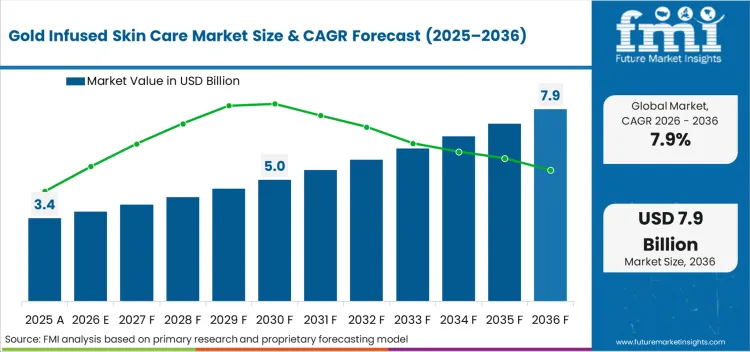
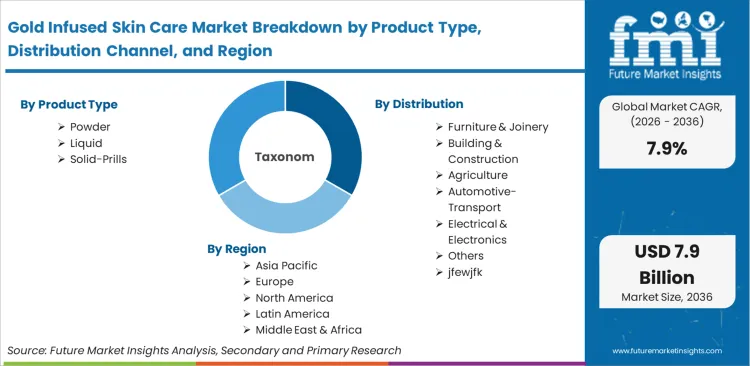
In 2025, the gold infused skin care market was valued at USD 3.4 billion. Demand for gold infused skin care products is estimated to grow to USD 3.7 billion in 2026 and USD 7.9 billion by 2036. The market projects a CAGR of 7.9% during the forecast period.
Beauty consumers and clinical practitioners are placing greater emphasis on high-bioavailability gold particle systems and stabilized colloidal delivery formats engineered for targeted dermal absorption at the nanoscale. Product choice is shifting toward hybrid treatment formats, long-wear solutions, and multifunctional actives that support complete skin regimens while preserving ease of daily use. Product innovation aligns with this direction through peptide-based complexes, antioxidant infusion platforms, and standardized dermatological testing protocols, supporting substantiated efficacy claims across regulated markets while retaining premium brand positioning.
In February 2025, the Estée Lauder Companies rolled out Beauty Reimagined, its new strategic vision. “Today, we are excited to launch Beauty Reimagined, a bold strategic vision to restore sustainable sales growth and achieve a solid double-digit adjusted operating margin over the next few years as we aim to become the best consumer-centric prestige beauty company,” said Stéphane de La Faverie, President and Chief Executive Officer. [1]
The market’s core value proposition is increasingly shaped by integrated scientific credibility frameworks that link clinical study validation, physician recommendation networks, and ingredient disclosure transparency. Skincare brands are broadening omnichannel access while reinforcing formulation trust through particle size disclosure, active concentration benchmarking, and independent testing certifications. Line extensions into gel formats, controlled-release capsules, and preservative-free variants across leading beauty retail channels signal how gold-infused treatments are transitioning from niche luxury offerings into routine skincare regimens aligned with professional dermatology workflows and aesthetic treatment pathways.
Summary of Gold Infused Skin Care Market
- Gold Infused Skin Care Market Definition
- The industry covers topical beauty products and facial care formulations containing gold particles utilized for anti-aging treatment, skin enhancement procedures, and cosmetic application.
- Demand Drivers in the Market
- Premium beauty segment expansion drives product acquisition for luxury skin care routines.
- Dermatologist endorsement programs expand demand for clinically validated formulations.
- Product innovation in particle delivery systems reduces application frequency while maintaining treatment efficacy standards.
- Key Segments Analyzed in the Report
- Product Type: Serums (42%) versus moisturizers and specialized treatment products.
- Distribution Channel: Online Retail (38%) versus specialty stores and department store beauty counters.
- Geography: High-growth Asia Pacific versus mature North American and European markets.
- Analyst Opinion at FMI
- Rahul Pandita, Senior Consultant for Consumer Products at Future Market Insights, says, "In the upcoming Gold Infused Skin Care Market Report for 2026 to 2036, industry stakeholders will find insights into clinical validation patterns that require formulation systems with documented efficacy across various dermatological testing protocols. My findings indicate that particle size specifications directly impact product development cycles and premium price point positioning could restrict market entry for mass-market manufacturers targeting entry-level beauty consumers."
- Strategic Implications/Executive Takeaways
- Shift focus from general beauty claims to clinically validated treatment outcomes.
- Treat dermatologist partnership programs as primary credibility strategy rather than supplementary marketing channel.
- Prioritize third-party testing verification to reduce consumer skepticism and support premium positioning.
- Methodology
- Validated through direct retail sales data and dermatology practitioner surveys.
- Zero reliance on speculative beauty trend forecasting.
- Based on verifiable brand performance metrics and verified distribution agreements.
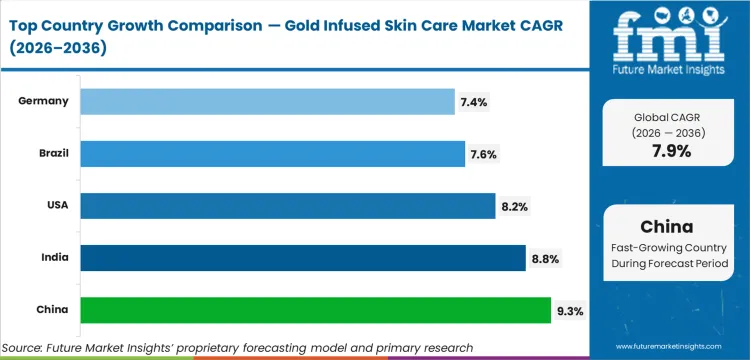
United States (8.2% CAGR) and Germany (7.4% CAGR) drive market expansion through established dermatology networks and premium beauty retail infrastructure. Japan (7.7% CAGR) contributes through ingredient innovation leadership and domestic manufacturing expertise. Emerging markets such as China (9.3%), India (8.8%), and Brazil (7.6%) generate growth through rising affluent consumer populations and increasing adoption of premium skin care as status signaling mechanism, while volume expansion accelerates through online retail penetration and mid-tier product development.
Gold Infused Skin Care Market Definition
Gold infused skin care products serve as the primary topical treatment category for premium facial care, encompassing formulations containing gold particles across professional and consumer applications. The gold infused skin care market comprises the global development, production, and distribution of beauty products featuring colloidal gold, gold leaf extracts, and nano-gold particle suspensions for dermatological application in cosmetic contexts.
Gold Infused Skin Care Market Inclusions
The report includes a comprehensive analysis of market dynamics, featuring Global and Regional Market Sizes (Volume and Value) and a 10-year Forecast (2026-2036). It covers segmental breakdowns by product type (Serums, Face Masks, Moisturizers, Eye Creams), distribution channels (Specialty Beauty Stores, Online Retail, Department Stores, Direct Sales), and applications (Anti-Aging Treatment, Skin Brightening, Hydration Enhancement, Acne Treatment).
Gold Infused Skin Care Market Exclusions
The scope excludes oral supplements containing gold, medical gold therapy treatments, industrial gold applications, and pharmaceutical gold compounds. It also omits raw ingredient suppliers, packaging manufacturers, and retail display equipment, focusing strictly on finished consumer-ready topical products designed for facial application and their immediate retail channels. Report does not account for salon professional-use-only formulations or compounding pharmacy preparations with negligible brand standardization.
Gold Infused Skin Care Market Research Methodology
- Primary Research: Interviews were conducted with cosmetic manufacturers, dermatology practitioners, beauty retail buyers, distribution channel managers, and aesthetic professional associations across major markets. Formulation chemists clarified gold particle specifications and delivery system requirements.
- Desk Research: Consumer purchase data from beauty retail analytics platforms, dermatologist recommendation patterns from professional surveys, and import/export statistics from trade organizations supported market benchmarking.
- Market-Sizing and Forecasting: A hybrid top-down and bottom-up model was developed. Demand was reconstructed from brand sales figures, retail store inventory turnover data, and professional channel procurement volumes, then validated against manufacturing output capacity and distribution network coverage.
- Data Validation and Update Cycle: Outputs undergo variance checks across retail and wholesale datasets, cross-verification with beauty industry associations, and structured expert review prior to release.
Segmental Analysis
Gold Infused Skin Care Market Analysis by Product Type
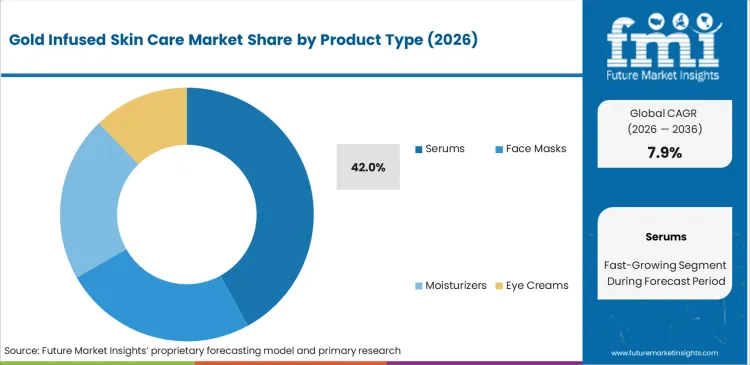
Demand for serums is projected to account for 42% share in 2026. Uptake within this format is being shaped by brands leveraging high-concentration delivery systems and improved dermal absorption performance to attract treatment-oriented consumers entering premium skincare through focused product formats that combine visible efficacy signaling with everyday usability.
- Particle Concentration Optimization: Manufacturers are deploying nano-structured gold dispersions with controlled particle size distributions, improving batch-level formulation consistency while addressing performance reliability benchmarks that guide purchasing decisions across clinical and consumer-facing segments.
- Clinical Testing Integration: The serum format supports structured dermatological validation frameworks that align efficacy assessment with safety documentation, easing regulatory pathways while strengthening unit-level margin profiles through scientific substantiation that enhances acceptance across retail and professional skincare channels.
Gold Infused Skin Care Market Analysis by Distribution Channel
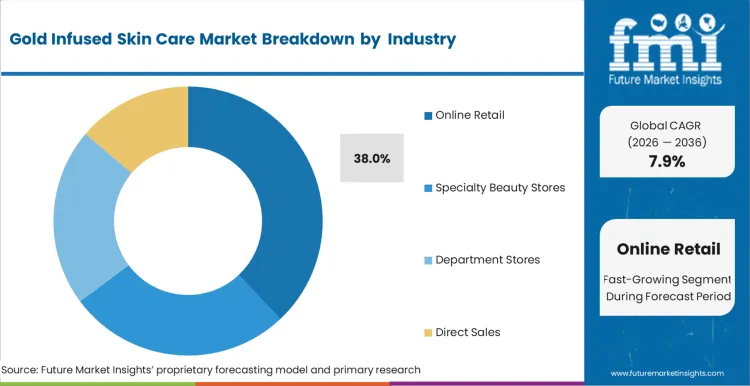
Online retail is expected to account for 38% market share in 2026, supported by its position as the primary product discovery and research channel where consumers review ingredient profiles and clinical substantiation. This concentration creates competitive advantages through formulation transparency and wide product comparison tools that align with premium beauty purchasing behavior. Ongoing integration with beauty influencer ecosystems and dermatologist-led review content sustains digital channel relevance, while educational ingredient content strengthens competitiveness versus offline formats that lack in-store advisory depth.
- Ingredient Transparency Access: Digital platforms provide structured formulation disclosures and independent testing records that reinforce buyer confidence, particularly among ingredient-focused consumers assessing gold particle concentrations and delivery mechanism performance.
- Subscription Program Development: E-commerce operators deploy auto-replenishment models and loyalty frameworks to secure repeat purchase patterns, supporting steady revenue visibility through full treatment-cycle adherence and routine maintenance consumption.
Gold Infused Skin Care Market Drivers, Restraints, and Opportunities
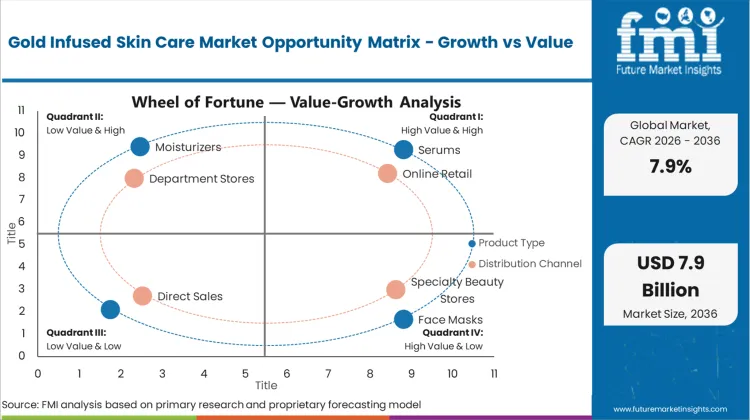
While mineral-based skincare demand faces competitive pressure from botanical-leaning preference shifts, the anti-aging performance attributes and professional validation associated with gold particle delivery systems continue to sustain purchase intent, supporting stable revenue trajectories across product formats. The outlook shows market saturation dynamics in developed regions alongside volume-led expansion in emerging economies as first-time premium skincare users enter the category. This factor is propelling the demand for gold-infused anti-aging skincare products.
Analysis points to a maturing consumer beauty segment in which gold-infused skincare is shifting from luxury indulgence positioning toward treatment-oriented formulations. The projected 2026 valuation reflects rising premium beauty participation as consumers place greater weight on proven performance, practitioner recommendations, and clinical substantiation rather than novelty-driven ingredient appeal.
- Clinical Validation Requirements: Growth momentum is moving away from marketing-led claims toward dermatologist-evaluated formulation systems, with documented efficacy and independent verification reinforcing differentiation versus mass-market beauty classifications.
- Particle Engineering Standards: Nano-scale particle uniformity and colloidal stability are becoming baseline formulation requirements rather than optional enhancements, prompting transitions from decorative gold leaf formats toward performance-driven engineered delivery systems.
- Ingredient Cost Management: In response to rising gold input costs, manufacturers are refining formulation efficiency through optimized particle loading to preserve unit economics aligned with retail pricing thresholds and distributor margin structures.
Regional Analysis
Based on regional analysis, the gold infused skin care market is segmented into North America, Latin America, Europe, East Asia, South Asia, Oceania and Middle East & Africa across 40 countries. The full report also offers market attractiveness analysis based on regional trends.
.webp "Top Country Growth Comparison Gold Infused Skin Care Market Cagr (2026 2036)")
| Country | CAGR (2026 to 2036) |
|---|---|
| United States | 8.2% |
| Germany | 7.4% |
| China | 9.3% |
| India | 8.8% |
| Brazil | 7.6% |
Source: Market analysis based on proprietary forecasting model and primary research
North America’s gold-infused skincare segment continues to expand as dermatology practice networks broaden, premium beauty retail assortments deepen, and consumers increasingly favor clinically substantiated treatments for age-management needs. Elevated disposable income levels support recurring purchases of premium formulations, while practitioner-led recommendation patterns reinforce replacement cycles across both preventive and corrective skincare routines.
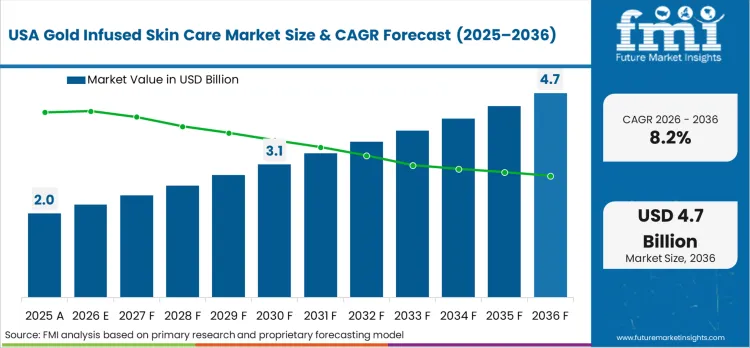
- United States: Demand for gold-infused skincare in the USA is forecast to advance at an 8.2% CAGR through 2036. Growth is being shaped by the scaling of aesthetic dermatology services and tighter validation expectations across high-end skincare portfolios.
The regional assessment covers the USA and Canada, detailing premium beauty participation trends, retail channel shifts, and category-specific development shaped by evolving distribution strategies.
Asia Pacific Gold-Infused Skin Care Market Analysis
Asia Pacific stands as the fastest-expanding regional market, supported by rising affluent consumer bases and increasingly sophisticated beauty routines that outpace growth in mature economies. Shiseido Company and AmorePacific Corporation anchor formulation-led innovation, while regional manufacturers widen access to premium-positioned offerings across emerging luxury tiers. China’s role as a supplier of cosmetic inputs, including gold particles, botanical actives, and peptide complexes, strengthens local value-chain integration.
- China: Leading regional growth with a projected 9.3% CAGR, driven by premium channel expansion and luxury consumption across tier-one urban centers, supporting standardized product rollouts and domestic brand scaling.
- India: Domestic demand is advancing at an 8.8% CAGR, underpinned by expanding middle-income beauty participation that lays the groundwork for premium skincare adoption and localized production economics.
The report evaluates East and South Asian markets from 2021 to 2036, covering participation dynamics, channel evolution, and formulation specification trends across China, Japan, South Korea, India, Singapore, and Australia, with attention to price-tier strategies shaping regional penetration.
Europe Gold-Infused Skin Care Market Analysis
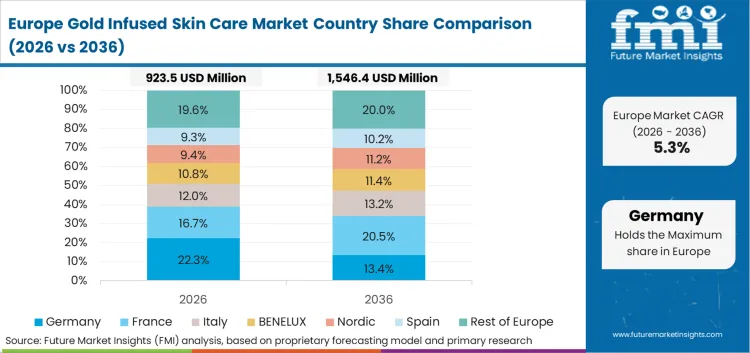
Europe represents a mature premium beauty landscape where category development is guided by practitioner networks and rigorous clinical substantiation norms across Germany, the UK, and France. Leading multinationals such as L'Oréal and Beiersdorf AG continue to scale clinically validated product lines and functional cosmetic ingredients within the gold-infused skincare segment.
- Germany: The market is projected to grow at a 7.4% CAGR through 2036, supported by strong preferences for dermatological testing protocols and formalized clinical documentation standards.
The European analysis spans the UK, Germany, France, Italy, Spain, the Netherlands, and Scandinavia, providing insight into premium beauty consumption patterns and practitioner-led recommendation frameworks shaping regional demand.
Competitive Landscape for Market Players
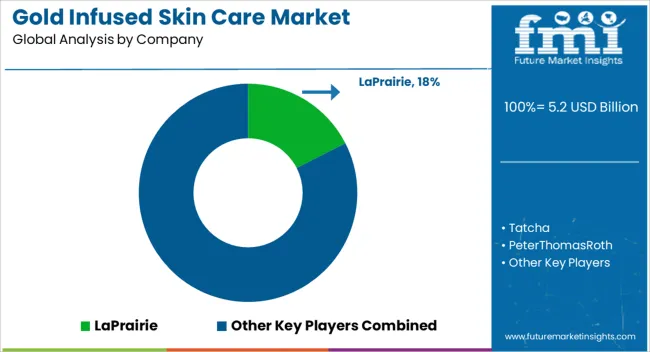
The competitive landscape is split between multinational beauty players with deep dermatology research infrastructure and smaller specialist brands operating with narrower retail reach. Market rivalry is increasingly shaped by the strength of clinical evidence, formulation engineering capabilities, and the depth of physician-aligned programs, rather than traditional differentiation based on ingredient storytelling or visual brand design.
Organizations with long-standing ties to dermatology clinics and strong positioning across premium retail channels are better placed to defend share and sustain price discipline. Practitioner-facing engagement models serve as entry points for scaled consumer brands, while high-end labels use medically oriented validation narratives to access clinical aesthetic environments.
Range diversity provides a structural edge. Brands offering multiple concentration tiers across different treatment applications achieve broader shelf and protocol coverage, while mono-formulation specialists rely heavily on documented performance outcomes and clinician advocacy to compete for relevance.
Recent Developments
The report includes comprehensive coverage of key industry developments and competitive positioning:
- In September 2025, L'Oréal Paris unveiled Age Perfect Serum Le Duo, a 2-in-1 dual-action serum featuring luxurious gold-accented packaging designed to elevate the user experience. The serum, clinically proven to combat ten signs of aging, combines cutting-edge science with luxury-grade ingredients. This launch represents L'Oréal's expansion into accessible luxury skincare, offering premium anti-aging benefits at a mass-market price point through an exclusive partnership with Walmart.
- In September 2025, Amorepacific Group marked its 80th anniversary by unveiling an ambitious new vision to achieve KRW 15 trillion (approximately USD 10.8 billion) in group sales by 2035. The company established five strategic pillars including global market expansion across a "Pentagon" of core regions (Korea, North America, Europe, India/Middle East, China, and Japan/APAC), integrated beauty solutions, biotechnology-driven anti-aging innovation, and AI-driven operations. Chairman Seo Kyung-bae articulated Amorepacific's vision as a global beauty creator advancing a philosophy that blends inner and outer beauty.
Key Players in Gold Infused Skin Care Market
- L'Oréal S.A.
- Estée Lauder Companies Inc.
- Shiseido Company, Limited
- Beiersdorf AG
- AmorePacific Corporation
- LVMH Moët Hennessy Louis Vuitton SE
- Clarins Group
- Coty Inc.
- La Prairie Group AG
- Natura & Co Holding S.A.
Scope of the Report
| Metric | Value |
|---|---|
| Quantitative Units | USD 3.7 billion (2026) to USD 7.9 billion (2036), at a CAGR of 7.9% |
| Market Definition | The gold infused skin care market comprises the global development, production, and distribution of topical beauty products containing gold particles including serums, masks, and moisturizers designed for facial application across consumer and professional segments. |
| Product Type Segmentation | Serums, Face Masks, Moisturizers, Eye Creams |
| Distribution Channel Coverage | Specialty Beauty Stores, Online Retail, Department Stores, Direct Sales |
| Application Segmentation | Anti-Aging Treatment, Skin Brightening, Hydration Enhancement, Acne Treatment |
| Regions Covered | North America, Latin America, Europe, East Asia, South Asia, Oceania, Middle East and Africa |
| Countries Covered | United States, Canada, United Kingdom, Germany, France, China, Japan, India, Brazil, UAE and 40 countries |
| Key Companies Profiled | L'Oréal S.A., Estée Lauder Companies Inc., Shiseido Company Limited, Beiersdorf AG, AmorePacific Corporation, LVMH, Clarins Group, Coty Inc., La Prairie Group AG, Natura & Co Holding S.A. |
| Forecast Period | 2026 to 2036 |
| Approach | Hybrid top down and bottom up market modeling validated through retail sales tracking and dermatologist surveys, supported by distribution network verification and premium beauty purchase pattern analysis |
Gold Infused Skin Care Market Analysis by Segments
Product Type
- Serums
- Face Masks
- Moisturizers
- Eye Creams
Distribution Channel
- Specialty Beauty Stores
- Online Retail
- Department Stores
- Direct Sales
- Others (dermatology clinics, medical spas)
Application
- Anti-Aging Treatment
- Skin Brightening
- Hydration Enhancement
- Acne Treatment
Region
- Asia Pacific
- China
- Japan
- South Korea
- India
- Australia
- Singapore
- Thailand
- Rest of Asia Pacific
- Europe
- United Kingdom
- Germany
- France
- Italy
- Spain
- Netherlands
- Scandinavia
- Switzerland
- Rest of Europe
- North America
- United States
- Canada
- Latin America
- Brazil
- Mexico
- Argentina
- Rest of Latin America
- Middle East & Africa
- United Arab Emirates
- Saudi Arabia
- South Africa
- Israel
- Rest of Middle East & Africa
Bibliography
- [1] The Estée Lauder Companies Inc. (2025, February 4). The Estée Lauder Companies Reports Fiscal 2025 Second Quarter Results.
- [5] Shiseido Company, Limited. (2023). Shiseido to acquire Dr. Dennis Gross Skincare.
- [6] AMOREPACIFIC Stories. (n.d.). Korean cosmetics giant Amorepacific announces the acquisition of luxury clean beauty brand Tata Harper.
This bibliography is provided for reader reference and is not exhaustive. The full report contains the complete reference list and detailed citations.
This Report Addresses
- Market intelligence to enable strategic decision making across established and emerging premium beauty markets
- Market size estimation and 10-year revenue forecasts from 2026 to 2036, supported by validated retail sales data and dermatologist surveys
- Growth opportunity mapping across product types and application segments with emphasis on distribution optimization
- Segment and regional revenue forecasts covering serums, masks, moisturizers, and specialty beauty retail networks
- Competition strategy assessment including brand portfolio management, dermatologist partnership requirements, and clinical validation positioning
- Product development tracking including particle engineering innovations, delivery system trends, and formulation testing protocols
- Market access analysis covering distribution agreements, professional endorsement strategies, and premium consumer engagement programs
- Market report delivery in PDF, Excel, PPT, and interactive dashboard formats for executive and operational use
Frequently Asked Questions
How large is the demand for Gold Infused Skin Care in the global market in 2026?
Demand for Gold Infused Skin Care in the global market is estimated to be valued at USD 3.7 billion in 2026.
What will be the market size of Gold Infused Skin Care in the global market by 2036?
Market size for Gold Infused Skin Care is projected to reach USD 7.9 billion by 2036.
What is the expected demand growth for Gold Infused Skin Care in the global market between 2026 and 2036?
Demand for Gold Infused Skin Care in the global market is expected to grow at a CAGR of 7.9% between 2026 and 2036.
Which Product Type is poised to lead global sales by 2026?
Serums is expected to be the dominant product type, capturing approximately 42.0% of global market share in 2026 due to concentrated formulation delivery and enhanced absorption characteristics.
How significant is the role of Online Retail in driving Gold Infused Skin Care adoption in 2026?
Online retail represents a primary distribution channel, projected to hold approximately 38% share of the total market in 2026 as ingredient transparency tools and broader product selection maintain digital channel relevance.
What is Driving Gold Infused Skin Care Demand in the United States?
Aesthetic dermatology expansion and increased treatment validation requirements across premium beauty categories are driving growth.
What Consumer Trends are Referenced for the United States?
Premium beauty participation patterns and dermatologist recommendation increases are referenced as key consumer behavior shifts.
What is the United States Growth Outlook in this Report?
The United States is projected to grow at a CAGR of 8.2% during 2026 to 2036.
Why is Europe described as Important for Skin Care Development in this Report?
Growth is driven by dermatology practitioner networks and clinical validation standards that establish standardized efficacy requirements.
What Type of Product Development Dominates in Europe?
Clinically validated formulations with dermatological testing documentation and third-party verification support dominate regional market segments.
What is Germany Growth Outlook in this Report?
Germany is projected to expand at a CAGR of 7.4% during 2026 to 2036.
Does the Report Cover China in its Regional Analysis?
China is included within East Asia under the regional scope of analysis.
What are the Sources referred to for analyzing the Market in China?
Premium beauty consumer participation data, luxury retail channel statistics, and domestic brand performance tracking covering purchase patterns, price sensitivity analysis, and formulation preference evolution are cited as primary reference sources.
What is the Main Development Theme Linked to China in Asia Coverage?
Asia Pacific development is associated with domestic premium beauty channel growth enabling product standardization across tier-one cities.
Does the Report Cover India in its Regional Analysis?
India is included within South Asia under the regional coverage framework.
What is the Main India Related Development Theme in Asia Coverage?
Growing middle-class beauty participation creating foundation for premium skin care adoption and local manufacturing using cost-competitive production methods is emphasized.
Which Distribution Strategies are Strategically Important for Asia Pacific Market Entry?
Dermatologist partnership models and premium retail programs are prioritized for credibility building across regional markets.
What is Gold Infused Skin Care and What is It Mainly Used For?
Gold infused skin care involves topical beauty products primarily used for anti-aging treatment, skin brightening procedures, and cosmetic enhancement application.
What does Gold Infused Skin Care Market Mean in this Report?
Gold infused skin care market refers to global development, manufacturing, and retail distribution of beauty formulations containing gold particles across various application categories and consumer segments.
What is Included in the Scope of this Gold Infused Skin Care Market Report?
Scope covers products by formulation type, key distribution channels such as specialty beauty stores and online platforms, and application segments including anti-aging treatment, skin brightening, and hydration enhancement.
What is Excluded from the Scope of this Report?
Oral gold supplements, medical gold therapy treatments, pharmaceutical gold compounds, and industrial gold applications are excluded unless part of topical cosmetic product offerings.
What does Market Forecast Mean on this Page?
Market forecast represents model-based projections built on retail sales trends and premium beauty participation assumptions for strategic planning purposes.
How is the Gold Infused Skin Care Market Forecast Built and Validated?
Forecast is developed using hybrid modeling validated through retail point-of-sale data, dermatologist surveys, and distribution network verification.
What does Zero Reliance on Speculative Third Party Market Research Mean Here?
Market analysis is based on verifiable sales figures, dermatology practitioner data, and formulation adoption patterns rather than speculative beauty trend predictions.
Preview the report firsthand - request a free sample
Get SampleGet the brochure for pricing and purchase details.
Get PDFTable of Content
- Executive Summary
- Global Market Outlook
- Demand-side Trends
- Supply-side Trends
- Technology Roadmap Analysis
- Analysis and Recommendations
- Market Overview
- Market Coverage / Taxonomy
- Market Definition / Scope / Limitations
- Research Methodology
- Chapter Orientation
- Analytical Lens and Working Hypotheses
- Market Structure, Signals, and Trend Drivers
- Benchmarking and Cross-market Comparability
- Market Sizing, Forecasting, and Opportunity Mapping
- Research Design and Evidence Framework
- Desk Research Programme (Secondary Evidence)
- Company Annual and Sustainability Reports
- Peer-reviewed Journals and Academic Literature
- Corporate Websites, Product Literature, and Technical Notes
- Earnings Decks and Investor Briefings
- Statutory Filings and Regulatory Disclosures
- Technical White Papers and Standards Notes
- Trade Journals, Industry Magazines, and Analyst Briefs
- Conference Proceedings, Webinars, and Seminar Materials
- Government Statistics Portals and Public Data Releases
- Press Releases and Reputable Media Coverage
- Specialist Newsletters and Curated Briefings
- Sector Databases and Reference Repositories
- FMI Internal Proprietary Databases and Historical Market Datasets
- Subscription Datasets and Paid Sources
- Social Channels, Communities, and Digital Listening Inputs
- Additional Desk Sources
- Expert Input and Fieldwork (Primary Evidence)
- Primary Modes
- Qualitative Interviews and Expert Elicitation
- Quantitative Surveys and Structured Data Capture
- Blended Approach
- Why Primary Evidence is Used
- Field Techniques
- Interviews
- Surveys
- Focus Groups
- Observational and In-context Research
- Social and Community Interactions
- Stakeholder Universe Engaged
- C-suite Leaders
- Board Members
- Presidents and Vice Presidents
- R&D and Innovation Heads
- Technical Specialists
- Domain Subject-matter Experts
- Scientists
- Physicians and Other Healthcare Professionals
- Governance, Ethics, and Data Stewardship
- Research Ethics
- Data Integrity and Handling
- Primary Modes
- Tooling, Models, and Reference Databases
- Desk Research Programme (Secondary Evidence)
- Data Engineering and Model Build
- Data Acquisition and Ingestion
- Cleaning, Normalisation, and Verification
- Synthesis, Triangulation, and Analysis
- Quality Assurance and Audit Trail
- Market Background
- Market Dynamics
- Drivers
- Restraints
- Opportunity
- Trends
- Scenario Forecast
- Demand in Optimistic Scenario
- Demand in Likely Scenario
- Demand in Conservative Scenario
- Opportunity Map Analysis
- Product Life Cycle Analysis
- Supply Chain Analysis
- Investment Feasibility Matrix
- Value Chain Analysis
- PESTLE and Porter’s Analysis
- Regulatory Landscape
- Regional Parent Market Outlook
- Production and Consumption Statistics
- Import and Export Statistics
- Market Dynamics
- Global Market Analysis 2021 to 2025 and Forecast, 2026 to 2036
- Historical Market Size Value (USD Million) Analysis, 2021 to 2025
- Current and Future Market Size Value (USD Million) Projections, 2026 to 2036
- Y-o-Y Growth Trend Analysis
- Absolute $ Opportunity Analysis
- Global Market Pricing Analysis 2021 to 2025 and Forecast 2026 to 2036
- Global Market Analysis 2021 to 2025 and Forecast 2026 to 2036, By Product Type
- Introduction / Key Findings
- Historical Market Size Value (USD Million) Analysis By Product Type , 2021 to 2025
- Current and Future Market Size Value (USD Million) Analysis and Forecast By Product Type , 2026 to 2036
- Serums
- Face Masks
- Moisturizers
- Eye Creams
- Serums
- Y-o-Y Growth Trend Analysis By Product Type , 2021 to 2025
- Absolute $ Opportunity Analysis By Product Type , 2026 to 2036
- Global Market Analysis 2021 to 2025 and Forecast 2026 to 2036, By Distribution Channel
- Introduction / Key Findings
- Historical Market Size Value (USD Million) Analysis By Distribution Channel, 2021 to 2025
- Current and Future Market Size Value (USD Million) Analysis and Forecast By Distribution Channel, 2026 to 2036
- Online Retail
- Specialty Beauty Stores
- Department Stores
- Direct Sales
- Online Retail
- Y-o-Y Growth Trend Analysis By Distribution Channel, 2021 to 2025
- Absolute $ Opportunity Analysis By Distribution Channel, 2026 to 2036
- Global Market Analysis 2021 to 2025 and Forecast 2026 to 2036, By Region
- Introduction
- Historical Market Size Value (USD Million) Analysis By Region, 2021 to 2025
- Current Market Size Value (USD Million) Analysis and Forecast By Region, 2026 to 2036
- North America
- Latin America
- Western Europe
- Eastern Europe
- East Asia
- South Asia and Pacific
- Middle East & Africa
- Market Attractiveness Analysis By Region
- North America Market Analysis 2021 to 2025 and Forecast 2026 to 2036, By Country
- Historical Market Size Value (USD Million) Trend Analysis By Market Taxonomy, 2021 to 2025
- Market Size Value (USD Million) Forecast By Market Taxonomy, 2026 to 2036
- By Country
- USA
- Canada
- Mexico
- By Product Type
- By Distribution Channel
- By Country
- Market Attractiveness Analysis
- By Country
- By Product Type
- By Distribution Channel
- Key Takeaways
- Latin America Market Analysis 2021 to 2025 and Forecast 2026 to 2036, By Country
- Historical Market Size Value (USD Million) Trend Analysis By Market Taxonomy, 2021 to 2025
- Market Size Value (USD Million) Forecast By Market Taxonomy, 2026 to 2036
- By Country
- Brazil
- Chile
- Rest of Latin America
- By Product Type
- By Distribution Channel
- By Country
- Market Attractiveness Analysis
- By Country
- By Product Type
- By Distribution Channel
- Key Takeaways
- Western Europe Market Analysis 2021 to 2025 and Forecast 2026 to 2036, By Country
- Historical Market Size Value (USD Million) Trend Analysis By Market Taxonomy, 2021 to 2025
- Market Size Value (USD Million) Forecast By Market Taxonomy, 2026 to 2036
- By Country
- Germany
- UK
- Italy
- Spain
- France
- Nordic
- BENELUX
- Rest of Western Europe
- By Product Type
- By Distribution Channel
- By Country
- Market Attractiveness Analysis
- By Country
- By Product Type
- By Distribution Channel
- Key Takeaways
- Eastern Europe Market Analysis 2021 to 2025 and Forecast 2026 to 2036, By Country
- Historical Market Size Value (USD Million) Trend Analysis By Market Taxonomy, 2021 to 2025
- Market Size Value (USD Million) Forecast By Market Taxonomy, 2026 to 2036
- By Country
- Russia
- Poland
- Hungary
- Balkan & Baltic
- Rest of Eastern Europe
- By Product Type
- By Distribution Channel
- By Country
- Market Attractiveness Analysis
- By Country
- By Product Type
- By Distribution Channel
- Key Takeaways
- East Asia Market Analysis 2021 to 2025 and Forecast 2026 to 2036, By Country
- Historical Market Size Value (USD Million) Trend Analysis By Market Taxonomy, 2021 to 2025
- Market Size Value (USD Million) Forecast By Market Taxonomy, 2026 to 2036
- By Country
- China
- Japan
- South Korea
- By Product Type
- By Distribution Channel
- By Country
- Market Attractiveness Analysis
- By Country
- By Product Type
- By Distribution Channel
- Key Takeaways
- South Asia and Pacific Market Analysis 2021 to 2025 and Forecast 2026 to 2036, By Country
- Historical Market Size Value (USD Million) Trend Analysis By Market Taxonomy, 2021 to 2025
- Market Size Value (USD Million) Forecast By Market Taxonomy, 2026 to 2036
- By Country
- India
- ASEAN
- Australia & New Zealand
- Rest of South Asia and Pacific
- By Product Type
- By Distribution Channel
- By Country
- Market Attractiveness Analysis
- By Country
- By Product Type
- By Distribution Channel
- Key Takeaways
- Middle East & Africa Market Analysis 2021 to 2025 and Forecast 2026 to 2036, By Country
- Historical Market Size Value (USD Million) Trend Analysis By Market Taxonomy, 2021 to 2025
- Market Size Value (USD Million) Forecast By Market Taxonomy, 2026 to 2036
- By Country
- Kingdom of Saudi Arabia
- Other GCC Countries
- Turkiye
- South Africa
- Other African Union
- Rest of Middle East & Africa
- By Product Type
- By Distribution Channel
- By Country
- Market Attractiveness Analysis
- By Country
- By Product Type
- By Distribution Channel
- Key Takeaways
- Key Countries Market Analysis
- USA
- Pricing Analysis
- Market Share Analysis, 2025
- By Product Type
- By Distribution Channel
- Canada
- Pricing Analysis
- Market Share Analysis, 2025
- By Product Type
- By Distribution Channel
- Mexico
- Pricing Analysis
- Market Share Analysis, 2025
- By Product Type
- By Distribution Channel
- Brazil
- Pricing Analysis
- Market Share Analysis, 2025
- By Product Type
- By Distribution Channel
- Chile
- Pricing Analysis
- Market Share Analysis, 2025
- By Product Type
- By Distribution Channel
- Germany
- Pricing Analysis
- Market Share Analysis, 2025
- By Product Type
- By Distribution Channel
- UK
- Pricing Analysis
- Market Share Analysis, 2025
- By Product Type
- By Distribution Channel
- Italy
- Pricing Analysis
- Market Share Analysis, 2025
- By Product Type
- By Distribution Channel
- Spain
- Pricing Analysis
- Market Share Analysis, 2025
- By Product Type
- By Distribution Channel
- France
- Pricing Analysis
- Market Share Analysis, 2025
- By Product Type
- By Distribution Channel
- India
- Pricing Analysis
- Market Share Analysis, 2025
- By Product Type
- By Distribution Channel
- ASEAN
- Pricing Analysis
- Market Share Analysis, 2025
- By Product Type
- By Distribution Channel
- Australia & New Zealand
- Pricing Analysis
- Market Share Analysis, 2025
- By Product Type
- By Distribution Channel
- China
- Pricing Analysis
- Market Share Analysis, 2025
- By Product Type
- By Distribution Channel
- Japan
- Pricing Analysis
- Market Share Analysis, 2025
- By Product Type
- By Distribution Channel
- South Korea
- Pricing Analysis
- Market Share Analysis, 2025
- By Product Type
- By Distribution Channel
- Russia
- Pricing Analysis
- Market Share Analysis, 2025
- By Product Type
- By Distribution Channel
- Poland
- Pricing Analysis
- Market Share Analysis, 2025
- By Product Type
- By Distribution Channel
- Hungary
- Pricing Analysis
- Market Share Analysis, 2025
- By Product Type
- By Distribution Channel
- Kingdom of Saudi Arabia
- Pricing Analysis
- Market Share Analysis, 2025
- By Product Type
- By Distribution Channel
- Turkiye
- Pricing Analysis
- Market Share Analysis, 2025
- By Product Type
- By Distribution Channel
- South Africa
- Pricing Analysis
- Market Share Analysis, 2025
- By Product Type
- By Distribution Channel
- USA
- Market Structure Analysis
- Competition Dashboard
- Competition Benchmarking
- Market Share Analysis of Top Players
- By Regional
- By Product Type
- By Distribution Channel
- Competition Analysis
- Competition Deep Dive
- L'Oréal S.A.
- Overview
- Product Portfolio
- Profitability by Market Segments (Product/Age /Sales Channel/Region)
- Sales Footprint
- Strategy Overview
- Marketing Strategy
- Product Strategy
- Channel Strategy
- Estée Lauder Companies Inc.
- Shiseido Company, Limited
- Beiersdorf AG
- AmorePacific Corporation
- LVMH Moët Hennessy Louis Vuitton SE
- Clarins Group
- Coty Inc.
- La Prairie Group AG
- Natura & Co Holding S.A.
- L'Oréal S.A.
- Competition Deep Dive
- Assumptions & Acronyms Used


