

- Market Size (2026)
- USD 1486.6 Mn
- Forecast (2036)
- USD 2377.4 Mn
- CAGR (2026 to 2036)
- 4.8%
How big is Grinding Aid Chemicals Market in 2026?
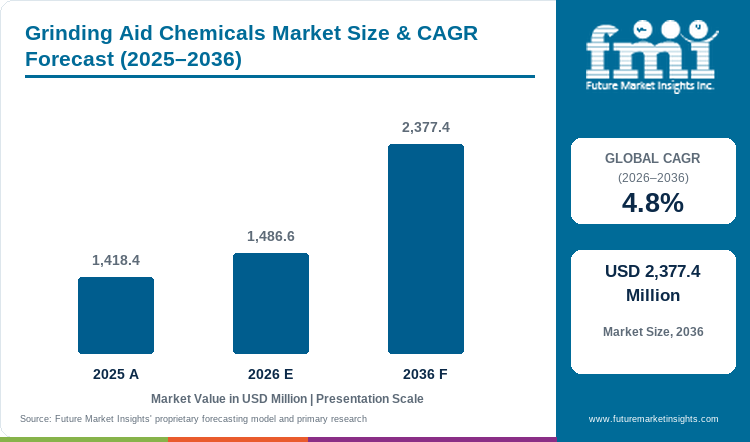
USD 1,486.6 million in 2026 and USD 2,377.4 million by 2036, expanding at 4.8% CAGR.
Sales of grinding aid chemicals are estimated to rise at 4.8% CAGR through 2036. Valuation rises from USD 1,418.4 million in 2025 to USD 1,486.6 million in 2026 before reaching USD 2,377.4 million by 2036. Plants continue buying cement grinding aids when mill trials confirm higher output or lower grinding energy. Lower-clinker cement needs tighter grinding control because larger supplementary-material shares can weaken early strength. In June 2026, CHRYSO described EnviroAdd HWR for cement formulations containing more supplementary material. EnviroAdd HWR supports clinker reduction and helps plants preserve workability and strength during local qualification trials.
Canada is projected at 5.8% CAGR through 2036 compared with France at 4.4%. The difference is attributable to distinct plant networks and qualification conditions rather than equal customer counts or trial costs. Canadian producers test grinding aids across long supply routes and seasonal concrete conditions that can change dosing requirements. In September 2026, the Cement Association of Canada listed 14 member plants across five provinces. French plants qualify blended cement under mature standards, with carbon reporting shaping reviews of lower-clinker formulas. Reliable local stock and technical service help both countries maintain approved formulas during regular production.
Key Takeaways
- Grinding aids earn repeat orders when controlled dosing improves mill output or reduces energy use without weakening cement performance.
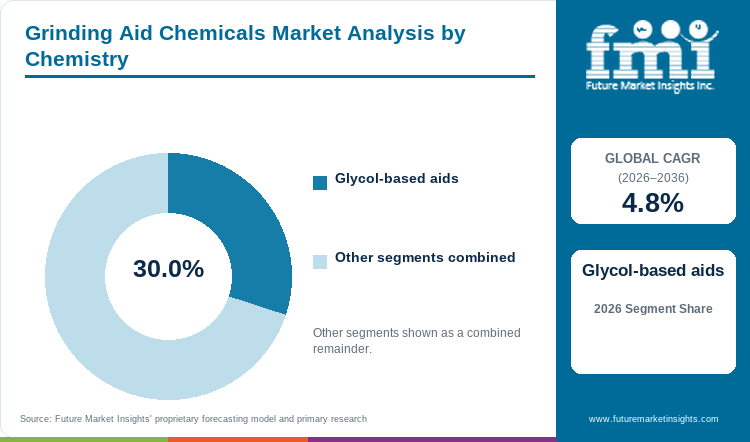
- Familiar dosing practices reinforce glycol-based aids, which are estimated at 30.0% of chemistry revenue in 2026.
- Routine finish-mill dosing supports cement grinding, projected at 55.0% of application revenue in 2026.
- Cement plants are forecast at 58.0% of end-use revenue in 2026, reflecting site control over formula trials and dose approval.
- Raw-material changes slow supplier switching since every new grinding-aid formula must protect setting behavior and finished-cement strength.
- Key participants include Sika, Saint-Gobain Construction Chemicals, BASF, Mapei, CEMEX, Master Builders Solutions, Euclid Chemical, and PROQUICESA.
Analyst Perspective
"The commercial opportunity improves when grinding aids raise mill output while lower-clinker cement remains within plant performance limits. Adoption depends on repeatable trials that prove strength, dosing stability and dependable supply before plants approve regular use."
- Nikhil Kaitwade, Principal Consultant, Future Market Insights
How is the grinding aid chemicals market segmented?
The grinding aid chemicals market is segmented by Chemistry, Application, End Use, Function, Sales Channel and Region.
Grinding aid chemicals are segmented by chemistry, application, end use, function, sales channel and region. Chemistry includes glycol-based, amine-based, polycarboxylate, lignosulfonate and specialty performance blends. Application covers cement, mineral, slag, coal and ceramic or raw-meal grinding. End use includes cement plants, mineral processors, ready-mix groups, ceramic plants and power plants. Function covers throughput, pack-set control, strength, energy saving and particle-size management. Sales channels include cement chemical suppliers, direct plant supply, distributors and technical service contracts.
How do glycol-based aids improve mill flow during plant qualification?
Glycol aids improve powder flow and reduce clumping during repeated grinding cycles inside cement mills. Plant teams test mineral grinding aids at fixed doses before comparing mill response with finished-cement performance. In May 2025, BASF switched its European amines production to renewable electricity while keeping the established supply route. The production change lowered the power footprint without altering the amine route used by formulators.
- Glycol-based aids are set to lead Chemistry with 30.0% share in 2026, supported by familiar dosing practices during plant qualification.
- Plant teams compare glycol, amine and polymer aids while checking strength, powder flow and setting performance before approval.
What makes cement grinding the leading application for grinding aids?
Finish mills dose grinding aids during routine cement production to improve grinding behavior and plant throughput. Plants adjust dosage as supplementary cementitious materials change grinding behavior and early-strength performance. In April 2025, Mapei opened an Egypt plant producing cement grinding aids alongside other construction chemicals. Local production shortens routes for trial stock and approved formulas when raw-material conditions change.
- By Application, cement grinding is forecast to represent 55.0% in 2026, tied to routine finish-mill dosing across production runs.
- Mineral and slag circuits also use grinding aids alongside coal and ceramic processing, although their dosing requirements differ.
How does plant-level dose approval favor cement plants in end use?
Cement plants maintain mill records and control approval for every grinding-aid dose used in routine production. Quality teams test concrete admixtures before regular use to ensure each formula protects finished-cement performance. In January 2025, PROQUICESA linked each grinding-aid dose with the specific cement and mill used during testing. Site teams use those results to approve regular supply and repeat dosing.
- Cement plants are set to account for 58.0% of End Use in 2026, reflecting site control over dose qualification.
- Mining and ceramic facilities also use grinding aids alongside power plants, but their qualification needs remain more process-specific.
Why does throughput improvement remain the leading grinding-aid function?
Plant teams compare tonnes per hour against a mill-trial baseline before assessing a grinding-aid formula. Quality staff review power use and ready-mix concrete results from the same controlled production run. In June 2026, PROQUICESA described additives that preserve mill output when cement formulations contain less clinker. Teams pair throughput gains with confirmed cement strength before approving regular use.
- Throughput improvement is projected to lead Function with 31.0% share in 2026, driven by mill output and power-use targets.
- Each trial also checks pack set and particle-size control, allowing plants to judge the dose against operating value targets.
How do cement chemical suppliers combine product supply with plant qualification?
Grinding-aid orders combine formulation work with plant trials and technical service during qualification. Technical service links grinding aids with construction chemicals already used across cement and concrete operations. In February 2025, Saint-Gobain completed its Fosroc acquisition and added 20 construction-chemical plants to its network. The broader network gives regional teams more locations for trials and local technical support.
- Cement chemical suppliers are likely to capture 42.0% of Sales Channel revenue in 2026, enabled by technical support during plant trials.
- Direct plant orders follow qualification, while distributors keep approved formulas nearby to reduce supply interruptions during regular production.
What are the drivers, restraints and opportunities in the Grinding Aid Chemicals Market?
Mill economics support adoption, plant-specific qualification slows switching and lower-clinker cement expands demand for performance-focused blends.
- Driver: Cement plants use grinding aids to raise output or reduce power consumption, helping existing mills delay major capacity investments.
- Restraint: Raw-material changes force plants to requalify grinding-aid chemistry through laboratory and mill trials before regular production resumes.
- Opportunity: Lower-clinker cement creates demand for blends that protect strength and mill output without increasing water demand during qualification.
Grinding economics connect chemical dosage with plant capacity
Plant managers compare additive cost with saleable tonnes and power use before approving regular grinding-aid supply. In June 2026, Cement Europe published its 2025 statistics report alongside sector output and carbon-reduction activity. Existing mills gain more value when grinding aids help meet demand without requiring another equipment line. Each controlled run measures output, fineness and cement strength before the plant accepts a dose. Routine dosing follows once results stay within approved production limits. LC3 activators need separate trials because lower clinker content changes grinding behavior and early-strength development. Mill teams record each dose together with results from later production runs and quality checks. Those records guide dosing decisions whenever production conditions or cement recipes change.
Qualification time slows substitution between grinding-aid chemistries
A grinding-aid formula can perform well with one clinker mix and fail with another. Plants test setting behavior and cement strength before approving each new chemistry for regular production. In March 2026, BASF raised European standard-amine prices by up to 30% as raw-material and shipping costs increased. Higher prices can make alternative chemistry more attractive during procurement reviews of formulation cost. Every formula change still requires plant approval, since cement performance can shift with local materials. Mineral processors face similar risks with mining flotation chemicals when local feed changes reagent response. Documented test methods help plants compare replacement formulas during trials. Plant teams need evidence that a replacement dose keeps cement quality stable during routine output.
Lower-clinker formulations widen demand for performance-focused additive blends
Cement producers use more limestone, slag and calcined clay while reducing clinker content in finished products. In May 2025, Heidelberg Materials opened a calcined-clay plant in Ghana to expand lower-carbon cement production. These blended formulations can make grinding more difficult and can also reduce early cement strength. Basic anti-clumping chemistry cannot solve both problems in every recipe. Formulators develop aids that improve powder flow and strength without increasing water demand during use. Poor powder flow can slow dispatch and raise demand for cement packaging during busy production periods. Plant teams run supervised trials before approving each new performance blend for regular production. Every trial must prove lower-clinker cement keeps mill output and finished-cement performance within plant limits.
Which country CAGRs are profiled in the Grinding Aid Chemicals Market?
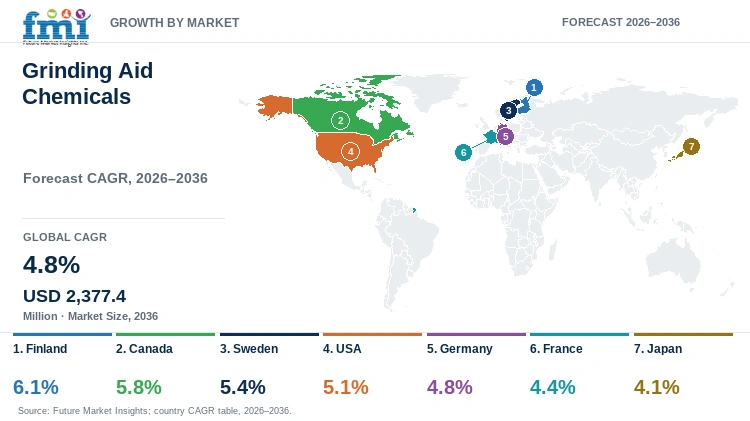
| Country | CAGR |
|---|---|
| Finland | 6.1% |
| Canada | 5.8% |
| Sweden | 5.4% |
| USA | 5.1% |
| Germany | 4.8% |
| France | 4.4% |
| Japan | 4.1% |
How do country-level CAGRs compare in the Grinding Aid Chemicals Market?
Finland at 6.1% and Canada at 5.8% form the faster-growth group among the seven profiled countries. Sweden and the USA occupy the next range, while Germany and France advance at more moderate forecast rates. The 2.0 percentage-point spread measures forecast speed rather than current revenue or plant count. Plant density, service distance and approval routines shape how those rates translate into trials and repeat supply.
- Finland's cold-weather concrete conditions favor grinding aids that protect early strength across seasonal cement use and repeated plant qualification.
- Canada's limited cement plant network raises qualification importance, owing to the wider regional effect of rejected formulas and supply interruptions.
- Sweden's concentrated cement supply base can slow supplier changes, with each approved grinding-aid formula carrying wider operational importance.
- The large U.S. cement plant base rewards suppliers that maintain approved bulk stock near production sites during routine operation.
- Germany's mature cement standards favor grinding aids linked to stable setting and strength as producers change mineral blends and clinker ratios.
- French cement producers value local technical support because lower-clinker recipes require repeated checks before grinding-aid formulas gain approval.
- Japan's mature cement plants favor predictable grinding-aid dosing, reinforced by quality routines that require repeatable results across regular deliveries.
Similar CAGRs produce different sales results, shaped by plant density, service distance and local approval routines.
The full report provides country-level CAGR analysis across seven regions. Coverage includes North America, Latin America, Western Europe, Eastern Europe, East Asia, South Asia and Pacific, and Middle East and Africa.
Country-wise Analysis
- Finland is projected to grow at 6.1% CAGR through 2036, supported by lower-clinker work that increases local mill qualification. Few cement plants concentrate supplier access across important production sites. In June 2025, Finnsementti reported projects using its lower-carbon Kolmossementti and Oiva cement products. Finnsementti states that most Finnish cement supply comes from its Parainen and Lappeenranta plants. Its 2025 figures show that more than 90% of cement raw materials came from Finland. Each plant supports a meaningful share of domestic demand, so failed grinding-aid trials can disrupt local supply. Plants need joint testing that protects cement strength and keeps approved formulas available for regular production.
- Canadian sales areas face seasonal changes in grinding-aid supply requirements. Canada is forecast to grow at 5.8% CAGR through 2036, with long routes increasing the value of local service. In September 2026, Statistics Canada updated its national cement shipment table with monthly records for 2025 and 2026. Those records cover a wide production base that depends on dependable regional supply during regular mill operations. Cold-weather concrete adds another performance check, since every trial must protect cement behavior across seasonal use. Local technical support helps plants adjust dosing as regional demand changes through the year. Nearby stock limits supply gaps that can interrupt routine dosing during seasonal production peaks.
- Swedish cement purchasing closely follows climate declarations and material records. Sweden is forecast to grow at 5.4% CAGR through 2036, influenced by the growing role of these records in product reviews. In January 2026, Boverket reported 1,509 climate declarations for new buildings during 2025. The rule does not name grinding aids but raises the value of evidence supporting lower-carbon cement formulations. Each approved formula carries wider operating importance, which can slow supplier changes across a small national supply base. Grinding-aid providers need plant results that connect clinker reduction with stable strength and mill output. Project records support local reviews of lower-carbon cement during qualification and later mill trials.
- U.S. grinding aid demand is forecast to rise at 5.1% CAGR through 2036, tied to varied plant trial requirements. Cement plants use different mill setups with local clinker and supplementary materials across the national production base. In February 2026, the U.S. Geological Survey reported 82 million tons of 2025 Portland and blended cement output. The same report counted 97 plants, giving suppliers many operating conditions for dose testing and qualification. No single formula matches every local clinker and mill configuration. Plant trials connect each dose with power use and cement strength before teams approve routine production. Approved formulas also require reliable bulk delivery and site test plans that support regular dosing across each plant.
- German cement plants use carbon records during qualification and tenders. Germany is projected to grow at 4.8% CAGR through 2036, shaped by carbon reporting in formulation reviews. In February 2025, VDZ introduced its Cement Carbon Class label for lower-emission cement categories. The label gives plants another reason to document grinding performance as clinker ratios and mineral blends change. Trial records connect mill output with cement strength and the carbon class assigned to each qualified recipe. Repeat local supply depends on approved formulas performing consistently during routine production. Plant approval work can slow supplier changes even when another chemistry offers a lower purchase cost.
- France is estimated to post 4.4% CAGR through 2036, constrained by grinding-aid spending that competes with other plant investments. French cement plants balance clinker reduction with mill gains while allocating technical resources across several decarbonization projects. In July 2025, France Ciment updated its sector roadmap and retained clinker reduction alongside mill efficiency as key levers. Grinding-aid trials compete with kiln and carbon-capture projects for engineers. New formulas must protect setting and strength as lower clinker content changes the cement recipe. Plant teams measure mill gains for each recipe before comparing those gains with formula cost during approval. Broad carbon claims carry less weight when a dosing decision lacks measurable plant-level performance.
- Japan has a concentrated cement producer base where each successful grinding-aid qualification can affect broad customer access. Japan is estimated to post 4.1% CAGR through 2036, reinforced by mature plants that prioritize stable supply and documented approval. In July 2026, the Japan Cement Association listed 26 plants run by 14 companies with 49 million tons clinker capacity. Fewer producer groups control a large share of output, giving failed trials greater commercial weight. Service teams keep approved formulas available through repeated plant deliveries. Grinding aids must perform consistently from one shipment to the next before plants preserve routine dosing. Long approval cycles favor formulas with documented acceptance records and dependable local supply.
Who are the notable companies in the Grinding Aid Chemicals Market?
Sika, Saint-Gobain Construction Chemicals, BASF, Mapei, CEMEX, Master Builders Solutions, Euclid Chemical, and PROQUICESA are active within the defined grinding aid chemicals boundary.
Competition focuses on chemistry performance, plant qualification and technical service across cement operations. Sika and Mapei combine grinding-aid portfolios with regional teams that support plant trials and regular dosing. Saint-Gobain Construction Chemicals includes CHRYSO, GCP Applied Technologies and Fosroc within its construction-chemical network. BASF supplies amine intermediates for formulation, while CEMEX and Euclid Chemical contribute cement and admixture operating knowledge. PROQUICESA develops custom grinding-aid blends for plant-specific dosing and lower-clinker cement requirements.
- Sika, Saint-Gobain Construction Chemicals, Mapei and Master Builders Solutions combine grinding-aid formulas with regional technical service.
- CEMEX and Euclid Chemical connect plant operating knowledge with North American cement-additive service and technical support.
- BASF supplies amine inputs, while PROQUICESA develops grinding aids and custom formulas for plant-specific cement requirements.
Competitive Benchmarking: Grinding Aid Chemicals Market
| Company | Grinding Chemistry Coverage | Plant Trial and Dosing Support | Low-Clinker Optimization | Geographic Reach |
|---|---|---|---|---|
| Sika | High | High | High | Global |
| Saint-Gobain Construction Chemicals | High | High | High | Global |
| BASF | Medium | Low | Medium | Global chemical supply |
| Mapei | High | High | High | Europe, Americas, Asia-Pacific and Middle East |
| CEMEX | Medium | High | High | Americas, Europe and selected global operations |
| Master Builders Solutions | High | High | High | Americas, Europe, Asia and Middle East |
| Euclid Chemical | High | High | Medium | North America |
| PROQUICESA | High | High | High | Europe with international cement markets |
High indicates broad supporting evidence, while Medium marks narrower coverage across the stated criterion. Low indicates limited evidence across the verified company regions and criteria.
Key Developments in the Grinding Aid Chemicals Market
- In May 2026, Master Builders Solutions opened two U.S. admixture sites, shortening regional supply routes for construction chemicals.
- In February 2026, Sika opened a Tanzania plant producing grinding aids for cement manufacturers across East Africa.
- In September 2025, BASF moved Geismar amines production to renewable electricity while keeping product specifications unchanged.
Key Players in the Grinding Aid Chemicals Market
Global cement-additive platforms
- Sika
- Saint-Gobain Construction Chemicals
- Mapei
- Master Builders Solutions
Plant and admixture networks
- CEMEX
- Euclid Chemical
Upstream and specialist chemistry
- BASF
- PROQUICESA
Grinding Aid Chemicals Market - Report Scope
| Coverage field | Report scope |
|---|---|
| Market breakdown | By chemistry, application, end use, function, sales channel and region. |
| Quantitative Units | USD million. |
| Market Definition | Commercial grinding aid chemicals used to improve grinding efficiency, flow or cement performance are included. Finished cement, concrete and grinding equipment are excluded. |
| Regions Covered | North America, Latin America, Western Europe, Eastern Europe, East Asia, South Asia and Pacific, and Middle East and Africa. |
| Countries Covered | Finland, Canada, Sweden, USA, Germany, France, Japan, and 20+ countries included in the full report. |
| Key Companies Profiled | Sika, Saint-Gobain Construction Chemicals, BASF, Mapei, CEMEX, Master Builders Solutions, Euclid Chemical, and PROQUICESA. |
| Forecast Period | 2026 to 2036. |
| Approach | Primary and secondary research with market triangulation. |
Grinding Aid Chemicals Market - Research Methodology
| Method | Approach |
|---|---|
| Primary Research | FMI analysts gathered input from manufacturers, service providers, technology developers, distributors, end users, procurement teams, and subject-matter experts. Interviews examined purchasing decisions, product or service evaluation, adoption barriers, approval requirements, pricing considerations, and expectations for technical or commercial support. Respondents were also asked what evidence is required before a trial, pilot, or initial order develops into regular purchasing. |
| Desk Research | Desk research covered government statistics, regulatory publications, trade data, industry associations, technical literature, standards, company filings, product information, and official corporate announcements. Sources were reviewed for relevance, publication date, geographic coverage, and consistency with the defined market scope. Claims relating to performance, applications, approvals, capacity, investment, and commercial activity were retained only when supported by credible public evidence. |
| Market Sizing and Forecasting | The market model combined the baseline value with historical performance, segment structure, pricing and volume indicators, adoption levels, company participation, and country-level demand conditions. Forecast assumptions considered economic activity, investment trends, regulatory developments, technology adoption, purchasing cycles, supply availability, and barriers to wider market use. Segment and regional estimates were reconciled before the final market total was calculated. |
| Data Validation | Estimates were checked against multiple independent indicators, including public data, company activity, trade patterns, industry developments, and findings from primary interviews. Validation also tested whether products, services, applications, and company revenues fell within the defined market boundaries. Adjacent categories, unsupported claims, overlapping revenues, and activities without direct market relevance were excluded to reduce double counting and maintain consistency across segments and countries. |
Grinding Aid Chemicals Market by Segments
Grinding Aid Chemicals Market segmented by Chemistry:
- Glycol-based aids
- Amine-based aids
- Polycarboxylate aids
- Lignosulfonate blends
- Specialty performance blends
Grinding Aid Chemicals Market segmented by Application:
- Cement grinding
- Mineral grinding
- Slag grinding
- Coal grinding
- Ceramic/raw meal grinding
Grinding Aid Chemicals Market segmented by End Use:
- Cement plants
- Mining/mineral processing
- Ready-mix admixture groups
- Ceramic plants
- Power plants
Grinding Aid Chemicals Market segmented by Function:
- Mill throughput improvement
- Pack-set reduction
- Strength enhancement
- Energy saving
- Particle-size control
Grinding Aid Chemicals Market segmented by Sales Channel:
- Cement chemical suppliers
- Direct plant supply
- Distributors
- Technical service contracts
Grinding Aid Chemicals Market by Region:
- North America
- United States
- Canada
- Latin America
- Brazil
- Mexico
- Chile
- Rest of Latin America
- Western Europe
- Germany
- United Kingdom
- Italy
- Spain
- France
- Nordics
- Benelux
- Rest of Western Europe
- Eastern Europe
- Russia
- Poland
- Hungary
- Balkan and Baltic States
- Rest of Eastern Europe
- East Asia
- China
- Japan
- South Korea
- South Asia and Pacific
- India
- ASEAN
- Australia and New Zealand
- Rest of South Asia and Pacific
- Middle East and Africa
- Kingdom of Saudi Arabia
- Other GCC Countries
- Türkiye
- South Africa
- Other African Union Countries
- Rest of Middle East and Africa
Research Sources and Bibliography
- CHRYSO. (2026, June 23). Enabling high-SCM, low-CO2 cements without compromising workability or strength.
- Cement Association of Canada. (2026, September). Our members.
- BASF. (2025, May 6). BASF Intermediates converts its entire European amines portfolio to 100 percent renewable electricity.
- Mapei. (2025, April 15). Mapei opens a new plant in Egypt.
- PROQUICESA. (2025, January 15). Effect of grinding aids on cement chemistry.
- PROQUICESA. (2026, June 3). Decarbonizing cement without losing performance: The role of next-generation additives in the cement sector.
- Saint-Gobain. (2025, February 10). Saint-Gobain completes the acquisition of Fosroc.
- Cement Europe. (2026, June 15). Statistics report 2025.
- BASF. (2026, March 25). BASF Intermediates increases prices for its standard amines portfolio in Europe.
- Heidelberg Materials. (2025, May 16). Calcined clay facility expands lower-carbon cement production in Ghana.
- U.S. Geological Survey. (2026, February 6). Mineral commodity summaries 2026: Cement.
- VDZ. (2025, February 4). VDZ introduces a new CO2 label for cement.
- Japan Cement Association. (2026, July). Cement industry statistics.
- Statistics Canada. (2026, September). Cement, monthly production and destination of shipments.
- Finnsementti. (2025, June 10). Sementti 1/2025 has been published.
- France Ciment. (2025, July 16). Decarbonization roadmap: The cement industry remains on course and continues its actions.
- Boverket. (2026, January 7). Statistics for climate declarations for new buildings.
- Master Builders Solutions. (2026, May 22). Master Builders Solutions expands U.S. manufacturing footprint with two new admixture sites.
- Sika. (2026, February 3). Sika expands its global manufacturing footprint across growth markets with five new plants.
- BASF. (2025, September 16). BASF Intermediates to produce amines at the Geismar site using 100 percent renewable electricity.
- Sika. (2025, June 18). Sika strengthens global presence with investments in China, Brazil, and Morocco.
- Mapei. (2026, March 13). Mapei opens its first manufacturing plant in Belgium.
- Saint-Gobain. (2026, August 24). Saint-Gobain strengthens its positioning in construction chemicals and light construction in Latin America.
- Master Builders Solutions. (2026, May 19). Master Builders Solutions expands Brazil operations with new automated manufacturing plant.
- Mapei. (2026, April 21). Mapei begins construction of a new manufacturing plant in Melbourne.
- Sika. (2025, June 27). Sika acquires Gulf Additive Factory in Qatar.
- Saint-Gobain. (2025, January 15). Saint-Gobain completes the acquisition of OVNIVER Group in Mexico and Central America.
- BASF. (2026, May 28). Intermediates factbook.
- Mapei. (2025, March 21). Mapei advances decarbonization in cement and concrete with the Mapecube launch.
- CEMEX, S.A.B. de C.V. (2026, April 24). Form 20-F for the fiscal year ended December 31, 2025.
- Master Builders Solutions. (2025, October 6). Master Builders Solutions inaugurates two new manufacturing plants to support regional growth.
- RPM International Inc. (2025, August 21). 2025 summary annual report.
- Infocemento. (2026, March). ADITOR LCC: A new generation of additives for calcined-clay cement (LC3).
This bibliography gives key sources for readers but does not list every source. The full report contains the complete reference list and detailed citations.
This Report Answers
- How large is the grinding aid chemicals market in 2026 and 2036?
- How do mill economics support repeat grinding-aid orders across cement plants?
- Which chemistry category holds the leading 30.0% share in 2026?
- Which application category holds the leading 55.0% share in 2026?
- Which end-use category holds the leading 58.0% share in 2026?
- How do changing raw materials affect grinding-aid qualification and supplier switching?
- How do growth rates differ in Finland, Canada, Sweden, USA, Germany, France and Japan?
- Which companies supply grinding-aid chemistry or provide plant technical support?
- How are lower-clinker cement formulations changing grinding-aid performance and qualification requirements?
Frequently Asked Questions
How big is the grinding aid chemicals market in 2026?
The grinding aid chemicals market totals USD 1,486.6 million in 2026 and is projected to reach USD 2,377.4 million by 2036. Plants purchase grinding aids when mill trials confirm useful output gains without weakening finished-cement performance.
What is the CAGR of the grinding aid chemicals market from 2026 to 2036?
The grinding aid chemicals market is projected to grow at 4.8% CAGR from 2026 to 2036. Mill output targets and lower-clinker cement requirements continue supporting regular grinding-aid demand.
Which chemistry segment leads the grinding aid chemicals market in 2026?
Glycol-based aids are expected to hold 30.0% of chemistry revenue in 2026. Familiar dosing behavior helps plant teams qualify these aids through established mill trials before regular use.
Which application segment leads the grinding aid chemicals market in 2026?
Cement grinding is projected to hold 55.0% of application revenue in 2026. Routine finish-mill dosing links grinding-aid use with output targets across regular cement production.
Which end-use segment leads the grinding aid chemicals market in 2026?
Cement plants are forecast to hold 58.0% of end-use revenue in 2026. Plant teams run qualification trials and control regular dosing across each production site.
Which countries have faster projected growth in the grinding aid chemicals market?
Finland leads the profiled group at 6.1% CAGR through 2036, while Canada follows at 5.8%. Sweden is projected at 5.4% CAGR, influenced by climate records that shape local cement qualification and grinding-aid trials.
Which companies are active in the grinding aid chemicals market?
Key companies include Sika, Saint-Gobain Construction Chemicals, BASF, Mapei, CEMEX, Master Builders Solutions, Euclid Chemical and PROQUICESA. These firms compete through grinding chemistry, plant qualification and local technical support.
Preview the report firsthand - request a free sample
Get SampleGet the brochure for pricing and purchase details.
Get PDFTable of Content
- Key Takeaways
- Market Size and CAGR
- Top Growth Driver
- Fastest Growing Segment
- Leading Region
- Key Companies
- Emerging Opportunities
- Executive Summary
- Global Market Outlook
- Demand-side Trends
- Supply-side Trends
- Technology Roadmap Analysis
- Analysis and Recommendations
- Analyst Perspective (What is happening? Why now? What should investors know?)
- Key Questions Answered
- How large is the market?
- What is the CAGR?
- What are key trends?
- Which region dominates?
- Who are the leaders?
- Market Overview
- Market Coverage / Taxonomy
- Market Definition / Scope / Limitations
- Research Methodology
- Chapter Orientation
- Analytical Lens and Working Hypotheses
- Market Structure, Signals, and Trend Drivers
- Benchmarking and Cross-market Comparability
- Market Sizing, Forecasting, and Opportunity Mapping
- Research Design and Evidence Framework
- Desk Research Programme (Secondary Evidence)
- Expert Input and Fieldwork (Primary Evidence)
- Tooling, Models, and Reference Databases
- Data Engineering and Model Build
- Quality Assurance and Audit Trail
- Market Background
- Market Dynamics (Drivers, Restraints, Opportunity, Trends)
- Scenario Forecast (Optimistic, Likely, Conservative)
- Impact Analysis
- AI Impact
- Sustainability Impact
- Regulatory Impact
- Technology Impact
- Consumer / Buyer Analysis
- Purchase Drivers
- Adoption Barriers
- Buyer Journey
- Opportunity Map Analysis
- Product Life Cycle Analysis
- Supply Chain Analysis
- Investment Feasibility Matrix
- Value Chain Analysis
- PESTLE and Porter's Analysis
- Regulatory Landscape
- Regional Parent Market Outlook
- Production and Consumption Statistics
- Import and Export Statistics
- Global Market Analysis and Forecast, 2021 to 2036
- Historical Market Size Value (USD Million) Analysis, 2021 to 2025
- Current and Future Market Size Value (USD Million) Projections, 2026 to 2036
- Y-o-Y Growth Trend Analysis
- Absolute $ Opportunity Analysis
- Global Market Pricing Analysis, 2021 to 2036
- Global Market Analysis and Forecast, By Chemistry, 2021 to 2036
- Introduction / Key Findings
- Historical Market Size Value (USD Million) Analysis By Chemistry, 2021 to 2025
- Current and Future Market Size Value (USD Million) Analysis and Forecast By Chemistry, 2026 to 2036
- Glycol-based aids
- Amine-based aids
- Polycarboxylate aids
- Lignosulfonate blends
- Specialty performance blends
- Y-o-Y Growth Trend Analysis By Chemistry, 2021 to 2025
- Absolute $ Opportunity Analysis By Chemistry, 2026 to 2036
- Global Market Analysis and Forecast, By Application, 2021 to 2036
- Introduction / Key Findings
- Historical Market Size Value (USD Million) Analysis By Application, 2021 to 2025
- Current and Future Market Size Value (USD Million) Analysis and Forecast By Application, 2026 to 2036
- Cement grinding
- Mineral grinding
- Slag grinding
- Coal grinding
- Ceramic/raw meal grinding
- Y-o-Y Growth Trend Analysis By Application, 2021 to 2025
- Absolute $ Opportunity Analysis By Application, 2026 to 2036
- Global Market Analysis and Forecast, By End Use, 2021 to 2036
- Introduction / Key Findings
- Historical Market Size Value (USD Million) Analysis By End Use, 2021 to 2025
- Current and Future Market Size Value (USD Million) Analysis and Forecast By End Use, 2026 to 2036
- Cement plants
- Mining/mineral processing
- Ready-mix admixture groups
- Ceramic plants
- Power plants
- Y-o-Y Growth Trend Analysis By End Use, 2021 to 2025
- Absolute $ Opportunity Analysis By End Use, 2026 to 2036
- Global Market Analysis and Forecast, By Function, 2021 to 2036
- Introduction / Key Findings
- Historical Market Size Value (USD Million) Analysis By Function, 2021 to 2025
- Current and Future Market Size Value (USD Million) Analysis and Forecast By Function, 2026 to 2036
- Mill throughput improvement
- Pack-set reduction
- Strength enhancement
- Energy saving
- Particle-size control
- Y-o-Y Growth Trend Analysis By Function, 2021 to 2025
- Absolute $ Opportunity Analysis By Function, 2026 to 2036
- Global Market Analysis and Forecast, By Sales Channel, 2021 to 2036
- Introduction / Key Findings
- Historical Market Size Value (USD Million) Analysis By Sales Channel, 2021 to 2025
- Current and Future Market Size Value (USD Million) Analysis and Forecast By Sales Channel, 2026 to 2036
- Cement chemical suppliers
- Direct plant supply
- Distributors
- Technical service contracts
- Y-o-Y Growth Trend Analysis By Sales Channel, 2021 to 2025
- Absolute $ Opportunity Analysis By Sales Channel, 2026 to 2036
- Global Market Analysis and Forecast, By Region, 2021 to 2036
- Introduction
- Historical Market Size Value (USD Million) Analysis By Region, 2021 to 2025
- Current Market Size Value (USD Million) Analysis and Forecast By Region, 2026 to 2036
- North America
- Latin America
- Western Europe
- Eastern Europe
- East Asia
- South Asia and Pacific
- Middle East and Africa
- Market Attractiveness Analysis By Region
- North America Market Analysis and Forecast, By Country, 2021 to 2036
- Historical Market Size Value (USD Million) Trend Analysis By Market Taxonomy, 2021 to 2025
- Market Size Value (USD Million) Forecast By Market Taxonomy, 2026 to 2036
- By Country
- United States
- Canada
- By Chemistry
- By Application
- By End Use
- By Function
- By Sales Channel
- By Country
- Market Attractiveness Analysis
- By Country
- By Chemistry
- By Application
- By End Use
- By Function
- By Sales Channel
- Key Takeaways
- Latin America Market Analysis and Forecast, By Country
- Historical Market Size Value (USD Million) Trend Analysis By Market Taxonomy, 2021 to 2025
- Market Size Value (USD Million) Forecast By Market Taxonomy, 2026 to 2036
- By Country
- Brazil
- Mexico
- Chile
- Rest of Latin America
- By Chemistry
- By Application
- By End Use
- By Function
- By Sales Channel
- By Country
- Market Attractiveness Analysis
- By Country
- By Chemistry
- By Application
- By End Use
- By Function
- By Sales Channel
- Key Takeaways
- Western Europe Market Analysis and Forecast, By Country
- Historical Market Size Value (USD Million) Trend Analysis By Market Taxonomy, 2021 to 2025
- Market Size Value (USD Million) Forecast By Market Taxonomy, 2026 to 2036
- By Country
- Germany
- United Kingdom
- Italy
- Spain
- France
- Nordics
- Benelux
- Rest of Western Europe
- By Chemistry
- By Application
- By End Use
- By Function
- By Sales Channel
- By Country
- Market Attractiveness Analysis
- By Country
- By Chemistry
- By Application
- By End Use
- By Function
- By Sales Channel
- Key Takeaways
- Eastern Europe Market Analysis and Forecast, By Country
- Historical Market Size Value (USD Million) Trend Analysis By Market Taxonomy, 2021 to 2025
- Market Size Value (USD Million) Forecast By Market Taxonomy, 2026 to 2036
- By Country
- Russia
- Poland
- Hungary
- Balkan and Baltic States
- Rest of Eastern Europe
- By Chemistry
- By Application
- By End Use
- By Function
- By Sales Channel
- By Country
- Market Attractiveness Analysis
- By Country
- By Chemistry
- By Application
- By End Use
- By Function
- By Sales Channel
- Key Takeaways
- East Asia Market Analysis and Forecast, By Country
- Historical Market Size Value (USD Million) Trend Analysis By Market Taxonomy, 2021 to 2025
- Market Size Value (USD Million) Forecast By Market Taxonomy, 2026 to 2036
- By Country
- China
- Japan
- South Korea
- By Chemistry
- By Application
- By End Use
- By Function
- By Sales Channel
- By Country
- Market Attractiveness Analysis
- By Country
- By Chemistry
- By Application
- By End Use
- By Function
- By Sales Channel
- Key Takeaways
- South Asia and Pacific Market Analysis and Forecast, By Country
- Historical Market Size Value (USD Million) Trend Analysis By Market Taxonomy, 2021 to 2025
- Market Size Value (USD Million) Forecast By Market Taxonomy, 2026 to 2036
- By Country
- India
- ASEAN
- Australia and New Zealand
- Rest of South Asia and Pacific
- By Chemistry
- By Application
- By End Use
- By Function
- By Sales Channel
- By Country
- Market Attractiveness Analysis
- By Country
- By Chemistry
- By Application
- By End Use
- By Function
- By Sales Channel
- Key Takeaways
- Middle East and Africa Market Analysis and Forecast, By Country
- Historical Market Size Value (USD Million) Trend Analysis By Market Taxonomy, 2021 to 2025
- Market Size Value (USD Million) Forecast By Market Taxonomy, 2026 to 2036
- By Country
- Kingdom of Saudi Arabia
- Other GCC Countries
- Türkiye
- South Africa
- Other African Union Countries
- Rest of Middle East and Africa
- By Chemistry
- By Application
- By End Use
- By Function
- By Sales Channel
- By Country
- Market Attractiveness Analysis
- By Country
- By Chemistry
- By Application
- By End Use
- By Function
- By Sales Channel
- Key Takeaways
- Key Countries Market Analysis
- United States
- Pricing Analysis
- Market Share Analysis, 2025
- By Chemistry
- By Application
- By End Use
- By Function
- By Sales Channel
- Canada
- Pricing Analysis
- Market Share Analysis, 2025
- By Chemistry
- By Application
- By End Use
- By Function
- By Sales Channel
- Mexico
- Pricing Analysis
- Market Share Analysis, 2025
- By Chemistry
- By Application
- By End Use
- By Function
- By Sales Channel
- Brazil
- Pricing Analysis
- Market Share Analysis, 2025
- By Chemistry
- By Application
- By End Use
- By Function
- By Sales Channel
- Chile
- Pricing Analysis
- Market Share Analysis, 2025
- By Chemistry
- By Application
- By End Use
- By Function
- By Sales Channel
- Germany
- Pricing Analysis
- Market Share Analysis, 2025
- By Chemistry
- By Application
- By End Use
- By Function
- By Sales Channel
- United Kingdom
- Pricing Analysis
- Market Share Analysis, 2025
- By Chemistry
- By Application
- By End Use
- By Function
- By Sales Channel
- Italy
- Pricing Analysis
- Market Share Analysis, 2025
- By Chemistry
- By Application
- By End Use
- By Function
- By Sales Channel
- Spain
- Pricing Analysis
- Market Share Analysis, 2025
- By Chemistry
- By Application
- By End Use
- By Function
- By Sales Channel
- France
- Pricing Analysis
- Market Share Analysis, 2025
- By Chemistry
- By Application
- By End Use
- By Function
- By Sales Channel
- India
- Pricing Analysis
- Market Share Analysis, 2025
- By Chemistry
- By Application
- By End Use
- By Function
- By Sales Channel
- ASEAN
- Pricing Analysis
- Market Share Analysis, 2025
- By Chemistry
- By Application
- By End Use
- By Function
- By Sales Channel
- Australia and New Zealand
- Pricing Analysis
- Market Share Analysis, 2025
- By Chemistry
- By Application
- By End Use
- By Function
- By Sales Channel
- China
- Pricing Analysis
- Market Share Analysis, 2025
- By Chemistry
- By Application
- By End Use
- By Function
- By Sales Channel
- Japan
- Pricing Analysis
- Market Share Analysis, 2025
- By Chemistry
- By Application
- By End Use
- By Function
- By Sales Channel
- South Korea
- Pricing Analysis
- Market Share Analysis, 2025
- By Chemistry
- By Application
- By End Use
- By Function
- By Sales Channel
- Russia
- Pricing Analysis
- Market Share Analysis, 2025
- By Chemistry
- By Application
- By End Use
- By Function
- By Sales Channel
- Poland
- Pricing Analysis
- Market Share Analysis, 2025
- By Chemistry
- By Application
- By End Use
- By Function
- By Sales Channel
- Hungary
- Pricing Analysis
- Market Share Analysis, 2025
- By Chemistry
- By Application
- By End Use
- By Function
- By Sales Channel
- Kingdom of Saudi Arabia
- Pricing Analysis
- Market Share Analysis, 2025
- By Chemistry
- By Application
- By End Use
- By Function
- By Sales Channel
- Türkiye
- Pricing Analysis
- Market Share Analysis, 2025
- By Chemistry
- By Application
- By End Use
- By Function
- By Sales Channel
- South Africa
- Pricing Analysis
- Market Share Analysis, 2025
- By Chemistry
- By Application
- By End Use
- By Function
- By Sales Channel
- Finland
- Pricing Analysis
- Market Share Analysis, 2025
- By Chemistry
- By Application
- By End Use
- By Function
- By Sales Channel
- Sweden
- Pricing Analysis
- Market Share Analysis, 2025
- By Chemistry
- By Application
- By End Use
- By Function
- By Sales Channel
- United States
- Market Structure Analysis
- Competition Dashboard
- Competition Benchmarking
- Market Share Analysis of Top Players
- By Regional
- By Chemistry
- By Application
- By End Use
- By Function
- By Sales Channel
- Emerging Startups
- Innovation Benchmarking
- Competition Analysis
- Competition Deep Dive
- Sika
- Overview
- Product Portfolio
- Profitability by Market Segments
- Sales Footprint
- Strategy Overview
- Marketing Strategy
- Product Strategy
- Channel Strategy
- Saint-Gobain Construction Chemicals
- BASF
- Mapei
- CEMEX
- Master Builders Solutions
- Euclid Chemical
- PROQUICESA
- Sika
- Case Studies
- Success Stories
- Recent Developments
- Competition Deep Dive
- Assumptions & Acronyms Used


