

- Market Size (2026)
- USD 1479.2 Mn
- Forecast (2036)
- USD 4269.1 Mn
- CAGR (2026 to 2036)
- 11.2%
How big is Human iPSC Biobanking for Drug Discovery Market in 2026?
USD 1,479.2 million in 2026 and USD 4,269.1 million by 2036 at an 11.2% CAGR.
The human iPSC biobanking for drug discovery demand is projected to grow at 11.2% CAGR through 2036, with valuation rising from USD 1,479.2 million in 2026 to USD 4,269.1 million by 2036. Pharmaceutical teams purchase biobanking services to preserve human genetic models across repeated screening and validation work. In April 2025, the USA Food and Drug Administration announced a plan encouraging human cell lines and organoid toxicity data within investigational submissions. The FDA policy direction increases the value of traceable cells whose identity and performance remain documented across every study. Commercial spending covers line acquisition and characterization together with expansion and storage across complete iPSC production platforms. Recurring revenue develops through differentiation services and replacement batches that preserve comparability during external assay transfers. Consistent results without schedule delays give research sponsors a practical basis for broader purchasing across several programs.
National research systems create different purchasing routes through public repositories and specialist service networks for human iPSC programs. United States laboratories combine federal core services with private repositories whereas Japanese programs often begin through academic partnerships. South Korean researchers rely more heavily on government-managed distribution and quality review for nationally banked pluripotent cells. A July 2026 review of the NHLBI iPSC Core confirmed reprogramming and gene editing services alongside differentiation support and technical training. National service differences determine whether sponsors purchase isolated vials or complete drug discovery services surrounding a bank-to-assay package. Commercial entrants need local licensing support and responsive troubleshooting for failed differentiation batches across partner laboratories. Qualified automated culture systems improve scale through trained teams that preserve cell identity during expansion and intersite transfer.
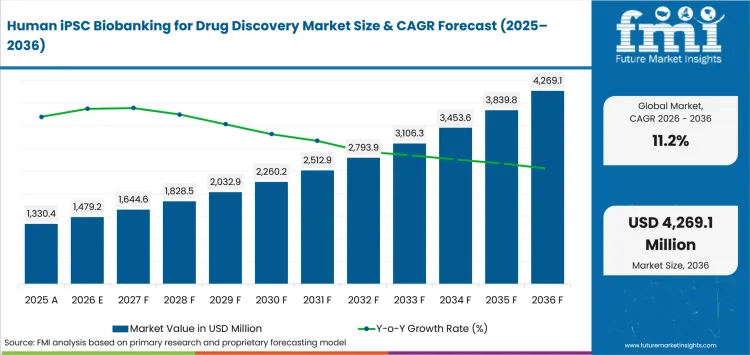
| Metric | Value |
|---|---|
| 2025 Market Size | USD 1,330.4 million |
| 2026 Market Size | USD 1,479.2 million |
| 2036 Market Size | USD 4,269.1 million |
| Forecast CAGR (2026-2036) | 11.2% |
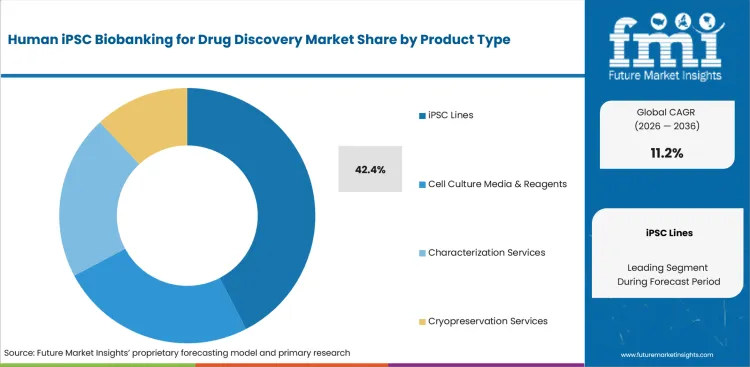
| Product Type Focus | iPSC Lines (42.4% share in 2026) |
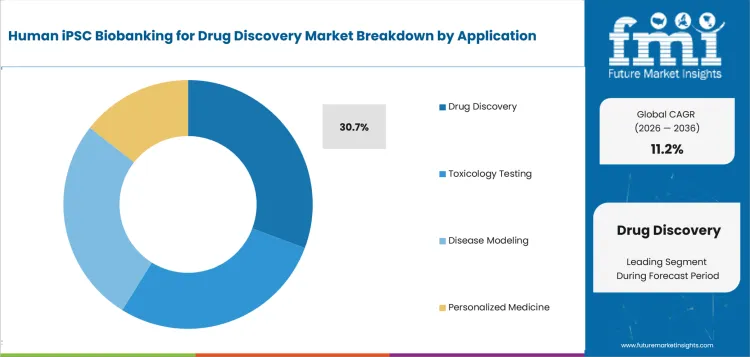
| Application Focus | Drug Discovery (30.7% share in 2026) |
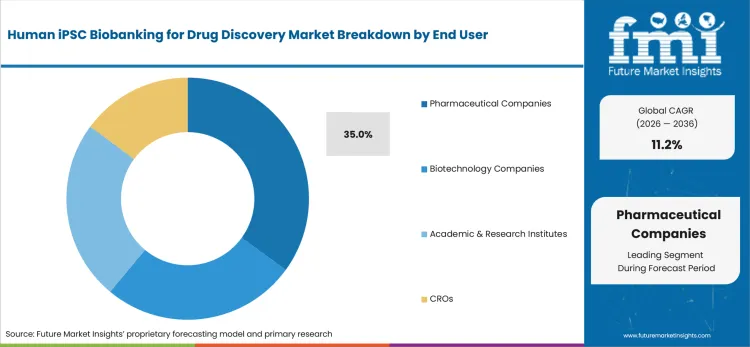
| End User Focus | Pharmaceutical Companies (35.0% share in 2026) |
Summary of the Human iPSC Biobanking for Drug Discovery Market
| Market Signal | Commercial Impact |
|---|---|
| Demand and Growth Drivers | Earlier compound decisions preserve scarce development capital and create spending on traceable human cell models across pharmaceutical programs.
|
| Product and Segment View | The commercial architecture combines cell inventory with characterization and storage services that preserve usable material across repeated studies.
|
| Geography and Growth Outlook | Country positions differ through repository access and validation pathways together with local service capacity for complex cell models.
|
| Competitive Landscape | Competition separates repository specialists from differentiated-cell manufacturers and integrated discovery organizations serving pharmaceutical research programs worldwide.
|
| Analyst Perspective | Commercial decisions must balance broad model access against the cost of proving reproducibility across every intended assay.
|
Source: FMI’s proprietary forecasting model and primary research
How is the human iPSC biobanking for drug discovery market segmented?
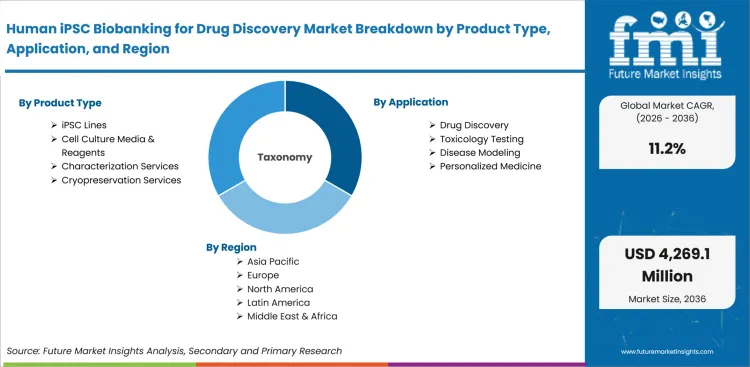
The human iPSC biobanking for drug discovery industry is segmented by product type, application, end user, cell source, and region.
Product type separates banked iPSC lines from supporting media and services used for characterization or cryopreservation. Application distinguishes drug discovery from toxicology testing together with disease modeling and personalized medicine programs using different endpoints. End user identifies pharmaceutical companies and biotechnology companies alongside academic institutes and contract research organizations with different purchasing responsibilities. Cell source separates healthy donor lines from disease-specific and gene-edited models together with patient-derived iPSCs for distinct biological comparisons. Regional analysis evaluates repository access and regulation together with service coverage and commercial research funding across national markets.
What supports demand for iPSC Lines within the Product Type category?
Research teams cannot compare compound responses reliably without a stable starting population and documented identity controls. In February 2024, NINDS required distributed repository lines to include sterility and recovery data alongside karyotype and identity records. The requirement also covers marker expression and pluripotency information that supports reproducible use across repeated studies. Standard cell culture media reduce avoidable expansion variation and improve assay transfers between participating laboratories.
- Within product type, iPSC lines are projected to account for 42.4% share in 2026 driven by their role as required starting material. Every differentiation protocol and disease model depends on a qualified line whose provenance remains connected with later results.
- Pharmaceutical research groups select banked iPSC lines to preserve donor permissions and genotype files across lengthy program handoffs. Linked passage histories and thaw records reduce model reconstruction risk during transfers between internal laboratories and external research partners using validated protocols.
How does Drug Discovery shape the Application category?
Drug discovery programs need human models that separate target biology from donor variation during early compound decisions. Ready-to-use differentiated cells shorten assay setup and preserve comparable material across extended pharmaceutical screening campaigns. In September 2024, FUJIFILM Cellular Dynamics introduced iPSC-derived sensory neurons for pain research and neurotoxicity evaluation worldwide. Researchers combine these cells with organoid models to examine tissue responses that simpler cultures cannot reproduce.
- Drug discovery is estimated to represent 30.7% of the application category in 2026 due to repeated screening across several development stages. Qualified models support target validation and efficacy testing across several programs and preserve material for later safety screening and biomarker development.
- Biotechnology companies adopt drug discovery models to compare disease-specific cells against healthy or isogenic controls during lead selection. The purchasing value comes from clearer biological discrimination and shorter preparation across repeated screening cycles within one portfolio and several therapeutic areas.
Why do Pharmaceutical Companies anchor the End User category?
Pharmaceutical companies must connect cell-model performance reliably with formal development decisions across several internal and external laboratories. Large portfolios also require dependable assay transfer and replacement material across therapeutic programs with different biological endpoints. Qualified preclinical CRO services reduce internal infrastructure demands and support comparable evidence across partner organizations. Central oversight also preserves documented method changes and replacement decisions across several therapeutic research programs worldwide.
- Pharmaceutical companies are forecast to hold 35.0% share within end user in 2026 propelled by repeated demand for validated models. In March 2026, the FDA described context of use and fit-for-purpose evidence as central principles for United States evaluation of non-animal methods.
- Translational and toxicology groups use external iPSC banks to avoid maintaining specialized reprogramming and cryogenic capacity internally. Adoption improves through service agreements that define assay transfer responsibilities and replacement criteria for failed production batches across several research programs and partner sites.
What makes Healthy Donor-derived iPSCs central to the Cell Source category?
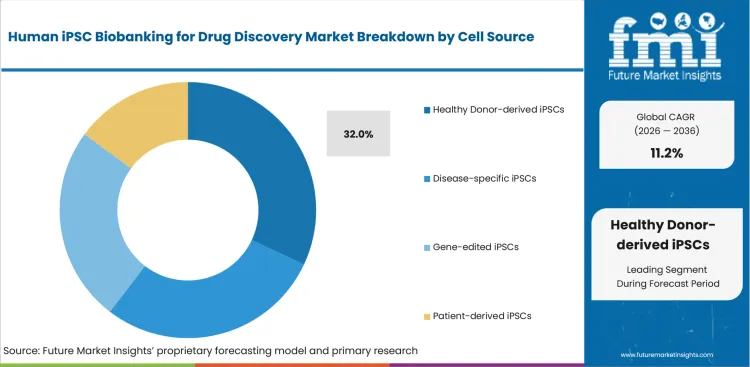
Disease models require a dependable baseline that separates pathological responses from ordinary donor variation across repeated experiments. Healthy controls become more useful through linked consent records and genomic files that remain accessible during distribution. Reliable cryopreservation systems protect stored material and support comparable thaw performance across participating research sites. Multi-donor panels also prevent one unusual genotype from defining every baseline response across a program.
- By cell source, healthy donor-derived iPSCs are likely to capture 32.0% share in 2026 owing to broad control applications. One qualified donor panel can support several differentiation workflows without introducing a disease mutation into every comparison across multiple therapeutic programs.
- Assay developers purchase healthy donor panels to measure baseline variability before adding patient-derived or gene-edited models. A July 2026 review of CiRA Foundation’s CFiS catalog confirmed five healthy donor iPSC clones for drug discovery with shipment within two weeks. Faster access reduces setup delays but licensing requirements can complicate cross-border use across commercial research programs.
What are the drivers, restraints, and opportunities in the human iPSC biobanking for drug discovery market?
Human-relevant drug models create demand; incomplete validation limits routine use; integrated bank-to-assay services create a practical opening for providers.
- Driver: Drug developers need reproducible human models that identify weak compounds during early testing and preserve capital for qualified development programs.
- Restraint: Variable differentiation and incomplete regulatory qualification can prevent a technically capable model from supporting formal decisions.
- Opportunity: Integrated banking and assay services can connect cell provenance with repeatable screening data across several research programs.
Weak compounds that survive early testing create substantial financial exposure across expensive pharmaceutical development stages. Human iPSC banks address that pressure through reusable genetic models that support repeated efficacy and toxicity comparisons. In April 2026, the FDA reported that more than 90% of drugs clearing animal studies historically failed to receive approval. Pharmaceutical teams respond by testing human-relevant evidence earlier through qualified cells and 3D culture plasticware. Banked models that remove an unsuitable candidate without schedule delays create a measurable basis for additional commercial spending.
Variable cell maturity limits adoption through functional responses that can change materially between otherwise comparable differentiation batches. Research groups therefore need acceptance criteria covering identity and phenotype together with assay performance across repeated production runs. A July 2024 Nature Communications study reported that quality and inter-batch consistency challenges reduced reproducibility for human iPSC-derived cardiomyocytes. Providers must document validated endpoints and batch limits so research sponsors can rely on one model across formal decisions.
Validated bank-to-assay services create an opening for providers that can connect cell provenance with repeatable screening evidence. Pharmaceutical sponsors need this continuity during transfers between repositories and external assay laboratories across multiyear programs. In November 2025, the United Kingdom published a national strategy supporting iPSCs for disease research and drug screening. The strategy also established a route for validation infrastructure that supports wider regenerative medicine methods. Service organizations capture value through documented protocols and clear responsibility for model replacement during failed transfers.
Which country CAGRs are profiled in the human iPSC biobanking for drug discovery market?
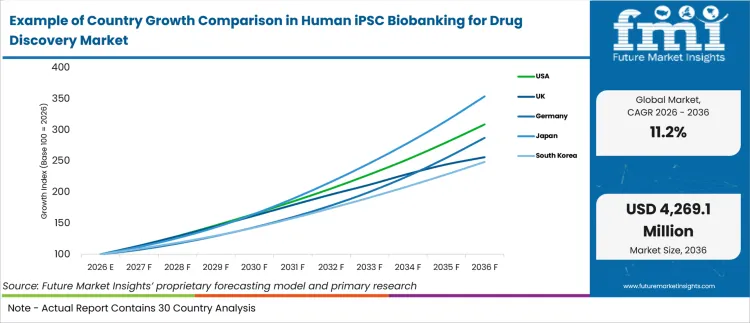
| Country | CAGR |
|---|---|
| USA | 11.9% |
| UK | 9.9% |
| Germany | 11.1% |
| Japan | 13.5% |
| South Korea | 9.5% |
How do country-level CAGRs compare in the human iPSC biobanking for drug discovery market?
Country-wise growth rates span 4.0 percentage points and form three commercially distinct bands. Japan remains separated from the United States by 1.6 percentage points across the forecast interval. The United States and Germany form a close middle pair with a 0.8-point difference. The United Kingdom and South Korea create another compressed pair with 0.4 point between their forecasts. The measured gaps describe forecast momentum rather than current market size or installed research capacity across the five profiles.
- Japan occupies the separated upper band through coordinated disease-specific research and academic access routes that support new model creation.
- The United States combines broad repository access with demanding fit-for-purpose evidence across regulated pharmaceutical development programs.
- Germany remains near the United States through established distribution infrastructure and formal validation requirements for alternative methods.
- The United Kingdom sits within the lower pair despite national collection services and a clearer policy route for non-animal methods.
- South Korea completes the compressed lower band through government-managed access that remains constrained by a smaller distributable catalog.
Similar CAGRs can produce different entry conditions through licensing terms and service distance across each national research system. Training capacity and validation expense can further separate purchasing plans among countries with comparable forecast momentum. The full report provides country-level CAGR analysis across North America, Latin America, Europe, East Asia, South Asia, Oceania and the Middle East and Africa.
Country-wise Analysis
- United States laboratories can obtain neurological disease models and healthy controls through established public repository channels. Demand for the human iPSC biobanking for drug discovery market in the USA is forecast to rise at 11.9% CAGR through 2036. A July 2026 review of NINDS resources confirmed disease-specific and healthy-control iPSC access through the federal repository system. California’s CIRM repository had closed during July 2025 and removed another public route for disease-specific line access. Federal resources enable broad research use but fragmented repository coverage can complicate replacement and service continuity. Commercial providers need domestic technical support and documentation that follows every line through differentiation and assay transfer.
- United Kingdom laboratories can combine authenticated culture collections with contract cell services and practical training routes. The UK human iPSC biobanking for drug discovery outlook is anticipated to advance at 9.9% CAGR over the assessment period. In March 2026, MHRA confirmed that medicine developers could discuss non-animal evidence during early regulatory engagement across the United Kingdom. National service capacity supports qualified material handling but regulatory acceptance remains specific to each medicine and proposed context. Entrants need local method-transfer support and licensing terms that cover commercial screening across partner laboratories.
- Germany provides an established distribution route through EBiSC stock held at Fraunhofer IBMT in Sulzbach. The German human iPSC biobanking for drug discovery sector is estimated to post 11.1% CAGR through 2036. A July 2026 review of EBiSC confirmed current distribution for academic and commercial researchers from its German stock center. In December 2025, BfR stated that reliable alternative methods must replace animal tests whenever suitable methods are available under German rules. Accredited cryobanking and common access terms enable research orders but incomplete validation restricts substitution for complex endpoints. Providers need local scientific partners and reproducibility files that support regulator-facing qualification across repeated assay transfers.
- Japanese research programs combine government funding with academic repositories that control quality and commercial access arrangements. Japan’s human iPSC biobanking for drug discovery outlook is anticipated to advance at 13.5% CAGR over the assessment period. In June 2025, AMED selected six projects from 45 applications for disease-specific iPSC research across Japan. The program supports locally relevant models for compound evaluation and personalized medicine programs across academic networks. Licensing and collaboration terms can differ across academic line owners and create material negotiation delays. Entrants need Japanese research partners and transparent permissions covering downstream screening use across commercial laboratories.
- South Korea distributes publicly banked human pluripotent lines through a government review process covering bioethics and safety. National infrastructure provides quality records and local access for laboratories combining public and proprietary cell models. Adoption of human iPSC biobanking for drug discovery in South Korea is estimated to expand at 9.5% CAGR through 2036. In March 2025, the Korea National Institute of Health reported 109 human iPSC lines and listed 41 for distribution in South Korea. The government route enables local access but the distributable catalog remains materially smaller than total holdings.
Who are the notable companies in the human iPSC biobanking for drug discovery market?
WiCell Research Institute, FUJIFILM Cellular Dynamics, Thermo Fisher Scientific, Lonza, Charles River Laboratories, Takara Bio, REPROCELL, Evotec, STEMCELL Technologies, and Axol Bioscience are notable companies shaping this market.
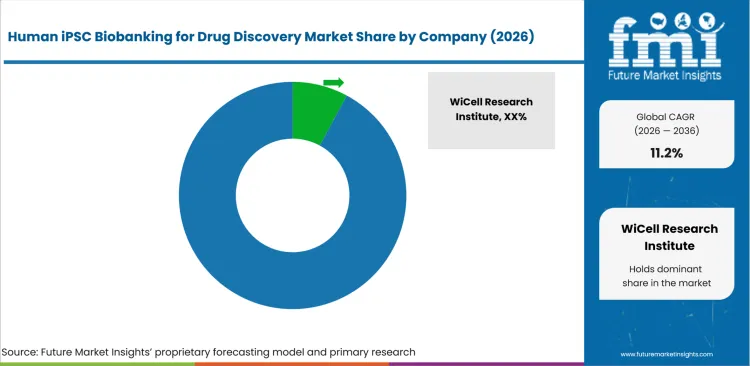
Competition separates repository specialists from differentiated-cell manufacturers and integrated discovery organizations serving pharmaceutical research programs. Repository providers compete through line diversity and documented provenance whereas model developers compete through cell maturity and assay readiness. A July 2026 review of WiCell’s catalog confirmed more than 1,500 diverse stem cell lines with banking and distribution services. FUJIFILM Cellular Dynamics pairs iPSC-derived research products with custom cell banking and development services for pharmaceutical programs. Integrated discovery groups add phenotypic screening and data interpretation around banked or newly generated models. Commercial selection therefore depends on exact workflow coverage and clearly assigned responsibility for technical exceptions during recurring studies.
- WiCell Research Institute supplies repository collections with quality documentation and FUJIFILM Cellular Dynamics combines iPSC lines with differentiated neurons and other research models. Their offers suit organizations seeking catalog access or broader development services across repeated compound studies.
- Thermo Fisher Scientific and Takara Bio support reprogramming and culture workflows and Lonza and REPROCELL provide generation or banking services. STEMCELL Technologies and Axol Bioscience add specialized media and differentiated cells for research assay preparation.
- Charles River Laboratories connects distributed iPSC materials with translational assays and Evotec operates integrated patient-derived discovery platforms. Integrated discovery organizations suit pharmaceutical sponsors that need compound screening and biological interpretation beyond cell acquisition across extended development programs.
Competitive Benchmarking: Human iPSC Biobanking for Drug Discovery Market
| Company | iPSC Line Supply | Differentiated Cell Models | Discovery Workflow Support | Geographic Reach |
|---|---|---|---|---|
| WiCell Research Institute | High | Low | Low | Global research distribution |
| FUJIFILM Cellular Dynamics | High | High | High | Global |
| Thermo Fisher Scientific | Medium | Medium | Medium | Global |
| Charles River Laboratories | Medium | High | High | Global |
| REPROCELL | High | High | High | North America, Europe, and Asia |
| Evotec | Low | High | High | North America and Europe |
| STEMCELL Technologies | High | High | Medium | Global |
| Axol Bioscience | High | High | High | North America and Europe |
Scoring basis: High line supply requires a broad available portfolio or custom banking service across active research geographies. Medium requires direct generation or distribution support and Low represents documented internal or narrow external access. High differentiated-cell capability requires several commercial lineages across multiple applications whereas Medium covers selected lineages and Low identifies a repository-centered commercial offer. High discovery workflow support requires integrated assays or compound screening across client programs whereas Medium covers selected services and Low reflects documented limits in external execution.
Key Developments in the Human iPSC Biobanking for Drug Discovery Market
- In April 2026, WiCell Research Institute: Two Parkinson’s disease collections entered the catalog with disease-relevant iPSC lines and matched isogenic or healthy controls. The centralized repository gives neuroscience teams a documented route for comparing variants across repeated compound studies. Researchers can order related materials through one catalog and preserve comparable provenance across continued screening work.
- In May 2026, FUJIFILM Cellular Dynamics: A 175,000-square-foot iPSC development and manufacturing facility opened in Madison with capacity expected to quadruple research products and services. Expanded culture and gene-editing capabilities support larger drug discovery programs alongside custom banking and process-development work. Pharmaceutical sponsors gain one service route for line creation and scaled material supply across extended studies.
- In February 2024, Charles River Laboratories: An agreement with Pluristyx expanded distribution of wild-type and genetically engineered iPSC lines for research use. The collaboration linked characterized pluripotent cells with translational cell-based assay services across Charles River’s United States research network. Drug developers can combine line acquisition with downstream model work through one commercial service relationship covering repeated research programs.
- In August 2024, Evotec: Progress in the neuroscience partnership with Bristol Myers Squibb produced a USD 25 million payment. The collaboration uses patient-derived disease models and integrated discovery capabilities across several neurodegenerative conditions and research stages.
Key Players in the Human iPSC Biobanking for Drug Discovery Market
Cell Bank and Line Providers
- WiCell Research Institute
- FUJIFILM Cellular Dynamics
- REPROCELL
- Axol Bioscience
Workflow and Manufacturing Providers
- Thermo Fisher Scientific
- Lonza
- Takara Bio
- STEMCELL Technologies
Integrated Discovery Service Providers
- Charles River Laboratories
- Evotec
Human iPSC Biobanking for Drug Discovery Market - Report Scope
| Coverage field | Report scope |
|---|---|
| Market breakdown | Product Type, Application, End User, Cell Source, and Region. |
| Quantitative Units | USD million |
| Market Definition | Products and services used to acquire or characterize human iPSC lines for specialized research programs. Scope also covers expansion and storage alongside distribution or differentiation within defined drug discovery workflows. |
| Regions Covered | North America, Latin America, Western Europe, Eastern Europe, East Asia, South Asia and Pacific, and Middle East and Africa. |
| Countries Covered | USA, UK, Germany, Japan, and South Korea, with wider regional coverage included in the complete report. |
| Key Companies Profiled | WiCell Research Institute, FUJIFILM Cellular Dynamics, Thermo Fisher Scientific, Lonza, Charles River Laboratories, Takara Bio, REPROCELL, Evotec, STEMCELL Technologies, and Axol Bioscience. |
| Forecast Period | 2026 to 2036. |
| Approach | Hybrid bottom-up and top-down market sizing supported by primary research and current official desk evidence. |
Human iPSC Biobanking for Drug Discovery Market - Research Methodology
| Method | Approach |
|---|---|
| Primary Research | FMI analysts gathered input from manufacturers, service providers, technology developers, distributors, end users, procurement teams, and subject-matter experts. Interviews examined purchasing decisions, product or service evaluation, adoption barriers, approval requirements, pricing considerations, and expectations for technical or commercial support. Respondents were also asked what evidence is required before a trial, pilot, or initial order develops into regular purchasing. |
| Desk Research | Desk research covered government statistics, regulatory publications, trade data, industry associations, technical literature, standards, company filings, product information, and official corporate announcements. Sources were reviewed for relevance, publication date, geographic coverage, and consistency with the defined market scope. Claims relating to performance, applications, approvals, capacity, investment, and commercial activity were retained only when supported by credible public evidence. |
| Market Sizing and Forecasting | The market model combined the baseline value with historical performance, segment structure, pricing and volume indicators, adoption levels, company participation, and country-level demand conditions. Forecast assumptions considered economic activity, investment trends, regulatory developments, technology adoption, purchasing cycles, supply availability, and barriers to wider market use. Segment and regional estimates were reconciled before the final market total was calculated. |
| Data Validation | Estimates were checked against multiple independent indicators, including public data, company activity, trade patterns, industry developments, and findings from primary interviews. Validation also tested whether products, services, applications, and company revenues fell within the defined market boundaries. Adjacent categories, unsupported claims, overlapping revenues, and activities without direct market relevance were excluded to reduce double counting and maintain consistency across segments and countries. |
Human iPSC Biobanking for Drug Discovery Market by Segments
Human iPSC Biobanking for Drug Discovery Market segmented by Product Type:
- iPSC Lines
- Cell Culture Media & Reagents
- Characterization Services
- Cryopreservation Services
Human iPSC Biobanking for Drug Discovery Market segmented by Application:
- Drug Discovery
- Toxicology Testing
- Disease Modeling
- Personalized Medicine
Human iPSC Biobanking for Drug Discovery Market segmented by End User:
- Pharmaceutical Companies
- Biotechnology Companies
- Academic & Research Institutes
- CROs
Human iPSC Biobanking for Drug Discovery Market segmented by Cell Source:
- Healthy Donor-derived iPSCs
- Disease-specific iPSCs
- Gene-edited iPSCs
- Patient-derived iPSCs
Human iPSC Biobanking for Drug Discovery Market by Region:
- North America
- United States
- Canada
- Latin America
- Brazil
- Mexico
- Argentina
- Chile
- Western Europe
- Germany
- France
- United Kingdom
- Italy
- Spain
- Benelux
- Nordics
- Eastern Europe
- Poland
- Czech Republic
- Romania
- Hungary
- East Asia
- China
- Japan
- South Korea
- South Asia and Pacific
- India
- ASEAN
- Australia and New Zealand
- Middle East and Africa
- GCC Countries
- South Africa
- Türkiye
- Israel
Research Sources and Bibliography
- USA Food and Drug Administration. (2025, April 10). FDA Announces Plan to Phase Out Animal Testing Requirement for Monoclonal Antibodies and Other Drugs.
- National Heart, Lung, and Blood Institute. (n.d.). iPSC Core.
- National Institute of Neurological Disorders and Stroke. (2024, February 1). NINDS Requirements for Induced Pluripotent Stem Cell Development and Resource Sharing.
- FUJIFILM Cellular Dynamics. (2024, September 10). FUJIFILM Cellular Dynamics Introduces Human iPSC-derived Sensory Neurons to Advance Pain Research.
- USA Food and Drug Administration. (2026, March 18). FDA Releases Draft Guidance on Alternatives to Animal Testing in Drug Development.
- CiRA Foundation. (n.d.). CFiS Series.
- USA Food and Drug Administration. (2026, April 20). FDA Achieves Year 1 Goals in Reducing Animal Testing in Drug Development.
- Prondzynski, M., Berkson, P., Trembley, M. A., Tharani, Y., Shani, K., Bortolin, R. H., Sweat, M. E., Mayourian, J., Yucel, D., Cordoves, A. M., Gabbin, B., Hou, C., Anyanwu, N. J., Nawar, F., Cotton, J., Milosh, J., Walker, D., Zhang, Y., Lu, F., ... Pu, W. T. (2024, July 15). Efficient and reproducible generation of human iPSC-derived cardiomyocytes and cardiac organoids in stirred suspension systems. Nature Communications, 15, 5929.
- Department for Science, Innovation and Technology, Home Office, & Department for Environment, Food & Rural Affairs. (2025, November 11). Replacing Animals in Science: A Strategy to Support the Development, Validation and Uptake of Alternative Methods.
- National Institute of Neurological Disorders and Stroke. (n.d.). Cell/Tissue/DNA.
- California Institute for Regenerative Medicine. (n.d.). iPSC Repository.
- Medicines and Healthcare products Regulatory Agency. (2026, March 25). MHRA Approach to Medicines Using Non-Animal Methods.
- European Bank for induced pluripotent Stem Cells. (n.d.). EBiSC iPSC Products and Services.
- German Federal Institute for Risk Assessment. (2025, December 9). Fragen und Antworten zu Tierversuchen, Alternativmethoden und Versuchstierzahlen [Questions and answers on animal experiments, alternative methods, and animal experiment numbers].
- Japan Agency for Medical Research and Development. (2025, June 17).[Selected FY2025 projects for disease elucidation and drug discovery using disease-specific iPS cells].
- Korea National Institute of Health. (2025, March 27). National Stem Cell Bank.
- WiCell Research Institute. (2026, April 3). WiCell Expands Stem Cell Catalog with New Parkinson’s Disease Collections.
- FUJIFILM Cellular Dynamics. (2026, May 19). FUJIFILM Cellular Dynamics Launches New iPSC Manufacturing Facility in Madison.
- Charles River Laboratories International, Inc. (2024, February 20). Charles River Collaborates with Pluristyx, Expanding Its Portfolio of Human Pluripotent Stem Cells.
- Evotec SE. (2024, August 8). Evotec Announces Progress in Strategic Neuroscience Partnership with Bristol Myers Squibb.
- WiCell Research Institute. (n.d.). Stem Cell Line Collections.
- Thermo Fisher Scientific. (n.d.). Induced Pluripotent Stem Cells (iPSCs).
- Lonza. (n.d.). Allogeneic Cell Therapy Manufacturing.
- Charles River Laboratories. (n.d.). Stem Cells for Drug Discovery.
- Takara Bio USA, Inc. (2023, September 14). What is included in the DEF-CS system?
- REPROCELL. (n.d.). iPSC Services.
- Evotec SE. (n.d.). iPSC Drug Discovery.
- STEMCELL Technologies. (n.d.). Human Induced Pluripotent Stem Cell Solutions.
- Axol Bioscience. (n.d.). Human iPSC-Derived Cells and Services.
This bibliography is provided for reader reference and is not exhaustive. The full report contains the complete reference list and detailed citations.
This Report Answers
- How large is the human iPSC biobanking for drug discovery market in 2026 and 2036?
- Which operating conditions support spending on qualified iPSC lines and related services?
- Why do iPSC lines hold the primary product type share during 2026?
- How does drug discovery influence demand for characterized and differentiated human cells?
- Why do pharmaceutical companies account for the principal end user position?
- How do country growth rates differ across the USA, UK, Germany, Japan, and South Korea?
- Which companies provide cell banks, differentiated models, or integrated discovery services?
- What prevents technically capable iPSC models from entering routine development decisions?
- Which service and validation conditions support long-term commercial use?
Frequently Asked Questions
What is driving growth in the Human iPSC Biobanking for Drug Discovery Market?
Drug developers increasingly use human-relevant cell models to reject weak compounds earlier and preserve development capital. Qualified iPSC banks support that decision through linked donor histories and repeatable assay performance across research programs.
Who are the key players in the Human iPSC Biobanking for Drug Discovery Market?
WiCell Research Institute and FUJIFILM Cellular Dynamics provide cell resources alongside specialized banking or differentiated research models. Charles River Laboratories and Evotec add assay development and screening services around iPSC-derived systems for pharmaceutical programs.
What notable restraint affects the Human iPSC Biobanking for Drug Discovery Market?
Variable differentiation maturity can weaken comparability between batches and prevent a model from supporting formal decisions. Providers must define stable identity and phenotype criteria that remain dependable through storage and assay transfer.
Why should executives track the Human iPSC Biobanking for Drug Discovery Market?
Human iPSC models can expose human genetic responses during early testing and preserve capital for qualified development stages. Executive oversight matters since licensing and validation costs often exceed the initial purchase price for stored cells.
What business problem does the Human iPSC Biobanking for Drug Discovery Market address?
Human iPSC biobanking addresses inconsistent access to traceable cell models across drug discovery laboratories and external partners. Qualified storage services preserve starting material so research groups avoid rebuilding the same biological system during every transfer.
What should pharmaceutical research leaders evaluate in the Human iPSC Biobanking for Drug Discovery Market?
Research leaders should compare donor documentation and genomic records alongside differentiation performance and assay reproducibility. They should also verify licensing rights and replacement terms prior to distributing one model across several research sites.
What limits return on investment in the Human iPSC Biobanking for Drug Discovery Market?
Low assay use and repeated batch failures can leave expensive banked inventory without measurable development value. Weak technical support also extends troubleshooting time and delays the compound decisions that justify recurring service spending.
What supports long-term commercial confidence in the Human iPSC Biobanking for Drug Discovery Market?
Documented provenance and consistent model performance support commercial confidence across repeated screening and translational studies. Clear responsibility for storage and replacement gives research organizations a dependable basis for expanding validated iPSC workflows.
Preview the report firsthand - request a free sample
Get SampleGet the brochure for pricing and purchase details.
Get PDFTable of Content
- Key Takeaways
- Market Size and CAGR
- Top Growth Driver
- Fastest Growing Segment
- Leading Region
- Key Companies
- Emerging Opportunities
- Executive Summary
- Global Market Outlook
- Demand-side Trends
- Supply-side Trends
- Technology Roadmap Analysis
- Analysis and Recommendations
- Analyst Perspective (What is happening? Why now? What should investors know?)
- Key Questions Answered
- How large is the market?
- What is the CAGR?
- What are key trends?
- Which region dominates?
- Who are the leaders?
- Market Overview
- Market Coverage / Taxonomy
- Market Definition / Scope / Limitations
- Research Methodology
- Chapter Orientation
- Analytical Lens and Working Hypotheses
- Market Structure, Signals, and Trend Drivers
- Benchmarking and Cross-market Comparability
- Market Sizing, Forecasting, and Opportunity Mapping
- Research Design and Evidence Framework
- Desk Research Programme (Secondary Evidence)
- Expert Input and Fieldwork (Primary Evidence)
- Tooling, Models, and Reference Databases
- Data Engineering and Model Build
- Quality Assurance and Audit Trail
- Market Background
- Market Dynamics (Drivers, Restraints, Opportunity, Trends)
- Scenario Forecast (Optimistic, Likely, Conservative)
- Impact Analysis
- AI Impact
- Sustainability Impact
- Regulatory Impact
- Technology Impact
- Consumer / Buyer Analysis
- Purchase Drivers
- Adoption Barriers
- Buyer Journey
- Opportunity Map Analysis
- Product Life Cycle Analysis
- Supply Chain Analysis
- Investment Feasibility Matrix
- Value Chain Analysis
- PESTLE and Porter's Analysis
- Regulatory Landscape
- Regional Parent Market Outlook
- Production and Consumption Statistics
- Import and Export Statistics
- Global Market Analysis and Forecast, 2021 to 2036
- Historical Market Size Value (USD Million) Analysis, 2021 to 2025
- Current and Future Market Size Value (USD Million) Projections, 2026 to 2036
- Y-o-Y Growth Trend Analysis
- Absolute $ Opportunity Analysis
- Global Market Pricing Analysis, 2021 to 2036
- Global Market Analysis and Forecast, By Product Type, 2021 to 2036
- Introduction / Key Findings
- Historical Market Size Value (USD Million) Analysis By Product Type, 2021 to 2025
- Current and Future Market Size Value (USD Million) Analysis and Forecast By Product Type, 2026 to 2036
- iPSC Lines
- Cell Culture Media & Reagents
- Characterization Services
- Cryopreservation Services
- iPSC Lines
- Y-o-Y Growth Trend Analysis By Product Type, 2021 to 2025
- Absolute $ Opportunity Analysis By Product Type, 2026 to 2036
- Global Market Analysis and Forecast, By Application, 2021 to 2036
- Introduction / Key Findings
- Historical Market Size Value (USD Million) Analysis By Application, 2021 to 2025
- Current and Future Market Size Value (USD Million) Analysis and Forecast By Application, 2026 to 2036
- Drug Discovery
- Toxicology Testing
- Disease Modeling
- Personalized Medicine
- Drug Discovery
- Y-o-Y Growth Trend Analysis By Application, 2021 to 2025
- Absolute $ Opportunity Analysis By Application, 2026 to 2036
- Global Market Analysis and Forecast, By End User, 2021 to 2036
- Introduction / Key Findings
- Historical Market Size Value (USD Million) Analysis By End User, 2021 to 2025
- Current and Future Market Size Value (USD Million) Analysis and Forecast By End User, 2026 to 2036
- Pharmaceutical Companies
- Biotechnology Companies
- Academic & Research Institutes
- CROs
- Pharmaceutical Companies
- Y-o-Y Growth Trend Analysis By End User, 2021 to 2025
- Absolute $ Opportunity Analysis By End User, 2026 to 2036
- Global Market Analysis and Forecast, By Cell Source, 2021 to 2036
- Introduction / Key Findings
- Historical Market Size Value (USD Million) Analysis By Cell Source, 2021 to 2025
- Current and Future Market Size Value (USD Million) Analysis and Forecast By Cell Source, 2026 to 2036
- Healthy Donor-derived iPSCs
- Disease-specific iPSCs
- Gene-edited iPSCs
- Patient-derived iPSCs
- Healthy Donor-derived iPSCs
- Y-o-Y Growth Trend Analysis By Cell Source, 2021 to 2025
- Absolute $ Opportunity Analysis By Cell Source, 2026 to 2036
- Global Market Analysis and Forecast, By Region, 2021 to 2036
- Introduction
- Historical Market Size Value (USD Million) Analysis By Region, 2021 to 2025
- Current Market Size Value (USD Million) Analysis and Forecast By Region, 2026 to 2036
- North America
- Latin America
- Western Europe
- Eastern Europe
- East Asia
- South Asia and Pacific
- Middle East & Africa
- Market Attractiveness Analysis By Region
- North America Market Analysis and Forecast, By Country, 2021 to 2036
- Historical Market Size Value (USD Million) Trend Analysis By Market Taxonomy, 2021 to 2025
- Market Size Value (USD Million) Forecast By Market Taxonomy, 2026 to 2036
- By Country
- USA
- Canada
- By Product Type
- By Application
- By End User
- By Cell Source
- By Country
- Market Attractiveness Analysis
- By Country
- By Product Type
- By Application
- By End User
- By Cell Source
- Key Takeaways
- Latin America Market Analysis and Forecast, By Country
- Historical Market Size Value (USD Million) Trend Analysis By Market Taxonomy, 2021 to 2025
- Market Size Value (USD Million) Forecast By Market Taxonomy, 2026 to 2036
- By Country
- Brazil
- Mexico
- Chile
- Rest of Latin America
- By Product Type
- By Application
- By End User
- By Cell Source
- By Country
- Market Attractiveness Analysis
- By Country
- By Product Type
- By Application
- By End User
- By Cell Source
- Key Takeaways
- Western Europe Market Analysis and Forecast, By Country
- Historical Market Size Value (USD Million) Trend Analysis By Market Taxonomy, 2021 to 2025
- Market Size Value (USD Million) Forecast By Market Taxonomy, 2026 to 2036
- By Country
- Germany
- UK
- Italy
- Spain
- France
- Nordic
- BENELUX
- Rest of Western Europe
- By Product Type
- By Application
- By End User
- By Cell Source
- By Country
- Market Attractiveness Analysis
- By Country
- By Product Type
- By Application
- By End User
- By Cell Source
- Key Takeaways
- Eastern Europe Market Analysis and Forecast, By Country
- Historical Market Size Value (USD Million) Trend Analysis By Market Taxonomy, 2021 to 2025
- Market Size Value (USD Million) Forecast By Market Taxonomy, 2026 to 2036
- By Country
- Russia
- Poland
- Hungary
- Balkan & Baltic
- Rest of Eastern Europe
- By Product Type
- By Application
- By End User
- By Cell Source
- By Country
- Market Attractiveness Analysis
- By Country
- By Product Type
- By Application
- By End User
- By Cell Source
- Key Takeaways
- East Asia Market Analysis and Forecast, By Country
- Historical Market Size Value (USD Million) Trend Analysis By Market Taxonomy, 2021 to 2025
- Market Size Value (USD Million) Forecast By Market Taxonomy, 2026 to 2036
- By Country
- China
- Japan
- South Korea
- By Product Type
- By Application
- By End User
- By Cell Source
- By Country
- Market Attractiveness Analysis
- By Country
- By Product Type
- By Application
- By End User
- By Cell Source
- Key Takeaways
- South Asia and Pacific Market Analysis and Forecast, By Country
- Historical Market Size Value (USD Million) Trend Analysis By Market Taxonomy, 2021 to 2025
- Market Size Value (USD Million) Forecast By Market Taxonomy, 2026 to 2036
- By Country
- India
- ASEAN
- Australia & New Zealand
- Rest of South Asia and Pacific
- By Product Type
- By Application
- By End User
- By Cell Source
- By Country
- Market Attractiveness Analysis
- By Country
- By Product Type
- By Application
- By End User
- By Cell Source
- Key Takeaways
- Middle East & Africa Market Analysis and Forecast, By Country
- Historical Market Size Value (USD Million) Trend Analysis By Market Taxonomy, 2021 to 2025
- Market Size Value (USD Million) Forecast By Market Taxonomy, 2026 to 2036
- By Country
- Kingdom of Saudi Arabia
- Other GCC Countries
- Türkiye
- South Africa
- Other African Union
- Rest of Middle East & Africa
- By Product Type
- By Application
- By End User
- By Cell Source
- By Country
- Market Attractiveness Analysis
- By Country
- By Product Type
- By Application
- By End User
- By Cell Source
- Key Takeaways
- Key Countries Market Analysis
- USA
- Pricing Analysis
- Market Share Analysis, 2025
- By Product Type
- By Application
- By End User
- By Cell Source
- Canada
- Pricing Analysis
- Market Share Analysis, 2025
- By Product Type
- By Application
- By End User
- By Cell Source
- Mexico
- Pricing Analysis
- Market Share Analysis, 2025
- By Product Type
- By Application
- By End User
- By Cell Source
- Brazil
- Pricing Analysis
- Market Share Analysis, 2025
- By Product Type
- By Application
- By End User
- By Cell Source
- Chile
- Pricing Analysis
- Market Share Analysis, 2025
- By Product Type
- By Application
- By End User
- By Cell Source
- Germany
- Pricing Analysis
- Market Share Analysis, 2025
- By Product Type
- By Application
- By End User
- By Cell Source
- UK
- Pricing Analysis
- Market Share Analysis, 2025
- By Product Type
- By Application
- By End User
- By Cell Source
- Italy
- Pricing Analysis
- Market Share Analysis, 2025
- By Product Type
- By Application
- By End User
- By Cell Source
- Spain
- Pricing Analysis
- Market Share Analysis, 2025
- By Product Type
- By Application
- By End User
- By Cell Source
- France
- Pricing Analysis
- Market Share Analysis, 2025
- By Product Type
- By Application
- By End User
- By Cell Source
- India
- Pricing Analysis
- Market Share Analysis, 2025
- By Product Type
- By Application
- By End User
- By Cell Source
- ASEAN
- Pricing Analysis
- Market Share Analysis, 2025
- By Product Type
- By Application
- By End User
- By Cell Source
- Australia & New Zealand
- Pricing Analysis
- Market Share Analysis, 2025
- By Product Type
- By Application
- By End User
- By Cell Source
- China
- Pricing Analysis
- Market Share Analysis, 2025
- By Product Type
- By Application
- By End User
- By Cell Source
- Japan
- Pricing Analysis
- Market Share Analysis, 2025
- By Product Type
- By Application
- By End User
- By Cell Source
- South Korea
- Pricing Analysis
- Market Share Analysis, 2025
- By Product Type
- By Application
- By End User
- By Cell Source
- Russia
- Pricing Analysis
- Market Share Analysis, 2025
- By Product Type
- By Application
- By End User
- By Cell Source
- Poland
- Pricing Analysis
- Market Share Analysis, 2025
- By Product Type
- By Application
- By End User
- By Cell Source
- Hungary
- Pricing Analysis
- Market Share Analysis, 2025
- By Product Type
- By Application
- By End User
- By Cell Source
- Kingdom of Saudi Arabia
- Pricing Analysis
- Market Share Analysis, 2025
- By Product Type
- By Application
- By End User
- By Cell Source
- Türkiye
- Pricing Analysis
- Market Share Analysis, 2025
- By Product Type
- By Application
- By End User
- By Cell Source
- South Africa
- Pricing Analysis
- Market Share Analysis, 2025
- By Product Type
- By Application
- By End User
- By Cell Source
- USA
- Market Structure Analysis
- Competition Dashboard
- Competition Benchmarking
- Market Share Analysis of Top Players
- By Regional
- By Product Type
- By Application
- By End User
- By Cell Source
- Emerging Startups
- Innovation Benchmarking
- Competition Analysis
- Competition Deep Dive
- WiCell Research Institute
- Overview
- Product Portfolio
- Profitability by Market Segments
- Sales Footprint
- Strategy Overview
- Marketing Strategy
- Product Strategy
- Channel Strategy
- FUJIFILM Cellular Dynamics
- Thermo Fisher Scientific
- Lonza
- Charles River Laboratories
- Takara Bio
- REPROCELL
- Evotec
- Stemcell Technologies
- Axol Bioscience
- WiCell Research Institute
- Case Studies
- Success Stories
- Recent Developments
- Competition Deep Dive
- Assumptions & Acronyms Used


