

- Market Size (2026)
- USD 1.1 Bn
- Forecast (2036)
- USD 3.0 Bn
- CAGR (2026 to 2036)
- 10.6%
How big is Hypothalamic Obesity Market in 2026?
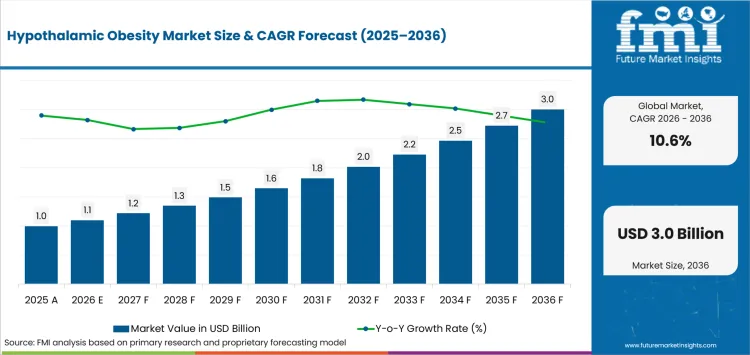
USD 1.1 billion in 2026 and USD 3.0 billion by 2036 at a 10.6% CAGR.
Sales in the hypothalamic obesity market are estimated to rise at a 10.6% CAGR through 2036. Valuation is projected to increase from USD 1.1 billion in 2026 to USD 3.0 billion by 2036. Market expansion is being shaped by the emergence of targeted therapies for a condition that has historically relied on supportive care and symptom management. The April 2026 DailyMed label reported that the pivotal program evaluated 142 patients, including 76 pediatric participants. The approval provides the first pathway-specific treatment option for a patient population historically managed through supportive interventions and symptom control. Use remains contingent on documented hypothalamic injury and ongoing clinical monitoring, placing diagnosis and follow-up at the center of treatment access.
Differences in referral networks and treatment infrastructure are now becoming more important than scientific eligibility alone. ClinicalTrials.gov recorded 28 TRANSCEND study locations in May 2026, including 16 sites in the United States and three in the United Kingdom. The broader USA site network increases opportunities for earlier diagnosis and treatment initiation following regulatory approval. In the United Kingdom, market uptake is more closely linked to NICE appraisal outcomes and available endocrine-service capacity. Treatment utilization depends as much on referral pathways and commissioning decisions as on regulatory authorization itself.
Key Takeaways
- Regulatory authorization gives specialist centers a disease-specific treatment route for patients with documented hypothalamic injury and persistent weight gain.
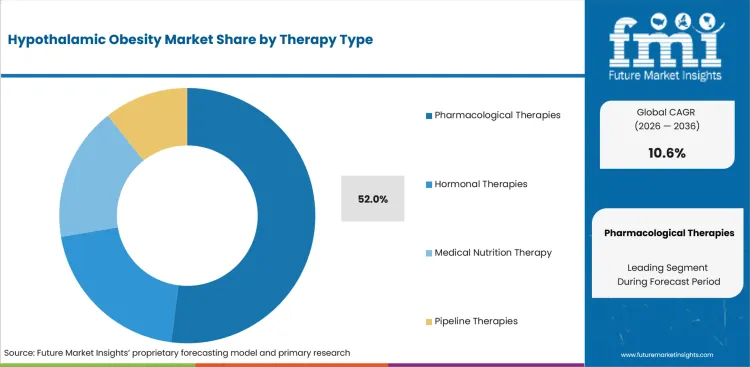
- Pharmacological therapies are projected to hold 52.0% by therapy type in 2026 owing to pathway-specific medicines and established supportive regimens.
- Pediatric patients are estimated to represent 61.0% of patient demand in 2026 due to childhood tumor treatment and extended endocrine follow-up.
- Oral therapies are forecast to account for 54.0% of route demand in 2026 as supportive medicines and oral pipeline candidates widen administration choice.
- Patient identification and reimbursement review delay treatment initiation even after regulators authorize a disease-specific medicine for long-term use.
- Rhythm Pharmaceuticals, Inc., LG Chem Ltd., Camurus AB, Novo Nordisk A/S, Eli Lilly and Company, Amgen Inc., Zealand Pharma A/S and Neurocrine Biosciences, Inc. form the profiled company set.
Analyst Perspective
"Commercial value depends on finding eligible patients before fragmented follow-up obscures their hypothalamic injury history. Manufacturers and providers should measure readiness through referral ownership, payer documentation and durable response tracking rather than product availability alone."
- Anurag Sharma, Principal Consultant, Future Market Insights
How is the hypothalamic obesity market segmented?
The hypothalamic obesity market is segmented by therapy type, patient type, route of administration, end user, distribution channel and region.
The hypothalamic obesity market covers pharmacological therapies, hormonal therapies, medical nutrition therapy and pipeline therapies across pediatric and adult patients. Route analysis distinguishes oral and injectable treatment while end users include hospitals, specialty clinics and home healthcare across the main care settings. Distribution channels cover hospital pharmacies, retail pharmacies and specialty pharmacies across the principal dispensing routes. Regional analysis spans North America, Latin America, Western Europe, Eastern Europe, East Asia, South Asia and Pacific, and the Middle East and Africa.
What supports demand for pharmacological therapies within the therapy type category?
Pharmacological treatment addresses disrupted appetite signaling and related metabolic complications that lifestyle programs rarely control alone. The April 2026 USA label describes a randomized trial involving 142 analyzed patients with acquired hypothalamic obesity. Clinical teams must separate pathway-specific response from the hormone replacement required for accompanying pituitary deficits.
- Based on therapy type, pharmacological therapies are projected to account for 52.0% in 2026 due to disease-specific MC4R treatment and established supportive medicines.
- Specialists combine MC4R therapy with supportive endocrine care based on injury records and pituitary testing. Rare neurological therapies remain relevant for associated conditions, but early response monitoring determines whether pathway-specific treatment continues.
How do pediatric patients shape demand within the patient type category?
Pediatric demand often begins after craniopharyngioma treatment damages hypothalamic appetite control and causes rapid weight gain during growth. The resulting obesity can complicate oncology recovery and requires coordinated surveillance across surgery, radiation and endocrine review. Early monitoring also helps clinical teams distinguish treatment response from continuing pituitary complications during development and puberty.
- In 2026, pediatric patients are expected to lead the patient type category with 61.0% share because early disease onset extends treatment exposure.
- In May 2026, Rhythm reported sustained BMI or BMI z-score reductions among ten pediatric patients treated for 2.5 years. Pediatric obesity management also requires caregiver education and reliable transfer into adult endocrinology.
What role does the oral route play within the route of administration category?
Oral regimens already support metabolic and endocrine care without injection training, while bivamelagon adds a pathway-directed oral candidate for acquired hypothalamic obesity. Daily dosing could simplify treatment calendars for families managing several medicines, but route convenience cannot replace evidence of durable response before routine prescribing.
- By route of administration, oral therapies are forecast to represent 54.0% in 2026 driven by familiar tablets and capsules used across long-term supportive care.
- The completed Phase 2 study used once-daily bivamelagon across specialist centers in North America and Europe. Wider use across peptide drug platforms depends on larger trials confirming comparative efficacy and long-term safety.
How do hospitals influence selection within the end-user category?
Hospitals connect neuro-oncology records with endocrine testing and nutritional assessment after hypothalamic injury. Referral centers also coordinate pituitary disorder treatment when several hormone deficits require parallel monitoring and medication adjustment. Centralized pharmacy support can shorten the interval between payer authorization and supervised treatment initiation.
- Hospitals are set to lead the end-user category with 44.0% share in 2026 due to multidisciplinary diagnosis and supervised treatment initiation.
- The European Medicines Agency requires prescribing and supervision by a physician with relevant expertise. Hospital teams therefore confirm eligibility and monitor early response before trained families continue treatment at home.
What are the drivers, restraints and opportunities in the Hypothalamic Obesity Market?
Disease-specific approval expands treatment demand while specialist capacity and reimbursement constrain conversion. Oral MC4R programs provide a lower-burden route for selected patients.
- Driver: Regulatory authorization converts documented hypothalamic injury into a defined treatment pathway for adults and children with persistent weight gain.
- Restraint: Patient identification plus reimbursement review can extend the interval between authorization and routine treatment at specialist centers.
- Opportunity: Oral MC4R programs and coordinated referral networks can reduce administration burden and identify eligible patients earlier.
Regulatory Approval Establishes a Defined Treatment Route
FDA and European authorization moved acquired hypothalamic obesity beyond fragmented symptom control. Hospitals must connect neuro-oncology records with specialist prescribing and hormone replacement therapy before eligible patients begin pathway-specific treatment. Commercial conversion therefore depends on case-finding rules and clear clinical ownership rather than approval alone.
Specialist Capacity and Reimbursement Limit Conversion
Regulatory approval does not settle reimbursement or assign referral ownership across pediatric and adult endocrine services. NICE scheduled committee review for October 2026 with final guidance expected in February 2027. Durable outcome evidence shapes payer review, and referral centers must coordinate records with growth hormone treatment across both care pathways.
Oral Programs and Referral Networks Expand Access
Oral MC4R development could reduce injection training for selected patients and simplify maintenance schedules. Rhythm reported in June 2026 that 26 bivamelagon participants completed at least 52 treatment weeks. Larger trials must establish comparative efficacy and safety before oral administration converts into routine prescribing.
Which country CAGRs are profiled in the Hypothalamic Obesity Market?
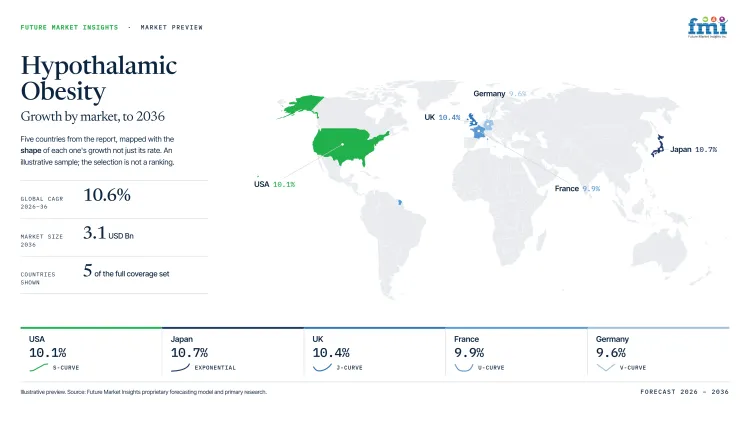
| Country | CAGR |
|---|---|
| Japan | 10.7% |
| United Kingdom | 10.4% |
| United States | 10.1% |
| France | 9.9% |
| Germany | 9.6% |
How do country-level CAGRs compare in the Hypothalamic Obesity Market?
The five-country range spans 1.1 percentage points and reflects access timing rather than current market size. Regulatory status is increasingly shared, yet reimbursement and referral capacity create different conversion paths.
- Japan's forecast reflects MHLW marketing authorization granted in August 2026, which was supported by a concentrated network of specialist centers with trial experience.
- The United Kingdom follows a defined appraisal route, although national commissioning depends on NICE's final recommendation.
- The United States combines legal prescribing with national specialty distribution, while payer authorization remains case specific.
- France uses an early-access pathway alongside European authorization, which reduces delay for eligible patients under expert care.
- Germany brings trial-site experience but still requires coordinated reimbursement and referral across university endocrine networks.
Comparable CAGRs can produce different market entry conditions. The full report provides country-level CAGR analysis across North America, Latin America, Europe, East Asia, South Asia and Pacific, and the Middle East and Africa.
Country-wise Analysis
- Japan's MHLW granted marketing authorization for IMCIVREE in August 2026, supported by a twelve-patient national cohort that gave specialist centers direct experience with eligibility assessment and long-term monitoring across pediatric and adult endocrine services. Rhythm reported in May 2026 that the accepted application included those participants within the broader Phase 3 evidence package for acquired hypothalamic obesity. Japan's hypothalamic obesity outlook is anticipated to advance at 10.7% CAGR over the assessment period, reinforced by local trial experience and a granted marketing authorization, but dependent on reimbursement and specialty-pharmacy support beyond the centers that generated the evidence.
- British centers in Birmingham, Cambridge and London participated in the completed bivamelagon study and gained direct experience with patient selection across specialist endocrine services. NICE confirmed in March 2026 that its appraisal remained active with committee review scheduled for October 2026 and final guidance expected in February 2027. Adoption of hypothalamic obesity treatment in the United Kingdom is estimated to expand at 10.4% CAGR through 2036, reinforced by trial participation but constrained by commissioned endocrine capacity and patient support logistics across regional hospital networks.
- United States clinicians gained a legal prescribing route in March 2026 for adults and children aged four years or older with acquired hypothalamic obesity. The April 2026 DailyMed label reports that 76 pediatric participants contributed to the pivotal randomized trial supporting the indication. The United States hypothalamic obesity sector is projected to record 10.1% CAGR during the assessment period, supported by national specialty distribution but constrained by case-specific prior authorization and incomplete injury records across regulated obesity care.
- French specialists can use an early-access pathway for adults and children aged six years or older with confirmed hypothalamic lesions under expert supervision. Haute Autorité de Santé renewed the authorization in January 2026 and updated the record in June following European marketing authorization for acquired hypothalamic obesity. Hypothalamic obesity treatment sales in France are forecast to expand at 9.9% CAGR by 2036, aided by specialist infrastructure but constrained by national reimbursement and coordination between hospital pharmacies and long-term endocrine services across pediatric and adult care.
- German university hospitals contributed four locations to the completed Phase 3 setmelanotide study and gained direct experience with eligibility assessment across pediatric and adult services. ClinicalTrials.gov posted final results in May 2026 and identifies centers in Hamburg, Munich, Oldenburg and Ulm within the national trial network. Germany is estimated to post 9.6% CAGR over the forecast period, shaped by trial experience but dependent on national access terms and consistent referral ownership during transition from pediatric into adult endocrinology.
Who are the notable companies in the Hypothalamic Obesity Market?
Rhythm Pharmaceuticals, Inc., LG Chem Ltd., Camurus AB, Novo Nordisk A/S, Eli Lilly and Company, Amgen Inc., Zealand Pharma A/S and Neurocrine Biosciences, Inc. are the companies profiled in this market.
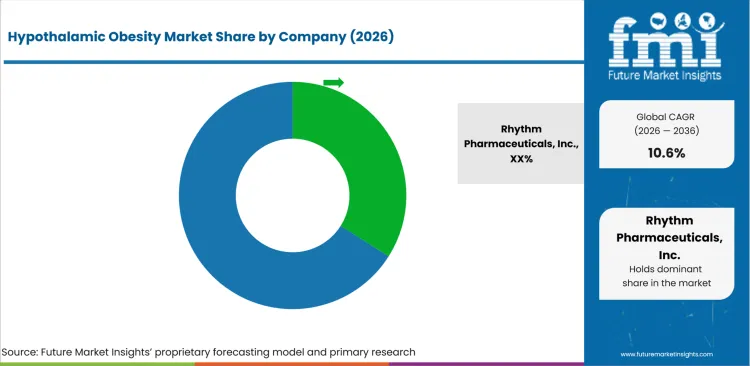
Competition remains concentrated as Rhythm controls the approved exact-market medicine and two advanced follow-on routes. LG Chem and Camurus contribute licensed molecule or delivery technology, whereas broader obesity companies compete through peptide development and multinational trials. Entry across orphan medicine commercialization requires exact-indication evidence plus referral support and reimbursement capability rather than general obesity scale alone.
- Rhythm Pharmaceuticals combines approved setmelanotide with oral bivamelagon and weekly RM-718 programs for acquired hypothalamic obesity.
- LG Chem originated bivamelagon and Camurus supplies long-acting formulation technology under licensing arrangements with Rhythm Pharmaceuticals.
- Novo Nordisk, Eli Lilly, Amgen and Zealand Pharma bring adjacent obesity portfolios with multinational development capacity. Neurocrine Biosciences adds rare-hyperphagia commercialization experience through its Soleno subsidiary within specialist endocrine care.
Competitive Benchmarking: Hypothalamic Obesity Market
| Company | Exact-Market Evidence | Obesity or MC4R Program Breadth | Rare-Disease Commercialization | Geographic Reach |
|---|---|---|---|---|
| Rhythm Pharmaceuticals, Inc. | High | High | High | Global |
| LG Chem Ltd. | Medium | Medium | Low | Asia and global licensing |
| Camurus AB | Medium | Medium | Medium | Europe and global licensing |
| Novo Nordisk A/S | Low | High | High | Global |
| Eli Lilly and Company | Low | High | Medium | Global |
| Amgen Inc. | Low | Medium | Medium | Global |
| Zealand Pharma A/S | Low | High | Medium | Europe and North America |
| Neurocrine Biosciences, Inc. | Low | Low | High | United States-led |
Key Developments in the Hypothalamic Obesity Market
- In July 2026, Rhythm Pharmaceuticals announced publication of Phase 3 TRANSCEND results in The New England Journal of Medicine for acquired hypothalamic obesity.
- In May 2026, Rhythm Pharmaceuticals received European Commission authorization for IMCIVREE in adults and children aged four years or older with acquired hypothalamic obesity.
- In March 2026, Rhythm Pharmaceuticals received FDA approval for IMCIVREE in adults and children aged four years or older with acquired hypothalamic obesity.
Key Players in the Hypothalamic Obesity Market
Direct and Licensed MC4R Programs
- Rhythm Pharmaceuticals, Inc.
- LG Chem Ltd.
- Camurus AB
Global Obesity Platforms
- Novo Nordisk A/S
- Eli Lilly and Company
- Amgen Inc.
- Zealand Pharma A/S
Rare Hyperphagia Commercial Platform
- Neurocrine Biosciences, Inc.
Hypothalamic Obesity Market - Report Scope
| Coverage field | Report scope |
|---|---|
| Market breakdown | By therapy type, patient type, route of administration, end user, distribution channel and region. |
| Quantitative Units | Revenue in USD billion and CAGR in %. |
| Market Definition | Therapies and care pathways used to treat and monitor hypothalamic obesity across approved, supportive and pipeline categories. |
| Regions Covered | North America, Latin America, Europe, East Asia, South Asia and Pacific, and Middle East and Africa. |
| Countries Covered | Japan, United Kingdom, United States, France, Germany, and 20+ countries included in the full report. |
| Key Companies Profiled | Rhythm Pharmaceuticals, Inc., LG Chem Ltd., Camurus AB, Novo Nordisk A/S, Eli Lilly and Company, Amgen Inc., Zealand Pharma A/S and Neurocrine Biosciences, Inc. |
| Forecast Period | 2026 to 2036. |
| Approach | Primary and secondary research with market triangulation. |
Hypothalamic Obesity Market - Research Methodology
| Method | Approach |
|---|---|
| Primary Research | FMI analysts gathered input from manufacturers, service providers, technology developers, distributors, end users, procurement teams, and subject-matter experts. Interviews examined purchasing decisions, product or service evaluation, adoption barriers, approval requirements, pricing considerations, and expectations for technical or commercial support. Respondents were also asked what evidence is required before a trial, pilot, or initial order develops into regular purchasing. |
| Desk Research | Desk research covered government statistics, regulatory publications, trade data, industry associations, technical literature, standards, company filings, product information, and official corporate announcements. Sources were reviewed for relevance, publication date, geographic coverage, and consistency with the defined market scope. Claims relating to performance, applications, approvals, capacity, investment, and commercial activity were retained only when supported by credible public evidence. |
| Market Sizing and Forecasting | The market model combined the baseline value with historical performance, segment structure, pricing and volume indicators, adoption levels, company participation, and country-level demand conditions. Forecast assumptions considered economic activity, investment trends, regulatory developments, technology adoption, purchasing cycles, supply availability, and barriers to wider market use. Segment and regional estimates were reconciled before the final market total was calculated. |
| Data Validation | Estimates were checked against multiple independent indicators, including public data, company activity, trade patterns, industry developments, and findings from primary interviews. Validation also tested whether products, services, applications, and company revenues fell within the defined market boundaries. Adjacent categories, unsupported claims, overlapping revenues, and activities without direct market relevance were excluded to reduce double counting and maintain consistency across segments and countries. |
Hypothalamic Obesity Market by Segments
Hypothalamic Obesity Market segmented by Therapy Type:
- Pharmacological Therapies
- GLP-1 Receptor Agonists
- Melanocortin Receptor Agonists
- Central Nervous System Stimulants
- Hormonal Therapies
- Growth Hormone Therapy
- Thyroid Hormone Replacement
- Corticosteroid Management
- Medical Nutrition Therapy
- Dietary Management
- Clinical Nutrition Support
- Personalized Nutrition Programs
- Pipeline Therapies
- Oral MC4R Agonists
- Combination Metabolic Therapies
- Gene-Based Therapeutics
Hypothalamic Obesity Market segmented by Patient Type:
- Pediatric Patients
- Craniopharyngioma-associated Hypothalamic Obesity
- Post-surgical Hypothalamic Obesity
- Radiation-induced Hypothalamic Obesity
- Adult Patients
- Acquired Hypothalamic Obesity
- Tumor-associated Hypothalamic Obesity
- Endocrine Disorder-associated Obesity
Hypothalamic Obesity Market segmented by Route of Administration:
- Oral
- Tablets
- Capsules
- Modified-release Formulations
- Injectable
- Subcutaneous Injection
- Intravenous Therapy
- Long-acting Injectable Therapies
Hypothalamic Obesity Market segmented by End User:
- Hospitals
- Pediatric Hospitals
- Endocrinology Departments
- Tertiary Care Hospitals
- Specialty Clinics
- Pediatric Endocrinology Clinics
- Obesity Management Centers
- Rare Disease Clinics
- Home Healthcare
- Remote Patient Monitoring
- Nutritional Counseling
- Long-term Disease Management
Hypothalamic Obesity Market segmented by Distribution Channel:
- Hospital Pharmacies
- Inpatient Pharmacies
- Outpatient Hospital Pharmacies
- Rare Disease Drug Distribution
- Retail Pharmacies
- Chain Pharmacies
- Independent Pharmacies
- Specialty Retail Pharmacies
- Specialty Pharmacies
- Biologics Distribution
- Cold Chain Distribution
- Home Delivery Services
Hypothalamic Obesity Market by Region:
- North America
- United States
- Canada
- Mexico
- Latin America
- Brazil
- Chile
- Rest of Latin America
- Western Europe
- Germany
- United Kingdom
- Italy
- Spain
- France
- Nordics
- Benelux
- Rest of Western Europe
- Eastern Europe
- Russia
- Poland
- Hungary
- Balkan and Baltic States
- Rest of Eastern Europe
- East Asia
- China
- Japan
- South Korea
- South Asia and Pacific
- India
- ASEAN
- Australia and New Zealand
- Rest of South Asia and Pacific
- Middle East and Africa
- Kingdom of Saudi Arabia
- Other GCC Countries
- Türkiye
- South Africa
- Other African Union Countries
- Rest of Middle East and Africa
Research Sources and Bibliography
- DailyMed. (2026, April 1). IMCIVREE- setmelanotide solution.
- ClinicalTrials.gov. (2026, May 29). A Trial of Setmelanotide in Acquired Hypothalamic Obesity.
- Rhythm Pharmaceuticals, Inc. (2026, May 4). Rhythm Pharmaceuticals Announces New Data Presentations in Acquired Hypothalamic Obesity at Pediatric Endocrine Society.
- ClinicalTrials.gov. (2026, February 12). A Study to Assess Efficacy and Safety of LB54640 in Patients With Hypothalamic Obesity.
- European Medicines Agency. (2026, May 27). Imcivree.
- National Institute for Health and Care Excellence. (2026, March 13). Setmelanotide for treating acquired hypothalamic obesity in people 4 years and over [ID6542].
- Rhythm Pharmaceuticals, Inc. (2026, June 15). Rhythm Pharmaceuticals Announces Multiple New Data Presentations from MC4R Agonists in Acquired Hypothalamic Obesity (HO), Bardet-Biedl Syndrome (BBS) and Prader-Willi Syndrome (PWS) at ENDO 2026.
- Rhythm Pharmaceuticals, Inc. (2026, May 5). Rhythm Pharmaceuticals Reports First Quarter 2026 Financial Results and Business Update.
- Haute Autorité de Santé. (2026, January 26). IMCIVREE (setmélanotide) - Obésité et contrôle de la faim - Adultes et enfants 6 ans et plus.
- Rhythm Pharmaceuticals, Inc. (2024, January 4). Rhythm Pharmaceuticals and LG Chem Life Sciences Enter Agreement for Rhythm to Acquire Global Rights to Oral MC4R Agonist LB54640.
- Camurus AB. (2026, April 29). Camurus Annual Report for 2025.
- Novo Nordisk A/S. (2026, February 4). Novo Nordisk has published its annual report for 2025.
- Eli Lilly and Company. (2026, February 12). 2025 Annual Report.
- Amgen Inc. (2026, March 31). Chairman and CEO Letter and Amgen Inc. 2025 Annual Report.
- Zealand Pharma A/S. (2026, February 19). Annual Report for 2025.
- Neurocrine Biosciences, Inc. (2026, May 18). Neurocrine Biosciences Completes Acquisition of Soleno Therapeutics.
- Rhythm Pharmaceuticals, Inc. (2026, July 8). Rhythm Pharmaceuticals Announces The New England Journal of Medicine Publication of Phase 3 TRANSCEND Trial Results in Acquired Hypothalamic Obesity.
- Rhythm Pharmaceuticals, Inc. (2026, May 1). Rhythm Pharmaceuticals Announces IMCIVREE® (Setmelanotide) Granted Marketing Authorization by European Commission for the Treatment of Obesity and Control of Hunger in Patients with Acquired Hypothalamic Obesity.
- Rhythm Pharmaceuticals, Inc. (2026, March 19). Rhythm Pharmaceuticals Announces FDA Approval of IMCIVREE® (setmelanotide) for Patients with Acquired Hypothalamic Obesity.
This bibliography is provided for reader reference and is not exhaustive. The full report contains the complete reference list and detailed citations
This Report Answers
- How large is the hypothalamic obesity market in 2026 and 2036?
- Which regulatory changes establish a disease-specific treatment pathway?
- Why do pharmacological therapies hold the leading therapy share?
- How do pediatric care requirements shape patient demand?
- How do oral and injectable routes affect administration planning?
- Which national access conditions explain country CAGR differences?
- What delays conversion from authorization into routine treatment?
- Which companies provide direct, licensed or adjacent commercial capabilities?
Frequently Asked Questions
How big is the Hypothalamic Obesity Market in 2026?
USD 1.1 billion is the estimated 2026 value of the global Hypothalamic Obesity Market across assessed regions. Disease-specific approval gives specialist centers a defined treatment route, although patient identification and reimbursement review determine how quickly eligible adults and children enter monitored long-term care.
What is the CAGR of the Hypothalamic Obesity Market from 2026 to 2036?
The Hypothalamic Obesity Market is projected to expand at a 10.6% CAGR from 2026 to 2036. Market value is forecast to reach USD 3.0 billion by 2036 as approved treatment pathways develop, although reimbursement timing and specialist capacity determine how quickly eligible patients enter sustained care.
Which therapy type is projected to account for 52.0% of the Hypothalamic Obesity Market?
Pharmacological therapies are projected to account for 52.0% of the Hypothalamic Obesity Market in 2026. These therapies address disrupted appetite signaling and associated endocrine complications, while specialist teams use injury records and clinical monitoring to confirm eligibility and maintain treatment over time.
Which patient type is projected to account for 61.0% of the Hypothalamic Obesity Market?
Pediatric patients are estimated to represent 61.0% of the Hypothalamic Obesity Market in 2026. Childhood tumors and their treatment can injure appetite-control pathways, so oncology and endocrine teams coordinate long-term surveillance with structured caregiver training and planned transition into adult services.
Which companies are active in the Hypothalamic Obesity Market?
Eight companies form the profiled set for the global Hypothalamic Obesity Market in 2026. Rhythm Pharmaceuticals has verified direct commercial activity, while LG Chem and Camurus contribute licensed exact-market roles. Novo Nordisk, Eli Lilly, Amgen, Zealand Pharma and Neurocrine Biosciences provide adjacent obesity or rare-hyperphagia capabilities.
Preview the report firsthand - request a free sample
Get SampleGet the brochure for pricing and purchase details.
Get PDFTable of Content
- Key Takeaways
- Market Size and CAGR
- Top Growth Driver
- Fastest Growing Segment
- Leading Region
- Key Companies
- Emerging Opportunities
- Executive Summary
- Global Market Outlook
- Demand-side Trends
- Supply-side Trends
- Technology Roadmap Analysis
- Analysis and Recommendations
- Analyst Perspective (What is happening? Why now? What should investors know?)
- Key Questions Answered
- How large is the market?
- What is the CAGR?
- What are key trends?
- Which region dominates?
- Who are the leaders?
- Market Overview
- Market Coverage / Taxonomy
- Market Definition / Scope / Limitations
- Research Methodology
- Chapter Orientation
- Analytical Lens and Working Hypotheses
- Market Structure, Signals, and Trend Drivers
- Benchmarking and Cross-market Comparability
- Market Sizing, Forecasting, and Opportunity Mapping
- Research Design and Evidence Framework
- Desk Research Programme (Secondary Evidence)
- Expert Input and Fieldwork (Primary Evidence)
- Tooling, Models, and Reference Databases
- Data Engineering and Model Build
- Quality Assurance and Audit Trail
- Market Background
- Market Dynamics (Drivers, Restraints, Opportunity, Trends)
- Scenario Forecast (Optimistic, Likely, Conservative)
- Impact Analysis
- AI Impact
- Sustainability Impact
- Regulatory Impact
- Technology Impact
- Consumer / Buyer Analysis
- Purchase Drivers
- Adoption Barriers
- Buyer Journey
- Opportunity Map Analysis
- Product Life Cycle Analysis
- Supply Chain Analysis
- Investment Feasibility Matrix
- Value Chain Analysis
- PESTLE and Porter's Analysis
- Regulatory Landscape
- Regional Parent Market Outlook
- Production and Consumption Statistics
- Import and Export Statistics
- Global Market Analysis and Forecast, 2021 to 2036
- Historical Market Size Value (USD Billion) Analysis, 2021 to 2025
- Current and Future Market Size Value (USD Billion) Projections, 2026 to 2036
- Y-o-Y Growth Trend Analysis
- Absolute $ Opportunity Analysis
- Global Market Pricing Analysis, 2021 to 2036
- Global Market Analysis and Forecast, By Therapy Type, 2021 to 2036
- Introduction / Key Findings
- Historical Market Size Value (USD Billion) Analysis By Therapy Type, 2021 to 2025
- Current and Future Market Size Value (USD Billion) Analysis and Forecast By Therapy Type, 2026 to 2036
- Pharmacological Therapies
- GLP-1 Receptor Agonists
- Melanocortin Receptor Agonists
- Central Nervous System Stimulants
- Hormonal Therapies
- Growth Hormone Therapy
- Thyroid Hormone Replacement
- Corticosteroid Management
- Medical Nutrition Therapy
- Dietary Management
- Clinical Nutrition Support
- Personalized Nutrition Programs
- Pipeline Therapies
- MC4R Agonists
- Combination Metabolic Therapies
- Gene-based Therapeutics
- Pharmacological Therapies
- Y-o-Y Growth Trend Analysis By Therapy Type, 2021 to 2025
- Absolute $ Opportunity Analysis By Therapy Type, 2026 to 2036
- Global Market Analysis and Forecast, By Patient Type, 2021 to 2036
- Introduction / Key Findings
- Historical Market Size Value (USD Billion) Analysis By Patient Type, 2021 to 2025
- Current and Future Market Size Value (USD Billion) Analysis and Forecast By Patient Type, 2026 to 2036
- Pediatric Patients
- Craniopharyngioma-associated Hypothalamic Obesity
- Post-surgical Hypothalamic Obesity
- Radiation-induced Hypothalamic Obesity
- Adult Patients
- Acquired Hypothalamic Obesity
- Tumor-associated Hypothalamic Obesity
- Endocrine Disorder-associated Obesity
- Pediatric Patients
- Y-o-Y Growth Trend Analysis By Patient Type, 2021 to 2025
- Absolute $ Opportunity Analysis By Patient Type, 2026 to 2036
- Global Market Analysis and Forecast, By Route of Administration, 2021 to 2036
- Introduction / Key Findings
- Historical Market Size Value (USD Billion) Analysis By Route of Administration, 2021 to 2025
- Current and Future Market Size Value (USD Billion) Analysis and Forecast By Route of Administration, 2026 to 2036
- Oral
- Tablets
- Capsules
- Modified-release Formulations
- Injectable
- Subcutaneous Injection
- Intravenous Therapy
- Long-acting Injectable Therapies
- Oral
- Y-o-Y Growth Trend Analysis By Route of Administration, 2021 to 2025
- Absolute $ Opportunity Analysis By Route of Administration, 2026 to 2036
- Global Market Analysis and Forecast, By End User, 2021 to 2036
- Introduction / Key Findings
- Historical Market Size Value (USD Billion) Analysis By End User, 2021 to 2025
- Current and Future Market Size Value (USD Billion) Analysis and Forecast By End User, 2026 to 2036
- Hospitals
- Pediatric Hospitals
- Endocrinology Departments
- Tertiary Care Hospitals
- Specialty Clinics
- Pediatric Endocrinology Clinics
- Obesity Management Centers
- Rare Disease Clinics
- Home Healthcare
- Remote Patient Monitoring
- Nutritional Counseling
- Long-term Disease Management
- Hospitals
- Y-o-Y Growth Trend Analysis By End User, 2021 to 2025
- Absolute $ Opportunity Analysis By End User, 2026 to 2036
- Global Market Analysis and Forecast, By Distribution Channel, 2021 to 2036
- Introduction / Key Findings
- Historical Market Size Value (USD Billion) Analysis By Distribution Channel, 2021 to 2025
- Current and Future Market Size Value (USD Billion) Analysis and Forecast By Distribution Channel, 2026 to 2036
- Hospital Pharmacies
- Inpatient Pharmacies
- Outpatient Hospital Pharmacies
- Rare Disease Drug Distribution
- Retail Pharmacies
- Chain Pharmacies
- Independent Pharmacies
- Specialty Retail Pharmacies
- Specialty Pharmacies
- Biologics Distribution
- Cold Chain Distribution
- Home Delivery Services
- Hospital Pharmacies
- Y-o-Y Growth Trend Analysis By Distribution Channel, 2021 to 2025
- Absolute $ Opportunity Analysis By Distribution Channel, 2026 to 2036
- Global Market Analysis and Forecast, By Region, 2021 to 2036
- Introduction
- Historical Market Size Value (USD Billion) Analysis By Region, 2021 to 2025
- Current Market Size Value (USD Billion) Analysis and Forecast By Region, 2026 to 2036
- North America
- Latin America
- Western Europe
- Eastern Europe
- East Asia
- South Asia and Pacific
- Middle East & Africa
- Market Attractiveness Analysis By Region
- North America Market Analysis and Forecast, By Country, 2021 to 2036
- Historical Market Size Value (USD Billion) Trend Analysis By Market Taxonomy, 2021 to 2025
- Market Size Value (USD Billion) Forecast By Market Taxonomy, 2026 to 2036
- By Country
- USA
- Canada
- By Therapy Type
- By Patient Type
- By Route of Administration
- By End User
- By Distribution Channel
- By Country
- Market Attractiveness Analysis
- By Country
- By Therapy Type
- By Patient Type
- By Route of Administration
- By End User
- By Distribution Channel
- Key Takeaways
- Latin America Market Analysis and Forecast, By Country
- Historical Market Size Value (USD Billion) Trend Analysis By Market Taxonomy, 2021 to 2025
- Market Size Value (USD Billion) Forecast By Market Taxonomy, 2026 to 2036
- By Country
- Brazil
- Mexico
- Chile
- Rest of Latin America
- By Therapy Type
- By Patient Type
- By Route of Administration
- By End User
- By Distribution Channel
- By Country
- Market Attractiveness Analysis
- By Country
- By Therapy Type
- By Patient Type
- By Route of Administration
- By End User
- By Distribution Channel
- Key Takeaways
- Western Europe Market Analysis and Forecast, By Country
- Historical Market Size Value (USD Billion) Trend Analysis By Market Taxonomy, 2021 to 2025
- Market Size Value (USD Billion) Forecast By Market Taxonomy, 2026 to 2036
- By Country
- Germany
- UK
- Italy
- Spain
- France
- Nordic
- BENELUX
- Rest of Western Europe
- By Therapy Type
- By Patient Type
- By Route of Administration
- By End User
- By Distribution Channel
- By Country
- Market Attractiveness Analysis
- By Country
- By Therapy Type
- By Patient Type
- By Route of Administration
- By End User
- By Distribution Channel
- Key Takeaways
- Eastern Europe Market Analysis and Forecast, By Country
- Historical Market Size Value (USD Billion) Trend Analysis By Market Taxonomy, 2021 to 2025
- Market Size Value (USD Billion) Forecast By Market Taxonomy, 2026 to 2036
- By Country
- Russia
- Poland
- Hungary
- Balkan & Baltic
- Rest of Eastern Europe
- By Therapy Type
- By Patient Type
- By Route of Administration
- By End User
- By Distribution Channel
- By Country
- Market Attractiveness Analysis
- By Country
- By Therapy Type
- By Patient Type
- By Route of Administration
- By End User
- By Distribution Channel
- Key Takeaways
- East Asia Market Analysis and Forecast, By Country
- Historical Market Size Value (USD Billion) Trend Analysis By Market Taxonomy, 2021 to 2025
- Market Size Value (USD Billion) Forecast By Market Taxonomy, 2026 to 2036
- By Country
- China
- Japan
- South Korea
- By Therapy Type
- By Patient Type
- By Route of Administration
- By End User
- By Distribution Channel
- By Country
- Market Attractiveness Analysis
- By Country
- By Therapy Type
- By Patient Type
- By Route of Administration
- By End User
- By Distribution Channel
- Key Takeaways
- South Asia and Pacific Market Analysis and Forecast, By Country
- Historical Market Size Value (USD Billion) Trend Analysis By Market Taxonomy, 2021 to 2025
- Market Size Value (USD Billion) Forecast By Market Taxonomy, 2026 to 2036
- By Country
- India
- ASEAN
- Australia & New Zealand
- Rest of South Asia and Pacific
- By Therapy Type
- By Patient Type
- By Route of Administration
- By End User
- By Distribution Channel
- By Country
- Market Attractiveness Analysis
- By Country
- By Therapy Type
- By Patient Type
- By Route of Administration
- By End User
- By Distribution Channel
- Key Takeaways
- Middle East & Africa Market Analysis and Forecast, By Country
- Historical Market Size Value (USD Billion) Trend Analysis By Market Taxonomy, 2021 to 2025
- Market Size Value (USD Billion) Forecast By Market Taxonomy, 2026 to 2036
- By Country
- Kingdom of Saudi Arabia
- Other GCC Countries
- Türkiye
- South Africa
- Other African Union
- Rest of Middle East & Africa
- By Therapy Type
- By Patient Type
- By Route of Administration
- By End User
- By Distribution Channel
- By Country
- Market Attractiveness Analysis
- By Country
- By Therapy Type
- By Patient Type
- By Route of Administration
- By End User
- By Distribution Channel
- Key Takeaways
- Key Countries Market Analysis
- USA
- Pricing Analysis
- Market Share Analysis, 2025
- By Therapy Type
- By Patient Type
- By Route of Administration
- By End User
- By Distribution Channel
- Canada
- Pricing Analysis
- Market Share Analysis, 2025
- By Therapy Type
- By Patient Type
- By Route of Administration
- By End User
- By Distribution Channel
- Mexico
- Pricing Analysis
- Market Share Analysis, 2025
- By Therapy Type
- By Patient Type
- By Route of Administration
- By End User
- By Distribution Channel
- Brazil
- Pricing Analysis
- Market Share Analysis, 2025
- By Therapy Type
- By Patient Type
- By Route of Administration
- By End User
- By Distribution Channel
- Chile
- Pricing Analysis
- Market Share Analysis, 2025
- By Therapy Type
- By Patient Type
- By Route of Administration
- By End User
- By Distribution Channel
- Germany
- Pricing Analysis
- Market Share Analysis, 2025
- By Therapy Type
- By Patient Type
- By Route of Administration
- By End User
- By Distribution Channel
- UK
- Pricing Analysis
- Market Share Analysis, 2025
- By Therapy Type
- By Patient Type
- By Route of Administration
- By End User
- By Distribution Channel
- Italy
- Pricing Analysis
- Market Share Analysis, 2025
- By Therapy Type
- By Patient Type
- By Route of Administration
- By End User
- By Distribution Channel
- Spain
- Pricing Analysis
- Market Share Analysis, 2025
- By Therapy Type
- By Patient Type
- By Route of Administration
- By End User
- By Distribution Channel
- France
- Pricing Analysis
- Market Share Analysis, 2025
- By Therapy Type
- By Patient Type
- By Route of Administration
- By End User
- By Distribution Channel
- India
- Pricing Analysis
- Market Share Analysis, 2025
- By Therapy Type
- By Patient Type
- By Route of Administration
- By End User
- By Distribution Channel
- ASEAN
- Pricing Analysis
- Market Share Analysis, 2025
- By Therapy Type
- By Patient Type
- By Route of Administration
- By End User
- By Distribution Channel
- Australia & New Zealand
- Pricing Analysis
- Market Share Analysis, 2025
- By Therapy Type
- By Patient Type
- By Route of Administration
- By End User
- By Distribution Channel
- China
- Pricing Analysis
- Market Share Analysis, 2025
- By Therapy Type
- By Patient Type
- By Route of Administration
- By End User
- By Distribution Channel
- Japan
- Pricing Analysis
- Market Share Analysis, 2025
- By Therapy Type
- By Patient Type
- By Route of Administration
- By End User
- By Distribution Channel
- South Korea
- Pricing Analysis
- Market Share Analysis, 2025
- By Therapy Type
- By Patient Type
- By Route of Administration
- By End User
- By Distribution Channel
- Russia
- Pricing Analysis
- Market Share Analysis, 2025
- By Therapy Type
- By Patient Type
- By Route of Administration
- By End User
- By Distribution Channel
- Poland
- Pricing Analysis
- Market Share Analysis, 2025
- By Therapy Type
- By Patient Type
- By Route of Administration
- By End User
- By Distribution Channel
- Hungary
- Pricing Analysis
- Market Share Analysis, 2025
- By Therapy Type
- By Patient Type
- By Route of Administration
- By End User
- By Distribution Channel
- Kingdom of Saudi Arabia
- Pricing Analysis
- Market Share Analysis, 2025
- By Therapy Type
- By Patient Type
- By Route of Administration
- By End User
- By Distribution Channel
- Türkiye
- Pricing Analysis
- Market Share Analysis, 2025
- By Therapy Type
- By Patient Type
- By Route of Administration
- By End User
- By Distribution Channel
- South Africa
- Pricing Analysis
- Market Share Analysis, 2025
- By Therapy Type
- By Patient Type
- By Route of Administration
- By End User
- By Distribution Channel
- USA
- Market Structure Analysis
- Competition Dashboard
- Competition Benchmarking
- Market Share Analysis of Top Players
- By Regional
- By Therapy Type
- By Patient Type
- By Route of Administration
- By End User
- By Distribution Channel
- Emerging Startups
- Innovation Benchmarking
- Competition Analysis
- Competition Deep Dive
- Rhythm Pharmaceuticals, Inc.
- Overview
- Product Portfolio
- Profitability by Market Segments
- Sales Footprint
- Strategy Overview
- Marketing Strategy
- Product Strategy
- Channel Strategy
- Novo Nordisk A/S
- Eli Lilly and Company
- Amgen Inc.
- Zealand Pharma A/S
- Soleno Therapeutics, Inc.
- Millendo Therapeutics, Inc.
- Pfizer Inc.
- Roche Holding AG
- Boehringer Ingelheim International GmbH
- Rhythm Pharmaceuticals, Inc.
- Case Studies
- Success Stories
- Recent Developments
- Competition Deep Dive
- Assumptions & Acronyms Used


