

- Industry Size (2026)
- USD 1060 Mn
- Forecast (2036)
- USD 3420 Mn
- CAGR (2026 to 2036)
- 12.4%
Idols and Figurines Packaging Market Forecast and Outlook By FMI
The idols and figurines packaging market is forecasted to total USD 1,060 million in 2026, and is expected to increase further to USD 3,420 million by 2036. As per FMI's projections, demand is slated to progress at a CAGR of 12.4% from 2026 to 2036. Structural realignment toward rigid paper-based and moulded fibre protective packaging within the devotional object supply chain is accelerating across institutional procurement, specialty retail, and original equipment manufacturing export channels.
India continues to hold a dominant position in the global export of brass and metal handicrafts, including deity figurines, supported by long-established artisan clusters such as Moradabad and Jaipur that supply international religious, cultural, and collector markets. While official Ministry of Commerce and Industry releases do not publish product-specific global rankings for figurines, trade analytics consistently indicate India as a leading source for handcrafted metal idols.
Government support for the sector is delivered primarily through handicraft cluster development programmes and export incentive frameworks that offset production and compliance costs rather than through packaging-specific capital subsidies. Under the National Handicrafts Development Programme, interventions focus on skill development, market access, quality standardisation, and infrastructure upgrading at the cluster level, indirectly enabling exporters to improve protective and sustainable packaging practices to meet international shipping and handling requirements.
A preference for damage-preventive, display-ready formats like window cartons and foam-insert corrugated boxes increasingly drives specification in this sector over generic polybags and thermocol crates. Corporate actions demonstrate specific adoption of these materials. Large-format temple retail chains began contracting directly with integrated packaging manufacturers for custom-printed rigid boxes featuring die-cut pulp inserts to replace single-use foam. Concurrently, gifting platforms specialising in divine artefacts introduced premium drawer boxes lined with acid-free specialty paper to enhance unboxing aesthetics and long-term collectible storage.
Indian corrugated packaging manufacturers have increasingly focused on developing higher-strength, moisture-resistant fibre-based formats to address the transport risks associated with dense, high-value handicraft exports such as brass and stone figurines. Industry discussions at packaging trade forums and corrugation exhibitions indicate rising demand for reinforced paperboard structures capable of withstanding point loads, humidity exposure, and long-distance shipping conditions common in exports to Southeast Asian and Middle Eastern diaspora markets.
On the demand side, India’s festival-led consumption cycle continues to drive organised retail growth for figurines and devotional artefacts, elevating expectations for shelf-ready, branded packaging that balances visual authenticity with transit protection. While publicly available reports do not quantify figurine sales growth at a precise percentage level, multiple retail and cultural commerce analyses confirm that festival periods significantly amplify demand for packaged spiritual goods, prompting brands to invest in packaging formats that reduce breakage while enhancing perceived cultural value.
Conservation best practices further reinforce this shift. Across museums, archives, and cultural institutions, the use of acid-free, lignin-free paperboard and neutral-pH tissue is widely recognised as a standard requirement for the storage and transport of heritage objects to minimise chemical degradation and surface damage.
Although no single 2026 national mandate formally prescribes these materials, their adoption reflects established conservation science principles that increasingly influence packaging specifications for museum loans, travelling exhibitions, and premium collectible artefacts. Collectively, these commercial and institutional dynamics support a broader market transition toward fibre-based protective packaging that delivers both mechanical performance and cultural premiumization.
Industrial leaders who view structural integrity and unboxing theatre as convergent brand assets in 2026 summarise this shift toward material science application and the prioritisation of collector psychology. Hiroshi Tanaka, Senior Managing Executive Officer of Toppan Inc., detailed this strategic transition in a February 2026 corporate strategy briefing:
Summary of Idols and Figurines Packaging Market
- The idols and figurines packaging market comprises fibre-based and paperboard packaging formats used to protect, present, and transport devotional statues, festival idols, collectible figurines, and export deity replicas across temple retail, cultural boutiques, gifting platforms, and original equipment manufacturing supply chains.
- The defined scope is structured under FMI taxonomy with segmentation across end use, packaging format, material, and region, focusing exclusively on rigid and semi-rigid protective paper packaging solutions and excluding single-use plastic films, expanded polystyrene forms, non-devotional consumer goods packaging, and downstream logistics aggregation services.
- The idols and figurines packaging market is projected to grow at a CAGR of 12.4% from 2026 to 2036, expanding from USD 1,060 million in 2026 to USD 3,420 million by 2036. This is based on FMI proprietary forecasting integrating festival retail formalisation, export compliance enforcement, heritage conservation procurement standards, and the industrialisation of high-cushion moulded fibre tooling within the global devotional economy.
- Competition is concentrated among integrated packaging corporations specialising in high-graphic substrate conversion and custom structural design, such as WestRock, Graphic Packaging International, Ranpak, Rengo Co. Ltd., Toppan Inc., Greatview, Zijiang, and Klabin S.A. The competitive advantage defined by moulded pulp tooling capacity, high-definition print capability on recycled board, just-in-time festival inventory management, and the ability to scale artisan-style drawer box construction into industrial-volume temple contracts.
- China is projected to be the fastest-growing country with a CAGR of 13.8% through 2036. Growth is supported by export-oriented manufacturing capacity, domestic formalisation of Buddhist and Taoist temple retail, and large-scale investment in high-speed corrugated conversion equipment, while South Asia remains the dominant regional market due to the density of annual festival cycles, high-volume bronze and marble deity production, and early institutional mandates banning expanded polystyrene at major pilgrimage centres.
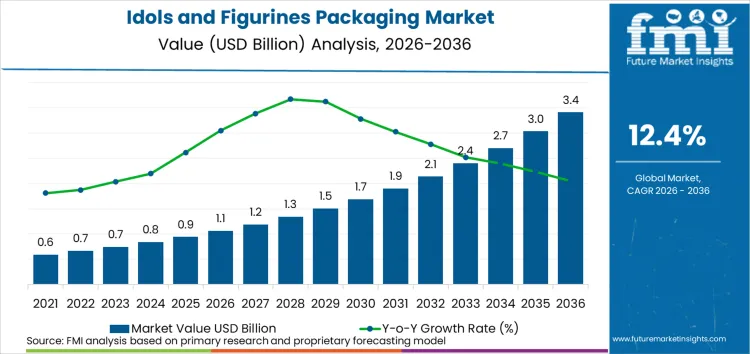
Idols and Figurines Packaging Market Key Takeaways
| Metrics | Values |
|---|---|
| Expected Value (2026E) | USD 1,060 million |
| Projected Value (2036F) | USD 3,420 million |
| CAGR (2026-2036) | 12.4% |
Source: Future Market Insights (FMI) analysis, based on proprietary forecasting model and primary research
Why is the Idols and Figurines Packaging Market Growing?
Expansion of idols and figurines packaging demand is propelled by festival retail formalisation, export shipment damage liability enforcement, and cultural institution procurement modernisation. Institutional mandates from major temple administrative bodies are forcing an immediate shift away from loose fill polystyrene and non-recyclable foam sheeting.
Temple administrations and municipal authorities in major pilgrimage centres such as Puri have increasingly emphasised waste reduction and environmental hygiene during festival periods, encouraging licensed vendors to move away from plastic-intensive and disposable protective materials. The growing scrutiny of post-festival solid waste, particularly thermocol fragments and low-grade paper wadding, has led vendors to voluntarily adopt corrugated fibreboard boxes and fibre-based cushioning solutions that offer more consistent impact protection and improved recyclability.
Institutional sustainability initiatives across India’s religious, cultural, and export ecosystems are steadily reshaping packaging expectations for deity figurines and spiritual artefacts, even in the absence of prescriptive, product-specific mandates. Large pilgrimage institutions and temple trusts have publicly prioritised plastic waste reduction in high-volume distribution streams such as prasad and visitor carry packaging, signalling a broader material transition away from plastic-intensive formats. While official communications typically stop short of mandating rigid packaging formats for metal idols sold through souvenir outlets, these actions have increased scrutiny on vendor packaging practices and accelerated voluntary adoption of fibre-based cartons that offer superior recyclability and visual presentation.
From a policy and economics perspective, government-backed MSME modernisation and green manufacturing frameworks are indirectly lowering the cost barriers associated with engineered fibre-based protective packaging. Capital support mechanisms under MSME sustainability and technology upgradation programmes are encouraging packaging converters and export-oriented handicraft units to invest in higher-precision corrugated formats and moulded fibre cushioning, improving consistency and impact resistance compared to legacy foam and paper-wadding solutions. Rather than direct packaging subsidies, this policy environment supports incremental infrastructure upgrades that enable exporters to meet international shipping and handling expectations.
Export market access and compliance requirements further reinforce this transition. Government-supported market development initiatives facilitate awareness and adoption of internationally acceptable packaging standards among handicraft exporters, particularly in clusters supplying high-value religious artefacts to overseas diaspora markets. At the same time, the rapid growth of e-commerce fulfilment and courier-based distribution has elevated expectations for engineered protective packaging. Leading logistics providers and marketplace platforms increasingly require appropriate corrugated board strength, controlled void fill, and validated cushioning performance to minimise in-transit damage, shifting packaging from a discretionary cost to an operational necessity.
Regulatory trajectory surrounding single-use plastics and expanded polystyrene coninues to influence material substitution decisions. Although no single national directive currently bans moulded EPS for protective packaging, ongoing enforcement of plastic waste management rules and policy discussions around polystyrene restrictions are prompting forward-looking retailers and spiritual goods brands to pre-emptively transition toward moulded pulp inserts and paper-based corner protection. These institutional, regulatory, and logistics-driven dynamics validate a structural pivot toward fibre-based protective packaging that satisfies transit durability requirements while supporting sustainability narratives and premiumisation in the global spiritual and cultural goods economy.
How is Idols and Figurines Packaging Market Segmented?
The global devotional object supply chain is defined by an intensifying convergence of transit damage economics and display-driven retail merchandising, where packaging is being re-engineered to serve both protective and promotional functions simultaneously. This shift is particularly evident in the formalisation of India's festival retail economy and the professionalisation of deity export logistics.
Does the Temple and Festival Retail segment represent the largest end-use category?
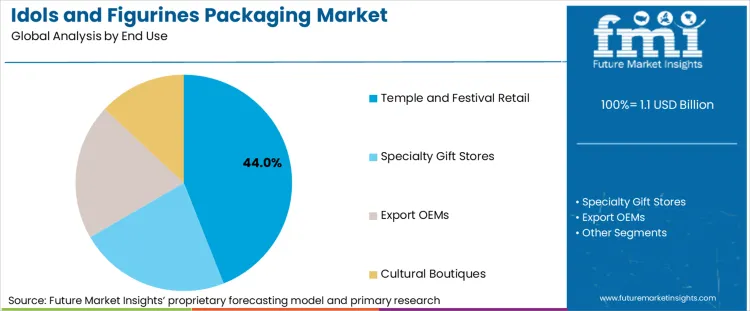
Temple and festival retail dominates with a 44% share in 2026. The high-velocity, high-volume nature of major Hindu, Buddhist, and Jain festival cycles including Durga Puja, Diwali, Ganesh Chaturthi, and Vaishakha Poornima sustains this leadership. These events generate concentrated demand for thousands of identical protective packaging units over compressed four- to six-week selling windows.
In India, the Maharashtra Pollution Control Board's 2026 directive to all Ganpati idol manufacturers in Mumbai and Pune requires that all festival idols sold above five kilograms be transported in recyclable corrugated boxes with paper-based cushioning. This regulatory intervention has effectively converted the entire organised Ganpati idol retail channel to rigid protective packaging overnight.
In China, the Qingming Festival and Lunar New Year ancestral veneration rituals drive concentrated demand for porcelain and resin ancestor figurines. Provincial authorities in Fujian and Guangdong, where substantial deity manufacturing clusters operate, have instituted mandatory packaging waste take-back schemes for festival retailers, favouring mono-material corrugated formats over composite plastic-foam combinations.
In the United States, major Hindu temple associations including the Hindu Temple Society of North America have standardised procurement specifications for murti (deity statue) shipments from India, requiring ISTA-certified corrugated packaging capable of surviving cross-continental freight handling. These institutional sourcing guidelines ensure that protective fibre-based formats remain the baseline operational standard for the world's largest religious festival supply chains.
How is Corrugated Board as the Primary Material driving Market Volume?
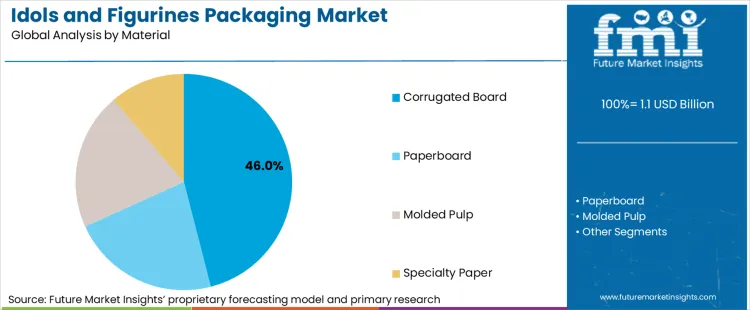
Corrugated board is the leading material in this sector, commanding a 46% market share as of early 2026. Its dominance is driven by inherent stacking strength, moisture resistance grades, and the global expansion of high-print-quality linerboard capable of reproducing intricate deity iconography. In Germany, the 2026 amendment to the Packaging Act (VerpackG) now mandates that all e-commerce shipments of collectible figurines must utilise fibre-based packaging achieving minimum 80% recyclability rate, effectively excluding expanded polystyrene fitments and favouring corrugated partition systems.
Technological advancements are also enhancing the functional value of corrugated in the devotional market. In Japan, Rengo Co. Ltd. commercialised Nano-Pak™ high-density corrugated in late 2025, achieving 35% greater compression strength than conventional double-wall board at equivalent caliper, specifically engineered for the export of heavy bronze Buddha statues to European collectors.
In Brazil, Klabin S.A. has scaled production of E-flute and F-flute micro-corrugated for the domestic saint figurine market, where shelf-ready packaging that transitions directly from shipping carton to retail display reduces secondary handling damage for terracotta and alabaster images. These developments confirm that corrugated board's structural versatility, combined with its compliance with global extended producer responsibility frameworks, makes it the preferred material for protective devotional packaging.
Why do Rigid Protective Boxes lead the packaging category?
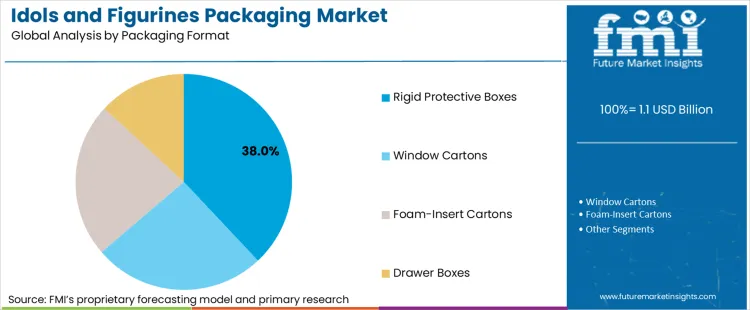
Rigid protective boxes represent 38% of total demand in 2026. This format is uniquely suited for idols and figurines due to its ability to function as permanent storage and display housing, extending the packaging lifecycle indefinitely. Unlike folding cartons, rigid set-up boxes withstand repeated opening and closing without structural fatigue, a critical attribute for festival idols that are stored eleven months annually and reinstalled for successive years of worship.
In South Korea, the Jogye Order of Korean Buddhism central procurement office now requires all bronze Buddha statues distributed to affiliate temples to be housed in rigid clamshell boxes with integrated moulded pulp cradles. This specification aims to eliminate the accumulation of single-use plastic bubble wrap historically used for seasonal statue relocation between winter storage and ceremonial installation.
Innovation in this format is particularly visible in the luxury spiritual gifting segment. In France, Maison Christofle's 2026 limited-edition silver-plated Ganesha sculpture is presented in a custom rigid drawer box lined with crushed velour paper, elevating the packaging to collectible object status. In the United States, the 2026 Gift and Premium Packaging Trends report identifies rigid magnetic-closure boxes as the fastest-growing format for high-value deity replicas sold through design hospitality channels.
This global adoption proves that the rigid protective box is the most effective format for balancing structural integrity during transit, archival-quality long-term storage, and the sensory gravitas required for objects of veneration.
What Drivers, Restraints, Opportunities, and Trends Prevail in the Idols and Figurines Packaging Market?
Expansion is governed by a fundamental convergence of festival retail formalisation and international freight damage economics. The implementation of the International Air Transport Association's Lithium Battery Shipping Regulations, while not directly applicable to inert deity figurines, has raised general cargo screening stringency. This serves as a secondary driver, as air cargo handlers increasingly refuse loosely packed, non-unitised shipments of fragile goods, forcing deity exporters to adopt certified, palletised rigid box packaging that presents uniform, stackable geometry.
The EU Deforestation Regulation, effective December 30, 2024, with full supply chain due diligence enforcement beginning 2026, impacts paper-based packaging components placed on the European market. Exporters of Hindu and Buddhist idols to Europe must now demonstrate that corrugated and paperboard packaging materials originate from deforestation-free supply chains, complete with geolocation coordinates of fibre sources. This compliance burden favours large-scale packaging suppliers with audited, vertically integrated forestry operations over unorganised local box makers.
Industrial growth is further catalysed by significant public sector investment in recycling infrastructure that directly benefits fibre-based packaging end-of-life economics. The Indian Ministry of Environment, Forest and Climate Change allocated ₹1,800 crore in 2026-27 for establishment of material recovery facilities across 100 major municipal corporations. Enhanced collection and sorting economics improve the recyclability value proposition of corrugated and paperboard relative to mixed-material foam composites.
These infrastructure improvements are intended to lower the net cost of certified recycled content packaging, which is increasingly demanded by global spiritual retailers seeking alignment with Science Based Targets initiative net-zero roadmaps.
The landscape faces structural restraints related to moulded pulp tooling lead times and customisation cost barriers. Precision-engineered pulp cushioning requires dedicated thermoforming tooling, with lead times of 8–12 weeks and per-cavity investment between ₹3–8 lakhs depending on geometric complexity. For small-scale idol artisans producing limited seasonal volumes, this capital outlay remains prohibitive, perpetuating continued use of loose-fill peanuts and air pillows for lower-value deity categories.
Additionally, evolving quality standards for high-graphic linerboard present supply-side constraints. The shift toward lighter-weight, recycled-content liners to meet corporate sustainability targets sometimes compromises surface smoothness and ink holdout required for fine reproduction of facial iconography. Brand owners in the premium collectible figurine segment continue to insist on virgin kraft top liner to achieve 200-line screen halftone fidelity, creating tension between recycled content targets and print quality expectations.
The sector is currently defined by a trend toward functional hybridisation—packaging that transitions from protective transit vehicle to permanent shrine or display housing. This is most advanced in Japan, where Shinto shrine souvenir committees now commission custom kirigami (folded paper) engineered packaging that unfolds to become a miniature torii gate display stand for the omamori or figurine contained within. These designs eliminate secondary display infrastructure while materially demonstrating reverence for the object.
Another defining trend is the industrialisation of moulded fibre beyond commodity egg-carton equivalents. Manufacturers including UFP Technologies and Ranpak have commercialised thin-wall, high-definition pulp moulding capable of reproducing textured surfaces that mimic carved wood or embroidered textile interiors. This enables deity packaging to communicate tactility and provenance through the substrate itself, rather than relying solely on printed graphics.
Analysis of Idols and Figurines Packaging Market by Key Countries
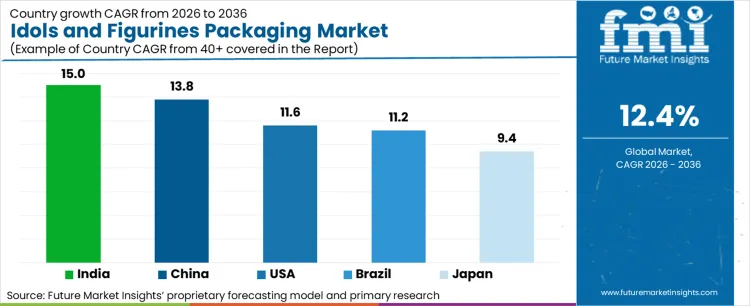
The global landscape for idols and figurines packaging is undergoing regional differentiation based on manufacturing infrastructure, festival density, and packaging waste regulatory maturity. As of early 2026, the market is characterised by South Asia's volume dominance, East Asia's premiumisation velocity, and North America's e-commerce specification formalisation.
| Country | CAGR (2026-2036) |
|---|---|
| India | 15.00% |
| USA | 11.60% |
| China | 13.80% |
| Japan | 9.40% |
| Brazil | 11.20% |
Source: Future Market Insights (FMI) analysis, based on proprietary forecasting model and primary research
Will India's Temple Modernisation and Festival Formalisation sustain its Leading Growth Rate?
India exhibits the highest market acceleration with a CAGR of 15.00% from 2026 to 2036. This growth is anchored by the progressive corporatisation of major temple trusts, which are transitioning from informal vendor networks to centralised procurement systems. The Shri Saibaba Sansthan Trust, Shirdi, migrated to a single-window packaging procurement model in January 2026, awarding a ₹42 crore annual contract for rigid protective boxes used in sale of marble idols and silver replica feet.
This growth is further reinforced by the Government of India's National Logistics Policy target to reduce freight damage in the handicraft sector by 40% by 2030. The Packaging for Export Excellence scheme, administered by the Export Promotion Council for Handicrafts, provides 50% reimbursement on certified drop-test validation and structural design fees for MSME deity manufacturers. This direct financial incentive lowers adoption barriers for engineered corrugated solutions.
The domestic market is also witnessing integration of authentication technologies. In February 2026, the Gujarat State Handloom and Handicraft Development Corporation launched the Hunar Hat platform, requiring all participating brass idol vendors to package products in rigid cartons embedded with QR-code security labels verifying geographical indication status. This convergence of packaging as authentication infrastructure is expected to drive significant value growth in the export OEM segment.
Is USA's E-commerce Qualification and Collector Culture driving its Double-Digit Expansion?
USA is projected to progress at a CAGR of 11.60% through 2036. A significant 2026 trend is the formalisation of protective packaging specifications by diaspora-focussed spiritual e-commerce platforms. Major retailers including Etsy and Amazon Handmade have instituted packaged condition performance clauses for third-party deity figurine sellers. Suspension notices issued in Q1 2026 cited inadequate interior packaging as a primary defect, compelling sellers of Hindu and Buddhist statues to upgrade from polybag-and-bubble mailers to rigid corrugated mailers with pulp corner blocks.
This shift is reinforced by the 2026 USPS Pricing and Mailing Standards adjustments, which introduced dimensional weight pricing surcharges for lightweight but oversized packages. Exporters of lightweight resin figurines are downsizing packaging footprints while increasing structural density, favouring precision-fit rigid boxes over oversized corrugated cartons filled with void fill.
The 2026 U.S. retail landscape is also witnessing the maturation of the "sacred commerce" segment—boutique home decor retailers specialising in ethically sourced global spiritual artefacts. These retailers require gift-ready rigid packaging that eliminates secondary wrapping. Several West Coast-based retailers have begun conducting packaging sustainability audits on deity figurine suppliers, prioritising vendors utilising 100% recycled paperboard with plant-based inks.
How is China's Export Manufacturing Scale and Domestic Retail Formalisation shaping its Regional Leadership?
China is slated for a CAGR of 13.80% between 2026 and 2036, the fastest among all major markets. This trajectory is driven by the convergence of two structural factors: scale optimisation in export deity manufacturing and state-directed formalisation of domestic temple retail.
In Guangdong and Zhejiang provinces, contract packaging manufacturers serving the Buddhist and Taoist figurine export industry have invested heavily in high-speed Bobst die-cutters and folder-gluers capable of producing complex rigid box constructions at Western quality specifications but at Southeast Asian labour cost points. This capital equipment density enables Chinese suppliers to offer integrated product-and-packaging solutions to Western spiritual retailers at landed costs that Indian and Southeast Asian competitors cannot match.
Domestically, the State Administration for Market Regulation's 2026 e-commerce quality certification now requires all "faith consumption" products sold on Tmall and JD.com to utilise tamper-evident, child-safe packaging if small parts are included. Buddhist and Taoist figurines frequently incorporate miniature attributes—swords, lotus pedestals, halos—that present choking hazards. This regulation has compelled mass-market figurine manufacturers to adopt rigid window cartons with sealed base construction rather than simple shrink-wrap or hang tags.
Does Japan's Heritage Conservation Mandates and Precision Engineering define its Premium Trajectory?
Japan's market is forecasted to grow at a CAGR of 9.40% from 2026 to 2036, reflecting a mature but high-value packaging ecosystem. The sector is defined by the intersection of cultural property preservation law and precision paper engineering. The Agency for Cultural Affairs' 2026 revised guidelines for the transfer of registered tangible cultural properties—which include many Buddhist sculptures held in regional temples—now require shock-documented transport packaging with validated vibration damping curves.
This regulatory environment favours domestic packaging engineers such as Rengo and Toppan, who have developed corrugated composites incorporating viscoelastic polymer interlayers that dissipate impact energy more efficiently than standard single-wall board. For high-value Kamakura-period replica sculptures commissioned by overseas museums, Japanese packaging commands significant premium due to verifiable shock absorption coefficients.
Cultural heritage remains the strongest domestic driver, with the omamori and engimono talisman figurine market continuing to professionalise its presentation formats. For 2026 seasonal sales, several major Shinto shrines introduced limited-edition daruma doll sets housed in precision-cut drawer boxes with integrated risers that elevate the figurine for display. This convergence of traditional talismanic object and contemporary luxury packaging ensures Japan maintains its global benchmark status for high-ritual-value paperboard conversion.
Is Brazil's Domestic Fibre Abundance and Retail Formalisation accelerating Packaging Adoption?
Brazil is expected to witness a CAGR of 11.20% from 2026 to 2036. The primary catalyst is the full enforcement of Decree No. 11,413/2023, which establishes sector-specific reverse logistics targets for packaging placed on the Brazilian market. For the 2026 compliance cycle, spiritual product retailers must demonstrate 35% recovery rate of packaging materials sold. Corrugated board, with its established collection infrastructure via the Rede Cataratas and other cooperative networks, presents significantly lower compliance cost than imported EPS foam or plastic air cushions.
Brazil's abundant planted pine and eucalyptus forestry base provides domestic packaging manufacturers with substantial cost advantage over imported alternatives. Klabin S.A.'s 2025 expansion of corrugated packaging capacity in Goiana, Pernambuco, specifically cited growing demand from the Northeast's vibrant St. Anthony and St. John festival figurine markets. Domestic saint image manufacturers seeking to align with retailer sustainability scorecards specify the company’s CMPC-certified linerboard.
Brazil's unique Product-as-a-Service model, observed in other packaging categories, is beginning to manifest in the figurine sector. Early-stage startups in São Paulo are piloting reusable rigid box subscription models for seasonal nativity scene figurine storage, wherein consumers return the engineered packaging to the retailer following Epiphany for refurbishment and reuse in the subsequent annual cycle. This circular model, while nascent, positions Brazil at the forefront of reusable devotional packaging systems in the Latin American context.
What is the Competition Outlook for Idols and Figurines Packaging?
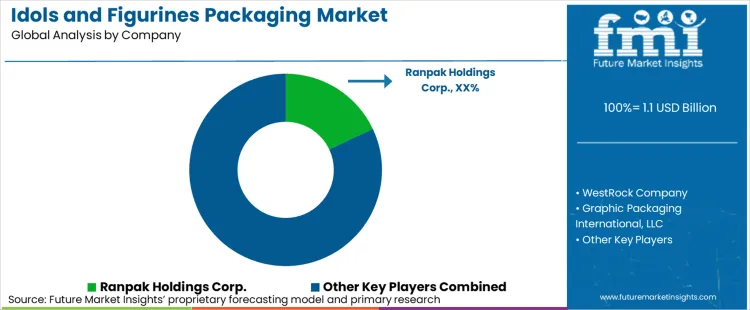
The competitive landscape for idols and figurines packaging is undergoing a transition from fragmented local corrugators serving spot requirements to integrated packaging corporations delivering system-engineered protection with graphic differentiation and sustainability accounting.
Competition is intensifying as multinational packaging groups acquire regional specialty converters to gain foothold in high-growth devotional corridors. Strategic differentiation is centred on structural design engineering capability rather than board grade or price alone. Suppliers that maintain in-house ISTA-certified test laboratories and provide drop-test validation reports are securing long-term rate contracts with export-oriented deity manufacturers, displacing local box makers who cannot furnish empirical performance data.
Large-format temple retail chains, festival organisers, and export houses are professionalising procurement through request-for-proposal processes that evaluate total cost of ownership—including damage rates, storage cubing efficiency, and recyclability compliance—rather than per-unit purchase price. This favours suppliers with national footprint and just-in-time inventory capabilities capable of servicing the compressed, high-volume delivery windows characteristic of major festival seasons.
By positioning themselves as supply chain partners offering packaging rationalisation engineering rather than commoditised brown boxes, leading firms are embedding their specifications into the standard operating procedures of temple administration bodies, effectively raising switching costs and raising barriers for unorganised local manufacturers lacking structural design and compliance certification capabilities.
Corporate Strategic Developments
- In March 2025, Ranpak Holdings Corp. expanded its sustainable packaging offerings by integrating PaperWrap into its portfolio across North America, enabling more circular logistics and reduced carbon footprint for shipped goods. The partnership includes semi-automatic to fully integrated PaperWrap machines designed to work with recyclable kraft paper wrap, supporting sustainability goals across industrial and consumer supply chains.
- In September 2025, Smurfit Westrock introduced the Bag-in-Box Powergrip solution, a paper-based alternative to traditional plastic-heavy HDPE containers for liquids. Designed at its Turnhout plant in Belgium, Powergrip features a cardboard casing and integrated handle to improve handling and reduce plastic by up to ~75% versus conventional jerrycans under forthcoming EU packaging regulations, reflecting advances in sustainable corrugated packaging.
- In 2025, Graphic Packaging International received broad industry recognition for sustainable and innovative paper packaging solutions, including multiple PAC Global Awards for best-in-class sustainable and innovation design. Award-winning solutions such as the EnviroClip™ Bottles clip-style multipack and the PaperLite tray demonstrated the company’s commitment to circular packaging formats that reduce reliance on plastic materials and enhance recyclability.
Key Players Profiled
- Ranpak Holdings Corp.
- WestRock Company
- Graphic Packaging International, LLC
- Greatview Aseptic Packaging Co., Ltd.
- Zhejiang Zijiang International Co., Ltd.
- Rengo Co., Ltd.
- Toppan Inc.
- Klabin S.A.
Market Definition
The idols and figurines packaging market comprises revenues generated from paper-based and fibre-based packaging formats used to protect, present, store, and transport devotional statues, festival idols, collectible figurines, and cultural replica objects across temple retail, specialty gift, e-commerce, and original equipment manufacturing export channels. These packaging solutions are designed to replace expanded polystyrene, polyurethane foam, polyethylene air cushioning, and single-use flexible plastics with recyclable, curbside-compatible fibre alternatives that provide equivalent or superior shock attenuation.
The scope includes packaging formats such as rigid set-up boxes, window display cartons, foam-insert corrugated containers, drawer-style gift boxes, and precision-moulded pulp fitments. Materials within scope include high-strength corrugated board, solid bleached sulphate paperboard, recycled chipboard, moulded cellulose fibre, and specialty archival papers used for packaging brass, marble, wood, resin, porcelain, and polystone devotional images.
The scope excludes revenues from the manufacture of idols, figurines, or devotional objects themselves, non-paper packaging formats such as plastic clamshells, polybags, or vacuum-formed PVC, and packaging used for non-devotional consumer collectibles including action figures or mass-market toys. It also excludes downstream logistics services, palletisation-only timber crating, ceremonial cloth wraps not functioning as protective transit packaging, and experimental bioplastics not supplied through organised commercial packaging value chains. Expanded polystyrene bead forms, polyurethane foam-in-place systems, and non-recyclable metallised film laminates fall outside the defined market boundary.
Scope of Report
| Items | Values |
|---|---|
| Quantitative Units (2026) | USD 1,060 million |
| End Use | Temple & Festival Retail, Specialty Gift Stores, Export OEMs, Cultural Boutiques |
| Packaging Format | Rigid Protective Boxes, Window Cartons, Foam-Insert Cartons, Drawer Boxes |
| Material | Corrugated Board, Paperboard, Molded Pulp, Specialty Paper |
| Regions Covered | South Asia, North America, East Asia, Japan, Rest of the World |
| Countries | India, USA, China, Japan, Brazil, and 40+ countries |
| Key Companies | Ranpak, WestRock, Graphic Packaging, Greatview, Zijiang, Rengo, Toppan, Klabin |
Source: Future Market Insights (FMI) analysis, based on proprietary forecasting model and primary research
Idols and Figurines Packaging Market Key Segments
By End Use
- Temple & Festival Retail
- Specialty Gift Stores
- Export OEMs
- Cultural Boutiques
By Packaging Format
- Rigid Protective Boxes
- Window Cartons
- Foam-Insert Cartons
- Drawer Boxes
By Material
- Corrugated Board
- Paperboard
- Molded Pulp
- Specialty Paper
By Region
- South Asia
- North America
- East Asia
- Japan
- Rest of the World
Bibliography
- Ministry of Commerce and Industry, Government of India. (2025). Export performance of handicrafts and handloom products: Annual report 2024–25. Directorate General of Commercial Intelligence and Statistics (DGCIS).
- Export Promotion Council for Handicrafts (EPCH). (2025). Handicrafts export promotion schemes, packaging guidance, and quality compliance framework. Ministry of Textiles, Government of India.
- Central Pollution Control Board (CPCB). (2024). Guidelines on management of plastic waste and alternatives to expanded polystyrene under Plastic Waste Management Rules, 2016 (amended). Government of India.
- Indira Gandhi National Centre for the Arts (IGNCA). (2024). Preventive conservation guidelines for storage, transport, and handling of sculptures and cultural artefacts. Ministry of Culture, Government of India.
- International Safe Transit Association (ISTA). (2025). ISTA 3A: Packaged-products for parcel delivery system shipment testing. ISTA.
- Agency for Cultural Affairs (Bunkachō), Government of Japan. (2024). Guidelines for the handling, transport, and vibration control of registered tangible cultural properties. Ministry of Education, Culture, Sports, Science and Technology (MEXT).
- Amazon Seller Services Pvt. Ltd. (2025). Packaging and preparation requirements for fragile products in e-commerce fulfilment (India & North America). Amazon Seller Central Documentation.
- Rengo Co., Ltd. (2024). Advanced corrugated board structures for heavy and fragile export goods. Rengo Technical Research Institute.
- Klabin S.A. (2024). Sustainability report 2024: Fibre-based packaging, circular forestry, and corrugated innovation. Klabin S.A.
Frequently Asked Questions
What is the projected global growth rate for the idols and figurines packaging market?
The global market is projected to expand at a 12.4% CAGR from 2026 to 2036, reflecting structural formalisation of temple festival retail, export shipment damage liability enforcement, and substitution of expanded polystyrene with certified fibre cushioning systems.
How large is the global idols and figurines packaging market expected to be by 2036?
The market is expected to grow from USD 1,060 million in 2026 to approximately USD 3,420 million by 2036.
What is driving the growth of idols and figurines packaging?
Growth is driven by institutional mandates from temple trusts banning thermocol and foam packaging, festival retail formalisation requiring display-ready branded cartons, and export compliance with ISTA drop-test certification and EU Deforestation Regulation due diligence for paper components. Protective packaging is transitioning from discretionary expense to regulatory and commercial compliance necessity.
Which materials and packaging formats dominate market demand?
Corrugated board is the leading material due to its stacking strength, customisation flexibility, and established recycling infrastructure, while rigid protective boxes dominate the packaging format segment. These formats are favoured for their ability to prevent transit damage, enable shelf-ready retail presentation, and provide long-term reusable storage for annually reinstalled festival idols.
Which regions are expected to lead market expansion over the forecast period?
South Asia remains the dominant and fastest-growing region, led by India, supported by temple modernisation committees, centralised trust procurement policies, and export packaging subsidies. China follows as the fastest-growing individual country, driven by export manufacturing scale and domestic e-commerce packaging compliance. East Asia and North America maintain significant shares through premium collectible packaging and diaspora e-commerce specification enforcement respectively.
Preview the report firsthand - request a free sample
Get SampleGet the brochure for pricing and purchase details.
Get PDFTable of Content
- Executive Summary
- Global Market Outlook
- Demand-side Trends
- Supply-side Trends
- Technology Roadmap Analysis
- Analysis and Recommendations
- Market Overview
- Market Coverage / Taxonomy
- Market Definition / Scope / Limitations
- Research Methodology
- Chapter Orientation
- Analytical Lens and Working Hypotheses
- Market Structure, Signals, and Trend Drivers
- Benchmarking and Cross-market Comparability
- Market Sizing, Forecasting, and Opportunity Mapping
- Research Design and Evidence Framework
- Desk Research Programme (Secondary Evidence)
- Company Annual and Sustainability Reports
- Peer-reviewed Journals and Academic Literature
- Corporate Websites, Product Literature, and Technical Notes
- Earnings Decks and Investor Briefings
- Statutory Filings and Regulatory Disclosures
- Technical White Papers and Standards Notes
- Trade Journals, Industry Magazines, and Analyst Briefs
- Conference Proceedings, Webinars, and Seminar Materials
- Government Statistics Portals and Public Data Releases
- Press Releases and Reputable Media Coverage
- Specialist Newsletters and Curated Briefings
- Sector Databases and Reference Repositories
- FMI Internal Proprietary Databases and Historical Market Datasets
- Subscription Datasets and Paid Sources
- Social Channels, Communities, and Digital Listening Inputs
- Additional Desk Sources
- Expert Input and Fieldwork (Primary Evidence)
- Primary Modes
- Qualitative Interviews and Expert Elicitation
- Quantitative Surveys and Structured Data Capture
- Blended Approach
- Why Primary Evidence is Used
- Field Techniques
- Interviews
- Surveys
- Focus Groups
- Observational and In-context Research
- Social and Community Interactions
- Stakeholder Universe Engaged
- C-suite Leaders
- Board Members
- Presidents and Vice Presidents
- R&D and Innovation Heads
- Technical Specialists
- Domain Subject-matter Experts
- Scientists
- Physicians and Other Healthcare Professionals
- Governance, Ethics, and Data Stewardship
- Research Ethics
- Data Integrity and Handling
- Primary Modes
- Tooling, Models, and Reference Databases
- Desk Research Programme (Secondary Evidence)
- Data Engineering and Model Build
- Data Acquisition and Ingestion
- Cleaning, Normalisation, and Verification
- Synthesis, Triangulation, and Analysis
- Quality Assurance and Audit Trail
- Market Background
- Market Dynamics
- Drivers
- Restraints
- Opportunity
- Trends
- Scenario Forecast
- Demand in Optimistic Scenario
- Demand in Likely Scenario
- Demand in Conservative Scenario
- Opportunity Map Analysis
- Product Life Cycle Analysis
- Supply Chain Analysis
- Investment Feasibility Matrix
- Value Chain Analysis
- PESTLE and Porter’s Analysis
- Regulatory Landscape
- Regional Parent Market Outlook
- Production and Consumption Statistics
- Import and Export Statistics
- Market Dynamics
- Global Market Analysis 2021 to 2025 and Forecast, 2026 to 2036
- Historical Market Size Value (USD Million) Analysis, 2021 to 2025
- Current and Future Market Size Value (USD Million) Projections, 2026 to 2036
- Y-o-Y Growth Trend Analysis
- Absolute $ Opportunity Analysis
- Global Market Pricing Analysis 2021 to 2025 and Forecast 2026 to 2036
- Global Market Analysis 2021 to 2025 and Forecast 2026 to 2036, By End Use
- Introduction / Key Findings
- Historical Market Size Value (USD Million) Analysis By End Use , 2021 to 2025
- Current and Future Market Size Value (USD Million) Analysis and Forecast By End Use , 2026 to 2036
- Temple and Festival Retail
- Specialty Gift Stores
- Export OEMs
- Cultural Boutiques
- Temple and Festival Retail
- Y-o-Y Growth Trend Analysis By End Use , 2021 to 2025
- Absolute $ Opportunity Analysis By End Use , 2026 to 2036
- Global Market Analysis 2021 to 2025 and Forecast 2026 to 2036, By Material
- Introduction / Key Findings
- Historical Market Size Value (USD Million) Analysis By Material, 2021 to 2025
- Current and Future Market Size Value (USD Million) Analysis and Forecast By Material, 2026 to 2036
- Corrugated Board
- Paperboard
- Molded Pulp
- Specialty Paper
- Corrugated Board
- Y-o-Y Growth Trend Analysis By Material, 2021 to 2025
- Absolute $ Opportunity Analysis By Material, 2026 to 2036
- Global Market Analysis 2021 to 2025 and Forecast 2026 to 2036, By Packaging Format
- Introduction / Key Findings
- Historical Market Size Value (USD Million) Analysis By Packaging Format, 2021 to 2025
- Current and Future Market Size Value (USD Million) Analysis and Forecast By Packaging Format, 2026 to 2036
- Rigid Protective Boxes
- Window Cartons
- Foam-Insert Cartons
- Drawer Boxes
- Rigid Protective Boxes
- Y-o-Y Growth Trend Analysis By Packaging Format, 2021 to 2025
- Absolute $ Opportunity Analysis By Packaging Format, 2026 to 2036
- Global Market Analysis 2021 to 2025 and Forecast 2026 to 2036, By Region
- Introduction
- Historical Market Size Value (USD Million) Analysis By Region, 2021 to 2025
- Current Market Size Value (USD Million) Analysis and Forecast By Region, 2026 to 2036
- North America
- Latin America
- Western Europe
- Eastern Europe
- East Asia
- South Asia and Pacific
- Middle East & Africa
- Market Attractiveness Analysis By Region
- North America Market Analysis 2021 to 2025 and Forecast 2026 to 2036, By Country
- Historical Market Size Value (USD Million) Trend Analysis By Market Taxonomy, 2021 to 2025
- Market Size Value (USD Million) Forecast By Market Taxonomy, 2026 to 2036
- By Country
- USA
- Canada
- Mexico
- By End Use
- By Material
- By Packaging Format
- By Country
- Market Attractiveness Analysis
- By Country
- By End Use
- By Material
- By Packaging Format
- Key Takeaways
- Latin America Market Analysis 2021 to 2025 and Forecast 2026 to 2036, By Country
- Historical Market Size Value (USD Million) Trend Analysis By Market Taxonomy, 2021 to 2025
- Market Size Value (USD Million) Forecast By Market Taxonomy, 2026 to 2036
- By Country
- Brazil
- Chile
- Rest of Latin America
- By End Use
- By Material
- By Packaging Format
- By Country
- Market Attractiveness Analysis
- By Country
- By End Use
- By Material
- By Packaging Format
- Key Takeaways
- Western Europe Market Analysis 2021 to 2025 and Forecast 2026 to 2036, By Country
- Historical Market Size Value (USD Million) Trend Analysis By Market Taxonomy, 2021 to 2025
- Market Size Value (USD Million) Forecast By Market Taxonomy, 2026 to 2036
- By Country
- Germany
- UK
- Italy
- Spain
- France
- Nordic
- BENELUX
- Rest of Western Europe
- By End Use
- By Material
- By Packaging Format
- By Country
- Market Attractiveness Analysis
- By Country
- By End Use
- By Material
- By Packaging Format
- Key Takeaways
- Eastern Europe Market Analysis 2021 to 2025 and Forecast 2026 to 2036, By Country
- Historical Market Size Value (USD Million) Trend Analysis By Market Taxonomy, 2021 to 2025
- Market Size Value (USD Million) Forecast By Market Taxonomy, 2026 to 2036
- By Country
- Russia
- Poland
- Hungary
- Balkan & Baltic
- Rest of Eastern Europe
- By End Use
- By Material
- By Packaging Format
- By Country
- Market Attractiveness Analysis
- By Country
- By End Use
- By Material
- By Packaging Format
- Key Takeaways
- East Asia Market Analysis 2021 to 2025 and Forecast 2026 to 2036, By Country
- Historical Market Size Value (USD Million) Trend Analysis By Market Taxonomy, 2021 to 2025
- Market Size Value (USD Million) Forecast By Market Taxonomy, 2026 to 2036
- By Country
- China
- Japan
- South Korea
- By End Use
- By Material
- By Packaging Format
- By Country
- Market Attractiveness Analysis
- By Country
- By End Use
- By Material
- By Packaging Format
- Key Takeaways
- South Asia and Pacific Market Analysis 2021 to 2025 and Forecast 2026 to 2036, By Country
- Historical Market Size Value (USD Million) Trend Analysis By Market Taxonomy, 2021 to 2025
- Market Size Value (USD Million) Forecast By Market Taxonomy, 2026 to 2036
- By Country
- India
- ASEAN
- Australia & New Zealand
- Rest of South Asia and Pacific
- By End Use
- By Material
- By Packaging Format
- By Country
- Market Attractiveness Analysis
- By Country
- By End Use
- By Material
- By Packaging Format
- Key Takeaways
- Middle East & Africa Market Analysis 2021 to 2025 and Forecast 2026 to 2036, By Country
- Historical Market Size Value (USD Million) Trend Analysis By Market Taxonomy, 2021 to 2025
- Market Size Value (USD Million) Forecast By Market Taxonomy, 2026 to 2036
- By Country
- Kingdom of Saudi Arabia
- Other GCC Countries
- Turkiye
- South Africa
- Other African Union
- Rest of Middle East & Africa
- By End Use
- By Material
- By Packaging Format
- By Country
- Market Attractiveness Analysis
- By Country
- By End Use
- By Material
- By Packaging Format
- Key Takeaways
- Key Countries Market Analysis
- USA
- Pricing Analysis
- Market Share Analysis, 2025
- By End Use
- By Material
- By Packaging Format
- Canada
- Pricing Analysis
- Market Share Analysis, 2025
- By End Use
- By Material
- By Packaging Format
- Mexico
- Pricing Analysis
- Market Share Analysis, 2025
- By End Use
- By Material
- By Packaging Format
- Brazil
- Pricing Analysis
- Market Share Analysis, 2025
- By End Use
- By Material
- By Packaging Format
- Chile
- Pricing Analysis
- Market Share Analysis, 2025
- By End Use
- By Material
- By Packaging Format
- Germany
- Pricing Analysis
- Market Share Analysis, 2025
- By End Use
- By Material
- By Packaging Format
- UK
- Pricing Analysis
- Market Share Analysis, 2025
- By End Use
- By Material
- By Packaging Format
- Italy
- Pricing Analysis
- Market Share Analysis, 2025
- By End Use
- By Material
- By Packaging Format
- Spain
- Pricing Analysis
- Market Share Analysis, 2025
- By End Use
- By Material
- By Packaging Format
- France
- Pricing Analysis
- Market Share Analysis, 2025
- By End Use
- By Material
- By Packaging Format
- India
- Pricing Analysis
- Market Share Analysis, 2025
- By End Use
- By Material
- By Packaging Format
- ASEAN
- Pricing Analysis
- Market Share Analysis, 2025
- By End Use
- By Material
- By Packaging Format
- Australia & New Zealand
- Pricing Analysis
- Market Share Analysis, 2025
- By End Use
- By Material
- By Packaging Format
- China
- Pricing Analysis
- Market Share Analysis, 2025
- By End Use
- By Material
- By Packaging Format
- Japan
- Pricing Analysis
- Market Share Analysis, 2025
- By End Use
- By Material
- By Packaging Format
- South Korea
- Pricing Analysis
- Market Share Analysis, 2025
- By End Use
- By Material
- By Packaging Format
- Russia
- Pricing Analysis
- Market Share Analysis, 2025
- By End Use
- By Material
- By Packaging Format
- Poland
- Pricing Analysis
- Market Share Analysis, 2025
- By End Use
- By Material
- By Packaging Format
- Hungary
- Pricing Analysis
- Market Share Analysis, 2025
- By End Use
- By Material
- By Packaging Format
- Kingdom of Saudi Arabia
- Pricing Analysis
- Market Share Analysis, 2025
- By End Use
- By Material
- By Packaging Format
- Turkiye
- Pricing Analysis
- Market Share Analysis, 2025
- By End Use
- By Material
- By Packaging Format
- South Africa
- Pricing Analysis
- Market Share Analysis, 2025
- By End Use
- By Material
- By Packaging Format
- USA
- Market Structure Analysis
- Competition Dashboard
- Competition Benchmarking
- Market Share Analysis of Top Players
- By Regional
- By End Use
- By Material
- By Packaging Format
- Competition Analysis
- Competition Deep Dive
- Ranpak Holdings Corp.
- Overview
- Product Portfolio
- Profitability by Market Segments (Product/Age /Sales Channel/Region)
- Sales Footprint
- Strategy Overview
- Marketing Strategy
- Product Strategy
- Channel Strategy
- WestRock Company
- Graphic Packaging International, LLC
- Greatview Aseptic Packaging Co., Ltd.
- Zhejiang Zijiang International Co., Ltd.
- Rengo Co., Ltd.
- Toppan Inc.
- Ranpak Holdings Corp.
- Competition Deep Dive
- Assumptions & Acronyms Used


