

- Market Size (2026)
- USD 11.5 Mn
- Forecast (2036)
- USD 61.2 Mn
- CAGR (2026 to 2036)
- 18.2%
How big is Ionocaloric Heat Pumps Market in 2026?
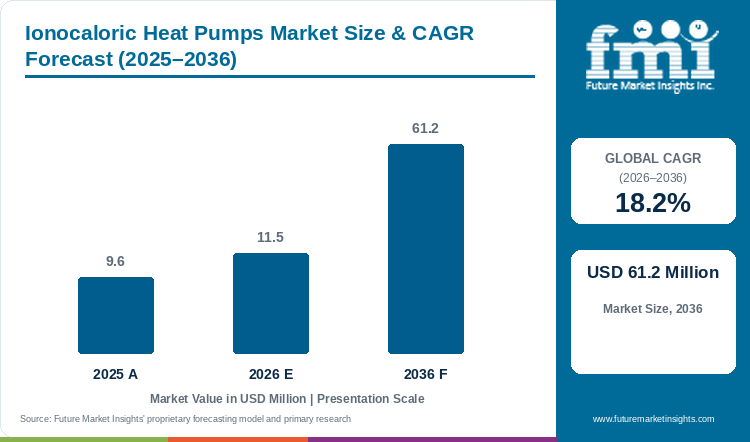
Posting USD 9.6 million across 2025, worldwide ionocaloric heat pumps demand is forecast to total USD 11.5 million for 2026 and is predicted to expand at an 18.2% CAGR to attain USD 61.2 million in 2036.
Dissolving sodium iodide salt into crystalline ethylene carbonate depresses the organic solvent's freezing point and absorbs ambient heat at roughly 30% of Carnot efficiency without mechanical gas compression, a solid-liquid thermodynamic cycle first demonstrated by Lawrence Berkeley National Laboratory scientists Drew Lilley and Ravi Prasher in December 2022 (reported in January 2023 at a 25-degree-Celsius temperature lift near 0.22 volts) and advanced in March 2025 by spin-out Calion Technologies under a USD 500,000 U.S. Department of Energy ARPA-E heat-pump project [1]. Commercial building HVAC architects and electric-vehicle thermal engineers specify these compressor-free electrochemical loops alongside commercial heat pump units because ethylene carbonate can incorporate captured carbon dioxide during synthesis, positioning the Ethylene Carbonate (EC) + Sodium Iodide (NaI) Cycle for an estimated 64.5% share of solid-liquid salt-solvent pairs in 2026. Reversing the salt concentration through selective ion-exchange membranes precipitates pure ethylene carbonate crystals and rejects hydronic heating water without hydrofluorocarbon leaks or rooftop compressor vibration. After recording USD 9.6 million across 2025, worldwide ionocaloric heat pumps turnover is forecast to total USD 11.5 million for 2026 before advancing at a projected 18.2% CAGR to attain USD 61.2 million by 2036 while generating an anticipated USD 49.7 million in new equipment orders.
Key Market Trends & Insights
- By solid-liquid salt-solvent pair: Ethylene Carbonate (EC) + Sodium Iodide (NaI) Cycle is forecast to hold 64.5% of 2026 working-pair revenue because ethylene carbonate binds CO2 during synthesis and provides a high latent heat of fusion near 205 J/g.
- By ion separation regeneration method: Electrodialysis Ion-Exchange Membrane Stack designs are predicted to claim 71.2% of 2026 regeneration turnover since selective cation and anion membranes desalinate the liquid phase continuously at high Coulombic efficiency.
- By end-use thermal system: Zero-GWP Building Space Heating & Cooling Heat Pumps are slated to represent 52.8% of 2026 thermal-system installations as commercial landlords replace gas-fired hydronic boilers with hermetically sealed liquid-phase heat pumps.
Regional Highlights
- Fastest national growth trajectory: South Korea is forecast to pace global national markets at a 19.3% annual expansion between 2026 and 2036 on strong EV thermal and district heat-pump R&D.
- High-growth European and North American hubs: British installations are anticipated to expand by 18.8% annually while United States deployments are forecast to rise by 18.0% on national laboratory licensing and federal building rules.
- Established industrial baselines: Japanese revenue is expected to advance at 17.7% per year whereas German turnover is predicted to grow at 17.5% across membrane and chemical equipment corridors.
Market Size & Forecast
Table 1: Market Size and Forecast for the Ionocaloric Heat Pumps Market (USD million and CAGR percentage), 2025 to 2036
| Metric | Value |
|---|---|
| 2025 Market Size | USD 9.6 million |
| Estimated Market Size in 2026 | USD 11.5 million |
| Projected Market Size by 2036 | USD 61.2 million |
| CAGR, 2026 to 2036 | 18.2% |
| Added Revenue, 2026 to 2036 | USD 49.7 million |
National hydrofluorocarbon phase-down schedules and building electrification codes across North America and Europe are creating commercial pull for compressor-free electrochemical heat pumps. During October 2026, U.S. EPA climate officials issued the Notice of 2027 Hydrofluorocarbon Allowance Allocations under the AIM Act capping calendar-year 2027 national consumption allowances at 181.5 million MTEVe and production allowances at 229.5 million MTEVe [2]. Because ionocaloric loops pump a non-flammable liquid salt-solvent mixture through compact plate heat exchangers, mechanical contractors avoid both outdoor acoustic enclosures and A2L refrigerant leak sensors required on residential heat pump units installations. System integrators that pair high-selectivity Japanese ion-exchange membranes with battery-grade ethylene carbonate achieve multi-year electrolyte stability.
Electrodialysis Stack Area and Electrolyte Charge Sizing
Table 2: Active Membrane Area and Salt-Solvent Charge Sizing for the Ionocaloric Heat Pumps Market (USD million, square meters, and metric tons), 2025 to 2036
| Metric | 2025 | 2026 | 2036 |
|---|---|---|---|
| Market size (USD million) | 9.6 | 11.5 | 61.2 |
| Active ion-exchange membrane area (sq. meters) | 3,800 to 4,400 | 4,600 to 5,300 | 27,500 to 31,800 |
| Ethylene carbonate + salt charge volume (metric tons) | 28.0 to 33.0 | 34.0 to 40.0 | 195.0 to 228.0 |
| Installed thermal heating/cooling output (MW thermal) | 7.2 to 8.4 | 8.8 to 10.2 | 51.0 to 59.5 |
Operational note: Membrane surface area and ethylene carbonate-sodium iodide inventory estimates reflect closed-loop ionocaloric heat pump modules operating at 0.2 to 0.8 volt electrodialysis cell potentials and 15 to 28 kelvin temperature lifts.
Scaling the thermal output of an ionocaloric heat pump depends directly on the active surface area and ionic conductivity of its electrodialysis membrane stack. In March 2026, the International Energy Agency reported in its Global Energy Review 2026 that European heat pump sales rose 11% in 2025 led by a 55% first-half surge in Germany while United States heat pumps outsold gas boilers for the fourth consecutive year [3]. To minimize ohmic voltage drop across non-aqueous ethylene carbonate solutions, stack builders source thin-film cation and anion membranes alongside ethylene carbonate solvents originally refined for lithium-ion battery electrolytes. Reducing membrane areal resistance below 1.5 ohm-square-centimeters raises the coefficient of performance while shrinking the stack frame required for a 10-kilowatt building heat pump.
Electrochemical Cycle Benchmarks and Membrane Durability Metrics
Table 3: Electrochemical Efficiency and Temperature-Lift Indicators for the Ionocaloric Heat Pumps Market (kelvin, volts, and percentage), 2025 to 2036
| Metric | 2025 | 2026 | 2036 |
|---|---|---|---|
| Adiabatic melting-point depression span (K) | 22.0 to 26.5 | 23.5 to 28.0 | 28.0 to 34.5 |
| Electrodialysis regeneration cell potential (V) | 0.35 to 0.85 | 0.30 to 0.75 | 0.18 to 0.45 |
| Relative Carnot efficiency achieved (%) | 26.0 to 31.0 | 28.0 to 33.0 | 36.0 to 44.0 |
| Membrane stack service interval (operating hours) | 12,000 to 16,000 | 15,000 to 20,000 | 32,000 to 45,000 |
Table 4: Institutional and Regulatory Reference Benchmarks for the Ionocaloric Heat Pumps Market (metrics, values, and reference bodies), 2026
| Benchmark Indicator | Reported / Modeled Value | Institutional Reference Basis |
|---|---|---|
| Market size, 2026 | USD 11.5 million | FMI baseline valuation |
| EC + NaI cycle share, 2026 | 64.5% (USD 7.4 million) | Solid-liquid salt-solvent pair segment |
| Experimental EC-NaI temperature lift | 25 deg C at ~0.22 V (Dec 2022 / Jan 2023 study) | Lawrence Berkeley National Laboratory / Calion Technologies ARPA-E |
| EU building heat-pump F-gas phase-out | Zero-GWP monoblock transition | European Commission Regulation (EU) 2024/573 |
Preventing organic solvent swelling and iodide fouling across ion-exchange membranes determines maintenance intervals for commercial ionocaloric installations. In April 2025, the European Commission Directorate-General for Climate Action confirmed under Regulation (EU) 2024/573 that monoblock and split air-to-water heat pumps up to 12 kilowatts and self-contained units up to 50 kilowatts cannot use fluorinated gases with a global warming potential of 150 or more starting January 2027 [4]. By cross-linking hydrocarbon polymer backbones used in bipolar electrodialysis membranes stacks, membrane manufacturers prevent ethylene carbonate crossover over multi-year heating seasons. Longer stack lifetimes allow commercial building owners to amortize ionocaloric heat pumps over standard fifteen-year mechanical depreciation schedules.
Analyst Perspective
"Ionocaloric heat pumps leverage mature lithium-ion battery ethylene carbonate supply chains and industrial electrodialysis stacks to eliminate gas compressors. Commercial HVAC adoption now depends on extending ion-exchange membrane life in concentrated organic salt solutions while scaling plate crystallizers."
- Nikhil Kaitwade, Principal Consultant, Future Market Insights.
How is the ionocaloric heat pumps market segmented?
The ionocaloric heat pumps market is segmented by solid-liquid salt-solvent pair, ion separation regeneration method, and end-use thermal system. In 2026, Ethylene Carbonate (EC) + Sodium Iodide (NaI) Cycle is estimated to lead at 64.5%, Electrodialysis Ion-Exchange Membrane Stack at 71.2%, and Zero-GWP Building Space Heating & Cooling Heat Pumps at 52.8%.
By solid-liquid salt-solvent pair: Ethylene Carbonate (EC) + Sodium Iodide (NaI) Cycle and Aqueous Nitrate / Halide Salt Eutectic Cycles.
By ion separation regeneration method: Electrodialysis Ion-Exchange Membrane Stack and Capacitive Deionization / Reverse-Osmosis Regeneration.
By end-use thermal system: Zero-GWP Building Space Heating & Cooling Heat Pumps, Battery Electric Vehicle Cabin Heat Pumps, and Medical & Cold-Chain Transport Refrigeration.
Why Does the Ethylene Carbonate (EC) + Sodium Iodide (NaI) Cycle Dominate Salt-Solvent Selection?
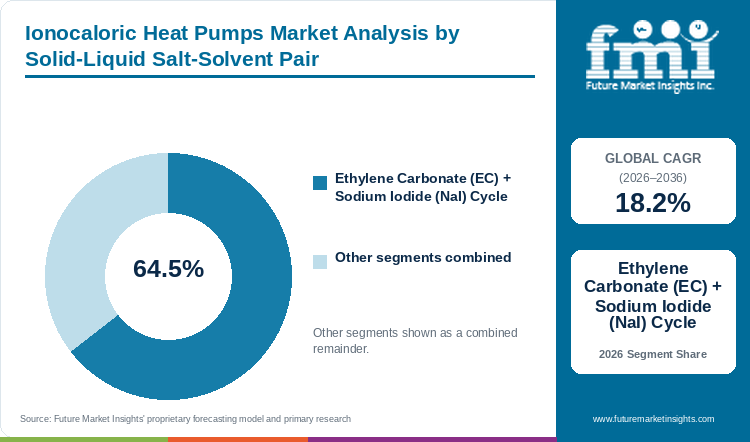
Ethylene Carbonate (EC) + Sodium Iodide (NaI) Cycle is forecast to command 64.5% of salt-solvent pairs in 2026, reinforced by temperature lifts.
Table 5: Solid-Liquid Salt-Solvent Pair Share for the Ionocaloric Heat Pumps Market (percentage share), 2026
| Solid-Liquid Salt-Solvent Pair Segment | Share (2026) |
|---|---|
| Ethylene Carbonate (EC) + Sodium Iodide (NaI) Cycle | 64.5% |
| Aqueous Nitrate / Halide Salt Eutectic Cycles | 35.5% |
| Total | 100.0% |
*Note: Combined share of remaining solid-liquid salt-solvent pair categories totaling 100.0% of 2026 market demand.
Table 6: Solid-Liquid Salt-Solvent Pair Leadership and Market Growth for the Ionocaloric Heat Pumps Market (segment and CAGR percentage), 2026 to 2036
| Metric | Value |
|---|---|
| Global CAGR (2026 to 2036) | 18.2% |
| Leading Segment | Ethylene Carbonate (EC) + Sodium Iodide (NaI) Cycle |
Blending solid ethylene carbonate with sodium iodide creates a non-flammable, zero-vapor-pressure working pair that melts near 36 degrees Celsius and delivers adiabatic temperature swings exceeding 25 kelvin. Unlike hydrofluorocarbon refrigerants that require high-pressure brazed copper tubing, the EC-NaI salt-solvent slurry circulates near atmospheric pressure through polymeric heat exchangers. Because ethylene carbonate synthesis can incorporate captured carbon dioxide feedstock, the working fluid offers the potential for a low or negative refrigerant global warming potential depending on feedstock sourcing and lifecycle electricity inputs, drawing from high-purity battery electrolyte plants alongside absorption chillers units thermal networks.
- The Ethylene Carbonate (EC) + Sodium Iodide (NaI) Cycle is estimated to capture 64.5% of 2026 working-pair revenue by delivering a 25-to-28 kelvin thermodynamic operating window across room-temperature heating and cooling.
- In December 2025, Mitsubishi Chemical Group Corporation announced an agreement transferring its Memphis and Billingham lithium-ion battery electrolyte manufacturing plants in the United States and the United Kingdom to Green E Origin SARL by March 2026 [5].
How Do Electrodialysis Ion-Exchange Membrane Stacks Capture Over Seventy Percent of Regeneration Designs?
Electrodialysis Ion-Exchange Membrane Stack is predicted to account for 71.2% of ion regeneration in 2026, linked to low voltage salt recovery.
Applying a sub-volt direct-current field across alternating cation-exchange and anion-exchange membranes extracts sodium and iodide ions out of the liquid mixture without boiling the solvent, causing pure ethylene carbonate crystals to precipitate and release heat. Unlike thermal distillation or high-pressure reverse osmosis, electrodialysis stacks operate silently with no moving pistons and leverage mature polymeric membrane materials engineered for industrial chemical recovery. Capacitive deionization and reverse-osmosis regeneration are slated to contribute the remaining 28.8% of 2026 regeneration volume in low-salinity aqueous loops.
- Electrodialysis Ion-Exchange Membrane Stack systems are forecast to generate 71.2% of 2026 regeneration turnover because continuous electro-membrane ion transport minimizes parasitic electrical work.
- In October 2026, Veolia Water Technologies expanded its polymer separation portfolio by launching a non-PVDF membrane manufacturing line in Oroszlany in Hungary under its GreenUp strategic program [6].
What Drives Zero-GWP Building Space Heating & Cooling Heat Pumps to Lead End-Use Thermal Systems?
Zero-GWP Building Space Heating & Cooling Heat Pumps are slated to generate 52.8% of thermal systems in 2026, enabled by decarbonization mandates.
Commercial office towers and multi-family residential buildings face strict indoor refrigerant charge limits under safety standards alongside municipal bans on fossil-fuel boilers. Because an ionocaloric heat pump operates at atmospheric pressure with non-volatile ethylene carbonate and sodium iodide, building engineers install modular hydronic units inside occupied mechanical closets alongside membrane filtration systems water loops without blast-relief venting. Battery electric vehicle cabin heat pumps (projected at 27.4%) and medical and cold-chain transport refrigeration (forecast at 19.8%) are slated to capture the remaining 47.2% of 2026 installations.
- Zero-GWP Building Space Heating & Cooling Heat Pumps are predicted to claim 52.8% of 2026 thermal-system revenue as commercial real estate owners seek silent, compressor-free hydronic heating and cooling.
- In May 2026, Johnson Controls reported that its commercial heat pump installations cut customer annual heating costs by 32% and heating emissions by 55% while saving 1.6 million metric tons of CO2e across 2025 [7].
What are the drivers, restraints, and opportunities in the ionocaloric heat pumps market?
Building electrification and F-gas bans drive ionocaloric heat pump adoption, whereas organic-solvent membrane resistance restrains current density, and EV cabin thermal management creates new growth.
- Driver: Zero-emission building mandates and hydrofluorocarbon phase-downs push HVAC OEMs toward atmospheric-pressure electrochemical heat pumps with zero GWP.
- Restraint: Higher ionic resistance and viscosity of ethylene carbonate-salt solutions compared with aqueous brines limit electrodialysis current density and require larger membrane stacks.
- Opportunity: Integrating compact, vibration-free ionocaloric heat pumps into battery electric vehicle thermal loops preserves winter driving range without flammable refrigerants.
Growth Analysis and Future Potential: Qualitative Demand Catalysts
Decarbonizing commercial building heating and industrial process cooling requires heat-pump cycles that eliminate both high-GWP hydrofluorocarbons and high-pressure compressor noise. In March 2026, Lawrence Berkeley National Laboratory's Energy Technologies Area highlighted industrial electrification and high-efficiency thermal heat pumps as primary levers to lower U.S. manufacturing energy intensity [8]. Because ethylene carbonate synthesis can incorporate captured carbon dioxide as a chemical input, the salt-solvent refrigerant itself has the potential for a carbon-negative material footprint, whereas net whole-system lifecycle emissions depend on local grid electricity carbon intensity and manufacturing boundaries. Building mechanical engineers integrating heat pumps systems into urban hospitals and multi-family apartments value the vibration-free operation of solid-state electrodialysis regeneration.
Risk Assessment of the Ionocaloric Heat Pumps Market: Operational and Formulation Friction
Operating electrodialysis stacks in concentrated organic carbonate-iodide mixtures introduces higher electrical resistance and viscosity drag than standard aqueous desalination. When ethylene carbonate cools near its crystallization point, slurry viscosity rises across narrow inter-membrane spacers and increases pumping power unless scraped-surface heat exchangers are carefully tuned. In July 2025, the European Heat Pump Association published its 2025 market report covering 21 European countries and documenting how high electricity-to-gas price ratios slow commercial heat pump replacements across Europe [9]. To prevent premature stack fouling and membrane swelling, system builders must specify solvent-resistant cross-linked membranes alongside cold storage facilities glycol heat-recovery loops.
Commercial Opportunity Analysis: Formulation Differentiation and Value-Add Formats
Battery electric vehicles lose 20% to 35% of their driving range in freezing weather when resistive cabin heaters drain high-voltage traction packs, while automotive OEMs seek alternatives to flammable propane or PFAS-linked R-1234yf refrigerants. In February 2026, Trane Technologies Commercial HVAC EMEA President Jose La Loggia detailed how integrated thermal management systems operating at 300% to 400% efficiency saved 7700 gigajoules of annual energy at Organon in the Netherlands [10]. Packaging solid-liquid ionocaloric cartridges with low-voltage electrodialysis cells powered directly by an electric vehicle's DC bus provides silent cabin and battery conditioning alongside refrigeration coolers units for electric delivery vans. Chemical producers supplying ultra-dry, battery-grade ethylene carbonate and ternary iodide-nitrate eutectics capture recurring fluid-fill contracts.
Ionocaloric Heat Pumps Market by Country (2026 to 2036)
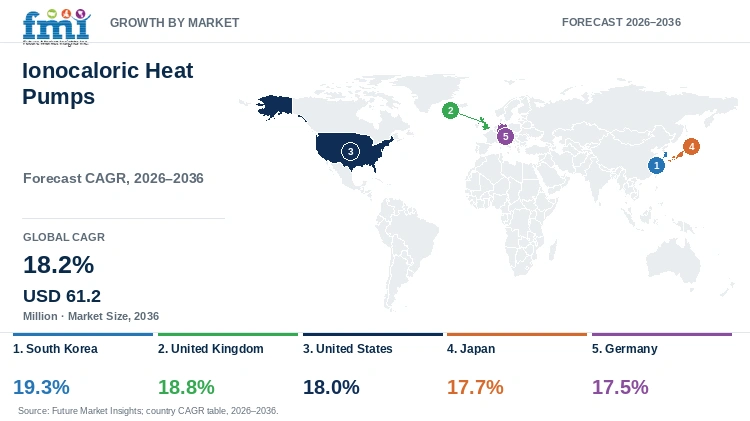
Commercialization of ionocaloric heat pumps concentrates in countries pairing lithium-ion battery electrolyte production with ion-exchange membrane manufacturing and building decarbonization mandates. South Korea is forecast to pace key national economies at a 19.3% compound annual increase through 2036 while the United Kingdom is predicted to register 18.8% and the United States is slated to achieve 18.0%. Meanwhile, Japanese installations are anticipated to grow 17.7% annually and German demand is expected to rise 17.5% across industrial and commercial hydronic installations.
Table 7: Country CAGR and Primary Growth Levers for the Ionocaloric Heat Pumps Market (CAGR percentage and operational drivers), 2026 to 2036
| Country | CAGR (2026 to 2036) | Primary Growth Lever |
|---|---|---|
| South Korea | 19.3% | Battery-grade ethylene carbonate supply and EV heat-pump R&D |
| United Kingdom | 18.8% | Boiler Upgrade Scheme grants and net-zero commercial building codes |
| United States | 18.0% | LBNL ionocaloric patent licensing and EPA AIM Act HFC restrictions |
| Japan | 17.7% | ASTOM and Asahi Kasei electrodialysis membrane manufacturing leadership |
| Germany | 17.5% | Federal BEG heat-pump subsidies and industrial heat electrification |
Source: Future Market Insights analysis
South Korea Ionocaloric Heat Pumps Market Outlook (2026 to 2036)
Whereas global ionocaloric adoption is led by commercial building space heating, South Korea's market is uniquely fueled by electric-vehicle cabin heat-pump integration and domestic battery-grade ethylene carbonate overcapacity. Technical specifications published for ASTOM Corporation's NEOSEPTA ion-exchange membrane series in January 2025 detail high ionic permselectivity and low solvent diffusion rates widely adopted across East Asian electrochemical separation stacks [11]. Domestic ionocaloric heat pump turnover is projected to rise at a leading 19.3% compound rate between 2026 and 2036 as Korean automotive and HVAC groups pilot ethylene carbonate-sodium iodide chillers. High peak commercial power tariffs nevertheless penalize stack voltage drops, driving Korean engineers to co-develop ultra-thin ion-exchange membranes with domestic battery separator producers.
Key takeaway: In South Korea, domestic battery-grade ethylene carbonate infrastructure and EV thermal R&D are projected to fuel 19.3% annual growth for ionocaloric heat pumps.
United Kingdom Ionocaloric Heat Pumps Market Outlook (2026 to 2036)
United Kingdom DESNZ statistical bulletins released in March 2026 on December 2025 heat-pump deployments confirmed expanding hydronic installations up to 45 kilowatts under the Boiler Upgrade Scheme across British residential and commercial properties [12]. Unlike continental European markets with spacious basement plant rooms, British commercial retrofits in London and Manchester are uniquely constrained by narrow Victorian mechanical closets and strict urban boundary noise limits. Because compressor-free ionocaloric stacks operate silently indoors without rooftop fan units, British ionocaloric revenues are predicted to climb by 18.8% per year over the decade to 2036. High electricity-to-gas spark spreads across UK utility tariffs remain a commercial hurdle, requiring vendors to prove seasonal coefficients of performance above 3.5.
Key takeaway: In the United Kingdom, Boiler Upgrade Scheme incentives and strict urban noise limits are predicted to underpin 18.8% annual expansion for silent indoor ionocaloric units.
United States Ionocaloric Heat Pumps Market Outlook (2026 to 2036)
United States demand is slated to grow by 18.0% per year between 2026 and 2036 as Calion Technologies and major HVAC OEMs including Trane Technologies and Johnson Controls test solid-liquid salt-solvent prototypes. The United States stands apart from Asian and European markets because domestic commercialization is anchored by direct Department of Energy national-laboratory patent licensing and venture-backed California defense and commercial HVAC consortia. Reinforcing this regulatory pull, the U.S. EPA HFC Data Hub updated in September 2026 documented that 2025 national hydrofluorocarbon consumption fell to 172.7 million MTCO2e below the 181.5 million MTEVe cap [13]. Underwriters Laboratories safety certification timelines for non-aqueous electrodialysis stacks still lengthen product launches, prompting American builders to standardize 24-volt DC stack modules.
Key takeaway: In the United States, LBNL patent licensing and EPA AIM Act refrigerant transitions are slated to fuel 18.0% yearly expansion across commercial HVAC pilots.
Japan Ionocaloric Heat Pumps Market Outlook (2026 to 2036)
Unlike downstream-only importer nations, Japan occupies a unique global position as the primary exporter of cross-linked Neosepta electrodialysis membranes and ultra-dry ethylene carbonate solvents used inside ionocaloric stacks worldwide. Engineering documentation for ASTOM Corporation's ACILYZER electrodialysis stacks in January 2025 confirmed that alternating cation-exchange and anion-exchange membranes desalinate and concentrate ionic solutions continuously under direct-current fields without mechanical pressurization [14]. Backed by ASTOM Corporation and Mitsubishi Chemical Group material supply, Japanese ionocaloric heat pump revenues are expected to climb at a 17.7% compound annual clip through 2036. Tight mechanical room footprints in Japanese commercial buildings still restrict large crystallizer tanks, pushing domestic engineers to design compact plate-and-frame phase-change heat exchangers.
Key takeaway: In Japan, domestic Neosepta ion-exchange membrane leadership and high-purity ethylene carbonate production are forecast to maintain 17.7% annual market growth.
Germany Ionocaloric Heat Pumps Market Outlook (2026 to 2036)
In May 2025, the International Renewable Energy Agency documented in its smart electrification assessment that heating and cooling account for over 40% of global energy carbon emissions and require 793 million ambient heat pumps by 2050 [15]. Germany diverges from North American markets because German municipal utilities and chemical park operators prioritize PFAS-free working fluids that avoid upcoming European Chemicals Agency restrictions on fluorinated hydrofluoroolefins. Consequently, German ionocaloric heat pump sales are predicted to rise at a 17.5% yearly pace across the decade to 2036 across Bavaria and North Rhine-Westphalia hydronic networks. Strict German water-hazard classifications (Wassergefaehrdungsklasse) for industrial chemical loops nevertheless require double-walled secondary containment on ethylene carbonate-iodide plumbing installed inside commercial basements.
Key takeaway: In Germany, federal building electrification subsidies and PFAS-free refrigerant preferences are anticipated to generate 17.5% yearly growth for double-walled ionocaloric hydronic modules.
Full report country CAGRs cover: North America; Latin America; Western Europe; Eastern Europe; East Asia; South Asia and Pacific; Middle East and Africa.
Who are the notable companies in the ionocaloric heat pumps market?
Calion Technologies, Trane Technologies plc, Johnson Controls International plc, ASTOM Corporation, Veolia Water Technologies, Mitsubishi Chemical Group, Asahi Kasei Corporation, and Huntsman Corporation are the notable companies in the ionocaloric heat pumps market.
Future Market Insights notes that the ionocaloric heat pump ecosystem brings together national-laboratory licensing ventures and commercial HVAC manufacturers with electrodialysis membrane fabricators and carbonate chemical producers. Cycle licensing pioneers and commercial HVAC OEMs engineer the integrated solid-liquid phase-change exchangers and hydronic control loops. Specialized membrane and water-technology companies supply the low-resistance cation and anion exchange stacks that regenerate the salt-solvent pair. Upstream chemical corporations refine the anhydrous, battery-grade ethylene carbonate and halide salts required for reversible crystallization.
- Ionocaloric Cycle Pioneers & Commercial HVAC Integrators: Calion Technologies and Trane Technologies plc alongside Johnson Controls International plc develop non-vapor-compression electrochemical heat pumps and building thermal systems.
- Electrodialysis Membrane & Stack Specialists: ASTOM Corporation and Veolia Water Technologies together with Asahi Kasei Corporation manufacture selective ion-exchange membranes and electrodialysis stacks.
- High-Purity Ethylene Carbonate & Salt-Solvent Suppliers: Mitsubishi Chemical Group and Huntsman Corporation supply ultra-pure ethylene carbonate and specialty carbonate solvents.
Competitive Benchmarking: Ionocaloric Heat Pumps Market
Table 8: Competitive Benchmarking for the Ionocaloric Heat Pumps Market (qualitative capability ratings), 2026
| Company | Ionocaloric Cycle & HVAC IP | Electrodialysis Stack Capability | Carbonate Solvent Purity & Scale | Geographic Reach |
|---|---|---|---|---|
| Calion Technologies | High | Medium | Medium | Medium |
| Trane Technologies plc | High | Medium | Low | High |
| Johnson Controls International plc | High | Medium | Low | High |
| ASTOM Corporation | Medium | High | Low | Medium |
| Veolia Water Technologies | Medium | High | Low | High |
| Mitsubishi Chemical Group | Medium | Low | High | High |
| Asahi Kasei Corporation | Medium | High | Medium | High |
| Huntsman Corporation | Low | Low | High | High |
Scoring basis: Ionocaloric Cycle & HVAC IP is rated High for entities holding core electrochemical heat-pump patents or global commercial chiller platforms. Electrodialysis Stack Capability is High for dedicated manufacturers of commercial ion-exchange membranes and desalination stacks, and Low for raw solvent suppliers. Carbonate Solvent Purity & Scale and Geographic Reach reflect documented battery-grade ethylene carbonate synthesis capacity and multi-region sales infrastructure.
Key Developments in the Ionocaloric Heat Pumps Market
- In August 2026, Asahi Kasei Corporation inaugurated a new Hipore wet-process membrane separator coating line at its Celgard facility in Charlotte in North Carolina to expand North American electrochemical separator capacity [16].
- In December 2025, Trane Technologies published industrial decarbonization findings showing that its RTSF HT high-temperature heat pump elevates recovered waste heat to 110 degrees Celsius and cut heating costs by 68% at a French food plant [17].
- In January 2025, Trane Technologies unveiled its Thermal Battery Storage-Source Heat Pump System combining solid-liquid phase-change thermal storage with modular heat pumps to decarbonize commercial buildings under its Gigaton Challenge [18].
Key Players in the Ionocaloric Heat Pumps Market
Ionocaloric Cycle Pioneers & Commercial HVAC Integrators
- Calion Technologies
- Trane Technologies plc
- Johnson Controls International plc
Electrodialysis Membrane & Stack Specialists
- ASTOM Corporation
- Veolia Water Technologies
- Asahi Kasei Corporation
High-Purity Ethylene Carbonate & Salt-Solvent Suppliers
- Mitsubishi Chemical Group
- Huntsman Corporation
Ionocaloric Heat Pumps Market - Report Scope
Table 9: Report Scope for the Ionocaloric Heat Pumps Market (coverage fields and definitions), 2026 to 2036
| Coverage field | Report scope |
|---|---|
| Market breakdown | Solid-Liquid Salt-Solvent Pair; Ion Separation Regeneration Method; End-Use Thermal System; Region |
| Quantitative Units | USD Million (2025, 2026, and 2036) |
| Market Definition | Encompasses commercial and pilot revenues from ionocaloric heat pump modules, electrodialysis ion-separation regeneration stacks configured for caloric loops, and pre-formulated ethylene carbonate or eutectic salt-solvent charges. Category Scope Note: Excludes municipal seawater desalination plants, lithium-ion battery electrolyte fills, and conventional vapor-compression heat pumps. |
| Regions Covered | North America; Latin America; Western Europe; Eastern Europe; East Asia; South Asia and Pacific; Middle East and Africa |
| Countries Covered | South Korea, United Kingdom, United States, Japan, Germany, and additional regional markets |
| Key Companies Covered | Calion Technologies, Trane Technologies plc, Johnson Controls International plc, ASTOM Corporation, Veolia Water Technologies, Mitsubishi Chemical Group, Asahi Kasei Corporation, Huntsman Corporation |
| Forecast Period | 2026 to 2036 (Base Year: 2026; Historical Baseline: 2025) |
| Approach | Primary and secondary research triangulated with electrodialysis membrane area (sq. meters) and salt-solvent charge models. |
Ionocaloric Heat Pumps Market - Research Methodology
Table 10: Research Methodology for the Ionocaloric Heat Pumps Market (research methods and approach), 2026 edition
| Method | Approach |
|---|---|
| Primary Research | Interviews with national-laboratory caloric licensing teams, commercial heat-pump R&D directors, electrodialysis stack engineers, and carbonate electrolyte producers to validate cell voltages, melting-point depression spans, and membrane lifetimes. |
| Secondary Research | Review of Lawrence Berkeley National Laboratory publications, U.S. DOE Building Technologies Office studies, EPA AIM Act rulemakings, European Commission F-Gas directives, and corporate annual reports. |
| Market Sizing and Forecasting | Bottom-up aggregation of active ion-exchange membrane area (sq. meters), ethylene carbonate-sodium iodide charge tonnage, and thermal megawatt output across building, EV, and cold-chain pilot deployments. |
| Country Forecasting Model | Econometric country CAGRs (ranging from 17.5% in Germany to 19.3% in South Korea around the 18.2% global CAGR) modeled against domestic battery-electrolyte capacity, membrane manufacturing, and heat-pump subsidy rates. |
| Operational Benchmark Traceability | Thermodynamic and regulatory benchmarks in Tables 2, 3, and 4 traced to Lawrence Berkeley National Laboratory experimental EC-NaI metrics, U.S. EPA AIM Act rules, IEA Global Energy Review 2026, and EU Regulation 2024/573. |
| Data Triangulation and Validation | Cross-validation of specialty ion-exchange membrane shipments against commercial HVAC and EV thermal prototype budgets to isolate in-scope caloric heat pump revenue. |
Ionocaloric Heat Pumps Market by Segments
Ionocaloric Heat Pumps Market segmented by Solid-Liquid Salt-Solvent Pair:
- Ethylene Carbonate (EC) + Sodium Iodide (NaI) Cycle
- Aqueous Nitrate / Halide Salt Eutectic Cycles
Ionocaloric Heat Pumps Market segmented by Ion Separation Regeneration Method:
- Electrodialysis Ion-Exchange Membrane Stack
- Capacitive Deionization / Reverse-Osmosis Regeneration
Ionocaloric Heat Pumps Market segmented by End-Use Thermal System:
- Zero-GWP Building Space Heating & Cooling Heat Pumps
- Battery Electric Vehicle Cabin Heat Pumps
- Medical & Cold-Chain Transport Refrigeration
Ionocaloric Heat Pumps Market by Region
- North America
- United States
- Canada
- Latin America
- Brazil
- Mexico
- Argentina
- Chile
- Western Europe
- Germany
- France
- United Kingdom
- Italy
- Spain
- Benelux
- Nordics
- Eastern Europe
- Poland
- Czech Republic
- Romania
- Hungary
- East Asia
- China
- Japan
- South Korea
- South Asia and Pacific
- India
- ASEAN
- Australia and New Zealand
- Middle East and Africa
- GCC Countries
- South Africa
- Türkiye
- Israel
Research Sources and Bibliography
- [1] Advanced Research Projects Agency-Energy. (2025, March 20). Zero-GWP Air Source Heat Pump Steam Generation Using Ionocalorics. U.S. Department of Energy ARPA-E.
- [2] U.S. Environmental Protection Agency. (2026, October 6). HFC Allowances. US EPA.
- [3] International Energy Agency. (2026, March 15). Technology: Heat pumps - Global Energy Review 2026. IEA Publications.
- [4] European Commission. (2025, April 9). Air conditioning - Climate-friendly alternatives to F-gases. Directorate-General for Climate Action.
- [5] Mitsubishi Chemical Group Corporation. (2025, December 12). Transfer of Electrolyte Manufacturing Assets in the United States and the United Kingdom. MCGC News Releases.
- [6] Veolia Water Technologies. (2026, October 14). Veolia expands its water technology portfolio with innovative non-PVDF ultrafiltration membrane. Veolia Press Room.
- [7] Johnson Controls International plc. (2026, May 21). Johnson Controls heat pumps deliver 32% reduction in annual heating costs while cutting heating emissions by 55%. Johnson Controls Media Center.
- [8] Lawrence Berkeley National Laboratory. (2026, March 12). Improving U.S. Industrial Competitiveness. LBNL Energy Technologies Area.
- [9] European Heat Pump Association. (2025, July 18). 2025 market report - European Heat Pump Association. EHPA Brussels.
- [10] Trane Technologies plc. (2026, February 26). Thermal Management Systems for a Sustainable Future. Trane Technologies Solutions & Innovation.
- [11] ASTOM Corporation. (2025, January 10). ASTOM > Ion exchange membrane[NEOSEPTA]. ASTOM Products.
- [12] Department for Energy Security and Net Zero. (2026, March 12). Heat pump deployment statistics: December 2025. GOV.UK.
- [13] U.S. Environmental Protection Agency. (2026, September 24). HFC Data Hub. US EPA.
- [14] ASTOM Corporation. (2025, January 10). ASTOM > Electrodialyzers[ACILYZER ED]. ASTOM Products.
- [15] International Renewable Energy Agency. (2025, May 20). Power to heat and cooling: Status. IRENA Abu Dhabi.
- [16] Asahi Kasei Corporation. (2026, August 26). Asahi Kasei Unveils New Wet-Process Separator Coating Line in North Carolina, Advancing the Company's 40-Year North American Battery Separator Strategy. Asahi Kasei Corporate News.
- [17] Trane Technologies plc. (2025, December 17). Industrial Decarbonization: From Silos to Systems - Rethinking Thermal Management. Trane Technologies Sustainability Leadership.
- [18] Trane Technologies plc. (2025, January 21). Accelerating Impact in New Arenas: Electrification of Buildings and the Cold Chain. Trane Technologies Solutions & Innovation.
- [19] Huntsman Corporation. (2026, January 15). ULTRAPURE® Ethylene Carbonate (ULTRAPURE® EC). Huntsman Product Finder.
- [20] Johnson Controls International plc. (2026, August 7). Johnson Controls heat pumps cut 2025 heating costs by 32%, emissions by 55%. Johnson Controls Building Insights.
This bibliography is provided for reader reference and is not exhaustive. The full report contains the complete reference list and detailed citations.
This Report Answers
- What is the 2026 valuation of the ionocaloric heat pumps market and how fast will it grow through 2036?
- Why does the Ethylene Carbonate (EC) + Sodium Iodide (NaI) Cycle capture 64.5% of working-pair demand?
- How do Electrodialysis Ion-Exchange Membrane Stacks achieve 71.2% share in ion regeneration?
- How does CO2-derived ethylene carbonate synthesis affect the refrigerant footprint of ionocaloric cycles relative to HFOs?
- How does carbon-negative ethylene carbonate synthesis differentiate ionocaloric cycles from HFO refrigerants?
- Why does South Korea lead national growth at a 19.3% CAGR ahead of the UK (18.8%) and USA (18.0%)?
- What technical challenges around organic-solvent membrane resistance and slurry crystallization affect stack sizing?
- How are Calion Technologies, Trane, Johnson Controls, ASTOM, Veolia, and Mitsubishi Chemical positioned?
Frequently Asked Questions
How large is the global ionocaloric heat pumps market in 2026 and 2036?
Starting from USD 9.6 million in 2025, global ionocaloric heat pump installations are estimated to total USD 11.5 million for 2026 according to Future Market Insights. Long-term adoption is projected to lift 2036 revenue to USD 61.2 million for an anticipated net gain of USD 49.7 million.
What is the forecast CAGR for ionocaloric heat pumps between 2026 and 2036?
Electrochemical heat pump shipments are projected to progress at an 18.2% annual rate across the 2026 to 2036 forecast window. Commercial building boiler bans and electric-vehicle cabin conditioning programs support this expected pace.
Which salt-solvent working pair dominates the market in 2026?
The Ethylene Carbonate (EC) + Sodium Iodide (NaI) Cycle is estimated to hold 64.5% of working-pair revenue in 2026. Dissolving sodium iodide into solid ethylene carbonate yields a 25-to-28 kelvin temperature lift near ambient conditions.
Why do electrodialysis ion-exchange membrane stacks lead ion separation regeneration?
Electrodialysis Ion-Exchange Membrane Stack assemblies are projected to capture 71.2% of 2026 regeneration turnover. Sub-volt electrochemical ion removal recovers pure ethylene carbonate crystals without thermal boiling or mechanical compression.
Which country exhibits the highest growth rate through 2036?
FMI projects South Korea as the fastest-growing national market at a 19.3% CAGR through 2036. Domestic battery-electrolyte carbonate supply and automotive heat-pump R&D accelerate Korean commercialization.
Which companies are key players in the ionocaloric heat pumps ecosystem?
Notable participants include Calion Technologies, Trane Technologies plc, Johnson Controls International plc, ASTOM Corporation, Veolia Water Technologies, Mitsubishi Chemical Group, Asahi Kasei Corporation, and Huntsman Corporation.
Preview the report firsthand - request a free sample
Get SampleGet the brochure for pricing and purchase details.
Get PDFTable of Content
- Key Takeaways
- Market Size and CAGR
- Top Growth Driver
- Fastest Growing Segment
- Leading Region
- Key Companies
- Emerging Opportunities
- Executive Summary
- Global Market Outlook
- Demand-side Trends
- Supply-side Trends
- Technology Roadmap Analysis
- Analysis and Recommendations
- Analyst Perspective (What is happening? Why now? What should investors know?)
- Key Questions Answered
- How large is the market?
- What is the CAGR?
- What are key trends?
- Which region dominates?
- Who are the leaders?
- Market Overview
- Market Coverage / Taxonomy
- Market Definition / Scope / Limitations
- Research Methodology
- Chapter Orientation
- Analytical Lens and Working Hypotheses
- Market Structure, Signals, and Trend Drivers
- Benchmarking and Cross-market Comparability
- Market Sizing, Forecasting, and Opportunity Mapping
- Research Design and Evidence Framework
- Desk Research Programme (Secondary Evidence)
- Expert Input and Fieldwork (Primary Evidence)
- Tooling, Models, and Reference Databases
- Data Engineering and Model Build
- Quality Assurance and Audit Trail
- Market Background
- Market Dynamics (Drivers, Restraints, Opportunity, Trends)
- Scenario Forecast (Optimistic, Likely, Conservative)
- Impact Analysis
- AI Impact
- Sustainability Impact
- Regulatory Impact
- Technology Impact
- Consumer / Buyer Analysis
- Purchase Drivers
- Adoption Barriers
- Buyer Journey
- Opportunity Map Analysis
- Product Life Cycle Analysis
- Supply Chain Analysis
- Investment Feasibility Matrix
- Value Chain Analysis
- PESTLE and Porter's Analysis
- Regulatory Landscape
- Regional Parent Market Outlook
- Production and Consumption Statistics
- Import and Export Statistics
- Global Market Analysis and Forecast, 2021 to 2036
- Historical Market Size Value (USD Million) Analysis, 2021 to 2025
- Current and Future Market Size Value (USD Million) Projections, 2026 to 2036
- Y-o-Y Growth Trend Analysis
- Absolute $ Opportunity Analysis
- Global Market Pricing Analysis, 2021 to 2036
- Global Market Analysis and Forecast, By Solid-Liquid Salt-Solvent Pair, 2021 to 2036
- Introduction / Key Findings
- Historical Market Size Value (USD Million) Analysis By Solid-Liquid Salt-Solvent Pair, 2021 to 2025
- Current and Future Market Size Value (USD Million) Analysis and Forecast By Solid-Liquid Salt-Solvent Pair, 2026 to 2036
- Ethylene Carbonate (EC) + Sodium Iodide (NaI) Cycle
- Aqueous Nitrate / Halide Salt Eutectic Cycles
- Y-o-Y Growth Trend Analysis By Solid-Liquid Salt-Solvent Pair, 2021 to 2025
- Absolute $ Opportunity Analysis By Solid-Liquid Salt-Solvent Pair, 2026 to 2036
- Global Market Analysis and Forecast, By Ion Separation Regeneration Method, 2021 to 2036
- Introduction / Key Findings
- Historical Market Size Value (USD Million) Analysis By Ion Separation Regeneration Method, 2021 to 2025
- Current and Future Market Size Value (USD Million) Analysis and Forecast By Ion Separation Regeneration Method, 2026 to 2036
- Electrodialysis Ion-Exchange Membrane Stack
- Capacitive Deionization / Reverse-Osmosis Regeneration
- Y-o-Y Growth Trend Analysis By Ion Separation Regeneration Method, 2021 to 2025
- Absolute $ Opportunity Analysis By Ion Separation Regeneration Method, 2026 to 2036
- Global Market Analysis and Forecast, By End-Use Thermal System, 2021 to 2036
- Introduction / Key Findings
- Historical Market Size Value (USD Million) Analysis By End-Use Thermal System, 2021 to 2025
- Current and Future Market Size Value (USD Million) Analysis and Forecast By End-Use Thermal System, 2026 to 2036
- Zero-GWP Building Space Heating & Cooling Heat Pumps
- Battery Electric Vehicle Cabin Heat Pumps
- Medical & Cold-Chain Transport Refrigeration
- Y-o-Y Growth Trend Analysis By End-Use Thermal System, 2021 to 2025
- Absolute $ Opportunity Analysis By End-Use Thermal System, 2026 to 2036
- Global Market Analysis and Forecast, By Region, 2021 to 2036
- Introduction
- Historical Market Size Value (USD Million) Analysis By Region, 2021 to 2025
- Current Market Size Value (USD Million) Analysis and Forecast By Region, 2026 to 2036
- North America
- Latin America
- Western Europe
- Eastern Europe
- East Asia
- South Asia and Pacific
- Middle East and Africa
- Market Attractiveness Analysis By Region
- North America Market Analysis and Forecast, By Country, 2021 to 2036
- Historical Market Size Value (USD Million) Trend Analysis By Market Taxonomy, 2021 to 2025
- Market Size Value (USD Million) Forecast By Market Taxonomy, 2026 to 2036
- By Country
- United States
- Canada
- By Solid-Liquid Salt-Solvent Pair
- By Ion Separation Regeneration Method
- By End-Use Thermal System
- By Country
- Market Attractiveness Analysis
- By Country
- By Solid-Liquid Salt-Solvent Pair
- By Ion Separation Regeneration Method
- By End-Use Thermal System
- Key Takeaways
- Latin America Market Analysis and Forecast, By Country
- Historical Market Size Value (USD Million) Trend Analysis By Market Taxonomy, 2021 to 2025
- Market Size Value (USD Million) Forecast By Market Taxonomy, 2026 to 2036
- By Country
- Brazil
- Mexico
- Argentina
- Chile
- By Solid-Liquid Salt-Solvent Pair
- By Ion Separation Regeneration Method
- By End-Use Thermal System
- By Country
- Market Attractiveness Analysis
- By Country
- By Solid-Liquid Salt-Solvent Pair
- By Ion Separation Regeneration Method
- By End-Use Thermal System
- Key Takeaways
- Western Europe Market Analysis and Forecast, By Country
- Historical Market Size Value (USD Million) Trend Analysis By Market Taxonomy, 2021 to 2025
- Market Size Value (USD Million) Forecast By Market Taxonomy, 2026 to 2036
- By Country
- Germany
- France
- United Kingdom
- Italy
- Spain
- Benelux
- Nordics
- By Solid-Liquid Salt-Solvent Pair
- By Ion Separation Regeneration Method
- By End-Use Thermal System
- By Country
- Market Attractiveness Analysis
- By Country
- By Solid-Liquid Salt-Solvent Pair
- By Ion Separation Regeneration Method
- By End-Use Thermal System
- Key Takeaways
- Eastern Europe Market Analysis and Forecast, By Country
- Historical Market Size Value (USD Million) Trend Analysis By Market Taxonomy, 2021 to 2025
- Market Size Value (USD Million) Forecast By Market Taxonomy, 2026 to 2036
- By Country
- Poland
- Czech Republic
- Romania
- Hungary
- By Solid-Liquid Salt-Solvent Pair
- By Ion Separation Regeneration Method
- By End-Use Thermal System
- By Country
- Market Attractiveness Analysis
- By Country
- By Solid-Liquid Salt-Solvent Pair
- By Ion Separation Regeneration Method
- By End-Use Thermal System
- Key Takeaways
- East Asia Market Analysis and Forecast, By Country
- Historical Market Size Value (USD Million) Trend Analysis By Market Taxonomy, 2021 to 2025
- Market Size Value (USD Million) Forecast By Market Taxonomy, 2026 to 2036
- By Country
- China
- Japan
- South Korea
- By Solid-Liquid Salt-Solvent Pair
- By Ion Separation Regeneration Method
- By End-Use Thermal System
- By Country
- Market Attractiveness Analysis
- By Country
- By Solid-Liquid Salt-Solvent Pair
- By Ion Separation Regeneration Method
- By End-Use Thermal System
- Key Takeaways
- South Asia and Pacific Market Analysis and Forecast, By Country
- Historical Market Size Value (USD Million) Trend Analysis By Market Taxonomy, 2021 to 2025
- Market Size Value (USD Million) Forecast By Market Taxonomy, 2026 to 2036
- By Country
- India
- ASEAN
- Australia and New Zealand
- By Solid-Liquid Salt-Solvent Pair
- By Ion Separation Regeneration Method
- By End-Use Thermal System
- By Country
- Market Attractiveness Analysis
- By Country
- By Solid-Liquid Salt-Solvent Pair
- By Ion Separation Regeneration Method
- By End-Use Thermal System
- Key Takeaways
- Middle East and Africa Market Analysis and Forecast, By Country
- Historical Market Size Value (USD Million) Trend Analysis By Market Taxonomy, 2021 to 2025
- Market Size Value (USD Million) Forecast By Market Taxonomy, 2026 to 2036
- By Country
- GCC Countries
- South Africa
- Türkiye
- Israel
- By Solid-Liquid Salt-Solvent Pair
- By Ion Separation Regeneration Method
- By End-Use Thermal System
- By Country
- Market Attractiveness Analysis
- By Country
- By Solid-Liquid Salt-Solvent Pair
- By Ion Separation Regeneration Method
- By End-Use Thermal System
- Key Takeaways
- Key Countries Market Analysis
- United States
- Pricing Analysis
- Market Share Analysis, 2025
- By Solid-Liquid Salt-Solvent Pair
- By Ion Separation Regeneration Method
- By End-Use Thermal System
- Canada
- Pricing Analysis
- Market Share Analysis, 2025
- By Solid-Liquid Salt-Solvent Pair
- By Ion Separation Regeneration Method
- By End-Use Thermal System
- Mexico
- Pricing Analysis
- Market Share Analysis, 2025
- By Solid-Liquid Salt-Solvent Pair
- By Ion Separation Regeneration Method
- By End-Use Thermal System
- Brazil
- Pricing Analysis
- Market Share Analysis, 2025
- By Solid-Liquid Salt-Solvent Pair
- By Ion Separation Regeneration Method
- By End-Use Thermal System
- Chile
- Pricing Analysis
- Market Share Analysis, 2025
- By Solid-Liquid Salt-Solvent Pair
- By Ion Separation Regeneration Method
- By End-Use Thermal System
- Germany
- Pricing Analysis
- Market Share Analysis, 2025
- By Solid-Liquid Salt-Solvent Pair
- By Ion Separation Regeneration Method
- By End-Use Thermal System
- United Kingdom
- Pricing Analysis
- Market Share Analysis, 2025
- By Solid-Liquid Salt-Solvent Pair
- By Ion Separation Regeneration Method
- By End-Use Thermal System
- Italy
- Pricing Analysis
- Market Share Analysis, 2025
- By Solid-Liquid Salt-Solvent Pair
- By Ion Separation Regeneration Method
- By End-Use Thermal System
- Spain
- Pricing Analysis
- Market Share Analysis, 2025
- By Solid-Liquid Salt-Solvent Pair
- By Ion Separation Regeneration Method
- By End-Use Thermal System
- France
- Pricing Analysis
- Market Share Analysis, 2025
- By Solid-Liquid Salt-Solvent Pair
- By Ion Separation Regeneration Method
- By End-Use Thermal System
- India
- Pricing Analysis
- Market Share Analysis, 2025
- By Solid-Liquid Salt-Solvent Pair
- By Ion Separation Regeneration Method
- By End-Use Thermal System
- ASEAN
- Pricing Analysis
- Market Share Analysis, 2025
- By Solid-Liquid Salt-Solvent Pair
- By Ion Separation Regeneration Method
- By End-Use Thermal System
- Australia and New Zealand
- Pricing Analysis
- Market Share Analysis, 2025
- By Solid-Liquid Salt-Solvent Pair
- By Ion Separation Regeneration Method
- By End-Use Thermal System
- China
- Pricing Analysis
- Market Share Analysis, 2025
- By Solid-Liquid Salt-Solvent Pair
- By Ion Separation Regeneration Method
- By End-Use Thermal System
- Japan
- Pricing Analysis
- Market Share Analysis, 2025
- By Solid-Liquid Salt-Solvent Pair
- By Ion Separation Regeneration Method
- By End-Use Thermal System
- South Korea
- Pricing Analysis
- Market Share Analysis, 2025
- By Solid-Liquid Salt-Solvent Pair
- By Ion Separation Regeneration Method
- By End-Use Thermal System
- Poland
- Pricing Analysis
- Market Share Analysis, 2025
- By Solid-Liquid Salt-Solvent Pair
- By Ion Separation Regeneration Method
- By End-Use Thermal System
- Hungary
- Pricing Analysis
- Market Share Analysis, 2025
- By Solid-Liquid Salt-Solvent Pair
- By Ion Separation Regeneration Method
- By End-Use Thermal System
- Türkiye
- Pricing Analysis
- Market Share Analysis, 2025
- By Solid-Liquid Salt-Solvent Pair
- By Ion Separation Regeneration Method
- By End-Use Thermal System
- South Africa
- Pricing Analysis
- Market Share Analysis, 2025
- By Solid-Liquid Salt-Solvent Pair
- By Ion Separation Regeneration Method
- By End-Use Thermal System
- United States
- Market Structure Analysis
- Competition Dashboard
- Competition Benchmarking
- Market Share Analysis of Top Players
- By Regional
- By Solid-Liquid Salt-Solvent Pair
- By Ion Separation Regeneration Method
- By End-Use Thermal System
- Emerging Startups
- Innovation Benchmarking
- Competition Analysis
- Competition Deep Dive
- Calion Technologies
- Overview
- Product Portfolio
- Profitability by Market Segments
- Sales Footprint
- Strategy Overview
- Marketing Strategy
- Product Strategy
- Channel Strategy
- Trane Technologies plc
- Johnson Controls International plc
- ASTOM Corporation
- Veolia Water Technologies
- Mitsubishi Chemical Group
- Asahi Kasei Corporation
- Huntsman Corporation
- Calion Technologies
- Case Studies
- Success Stories
- Recent Developments
- Competition Deep Dive
- Assumptions & Acronyms Used


