

- Industry Size (2025)
- USD 345.3 Mn
- Forecast (2035)
- USD 524.8 Mn
- CAGR (2025 to 2035)
- 4.3%
Demand for Blister Card in Japan 2025 to 2035
The Japan blister card demand is valued at USD 345.3 million in 2025 and is forecasted to reach USD 524.8 million by 2035, reflecting a CAGR of 4.3%. Demand is supported by increased packaging requirements for prescription and over-the-counter pharmaceuticals, consumer healthcare products, and compact retail-oriented goods. Compliance with child-resistant packaging mandates and traceability standards sustains the use of durable card-and-film structures. PVC/Vinyl represents the leading material type. It offers stability, thermoforming compatibility, and clarity required for accurate product identification in regulated healthcare distribution. Pharmaceutical packaging leads blister-card use due to expanding therapeutic volumes for chronic diseases and continued preference for unit-dose protection. Uptake is influenced by medication adherence programmes and secure dispensing protocols in clinical and retail settings.
Kyushu & Okinawa and Kanto record the highest usage levels due to the presence of pharmaceutical manufacturing sites, distribution hubs, and established print-pack conversion facilities. These regions maintain infrastructure for regulated cold-chain transport, which supports blister-packed treatments. Key suppliers include Dai Nippon Printing Co., Ltd. (DNP), Toppan Inc., Oji F-Tex Co., Ltd., Nissha Co., Ltd., and Kyodo Printing Co., Ltd. Their portfolios include pharmaceutical-grade blister substrates, functional coatings, and serialization-ready formats used in compliance packaging across domestic healthcare supply chains.
Quick Stats for Japan Blister Card Demand
- Japan Blister Card Sales Value (2025): USD 345.3 million
- Japan Blister Card Forecast Value (2035): USD 524.8 million
- Japan Blister Card Forecast CAGR (2025–2035): 4.3%
- Leading Material Type in Japan Blister Card Demand: PVC/Vinyl
- Leading End-use Industry in Japan Blister Card Demand: Pharmaceuticals
- Key Growth Regions in Japan Blister Card Demand: Kyushu & Okinawa, Kanto
- Top Players in Japan Blister Card Demand: Dai Nippon Printing Co., Ltd. (DNP), Toppan Inc., Oji F-Tex Co., Ltd., Nissha Co., Ltd., Kyodo Printing Co., Ltd.
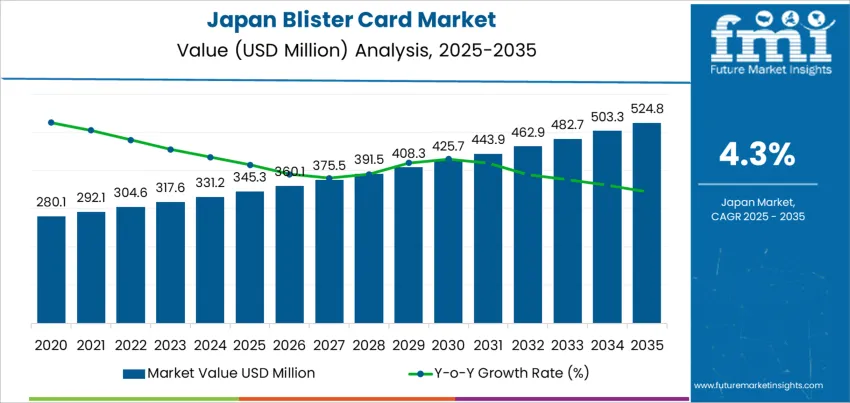
What is the Growth Forecast for Blister Card Industry in Japan through 2035?
Demand for blister cards in Japan follows a phased growth profile shaped by regulated pharmaceutical packaging, medical-device distribution, and retail hygiene standards. Early-period growth remains supported by prescription-medication needs, particularly within aging-population segments. Packaging upgrades linked to dosage safety, tamper resistance, and portability provide steady expansion. Initial demand is also reinforced by strong domestic manufacturing of over-the-counter healthcare products, where blister formats remain a preferred enclosure.
Late-period growth maintains continuity but at a slower trajectory due to high packaging penetration in healthcare systems and disciplined inventory planning within established drug-supply chains. Ecofriendly regulations influence a gradual shift toward recyclable materials and reduced plastic content. These transitions create replacement demand rather than large volume surges. Electronics components contribute incremental gains, though efficiency improvements reduce packaging units per shipment. The curve therefore transitions from healthcare-driven expansion in the early phase to regulatory-aligned and material-innovation growth in the later phase, demonstrating controlled maturity rather than acceleration.
Japan Blister Card Key Takeaways
| Metric | Value |
|---|---|
| Japan Blister Card Sales Value (2025) | USD 345.3 million |
| Japan Blister Card Forecast Value (2035) | USD 524.8 million |
| Japan Blister Card Forecast CAGR (2025-2035) | 4.3% |
Why is the Demand for Blister Cards in Japan Growing?
Demand for blister cards in Japan is increasing because pharmaceutical companies, supplement brands and consumer goods manufacturers require packaging that offers unit protection, clear product visibility and controlled dosing. Blister cards help preserve product quality by reducing exposure to moisture and handling, which is important for temperature-sensitive medicines and nutraceuticals commonly used by Japan’s ageing population. Pharmacies and hospitals also prefer unit-dose packaging because it supports accuracy in daily medication routines and simplifies inventory checks. Retailers use blister cards for small electronics, household items and personal-care accessories to improve presentation on shelves and reduce theft risk in high-traffic stores.
Manufacturers invest in automated sealing and inspection lines, which encourages consistent use of blister cards in production planning. Printed backing cards provide space for multilingual instructions, regulatory information and branding, which aligns with Japan’s strict labelling requirements. Sustainability discussions contribute to material improvements, including recyclable components and reduced plastic content. Constraints include cost pressure compared with bottles or flexible pouches, as well as limited adoption in low-value items where packaging expense must remain minimal. Some brands adjust usage based on environmental goals that prioritize material reduction.
Which Material Types, End-use Industries, and Product Formats Lead Demand for Blister Cards in Japan?
Demand for blister cards in Japan reflects secure packaging requirements in healthcare, retail goods, and regulated consumer product distribution. Users prioritize tamper evidence, unit-dose presentation, and clarity for product identification. Retail environments require packaging that supports display visibility and organized shelf arrangement, while mail-order distribution growth increases the need for protective structures. Adoption aligns with Japan’s domestic focus on precise dosage labeling, compact packaging sizes, and hygiene-compliant sealing.
By Material Type, PVC/Vinyl Holds the Largest Share
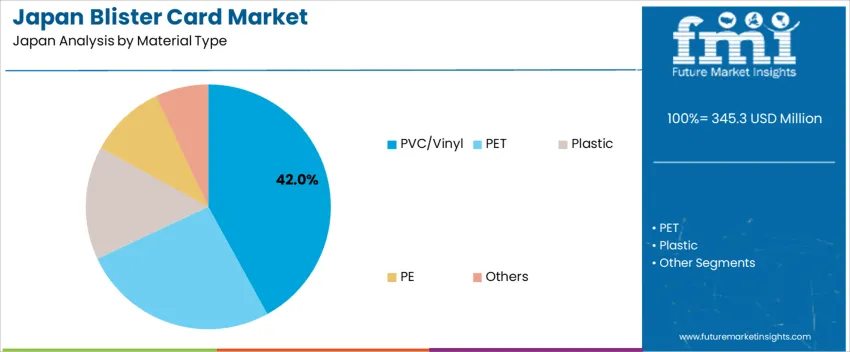
PVC/Vinyl accounts for 42.0%, driven by strong thermoforming performance, sealing compatibility, and affordable equipment integration in Japan’s pharmaceutical and personal goods packaging lines. PET represents 26.0%, used where recycling alignment and high transparency are required. Generic plastic formats hold 15.0%, supporting mid-cost products needing durable forming properties. PE represents 10.0%, valued in moisture-resistant packaging but used in limited volumes for blister structures. Others total 7.0%, including barrier-enhanced substrates for sensitive products. Material choice reflects Japan’s retail display expectations, moisture-control needs, and supply chain consistency across distributed storage environments.
Key points:
- PVC remains dominant due to seal strength and processing stability.
- PET expands in recyclable transparent blister applications.
- Specialized barriers support regulated and moisture-sensitive goods.
By End-use Industry, Pharmaceuticals Hold the Largest Share
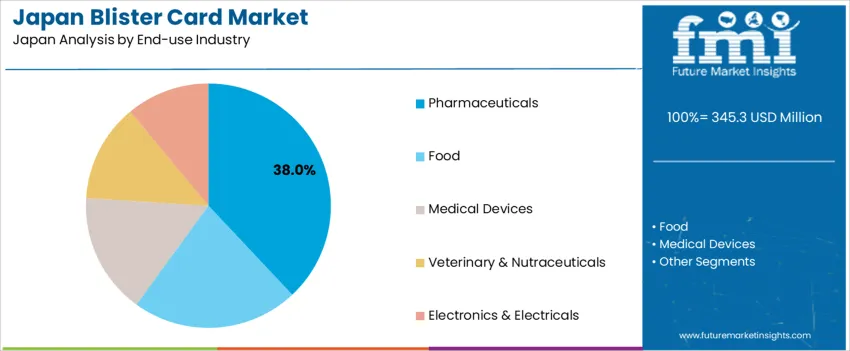
Pharmaceutical applications represent 38.0%, supported by regulated requirements for tamper-visible, unit-dose medication packaging. Food accounts for 22.0%, especially confectionery and small portion-packed snacks. Medical devices hold 16.0%, focusing on sterile handling and secure product presentation. Veterinary and nutraceuticals represent 13.0%, supporting dosage accuracy for supplements and clinical animal care. Electronics and electricals total 11.0%, where blister cards prevent mechanical damage for compact device components. Demand patterns reflect Japan’s centralized healthcare supply network and continued preference for precise single-unit dispensing in consumer and clinical settings.
Key points:
- Healthcare regulation drives pharmaceutical adoption.
- Food and nutraceutical uses benefit from portioned formats.
- Electronics use supports protection against handling damage.
By Product Type, Carded Blister Packaging Holds the Largest Share
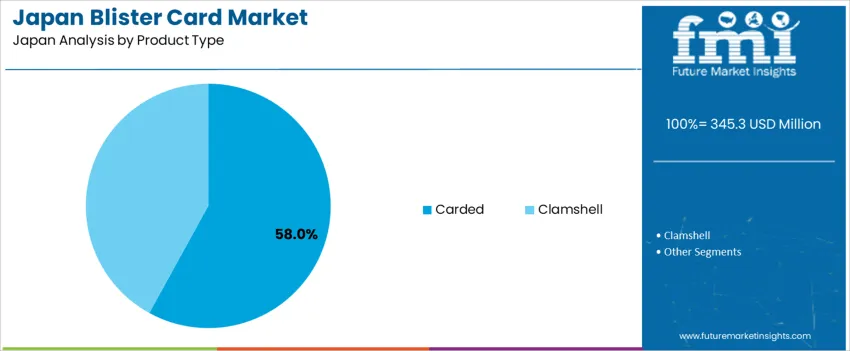
Carded blister products account for 58.0%, supported by lightweight construction, printing area for regulatory information, and compatibility with automated sealing lines used by Japanese manufacturers. Clamshell formats represent 42.0%, providing stronger mechanical protection for electronics and hardware sold in retail stores. Card-backed structures remain preferred in pharmaceuticals and smaller consumer goods due to low material usage and organized presentation. Procurement considerations include product visibility in compact retail layouts, sealing durability in mail delivery, and controlled material use that aligns with domestic sustainability priorities.
Key points:
- Carded designs support cost-efficient labeling and display.
- Clamshells provide enhanced impact resistance in retail environments.
- Format selection balances protection level with material sustainability.
What are the Drivers, Restraints, and Key Trends of the Demand for Blister Cards in Japan?
Growth of over-the-counter product sales, expansion of unit-dose packaging in pharmacies and increased distribution of small accessories in convenience stores are driving demand.
In Japan, blister cards remain an important packaging format as pharmacies and drugstores increase retail sales of OTC medicines, including cold tablets, allergy treatments and supplements commonly purchased without prescriptions. Unit-dose packaging helps support safe usage instructions, particularly for older adults who rely on clear dosing visibility. Convenience stores located near train stations and business districts sell small accessories, batteries and personal care items that require tamper-evident packaging, contributing to continuous use of blister cards. Manufacturers supplying cosmetics and grooming tools also rely on blister cards to display products upright on pegboards, supporting merchandising standards in Japanese retail channels. Seasonal gift promotions and travel-size product kits further sustain procurement throughout the year.
Environmental pressure to reduce plastic components, limited recyclability of multi-material packs and high automation costs for smaller producers restrain adoption.
Government and consumer expectations for plastic reduction influence packaging decisions in major CPG brands, which may replace blister packs with cardboard-forward alternatives when feasible. Many blister cards use plastic cavities attached to printed board, creating recycling challenges because the materials must be separated before disposal, limiting acceptance in local waste streams. Smaller factories with manual or semi-automated lines face higher investment costs for advanced sealing and forming equipment, reducing their willingness to expand blister-pack usage. These constraints create cautious growth conditions as brands balance protection needs with sustainability and cost priorities.
Shift toward paper-forward structures, increased integration of QR-based safety information and rising demand in adherence-focused pharmaceutical packaging define key trends.
Packaging producers are introducing designs that maximize paperboard content to meet municipal recycling rules while minimizing plastic thickness. QR codes printed on blister cards provide access to digital instructions, safety data and allergy information, aligning with Japan’s preference for detailed consumer guidance. Pharmacies and hospitals are adopting calendar-style blister cards for patients managing chronic therapies, supporting better dose tracking in aging populations. Automation upgrades in pharmaceutical contract packaging facilities improve production speed for unit-dose formats used in national drug distribution. These trends support steady, clinical- and retail-focused demand for blister cards in Japan.
Analysis of the Demand for Blister Cards in Japan by Region
Demand for blister cards in Japan is influenced by pharmaceutical packaging, battery merchandising, small electronics, and hardware retail formats that rely on tamper-evident presentation and secure transport handling. Regional consumption patterns follow manufacturing concentration, convenience retail footprint, and distribution exposure across varied climates. Kyushu & Okinawa leads at 5.3% CAGR, followed by Kanto (4.9%), Kinki (4.3%), Chubu (3.8%), Tohoku (3.3%), and Rest of Japan (3.2%).
| Region | CAGR (2025-2035) |
|---|---|
| Kyushu & Okinawa | 5.3% |
| Kanto | 4.9% |
| Kinki | 4.3% |
| Chubu | 3.8% |
| Tohoku | 3.3% |
| Rest of Japan | 3.2% |
How is Kyushu & Okinawa driving demand for blister cards?
Kyushu & Okinawa records 5.3% CAGR, supported by pharmaceutical distribution, consumer electronics retail, and tourism-related merchandising. Drugstores and hospital-linked pharmacies require blister-carded medication packaging that ensures hygiene protection during stocking and patient handling. Convenience retail zones serving travelers use blister packaging for batteries, personal accessories, and portable electronics that must withstand frequent shelf contact in humid regions. Packaging lines prioritize plastic-paper card integration that maintains sealing security for product display. Clear-view cards help prevent pilferage and improve visual inspection in high-traffic stores. Logistics networks emphasize stable card rigidity to avoid deformation during transport to island industry. Procurement teams evaluate heat-seal compatibility and tear resistance aligned with handling expectations in hospitality and transit retail channels.
- Healthcare packaging requiring tamper visibility
- Tourism retail sustaining carded product formats
- Humidity-resistant sealing guiding material selection
- Shelf-handling conditions influencing card strength
How is Kanto shaping demand for blister cards?
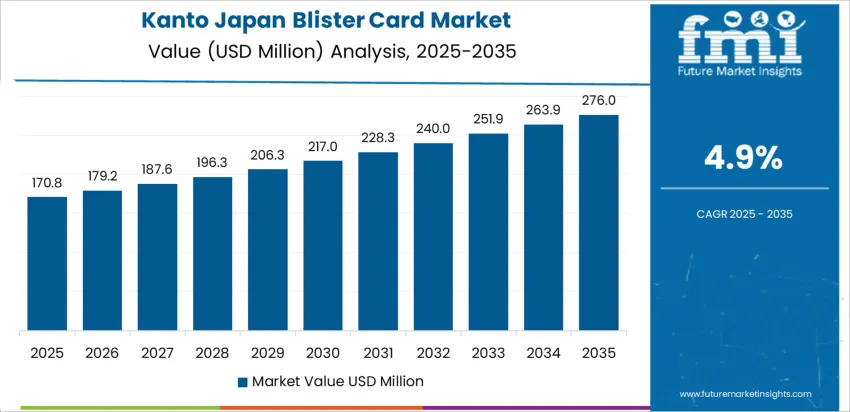
Kanto expands at 4.9% CAGR, influenced by dense pharmacy chains and electronics retail volume across Tokyo and neighboring prefectures. Consumer electronics with high turnover depend on blister cards to secure small devices, cables, and accessories. Pharmaceutical packaging follows standards for unit-dose formats compatible with automated distribution in large hospitals. Retailers emphasize clear packaging that supports visible labeling and compact display layouts in limited shelf spaces. Packaging converters located in Kanto maintain short lead times for card customization aligned with promotional cycles. Interest in recyclable structures grows where material simplification supports collection efficiency in urban waste systems.
- Dense pharmacy networks shaping unit-dose packaging
- Small electronics retail driving clear blister formats
- Space-efficient merchandising influencing packaging geometry
- Material simplification favored for recycling alignment
How is Kinki influencing demand for blister cards?
Kinki posts 4.3% CAGR, driven by consumer hardware and small tool packaging across Osaka commercial corridors. Blister cards maintain structural protection for metal parts and household accessories during retail handling. Retail display systems favor hang-tab card formats supporting rapid product scanning in high-activity environments. Pharmaceutical distribution maintains consistent blister adoption for chronic medication supplies. Buyers prioritize forming compatibility with existing sealing dies to avoid operational disruption. Incremental ecofriendly improvements include reduced card weight while preserving load capacity for heavier contents.
- Hardware retail supporting rigid-card usage
- Hang-tab formats optimizing shelf navigation
- Existing sealing equipment influencing procurement decisions
- Weight-controlled designs balancing sustainability and performance
How is Chubu contributing to demand for blister cards?
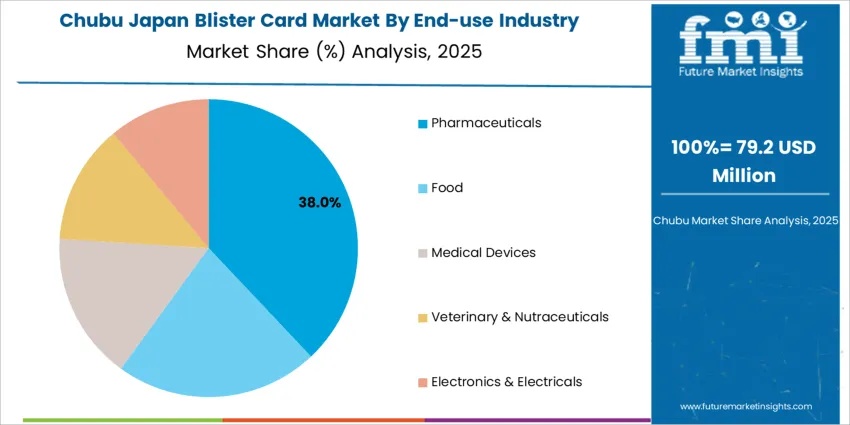
Chubu achieves 3.8% CAGR, supported by manufacturing clusters in Aichi and Shizuoka supplying consumer goods requiring protective card packaging. Automotive tools, accessories, and small replacement components are frequently sold in blister formats to ensure organized handling and visibility. Product catalogs for warehouse stores influence standardized card sizing to fit automated peg-system layouts. Adhesive and sealing consistency is evaluated for stability during transport across long delivery routes. Buyers assess cost reliability with volume runs that align with industrial procurement cycles.
- Automotive accessory packaging sustaining demand
- Standardized card sizing improving stocking efficiency
- Transport conditions affecting seal reliability
- Volume-based procurement guiding cost control
How is Tohoku shaping demand for blister cards?
Tohoku reports 3.3% CAGR, supported by distribution of essential household items and pharmaceuticals across wide geographic distances prone to temperature fluctuation. Card rigidity protects product shape during extended logistics. Healthcare facilities favor blister cards for infection-controlled dispensing. Retailers with lower foot traffic maintain product integrity through sealed visibility packaging to reduce handling damage. Procurement decisions incorporate cost stability and card thickness suited for long-route transport.
- Wide geography requiring protective packaging
- Hospital dispensing supporting blister reliance
- Low-touch retail favoring durable card visibility
- Route-based risk driving sealing strength requirements
How is the Rest of Japan adopting blister cards?
Rest of Japan grows at 3.2% CAGR, driven by local pharmacy sales, general merchandise stores, and seasonal tourist retail. Blister cards support compact storage and clear product identification in smaller retail footprints. Material choices emphasize affordability and reliable sealing performance without major equipment modification. Buyers explore lower-mass cards compatible with regional recycling channels where infrastructure exists.
- Small retail formats driving visibility-based packaging needs
- Local pharmacy sales maintaining volume stability
- Cost-checked procurement shaping material selection
- Recyclability considered where collection systems support it
What is the competitive landscape of demand for blister cards in Japan?
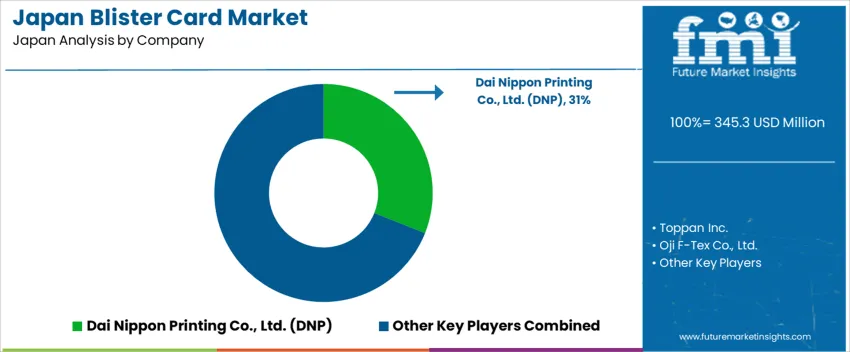
Demand for blister cards in Japan is driven by packaging suppliers supporting pharmaceuticals, consumer electronics accessories, and retail hardware items. Dai Nippon Printing Co., Ltd. holds an estimated 31.0% share, supported by controlled coating technologies and reliable adhesion performance required in regulated healthcare packaging. Its blister cards deliver consistent print accuracy and secure product retention during domestic distribution. Toppan Inc. maintains strong participation through printed card substrates that offer controlled heat-seal properties and excellent graphical detail for point-of-sale presentation. Oji F-Tex Co., Ltd. contributes presence in coated paperboard solutions used in retail blister applications where dimensional stability and predictable sealing efficiency are priorities.
Nissha Co., Ltd. supports demand for electronics and precision goods packaging with blister-compatible substrates designed for clean cavity engagement and durable visibility. Kyodo Printing Co., Ltd. services pharmaceutical and household-goods producers with card materials that maintain coating uniformity and traceable production control. Competition in Japan centers on seal-integrity consistency, barrier performance, print resolution, cavity-fit reliability, and validated supply-chain capability. Demand remains stable as Japanese manufacturers continue using protective card-based blister formats to secure products and maintain visual clarity throughout retail handling in Japan’s distribution channels.
Key Players in Japan Blister Card Demand
- Dai Nippon Printing Co., Ltd. (DNP)
- Toppan Inc.
- Oji F-Tex Co., Ltd.
- Nissha Co., Ltd.
- Kyodo Printing Co., Ltd.
Scope of the Report
| Items | Values |
|---|---|
| Quantitative Units | USD million |
| Material Type | PVC/Vinyl, PET, Plastic, PE, Others |
| End-use Industry | Pharmaceuticals, Food, Medical Devices, Veterinary & Nutraceuticals, Electronics & Electricals |
| Product Type | Carded, Clamshell |
| Technology Type | Thermoforming Technology, Cold Forming Technology |
| Regions Covered | Kyushu & Okinawa, Kanto, Kinki, Chubu, Tohoku, Rest of Japan |
| Key Companies Profiled | Dai Nippon Printing Co., Ltd. (DNP), Toppan Inc., Oji F-Tex Co., Ltd., Nissha Co., Ltd., Kyodo Printing Co., Ltd. |
| Additional Attributes | Increased usage in pharmaceutical packaging due to medication safety standards; demand driven by unit-dose compliance and child-resistant packaging; cold-form blister cards expanding in temperature-sensitive medical products; technological advancements in barrier materials and sustainable substrates; regional demand supported by pharmaceutical hubs in Kanto and Kansai regions. |
Japan Blister Card Demand by Segments
Material Type:
- PVC/Vinyl
- PET
- Plastic
- PE
- Others
End-use Industry:
- Pharmaceuticals
- Food
- Medical Devices
- Veterinary & Nutraceuticals
- Electronics & Electricals
Product Type:
- Carded
- Clamshell
Technology Type
- Thermoforming Technology
- Cold Forming Technology
Region:
- Kyushu & Okinawa
- Kanto
- Kinki
- Chubu
- Tohoku
- Rest of Japan
Frequently Asked Questions
How big is the demand for blister card in Japan in 2025?
The demand for blister card in Japan is estimated to be valued at USD 345.3 million in 2025.
What will be the size of blister card in Japan in 2035?
The market size for the blister card in Japan is projected to reach USD 524.8 million by 2035.
How much will be the demand for blister card in Japan growth between 2025 and 2035?
The demand for blister card in Japan is expected to grow at a 4.3% CAGR between 2025 and 2035.
What are the key product types in the blister card in Japan?
The key product types in blister card in Japan are pvc/vinyl, pet, plastic, pe and others.
Which end-use industry segment is expected to contribute significant share in the blister card in Japan in 2025?
In terms of end-use industry, pharmaceuticals segment is expected to command 38.0% share in the blister card in Japan in 2025.
Preview the report firsthand - request a free sample
Get SampleGet the brochure for pricing and purchase details.
Get PDFTable of Content
- Executive Summary
- Japan Market Outlook
- Demand-side Trends
- Supply-side Trends
- Technology Roadmap Analysis
- Analysis and Recommendations
- Market Overview
- Market Coverage / Taxonomy
- Market Definition / Scope / Limitations
- Market Background
- Market Dynamics
- Drivers
- Restraints
- Opportunity
- Trends
- Scenario Forecast
- Demand in Optimistic Scenario
- Demand in Likely Scenario
- Demand in Conservative Scenario
- Opportunity Map Analysis
- Product Life Cycle Analysis
- Supply Chain Analysis
- Investment Feasibility Matrix
- Value Chain Analysis
- PESTLE and Porter’s Analysis
- Regulatory Landscape
- Regional Parent Market Outlook
- Production and Consumption Statistics
- Import and Export Statistics
- Market Dynamics
- Japan Market Analysis 2020 to 2024 and Forecast, 2025 to 2035
- Historical Market Size Value (USD Million) Analysis, 2020 to 2024
- Current and Future Market Size Value (USD Million) Projections, 2025 to 2035
- Y-o-Y Growth Trend Analysis
- Absolute $ Opportunity Analysis
- Japan Market Pricing Analysis 2020 to 2024 and Forecast 2025 to 2035
- Japan Market Analysis 2020 to 2024 and Forecast 2025 to 2035, By Material Type
- Introduction / Key Findings
- Historical Market Size Value (USD Million) Analysis By Material Type , 2020 to 2024
- Current and Future Market Size Value (USD Million) Analysis and Forecast By Material Type , 2025 to 2035
- PVC/Vinyl
- PET
- Plastic
- PE
- Others
- Y-o-Y Growth Trend Analysis By Material Type , 2020 to 2024
- Absolute $ Opportunity Analysis By Material Type , 2025 to 2035
- Japan Market Analysis 2020 to 2024 and Forecast 2025 to 2035, By End-use Industry
- Introduction / Key Findings
- Historical Market Size Value (USD Million) Analysis By End-use Industry, 2020 to 2024
- Current and Future Market Size Value (USD Million) Analysis and Forecast By End-use Industry, 2025 to 2035
- Pharmaceuticals
- Food
- Medical Devices
- Veterinary & Nutraceuticals
- Electronics & Electricals
- Y-o-Y Growth Trend Analysis By End-use Industry, 2020 to 2024
- Absolute $ Opportunity Analysis By End-use Industry, 2025 to 2035
- Japan Market Analysis 2020 to 2024 and Forecast 2025 to 2035, By Product Type
- Introduction / Key Findings
- Historical Market Size Value (USD Million) Analysis By Product Type, 2020 to 2024
- Current and Future Market Size Value (USD Million) Analysis and Forecast By Product Type, 2025 to 2035
- Carded
- Clamshell
- Y-o-Y Growth Trend Analysis By Product Type, 2020 to 2024
- Absolute $ Opportunity Analysis By Product Type, 2025 to 2035
- Japan Market Analysis 2020 to 2024 and Forecast 2025 to 2035, By Technology Type
- Introduction / Key Findings
- Historical Market Size Value (USD Million) Analysis By Technology Type, 2020 to 2024
- Current and Future Market Size Value (USD Million) Analysis and Forecast By Technology Type, 2025 to 2035
- Thermoforming Technology
- Cold Forming Technology
- Y-o-Y Growth Trend Analysis By Technology Type, 2020 to 2024
- Absolute $ Opportunity Analysis By Technology Type, 2025 to 2035
- Market Structure Analysis
- Competition Dashboard
- Competition Benchmarking
- Market Share Analysis of Top Players
- By Regional
- By Material Type
- By End-use Industry
- By Product Type
- By Technology Type
- Competition Analysis
- Competition Deep Dive
- Dai Nippon Printing Co., Ltd. (DNP)
- Overview
- Product Portfolio
- Profitability by Market Segments (Product/Age /Sales Channel/Region)
- Sales Footprint
- Strategy Overview
- Marketing Strategy
- Product Strategy
- Channel Strategy
- Toppan Inc.
- Oji F-Tex Co., Ltd.
- Nissha Co., Ltd.
- Kyodo Printing Co., Ltd.
- Dai Nippon Printing Co., Ltd. (DNP)
- Competition Deep Dive
- Assumptions & Acronyms Used
- Research Methodology


