

- Industry Size (2025)
- USD 1.1 Bn
- Forecast (2035)
- USD 1.4 Bn
- CAGR (2025 to 2035)
- 2.8%
Demand for Storage Area Network (SAN) in Japan Forecast and Outlook 2025 to 2035
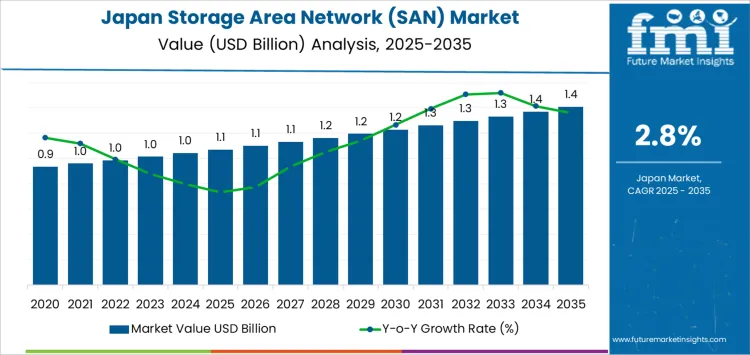
The demand for storage area network in Japan is valued at USD 1.1 billion in 2025 and is projected to reach USD 1.4 billion by 2035, reflecting a CAGR of 2.8%. The historical pattern from 2020 to 2025 shows a gradual rise from USD 0.9 billion to USD 1.1 billion, indicating steady infrastructure refresh across enterprise data environments. Financial services, manufacturing, and public sector data centers form the core early user base. Demand during this phase reflects system upgrades aimed at improving reliability, backup integrity, and storage consolidation. Most installations remain tied to on premises data centers rather than distributed cloud native environments. Procurement cycles follow multiyear capital planning schedules, which supports predictable order flows. The flat movement between 2021 and 2023 indicates controlled spending under stable server and workload volumes. Growth resumes as legacy systems approach renewal thresholds.
From 2026 onward, values move from USD 1.1 billion to USD 1.3 billion by 2031, then rise to USD 1.4 billion by 2035 through narrow annual increments. Demand in the later phase reflects capacity expansion within existing facilities rather than broad new data center construction. Enterprise virtualization, database growth, and regulated data retention requirements sustain baseline investment levels. Network refresh projects remain paced by compatibility with installed server architecture. Spending remains concentrated among large enterprises with stable data workloads. After 2030, replacement demand outweighs first time deployment as network arrays reach mid cycle renewal periods. Annual value changes stay within a limited band, which points to low volatility. The long range outlook reflects measured infrastructure accumulation shaped by operational continuity requirements rather than rapid digital infrastructure expansion.
Quick Stats of the Demand for Storage Area Network SAN in Japan
- Demand for Storage Area Network SAN in Japan Value (2025): USD 1.1 billion
- Demand for Storage Area Network SAN in Japan Forecast Value (2035): USD 1.4 billion
- Demand for Storage Area Network SAN in Japan Forecast CAGR (2025-2035): 2.8%
- Demand for Storage Area Network SAN in Japan Leading Component: Hardware (58%)
- Demand for Storage Area Network SAN in Japan Key Growth Regions: Kyushu & Okinawa, Kanto, Kansai
- Demand for Storage Area Network SAN in Japan Top Players: Dell Technologies, Hewlett Packard Enterprise (HPE), NetApp Inc., IBM Corporation, Cisco Systems
What is the Growth Forecast for Storage Area Network (SAN) in Japan through 2035?
Between 2025 and 2030, demand for storage area network in Japan is projected to rise from USD 1.1 billion to USD 1.2 billion, generating an absolute increase of USD 0.1 billion and representing about 33.3% of total decade growth. This phase reflects steady infrastructure refresh across enterprise data centers, financial institutions, and government IT systems. Replacement of legacy storage backbones supports baseline demand. Historical growth was shaped by server virtualization and basic cloud migration, while near term performance is driven by structured data consolidation, stricter uptime requirements, and stable investment in hybrid IT architectures across regulated industries.
From 2030 to 2035, demand is forecast to expand from USD 1.2 billion to USD 1.4 billion, adding USD 0.2 billion and accounting for nearly 66.7% of total ten-year growth. This stage reflects higher capacity deployment for artificial intelligence workloads, data intensive analytics, and disaster recovery infrastructure. Expansion of colocation facilities strengthens volume consistency. Earlier growth relied on enterprise hardware refresh cycles, while future expansion is guided by higher data throughput requirements, multi-site storage replication, automated storage management platforms, and long term capacity planning across large scale institutional users.
Storage Area Network (SAN) Industry in Japan Key Takeaways
| Metric | Value |
|---|---|
| Industry Value (2025) | USD 1.1 billion |
| Forecast Value (2035) | USD 1.4 billion |
| Forecast CAGR (2025-2035) | 2.8% |
What Is Driving the Demand for Storage Area Network Systems in Japan Across Historical and Future Growth Cycles?
Demand for storage area network systems in Japan expanded as enterprises shifted from direct attached storage to centralized architectures supporting large databases and virtualized servers. Financial institutions, manufacturers, and telecom operators adopted SAN to manage rising transaction volumes and digital records. Data growth from enterprise software, imaging systems, and content repositories supported steady procurement. Purchasing decisions focused on uptime, vendor service coverage, and compatibility with existing server estates. Fibre Channel dominated high performance environments while iSCSI gained entry in cost sensitive deployments. Historical growth reflected stable capital spending cycles tied to data center refresh programs, regulatory data retention needs, and steady expansion of domestic cloud service providers serving government and corporate workloads. System lifecycles followed multiyear replacement schedules aligned with corporate IT budgeting practices.
Future demand for storage area network systems in Japan is expected to align with data center density, hybrid cloud deployment models, and rising compute intensity from analytics workloads. Enterprises seek higher throughput, lower latency, and stronger fault isolation within mission critical environments. Public sector digitization programs and financial trading platforms sustain high availability requirements. Historical growth depended on refresh driven procurement. Future growth centers on scale out architectures, NVMe over Fabrics adoption, and tighter integration with software defined storage layers. Investment decisions reflect power efficiency targets, rack space constraints, and long term operating cost control. Growth will depend on vendor alignment with security standards, domestic data residency rules, and sustained growth in colocated data center capacity across major metropolitan regions.
What Is the Demand for Storage Area Network SAN in Japan by Component and SAN Type?
The demand for storage area network SAN in Japan is shaped by expansion of cloud infrastructure, financial data security requirements, and rising enterprise data traffic. Hardware leads by component due to continued investment in high density storage controllers, switches, and disk arrays. Hyperscale server SAN leads by SAN type as large scale data centers support cloud platforms, streaming services, and enterprise digital transformation. Procurement is driven by domestic data center operators, telecom groups, and large enterprise IT departments. Import reliance remains present for high speed networking chips and storage processors. Substitution pressure exists from software defined storage architectures. Demand stability is supported by continuous growth in data generation and regulated data retention requirements.
Why does hardware account for 58% of the demand for storage area network SAN in Japan by component?
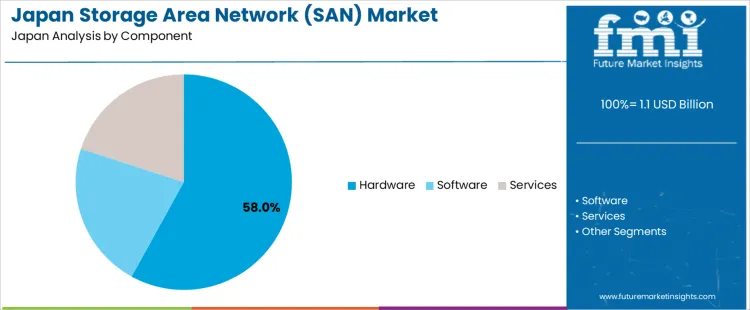
Hardware accounts for 58% of the demand for storage area network SAN in Japan by component, reflecting sustained investment in physical storage infrastructure. Consumption intensity is driven by deployment of fiber channel switches, host bus adapters, and high capacity storage arrays across hyperscale and enterprise facilities. Usage remains stable because core data workloads continue to rely on dedicated hardware for performance, latency control, and uptime assurance. Procurement is led by large data center operators, financial institutions, and government IT agencies. Price sensitivity remains moderate because hardware reliability directly affects system availability. Specification control emphasizes throughput capacity, port density, redundancy design, and thermal performance under continuous load.
Hardware driven SAN deployment also generates steady repeat demand through refresh cycles linked to processor upgrades and capacity scaling. Repeat utilization remains predictable as storage requirements expand with application growth. Buyers favor platform standardization to simplify spares inventory and maintenance contracts. Margin structure remains controlled under competitive bidding among global hardware suppliers. Regulatory exposure centers on data security certification and disaster recovery readiness. Import reliance persists for ASICs, transceivers, and controller boards. Substitution pressure from software defined storage affects commodity workloads but does not remove the need for high performance hardware in mission critical environments.
Why does hyperscale server SAN represent 65.0% of the demand for storage area network SAN in Japan by SAN type?
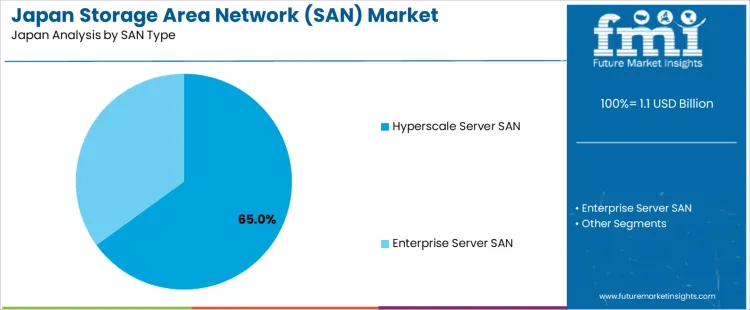
Hyperscale server SAN represents 65.0% of the demand for storage area network SAN in Japan by SAN type, reflecting rapid scale up of cloud and content delivery infrastructure. Consumption intensity is driven by web services, digital payments, media streaming, and enterprise platform hosting. Usage remains stable because hyperscale environments require continuous storage expansion to manage structured and unstructured data volumes. Procurement is dominated by cloud service providers, telecom data centers, and large system integrators. Price sensitivity remains moderate because cost efficiency is managed at architecture level rather than per unit system pricing. Specification control emphasizes fabric scalability, low latency switching, fault tolerance, and high availability under multi-tenant operations.
Hyperscale SAN deployment also generates consistent repeat demand through phased data hall expansion and capacity upgrades. Repeat utilization remains predictable as cloud workloads scale across regions. Buyers favor modular SAN designs that allow incremental port and capacity addition without service interruption. Margin structure remains controlled under long term supply agreements and volume pricing structures. Regulatory exposure centers on data sovereignty compliance and uptime service level reporting. Import reliance persists for optical modules and switching silicon. Substitution pressure from hyperconverged infrastructure exists for edge computing but does not displace large scale core data center SAN systems.
What Is Driving the Demand for Storage Area Network in Japan Enterprise Data Continuity and Latency Control?
Demand for storage area network in Japan reflects data intensive manufacturing, financial transaction volume, and strict uptime expectations. Banks, insurers, and stock trading platforms depend on deterministic latency and nonstop access for settlement and risk systems. Semiconductor design, automotive simulation, and medical imaging generate large block data flows that exceed file server limits. Earthquake resilience planning favors mirrored storage across distant data centers with synchronous replication. Buyers value predictable throughput, deterministic failover, and long service life. Procurement aligns with core system refresh cycles and disaster recovery audits. Demand follows infrastructure stability mandates rather than short term cloud migration trends across.
How Is Financial Services Compliance Sustaining High Performance SAN Deployment in Japan Data Centers?
Financial institutions in Japan operate under continuous audit of transaction integrity and recovery objectives. SAN architectures support real time replication between primary and secondary sites without application disruption. Core banking, clearing, and fraud detection platforms write to shared storage with strict write order control. Batch reconciliation runs overnight with sustained throughput demands. Disaster drills test instant switchover across seismic zones. These operational patterns maintain preference for fibre channel and high grade Ethernet fabrics with guaranteed service levels. Demand holds firm through periodic mainframe and core banking refresh programs tied to regulatory inspection cycles and systemic risk control schedules nationwide today.
How Are Manufacturing, Research, and Medical Imaging Shaping SAN Usage in Japan?
Japan advanced manufacturing creates sustained SAN usage through simulation data, quality imaging, and test record archiving. Automotive firms store continuous sensor output from endurance testing and production validation. Semiconductor fabs capture defect imaging at nanometer scale that requires fast block storage retrieval. Research institutes generate genome sequencing and materials analysis datasets with sustained write rates. Hospitals store diagnostic imaging from CT, MRI, and pathology systems under long retention rules. Shared storage pools support collaboration across departments without duplicating arrays. Demand links to precision engineering throughput, R and D intensity, and regulatory archiving duties inside industrial and medical facilities nationwide today.
How Do Cloud Integration, Power Cost, and Cyber Risk Shape SAN Investment in Japan?
Enterprises in Japan balance SAN investment with selective cloud integration for backup, analytics, and burst processing. High electricity cost elevates attention on energy efficient controllers and storage density per rack. Cyber risk planning drives use of air gapped replicas and immutable snapshot tiers within SAN frameworks. Skilled storage engineers remain in limited supply, which raises reliance on vendor managed platforms. Floor space limits inside urban data centers favor high capacity nodes over distributed sprawl. These technical and economic filters slow unchecked expansion. Demand advances through planned refresh programs that match power budgeting, security architecture, and staffing capacity across enterprise estates.
What is the Demand for Storage Area Network SAN in Japan by Region?
| Region | CAGR (%) |
|---|---|
| Kyushu & Okinawa | 3.5% |
| Kanto | 3.2% |
| Kansai | 2.8% |
| Chubu | 2.5% |
| Tohoku | 2.2% |
| Rest of Japan | 2.1% |
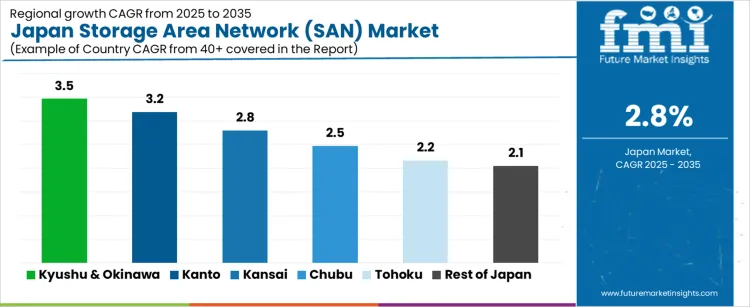
The demand for storage area network SAN in Japan is expanding at a measured pace across enterprise and data infrastructure regions, led by Kyushu and Okinawa at a 3.5% CAGR. Growth in this region is supported by regional data center investments, manufacturing IT upgrades, and cloud migration projects by midsize enterprises. Kanto follows at 3.2%, driven by dense concentration of financial institutions, hyperscale data centers, and large enterprise IT modernization programs. Kansai records 2.8% growth, reflecting steady demand from commercial IT users, healthcare networks, and managed service providers. Chubu at 2.5% shows moderate uptake linked to automotive manufacturing IT systems and industrial cloud adoption. Tohoku and the Rest of Japan, at 2.2% and 2.1%, reflect slower growth shaped by limited new data center development, conservative IT budgets, and longer infrastructure refresh cycles.
How Is Tourism Data Infrastructure Supporting SAN Demand in Kyushu and Okinawa?
Demand for storage area network SAN in Kyushu and Okinawa is advancing at a CAGR of 3.5% through 2035, supported by rising data storage needs across hospitality systems, airport operations, and regional cloud hosting facilities. Resort operators rely on centralized data storage for booking platforms, surveillance archives, and customer analytics. Local enterprises also adopt SAN for backup and disaster recovery preparedness. Growth reflects steady digitalization of tourism services, expansion of smart airport infrastructure, and controlled investment in secure data environments for public and private sector operations.
- Hospitality systems drive centralized data storage needs
- Airport operations rely on real time data access
- Disaster recovery planning supports SAN deployment
- Regional cloud facilities strengthen infrastructure demand
Why Is Enterprise IT Modernization Driving SAN Growth in Kanto?
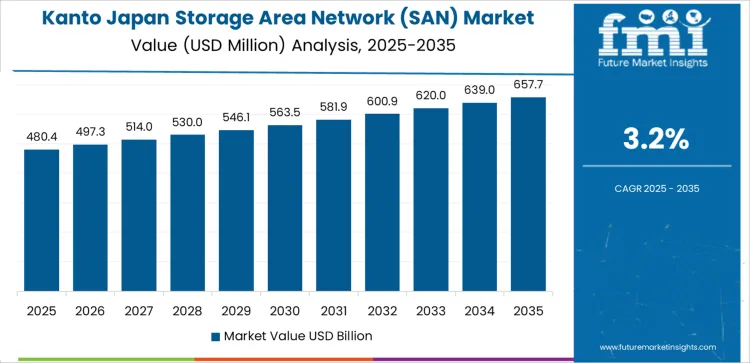
Demand for storage area network SAN in Kanto is rising at a CAGR of 3.2% through 2035, driven by dense concentration of corporate data centers, financial institutions, and large scale enterprise IT environments. Kanto leads in server virtualization, hybrid cloud integration, and real time business analytics platforms that depend on high performance storage networks. Data traffic volume remains the highest nationwide. Growth reflects continuous data center upgrades, rising cybersecurity investment, and expanding use of AI driven workloads that require low latency shared storage access.
- Financial institutions anchor high capacity SAN installations
- Data center upgrades sustain steady hardware refresh cycles
- Virtualization platforms expand shared storage demand
- Cybersecurity frameworks increase redundant storage adoption
What Is Supporting Controlled SAN Adoption Across Kansai Enterprises?
Demand for storage area network SAN in Kansai is progressing at a CAGR of 2.8% through 2035, supported by steady uptake among mid sized enterprises, manufacturing IT environments, and regional service providers. Kansai shows balanced use of SAN for enterprise resource planning, production data storage, and internal cloud migration. Investment remains measured with preference for modular scalable architectures. Growth reflects stable business digitization, controlled capital spending, and gradual shift toward centralized data management across commercial and industrial users.
- Manufacturing IT systems depend on centralized storage
- Modular SAN solutions support scalable infrastructure planning
- Enterprise software platforms drive shared data access
- Controlled budgets shape phased deployment patterns
How Is Industrial Data Management Shaping SAN Demand in Chubu?
Demand for storage area network SAN in Chubu is advancing at a CAGR of 2.5% through 2035, supported by automotive manufacturing data workloads, factory automation systems, and product lifecycle management platforms. Chubu facilities rely on high availability storage for production analytics, quality inspection data, and design simulation workloads. SAN systems support continuous production environments that require low downtime. Growth reflects stable industrial output, digital twin adoption, and steady replacement demand for aging on premises data storage systems.
- Automotive plants rely on production data archiving
- Simulation workloads sustain high performance storage demand
- Factory automation systems require low latency access
- Hardware refresh cycles guide equipment replacement
Why Is Infrastructure Scale Moderating SAN Growth in Tohoku?
Demand for storage area network SAN in Tohoku is advancing at a CAGR of 2.2% through 2035, supported by selective deployment across public sector institutions, healthcare facilities, and small enterprise data rooms. Tohoku records lower density of hyperscale data centers. SAN usage remains focused on medical imaging storage, municipal records digitization, and regional educational networks. Growth reflects cautious IT investment behavior, gradual cloud integration, and steady public sector modernization programs.
- Hospitals rely on centralized medical image storage
- Municipal offices drive secure record digitization
- Education networks adopt shared academic data platforms
- Conservative IT budgets shape moderate deployment pace
How Is Small City Digital Infrastructure Influencing SAN Demand in Rest of Japan?
Demand for storage area network SAN in Rest of Japan is advancing at a CAGR of 2.1% through 2035, supported by gradual modernization of small business IT environments, regional data backup facilities, and local government digitization projects. These areas show preference for entry level SAN systems supporting basic redundancy and file sharing needs. Large scale virtualization remains limited. Growth remains steady and guided by public funding cycles, cautious enterprise IT upgrades, and steady adoption of centralized storage for compliance and backup purposes.
- Small business servers rely on shared file storage
- Public digitization projects support baseline demand
- Entry level SAN systems dominate procurement patterns
- Compliance driven backups sustain recurring demand
What Is Driving the Demand for Storage Area Network in Japan and Which Companies Shape Enterprise Deployment?
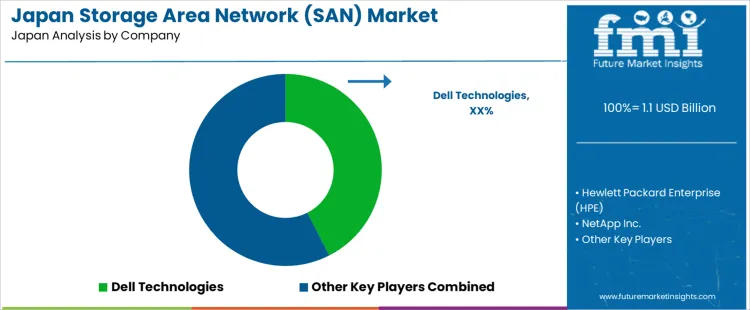
The demand for storage area network in Japan is shaped by steady data growth in manufacturing, finance, healthcare, and government systems that rely on high availability infrastructure. Fujitsu holds a central domestic position through integrated storage and server platforms supplied to public sector agencies, banks, and large manufacturers. NEC supports demand through enterprise storage systems and network integration used in national data centers and carrier grade facilities. Hitachi Vantara Japan anchors mission critical deployments across utilities, transport operators, and industrial enterprises that require high resilience and low latency access. Dell Technologies participates strongly through modular SAN architectures adopted by global firms operating Japanese data centers. HPE supports demand through enterprise storage platforms tied to hybrid cloud and on premises consolidation programs.
NetApp contributes through unified storage systems used in data analytics, research computing, and software defined environments deployed by technology driven enterprises. IBM supports legacy and high security environments through mainframe attached storage and financial sector infrastructure. Cisco Systems shapes SAN fabric deployment through switching platforms used in large scale data center interconnects. Procurement in Japan is governed by uptime performance, disaster recovery readiness, compatibility with virtualization stacks, and long term vendor support. Buyer preference favors suppliers with domestic maintenance teams, Japanese language system documentation, and secure supply chains aligned with government cybersecurity guidance. Demand visibility tracks data center expansion in metropolitan regions, public cloud interconnection programs, financial system refresh cycles, and steady migration from legacy disk arrays toward high density flash architectures.
Key Players in the Storage Area Network Industry in Japan
- Dell Technologies
- Hewlett Packard Enterprise (HPE)
- NetApp Inc.
- IBM Corporation
- Cisco Systems Inc.
Scope of the Report
| Items | Values |
|---|---|
| Quantitative Units (2025) | USD billion |
| Type | Hyperscale Server SAN, Enterprise Server SAN |
| Application | BFSI, IT and Telecom, Energy and Utility, Government, Military and Defense, Healthcare, Manufacturing |
| End User | Data Center Operators, Financial Institutions, Manufacturing Enterprises, Healthcare Providers, Government and Public Sector Agencies |
| Regions Covered | Kyushu and Okinawa, Kanto, Kansai, Chubu, Tohoku, Rest of Japan |
| Countries Covered | Japan |
| Key Companies Profiled | Dell Technologies, Hewlett Packard Enterprise (HPE), NetApp Inc., IBM Corporation, Cisco Systems Inc., Fujitsu, NEC, Hitachi Vantara |
| Additional Attributes | Dollar sales by component and SAN type, regional demand from enterprise and hyperscale data centers, replacement driven infrastructure refresh cycles, procurement linked to disaster recovery and uptime compliance, technology mix across Fibre Channel, Fibre Channel over Ethernet, InfiniBand, and iSCSI, data residency and cybersecurity compliance requirements across regulated industries |
Storage Area Network Industry in Japan Segmentation
Component:
- Hardware
- Software
- Services
SAN Type:
- Hyperscale Server SAN
- Enterprise Server SAN
Technology:
- Fibre Channel
- Fibre Channel Over Ethernet
- InfiniBand
- iSCSI Protocol
Vertical:
- BFSI
- IT & Telecom, Energy & Utility
- Government, Military & Defense
- Healthcare
- Manufacturing
Region:
- Kyushu & Okinawa
- Kanto
- Kansai
- Chubu
- Tohoku
- Rest of Japan
Frequently Asked Questions
How big is the demand for storage area network (SAN) in Japan in 2025?
The demand for storage area network (SAN) in Japan is estimated to be valued at USD 1.1 billion in 2025.
What will be the size of storage area network (SAN) in Japan in 2035?
The market size for the storage area network (SAN) in Japan is projected to reach USD 1.4 billion by 2035.
How much will be the demand for storage area network (SAN) in Japan growth between 2025 and 2035?
The demand for storage area network (SAN) in Japan is expected to grow at a 2.8% CAGR between 2025 and 2035.
What are the key product types in the storage area network (SAN) in Japan?
The key product types in storage area network (SAN) in Japan are hardware, software and services.
Which san type segment is expected to contribute significant share in the storage area network (SAN) in Japan in 2025?
In terms of san type, hyperscale server san segment is expected to command 65.0% share in the storage area network (SAN) in Japan in 2025.
Preview the report firsthand - request a free sample
Get SampleGet the brochure for pricing and purchase details.
Get PDFTable of Content
- Executive Summary
- Japan Market Outlook
- Demand-side Trends
- Supply-side Trends
- Technology Roadmap Analysis
- Analysis and Recommendations
- Market Overview
- Market Coverage / Taxonomy
- Market Definition / Scope / Limitations
- Market Background
- Market Dynamics
- Drivers
- Restraints
- Opportunity
- Trends
- Scenario Forecast
- Demand in Optimistic Scenario
- Demand in Likely Scenario
- Demand in Conservative Scenario
- Opportunity Map Analysis
- Product Life Cycle Analysis
- Supply Chain Analysis
- Investment Feasibility Matrix
- Value Chain Analysis
- PESTLE and Porter’s Analysis
- Regulatory Landscape
- Regional Parent Market Outlook
- Production and Consumption Statistics
- Import and Export Statistics
- Market Dynamics
- Japan Market Analysis 2020 to 2024 and Forecast, 2025 to 2035
- Historical Market Size Value (USD Million) Analysis, 2020 to 2024
- Current and Future Market Size Value (USD Million) Projections, 2025 to 2035
- Y-o-Y Growth Trend Analysis
- Absolute $ Opportunity Analysis
- Japan Market Pricing Analysis 2020 to 2024 and Forecast 2025 to 2035
- Japan Market Analysis 2020 to 2024 and Forecast 2025 to 2035, By Component
- Introduction / Key Findings
- Historical Market Size Value (USD Million) Analysis By Component , 2020 to 2024
- Current and Future Market Size Value (USD Million) Analysis and Forecast By Component , 2025 to 2035
- Hardware
- Software
- Services
- Y-o-Y Growth Trend Analysis By Component , 2020 to 2024
- Absolute $ Opportunity Analysis By Component , 2025 to 2035
- Japan Market Analysis 2020 to 2024 and Forecast 2025 to 2035, By SAN Type
- Introduction / Key Findings
- Historical Market Size Value (USD Million) Analysis By SAN Type, 2020 to 2024
- Current and Future Market Size Value (USD Million) Analysis and Forecast By SAN Type, 2025 to 2035
- Hyperscale Server SAN
- Enterprise Server SAN
- Y-o-Y Growth Trend Analysis By SAN Type, 2020 to 2024
- Absolute $ Opportunity Analysis By SAN Type, 2025 to 2035
- Japan Market Analysis 2020 to 2024 and Forecast 2025 to 2035, By Technology
- Introduction / Key Findings
- Historical Market Size Value (USD Million) Analysis By Technology, 2020 to 2024
- Current and Future Market Size Value (USD Million) Analysis and Forecast By Technology, 2025 to 2035
- Fibre Channel
- Fibre Channel Over Ethernet
- InfiniBand
- iSCSI Protocol
- Y-o-Y Growth Trend Analysis By Technology, 2020 to 2024
- Absolute $ Opportunity Analysis By Technology, 2025 to 2035
- Japan Market Analysis 2020 to 2024 and Forecast 2025 to 2035, By Vertical
- Introduction / Key Findings
- Historical Market Size Value (USD Million) Analysis By Vertical, 2020 to 2024
- Current and Future Market Size Value (USD Million) Analysis and Forecast By Vertical, 2025 to 2035
- BFSI
- IT & Telecom, Energy & Utility
- Government, Military & Defense
- Healthcare
- Manufacturing
- Y-o-Y Growth Trend Analysis By Vertical, 2020 to 2024
- Absolute $ Opportunity Analysis By Vertical, 2025 to 2035
- Market Structure Analysis
- Competition Dashboard
- Competition Benchmarking
- Market Share Analysis of Top Players
- By Regional
- By Component
- By SAN Type
- By Technology
- By Vertical
- Competition Analysis
- Competition Deep Dive
- Dell Technologies
- Overview
- Product Portfolio
- Profitability by Market Segments (Product/Age /Sales Channel/Region)
- Sales Footprint
- Strategy Overview
- Marketing Strategy
- Product Strategy
- Channel Strategy
- Hewlett Packard Enterprise (HPE)
- NetApp Inc.
- IBM Corporation
- Cisco Systems Inc.
- Dell Technologies
- Competition Deep Dive
- Assumptions & Acronyms Used
- Research Methodology


