

- Industry Size (2025)
- USD 8.6 Bn
- Forecast (2035)
- USD 12.1 Bn
- CAGR (2025 to 2035)
- 3.5%
Demand for Storage Area Network (SAN) in USA 2025 to 2035
The USA storage area network (SAN) demand is valued at USD 8.6 billion in 2025 and is projected to reach USD 12.1 billion by 2035, reflecting a CAGR of 3.5%. Growth is driven by rising enterprise data workloads, increased adoption of virtualization, and ongoing modernization of IT infrastructure to support mission-critical applications. Hybrid storage strategies and continued investment in high-availability architecture sustain long-term procurement across data-intensive industries.
Hardware remains the leading component category due to strong deployment of switches, controllers, and dedicated storage arrays that deliver low-latency performance. Organizations prioritize scalable systems that support seamless expansion, improved input-output operations, and stronger encryption and redundancy capabilities to secure business continuity. Integration with cloud management tools enhances system efficiency and operational visibility.
Quick Stats for USA Storage Area Network (SAN) Demand
- USA Storage Area Network (SAN) Sales Value (2025): USD 8.6 billion
- USA Storage Area Network (SAN) Forecast Value (2035): USD 12.1 billion
- USA Storage Area Network (SAN) Forecast CAGR (2025 to 2035): 3.5%
- Leading Component in USA Storage Area Network (SAN) Demand: Hardware
- Key Growth Regions in USA Storage Area Network (SAN) Demand: West USA, South USA, Northeast USA
- Top Players in USA Storage Area Network (SAN) Demand: Dell Technologies, Hewlett Packard Enterprise (HPE), NetApp Inc., IBM Corporation, Cisco Systems Inc.
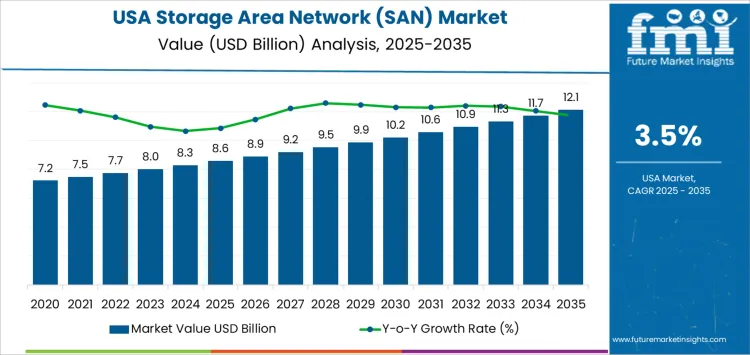
What is the Growth Forecast for Storage Area Network (SAN) Industry in USA through 2035?
The West, South, and Northeast regions show high adoption linked to concentrated technology enterprises, financial institutions, and government data operations. Key suppliers include Dell Technologies, Hewlett Packard Enterprise (HPE), NetApp Inc., IBM Corporation, and Cisco Systems Inc. Their strategies focus on intelligent storage automation, improved flash-based architecture, and optimized solutions for converged and hyperconverged environments aligned with growing data center requirements.
Demand for storage area network solutions in the United States presents a stable growth profile with limited volatility across the forecast horizon. Enterprise data workloads expand continuously through cloud hosting, virtualization architecture, and high-density transactional systems in finance, healthcare, and retail. These use cases create dependable procurement cycles that reduce fluctuation in annual performance. Hardware upgrade requirements arise from throughput expansion, cyber-resilience strategies, and regulatory compliance, which contributes to predictable replacement demand.
Macroeconomic uncertainty has minor influence because SAN infrastructure supports critical operations. Procurement timing can shift across fiscal periods, although budget allocation remains consistent. The rise of hyperscale data centers strengthens multi-year commitments, which supports a low volatility signal. Hybrid deployments increase adoption within mid-sized organizations, adding a diversified demand base. Competitive movement among vendors drives gradual pricing adjustments rather than abrupt shifts.
Software-defined architecture, NVMe protocol penetration, and storage tier optimization add incremental lift over time. The result is a steady climb without major peaks or retrenchment phases. Year-to-year deviations remain narrow since performance depends on essential data-storage continuity rather than discretionary technology cycles.
USA Storage Area Network (SAN) Key Takeaways
| Metric | Value |
|---|---|
| USA Storage Area Network (SAN) Sales Value (2025) | USD 8.6 billion |
| USA Storage Area Network (SAN) Forecast Value (2035) | USD 12.1 billion |
| USA Storage Area Network (SAN) Forecast CAGR (2025-2035) | 3.5% |
Why is the Demand for Storage Area Network (SAN) in the USA Growing?
Demand for Storage Area Network systems in the USA is increasing because enterprises handle large volumes of critical data that require fast access, secure storage and efficient management. SAN technology supports centralized storage with high throughput, which fits the needs of financial services, healthcare providers, e commerce platforms and data driven organizations. Many companies expand digital services and rely on systems that maintain uptime and protect business continuity. Virtualization and cloud integration continue to influence storage planning. Enterprises choose SAN for predictable performance when supporting virtual machines and mission critical workloads. High availability and strong data protection features such as redundancy and snapshot management strengthen its role in disaster recovery strategies.
Growth in artificial intelligence, analytics and connected devices increases data traffic in enterprise networks. SAN infrastructure helps organizations scale capacity and performance while supporting data governance requirements across departments. Constraints include high procurement and maintenance cost. Smaller businesses may delay investment until storage demands justify the expense. Trained IT personnel are required to configure and manage SAN environments, which adds to operational considerations.
Which Components and SAN Types Lead Demand for Storage Area Networks in the United States?
Demand for Storage Area Networks in the United States aligns with enterprise digitalization, managed data protection, and scalable workload processing. Organizations expand storage to support cloud migration, AI-driven analytics, and backup systems for compliance. SAN architecture adoption continues across financial services, healthcare, and hyperscale computing ecosystems. USA buyers emphasize low latency, virtual machine traffic reliability, and data accessibility within centralized storage infrastructure.
By Component, Hardware Holds the Largest Share
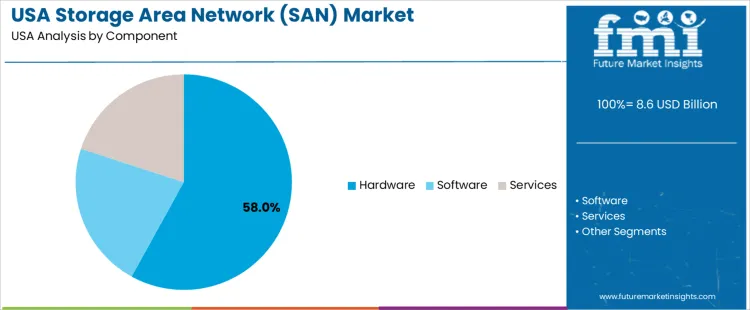
Hardware accounts for 58.0%. This segment includes fiber-channel switches, controllers, storage arrays, and host bus adapters. Deployment decisions relate to high-performance throughput and system durability across mission-critical workloads. Software represents 22.0%. Storage management tools support visibility, volume provisioning, and data lifecycle automation inside SAN architectures. Services hold 20.0%. USA enterprises source consulting, installation, and managed optimization to adapt legacy environments to scalable platforms. Growth aligns with infrastructure modernization inside data centers where equipment upgrades sustain security, redundancy, and virtualization performance.
Key Points:
- Hardware demand reflects latency, reliability, and compute-storage distance control
- Software supports orchestration and multi-workload traffic handling
- Services enable migration consistency and lifecycle performance tuning
By SAN Type, Hyperscale Server SAN Leads Usage
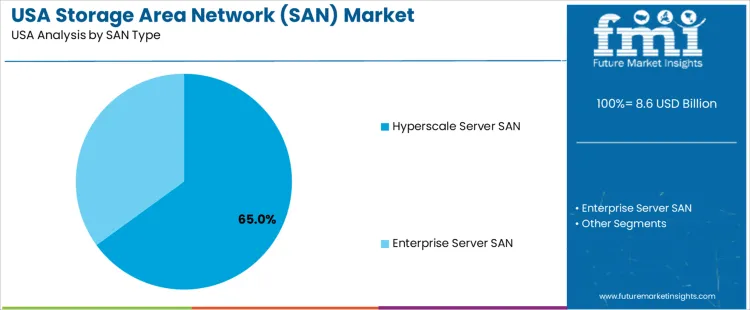
Hyperscale server SAN solutions hold 65.0%. Adoption continues in cloud providers, large enterprises, and content delivery platforms requiring expandable pooled storage. Scale-out architectures back distributed compute models used in streaming, digital services, and AI processing. Enterprise server SAN holds 35.0%. Organizations apply dedicated SAN networks to improve security and governance for regulated data environments including banking, insurance, and patient information holdings. Type selection aligns with data volume growth, central management structures, and sustainability requirements in USA operational systems.
Key Points:
- Hyperscale SAN supports elastic compute growth and distributed storage needs
- Enterprise SAN sustains governance and control of sensitive workloads
- Architecture choice responds to scalability, compliance, and cost strategy
What are the Key Dynamics in the Storage Area Network (SAN) Industry?
Growth of data-intensive enterprise workloads, rising need for secure on premise storage and continued investment in business continuity systems drive demand.
In the United States, hospitals, banks and government agencies rely on Storage Area Networks for controlled access to mission-critical data that supports daily operations. Industries running electronic health records, payment authorization, supply chain management and advanced analytics require high-performance storage designed for reliability. Hybrid IT deployment grows as enterprises combine cloud services with SAN environments to keep sensitive data within secure facilities. Manufacturers adopt SANs to support automation and connected equipment that generate constant operational data. Retailers and logistics providers maintain SAN capacity for real-time inventory management and transaction records. These use cases sustain demand among organizations prioritizing low latency, rapid scaling and strong data governance.
High infrastructure cost, shortage of skilled IT personnel and slower refresh cycles in cost-conscious sectors restrain demand.
SAN installation requires capital investment in hardware, fiber switching and backup systems that challenge smaller firms with limited technology budgets. Expansion projects demand specialized configuration expertise that remains unevenly available across regional markets. Many organizations extend service life of existing arrays to reduce spending, delaying adoption of newer SAN platforms. Growth of public cloud usage influences procurement decisions in mid-size companies that prefer outsourced storage for non-critical workloads. These conditions create measured spending patterns outside highly regulated or data-centric industries.
Shift toward all-flash architectures, increased integration with virtualization and rising adoption of automation in storage management define key trends.
All-flash SAN systems replace spinning media to improve throughput and reduce space and cooling requirements in enterprise data centers. Virtual server environments depend on SANs for high-availability clustering that supports workload mobility across physical hosts. Storage management software introduces AI-based optimization to balance performance, reduce manual configuration and improve resource utilization.
Enterprises evaluate NVMe-over-Fibre Channel to raise application responsiveness in analytics and transactional workloads. Co-location facilities provide managed SAN hosting for organizations seeking resilient infrastructure without owning dedicated spaces. These developments indicate stable, performance-driven demand for Storage Area Networks across the United States linked to digital operations and critical data protection needs.
Analysis of the Demand for Storage Area Networks (SAN) in the USA by Region
Demand for Storage Area Networks in the United States develops through investments in data-intensive operations, secure enterprise storage, and business continuity requirements. IT modernization within finance, healthcare, cloud services, and large-scale retail creates consistent infrastructure upgrades for centralized data access and scalable storage pools. Virtualized workloads and container-based applications lead organizations to expand networked storage capacity.
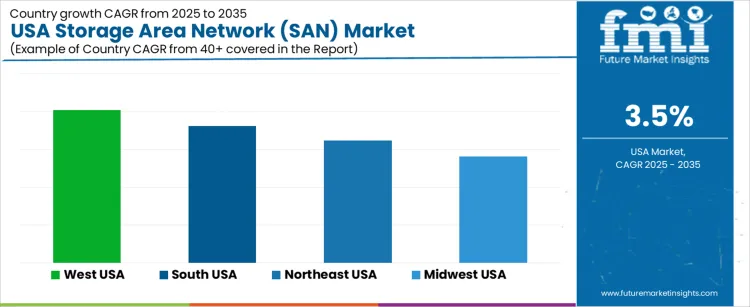
Data governance and cybersecurity compliance increase the need for high-reliability SAN architecture. West USA leads growth at 4.0%, South USA follows at 3.6%, Northeast USA records 3.2%, and Midwest USA observes 2.8% expansion through 2035. Regional adoption reflects variations in enterprise data footprints, colocated data centers, and digital transformation budgets.
| Region | CAGR (2025-2035) |
|---|---|
| West USA | 4.0% |
| South USA | 3.6% |
| Northeast USA | 3.2% |
| Midwest USA | 2.8% |
How is the West USA supporting SAN demand?
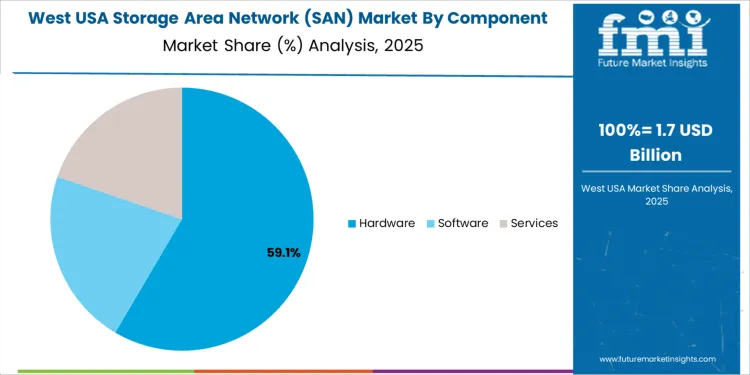
West USA shows 4.0% CAGR, shaped by hyperscale data center clusters and cloud platform investment across California, Washington, and Oregon. Technology companies host significant volumes of applications requiring high-throughput and low-latency storage. Media production and streaming services rely on SAN for large asset repositories, rapid editing workflows, and archive reliability. Startups integrate enterprise-grade storage earlier in scaling cycles due to data-driven business models. Healthcare providers adopt SAN to manage diagnostic imaging systems and electronic health record retention. Procurement teams prioritize flexible storage tiering, seamless data migration, and encryption support to align with evolving security expectations.
- Hyperscale hosting facilities creating continuous capacity upgrades
- Media and streaming workflows relying on high-bandwidth performance
- Early enterprise adoption within data-driven startups
- Healthcare imaging and EHR retention increasing storage needs
How is the South USA shaping expansion?
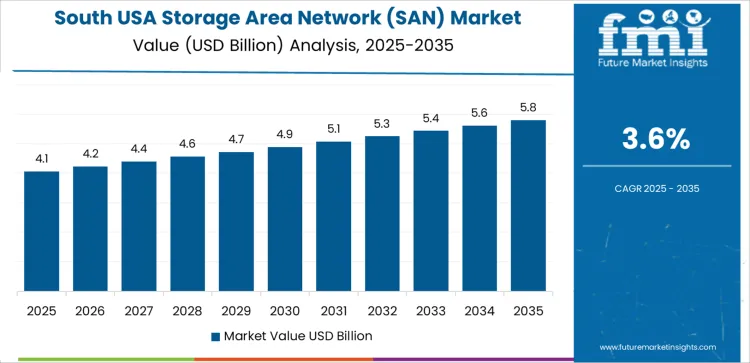
South USA records 3.6% CAGR, influenced by suburban corporate expansion and colocation facilities concentrated across Texas, Georgia, and Virginia. Logistics enterprises deploy SAN infrastructure to support automation and real-time inventory tracking. Energy and manufacturing sectors maintain large operational data repositories that require resilient backup and fast restoration. Universities strengthen research data environments using scalable storage pools. Cloud-migration initiatives increase SAN integration for hybrid IT environments designed to support sensitive information storage. Buyers evaluate hardware longevity and upgrade paths that minimize downtime during capacity expansion.
- Industrial and logistics organizations creating steady SAN demand
- Colocation hubs supporting hybrid infrastructure needs
- Academic research reinforcing large-volume storage capacity
- Procurement focused on resilience and extended lifecycle use
How is the Northeast USA driving utilization?
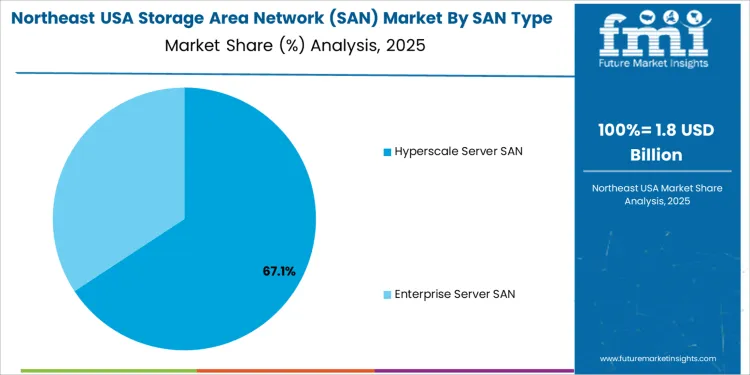
Northeast USA posts 3.2% CAGR, supported by financial institutions and healthcare networks operating dense data environments in New York, New Jersey, and Massachusetts. Data governance policies elevate interest in reliable storage orchestration to protect sensitive information during transfers. Corporate IT teams require centralized data pools for collaboration across distributed offices. Hospitals use SAN for imaging, laboratory records, and patient-care analytics. Government entities rely on validated infrastructure for secure document retention. Purchasers prefer high-availability configurations with continuous replication to address operational risk.
- Finance and healthcare maintaining mission-critical storage demand
- Distributed teams requiring centralized data access
- Public sector operations enforcing compliance-aligned storage
- Operational continuity guiding architecture selection
How is the Midwest USA contributing to adoption?
Midwest USA expands at 2.8% CAGR, driven by cost-efficient IT upgrades in manufacturing, transportation, and education sectors across Illinois, Michigan, and Ohio. Organizations replace isolated storage devices with SAN systems that support better utilization of shared resources. Regional enterprises prefer scalable models sized for predictable growth patterns rather than aggressive capacity expansion. Agricultural technology firms and logistics operators integrate SAN for equipment data analytics and fleet coordination. Buyers assess power efficiency, maintenance simplicity, and compatibility with existing servers to minimize capital strain.
- Manufacturing automation creating centralized data storage needs
- Predictable demand supporting incremental scaling strategies
- Fleet and equipment analytics increasing digital storage workloads
- Cost-control priorities guiding procurement decisions
What is the competitive landscape of the demand for storage area network solutions in the United States?
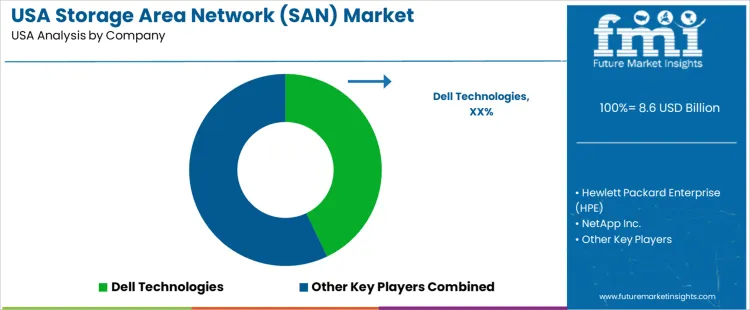
Demand for storage area network solutions in the United States supports high-performance data workloads in banking, healthcare, media production, government operations, and enterprise cloud environments. Buyers evaluate throughput stability, virtualization compatibility, cybersecurity architecture, encrypted data mobility, and technical support coverage across nationwide data-center footprints. Procurement teams also consider long lifecycle assurance due to the capital-intensive nature of storage infrastructure.
Dell Technologies holds an estimated 42.9% share through broad SAN and unified-storage portfolios that meet scalability needs of large USA enterprises. Its strong channel presence and integrated management tools allow alignment with existing server and networking deployments. Hewlett Packard Enterprise provides fibre-channel arrays and hybrid solutions used by organizations managing continuous database access or mission-critical ERP systems. NetApp Inc. maintains a position in virtualized environments and cloud-connected architectures valued by enterprises transitioning workloads across private and hosted infrastructure.
IBM Corporation supports SAN adoption where legacy platforms, high-security zoning, and mainframe workloads remain central to operations. Cisco Systems Inc. contributes through switching platforms that enable multi-vendor SAN deployment focused on predictable latency and simplified zoning within data-center networks. Key competitive factors involve certified interoperability with USA enterprise software ecosystems, reliable on-site service capacity, and performance optimization for virtual compute clusters. Suppliers showing consistent firmware maturity, strong cybersecurity postures, and efficient total cost of ownership remain best positioned to address USA demand for SAN infrastructure.
Key Players in USA Storage Area Network (SAN) Demand
- Dell Technologies
- Hewlett Packard Enterprise (HPE)
- NetApp Inc.
- IBM Corporation
- Cisco Systems Inc.
Scope of the Report
| Items | Values |
|---|---|
| Quantitative Units | USD billion |
| Component | Hardware, Software, Services |
| SAN Type | Hyperscale Server SAN, Enterprise Server SAN |
| Technology | Fibre Channel, Fibre Channel Over Ethernet, InfiniBand, iSCSI Protocol |
| Vertical | BFSI, IT & Telecom, Energy & Utility, Government, Military & Defense, Healthcare, Manufacturing |
| Regions Covered | West USA, South USA, Northeast USA, Midwest USA |
| Key Companies Profiled | Dell Technologies, Hewlett Packard Enterprise (HPE), NetApp Inc., IBM Corporation, Cisco Systems Inc. |
| Additional Attributes | Dollar sales by SAN type, component segmentation, and technology preferences; adoption trends across BFSI, IT & telecom, and hyperscale data center environments; expansion driven by virtualization workloads, hybrid cloud storage, and NVMe-oF integration; vendor differentiation via high-speed throughput, storage optimization, cybersecurity compliance, and network resiliency in critical USA enterprise infrastructure. |
USA Storage Area Network (SAN) Demand by Segments
Component:
- Hardware
- Software
- Services
SAN Type:
- Hyperscale Server SAN
- Enterprise Server SAN
Technology:
- Fibre Channel
- Fibre Channel Over Ethernet
- InfiniBand
- iSCSI Protocol
Vertical:
- BFSI
- IT & Telecom, Energy & Utility
- Government, Military & Defense
- Healthcare
- Manufacturing
Region:
- West USA
- South USA
- Northeast USA
- Midwest USA
Frequently Asked Questions
How big is the demand for storage area network (SAN) in USA in 2025?
The demand for storage area network (SAN) in USA is estimated to be valued at USD 8.6 billion in 2025.
What will be the size of storage area network (SAN) in USA in 2035?
The market size for the storage area network (SAN) in USA is projected to reach USD 12.1 billion by 2035.
How much will be the demand for storage area network (SAN) in USA growth between 2025 and 2035?
The demand for storage area network (SAN) in USA is expected to grow at a 3.5% CAGR between 2025 and 2035.
What are the key product types in the storage area network (SAN) in USA?
The key product types in storage area network (SAN) in USA are hardware, software and services.
Which san type segment is expected to contribute significant share in the storage area network (SAN) in USA in 2025?
In terms of san type, hyperscale server san segment is expected to command 65.0% share in the storage area network (SAN) in USA in 2025.
Preview the report firsthand - request a free sample
Get SampleGet the brochure for pricing and purchase details.
Get PDFTable of Content
- Executive Summary
- USA Market Outlook
- Demand-side Trends
- Supply-side Trends
- Technology Roadmap Analysis
- Analysis and Recommendations
- Market Overview
- Market Coverage / Taxonomy
- Market Definition / Scope / Limitations
- Market Background
- Market Dynamics
- Drivers
- Restraints
- Opportunity
- Trends
- Scenario Forecast
- Demand in Optimistic Scenario
- Demand in Likely Scenario
- Demand in Conservative Scenario
- Opportunity Map Analysis
- Product Life Cycle Analysis
- Supply Chain Analysis
- Investment Feasibility Matrix
- Value Chain Analysis
- PESTLE and Porter’s Analysis
- Regulatory Landscape
- Regional Parent Market Outlook
- Production and Consumption Statistics
- Import and Export Statistics
- Market Dynamics
- USA Market Analysis 2020 to 2024 and Forecast, 2025 to 2035
- Historical Market Size Value (USD Million) Analysis, 2020 to 2024
- Current and Future Market Size Value (USD Million) Projections, 2025 to 2035
- Y-o-Y Growth Trend Analysis
- Absolute $ Opportunity Analysis
- USA Market Pricing Analysis 2020 to 2024 and Forecast 2025 to 2035
- USA Market Analysis 2020 to 2024 and Forecast 2025 to 2035, By Component
- Introduction / Key Findings
- Historical Market Size Value (USD Million) Analysis By Component , 2020 to 2024
- Current and Future Market Size Value (USD Million) Analysis and Forecast By Component , 2025 to 2035
- Hardware
- Software
- Services
- Y-o-Y Growth Trend Analysis By Component , 2020 to 2024
- Absolute $ Opportunity Analysis By Component , 2025 to 2035
- USA Market Analysis 2020 to 2024 and Forecast 2025 to 2035, By SAN Type
- Introduction / Key Findings
- Historical Market Size Value (USD Million) Analysis By SAN Type, 2020 to 2024
- Current and Future Market Size Value (USD Million) Analysis and Forecast By SAN Type, 2025 to 2035
- Hyperscale Server SAN
- Enterprise Server SAN
- Y-o-Y Growth Trend Analysis By SAN Type, 2020 to 2024
- Absolute $ Opportunity Analysis By SAN Type, 2025 to 2035
- USA Market Analysis 2020 to 2024 and Forecast 2025 to 2035, By Technology
- Introduction / Key Findings
- Historical Market Size Value (USD Million) Analysis By Technology, 2020 to 2024
- Current and Future Market Size Value (USD Million) Analysis and Forecast By Technology, 2025 to 2035
- Fibre Channel
- Fibre Channel Over Ethernet
- InfiniBand
- iSCSI Protocol
- Y-o-Y Growth Trend Analysis By Technology, 2020 to 2024
- Absolute $ Opportunity Analysis By Technology, 2025 to 2035
- USA Market Analysis 2020 to 2024 and Forecast 2025 to 2035, By Vertical
- Introduction / Key Findings
- Historical Market Size Value (USD Million) Analysis By Vertical, 2020 to 2024
- Current and Future Market Size Value (USD Million) Analysis and Forecast By Vertical, 2025 to 2035
- BFSI
- IT & Telecom, Energy & Utility
- Government, Military & Defense
- Healthcare
- Manufacturing
- Y-o-Y Growth Trend Analysis By Vertical, 2020 to 2024
- Absolute $ Opportunity Analysis By Vertical, 2025 to 2035
- Market Structure Analysis
- Competition Dashboard
- Competition Benchmarking
- Market Share Analysis of Top Players
- By Regional
- By Component
- By SAN Type
- By Technology
- By Vertical
- Competition Analysis
- Competition Deep Dive
- Dell Technologies
- Overview
- Product Portfolio
- Profitability by Market Segments (Product/Age /Sales Channel/Region)
- Sales Footprint
- Strategy Overview
- Marketing Strategy
- Product Strategy
- Channel Strategy
- Hewlett Packard Enterprise (HPE)
- NetApp Inc.
- IBM Corporation
- Cisco Systems Inc.
- Dell Technologies
- Competition Deep Dive
- Assumptions & Acronyms Used
- Research Methodology


