

- Industry Size (2026)
- USD 1960 Mn
- Forecast (2036)
- USD 6880 Mn
- CAGR (2026 to 2036)
- 13.4%
Knock-Down Packaging Market Forecast and Outlook By FMI
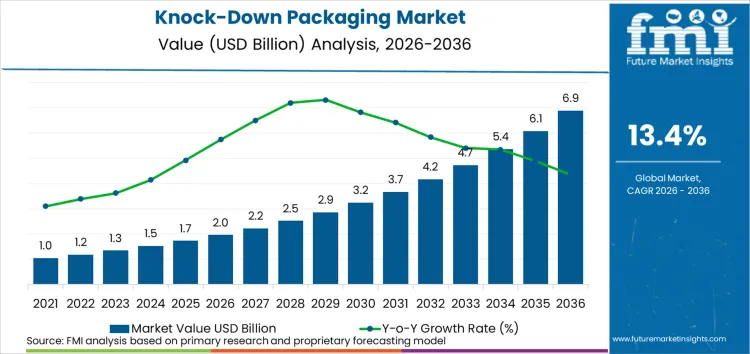
The global knock-down packaging market is projected to reach a valuation of USD 1,960 million in 2026 and expand to USD 6,880 million by 2036, advancing at a 13.4% CAGR over the forecast period. Growth reflects a fundamental redefinition of transport packaging economics, wherein dimensional efficiency, collapsibility, and circular compliance have become primary procurement criteria across furniture distribution, industrial equipment logistics, and e-commerce fulfillment networks.
Knock-down packaging is transitioning from a niche flat-pack solution into core logistics infrastructure, driven by sustained freight cost inflation and regulatory pressure on packaging inefficiency. Less-than-truckload (LTL) carriers implementing record-high dimensional weight pricing in late 2025 altered cost structures across North American and European logistics networks. Freight charges increasingly reflect package volume rather than mass alone, with inefficient cube utilization triggering penalties of up to 60% per shipment. This pricing shift has accelerated adoption of collapsible corrugated boxes and slot-lock cartons that achieve 40–60% outbound cube reduction without compromising protection performance.
Structural demand is reinforced by regulatory mandates targeting packaging bulk and recyclability. The EU Packaging and Packaging Waste Regulation (PPWR) enforces strict void-space minimization and recyclability documentation, while Germany’s 2026 modulated EPR fees impose penalties of up to 20% on excessively bulky or non-recyclable packaging. In parallel, China’s GB 43352-2023 express delivery packaging standards mandate dimensional limits and minimum collapsed storage cube efficiency, institutionalizing knock-down formats as compliance mechanisms rather than discretionary design choices.
Corporate investments underscore this transition. Smurfit Westrock’s USD 19.3 million expansion of its Saltillo, Mississippi facility in 2026 targets large-format knock-down solutions for automotive and industrial applications, signaling sustained demand growth in segments historically dominated by wooden crating. DS Smith’s AI-driven PalletOptimization system integrates cube efficiency analytics directly into knock-down carton specification, reducing corrugated consumption 18–25% while preserving transit performance.
Summary of the Knock-Down Packaging Market
- The knock-down packaging market comprises collapsible, flat-pack, and ready-to-assemble transport packaging formats engineered to minimize empty storage cube, reduce outbound dimensional weight charges, and enable efficient one-way or returnable logistics. These systems are deployed across furniture components, industrial equipment, e-commerce kitting, and modular construction supply chains where transportation efficiency and storage density materially influence total delivered cost.
- Under FMI taxonomy, the market is segmented by product segment, pack structure, material, and region, focusing exclusively on packaging architectures designed for repeated erection and collapse cycles or flat-packed one-way shipment. The scope excludes rigid one-piece containers, non-collapsible wooden crating, pallet-level unitization systems, and downstream logistics or assembly services. This boundary is essential, as the value proposition of knock-down packaging lies in its ability to convert packaging design into freight avoidance and real-estate optimization rather than simple product containment.
- FMI projects the market to grow at a 13.4% CAGR from 2026 to 2036, expanding from USD 1,960 million to USD 6,880 million. Growth is structurally underpinned by four converging forces: (1) dimensional weight pricing escalation across LTL and parcel carriers, (2) warehouse real-estate scarcity driving demand for collapsible empty-container storage, (3) automation requirements in e-commerce fulfillment demanding dimensional consistency, and (4) circular economy regulations penalizing bulky and non-recyclable transport packaging.
- Competition is consolidating around global packaging corporations capable of delivering engineered knock-down systems with validated cube-efficiency metrics, automated line compatibility, and auditable sustainability documentation. China is the fastest-growing country market at 14.8% CAGR, while the United States and Germany follow, driven respectively by freight economics and EPR-led compliance pressure.
Knock-Down Packaging Market Key Takeaways
| Metric | Value |
|---|---|
| Market Size (2026E) | USD 1,960 million |
| Market Size (2036F) | USD 6,880 million |
| CAGR (2026-2036) | 13.4% |
Source: Future Market Insights (FMI) analysis
Why is the Knock-Down Packaging Market Growing?
Growth in the knock-down packaging market is propelled by freight cost optimization imperatives, warehouse space economics, automation compatibility requirements, and circular-economy regulatory enforcement. Supply-chain control functions rather than purchasing departments, prioritizing cost-per-pallet and cost-per-trailer metrics increasingly make procurement decisions over unit packaging cost.
Less-than-truckload carriers’ adoption of dimensional weight pricing in late 2025 fundamentally restructured packaging economics. Shippers now incur freight penalties when packaging volume exceeds optimal cube utilization, making collapsible knock-down formats a direct lever for freight cost avoidance. Manufacturers report 35–60% freight savings following conversion from rigid containers to flat-pack knock-down systems, with typical payback periods of 6–18 months despite higher per-unit material costs.
Warehouse real-estate scarcity amplifies this effect. Industrial vacancy rates of 3–4% across major logistics corridors have driven rental inflation of 15–25% annually, making empty container storage a significant cost burden. Knock-down systems that collapse to 15–20% of erected height reduce empty storage footprint by 70–85%, enabling operators to defer costly warehouse expansions.
Regulatory drivers further institutionalize demand. Germany’s 2026 EPR fee modulation penalizes bulky and non-recyclable packaging, while China’s GB 43352-2023 standards enforce strict dimensional compliance through sortation-center audits. Together, these frameworks elevate knock-down packaging from optional efficiency enhancement to mandatory compliance infrastructure across multiple regions.
How is the Knock-Down Packaging Market Segmented?
The knock-down packaging market is segmented by product segment, pack structure, and material, reflecting how collapsibility requirements vary by end-use application, handling frequency, and logistics environment. Unlike conventional transport packaging, segmentation here is determined less by payload protection alone and more by cube-efficiency performance, erection simplicity, and storage density when empty. As freight pricing, warehouse space utilization, and regulatory oversight converge, buyers increasingly evaluate knock-down formats as logistics optimization tools rather than packaging consumables.
Segmentation dynamics also reflect a shift toward engineered flat-pack systems designed to integrate with automated or semi-automated fulfillment operations. As e-commerce and industrial distribution centers adopt standardized carton erection, slot-lock mechanisms, and repeatable folding geometries, demand is consolidating around knock-down formats that can be deployed at scale without introducing variability in dimensions or labor requirements. This has raised the value threshold for segmentation, favoring designs that combine structural performance with operational repeatability.
Why do Furniture Components dominate the knock-down packaging landscape?
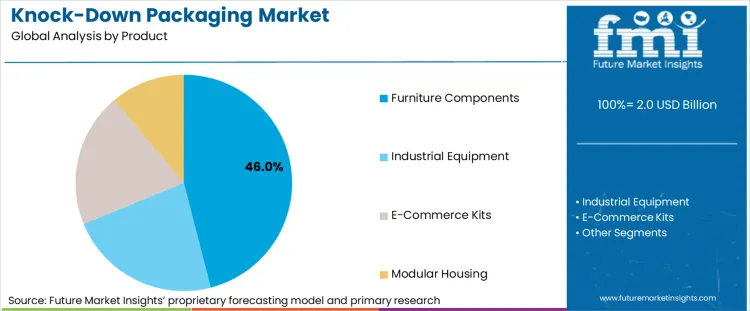
Furniture components represent approximately 46% of total market demand, making them the leading product segment within knock-down packaging. This dominance is driven by the inherent mismatch between traditional rigid packaging and the dimensional profile of furniture parts, which are often large, flat, and non-fragile but expensive to transport due to volume inefficiency. Knock-down cartons and flat-pack systems allow manufacturers and retailers to ship disassembled components with minimal void space, materially reducing freight cost per unit.
The rise of direct-to-consumer furniture distribution further reinforces this segment’s leadership. Online furniture retailers depend on packaging formats that minimize dimensional weight charges while remaining easy for end users to open, assemble, and dispose of. Knock-down corrugated systems meet these requirements by combining cube efficiency with recyclability and consumer-friendly handling, sustaining furniture components as the largest and most structurally entrenched application segment.
How are Collapsible Corrugated Boxes emerging as the dominant pack structure?
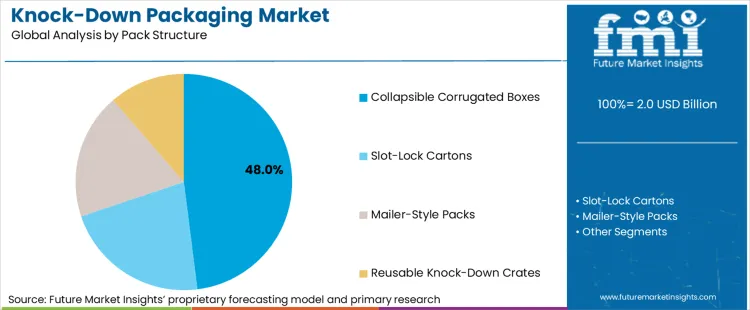
Collapsible corrugated boxes account for roughly 48% of pack structure adoption, reflecting their ability to deliver high compression strength when erected while collapsing to a fraction of their deployed volume when empty. These designs typically use slot-locks, hinged panels, or fold-flat architectures that eliminate the need for adhesives, enabling repeated erection cycles or efficient one-way flat shipment.
From a logistics standpoint, collapsible corrugated boxes offer a unique advantage: they enable predictable dimensional control. Unlike flexible packaging, their erected geometry is consistent, allowing precise palletization and trailer loading. At the same time, their collapsed form dramatically reduces return logistics or empty storage costs. This dual benefit has made collapsible corrugated boxes the preferred knock-down format for both industrial and e-commerce applications under tightening freight economics.
Why does Corrugated Board remain the dominant material platform?
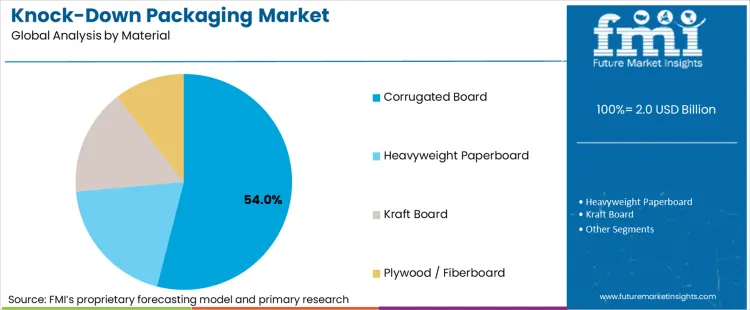
Corrugated board represents 54% of material usage in the knock-down packaging market, reflecting its balance of structural performance, cost efficiency, and regulatory alignment. Corrugated board provides the rigidity required for load-bearing applications while remaining lightweight and highly recyclable—an increasingly important consideration under EPR and packaging waste regulations.
Material familiarity and supply-chain maturity further reinforce corrugated board’s dominance. Manufacturers and converters benefit from established tooling, predictable performance characteristics, and global availability, enabling rapid customization of knock-down designs. As packaging regulations penalize non-recyclable or composite materials, corrugated board continues to offer the lowest compliance risk for knock-down applications, sustaining its leadership position across regions.
What Drivers, Restraints, Opportunities, and Trends Shape the Knock-Down Packaging Market?
A primary driver is freight cost escalation driven by dimensional weight pricing. As LTL and parcel carriers price shipments based on volume rather than mass, packaging designs that minimize cube utilization deliver immediate and measurable savings. Knock-down formats enable shippers to reduce outbound and return freight costs without altering product design, making them an attractive lever for rapid logistics optimization. Another major driver is warehouse space scarcity and storage cost inflation. High occupancy rates and rising rental costs have made empty packaging storage a material expense. Knock-down systems that collapse to a small fraction of their erected volume significantly reduce storage footprints, allowing operators to defer warehouse expansion or repurpose space for revenue-generating activities.
One key restraint is higher upfront design and tooling complexity. Knock-down packaging requires precise die-cutting, folding logic, and structural validation, which can increase development timelines and initial costs compared to standard boxes. This can deter smaller manufacturers or those with limited packaging engineering resources. Another restraint is labor and training requirements at deployment sites. While knock-down systems reduce logistics costs, they often require on-site erection, which introduces labor dependency and potential variability. In facilities with high turnover or limited training capacity, this can slow adoption or necessitate investment in automation.
A significant opportunity lies in automation-compatible knock-down designs. As fulfillment centers invest in automated carton erection and handling systems, knock-down formats engineered for machine assembly can unlock additional efficiency gains. Suppliers that align design geometry with automation standards are well positioned to capture long-term contracts.Another opportunity is substitution of wooden crates and rigid containers. In heavy industrial and automotive applications, knock-down corrugated systems are increasingly replacing wood due to lower weight, better recyclability, and reduced handling complexity. This substitution trend expands the addressable market beyond traditional corrugated applications.
A defining trend is the integration of cube-efficiency analytics into packaging design. Tools that model trailer fill rates, pallet patterns, and return logistics are increasingly used to optimize knock-down designs before deployment, shifting packaging decisions upstream into supply-chain planning. Another emerging trend is the standardization of knock-down packaging platforms. Rather than custom designs for each SKU, manufacturers are adopting modular knock-down systems that can accommodate multiple product dimensions. This reduces tooling complexity, simplifies inventory, and supports scalable deployment across product lines.
Analysis of Knock-Down Packaging Market by Key Countries
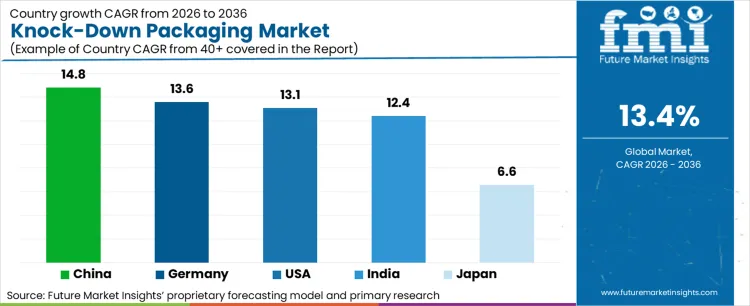
| Country | CAGR (2026-2036) |
|---|---|
| China | 14.8% |
| Germany | 13.6% |
| USA | 13.1% |
| India | 12.4% |
| Japan | 6.6% |
Source: Future Market Insights (FMI), based on document-referenced analysis
Why Is China Leading Global Growth in Knock-Down Packaging Adoption?
China is projected to expand at a 14.8% CAGR between 2026 and 2036, making it the fastest-growing country market for knock-down packaging. This growth is directly linked to regulatory enforcement of express delivery packaging efficiency standards and the scale of China’s e-commerce and industrial manufacturing ecosystems. The implementation of GB 43352-2023 has institutionalized dimensional efficiency audits at sorting centers, effectively penalizing bulky, non-collapsible packaging formats and accelerating adoption of flat-pack and collapsible designs.
In parallel, China’s manufacturing exporters face mounting pressure to reduce outbound freight costs as international shipping rates remain volatile. Knock-down packaging enables exporters to optimize container utilization and reduce empty return volume, delivering measurable logistics savings. These structural incentives—regulatory enforcement combined with freight economics—support sustained double-digit growth throughout the forecast period
How Is Germany’s Regulatory Framework Accelerating Market Expansion?
Germany is forecast to grow at a 13.6% CAGR from 2026 to 2036, driven by one of the most stringent packaging compliance environments globally. Germany’s modulated Extended Producer Responsibility (EPR) fee system, effective from 2026, imposes higher fees on bulky and non-recyclable transport packaging. This directly incentivizes manufacturers to adopt knock-down formats that minimize material usage and storage footprint.
Beyond compliance, German manufacturers operate within dense logistics corridors where warehouse space is both scarce and expensive. Knock-down packaging reduces empty container storage requirements and supports just-in-time logistics models. The combination of regulatory penalties and real-estate economics makes knock-down solutions economically compelling, sustaining Germany’s strong growth trajectory despite its mature industrial base.
Why Is the United States Experiencing Strong Uptake of Knock-Down Packaging?
The United States market is projected to expand at a 13.1% CAGR over the forecast period, primarily driven by freight pricing dynamics and e-commerce fulfillment optimization. The widespread adoption of dimensional weight pricing by LTL carriers in late 2025 has fundamentally altered cost structures, penalizing inefficient packaging volumes regardless of weight. As a result, U.S. shippers are actively redesigning packaging systems to reduce cube utilization, with knock-down formats offering immediate and scalable cost relief.
Additionally, the rapid expansion of direct-to-consumer furniture and large-item e-commerce has amplified demand for flat-pack solutions. Knock-down packaging aligns with consumer-friendly delivery expectations while reducing last-mile logistics costs, reinforcing its adoption across retail and industrial supply chains.
What Is Supporting India’s Rising Adoption of Knock-Down Packaging?
India is expected to grow at a 12.4% CAGR between 2026 and 2036, supported by the expansion of organized retail, e-commerce, and manufacturing exports. As logistics infrastructure modernizes and freight costs rise, Indian manufacturers are increasingly sensitive to packaging-driven inefficiencies. Knock-down formats provide a practical means to reduce transportation volume without compromising product protection.
Moreover, India’s warehousing sector is experiencing rapid consolidation, with large third-party logistics providers prioritizing space utilization and standardized handling. Knock-down packaging supports these objectives by reducing empty storage footprint and enabling scalable deployment across diverse product categories, sustaining steady growth across the forecast horizon.
Why does Japan Show More Moderate Growth Despite Advanced Logistics Practices?
Japan is projected to grow at a 6.6% CAGR through 2036, reflecting a mature logistics environment where space efficiency and packaging optimization have long been prioritized. Many Japanese manufacturers already employ flat-pack or collapsible packaging formats, limiting the scope for rapid penetration-driven growth.
However, incremental expansion continues as companies refine knock-down designs to improve ergonomics, reduce labor effort during erection, and enhance recyclability documentation. These incremental upgrades support continued value growth even as overall market expansion remains more measured relative to faster-growing regions.
What is the Competition Outlook for the Knock-Down Packaging Market?
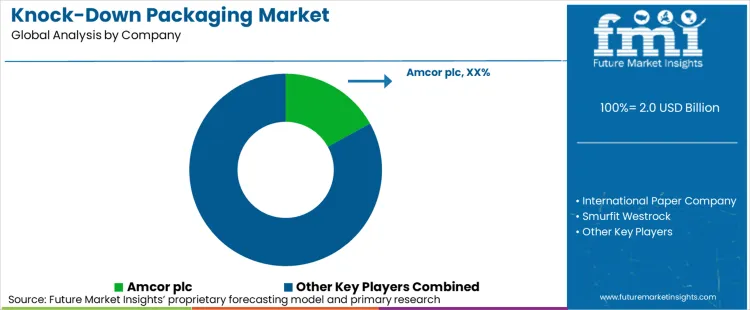
Competition in the knock-down packaging market is consolidating around suppliers that can translate collapsibility into measurable cube-economics outcomes, validated protection performance, and compliance-grade documentation. The market has moved beyond “flat-pack availability” as a differentiator; buyers increasingly evaluate packaging partners on their ability to engineer knock-down systems that directly improve cost-per-trailer, cost-per-pallet, and return-cube efficiency under dimensional-weight pricing regimes. This has elevated the strategic role of large converters and global packaging groups that can deliver design services, test validation, and multi-site manufacturing consistency.
A defining competitive differentiator is engineering-led design and validation capability. Suppliers with structural design teams, test laboratories, and simulation-driven development (including virtual compression and transport-condition modeling) reduce customer development cycles materially and improve speed-to-qualification for new knock-down formats. This matters because knock-down designs must preserve performance when erected while also collapsing reliably—meaning failure risk exists not only in transit, but at assembly/erection points inside distribution centers. Suppliers that can validate performance before prototyping, and then standardize the specification into repeatable supply contracts, win share in consolidated procurement environments.
A second differentiator is automation and system integration readiness. Knock-down packaging must interface with case erectors, robotic palletization, and standardized DC workflows. Suppliers that provide integration support and commissioning guidance are capturing preferred-supplier status as packaging shifts into automation-constrained operations. In parallel, sustainability documentation has become a procurement gate: suppliers increasingly must provide verified recycled-content and recyclability validation documentation aligned to evolving EU packaging governance. These demands push the market toward suppliers with mature compliance systems rather than regional converters focused solely on conversion capacity.
Key Players Profiled in the Knock-Down Packaging Market
- Amcor plc
- International Paper Company
- Smurfit Westrock
- DS Smith Plc
- Mondi Group
- Georgia-Pacific LLC
- Pratt Industries Inc.
- Klabin S.A.
Market Definition
The knock-down packaging market comprises revenues generated from collapsible, flat-pack, and ready-to-assemble transport packaging formats engineered to minimize empty storage and return cube, reduce outbound freight dimensional weight charges, and enable efficient one-way or returnable logistics across furniture distribution, industrial equipment supply chains, e-commerce kitting operations, and modular building component transport.
The scope includes knock-down systems segmented by product segment (furniture components, industrial equipment, e-commerce kits, modular housing), pack structure (collapsible corrugated boxes, slot-lock cartons, mailer-style packs, reusable knock-down crates), and material (corrugated board, heavyweight paperboard, kraft board, plywood/fiberboard). Products within scope are engineered for repeated erection/collapse cycles or flat-packed one-way shipment and are designed to achieve minimum 30% outbound shipping cube reduction and 70% empty storage cube reduction relative to equivalent rigid containers.
Scope of the Report
| Attribute | Details |
|---|---|
| Base Year | 2026 |
| Forecast Period | 2026–2036 |
| Market Size (2026E) | USD 1,960 million |
| Market Size (2036F) | USD 6,880 million |
| CAGR (2026–2036) | 13.4% |
| Product Segments | Furniture Components; Industrial Equipment; E-Commerce Kits; Modular Housing |
| Pack Structures | Collapsible Corrugated Boxes; Slot-Lock Cartons; Mailer-Style Packs; Reusable Knock-Down Crates |
| Materials | Corrugated Board; Heavyweight Paperboard; Kraft Board; Plywood/Fiberboard |
| Regions Covered | Europe; North America; East Asia; Rest of World |
| Countries Covered | Germany; United States; China; Sweden; plus others listed |
Source: Future Market Insights (FMI) analysis
Knock-Down Packaging Market Key Segments
By Product Segment
- Furniture Components
- Industrial Equipment
- E-Commerce Kits
- Modular Housing
By Pack Structure
- Collapsible Corrugated Boxes
- Slot-Lock Cartons
- Mailer-Style Packs
- Reusable Knock-Down Crates
By Material
- Corrugated Board
- Heavyweight Paperboard
- Kraft Board
- Plywood / Fiberboard
By Region
- Europe
- North America
- East Asia
- Rest of the World
Bibliography
- American Trucking Associations. (2026). National Motor Freight Classification 100-A: Density-based freight classification and packaging efficiency standards. ATA.
- Council of Supply Chain Management Professionals. (2026). State of logistics report 2026: Transportation cost, warehouse capacity, and packaging optimization trends. CSCMP.
- European Commission. (2026). Commission delegated regulation (EU) 2026/882 supplementing Regulation (EU) 2025/2405 on packaging and packaging waste: Recyclability assessment methodology for fibre-based packaging. Official Journal of the European Union.
- Fact.MR. (2026). Knock-down packaging market: Global industry analysis and outlook 2026—2036. Fact.MR.
- Hydro. (2026). Net-Zero Roadmap 2026: Supply chain optimization and circular aluminum packaging systems. Norsk Hydro ASA.
- International Organization for Standardization. (2026). ISO 18604:2026 Packaging and the environment — Material recycling — Collapsible fibre-based transport packaging. ISO.
Frequently Asked Questions
What is the long-term growth outlook for the knock-down packaging market?
FMI projects the market to expand from USD 1,960 million in 2026 to USD 6,880 million by 2036, registering a 13.4% CAGR over the forecast period.
Which applications are most influential in driving knock-down packaging demand?
Demand is strongest where cube efficiency and storage density are monetized—particularly furniture components, followed by industrial equipment and e-commerce kit logistics, as reflected in the market’s segment taxonomy and stated scope.
Which country is expected to grow the fastest, and why?
China is projected to be the fastest-growing country at 14.8% CAGR through 2036, driven by national standards (GB 43352-2023) emphasizing dimensional limits for express delivery packaging and the build-out of e-commerce super-hub infrastructure favoring returnable systems.
What is changing in how buyers evaluate knock-down packaging suppliers?
Buyers increasingly prioritize design engineering, validation capability, automation integration support, and sustainability documentation—capabilities that shorten qualification cycles and reduce operational variance across networks.
What pack structures fall within FMI’s defined scope for this market?
The scope includes collapsible corrugated boxes, slot-lock cartons, mailer-style packs, and reusable knock-down crates engineered for repeated erection/collapse cycles or flat-packed shipment.
Preview the report firsthand - request a free sample
Get SampleGet the brochure for pricing and purchase details.
Get PDFTable of Content
- Executive Summary
- Global Market Outlook
- Demand-side Trends
- Supply-side Trends
- Technology Roadmap Analysis
- Analysis and Recommendations
- Market Overview
- Market Coverage / Taxonomy
- Market Definition / Scope / Limitations
- Research Methodology
- Chapter Orientation
- Analytical Lens and Working Hypotheses
- Market Structure, Signals, and Trend Drivers
- Benchmarking and Cross-market Comparability
- Market Sizing, Forecasting, and Opportunity Mapping
- Research Design and Evidence Framework
- Desk Research Programme (Secondary Evidence)
- Company Annual and Sustainability Reports
- Peer-reviewed Journals and Academic Literature
- Corporate Websites, Product Literature, and Technical Notes
- Earnings Decks and Investor Briefings
- Statutory Filings and Regulatory Disclosures
- Technical White Papers and Standards Notes
- Trade Journals, Industry Magazines, and Analyst Briefs
- Conference Proceedings, Webinars, and Seminar Materials
- Government Statistics Portals and Public Data Releases
- Press Releases and Reputable Media Coverage
- Specialist Newsletters and Curated Briefings
- Sector Databases and Reference Repositories
- FMI Internal Proprietary Databases and Historical Market Datasets
- Subscription Datasets and Paid Sources
- Social Channels, Communities, and Digital Listening Inputs
- Additional Desk Sources
- Expert Input and Fieldwork (Primary Evidence)
- Primary Modes
- Qualitative Interviews and Expert Elicitation
- Quantitative Surveys and Structured Data Capture
- Blended Approach
- Why Primary Evidence is Used
- Field Techniques
- Interviews
- Surveys
- Focus Groups
- Observational and In-context Research
- Social and Community Interactions
- Stakeholder Universe Engaged
- C-suite Leaders
- Board Members
- Presidents and Vice Presidents
- R&D and Innovation Heads
- Technical Specialists
- Domain Subject-matter Experts
- Scientists
- Physicians and Other Healthcare Professionals
- Governance, Ethics, and Data Stewardship
- Research Ethics
- Data Integrity and Handling
- Primary Modes
- Tooling, Models, and Reference Databases
- Desk Research Programme (Secondary Evidence)
- Data Engineering and Model Build
- Data Acquisition and Ingestion
- Cleaning, Normalisation, and Verification
- Synthesis, Triangulation, and Analysis
- Quality Assurance and Audit Trail
- Market Background
- Market Dynamics
- Drivers
- Restraints
- Opportunity
- Trends
- Scenario Forecast
- Demand in Optimistic Scenario
- Demand in Likely Scenario
- Demand in Conservative Scenario
- Opportunity Map Analysis
- Product Life Cycle Analysis
- Supply Chain Analysis
- Investment Feasibility Matrix
- Value Chain Analysis
- PESTLE and Porter’s Analysis
- Regulatory Landscape
- Regional Parent Market Outlook
- Production and Consumption Statistics
- Import and Export Statistics
- Market Dynamics
- Global Market Analysis 2021 to 2025 and Forecast, 2026 to 2036
- Historical Market Size Value (USD Million) Analysis, 2021 to 2025
- Current and Future Market Size Value (USD Million) Projections, 2026 to 2036
- Y-o-Y Growth Trend Analysis
- Absolute $ Opportunity Analysis
- Global Market Pricing Analysis 2021 to 2025 and Forecast 2026 to 2036
- Global Market Analysis 2021 to 2025 and Forecast 2026 to 2036, By Product
- Introduction / Key Findings
- Historical Market Size Value (USD Million) Analysis By Product , 2021 to 2025
- Current and Future Market Size Value (USD Million) Analysis and Forecast By Product , 2026 to 2036
- Furniture Components
- Industrial Equipment
- E-Commerce Kits
- Modular Housing
- Furniture Components
- Y-o-Y Growth Trend Analysis By Product , 2021 to 2025
- Absolute $ Opportunity Analysis By Product , 2026 to 2036
- Global Market Analysis 2021 to 2025 and Forecast 2026 to 2036, By Pack Structure
- Introduction / Key Findings
- Historical Market Size Value (USD Million) Analysis By Pack Structure, 2021 to 2025
- Current and Future Market Size Value (USD Million) Analysis and Forecast By Pack Structure, 2026 to 2036
- Collapsible Corrugated Boxes
- Slot-Lock Cartons
- Mailer-Style Packs
- Reusable Knock-Down Crates
- Collapsible Corrugated Boxes
- Y-o-Y Growth Trend Analysis By Pack Structure, 2021 to 2025
- Absolute $ Opportunity Analysis By Pack Structure, 2026 to 2036
- Global Market Analysis 2021 to 2025 and Forecast 2026 to 2036, By Material
- Introduction / Key Findings
- Historical Market Size Value (USD Million) Analysis By Material, 2021 to 2025
- Current and Future Market Size Value (USD Million) Analysis and Forecast By Material, 2026 to 2036
- Corrugated Board
- Heavyweight Paperboard
- Kraft Board
- Plywood / Fiberboard
- Corrugated Board
- Y-o-Y Growth Trend Analysis By Material, 2021 to 2025
- Absolute $ Opportunity Analysis By Material, 2026 to 2036
- Global Market Analysis 2021 to 2025 and Forecast 2026 to 2036, By Region
- Introduction
- Historical Market Size Value (USD Million) Analysis By Region, 2021 to 2025
- Current Market Size Value (USD Million) Analysis and Forecast By Region, 2026 to 2036
- North America
- Latin America
- Western Europe
- Eastern Europe
- East Asia
- South Asia and Pacific
- Middle East & Africa
- Market Attractiveness Analysis By Region
- North America Market Analysis 2021 to 2025 and Forecast 2026 to 2036, By Country
- Historical Market Size Value (USD Million) Trend Analysis By Market Taxonomy, 2021 to 2025
- Market Size Value (USD Million) Forecast By Market Taxonomy, 2026 to 2036
- By Country
- USA
- Canada
- Mexico
- By Product
- By Pack Structure
- By Material
- By Country
- Market Attractiveness Analysis
- By Country
- By Product
- By Pack Structure
- By Material
- Key Takeaways
- Latin America Market Analysis 2021 to 2025 and Forecast 2026 to 2036, By Country
- Historical Market Size Value (USD Million) Trend Analysis By Market Taxonomy, 2021 to 2025
- Market Size Value (USD Million) Forecast By Market Taxonomy, 2026 to 2036
- By Country
- Brazil
- Chile
- Rest of Latin America
- By Product
- By Pack Structure
- By Material
- By Country
- Market Attractiveness Analysis
- By Country
- By Product
- By Pack Structure
- By Material
- Key Takeaways
- Western Europe Market Analysis 2021 to 2025 and Forecast 2026 to 2036, By Country
- Historical Market Size Value (USD Million) Trend Analysis By Market Taxonomy, 2021 to 2025
- Market Size Value (USD Million) Forecast By Market Taxonomy, 2026 to 2036
- By Country
- Germany
- UK
- Italy
- Spain
- France
- Nordic
- BENELUX
- Rest of Western Europe
- By Product
- By Pack Structure
- By Material
- By Country
- Market Attractiveness Analysis
- By Country
- By Product
- By Pack Structure
- By Material
- Key Takeaways
- Eastern Europe Market Analysis 2021 to 2025 and Forecast 2026 to 2036, By Country
- Historical Market Size Value (USD Million) Trend Analysis By Market Taxonomy, 2021 to 2025
- Market Size Value (USD Million) Forecast By Market Taxonomy, 2026 to 2036
- By Country
- Russia
- Poland
- Hungary
- Balkan & Baltic
- Rest of Eastern Europe
- By Product
- By Pack Structure
- By Material
- By Country
- Market Attractiveness Analysis
- By Country
- By Product
- By Pack Structure
- By Material
- Key Takeaways
- East Asia Market Analysis 2021 to 2025 and Forecast 2026 to 2036, By Country
- Historical Market Size Value (USD Million) Trend Analysis By Market Taxonomy, 2021 to 2025
- Market Size Value (USD Million) Forecast By Market Taxonomy, 2026 to 2036
- By Country
- China
- Japan
- South Korea
- By Product
- By Pack Structure
- By Material
- By Country
- Market Attractiveness Analysis
- By Country
- By Product
- By Pack Structure
- By Material
- Key Takeaways
- South Asia and Pacific Market Analysis 2021 to 2025 and Forecast 2026 to 2036, By Country
- Historical Market Size Value (USD Million) Trend Analysis By Market Taxonomy, 2021 to 2025
- Market Size Value (USD Million) Forecast By Market Taxonomy, 2026 to 2036
- By Country
- India
- ASEAN
- Australia & New Zealand
- Rest of South Asia and Pacific
- By Product
- By Pack Structure
- By Material
- By Country
- Market Attractiveness Analysis
- By Country
- By Product
- By Pack Structure
- By Material
- Key Takeaways
- Middle East & Africa Market Analysis 2021 to 2025 and Forecast 2026 to 2036, By Country
- Historical Market Size Value (USD Million) Trend Analysis By Market Taxonomy, 2021 to 2025
- Market Size Value (USD Million) Forecast By Market Taxonomy, 2026 to 2036
- By Country
- Kingdom of Saudi Arabia
- Other GCC Countries
- Turkiye
- South Africa
- Other African Union
- Rest of Middle East & Africa
- By Product
- By Pack Structure
- By Material
- By Country
- Market Attractiveness Analysis
- By Country
- By Product
- By Pack Structure
- By Material
- Key Takeaways
- Key Countries Market Analysis
- USA
- Pricing Analysis
- Market Share Analysis, 2025
- By Product
- By Pack Structure
- By Material
- Canada
- Pricing Analysis
- Market Share Analysis, 2025
- By Product
- By Pack Structure
- By Material
- Mexico
- Pricing Analysis
- Market Share Analysis, 2025
- By Product
- By Pack Structure
- By Material
- Brazil
- Pricing Analysis
- Market Share Analysis, 2025
- By Product
- By Pack Structure
- By Material
- Chile
- Pricing Analysis
- Market Share Analysis, 2025
- By Product
- By Pack Structure
- By Material
- Germany
- Pricing Analysis
- Market Share Analysis, 2025
- By Product
- By Pack Structure
- By Material
- UK
- Pricing Analysis
- Market Share Analysis, 2025
- By Product
- By Pack Structure
- By Material
- Italy
- Pricing Analysis
- Market Share Analysis, 2025
- By Product
- By Pack Structure
- By Material
- Spain
- Pricing Analysis
- Market Share Analysis, 2025
- By Product
- By Pack Structure
- By Material
- France
- Pricing Analysis
- Market Share Analysis, 2025
- By Product
- By Pack Structure
- By Material
- India
- Pricing Analysis
- Market Share Analysis, 2025
- By Product
- By Pack Structure
- By Material
- ASEAN
- Pricing Analysis
- Market Share Analysis, 2025
- By Product
- By Pack Structure
- By Material
- Australia & New Zealand
- Pricing Analysis
- Market Share Analysis, 2025
- By Product
- By Pack Structure
- By Material
- China
- Pricing Analysis
- Market Share Analysis, 2025
- By Product
- By Pack Structure
- By Material
- Japan
- Pricing Analysis
- Market Share Analysis, 2025
- By Product
- By Pack Structure
- By Material
- South Korea
- Pricing Analysis
- Market Share Analysis, 2025
- By Product
- By Pack Structure
- By Material
- Russia
- Pricing Analysis
- Market Share Analysis, 2025
- By Product
- By Pack Structure
- By Material
- Poland
- Pricing Analysis
- Market Share Analysis, 2025
- By Product
- By Pack Structure
- By Material
- Hungary
- Pricing Analysis
- Market Share Analysis, 2025
- By Product
- By Pack Structure
- By Material
- Kingdom of Saudi Arabia
- Pricing Analysis
- Market Share Analysis, 2025
- By Product
- By Pack Structure
- By Material
- Turkiye
- Pricing Analysis
- Market Share Analysis, 2025
- By Product
- By Pack Structure
- By Material
- South Africa
- Pricing Analysis
- Market Share Analysis, 2025
- By Product
- By Pack Structure
- By Material
- USA
- Market Structure Analysis
- Competition Dashboard
- Competition Benchmarking
- Market Share Analysis of Top Players
- By Regional
- By Product
- By Pack Structure
- By Material
- Competition Analysis
- Competition Deep Dive
- Amcor plc
- Overview
- Product Portfolio
- Profitability by Market Segments (Product/Age /Sales Channel/Region)
- Sales Footprint
- Strategy Overview
- Marketing Strategy
- Product Strategy
- Channel Strategy
- International Paper Company
- Smurfit Westrock
- DS Smith Plc
- Mondi Group
- Georgia-Pacific LLC
- Amcor plc
- Competition Deep Dive
- Assumptions & Acronyms Used


