

- Market Size (2026)
- USD 27.6 Mn
- Forecast (2036)
- USD 91.2 Mn
- CAGR (2026 to 2036)
- 12.7%
How big is Kojibiose Sweeteners Market in 2026?
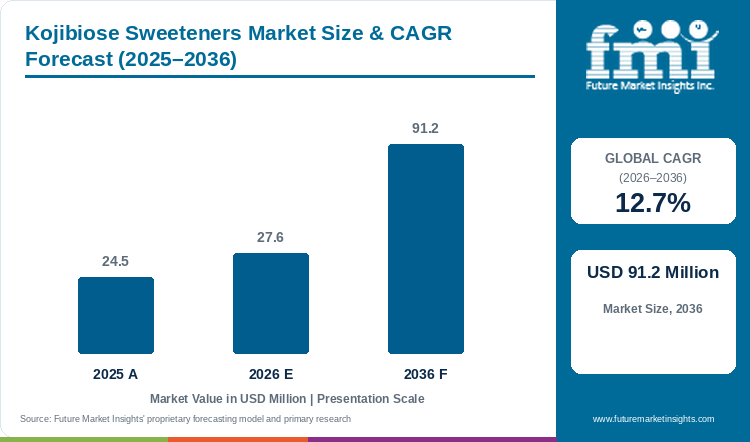
Global kojibiose sweeteners turnover is estimated to climb from USD 24.5 million in 2025 to USD 27.6 million in 2026 and is projected to reach USD 91.2 million by 2036 at an anticipated 12.7% compound annual growth rate.
Dairy and functional beverage formulators face a recurring stability bottleneck when cutting refined sucrose from chilled yogurts and botanical teas because high-intensity sweeteners strip dissolved solids while conventional fructans hydrolyze under acidic pasteurization. August 2026 sweetener supply tables from the U.S. Department of Agriculture track shifting domestic sucrose deliveries and trade balances across North American beverage processors [1]. Because alpha-1,2 linked kojibiose resists both pH 4.0 lactic acid cleavage and small-intestinal maltase digestion while nourishing colonic bifidobacteria, Sucrose Phosphorylase Transglycosylation is projected to capture 58.4% of enzymatic synthesis route demand in 2026 alongside rare sugar sweeteners. Consequently, global kojibiose sweeteners sales are estimated to rise from USD 24.5 million in 2025 to USD 27.6 million in 2026 and are expected to reach USD 91.2 million by 2036, expanding at a projected 12.7% CAGR that generates USD 63.6 million in added revenue.
Key Market Trends & Insights
- By enzymatic synthesis route: Sucrose Phosphorylase Transglycosylation (estimated at 58.4% in 2026) dominates bioreactor output because engineered Bifidobacterium adolescentis enzymes transfer glucosyl moieties onto glucose acceptors at high molar yields.
- By physical form: Crystalline Low-Hygroscopicity Powder (projected at 63.2% in 2026) leads physical deliveries since anhydrous alpha-1,2 crystals prevent Maillard browning and clumping in dry probiotic sachets.
- By functional claim: Prebiotic Bifidogenic Microbiome Modulation (anticipated at 46.5% in 2026) anchors commercial positioning because human colonic Bifidobacterium strains selectively metabolize kojibiose into short-chain fatty acids.
- By end-use food category: Synbiotic Dairy & Fermented Yogurt Drinks (expected to hold 41.2% in 2026) generate top category turnover as live lactic acid cultures remain viable in kojibiose-sweetened chilled matrices.
- By packaging size: 20 kg - 25 kg Foil-Lined Kraft Industrial Bags (estimated at 72.5% in 2026) represent the primary shipping format for cleanroom weighing and batch dairy fortification.
Regional Highlights
- Fastest national expansion pace: South Korea is projected to lead national growth at a 14.2% compound annual rate through 2036 on strong fermented drinkable yogurt and functional food reformulation.
- High-velocity Asian and European hubs: Singapore is expected to advance at 13.7% annually under mandatory beverage sugar grading while German clean-label dairy and bakery processors are forecast to expand at 13.1% per year.
- Established industrial baselines: Demand in the United States is anticipated to progress at a 12.4% CAGR and Japan is predicted to grow by 12.0% yearly as mature enzymatic saccharification plants upgrade immobilized phosphorylase columns.
Market Size & Forecast
Table 1: Market Size and Forecast for the Kojibiose Sweeteners Market (USD million and CAGR percentage), 2025 to 2036
| Metric | Value |
|---|---|
| 2025 Market Size | USD 24.5 million |
| Estimated Market Size in 2026 | USD 27.6 million |
| Projected Market Size by 2036 | USD 91.2 million |
| CAGR, 2026 to 2036 | 12.7% |
| Added Revenue, 2026 to 2036 | USD 63.6 million |
Front-of-pack sugar warning thresholds across Asia-Pacific and Western Europe are compelling dairy and beverage manufacturers to replace sucrose with low-insulinemic disaccharides that preserve mouthfeel. January 2026 dietary guidance in the World Health Organization Healthy diet fact sheet advises keeping free sugars below 10% of daily caloric intake (roughly 50 grams on a 2,000-calorie diet) and preferably under 5% to prevent dental caries [2]. Unlike metallic high-potency sweeteners, kojibiose provides 30% to 40% of sucrose sweetness with clean temporal decay and delayed alpha-glucosidase hydrolysis in preclinical brush-border enzyme models when blended with low-calorie sugar substitutes. Biorefineries operating immobilized transglycosylation reactors secure multi-year supply agreements with probiotic yogurt and functional drink brands that require steric alpha-1,2 linkage stability across pH 3.5 to 5.0 pasteurization cycles.
Bioreactor Capacity and Enzymatic Tonnage Sizing
Table 2: Bioreactor Capacity and Enzymatic Tonnage Indicators for the Kojibiose Sweeteners Market (USD million, metric tons, and USD per kilogram), mixed historical and forecast years from 2025 to 2036
| Metric | 2025 | 2026 | 2036 |
|---|---|---|---|
| Market size (USD million) | 24.5 | 27.6 | 91.2 |
| Commercial kojibiose production volume (metric tons) | 1,120 to 1,240 | 1,280 to 1,410 | 4,850 to 5,320 |
| Crystalline powder output (metric tons) | 700 to 780 | 810 to 890 | 3,150 to 3,450 |
| Average realized B2B price (USD per kilogram) | 19.80 to 21.90 | 19.50 to 21.50 | 17.10 to 18.80 |
Operational note: Production tonnage and unit price ranges reflect food-grade crystalline kojibiose (purity above 97% dry basis) and 75-Brix oligosaccharide syrups exiting commercial simulated-moving-bed chromatography lines.
Scaling immobilized sucrose phosphorylase columns is projected to expand global commercial kojibiose output from an estimated 1,280 to 1,410 metric tons in 2026 to between 4,850 and 5,320 metric tons by 2036. In February 2025, the U.S. Food and Drug Administration noted in its Aspartame and Other Sweeteners in Food guidance that differently metabolized sugars and sugar alcohols deliver 25% to 100% of sucrose sweetness without promoting tooth decay or sudden blood glucose increases [3]. Integrating continuous simulated-moving-bed resin separation with industrial food enzymes allows Japanese and European starch refiners to recycle unreacted sucrose and compress average realized B2B prices from USD 19.50 to 21.50 per kilogram in 2026 toward USD 17.10 to 18.80 per kilogram by 2036.
Per Capita & Dairy-Plant Procurement Sizing
Table 3: Per Capita and Formulation-Plant Spending Indicators for the Kojibiose Sweeteners Market (USD and gram metrics), mixed historical and forecast years from 2025 to 2036
| Metric | 2025 | 2026 | 2036 |
|---|---|---|---|
| World population (billion) | 8.23 | 8.30 | 8.95 |
| Spend per 1,000 people (USD) | 2.98 | 3.33 | 10.19 |
| Annual spend per qualified food formulation plant (USD thousand) | 38.5 to 43.0 | 42.0 to 47.5 | 112.0 to 126.0 |
| Typical inclusion rate per synbiotic serving (grams) | 1.5 to 3.0 | 1.5 to 3.5 | 2.0 to 4.5 |
Table 4: Biorefinery and Dairy-Formulation Benchmark Indicators for the Kojibiose Sweeteners Market (USD and percentages), mixed reporting years from 2025 to 2026
| Benchmark Indicator | Reported / Modeled Value | Institutional Reference Basis |
|---|---|---|
| Market size, 2026 | USD 27.6 million | Report value |
| Qualified synbiotic dairy and clinical nutrition plants | 610 facilities | 2025 industry registry |
| Sucrose phosphorylase transglycosylation revenue, 2026 | USD 16.1 million | 58.4% route share |
| Crystalline low-hygroscopicity powder revenue, 2026 | USD 17.4 million | 63.2% form share |
Formulators across 610 qualified fermented milk and specialty nutrition plants are estimated to spend USD 42.0 to 47.5 thousand per facility in 2026 and are projected to expand annual procurement to USD 112.0 to 126.0 thousand by 2036 as pilot beverage formulations scale to commercial production. Whereas standard isomalto-oligosaccharide syrups contain digestible alpha-1,4 fractions that elevate blood glucose, purified alpha-1,2 kojibiose generates an estimated USD 17.4 million in 2026 crystalline powder turnover by resisting brush-border maltase cleavage.
Analyst Perspective
"Immobilized sucrose phosphorylase reactors have turned kojibiose from a trace honey disaccharide into a scalable prebiotic bulk sweetener. Suppliers must still navigate regional novel-food dossiers and narrow price gaps against conventional oligosaccharides to win mainstream beverage tenders."
- Nandini Roy Choudhury, Principal Consultant, Future Market Insights.
How is the kojibiose sweeteners market segmented?
The kojibiose sweeteners market is segmented by enzymatic synthesis route, physical form, functional claim, end-use food category, packaging size, and region. In 2026, Sucrose Phosphorylase Transglycosylation is projected at 58.4%, Crystalline Low-Hygroscopicity Powder at 63.2%, Prebiotic Bifidogenic Microbiome Modulation at 46.5%, Synbiotic Dairy & Fermented Yogurt Drinks at 41.2%, and 20 kg - 25 kg Foil-Lined Kraft Industrial Bags at 72.5%.
By enzymatic synthesis route: Sucrose Phosphorylase Transglycosylation, Kojibiose Phosphorylase Direct Bioconversion, and Starch Hydrolysate Isomerization.
By physical form: Crystalline Low-Hygroscopicity Powder and Liquid Functional Oligosaccharide Syrup.
By functional claim: Prebiotic Bifidogenic Microbiome Modulation, Low-Glycemic Tooth-Friendly Bulk Sweetening, and Mineral Absorption & Iron Bioavailability Enhancer.
By end-use food category: Synbiotic Dairy & Fermented Yogurt Drinks, Infant & Senior Clinical Nutrition Formulas, Sugar-Reduced Artisanal Bakery & Confectionery, and Functional RTD Botanical Teas.
By packaging size: 20 kg - 25 kg Foil-Lined Kraft Industrial Bags and 500 kg - 1,000 kg Bulk FIBC Totes & IBC Drums.
Why Does Sucrose Phosphorylase Transglycosylation Anchor Enzymatic Synthesis Route Output?
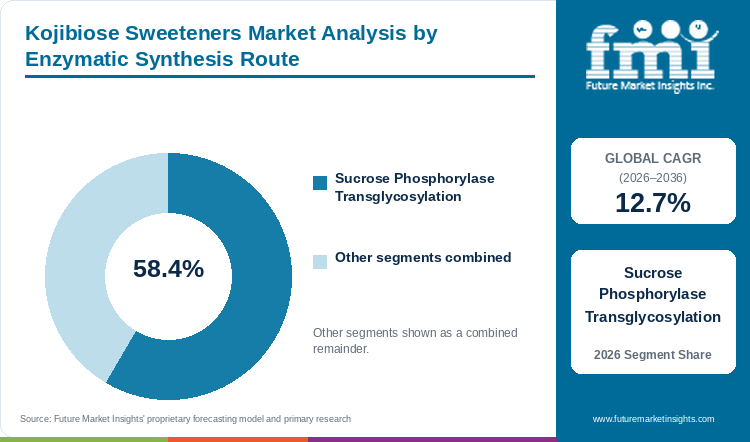
Sucrose Phosphorylase Transglycosylation is projected to hold 58.4% of 2026 enzymatic synthesis route volume, supported by regioselective sucrose bioconversion.
Table 5: Enzymatic Synthesis Route Share for the Kojibiose Sweeteners Market (percentage share), 2026
| Enzymatic Synthesis Route | Share (2026) |
|---|---|
| Sucrose Phosphorylase Transglycosylation | 58.4% |
| Other Segments Combined | 41.6%* |
| Total | 100.0% |
*Note: Combined share of remaining enzymatic synthesis route categories totaling 100.0% of 2026 market demand.
Table 6: Enzymatic Synthesis Route Leadership and Market Growth for the Kojibiose Sweeteners Market (segment and CAGR percentage), 2026 to 2036
| Metric | Value |
|---|---|
| Global CAGR (2026 to 2036) | 12.7% |
| Leading Segment | Sucrose Phosphorylase Transglycosylation |
Thermostable sucrose phosphorylase variants engineered from Bifidobacterium adolescentis drive direct glucosyl transfer from inexpensive beet or cane sucrose onto D-glucose acceptors without requiring costly nucleotide-sugar cofactors. Alternative routes such as beta-glucose-1-phosphate coupling via kojibiose phosphorylase or multi-step starch isomerization suffer from lower equilibrium conversion and complex fructose separation steps. Biorefineries operating packed-bed transglycosylation columns alongside crystalline allulose ingredients achieve regioselectivity above 85% and crystallize high-purity kojibiose in a single evaporative pass. This single-substrate economy is expected to keep sucrose phosphorylase transglycosylation as the preferred industrial synthesis architecture through 2036.
- Eliminating phosphorylated intermediate cofactors is estimated to allow Sucrose Phosphorylase Transglycosylation to command 58.4% of 2026 synthesis route turnover.
- Nagase Viita Co. Ltd. marked the 30th anniversary of commercializing enzymatic trehalose from starch in November 2025 after cutting production cost to one-hundredth and supplying over 90% of Japanese wagashi makers [4].
How Does Crystalline Low-Hygroscopicity Powder Capture Two-Thirds of Physical Form Demand?
Within physical form, Crystalline Low-Hygroscopicity Powder is estimated at 63.2% of 2026 turnover, reflecting caking resistance in dairy premixes.
Spray-granulated and seeded anhydrous kojibiose crystals exhibit equilibrium moisture sorption below 2% at 75% relative humidity, preventing powder bridging inside pneumatic dry-blending silos. When infant formula and synbiotic sachet manufacturers blend freeze-dried Bifidobacterium cultures with hygroscopic syrups, free water activity rises above 0.25 and kills live probiotic cells during ambient shelf storage. Specifying crystalline kojibiose powder alongside polyol bulk sweeteners preserves glass-transition stability and eliminates cold-chain freight expenses for international ingredient shipments. Dry crystalline formats are also projected to outpace liquid syrups in clear botanical beverages and table-top prebiotic sticks.
- Maintaining low water activity around live probiotic strains is anticipated to give Crystalline Low-Hygroscopicity Powder 63.2% of 2026 physical form sales.
- Matsutani Chemical Industry Co. Ltd. President Sayo Sakamoto detailed the company's expansion across Fibersol indigestible dextrin and Astraea rare-sugar powders at its Itami headquarters in its 2025 management message [5].
What Places Prebiotic Bifidogenic Microbiome Modulation Ahead Among Functional Claims?
Prebiotic Bifidogenic Microbiome Modulation is expected to capture 46.5% of 2026 functional claim demand, driven by selective colonic fermentation.
In preclinical rat intestinal brush-border and human Caco-2 cell assays alongside in-vitro fecal batch cultures, kojibiose exhibits slow alpha-glucosidase cleavage and selective saccharolytic fermentation by Bifidobacterium strains into acetate and lactate. Unlike fructans that ferment rapidly in in-vitro proximal colon simulations, alpha-1,2 linked kojibiose undergoes gradual saccharolytic conversion that elevates short-chain fatty acid generation in laboratory models. Beverage and nutrition formulators pair kojibiose with prebiotic functional ingredients while conducting translational human tolerance studies needed to substantiate commercial microbiome claims. Low-glycemic sweetening and iron-chelation claims are projected to account for the remaining 53.5% of functional turnover across dental-friendly confections and geriatric supplements.
- Selective utilization by beneficial colonic bifidobacteria is predicted to secure 46.5% of 2026 functional claim revenue for Prebiotic Bifidogenic Microbiome Modulation.
- Meiji Food Materia Co. Ltd. supplies functional oligosaccharides including Meioligo fructooligosaccharide (approved as Japan's first FOSHU ingredient) through its specialized food and functional materials business units [6].
Why Do Synbiotic Dairy & Fermented Yogurt Drinks Lead End-Use Food Categories?
Across end-use food category applications, Synbiotic Dairy & Fermented Yogurt Drinks are anticipated at 41.2% in 2026, owing to acid-stable compatibility.
Chilled drinkable yogurts and kefir shots operate at pH 4.0 to 4.5, an acidic environment where fructo-oligosaccharides partially hydrolyze into cariogenic free fructose and glucose during refrigerated distribution. Kojibiose retains complete glycosidic bond integrity across high-temperature short-time pasteurization and 28-day acidic cold storage while selectively nourishing co-formulated Bifidobacterium animalis cultures. Dairy formulators also value kojibiose for rounding out lactic tartness without adding sticky mouthfeel or masking delicate fruit esters. Clinical nutrition formulas and reduced-sugar artisanal pastries alongside ready-to-drink botanical teas are forecast to represent fast-expanding secondary application verticals.
- Acid resistance during refrigerated yogurt storage is projected to enable Synbiotic Dairy & Fermented Yogurt Drinks to generate 41.2% of 2026 end-use food category sales.
- Nihon Shokuhin Kako Co. Ltd. exhibited its Fuji Oligo and Branch Oligo functional syrups alongside Gentose and Fit Fiber for balancing health and taste in dairy products at Hi Japan in October 2025 [7].
What Sustains 20 kg - 25 kg Foil-Lined Kraft Industrial Bags as the Dominant Packaging Size?
20 kg - 25 kg Foil-Lined Kraft Industrial Bags are forecast at 72.5% of 2026 packaging size shipments, reinforced by manual batch dosing.
Because kojibiose is dosed at 1.5% to 4.0% weight-by-weight in high-value synbiotic dairy premixes and clinical nutrition batches, formulators overwhelmingly procure multi-wall kraft bags fitted with heat-sealed aluminum-polyethylene moisture liners. Single-operator 20 kg and 25 kg bags allow quality-assurance teams to empty entire sealed units into ribbon blenders without exposing residual crystalline powder to humid factory air. Conversely, 500 kg to 1,000 kg flexible intermediate bulk containers and liquid IBC totes are expected to account for 27.5% of 2026 shipments across high-throughput bottling plants running continuous syrup metering pumps.
- Cleanroom tipping convenience and moisture-barrier protection are estimated to give 20 kg - 25 kg Foil-Lined Kraft Industrial Bags 72.5% of 2026 packaging size volume.
- B Food Science Co. Ltd. manufactures FSSC 22000-certified crystalline powders and 70% to 75% functional syrups spanning kestose and xylooligosaccharide for food and pharmaceutical clients [8].
What are the drivers, restraints, and opportunities in the kojibiose sweeteners market?
Mandatory beverage sugar-grading labels and synbiotic dairy reformulation are projected to accelerate kojibiose sweeteners adoption through 2036, whereas multistage chromatographic purification costs restrain mass-market confectionery replacement, and iron-bioavailability fortification opens premium clinical nutrition tenders.
- Driver: Statutory front-of-pack sugar penalties and rising formulator demand for mild-sweetness synbiotic dairy carbohydrates are expected to compel brands to evaluate alpha-1,2 linked disaccharides.
- Restraint: Capital-intensive simulated-moving-bed chromatography and regional novel-food authorization timelines keep unit kojibiose prices above commodity sucrose and corn syrups.
- Opportunity: Co-formulating kojibiose with organic-acid mineral complexes in adult and senior nutritional shakes is anticipated to open high-margin specialty ingredient contracts as human bioavailability trials progress.
Growth Analysis and Future Potential: Qualitative Demand Catalysts
Escalating fiscal sugar excises and mandatory front-of-pack nutrition grades are forcing beverage and dairy processors to strip sucrose from flagship refrigerated drinks while preserving body and freezing-point depression. When formulators blend kojibiose with fermented dairy ingredients, the alpha-1,2 disaccharide resists rapid hydrolysis in preclinical Caco-2 and brush-border enzyme models while supporting selective in-vitro Bifidobacterium proliferation. In June 2026, the Food and Agriculture Organization of the United Nations published its biannual Food Outlook evaluating global production and trade balances across sugar and dairy commodities [9]. Multi-year reformulation roadmaps across East Asian and European dairy cooperatives are projected to anchor recurring contract volumes for enzymatic kojibiose refiners through 2036.
Risk Assessment of the Kojibiose Sweeteners Market: Operational and Formulation Friction
In July 2025, the European Food Safety Authority noted in its Safe2Eat Novel foods guidance that food ingredients lacking pre-May 1997 European Union consumption history require pre-market toxicological and compositional safety clearance [10]. High capital depreciation on simulated-moving-bed chromatographic columns and jurisdiction-by-jurisdiction novel-food safety filings restrict rapid cost parity with bulk commodity sweeteners. Furthermore, enzymatic transglycosylation reactions leave residual fructose and unreacted glucose that must be stripped via nanofiltration to achieve 98% crystalline purity for commercial bakery ingredients. Mid-tier confectionery brands are therefore expected to restrict pure kojibiose to premium gut-health SKUs rather than baseline mass-market candy lines.
Commercial Opportunity Analysis: Formulation Differentiation and Value-Add Formats
Pairing kojibiose with divalent iron and calcium salts in adult wellness shakes and senior nutritional powders is anticipated to create high-margin formulation differentiation beyond simple calorie reduction. In preclinical cecal fermentation models, organic-acid generation from slow disaccharide fermentation lowers luminal pH and supports mineral solubility, although consumer or pediatric mineral-absorption claims require dedicated human clinical trials. Ingredient suppliers that expand translational human research alongside functional beverage formulations strengthen technical qualification with institutional nutrition brands. In September 2025, Cargill Incorporated reported in its Global Good Awards finalist announcement that 65% of consumers tracked by Cargill's Trend Tracker prefer products that are less sweet while precision-fermented EverSweet reduces water use by 97% and land use by 96% [11].
Kojibiose Sweeteners Market by Country (2026 to 2036)
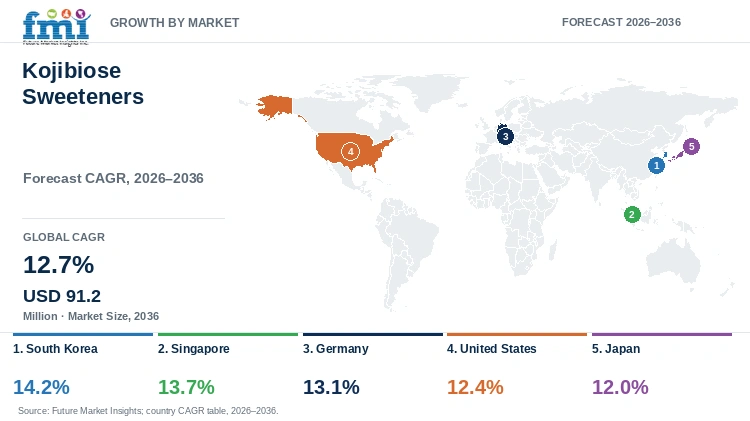
South Korean functional beverage and fermented dairy processors are projected to lead national kojibiose sweeteners growth with a 14.2% CAGR through 2036 ahead of Singapore (expected at 13.7%) and Germany (anticipated at 13.1%), whereas the United States (forecast at 12.4%) and Japan (predicted at 12.0%) build upon mature enzymatic starch-processing capacities. National health-claim registration pathways, mandatory front-of-pack sugar grading, and domestic glycosyltransferase bioreactor capacity govern country-level adoption trajectories.
Table 7: Country CAGR and Primary Growth Levers for the Kojibiose Sweeteners Market (CAGR percentage and operational drivers), 2026 to 2036
| Country | CAGR (2026 to 2036) | Primary Growth Lever |
|---|---|---|
| South Korea | 14.2% | High-value processed food output and synbiotic drinkable yogurt launches |
| Singapore | 13.7% | Mandatory Nutri-Grade C/D total-sugar beverage scoring and regional beverage R&D hubs |
| Germany | 13.1% | Clean-label sugar reduction across Europe's fourth-largest industrial sector |
| United States | 12.4% | Expanding food and beverage manufacturing employment and synbiotic beverage adoption |
| Japan | 12.0% | Domestic immobilized phosphorylase biorefinery scale and health-food beverage demand |
Source: Future Market Insights analysis
South Korea Kojibiose Sweeteners Market Outlook (2026 to 2036)
Unlike Western markets where bulk table-top sugar replacement dominates, South Korea is uniquely driven by convenience-store fermented drinkable yogurts and single-serve post-meal glycemic control jelly sticks. In July 2026, the Bank of Korea reported that national real gross domestic product expanded 3.7% year-on-year in the second quarter of 2026 while real gross domestic income rose 15.6% year-on-year across domestic manufacturing and consumption sectors [12]. Seoul dairy processors and contract supplement packers increasingly replace high-fructose syrups with alpha-1,2 disaccharides, pushing domestic kojibiose demand at a projected 14.2% CAGR through 2036. However, absence of domestic phosphorylase bioreactors leaves Korean brands reliant on imported Japanese crystalline lots during summer bottling.
Key takeaway: In South Korea, expanding domestic income and high per-capita fermented yogurt consumption are projected to drive a 14.2% CAGR through 2036.
Singapore Kojibiose Sweeteners Market Outlook (2026 to 2036)
October 2026 regulatory updates from the Health Promotion Board in Singapore mandate front-of-pack Nutri-Grade marks on higher-sugar packaged and freshly prepared drinks while strictly banning Grade D beverage promotions [13]. Because Nutri-Grade scores non-exempt beverages on total sugar grams per 100 mL (subtracting only declared lactose and galactose) and saturated fat rather than glycemic index, botanical tea and cultured dairy R&D teams in Tuas combine reduced carbohydrate solids with high-potency sweeteners. While infant and follow-up formulas remain exempt special-purpose foods under local law, adult functional beverage reformulation is expected to lift Singapore demand at a 13.7% CAGR from 2026 to 2036 despite imported crystal freight costs.
Key takeaway: In Singapore, total-sugar Nutri-Grade beverage reformulation and regional dairy R&D hubs are expected to sustain 13.7% annual growth through 2036.
Germany Kojibiose Sweeteners Market Outlook (2026 to 2036)
German demand for kojibiose sweeteners is anticipated to expand at a 13.1% compound annual clip through 2036 as dairy and bakery processors execute national sugar-reduction commitments. What sets Germany apart from Asian beverage-led markets is the concentration of Mittelstand quark-dessert dairies and artisanal bakeries that refuse to print mandatory European polyol laxative warnings on clean-label retail packs. Bavarian and North Rhine-Westphalian food plants therefore incorporate prebiotic alpha-1,2 disaccharides into clinical drinks and reduced-sugar pastries. Eurostat industrial indicators published in May 2026 show European Union intermediate goods output rising 1.4% month-on-month while German manufacturing plants recorded a calendar-adjusted production index of 99.5 across domestic processing lines [14].
Key takeaway: In Germany, EUR 232.7 billion food-manufacturing turnover and clean-label dairy engineering are anticipated to support a 13.1% CAGR through 2036.
United States Kojibiose Sweeteners Market Outlook (2026 to 2036)
Whereas European buyers prioritize bakery crumb replacement, the United States market is uniquely shaped by mandatory FDA Added Sugars nutrition-facts panels and rapid rollout of GLP-1 companion synbiotic gut-health beverages. Midwestern corn wet-millers and coastal functional drink brands formulate alpha-1,2 disaccharides into low-glycemic ready-to-drink botanical teas and pediatric oral rehydration powders, driving an estimated 12.4% annual growth rate through 2036. In July 2026, the U.S. Bureau of Labor Statistics projected that domestic food and beverage manufacturing employment will exceed 2.2 million jobs by 2034 as beverage (+37,800 jobs) and dairy (+10,800 jobs) plants expand [15]. Commercial friction persists from aggressive price competition against domestically produced allulose and erythritol in mass-market soda aisles.
Key takeaway: In the United States, added-sugar labeling compliance and beverage manufacturing job expansion are forecast to anchor a 12.4% CAGR through 2036.
Japan Kojibiose Sweeteners Market Outlook (2026 to 2036)
Japan stands apart from every other national market as the sole net-exporting biomanufacturing hub operating commercial-scale immobilized sucrose phosphorylase reactors in Okayama and Hyogo prefectures. May 2026 federal sweetener outlook dispatches document how industrial food and beverage processors continue adjusting specialty carbohydrate and refined sugar procurement throughout current and upcoming crop years [16]. Domestic Foods for Specified Health Uses (FOSHU) and Foods with Function Claims (FFC) frameworks enable beverage and wagashi confectionery makers to market kojibiose for intestinal bifidobacteria maintenance, supporting a predicted 12.0% CAGR through 2036. However, shrinking domestic birth cohorts compel Japanese enzymatic saccharide refiners to prioritize high-purity anhydrous export crystals for overseas buyers.
Key takeaway: In Japan, mature FOSHU/FFC functional food labeling and proprietary sucrose phosphorylase biorefineries are predicted to deliver 12.0% annual growth through 2036.
Full report country CAGRs cover: North America; Latin America; Western Europe; Eastern Europe; East Asia; South Asia and Pacific; Middle East and Africa.
Who are the notable companies in the kojibiose sweeteners market?
Nagase Viita Co. Ltd., Matsutani Chemical Industry Co. Ltd., Nihon Shokuhin Kako Co. Ltd., Meiji Food Materia Co. Ltd., B Food Science Co. Ltd., Cargill Incorporated, Glico Nutrition Co. Ltd., and Ingredion Incorporated are the notable companies in the kojibiose sweeteners market.
Supplier qualification across the kojibiose sweeteners sector depends on proprietary sucrose phosphorylase enzyme patents and simulated-moving-bed chromatographic purity alongside international regulatory dossier ownership. Japanese enzymatic saccharide pioneers including Nagase Viita Co. Ltd. alongside Matsutani Chemical Industry Co. Ltd. and B Food Science Co. Ltd. control industrial glycosyltransferase immobilization and high-purity rare-disaccharide crystallization. Specialized starch-syrup and oligosaccharide formulators such as Nihon Shokuhin Kako Co. Ltd. together with Meiji Food Materia Co. Ltd. and Glico Nutrition Co. Ltd. customize prebiotic syrup blends for domestic dairy and bakery accounts. Global sweetener platforms Cargill Incorporated and Ingredion Incorporated provide multi-continental distribution and co-formulated sugar-reduction systems.
- Enzymatic Rare-Disaccharide & Glycosyltransferase Pioneers: Nagase Viita Co. Ltd. alongside Matsutani Chemical Industry Co. Ltd. and B Food Science Co. Ltd. operate immobilized phosphorylase reactors producing crystalline alpha-1,2 disaccharides.
- Japanese Functional Oligosaccharide & Starch Syrup Formulators: Nihon Shokuhin Kako Co. Ltd. together with Meiji Food Materia Co. Ltd. and Glico Nutrition Co. Ltd. supply tailored oligosaccharide syrups and dairy premixes.
- Global Specialty Sweetener & Bioprocess Platforms: Cargill Incorporated and Ingredion Incorporated integrate rare sugars and prebiotic fibers into multinational beverage and bakery reformulation programs.
Competitive Benchmarking: Kojibiose Sweeteners Market
Table 8: Competitive Benchmarking for the Kojibiose Sweeteners Market (qualitative capability ratings), 2026
| Company | Enzymatic Synthesis Mastery | Crystalline Purity Capability | Prebiotic Research & Dossier Depth | Global Distribution Reach |
|---|---|---|---|---|
| Nagase Viita Co., Ltd. | High | High | High | High |
| Matsutani Chemical Industry Co., Ltd. | High | High | High | High |
| Nihon Shokuhin Kako Co., Ltd. | High | Medium | Medium | Medium |
| Meiji Food Materia Co., Ltd. | Medium | Medium | High | Medium |
| B Food Science Co., Ltd. | High | High | Medium | Medium |
| Cargill, Incorporated | Medium | High | High | High |
| Glico Nutrition Co., Ltd. | High | Medium | Medium | High |
| Ingredion Incorporated | Medium | High | High | High |
Scoring basis: Enzymatic Synthesis Mastery receives a High rating where a manufacturer operates proprietary immobilized phosphorylase or glycosyltransferase bioreactors, whereas Medium reflects downstream blending or licensed conversion. Crystalline Purity Capability evaluates commercial crystallization above 97% anhydrous purity alongside low-hygroscopicity particle engineering. Prebiotic Research & Dossier Depth reflects preclinical Caco-2 and brush-border digestibility studies on kojibiose alongside broader oligosaccharide FOSHU and FFC registrations.
Key Developments in the Kojibiose Sweeteners Market
- Ingredion Incorporated announced a recommended all-cash acquisition of Tate & Lyle in June 2026 to create a scaled global specialty sweetener and prebiotic fiber formulator [17].
- Nagase Viita Co. Ltd. achieved its 2025 Nutrition Accountability Framework milestone of developing 100 functional food products and progressed toward 200 products and 200 agricultural saccharide end users by 2030 while supporting 100 Southeast Asian technical cases annually [18].
- Glico Nutrition Co. Ltd. expanded technical applications for its enzymatically cyclized Cluster Dextrin carbohydrate platform (produced via branching enzyme EC 2.4.1.18) to mask plant-protein bitterness and stabilize spray-dried functional powders in 2026 [19].
Key Players in the Kojibiose Sweeteners Market
Enzymatic Rare-Disaccharide & Glycosyltransferase Pioneers
- Nagase Viita Co., Ltd. (formerly Hayashibara)
- Matsutani Chemical Industry Co., Ltd.
- B Food Science Co., Ltd.
Japanese Functional Oligosaccharide & Starch Syrup Formulators
- Nihon Shokuhin Kako Co., Ltd.
- Meiji Food Materia Co., Ltd.
- Glico Nutrition Co., Ltd.
Global Specialty Sweetener & Bioprocess Platforms
- Cargill, Incorporated
- Ingredion Incorporated
Kojibiose Sweeteners Market - Report Scope
Table 9: Report Scope for the Kojibiose Sweeteners Market (coverage fields and definitions), 2026 to 2036
| Coverage field | Report scope |
|---|---|
| Market breakdown | Enzymatic Synthesis Route; Physical Form; Functional Claim; End-Use Food Category; Packaging Size; Region |
| Quantitative Units | USD Million |
| Market Definition | Includes B2B manufacturer revenue from enzymatically synthesized kojibiose (alpha-D-glucopyranosyl-(1->2)-D-glucose) sold as crystalline low-hygroscopicity powders and functional oligosaccharide syrups across the listed segmentation. Category Scope Note: The valuation captures bulk and semi-bulk food, clinical-nutrition, and beverage ingredient shipments where Sucrose Phosphorylase Transglycosylation is projected to account for 58.4% of 2026 route demand, excluding downstream retail sales of finished yogurt drinks, infant formulas, baked goods, and ready-to-drink teas. |
| Regions Covered | North America; Latin America; Western Europe; Eastern Europe; East Asia; South Asia and Pacific; Middle East and Africa |
| Countries Covered | South Korea, Singapore, Germany, United States, Japan, and additional countries in the full report |
| Key Companies Covered | Nagase Viita Co., Ltd. (formerly Hayashibara), Matsutani Chemical Industry Co., Ltd., Nihon Shokuhin Kako Co., Ltd., Meiji Food Materia Co., Ltd., B Food Science Co., Ltd., Cargill, Incorporated, Glico Nutrition Co., Ltd., Ingredion Incorporated |
| Forecast Period | 2026 to 2036 |
| Approach | Primary and secondary research with rigorous market triangulation. |
Kojibiose Sweeteners Market - Research Methodology
Table 10: Research Methodology for the Kojibiose Sweeteners Market (research methods and approach), 2026 edition
| Method | Approach |
|---|---|
| Primary Research | Primary interviews were conducted with enzymatic starch-saccharification directors, immobilized phosphorylase bioprocess engineers, synbiotic dairy R&D managers, clinical nutrition formulators, and regulatory toxicology consultants to validate conversion yields, pricing tiers, and qualification criteria. |
| Secondary Research | Secondary research included company annual reports, investor presentations, USDA ERS Sugar and Sweeteners Outlook publications, FDA GRAS and EFSA Novel Food dossiers, USDA FAS Food Processing Ingredients Annual reports, and verified corporate press releases. |
| Market Sizing and Forecasting | Market sizing and forecasting for the 2026 to 2036 period were developed using top-down and bottom-up models reconciling immobilized bioreactor capacities, chromatographic recovery yields, and B2B contract realizations across crystalline and syrup grades. |
| Data Triangulation and Validation | Market estimates are cross-checked against national starch-sweetener production registries, probiotic dairy launch volumes, front-of-pack sugar taxation schedules, and historical rare-disaccharide adoption curves to eliminate double counting with adjacent oligosaccharides. |
| Country Forecasting Model | Country-level CAGRs are projected via FMI's specialty carbohydrate econometric model, calibrating national trajectories against the 12.7% global baseline using Korean processed-food import demand, Singapore Nutri-Grade beverage thresholds, European clean-label dairy reformulation rates, and Japanese FOSHU/FFC filings. |
| Operational Benchmark Traceability | Operational benchmarks (commercial kojibiose metric tonnage, crystalline powder output, realized USD per kilogram pricing, and inclusion rates per serving) represent modeled estimates synthesized from USDA ERS, USDA FAS country statistics, FDA GRAS exposure filings, and corporate biorefinery disclosures. |
Kojibiose Sweeteners Market by Segments
Kojibiose Sweeteners Market segmented by Enzymatic Synthesis Route:
- Sucrose Phosphorylase Transglycosylation
- Kojibiose Phosphorylase Direct Bioconversion
- Starch Hydrolysate Isomerization
Kojibiose Sweeteners Market segmented by Physical Form:
- Crystalline Low-Hygroscopicity Powder
- Liquid Functional Oligosaccharide Syrup
Kojibiose Sweeteners Market segmented by Functional Claim:
- Prebiotic Bifidogenic Microbiome Modulation
- Low-Glycemic Tooth-Friendly Bulk Sweetening
- Mineral Absorption & Iron Bioavailability Enhancer
Kojibiose Sweeteners Market segmented by End-Use Food Category:
- Synbiotic Dairy & Fermented Yogurt Drinks
- Infant & Senior Clinical Nutrition Formulas
- Sugar-Reduced Artisanal Bakery & Confectionery
- Functional RTD Botanical Teas
Kojibiose Sweeteners Market segmented by Packaging Size:
- 20 kg - 25 kg Foil-Lined Kraft Industrial Bags
- 500 kg - 1,000 kg Bulk FIBC Totes & IBC Drums
Kojibiose Sweeteners Market by Region
- North America
- United States
- Canada
- Latin America
- Brazil
- Mexico
- Argentina
- Chile
- Western Europe
- Germany
- France
- United Kingdom
- Italy
- Spain
- Benelux
- Nordics
- Eastern Europe
- Poland
- Czech Republic
- Romania
- Hungary
- East Asia
- China
- Japan
- South Korea
- South Asia and Pacific
- India
- ASEAN
- Australia and New Zealand
- Middle East and Africa
- GCC Countries
- South Africa
- Türkiye
- Israel
Research Sources and Bibliography
- [1] U.S. Department of Agriculture, Economic Research Service. (2026, August 18). Sugar and Sweeteners Outlook: August 2026. U.S. Department of Agriculture.
- [2] World Health Organization. (2026, January 26). Healthy diet. World Health Organization.
- [3] U.S. Food and Drug Administration. (2025, February 27). Aspartame and Other Sweeteners in Food. U.S. Food and Drug Administration.
- [4] Nagase Viita Co., Ltd. (2025, November 14). A Sweet Partnership with Tradition | Nagase Viita Co., Ltd. Nagase Viita Co., Ltd.
- [5] Matsutani Chemical Industry Co., Ltd. (2025, July 18). Message from Management - Matsutani Chemical industry Co,. Ltd. Matsutani Chemical Industry Co., Ltd.
- [6] Meiji Food Materia Co., Ltd. (2025, September 22). About Meiji Food Materia - 明治フードマテリア. Meiji Food Materia Co., Ltd.
- [7] Nihon Shokuhin Kako Co., Ltd. (2025, October 15). Introduction to Oligosaccharides,Modified Starch and Dietary Fiber That Enhance Taste and Quality. Hi Japan 2025 Exhibitor Directory (Nihon Shokuhin Kako Co., Ltd.).
- [8] B Food Science Co., Ltd. (2026, January 15). Products | B Food Science Co., Ltd. B Food Science Co., Ltd.
- [9] Food and Agriculture Organization of the United Nations. (2026, June 18). Food Outlook – Biannual report on global food markets. Food and Agriculture Organization of the United Nations.
- [10] European Food Safety Authority. (2025, July 22). Novel foods. European Food Safety Authority.
- [11] Cargill, Incorporated. (2025, September 26). Cargill's EverSweet® stevia sweetener named a finalist in the 2025 Global Good Awards Game Changing Innovation of the Year. Cargill, Incorporated.
- [12] Bank of Korea. (2026, July 23). Real Gross Domestic Product: Second Quarter of 2026 (Advance Estimate). Bank of Korea.
- [13] Health Promotion Board. (2026, October 03). Measures for Nutri-Grade. Health Promotion Board Singapore.
- [14] Eurostat. (2026, May 13). Industrial production up by 0.2% in the euro area and by 0.8% in the EU. Statistical Office of the European Union (Eurostat).
- [15] U.S. Bureau of Labor Statistics. (2026, July 01). A recipe for growth: food and beverage manufacturing projected to expand through 2034. U.S. Department of Labor, The Economics Daily.
- [16] U.S. Department of Agriculture, Economic Research Service. (2026, May 18). Sugar and Sweeteners Outlook: May 2026. U.S. Department of Agriculture (LDP-M-383).
- [17] Ingredion Incorporated. (2026, June 08). Ingredion Announces Recommended All-Cash Acquisition of Tate & Lyle. Ingredion Incorporated.
- [18] Nagase Viita Co., Ltd. & Global Nutrition Report. (2026, January 12). Nagase Viita (formerly Hayashibara Co., Ltd) - - Global Nutrition Report. Global Nutrition Report NAF Commitment Tracker.
- [19] Glico Nutrition Co., Ltd. (2026, March 18). CLUSTER DEXTRIN™ | Glico Nutrition. Glico Nutrition Co., Ltd.
- [20] Ingredion Incorporated. (2026, April 09). PURECIRCLE™ Clean Taste Solutions - Ingredion. Ingredion Incorporated.
- [21] Matsutani Chemical Industry Co., Ltd. (2026, February 11). ALLULOSE (ASTRAEA™) - Matsutani Chemical industry Co,. Ltd. Matsutani Chemical Industry Co., Ltd.
This bibliography is provided for reader reference and is not exhaustive. The full report contains the complete reference list and detailed citations.
This Report Answers
- How large is the kojibiose sweeteners market in 2026 and what is forecast for 2036?
- Which sugar-reduction and microbiome catalysts drive demand for kojibiose sweeteners?
- Why does Sucrose Phosphorylase Transglycosylation lead the enzymatic synthesis route category?
- Why does Crystalline Low-Hygroscopicity Powder lead the physical form category globally?
- How do growth rates differ across South Korea, Singapore, Germany, the United States, and Japan?
- Which leading companies manufacture enzymatic kojibiose and prebiotic disaccharides today?
- What limits adoption or supplier switching in the kojibiose sweeteners market?
- What should dairy and beverage formulators evaluate before procuring kojibiose sweeteners?
Frequently Asked Questions
How big is the kojibiose sweeteners market in 2026, and what is forecast for 2036?
Global kojibiose sweeteners revenue is estimated at USD 27.6 million in 2026 (up from USD 24.5 million in 2025) and is projected to reach USD 91.2 million by 2036 as synbiotic yogurt and clinical nutrition brands adopt alpha-1,2 linked prebiotic disaccharides.
What is the CAGR for the kojibiose sweeteners market from 2026 to 2036?
Future Market Insights projects a 12.7% compound annual growth rate between 2026 and 2036, generating an estimated USD 63.6 million in added ingredient sales as immobilized phosphorylase reactors reduce enzymatic conversion costs.
Which enzymatic synthesis route leads the kojibiose sweeteners market?
Sucrose Phosphorylase Transglycosylation is projected to capture 58.4% of 2026 route demand because engineered bacterial phosphorylases transfer glucosyl groups directly from sucrose onto glucose without expensive nucleotide cofactors.
Which physical form segment leads the kojibiose sweeteners market?
Crystalline Low-Hygroscopicity Powder is estimated to account for 63.2% of 2026 physical form sales since anhydrous crystals resist ambient moisture caking and preserve live probiotic viability inside dry sachets.
Which country registers the fastest growth outlook during the assessment period?
FMI analysis identifies South Korea as the fastest-expanding national market at a projected 14.2% CAGR from 2026 to 2036, supported by expanding domestic household income and drinkable yogurt reformulation.
Who are the key players in the kojibiose sweeteners market?
Notable market participants include Nagase Viita Co., Ltd. (formerly Hayashibara), Matsutani Chemical Industry Co., Ltd., Nihon Shokuhin Kako Co., Ltd., Meiji Food Materia Co., Ltd., B Food Science Co., Ltd., Cargill, Incorporated, Glico Nutrition Co., Ltd., and Ingredion Incorporated.
Preview the report firsthand - request a free sample
Get SampleGet the brochure for pricing and purchase details.
Get PDFTable of Content
- Key Takeaways
- Market Size and CAGR
- Top Growth Driver
- Fastest Growing Segment
- Leading Region
- Key Companies
- Emerging Opportunities
- Executive Summary
- Global Market Outlook
- Demand-side Trends
- Supply-side Trends
- Technology Roadmap Analysis
- Analysis and Recommendations
- Analyst Perspective (What is happening? Why now? What should investors know?)
- Key Questions Answered
- How large is the market?
- What is the CAGR?
- What are key trends?
- Which region dominates?
- Who are the leaders?
- Market Overview
- Market Coverage / Taxonomy
- Market Definition / Scope / Limitations
- Research Methodology
- Chapter Orientation
- Analytical Lens and Working Hypotheses
- Market Structure, Signals, and Trend Drivers
- Benchmarking and Cross-market Comparability
- Market Sizing, Forecasting, and Opportunity Mapping
- Research Design and Evidence Framework
- Desk Research Programme (Secondary Evidence)
- Expert Input and Fieldwork (Primary Evidence)
- Tooling, Models, and Reference Databases
- Data Engineering and Model Build
- Quality Assurance and Audit Trail
- Market Background
- Market Dynamics (Drivers, Restraints, Opportunity, Trends)
- Scenario Forecast (Optimistic, Likely, Conservative)
- Impact Analysis
- AI Impact
- Sustainability Impact
- Regulatory Impact
- Technology Impact
- Consumer / Buyer Analysis
- Purchase Drivers
- Adoption Barriers
- Buyer Journey
- Opportunity Map Analysis
- Product Life Cycle Analysis
- Supply Chain Analysis
- Investment Feasibility Matrix
- Value Chain Analysis
- PESTLE and Porter's Analysis
- Regulatory Landscape
- Regional Parent Market Outlook
- Production and Consumption Statistics
- Import and Export Statistics
- Global Market Analysis and Forecast, 2021 to 2036
- Historical Market Size Value (USD Million) Analysis, 2021 to 2025
- Current and Future Market Size Value (USD Million) Projections, 2026 to 2036
- Y-o-Y Growth Trend Analysis
- Absolute $ Opportunity Analysis
- Global Market Pricing Analysis, 2021 to 2036
- Global Market Analysis and Forecast, By Enzymatic Synthesis Route, 2021 to 2036
- Introduction / Key Findings
- Historical Market Size Value (USD Million) Analysis By Enzymatic Synthesis Route, 2021 to 2025
- Current and Future Market Size Value (USD Million) Analysis and Forecast By Enzymatic Synthesis Route, 2026 to 2036
- Sucrose Phosphorylase Transglycosylation
- Kojibiose Phosphorylase Direct Bioconversion
- Starch Hydrolysate Isomerization
- Y-o-Y Growth Trend Analysis By Enzymatic Synthesis Route, 2021 to 2025
- Absolute $ Opportunity Analysis By Enzymatic Synthesis Route, 2026 to 2036
- Global Market Analysis and Forecast, By Physical Form, 2021 to 2036
- Introduction / Key Findings
- Historical Market Size Value (USD Million) Analysis By Physical Form, 2021 to 2025
- Current and Future Market Size Value (USD Million) Analysis and Forecast By Physical Form, 2026 to 2036
- Crystalline Low-Hygroscopicity Powder
- Liquid Functional Oligosaccharide Syrup
- Y-o-Y Growth Trend Analysis By Physical Form, 2021 to 2025
- Absolute $ Opportunity Analysis By Physical Form, 2026 to 2036
- Global Market Analysis and Forecast, By Functional Claim, 2021 to 2036
- Introduction / Key Findings
- Historical Market Size Value (USD Million) Analysis By Functional Claim, 2021 to 2025
- Current and Future Market Size Value (USD Million) Analysis and Forecast By Functional Claim, 2026 to 2036
- Prebiotic Bifidogenic Microbiome Modulation
- Low-Glycemic Tooth-Friendly Bulk Sweetening
- Mineral Absorption & Iron Bioavailability Enhancer
- Y-o-Y Growth Trend Analysis By Functional Claim, 2021 to 2025
- Absolute $ Opportunity Analysis By Functional Claim, 2026 to 2036
- Global Market Analysis and Forecast, By End-Use Food Category, 2021 to 2036
- Introduction / Key Findings
- Historical Market Size Value (USD Million) Analysis By End-Use Food Category, 2021 to 2025
- Current and Future Market Size Value (USD Million) Analysis and Forecast By End-Use Food Category, 2026 to 2036
- Synbiotic Dairy & Fermented Yogurt Drinks
- Infant & Senior Clinical Nutrition Formulas
- Sugar-Reduced Artisanal Bakery & Confectionery
- Functional RTD Botanical Teas
- Y-o-Y Growth Trend Analysis By End-Use Food Category, 2021 to 2025
- Absolute $ Opportunity Analysis By End-Use Food Category, 2026 to 2036
- Global Market Analysis and Forecast, By Packaging Size, 2021 to 2036
- Introduction / Key Findings
- Historical Market Size Value (USD Million) Analysis By Packaging Size, 2021 to 2025
- Current and Future Market Size Value (USD Million) Analysis and Forecast By Packaging Size, 2026 to 2036
- 20 kg - 25 kg Foil-Lined Kraft Industrial Bags
- 500 kg - 1,000 kg Bulk FIBC Totes & IBC Drums
- Y-o-Y Growth Trend Analysis By Packaging Size, 2021 to 2025
- Absolute $ Opportunity Analysis By Packaging Size, 2026 to 2036
- Global Market Analysis and Forecast, By Region, 2021 to 2036
- Introduction
- Historical Market Size Value (USD Million) Analysis By Region, 2021 to 2025
- Current Market Size Value (USD Million) Analysis and Forecast By Region, 2026 to 2036
- North America
- Latin America
- Western Europe
- Eastern Europe
- East Asia
- South Asia and Pacific
- Middle East and Africa
- Market Attractiveness Analysis By Region
- North America Market Analysis and Forecast, By Country, 2021 to 2036
- Historical Market Size Value (USD Million) Trend Analysis By Market Taxonomy, 2021 to 2025
- Market Size Value (USD Million) Forecast By Market Taxonomy, 2026 to 2036
- By Country
- United States
- Canada
- By Enzymatic Synthesis Route
- By Physical Form
- By Functional Claim
- By End-Use Food Category
- By Packaging Size
- By Country
- Market Attractiveness Analysis
- By Country
- By Enzymatic Synthesis Route
- By Physical Form
- By Functional Claim
- By End-Use Food Category
- By Packaging Size
- Key Takeaways
- Latin America Market Analysis and Forecast, By Country
- Historical Market Size Value (USD Million) Trend Analysis By Market Taxonomy, 2021 to 2025
- Market Size Value (USD Million) Forecast By Market Taxonomy, 2026 to 2036
- By Country
- Brazil
- Mexico
- Argentina
- Chile
- By Enzymatic Synthesis Route
- By Physical Form
- By Functional Claim
- By End-Use Food Category
- By Packaging Size
- By Country
- Market Attractiveness Analysis
- By Country
- By Enzymatic Synthesis Route
- By Physical Form
- By Functional Claim
- By End-Use Food Category
- By Packaging Size
- Key Takeaways
- Western Europe Market Analysis and Forecast, By Country
- Historical Market Size Value (USD Million) Trend Analysis By Market Taxonomy, 2021 to 2025
- Market Size Value (USD Million) Forecast By Market Taxonomy, 2026 to 2036
- By Country
- Germany
- France
- United Kingdom
- Italy
- Spain
- Benelux
- Nordics
- By Enzymatic Synthesis Route
- By Physical Form
- By Functional Claim
- By End-Use Food Category
- By Packaging Size
- By Country
- Market Attractiveness Analysis
- By Country
- By Enzymatic Synthesis Route
- By Physical Form
- By Functional Claim
- By End-Use Food Category
- By Packaging Size
- Key Takeaways
- Eastern Europe Market Analysis and Forecast, By Country
- Historical Market Size Value (USD Million) Trend Analysis By Market Taxonomy, 2021 to 2025
- Market Size Value (USD Million) Forecast By Market Taxonomy, 2026 to 2036
- By Country
- Poland
- Czech Republic
- Romania
- Hungary
- By Enzymatic Synthesis Route
- By Physical Form
- By Functional Claim
- By End-Use Food Category
- By Packaging Size
- By Country
- Market Attractiveness Analysis
- By Country
- By Enzymatic Synthesis Route
- By Physical Form
- By Functional Claim
- By End-Use Food Category
- By Packaging Size
- Key Takeaways
- East Asia Market Analysis and Forecast, By Country
- Historical Market Size Value (USD Million) Trend Analysis By Market Taxonomy, 2021 to 2025
- Market Size Value (USD Million) Forecast By Market Taxonomy, 2026 to 2036
- By Country
- China
- Japan
- South Korea
- By Enzymatic Synthesis Route
- By Physical Form
- By Functional Claim
- By End-Use Food Category
- By Packaging Size
- By Country
- Market Attractiveness Analysis
- By Country
- By Enzymatic Synthesis Route
- By Physical Form
- By Functional Claim
- By End-Use Food Category
- By Packaging Size
- Key Takeaways
- South Asia and Pacific Market Analysis and Forecast, By Country
- Historical Market Size Value (USD Million) Trend Analysis By Market Taxonomy, 2021 to 2025
- Market Size Value (USD Million) Forecast By Market Taxonomy, 2026 to 2036
- By Country
- India
- ASEAN
- Australia and New Zealand
- By Enzymatic Synthesis Route
- By Physical Form
- By Functional Claim
- By End-Use Food Category
- By Packaging Size
- By Country
- Market Attractiveness Analysis
- By Country
- By Enzymatic Synthesis Route
- By Physical Form
- By Functional Claim
- By End-Use Food Category
- By Packaging Size
- Key Takeaways
- Middle East and Africa Market Analysis and Forecast, By Country
- Historical Market Size Value (USD Million) Trend Analysis By Market Taxonomy, 2021 to 2025
- Market Size Value (USD Million) Forecast By Market Taxonomy, 2026 to 2036
- By Country
- GCC Countries
- South Africa
- Türkiye
- Israel
- By Enzymatic Synthesis Route
- By Physical Form
- By Functional Claim
- By End-Use Food Category
- By Packaging Size
- By Country
- Market Attractiveness Analysis
- By Country
- By Enzymatic Synthesis Route
- By Physical Form
- By Functional Claim
- By End-Use Food Category
- By Packaging Size
- Key Takeaways
- Key Countries Market Analysis
- United States
- Pricing Analysis
- Market Share Analysis, 2025
- By Enzymatic Synthesis Route
- By Physical Form
- By Functional Claim
- By End-Use Food Category
- By Packaging Size
- Canada
- Pricing Analysis
- Market Share Analysis, 2025
- By Enzymatic Synthesis Route
- By Physical Form
- By Functional Claim
- By End-Use Food Category
- By Packaging Size
- Mexico
- Pricing Analysis
- Market Share Analysis, 2025
- By Enzymatic Synthesis Route
- By Physical Form
- By Functional Claim
- By End-Use Food Category
- By Packaging Size
- Brazil
- Pricing Analysis
- Market Share Analysis, 2025
- By Enzymatic Synthesis Route
- By Physical Form
- By Functional Claim
- By End-Use Food Category
- By Packaging Size
- Chile
- Pricing Analysis
- Market Share Analysis, 2025
- By Enzymatic Synthesis Route
- By Physical Form
- By Functional Claim
- By End-Use Food Category
- By Packaging Size
- Germany
- Pricing Analysis
- Market Share Analysis, 2025
- By Enzymatic Synthesis Route
- By Physical Form
- By Functional Claim
- By End-Use Food Category
- By Packaging Size
- United Kingdom
- Pricing Analysis
- Market Share Analysis, 2025
- By Enzymatic Synthesis Route
- By Physical Form
- By Functional Claim
- By End-Use Food Category
- By Packaging Size
- Italy
- Pricing Analysis
- Market Share Analysis, 2025
- By Enzymatic Synthesis Route
- By Physical Form
- By Functional Claim
- By End-Use Food Category
- By Packaging Size
- Spain
- Pricing Analysis
- Market Share Analysis, 2025
- By Enzymatic Synthesis Route
- By Physical Form
- By Functional Claim
- By End-Use Food Category
- By Packaging Size
- France
- Pricing Analysis
- Market Share Analysis, 2025
- By Enzymatic Synthesis Route
- By Physical Form
- By Functional Claim
- By End-Use Food Category
- By Packaging Size
- India
- Pricing Analysis
- Market Share Analysis, 2025
- By Enzymatic Synthesis Route
- By Physical Form
- By Functional Claim
- By End-Use Food Category
- By Packaging Size
- ASEAN
- Pricing Analysis
- Market Share Analysis, 2025
- By Enzymatic Synthesis Route
- By Physical Form
- By Functional Claim
- By End-Use Food Category
- By Packaging Size
- Australia and New Zealand
- Pricing Analysis
- Market Share Analysis, 2025
- By Enzymatic Synthesis Route
- By Physical Form
- By Functional Claim
- By End-Use Food Category
- By Packaging Size
- China
- Pricing Analysis
- Market Share Analysis, 2025
- By Enzymatic Synthesis Route
- By Physical Form
- By Functional Claim
- By End-Use Food Category
- By Packaging Size
- Japan
- Pricing Analysis
- Market Share Analysis, 2025
- By Enzymatic Synthesis Route
- By Physical Form
- By Functional Claim
- By End-Use Food Category
- By Packaging Size
- South Korea
- Pricing Analysis
- Market Share Analysis, 2025
- By Enzymatic Synthesis Route
- By Physical Form
- By Functional Claim
- By End-Use Food Category
- By Packaging Size
- Poland
- Pricing Analysis
- Market Share Analysis, 2025
- By Enzymatic Synthesis Route
- By Physical Form
- By Functional Claim
- By End-Use Food Category
- By Packaging Size
- Hungary
- Pricing Analysis
- Market Share Analysis, 2025
- By Enzymatic Synthesis Route
- By Physical Form
- By Functional Claim
- By End-Use Food Category
- By Packaging Size
- Türkiye
- Pricing Analysis
- Market Share Analysis, 2025
- By Enzymatic Synthesis Route
- By Physical Form
- By Functional Claim
- By End-Use Food Category
- By Packaging Size
- South Africa
- Pricing Analysis
- Market Share Analysis, 2025
- By Enzymatic Synthesis Route
- By Physical Form
- By Functional Claim
- By End-Use Food Category
- By Packaging Size
- Singapore
- Pricing Analysis
- Market Share Analysis, 2025
- By Enzymatic Synthesis Route
- By Physical Form
- By Functional Claim
- By End-Use Food Category
- By Packaging Size
- United States
- Market Structure Analysis
- Competition Dashboard
- Competition Benchmarking
- Market Share Analysis of Top Players
- By Regional
- By Enzymatic Synthesis Route
- By Physical Form
- By Functional Claim
- By End-Use Food Category
- By Packaging Size
- Emerging Startups
- Innovation Benchmarking
- Competition Analysis
- Competition Deep Dive
- Nagase Viita Co., Ltd.
- Overview
- Product Portfolio
- Profitability by Market Segments
- Sales Footprint
- Strategy Overview
- Marketing Strategy
- Product Strategy
- Channel Strategy
- Matsutani Chemical Industry Co., Ltd.
- Nihon Shokuhin Kako Co., Ltd.
- Meiji Food Materia Co., Ltd.
- B Food Science Co., Ltd.
- Cargill, Incorporated
- Glico Nutrition Co., Ltd.
- Ingredion Incorporated
- Nagase Viita Co., Ltd. (formerly Hayashibara)
- Nagase Viita Co., Ltd.
- Case Studies
- Success Stories
- Recent Developments
- Competition Deep Dive
- Assumptions & Acronyms Used


