

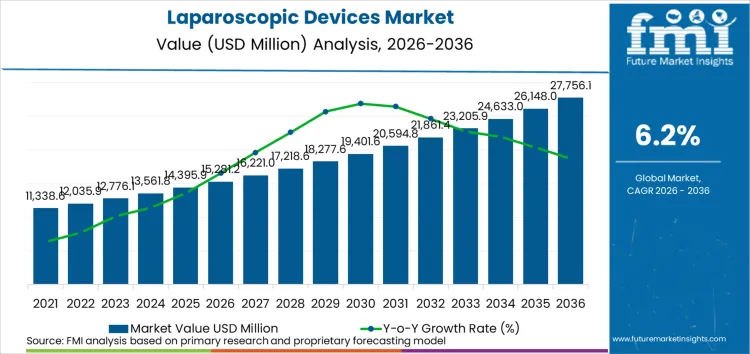
In 2026, the laparoscopic devices market is valued at USD 15,281.2 million. Based on the provided market model, demand is estimated to grow to USD 27,625.6 million by 2036. The market is projected to expand at a CAGR of 6.1% during the forecast period.
Absolute dollar growth of USD 12,344.4 million over the decade points to a market that is already well-established, yet still gaining procedure share across major surgical specialties. The underlying commercial logic is straightforward: laparoscopic surgery is not a single-product market. Each case pulls through access devices, visualization, insufflation, closure, and often-advanced energy. That creates a layered revenue model in which recurring procedural demand supports disposables and accessories, while capital equipment upgrades sustain the installed base.
As John Langell, MD, highlighted the clinical relevance of Xenocor’s newly cleared Saberscope, “Every case begins with a new scope that delivers a clear, consistent image,” emphasizing that the single-use articulating laparoscope is intended to reduce contamination concerns, avoid reprocessing-related downtime, and help surgical teams stay focused on the procedure rather than equipment reliability. [1]
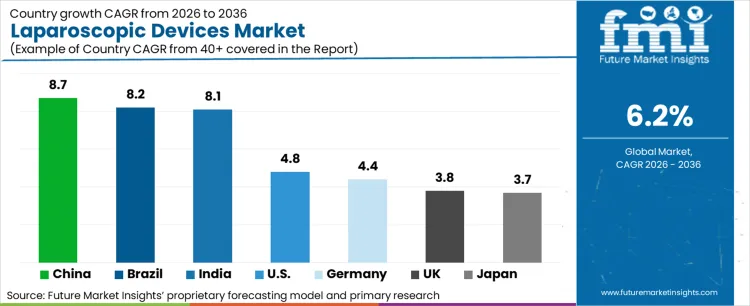
China (10.3% CAGR) is expected to be the fastest-growing tracked market, followed by Brazil (8.7%) and India (8.3%), where procedure volumes, hospital expansion, and improving access to minimally invasive surgery continue to widen the installed base. Japan (6.1%), Italy (5.8%), and Turkey (5.8%) sit in the next tier, where replacement demand and broader procedural adoption both matter. France (5.0%), the USA (4.6%), Germany (4.5%), and the UK (4.0%) remain commercially important, although growth there is shaped more by technology refresh, robotics layering, and account retention than by first-time market formation.
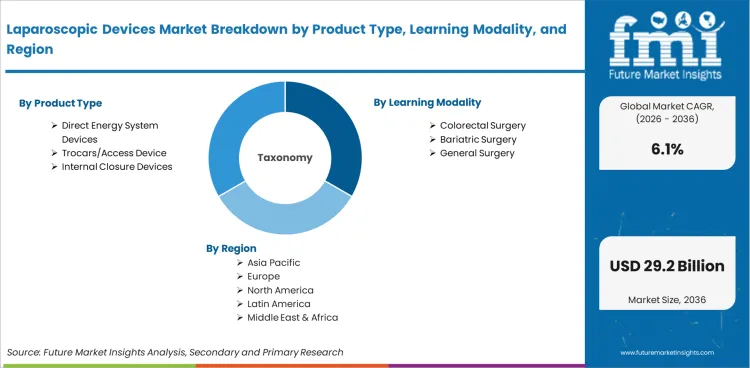
The market covers devices used to perform minimally invasive abdominal and pelvic surgery through small incisions using endoscopic visualization, specialized access ports, insufflation, tissue manipulation, closure, and energy delivery. It includes direct energy system devices, trocars and access devices, internal closure devices, laparoscopes, hand access instruments, insufflation devices, and robotic-assisted surgical systems used in laparoscopic workflows.
Commercial demand spans colorectal surgery, bariatric surgery, general surgery, gynecological surgery, and other laparoscopic procedures performed in hospitals, ambulatory surgical centers, and clinic-linked surgical settings. This is a procedure-driven equipment market, not a general hospital supply market.
The report includes global and regional market sizing and a forecast for 2026 to 2036. Product type, application, and end user, with country-level CAGR comparisons across key markets, provide segment-level sizing. Coverage includes revenue generated from laparoscopic capital equipment, reusable instruments, procedure-linked accessories, and disposable device categories used in minimally invasive surgical workflows.
The scope also captures how product choice is influenced by procedural complexity, OR standardization, smoke and visualization management, hospital procurement discipline, surgeon training, and robotics adoption in selected accounts. Official company product pages make clear that leading vendors do not compete in a single narrow category.
The scope excludes open-surgery-only instruments, non-laparoscopic diagnostic equipment, generic OR furniture, anesthesia systems, and post-operative care consumables that do not participate directly in laparoscopic procedure execution. It also excludes pharmaceuticals, sutures sold outside laparoscopic procedure sets, and broad imaging assets that are not integral to laparoscopic surgery workflows.
This distinction matters because procurement behavior in laparoscopy is procedure-linked and platform-led. A hospital may delay an imaging room refresh without materially changing laparoscopic case volume, but it cannot execute minimally invasive abdominal surgery without access devices, visualization, insufflation, and closure support fitted to that workflow. The commercial center of gravity remains the surgical stack and its case-by-case pull-through, not general hospital capital spending.
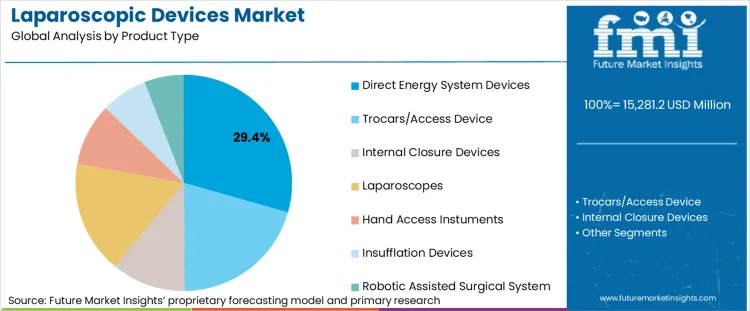
Based on the provided market model, Direct Energy System Devices are estimated to hold 29.4% share in 2026, followed by Trocars/Access Devices at 20.5%. Direct energy leads because energy delivery sits close to procedural criticality. Tissue dissection, sealing, and hemostasis influence operative speed, surgeon confidence, and case standardization more directly than many accessory categories. That makes energy harder to displace once surgeons and OR teams are trained on a given platform. Medtronic’s official portfolio presentation reflects this breadth, spanning electrosurgical products, vessel sealing, ultrasonic dissection, and related laparoscopic categories rather than treating energy as an add-on line.
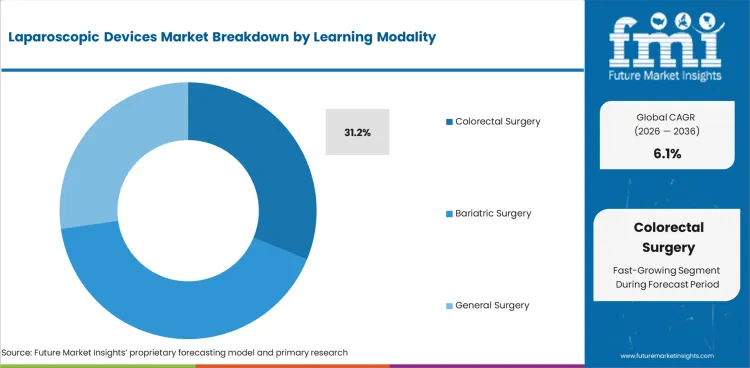
Colorectal Surgery accounts for 31.2% share in 2026, followed by Bariatric Surgery at 27.3%. Colorectal surgery leads because it combines substantial case volume with high device intensity. These procedures demand reliable access, stable pneumoperitoneum, clear visualization, dissection capability, tissue handling, and closure support. NCI continues to describe laparoscopic-assisted colectomy as a defined surgical approach in colon surgery, and Stryker’s insufflation materials explicitly position insufflation systems for colorectal and general surgery, underscoring the procedure’s commercial weight within laparoscopy. Bariatric surgery remains close behind because metabolic surgery still depends heavily on minimally invasive access, with NIDDK materials continuing to frame laparoscopic gastric procedures within mainstream bariatric practice.
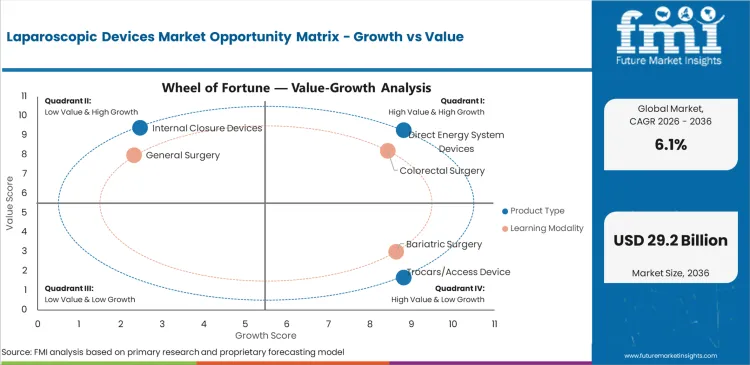
Future Market Insights analysis indicates that the market benefits from a durable clinical preference for minimally invasive surgery where appropriate, but growth is not automatic across all product lines. Procedural migration supports demand, yet buying decisions still pass through hospital committees, surgeon champions, and capital allocation cycles. That is why direct energy, optics, access, and insufflation often move together as platform decisions rather than as isolated purchases. SAGES and NHS materials support the clinical side of this logic, emphasizing recovery and morbidity advantages that keep laparoscopy structurally relevant.
The main restraint is not lack of procedural relevance. It is account complexity. Hospitals do not replace visualization systems, energy generators, or robotic platforms lightly once training, sterilization, service contracts, and surgeon familiarity are embedded. Robotics also adds a second layer of capital scrutiny. Intuitive’s da Vinci 5 rollout and Medtronic’s Hugo positioning show that the market is still moving toward more integrated and data-enabled OR environments, but this does not erase budget discipline. The opportunity lies with suppliers that reduce switching pain, fit existing OR workflows, and show practical value through efficiency, visualization quality, smoke control, or instrument versatility.
Based on the regional analysis, the laparoscopic devices market is segmented into North America, Latin America, Western Europe, East Asia, South Asia & Pacific, and Middle East & Africa across key surgical device markets. Regional performance is assessed using country-level demand signals linked to hospital capacity, minimally invasive surgery penetration, capital equipment access, procedural case mix, and supplier service reach.
.webp "Top Country Growth Comparison Laparoscopic Devices Market Cagr (2026 2036)")
| Country | CAGR |
|---|---|
| USA | 4.6% |
| Brazil | 8.7% |
| UK | 4.0% |
| Germany | 4.5% |
| France | 5.0% |
| Italy | 5.8% |
| India | 8.3% |
| China | 10.3% |
| Japan | 6.1% |
Source: Future Market Insights (FMI) analysis, based on proprietary forecasting model and primary research
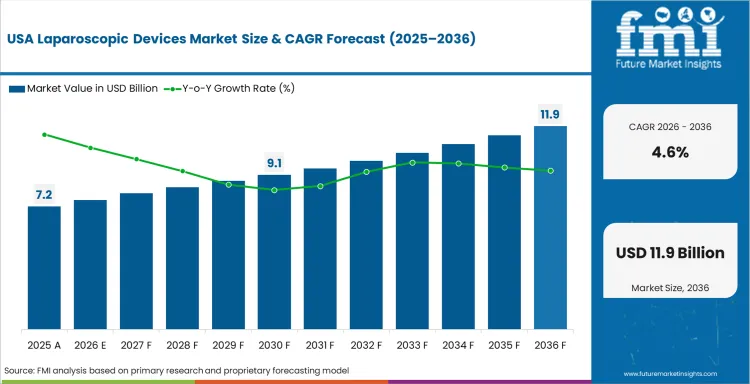
North America remains a high-value market because the installed base is deep, surgeon familiarity is high, and major multinationals have long-standing access to hospital procurement channels. Growth is steadier here than in faster-rising Asian markets, but the region still matters because capital refresh, robotic layering, and procedural intensity keep average account value high. The USA is not a volume story alone. It is also a mix story, where advanced imaging, energy platforms, and robotic systems sustain revenue quality.
FMI’s report includes a detailed analysis of North America, along with a country-wise assessment that includes the USA, Canada, and Mexico. Readers can also find regional trends, regulations, and market growth based on different segments and countries in the North America region.
Asia is where procedure growth and infrastructure expansion are interacting most visibly. China and India benefit from expanding hospital capacity, broader access to specialist surgery, and a rising appetite for minimally invasive techniques in high-volume specialties. Japan remains commercially important for premium device categories, though its growth profile is more measured. Company product strategies also reflect Asia’s relevance. Olympus continues to emphasize advanced laparoscopic imaging, and Intuitive maintains dedicated regional positioning around robotic-assisted minimally invasive surgery.
The full report analyzes the laparoscopic devices market across East and South Asia from 2026 to 2036, covering pricing, technology adoption, and growth drivers in China, Japan, India, and adjacent regional markets.
Latin America remains distributor- and hospital-led, with Brazil acting as the principal anchor market. The region’s opportunity is not based on novelty alone. It rests on the widening use of minimally invasive surgery in tertiary centers and private hospital networks, where equipment availability, surgeon training, and after-sales support determine whether procedures scale beyond a handful of reference sites.
The report consists of a detailed analysis for the market in Brazil, Argentina, and Rest of Latin America. Readers can find detailed information about pricing analysis and regional trends affecting growth in the Latin America region.
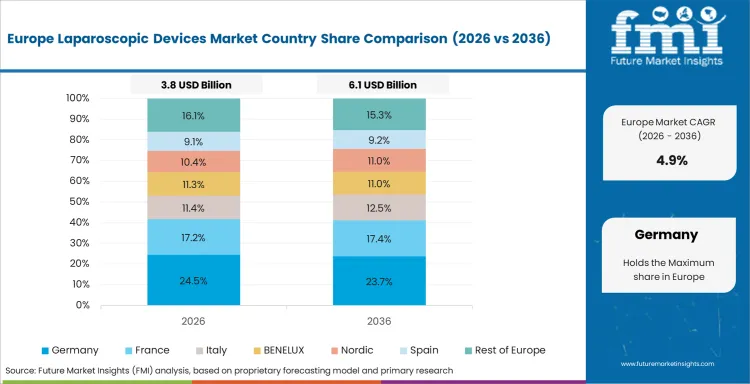
Europe remains a structurally important market because surgeon training, hospital standardization, and advanced visualization use are already well developed. Growth is moderate in the UK and Germany, firmer in Italy and France, and tied to replacement cycles, robotics layering, and imaging upgrades rather than wholesale market creation. Olympus’s 3D and 4K imaging positioning and Intuitive’s CE mark progress for da Vinci 5 illustrate how European accounts continue to be relevant for premium technology refresh.
FMI’s analysis of the laparoscopic devices market in Europe consists of country-wise assessment that includes Germany, Italy, France, the United Kingdom, Spain, Nordic countries, Benelux, and Rest of Europe. Readers can know various regulations and latest trends in the regional market.
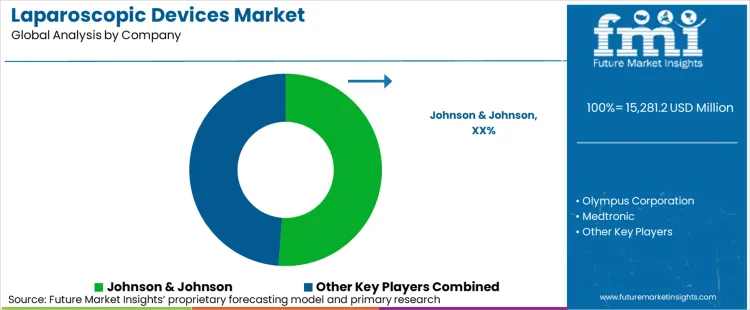
Market competition is fragmented on paper but concentrated in practice. A limited number of vendors have the breadth to compete credibly across energy, access, optics, insufflation, and robotics. That matters because hospitals do not buy laparoscopic devices the way they buy commodity consumables. They compare ecosystems. A trocar may be judged on unit price, but an account decision often depends on whether the same supplier can support the generator, visualization stack, service response, surgeon training, and OR consistency around that case type. Medtronic, Olympus, Stryker, and Intuitive each illustrate a different version of this ecosystem logic through their official portfolios.
Supplier retention is reinforced by workflow familiarity. Surgeons and OR staff get used to access feel, optical quality, energy behavior, smoke management, and service pathways. That makes switching slower than product announcements sometimes suggest. Incremental technology still matters, especially when it improves image clarity, reduces smoke-related disruption, or expands robotic workflow, but it usually has to fit existing procedural habits to win share. Olympus’s newer imaging platform positioning, Stryker’s insufflation workflow claims, and Intuitive’s da Vinci 5 launch all point in that direction: the message is not novelty for its own sake, but smoother execution inside minimally invasive surgery.
Buyer power remains meaningful because hospitals can stage evaluations, split categories by vendor, and use service expectations as a negotiation lever. Yet pricing is not the only trigger. In many accounts, switching happens only when there is a service gap, an unmet need in visualization or OR integration, or a capital refresh cycle that reopens the decision. That is why portfolio breadth acts as account protection. Vendors named in the current market universe include Janssen Pharmaceuticals, Inc. (Johnson & Johnson), Medtronic plc., Becton, Dickinson and Company, Olympus Corporation, B. Braun Melsungen AG, Stryker Corporation, Smith & Nephew Plc, KARL STORZ GmbH & Co. KG, Richard Wolf GmbH, CooperSurgical, Inc., Intuitive Surgical Inc, Endocontrol SA, Hangzhou Kangji Medical Instrument Co., Ltd, and Zhejiang Geyi Medical Instrument Co., Ltd.
Recent Developments
The report includes full coverage of key trends from competitive benchmarking. Some of the recent developments covered in the reports:
| Metric | Value |
|---|---|
| Quantitative units | US$ 15,287.2 million (2026) to US$ 27,625.6 million (2036), at a CAGR of 6.1% |
| Market definition | The market covers devices used to perform minimally invasive abdominal and pelvic surgery through small incisions using endoscopic visualization, specialized access ports, insufflation, tissue manipulation, closure, and energy delivery. It includes direct energy system devices, trocars and access devices, internal closure devices, laparoscopes, hand access instruments, insufflation devices, and robotic-assisted surgical systems used in laparoscopic workflows. Commercial demand spans colorectal surgery, bariatric surgery, general surgery, gynecological surgery, and other laparoscopic procedures performed in hospitals, ambulatory surgical centers, and clinic-linked surgical settings. This is a procedure-driven equipment market, not a general hospital supply market. |
| Product Type Segmentation | Direct Energy System Devices, Trocars/Access Device, Internal Closure Devices, Laparoscopes, Hand Access Instrument’s, Insufflation Devices, Robotic Assisted Surgical System |
| Application Segmentation | Bariatric Surgery, Colorectal Surgery, General Surgery, Gynecological Surgery, Other Laparoscopic Surgery |
| End User Coverage | Hospitals, Ambulatory Surgical Centers & Clinics |
| Regions covered | North America, Latin America, East Asia, South Asia, Western Europe, Eastern Europe, Middle East and Africa |
| Countries covered | United States, Canada, Mexico, Brazil, Argentina, Germany, France, United Kingdom, Italy, Spain, China, India, Japan, South Korea, Indonesia, Australia and 40 plus countries |
| Key companies profiled | Janssen Pharmaceuticals, Inc. (Johnson & Johnson), Medtronic plc., Becton, Dickinson and Company, Olympus Corporation, B. Braun Melsungen AG, Stryker Corporation, Smith & Nephew Plc, KARL STORZ GmbH & Co. KG, Richard Wolf GmbH, CooperSurgical, Inc., Intuitive Surgical Inc, Endocontrol SA, Hangzhou Kangji Medical Instrument Co., Ltd, Zhejiang Geyi Medical Instrument Co., Ltd |
| Forecast period | 2026 to 2036 |
| Approach | A hybrid top-down and bottom-up market modeling approach was used, validated through primary interviews with laparoscopic surgeons, operating room managers, hospital procurement teams, and device manufacturers, and further supported by product portfolio mapping, procedure-volume assessment, and end-user channel benchmarking, as per FMI. |
This bibliography is provided for reader reference and is not exhaustive. The full report contains the complete reference list and detailed citations.
How large is the demand for laparoscopic devices in the global market in 2026?
Demand for laparoscopic devices in the global market is estimated to be valued at US$ 15,281.2 Mn in 2026, as per FMI.
What will be the market size of laparoscopic devices in the global market by 2036?
Market size for laparoscopic devices is projected to reach US$ 27,625.6 Mn by 2036.
What is the expected demand growth for laparoscopic devices in the global market between 2026 and 2036?
Demand for laparoscopic devices in the global market is expected to grow at a CAGR of 6.1% between 2026 and 2036.
Which product type is poised to lead global demand by 2026?
Direct energy system devices solutions kits is expected to be the dominant product, capturing 29.4% share in 2026.
Which application is expected to account for the largest share in 2026?
Colorectal surgery is expected to hold the highest share at 31.2% in 2026.
Which end user is expected to dominate the mix in 2026?
Hospitals is expected to lead material use with 72.6% share in 2026.
Full Research Suite comprises of:

Market outlook & trends analysis
Interviews & case studies
Strategic recommendations
Vendor profiles & capabilities analysis
5-year forecasts
8 regions and 60+ country-level data splits
Market segment data splits
12 months of continuous data updates
DELIVERED AS:
PDF EXCEL ONLINE

Laparoscopic Devices Market

Thank you!
You will receive an email from our Business Development Manager. Please be sure to check your SPAM/JUNK folder too.

