

- Market Size (2026)
- USD 5.5 Bn
- Forecast (2036)
- USD 10.3 Bn
- CAGR (2026 to 2036)
- 6.5%
How big is Late-Stage Customization and Postponement Packaging Services Market in 2026?
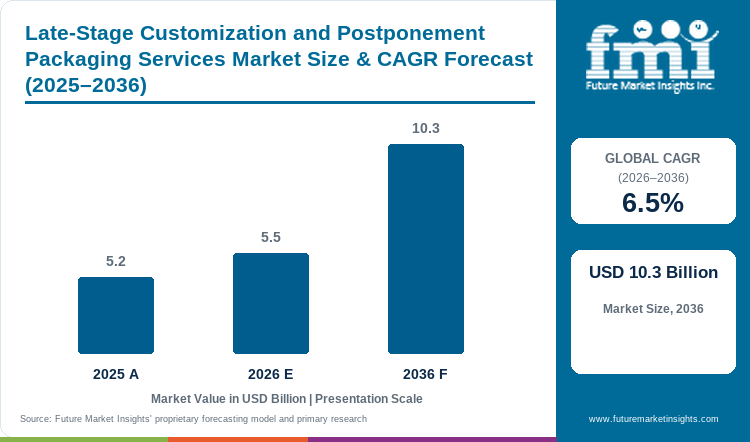
The late-stage customization and postponement packaging services market is valued at USD 5.5 billion in 2026. It is projected to reach USD 10.3 billion by 2036 at a 6.5% CAGR over the 2026-2036 period.
Demand for late-stage customization and postponement packaging services is projected to expand at 6.5% CAGR between 2026 and 2036. Industry value grows from USD 5.2 billion in 2025 to USD 5.5 billion in 2026. The market is projected to reach USD 10.3 billion by 2036. Brands are using late-stage pack work to keep final pack choices open until demand is clearer. Warehouse teams are adding labels, kits, bundles, and retail parts near the ship point. Common stock remains useful for stores, online channels, and country programs. The service links contract packaging with warehouse work that already controls stock and orders. DHL Group’s March 2026 annual report lists value-added services inside its Supply Chain division. The report places pack work inside logistics contracts instead of a separate production step. Buyers are using this model to avoid holding a finished pack for every channel. Quality checks and order control remain inside the same site.
Countries are using this model in different retail and warehouse systems. The Netherlands is projected to expand at 6.3% CAGR through 2036. German demand is expected to record 5.6% CAGR through 2036. Statistics Netherlands reported in August 2026 that online retail turnover rose 7.5% year over year during June. Dutch hubs are handling cross-border orders that need local labels near release. German sites are using standard work because labor and checks raise short-run costs. E-commerce packaging is creating different service needs in the two countries. Providers are matching staff, label controls, and warehouse systems to local order patterns.
Key Takeaways
- Omnichannel fulfillment is moving final labeling and pack assembly closer to distribution sites holding common inventory.
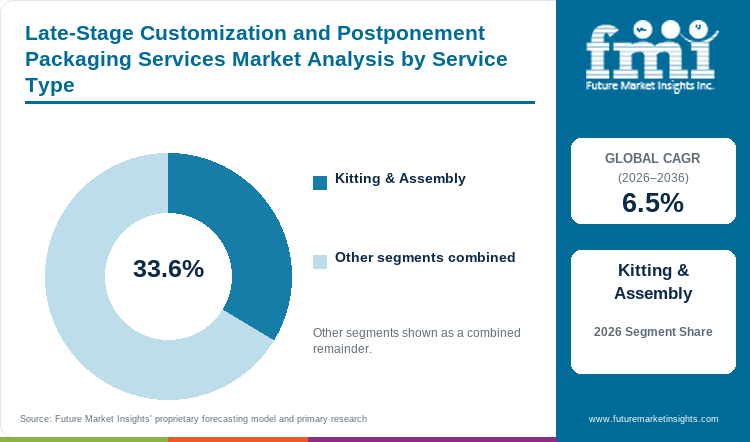
- Kitting & assembly is projected to account for 33.6% of service type revenue in 2026. Promotional programs are increasing demand for flexible multi-SKU preparation work.
- Corrugated cartons are estimated to hold 30.6% of packaging format demand in 2026. Flexible secondary-pack customization is supporting carton use for several channels.
- Food & beverage is expected to lead end-user demand with 28.1% share in 2026. Frequent promotions are requiring pack and display changes near shipment.
- Small customized runs are raising unit costs as labor scheduling, material staging, and verification cluster near shipment deadlines.
- Key companies include DHL Supply Chain, GXO Logistics, GEODIS, Ryder System, CEVA Logistics, Kuehne+Nagel, DSV, and Tjoapack.
Analyst Perspective
“I expect brands to shift more final pack decisions into fulfillment sites as channel variation expands. Providers need faster changeovers and tighter release controls because small runs are likely to test labor economics.”
- Nandini Roy Choudhury, Principal Consultant, Future Market Insights
How is the late-stage customization and postponement packaging services market segmented?
The late-stage customization and postponement packaging services market is segmented four ways by Service Type, Packaging Format, End User, and Region. Kitting & assembly holds 33.6% of service type revenue in 2026. Corrugated cartons hold 30.6% of packaging format demand in 2026. Food & beverage represents 28.1% of end-user demand in 2026.
The market is segmented by service type, packaging format, end user, and region. Service type includes kitting & assembly, labeling & printing, custom pack-out & bundling, postponement packaging, and other services. Packaging format covers corrugated cartons, pouches & sachets, blister & clamshell, bottles & jars, secondary retail-ready displays, and other formats. End users include food & beverage, cosmetics & personal care, pharmaceuticals, consumer electronics, and other industries.
Why does kitting & assembly lead the service type category?
Kitting & assembly groups several products into one ready-to-ship set beside stored goods. Warehouse teams use it for bundles, subscription packs, store sets, and mixed product kits. Keeping this work on site cuts trips back to a factory for another pack step. Teams are pairing kitting with checks and order release inside the same building. GXO launched its enhanced Direct offer in June 2025 with kitting, custom work, and gift wrapping for growing brands. That launch supports third-party logistics services that keep pack work beside stock and order handling. Buyers choose sites that change bundle content without slowing outbound orders.
- Kitting & assembly is projected to account for 33.6% of service type revenue in 2026. Programs with many SKUs are supporting fast order setup beside stored goods.
- Brand teams are choosing kitting for bundles that cost too much to finish during the main factory run.
Why are corrugated cartons central to packaging format demand?
Corrugated cartons give warehouses a sturdy outer box for labels, inserts, dividers, and store graphics. Teams are keeping common box sizes and adding final print or labels near dispatch. This supports web orders and store restock without changing the pack that touches the product. Nefab opened a Georgia hub in September 2025 that makes corrugated packs and handles kitting under one roof. The site links corrugated boxes with late assembly and warehouse prep in one building. Teams match box size to product size because empty space raises material and freight costs. Buyers are choosing cartons that support pack changes without slowing normal warehouse work.
- Corrugated cartons are estimated to hold 30.6% of packaging format demand in 2026. Cartons support labels, inserts, dividers, and store graphics for several sales channels.
- Pack teams use cartons for visible pack changes during many campaigns. They avoid new product-contact packs for every small design change.
Why does food & beverage lead the end user category?
Food and beverage brands are using promo packs, multipacks, seasonal bundles, and store-specific packs in several channels. Late-stage services let teams keep one base product and finish the outer pack near shipment. That approach reduces the finished pack types held until orders are known. Nagel-Group announced in February 2025 one digital co-packing system for more than fifty European food logistics sites. The rollout gives food logistics teams a common way to plan and track co-packing work. Retail e-commerce packaging is supporting outer packs and order inserts for online sales. Buyers are choosing providers that track each pack change without slowing dispatch or food-safety checks.
- Food & beverage is expected to lead end-user demand with 28.1% share in 2026. Promo cycles are causing frequent changes to counts, labels, sleeves, and store-ready displays near shipment.
- Brand owners are using late-stage assembly to change outer pack design. The product formula and primary pack are staying unchanged during these updates.
What are the drivers, restraints and opportunities in the Late-Stage Customization and Postponement Packaging Services Market?
In the late-stage customization and postponement packaging services market, the key driver is omnichannel SKU variation. The key restraint is labor-heavy changeovers that are limiting margins on short customization runs. The key opportunity is configurable automation that is widening viable short-run packaging work.
- Driver: Brands are using common inventory to support channel-specific packs without stocking every final configuration in advance.
- Restraint: Manual changeovers and verification are raising costs for fragmented orders with short release windows.
- Opportunity: Digital printing, vision inspection, and configurable packing cells are making smaller customization batches easier to control.
Store and web programs are creating more pack types once the main run ends. Brands are keeping common stock and adding labels, bundles, inserts, or promo pieces near shipment. Ryder reported in September 2025 that shoppers used several sales channels during holiday orders. The channels included stores, web marketplaces, websites, mobile apps, and social sites. The channel mix is increasing the order paths brands serve from the same stock. Late-stage services are helping teams change outer packs without building separate stock for each route. E-commerce flexible packaging is supporting lighter online orders that need late labels or inserts. Pack teams are linking pack changes with live stock and order data.
Late-stage work costs more as small runs rely on hand staging, packing, and checks. Each change adds pack setup, line clearance, label checks, and release work during order staging. The Bureau of Labor Statistics released 2025 warehouse job data in September 2026. The release counted 457,740 stock clerks and order fillers in American warehouses. The workforce figure points to the labor needed for warehouse order handling. Short promo windows are making staffing harder because work arrives close to ship cutoffs. Firms are keeping costs down with standard pack steps and fewer format changes. Buyers weigh pack choice against error risk because one wrong label can stop an order wave.
Warehouses are using automation to handle more pack changes without adding staff at the same rate. Flexible cells are printing labels, checking codes, tracking serial numbers, and building packs beside stored goods. DHL Supply Chain announced its SOFTBOT rollout in March 2026 to speed robot links through its global warehouse network. Faster setup lets teams add small robot projects to changing customer programs. Packaging machinery and converting automation support routine tasks that need steady output and digital records. Warehouse teams link machines with stock data and quality checks to reduce handoffs. Pack providers add short-run capacity with lines that switch among several pack tasks.
Which country CAGRs are profiled in the Late-Stage Customization and Postponement Packaging Services Market?
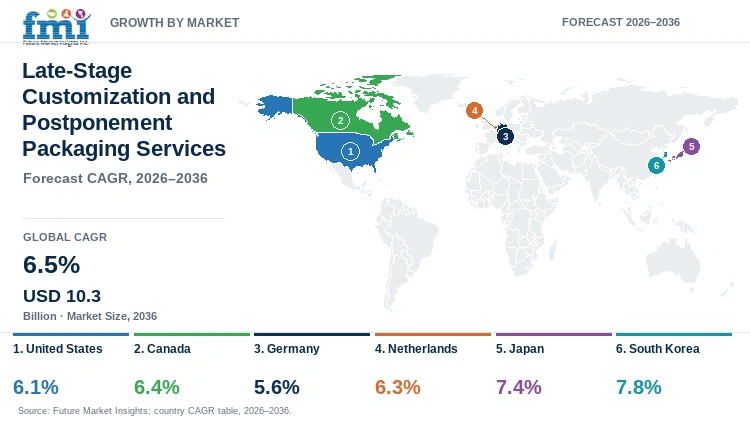
| Country | CAGR |
|---|---|
| United States | 6.1% |
| Canada | 6.4% |
| Germany | 5.6% |
| Netherlands | 6.3% |
| Japan | 7.4% |
| South Korea | 7.8% |
How do country-level CAGRs compare in the Late-Stage Customization and Postponement Packaging Services Market?
Country demand follows local warehouse and retail systems rather than one common pack model. United States and Canadian brands use large regional hubs for store and online programs. German and Japanese sites favor tighter work controls for labor-intensive pack changes. Dutch hubs handle cross-border orders, whereas South Korean sites serve fast mobile shopping cycles. These local systems change staff needs, label checks, stock choices, and late pack work.
- In the United States, large retail hubs are moving final labels and promo pack work closer to shipping points.
- Canadian brands are using large hubs to handle long freight routes, bilingual packs, and store order work.
- Germany favors standard work and label checks because high labor costs make small custom runs harder to manage.
- The Netherlands uses cross-border hubs to add local labels and store-specific packs to shared inventory near shipment.
- Japan favors careful pack work and small work cells that protect brand appearance in sites with limited space.
- South Korea’s fast online shopping cycle is creating more pack changes, labels, and promo work near shipping hubs.
Providers are adapting service design to each country’s shipping network, pack rules, labor costs, and channel mix. The full report covers North America, Latin America, Western Europe, Eastern Europe, and East Asia. Coverage includes South Asia and Pacific as well as the Middle East and Africa.
Country-wise Analysis
- United States brands are using large warehouse networks for store and online orders. The country is projected to expand at 6.1% CAGR through 2036. Census Bureau data released in August 2026 showed online retail sales rose 12.2% year over year during the second quarter. More parcel orders are creating label, insert, bundle, and promo pack work near shipping points. Peak campaigns are putting pressure on labor and open line time. Operators are using machines and live stock data to keep pack changes tied to order release. Large brands are using shared stock to serve several regions from the same product pool. That model reduces the need to hold every finished pack until local demand is known.
- Canadian pack programs are serving a wide country with long freight routes. Canada is forecast to rise at 6.4% CAGR through 2036. Statistics Canada reported in August 2026 that online sales made up 7.7% of retail trade during June. National hubs are helping brands hold common stock and add final kits or labels near shipment. Bilingual packs and store rules are adding checks during custom-order release. Operators are keeping labels, bundles, and order release inside one site to cut extra stock handling. Large hubs are helping brands keep service steady in Canadian provinces. These hubs keep late pack work close to outbound freight and local orders.
- German brands are using dense warehouse networks for store and online orders. German demand is expected to record 5.6% CAGR through 2036. Destatis reported in April 2026 that seven in ten people in its covered age group shopped online during 2025. High online use is creating more parcel packs and local label work in regional warehouses. Labor costs are making fixed pack steps and steady checks more important for small runs. Operators are using standard work cells to control pack changes for several sales channels. Local pack work is helping global brands serve German needs from common upstream stock. Clear work rules are reducing rework during short promo cycles.
- The Netherlands is using dense warehouse hubs for local and cross-border orders. Demand is projected to grow at 6.3% CAGR through 2036. Statistics Netherlands reported in September 2026 that online retail sales rose 3.8% from a year earlier in July. Cross-border orders are adding language changes, labels, bundles, and store-specific outer packs. Operators are linking pack work with warehouse systems to cut handoffs during dispatch preparation. Language checks are adding work to short runs that serve several countries. Benelux hubs are helping brands keep final pack choices open until orders are clearer. Providers with linked data and pack checks are handling frequent local changes without building duplicate finished stock.
- Japanese pack programs are placing high value on careful work and clean pack appearance. Japan is forecast to expand at 7.4% CAGR through 2036. METI reported in August 2025 that business-to-consumer online sales grew 5.1% during 2024. Online demand is supporting outer packs used for parcel delivery and store programs. Space and labor limits are increasing the value of compact work cells in distribution sites. Operators are using careful label and pack checks to protect premium brand appearance. Late pack work is helping global brands adapt common stock for Japanese language and channel needs. Local service teams are cutting approval and rework time for frequent pack campaigns.
- South Korean pack programs are serving fast mobile shopping and promo cycles. The country is projected to rise at 7.8% CAGR through 2036. The Ministry of Data and Statistics reported in November 2025 that mobile shopping made up 75.9% of September online shopping value. Online campaigns are creating demand for bundles, labels, inserts, and channel-specific packs near shipping sites. Operators are using print-and-apply tools and standard work steps to cut error risk. Fast campaign changes are putting pressure on line space and material staging. Late pack services are helping brands keep channel choices open until order needs are clearer. Providers with fast pack-job changeovers are matching Korea’s fast promo cycle.
Who are the notable companies in the Late-Stage Customization and Postponement Packaging Services Market?
Notable companies in the late-stage customization and postponement packaging services market include DHL Supply Chain, GXO Logistics, GEODIS, and Ryder System. CEVA Logistics, Kuehne+Nagel, DSV, and Tjoapack provide contract logistics or specialist regulated packaging services.
DHL Supply Chain, GXO Logistics, GEODIS, CEVA Logistics, Kuehne+Nagel, and DSV combine warehousing with value-added pack services. Ryder System supports North American e-commerce orders and store replenishment from its fulfillment network. Tjoapack focuses on pharmaceutical packs requiring labels, cartons, serialization, and delayed final preparation. Buyers compare network reach with process control because contracts cover different packaging tasks. Multi-site logistics groups suit distributed programs that require common controls in several regions. Tjoapack addresses regulated packs that need product-level controls and market-specific secondary preparation.
Regulated programs are linking late pack work with pharmaceutical packaging following primary filling and sealing. Pharmaceutical secondary packaging covers cartons, labels, and country-specific presentation around finished drug products. Blister packaging adds another format that can need local labels, inserts, or final pack work.
- Integrated contract logistics: DHL Supply Chain, GXO Logistics, GEODIS, CEVA Logistics, Kuehne+Nagel, and DSV combine warehousing with value-added packaging.
- Omnichannel fulfillment: Ryder System is supporting e-commerce and store-replenishment programs with promotional packaging and customized order preparation.
- Regulated packaging: Tjoapack is providing pharmaceutical labeling, cartoning, serialization, and postponement services for market-specific secondary preparation.
Competitive Benchmarking: Late-Stage Customization and Postponement Packaging Services Market
| Company | Packaging Execution | Kitting / Assembly | Regulated / Specialized Capability | Geographic Reach |
|---|---|---|---|---|
| DHL Supply Chain | High | High | High | Global |
| GXO Logistics | High | High | Medium | North America and Europe |
| GEODIS | High | High | High | Global |
| Ryder System | Medium | High | Medium | North America |
| CEVA Logistics | High | High | High | Global |
| Kuehne+Nagel | High | Medium | High | Global |
| DSV | High | Medium | Medium | Global |
| Tjoapack | High | High | High | Europe and North America |
High ratings require direct commercial-scale evidence for each reviewed capability. Medium marks a narrower documented role within the defined service scope. Low marks limited evidence for the capability within this service market. Geographic reach remains descriptive and does not affect capability ratings.
Key Developments in the Late-Stage Customization and Postponement Packaging Services Market
- In May 2025, Tjoapack commissioned and validated an automated vial line with labeling, cartoning, and serialization capabilities.
- In April 2025, CEVA Logistics announced a Strasbourg pharmaceutical facility for value-added logistics services beginning in early 2026.
- In April 2025, DHL Group announced a EUR 2 billion investment program for life sciences and healthcare logistics through 2030.
Key Players in the Late-Stage Customization and Postponement Packaging Services Market
Integrated Contract Logistics
- DHL Supply Chain
- GXO Logistics
- GEODIS
- CEVA Logistics
- Kuehne+Nagel
- DSV
E-commerce and Omnichannel Fulfillment
- Ryder System
Specialized Pharmaceutical Packaging
- Tjoapack
Late-Stage Customization and Postponement Packaging Services Market - Report Scope
| Coverage field | Report scope |
|---|---|
| Market breakdown | By service type, packaging format, end user and region. |
| Quantitative Units | USD billion. |
| Market Definition | Late-stage customization and postponement packaging services include kitting, assembly, labeling, printing, custom pack-out, bundling, repacking, postponement packaging, and related secondary-pack preparation performed as outsourced services. Primary package manufacturing and base transport or warehousing without value-added packaging revenue are excluded. |
| Regions Covered | North America, Latin America, Western Europe, Eastern Europe, East Asia, South Asia and Pacific, and Middle East and Africa. |
| Countries Covered | United States, Canada, Germany, Netherlands, Japan, South Korea, and 20+ countries included in the full report. |
| Key Companies Profiled | DHL Supply Chain, GXO Logistics, GEODIS, Ryder System, CEVA Logistics, Kuehne+Nagel, DSV, and Tjoapack. |
| Forecast Period | 2026 to 2036. |
| Approach | Primary and secondary research with market triangulation. |
Late-Stage Customization and Postponement Packaging Services Market - Research Methodology
| Method | Approach |
|---|---|
| Primary Research | FMI analysts gathered input from manufacturers, service providers, technology developers, distributors, end users, procurement teams, and subject-matter experts. Interviews examined purchasing decisions, product or service evaluation, adoption barriers, approval requirements, pricing considerations, and expectations for technical or commercial support. Respondents were also asked what evidence is required before a trial, pilot, or initial order develops into regular purchasing. |
| Desk Research | Desk research covered government statistics, regulatory publications, trade data, industry associations, technical literature, standards, company filings, product information, and official corporate announcements. Sources were reviewed for relevance, publication date, geographic coverage, and consistency with the defined market scope. Claims relating to performance, applications, approvals, capacity, investment, and commercial activity were retained only when supported by credible public evidence. |
| Market Sizing and Forecasting | The market model combined the baseline value with historical performance, segment structure, pricing and volume indicators, adoption levels, company participation, and country-level demand conditions. Forecast assumptions considered economic activity, investment trends, regulatory developments, technology adoption, purchasing cycles, supply availability, and barriers to wider market use. Segment and regional estimates were reconciled before the final market total was calculated. |
| Data Validation | Estimates were checked against multiple independent indicators, including public data, company activity, trade patterns, industry developments, and findings from primary interviews. Validation also tested whether products, services, applications, and company revenues fell within the defined market boundaries. Adjacent categories, unsupported claims, overlapping revenues, and activities without direct market relevance were excluded to reduce double counting and maintain consistency across segments and countries. |
Late-Stage Customization and Postponement Packaging Services Market by Segments
Late-Stage Customization and Postponement Packaging Services Market segmented by Service Type:
- Kitting & Assembly
- Labeling & Printing
- Custom Pack-Out & Bundling
- Postponement Packaging
- Other
Late-Stage Customization and Postponement Packaging Services Market segmented by Packaging Format:
- Corrugated Cartons
- Pouches & Sachets
- Blister & Clamshell
- Bottles & Jars
- Secondary Retail-Ready Displays
- Other
Late-Stage Customization and Postponement Packaging Services Market segmented by End User:
- Food & Beverage
- Cosmetics & Personal Care
- Pharmaceuticals
- Consumer Electronics
- Other
Late-Stage Customization and Postponement Packaging Services Market by Region:
- North America
- United States
- Canada
- Latin America
- Brazil
- Mexico
- Chile
- Rest of Latin America
- Western Europe
- Germany
- United Kingdom
- Italy
- Spain
- France
- Nordics
- Benelux
- Rest of Western Europe
- Eastern Europe
- Russia
- Poland
- Hungary
- Balkan and Baltic States
- Rest of Eastern Europe
- East Asia
- China
- Japan
- South Korea
- South Asia and Pacific
- India
- ASEAN
- Australia and New Zealand
- Rest of South Asia and Pacific
- Middle East and Africa
- Kingdom of Saudi Arabia
- Other GCC Countries
- Türkiye
- South Africa
- Other African Union Countries
- Rest of Middle East and Africa
Research Sources and Bibliography
- U.S. Census Bureau. (2026, August 18). Quarterly retail e-commerce sales, second quarter 2026. Country context: United States. https://www.census.gov/retail/ecommerce.html
- Statistics Canada. (2026, August 21). Retail trade, June 2026. Country context: Canada. https://www150.statcan.gc.ca/n1/daily-quotidien/260821/dq260821a-eng.pdf
- Ministry of Economy, Trade and Industry, Japan. (2025, August 26). Results of FY2024 E-Commerce Market Survey Compiled. Country context: Japan. https://www.meti.go.jp/english/press/2025/0826_003.html
- Federal Statistical Office of Germany. (2026, April 20). Internet use and online purchases over time. Country context: Germany.
- Statistics Netherlands. (2026, August 3). Retail turnover up by nearly 3 percent in June. Country context: Netherlands.
- Ministry of Data and Statistics, Republic of Korea. (2025, November 3). Online Shopping in September 2025. Country context: South Korea.
- DHL Group. (2025, April 7). DHL Group to invest EUR 2 billion by 2030 in DHL Health Logistics. Country context: Global.
- GXO Logistics, Inc. (2025, June 10). GXO introduces enhanced GXO Direct solution in the U.S. Country context: United States.
- Ryder System, Inc. (2025, April 23). Case study: Ryder E-commerce and Mugsy. Country context: United States.
- CEVA Logistics. (2025, April 8). CEVA Logistics announces a new logistics facility dedicated to pharmaceuticals in Strasbourg, France. Country context: France.
- CEVA Logistics. (2025, December 1). CEVA Logistics and CooperVision open a new regional service center. Country context: Singapore.
- Kuehne+Nagel. (2025, September 4). Kuehne+Nagel and Sysmex enter into strategic partnership in the healthcare sector. Country context: Germany.
- Kuehne+Nagel. (2026, July 21). How logistics support medication workflows so healthcare teams can focus on patients. Country context: Singapore.
- DSV. (2025, July 22). DSV breaks ground on new 900,000-square-foot facility to expand its Laredo, Texas operations. Country context: United States.
- GEODIS. (2026, May 6). GEODIS to enhance its pharmaceutical logistics capabilities with a GDP-compliant warehouse in Manchester. Country context: United Kingdom.
- Tjoapack. (2026). Tjoapack announces major U.S. expansion to improve its packaging and logistics capabilities. Country context: United States.
- DHL Supply Chain. (2026, September 23). DHL Supply Chain launches new logistics solution for U.S. health systems. Country context: United States.
- DHL Group. (2026, March 5). Supply Chain division: 2025 Annual Report. Country context: Global.
- Nefab Group. (2025, September 4). Nefab opens new Southeast Hub in Braselton, Georgia. Country context: United States.
- Nagel-Group. (2025, February). Nagel-Group powers its European contract packing with Nulogy roll out. Country context: Europe.
- Ryder System, Inc. (2025, September 16). Ryder 2025 E-commerce Study: 94% of shoppers prioritize cost savings; flexibility gains on speed. Country context: United States.
- U.S. Bureau of Labor Statistics. (2026). Warehousing and Storage: NAICS 493. Country context: United States.
- DHL Supply Chain. (2026, March 16). DHL Supply Chain accelerates automation deployments with SVT Robotics SOFTBOT platform. Country context: Global.
- Statistics Netherlands. (2026, September 1). Retail turnover up by nearly 3 percent in July. Country context: Netherlands.
- GXO Logistics, Inc. (2026, September 17). GXO and Exotec partner to advance fashion fulfillment for Guess in the Netherlands. Country context: Netherlands.
- CEVA Logistics. (2026, July 15). CEVA Logistics, GSK extend agreement to manage distribution center in Poland. Country context: Poland.
- Tjoapack. (2026, April 22). Tjoapack joins Alcami. Country context: Global.
This bibliography is provided for reader reference and is not exhaustive. The full report contains the complete reference list and detailed citations.
This Report Answers
- How large is the late-stage customization and postponement packaging services market in 2026 and 2036?
- Which operating needs move final labeling and pack assembly closer to fulfillment nodes?
- Why does kitting & assembly hold 33.6% of service type revenue in 2026?
- Why do corrugated cartons account for 30.6% of packaging format demand?
- Why does food & beverage represent 28.1% of end-user demand in 2026?
- Which labor and changeover constraints affect late-stage customization margins?
- How do country growth conditions differ across the United States, Canada, Germany, Netherlands, Japan, and South Korea?
- Which companies combine contract logistics with packaging customization or specialized regulated packaging?
- How can automation improve short-run labeling, verification, and pack assembly?
Frequently Asked Questions
How big is the late-stage customization and postponement packaging services market in 2026?
The late-stage customization and postponement packaging services market is valued at USD 5.5 billion in 2026. It is projected to reach USD 10.3 billion by 2036 as brands outsource more channel-specific packaging work.
What is the CAGR of the late-stage customization and postponement packaging services market from 2026 to 2036?
The late-stage customization and postponement packaging services market is projected to grow at 6.5% CAGR between 2026 and 2036. Omnichannel fulfillment and SKU variation are increasing demand for delayed final pack decisions.
Which service type leads the market in 2026?
Kitting & assembly is projected to hold 33.6% of service type revenue in 2026. Brand teams are using the service for bundles, promotions, component sets, and channel-specific assortments.
Which packaging format leads the market in 2026?
Corrugated cartons are estimated to hold 30.6% of packaging format demand in 2026. Warehouses are using cartons for labels, inserts, dividers, bundles, and store graphics.
Which end user leads the market in 2026?
Food & beverage is expected to account for 28.1% of end-user demand in 2026. Brand owners are using late-stage services for promo packs and retailer-specific pack changes.
What incremental revenue opportunity is projected between 2026 and 2036?
The late-stage customization and postponement packaging services market is projected to add USD 4.8 billion between 2026 and 2036. The figure equals the difference between the 2026 baseline and the 2036 forecast.
What CAGRs are projected for South Korea and Japan through 2036?
South Korea is projected at 7.8% CAGR through 2036. Japan is projected at 7.4% as mobile and online channels support frequent secondary-pack work.
Which companies are active in the market?
Notable companies in the late-stage customization and postponement packaging services market include DHL Supply Chain, GXO Logistics, GEODIS, and Ryder System. CEVA Logistics, Kuehne+Nagel, DSV, and Tjoapack provide contract logistics, omnichannel fulfillment, or regulated pack work.
Preview the report firsthand - request a free sample
Get SampleGet the brochure for pricing and purchase details.
Get PDFTable of Content
- Key Takeaways
- Market Size and CAGR
- Top Growth Driver
- Fastest Growing Segment
- Leading Region
- Key Companies
- Emerging Opportunities
- Executive Summary
- Global Market Outlook
- Demand-side Trends
- Supply-side Trends
- Technology Roadmap Analysis
- Analysis and Recommendations
- Analyst Perspective (What is happening? Why now? What should investors know?)
- Key Questions Answered
- How large is the market?
- What is the CAGR?
- What are key trends?
- Which region dominates?
- Who are the leaders?
- Market Overview
- Market Coverage / Taxonomy
- Market Definition / Scope / Limitations
- Research Methodology
- Chapter Orientation
- Analytical Lens and Working Hypotheses
- Market Structure, Signals, and Trend Drivers
- Benchmarking and Cross-market Comparability
- Market Sizing, Forecasting, and Opportunity Mapping
- Research Design and Evidence Framework
- Desk Research Programme (Secondary Evidence)
- Expert Input and Fieldwork (Primary Evidence)
- Tooling, Models, and Reference Databases
- Data Engineering and Model Build
- Quality Assurance and Audit Trail
- Market Background
- Market Dynamics (Drivers, Restraints, Opportunity, Trends)
- Scenario Forecast (Optimistic, Likely, Conservative)
- Impact Analysis
- AI Impact
- Sustainability Impact
- Regulatory Impact
- Technology Impact
- Consumer / Buyer Analysis
- Purchase Drivers
- Adoption Barriers
- Buyer Journey
- Opportunity Map Analysis
- Product Life Cycle Analysis
- Supply Chain Analysis
- Investment Feasibility Matrix
- Value Chain Analysis
- PESTLE and Porter's Analysis
- Regulatory Landscape
- Regional Parent Market Outlook
- Production and Consumption Statistics
- Import and Export Statistics
- Global Market Analysis and Forecast, 2021 to 2036
- Historical Market Size Value (USD Billion) Analysis, 2021 to 2025
- Current and Future Market Size Value (USD Billion) Projections, 2026 to 2036
- Y-o-Y Growth Trend Analysis
- Absolute $ Opportunity Analysis
- Global Market Pricing Analysis, 2021 to 2036
- Global Market Analysis and Forecast, By Service Type, 2021 to 2036
- Introduction / Key Findings
- Historical Market Size Value (USD Billion) Analysis By Service Type, 2021 to 2025
- Current and Future Market Size Value (USD Billion) Analysis and Forecast By Service Type, 2026 to 2036
- Kitting & Assembly
- Labeling & Printing
- Custom Pack-Out & Bundling
- Postponement Packaging
- Other
- Y-o-Y Growth Trend Analysis By Service Type, 2021 to 2025
- Absolute $ Opportunity Analysis By Service Type, 2026 to 2036
- Global Market Analysis and Forecast, By Packaging Format, 2021 to 2036
- Introduction / Key Findings
- Historical Market Size Value (USD Billion) Analysis By Packaging Format, 2021 to 2025
- Current and Future Market Size Value (USD Billion) Analysis and Forecast By Packaging Format, 2026 to 2036
- Corrugated Cartons
- Pouches & Sachets
- Blister & Clamshell
- Bottles & Jars
- Secondary Retail-Ready Displays
- Other
- Y-o-Y Growth Trend Analysis By Packaging Format, 2021 to 2025
- Absolute $ Opportunity Analysis By Packaging Format, 2026 to 2036
- Global Market Analysis and Forecast, By End User, 2021 to 2036
- Introduction / Key Findings
- Historical Market Size Value (USD Billion) Analysis By End User, 2021 to 2025
- Current and Future Market Size Value (USD Billion) Analysis and Forecast By End User, 2026 to 2036
- Food & Beverage
- Cosmetics & Personal Care
- Pharmaceuticals
- Consumer Electronics
- Other
- Y-o-Y Growth Trend Analysis By End User, 2021 to 2025
- Absolute $ Opportunity Analysis By End User, 2026 to 2036
- Global Market Analysis and Forecast, By Region, 2021 to 2036
- Introduction
- Historical Market Size Value (USD Billion) Analysis By Region, 2021 to 2025
- Current Market Size Value (USD Billion) Analysis and Forecast By Region, 2026 to 2036
- North America
- Latin America
- Western Europe
- Eastern Europe
- East Asia
- South Asia and Pacific
- Middle East and Africa
- Market Attractiveness Analysis By Region
- North America Market Analysis and Forecast, By Country, 2021 to 2036
- Historical Market Size Value (USD Billion) Trend Analysis By Market Taxonomy, 2021 to 2025
- Market Size Value (USD Billion) Forecast By Market Taxonomy, 2026 to 2036
- By Country
- United States
- Canada
- By Service Type
- By Packaging Format
- By End User
- By Country
- Market Attractiveness Analysis
- By Country
- By Service Type
- By Packaging Format
- By End User
- Key Takeaways
- Latin America Market Analysis and Forecast, By Country
- Historical Market Size Value (USD Billion) Trend Analysis By Market Taxonomy, 2021 to 2025
- Market Size Value (USD Billion) Forecast By Market Taxonomy, 2026 to 2036
- By Country
- Brazil
- Mexico
- Chile
- Rest of Latin America
- By Service Type
- By Packaging Format
- By End User
- By Country
- Market Attractiveness Analysis
- By Country
- By Service Type
- By Packaging Format
- By End User
- Key Takeaways
- Western Europe Market Analysis and Forecast, By Country
- Historical Market Size Value (USD Billion) Trend Analysis By Market Taxonomy, 2021 to 2025
- Market Size Value (USD Billion) Forecast By Market Taxonomy, 2026 to 2036
- By Country
- Germany
- United Kingdom
- Italy
- Spain
- France
- Nordics
- Benelux
- Rest of Western Europe
- By Service Type
- By Packaging Format
- By End User
- By Country
- Market Attractiveness Analysis
- By Country
- By Service Type
- By Packaging Format
- By End User
- Key Takeaways
- Eastern Europe Market Analysis and Forecast, By Country
- Historical Market Size Value (USD Billion) Trend Analysis By Market Taxonomy, 2021 to 2025
- Market Size Value (USD Billion) Forecast By Market Taxonomy, 2026 to 2036
- By Country
- Russia
- Poland
- Hungary
- Balkan and Baltic States
- Rest of Eastern Europe
- By Service Type
- By Packaging Format
- By End User
- By Country
- Market Attractiveness Analysis
- By Country
- By Service Type
- By Packaging Format
- By End User
- Key Takeaways
- East Asia Market Analysis and Forecast, By Country
- Historical Market Size Value (USD Billion) Trend Analysis By Market Taxonomy, 2021 to 2025
- Market Size Value (USD Billion) Forecast By Market Taxonomy, 2026 to 2036
- By Country
- China
- Japan
- South Korea
- By Service Type
- By Packaging Format
- By End User
- By Country
- Market Attractiveness Analysis
- By Country
- By Service Type
- By Packaging Format
- By End User
- Key Takeaways
- South Asia and Pacific Market Analysis and Forecast, By Country
- Historical Market Size Value (USD Billion) Trend Analysis By Market Taxonomy, 2021 to 2025
- Market Size Value (USD Billion) Forecast By Market Taxonomy, 2026 to 2036
- By Country
- India
- ASEAN
- Australia and New Zealand
- Rest of South Asia and Pacific
- By Service Type
- By Packaging Format
- By End User
- By Country
- Market Attractiveness Analysis
- By Country
- By Service Type
- By Packaging Format
- By End User
- Key Takeaways
- Middle East and Africa Market Analysis and Forecast, By Country
- Historical Market Size Value (USD Billion) Trend Analysis By Market Taxonomy, 2021 to 2025
- Market Size Value (USD Billion) Forecast By Market Taxonomy, 2026 to 2036
- By Country
- Kingdom of Saudi Arabia
- Other GCC Countries
- Türkiye
- South Africa
- Other African Union Countries
- Rest of Middle East and Africa
- By Service Type
- By Packaging Format
- By End User
- By Country
- Market Attractiveness Analysis
- By Country
- By Service Type
- By Packaging Format
- By End User
- Key Takeaways
- Key Countries Market Analysis
- United States
- Pricing Analysis
- Market Share Analysis, 2025
- By Service Type
- By Packaging Format
- By End User
- Canada
- Pricing Analysis
- Market Share Analysis, 2025
- By Service Type
- By Packaging Format
- By End User
- Mexico
- Pricing Analysis
- Market Share Analysis, 2025
- By Service Type
- By Packaging Format
- By End User
- Brazil
- Pricing Analysis
- Market Share Analysis, 2025
- By Service Type
- By Packaging Format
- By End User
- Chile
- Pricing Analysis
- Market Share Analysis, 2025
- By Service Type
- By Packaging Format
- By End User
- Germany
- Pricing Analysis
- Market Share Analysis, 2025
- By Service Type
- By Packaging Format
- By End User
- United Kingdom
- Pricing Analysis
- Market Share Analysis, 2025
- By Service Type
- By Packaging Format
- By End User
- Italy
- Pricing Analysis
- Market Share Analysis, 2025
- By Service Type
- By Packaging Format
- By End User
- Spain
- Pricing Analysis
- Market Share Analysis, 2025
- By Service Type
- By Packaging Format
- By End User
- France
- Pricing Analysis
- Market Share Analysis, 2025
- By Service Type
- By Packaging Format
- By End User
- India
- Pricing Analysis
- Market Share Analysis, 2025
- By Service Type
- By Packaging Format
- By End User
- ASEAN
- Pricing Analysis
- Market Share Analysis, 2025
- By Service Type
- By Packaging Format
- By End User
- Australia and New Zealand
- Pricing Analysis
- Market Share Analysis, 2025
- By Service Type
- By Packaging Format
- By End User
- China
- Pricing Analysis
- Market Share Analysis, 2025
- By Service Type
- By Packaging Format
- By End User
- Japan
- Pricing Analysis
- Market Share Analysis, 2025
- By Service Type
- By Packaging Format
- By End User
- South Korea
- Pricing Analysis
- Market Share Analysis, 2025
- By Service Type
- By Packaging Format
- By End User
- Russia
- Pricing Analysis
- Market Share Analysis, 2025
- By Service Type
- By Packaging Format
- By End User
- Poland
- Pricing Analysis
- Market Share Analysis, 2025
- By Service Type
- By Packaging Format
- By End User
- Hungary
- Pricing Analysis
- Market Share Analysis, 2025
- By Service Type
- By Packaging Format
- By End User
- Kingdom of Saudi Arabia
- Pricing Analysis
- Market Share Analysis, 2025
- By Service Type
- By Packaging Format
- By End User
- Türkiye
- Pricing Analysis
- Market Share Analysis, 2025
- By Service Type
- By Packaging Format
- By End User
- South Africa
- Pricing Analysis
- Market Share Analysis, 2025
- By Service Type
- By Packaging Format
- By End User
- Netherlands
- Pricing Analysis
- Market Share Analysis, 2025
- By Service Type
- By Packaging Format
- By End User
- United States
- Market Structure Analysis
- Competition Dashboard
- Competition Benchmarking
- Market Share Analysis of Top Players
- By Regional
- By Service Type
- By Packaging Format
- By End User
- Emerging Startups
- Innovation Benchmarking
- Competition Analysis
- Competition Deep Dive
- DHL Supply Chain
- Overview
- Product Portfolio
- Profitability by Market Segments
- Sales Footprint
- Strategy Overview
- Marketing Strategy
- Product Strategy
- Channel Strategy
- GXO Logistics
- GEODIS
- Ryder System
- CEVA Logistics
- Kuehne+Nagel
- DSV
- Tjoapack
- DHL Supply Chain
- Case Studies
- Success Stories
- Recent Developments
- Competition Deep Dive
- Assumptions & Acronyms Used


