

- Market Size (2026)
- USD 334.0 Mn
- Forecast (2036)
- USD 974.3 Mn
- CAGR (2026 to 2036)
- 11.3%
How big is Leaf Disease Biologics Market in 2026?
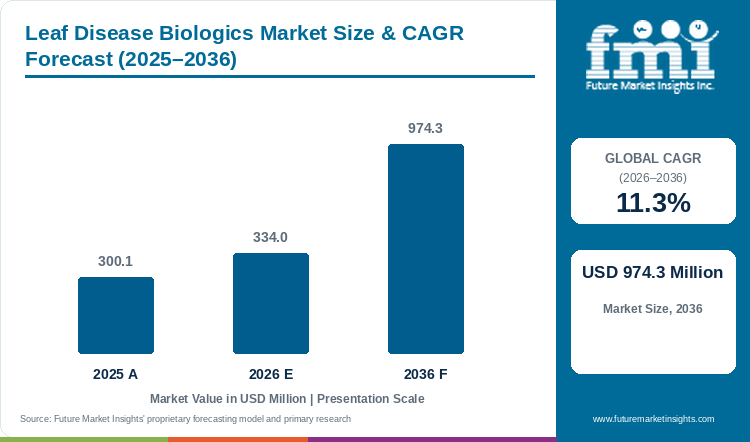
Accounting for USD 300.1 million in 2025 and rising to USD 334.0 million in 2026, the global leaf disease biologics market is projected to expand to USD 974.3 million by 2036, advancing at a CAGR of 11.3%.
Widespread pathogen insensitivity to single-site strobilurin and triazole fungicides and strict supermarket maximum residue limits are compelling commercial agronomists to integrate biological foliar sprays into seasonal crop-protection calendars. For instance, multi-location wheat trials in Anhui Province by Liao et al. in January 2026 showed that biological fungicide sprays targeting Fusarium head blight achieved 61.96% to 78.30% control efficacy and reduced deoxynivalenol mycotoxin levels by 65.58% to 75.56% [1]. Because rotating biologicals with fungicide active ingredients preserves chemical sensitivity while enabling zero-day pre-harvest sprays, global leaf disease biologics industry valuation equals USD 300.1 million in 2025, crossing USD 334.0 million in 2026 as an 11.3% compound annual pace lifts overall market size to USD 974.3 million by 2036 and generates USD 640.3 million in net market size expansion by 2036. However, ultraviolet spore degradation and bactericidal copper tank-mixes still penalize delicate fungal conidia, which is why the heat-tolerant Bacillus-Based segment is projected to reach 47.9% of active-type demand in 2026.
Key Market Trends & Insights
- By active type: Shelf-stable endospores and cyclic lipopeptide metabolites allow the Bacillus-Based segment to capture a projected 47.9% active-type share in 2026.
- By crop type: Preventive flag-leaf spray programs against wheat septoria and yellow rust allow Cereals & Grains to represent an expected 42.4% within the crop type segment in 2026.
- By application method: In 2026, Foliar Canopy Spray is estimated to command 54.6% of application-method demand through direct leaf-cuticle colonization and systemic resistance induction.
- By target setting: Broadacre grain rotations and commercial vineyard canopy protection support an anticipated 45.4% share for Open Field in the target setting category in 2026.
- By sales channel: Tank-mix compatibility advisory and cold-room biological storage support a forecast 46.4% sales-channel share for Agri-Input Distributors in 2026.
Regional Highlights
- Latin America and East Asia biocontrol momentum: Brazil leads country-level expansion at a projected 12.8% CAGR through 2036 ahead of South Korea at 12.1% under fast-track biofungicide registrations.
- North America and Europe integrated pest management: National CAGRs reach 11.6% for the USA and 11.4% for Spain alongside 10.9% for France, while Germany at 10.5% and the UK with 9.9% lead Japan at 9.4%.
Market Size & Forecast
Table 1: Market Size and Forecast for the Leaf Disease Biologics Market (USD million and CAGR percentage), 2025 to 2036
| Metric | Value |
|---|---|
| 2025 Market Size | USD 300.1 million |
| Estimated Market Size in 2026 | USD 334.0 million |
| Projected Market Size by 2036 | USD 974.3 million |
| CAGR, 2026 to 2036 | 11.3% |
| Added Revenue, 2026 to 2036 | USD 640.3 million |
Historically, inconsistent field control under heavy rain or high humidity held back grower confidence in first-generation biological fungicides. To overcome this limitation, crop protection formulators scaling Bacillus-based biofungicide suspensions now optimize fermentation titers of fengycin and iturin lipopeptides so sprays arrest fungal spore germination on contact even before live bacteria colonize the leaf. As a matter of fact, an August 2025 strawberry biocontrol study by Gao et al. established that Bacillus velezensis strain Gual21 inhibited Botrytis cinerea mycelial growth by 69.23% and cut detached-leaf lesion areas by 78.6% [2].
Treated Canopy Acreage and Spray-Program Sizing
Table 2: Treated Canopy Acreage and Spray-Program Sizing for the Leaf Disease Biologics Market (USD million and operational ranges), 2025 to 2036
| Metric | 2025 | 2026 | 2036 |
|---|---|---|---|
| Market size (USD million) | 300.1 | 334.0 | 974.3 |
| Foliar biological treated crop area (million hectares) | 11.2 to 12.8 | 12.4 to 14.2 | 32.0 to 36.5 |
| Average seasonal spray applications per hectare (passes) | 2.4 to 3.2 | 2.5 to 3.4 | 3.0 to 4.0 |
| Average grower expenditure per foliar biological pass (USD/ha) | 8.5 to 10.5 | 8.6 to 10.7 | 9.2 to 11.4 |
Operational note: Treated hectare and per-pass cost ranges reconcile USDA NASS agricultural chemical use surveys and European biopesticide acreage against commercial Bacillus and botanical elicitor label rates.
Growth in average seasonal biological applications from 2.5-3.4 passes per hectare in 2026 to 3.0-4.0 passes by 2036 occurs because foliar biofungicides act preventively through phyllosphere competition and induced systemic resistance rather than curative systemic eradication. When synthetic fungicides are locked out by 14-to-21-day pre-harvest intervals during late fruit ripening, growers step up biological spray frequency to keep export crops blemish-free. Consequently, formulators extracting saponins and polyphenols from standardized botanical extracts stabilize liquid concentrates that can be sprayed right up to harvest day without leaving regulated chemical residues.
Per Capita & Commercial Farm Sizing
Table 3: Per Capita and Farm Valuation Indicators for the Leaf Disease Biologics Market (USD), 2025 to 2036
| Metric | 2025 | 2026 | 2036 |
|---|---|---|---|
| World population (billion) | 8.2 | 8.3 | 9.0 |
| Market value per 1,000 people (USD) | 36.6 | 40.2 | 108.3 |
| Annual foliar biological spend per commercial grower (USD) | 680 to 820 | 740 to 890 | 1,650 to 1,980 |
| Integrated tank-mix rotation program share (%) | 61.0% to 65.0% | 63.0% to 67.0% | 75.0% to 80.0% |
Table 4: Agronomic & Segment Allocation Indicators for the Leaf Disease Biologics Market (USD and percentages), 2026
| Metric | Value | Institutional Reference Basis |
|---|---|---|
| Market size, 2026 | USD 334.0 million | 2026 global market valuation baseline |
| Registered microbial & botanical foliar labels globally | 1,450 registrations | EPA, EU SANTE, MAPA & MAFF biopesticide registries |
| Bacillus-based active allocation, 2026 | USD 160.0 million | 47.9% active type segment allocation |
| Foliar canopy spray allocation, 2026 | USD 182.4 million | 54.6% application method segment allocation |
Wider adoption of integrated tank-mix rotation programs, projected at 63.0% to 67.0% of treated acreage in 2026 before reaching 75.0% to 80.0% by 2036, shows that conventional farms rather than organic-only growers now drive the bulk of revenue growth. Because overwintering fungal spores in crop debris splash onto lower leaves during spring rain, commercial agronomists link early rhizosphere treatments with mid-season canopy sprays. To cut total seasonal disease pressure, growers pair root-zone applications of soil pathogen inhibitors with scheduled Bacillus subtilis flag-leaf and fruit-set sprays.
Analyst Perspective
"Grower conversion from synthetic contact fungicides to leaf disease biologics depends on strain-specific pathogen labels and verified tank-mix compatibility with copper or strobilurin partners under high humidity. Suppliers that back zero-day pre-harvest intervals with multi-season university trial data will secure core positions in spray rotations."
- Nikhil Kaitwade, Principal Consultant, Future Market Insights.
How is the leaf disease biologics market segmented?
The leaf disease biologics market is segmented by active type, crop type, application method, target setting, and sales channel. In 2026, Bacillus-Based is projected at 47.9%, Cereals & Grains at 42.4%, Foliar Canopy Spray at 54.6%, Open Field at 45.4%, and Agri-Input Distributors at 46.4%.
By active type: Bacillus-Based, Trichoderma & Fungal-Based, Botanical Extracts, and Bacteriophage & Yeast-Derived Elicitors.
By crop type: Cereals & Grains, Fruits & Vegetables, Oilseeds & Pulses, Turf & Ornamentals, and Others.
By application method: Foliar Canopy Spray, Preventive Soil & Root-Zone Drench, Seed & Transplant Dip Treatment, and Protected-Cropping Mist & Others.
By target setting: Open Field, Protected Cultivation, Post-Plant Canopy Rescue, and Others.
By sales channel: Agri-Input Distributors, Cooperatives, Agri-Retail Chains, Online / Direct-to-Farm, and Others.
Why does Bacillus-Based lead the active type segment?
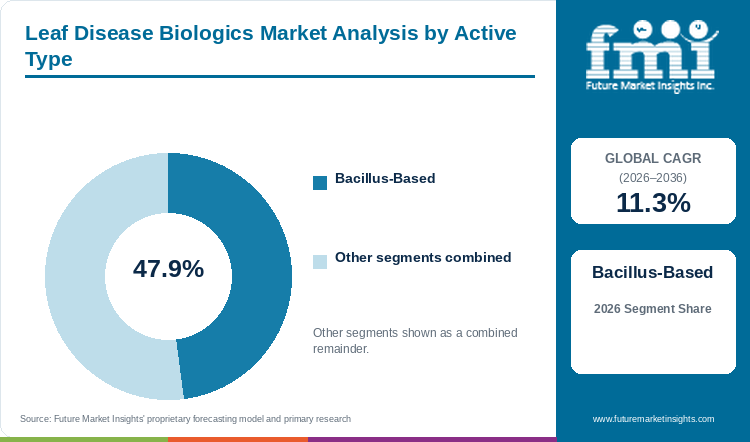
Heat-tolerant endospores and lipopeptide metabolites give the Bacillus-Based segment a projected 47.9% active-type share in 2026.
Table 5: Active Type Share for the Leaf Disease Biologics Market (percentage share), 2026
| Active Type | Share (2026) |
|---|---|
| Bacillus-Based | 47.9% |
| Other Segments Combined | 52.1% |
| Total | 100.0% |
Calculated as the balance remaining after deducting the leading segment's reported share from 100.0%.
Table 6: Active Type Leadership and Market Growth for the Leaf Disease Biologics Market (segment and CAGR percentage), 2026 to 2036
| Metric | Value |
|---|---|
| Global CAGR (2026 to 2036) | 11.3% |
| Leading Segment | Bacillus-Based |
Agricultural dealers and large farms hesitate to stock live fungal conidia or bacteriophages when those products require refrigerated storage and lose viability inside warm spray tanks. By contrast, Bacillus subtilis and Bacillus amyloliquefaciens form tough endospores that survive 24 months in ambient warehouses while secreting cyclic lipopeptides that perforate pathogen cell membranes on contact. Furthermore, formulators pairing bacterial spores with biological seed carriers and suspension stabilizers ensure uniform nozzle flow in commercial boom sprayers.
- Because endospores tolerate tank mixing with triazole and strobilurin partners, the Bacillus-Based segment is expected to command 47.9% of active-type demand in 2026.
- Broad specialty-crop label coverage reinforces this lead; for instance, Bayer Crop Science's January 2026 California technical bulletin for Serenade ASO (Bacillus subtilis strain QST 713) details foliar biofungicide spray programs across grapes and leafy greens plus berries and tree nuts [3].
What places Cereals & Grains first in the crop type segment?
In 2026, Cereals & Grains are expected to hold 42.4% of crop-type demand across broadacre wheat septoria and rice blast spray programs.
Declining field efficacy of conventional azole and succinate dehydrogenase inhibitor fungicides against Zymoseptoria tritici and yellow rust has created an urgent resistance-management gap across winter wheat and barley belts. Because protecting the upper flag leaf is essential for grain filling across millions of broadacre cereal and paddy-rice hectares, even a single biological spray pass at the T1 or T2 timing generates massive volume demand. Consequently, cereal growers establishing early stand vigor with seed health treatments follow up with preventive biological canopy sprays before foliar lesions erupt.
- Because wheat and rice estates integrate biologicals into resistance-management spray rotations, Cereals & Grains are expected to command 42.4% within the crop type segment in 2026.
- Multinational crop-protection leaders are licensing novel actives specifically for cereal foliar diseases; for example, in November 2025, Syngenta signed a memorandum of understanding with Amoéba to commercialize a Willaertia magna C2c Maky biofungicide targeting wheat septoria and yellow rust in the EU and UK [4].
How does Foliar Canopy Spray lead the application method category?
In 2026, Foliar Canopy Spray is estimated to command 54.6% of application-method demand through direct leaf-cuticle coverage and contact pathogen inhibition.
Airborne fungal spores such as powdery mildew and Botrytis gray mold land directly on upper and lower leaf cuticles, where root drenches or seed dips cannot deliver contact lipopeptides fast enough to stop infection. By applying biological suspensions through hydraulic boom sprayers and orchard air-blast atomizers ahead of wet weather, growers coat susceptible foliage and trigger localized phytoalexin defense pathways. In addition, protected-cropping operators pairing canopy sprays with greenhouse crop biostimulants keep leaves blemish-free across continuous tomato and berry harvests.
- Immediate contact fungistasis and zero-day pre-harvest spray flexibility allow Foliar Canopy Spray to capture an anticipated 54.6% application-method share in 2026.
- Greenhouse efficacy data strongly supports foliar delivery; specifically, summer squash trials by Martínez-Terrazas et al. in November 2025 proved that foliar sprays of Reynoutria sachalinensis extract and Trichoderma species reduced powdery mildew severity by 62% to 92% [5].
Why is Open Field the principal target setting?
Preventive canopy spraying across broadacre grain estates and commercial vineyards supports an anticipated 45.4% target-setting share for Open Field in 2026.
Unlike enclosed greenhouses where humidity and air filtration can be controlled, open-field cereals and vineyards face unbuffered rainfall and wind-borne spore showers that trigger rapid disease outbreaks. Historically, solar ultraviolet radiation degraded open-field biological sprays within days, but micro-encapsulated UV protectants and rainfast terpene stickers now preserve active efficacy across 7-to-10-day spray intervals. As a result, open-field wine-grape and row-crop estates deploy scheduled microbial sprays ahead of forecast rain events and throughout pre-harvest ripening.
- Large-scale vineyard Botrytis and broadacre cereal spray programs put Open Field at a forecast 45.4% target-setting share in 2026.
- Multi-country viticulture evidence confirms open-field reliability; for instance, a January 2026 systematic review and meta-analysis by Fessia et al. mapping vineyard biological control agents verified that open-field microbial antagonists significantly suppress Botrytis cinerea bunch rot [6].
Why do Agri-Input Distributors dominate the sales channel category?
Local pathogen scouting and tank-mix compatibility advisory support a forecast 46.4% share for Agri-Input Distributors across sales channels in 2026.
Improper tank-mix sequencing of a biological fungicide with alkaline water or copper hydroxide can kill live spores before the spray boom leaves the yard. Because commercial growers cannot afford a failed spray pass during peak disease pressure, farm managers turn to local agronomy dealers whose technical specialists scout canopies and verify safe tank-mix partners. Consequently, multinational biofungicide developers scale new botanical and microbial launches through exclusive regional distributor networks rather than direct online portals.
- Since commercial growers depend on local dealers for cold-room biological storage and on-farm spray calibration, Agri-Input Distributors are projected to represent 46.4% across sales channels in 2026.
- Major suppliers are expanding multi-country distributor agreements to capture this channel demand; for example, in February 2026, Syngenta and Botanical Solution Inc. expanded their exclusive distribution pact for the Quillaja saponaria-derived biofungicide Quillibrium across Mexico and North America [7].
What are the drivers, restraints, and opportunities in the leaf disease biologics market?
Across the leaf disease biologics market, synthetic fungicide resistance and strict supermarket residue caps drive preventive biological spray adoption, whereas tank-mix antagonism and strain-level registration delays restrain rapid conversion.
- Driver: Widespread pathogen resistance to single-site synthetic fungicides and zero-day pre-harvest residue requirements expand biological inclusion in seasonal spray calendars.
- Restraint: Multi-year strain-level regulatory dossiers and spore inactivation from incompatible tank-mix partners or ultraviolet exposure slow standalone biological replacement.
- Opportunity: Cell-free peptide and botanical elicitor formulations paired with broadacre wheat septoria biocontrol partnerships open large cereal and specialty-crop markets.
Growth Analysis and Future Potential: Qualitative Demand Catalysts
Supermarket chains and fruit exporters enforce secondary pesticide residue standards that cap both the concentration and total number of synthetic fungicide actives permitted on harvested produce, forcing growers to switch to biologicals during late fruiting stages. For instance, July 2025 bell pepper biocontrol experiments by Mishu et al. established that applying Bacillus subtilis strain HA1 culture filtrate to foliage suppressed Alternaria alternata leaf spot while elevating endogenous salicylic acid and antioxidant enzyme defenses under salt stress [8]. Because cell-free filtrates and microbial sprays boost host immunity without leaving synthetic chemical residues, growers protecting moisture-stressed canopies with drought recovery biologics integrate biological fungicides across late-season spray passes.
Risk Assessment of the Leaf Disease Biologics Market: Operational and Formulation Friction
Field performance of live microbial and botanical biofungicides drops sharply if operators mix them into unbuffered alkaline spray water or incompatible chemical tanks. Specifically, chili powdery mildew evaluations by Ghosh et al. in May 2025 revealed that combining green chili fruit botanical extract with Bacillus subtilis achieved 81.9% disease reduction only when spray water pH and surfactant levels were buffered to preserve bacterial viability [9]. Furthermore, Bioceres Crop Solutions disclosed in September 2026 that Pro Farm Group had been classified as discontinued operations following January 2026 creditor proceedings, which shows why buyers qualifying seedling stress protectors audit long-term vendor stability [10].
Commercial Opportunity Analysis: Formulation Differentiation and Value-Add Formats
Overcoming grower skepticism in high-value vineyards and orchards requires multi-season field proof showing that biological antagonists protect pruning wounds and fruit clusters just as reliably as chemical standards. For instance, Andermatt Group documented multi-year European vineyard field trials in November 2025 for its T-77 (Trichoderma atroviride strain I-1237) biofungicide that confirmed consistent protection against Botrytis bunch rot and grapevine trunk diseases ahead of broader registration [11]. When formulators pair proven fungal antagonists and cell-free peptides with microclimate infection alerts from smart crop-monitoring platforms, growers can apply preventive sprays 24 to 48 hours before spore germination.
Leaf Disease Biologics Market by Country (2026 to 2036)
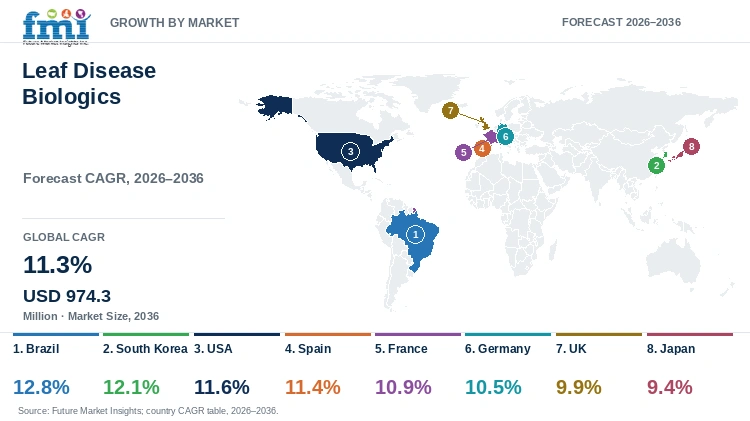
Brazil leads national leaf disease biologics expansion at a projected 12.8% CAGR through 2036, followed by South Korea at 12.1% and the USA with 11.6%, while Japan advances at a forecast 9.4% yearly pace. National adoption differs according to fast-track biofungicide registration timelines, tropical soybean rust pressure, and European supermarket residue scoring.
Table 7: Country CAGR and Primary Growth Levers for the Leaf Disease Biologics Market (CAGR percentage and operational drivers), 2026 to 2036
| Country | CAGR (2026 to 2036) | Primary Growth Lever |
|---|---|---|
| Brazil | 12.8% | MAPA Bioinsumos fast-track approvals and multi-site Bacillus sprays for soybean Asian rust and target spot |
| South Korea | 12.1% | Eco-friendly microbial disease-control pipeline for greenhouse cucurbits and paddy rice |
| USA | 11.6% | Zero-day PHI foliar biofungicide registrations and engineered microbial investments across specialty and row crops |
| Spain | 11.4% | Almería and Murcia export greenhouse MRL-compliance programs and vineyard Botrytis biocontrol |
| France | 10.9% | Écophyto 2030 biocontrol list incentives across Bordeaux vineyards and winter wheat septoria rotations |
| Germany | 10.5% | Strategic crop-protection R&D investment and supermarket residue scoring across pome fruit and cereals |
| UK | 9.9% | Integrated foliar blight and winter wheat septoria spray programs across commercial arable estates |
| Japan | 9.4% | Cyclic lipopeptide elicitor research and JA cooperative microbial sprays in rice and horticulture |
Source: Future Market Insights analysis
Brazil Leaf Disease Biologics Market Outlook (2026 to 2036)
In Brazil, commercial grower uptake of leaf disease biologics is projected to expand at a leading 12.8% CAGR over the 2026-to-2036 period, driven by large soybean and maize producers tank-mixing multi-strain Bacillus suspensions with multisite protectant fungicides under Ministry of Agriculture Bioinsumos regulatory pathways. Unlike temperate single-season cropping, continuous tropical cropping across Mato Grosso and Paraná creates year-round inoculum bridges for Asian soybean rust (Phakopsora pachyrhizi) and target spot (Corynespora cassiicola) that quickly erode synthetic triazole efficacy. In fact, soybean field trials in Brazil by Moreira et al. in June 2025 proved that commercial foliar biofungicides combined with soluble potassium silicate controlled target spot and Asian rust while preserving grain weight [12].
Key takeaway: In Brazil, severe Asian soybean rust resistance to synthetic fungicides and fast-track Bioinsumos registrations are projected to drive 12.8% annual market growth.
South Korea Leaf Disease Biologics Market Outlook (2026 to 2036)
Intensive paddy-rice cultivation and high-density greenhouse strawberry and cucurbit production in South Korea face strict Positive List System pesticide residue audits that penalize late-season chemical sprays. At the same time, bacterial leaf blight in rice requires selective control agents that do not wipe out beneficial phyllosphere bacteria. For instance, February 2026 plant pathology studies by Win et al. at Kyung Hee University in South Korea evaluated selective bacteriostatic control against Xanthomonas oryzae pv. oryzae rice bacterial leaf blight while benchmarking sensitivity windows against beneficial Bacillus pumilus and Pseudomonas biocontrol strains [13]. In South Korea, commercial foliar biological usage is expected to climb at a 12.1% CAGR through 2036 because cooperatives prioritize stain-free microbial suspensions.
Key takeaway: In South Korea, microbial biocontrol formulations and Positive List System residue caps are expected to sustain 12.1% annual growth.
USA Leaf Disease Biologics Market Outlook (2026 to 2036)
Multi-pick harvesting schedules across California vineyards and Florida vegetable farms make the USA highly reliant on foliar biofungicides that carry four-hour restricted-entry intervals and zero-day pre-harvest clearances. However, expanding biological adoption from coastal specialty crops into Midwest corn and soybean acreage requires engineered microbial strains that match the lower per-acre cost of synthetic chemistry. To accelerate this shift, Bayer AG and Robigo announced Series A financing in September 2026 through Leaps by Bayer to advance engineered biologicals that protect crop yields and reduce grower treatment costs in the USA [14]. Across the USA, grower adoption of leaf disease biologics is anticipated to advance at an 11.6% CAGR through 2036, supported by EPA biopesticide registrations.
Key takeaway: In the USA, engineered microbial investments and zero-day pre-harvest intervals are anticipated to support specialty and row-crop expansion.
Spain Leaf Disease Biologics Market Outlook (2026 to 2036)
Export horticulture cooperatives in Almería and Murcia and Mediterranean wine-grape estates in Spain must comply with Northern European supermarket buyer protocols that cap chemical fungicide residues at 30% to 50% of statutory EU maximum residue limits. To capture this export-driven demand, Koppert Biological Systems and Amoéba signed a five-year distribution agreement in June 2025 to commercialize an innovative biofungicide based on Willaertia magna C2c Maky lysate for grapevines and protected vegetables across Spain and European markets [15]. Foliar biofungicide consumption in Spain is forecast to grow at an 11.4% annual rate from 2026 to 2036, owing to continuous winter greenhouse picking windows that prohibit long chemical pre-harvest intervals.
Key takeaway: In Spain, supermarket residue specifications across Almería greenhouses and Mediterranean vineyards are forecast to drive 11.4% annual growth.
France Leaf Disease Biologics Market Outlook (2026 to 2036)
Across France, expenditure on leaf disease biologics is predicted to rise at a 10.9% CAGR through 2036 under national Écophyto 2030 pesticide-reduction mandates and official Ministry of Agriculture biocontrol tax incentives. Strict European limits on annual copper accumulation per hectare across Champagne and Bordeaux wine estates force vineyard managers in France to substitute Trichoderma and amoeba-lysate elicitors against downy mildew and Botrytis. For example, Koppert Biological Systems invested in Lyon-based biocontrol developer Amoéba in July 2025 to accelerate joint commercialization and regulatory rollouts of its biofungicide technology in France [16]. Even so, wet spring weather across northern wheat basins in France still requires pairing biologicals with reduced-rate triazoles.
Key takeaway: In France, Écophyto 2030 biocontrol incentives and wheat septoria resistance management are predicted to anchor demand across arable and vineyard cooperatives.
Germany Leaf Disease Biologics Market Outlook (2026 to 2036)
Food-retail chains in Germany enforce strict private-label residue scoring that penalizes pome-fruit and vegetable suppliers whenever harvested crops contain more than three or four detectable synthetic fungicide actives. Consequently, orchardists in Baden-Württemberg and Lower Saxony switch to Bacillus and Trichoderma sprays after petal fall so early-season chemical residues degrade before harvest. At the same time, domestic crop-protection R&D in Germany is shifting toward biologicals; for instance, Bayer AG announced in May 2025 that its Crop Science division in Germany will concentrate research and production in Monheim and Dormagen on strategic technologies and biological solutions [17]. In Germany, grower procurement of leaf disease biologics is estimated to progress at a 10.5% annual rate between 2026 and 2036 through orchard and cereal IPM programs.
Key takeaway: In Germany, domestic crop-protection R&D investment and supermarket residue scoring systems are estimated to guide orchard and cereal biofungicide adoption.
UK Leaf Disease Biologics Market Outlook (2026 to 2036)
Persistent maritime rainfall across eastern and southern arable regions of the UK creates intense pressure from potato late blight (Phytophthora infestans) and wheat septoria (Zymoseptoria tritici), rapidly selecting for fungicide-resistant pathogen strains. As a matter of fact, technical agronomy guidance issued by Corteva Agriscience in the UK in May 2026 emphasized combining multi-mode foliar chemistry with integrated resistance-management practices to protect potato canopies in 2026 [18]. Across the UK, commercial foliar biological spray programs are slated to progress at a 9.9% CAGR from 2026 to 2036 around Bacillus amyloliquefaciens strain FZB24 (Taegro) in protected horticulture and early T0 wheat elicitor sprays, though independent national regulatory reviews in the UK still lengthen label approvals.
Key takeaway: In the UK, integrated foliar blight resistance management and maritime wheat septoria pressure are slated to shape distributor spray programs.
Japan Leaf Disease Biologics Market Outlook (2026 to 2036)
High summer humidity and seasonal typhoon rainfall across irrigated paddy rice and greenhouse strawberry districts in Japan cause rapid wash-off of conventional contact powders, making systemic host-defense induction a priority for local growers. According to a February 2026 biochemical review by Yokota at Tokyo University of Agriculture in Japan, cyclic lipopeptides synthesized by biocontrol Bacillus strains function primarily as plant defense elicitors that trigger systemic resistance against foliar pathogens rather than relying solely on surface antibiosis [19]. Because systemic elicitation protects new leaf growth between monsoon showers, leaf disease biologics demand across Japan is likely to record a 9.4% CAGR through 2036, supported by prefectural JA cooperative spray calendars.
Key takeaway: In Japan, Bacillus cyclic lipopeptide elicitor research and prefecture-level JA cooperative trials are likely to sustain steady adoption of registered microbial biofungicides.
Full report country CAGRs cover: North America; Latin America; Western Europe; Eastern Europe; East Asia; South Asia and Pacific; Middle East and Africa.
Who are the notable companies in the leaf disease biologics market?
Andermatt Group, ProFarm (Bioceres), BioWorks, Bayer Crop Science, Syngenta, Corteva Agriscience, Certis Biologicals, and Koppert Biological Systems are the notable companies in the leaf disease biologics market.
Supplier positioning across leaf disease biologics is shaped by whether a vendor owns proprietary microbial strain libraries or global broadacre fungicide distribution channels. Andermatt Group and BioWorks with Certis Biologicals manufacture strain-specific Bacillus and Trichoderma foliar biofungicides supported by detailed tank-mix compatibility charts for specialty crops. Bayer Crop Science and Syngenta plus Corteva Agriscience pair global broadacre and vineyard fungicide portfolios with licensed microbial and botanical foliar actives. Meanwhile, ProFarm (Bioceres) and Koppert Biological Systems supply plant-elicitor extracts and protected-cropping fungal antagonists.
- Specialist Microbial & Botanical Biofungicide Formulators: Andermatt Group and BioWorks along with ProFarm (Bioceres) and Certis Biologicals supply registered Bacillus, Trichoderma, and Reynoutria foliar disease-control formulations.
- Integrated Multinational Crop-Protection Platforms: Bayer Crop Science and Syngenta as well as Corteva Agriscience combine global broadacre and specialty fungicide portfolios with biological foliar licensing and distribution.
- Protected-Cropping & Horticultural Biological IPM Specialists: Koppert Biological Systems delivers foliar and root-zone microbial biofungicides integrated with greenhouse crop-health advisory.
Competitive Benchmarking: Leaf Disease Biologics Market
Table 8: Competitive Benchmarking for the Leaf Disease Biologics Market (qualitative capability ratings), 2026
| Company | Foliar Pathogen Label Breadth | Tank-Mix & Shelf Stability | Agronomic Program Guidance | Geographic Reach |
|---|---|---|---|---|
| Andermatt Group | High | High | High | High |
| ProFarm (Bioceres) | High | High | Medium | Medium |
| BioWorks | High | High | High | Medium |
| Bayer Crop Science | High | High | High | High |
| Syngenta | High | High | High | High |
| Corteva Agriscience | Medium | High | High | High |
| Certis Biologicals | High | High | High | High |
| Koppert Biological Systems | High | Medium | High | High |
Scoring basis: Capability ratings evaluate documented foliar fungal and bacterial disease claims on approved labels and spore or extract shelf stability plus published field spray protocols. Geographic reach reflects multi-country pesticide authorizations and distributor access.
Key Developments in the Leaf Disease Biologics Market
- Owning proprietary natural-product strain libraries speeds up biofungicide discovery; for instance, Syngenta strengthened its global agricultural biologicals R&D pipeline in February 2025 by acquiring Novartis's repository of natural compounds and genetic strains [20].
- On-orchard demonstration trials are essential to convert commercial pome and stone fruit growers; for example, Andermatt Group convened its International Fruit Grower Event at Lake Constance in June 2025 to present biological foliar disease management strategies [21].
- Export vegetable and berry growers in Latin America require localized biorational spray support; as a matter of fact, Certis Biologicals launched its Certis Agro Mexico technical platform in June 2025 to broaden grower access to Double Nickel and LifeGard biofungicides [22].
Key Players in the Leaf Disease Biologics Market
Specialist Microbial & Botanical Biofungicide Formulators
- Andermatt Group
- ProFarm (Bioceres)
- BioWorks
- Certis Biologicals
Integrated Multinational Crop-Protection Platforms
- Bayer Crop Science
- Syngenta
- Corteva Agriscience
Protected-Cropping & Horticultural Biological IPM Specialists
- Koppert Biological Systems
Leaf Disease Biologics Market - Report Scope
Table 9: Report Scope for the Leaf Disease Biologics Market (coverage fields and definitions), 2026 to 2036
| Coverage field | Report scope |
|---|---|
| Market breakdown | Active Type; Crop Type; Application Method; Target Setting; Sales Channel; Region |
| Quantitative Units | USD Million |
| Market Definition | Includes commercial manufacturer and formulator revenue from registered microbial (Bacillus, Trichoderma, Streptomyces, yeast), botanical extract (Reynoutria, Quillaja, tea-tree), bacteriophage, and peptide biological plant-protection products sold for named leaf or canopy fungal and bacterial disease management. Soil or seed-delivered products are included only where an approved label indication establishes systemic or preventive foliar disease control. Category Scope Note: Excludes synthetic chemical fungicides, root-only nematicides, insecticidal peptides and entomopathogenic nematodes, bioherbicides, and non-pesticidal biostimulant fertilizers. |
| Regions Covered | North America; Latin America; Western Europe; Eastern Europe; East Asia; South Asia and Pacific; Middle East and Africa |
| Countries Covered | Brazil, South Korea, USA, Spain, France, Germany, UK, Japan, and additional countries in the full report |
| Key Companies Covered | Andermatt Group, ProFarm (Bioceres), BioWorks, Bayer Crop Science, Syngenta, Corteva Agriscience, Certis Biologicals, Koppert Biological Systems |
| Forecast Period | 2026 to 2036 |
| Approach | Primary and secondary research with top-down and bottom-up market triangulation. |
Leaf Disease Biologics Market - Research Methodology
Table 10: Research Methodology for the Leaf Disease Biologics Market (research methods and approach), 2026 edition
| Method | Approach |
|---|---|
| Primary Research | Structured interviews with crop-protection regulatory affairs directors, university plant pathologists, vineyard and cereal agronomists, and agri-input distributor technical managers across North America, Latin America, Europe, and East Asia to validate foliar spray passes and per-hectare pricing. |
| Secondary Research | Analysis of peer-reviewed PubMed foliar biocontrol trials, Bayer Serenade ASO California technical bulletins, Syngenta and Koppert amoeba-biofungicide partnerships, Andermatt European vineyard trials, and corporate financial disclosures. |
| Market Sizing and Forecasting | Bottom-up foliar biological treated crop hectares multiplied by average seasonal spray passes and grower expenditure per hectare across cereals, fruits/vegetables, oilseeds, and specialty crops from 2025 to 2036. |
| Country Forecasting Model | Econometric country projections weight registered biofungicide active labels, foliar fungal resistance prevalence, supermarket MRL compliance pressure, and national chemical-pesticide reduction mandates across eight agricultural markets. |
| Operational Benchmark Traceability | Treated canopy acreage and spray-program cost indicators in Tables 2, 3, and 4 trace to USDA NASS chemical use datasets, national biopesticide label registries, university extension trials, and distributor price lists. |
| Data Triangulation and Validation | Demand estimates are cross-checked against commercial microbial fermentation and botanical extraction volumes without double counting root-only soil fungicides, bioinsecticides, entomopathogenic nematodes, or biostimulant fertilizers. |
Leaf Disease Biologics Market by Segments
Leaf Disease Biologics Market segmented by Active Type:
- Bacillus-Based
- Trichoderma & Fungal-Based
- Botanical Extracts
- Bacteriophage & Yeast-Derived Elicitors
Leaf Disease Biologics Market segmented by Crop Type:
- Cereals & Grains
- Fruits & Vegetables
- Oilseeds & Pulses
- Turf & Ornamentals
- Others
Leaf Disease Biologics Market segmented by Application Method:
- Foliar Canopy Spray
- Preventive Soil & Root-Zone Drench
- Seed & Transplant Dip Treatment
- Protected-Cropping Mist & Others
Leaf Disease Biologics Market segmented by Target Setting:
- Open Field
- Protected Cultivation
- Post-Plant Canopy Rescue
- Others
Leaf Disease Biologics Market segmented by Sales Channel:
- Agri-Input Distributors
- Cooperatives
- Agri-Retail Chains
- Online / Direct-to-Farm
- Others
Leaf Disease Biologics Market by Region
- North America
- United States
- Canada
- Latin America
- Brazil
- Mexico
- Argentina
- Chile
- Western Europe
- Germany
- France
- United Kingdom
- Italy
- Spain
- Benelux
- Nordics
- Eastern Europe
- Poland
- Czech Republic
- Romania
- Hungary
- East Asia
- China
- Japan
- South Korea
- South Asia and Pacific
- India
- ASEAN
- Australia and New Zealand
- Middle East and Africa
- GCC Countries
- South Africa
- Türkiye
- Israel
Research Sources and Bibliography
- [1] Liao, Y., et al. (2026, January 02). Control Efficiency and Yield-Increasing Effects of Main Wait-to-Promote Biological Fungicides Against Wheat Fusarium Head Blight in Anhui Province. PubMed (PMID 41590449).
- [2] Gao, S., et al. (2025, August 07). Identification of Bacillus velezensis Gual21 and its antifungal effects on gray mold of strawberry. PubMed (PMID 40851872).
- [3] Bayer CropScience LP. (2026, January 15). Serenade® ASO Biological Fungicide. Bayer Crop Science California Technical Bulletin.
- [4] Syngenta Group. (2025, November 18). A natural breakthrough in protecting cereals and field crops. Syngenta Media Releases.
- [5] Martínez-Terrazas, E., et al. (2025, November 19). Botanical extracts and Trichoderma spp. show greenhouse efficacy against Erysiphe cichoracearum and Podosphaera xanthii in summer squash. PubMed (PMID 41261527).
- [6] Fessia, A., et al. (2026, January 09). Exploring biological control agents mapping in grapes and wine: Systematic review and meta-analysis. PubMed (PMID 41405427).
- [7] Syngenta Group. (2026, February 19). From Chile's Forests to Fields, Syngenta brings botanical-based biofungicide to the Americas. Syngenta Media Releases.
- [8] Mishu, N. J., et al. (2025, July 30). Foliar Application of Bacillus subtilis HA1 Culture Filtrate Enhances Bell Pepper Growth and Suppresses Alternaria alternata Under Salt Stress by Modulating Hormonal, Antioxidant, and Defense Responses. PubMed (PMID 40737253).
- [9] Ghosh, A., et al. (2025, May 29). Management of chili powdery mildew using green chili fruit extract combined with Bacillus subtilis. PubMed (PMID 40439763).
- [10] Bioceres Crop Solutions Corp. (2026, September 14). Bioceres Crop Solutions Reports Fiscal Fourth Quarter and Full-Year 2026 Financial and Operating Results. Bioceres Crop Solutions Investor Relations.
- [11] Andermatt Group AG. (2025, November 05). Shielding Vines from Botrytis and Trunk Disease - T-77®'s Journey to European Vineyards. Andermatt Group Corporate News.
- [12] Moreira, R. F., et al. (2025, June 12). Biofungicides and silicon control target spot and Asian rust in soybean. PubMed (PMID 40572253).
- [13] Win, K. T. Y. S., et al. (2026, February 01). Potent Bacteriostatic Activity of a Naphthalene-2-Acyl Imidazolium Salt against Xanthomonas oryzae pv. oryzae. PubMed (PMID 41656723).
- [14] Bayer AG. (2026, September 17). Robigo and Leaps by Bayer Announce Series A Financing to Advance Engineered Biologicals That Protect Yields and Reduce Costs. Bayer Global Media Releases.
- [15] Koppert Biological Systems. (2025, June 02). Koppert and Amoéba sign major distribution agreement for innovative biofungicide solution. Koppert Corporate Newsroom.
- [16] Koppert Biological Systems. (2025, July 23). Koppert invests in Amoéba to strengthen strategic collaboration. Koppert Corporate Newsroom.
- [17] Bayer AG. (2025, May 12). Bayer to focus production, research and development of its Crop Science division in Germany on strategic technologies. Bayer Global Media Releases.
- [18] Corteva Agriscience. (2026, May 27). Tackling potato late blight in 2026. Corteva Agriscience UK Newsroom.
- [19] Yokota, K. (2026, February 23). Bacillus cyclic lipopeptide; elicitors to induce disease resistance in biological control of plant diseases. PubMed (PMID 41453203).
- [20] Syngenta Group. (2025, February 26). Syngenta strengthens global leadership in agricultural biologicals. Syngenta Media Releases.
- [21] Andermatt Group AG. (2025, July 15). International Fruit Grower Event at Lake Constance, June 2025. Andermatt Group Corporate News.
- [22] Certis Biologicals. (2025, June 05). Certis Agro Mexico Website Officially Launches. Certis Biologicals Press Releases.
- [23] Corteva Agriscience. (2025, June 04). Corteva Will Launch Forcivo™ Fungicide with Triple-Action Foliar Disease Control. Corteva Agriscience US Press Releases.
This bibliography is provided for reader reference and is not exhaustive. The full report contains the complete reference list and detailed citations.
This Report Answers
- How large is the leaf disease biologics market in 2026 and what is forecast for 2036?
- Which fungicide-resistance and supermarket residue pressures support biological foliar sprays?
- Why does Bacillus-Based lead the active type segment?
- Why does Cereals & Grains lead crop type demand globally?
- How do growth rates differ across Brazil, South Korea, the USA, Spain, and France?
- Which companies supply microbial, botanical, and peptide foliar disease-control products?
- What tank-mix compatibility and strain-authorization factors delay grower conversion?
- What label and field-trial evidence should agronomists verify before purchasing?
Frequently Asked Questions
How big is the leaf disease biologics market in 2026, and what is forecast for 2036?
Global leaf disease biologics market value reaches USD 334.0 million in 2026 following USD 300.1 million in 2025, with projections climbing to USD 974.3 million by 2036 as commercial growers integrate microbial and botanical foliar protectants into resistance-management calendars.
What is the CAGR for the leaf disease biologics market from 2026 to 2036?
Global foliar biological demand is slated to advance at an 11.3% compound annual clip from 2026 through 2036, adding USD 640.3 million in annual market revenue across broadacre and horticultural spray programs.
Which active type segment leads the leaf disease biologics market?
The Bacillus-Based segment is projected to account for a 47.9% active-type share in 2026 because unrefrigerated spore shelf stability and multi-site lipopeptides protect treated foliage.
Which crop type segment leads the leaf disease biologics market?
Broadacre flag-leaf spray rotations against wheat septoria and rice blast give Cereals & Grains an expected 42.4% crop-type share in 2026.
Which country has a notable growth outlook during the assessment period?
Brazil leads country-level growth projections at a 12.8% CAGR through 2036, driven by fast-track MAPA Bioinsumos approvals and soybean Asian rust tank-mix programs.
Who are the key players in the market?
Andermatt Group, ProFarm (Bioceres), BioWorks, Bayer Crop Science, Syngenta, Corteva Agriscience, Certis Biologicals, and Koppert Biological Systems supply registered microbial and botanical foliar disease-control solutions.
Preview the report firsthand - request a free sample
Get SampleGet the brochure for pricing and purchase details.
Get PDFTable of Content
- Key Takeaways
- Market Size and CAGR
- Top Growth Driver
- Fastest Growing Segment
- Leading Region
- Key Companies
- Emerging Opportunities
- Executive Summary
- Global Market Outlook
- Demand-side Trends
- Supply-side Trends
- Technology Roadmap Analysis
- Analysis and Recommendations
- Analyst Perspective (What is happening? Why now? What should investors know?)
- Key Questions Answered
- How large is the market?
- What is the CAGR?
- What are key trends?
- Which region dominates?
- Who are the leaders?
- Market Overview
- Market Coverage / Taxonomy
- Market Definition / Scope / Limitations
- Research Methodology
- Chapter Orientation
- Analytical Lens and Working Hypotheses
- Market Structure, Signals, and Trend Drivers
- Benchmarking and Cross-market Comparability
- Market Sizing, Forecasting, and Opportunity Mapping
- Research Design and Evidence Framework
- Desk Research Programme (Secondary Evidence)
- Expert Input and Fieldwork (Primary Evidence)
- Tooling, Models, and Reference Databases
- Data Engineering and Model Build
- Quality Assurance and Audit Trail
- Market Background
- Market Dynamics (Drivers, Restraints, Opportunity, Trends)
- Scenario Forecast (Optimistic, Likely, Conservative)
- Impact Analysis
- AI Impact
- Sustainability Impact
- Regulatory Impact
- Technology Impact
- Consumer / Buyer Analysis
- Purchase Drivers
- Adoption Barriers
- Buyer Journey
- Opportunity Map Analysis
- Product Life Cycle Analysis
- Supply Chain Analysis
- Investment Feasibility Matrix
- Value Chain Analysis
- PESTLE and Porter's Analysis
- Regulatory Landscape
- Regional Parent Market Outlook
- Production and Consumption Statistics
- Import and Export Statistics
- Global Market Analysis and Forecast, 2021 to 2036
- Historical Market Size Value (USD Million) Analysis, 2021 to 2025
- Current and Future Market Size Value (USD Million) Projections, 2026 to 2036
- Y-o-Y Growth Trend Analysis
- Absolute $ Opportunity Analysis
- Global Market Pricing Analysis, 2021 to 2036
- Global Market Analysis and Forecast, By Active Type, 2021 to 2036
- Introduction / Key Findings
- Historical Market Size Value (USD Million) Analysis By Active Type, 2021 to 2025
- Current and Future Market Size Value (USD Million) Analysis and Forecast By Active Type, 2026 to 2036
- Bacillus-Based
- Trichoderma & Fungal-Based
- Botanical Extracts
- Bacteriophage & Yeast-Derived Elicitors
- Y-o-Y Growth Trend Analysis By Active Type, 2021 to 2025
- Absolute $ Opportunity Analysis By Active Type, 2026 to 2036
- Global Market Analysis and Forecast, By Crop Type, 2021 to 2036
- Introduction / Key Findings
- Historical Market Size Value (USD Million) Analysis By Crop Type, 2021 to 2025
- Current and Future Market Size Value (USD Million) Analysis and Forecast By Crop Type, 2026 to 2036
- Cereals & Grains
- Fruits & Vegetables
- Oilseeds & Pulses
- Turf & Ornamentals
- Others
- Y-o-Y Growth Trend Analysis By Crop Type, 2021 to 2025
- Absolute $ Opportunity Analysis By Crop Type, 2026 to 2036
- Global Market Analysis and Forecast, By Application Method, 2021 to 2036
- Introduction / Key Findings
- Historical Market Size Value (USD Million) Analysis By Application Method, 2021 to 2025
- Current and Future Market Size Value (USD Million) Analysis and Forecast By Application Method, 2026 to 2036
- Foliar Canopy Spray
- Preventive Soil & Root-Zone Drench
- Seed & Transplant Dip Treatment
- Protected-Cropping Mist & Others
- Y-o-Y Growth Trend Analysis By Application Method, 2021 to 2025
- Absolute $ Opportunity Analysis By Application Method, 2026 to 2036
- Global Market Analysis and Forecast, By Target Setting, 2021 to 2036
- Introduction / Key Findings
- Historical Market Size Value (USD Million) Analysis By Target Setting, 2021 to 2025
- Current and Future Market Size Value (USD Million) Analysis and Forecast By Target Setting, 2026 to 2036
- Open Field
- Protected Cultivation
- Post-Plant Canopy Rescue
- Others
- Y-o-Y Growth Trend Analysis By Target Setting, 2021 to 2025
- Absolute $ Opportunity Analysis By Target Setting, 2026 to 2036
- Global Market Analysis and Forecast, By Sales Channel, 2021 to 2036
- Introduction / Key Findings
- Historical Market Size Value (USD Million) Analysis By Sales Channel, 2021 to 2025
- Current and Future Market Size Value (USD Million) Analysis and Forecast By Sales Channel, 2026 to 2036
- Agri-Input Distributors
- Cooperatives
- Agri-Retail Chains
- Online / Direct-to-Farm
- Others
- Y-o-Y Growth Trend Analysis By Sales Channel, 2021 to 2025
- Absolute $ Opportunity Analysis By Sales Channel, 2026 to 2036
- Global Market Analysis and Forecast, By Region, 2021 to 2036
- Introduction
- Historical Market Size Value (USD Million) Analysis By Region, 2021 to 2025
- Current Market Size Value (USD Million) Analysis and Forecast By Region, 2026 to 2036
- North America
- Latin America
- Western Europe
- Eastern Europe
- East Asia
- South Asia and Pacific
- Middle East and Africa
- Market Attractiveness Analysis By Region
- North America Market Analysis and Forecast, By Country, 2021 to 2036
- Historical Market Size Value (USD Million) Trend Analysis By Market Taxonomy, 2021 to 2025
- Market Size Value (USD Million) Forecast By Market Taxonomy, 2026 to 2036
- By Country
- United States
- Canada
- By Active Type
- By Crop Type
- By Application Method
- By Target Setting
- By Sales Channel
- By Country
- Market Attractiveness Analysis
- By Country
- By Active Type
- By Crop Type
- By Application Method
- By Target Setting
- By Sales Channel
- Key Takeaways
- Latin America Market Analysis and Forecast, By Country
- Historical Market Size Value (USD Million) Trend Analysis By Market Taxonomy, 2021 to 2025
- Market Size Value (USD Million) Forecast By Market Taxonomy, 2026 to 2036
- By Country
- Brazil
- Mexico
- Argentina
- Chile
- By Active Type
- By Crop Type
- By Application Method
- By Target Setting
- By Sales Channel
- By Country
- Market Attractiveness Analysis
- By Country
- By Active Type
- By Crop Type
- By Application Method
- By Target Setting
- By Sales Channel
- Key Takeaways
- Western Europe Market Analysis and Forecast, By Country
- Historical Market Size Value (USD Million) Trend Analysis By Market Taxonomy, 2021 to 2025
- Market Size Value (USD Million) Forecast By Market Taxonomy, 2026 to 2036
- By Country
- Germany
- France
- United Kingdom
- Italy
- Spain
- Benelux
- Nordics
- By Active Type
- By Crop Type
- By Application Method
- By Target Setting
- By Sales Channel
- By Country
- Market Attractiveness Analysis
- By Country
- By Active Type
- By Crop Type
- By Application Method
- By Target Setting
- By Sales Channel
- Key Takeaways
- Eastern Europe Market Analysis and Forecast, By Country
- Historical Market Size Value (USD Million) Trend Analysis By Market Taxonomy, 2021 to 2025
- Market Size Value (USD Million) Forecast By Market Taxonomy, 2026 to 2036
- By Country
- Poland
- Czech Republic
- Romania
- Hungary
- By Active Type
- By Crop Type
- By Application Method
- By Target Setting
- By Sales Channel
- By Country
- Market Attractiveness Analysis
- By Country
- By Active Type
- By Crop Type
- By Application Method
- By Target Setting
- By Sales Channel
- Key Takeaways
- East Asia Market Analysis and Forecast, By Country
- Historical Market Size Value (USD Million) Trend Analysis By Market Taxonomy, 2021 to 2025
- Market Size Value (USD Million) Forecast By Market Taxonomy, 2026 to 2036
- By Country
- China
- Japan
- South Korea
- By Active Type
- By Crop Type
- By Application Method
- By Target Setting
- By Sales Channel
- By Country
- Market Attractiveness Analysis
- By Country
- By Active Type
- By Crop Type
- By Application Method
- By Target Setting
- By Sales Channel
- Key Takeaways
- South Asia and Pacific Market Analysis and Forecast, By Country
- Historical Market Size Value (USD Million) Trend Analysis By Market Taxonomy, 2021 to 2025
- Market Size Value (USD Million) Forecast By Market Taxonomy, 2026 to 2036
- By Country
- India
- ASEAN
- Australia and New Zealand
- By Active Type
- By Crop Type
- By Application Method
- By Target Setting
- By Sales Channel
- By Country
- Market Attractiveness Analysis
- By Country
- By Active Type
- By Crop Type
- By Application Method
- By Target Setting
- By Sales Channel
- Key Takeaways
- Middle East and Africa Market Analysis and Forecast, By Country
- Historical Market Size Value (USD Million) Trend Analysis By Market Taxonomy, 2021 to 2025
- Market Size Value (USD Million) Forecast By Market Taxonomy, 2026 to 2036
- By Country
- GCC Countries
- South Africa
- Türkiye
- Israel
- By Active Type
- By Crop Type
- By Application Method
- By Target Setting
- By Sales Channel
- By Country
- Market Attractiveness Analysis
- By Country
- By Active Type
- By Crop Type
- By Application Method
- By Target Setting
- By Sales Channel
- Key Takeaways
- Key Countries Market Analysis
- United States
- Pricing Analysis
- Market Share Analysis, 2025
- By Active Type
- By Crop Type
- By Application Method
- By Target Setting
- By Sales Channel
- Canada
- Pricing Analysis
- Market Share Analysis, 2025
- By Active Type
- By Crop Type
- By Application Method
- By Target Setting
- By Sales Channel
- Mexico
- Pricing Analysis
- Market Share Analysis, 2025
- By Active Type
- By Crop Type
- By Application Method
- By Target Setting
- By Sales Channel
- Brazil
- Pricing Analysis
- Market Share Analysis, 2025
- By Active Type
- By Crop Type
- By Application Method
- By Target Setting
- By Sales Channel
- Chile
- Pricing Analysis
- Market Share Analysis, 2025
- By Active Type
- By Crop Type
- By Application Method
- By Target Setting
- By Sales Channel
- Germany
- Pricing Analysis
- Market Share Analysis, 2025
- By Active Type
- By Crop Type
- By Application Method
- By Target Setting
- By Sales Channel
- United Kingdom
- Pricing Analysis
- Market Share Analysis, 2025
- By Active Type
- By Crop Type
- By Application Method
- By Target Setting
- By Sales Channel
- Italy
- Pricing Analysis
- Market Share Analysis, 2025
- By Active Type
- By Crop Type
- By Application Method
- By Target Setting
- By Sales Channel
- Spain
- Pricing Analysis
- Market Share Analysis, 2025
- By Active Type
- By Crop Type
- By Application Method
- By Target Setting
- By Sales Channel
- France
- Pricing Analysis
- Market Share Analysis, 2025
- By Active Type
- By Crop Type
- By Application Method
- By Target Setting
- By Sales Channel
- India
- Pricing Analysis
- Market Share Analysis, 2025
- By Active Type
- By Crop Type
- By Application Method
- By Target Setting
- By Sales Channel
- ASEAN
- Pricing Analysis
- Market Share Analysis, 2025
- By Active Type
- By Crop Type
- By Application Method
- By Target Setting
- By Sales Channel
- Australia and New Zealand
- Pricing Analysis
- Market Share Analysis, 2025
- By Active Type
- By Crop Type
- By Application Method
- By Target Setting
- By Sales Channel
- China
- Pricing Analysis
- Market Share Analysis, 2025
- By Active Type
- By Crop Type
- By Application Method
- By Target Setting
- By Sales Channel
- Japan
- Pricing Analysis
- Market Share Analysis, 2025
- By Active Type
- By Crop Type
- By Application Method
- By Target Setting
- By Sales Channel
- South Korea
- Pricing Analysis
- Market Share Analysis, 2025
- By Active Type
- By Crop Type
- By Application Method
- By Target Setting
- By Sales Channel
- Poland
- Pricing Analysis
- Market Share Analysis, 2025
- By Active Type
- By Crop Type
- By Application Method
- By Target Setting
- By Sales Channel
- Hungary
- Pricing Analysis
- Market Share Analysis, 2025
- By Active Type
- By Crop Type
- By Application Method
- By Target Setting
- By Sales Channel
- Türkiye
- Pricing Analysis
- Market Share Analysis, 2025
- By Active Type
- By Crop Type
- By Application Method
- By Target Setting
- By Sales Channel
- South Africa
- Pricing Analysis
- Market Share Analysis, 2025
- By Active Type
- By Crop Type
- By Application Method
- By Target Setting
- By Sales Channel
- United States
- Market Structure Analysis
- Competition Dashboard
- Competition Benchmarking
- Market Share Analysis of Top Players
- By Regional
- By Active Type
- By Crop Type
- By Application Method
- By Target Setting
- By Sales Channel
- Emerging Startups
- Innovation Benchmarking
- Competition Analysis
- Competition Deep Dive
- Andermatt Group
- Overview
- Product Portfolio
- Profitability by Market Segments
- Sales Footprint
- Strategy Overview
- Marketing Strategy
- Product Strategy
- Channel Strategy
- ProFarm (Bioceres)
- BioWorks
- Bayer Crop Science
- Syngenta
- Corteva Agriscience
- Certis Biologicals
- Koppert Biological Systems
- Andermatt Group
- Case Studies
- Success Stories
- Recent Developments
- Competition Deep Dive
- Assumptions & Acronyms Used


