

- Market Size (2026)
- USD 796.7 Mn
- Forecast (2036)
- USD 1285.5 Mn
- CAGR (2026 to 2036)
- 4.9%
How big is Lumber Stacking Systems Market in 2026?
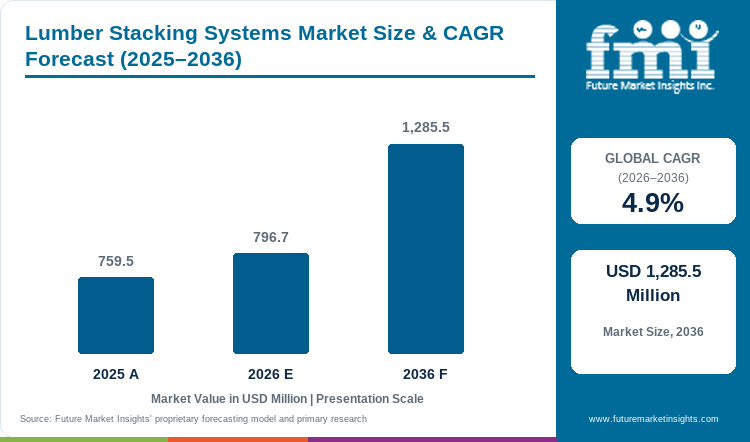
USD 796.7 million in 2026 and USD 1,285.5 million by 2036, expanding at 4.9% CAGR.
Sales of lumber stacking systems are estimated to rise at 4.9% CAGR through 2036, increasing valuation from USD 759.5 million in 2025 to USD 796.7 million in 2026, and reaching USD 1,285.5 million by 2036. Mills pair stackers with faster woodworking machines so package building does not slow the line. SPRINGER documented an August 2026 planer project with a Toro bundler rated at 14 cycles per minute. Mills must make the package route handle that speed inside the planned shutdown.
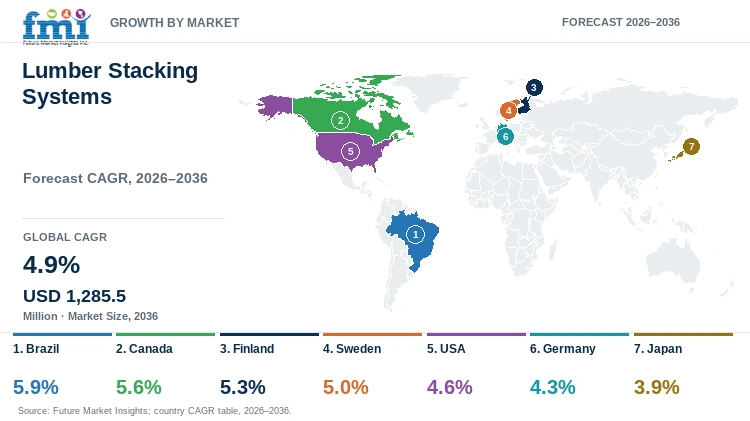
Brazil is projected at 5.9% CAGR through 2036 while Germany is projected at 4.3%. IBGE recorded forestry production in 4,921 Brazilian municipalities during 2024. This wide production base increases the need for local installation and service as mills add capacity. Destatis recorded 57.3 million cubic meters of timber harvested in Germany during 2025. German projects focus on upgrades inside older mills.
Key Takeaways
- Mills add stacking capacity when faster saws make package building the next clear production bottleneck.
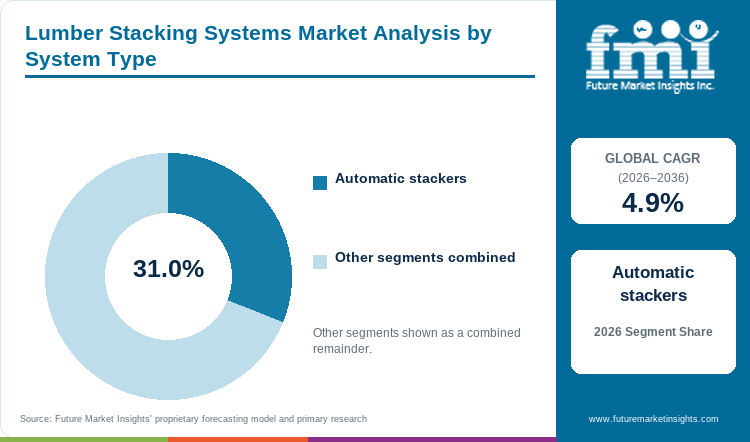
- Automatic stackers are projected to hold 31.0% of system type revenue in 2026 because steady layer building suits existing lines.
- Within lumber type, dimension lumber is estimated at 32.0% in 2026 because standard board sizes keep stacking recipes stable.
- In 2026, fully automatic systems are forecast to hold 41.0% of automation revenue because linked transfer cuts manual pacing.
- Brownfield controls and short shutdowns can delay approval even after a mill confirms the stacking bottleneck.
- Some of the key players in this market include Comact, USNR, Springer Maschinenfabrik, Kallfass, System TM, Ledinek, Pendu Manufacturing, and Renholmen.
Analyst Perspective
“A stacker earns approval when it removes a bottleneck without creating another one. Mills test board sizes, control links and shutdown time before accepting speed.”
- Nikhil Kaitwade, Principal Consultant, Future Market Insights
How is the lumber stacking systems market segmented?
The lumber stacking systems market is segmented by System Type, Lumber Type, Automation, End Use, Sales Channel, and Region.
System type includes automatic, robotic, sticker, bundle and sorting-stacking systems. Lumber type includes dimension lumber, boards, timber - large sections, kiln-dried lumber and pallet lumber. Automation includes fully automatic, semi-automatic, robot-assisted and MES - line integrated. End use includes sawmills, planer mills, dry kilns, pallet plants and wood distribution. Sales channels include turnkey projects, sawmill OEMs, integrators and retrofits while region completes the structure.
What supports automatic stackers within the system type category?
Automatic stackers build even layers without custom robot cells. Mills link recipes to sorter output and use familiar fork or stick-magazine parts. Many industrial automation systems move stable packages at a set rate.
- Based on system type, automatic stackers are projected at 31.0% in 2026. Repeatable course building supports their use on lumber lines.
- Kallfass documented a 2026 pallet-board project with two sorting and stacking lines. Both lines route finished packages to strapping stations.
Why does dimension lumber hold the largest modeled share within lumber type?
Dimension lumber gives controls regular widths and thicknesses for long runs. Mills use automated sortation systems to release courses at a steady rate. Large sections need heavier handling while dry lumber needs more surface protection.
- Within lumber type, dimension lumber is anticipated at 32.0% in 2026. Regular board sizes keep recipes stable during long production runs.
- SPRINGER’s August 2026 planer project used a Toro bundler. It handles boards 15 to 120 mm thick and up to 6.1 m long.
How do fully automatic systems change the automation decision?
Fully automatic systems remove manual pacing from layer building and package transfer. Recipes use sorter data while stick placement stays at line speed. Mills use industrial robotics for more varied products.
- In 2026, fully automatic systems are expected to lead automation at 41.0%. Linked layer building and package transfer support this position.
- System TM stated in January 2026 that its Finland offer includes automated feeding and stacking with Projecta handling sales and service.
What makes sawmills the main end-use setting?
Sawmills place stacking after sorting or primary cutting. A slow stacker can hold back equipment. Finished courses move to kilns or shipping, so mills need material handling equipment that matches output.
- For end use, sawmills are predicted at 39.0% in 2026. They move sorting output into kiln and shipping flows.
- Statistics Canada reported 3,894.4 thousand cubic meters of lumber production in June 2026. Shipments reached 4,133.3 thousand cubic meters that month.
Why do turnkey mill projects lead the sales channel category?
A stacker works with the rest of the mill. Sorter output and stick supply share controls with package movement. Turnkey delivery gives one supplier responsibility for conveyor systems and testing before restart.
- Turnkey mill projects are set to hold 34.0% of sales-channel demand in 2026, because one team manages mechanical and control commissioning.
- Renholmen announced in April 2026 that Södra Mönsterås would move and upgrade a package stacker during wider timber-handling work.
What are the drivers, restraints and opportunities in the Lumber Stacking Systems Market?
Throughput modernization raises stacking demand, brownfield integration delays some approvals, and modular automation gives suppliers a practical retrofit route.
- Driver: Mills add stacking capacity when faster saws and planers send more lumber than the package station can handle.
- Restraint: Control testing and short outage windows can delay brownfield projects even when a mill has confirmed the bottleneck.
- Opportunity: Mills can add stick handling, controls or robot support to improve an installed stacker without replacing the full line.
Line balance turns upstream investment into stacker demand
Mill engineers approve a stacker when the package station limits faster saws or planers. Lumber must leave before bins or conveyors begin to fill. The same line-balance problem appears in palletizing systems used at the end of faster lines. SPRINGER’s August 2026 project paired a new planer mill with a Toro bundler rated for the stated board range. Mills gain that speed only if the sorter and package route keep pace. Engineers therefore size the stacker from measured course flow and the product mix. They also check board lengths and package routes before approval so the upstream investment keeps producing value. That check protects the value of faster upstream equipment.
Brownfield integration can extend the approval cycle
Older mills often have several different control systems around one stacker. The new machine must exchange signals with existing conveyors and sort controls. It must also connect with safety devices and package discharge equipment. The same issue affects automated material handling systems inside older running plants. Renholmen’s April 2026 Södra Mönsterås project includes new cutting systems and a moved package stacker. Crews must test the changed controls before production restarts inside the planned mill outage. Suppliers reduce project risk by defining each interface early and checking signal paths before installation. Crews also need a shutdown sequence for every signal change, and early testing lets maintenance teams fix faults before restart.
Modular automation widens the retrofit route
Older stackers can gain capacity from better stick handling or controls without a full line replacement. Robot support can improve the same installed line. Mills can repair the process that causes the most stops first. The same retrofit idea appears in robotic palletizers that use controlled placement. Comact launched a redesigned Miller Planer in May 2026 for new plants and retrofit projects. Stacker suppliers can follow this route with modular feeders, stick systems and control upgrades. Mills can install the work in stages during planned outages and avoid one large replacement project. Staged work lowers shutdown risk and lets mills spread capital over several planned outages without one large shutdown.
Which country CAGRs are profiled in the Lumber Stacking Systems Market?
| Country | CAGR |
|---|---|
| Brazil | 5.9% |
| Canada | 5.6% |
| Finland | 5.3% |
| Sweden | 5.0% |
| USA | 4.6% |
| Germany | 4.3% |
| Japan | 3.9% |
How do country-level CAGRs compare in the Lumber Stacking Systems Market?
Brazil and Canada form the upper growth group. Finland and Sweden use automation while USA and Germany rely on existing-line upgrades. Japan needs more layout work before installation begins. The rates show forecast speed rather than current size.
- Brazil combines a wide forestry base with new capacity, so local service matters during project work.
- Canada combines large lumber output with production swings, so mills watch retrofit timing and commissioning.
- Finland's automated mills require new stackers to prove clear control gains over installed equipment.
- Swedish mills link sawing with drying, so reliable upgrades and package quality matter more than basic automation.
- US projects start with throughput or labor needs, then controls and shutdown planning shape approval.
- German mills favor upgrades that keep safety controls intact and extend older equipment life.
- Japanese mills use varied layouts and log sizes, so compact equipment and site engineering can slow projects.
Equipment and service coverage make similar CAGRs produce different orders. The full report provides country-level CAGR analysis across North America, Latin America, Europe, East Asia, South Asia, Oceania and the Middle East and Africa.
Country-wise Analysis
- US sawmills are replacing labor-heavy handling while keeping older conveyors and sort controls in service. The USA is projected to record 4.6% CAGR through 2036, shaped by brownfield upgrades and labor pressure. The Bureau of Labor Statistics listed sawmill and wood preservation employment at 81.5 thousand in April 2026. A smaller labor pool makes repeatable handling more useful during production schedules. Retrofit teams must make new stackers exchange signals with several equipment generations. Suppliers can test control links before crews arrive. They can plan work around the mill’s outage window. Testing helps older mills restart with less delay.
- German sawmills use a mature equipment base and seek more output before rebuilding a full line. Germany is estimated to post 4.3% CAGR through 2036, influenced by timber throughput and long equipment life. Destatis recorded 57.3 million cubic meters of timber harvested in 2025. Older buildings and varied feedstock increase the need for flexible recipes and careful interface design. Mills must keep safety logic consistent during equipment changes. Suppliers with clear control boundaries can win repeat upgrade work. Local service and ready spare parts help crews use short shutdowns well. Faster restarts protect planned production without extra delay.
- Japanese sawmills are adapting equipment to local log supply and compact buildings. Lumber stacking system demand in Japan is forecast to rise at 3.9% CAGR through 2036, linked to changes in mill material flow. The Forestry Agency recorded 14,512 thousand cubic meters of raw-log arrivals to sawmills in 2025. It also reported 7,824 thousand cubic meters of sawn-product shipments. Mixed board sizes force more recipe changes than uniform lumber runs. Compact modules and local engineering matter more than headline speed. Service teams need installation plans for tight spaces. Local support can reduce startup delays at smaller mills.
- Brazilian suppliers serve mills with very different levels of automation and site support. Through 2036, Brazil is expected to record 5.9% CAGR as new capacity expands in planted-forest regions. IBGE recorded forestry production in 4,921 municipalities during 2024. That spread raises survey and service costs for small field teams. Remote diagnostics can reduce travel but cannot replace mechanical commissioning on site. Regional installation partners can cover more projects and keep spare parts closer to mills. Teams need staged commissioning plans for remote mill sites. Local crews must plan travel between distant sites and stock parts close to mills.
- Canadian mills combine large shipments with production cycles that change capital timing. Canada’s lumber stacking system demand is set to expand at 5.6% CAGR through 2036, reinforced by mill output and replacement needs. Statistics Canada reported 3,894.4 thousand cubic meters of lumber production in June 2026. Shipments reached 4,133.3 thousand cubic meters that month. Managers can delay capacity when demand weakens even if an old stacker needs replacement. Phased retrofits can protect output during maintenance periods. Remote mills need parts and service plans before outages. Local technicians can help crews restart within the outage window.
- Finnish mills use advanced automation and expect new equipment to share production data with machines. Lumber stacking system sales in Finland are forecast to expand at 5.3% CAGR by 2036, aided by industrial sawlog flow. Luke reported 1.6 million cubic meters of sawlogs harvested in July 2026. That volume was 16% above the same month a year earlier. Suppliers must prove gains over the installed base instead of selling basic automation. They need control links and gains in changeovers or package consistency. Small cycle gains must justify integration work, and service support must match the mill’s automation level.
- Swedish mills treat stackers as part of one sawing and drying system instead of stand-alone machines. Swedish lumber stacking system demand is predicted to advance at 5.0% CAGR through 2036, tied to sawlog supply and replacement work. The Swedish Forest Agency put gross felling at 87.0 million cubic meters in 2025. Just under half of net felling consisted of coniferous sawlogs. Stable mill flows move the business case toward reliability and product flexibility instead of basic volume growth. Suppliers need proven brownfield work and service coverage during upgrades. Local support can shorten maintenance outages and protect planned production.
Who are the notable companies in the Lumber Stacking Systems Market?
Comact, USNR, Springer Maschinenfabrik, Kallfass, System TM, Ledinek, Pendu Manufacturing, and Renholmen.
Millwide OEMs and stacking specialists compete for projects. Comact and USNR handle projects and controls. Springer, Kallfass and Renholmen focus on package formation. System TM and Ledinek connect stackers with solid-wood lines. Pendu Manufacturing serves North America as warehouse robotics raises expectations for sensors and support.
- Comact and USNR pursue millwide projects needing controls, commissioning and long-term service.
- Springer and Kallfass combine sorting and stacking while System TM and Renholmen add solid-wood handling.
- Ledinek and Pendu Manufacturing serve jobs shaped by package size and handling needs.
Competitive Benchmarking: Lumber Stacking Systems Market
| Company | Stacking Scope | Controls Integration | Brownfield Support | Geographic Reach |
|---|---|---|---|---|
| Comact | High | High | High | North America and selected global markets |
| USNR | High | High | High | North America, Europe and Oceania |
| Springer Maschinenfabrik | High | High | Medium | Europe and international project markets |
| Kallfass | High | High | High | Europe and selected export markets |
| System TM | High | High | High | Europe with global HOMAG-linked reach |
| Ledinek | High | High | Medium | Europe, North America and project markets |
| Pendu Manufacturing | Medium | Medium | High | North America |
| Renholmen | High | High | High | Nordics and European project markets |
Scoring basis: High stacking scope means several formats or integrated systems, while Medium means narrower coverage. High controls integration needs automation-link proof. High brownfield support needs retrofit or relocation proof.
Key Developments in the Lumber Stacking Systems Market
- In 2025, TS Manufacturing presented its TS Lumber Stacker Systems at LIGNA, featuring configurable electric or hydraulic drives, servo layer positioning, and automated stick-placement options for hardwood and softwood applications.
- In 2026, Woodflow Technologies introduced the modular Smart Stacker, an automated lumber-stacking system designed to integrate with existing conveyors and increase throughput while reducing manual handling.
- In January 2026, System TM moved Finnish sales and service to Projecta Oy while keeping automated stacking in its offer.
Key Players in the Lumber Stacking Systems Market
Millwide sawmill integrators
- Comact
- USNR
- Springer Maschinenfabrik
Stacking and sorting specialists
- Kallfass
- Renholmen
- Pendu Manufacturing
Solid-wood automation companies
- System TM
- Ledinek
Lumber Stacking Systems Market - Report Scope
| Coverage field | Report scope |
|---|---|
| Market breakdown | By system type, lumber type, automation, end use, sales channel and region. |
| Quantitative Units | USD million. |
| Market Definition | Commercial lumber stacking systems used to form kiln, shipping or process packages are included with directly associated controls and commissioning. Standalone saws, kilns, scanners and general conveyors are excluded unless supplied as part of the stacking project. |
| Regions Covered | North America, Latin America, Western Europe, Eastern Europe, East Asia, South Asia and Pacific, and Middle East and Africa. |
| Countries Covered | Brazil, Canada, Finland, Sweden, USA, Germany, Japan, and 20+ countries included in the full report. |
| Key Companies Profiled | Comact, USNR, Springer Maschinenfabrik, Kallfass, System TM, Ledinek, Pendu Manufacturing, and Renholmen. |
| Forecast Period | 2026 to 2036. |
| Approach | Primary and secondary research with market triangulation. |
Lumber Stacking Systems Market - Research Methodology
| Method | Approach |
|---|---|
| Primary Research | FMI analysts gathered input from manufacturers, service providers, technology developers, distributors, end users, procurement teams, and subject-matter experts. Interviews examined purchasing decisions, product or service evaluation, adoption barriers, approval requirements, pricing considerations, and expectations for technical or commercial support. Respondents were also asked what evidence is required before a trial, pilot, or initial order develops into regular purchasing. |
| Desk Research | Desk research covered government statistics, regulatory publications, trade data, industry associations, technical literature, standards, company filings, product information, and official corporate announcements. Sources were reviewed for relevance, publication date, geographic coverage, and consistency with the defined market scope. Claims relating to performance, applications, approvals, capacity, investment, and commercial activity were retained only when supported by credible public evidence. |
| Market Sizing and Forecasting | The market model combined the baseline value with historical performance, segment structure, pricing and volume indicators, adoption levels, company participation, and country-level demand conditions. Forecast assumptions considered economic activity, investment trends, regulatory developments, technology adoption, purchasing cycles, supply availability, and barriers to wider market use. Segment and regional estimates were reconciled before the final market total was calculated. |
| Data Validation | Estimates were checked against multiple independent indicators, including public data, company activity, trade patterns, industry developments, and findings from primary interviews. Validation also tested whether products, services, applications, and company revenues fell within the defined market boundaries. Adjacent categories, unsupported claims, overlapping revenues, and activities without direct market relevance were excluded to reduce double counting and maintain consistency across segments and countries. |
Lumber Stacking Systems Market by Segments
Lumber Stacking Systems Market segmented by System Type:
- Automatic stackers
- Robotic lumber stackers
- Sticker stackers
- Bundle stackers
- Sorting-stacking lines
Lumber Stacking Systems Market segmented by Lumber Type:
- Dimension lumber
- Boards
- Timber - large sections
- Kiln-dried lumber
- Pallet lumber
Lumber Stacking Systems Market segmented by Automation:
- Fully automatic
- Semi-automatic
- Robot-assisted
- MES - line integrated
Lumber Stacking Systems Market segmented by End Use:
- Sawmills
- Planer mills
- Dry kiln operations
- Pallet plants
- Wood distribution
Lumber Stacking Systems Market segmented by Sales Channel:
- Turnkey mill projects
- Sawmill OEMs
- Automation integrators
- Aftermarket retrofit
Lumber Stacking Systems Market by Region:
- North America
- United States
- Canada
- Latin America
- Brazil
- Mexico
- Chile
- Rest of Latin America
- Western Europe
- Germany
- United Kingdom
- Italy
- Spain
- France
- Nordics
- Benelux
- Rest of Western Europe
- Eastern Europe
- Russia
- Poland
- Hungary
- Balkan and Baltic States
- Rest of Eastern Europe
- East Asia
- China
- Japan
- South Korea
- South Asia and Pacific
- India
- ASEAN
- Australia and New Zealand
- Rest of South Asia and Pacific
- Middle East and Africa
- Kingdom of Saudi Arabia
- Other GCC Countries
- Türkiye
- South Africa
- Other African Union Countries
- Rest of Middle East and Africa
Research Sources and Bibliography
- LIGNA. (2025). TS Lumber Stacker Systems by TS Manufacturing.
- Brazilian Institute of Geography and Statistics (IBGE). (2025, September 25). Production value of silviculture and wild-crop harvesting grows 16.7% and production reaches 4,921 municipalities.
- Federal Statistical Office of Germany (Destatis). (2026, April 15). Holzeinschlag im Jahr 2025 um 6,4 % gesunken.
- Woodflow Technologies. (2026). Smart Stacker: Automated lumber stacking that increases throughput and reduces labor.
- System TM. (2026, January 7). System TM and Projecta Oy announce new sales partnership in Finland starting January 2026.
- Statistics Canada. (2026, September 4). Sawmills, June 2026.
- Renholmen. (2026, April 10). Södra Mönsterås upgrades timber handling.
- Comact. (2026, May 4). Comact Launches New Generation Miller Planer.
- U.S. Bureau of Labor Statistics. (2026, May). Table B-1a. Employees on nonfarm payrolls by industry sector and selected industry detail, seasonally adjusted.
- Forestry Agency, Ministry of Agriculture, Forestry and Fisheries, Japan. (2026, February). Wood supply and demand information: trends in sawmill log arrivals and product production.
- Natural Resources Institute Finland (Luke). (2026, August 27). Commercial fellings, 7/2026.
- Swedish Forest Agency. (2026, June 9). Felling continued to decrease in 2025.
- Ledinek. (2026, May 26). Highly complex, high-performance line.
- Pendu Manufacturing. (2026, August 4). DL Truss Custom Hydraulic Truss Stacker.
- USNR. (2026). Millwide Insider 2026.
This bibliography is provided for reader reference and is not exhaustive. The full report contains the complete reference list and detailed citations.
This Report Answers
- What is the lumber stacking systems market size in 2026 and 2036?
- Which mill constraints turn modernization into stacker demand?
- Why do automatic stackers lead system type share?
- Why do fully automatic systems lead automation share?
- How do brownfield controls and shutdowns delay projects?
- Why do country CAGRs differ across the profiled countries?
- Which companies supply lumber stacking systems?
- What should mills evaluate before approving a stacking project?
Frequently Asked Questions
How big is the lumber stacking systems market in 2026?
The lumber stacking systems market is USD 796.7 million in 2026 and reaches USD 1,285.5 million by 2036. Stackers prevent package delays and keep kiln or shipping loads stable.
What is the CAGR of the lumber stacking systems market from 2026 to 2036?
The lumber stacking systems market is projected to grow at 4.9% CAGR between 2026 and 2036. Replacement and retrofit projects support automated package building in older mills.
Which system type leads the lumber stacking systems market?
The automatic stackers segment is expected to hold 31.0% of system type revenue in 2026. Steady layer building cuts manual handling without a full line rebuild.
Which lumber type holds the largest modeled share in the lumber stacking systems market?
The dimension lumber segment is expected to hold 32.0% of lumber type revenue in 2026. Regular sizes cut recipe changes and keep packages stable at speed.
Which automation type leads the lumber stacking systems market?
The fully automatic segment is expected to hold 41.0% of automation revenue in 2026. Linked layer building cuts manual pacing and keeps transfer at line speed.
Which countries are projected to record the highest growth in the lumber stacking systems market?
Brazil is projected at 5.9% CAGR through 2036, followed by Canada at 5.6% and Finland at 5.3%. Capacity and service access shape project timing.
Which companies are active in the lumber stacking systems market?
Key companies include Comact, USNR, Springer Maschinenfabrik, Kallfass, System TM, Ledinek, Pendu Manufacturing, and Renholmen. Their offers differ in controls, integration and retrofit service routes.
What should mills check before approving a lumber stacking system?
Mill teams should check board range and course rate before they review stick accuracy, controls and footprint. They should test lumber variation and downstream flow before approving rated speed.
Preview the report firsthand - request a free sample
Get SampleGet the brochure for pricing and purchase details.
Get PDFTable of Content
- Key Takeaways
- Market Size and CAGR
- Top Growth Driver
- Fastest Growing Segment
- Leading Region
- Key Companies
- Emerging Opportunities
- Executive Summary
- Global Market Outlook
- Demand-side Trends
- Supply-side Trends
- Technology Roadmap Analysis
- Analysis and Recommendations
- Analyst Perspective (What is happening? Why now? What should investors know?)
- Key Questions Answered
- How large is the market?
- What is the CAGR?
- What are key trends?
- Which region dominates?
- Who are the leaders?
- Market Overview
- Market Coverage / Taxonomy
- Market Definition / Scope / Limitations
- Research Methodology
- Chapter Orientation
- Analytical Lens and Working Hypotheses
- Market Structure, Signals, and Trend Drivers
- Benchmarking and Cross-market Comparability
- Market Sizing, Forecasting, and Opportunity Mapping
- Research Design and Evidence Framework
- Desk Research Programme (Secondary Evidence)
- Expert Input and Fieldwork (Primary Evidence)
- Tooling, Models, and Reference Databases
- Data Engineering and Model Build
- Quality Assurance and Audit Trail
- Market Background
- Market Dynamics (Drivers, Restraints, Opportunity, Trends)
- Scenario Forecast (Optimistic, Likely, Conservative)
- Impact Analysis
- AI Impact
- Sustainability Impact
- Regulatory Impact
- Technology Impact
- Consumer / Buyer Analysis
- Purchase Drivers
- Adoption Barriers
- Buyer Journey
- Opportunity Map Analysis
- Product Life Cycle Analysis
- Supply Chain Analysis
- Investment Feasibility Matrix
- Value Chain Analysis
- PESTLE and Porter's Analysis
- Regulatory Landscape
- Regional Parent Market Outlook
- Production and Consumption Statistics
- Import and Export Statistics
- Global Market Analysis and Forecast, 2021 to 2036
- Historical Market Size Value (USD Million) Analysis, 2021 to 2025
- Current and Future Market Size Value (USD Million) Projections, 2026 to 2036
- Y-o-Y Growth Trend Analysis
- Absolute $ Opportunity Analysis
- Global Market Pricing Analysis, 2021 to 2036
- Global Market Analysis and Forecast, By System Type, 2021 to 2036
- Introduction / Key Findings
- Historical Market Size Value (USD Million) Analysis By System Type, 2021 to 2025
- Current and Future Market Size Value (USD Million) Analysis and Forecast By System Type, 2026 to 2036
- Automatic stackers
- Robotic lumber stackers
- Sticker stackers
- Bundle stackers
- Sorting-stacking lines
- Y-o-Y Growth Trend Analysis By System Type, 2021 to 2025
- Absolute $ Opportunity Analysis By System Type, 2026 to 2036
- Global Market Analysis and Forecast, By Lumber Type, 2021 to 2036
- Introduction / Key Findings
- Historical Market Size Value (USD Million) Analysis By Lumber Type, 2021 to 2025
- Current and Future Market Size Value (USD Million) Analysis and Forecast By Lumber Type, 2026 to 2036
- Dimension lumber
- Boards
- Timber - large sections
- Kiln-dried lumber
- Pallet lumber
- Y-o-Y Growth Trend Analysis By Lumber Type, 2021 to 2025
- Absolute $ Opportunity Analysis By Lumber Type, 2026 to 2036
- Global Market Analysis and Forecast, By Automation, 2021 to 2036
- Introduction / Key Findings
- Historical Market Size Value (USD Million) Analysis By Automation, 2021 to 2025
- Current and Future Market Size Value (USD Million) Analysis and Forecast By Automation, 2026 to 2036
- Fully automatic
- Semi-automatic
- Robot-assisted
- MES - line integrated
- Y-o-Y Growth Trend Analysis By Automation, 2021 to 2025
- Absolute $ Opportunity Analysis By Automation, 2026 to 2036
- Global Market Analysis and Forecast, By End Use, 2021 to 2036
- Introduction / Key Findings
- Historical Market Size Value (USD Million) Analysis By End Use, 2021 to 2025
- Current and Future Market Size Value (USD Million) Analysis and Forecast By End Use, 2026 to 2036
- Sawmills
- Planer mills
- Dry kiln operations
- Pallet plants
- Wood distribution
- Y-o-Y Growth Trend Analysis By End Use, 2021 to 2025
- Absolute $ Opportunity Analysis By End Use, 2026 to 2036
- Global Market Analysis and Forecast, By Sales Channel, 2021 to 2036
- Introduction / Key Findings
- Historical Market Size Value (USD Million) Analysis By Sales Channel, 2021 to 2025
- Current and Future Market Size Value (USD Million) Analysis and Forecast By Sales Channel, 2026 to 2036
- Turnkey mill projects
- Sawmill OEMs
- Automation integrators
- Aftermarket retrofit
- Y-o-Y Growth Trend Analysis By Sales Channel, 2021 to 2025
- Absolute $ Opportunity Analysis By Sales Channel, 2026 to 2036
- Global Market Analysis and Forecast, By Region, 2021 to 2036
- Introduction
- Historical Market Size Value (USD Million) Analysis By Region, 2021 to 2025
- Current Market Size Value (USD Million) Analysis and Forecast By Region, 2026 to 2036
- North America
- Latin America
- Western Europe
- Eastern Europe
- East Asia
- South Asia and Pacific
- Middle East and Africa
- Market Attractiveness Analysis By Region
- North America Market Analysis and Forecast, By Country, 2021 to 2036
- Historical Market Size Value (USD Million) Trend Analysis By Market Taxonomy, 2021 to 2025
- Market Size Value (USD Million) Forecast By Market Taxonomy, 2026 to 2036
- By Country
- United States
- Canada
- By System Type
- By Lumber Type
- By Automation
- By End Use
- By Sales Channel
- By Country
- Market Attractiveness Analysis
- By Country
- By System Type
- By Lumber Type
- By Automation
- By End Use
- By Sales Channel
- Key Takeaways
- Latin America Market Analysis and Forecast, By Country
- Historical Market Size Value (USD Million) Trend Analysis By Market Taxonomy, 2021 to 2025
- Market Size Value (USD Million) Forecast By Market Taxonomy, 2026 to 2036
- By Country
- Brazil
- Mexico
- Chile
- Rest of Latin America
- By System Type
- By Lumber Type
- By Automation
- By End Use
- By Sales Channel
- By Country
- Market Attractiveness Analysis
- By Country
- By System Type
- By Lumber Type
- By Automation
- By End Use
- By Sales Channel
- Key Takeaways
- Western Europe Market Analysis and Forecast, By Country
- Historical Market Size Value (USD Million) Trend Analysis By Market Taxonomy, 2021 to 2025
- Market Size Value (USD Million) Forecast By Market Taxonomy, 2026 to 2036
- By Country
- Germany
- United Kingdom
- Italy
- Spain
- France
- Nordics
- Benelux
- Rest of Western Europe
- By System Type
- By Lumber Type
- By Automation
- By End Use
- By Sales Channel
- By Country
- Market Attractiveness Analysis
- By Country
- By System Type
- By Lumber Type
- By Automation
- By End Use
- By Sales Channel
- Key Takeaways
- Eastern Europe Market Analysis and Forecast, By Country
- Historical Market Size Value (USD Million) Trend Analysis By Market Taxonomy, 2021 to 2025
- Market Size Value (USD Million) Forecast By Market Taxonomy, 2026 to 2036
- By Country
- Russia
- Poland
- Hungary
- Balkan and Baltic States
- Rest of Eastern Europe
- By System Type
- By Lumber Type
- By Automation
- By End Use
- By Sales Channel
- By Country
- Market Attractiveness Analysis
- By Country
- By System Type
- By Lumber Type
- By Automation
- By End Use
- By Sales Channel
- Key Takeaways
- East Asia Market Analysis and Forecast, By Country
- Historical Market Size Value (USD Million) Trend Analysis By Market Taxonomy, 2021 to 2025
- Market Size Value (USD Million) Forecast By Market Taxonomy, 2026 to 2036
- By Country
- China
- Japan
- South Korea
- By System Type
- By Lumber Type
- By Automation
- By End Use
- By Sales Channel
- By Country
- Market Attractiveness Analysis
- By Country
- By System Type
- By Lumber Type
- By Automation
- By End Use
- By Sales Channel
- Key Takeaways
- South Asia and Pacific Market Analysis and Forecast, By Country
- Historical Market Size Value (USD Million) Trend Analysis By Market Taxonomy, 2021 to 2025
- Market Size Value (USD Million) Forecast By Market Taxonomy, 2026 to 2036
- By Country
- India
- ASEAN
- Australia and New Zealand
- Rest of South Asia and Pacific
- By System Type
- By Lumber Type
- By Automation
- By End Use
- By Sales Channel
- By Country
- Market Attractiveness Analysis
- By Country
- By System Type
- By Lumber Type
- By Automation
- By End Use
- By Sales Channel
- Key Takeaways
- Middle East and Africa Market Analysis and Forecast, By Country
- Historical Market Size Value (USD Million) Trend Analysis By Market Taxonomy, 2021 to 2025
- Market Size Value (USD Million) Forecast By Market Taxonomy, 2026 to 2036
- By Country
- Kingdom of Saudi Arabia
- Other GCC Countries
- Türkiye
- South Africa
- Other African Union Countries
- Rest of Middle East and Africa
- By System Type
- By Lumber Type
- By Automation
- By End Use
- By Sales Channel
- By Country
- Market Attractiveness Analysis
- By Country
- By System Type
- By Lumber Type
- By Automation
- By End Use
- By Sales Channel
- Key Takeaways
- Key Countries Market Analysis
- United States
- Pricing Analysis
- Market Share Analysis, 2025
- By System Type
- By Lumber Type
- By Automation
- By End Use
- By Sales Channel
- Canada
- Pricing Analysis
- Market Share Analysis, 2025
- By System Type
- By Lumber Type
- By Automation
- By End Use
- By Sales Channel
- Mexico
- Pricing Analysis
- Market Share Analysis, 2025
- By System Type
- By Lumber Type
- By Automation
- By End Use
- By Sales Channel
- Brazil
- Pricing Analysis
- Market Share Analysis, 2025
- By System Type
- By Lumber Type
- By Automation
- By End Use
- By Sales Channel
- Chile
- Pricing Analysis
- Market Share Analysis, 2025
- By System Type
- By Lumber Type
- By Automation
- By End Use
- By Sales Channel
- Germany
- Pricing Analysis
- Market Share Analysis, 2025
- By System Type
- By Lumber Type
- By Automation
- By End Use
- By Sales Channel
- United Kingdom
- Pricing Analysis
- Market Share Analysis, 2025
- By System Type
- By Lumber Type
- By Automation
- By End Use
- By Sales Channel
- Italy
- Pricing Analysis
- Market Share Analysis, 2025
- By System Type
- By Lumber Type
- By Automation
- By End Use
- By Sales Channel
- Spain
- Pricing Analysis
- Market Share Analysis, 2025
- By System Type
- By Lumber Type
- By Automation
- By End Use
- By Sales Channel
- France
- Pricing Analysis
- Market Share Analysis, 2025
- By System Type
- By Lumber Type
- By Automation
- By End Use
- By Sales Channel
- India
- Pricing Analysis
- Market Share Analysis, 2025
- By System Type
- By Lumber Type
- By Automation
- By End Use
- By Sales Channel
- ASEAN
- Pricing Analysis
- Market Share Analysis, 2025
- By System Type
- By Lumber Type
- By Automation
- By End Use
- By Sales Channel
- Australia and New Zealand
- Pricing Analysis
- Market Share Analysis, 2025
- By System Type
- By Lumber Type
- By Automation
- By End Use
- By Sales Channel
- China
- Pricing Analysis
- Market Share Analysis, 2025
- By System Type
- By Lumber Type
- By Automation
- By End Use
- By Sales Channel
- Japan
- Pricing Analysis
- Market Share Analysis, 2025
- By System Type
- By Lumber Type
- By Automation
- By End Use
- By Sales Channel
- South Korea
- Pricing Analysis
- Market Share Analysis, 2025
- By System Type
- By Lumber Type
- By Automation
- By End Use
- By Sales Channel
- Russia
- Pricing Analysis
- Market Share Analysis, 2025
- By System Type
- By Lumber Type
- By Automation
- By End Use
- By Sales Channel
- Poland
- Pricing Analysis
- Market Share Analysis, 2025
- By System Type
- By Lumber Type
- By Automation
- By End Use
- By Sales Channel
- Hungary
- Pricing Analysis
- Market Share Analysis, 2025
- By System Type
- By Lumber Type
- By Automation
- By End Use
- By Sales Channel
- Kingdom of Saudi Arabia
- Pricing Analysis
- Market Share Analysis, 2025
- By System Type
- By Lumber Type
- By Automation
- By End Use
- By Sales Channel
- Türkiye
- Pricing Analysis
- Market Share Analysis, 2025
- By System Type
- By Lumber Type
- By Automation
- By End Use
- By Sales Channel
- South Africa
- Pricing Analysis
- Market Share Analysis, 2025
- By System Type
- By Lumber Type
- By Automation
- By End Use
- By Sales Channel
- Finland
- Pricing Analysis
- Market Share Analysis, 2025
- By System Type
- By Lumber Type
- By Automation
- By End Use
- By Sales Channel
- Sweden
- Pricing Analysis
- Market Share Analysis, 2025
- By System Type
- By Lumber Type
- By Automation
- By End Use
- By Sales Channel
- United States
- Market Structure Analysis
- Competition Dashboard
- Competition Benchmarking
- Market Share Analysis of Top Players
- By Regional
- By System Type
- By Lumber Type
- By Automation
- By End Use
- By Sales Channel
- Emerging Startups
- Innovation Benchmarking
- Competition Analysis
- Competition Deep Dive
- Comact
- Overview
- Product Portfolio
- Profitability by Market Segments
- Sales Footprint
- Strategy Overview
- Marketing Strategy
- Product Strategy
- Channel Strategy
- USNR
- Springer Maschinenfabrik
- Kallfass
- System TM
- Ledinek
- Pendu Manufacturing
- Renholmen
- Comact
- Case Studies
- Success Stories
- Recent Developments
- Competition Deep Dive
- Assumptions & Acronyms Used


